EP0932485B1 - Verwendung von bearbeitungsmischung zum sägen von gestein - Google Patents
Verwendung von bearbeitungsmischung zum sägen von gestein Download PDFInfo
- Publication number
- EP0932485B1 EP0932485B1 EP97938962A EP97938962A EP0932485B1 EP 0932485 B1 EP0932485 B1 EP 0932485B1 EP 97938962 A EP97938962 A EP 97938962A EP 97938962 A EP97938962 A EP 97938962A EP 0932485 B1 EP0932485 B1 EP 0932485B1
- Authority
- EP
- European Patent Office
- Prior art keywords
- rocks
- mixture
- rock
- use according
- sawing
- Prior art date
- Legal status (The legal status is an assumption and is not a legal conclusion. Google has not performed a legal analysis and makes no representation as to the accuracy of the status listed.)
- Expired - Lifetime
Links
- 239000000203 mixture Substances 0.000 title claims description 66
- 239000011435 rock Substances 0.000 title claims description 32
- SVPXDRXYRYOSEX-UHFFFAOYSA-N bentoquatam Chemical compound O.O=[Si]=O.O=[Al]O[Al]=O SVPXDRXYRYOSEX-UHFFFAOYSA-N 0.000 claims description 17
- 239000000440 bentonite Substances 0.000 claims description 16
- 229910000278 bentonite Inorganic materials 0.000 claims description 16
- 239000002734 clay mineral Substances 0.000 claims description 13
- 239000010438 granite Substances 0.000 claims description 12
- 150000001875 compounds Chemical class 0.000 claims description 10
- 239000012530 fluid Substances 0.000 claims description 10
- CDBYLPFSWZWCQE-UHFFFAOYSA-L Sodium Carbonate Chemical group [Na+].[Na+].[O-]C([O-])=O CDBYLPFSWZWCQE-UHFFFAOYSA-L 0.000 claims description 8
- 229910021645 metal ion Inorganic materials 0.000 claims description 7
- 150000001450 anions Chemical class 0.000 claims description 6
- VYPSYNLAJGMNEJ-UHFFFAOYSA-N silicon dioxide Inorganic materials O=[Si]=O VYPSYNLAJGMNEJ-UHFFFAOYSA-N 0.000 claims description 6
- -1 berthierite Inorganic materials 0.000 claims description 5
- 230000000694 effects Effects 0.000 claims description 5
- 229910052751 metal Inorganic materials 0.000 claims description 5
- 239000002184 metal Substances 0.000 claims description 5
- 239000000454 talc Substances 0.000 claims description 5
- 229910052623 talc Inorganic materials 0.000 claims description 5
- QBWCMBCROVPCKQ-UHFFFAOYSA-N chlorous acid Chemical class OCl=O QBWCMBCROVPCKQ-UHFFFAOYSA-N 0.000 claims description 4
- 229910052618 mica group Inorganic materials 0.000 claims description 4
- 238000004062 sedimentation Methods 0.000 claims description 4
- 229910000029 sodium carbonate Inorganic materials 0.000 claims description 4
- 239000000126 substance Substances 0.000 claims description 4
- 235000019354 vermiculite Nutrition 0.000 claims description 4
- 238000013019 agitation Methods 0.000 claims description 3
- 229910001588 amesite Inorganic materials 0.000 claims description 3
- 150000002500 ions Chemical class 0.000 claims description 3
- 229910052622 kaolinite Inorganic materials 0.000 claims description 3
- CYPPCCJJKNISFK-UHFFFAOYSA-J kaolinite Chemical compound [OH-].[OH-].[OH-].[OH-].[Al+3].[Al+3].[O-][Si](=O)O[Si]([O-])=O CYPPCCJJKNISFK-UHFFFAOYSA-J 0.000 claims description 3
- 229910001416 lithium ion Inorganic materials 0.000 claims description 3
- 239000010445 mica Substances 0.000 claims description 3
- 229920000642 polymer Polymers 0.000 claims description 3
- 239000010453 quartz Substances 0.000 claims description 3
- 241000923606 Schistes Species 0.000 claims description 2
- 229910052612 amphibole Inorganic materials 0.000 claims description 2
- 229910052655 plagioclase feldspar Inorganic materials 0.000 claims description 2
- 239000000843 powder Substances 0.000 claims description 2
- 239000000725 suspension Substances 0.000 claims description 2
- 239000008187 granular material Substances 0.000 claims 2
- 229910000975 Carbon steel Inorganic materials 0.000 claims 1
- 239000010962 carbon steel Substances 0.000 claims 1
- 239000004927 clay Substances 0.000 claims 1
- 229910001092 metal group alloy Inorganic materials 0.000 claims 1
- 150000002739 metals Chemical class 0.000 claims 1
- 235000012216 bentonite Nutrition 0.000 description 16
- 230000009974 thixotropic effect Effects 0.000 description 16
- 229940092782 bentonite Drugs 0.000 description 15
- 238000005553 drilling Methods 0.000 description 11
- 239000000499 gel Substances 0.000 description 11
- XLYOFNOQVPJJNP-UHFFFAOYSA-N water Substances O XLYOFNOQVPJJNP-UHFFFAOYSA-N 0.000 description 11
- 235000008733 Citrus aurantifolia Nutrition 0.000 description 7
- 235000011941 Tilia x europaea Nutrition 0.000 description 7
- 239000004571 lime Substances 0.000 description 7
- 239000004033 plastic Substances 0.000 description 6
- 239000011734 sodium Substances 0.000 description 6
- 238000000034 method Methods 0.000 description 5
- 208000031968 Cadaver Diseases 0.000 description 3
- 238000009434 installation Methods 0.000 description 3
- 239000007788 liquid Substances 0.000 description 3
- 239000002245 particle Substances 0.000 description 3
- 229910000281 calcium bentonite Inorganic materials 0.000 description 2
- 239000004568 cement Substances 0.000 description 2
- 239000004567 concrete Substances 0.000 description 2
- 239000002826 coolant Substances 0.000 description 2
- 238000012937 correction Methods 0.000 description 2
- 239000002173 cutting fluid Substances 0.000 description 2
- 238000005520 cutting process Methods 0.000 description 2
- 230000003247 decreasing effect Effects 0.000 description 2
- 230000001747 exhibiting effect Effects 0.000 description 2
- 239000010433 feldspar Substances 0.000 description 2
- 238000007710 freezing Methods 0.000 description 2
- 230000008014 freezing Effects 0.000 description 2
- 239000000314 lubricant Substances 0.000 description 2
- 239000000463 material Substances 0.000 description 2
- 238000010907 mechanical stirring Methods 0.000 description 2
- 229910000000 metal hydroxide Inorganic materials 0.000 description 2
- 150000004692 metal hydroxides Chemical class 0.000 description 2
- 229910052901 montmorillonite Inorganic materials 0.000 description 2
- 239000003921 oil Substances 0.000 description 2
- 239000012188 paraffin wax Substances 0.000 description 2
- 230000002035 prolonged effect Effects 0.000 description 2
- 238000004064 recycling Methods 0.000 description 2
- 238000000518 rheometry Methods 0.000 description 2
- 229910000269 smectite group Inorganic materials 0.000 description 2
- 239000007787 solid Substances 0.000 description 2
- 238000012360 testing method Methods 0.000 description 2
- 239000002562 thickening agent Substances 0.000 description 2
- SMZOUWXMTYCWNB-UHFFFAOYSA-N 2-(2-methoxy-5-methylphenyl)ethanamine Chemical compound COC1=CC=C(C)C=C1CCN SMZOUWXMTYCWNB-UHFFFAOYSA-N 0.000 description 1
- NIXOWILDQLNWCW-UHFFFAOYSA-N 2-Propenoic acid Natural products OC(=O)C=C NIXOWILDQLNWCW-UHFFFAOYSA-N 0.000 description 1
- GJCOSYZMQJWQCA-UHFFFAOYSA-N 9H-xanthene Chemical compound C1=CC=C2CC3=CC=CC=C3OC2=C1 GJCOSYZMQJWQCA-UHFFFAOYSA-N 0.000 description 1
- BVKZGUZCCUSVTD-UHFFFAOYSA-L Carbonate Chemical compound [O-]C([O-])=O BVKZGUZCCUSVTD-UHFFFAOYSA-L 0.000 description 1
- DGAQECJNVWCQMB-PUAWFVPOSA-M Ilexoside XXIX Chemical compound C[C@@H]1CC[C@@]2(CC[C@@]3(C(=CC[C@H]4[C@]3(CC[C@@H]5[C@@]4(CC[C@@H](C5(C)C)OS(=O)(=O)[O-])C)C)[C@@H]2[C@]1(C)O)C)C(=O)O[C@H]6[C@@H]([C@H]([C@@H]([C@H](O6)CO)O)O)O.[Na+] DGAQECJNVWCQMB-PUAWFVPOSA-M 0.000 description 1
- BPQQTUXANYXVAA-UHFFFAOYSA-N Orthosilicate Chemical compound [O-][Si]([O-])([O-])[O-] BPQQTUXANYXVAA-UHFFFAOYSA-N 0.000 description 1
- 239000004113 Sepiolite Substances 0.000 description 1
- 235000015076 Shorea robusta Nutrition 0.000 description 1
- 244000166071 Shorea robusta Species 0.000 description 1
- 229910000831 Steel Inorganic materials 0.000 description 1
- 238000010521 absorption reaction Methods 0.000 description 1
- 239000000654 additive Substances 0.000 description 1
- 229960000892 attapulgite Drugs 0.000 description 1
- 230000006399 behavior Effects 0.000 description 1
- 150000001669 calcium Chemical class 0.000 description 1
- VNSBYDPZHCQWNB-UHFFFAOYSA-N calcium;aluminum;dioxido(oxo)silane;sodium;hydrate Chemical compound O.[Na].[Al].[Ca+2].[O-][Si]([O-])=O VNSBYDPZHCQWNB-UHFFFAOYSA-N 0.000 description 1
- 238000005266 casting Methods 0.000 description 1
- 239000001913 cellulose Substances 0.000 description 1
- 229920002678 cellulose Polymers 0.000 description 1
- 239000000919 ceramic Substances 0.000 description 1
- 238000012512 characterization method Methods 0.000 description 1
- 238000006243 chemical reaction Methods 0.000 description 1
- 239000003795 chemical substances by application Substances 0.000 description 1
- 239000000470 constituent Substances 0.000 description 1
- 238000001816 cooling Methods 0.000 description 1
- 238000004132 cross linking Methods 0.000 description 1
- 239000003599 detergent Substances 0.000 description 1
- GUJOJGAPFQRJSV-UHFFFAOYSA-N dialuminum;dioxosilane;oxygen(2-);hydrate Chemical compound O.[O-2].[O-2].[O-2].[Al+3].[Al+3].O=[Si]=O.O=[Si]=O.O=[Si]=O.O=[Si]=O GUJOJGAPFQRJSV-UHFFFAOYSA-N 0.000 description 1
- ONCZQWJXONKSMM-UHFFFAOYSA-N dialuminum;disodium;oxygen(2-);silicon(4+);hydrate Chemical compound O.[O-2].[O-2].[O-2].[O-2].[O-2].[O-2].[O-2].[O-2].[O-2].[O-2].[O-2].[O-2].[Na+].[Na+].[Al+3].[Al+3].[Si+4].[Si+4].[Si+4].[Si+4] ONCZQWJXONKSMM-UHFFFAOYSA-N 0.000 description 1
- 239000006185 dispersion Substances 0.000 description 1
- 238000009826 distribution Methods 0.000 description 1
- 239000002019 doping agent Substances 0.000 description 1
- 239000003995 emulsifying agent Substances 0.000 description 1
- 230000007613 environmental effect Effects 0.000 description 1
- 239000003295 industrial effluent Substances 0.000 description 1
- 238000002347 injection Methods 0.000 description 1
- 239000007924 injection Substances 0.000 description 1
- 229910052500 inorganic mineral Inorganic materials 0.000 description 1
- 229910003480 inorganic solid Inorganic materials 0.000 description 1
- 230000003993 interaction Effects 0.000 description 1
- 239000010410 layer Substances 0.000 description 1
- 238000004519 manufacturing process Methods 0.000 description 1
- 239000013528 metallic particle Substances 0.000 description 1
- 239000011707 mineral Substances 0.000 description 1
- 239000002480 mineral oil Substances 0.000 description 1
- 235000010446 mineral oil Nutrition 0.000 description 1
- 238000002156 mixing Methods 0.000 description 1
- 238000012986 modification Methods 0.000 description 1
- 230000004048 modification Effects 0.000 description 1
- 229910000273 nontronite Inorganic materials 0.000 description 1
- 230000010355 oscillation Effects 0.000 description 1
- 230000003647 oxidation Effects 0.000 description 1
- 238000007254 oxidation reaction Methods 0.000 description 1
- 229910052625 palygorskite Inorganic materials 0.000 description 1
- 235000011837 pasties Nutrition 0.000 description 1
- 239000012169 petroleum derived wax Substances 0.000 description 1
- 235000019381 petroleum wax Nutrition 0.000 description 1
- 239000011150 reinforced concrete Substances 0.000 description 1
- 230000002441 reversible effect Effects 0.000 description 1
- 239000004576 sand Substances 0.000 description 1
- 229910000275 saponite Inorganic materials 0.000 description 1
- 238000000926 separation method Methods 0.000 description 1
- 229910052624 sepiolite Inorganic materials 0.000 description 1
- 235000019355 sepiolite Nutrition 0.000 description 1
- 239000000377 silicon dioxide Substances 0.000 description 1
- 239000010454 slate Substances 0.000 description 1
- 239000012791 sliding layer Substances 0.000 description 1
- 239000010802 sludge Substances 0.000 description 1
- 229910052708 sodium Inorganic materials 0.000 description 1
- 229910000280 sodium bentonite Inorganic materials 0.000 description 1
- 229940080314 sodium bentonite Drugs 0.000 description 1
- 239000000243 solution Substances 0.000 description 1
- 239000010959 steel Substances 0.000 description 1
- 238000003756 stirring Methods 0.000 description 1
- 238000002604 ultrasonography Methods 0.000 description 1
- 229920001285 xanthan gum Polymers 0.000 description 1
Images
Classifications
-
- B—PERFORMING OPERATIONS; TRANSPORTING
- B28—WORKING CEMENT, CLAY, OR STONE
- B28D—WORKING STONE OR STONE-LIKE MATERIALS
- B28D1/00—Working stone or stone-like materials, e.g. brick, concrete or glass, not provided for elsewhere; Machines, devices, tools therefor
- B28D1/02—Working stone or stone-like materials, e.g. brick, concrete or glass, not provided for elsewhere; Machines, devices, tools therefor by sawing
- B28D1/025—Use, recovery or regeneration of abrasive mediums
Definitions
- the invention relates to operating mixtures sawing as well as the implementation of these mixtures.
- the invention relates more particularly to sawing hard rocks such as: granite, gneiss, mica schist, pegmatite, and in general, all magmatic, metamorphic, even sedimentary rocks exhibiting significant hardness.
- the operating mixtures used conventionally for sawing granite include lime mixed with metal shot.
- This lime is now used to increase the viscosity of the sawing operating mixtures and facilitate the transport of metal shot.
- Document D2 (EP 653 473) describes a process for cutting or drilling of hollow bodies in concrete, rocks or ceramic, in using a thixotropic coolant intended for cooling cutting or drilling elements.
- the coolant is composed of water and an agent silicate-based thixotropant.
- Document D3 mentions a pasty liquid composition, comprising 10% to 80% by weight of a finely divided inorganic solid, and 90% to 15% water or synthetic lubricants.
- This composition serves as a cutting fluid or drilling hard materials, more particularly reinforced concrete.
- the solid contains chalk or talc, and the lubricant is mineral oil, or paraffin mixed in 65% to 95% water.
- the mixture can comprise from 2% to 10% petroleum or paraffin wax, 2% to 8% silica, 1% to 6% metallic particles, from 1% to 10% of a thickener and from 0.1% to 4% of a emulsifier.
- the cutting fluid makes it possible to increase the working speed, and the duration of tool life.
- An object of the invention is therefore to provide operating mixtures for sawing hard rocks such as granite which are devoid of lime.
- a more particular subject of the invention is the use of a mixture thixotropic procedure for sawing rocks according to the appended claims.
- the sawing operating mixtures of the invention surprisingly improve sawing efficiency.
- the productivity of a multi-blade frame machine is in particular greatly improved.
- thixotropy qualified the property of a body to transform itself reversibly and gradually from the gel state to the fluid state.
- thixotropy is used here in a sense more general.
- any body whose apparent viscosity tends to decrease in time when we apply a constant stress or shear rate is said thixotropic; provided that after removing this stress or this shear rate and after a sufficient rest time, its initial structure is regenerates. And this, that this initial structure is a gel or not.
- thixotropic compound is a gel
- it is reversible, that is to say that to liquefy it, a simple mechanical stirring is sufficient.
- Some nail polish, lipsticks, some oily solutions, some derivatives of cellulose are thixotropic in the defined sense previously.
- this mixture itself is thixotropic.
- At least one of the thixotropic compounds is a clay mineral chosen from the group comprising: kaolinite, berthierine, amesite, chrysolite, illites and vermiculites, chlorites, smectites, pyrophyllites, talc, interbedded clay minerals.
- At least one of the thixotropic compounds is a powder of argillaceous rocks consisting essentially of a mixture of minerals clayey chosen from the group comprising: kaolinite, berthierine, amesite, chrysolite, illites and vermiculites, chlorites, smectites, pyrophyllites, talc, clay minerals interstratified.
- Bentonites are clay minerals of the group montmorillonites.
- the bentonite used can be of original natural.
- It can be a calcium bentonite.
- the bentonite used can also be a activated calcium bentonite, rendered sodium by treatment chemical.
- the bentonite used can also be a bentonite treated with an organic dopant such as derivatives cellulosics, acrylic acid or derivatives thereof.
- the compound making it possible to fix the pH of the operating sawing mixture is sodium carbonate Na 2 CO 3 .
- the metal hydroxides contained in the mixture in one embodiment of the mixture, have a chemical composition of the type: Li m D d T (OH) (m + 2d + 3 + na) A
- m is the number of Li ions, between 0 and 1.
- D represents divalent metal ions
- d is the number of D ions, between 0 and 4
- T represents the trivalent metal ions
- A represents the monovalent or polyvalent anions of valence n, other than OH -
- a is the number of A anions, (m + 2d + 3 + na) being greater than or equal to 3.
- the operating mixture can comprise a polymer reversibly changing from the gel state to the fluid when it undergoes a stress or a velocity of shear.
- the various constituents of the mixture can be mixed in water.
- the invention also relates to the application of sawing operating mixtures presented above in sawing of a hard rock selected from the group comprising metamorphic rocks, igneous rocks and sedimentary rocks of significant hardness such than slates, slate shales, carbonate rocks, siliceous rocks.
- the rock to sawn is formed mainly of quartz, feldspar alkaline, plagioclase, mica and amphibole and are among the granitoids.
- the rock to be sawn can be an ornamental granitoid chosen from the group comprising: granites porphyroids, pegmatites, saccharoid granites, fine-grained granites.
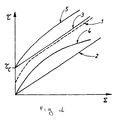
- Figure 1 is a schematic rheogram of a sawing operating mixture according to the invention, this rheogram being compared to theoretical behaviors of fluids.
- the operating mixtures obtained according to the invention are shear thinners and thixotropic.
- Figure 1 shows part of a rheogram 1 of an operating mixture according to the invention.
- the BINGHAM bodies behave like mewtonian liquids.
- the viscosity plastic ⁇ is a constant corresponding to the slope of the theoretical rheogram.
- ⁇ c is also a constant (yield point or yield value) corresponding to the ordinate at the origin of the theoretical rheogram.
- the viscosity of the operating fluid has been measured using a FANN-type viscometer, in the examples shown below.
- the FANN rheometer is two-speed.
- rheometers can be used, in particularly rheometers of the cone-plate type, rheometers with forced oscillations.
- Plate cone type rheometers are sometimes considered preferable for the characterization of liquids thixotropic or antithixotropic, because it is considered that, in this type of rheometer, the mechanical history is the same for all layers of the material tested.
- cylindrical rheometers for the study of thixotropic mixtures of the invention requires very narrow air gaps, difficult to manufacture with precision.
- coaxial cylindrical rheometers make it possible to eliminate the effects of thermalization and ensure a constant thermal environment.
- the FANN rheometer makes it possible to determine the flow threshold ⁇ c , the plastic viscosity ⁇ which can be related to the theoretical model of BINGHAM.
- the FANN rheometer can also be used to determine the stress from which the freezing effect disappears, if necessary.
- this rheometer is not used to characterize a working mixture containing shot.
- Means of separation for example magnetic, are used to separate the shot a sample of the operating mixture which is to be determine the rheological characteristics presented above.
- Rhodopol (registered trademark) is a polymer based xanthan.
- the conventional Anglo-Saxon unit lbf.pd 2 can be converted into a unit of the international system by taking into account the following correspondence: 1 lbf. pd 2 ⁇ 47.88 Pa ⁇ 47.88 N / m 2
- the mixture regains its fluid appearance after a vigorous shaking that cannot be achieved by hand but requires a mechanical stirrer, as a test after eight days' rest has shown it.
- This mixture is based on the interaction of bentonite and Polyvis (registered trademark).
- Bentonite is a montmorillonite, that is to say a clay mineral belonging to the smectite group.
- Clay minerals such as bentonite are used as thixotropic thickeners, in particular for household detergents.
- the Polyvis product is described therein as a composition containing mixed metal hydroxides of the MgAlOH 4.7 Cl 0.3 type .
- m corresponds to the number of Li ions, between 0 and approximately 1
- D denotes divalent metal ions
- d denotes the number of divalent metal ions
- T represents the trivalent metal ions
- A represents monovalent or polyvalent anions of valence n other than OH - ; a being the number of A anions; and m + 2d + 3 + na being equal to or greater than 3.
- the Polyvis product is incorporated into a rich mud in bentonite in the field of drilling, in particular drilling oil tanker, to quickly cement the borehole walls, the cement obtained acquiring mechanical resistance important in a short time, the objective being, in in particular, to avoid the inflow of water into the drilling.
- clay minerals of the smectite group such as beidellite, saponite, stevensite and nontronite can be considered.
- Clay minerals belonging to the group of chlorites, illites and vermiculites or even group of pyrophyllites and talc can be considered just like attapulgite, sepiolite.
- any composition comprising at least one clay mineral and an amount more or less important of Polyvis making it possible to obtain the rheological properties presented above fit within the scope of the invention.
- the sawing operating mixtures of the invention do not necessarily contain lime.
- Mechanical agitation by mechanical stirring, gas or air injection, wall vibration or ultrasound allows an easy restart of a sawing installation, even after a prolonged shutdown.
- the thixotropy of the operating mixture can be maintained, even with large amounts of rock or steel.
Landscapes
- Engineering & Computer Science (AREA)
- Mining & Mineral Resources (AREA)
- Mechanical Engineering (AREA)
- Curing Cements, Concrete, And Artificial Stone (AREA)
- Lubricants (AREA)
- Processing Of Stones Or Stones Resemblance Materials (AREA)
- Sawing (AREA)
- Disintegrating Or Milling (AREA)
- Silicates, Zeolites, And Molecular Sieves (AREA)
- Compositions Of Macromolecular Compounds (AREA)
Claims (8)
- Verwendung eines thixotropen Bearbeitungsgemischs für das Zersägen von Gestein, dadurch gekennzeichnet, dass das Bearbeitungsgemisch umfasst:eine thixotrope Verbindung, die ein Tonmineral oder ein Tonsteinmehl umfasst, das im Wesentlichen aus einem Tonmineraliengemisch besteht, wobei die Tonminerale aus der aus Kaolinit, Berthierin, Amesit, Chrysolit, Illite und Vermiculite, Chlorite, Smektite, Pyrophyllite, Talk und in Wechselschichten angeordneten Tonmineralien gebildeten Gruppe gewählt sind,ein graupiges, abrasives Material, das aus der aus Metallen und Metalllegierungen gebildeten Gruppe gewählt ist, insbesondere Kohlenstoffstahlkies mit einer Härte, die der durchschnittlichen Härte des zu sägenden Gesteins entspricht oder größer ist als diese,eine Verbindung, die dazu bestimmt ist, einen vorbestimmten basischen pH-Wert für das Bearbeitungsgemisch zu bestimmen,gemischte Metallhydroxyde,wobei das graupige, abrasive Material in dem Gemisch als Schwebestoff bleibt, und zwar ohne Sedimentierungswirkung, solange kein mechanisches Schütteln erfolgt.
- Verwendung nach Anspruch 1, dadurch gekennzeichnet, dass das Bearbeitungsgemisch Bentonit enthält.
- Verwendung nach einem der Ansprüche 1 und 2, dadurch gekennzeichnet, dass die Verbindung, die eine Bestimmung des pH-Werts des Gemischs auf einen vorbestimmten Wert erlaubt, Natriumkarbonat Na2CO3 ist.
- Verwendung nach einem der Ansprüche 1 bis 3, dadurch gekennzeichnet, dass die gemischten Metallhydroxyde eine chemische Zusammensetzung folgender Art aufweisen:
D die zweiwertigen Metallionen darstellt,
d die Anzahl der lonen D von 0 bis 4 ist,
T die dreiwertigen Metallionen darstellt,
A die mono- oder polyvalenten lonen der Valenz n darstellt, die nicht (OH-) sind,
a die Anzahl Anionen A ist,
(m+2d+3+na) größer oder gleich 3 ist. - Verwendung nach einem der Ansprüche 1 bis 4, dadurch gekennzeichnet, dass das Bearbeitungsgemisch ein Polymer einschließt, das reversibel aus einem gelförmigen in einen flüssigen Zustand übergeht, wenn auf ihn ein Druck oder eine Schergeschwindigkeit ausgeübt wird.
- Verwendung nach einem der Ansprüche 1 bis 5, dadurch gekennzeichnet, dass das zu sägende Gestein ein hartes Gestein ist, das aus der aus metamorphen, magmatischen und sedimentären Gesteinen großer Härte gebildeten Gruppe ausgewählt ist, wie Schiefer, hartem Schiefer, mit Kohlensäure gesättigtem Gestein, Silikatgestein.
- Verwendung nach Anspruch 6, dadurch gekennzeichnet, dass das zu sägende Gestein im Wesentlichen aus Quarz, alkalischem Feldspat, Plagioklas, Mika und Amphibol gebildet wird und zu den granitartig aussehenden Gesteinen gehört.
- Verwendung nach Anspruch 7, dadurch gekennzeichnet, dass das zu sägende Gestein ein granitartig aussehender Schmuckstein ist, der aus der aus Porphyroid-Graniten, Pegmatiten, zuckerkörnigen Graniten und feinkörnigen Graniten gebildeten Gruppe ausgewählt ist.
Applications Claiming Priority (3)
| Application Number | Priority Date | Filing Date | Title |
|---|---|---|---|
| FR9611814 | 1996-09-27 | ||
| FR9611814A FR2753913B1 (fr) | 1996-09-27 | 1996-09-27 | Melanges operatoires de sciage de roches et mise en oeuvre de ces melanges |
| PCT/FR1997/001538 WO1998013180A1 (fr) | 1996-09-27 | 1997-08-29 | Melanges operatoires de sciage de roches et mise en oeuvre de ces melanges |
Publications (2)
| Publication Number | Publication Date |
|---|---|
| EP0932485A1 EP0932485A1 (de) | 1999-08-04 |
| EP0932485B1 true EP0932485B1 (de) | 2003-11-12 |
Family
ID=9496132
Family Applications (1)
| Application Number | Title | Priority Date | Filing Date |
|---|---|---|---|
| EP97938962A Expired - Lifetime EP0932485B1 (de) | 1996-09-27 | 1997-08-29 | Verwendung von bearbeitungsmischung zum sägen von gestein |
Country Status (7)
| Country | Link |
|---|---|
| EP (1) | EP0932485B1 (de) |
| AR (1) | AR009367A1 (de) |
| AU (1) | AU4121797A (de) |
| BR (1) | BR9711574A (de) |
| FR (1) | FR2753913B1 (de) |
| SA (1) | SA98190175A (de) |
| WO (1) | WO1998013180A1 (de) |
Families Citing this family (1)
| Publication number | Priority date | Publication date | Assignee | Title |
|---|---|---|---|---|
| DE102007050483A1 (de) * | 2007-10-19 | 2009-09-10 | Meyer Burger Ag | Mischung aus einem thixotropen Dispersionsmedium sowie abrasiv wirkenden Körnern als Schleifmittel |
Family Cites Families (4)
| Publication number | Priority date | Publication date | Assignee | Title |
|---|---|---|---|---|
| GB383282A (en) * | 1931-04-09 | 1932-11-09 | George Francis Atyeo | Improvements in and relating to the cutting, grinding or other treatment of stone and such like material where ball shot or like abrasive material is employed |
| IL79304A (en) * | 1985-07-05 | 1990-07-12 | Dow Chemical Co | Mixed metal hydroxides for thickening water or hydrophilic fluids |
| DE3742572A1 (de) * | 1987-12-16 | 1989-07-06 | Hilti Ag | Bohr- und schneidmittel fuer gestein |
| DE4338544C1 (de) * | 1993-11-11 | 1995-06-22 | Walter H Maria Wiemeler | Verfahren zum Bohren oder Sägen von Durchbrechungen in Hohlraumdecken oder -wänden |
-
1996
- 1996-09-27 FR FR9611814A patent/FR2753913B1/fr not_active Expired - Fee Related
-
1997
- 1997-08-29 WO PCT/FR1997/001538 patent/WO1998013180A1/fr not_active Ceased
- 1997-08-29 EP EP97938962A patent/EP0932485B1/de not_active Expired - Lifetime
- 1997-08-29 AU AU41217/97A patent/AU4121797A/en not_active Abandoned
- 1997-08-29 BR BR9711574-6A patent/BR9711574A/pt not_active Application Discontinuation
- 1997-09-25 AR ARP970104417 patent/AR009367A1/es not_active Application Discontinuation
-
1998
- 1998-06-20 SA SA98190175A patent/SA98190175A/ar unknown
Also Published As
| Publication number | Publication date |
|---|---|
| WO1998013180A1 (fr) | 1998-04-02 |
| AR009367A1 (es) | 2000-04-12 |
| FR2753913B1 (fr) | 1999-10-15 |
| EP0932485A1 (de) | 1999-08-04 |
| SA98190175A (ar) | 2005-12-03 |
| BR9711574A (pt) | 2000-01-18 |
| AU4121797A (en) | 1998-04-17 |
| FR2753913A1 (fr) | 1998-04-03 |
Similar Documents
| Publication | Publication Date | Title |
|---|---|---|
| CA1317099C (en) | Compositions for freeing jammed drill pipes | |
| FR2624132A1 (fr) | Fluide de forage renfermant une phase liquide modifiee non polluante, destine a l'inhibition du gonflement des schistes, et procede pour son utilisation | |
| MX2012012884A (es) | Composiciones y metodos para limpiar un hoyo antes de la cementacion. | |
| FR2695383A1 (fr) | Composition et procédé pour augmenter la résistance au cisaillement des déchets de traitement utilisés pour la construction de remblais et la consolidation souterraine. | |
| CA2334992C (fr) | Fluide de puits comportant une composition lubrifiante - procede pour controler la lubrification d'un fluide de puits - application aux fluides a haut ph | |
| EP0932485B1 (de) | Verwendung von bearbeitungsmischung zum sägen von gestein | |
| FR2638109A1 (fr) | Procede permettant de lier et de consolider des matieres solides et liquides contenant des metaux lourds | |
| WO2007118328A1 (en) | Methods of preparing hydrocarbon, water and organophilic clay emulsions and compositions thereof | |
| US4959164A (en) | Rock fragmentation method | |
| FR2473054A1 (fr) | Fluide de forage contenant un agent alourdissant | |
| RU2386656C1 (ru) | Буровой раствор для строительства скважин в осложненных условиях, преимущественно для бурения пологих и горизонтальных скважин | |
| CA2040753A1 (fr) | Boue de forage au scleroglucane | |
| CN112610173B (zh) | 一种废弃油基泥浆的处理方法、砖及油基泥浆 | |
| RU2092516C1 (ru) | Состав для глушения и заканчивания скважин | |
| RU2136717C1 (ru) | Раствор для заканчивания и глушения низкотемпературных газовых скважин | |
| RU2067156C1 (ru) | Тампонажный раствор и способ его применения для временного крепления скважин | |
| RU2255105C1 (ru) | Способ приготовления эмульсионного бурового раствора на основе полисахаридного полимера | |
| JPS5968495A (ja) | 掘削用流体及び掘削装置から汚染物質を除去する方法 | |
| RU2427605C1 (ru) | Безглинистый полисахаридный буровой раствор | |
| RU2167181C2 (ru) | Состав для проведения ремонтных и изоляционных работ в скважине | |
| RU2274651C1 (ru) | Полимерглинистый раствор для бурения скважин в многолетнемерзлых породах | |
| RU2277571C1 (ru) | Безглинистый буровой раствор | |
| SU834329A1 (ru) | Тампонажный раствор | |
| SU1744089A1 (ru) | Буровой раствор | |
| EP0521120A1 (de) | Verwendung von Scleroglucanschlammen zum Bohren von Abgelenkten Erdölbohrungen. |
Legal Events
| Date | Code | Title | Description |
|---|---|---|---|
| PUAI | Public reference made under article 153(3) epc to a published international application that has entered the european phase |
Free format text: ORIGINAL CODE: 0009012 |
|
| 17P | Request for examination filed |
Effective date: 19990420 |
|
| AK | Designated contracting states |
Kind code of ref document: A1 Designated state(s): BE ES FR IT PT |
|
| 17Q | First examination report despatched |
Effective date: 20001212 |
|
| RTI1 | Title (correction) |
Free format text: USE OF OPERATIONAL MIXTURES FOR SAWING ROCKS |
|
| GRAH | Despatch of communication of intention to grant a patent |
Free format text: ORIGINAL CODE: EPIDOS IGRA |
|
| GRAS | Grant fee paid |
Free format text: ORIGINAL CODE: EPIDOSNIGR3 |
|
| GRAA | (expected) grant |
Free format text: ORIGINAL CODE: 0009210 |
|
| AK | Designated contracting states |
Kind code of ref document: B1 Designated state(s): BE ES FR IT PT |
|
| PG25 | Lapsed in a contracting state [announced via postgrant information from national office to epo] |
Ref country code: IT Free format text: LAPSE BECAUSE OF FAILURE TO SUBMIT A TRANSLATION OF THE DESCRIPTION OR TO PAY THE FEE WITHIN THE PRESCRIBED TIME-LIMIT;WARNING: LAPSES OF ITALIAN PATENTS WITH EFFECTIVE DATE BEFORE 2007 MAY HAVE OCCURRED AT ANY TIME BEFORE 2007. THE CORRECT EFFECTIVE DATE MAY BE DIFFERENT FROM THE ONE RECORDED. Effective date: 20031112 |
|
| PG25 | Lapsed in a contracting state [announced via postgrant information from national office to epo] |
Ref country code: ES Free format text: LAPSE BECAUSE OF FAILURE TO SUBMIT A TRANSLATION OF THE DESCRIPTION OR TO PAY THE FEE WITHIN THE PRESCRIBED TIME-LIMIT Effective date: 20040223 |
|
| PG25 | Lapsed in a contracting state [announced via postgrant information from national office to epo] |
Ref country code: BE Free format text: LAPSE BECAUSE OF NON-PAYMENT OF DUE FEES Effective date: 20040831 |
|
| PLBE | No opposition filed within time limit |
Free format text: ORIGINAL CODE: 0009261 |
|
| STAA | Information on the status of an ep patent application or granted ep patent |
Free format text: STATUS: NO OPPOSITION FILED WITHIN TIME LIMIT |
|
| 26N | No opposition filed |
Effective date: 20040813 |
|
| BERE | Be: lapsed |
Owner name: S.A. *WHEELABRATOR ALLEVARD Effective date: 20040831 |
|
| BERE | Be: lapsed |
Owner name: S.A. *WHEELABRATOR ALLEVARD Effective date: 20040831 |
|
| PG25 | Lapsed in a contracting state [announced via postgrant information from national office to epo] |
Ref country code: PT Free format text: LAPSE BECAUSE OF NON-PAYMENT OF DUE FEES Effective date: 20040412 |
|
| REG | Reference to a national code |
Ref country code: FR Ref legal event code: CD Owner name: WINOA, FR Effective date: 20110901 |
|
| PGFP | Annual fee paid to national office [announced via postgrant information from national office to epo] |
Ref country code: FR Payment date: 20140821 Year of fee payment: 18 |
|
| REG | Reference to a national code |
Ref country code: FR Ref legal event code: GC Effective date: 20141223 |
|
| REG | Reference to a national code |
Ref country code: FR Ref legal event code: ST Effective date: 20160429 |
|
| PG25 | Lapsed in a contracting state [announced via postgrant information from national office to epo] |
Ref country code: FR Free format text: LAPSE BECAUSE OF NON-PAYMENT OF DUE FEES Effective date: 20150831 |
|
| REG | Reference to a national code |
Ref country code: FR Ref legal event code: RG Effective date: 20170725 |