EP0932963B1 - Verfahren und einrichtung zur bestimmung der datenrate empfangener daten in einem übertragungssystem mit veränderlicher datenrate - Google Patents
Verfahren und einrichtung zur bestimmung der datenrate empfangener daten in einem übertragungssystem mit veränderlicher datenrate Download PDFInfo
- Publication number
- EP0932963B1 EP0932963B1 EP97910971A EP97910971A EP0932963B1 EP 0932963 B1 EP0932963 B1 EP 0932963B1 EP 97910971 A EP97910971 A EP 97910971A EP 97910971 A EP97910971 A EP 97910971A EP 0932963 B1 EP0932963 B1 EP 0932963B1
- Authority
- EP
- European Patent Office
- Prior art keywords
- value
- rate
- values
- error rate
- rates
- Prior art date
- Legal status (The legal status is an assumption and is not a legal conclusion. Google has not performed a legal analysis and makes no representation as to the accuracy of the status listed.)
- Expired - Lifetime
Links
- 238000000034 method Methods 0.000 title claims abstract description 50
- 238000004891 communication Methods 0.000 title claims abstract description 25
- 125000004122 cyclic group Chemical group 0.000 claims description 7
- 230000007423 decrease Effects 0.000 claims 1
- 230000003247 decreasing effect Effects 0.000 claims 1
- 230000005540 biological transmission Effects 0.000 description 13
- 206010009944 Colon cancer Diseases 0.000 description 11
- 230000001413 cellular effect Effects 0.000 description 6
- 230000006870 function Effects 0.000 description 6
- 238000001228 spectrum Methods 0.000 description 6
- 238000012545 processing Methods 0.000 description 5
- 230000008901 benefit Effects 0.000 description 3
- 230000001419 dependent effect Effects 0.000 description 3
- 238000010586 diagram Methods 0.000 description 3
- 230000004044 response Effects 0.000 description 3
- 238000012937 correction Methods 0.000 description 2
- 238000013461 design Methods 0.000 description 2
- 238000001514 detection method Methods 0.000 description 2
- 230000000694 effects Effects 0.000 description 2
- 238000010606 normalization Methods 0.000 description 2
- 230000008859 change Effects 0.000 description 1
- 230000000052 comparative effect Effects 0.000 description 1
- 238000007796 conventional method Methods 0.000 description 1
- 230000001934 delay Effects 0.000 description 1
- 238000005562 fading Methods 0.000 description 1
- 230000006872 improvement Effects 0.000 description 1
- 238000012886 linear function Methods 0.000 description 1
- 230000008569 process Effects 0.000 description 1
- 238000013442 quality metrics Methods 0.000 description 1
- 230000007480 spreading Effects 0.000 description 1
- 238000012360 testing method Methods 0.000 description 1
Images




Classifications
-
- H—ELECTRICITY
- H04—ELECTRIC COMMUNICATION TECHNIQUE
- H04L—TRANSMISSION OF DIGITAL INFORMATION, e.g. TELEGRAPHIC COMMUNICATION
- H04L25/00—Baseband systems
- H04L25/02—Details ; arrangements for supplying electrical power along data transmission lines
-
- H—ELECTRICITY
- H04—ELECTRIC COMMUNICATION TECHNIQUE
- H04L—TRANSMISSION OF DIGITAL INFORMATION, e.g. TELEGRAPHIC COMMUNICATION
- H04L25/00—Baseband systems
- H04L25/02—Details ; arrangements for supplying electrical power along data transmission lines
- H04L25/0262—Arrangements for detecting the data rate of an incoming signal
-
- H—ELECTRICITY
- H04—ELECTRIC COMMUNICATION TECHNIQUE
- H04L—TRANSMISSION OF DIGITAL INFORMATION, e.g. TELEGRAPHIC COMMUNICATION
- H04L1/00—Arrangements for detecting or preventing errors in the information received
- H04L1/004—Arrangements for detecting or preventing errors in the information received by using forward error control
- H04L1/0045—Arrangements at the receiver end
- H04L1/0046—Code rate detection or code type detection
Definitions
- the present invention relates to communications. More particularly, the present invention relates to a method and apparatus for determining transmission rate in a variable rate transmission system.
- CDMA code division multiple access
- TDMA time division multiple access
- FDMA frequency division multiple access
- AM modulation schemes such as amplitude companded single sideband (ACSSB)
- TDMA time division multiple access
- FDMA frequency division multiple access
- AM modulation schemes such as amplitude companded single sideband (ACSSB)
- CDMA has significant advantages over these other techniques.
- the use of CDMA techniques in a multiple access communication system is disclosed in U.S. Patent No. 4,901,307, entitled "SPREAD SPECTRUM MULTIPLE ACCESS COMMUNICATION SYSTEM USING SATELLITE OR TERRESTRIAL REPEATERS,” and assigned to the assignee of the present invention and incorporated by reference herein.
- CDMA by its inherent nature of being a wideband signal offers a form of frequency diversity by spreading the signal energy over a wide bandwidth. Therefore, frequency selective fading affects only a small part of the CDMA signal bandwidth.
- Space or path diversity is obtained by providing multiple signal paths through simultaneous links from a mobile user through two or more cell-sites.
- path diversity may be obtained by exploiting the multipath environment through spread spectrum processing by allowing a signal arriving with different propagation delays to be received and processed separately. Examples of path diversity are illustrated in U.S. Patent No. 5,101,501 entitled “METHOD AND SYSTEM FOR PROVIDING A SOFT HANDOFF IN COMMUNICATIONS IN A CDMA CELLULAR TELEPHONE SYSTEM", and U.S. Patent No. 5,109,390 entitled “DIVERSITY RECEIVER IN A CDMA CELLULAR TELEPHONE SYSTEM", both assigned to the assignee of the present invention,
- CDMA systems often employ a variable rate vocoder to encode data so that the data rate can be varied from one data frame to another.
- An exemplary embodiment of a variable rate vocoder is described in U.S. Pat No. 5,414,796, entitled "VARIABLE RATE VOCODER,” assigned to the assignee of the present invention.
- the use of a variable rate communications channel reduces mutual interference by eliminating unnecessary transmissions when there is no useful speech to be transmitted.
- Algorithms are utilized within the vocoder for generating a varying number of information bits in each frame in accordance with variations in speech activity. For example, a vocoder with a rate set of four may produce 20 millisecond data frames containing 20, 40, 80, or 160 bits; depending on the activity of the speaker.
- the error metrics may include Cyclic Redundancy Check (CRC) results, Yamamoto Quality Metrics, and Symbol Error Rates. These error metrics are well-known in communications systems.
- the processor analyzes the error metrics and determines the most probable rate at which the incoming symbols were transmitted. '
- the received data decoding apparatus includes a most likelihood decoder for decoding the received data on the basis of a Viterbi algorithm and a data rate decision unit for obtaining a predetermined data rate of the second channel determined according to a path metric amount which is a decoded output from the most likelihood decoder.
- the present invention provides a novel and improved apparatus and method for decoding data.
- the apparatus and method are employed in a communications system having a transmitter and a receiver, where the receiver determines at which of several rates individual frames in a signal has been transmitted by the transmitter. For example, if the transmitter employs four transmission rates, the receiver decodes each frame of the received signal based on the four rates to produce four cyclic redundancy check (CRC) bits, four symbol error rate (SER) values and one or more Yamamoto check values. If the CRC checks for only two rates, then the receiver compares to each other the SER values for those two rates to determine at which of the two rates a current frame was transmitted.
- CRC cyclic redundancy check
- SER symbol error rate
- the SER value for that rate is compared with a maximum SER threshold for that rate. Additionally, SER values for the other rates can be compared to minimum SER thresholds. Furthermore, the Yamamoto check values can be analyzed to determined whether looser or tighter minimum and maximum SER thresholds should be employed if the Yamamoto values check for the current rate, or do not check, respectively.
- the present invention embodies a method for use in a communication system having a transmitter and a receiver.
- the transmitter transmits a signal at a current rate, wherein the current rate corresponds to one of a plurality of rates.
- the receiver generates a plurality of check error values and error rate codes, and at least one decoding code, each based on whether the signal has one of the plurality of rates.
- the method determines the current rate of the signal and includes the steps of: (a) determining if only a first check value of a selected rate favorably checks, wherein the selected rate is one of the plurality of rates; (b) determining if the selected rate corresponds to a predetermined rate; (c) if the selected rate corresponds to the predetermined rate, comparing a selected decoding code to a selected value; (d) if the selected rate does not correspond to the predetermined rate, comparing a selected error rate code to a first value based on a predetermined operational relationship, wherein the selected rate code corresponds to the selected rate; (e) if the selected decoding code corresponds to the selected value, comparing the selected error rate code to a second value based on the predetermined operational relationship; (f) if the selected decoding code does not correspond to the selected value, comparing the selected error rate code to a third value based on the predetermined operational relationship; and (g) determining that the current rate of the signal is the selected rate if the selected error rate
- the present invention also embodies a method for determining the current rate of the signal having the steps of: (a) determining that only first and second error check values of first and second rates favorably check, wherein the first and second rates are from the plurality of rates; (b) comparing a first error rate code to a second error rate code plus a first value based on a predetermined operational relationship, wherein the first and second error rate codes correspond to the first and second rates; and (c) determining that the current rate of the signal is the second rate if the first error rate code has the predetermined operational relationship to the second error rate code plus a first value, and otherwise determining that the current rate is the first rate.
- a remote transmission system 2 transmits data to a remote receiving system 4.
- the present invention is implemented in a wireless communication system which communicates using spread spectrum modulation signals. Communication using spread spectrum communication systems is described in detail in the aforementioned U.S. Patents 4,901,307 and 5,103,459.
- a variable rate data source 6 provides variable rate data frames for transmission to a Cyclic Redundancy Check (CRC) and Tail Bit Generator 8.
- the data source 6 is a variable rate vocoder for encoding speech information at four variable rates as described in detail in the aforementioned U.S Patent No. 5,414,796.
- the signal is transmitted at the full rate to transmit speech (i.e ., when a user is talking) and is transmitted at the eighth rate to transmit silence ( i.e. , when the user is not talking).
- the eighth rate saves on the number of bits transmitted, and thereby saves on power.
- 90% of the signals transmitted by the transmitter 2 to the receiver 4 are either at the full or one-eighth rate.
- the one-half and one-quarter rates represent transitional rates between the full and eighth rates.
- the generator 8 generates a set of CRC bits to provide for error detection at the receiver as is well known in the art. In addition, the generator 8 appends a sequence of tail bits to the frame. In the exemplary embodiment, the generator 8 generates the set of CRC and tail bits in accordance with the Telecommunications Industry Association's TIA/EIA/IS-95-A Mobile Stations-Base Station Compatibility Standard for Dual-Mode Wideband Spread Spectrum Cellular System.
- the data frame is provided by the generator 8 to an encoder 10 which encodes the data as symbols for error correction and detection at the receiver.
- the encoder 10 is a rate 1/2 convolutional encoder.
- the encoded symbols are provided to an interleaver 12, which reorders the encoded symbols in accordance with a predetermined interleaving format.
- the interleaver 12 is a block interleaver, the design and implementation of which is well known in the art.
- the reordered frame is then provided to a modulator 14 which modulates the frame for transmission.
- the modulator 14 is a CDMA modulator, the implementation of which is described in detail in the aforementioned U.S. Patents 4,901,307 and 5,103,459.
- the modulated data frame is provided to a transmitter (TMTR) 16.
- the transmitter 16 upconverts and amplifies the signal for transmission through an antenna 18.
- the transmitted signal is received by an antenna 20 of a remote station 4, such as a cellular phone, and provided to a receiver (RCVR) 22 which down converts and amplifies the received signal.
- the received signal is then provided to a demodulator (DEMOD) 24 which demodulates the signal.
- the demodulator 24 is a CDMA demodulator 24, the implementation of which is described in detail in the aforementioned U.S. Patents 4,901,307 and 5,103,459.
- the demodulated signal is then provided to a diversity combiner 26.
- the diversity combiner 26 combines the demodulated signal from the demodulator 24 with demodulated signals from other demodulators (not shown) which demodulate the same signal except provided on a different propagation path.
- the design and implementation of the diversity combiner 26 is described in detail in the aforementioned U.S. Patent No. 5,109,390.
- the diversity combined signal is provided to a de-interleaver 28 which re-orders the symbols in the frame in accordance with a predetermined re-ordering format as is well known in the art.
- the re-ordered frame is then provided to a multi-rate decoder 30, which provides error correction on the frame of symbols.
- the decoder 30 decodes the data based on a predetermined set of rate hypotheses.
- the decoder 30 is a multi-rate Viterbi decoder as is described in detail in the aforementioned copending U.S. Patent Application Serial No. 08/126,477.
- the decoder 30 decodes the symbols for each of the four possible rates to provide four separately decoded frames of data, each of which is provided to a CRC check detector 32.
- the CRC check detector 32 determines under conventional techniques whether the cyclic redundancy check bits for each frame are correct for the decoded data.
- the CRC check detector 32 performs a CRC check for the CRC bits in the four decoded frames to help determine whether the currently received frame was transmitted at the full, half, quarter or eighth rates.
- the CRC check detector 32 provides four check bits, C 1 , C 2 , C 4 and C 8 , where a binary value of "1" for a given CRC check bit can indicate that the CRC check matched or checked, while a binary value of "0" can indicate that the CRC bits did not check.
- the subscript or indication "1" corresponds to the full rate
- "2" corresponds to the half rate
- "4" corresponds to the quarter rate
- “8" corresponds to the eighth rate.
- the decoder 30 provides the decoded data to a symbol error rate (SER) check detector 34.
- the SER detector 34 receives the decoded bits and an estimate of the received symbol data from the decoder 30. As is known, the SER detector 34 re-encodes the decoded bits, and compares them to the estimate of the received symbol data from the decoder 30. The SER is a count of the number of discrepancies between the re-encoded symbol data and the received symbol data. Therefore, the SER detector 34 generates four SER values: SER 1 , SER 2 , SER 4 and SER 8 . For processing efficiency, the SER detector 34 provides SER values having a maximum value of 255. In addition to the CRC bits, the SER values help provide a determination of the rate of the current frame transmitted by the transmitter 2, and whether the frame has errors.
- SER symbol error rate
- the decoder 30 provides information to a Yamamoto check detector 36 which provides a confidence metric based on the difference between the selected path through a trellis and the next closest path through the trellis. While the CRC check is dependent on the bits in each of the four decoded frames, the Yamamoto check is dependent on the decoding process of the receiver 4.
- the Yamamoto detector 36 as with the detectors 32 and 34, provides four Yamamoto values for each of the four possible rates: Y 1 , Y 2 , Y 4 and Y 8 .
- the detectors 32, 34 and 36 are shown as separate elements, the detectors can be incorporated within the hardware of the decoder 30.
- a control processor 38 receives the CRC check bits, SER values and Yamamoto values from the detectors 32, 34 and 36, respectively. The processor 38 then determines at which of the four rates the currently received frame was sent.
- the decoder 30 provides four decoded frames for storage in a decoded frame buffer 40, where each of the four frames is decoded under one of the four rates. Based on the rate determined by the processor 38, the control processor provides a signal to the decoded frame buffer 40, which in response thereto, outputs the stored frame decoded at the determined rate or outputs no frame if an erasure is declared. In an alternative embodiment, decoder frame buffer 40 outputs a signal indicative of a frame erasure if an erasure is declared.
- the signal transmitted by the transmitter 2 to the receiver 4 can rapidly change between the four rates.
- the transmitter 2 does not include within the transmitted signal an actual indication as to the rate at which the signal is currently being transmitted. To do so would require unnecessary bandwidth. Therefore, the transmitter 2 transmits a frame at a current rate (selected from one of the four rates), and a control processor 38 and the decoder 30 of the receiver 4, under routines described below, determine at which of the four rates the currently received frame was sent or whether an erasure should be declared ( i.e ., whether the current frame was sent at the full, half, quarter or eighth rate).
- the decoder 30 then decodes the one of the four decoded frames which has the determined rate and outputs a decoded signal.
- the appropriately decoded signal can then be input to, for example, a vocoder, amplifier and speaker (not shown) to output a voice signal to be heard by a user of the receiver 4.
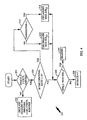
- the control processor 38 coupled to at least the decoder 30, operates in conjunction with the methods illustrated in the flow diagrams of FIGS. 2-5 to select the appropriate decoded frame to be output or provided to the user, or to declare the current frame an erasure condition. While the control processor 38 and decoder 30 are shown as separate elements, the control processor and decoder can be incorporated together to form a single decoder.
- step 104 the processor 38 determines whether the CRC for exactly one rate checks. If so, then in step 108, the processor 38 performs a one CRC check routine as described below. However, if the CRCs for none of the rates check, or if the CRCs for three or four rates check, then in step 106, the processor 38 declares the currently received frame an erasure. In general, if the CRCs for none of the rates check, then the current frame is erased.
- step 110 the processor 38 compares the SER values for the two rates that checked in step 102. For example, if the CRCs for the full and eighth rates check in step 102, then the processor 38 in step 110 determines whether the SER value for the full rate (SER 1 ) is greater than or equal to the SER value for the eighth rate (SER 8 ) plus a weighting value W determined based on the full and eighth rates (W 1,8 ). In general, the processor 38 under step 110 compares the SERs based on the following equation: SER i ⁇ SER j + W i , j , where i and j refer to the two rates corresponding to the two rates that checked under step 102.
- the weighting or scaling value W can have one of six possible values, since i and j can have one of four possible values based on the four rates (i.e., W 1,2 , W 1,4 , W 1,8 , W 2,4 , W 2,8 , and W 4,8 ). Additionally, the weighting value W can have a value ranging from -255 to +255 since the SER values have a maximum value of 255.
- the weighting value W is generally necessary because, fof the different probability densities of the SERs for the possible rates, and the differences in the chances of the CRC checking given the different actual frame rates from the transmitter.
- the weighting value W is preferably established based on empirical data provided through experimentation. By establishing a target acceptable error rate, and testing the response of the communication system of FIG.1 under the four rates, empirical data resulting therefrom is used to determine a weighting value W for each of the six combination of rates.
- the weighting value W provides an increased level of confidence as to which of the two rates the currently received frame was transmitted. Simply determining that the current rate is equal to the rate having the lower SER can result in incorrectly determining the rate of the current frame. Therefore, the SER i value must be less than the SER j value plus a weighting factor for the processor 38 to determine that the rate of the currently received frame is equal to the rate I.
- the decoder 30 will output a noisy signal that can be amplified and broadcast to a user's ear. Such a noisy signal can be perceptually undesirable to a user.
- the present invention sacrifices a little higher frame erasure rate, in exchange for not decoding a current frame at the wrong rate.
- the receiver 4 preferably attempts to maintain a frame erasure rate of less than 1%.
- the probability of the wrong rate being determined under the routines described herein are less than or equal to 10 -5 .
- the processor 38 determines that the rate of the current frame received from the transmitter 2 is at the rate i. Alternatively, if the SER i value is less than the SER j value plus W i,j , then in step 114, the processor 38 determines that the rate of the current frame received from the transmitter 2 is equal to the rate j.
- the processor 38 After determining the rate of the current frame, the processor 38 provides an appropriate signal to the buffer 40, which in response thereto, outputs the frame decoded corresponding to the determined rate or no frame if an erasure is declared.
- FIG. 3 An alternative embodiment according to the present invention for determining the received signal rate where two of the four rates check is shown in FIG. 3 as a routine 120.
- This and other alternative embodiments described below are similar to their corresponding previously described embodiment, and common steps are identified by the same reference numerals. Only the significant differences in operation are described in detail.
- the routine 120 performs the same steps 102,104, 106 and 108 as described above with respect to the routine 100.
- step 124 if the CRCs for two of the rates check under step 102, then the processor 38 employs a more accurate comparison between the SER values for the two rates identified under step 102 to further ensure that the current frame is decoded under the appropriate rate.
- the processor 38 in step 124 employs a multiplicative factor k i,j in equation (1) above, to provide the following comparative function: SER i ⁇ k i , j * SER j + W i , j .
- the multiplicative factor k i,j is preferably determined through experimentation based on empirical data for the four transmission rates. Therefore, six possible multiplicative factors are possible based on the four transmission rates (i.e., k 1,2 , k 1,4 , k 1,8 , k 2,4 , k 2,8, and k 4,8 ).
- the multiplicative factor k can simply be a normalization factor so that, for example, if i is equal to full and j is equal to half, then k 1,2 would be equal to two to normalize the half rate SER 2 value with respect to the SER 1 value.
- the multiplicative factor k can include not only a normalization factor, but compensate for differences between the different transmission rates, as described below.
- FIG. 6 a simplified diagram is shown of rate decision regions for SER values SER i and SER j , where CRCs for rates i and j check.
- the multiplicative factor k i,j determines the slope of the line, while the weighting value W i,j determines its offset from the origin (its Y-axis intercept).
- the multiplicative factor k and weighting value W vary the decision range for areas 140 and 142.
- the empirical data can be input to spreadsheets and known numerical analysis techniques can be employed under the spreadsheets to provide optimized values below the target acceptable error rate.
- routine 120 and the other routines described herein employ functions based on two rates and two SERs, SER i , SER j (i.e. f(i, j, SER i , SER j ).
- the present invention employs linear equations such as equation (2) above, and as represented in FIG. 6.
- the weighting value W, the multiplicative factor k, and the maximum and minimum SER thresholds are preferably stored in memory as a look-up table (not shown) to be accessed by the processor 38.
- step 124 the processor 38 essentially determines on which side of the line in FIG. 6 a point defined by the two SER values (SER i , SER j ) exists, to thereby determine the most likely rate for the currently received frame. If the SER i value is less than k i,j times the SER j value plus W i,j , then in step 126, the processor 38 determines whether the SER i is greater than a maximum acceptable SER threshold for rate i ( i.e ., MaxSER i ). In general, there is a maximum SER threshold value for the given rate beyond which the probability of error (of decoding at the incorrect rate) is unacceptable. As noted above, the maximum SER thresholds, shown in FIG.
- the processor 38 in step 128 determines that the rate of the currently received frame is equal to i. If, however, the SER i value is greater than or equal to the maximum SER i threshold, then in step 130 the processor 38 determines that the current frame is an erasure.
- step 124 the processor 38 determines that the SER i value is greater than or equal to k i,j times the SER j value plus W i,j . If so, the processor 38 in step 130 determines that the current frame is erased. However, if the SER j value is less than the maximum SER j threshold, then in step 134 the processor 38 determines that the current frame was transmitted at the rate j.
- a maximum SER threshold for rate j i.e ., MaxSER j
- a routine 200 is performed by the processor 38 if the CRC for only one rate checks.
- step 206 the processor 38 determines whether the SER value for the determined rate is greater than or equal to a maximum SER threshold for that rate (i.e., SER i ⁇ MaxSER i ). If it is less than the maximum, then in step 208, the processor 38 determines that the rate of the currently received frame is equal to i; otherwise, in step 210, the processor declares an erasure.
- a maximum SER threshold for that rate i.e., SER i ⁇ MaxSER i .
- step 212 the processor examines the Yamamoto value for the eighth rate (Y 8 ).
- Y 8 the Yamamoto value for the eighth rate
- the routine 200 employs additional checks to confirm that the current frame was transmitted at the eighth rate. Consequently, in step 212, if the Yamamoto value for the eighth rate checks (i.e ., provides a binary "1" value to the decoder 30), then the processor 38 has an increased level of confidence that the rate of the current frame is the eighth rate. Therefore, in step 214, the processor 38 employs a larger or looser maximum SER value for the determined rate. Such a looser maximum SER threshold improves the probability that subsequent steps under the routine 200 will appropriately determine that the current frame was transmitted at the eighth rate.
- step 216 the processor 38 selects a smaller or tighter maximum SER value for the eighth rate. If the Yamamoto value does not check, the processor 38 expects the current frame to be an erasure, and therefore makes subsequent comparisons more stringent to ensure that the current frame is determined to have been transmitted at the eighth rate under only the most stringent of comparisons. Under step 206, the processor 38 employs the looser maximum SER value from step 214, or the tighter maximum SER value from step 216, and compares it to the eighth rate SER to determine whether the frame is erased (step 210) or confirms that the current frame was transmitted at the eighth rate (step 208).
- routine 220 a more detailed analysis is shown as a routine 220.
- the processor 38 under the routine 220 performs the steps 202, 204, and 206 as discussed above. Thereafter, however, under steps 228, 230, and 232, the processor 38 compares the SER values for the three rates which did not check under step 202 ( i.e. , rates j, k, and l), to minimum SER thresholds. This reduces the chances that one of the rates decoded with a low SER is actually the correct rate though the CRC did not check for that rate.
- the steps 228, 230 and 232 determine if the SER values for the other rates are greater than minimum thresholds for that rate, and if so, declare an erasure because the probability that the current frame was transmitted at that rate outweighs the probability that the current frame was transmitted at rate i.
- step 228, the processor 38 determines whether the SER j value is less than or equal to the minimum SER threshold for the determined rate i and the rate j ( i.e ., SER i,j ). If it is, then the processor 38 declares the current frame an erasure under step 227. The reason for doing so is that the low SER of another rate (j) indicates an increased probability that the frame was transmitted at that rate (j). If it isn't, then under steps 230 and 232, the processor 38 compares the last two SER values (for rates k and l) to corresponding minimum SER thresholds for the rate i and rates k or l (SER i,k and SER i,l ), respectively.
- the processor 38 determines that the current frame was transmitted at rate i.
- the processor 38 checks the Yamamoto values for the eighth rate under step 212 as discussed above. Therefore, if the Yamamoto value for the eighth rate checks, then in step 238 the processor 38 not only employs a looser maximum SER threshold for the determined rate (the eighth rate), but also employs looser minimum SER thresholds for the determined and nondetermined rates ( i.e. , looser Min. SER i , j , SER i,k and SER i,l ).
- step 240 if the Yamamoto value does not check under step 212, then in step 240 the processor 38 not only employs a tighter maximum SER i threshold, but tighter minimum SER thresholds for the other rates ( i.e. , tighter Min. SER i,j, SER i,k and SER i,l ). Therefore, for the eighth rate, the threshold lookup table employed by the processor 38 includes two maximum threshold values for the eighth rate, and two sets of three minimum threshold values to be employed under steps 238 and 240.
- the processor 38 can compare the particular SER value to a linear function by multiplying the minimum or maximum SER threshold by the multiplicative factor k, and adding an appropriate weighting value W. For example, under step 206, the processor 38 can compare the SER value SER i to the function k i *MaxSER i + W i , while under step 228, the processor can compare the SER j value to the function k i,j * MinSER i,j + W i,j .
- a nonlinear function can be employed under steps 206-232. However, any improvement provided by a nonlinear function will likely, at best, provide only a small incremental benefit to the routine 220 and will lead to processing complexity and thus increased processing time.
- the routine 220 can be modified so that the Yamamoto values for the other rates are also checked. As a result, corresponding tighter or looser maximum and minimum SER thresholds would be employed for each of the other rates. A larger lookup table would therefore be required under such an alternative embodiment by the processor 38. Additionally, the routines 100, 120, 200 can employ such above alternatives, such as employing the Yamamoto check for each rate.
- routines of the present invention can compare the currently determined rate (rate i) to previous rates. As noted above, 90% of the time the rate of the current frame is either at the full or eighth rate in the exemplary embodiment. Similarly, under the exemplary embodiment, the probability is high that the rate of the current frame is equal to the rate of the previous frame. If a person is talking, they will likely continue talking (causing the current frame to be at the full rate), while if they are silent, they will likely continue to be silent (maintaining the current frame at the eighth rate). As a result, the above-described routines can compare the determined rate of the current frame to the rate of the previous frame, and apply looser maximum and minimum SER thresholds. Alternatively, if the current determined rate differs from the previous rate, tighter thresholds can be applied.
Landscapes
- Engineering & Computer Science (AREA)
- Computer Networks & Wireless Communication (AREA)
- Signal Processing (AREA)
- Power Engineering (AREA)
- Detection And Prevention Of Errors In Transmission (AREA)
- Communication Control (AREA)
- Error Detection And Correction (AREA)
- Synchronisation In Digital Transmission Systems (AREA)
Claims (34)
- Ein Verfahren zum Bestimmen einer momentanen Rate eines momentanen Rahmens für ein Kommunikationssystem mit einem Sender (2) und einem Empfänger (4), wobei der Sender (2) einen jeden einer Vielzahl von Rahmen mit der momentanen Rate sendet, wobei die momentane Rate einer von einer Vielzahl von Raten entspricht, wobei das Verfahren die folgenden Schritte aufweist:Generieren einer Vielzahl von Fehlerprüfwerten, von denen jeder darauf basiert, ob der momentane Rahmen eine von einer Vielzahl von Raten besitzt, wobei nur ein erster Prüfwert einer ausgewählten Rate ein positives Prüfergebnis liefert, und wobei die ausgewählte Rate eine der Vielzahl von Raten ist;Generieren einer Vielzahl von Fehlerratenwerten, wobei jeder darauf basiert, ob der momentane Rahmen eine einer Vielzahl von Raten besitzt, wobei ein ausgewählter Fehlerratenwert einer ausgewählten Rate entspricht;Generieren einer Vielzahl von Decodierungswerten, jeweils darauf basierend, ob der momentane Rahmen eine der Vielzahl von Raten besitzt, wobei ein ausgewählter Decodierungswert der ausgewählten Rate entspricht;Bestimmen (204), ob die ausgewählte Rate des ausgewählten Fehlerratenwerts einer vorbestimmten Rate entspricht;wenn die ausgewählte Rate der vorbestimmten Rate entspricht, Vergleichen (212) des ausgewählten Decodierungswertes mit einem ausgewählten Wert;wenn die ausgewählte Rate nicht der vorbestimmten Rate entspricht, Vergleichen (206) des ausgewählten Fehlerratenwertes mit einem ersten Wert, basierend auf einer vorbestimmten Beziehung;wenn der ausgewählte Decodierungswert dem ausgewählten Wert entspricht, Vergleichen (214) des ausgewählten Fehlerratenwertes mit einem zweiten Wert, basierend auf der vorbestimmten Beziehung;wenn der ausgewählte Decodierungswert nicht dem ausgewählten Wert entspricht, Vergleichen (216) des ausgewählten Fehlerratenwertes mit einem dritten Wert, basierend auf der vorbestimmten Beziehung; undBestimmen (208), dass die momentane Rate des momentanen Rahmens die ausgewählte Rate ist, wenn der ausgewählte Fehlerratenwert eine vorbestimmte Beziehung mit dem ersten, zweiten oder dritten Wert besitzt.
- Verfahren nach Anspruch 1, wobei der Schritt des Generierens einer Vielzahl von Fehlerprüfwerten eine Vielzahl von zyklischen Redundanzprüf- bzw. cyclic redundancy check-Werten generiert, wobei der Schritt des Generierens einer Vielzahl von Fehlerratenwerten eine Vielzahl von Symbolfehlerraten generiert, und wobei der Schritt des Generierens einer Vielzahl von Decodierungswerten eine Vielzahl von Yamamoto-Prüfwerten generiert.
- Verfahren nach Anspruch 1, wobei die Vielzahl von Raten Voll-, Halb-, Viertel- und Achtel-Raten beinhalten und wobei der Schritt des Bestimmens (204), ob die ausgewählte Rate des ausgewählten Fehlerratenwertes einer vorbestimmten Rate entspricht, bestimmt, ob die ausgewählte Rate der Achtel-Rate entspricht.
- Verfahren nach Anspruch 1, wobei der Schritt des Generierens einer Vielzahl von Decodierungswerten eine Vielzahl von Yamamoto-Prüfwerten generiert, und wobei der Schritt des Vergleichens (212) des ausgewählten Decodierungswertes mit einem ausgewählten Wert den Schritt des Bestimmens beinhaltet, ob der ausgewählte Yamamoto-Wert ein akzeptables Prüfergebnis liefert.
- Verfahren nach Anspruch 1, wobei der erste, zweite und dritte Wert Fehlerratenwertschwellenwerte sind, wobei die Schritte des Vergleichens (206, 216, 214) des ausgewählten Fehlerratenwertes mit den ersten, zweiten und dritten Werten bestimmt, ob der ausgewählte Fehlerratenwert geringer ist, als der erste, zweite bzw. dritte Schwellenwert und wobei der zweite Schwellenwert größer ist, als der dritte Schwellenwert.
- Verfahren nach Anspruch 1, wobei der Schritt des Bestimmens (206), dass die momentane Rate des momentanen Rahmens die ausgewählte Rate ist, den Schritt des Bestimmens (210) beinhaltet, dass der momentane Rahmen gelöscht ist bzw. wird, wenn der ausgewählte Fehlerratenwert nicht die vorbestimmte Beziehung mit dem ersten, zweiten oder dritten Wert besitzt.
- Verfahren nach Anspruch 1, das weiterhin folgende Schritte aufweist: Vergleichen von zumindest einem weiteren der Fehlerratenwerte mit einem Minimumsschwellenfehlerratenwert, basierend auf einer ausgewählten Beziehung; und Bestimmen, dass der momentane Rahmen gelöscht ist bzw. wird, wenn der erwähnte andere Wert der Fehlerratenwerte die ausgewählte Beziehung mit der Minimumsschwelle besitzt.
- Verfahren nach Anspruch 1, wobei der Sender ein Signal sendet, das durch die Vielzahl von Rahmen gebildet wird und das Verfahren zum Bestimmen einer momentanen Rate des Signals dient, und wobei der Empfänger (4) die Vielzahl von Fehlerprüfwerten und die Fehlerratenwerte und den zumindest einen Decodierungswert, jeweils basierend darauf, ob das Signal eine der Vielzahl von Raten besitzt, generiert.
- Verfahren nach Anspruch 8, wobei die Vielzahl von Raten Voll-, Halb-, Viertel- und Achtel-Raten enthalten, und wobei der Schritt des Bestimmens (208), ob die ausgewählte Rate einer vorbestimmte Rate entspricht, bestimmt, ob die ausgewählte Rate der Achtel-Rate entspricht.
- Verfahren nach Anspruch 8, wobei der ausgewählte Decodierungswert ein Yamamoto-Prüfwert ist, und wobei der Schritt des Vergleichens (212) eines ausgewählten Decodierungswertes mit einem ausgewählten Wert den Schritt des Bestimmens enthält, ob der ausgewählte Yamamoto-Wert ein akzeptables Prüfergebnis liefert.
- Verfahren nach Anspruch 8, wobei die ersten, zweiten und dritten Werte Fehlerratenwertschwellenwerte sind, wobei die Schritte des Vergleichens (206, 216, 214) des ausgewählten Fehlerratenwertes mit den ersten, zweiten und dritten Werten bestimmen, ob der ausgewählte Fehlerratenwert kleiner als der erste, zweite bzw. dritte Schwellenwert ist, und wobei der zweite Schwellenwert größer ist, als der dritte Schwellenwert.
- Verfahren nach Anspruch 8, wobei das Signal eine Vielzahl von Rahmen enthält, die einen momentanen Rahmen enthalten, und wobei der Schritt des Bestimmens (208), dass die momentane Rate des Signals die ausgewählte Rate ist, den Schritt des Bestimmens enthält, ob der momentane Rahmen gelöscht ist bzw. wird, wenn der ausgewählte Fehlerratenwert nicht eine vorbestimmte Beziehung zu dem ersten, zweiten oder dritten Wert hat.
- Verfahren nach Anspruch 8, der weiterhin die folgenden Schritte aufweist: Vergleichen mindestens eines weiteren der Fehlerratenwerte mit einem Minimumsschwellenfehlerratenwert, basierend auf einer ausgewählten Beziehung; und Bestimmen, dass das Signal fehlerhaft ist, wenn der weitere Wert der Fehlerratenwerte die ausgewählte Beziehung mit einem Minimumsschwellenwert hat.
- Verfahren nach Anspruch 8, wobei die Schritte des Vergleichens den Schritt des Vergleichens des ausgewählten Fehlerratenwertes mit ersten, zweiten und dritten Gewichtungswerten plus dem ersten, zweiten bzw. dritten Wert enthält.
- Verfahren nach Anspruch 8, wobei die Schritte des Vergleichens den Schritt des Vergleichens des ausgewählten Fehlerratenwertes mit ersten, zweiten und dritten multiplikativen Faktor mal dem ersten, zweiten bzw. dritten Wert enthält.
- Verfahren nach Anspruch 8, wobei der erste Wert ein Fehlerratenwertschwellenwert ist, und wobei das Verfahren weiterhin folgende Schritte enthält: Vergleichen der ausgewählten Rate mit einer vorhergehenden Rate; Senken des ersten Schwellenwertes, wenn die ausgewählte Rate und die vorhergehende Rate ungefähr gleich sind; und Erhöhen der ersten Schwellenrate, wenn die ausgewählte Rate und die vorhergehende Rate nicht gleich sind.
- Ein Empfänger (4) für ein Kommunikationssystem mit einem Sender (2), der ein Signal mit einer momentanen Rate sendet, und wobei die momentane Rate eine einer Vielzahl von Raten entspricht, wobei der Empfänger (4) Folgendes aufweist:einen Fehlerprüfwertgenerator (32), der konfiguriert ist zum Generieren einer Vielzahl von Fehlerprüfwerten, jeweils basierend darauf, ob das Signal eine von einer Vielzahl von Raten besitzt, wobei nur ein erster Prüfwert einer ausgewählten Rate ein positives Prüfergebnis liefert, und wobei die ausgewählte Rate eine der Vielzahl von Raten ist;einen Fehlerratenwertgenerator (34), der konfiguriert ist zum Generieren einer Vielzahl von Fehlerratenwerten, jeweils basierend darauf, ob das Signal eine der Vielzahl von Raten hat, wobei ein ausgewählter Fehlerratenwert der ausgewählten Rate entspricht;einen Decodierungswertgenerator (36), der konfiguriert ist, um zumindest einen ausgewählten Decodierungswert zu generieren, und zwar basierend darauf, ob das Signal die ausgewählte Rate besitzt; undeinen Decodierer (30), der an den Fehlerprüfwertgenerator (32), den Fehlerratenwertgenerator (34) und den Decodierungswertgenerator (36) gekoppelt und konfiguriert ist, (a) zum Bestimmen, ob die ausgewählte Rate des ausgewählten Fehlerratenwertes einer vorbestimmten Rate entspricht, (b) zum Vergleichen des ausgewählten Decodierungswertes mit einem ausgewählten Wert, wenn die ausgewählte Rate der vorbestimmten Rate entspricht, (c) zum Vergleichen des ausgewählten Fehlerratenwertes mit einem ersten Wert, basierend auf einer vorbestimmten Beziehung, wenn die ausgewählte Rate nicht der vorbestimmten Rate entspricht, (d) zum Vergleichen des ausgewählten Fehlerratenwertes mit einem zweiten Wert, basierend auf der vorbestimmten Beziehung, wenn der ausgewählte Decodierungswert dem ausgewählten Wert entspricht, (e) zum Vergleichen des ausgewählten Fehlerratenwertes mit einem dritten Wert, basierend auf der vorbestimmten Beziehung, wenn der ausgewählte Decodierungswert nicht dem ausgewählten Wert entspricht, (f) zum Bestimmen, dass die momentane Rate des Signals die ausgewählte Rate ist, wenn der ausgewählte Fehlerratenwert die vorbestimmte Beziehung mit dem ersten, zweiten oder dritten Wert besitzt, und (g) zum Decodieren des Signals, basierend auf der ausgewählten Rate.
- Empfänger (4) nach Anspruch 17, wobei der Fehlerprüfwertgenerator (32) eine Vielzahl von zyklischen Redundanzprüfwerten bzw. CRC-Werten generiert, wobei der Fehlerratenwertgenerator eine Vielzahl von Symbolfehlerraten generiert, und wobei der Decodierungswertgenerator eine Vielzahl von Yamamoto-Prüfinrerten generiert.
- Empfänger (4) nach Anspruch 17, wobei die Vielzahl von Raten Voll-, Halb-, Viertel- und Achtel-Raten enthält und wobei der Decodierer bestimmt, ob die ausgewählte Rate der Achtel-Rate entspricht.
- Empfänger (4) nach Anspruch 17, wobei der Decodierungswertgenerator (36) eine Vielzahl von Yamamoto-Prüfwerten generiert, und wobei der Decodierer bestimmt, ob der ausgewählte Yamamoto-Wert ein positives Prüfergebnis liefert.
- Empfänger (4) nach Anspruch 17, wobei die ersten, zweiten und dritten Werte Fehlerratenwertschwellenwerte sind, und wobei der Decodierer (30) bestimmt, ob der ausgewählte Fehlerratenwert geringer ist als der erste, zweite bzw. dritte Wert und wobei der zweite Schwellenwert größer ist als der dritte Schwellenwert.
- Empfänger (4) nach Anspruch 17, wobei das Signal eine Vielzahl von Rahmen enthält, inklusive eines momentanen Rahmens, und wobei der Decodierer bestimmt, dass der momentane Rahmen gelöscht ist bzw. wird, wenn der ausgewählte Fehlerratenwert nicht eine vorbestimmte Beziehung mit dem ersten, zweiten oder dritten Wert besitzt.
- Empfänger (4) nach Anspruch 17, wobei der Decodierer (30) zumindest einen weiteren der Fehlerratenwerte mit einem Minimumsschwellenwert, basierend auf einer ausgewählten Beziehung vergleicht, und bestimmt, dass das Signal fehlerhaft ist, wenn der weitere Wert der Fehlerratenwerte die ausgewählte Beziehung mit dem Minimumsschwellenwert hat.
- Empfänger (4) nach Anspruch 17, wobei der Decodierer (30) den ausgewählten Fehlerratenwert mit ersten, zweiten und dritten Gewichtungswerten plus den ersten, zweiten bzw. dritten Werten vergleicht.
- Empfänger (4) nach Anspruch 17, wobei der Decodierer (30) den ausgewählten Fehlerratenwert mit ersten, zweiten und dritten multiplikativen Faktoren mal den ersten, zweiten bzw. dritten Werten vergleicht.
- Empfänger (4) nach Anspruch 17, wobei der Decodierer (30) die ausgewählten Raten mit einer vorhergehenden Rate vergleicht und den ersten Wert senkt, wenn die ausgewählte Rate und die vorhergehende Rate ungefähr gleich sind.
- Empfänger (4) nach Anspruch 17, wobei der Sender an den Empfänger (4) eine Vielzahl von Rahmen sendet, wobei die Vielzahl von Rahmen das Signal bildet,
und wobei der Fehlerprüfwertgenerator Mittel (32) zum Generieren der Vielzahl von Fehlerprüfwerten aufweist, und zwar jeweils basierend darauf, ob der momentane Rahmen eine der Vielzahl von Raten besitzt, und wobei nur ein erster Prüfwert einer ausgewählten Rate ein positives Prüfergebnis liefert, und wobei die ausgewählte Rate eine der Vielzahl von Raten ist;
und wobei der Fehlerratenwertgenerator Mittel (34) zum Generieren der Vielzahl von Fehlerratenwerten aufweist, jeweils basierend darauf, ob der momentane Rahmen eine der Vielzahl von Raten besitzt, wobei ein ausgewählter Fehlerratenwert der ausgewählten Rate entspricht;
und wobei der Decodierungswertgenerator Mittel (36) zum Generieren des zumindest einen Decodierungswertes aufweist, wobei jeder Decodierungswert darauf basiert, ob der momentane Rahmen eine der Vielzahl von Raten besitzt, wobei der ausgewählte Decodierungswert der ausgewählten Rate entspricht;
und wobei der Decodierer Folgendes aufweist:Mittel, gekoppelt an die Mittel (34) zum Generieren einer Vielzahl von Fehlerratenwerten, zum Bestimmen, ob die ausgewählte Rate des ausgewählten Fehlerratenwerts der vorbestimmten Rate entspricht;Mittel, gekoppelt an die Mittel (36) zum Generieren einer Vielzahl von Decodierungswerten, zum Vergleichen des ausgewählten Decodierungswertes mit dem ausgewählten Wert, wenn die ausgewählte Rate der vorbestimmten Rate entspricht;Mittel, gekoppelt an die Mittel (34) zum Generieren einer Vielzahl von Fehlerratenwerten, zum Vergleichen des ausgewählten Fehlerratenwertes mit dem ersten Wert, basierend auf der vorbestimmten Beziehung, wenn die ausgewählte Rate nicht der vorbestimmten Rate entspricht, zum Vergleichen des ausgewählten Fehlerratenwertes mit dem zweiten Wert, basierend auf der vorbestimmten Beziehung, wenn der ausgewählte Decodierungswert dem ausgewählten Wert entspricht, und zum Vergleichen des ausgewählten Fehlerratenwertes mit dem dritten Wert, basierend auf der vorbestimmten Beziehung, wenn der ausgewählte Decodierungswert nicht dem ausgewählten Wert entspricht;und Mittel, gekoppelt an die Mittel zum Vergleichen der ersten, zweiten und dritten Werte, zum Bestimmen, dass die momentane Rate des momentanen Rahmens die ausgewählte Rate ist, wenn der ausgewählte Fehlerratenwert die vorbestimmte Beziehung zu den ersten, zweiten und dritten Werten besitzt. - Empfänger (4) nach Anspruch 27, wobei die Mittel (32) zum Generieren einer Vielzahl von Fehlerprüfwerten eine Vielzahl von CRC-Werten generiert, wobei die Mittel zum Generieren einer Vielzahl von Fehlerratenwerten eine Vielzahl von Symbolfehlerraten generiert, und wobei die Mittel zum Generieren einer Vielzahl von Decodierungswerten eine Vielzahl von Yamamoto-Prüfwerten generieren.
- Empfänger (4) nach Anspruch 27, wobei die Vielzahl von Raten Voll-, Halb-, Viertel- und Achtel-Raten enthalten, und wobei die Mittel zum Bestimmen, ob die ausgewählte Rate des ausgewählten Fehlerratenwertes einer vorbestimmten Rate entspricht, Mittel aufweisen zum Bestimmen, ob die ausgewählte Rate der Achtel-Rate entspricht.
- Empfänger (4) nach Anspruch 27, wobei die Mittel zum Generieren einer Vielzahl von Decodierungswerten eine Vielzahl von Yamamoto-Prüfwerten generieren, und wobei die Mittel zum Vergleichen des ausgewählten Decodierungswertes mit einem ausgewählten Wert Mittel aufweisen zum Bestimmen, ob der ausgewählte Yamamoto-Wert ein positives Prüfergebnis liefert.
- Empfänger (4) nach Anspruch 27, wobei erste, zweite und dritte Werte Fehlerratenschwellenwerte sind, und wobei die Mittel zum Vergleichen des ausgewählten Fehlerratenwertes mit den ersten, zweiten und dritten Werten Mittel aufweisen zum Bestimmen, ob der ausgewählte Fehlerratenwert geringer ist als die ersten, zweiten bzw. dritten Schwellenwerte, und wobei der zweite Schwellenwert größer ist als der dritte Schwellenwert.
- Empfänger (4) nach Anspruch 27, wobei die Mittel zum Bestimmen, dass die momentane Rate des momentanen Rahmens die ausgewählte Rate ist, Mittel aufweisen zum Bestimmen, dass der momentane Rahmen gelöscht ist bzw. wird, wenn der ausgewählte Fehlerratenwert nicht die vorbestimmte Beziehung mit dem ersten, zweiten oder dritten Wert besitzt.
- Empfänger (4) nach Anspruch 27, der weiterhin Folgendes aufweist: Mittel zum Vergleichen zumindest eines weiteren der Fehlerratenwerte mit einem Minimumsschwellenfehlerratenwert, basierend auf einer ausgewählten Beziehung; und Mittel zum Bestimmen, dass der momentane Rahmen gelöscht wird, wenn der weitere der Fehlerratenwerte die ausgewählte Beziehung mit der Minimumsschwelle besitzt.
- Ein Kommunikationssystem, das Folgendes aufweist:einen Sender (2), der konfiguriert ist zum Senden eines Signals mit einer momentanen Rate, wobei die momentane Rate eine Vielzahl von Raten entspricht; undeinen Empfänger (4), der konfiguriert ist, um das Signal zu empfangen, wobei der Empfänger Folgendes aufweist:einen Fehlerprüfwertgenerator (32), der konfiguriert ist zum Generieren einer Vielzahl von Fehlerprüfwerten, jeweils basierend darauf, ob das Signal eine der Vielzahl von Raten besitzt, wobei nur ein erster Prüfwert einer ausgewählten Rate ein positives Prüfergebnis liefert, und wobei die ausgewählte Rate eine der Vielzahl von Raten ist;einen Fehlerratenwertgenerator (34), der konfiguriert ist zum Generieren einer Vielzahl von Fehlerratenwerten, jeweils basierend darauf, ob das Signal eine der Vielzahl von Raten besitzt, wobei ein ausgewählter Fehlerratenwert der ausgewählten Rate entspricht;einen Decodierungswertgenerator (36), der konfiguriert ist zum Generieren einer Vielzahl von Decodierungswerten, jeweils basierend darauf, ob das Signal eine der Vielzahl von Raten besitzt, wobei ein ausgewählter Decodierungswert der ausgewählten Rate entspricht; undeinen Decodierer (30), der an den Fehlerprüfwertgenerator (32), den Fehlerratenwertgenerator (34) und den Decodierungswertgenerator (36) gekoppelt und konfiguriert ist (a) zum Bestimmen, ob die ausgewählte Rate des ausgewählten Fehlerratenwertes einer vorbestimmten Rate entspricht, (b) zum Vergleichen des ausgewählten Decodierungswertes mit einem ausgewählten Wert, wenn die ausgewählte Rate der vorbestimmten Rate entspricht, (c) zum Vergleichen des ausgewählten Fehlerratenwertes mit einem ersten Wert, basierend auf einer vorbestimmten Beziehung, wenn die ausgewählte Rate nicht der vorbestimmten Rate entspricht, (d) zum Vergleichen des ausgewählten Fehlerratenwertes mit einem zweiten Wert, basierend auf der vorbestimmten Beziehung, wenn der ausgewählte Decodierungswert dem ausgewählten Wert entspricht, (e) zum Vergleichen des ausgewählten Fehlerratenwertes mit einem dritten Wert, basierend auf der vorbestimmten Beziehung, wenn der ausgewählte Decodierungswert nicht dem ausgewählten Wert entspricht, (f) zum Bestimmen, dass die momentane Rate des Signals die ausgewählte Rate ist, wenn der ausgewählte Fehlerratenwert die vorbestimmte Beziehung zu dem ersten, zweiten oder dritten Wert besitzt, und (g) zum Decodieren des Signals, basierend auf der ausgewählten Rate.
Priority Applications (1)
| Application Number | Priority Date | Filing Date | Title |
|---|---|---|---|
| EP04019848A EP1478144B1 (de) | 1996-10-18 | 1997-10-09 | Verfahren und Einrichtung zur Bestimmung der Datenrate eines empfangenen Signals in einem Übertragungssystem mit veränderlicher Datenrate |
Applications Claiming Priority (3)
| Application Number | Priority Date | Filing Date | Title |
|---|---|---|---|
| US08/730,863 US5751725A (en) | 1996-10-18 | 1996-10-18 | Method and apparatus for determining the rate of received data in a variable rate communication system |
| US730863 | 1996-10-18 | ||
| PCT/US1997/018625 WO1998018242A1 (en) | 1996-10-18 | 1997-10-09 | Method and apparatus for determining the rate of received data in a variable rate communication system |
Related Child Applications (1)
| Application Number | Title | Priority Date | Filing Date |
|---|---|---|---|
| EP04019848A Division EP1478144B1 (de) | 1996-10-18 | 1997-10-09 | Verfahren und Einrichtung zur Bestimmung der Datenrate eines empfangenen Signals in einem Übertragungssystem mit veränderlicher Datenrate |
Publications (2)
| Publication Number | Publication Date |
|---|---|
| EP0932963A1 EP0932963A1 (de) | 1999-08-04 |
| EP0932963B1 true EP0932963B1 (de) | 2006-04-12 |
Family
ID=24937097
Family Applications (2)
| Application Number | Title | Priority Date | Filing Date |
|---|---|---|---|
| EP04019848A Expired - Lifetime EP1478144B1 (de) | 1996-10-18 | 1997-10-09 | Verfahren und Einrichtung zur Bestimmung der Datenrate eines empfangenen Signals in einem Übertragungssystem mit veränderlicher Datenrate |
| EP97910971A Expired - Lifetime EP0932963B1 (de) | 1996-10-18 | 1997-10-09 | Verfahren und einrichtung zur bestimmung der datenrate empfangener daten in einem übertragungssystem mit veränderlicher datenrate |
Family Applications Before (1)
| Application Number | Title | Priority Date | Filing Date |
|---|---|---|---|
| EP04019848A Expired - Lifetime EP1478144B1 (de) | 1996-10-18 | 1997-10-09 | Verfahren und Einrichtung zur Bestimmung der Datenrate eines empfangenen Signals in einem Übertragungssystem mit veränderlicher Datenrate |
Country Status (15)
| Country | Link |
|---|---|
| US (1) | US5751725A (de) |
| EP (2) | EP1478144B1 (de) |
| JP (1) | JP3889448B2 (de) |
| KR (1) | KR100559099B1 (de) |
| CN (1) | CN1124726C (de) |
| AT (2) | ATE432577T1 (de) |
| AU (1) | AU4822097A (de) |
| BR (1) | BR9712354A (de) |
| CA (1) | CA2268857C (de) |
| DE (2) | DE69739430D1 (de) |
| ES (1) | ES2260786T3 (de) |
| IL (1) | IL129305A0 (de) |
| RU (1) | RU99109991A (de) |
| TW (1) | TW363312B (de) |
| WO (1) | WO1998018242A1 (de) |
Families Citing this family (107)
| Publication number | Priority date | Publication date | Assignee | Title |
|---|---|---|---|---|
| US6108372A (en) * | 1996-10-30 | 2000-08-22 | Qualcomm Inc. | Method and apparatus for decoding variable rate data using hypothesis testing to determine data rate |
| US6094465A (en) * | 1997-03-21 | 2000-07-25 | Qualcomm Incorporated | Method and apparatus for performing decoding of CRC outer concatenated codes |
| US6094428A (en) * | 1997-04-30 | 2000-07-25 | Motorola, Inc. | Method and apparatus for transmission and reception of a transmission rate in a CDMA communication system |
| US6377809B1 (en) | 1997-09-16 | 2002-04-23 | Qualcomm Incorporated | Channel structure for communication systems |
| US9118387B2 (en) | 1997-11-03 | 2015-08-25 | Qualcomm Incorporated | Pilot reference transmission for a wireless communication system |
| US7184426B2 (en) * | 2002-12-12 | 2007-02-27 | Qualcomm, Incorporated | Method and apparatus for burst pilot for a time division multiplex system |
| US6112325A (en) * | 1998-01-23 | 2000-08-29 | Dspc Technologies, Ltd. | Method and device for detecting rate |
| US6603751B1 (en) * | 1998-02-13 | 2003-08-05 | Qualcomm Incorporated | Method and system for performing a handoff in a wireless communication system, such as a hard handoff |
| ES2331974T3 (es) | 1998-02-13 | 2010-01-21 | Qualcomm Incorporated | Procedimiento y sistema para llevar a cabo una transferencia en un sistema de comunicacion inalambrica, tal como una transferencia dura. |
| US6307867B1 (en) * | 1998-05-14 | 2001-10-23 | Telefonaktiebolaget Lm Ericsson (Publ) | Data transmission over a communications link with variable transmission rates |
| US20030194033A1 (en) | 1998-05-21 | 2003-10-16 | Tiedemann Edward G. | Method and apparatus for coordinating transmission of short messages with hard handoff searches in a wireless communications system |
| FR2779591B1 (fr) * | 1998-06-03 | 2000-09-01 | Nortel Matra Cellular | Transmission de paquets codes sans identification du code employe |
| EP1046236B1 (de) * | 1998-08-17 | 2016-02-24 | Dtvg Licensing, Inc | Verschachteler für turbo-kode mit annäherender optimaler leistung |
| US6847658B1 (en) | 1998-12-10 | 2005-01-25 | Qualcomm, Incorporated | Demultiplexer for channel interleaving |
| KR100322019B1 (ko) * | 1999-02-10 | 2002-02-04 | 윤종용 | 부호분할 다중접속 단말기의 전송률 검출 방법 |
| US6587446B2 (en) | 1999-02-11 | 2003-07-01 | Qualcomm Incorporated | Handoff in a wireless communication system |
| US6567466B1 (en) * | 1999-02-16 | 2003-05-20 | Agere Systems Inc. | Method and apparatus for determining the data rate of a received signal in a variable data rate orthogonal spread spectrum communication system |
| US6681203B1 (en) | 1999-02-26 | 2004-01-20 | Lucent Technologies Inc. | Coupled error code protection for multi-mode vocoders |
| US6597922B1 (en) | 1999-05-14 | 2003-07-22 | Qualcomm Incorporated | Method and apparatus for efficient candidate frequency search while initiating a handoff in a code division multiple access communication system |
| US6633601B1 (en) * | 1999-05-28 | 2003-10-14 | Koninklijke Philips Electronics N.V. | Method and device for frame rate determination using correlation metrics and frame quality indicators |
| FI107676B (fi) | 1999-06-21 | 2001-09-14 | Nokia Mobile Phones Ltd | Menetelmä ja järjestely tietyn signaalinkäsittelymetodin käyttämiseksi informaation välittämiseen |
| ATE288639T1 (de) * | 1999-07-08 | 2005-02-15 | Samsung Electronics Co Ltd | Detektionsgerät und -verfahren für datenrate in einer mobilen kommunikationsanordnung |
| AU2004203065B2 (en) * | 1999-08-11 | 2008-01-10 | Qualcomm Incorporated | Method and system for performing a handoff in a wireless communication system, such as a hard handoff |
| AU2007240231B2 (en) * | 1999-08-11 | 2010-10-07 | Qualcomm Incorporated | Method and system for performing a handoff in a wireless communication system, such as a hard handoff |
| US8064409B1 (en) | 1999-08-25 | 2011-11-22 | Qualcomm Incorporated | Method and apparatus using a multi-carrier forward link in a wireless communication system |
| US6621804B1 (en) | 1999-10-07 | 2003-09-16 | Qualcomm Incorporated | Method and apparatus for predicting favored supplemental channel transmission slots using transmission power measurements of a fundamental channel |
| US7010001B2 (en) * | 2000-01-10 | 2006-03-07 | Qualcomm, Incorporated | Method and apparatus for supporting adaptive multi-rate (AMR) data in a CDMA communication system |
| US6598189B1 (en) * | 2000-04-28 | 2003-07-22 | Nortel Networks Limited | Method and apparatus for determining the rate and quality of received data in a variable rate digital communication system |
| US7080009B2 (en) * | 2000-05-01 | 2006-07-18 | Motorola, Inc. | Method and apparatus for reducing rate determination errors and their artifacts |
| US7159164B1 (en) * | 2000-06-05 | 2007-01-02 | Qualcomm Incorporated | Method and apparatus for recovery of particular bits of a frame |
| US6654928B1 (en) * | 2000-07-20 | 2003-11-25 | Nokia Mobile Phones Limited | Hybrid dimensional, spherical space-time coding and decoding apparatus, and associated method, for a communication system |
| US7068683B1 (en) | 2000-10-25 | 2006-06-27 | Qualcomm, Incorporated | Method and apparatus for high rate packet data and low delay data transmissions |
| US6973098B1 (en) | 2000-10-25 | 2005-12-06 | Qualcomm, Incorporated | Method and apparatus for determining a data rate in a high rate packet data wireless communications system |
| US6804218B2 (en) * | 2000-12-04 | 2004-10-12 | Qualcomm Incorporated | Method and apparatus for improved detection of rate errors in variable rate receivers |
| US7746832B2 (en) * | 2001-01-05 | 2010-06-29 | Qualcomm Incorporated | Method and apparatus for supporting adaptive multi-rate (AMR) data in a CDMA communication system |
| US6850499B2 (en) * | 2001-01-05 | 2005-02-01 | Qualcomm Incorporated | Method and apparatus for forward power control in a communication system |
| US7003045B2 (en) * | 2001-01-31 | 2006-02-21 | Motorola, Inc. | Method and apparatus for error correction |
| US7076005B2 (en) | 2001-02-15 | 2006-07-11 | Qualcomm, Incorporated | System and method for transmission format detection |
| US7120134B2 (en) * | 2001-02-15 | 2006-10-10 | Qualcomm, Incorporated | Reverse link channel architecture for a wireless communication system |
| US6975868B2 (en) * | 2001-02-21 | 2005-12-13 | Qualcomm Incorporated | Method and apparatus for IS-95B reverse link supplemental code channel frame validation and fundamental code channel rate decision improvement |
| US7065159B2 (en) * | 2001-03-14 | 2006-06-20 | Lucent Technologies Inc. | Compensation based bit-error-rate estimation for convolutionally encoded transmissions in wireless systems |
| US6763244B2 (en) * | 2001-03-15 | 2004-07-13 | Qualcomm Incorporated | Method and apparatus for adjusting power control setpoint in a wireless communication system |
| US6732321B2 (en) * | 2001-03-27 | 2004-05-04 | Motorola, Inc. | Method, apparatus, and article of manufacture for error detection and channel management in a communication system |
| US6760576B2 (en) | 2001-03-27 | 2004-07-06 | Qualcomm Incorporated | Method and apparatus for enhanced rate determination in high data rate wireless communication systems |
| US8121296B2 (en) * | 2001-03-28 | 2012-02-21 | Qualcomm Incorporated | Method and apparatus for security in a data processing system |
| US8077679B2 (en) | 2001-03-28 | 2011-12-13 | Qualcomm Incorporated | Method and apparatus for providing protocol options in a wireless communication system |
| US9100457B2 (en) | 2001-03-28 | 2015-08-04 | Qualcomm Incorporated | Method and apparatus for transmission framing in a wireless communication system |
| US7308050B2 (en) | 2001-06-08 | 2007-12-11 | Broadcom Corporation | Detection and mitigation of temporary impairments in a communications channel |
| US7570576B2 (en) * | 2001-06-08 | 2009-08-04 | Broadcom Corporation | Detection and mitigation of temporary (bursts) impairments in channels using SCDMA |
| US7058035B2 (en) * | 2001-06-29 | 2006-06-06 | Qualcomm, Indorporated | Communication system employing multiple handoff criteria |
| US7185362B2 (en) * | 2001-08-20 | 2007-02-27 | Qualcomm, Incorporated | Method and apparatus for security in a data processing system |
| US7787389B2 (en) * | 2001-08-20 | 2010-08-31 | Qualcomm Incorporated | Method and system for utilization of an outer decoder in a broadcast services communication system |
| US7352868B2 (en) | 2001-10-09 | 2008-04-01 | Philip Hawkes | Method and apparatus for security in a data processing system |
| US7649829B2 (en) | 2001-10-12 | 2010-01-19 | Qualcomm Incorporated | Method and system for reduction of decoding complexity in a communication system |
| US7177658B2 (en) | 2002-05-06 | 2007-02-13 | Qualcomm, Incorporated | Multi-media broadcast and multicast service (MBMS) in a wireless communications system |
| US8699505B2 (en) * | 2002-05-31 | 2014-04-15 | Qualcomm Incorporated | Dynamic channelization code allocation |
| US7111226B1 (en) * | 2002-05-31 | 2006-09-19 | Broadcom Corporation | Communication decoder employing single trellis to support multiple code rates and/or multiple modulations |
| US7016327B2 (en) * | 2002-08-21 | 2006-03-21 | Qualcomm Incorporated | Method and system for communicating content on a broadcast services communication system |
| EP2442592A3 (de) | 2002-08-21 | 2014-01-22 | Qualcomm Incorporated | Verfahren und System zur Kommunikation von Inhalt auf einem Rundfunkdienstkommunikationssystem |
| US7020109B2 (en) * | 2002-08-21 | 2006-03-28 | Qualcomm Incorporated | Method and system for communicating content on a broadcast services communication system |
| US6901083B2 (en) * | 2002-10-25 | 2005-05-31 | Qualcomm, Incorporated | Method and system for code combining at an outer decoder on a communication system |
| US7505534B1 (en) * | 2002-11-04 | 2009-03-17 | Nortel Networks Limited | Method for determination of discontinuous transmission, frame erasure, and rate |
| US7599655B2 (en) | 2003-01-02 | 2009-10-06 | Qualcomm Incorporated | Method and apparatus for broadcast services in a communication system |
| US8306562B2 (en) * | 2003-05-29 | 2012-11-06 | Texas Instruments Incorporated | Signal-to-interference ratio target control for multi-data-rate communication systems |
| US7933250B2 (en) * | 2003-06-23 | 2011-04-26 | Qualcomm Incorporated | Code channel management in a wireless communications system |
| US7124332B2 (en) * | 2003-06-30 | 2006-10-17 | Intel Corporation | Failure prediction with two threshold levels |
| US8098818B2 (en) * | 2003-07-07 | 2012-01-17 | Qualcomm Incorporated | Secure registration for a multicast-broadcast-multimedia system (MBMS) |
| US8718279B2 (en) | 2003-07-08 | 2014-05-06 | Qualcomm Incorporated | Apparatus and method for a secure broadcast system |
| US7292873B2 (en) * | 2003-08-07 | 2007-11-06 | Qualcomm Incorporated | Method and apparatus for regulating base station ACK/NAK message transmit power in a wireless communication system |
| US7318187B2 (en) * | 2003-08-21 | 2008-01-08 | Qualcomm Incorporated | Outer coding methods for broadcast/multicast content and related apparatus |
| US8804761B2 (en) * | 2003-08-21 | 2014-08-12 | Qualcomm Incorporated | Methods for seamless delivery of broadcast and multicast content across cell borders and/or between different transmission schemes and related apparatus |
| US8694869B2 (en) | 2003-08-21 | 2014-04-08 | QUALCIMM Incorporated | Methods for forward error correction coding above a radio link control layer and related apparatus |
| US8724803B2 (en) | 2003-09-02 | 2014-05-13 | Qualcomm Incorporated | Method and apparatus for providing authenticated challenges for broadcast-multicast communications in a communication system |
| US7010469B2 (en) * | 2003-09-30 | 2006-03-07 | International Business Machines Corporation | Method of computing partial CRCs |
| KR101002814B1 (ko) | 2003-10-02 | 2010-12-21 | 삼성전자주식회사 | 패킷 데이터 서비스를 제공하는 이동통신 시스템에서순방향 패킷 데이터 제어 채널 수신 장치 및 방법 |
| US8072942B2 (en) * | 2003-11-26 | 2011-12-06 | Qualcomm Incorporated | Code channel management in a wireless communications system |
| US7730381B2 (en) * | 2004-06-09 | 2010-06-01 | Qualcomm Incorporated | Erasure detection and power control for a transport channel with unknown format in a wireless communication system |
| FI20045318A0 (fi) * | 2004-09-01 | 2004-09-01 | Nokia Corp | Kommunikointijärjestelmä, vastaanotin, ja menetelmä arvioida vastaanotetun signaalin laatua |
| KR20100120722A (ko) | 2004-09-25 | 2010-11-16 | 어웨어, 인크. | Crc 카운터 정규화 |
| US20060084459A1 (en) * | 2004-10-13 | 2006-04-20 | Vinh Phan | Outer loop power control of user equipment in wireless communication |
| US8074158B2 (en) * | 2005-02-02 | 2011-12-06 | Qualcomm Incorporated | Erasure detection for a transport channel with an unknown format |
| KR101111515B1 (ko) * | 2005-02-02 | 2014-05-07 | 엘지전자 주식회사 | 데이터 송수신 방법 |
| WO2006106377A1 (en) * | 2005-04-07 | 2006-10-12 | Nokia Corporation | Blind transport format detection based on decoder metric |
| US8630602B2 (en) * | 2005-08-22 | 2014-01-14 | Qualcomm Incorporated | Pilot interference cancellation |
| US9071344B2 (en) | 2005-08-22 | 2015-06-30 | Qualcomm Incorporated | Reverse link interference cancellation |
| US8594252B2 (en) | 2005-08-22 | 2013-11-26 | Qualcomm Incorporated | Interference cancellation for wireless communications |
| US8611305B2 (en) * | 2005-08-22 | 2013-12-17 | Qualcomm Incorporated | Interference cancellation for wireless communications |
| US8743909B2 (en) * | 2008-02-20 | 2014-06-03 | Qualcomm Incorporated | Frame termination |
| JP2007195076A (ja) * | 2006-01-20 | 2007-08-02 | Nec Corp | 無線通信システムとその送信電力制御方法および装置 |
| JP4771835B2 (ja) * | 2006-03-06 | 2011-09-14 | 株式会社リコー | トナー及び画像形成方法 |
| US8920343B2 (en) | 2006-03-23 | 2014-12-30 | Michael Edward Sabatino | Apparatus for acquiring and processing of physiological auditory signals |
| KR20080003537A (ko) * | 2006-07-03 | 2008-01-08 | 엘지전자 주식회사 | 이동 단말기의 통화 중 노이즈 제거 방법 및 이를 위한이동 단말기 |
| US8831140B2 (en) * | 2007-03-16 | 2014-09-09 | Altera Corporation | Protocol-agnostic automatic rate negotiation for high-speed serial interface in a programmable logic device |
| US8995417B2 (en) * | 2008-06-09 | 2015-03-31 | Qualcomm Incorporated | Increasing capacity in wireless communication |
| US9277487B2 (en) | 2008-08-01 | 2016-03-01 | Qualcomm Incorporated | Cell detection with interference cancellation |
| US9237515B2 (en) * | 2008-08-01 | 2016-01-12 | Qualcomm Incorporated | Successive detection and cancellation for cell pilot detection |
| US20100097955A1 (en) * | 2008-10-16 | 2010-04-22 | Qualcomm Incorporated | Rate determination |
| US8964692B2 (en) * | 2008-11-10 | 2015-02-24 | Qualcomm Incorporated | Spectrum sensing of bluetooth using a sequence of energy detection measurements |
| US9160577B2 (en) * | 2009-04-30 | 2015-10-13 | Qualcomm Incorporated | Hybrid SAIC receiver |
| US8446868B2 (en) * | 2009-05-07 | 2013-05-21 | Qualcomm Incorporated | Method and apparatus for processing blind decoding results in a wireless communication system |
| US8787509B2 (en) * | 2009-06-04 | 2014-07-22 | Qualcomm Incorporated | Iterative interference cancellation receiver |
| CN101673296B (zh) * | 2009-09-02 | 2011-07-20 | 太仓市同维电子有限公司 | 数据通讯过程中文件校验的方法 |
| US8831149B2 (en) * | 2009-09-03 | 2014-09-09 | Qualcomm Incorporated | Symbol estimation methods and apparatuses |
| US8811200B2 (en) | 2009-09-22 | 2014-08-19 | Qualcomm Incorporated | Physical layer metrics to support adaptive station-dependent channel state information feedback rate in multi-user communication systems |
| US9509452B2 (en) | 2009-11-27 | 2016-11-29 | Qualcomm Incorporated | Increasing capacity in wireless communications |
| WO2011063569A1 (en) | 2009-11-27 | 2011-06-03 | Qualcomm Incorporated | Increasing capacity in wireless communications |
| US10038569B2 (en) * | 2016-03-29 | 2018-07-31 | Intel IP Corporation | Self-adapting baud rate |
Family Cites Families (13)
| Publication number | Priority date | Publication date | Assignee | Title |
|---|---|---|---|---|
| US4748626A (en) * | 1987-01-28 | 1988-05-31 | Racal Data Communications Inc. | Viterbi decoder with reduced number of data move operations |
| US4845714A (en) * | 1987-06-08 | 1989-07-04 | Exabyte Corporation | Multiple pass error correction process and apparatus for product codes |
| US5023889A (en) * | 1988-05-31 | 1991-06-11 | California Institute Of Technology | Trellis coded multilevel DPSK system with doppler correction for mobile satellite channels |
| US5056117A (en) * | 1989-08-07 | 1991-10-08 | At&T Bell Laboratories | Decision feedback equalization with trellis coding |
| CA2020899C (en) * | 1989-08-18 | 1995-09-05 | Nambirajan Seshadri | Generalized viterbi decoding algorithms |
| US5485486A (en) * | 1989-11-07 | 1996-01-16 | Qualcomm Incorporated | Method and apparatus for controlling transmission power in a CDMA cellular mobile telephone system |
| US5416787A (en) * | 1991-07-30 | 1995-05-16 | Kabushiki Kaisha Toshiba | Method and apparatus for encoding and decoding convolutional codes |
| JP2683665B2 (ja) * | 1991-11-27 | 1997-12-03 | 日本電気株式会社 | 最尤系列推定装置 |
| ZA93290B (en) * | 1992-01-16 | 1993-11-22 | Qualcomm Inc | Method and apparatus for the formatting of data for transmission |
| US5509020A (en) * | 1993-05-27 | 1996-04-16 | Sony Corporation | Viterbi decoding apparatus and methods |
| AU683479B2 (en) * | 1993-06-18 | 1997-11-13 | Qualcomm Incorporated | Method and apparatus for determining the data rate of a received signal |
| US5566206A (en) * | 1993-06-18 | 1996-10-15 | Qualcomm Incorporated | Method and apparatus for determining data rate of transmitted variable rate data in a communications receiver |
| ZA947317B (en) * | 1993-09-24 | 1995-05-10 | Qualcomm Inc | Multirate serial viterbi decoder for code division multiple access system applications |
-
1996
- 1996-10-18 US US08/730,863 patent/US5751725A/en not_active Expired - Lifetime
-
1997
- 1997-10-09 EP EP04019848A patent/EP1478144B1/de not_active Expired - Lifetime
- 1997-10-09 CN CN97198894A patent/CN1124726C/zh not_active Expired - Lifetime
- 1997-10-09 CA CA002268857A patent/CA2268857C/en not_active Expired - Fee Related
- 1997-10-09 EP EP97910971A patent/EP0932963B1/de not_active Expired - Lifetime
- 1997-10-09 AU AU48220/97A patent/AU4822097A/en not_active Abandoned
- 1997-10-09 BR BR9712354-4A patent/BR9712354A/pt not_active Application Discontinuation
- 1997-10-09 KR KR1019997003353A patent/KR100559099B1/ko not_active Expired - Lifetime
- 1997-10-09 AT AT04019848T patent/ATE432577T1/de not_active IP Right Cessation
- 1997-10-09 JP JP51947298A patent/JP3889448B2/ja not_active Expired - Fee Related
- 1997-10-09 RU RU99109991/09A patent/RU99109991A/ru not_active Application Discontinuation
- 1997-10-09 WO PCT/US1997/018625 patent/WO1998018242A1/en not_active Ceased
- 1997-10-09 IL IL12930597A patent/IL129305A0/xx not_active IP Right Cessation
- 1997-10-09 ES ES97910971T patent/ES2260786T3/es not_active Expired - Lifetime
- 1997-10-09 AT AT97910971T patent/ATE323365T1/de not_active IP Right Cessation
- 1997-10-09 DE DE69739430T patent/DE69739430D1/de not_active Expired - Lifetime
- 1997-10-09 DE DE69735673T patent/DE69735673T2/de not_active Expired - Lifetime
- 1997-10-14 TW TW086115038A patent/TW363312B/zh active
Also Published As
| Publication number | Publication date |
|---|---|
| JP2001505377A (ja) | 2001-04-17 |
| BR9712354A (pt) | 1999-08-31 |
| US5751725A (en) | 1998-05-12 |
| KR20000049248A (ko) | 2000-07-25 |
| CA2268857C (en) | 2008-09-09 |
| JP3889448B2 (ja) | 2007-03-07 |
| HK1072846A1 (en) | 2005-09-09 |
| RU99109991A (ru) | 2003-03-10 |
| ATE323365T1 (de) | 2006-04-15 |
| EP0932963A1 (de) | 1999-08-04 |
| HK1024362A1 (en) | 2000-10-05 |
| AU4822097A (en) | 1998-05-15 |
| ATE432577T1 (de) | 2009-06-15 |
| TW363312B (en) | 1999-07-01 |
| CN1234160A (zh) | 1999-11-03 |
| EP1478144A1 (de) | 2004-11-17 |
| DE69735673T2 (de) | 2007-03-29 |
| CN1124726C (zh) | 2003-10-15 |
| EP1478144B1 (de) | 2009-05-27 |
| IL129305A0 (en) | 2000-02-17 |
| DE69739430D1 (de) | 2009-07-09 |
| CA2268857A1 (en) | 1998-04-30 |
| KR100559099B1 (ko) | 2006-03-15 |
| DE69735673D1 (de) | 2006-05-24 |
| ES2260786T3 (es) | 2006-11-01 |
| WO1998018242A1 (en) | 1998-04-30 |
Similar Documents
| Publication | Publication Date | Title |
|---|---|---|
| EP0932963B1 (de) | Verfahren und einrichtung zur bestimmung der datenrate empfangener daten in einem übertragungssystem mit veränderlicher datenrate | |
| EP1010305B1 (de) | Verfahren und einrichtung zum feststellen der rate von empfangenen daten in einem vermittlungssystem mit änderbaren raten | |
| US6108372A (en) | Method and apparatus for decoding variable rate data using hypothesis testing to determine data rate | |
| JP4522634B2 (ja) | 通信システムにおけるゼロレートフレームを検出する方法および装置 | |
| US5872775A (en) | Method and apparatus for performing rate determination | |
| US6256487B1 (en) | Multiple mode transmitter using multiple speech/channel coding modes wherein the coding mode is conveyed to the receiver with the transmitted signal | |
| HK1024362B (en) | Method and apparatus for determining the rate of received data in a variable rate communication system | |
| HK1072846B (en) | Method and apparatus for determining the rate of received data in a variable rate communication system | |
| HK1111826A (en) | Method and apparatus for determining the rate of received data in a variable rate communication system | |
| HK1028309A (en) | Method and apparatus for determining the rate of received data in a variable rate communication system |
Legal Events
| Date | Code | Title | Description |
|---|---|---|---|
| PUAI | Public reference made under article 153(3) epc to a published international application that has entered the european phase |
Free format text: ORIGINAL CODE: 0009012 |
|
| 17P | Request for examination filed |
Effective date: 19990414 |
|
| AK | Designated contracting states |
Kind code of ref document: A1 Designated state(s): AT BE CH DE DK ES FI FR GB GR IE IT LI LU MC NL PT SE |
|
| RAP1 | Party data changed (applicant data changed or rights of an application transferred) |
Owner name: QUALCOMM INCORPORATED |
|
| 17Q | First examination report despatched |
Effective date: 20040119 |
|
| GRAP | Despatch of communication of intention to grant a patent |
Free format text: ORIGINAL CODE: EPIDOSNIGR1 |
|
| GRAS | Grant fee paid |
Free format text: ORIGINAL CODE: EPIDOSNIGR3 |
|
| GRAA | (expected) grant |
Free format text: ORIGINAL CODE: 0009210 |
|
| AK | Designated contracting states |
Kind code of ref document: B1 Designated state(s): AT BE CH DE DK ES FI FR GB GR IE IT LI LU MC NL PT SE |
|
| PG25 | Lapsed in a contracting state [announced via postgrant information from national office to epo] |
Ref country code: NL Free format text: LAPSE BECAUSE OF FAILURE TO SUBMIT A TRANSLATION OF THE DESCRIPTION OR TO PAY THE FEE WITHIN THE PRESCRIBED TIME-LIMIT Effective date: 20060412 Ref country code: LI Free format text: LAPSE BECAUSE OF FAILURE TO SUBMIT A TRANSLATION OF THE DESCRIPTION OR TO PAY THE FEE WITHIN THE PRESCRIBED TIME-LIMIT Effective date: 20060412 Ref country code: IT Free format text: LAPSE BECAUSE OF FAILURE TO SUBMIT A TRANSLATION OF THE DESCRIPTION OR TO PAY THE FEE WITHIN THE PRESCRIBED TIME-LIMIT;WARNING: LAPSES OF ITALIAN PATENTS WITH EFFECTIVE DATE BEFORE 2007 MAY HAVE OCCURRED AT ANY TIME BEFORE 2007. THE CORRECT EFFECTIVE DATE MAY BE DIFFERENT FROM THE ONE RECORDED. Effective date: 20060412 Ref country code: CH Free format text: LAPSE BECAUSE OF FAILURE TO SUBMIT A TRANSLATION OF THE DESCRIPTION OR TO PAY THE FEE WITHIN THE PRESCRIBED TIME-LIMIT Effective date: 20060412 Ref country code: BE Free format text: LAPSE BECAUSE OF FAILURE TO SUBMIT A TRANSLATION OF THE DESCRIPTION OR TO PAY THE FEE WITHIN THE PRESCRIBED TIME-LIMIT Effective date: 20060412 Ref country code: AT Free format text: LAPSE BECAUSE OF FAILURE TO SUBMIT A TRANSLATION OF THE DESCRIPTION OR TO PAY THE FEE WITHIN THE PRESCRIBED TIME-LIMIT Effective date: 20060412 |
|
| REG | Reference to a national code |
Ref country code: GB Ref legal event code: FG4D |
|
| REG | Reference to a national code |
Ref country code: CH Ref legal event code: EP |
|
| REF | Corresponds to: |
Ref document number: 69735673 Country of ref document: DE Date of ref document: 20060524 Kind code of ref document: P |
|
| REG | Reference to a national code |
Ref country code: IE Ref legal event code: FG4D |
|
| REG | Reference to a national code |
Ref country code: SE Ref legal event code: TRGR |
|
| PG25 | Lapsed in a contracting state [announced via postgrant information from national office to epo] |
Ref country code: DK Free format text: LAPSE BECAUSE OF FAILURE TO SUBMIT A TRANSLATION OF THE DESCRIPTION OR TO PAY THE FEE WITHIN THE PRESCRIBED TIME-LIMIT Effective date: 20060712 |
|
| PG25 | Lapsed in a contracting state [announced via postgrant information from national office to epo] |
Ref country code: PT Free format text: LAPSE BECAUSE OF FAILURE TO SUBMIT A TRANSLATION OF THE DESCRIPTION OR TO PAY THE FEE WITHIN THE PRESCRIBED TIME-LIMIT Effective date: 20060912 |
|
| REG | Reference to a national code |
Ref country code: HK Ref legal event code: GR Ref document number: 1024362 Country of ref document: HK |
|
| NLV1 | Nl: lapsed or annulled due to failure to fulfill the requirements of art. 29p and 29m of the patents act | ||
| PG25 | Lapsed in a contracting state [announced via postgrant information from national office to epo] |
Ref country code: IE Free format text: LAPSE BECAUSE OF NON-PAYMENT OF DUE FEES Effective date: 20061009 |
|
| REG | Reference to a national code |
Ref country code: CH Ref legal event code: PL |
|
| PG25 | Lapsed in a contracting state [announced via postgrant information from national office to epo] |
Ref country code: MC Free format text: LAPSE BECAUSE OF NON-PAYMENT OF DUE FEES Effective date: 20061031 |
|
| REG | Reference to a national code |
Ref country code: ES Ref legal event code: FG2A Ref document number: 2260786 Country of ref document: ES Kind code of ref document: T3 |
|
| ET | Fr: translation filed | ||
| PLBE | No opposition filed within time limit |
Free format text: ORIGINAL CODE: 0009261 |
|
| STAA | Information on the status of an ep patent application or granted ep patent |
Free format text: STATUS: NO OPPOSITION FILED WITHIN TIME LIMIT |
|
| 26N | No opposition filed |
Effective date: 20070115 |
|
| PG25 | Lapsed in a contracting state [announced via postgrant information from national office to epo] |
Ref country code: GR Free format text: LAPSE BECAUSE OF FAILURE TO SUBMIT A TRANSLATION OF THE DESCRIPTION OR TO PAY THE FEE WITHIN THE PRESCRIBED TIME-LIMIT Effective date: 20060713 |
|
| PG25 | Lapsed in a contracting state [announced via postgrant information from national office to epo] |
Ref country code: LU Free format text: LAPSE BECAUSE OF NON-PAYMENT OF DUE FEES Effective date: 20061009 |
|
| PGFP | Annual fee paid to national office [announced via postgrant information from national office to epo] |
Ref country code: SE Payment date: 20100923 Year of fee payment: 14 Ref country code: FR Payment date: 20101004 Year of fee payment: 14 |
|
| PGFP | Annual fee paid to national office [announced via postgrant information from national office to epo] |
Ref country code: FI Payment date: 20101008 Year of fee payment: 14 |
|
| PGFP | Annual fee paid to national office [announced via postgrant information from national office to epo] |
Ref country code: IT Payment date: 20101016 Year of fee payment: 14 |
|
| PGFP | Annual fee paid to national office [announced via postgrant information from national office to epo] |
Ref country code: ES Payment date: 20101007 Year of fee payment: 14 |
|
| REG | Reference to a national code |
Ref country code: SE Ref legal event code: EUG |
|
| REG | Reference to a national code |
Ref country code: FR Ref legal event code: ST Effective date: 20120629 |
|
| PG25 | Lapsed in a contracting state [announced via postgrant information from national office to epo] |
Ref country code: IT Free format text: LAPSE BECAUSE OF NON-PAYMENT OF DUE FEES Effective date: 20111009 Ref country code: FI Free format text: LAPSE BECAUSE OF NON-PAYMENT OF DUE FEES Effective date: 20111009 Ref country code: FR Free format text: LAPSE BECAUSE OF NON-PAYMENT OF DUE FEES Effective date: 20111102 |
|
| PG25 | Lapsed in a contracting state [announced via postgrant information from national office to epo] |
Ref country code: SE Free format text: LAPSE BECAUSE OF NON-PAYMENT OF DUE FEES Effective date: 20111010 |
|
| REG | Reference to a national code |
Ref country code: ES Ref legal event code: FD2A Effective date: 20130417 |
|
| PG25 | Lapsed in a contracting state [announced via postgrant information from national office to epo] |
Ref country code: ES Free format text: LAPSE BECAUSE OF NON-PAYMENT OF DUE FEES Effective date: 20111010 |
|
| PGFP | Annual fee paid to national office [announced via postgrant information from national office to epo] |
Ref country code: DE Payment date: 20141028 Year of fee payment: 18 |
|
| PGFP | Annual fee paid to national office [announced via postgrant information from national office to epo] |
Ref country code: GB Payment date: 20150924 Year of fee payment: 19 |
|
| REG | Reference to a national code |
Ref country code: DE Ref legal event code: R119 Ref document number: 69735673 Country of ref document: DE |
|
| PG25 | Lapsed in a contracting state [announced via postgrant information from national office to epo] |
Ref country code: DE Free format text: LAPSE BECAUSE OF NON-PAYMENT OF DUE FEES Effective date: 20160503 |
|
| GBPC | Gb: european patent ceased through non-payment of renewal fee |
Effective date: 20161009 |
|
| PG25 | Lapsed in a contracting state [announced via postgrant information from national office to epo] |
Ref country code: GB Free format text: LAPSE BECAUSE OF NON-PAYMENT OF DUE FEES Effective date: 20161009 |