EP0933078A2 - Wirkstoff enthaltende Fällungskieselsäuren - Google Patents
Wirkstoff enthaltende Fällungskieselsäuren Download PDFInfo
- Publication number
- EP0933078A2 EP0933078A2 EP98122229A EP98122229A EP0933078A2 EP 0933078 A2 EP0933078 A2 EP 0933078A2 EP 98122229 A EP98122229 A EP 98122229A EP 98122229 A EP98122229 A EP 98122229A EP 0933078 A2 EP0933078 A2 EP 0933078A2
- Authority
- EP
- European Patent Office
- Prior art keywords
- fluoride
- precipitated silica
- silica
- ppm
- active ingredient
- Prior art date
- Legal status (The legal status is an assumption and is not a legal conclusion. Google has not performed a legal analysis and makes no representation as to the accuracy of the status listed.)
- Withdrawn
Links
Images


Classifications
-
- A—HUMAN NECESSITIES
- A61—MEDICAL OR VETERINARY SCIENCE; HYGIENE
- A61Q—SPECIFIC USE OF COSMETICS OR SIMILAR TOILETRY PREPARATIONS
- A61Q11/00—Preparations for care of the teeth, of the oral cavity or of dentures; Dentifrices, e.g. toothpastes; Mouth rinses
-
- A—HUMAN NECESSITIES
- A61—MEDICAL OR VETERINARY SCIENCE; HYGIENE
- A61K—PREPARATIONS FOR MEDICAL, DENTAL OR TOILETRY PURPOSES
- A61K8/00—Cosmetics or similar toiletry preparations
- A61K8/18—Cosmetics or similar toiletry preparations characterised by the composition
- A61K8/19—Cosmetics or similar toiletry preparations characterised by the composition containing inorganic ingredients
- A61K8/25—Silicon; Compounds thereof
-
- A—HUMAN NECESSITIES
- A61—MEDICAL OR VETERINARY SCIENCE; HYGIENE
- A61P—SPECIFIC THERAPEUTIC ACTIVITY OF CHEMICAL COMPOUNDS OR MEDICINAL PREPARATIONS
- A61P1/00—Drugs for disorders of the alimentary tract or the digestive system
- A61P1/02—Stomatological preparations, e.g. drugs for caries, aphtae, periodontitis
Definitions
- the invention relates to active ingredients Precipitated silicas, their production and use in Oral care products.
- Fluoride ions play a role in caries prophylaxis decisive role. Among other things, fluoride ions added to the drinking water to prevent the proliferation of Counter caries.
- fluoride ions Another form of using fluoride ions to combat tooth decay is toothpaste containing fluoride ions (cf. Oral Hygiene Products and Practice "by Morton Pader in Cosmetic Science and Technology Series ", Vol. 6, pages 383 ff., (1988), Marcel Dekker, Inc.).
- fluoride ions in the form of NaF, MFP, amine fluoride, tin fluoride etc.
- these toothpastes can contain precipitated silicas which have an abrasive effect and / or thickening effect (WO 93/24103), but the availability of fluoride ions in the oral cavity is essentially limited to the short duration of brushing the teeth.
- the fluoride-containing fumed silica is according to the US-A 4 054 689 by treating the fumed silica made with HF gas.
- a crucial factor in improving the The effectiveness of oral care products is mainly in it seen that after a spontaneous release of the Active substances the active substance concentration in the oral cavity if possible remains for a long time.
- the goal is drug retention to improve, and thus also the desired effect to achieve reduced drug doses. In this way are said to have undesirable side effects from high doses largely avoided.
- the invention relates to active ingredients Precipitated silicas, which are characterized by a characteristic, delayed drug release.
- the precipitated silica according to the invention can have the following physico-chemical parameters Humidity % 1 - 10, preferably 1-7 pH 2.5 - 8.5, preferably 6-8 N 2 surface m 2 / g 25 - 800, preferably 25-400 Medium particle size Malvern ⁇ m 2 - 100, preferably 2 - 20 exhibit.
- Another object of the invention is a method for Production of the precipitated silica with Active ingredient carrier function, which is characterized is that you can precipitate silica in a known way produces, with a moderately to poorly soluble in water Active ingredient either in the precipitation template or in the Precipitation suspension given or together with the washed and optionally redispersed Precipitated silica dough dried or simultaneously with the dried material is ground.
- amorphous silicas has been described in many different ways. Common to all processes is the implementation of alkali metal silicate solution with mineral acid or CO 2 while observing certain precipitation conditions, such as, for. B. temperature, time, pH, solids content in the precipitation suspension. The pH can then be lowered by adding more acid. During the precipitation and acidification phase, stirring is continued. The suspension is filtered, the cake washed out, dried and ground.
- the amorphous silicas according to the invention are in the Made in such a way that a precipitated silica known way, whereby a moderate in water (0.1 - 1.0 molar) to less soluble (less than 0.1 molar) Active ingredient either in the precipitation template or in the Precipitation suspension given or together with the washed and optionally redispersed Dried silica dough or simultaneously with the dried material is ground.
- fluoride ions e.g. B. alkali
- Alkaline earth fluorides or fluorapatite can be used, wherein Fluoride from alkali compounds additionally by adding Alkaline earth metal ions can be bound.
- Other active ingredients can be: chlorhexidine, triclosan, hydroxyethane-1,1-diphosphonic acid, Alkali pyrophosphates, zinc citrate and etc.
- the preparation of the precipitated silica can be carried out as they in documents DE-A 44 23 493, DE-AS 14 67 019 and EP-B 0 272 380 is described.
- Preparation consists in that the active ingredient in the Precipitation template or the spray dryer dish gives. This is the most even and finest Distribution in the finished product and the largest Retention effect guaranteed.
- the therapeutic effective amounts of fluoride are 0.001 to 10%, preferably 0.005 to 1.0%.
- the amounts of triclosan are 0.1-1.0%, preferably 0.2-0.5%.
- the preparation of the invention Precipitated silica with active substance carrier function, by putting water and the active ingredient in a precipitation vessel submitted the mixture to a temperature of 50 to 100 ° C, preferably heated to 80 to 90 ° C, under Maintaining the temperature by adding Sodium silicate solution the pH or the alkali content of the Mix sets, then simultaneously under Keeping the pH or alkali constant or successively sodium silicate solution and sulfuric acid then add further sulfuric acid preferably acidified to pH 7, if necessary, filtered, washed salt-free, the Redispersed filter cake using a spray dryer dries and the silica granules obtained are ground.
- the commercially available sodium silicate solution can e.g. B. have a concentration of 26.8% SiO 2 and 7.85% Na 2 O at a density of 1.352 g / ml.
- the sulfuric acid can have a concentration of 50 - 96% exhibit.
- the silicas of the invention can in the usual, the A person skilled in the art in oral care preparations such as Toothpastes, medicated chewing gums and topical Fluoride preparations and dental materials are used come. They usually replace them there all or part of the silica used.
- the preferred area of application is that of toothpastes. About that but also a combination with others, if necessary soluble active ingredients and the production of Gel formulations etc. possible.
- Dental care products according to the invention can have one or more of raw materials related to the prior art, such as Water, binders such as B. cellulose derivatives such as Carboxymethyl celluloses and their alkali salts, in particular of sodium, hydroxyalkyl celluloses, xanthan gum, tragacanth, Carragenate, alginates and gum arabic etc., cleaning body (precipitated and pyrogenic silicas, Dicalcium phosphate, chalk, aluminum hydroxide, etc.), Humectants such as B.
- binders such as B.
- cellulose derivatives such as Carboxymethyl celluloses and their alkali salts, in particular of sodium, hydroxyalkyl celluloses, xanthan gum, tragacanth, Carragenate, alginates and gum arabic etc.
- cleaning body precipitated and pyrogenic silicas, Dicalcium phosphate, chalk, aluminum hydroxide, etc.
- Humectants such as B.
- glycerin sorbitol, Lower propylene glycol, polyethylene glycols Molecular weight, 1,4 butanediol, xylitol etc.
- Flavors surfactants such as B. alkyl sulfates, Sodium lauryl sulfate, sarcosides, taurine fatty acid amides Monoglyceride sulfate, betaines etc., dyes and / or Titanium dioxide, sweeteners, buffers, bases or acids, Preservatives and active ingredients included.
- the dental care products are manufactured according to the status of the technique.
- the ingredients are more suitable Form mixed together, swollen and dispersed.
- the precipitated silica according to the invention can be used as an additive, in particular as a thickening and / or abrasive component, which also releases active ingredients, used in toothpastes become.
- the precipitated silica according to the invention has the following advantages:
- the silicas according to the invention serve as carriers for dental active ingredients which are stored at the site of action and release the active ingredients in small doses over long periods of time (depot effect, controlled release).
- the silicas thus act as active substance stores, which contain the active substances in adsorbed, absorbed or chemisorbed form.
- All forms of silicas e.g. B. precipitated silicas or silica gels, pyrogenic silicas can be used. All poorly soluble fluorides, such as. B. CaF 2 and poorly soluble active ingredients, such as. B. triclosan or chlorhexidine.
- the poorly soluble active ingredients can be easily soluble Active ingredients, such as B. NaF, monofluorophosphate etc. can be combined, creating a targeted setting of the Drug release dynamics, that is, targeted Combination of immediate and deposit effect is possible.
- the Advantages of the silicas according to the invention are in the longer availability and thus improved therapeutic efficacy z.
- the precipitation is carried out essentially according to DE-A 44 23 493, Example 1 with the addition of CaF 2 in the precipitation template.
- a pH of 8.5 is initially set by adding a little sodium silicate solution (26.8% SiO 2 and 7.85% Na 2 O, density 1.352 g / ml). Thereafter, by adding 60.0 ml / min of water glass (composition as indicated above) and sufficient sulfuric acid (50%) that the pH 8.5 is kept constant, it is precipitated for 240 minutes.
- reaction mixture is stirred for 60 minutes, filtered off, washed salt-free and in a spray dryer dried. The product is then ground.
- the precipitated silica obtained has the following physico-chemical characteristics: Humidity % 3.2 PH value 8.0 conductivity ⁇ S / cm 400 N 2 surface m 2 / g 31 Average particle size (Malvern) ⁇ m 10.2 Fluoride ion content % 0.5
- the low-salt dough obtained after filtering off and washing out is converted into a sprayable suspension, spray-dried and on an air jet mill with vigorous stirring and addition of water and enough CaF 2 that the F content, based on the amount of silica, is 0.5% by weight grind.
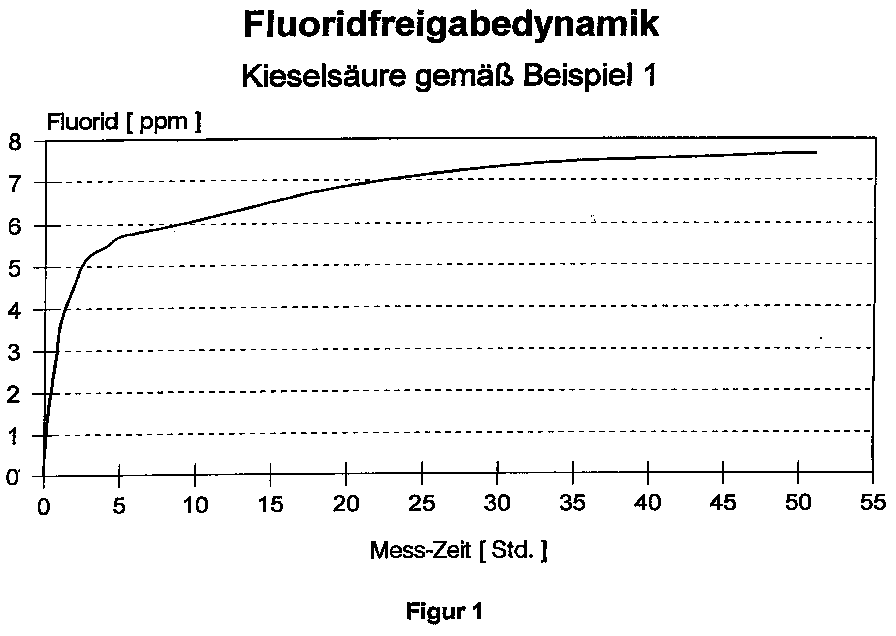
- the silica according to the invention according to Example 1 has a fluoride depot of 5 mg F '/ g silica, corresponding to 50 ppm in the test suspension. Due to the solubility product of CaF 2 , 7.8 ppm are soluble. The experiment shows that 97.9% of the soluble fluoride is released within 2 days.
- the total fluoride content of the silica is determined with the aid of pyrohydrolysis and an ion chromatography determination.
- the precipitated silica according to the invention according to Example 1 shows that after a single brushing operation, fluoride ions are embedded in the tooth surface.
- parameter Tooth number 1 Tooth number 2nd Tooth number 3rd polishing The tooth surface is polished The tooth surface is polished The tooth surface is polished 1.
- XPS X-ray photoelectron spectrometry
- the XPS technology which is based on the principle of photoelectric Effect rests / 1-4 /, is used to control the Surface composition of the teeth before and after the F treatment to determine. Because of the high The surface specificity of the XPS can be used in the processes in the uppermost nanometer, the interface area in which the Incorporation of F or the chemical attack on the tooth enamel or abrasion processes take place, are analyzed in a targeted manner.
- the analysis only records the uppermost atomic layers, i.e. selectively the area in which F-incorporation or elution processes take place. Although the analysis penetrates only a few atomic layers deep into the material, the Analysis spot "placed specifically over the entire tooth, so that the influence of micro-inhomogeneities on the analysis result is excluded, and macroscopic information relevant for the entire tooth surface is obtained.
- the XPS method is approx. 1000 times more sensitive to surface than that in technology used in electron microscopy EDX (energy dispersive X-ray microanalysis).
- the XPS method offers the advantage of good ones Quantifiability. In particular, it also delivers Information about the chemical bond state of the Surface of enamel or dentin. XPS is therefore one in dental research and at dental clinics (especially in the USA) very good internationally established measuring method, e.g. B. also complexation of Ca, the Ca / P ratio of the tooth surface or the Track dentin or effects through cleanser and primer.
- a molar tooth is introduced into the XPS test facility (Leybold LHS12) without further pretreatment.
- the device used consists of several vacuum chambers. In the first chamber, the molar tooth is carefully brought from room air conditions to fore-vacuum conditions (approx. 10 - 2 mbar, oil-free rotary vane pump vacuum) in order to prevent moisture and other z. Pump out T. organic, easily desorbable components, especially of dentin.
- the roughly pre-dried tooth is then transferred to a preparation chamber. In this chamber the material is pumped down to high or ultra high vacuum conditions (10 -7 -10 -8 mbar, turbopump vacuum).
- the tooth surface is bombarded over a large area with ultra-high vacuum conditions using soft X-rays (MgK ⁇ radiation, 1253.6 electron volts, power 200 watts). This triggers photoemission processes. Electrons are released (e.g. F1s, Ca2p, P2s, C1s, O1s etc.). Due to the selected excitation energy, photo electrons are triggered that have only a very small mean free path in the solid. The method is therefore specific for the area of the uppermost atomic layers, ie in the case of oxidic minerals such as. B. Hydroxyapatite / fluoroapatite, the top 2 nanometers are selectively detected.
- soft X-rays MgK ⁇ radiation, 1253.6 electron volts, power 200 watts.
- the measured XPS spectra are initially determined by Polynomial fits and subtraction programs for removal so-called X-ray satellite signals treated. After that all elements verified by XPS (except H and He) identified. The quantification follows Underground subtraction according to Shirley / 5 / under Consideration of the element-specific relative Sensitivity factors.
- Standard paste A [%] Standard paste B [%] 1 the. water 34.54 34.54 2 CMC, Blanose 7 MCF 1.00 1.00 3 preservative Solbrol-M 0.20 0.20 4 sweetener saccharin 0.10 0.10 5 CaF 2 - 0.21 6 paraffin oil 0.50 0.50 7 sorbitol 40.00 40.00 8 aromatic oil 1.00 1.00 Silica 20% precipitated silica according to example 1 20% precipitated silica according to Example 2
- the siliceous toothpaste suspensions are in a cleaning device filled and the occlusal surface polished Human teeth (molars) 5 min. with an electric Brushed toothbrush (brand Broxodent).
- the one for the Cleaning device used vibrating table was 60 Vibrations / min. set to sedimentation too avoid. After brushing, the teeth are under Flowing, dried and free flowing fluoride water examined by surface analysis.
- the toothpaste Colgate with bi-fluoride and calcium is in the Available commercially. It has the following ingredients (corresponds to CTFA) on:
- Dicalcium phosphate water, glycerin, sorbitol, cellulose Gum, sodium lauryl sulfate, flavor, tetra sodium Pyrophosphates, sodium saccharin, sodium monofluorophosphates, Sodium fluoride.
- the measurement is carried out using an ion-selective electrode and an ion analyzer.
- Example used alkali and alkaline earth salts.
- the present ORION fluoride standard 100 ppm, is used for calibration 1: 1 or 1: 5 with distilled water diluted and in 250 ml poly screw cap containers stored.
- the calibration of the ion meter is everyone before the start Series of measurements. For this, the previously specified Calibration or buffer solutions used. In front of everyone Immersing the electrode in a calibration solution Electrode with dist. Rinsed off water and carefully dried off. The details of the device manufacturer are included to consider.
- the suspension is heated to 37 ° C. in a water bath and stirred with a magnetic stirrer at stirring speed 3.
- the fluoride release is measured using a ion selective electrode.
- a ion selective electrode For this, the membrane of the ion-selective electrode with the, in the electrode existing filling solution rinsed according to the manufacturer's instructions and the Level corrected again.
- the electrode is with distilled water and rinsed with a soft cloth dried, the tip of the electrode is in the Suspension immersed and the fluoride content in certain Read the time intervals with stirring in ppm and note them.
- the measuring intervals are from 2 min to several hours increased to the constancy of the measured value.
- the pH of the suspension is measured.
- the electrode is measured with distilled water rinsed and dried.
- the ion analyzer will now open changed the pH measurement.
- the electrode is in the Suspension immersed and the pH with stirring measured and noted.
- the electrodes remain in the suspension; it takes place just switch to the respective electrode type for the acquisition of the measured values.
Landscapes
- Health & Medical Sciences (AREA)
- Life Sciences & Earth Sciences (AREA)
- Animal Behavior & Ethology (AREA)
- General Health & Medical Sciences (AREA)
- Public Health (AREA)
- Veterinary Medicine (AREA)
- Chemical & Material Sciences (AREA)
- Epidemiology (AREA)
- Inorganic Chemistry (AREA)
- Birds (AREA)
- Oral & Maxillofacial Surgery (AREA)
- General Chemical & Material Sciences (AREA)
- Bioinformatics & Cheminformatics (AREA)
- Chemical Kinetics & Catalysis (AREA)
- Engineering & Computer Science (AREA)
- Medicinal Chemistry (AREA)
- Nuclear Medicine, Radiotherapy & Molecular Imaging (AREA)
- Organic Chemistry (AREA)
- Pharmacology & Pharmacy (AREA)
- Cosmetics (AREA)
- Silicon Compounds (AREA)
Abstract
Description

- den Wirkstoffgehalt
- die Wirkstoff-Freigabedynamik
| Feuchte | % | 1 - 10, | vorzugsweise 1 - 7 |
| pH | 2,5 - 8,5, | vorzugsweise 6 - 8 | |
| N2-Oberfläche | m2/g | 25 - 800, | vorzugsweise 25 - 400 |
| Mittlere Teilchengröße Malvern | µm | 2 - 100, | vorzugsweise 2 - 20 |
Fluoridsalze in die Fällungsvorlage + Erdalkalichloride am Fällungsende
Fluoridsalze + Erdalkalichloride am Ende der Fällung
Fluoridsalze in der Fällungsvorlage
Fluoridsalze in die Sprühtrocknerspeise
| Feuchte | % | 3,2 |
| pH-Wert | 8,0 | |
| Leitfähigkeit | µS/cm | 400 |
| N2-Oberfläche | m2/g | 31 |
| Mittlere Teilchengröße (Malvern) | µm | 10,2 |
| Fluorid-Ion-Gehalt | % | 0,5 |
| Zahnpasta 1 % | Zahnpasta 4 % | |
| Wasser deion. | 30,60 | 31,60 |
| CMC | 1,20 | 1,20 |
| Solbrol M-Na | 0,20 | 0,20 |
| Saccharin Na | 0,10 | 0,10 |
| Titandioxid | 0,40 | 0,40 |
| Sorbitol 70 %ig | 40,00 | 40,00 |
| Kieselsäure gemäß Beispiel 1 | 25,00 | 22,00 |
| AEROSlL 200 | - | 2,00 |
| Aromaöl | 1,00 | 1,00 |
| Schaummittel | 1,50 | 1,50 |
| Zahnpasta 2 % | Zahnpasta 5 % | |
| Wasser deion. | 33,60 | 33,60 |
| CMC | 1,20 | 1,20 |
| Solbrol M-Na | 0,20 | 0,20 |
| Saccharin Na | 0,10 | 0,10 |
| Titandioxid | 0,40 | 0,40 |
| Sorbitol 70 %ig | 40,00 | 40,00 |
| Kieselsäure gemäß Beispiel 1 | 14,00 | - |
| Kieselsäure gemäß Beispiel 2 | - | 14,00 |
| Kieselsäure gemäß Beispiel 3 | - | 8,00 |
| Kieselsäure gemäß Beispiel 4 | 8,00 | - |
| Aromaöl | 1,00 | 1,00 |
| Schaummittel | 1,50 | 1,50 |
| Zahnpasta 3 % | Zahnpasta 6 % | |
| Wasser deion. | 39,60 | 39,60 |
| CMC | 1,20 | 1,20 |
| Solbrol M-Na | 0,20 | 0,20 |
| Saccharin Na | 0,10 | 0,10 |
| Titandioxid | 0,40 | 0,40 |
| Sorbitol 70 %ig | 40,00 | 40,00 |
| Kieselsäure gemäß Beispiel 1 | 5,00 | - |
| Kieselsäure gemäß Beispiel 2 | - | 5,00 |
| Kieselsäure gemäß Beispiel 3 | - | 11,00 |
| Kieselsäure gemäß Beispiel 4 | 11,00 | - |
| Aromaöl | 1,00 | 1,00 |
| Schaummittel | 1,50 | 1,50 |
| Zahnpasta 7 % | Zahnpasta 10 % | |
| Wasser deion. | 7,95 | 12,45 |
| CMC | 0,50 | 0,50 |
| Farbstoff 1 %ig | 0,50 | 0,50 |
| Solbrol M-Na | 0,15 | 0,15 |
| Saccharin- Na | 0,20 | 0,20 |
| Polyethylenglykol 400 | 3,50 | 3,50 |
| Sorbitol 70 %ig | 40,00 | 40,00 |
| Glyzerin | 20,00 | 20,00 |
| Kieselsäure gemäß Beispiel 1 | 25,00 | 18,00 |
| AEROSIL 200 | - | 2,50 |
| Aromaöl | 1,00 | 1,00 |
| Schaummittel | 1,20 | 1,20 |
| Zahnpasta 8 % | Zahnpasta 11 % | |
| Wasser deion. | 10,95 | 10,95 |
| CMC | 0,50 | 0,50 |
| Farbstoff 1 %ig | 0,50 | 0,50 |
| Solbrol M-Na | 0,15 | 0,15 |
| Saccharin- Na | 0,20 | 0,20 |
| Polyethylenglykol 400 | 3,50 | 3,50 |
| Sorbitol 70 %ig | 40,00 | 40,00 |
| Glyzerin | 20,00 | 20,00 |
| Kieselsäure gemäß Beispiel 1 | 14,00 | - |
| Kieselsäure gemäß Beispiel 2 | - | 14,00 |
| Kieselsäure gemäß Beispiel 3 | - | 8,00 |
| Kieselsäure gemäß Beispiel 4 | 8,00 | - |
| Aromaöl | 1,00 | 1,00 |
| Schaummittel | 1,20 | 1,20 |
| Zahnpasta 9 % | Zahnpasta 12 % | |
| Wasser deion. | 11,95 | 11,95 |
| CMC | 0,50 | 0,50 |
| Farbstoff 1 %ig | 0,50 | 0,50 |
| Solbrol M-Na | 0,15 | 0,15 |
| Saccharin- Na | 0,20 | 0,20 |
| Polyethylenglykol 400 | 3,50 | 3,50 |
| Sorbitol 70 %ig | 40,00 | 40,00 |
| Glyzerin | 25,00 | 25,00 |
| Kieselsäure gemäß Beispiel 1 | 5,00 | - |
| Kieselsäure gemäß Beispiel 2 | - | 5,00 |
| Kieselsäure gemäß Beispiel 3 | - | 11,00 |
| Kieselsäure gemäß Beispiel 4 | 11,00 | - |
| Aromaöl | 1,00 | 1,00 |
| Schaummittel | 1,20 | 1,20 |
| Menge an Fluorid bezogen auf die Fällungskieselsäure | pH-Wert | |
| nach 2 min. | 0,479 ppm | 7,95 |
| nach 5 min. | 0,767 ppm | 7,91 |
| nach 15 min. | 1,62 ppm | 7,71 |
| nach 30 min. | 2,24 ppm | 7,59 |
| nach 45 min. | 2,86 ppm | 7,42 |
| nach 60 min. | 3,62 ppm | 7,29 |
| nach 120 min. | 4,64 ppm | 7,09 |
| nach 150 min. | 5,08 ppm | 7,01 |
| nach 180 min. | 5,28 ppm | 6,96 |
| nach 240 min. | 5,48 ppm | 6,91 |
| nach 300 min. | 5,73 ppm | 6,87 |
| nach 360 min | 5,80 ppm | 6,84 |
| nach 24 Std. | 7,09 ppm | 6,86 |
| nach 25 Std. | 7,06 ppm | 6,79 |
| nach 26 Std. | 6,89 ppm | 6,75 |
| nach 48 Std. | 7,64 ppm | 6,73 |
| nach 49 Std. | 7,49 ppm | 6,69 |
| nach 50 Std. | 7,43 ppm | 6,67 |
| nach 51 Std. | 7,40 ppm | 6,65 |
| Gesamt-Fluorid in der Prüfsuspension | [F] ges. | 50 ppm |
| Lösliches Fluorid | [F] löst. | 7,8 ppm |
| Freigesetztes Fluorid | [%] d. lösl. F- | 97,9 |
| Kieselsäure | Meßergebnis [%] |
| gemäß Beispiel 1 | 0,51 ± 0,02 |
| Parameter | Zahn-Nr. 1 | Zahn-Nr. 2 | Zahn-Nr. 3 |
| Polieren | Zahnoberfläche wird poliert | Zahnoberfläche wird poliert | Zahnoberfläche wird poliert |
| 1. Oberflächenanalyse (= Ausgangszustand vor dem Putzen) | Analyse mittels XPS / SIMS | Analyse mittels XPS / SIMS | Analyse mittels XPS / SIMS |
| Herstellung von Zahnpasten-Putzkörper-Suspensionen | Suspension Colgate-Zahnpaste Kariesschutz wird 1:1 in Wasser homogenisiert | Eine 20 % Kieselsäure gemäß Beispiel 1 enthaltende Standardpaste A wird 1:1 in Wasser dispergiert | Eine 20 % Kieselsäure gemäß Beispiel 2 und 1000 ppm CaF2 enthaltende Standardpaste B wird 1 : 1 in Wasser dispergiert |
| Putzvorgang | 5 min. mit elektr. Zahnbürste auf einem Rütteltisch putzen | 5 min. mit elektr. Zahnbürste auf einem Rütteltisch putzen | 5 min. mit elektr. Zahnbürste auf einem Rütteltisch putzen |
| Rohstoff | Standardpaste A [%] | Standardpaste B [%] |
| 1 dem. Wasser | 34,54 | 34,54 |
| 2 CMC, Blanose 7 MCF | 1,00 | 1.00 |
| 3 Konservierungsstoff Solbrol-M | 0,20 | 0,20 |
| 4 Süßstoff Saccharin | 0,10 | 0,10 |
| 5 CaF2 | - | 0,21 |
| 6 Paraffinöl | 0,50 | 0,50 |
| 7 Sorbitol | 40,00 | 40.00 |
| 8 Aromaöl | 1,00 | 1,00 |
| Kieselsäure | 20 % Fällungskieselsäure gemäß Beispiel 1 | 20 % Fällungskieselsäure gemäß Beispiel 2 |
| Zahn 1 Colgate Bi-fluorid | Zahn 1 Colgate Bi-fluorid | Zahn 2 Standardpaste A | Zahn 2 Standardpaste A | Zahn 3 Standardpaste B | Zahn 3 Standardpaste B | |
| Zustand Humanzahn Kaufläche | poliert | geputzt | poliert | geputzt | poliert | geputzt |
| Flächenprozent Fluorid 1. Messung | 0,68 | 1,04 | 0,45 | 0,91 | 0,46 | 0,69 |
| Δ-Prozent 1. Messung | + 0,36 | + 0,46 | + 0,23 | |||
| Wiederholungsmessung | ||||||
| Zustand Humanzahn Kaufläche | poliert | geputzt | poliert | geputzt | poliert | geputzt |
| Flächenprozent Fluorid 2. Messung | 0,33 | 0,75 | 0,41 | 0,91 | 0,35 | 0,33 |
| Δ-Prozent 2. Messung | + 0,42 | + 0,50 | -0,02 |
Claims (4)
- Wirkstoff enthaltende Fällungskieselsäure, gekennzeichnet durch eine charakteristische, verzögerte Wirkstofffreigabe.
- Verfahren zur Herstellung der Wirkstoff enthaltenden Fällungskieselsäure gemäß Anspruch 1, dadurch gekennzeichnet, daß man eine Fällungskieselsäure auf bekanntem Wege herstellt, wobei ein in Wasser mäßig bis schwer löslicher Wirkstoff entweder in die Fällungsvorlage oder in die Fällungssuspension gegeben oder zusammen mit dem gewaschenen und gegebenenfalls redispergierten Fällungskieselsäureteig getrocknet oder gleichzeitig mit dem getrockneten Material vermahlen wird.
- Verwendung der Wirkstoff enthaltenden Fällungskieselsäure gemäß Anspruch 1 in Mundpflegemitteln.
- Verwendung der Wirkstoff enthaltenden Fallungskieselsäure gemäß Anspruch 3 als Fluoid-Ionen abgebenden Zusatz zu Mundpflegemitteln.
Applications Claiming Priority (4)
| Application Number | Priority Date | Filing Date | Title |
|---|---|---|---|
| DE19754798 | 1997-12-10 | ||
| DE19754798 | 1997-12-10 | ||
| DE19803066A DE19803066A1 (de) | 1997-12-10 | 1998-01-28 | Wirkstoff enthaltende Fällungskieselsäuren |
| DE19803066 | 1998-01-28 |
Publications (2)
| Publication Number | Publication Date |
|---|---|
| EP0933078A2 true EP0933078A2 (de) | 1999-08-04 |
| EP0933078A3 EP0933078A3 (de) | 2000-02-09 |
Family
ID=26042338
Family Applications (1)
| Application Number | Title | Priority Date | Filing Date |
|---|---|---|---|
| EP98122229A Withdrawn EP0933078A3 (de) | 1997-12-10 | 1998-11-23 | Wirkstoff enthaltende Fällungskieselsäuren |
Country Status (12)
| Country | Link |
|---|---|
| US (1) | US6214383B1 (de) |
| EP (1) | EP0933078A3 (de) |
| JP (1) | JPH11236325A (de) |
| CN (1) | CN1220871A (de) |
| BG (1) | BG62998B1 (de) |
| BR (1) | BR9805265A (de) |
| CA (1) | CA2255398A1 (de) |
| ID (1) | ID21468A (de) |
| IL (1) | IL127439A0 (de) |
| NZ (1) | NZ333198A (de) |
| PL (1) | PL330178A1 (de) |
| TR (1) | TR199802573A3 (de) |
Families Citing this family (19)
| Publication number | Priority date | Publication date | Assignee | Title |
|---|---|---|---|---|
| US7071257B2 (en) * | 1993-10-07 | 2006-07-04 | Degussa Ag | Precipitated silicas |
| US6977065B1 (en) * | 1993-10-07 | 2005-12-20 | Degussa Ag | Precipitated silicas |
| US6479036B1 (en) * | 1998-06-05 | 2002-11-12 | Crosfield Limited | Particulate materials for use in dentifrice compositions |
| DE10062449A1 (de) * | 2000-12-14 | 2002-06-20 | Degussa | Dotierte Fällungskieselsäure |
| DE10112441A1 (de) * | 2001-03-15 | 2002-09-19 | Degussa | Kieselsäure durch Fällung mit konstanter Alkalizahl und deren Verwendung |
| DE10126163A1 (de) * | 2001-05-30 | 2002-12-05 | Degussa | Pharmazeutische Zubereitungen |
| US20040086467A1 (en) * | 2001-10-10 | 2004-05-06 | Frederick Curro | Dental compositions for hypersensitive teeth |
| US6645471B2 (en) | 2001-11-08 | 2003-11-11 | J. M. Huber Corporation | Composite abrasive material for oral compositions, and methods of making and using same |
| US20050002877A1 (en) * | 2003-07-03 | 2005-01-06 | Miller Brett Kenneth | One and only toe nail/finger nail fungus killer |
| IL174146A0 (en) * | 2005-03-11 | 2006-08-01 | Thomas & Betts Int | Coaxial connector with a cable gripping feature |
| CN101528320B (zh) | 2006-07-14 | 2013-11-20 | 英默里斯筛选矿物公司 | 用于过滤并去除流体中的粒子和/或组分的组合物 |
| US20100189663A1 (en) * | 2009-01-24 | 2010-07-29 | Gallis Karl W | Mouth rinse compositions including chemically modified silica or silicate materials for sustained delivery to tooth surfaces |
| TWI539969B (zh) * | 2009-10-14 | 2016-07-01 | Sunstar Inc | Composition for oral use |
| TWI392514B (zh) | 2010-01-29 | 2013-04-11 | Colgate Palmolive Co | 具有高微生物效力之不含氟化物及陰離子表面活性劑的潔牙劑 |
| US20110206749A1 (en) * | 2010-02-19 | 2011-08-25 | J.M. Huber Corporation | Silica materials for reducing oral malador |
| US20110236444A1 (en) * | 2010-03-25 | 2011-09-29 | Darsillo Michael S | Antimicrobial Silica Composites |
| US11883511B2 (en) * | 2019-12-12 | 2024-01-30 | Gaba International Holding Gmbh | Thickening silica as fluoride carrier for tailored delivery and slow release |
| EP3954743A1 (de) | 2020-08-12 | 2022-02-16 | Evonik Operations GmbH | Verwendung von siliziumdioxid zur verbesserung der leitfähigkeit von beschichtungen |
| CN117860593B (zh) * | 2023-12-30 | 2025-10-28 | 杭州岛屿星晴生物技术有限公司 | 一种修复牙釉质的牙膏及其制备方法 |
Family Cites Families (6)
| Publication number | Priority date | Publication date | Assignee | Title |
|---|---|---|---|---|
| DE1016410B (de) * | 1953-07-09 | 1957-09-26 | Mueller Otto | Verfahren zur Herstellung einer fluorhaltigen Zahnpaste |
| US4172121A (en) * | 1978-08-21 | 1979-10-23 | The Dow Chemical Company | Dentifrice compositions containing fumed silica with sorbed fluoride |
| JPS60105609A (ja) | 1983-03-04 | 1985-06-11 | Taki Chem Co Ltd | 歯磨用シリカ基剤及びその製造方法 |
| FR2631620B1 (fr) * | 1988-05-19 | 1990-07-27 | Rhone Poulenc Chimie | Nouvelle silice precipitee absorbante et composition a base de cette s ilice |
| FR2632185B1 (fr) * | 1988-06-01 | 1992-05-22 | Rhone Poulenc Chimie | Silice pour compositions dentifrices compatible notamment avec le zinc |
| US5292528A (en) | 1992-06-19 | 1994-03-08 | Sunstar Kabushiki Kaisha | Oral Composition |
-
1998
- 1998-11-23 EP EP98122229A patent/EP0933078A3/de not_active Withdrawn
- 1998-12-07 JP JP10347214A patent/JPH11236325A/ja active Pending
- 1998-12-07 NZ NZ333198A patent/NZ333198A/xx unknown
- 1998-12-08 IL IL12743998A patent/IL127439A0/xx unknown
- 1998-12-08 ID IDP981592A patent/ID21468A/id unknown
- 1998-12-09 BG BG103005A patent/BG62998B1/bg unknown
- 1998-12-09 CA CA002255398A patent/CA2255398A1/en not_active Abandoned
- 1998-12-09 PL PL98330178A patent/PL330178A1/xx unknown
- 1998-12-10 BR BR9805265-9A patent/BR9805265A/pt not_active Application Discontinuation
- 1998-12-10 US US09/208,453 patent/US6214383B1/en not_active Expired - Fee Related
- 1998-12-10 CN CN98123288A patent/CN1220871A/zh active Pending
- 1998-12-10 TR TR1998/02573A patent/TR199802573A3/tr unknown
Also Published As
| Publication number | Publication date |
|---|---|
| TR199802573A2 (xx) | 1999-06-21 |
| US6214383B1 (en) | 2001-04-10 |
| IL127439A0 (en) | 1999-10-28 |
| NZ333198A (en) | 2000-04-28 |
| EP0933078A3 (de) | 2000-02-09 |
| BR9805265A (pt) | 2000-04-11 |
| BG62998B1 (bg) | 2001-01-31 |
| ID21468A (id) | 1999-06-17 |
| PL330178A1 (en) | 1999-06-21 |
| TR199802573A3 (tr) | 1999-06-21 |
| CN1220871A (zh) | 1999-06-30 |
| JPH11236325A (ja) | 1999-08-31 |
| CA2255398A1 (en) | 1999-06-10 |
| BG103005A (en) | 1999-07-30 |
Similar Documents
| Publication | Publication Date | Title |
|---|---|---|
| US6214383B1 (en) | Precipitated silicas which contain an active substance | |
| DE1289246C2 (de) | Zahnpflegemittel | |
| EP1009370B1 (de) | Zahnreinigungsmittel mit einer poliermittelkombination aus kieselsäurepoliermitteln und aluminiumoxid | |
| DE2119108A1 (de) | Zahnpasta | |
| EP2801346B1 (de) | Besonders lagerstabile und thixotrop standfeste Prophylaxepaste für den professionellen zahnärztlichen Gebrauch | |
| DE19803066A1 (de) | Wirkstoff enthaltende Fällungskieselsäuren | |
| EP2821051B1 (de) | Remineralisierende Mund- und Zahnpflege- und Reinigungsmittel mit Zahnfleischstimulation | |
| EP2727627B1 (de) | Mund- und Zahnpflege - und -reinigungsmittel mit Tocopherylacetat | |
| WO2014060233A1 (de) | L-ergothionein in der mundhygiene | |
| EP2862564B1 (de) | Mund- und Zahnreinigungsmittel | |
| EP2753299B1 (de) | Spezialzahncreme für elektrische zahnbürsten | |
| EP3960148A1 (de) | Dentale prophylaxepaste | |
| EP3609583B1 (de) | Zahnpflegemittel mit nativer cellulose | |
| DE102014222915A1 (de) | Mund- und Zahnpflege- und -reinigungsmittel mit Ginkgo Biloba zur Zahnfleischvitalisierung | |
| DE102013213596A1 (de) | Mund- und Zahnpflege- und -reinigungsmittel zur Zahnfleischvitalisierung | |
| DE1467902A1 (de) | Mundpflegemittel | |
| DE102013212874A1 (de) | Mund- und Zahnpflege- und -reinigungsmittel mit optimiertem Schaumverhalten und verbesserter Wirkstoffdeposition | |
| DE2012928A1 (en) | Dentifrice | |
| EP3621575A1 (de) | Zahncreme enthalten bbambusbasierte cellulose und fällungskieselsäure, | |
| DE19951932A1 (de) | Zahncreme mit verbesserter Fluoridierung des Zahnschmelzes | |
| DE102016224689A1 (de) | Mund- und Zahnpflege- und -reinigungsmittel für die Zahnfleischgesundheit | |
| DE102011119627A1 (de) | Spezialzahncreme für Zähne mit Amalgamfüllungen | |
| DE102014217216A1 (de) | Mund- und Zahnpflege- und -reinigungsmittel zur Zahnfleischvitalisierung | |
| DE1617535A1 (de) | Prophylaktische Zahnpasten,die Zirkoniumsilikat enthalten | |
| DE29824582U1 (de) | Schutzlack für Dentin |
Legal Events
| Date | Code | Title | Description |
|---|---|---|---|
| PUAI | Public reference made under article 153(3) epc to a published international application that has entered the european phase |
Free format text: ORIGINAL CODE: 0009012 |
|
| 17P | Request for examination filed |
Effective date: 19981123 |
|
| AK | Designated contracting states |
Kind code of ref document: A2 Designated state(s): AT BE CH DE DK ES FI FR GB IE IT LI NL SE |
|
| AX | Request for extension of the european patent |
Free format text: AL;LT;LV;MK;RO;SI |
|
| RIN1 | Information on inventor provided before grant (corrected) |
Inventor name: THOMAS, KLAUS-PETER Inventor name: RAUSCH, RALF, DR. Inventor name: OTTO, KARIN, DR. Inventor name: NEUMUELLER, MATTHIAS Inventor name: KUHLMANN, ROBERT Inventor name: ESCH, HEINZ |
|
| RAP3 | Party data changed (applicant data changed or rights of an application transferred) |
Owner name: DEGUSSA-HUELS AKTIENGESELLSCHAFT |
|
| PUAL | Search report despatched |
Free format text: ORIGINAL CODE: 0009013 |
|
| AK | Designated contracting states |
Kind code of ref document: A3 Designated state(s): AT BE CH CY DE DK ES FI FR GB GR IE IT LI LU MC NL PT SE |
|
| AX | Request for extension of the european patent |
Free format text: AL;LT;LV;MK;RO;SI |
|
| AKX | Designation fees paid |
Free format text: AT BE CH DE DK ES FI FR GB IE IT LI NL SE |
|
| RAP1 | Party data changed (applicant data changed or rights of an application transferred) |
Owner name: DEGUSSA AG |
|
| STAA | Information on the status of an ep patent application or granted ep patent |
Free format text: STATUS: THE APPLICATION HAS BEEN WITHDRAWN |
|
| 18W | Application withdrawn |
Withdrawal date: 20011114 |