EP0933191A1 - Article à base de fibres végétales utile pour la fabrication de pièces de véhicules routiers - Google Patents
Article à base de fibres végétales utile pour la fabrication de pièces de véhicules routiers Download PDFInfo
- Publication number
- EP0933191A1 EP0933191A1 EP99420026A EP99420026A EP0933191A1 EP 0933191 A1 EP0933191 A1 EP 0933191A1 EP 99420026 A EP99420026 A EP 99420026A EP 99420026 A EP99420026 A EP 99420026A EP 0933191 A1 EP0933191 A1 EP 0933191A1
- Authority
- EP
- European Patent Office
- Prior art keywords
- fibers
- article according
- article
- treated
- agent
- Prior art date
- Legal status (The legal status is an assumption and is not a legal conclusion. Google has not performed a legal analysis and makes no representation as to the accuracy of the status listed.)
- Granted
Links
Classifications
-
- B—PERFORMING OPERATIONS; TRANSPORTING
- B29—WORKING OF PLASTICS; WORKING OF SUBSTANCES IN A PLASTIC STATE IN GENERAL
- B29B—PREPARATION OR PRETREATMENT OF THE MATERIAL TO BE SHAPED; MAKING GRANULES OR PREFORMS; RECOVERY OF PLASTICS OR OTHER CONSTITUENTS OF WASTE MATERIAL CONTAINING PLASTICS
- B29B15/00—Pretreatment of the material to be shaped, not covered by groups B29B7/00 - B29B13/00
- B29B15/08—Pretreatment of the material to be shaped, not covered by groups B29B7/00 - B29B13/00 of reinforcements or fillers
- B29B15/10—Coating or impregnating independently of the moulding or shaping step
- B29B15/105—Coating or impregnating independently of the moulding or shaping step of reinforcement of definite length with a matrix in solid form, e.g. powder, fibre or sheet form
-
- B—PERFORMING OPERATIONS; TRANSPORTING
- B29—WORKING OF PLASTICS; WORKING OF SUBSTANCES IN A PLASTIC STATE IN GENERAL
- B29C—SHAPING OR JOINING OF PLASTICS; SHAPING OF MATERIAL IN A PLASTIC STATE, NOT OTHERWISE PROVIDED FOR; AFTER-TREATMENT OF THE SHAPED PRODUCTS, e.g. REPAIRING
- B29C70/00—Shaping composites, i.e. plastics material comprising reinforcements, fillers or preformed parts, e.g. inserts
- B29C70/04—Shaping composites, i.e. plastics material comprising reinforcements, fillers or preformed parts, e.g. inserts comprising reinforcements only, e.g. self-reinforcing plastics
- B29C70/06—Fibrous reinforcements only
- B29C70/10—Fibrous reinforcements only characterised by the structure of fibrous reinforcements, e.g. hollow fibres
Definitions
- the invention relates to an article, based on thermoplastic material, preferably thermoplastic fibers, and based on natural fibers of plant origin (hereinafter called “vegetable fibers”), useful in particular for the manufacture of parts interior and exterior of road vehicles, such as door panels, dashboards, ceiling fixtures, shelves, window frames window, exterior parts under the hood, etc.
- thermoplastic material preferably thermoplastic fibers
- vegetable fibers natural fibers of plant origin
- thermoplastic fibers and fibers plants are already in use. Generally, these items are obtained by pressure molding of fibrous mats previously heated and are optionally combined with one or more layers of another material.
- n ° 0671259 a multilayer composite panel in which the support element consists of three layers: a central layer and two outer layers, all three based on a thermoplastic synthetic material and, as appropriate, on vegetable fibers.
- the weight ratio of thermoplastic synthetic material on plant fibers is expected to be high in two outer layers, while this ratio is variable in the central layer, from so that the outer layers contain less fiber than that provided in the central layer.
- the fibers may be absent from the two outer layers.
- this three-layered article is not satisfactory because during certain automotive interior parts manufacturing operations, such as punching and cutting, partially eliminating the protective outer layers. Since then, humidity and oxygen in the air can reach the highly charged central layer in vegetable fibers and lead to their degradation. In addition, this opening on the exterior offers the possibility for the gases emitted by the plant fibers to escape and to cause odors and / or fatty deposits on the windows (fogging).
- the monolayer article may have a particular surface appearance, for example smooth or grained (the surface appearance granulated can be obtained during cold and pressure molding).
- the treated plant fibers may still contain unwanted chemicals and lignin (or wood particles). So after treatment, vegetable fibers may still contain up to about 12% by weight unwanted chemicals and lignin. Preferably, after treatment, the vegetable fibers contain at most 10% by weight of undesirable chemical compounds. The maximum amount of lignin acceptable in the treated plant fibers is around 10% by volume. Preferably, the treated plant fibers contain at least plus 5% by volume of wood particles. When the plant fibers treated contain around 3% to about 5% by volume of wood particles, the article according to the invention has a finely mottled decorative appearance.
- Chemical treatment of plant fibers to at least partially remove the undesirable chemical compounds, is more or less pushed according to the degree of purity that we want to reach.
- the treatment must not lead to a modification sensitive to the cellulosic chemical structure of plant fibers.
- cellulose oxidation should be avoided.
- a first type of chemical treatment applicable to vegetable fibers, consists in subject to an aqueous bath, at elevated temperature, preferably between around 60 ° C and around 95 ° C, this aqueous bath containing at least one alkaline agent, even better a carbonated alkaline agent such as sodium (bi) carbonate or (bi) potassium carbonate.
- This treatment the duration of which varies according to the bath temperature, is followed by rinsing operations, if necessary neutralization, and drying.
- this treatment eliminates a large part of the fatty substances, pectin and hemicellulose associated with vegetable fibers without altering its mechanical properties.
- Chemical treatment with a bleaching agent is more or less extensive depending on whether you want a more or less advanced white fiber.
- wetting agents and detergents generally at a rate of 0.5 to 2 g / liter of the solution aqueous treatment.
- the treatment of plant fibers aimed at eliminating at least partially unwanted chemicals can be followed by an operation conventional dyeing using an aqueous bath containing at least one coloring agent.
- the treatment of vegetable fibers aimed at at least partially eliminating undesirable chemical compounds, these fibers being possibly dyed can be followed by a surface treatment of plant fibers to incorporate an agent into them lubricant and thus facilitate work during needling.
- the average density of the article according to the invention is at most equal to 1.
- the average density of the article is between 0.75 and 0.99 (limits included).
- the synthetic thermoplastic fibers have an average length at less than 30mm or greater.
- the fineness of the thermoplastic synthetic fibers is advantageously between 1.5 and 17 dtex (0.15 and 1.7 tex).
- thermoplastic fibers polypropylene fibers are preferred, and again better fibers based on propylene homopolymer.
- the article is based, in proportion by weight, mainly of thermoplastic synthetic material, i.e. more than 50% by weight based on total weight of the article, and a minority of treated plant fibers, i.e. less 50% by weight based on the total weight of the article.
- the weight of the thermoplastic synthetic material when it is in the form of fiber and is made of polypropylene, does not exceed 90% of the total weight of the article, more preferably still, is less than 70% of the total weight of the article, again better is around 55 to 65% of the total weight of the article.
- suitable for the invention in particular flax fibers, fibers hemp, kenaf fibers, ramie fibers, sisal fibers, jute fibers, banana fibers, phormium fibers and coconut fibers. More suitable especially hemp fibers and flax fibers.
- the fibers treated plants have an average length of at least 30 mm.
- flax fibers are used to prepare the article according to the invention, these flax fibers may be in the form of scutching tows or combing. It is preferable to use flax tows, from a first flax scutching stage, at the end of which raw flax tows are obtained, followed a second stage of scutching these raw flax tows.
- At least one antioxidant and at least one anti-ultraviolet agent is particularly recommended in the case of an article useful for the manufacture of a automotive part intended to be exposed to light, air, the action of room temperature, such as a dashboard.
- the article also contains at least one fungicidal agent capable of withstanding without degrading at a temperature between 160 and 220 ° C (limits included), preferably chosen from fungicidal agents belonging to the imidazole family, even better belonging to the ester family benzimidazole carbamic acid alkyl.
- the article according to the invention is advantageously obtained by thermoforming a mat fibrous, needled and flexible, therefore presentable in a roll, consisting mainly (in by weight) of synthetic thermoplastic fibers and a minority (by weight) of fibers vegetable, preferably chemically treated to eliminate at least partially unwanted chemical compounds.
- synthetic thermoplastic fibers and the treated plant fibers are mixed and distributed in a substantially uniform in the matt.
- these two types of fibers are intimately mixed by stirring fibers, then carded, coated. They are then interlaced by needling according to the classic textile process.
- the fibrous mat obtained at the result of these operations is monolayer, that is to say that the mixing and the distribution fibers are substantially identical over the entire thickness.
- the fibrous mat is then transformed into the article according to the invention by hot molding under pressure.
- This second operation generally lasts on the order of 10 to 40 seconds. Thickness of the article at the end of this second step is generally between 0.3 and 4 mm (terminals included). Besides the general shape of the article, a particular surface aspect can be given in the second step.
- thermoformed article can be transformed and / or cut and / or hallmarked according to conventional techniques used in the automotive industry.
- the article according to the invention can be used alone, without being associated with other materials, for manufacturing road vehicle parts such as switchboards edge, shelves, window frames, etc.
- one or more specific additives such as a coloring agent and / or an antioxidant agent and / or an anti-ultraviolet agent, or having a particular surface condition.
- the article according to the invention as a support and to associate it with various additional layers such as a decorative outer layer, for example a textile or a polyolefin layer.
- an insulating layer preferably for comfort and / or thermal insulation, and / or sound insulation, for example a layer of foam polyurethane or polyolefin foam or polyvinyl chloride (PVC) foam.
- PVC polyvinyl chloride
- the laminates obtained are in particular useful in the manufacture of door panels.
- the polypropylene fibers used have a length equal to 40 mm and a fineness average equal to 2.2 dtex.
- This chemical treatment is followed by a careful rinsing with water of the flax fibers treated in several rinsing steps, in this case 3 successive rinsing steps of approximately 20 minutes each, performed respectively at 60 ° C, 50 ° C and 30 ° C.
- the second rinse water also contains formic acid for neutralization at pH 7. Then, the treated flax fibers are dried.
- Mats M1 and M2 are then thermoformed according to the stages and conditions to give them the shape of a door panel:
- Mats M1 and M2 are subjected to a first contact heating operation, at 210 ° C, under a light pressure of 2 bars for 100 seconds, in a press with heating plates.
- Polypropylene melts and transforms by binding a network of flax fibers.
- step 1 the products obtained are then compressed to a thickness of 2 mm and at a density of 0.9, in a cold mold at a temperature controlled at 15 ° C, under a pressure of 10 bars.
- Articles A1 and A2 are in this case in the form of a door panel.
- test pieces consist of cutting test pieces from articles A1 and A2 and conditioning each test tube in a closed glass container of equal volume.
- the conditioning of the test pieces takes place at 40 ° C for 24 hours in the presence of deionized water in the container closed with a waterproof cap.
- the requirement to be reached is a rating greater than or equal to 6.
- test pieces are packed in plastic bags, in this case the TEDLAR ® commercial brand polymer, in the presence of nitrogen in an oven 90 ° C for 30 minutes.
- the volatile compounds released into nitrogen are then trapped on an adsorbent cartridge before injection into a phase chromatograph gas coupled to a mass spectrometer (GC-MS).
- GC-MS mass spectrometer
- the content of organic compounds in the gaseous effluents is measured by a gas chromatograph coupled to a mass spectrometer (GC-MS) (NF X20-302 and NF X20-303) for the identification and quantification of each compound.
- GC-MS mass spectrometer
- the injection of the compounds into the GC-MS is carried out by a cryogenic trap thermosorber heated to 250 ° C.
- article A2 according to the invention which contains flax fibers chemically treated emits significantly less volatile organic compounds after thermoforming and a substantial drop in the intensity of odors.
- the DIN 75201-A evaluation method was used.
- Test pieces of 80 mm in diameter were cut in articles A1 and A2 and were placed in a cylindrical beaker 80 mm in diameter.
- the oil bath is heated for 3 hours at 90 ° C: compounds volatilize and escape from the test pieces, to settle on the glass plate which is cooled by a current of water at around 18 ° C, to ensure the condensation of volatile compounds.
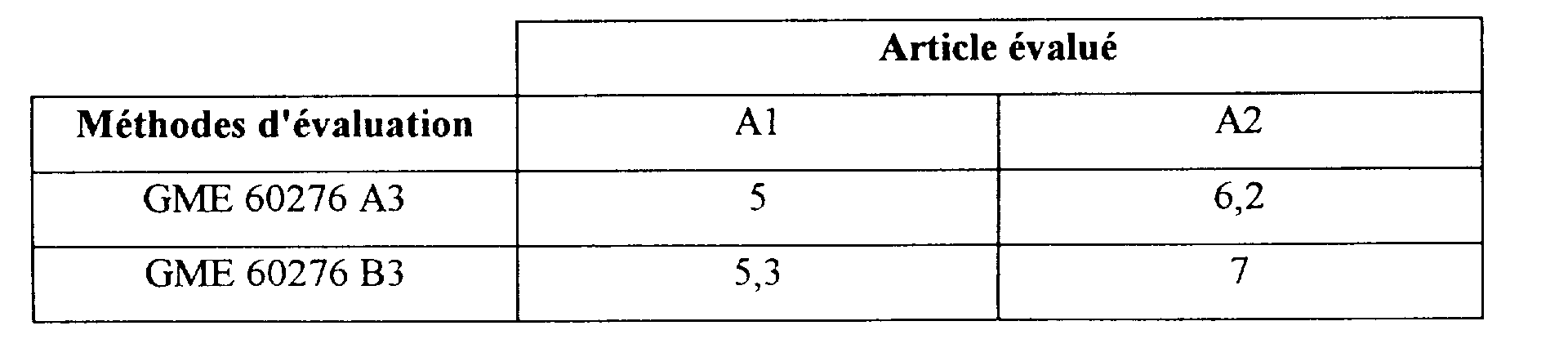
- the GME 60287 method from General Motors is used. We cut out identical size test pieces in articles A1 and A2. The test pieces are suspended in bottles previously washed, sterilized and then rinsed.
- Distilled water is introduced into the bottom of the bottles so that the test tubes never come into contact with water.
- the bottles are sealed.
- the bottles are heated for 14 days at 40 ° C.
- An M3 needled fibrous mat was prepared by reproducing the operating conditions set out in example 1. The only difference is in the handling of the tows flaxseed, which is in Example 2 is a leaching treatment.
- Leaching consists essentially of treating flax stained tows using a high temperature aqueous solution containing a chemical agent such as sodium hydroxide caustic, lime or an alkaline or alkaline earth carbonate.
- a chemical agent such as sodium hydroxide caustic, lime or an alkaline or alkaline earth carbonate.
- the second rinse water contains formic acid for neutralization at pH 7.
- the fogging disc which is deposited on the glass plate is homogeneous and transparent.
- test pieces of article A3 After 14 days, there is no evidence of mold. In addition, the smell of test pieces of article A3 is not very pronounced and is not unpleasant.
Landscapes
- Engineering & Computer Science (AREA)
- Mechanical Engineering (AREA)
- Chemical & Material Sciences (AREA)
- Composite Materials (AREA)
- Compositions Of Macromolecular Compounds (AREA)
- Dry Formation Of Fiberboard And The Like (AREA)
Abstract
Description
- ils peuvent produire des gaz odorants, résultant probablement, d'une part des températures élevées auxquelles les fibres végétales sont soumises lors de l'opération de chauffage des mats fibreux, et d'autre part de la température et de l'ambiance (lumière, chaleur, hygrométrie) dans le véhicule où l'article est utilisé. Ainsi, il a été constaté que des émanations odorantes se poursuivent et persistent tout au long de la vie de l'article, dans l'espace intérieur du véhicule;
- ils peuvent produire des composés organiques volatils, plus ou moins gras, qui peuvent se déposer sur les vitres du véhicule pour former un voile gênant la visibilité du conducteur (ce phénomène est connu sous le vocable anglais de "fogging");
- ils peuvent se dégrader progressivement en présence d'humidité, par suite du développement de moisissures. Les fibres végétales sont en effet facilement putrescibles quand elles sont mises en présence d'humidité et de l'oxygène de l'air. La dégradation des fibres végétales peut aller jusqu'à des nuisances d'odeurs et d'aspect ainsi qu'à une diminution notable des résistances mécaniques des articles connus.
- l'article est monocouche;
- l'article a une densité moyenne égale ou supérieure à 0,70 ;
- les fibres végétales sont traitées afin d'éliminer, au moins partiellement, des composés chimiques indésirables associés aux fibres végétales ;
- l'article est obtenu à partir d'un mat fibreux et aiguilleté, constitué minoritairement en poids de fibres végétales traitées et majoritairement en poids de matière synthétique thermoplastique, et ;
- les fibres végétales traitées et la matière synthétique thermoplastique sont mélangées et réparties de façon sensiblement uniforme dans le mat fibreux et aiguilleté.
- la matière synthétique thermoplastique est sous la forme de fibres synthétiques thermoplastiques;
- les fibres végétales traitées et les fibres synthétiques thermoplastiques sont mélangées et réparties de façon sensiblement uniforme dans le mat fibreux et sont aiguilletées ;
- le mat fibreux et aiguilleté, qui est flexible et thermofaçonnable, est constitué minoritairement en poids de fibres végétales traitées et majoritairement en poids de fibres synthétiques thermoplastiques.
- "article" désigne un article monocouche, préparé préférentiellement par thermofaçonnage. Cet article conserve sa forme dans des conditions normales de pose et d'utilisation. Son grammage est de préférence compris entre 200 et 3500g/m2. Dans le cas de l'application en tant que panneau de porte, son grammage est alors de l'ordre de 1600 g/m2 ou supérieur;
- "composés chimiques indésirables associés aux fibres végétales" désigne essentiellement des composés chimiques qui subsistent dans les fibres végétales, après les opérations de traitements naturels, biochimiques et physiques de rouissage, de broyage, de teillage (et le cas échéant de peignage) et qui peuvent produire des composés organiques volatils odorants et/ou gras (fogging). Ces composés chimiques indésirables sont essentiellement constitués de pectine et autres substances grasses. Des exemples de composés organiques volatils résultant de ces composés organiques indésirables sont donnés dans les exemples (se reporter aux résultats de l'analyse par chromatographie en phase gazeuse couplée à une spectrométrie de masse) ;
- "fibres végétales traitées" désigne les fibres végétales plus ou moins purifiées, qui
ont subi :
- des traitements visant à éliminer une grande partie, voire la totalité, de la lignine (ou particules de bois) associée aux fibres végétales cellulosiques. On utilise généralement des traitements naturels, biochimiques et physiques de rouissage, de broyage, de teillage et, le cas échéant, de peignage,
- suivies par un traitement visant à éliminer une grande partie des composés chimiques indésirables précités. De préférence, le traitement est chimique et réalisé selon les modes de réalisation décrits ci-après.
- le bain aqueux à une température élevée, de préférence comprise entre environ 60°C et environ 95°C; et
- le bain aqueux à un pH basique, de préférence, compris entre 9 et 10 ; et
- le bain aqueux contient au moins un agent de blanchiment, de préférence choisi parmi le peroxyde d'hydrogène, les hypochlorites en particulier l'eau de Javel ou les chlorites. De préférence, on utilise le peroxyde d'hydrogène.
- un ou plusieurs agents séquestrants, à raison d'environ 0,5 à 2 g/litre de solution;
- un ou plusieurs agents alcalins, de préférence un agent alcalin carbonaté tel que le bicarbonate de sodium, à raison d'environ 0,5 à 2 g/litre de solution.
- si la mesure est réalisée à une fréquence angulaire de 10 radians par seconde, à 200°C, la viscosité en oscillation du polypropylène sera comprise entre 240 et 1000 Pa.s (bornes incluses);
- si la mesure est réalisée à une fréquence angulaire de 100 radians par seconde, à 200°C, la viscosité en oscillation du polypropylène sera comprise entre 140 et 400 Pa.s
- un agent colorant, de préférence un agent colorant ayant une affinité pour la cellulose des fibres végétales, et/ou
- une (ou plusieurs) charge finement divisée telle que, par exemple, du charbon actif, des zéolithes, du carbonate de calcium et de la silice, éventuellement imprégnée de substances chimiques actives, et/ou
- un agent hygroscopique pour minimiser, voire empêcher la fixation d'eau, par les fibres végétales,
- d'autres types de fibres pour accroítre sa tenue au feu et/ou sa résistance en traction, telles que des fibres de verre, et/ou
- au moins un agent anti oxydant, et/ou
- au moins un agent anti-ultraviolet, etc.
- la forte diminution de la production de gaz odorants par les articles rigides après thermofaçonnage, et
- la forte diminution du phénomène de formation d'un voile sur une vitre (fogging), susceptible de gêner l'automobiliste;
- l'absence de dégradation de l'article en présence d'humidité, par suite du développement de moisissures, dans des conditions normales d'utilisation;
- à grammage équivalent, les caractéristiques mécaniques sont équivalentes ou supérieures. Ainsi, le module de flexion de l'article selon l'invention est plus élevé.
- température de fusion : 165,7°C (selon NFT 51223);
- viscosité en oscillation à 0,1 rad/s à 200°C: 974,5 Pa.s
- les fibres de lin utilisées pour préparer le mat M1 sont brutes ou écrues, c'est-à-dire qu'elles n'ont pas subies un traitement chimique particulier après rouissage, broyage, et teillage;
- tandis que les fibres de lin utilisées pour préparer le mat M2 ont été soumises à un traitement chimique afin d'éliminer, au moins partiellement, les composés chimiques indésirables associés au lin.
- 2 à 6 g par litre de soude (NaOH);
- 4 à 8 g par litre de carbonate de sodium;
- 10 à 15 cm3 d'eau oxygénée (H2O2) à 130 volumes d'oxygène (soit 10 à 15 cm3 d'eau oxygénée à 35 % en poids) ;
- 2,5 à 4 cm3 par litre de silicate de soude à 35-37 % en poids ;
- un agent séquestrant à raison de lg par litre ;
- un agent mouillant à raison de 1g par litre.
- on réalise un mélange intime des fibres de lin (selon le cas traitées ou non) et des fibres de polypropylène par brassage de ces fibres ;
- puis on procède au cardage des fibres pour finir le mélange intime et affiner les fibres de lin;
- puis on effectue le nappage du voile de carde par superposition des voiles de carde de 20 à 25 g/m2 ;
- on procède après à un pré-aiguilletage à raison de 4 coups d'aiguilles par cm2, suivi d'un aiguilletage à raison de 55 coups d'aiguilles par cm2 sur une profondeur d'aiguilletage de 14 mm. Les mats M1 et M2 obtenus ont une épaisseur d'environ 14 mm.
| Effet du blanchiment des fibres de lin sur les émissions de composés volatils après étuvage des éprouvettes | |||
| Famille chimique des composés volatils | Nature chimique des composés volatils | Quantité de composés volatils émise par les éprouvettes issues de A1, en mg pour 20 g d'échantillon | Action du blanchiment Réduction des émissions de composés volatils par les éprouvettes issues de A2, exprimés en % en poids |
| Cétones | Acétone | 26,5 | 80 % |
| Butanone | 257,7 | 91 % | |
| méthylpentanone | 21,6 | 100 % | |
| Acides | Acide Acétique | 25 | 100 % |
| Acide Pentanoïque | 48,4 | 100 % | |
| Aldéhydes | Pentanal | 17,32 | 100 % |
| Hexanal | 66,62 | 55 % | |
| Heptanal | 23,58 | 52 % | |
| Octanal | 26,68 | 56 % | |
| Benzaldéhyde | 16,44 | 48 % | |
| Alcanes | méthyl-2 hexane | 38,6 | 100 % |
| méthyl-3 hexane | 48,28 | 89 % | |
| Heptane | 96 | 88 % | |
| méthylcyclohexane | 100,62 | 90 % | |
| éthylcyclopentane | 8,64 | 100 % | |
| Alcane C9 | 3,5 | 100 % | |
| Alcane C14 | 62,82 | 80 % | |
| Alcane C13 | 17,52 | 57 % | |
| Aromatiques | Toluène | 26,52 | 80 % |
| Ethylenzène | 30,82 | 100 % | |
| Phénol | 518,5 | 94 % | |
| méthoxy propényl Benzène | 93 | 83 % | |
| triméthyl Benzène | 22,4 | 55 % | |
| Amides | Diméthyl acétamide | 70,3 | 88 % |

Remarque: toute matière végétale, en présence d'oxygène, d'humidité et à une certaine température, est susceptible de développer des champignons et des moisissures.
| Article A1 | Article A2 |
| Développement de champignons verts ou gris | Pas de moisissures constatées visuellement |
- Aspergillus Fumigatus M137;
- Trichoderma Konigii M136.
- 2 à 6 g par litre de soude (NaOH);
- 4 à 8 g par litre de (bi)carbonate de sodium;
- un agent séquestrant à raison de 1 g par litre ;
- un agent mouillant et détergent, à raison de 1 g par litre.
Claims (27)
- Article, utile notamment pour la fabrication de pièces de véhicules routiers, à base de fibres végétales et de matière synthétique thermoplastique, caractérisé en ce que :l'article est monocouche;l'article a une densité moyenne égale ou supérieure à 0,70;l'article renferme des fibres végétales traitées afin d'être débarrassées au moins partiellement des composés chimiques indésirables associés aux fibres végétales;l'article est obtenu à partir d'un mat fibreux et aiguilleté, constitué minoritairement en poids de fibres végétales traitées et majoritairement en poids de matière synthétique thermoplastique; et,les fibres végétales traitées et la matière, synthétique thermoplastique, sont mélangées et réparties de façon sensiblement uniforme dans le mat fibreux et aiguilleté.
- Article selon la revendication 1, caractérisé en ce que la matière synthétique thermoplastique est sous la forme de fibres synthétiques thermoplastiques, et en ce que les fibres végétales traitées et les fibres synthétiques thermoplastiques sont mélangées et réparties de façon sensiblement uniforme dans le mat fibreux et aiguilletées.
- Article selon la revendication 1 ou 2, caractérisé en ce que les fibres végétales sont traitées à l'aide d'un bain aqueux chaud, contenant au moins un agent alcalin.
- Article selon l'une des revendications précédentes, caractérisé en ce que l'agent alcalin est carbonaté.
- Article selon la revendication 1 ou 2, caractérisé en ce que les fibres sont traitées à l'aide d'un bain aqueux chaud, ayant un pH basique et contenant au moins un agent de blanchiment.
- Article selon la revendication 5, caractérisé en ce que l'agent de blanchiment est le peroxyde d'hydrogène.
- Article selon l'une des revendications précédentes, caractérisé en ce que les fibres végétales traitées sont en outre teintées.
- Article selon l'une des revendications précédentes, caractérisé en ce qu'il présente une densité moyenne comprise entre 0,75 et 0,99 (bornes incluses).
- Article selon l'une des revendications précédentes 2 à 8, caractérisé en ce que les fibres synthétiques thermoplastiques présentent une longueur moyenne au moins égale à 30 mm ou supérieure.
- Article selon l'une des revendications précédentes 2 à 9, caractérisé en ce que les fibres synthétiques thermoplastiques présentent une finesse comprise entre 1,5 et 17 dtex.
- Article selon l'une des revendications précédentes 2 à 10, caractérisé en ce que les fibres synthétiques thermoplastiques sont à base de polypropylène.
- Article selon la revendication 11, caractérisé en ce que les fibres synthétiques thermoplastiques sont à base d'un homopolymère de propylène.
- Article selon la revendication 11 ou 12, caractérisé en ce que la température de fusion du polypropylène constitutif des fibres est compris entre 155 et 175°C (bornes incluses), dans les conditions de la norme NFT 51223.
- Article selon la revendication 11 ou 12, caractérisé en ce que la viscosité en oscillation à 0,1 rad/s à 200°C, du polypropylène constitutif des fibres, est comprise entre 250 et 2500 Pa.s (bornes incluses).
- Article selon l'une des revendications 11 à 14, caractérisé en ce que les fibres de polypropylène représentent au plus 90 % du poids de l'article.
- Article selon la revendication 15, caractérisé en ce que les fibres de polypropylène représentent de l'ordre de 55 % à 65 % du poids de l'article.
- Article selon l'une des revendications précédentes, caractérisé en ce que la longueur moyenne des fibres végétales traitées est au moins égale à 30 mm.
- Article selon l'une des revendications précédentes, caractérisé en ce que les fibres végétales traitées sont à base de fibres de lin.
- Article selon la revendication 18, caractérisé en ce que les fibres de lin sont des étoupes de teillage.
- Article selon la revendication 19, caractérisé en ce que les fibres de lin sont des étoupes teillées.
- Article selon l'une des revendications précédentes, caractérisé en ce que le grammage de l'article est compris entre 200 et 3500 g/m2.
- Article selon l'une des revendications précédentes, caractérisé en ce qu'il renferme en outre au moins un agent colorant, et/ou au moins une charge finement divisée, et/ou un agent hygroscopique, et/ou d'autres types de fibres afin d'accroítre la tenue au feu du produit rigide et/ou sa résistance en traction, et/ou au moins un agent antioxydant, et/ou au moins un agent anti-ultraviolet.
- Article selon l'une des revendications précédentes, caractérisé en ce qu'il renferme en outre au moins un agent fongicide capable de résister sans se dégrader à une température comprise entre 160 et 220°C (bornes incluses), de préférence choisi parmi les agents fongicides appartenant à la famille des imidazoles, de préférence encore appartenant à la famille des esters d'alkyle d'acide carbamique de benzimidazole.
- Article selon l'une des revendications précédentes, caractérisé en ce qu'il présente une épaisseur comprise entre 0,3 et 4 mm (bornes incluses).
- Procédé de fabrication de l'article selon l'une des revendications 2 à 24, caractérisé en ce que l'on soumet un mat fibreux aiguilleté, constitué minoritairement en poids de fibres végétales, traitées afin d'en éliminer au moins partiellement les composés chimiques indésirables, et majoritairement en poids de fibres synthétiques thermoplastiques, à une première opération de chauffage par contact, à une température comprise entre 160 et 220°C (bornes incluses), sous une pression inférieure ou égale à 8 bars, suivie d'une seconde opération de compression sous une pression de l'ordre de 5 à 20 bars (bornes incluses), dans un moule froid.
- Application de l'article selon l'une des revendications 1 à 25 pour la fabrication de pièces de véhicules routiers.
- Application de l'article selon l'une des revendications 1 à 25 pour la fabrication d'un article stratifié, selon laquelle cet article constitue une première couche sur laquelle on fixe une couche décorative et, le cas échéant, entre la première couche et la couche décorative, une couche intermédiaire, de préférence pour le confort et/ou l'isolation thermique et/ou l'isolation phonique.
Applications Claiming Priority (2)
| Application Number | Priority Date | Filing Date | Title |
|---|---|---|---|
| FR9801249 | 1998-01-29 | ||
| FR9801249A FR2774020B1 (fr) | 1998-01-29 | 1998-01-29 | Article a base de fibres vegetales utile pour la fabrication de pieces de vehicules routiers |
Publications (3)
| Publication Number | Publication Date |
|---|---|
| EP0933191A1 true EP0933191A1 (fr) | 1999-08-04 |
| EP0933191B1 EP0933191B1 (fr) | 2002-07-10 |
| EP0933191B2 EP0933191B2 (fr) | 2009-09-02 |
Family
ID=9522549
Family Applications (1)
| Application Number | Title | Priority Date | Filing Date |
|---|---|---|---|
| EP99420026A Expired - Lifetime EP0933191B2 (fr) | 1998-01-29 | 1999-01-29 | Article à base de fibres végétales utile pour la fabrication de pièces de véhicules routiers |
Country Status (3)
| Country | Link |
|---|---|
| EP (1) | EP0933191B2 (fr) |
| DE (1) | DE69902061T2 (fr) |
| FR (1) | FR2774020B1 (fr) |
Cited By (3)
| Publication number | Priority date | Publication date | Assignee | Title |
|---|---|---|---|---|
| FR2892046A1 (fr) * | 2005-10-17 | 2007-04-20 | Apollor Union | Produit a base de mat thermoplastique, son procede de fabrication et application de ce produit. |
| CN1328312C (zh) * | 2003-11-03 | 2007-07-25 | 倪斌 | 一种植物纤维聚丙烯复合材料及制备方法 |
| WO2008135593A1 (fr) * | 2007-05-07 | 2008-11-13 | Concert Gmbh | Produit semi-fini multicouche en matériau composite renforcé de fibres constitué de fibres de renforcement courtes à drapé optimisé |
Families Citing this family (1)
| Publication number | Priority date | Publication date | Assignee | Title |
|---|---|---|---|---|
| DE19961216A1 (de) * | 1999-12-15 | 2001-06-28 | Hempage Ag | Bewehrungsmaterial, Verfahren zu seiner Herstellung und Anwendung des Bewehrungsmaterials |
Citations (9)
| Publication number | Priority date | Publication date | Assignee | Title |
|---|---|---|---|---|
| GB198910A (en) * | 1922-06-09 | 1923-06-14 | Gen Electric | Improvements in and relating to moulded materials and methods of making the same |
| FR1313921A (fr) * | 1961-11-21 | 1963-01-04 | Comptoir Linier | Nouveau procédé de fabrication de produits moulés à partir de résines thermodurcissables armées de fibres naturelles |
| DE1283541B (de) * | 1962-12-22 | 1968-11-21 | Terpal Chemie Ruck & Co | Verstaerker von Kunstharzen |
| US4617383A (en) * | 1983-11-22 | 1986-10-14 | Helmic, Inc. | Method for degumming and bleaching decorticated plant bast fiber |
| US5232779A (en) * | 1989-04-17 | 1993-08-03 | Ecco Gleittechnik Gmbh | Reinforcement fibers and/or process fibers based on plant fibers, method for their production, and their use |
| DE4207243A1 (de) * | 1992-03-07 | 1993-09-09 | Basf Ag | Poroese formteile |
| EP0647519A1 (fr) * | 1993-10-06 | 1995-04-12 | Matec Holding Ag | Article moulé sans odeur pour isolation acoustique et thermique et procédé pour sa fabrication |
| EP0744261A1 (fr) * | 1995-05-21 | 1996-11-27 | Möller Plast GmbH | Elément de structure composite, en particulier panneau avec revêtement et son procédé de fabrication |
| DE19543165A1 (de) * | 1995-11-20 | 1997-05-22 | Hoelter Heinz | Innenverkleidungsteil für Kraftfahrzeuge und Verfahren zu seiner Herstellung |
Family Cites Families (6)
| Publication number | Priority date | Publication date | Assignee | Title |
|---|---|---|---|---|
| LU31165A1 (fr) † | 1950-12-27 | |||
| DE2845117C2 (de) † | 1978-10-17 | 1985-03-07 | Casimir Kast Gmbh & Co Kg, 7562 Gernsbach | Verfahren und Anlage zur Herstellung von zu Formteilen verpreßbarem Plattenmaterial |
| DE3614533A1 (de) † | 1986-04-29 | 1987-11-05 | Walter Isphording | Verfahren zum herstellen von kompakten, eine verstaerkungseinlage aus fasern enthaltenden formkoerpern aus thermoplastischem kunststoff |
| DE4228606C5 (de) † | 1992-08-28 | 2004-10-14 | Quadrant Plastic Composites Ag | Flächiger Verbundwerkstoff |
| EP0596379A1 (fr) † | 1992-10-31 | 1994-05-11 | Hoechst Aktiengesellschaft | Masse à mouler polymère pour la fabrication d'objets colorés avec un effet décoratif |
| DE4311592C2 (de) † | 1993-04-08 | 2002-06-27 | R & S Technik Gmbh | Verfahren und Vorrichtung zum Herstellen von Kunststoff enthaltenden Teilen mit wenigstens einer Hohlkammer und entsprechend hergestelltes Teil |
-
1998
- 1998-01-29 FR FR9801249A patent/FR2774020B1/fr not_active Expired - Fee Related
-
1999
- 1999-01-29 EP EP99420026A patent/EP0933191B2/fr not_active Expired - Lifetime
- 1999-01-29 DE DE69902061T patent/DE69902061T2/de not_active Expired - Lifetime
Patent Citations (9)
| Publication number | Priority date | Publication date | Assignee | Title |
|---|---|---|---|---|
| GB198910A (en) * | 1922-06-09 | 1923-06-14 | Gen Electric | Improvements in and relating to moulded materials and methods of making the same |
| FR1313921A (fr) * | 1961-11-21 | 1963-01-04 | Comptoir Linier | Nouveau procédé de fabrication de produits moulés à partir de résines thermodurcissables armées de fibres naturelles |
| DE1283541B (de) * | 1962-12-22 | 1968-11-21 | Terpal Chemie Ruck & Co | Verstaerker von Kunstharzen |
| US4617383A (en) * | 1983-11-22 | 1986-10-14 | Helmic, Inc. | Method for degumming and bleaching decorticated plant bast fiber |
| US5232779A (en) * | 1989-04-17 | 1993-08-03 | Ecco Gleittechnik Gmbh | Reinforcement fibers and/or process fibers based on plant fibers, method for their production, and their use |
| DE4207243A1 (de) * | 1992-03-07 | 1993-09-09 | Basf Ag | Poroese formteile |
| EP0647519A1 (fr) * | 1993-10-06 | 1995-04-12 | Matec Holding Ag | Article moulé sans odeur pour isolation acoustique et thermique et procédé pour sa fabrication |
| EP0744261A1 (fr) * | 1995-05-21 | 1996-11-27 | Möller Plast GmbH | Elément de structure composite, en particulier panneau avec revêtement et son procédé de fabrication |
| DE19543165A1 (de) * | 1995-11-20 | 1997-05-22 | Hoelter Heinz | Innenverkleidungsteil für Kraftfahrzeuge und Verfahren zu seiner Herstellung |
Cited By (4)
| Publication number | Priority date | Publication date | Assignee | Title |
|---|---|---|---|---|
| CN1328312C (zh) * | 2003-11-03 | 2007-07-25 | 倪斌 | 一种植物纤维聚丙烯复合材料及制备方法 |
| FR2892046A1 (fr) * | 2005-10-17 | 2007-04-20 | Apollor Union | Produit a base de mat thermoplastique, son procede de fabrication et application de ce produit. |
| EP1775170A3 (fr) * | 2005-10-17 | 2008-05-07 | Apollor Union | Produit à base de mat thermoplastique, son procédé de fabrication et applications de ce produit |
| WO2008135593A1 (fr) * | 2007-05-07 | 2008-11-13 | Concert Gmbh | Produit semi-fini multicouche en matériau composite renforcé de fibres constitué de fibres de renforcement courtes à drapé optimisé |
Also Published As
| Publication number | Publication date |
|---|---|
| FR2774020B1 (fr) | 2000-03-10 |
| DE69902061D1 (de) | 2002-08-14 |
| FR2774020A1 (fr) | 1999-07-30 |
| DE69902061T2 (de) | 2003-03-13 |
| EP0933191B1 (fr) | 2002-07-10 |
| EP0933191B2 (fr) | 2009-09-02 |
Similar Documents
| Publication | Publication Date | Title |
|---|---|---|
| US9902813B2 (en) | Method for reinforcing a thermoplastic resin composition | |
| Choi et al. | Effects of surface treatment of ramie fibers in a ramie/poly (lactic acid) composite | |
| CA2804662A1 (fr) | Nouveaux materiaux composites a base de cellulose | |
| FR2912427A1 (fr) | Procede de fabrication d'une armature de renfort et d'une membrane d'etancheite comprenant une telle armature et produits obtenus. | |
| Azlin et al. | Natural polylactic acid-based fiber composites: a review | |
| CA2933784C (fr) | Procede pour traiter des fibres de lin de plantes oleagineuses destinees a etre utilisees dans des materiaux biocomposites | |
| US10093779B2 (en) | Method for reinforcing a thermoplastic resin composition | |
| EP0933191B1 (fr) | Article à base de fibres végétales utile pour la fabrication de pièces de véhicules routiers | |
| FR2932511A1 (fr) | Panneau d'isolation thermique a base de fibres naturelles et son procede de fabrication. | |
| CA3062509A1 (fr) | Procede de fabrication d'un materiau composite | |
| EP2026949A1 (fr) | Produits multicouches | |
| FR2898900A1 (fr) | Ensimage pour mat de verre aiguillete | |
| CN109181061A (zh) | 一种基于石墨烯的微发泡聚乙烯科技板材及其制备方法 | |
| EP2516148B1 (fr) | Membrane d'etancheite souple, notamment pour l'etancheification de surfaces planes telles que des toitures | |
| FR2491821A1 (fr) | Procede de recyclage de dechets fibreux par moulage avec des resines phenoliques et produits expanses et moules obtenus | |
| CA2989726C (fr) | Procede d'elimination d'odeurs de matieres fibreuses utilisees dans la formation de materiaux biocomposites | |
| FR3152816A1 (fr) | Nappe fibreuse biosourcée aux propriétés d’isolation | |
| SILVA | WOOD-FIBER REINFORCED BIO-POLYMER COMPOSITES AS ALTERNATIVE MATERIALS FOR INDUSTRIAL APPLICATIONS | |
| FR2626888A1 (fr) | Composition de resine pour materiaux composites ablatifs a matrice organique |
Legal Events
| Date | Code | Title | Description |
|---|---|---|---|
| PUAI | Public reference made under article 153(3) epc to a published international application that has entered the european phase |
Free format text: ORIGINAL CODE: 0009012 |
|
| AK | Designated contracting states |
Kind code of ref document: A1 Designated state(s): BE DE ES FR GB IT |
|
| AX | Request for extension of the european patent |
Free format text: AL;LT;LV;MK;RO;SI |
|
| 17P | Request for examination filed |
Effective date: 19991018 |
|
| AKX | Designation fees paid |
Free format text: BE DE ES FR GB IT |
|
| 17Q | First examination report despatched |
Effective date: 20000816 |
|
| RAP1 | Party data changed (applicant data changed or rights of an application transferred) |
Owner name: VISTEON SYSTEMES INTERIEURS S.A.S. |
|
| GRAG | Despatch of communication of intention to grant |
Free format text: ORIGINAL CODE: EPIDOS AGRA |
|
| GRAG | Despatch of communication of intention to grant |
Free format text: ORIGINAL CODE: EPIDOS AGRA |
|
| GRAH | Despatch of communication of intention to grant a patent |
Free format text: ORIGINAL CODE: EPIDOS IGRA |
|
| GRAH | Despatch of communication of intention to grant a patent |
Free format text: ORIGINAL CODE: EPIDOS IGRA |
|
| GRAA | (expected) grant |
Free format text: ORIGINAL CODE: 0009210 |
|
| AK | Designated contracting states |
Kind code of ref document: B1 Designated state(s): BE DE ES FR GB IT |
|
| PG25 | Lapsed in a contracting state [announced via postgrant information from national office to epo] |
Ref country code: IT Free format text: LAPSE BECAUSE OF FAILURE TO SUBMIT A TRANSLATION OF THE DESCRIPTION OR TO PAY THE FEE WITHIN THE PRE;WARNING: LAPSES OF ITALIAN PATENTS WITH EFFECTIVE DATE BEFORE 2007 MAY HAVE OCCURRED AT ANY TIME BEFORE 2007. THE CORRECT EFFECTIVE DATE MAY BE DIFFERENT FROM THE ONE RECORDED.SCRIBED TIME-LIMIT Effective date: 20020710 |
|
| REG | Reference to a national code |
Ref country code: GB Ref legal event code: FG4D Free format text: NOT ENGLISH |
|
| REF | Corresponds to: |
Ref document number: 69902061 Country of ref document: DE Date of ref document: 20020814 |
|
| GBT | Gb: translation of ep patent filed (gb section 77(6)(a)/1977) |
Effective date: 20021016 |
|
| PG25 | Lapsed in a contracting state [announced via postgrant information from national office to epo] |
Ref country code: ES Free format text: LAPSE BECAUSE OF FAILURE TO SUBMIT A TRANSLATION OF THE DESCRIPTION OR TO PAY THE FEE WITHIN THE PRESCRIBED TIME-LIMIT Effective date: 20030130 |
|
| PLBI | Opposition filed |
Free format text: ORIGINAL CODE: 0009260 |
|
| PLBQ | Unpublished change to opponent data |
Free format text: ORIGINAL CODE: EPIDOS OPPO |
|
| PLBI | Opposition filed |
Free format text: ORIGINAL CODE: 0009260 |
|
| 26 | Opposition filed |
Opponent name: QUADRANT NATURAL FIBER COMPOSITES GMBH Effective date: 20030226 |
|
| PLBI | Opposition filed |
Free format text: ORIGINAL CODE: 0009260 |
|
| PLBQ | Unpublished change to opponent data |
Free format text: ORIGINAL CODE: EPIDOS OPPO |
|
| PLBI | Opposition filed |
Free format text: ORIGINAL CODE: 0009260 |
|
| 26 | Opposition filed |
Opponent name: JOHANN BORGERS GMBH & CO. KG. Effective date: 20030408 Opponent name: QUADRANT NATURAL FIBER COMPOSITES GMBH Effective date: 20030226 |
|
| 26 | Opposition filed |
Opponent name: FINDLAY INDUSTRIES DEUTSCHLAND GMBH Effective date: 20030409 Opponent name: JOHANN BORGERS GMBH & CO. KG. Effective date: 20030408 Opponent name: QUADRANT NATURAL FIBER COMPOSITES GMBH Effective date: 20030226 |
|
| 26 | Opposition filed |
Opponent name: SAI AUTOMOTIVE SAL GMBH Effective date: 20030410 Opponent name: FINDLAY INDUSTRIES DEUTSCHLAND GMBH Effective date: 20030409 Opponent name: JOHANN BORGERS GMBH & CO. KG. Effective date: 20030408 Opponent name: QUADRANT NATURAL FIBER COMPOSITES GMBH Effective date: 20030226 |
|
| PLAX | Notice of opposition and request to file observation + time limit sent |
Free format text: ORIGINAL CODE: EPIDOSNOBS2 |
|
| PLAX | Notice of opposition and request to file observation + time limit sent |
Free format text: ORIGINAL CODE: EPIDOSNOBS2 |
|
| PLAX | Notice of opposition and request to file observation + time limit sent |
Free format text: ORIGINAL CODE: EPIDOSNOBS2 |
|
| PLBB | Reply of patent proprietor to notice(s) of opposition received |
Free format text: ORIGINAL CODE: EPIDOSNOBS3 |
|
| REG | Reference to a national code |
Ref country code: FR Ref legal event code: CL |
|
| PLAQ | Examination of admissibility of opposition: information related to despatch of communication + time limit deleted |
Free format text: ORIGINAL CODE: EPIDOSDOPE2 |
|
| PLAR | Examination of admissibility of opposition: information related to receipt of reply deleted |
Free format text: ORIGINAL CODE: EPIDOSDOPE4 |
|
| PLBQ | Unpublished change to opponent data |
Free format text: ORIGINAL CODE: EPIDOS OPPO |
|
| PLAB | Opposition data, opponent's data or that of the opponent's representative modified |
Free format text: ORIGINAL CODE: 0009299OPPO |
|
| PLBI | Opposition filed |
Free format text: ORIGINAL CODE: 0009260 |
|
| 26 | Opposition filed |
Opponent name: FAURECIA INNENRAUM SYSTEME GMBH Effective date: 20030410 Opponent name: FINDLAY INDUSTRIES DEUTSCHLAND GMBH Effective date: 20030409 Opponent name: JOHANN BORGERS GMBH & CO. KG. Effective date: 20030408 Opponent name: QUADRANT NATURAL FIBER COMPOSITES GMBH Effective date: 20030226 |
|
| APBP | Date of receipt of notice of appeal recorded |
Free format text: ORIGINAL CODE: EPIDOSNNOA2O |
|
| APBP | Date of receipt of notice of appeal recorded |
Free format text: ORIGINAL CODE: EPIDOSNNOA2O |
|
| APAH | Appeal reference modified |
Free format text: ORIGINAL CODE: EPIDOSCREFNO |
|
| APBQ | Date of receipt of statement of grounds of appeal recorded |
Free format text: ORIGINAL CODE: EPIDOSNNOA3O |
|
| PGFP | Annual fee paid to national office [announced via postgrant information from national office to epo] |
Ref country code: GB Payment date: 20080124 Year of fee payment: 10 |
|
| PGFP | Annual fee paid to national office [announced via postgrant information from national office to epo] |
Ref country code: FR Payment date: 20080111 Year of fee payment: 10 |
|
| PGFP | Annual fee paid to national office [announced via postgrant information from national office to epo] |
Ref country code: BE Payment date: 20080304 Year of fee payment: 10 |
|
| APBU | Appeal procedure closed |
Free format text: ORIGINAL CODE: EPIDOSNNOA9O |
|
| PUAH | Patent maintained in amended form |
Free format text: ORIGINAL CODE: 0009272 |
|
| STAA | Information on the status of an ep patent application or granted ep patent |
Free format text: STATUS: PATENT MAINTAINED AS AMENDED |
|
| 27A | Patent maintained in amended form |
Effective date: 20090902 |
|
| AK | Designated contracting states |
Kind code of ref document: B2 Designated state(s): BE DE ES FR GB IT |
|
| GBPC | Gb: european patent ceased through non-payment of renewal fee |
Effective date: 20090129 |
|
| REG | Reference to a national code |
Ref country code: ES Ref legal event code: FD2A Effective date: 20030130 |
|
| REG | Reference to a national code |
Ref country code: FR Ref legal event code: ST Effective date: 20091030 |
|
| PG25 | Lapsed in a contracting state [announced via postgrant information from national office to epo] |
Ref country code: GB Free format text: LAPSE BECAUSE OF NON-PAYMENT OF DUE FEES Effective date: 20090129 |
|
| PG25 | Lapsed in a contracting state [announced via postgrant information from national office to epo] |
Ref country code: BE Free format text: LAPSE BECAUSE OF NON-PAYMENT OF DUE FEES Effective date: 20090131 |
|
| PLAB | Opposition data, opponent's data or that of the opponent's representative modified |
Free format text: ORIGINAL CODE: 0009299OPPO |
|
| R26 | Opposition filed (corrected) |
Opponent name: FAURECIA INNENRAUM SYSTEME GMBH Effective date: 20030410 Opponent name: FINDLAY INDUSTRIES DEUTSCHLAND GMBH Effective date: 20030409 Opponent name: JOHANN BORGERS GMBH & CO. KG. Effective date: 20030408 Opponent name: QUADRANT NATURAL FIBER COMPOSITES GMBH Effective date: 20030226 |
|
| PG25 | Lapsed in a contracting state [announced via postgrant information from national office to epo] |
Ref country code: FR Free format text: LAPSE BECAUSE OF NON-PAYMENT OF DUE FEES Effective date: 20090202 |
|
| PG25 | Lapsed in a contracting state [announced via postgrant information from national office to epo] |
Ref country code: DE Free format text: LAPSE BECAUSE OF FAILURE TO SUBMIT A TRANSLATION OF THE DESCRIPTION OR TO PAY THE FEE WITHIN THE PRESCRIBED TIME-LIMIT Effective date: 20091203 |
|
| REG | Reference to a national code |
Ref country code: DE Ref legal event code: 8570 |
|
| PGRI | Patent reinstated in contracting state [announced from national office to epo] |
Ref country code: DE Effective date: 20110126 |
|
| PGFP | Annual fee paid to national office [announced via postgrant information from national office to epo] |
Ref country code: DE Payment date: 20140122 Year of fee payment: 16 |
|
| REG | Reference to a national code |
Ref country code: DE Ref legal event code: R119 Ref document number: 69902061 Country of ref document: DE |
|
| PG25 | Lapsed in a contracting state [announced via postgrant information from national office to epo] |
Ref country code: DE Free format text: LAPSE BECAUSE OF FAILURE TO SUBMIT A TRANSLATION OF THE DESCRIPTION OR TO PAY THE FEE WITHIN THE PRESCRIBED TIME-LIMIT Effective date: 20150801 |