EP0933366B1 - Derives de 5-phenyl-3-pyridazinone et compositions medicamenteuses les contenant - Google Patents
Derives de 5-phenyl-3-pyridazinone et compositions medicamenteuses les contenant Download PDFInfo
- Publication number
- EP0933366B1 EP0933366B1 EP97924332A EP97924332A EP0933366B1 EP 0933366 B1 EP0933366 B1 EP 0933366B1 EP 97924332 A EP97924332 A EP 97924332A EP 97924332 A EP97924332 A EP 97924332A EP 0933366 B1 EP0933366 B1 EP 0933366B1
- Authority
- EP
- European Patent Office
- Prior art keywords
- group
- phenyl
- compound
- acid
- alkyl group
- Prior art date
- Legal status (The legal status is an assumption and is not a legal conclusion. Google has not performed a legal analysis and makes no representation as to the accuracy of the status listed.)
- Expired - Lifetime
Links
Classifications
-
- C—CHEMISTRY; METALLURGY
- C07—ORGANIC CHEMISTRY
- C07D—HETEROCYCLIC COMPOUNDS
- C07D237/00—Heterocyclic compounds containing 1,2-diazine or hydrogenated 1,2-diazine rings
- C07D237/02—Heterocyclic compounds containing 1,2-diazine or hydrogenated 1,2-diazine rings not condensed with other rings
- C07D237/04—Heterocyclic compounds containing 1,2-diazine or hydrogenated 1,2-diazine rings not condensed with other rings having less than three double bonds between ring members or between ring members and non-ring members
-
- A—HUMAN NECESSITIES
- A61—MEDICAL OR VETERINARY SCIENCE; HYGIENE
- A61P—SPECIFIC THERAPEUTIC ACTIVITY OF CHEMICAL COMPOUNDS OR MEDICINAL PREPARATIONS
- A61P11/00—Drugs for disorders of the respiratory system
-
- A—HUMAN NECESSITIES
- A61—MEDICAL OR VETERINARY SCIENCE; HYGIENE
- A61P—SPECIFIC THERAPEUTIC ACTIVITY OF CHEMICAL COMPOUNDS OR MEDICINAL PREPARATIONS
- A61P29/00—Non-central analgesic, antipyretic or antiinflammatory agents, e.g. antirheumatic agents; Non-steroidal antiinflammatory drugs [NSAID]
-
- A—HUMAN NECESSITIES
- A61—MEDICAL OR VETERINARY SCIENCE; HYGIENE
- A61P—SPECIFIC THERAPEUTIC ACTIVITY OF CHEMICAL COMPOUNDS OR MEDICINAL PREPARATIONS
- A61P37/00—Drugs for immunological or allergic disorders
-
- A—HUMAN NECESSITIES
- A61—MEDICAL OR VETERINARY SCIENCE; HYGIENE
- A61P—SPECIFIC THERAPEUTIC ACTIVITY OF CHEMICAL COMPOUNDS OR MEDICINAL PREPARATIONS
- A61P43/00—Drugs for specific purposes, not provided for in groups A61P1/00-A61P41/00
Definitions
- the present invention relates to a novel 5-phenyl-3-pyridazinone derivative having a type IV phosphodiesterase (PDE) inhibitory activity and a pharmaceutical composition containing the same.
- PDE phosphodiesterase
- Intracellular second messenger cAMP is synthesized by adenylate cyclase, and hydrolysed to 5'-AMP by a family of phosphodiesterase(PDE) isozymes.
- PDE phosphodiesterase
- Intracellular second messenger cAMP is synthesized by adenylate cyclase, and hydrolysed to 5'-AMP by a family of phosphodiesterase(PDE) isozymes.
- PDE phosphodiesterase
- a compound which inhibit type IV PDE may exhibit beneficial effects on inflammatory disease such as asthma [J. Pharmacol. Exp. Ther., 266, 306 (1993)], dermatitis [Br. J. Pharmacol., 112, 332 (1994)], and autoimmune diseases including multiple sclerosis [Nature Medicine, 1, 244 (1994)], and rheumatoid arthritis [Clin. Exp. Immunol., 100, 126 (1995)].
- Rolipram having the following formula JP-A-50-157360 publication is known as a compound having a specific inhibitory action against type IV PDE.
- JP-A-60-89421 discloses a compound having the following formula (II): wherein R 1 represents an isopropyl group or t-butyl group; R 2 represents a hydrogen atom, C 1 to C 4 alkyl group, C 1 to C 4 alkoxy group, hydroxy group, or amino group; and R 3 represents a hydrogen atom or methyl group, as a ⁇ -adrenergic receptor antagonist.
- JP-A-4-234369 and EP 0 469 992 disclose a compound having the following formula (III): wherein Ar represents a phenyl group substituted with two groups, a pyridyl group, or thienyl group; and R 3 represents a C 1 to C 5 alkyl group, -CH 2 Ph group, or -CH 2 CH 2 Ph group, as a synthesis intermediate of a pharmaceutical composition.
- JP-A-50-37800 discloses a compound having the following formula (IV): wherein R 1 , R 2 , R 3 , and R 4 represent a hydrogen atom or lower alkyl group; and A represents a hydrogen atom or oxygen atom, as a synthesis intermediate of a compound exhibiting an analgesic action.
- WO 92/06963 discloses a compound having the following formula (V): wherein R 1 and R 2 represent a methoxy group, difluoromethoxy group, ethoxy group, C 4 to C 7 cycloalkoxy group, or C 3 to C 7 cycloalkylmethoxy group, as a synthesis intermediate of a compound exhibiting a bronchospasm relieving action.
- R 1 and R 2 represent a methoxy group, difluoromethoxy group, ethoxy group, C 4 to C 7 cycloalkoxy group, or C 3 to C 7 cycloalkylmethoxy group
- EP 0 738 715 was published after the date of filing of the present patent application.
- This document discloses an arylalkylpiperazinone derivative of the general formula I in which R 1 and R 2 in each case independently of one another are H or A, R 3 and R 4 in each case independently of one another are -OH, -OR 10 , -S-R 10 , -SOR 10 , -SO 2 R 10 , Hal, methylenedioxy, -NO 2 , -NH 2 , -NHR 10 or -NR 10 R 11 , R 5 is a phenyl radical which is mono- or disubstituted by R 6 and/or R 7 , Q is absent or is alkylene having 1-6 C atoms, R 6 and R 7 in each case independently of one another are -NH 2 , -NR 8 R 9 , -NHR 10 , -NR 10 R 11 , -NO 2 , -Hal, -CN, -OA, -COOH
- an object of the present invention is to provide a novel compound having a type IV PDE inhibitory activity, especially strong bronchodilator and anti-inflammatory effects, and a pharmaceutical composition containing the same.
- a 5-phenyl-3-pyridazinone derivative having the following general formula (I): wherein R 1 represents a C 1 to C 8 linear or branched alkyl group optionally substituted with a phenyl group, a C 3 to C 6 cycloalkyl group which may be optionally substituted with a C 1 to C 3 alkyl group; a C 3 to C 7 cycloalkyl group; or an indanyl group; R 2 represents a C 1 to C 4 alkyl group; R 3 represents a hydrogen atom; a C 1 to C 5 linear or branched alkyl group optionally substituted with a substituent selected from the group consisting of phenyl, pyridyl, thiazolyl, furyl, thienyl, naphthyl, and quinolyl; a C 3 to C 7 cycloalkyl group; or a C 5 to C 10 monocyclic or bicyclic aromatic group or
- R 1 of the above formula (I) is a C 1 to C 8 linear or branched alkyl group (for example, a methyl, ethyl, propyl, isopropyl, n-butyl, isobutyl, sec-butyl, t-butyl, n-pentyl, 1,1-dimethylpropyl, 2,2-dimethylpropyl, 2-ethylbutyl, n-hexyl, 1-methylpentyl, 1,1-dimethylbutyl, n-heptyl, and n-octyl) .
- a C 1 to C 8 linear or branched alkyl group for example, a methyl, ethyl, propyl, isopropyl, n-butyl, isobutyl, sec-butyl, t-butyl, n-pentyl, 1,1-dimethylpropyl, 2,2-dimethylpropyl, 2-
- a substituent a phenyl; a cycloalkyl group such as a cyclopropyl, cyclobutyl, cyclopentyl and cyclohexyl and a cycloalkyl substituted with an alkyl group such as a methyl, ethyl, and propyl.
- C 1 to C 8 alkyl group for example, a cyclopropylmethyl, cyclobutylmethyl, cyclopentylmethyl, cyclohexylmethyl, benzyl, phenethyl, 3-phenylpropyl, 4-phenylbutyl, (1-methylcyclopropyl)methyl, and (1-phenylcyclopropyl)methyl may be mentioned.
- R 1 a C 3 to C 7 cycloalkyl group (for example, a cyclopropyl, cyclobutyl, cyclopentyl, cyclohexyl, cycloheptyl, etc.) and indanyl may be mentioned.
- R 1 preferably a C 1 to C 6 alkyl group, a C 1 to C 5 alkyl group which is substituted with a phenyl, C 3 to C 6 cycloalkyl group, or C 3 to C 6 cycloalkyl group substituted with a C 1 to C 3 alkyl group; C 4 to C 6 cycloalkyl group; or an indanyl group may be mentioned. More preferably a cyclopentyl, cyclopropylmethyl, or 2-indanyl may be mentioned.
- R 2 is a C 1 to C 4 linear or branched alkyl group (for example, a methyl, ethyl, n-propyl, isopropyl, n-butyl, sec-butyl, and t-butyl).
- a methyl or ethyl, more preferably a methyl may be mentioned.
- R 3 is a hydrogen atom; a C 1 to C 5 linear or branched alkyl group (for example, a methyl, ethyl, n-propyl, isopropyl, n-butyl, sec-butyl, t-butyl and n-pentyl) . These may be substituted with a phenyl, pyridyl, thiazolyl, furyl, thienyl, naphthyl, and quinolyl.
- C 1 to C 5 alkyl group which may be substituted, for example a benzyl, phenethyl, 3-phenylpropyl, 4-phenylbutyl, 5-phenylpentyl, pyridylmethyl, furylmethyl, thiazolylmethyl, 1-naphthylmethyl, and 4-quinolylmethyl may be mentioned.
- a C 3 to C 7 cycloalkyl group for example, a cyclopropyl, cyclobutyl, cyclopentyl, cyclohexyl, and cycloheptyl
- an aryl group which may contain at least one heteroatom selected from an oxygen atom, nitrogen atom, and sulfur atom, said aryl group selected from a phenyl, pyridyl thiazolyl, furyl, thienyl, naphthyl, and quinolyl
- R 3 preferably a hydrogen atom, a C 1 to C 3 alkyl group, an aryl group, and a C 1 to C 2 alkyl group substituted with an aryl group may be mentioned. More preferably, a hydrogen atom, methyl, ethyl, phenyl, or benzyl may be mentioned.
- R 4 and R 5 a hydrogen atom; phenyl, 4-methylphenyl, and 4-chlorophenyl; a monocyclic aryl group having at least one heteroatom selected from an oxygen atom, nitrogen atom, and sulfur atom, said aryl group selected from a pyridyl group, thiazolyl group, thienyl group, and furyl group, have to be independently mentioned.
- a hydrogen atom, phenyl, and pyridyl may be independently mentioned. More preferably, R 5 is a hydrogen atom.
- a dotted line represents a single or double bond, provided that when the dotted line is a single bond, R 6 represents a hydrogen atom or C 1 to C 6 alkyl group (for example, a methyl group, ethyl group, propyl group, butyl group, pentyl group, and hexyl group).
- the dotted line preferably represents a double bond.
- the compound represented by the above formula (I) has an asymmetric carbon atom and includes optical isomers.
- the optical isomers are also included in the present invention.
- salts of the compound of the formula (I) and optical isomers thereof are included in the present invention.
- the salt is preferably a pharmaceutically acceptable salt.
- salts of inorganic acids such as a salt of hydrochloric acid, hydrobromic acid, hydroiodic acid, and phosphoric acid
- salts of organic acids such as a salt of oxalic acid, maleic acid, fumaric acid, lactic acid, malic acid, citric acid, tartaric acid, benzoic acid, methanesulfonic acid, and p-toluenesulfonic acid may be mentioned.
- the present invention includes a hydrate and a solvate of the compound having the formula (I), optical isomers thereof, and salts thereof.
- the solvents for the solvates include methanol, ethanol, isopropanol, butanol, acetone, ethyl acetate, chloroform, etc.
- the compound having the above formula (I) can be produced by a known method (for example, see JP-A-50-37800, JP-A-60-89421, JP-A-4-234369, etc.) An example of the production process is described with reference to the following reaction schemes.
- ⁇ , ⁇ -unsaturated dialkyl ester (VIII) is synthesized from a ketone derivative (or an aldehyde derivative when R 4 represents a hydrogen atom) (VI) and a dialkyl ester derivative of malonic acid (VII) by a Knoevenagel reaction.
- the reaction is performed in the presence of a base such as an amine such as piperidine, an organic acid salt of an amine, or ammonium acetate in an aromatic hydrocarbon solvent such as benzene and toluene which does not inhibit the reaction.
- the reaction product is separated by a known method and is used for the next step without further purification.
- Methyl methylsulfinyl-methylsulfide (IX) is reacted with ⁇ , ⁇ -unsaturated dialkyl ester (VIII) in the presence of a base such as n-butyllithium to synthesize thioether (X) [J. L. Hermann et al., Tetrahedron Letters 47, 4707, (1973)].
- a base such as n-butyllithium
- thioether thioether
- an ether solvent such as diethyl ether or tetrahydrofuran is used as a reaction solvent, and the reaction is performed at a temperature of 0°C or less.
- the methyl methylsulfinyl-methylsulfide (IX) used here is prepared by a known method [Ogura et al., Tetrahedron Letters, 659, (1974)].
- Thioether (X) is reacted with triethyl orthoformate in the presence of a catalytic amount of an acid such as sulfuric acid to synthesize diethyl acetal (XI).
- the reaction product is separated by a known method.
- Diethyl acetal (XI) is hydrolyzed with a base, is then decarboxylated, and is further treated with an acid to be converted to 3-phenyl butyric acid (XII).
- the base usable in the hydrolysis is, for example, potassium hydroxide and sodium hydroxide, and the solvent usable includes water or an alcohol (ethanol, methanol, etc.)
- 3-phenylbutyric acid (XII) is reacted with a hydrazine (XIII) to synthesize 2,3,4,5-tetrahydropyridazin-3-one (XIV).
- the reaction is performed in the presence or absence of a solvent. Any solvent may be used so long as it does not inhibit the reaction.
- a solvent Any solvent may be used so long as it does not inhibit the reaction.
- benzene, toluene, xylene, methanol, ethanol, isopropanol, butanol, decaline, tetraline, acetic acid, water, etc. may be mentioned.
- the reaction temperature is generally about 0 to 120°C.
- the reaction product is purified by a known method such as crystallization, recrystallization, and chromatography.
- 2,3,4,5-tetrahydropyridazin-3-one is converted to hexahydropiridazin-3(2H)-one (XV) by a reducing agent.
- the reducing agent usable here is preferably platinum oxide.
- the reaction product is purified by a known method.
- An alkyl halide (XVI) is reacted with hexahydropyridazin-3-one (XV) in the presence of a base to synthesize a compound (XVII).
- X in the formula of the compound (XVI) represents a halogen atom (e.g., chlorine atom, bromine atom, iodine atom, etc.).
- the base used for the reaction includes, for example, sodium hydroxide, potassium hydroxide, sodium hydride, triethylamine, pyridine, etc.
- the reaction is performed in the presence or absence of a solvent. Any solvent may be used so long as it does not inhibit the reaction.
- reaction product is purified by a known method.
- the compound (XIV) in the reaction scheme corresponds to a compound (I) having the formula (I).
- a 1,3-dithiane (XVIII) is reacted with ⁇ , ⁇ -unsaturated dialkyl ester (VIII) in the presence of a base such as n-butyllithium to synthesize 1,3-dithiane (XIX).
- a 4-ketobutyric acid ester (XX) is converted to 4-ketobutyric acid (XXI) by the same method as in the Step 4.
- a ketone derivative (or an aldehyde derivative when R 5 is a hydrogen atom) (XXII) is reacted with a halogenated acetic acid ester in the presence of a base to synthesize a 4-ketobutyric acid ester (XXIII).
- a 4-ketobutyric acid ester (XXIII) is reacted with a hydrazine (XIII) by the same method as in Step 5 to synthesize 2,3,4,5-tetrahydropyridazin-3-one (XIV).
- the starting material usable for the above reaction step is a commercially available compound or is synthesized by a known method from existing compounds.
- the starting ketone derivative (VI) can be prepared by a method disclosed in WO94/10118.
- the compound of the invention when used as a therapeutic agent, it can be administered alone or together with a pharmacologically acceptable carrier.
- the composition is determined by the solubility of the compound, its chemical properties, the delivery route, medication plan, etc.
- it can be administered orally in the form of granules, powders, tablets, pills, hard gelatin capsules, soft gelatin capsules, syrups, emulsions, suspensions, liquids, etc. or can be administered by a non-oral route such as an injection (e.g., intravenous, intramuscular, or hypodermic injection), ointment, suppository, aerosol, etc.
- it may be made a powder for injection which is prepared at the time of use.
- Organic or inorganic solid or liquid carriers or diluents which are suitable for oral, rectal, non-oral, and topical administration can be used together with the compound of the invention.
- the compound in the case of the oral administration, can be prepared in the desired form by using excipients such as lactose, D-glucose, corn starch, and sucrose, disintegrants such as calcium carboxymethylcellulose, hydroxypropylcellulose, etc., lubricants such as calcium stearate, magnesium stearate, talc, polyethylene glycol, and hydrogenated oil, humectants such as hydroxypropylcellulose, hydroxypropylmethylcellulose, carboxymethylcellulose, polyvinyl alcohol, gelatin, and gum arabic, and a surfactant and flavoring agent if necessary.
- excipients such as lactose, D-glucose, corn starch, and sucrose
- disintegrants such as calcium carboxymethylcellulose, hydroxypropylcellulose, etc.
- compositions may be prepared by general methods.
- the clinical dosage generally ranges 0.01 to 1000 mg in terms of the compound of the invention per adult per day when orally administered, preferably 0.01 to 100 mg, but can be appropriately arranged depending upon the age, condition, symptoms, other drugs administered at the same time, etc.
- the daily dosage of the drug i.e., compound of present invention
- one dosage in an amount of 0.001 to 100 mg per adult with or without intervals is preferable.
- the product was purified by flash chromatography (SiO 2 : eluted with a gradient of 20% of ethyl acetate/hexane to 50% of ethyl acetate/hexane). The solvent was evaporated in vacuo and the resultant product was dried to obtain 0.35 g of a light yellow solid of the above-described compound (yield 9.1%).
- the organic extract was dried over anhydrous sodium sulfate and the solvent was evaporated in vacuo to obtain a crude product.
- the crude product was purified by flash chromatography (SiO 2 : eluted with a gradient of 2% methanol/methylene chloride to 5% methanol/methylene chloride). The solvent was removed under vacuum and the resultant product was dried to obtain 0.35 g of a white solid of the above-described compound (yield 85.9%).
- 0.12 g (5.30 mM) sodium was dissolved in 5 ml of 2-propanol and the resultant solution was stirred over night at room temperature.
- 1.00 g (5.15 mM) of 3,4-dimethoxyphenylacetone dissolved in 1 ml of 2-propanol was dropwise added to the solution.
- the solution was cooled to 0°C. 0.89 g (5.30 mM) of ethyl bromoacetate dissolved in 1 ml of 2-propanol was dropwise added to the solution, and the mixture was stirred for about 2 hours at that temperature.
- the solution obtained was poured to water and the resultant product was extracted with methylene chloride.
- the organic extract was dried over anhydrous magnesium sulfate, then the solvent was evaporated in vacuo to obtain a yellow oily crude product.
- the crude product was purified by chromatography (SiO 2 : eluted with a gradient of 20% methyl acetate/hexane to 25% methyl acetate/hexane).
- the solvent was evaporated in vacuo and was dried to obtain 0.67 g of colorless 3-(3,4-dimethoxyphenyl)4-oxovaleric acid isopropyl ester.
- the solution obtained was gradually heated to room temperature, was poured to an aqueous ammonium chloride, and was extracted with diethyl ether. The organic extract was dried over anhydrous magnesium sulfate, then the solvent was evaporated in vacuo to obtain a crude product.
- the crude product was purified by chromatography (SiO 2 : eluted with a gradient of 10% hexane/methylene chloride-methylene chloride-2% methanol/methylene chloride).
- Type I, III, IV, and V PDE isozymes were prepared to study the PDE inhibiting activities and selectivities of the compound of the invention [Trends Pharmacol Sci., 12, 19-27 (1992)].
- Type I PDE was purchased from Sigma Corp.
- Type III and V PDE isozymes were partially purified from rats platelets, and type IV PDE isozyme was partially purified from neutrophils.
- Each enzyme source was homogenized in a buffer (pH 6.5) containing 20 mM bisTris, 2 mM EDTA, 0.1 mM PMSF (phenylmethylsulfonyl fluoride), 5 mM 2-mercaptoethanol, 0.01 mM pepstatin, and 0.01 mM leupeptin and was centrifuged at 30000G for 30 minutes to obtain a supernatant, which was applied to a column (1.5 x 20 cm) packed with an ion-exchange resin (Q-sepharose First Flow, Pharmacia Corp.) and was eluted with sodium acetate gradient of 0 to 1M. Partially purified isozymes were identified by observing the effects of conventional inhibitor.
- Each PDE isozyme and test compounds dissolved in DMSO i.e., dimethyl sulfoxide were added to 50 mM Tris-HCl buffer containing 5 mM magnesium chloride.
- the nucleotides formed by PDE were broken down by 5'-nucleotidase to 3 H-adenosine or 3 H-guanosine.
- the unreacted substrate and reaction product were separated through a column packed with an ion-exchange resin (QAE sephadex).
- the eluted 3 H-nucleoside was measured for its radioactivity by a liquid scintillation counter.
- the inhibiting activities of the compound of the present invention against types I, III and V are 1/10 or less than that against type IV.
- the inhibiting activities against type IV are shown in Table 2.
- the release of super oxide anions was measured so as to study the inhibitory effects of the compound on inflammatory leukocytes, that is, neutrophils.
- Blood sample was obtained from Wister rats anesthetized with ether. It was superposed on a blood cell separation solution (Polymorphoprep 1.113, made by Naicomet Co. (phonetic)) and the neutrophils were separated by centrifugation. The neutrophils were resuspended in a Hank's balanced salt solution at a concentration of 0.5 x 10 4 cell/ml. 0.1 mM of Lusigenin and the test substance dissolved in DMSO were added to 2 ml of the cell-suspension. The chemiluminescence generated by stimulation of 0.3 ⁇ M calcium ionophore A23187 was measured by a chemiluminescence reader so as to evaluate the release of super oxide anions.
- a blood cell separation solution Polymorphoprep 1.113, made by Naicomet Co. (phonetic)
- the neutrophils were resuspended in a Hank's balanced salt solution at a concentration of 0.5 x 10 4 cell/ml.
- IC 50 Compound No. Action for suppressing release of super oxide anions from rat neutrophils IC 50 (M) 1 1.4 x 10 -5 2 1.7 x 10 -6 3 3.0 x 10 -8 5 4.3 x 10 -7 6 1.3 x 10 -7 27 1.5 x 10 -5
- a Hartley male guinea pig was sensitized by intramuscular administration of 35 mg Ovalbumin (OA) on first day and fourth day, and used after 24th day.
- a trachial canula was introduced in the guinea pig anesthetized with pentobarbital and artificial ventilation was performed 25 to 29 days after the first sensitization.
- the overflow of the ventilation was measured by the Konzett-Roessler method, while 0.2 mg/kg OA were administered intravenously.
- the test compound was dissolved in polyethylene glycol 400 and intravenously administered 10 minutes before administration of the antigens.
- the effect of the present invention was expressed by the ED 50 value and is shown in Table 4.
- the compound of the present invention exhibits an excellent type IV PDE inhibiting action and is very useful for treating inflammatory diseases such as asthma and dermatitis and autoimmune diseases such as multiple sclerosis and rheumatism.
Landscapes
- Health & Medical Sciences (AREA)
- Chemical & Material Sciences (AREA)
- Organic Chemistry (AREA)
- Pharmacology & Pharmacy (AREA)
- Animal Behavior & Ethology (AREA)
- Chemical Kinetics & Catalysis (AREA)
- General Chemical & Material Sciences (AREA)
- Medicinal Chemistry (AREA)
- Nuclear Medicine, Radiotherapy & Molecular Imaging (AREA)
- Veterinary Medicine (AREA)
- Public Health (AREA)
- Life Sciences & Earth Sciences (AREA)
- General Health & Medical Sciences (AREA)
- Engineering & Computer Science (AREA)
- Bioinformatics & Cheminformatics (AREA)
- Immunology (AREA)
- Pain & Pain Management (AREA)
- Rheumatology (AREA)
- Pulmonology (AREA)
- Pharmaceuticals Containing Other Organic And Inorganic Compounds (AREA)
- Heterocyclic Carbon Compounds Containing A Hetero Ring Having Nitrogen And Oxygen As The Only Ring Hetero Atoms (AREA)
Abstract
Claims (8)
- Dérivé 5-phényl-3-pyridazinone ayant la formule (I) :dans laquelle :
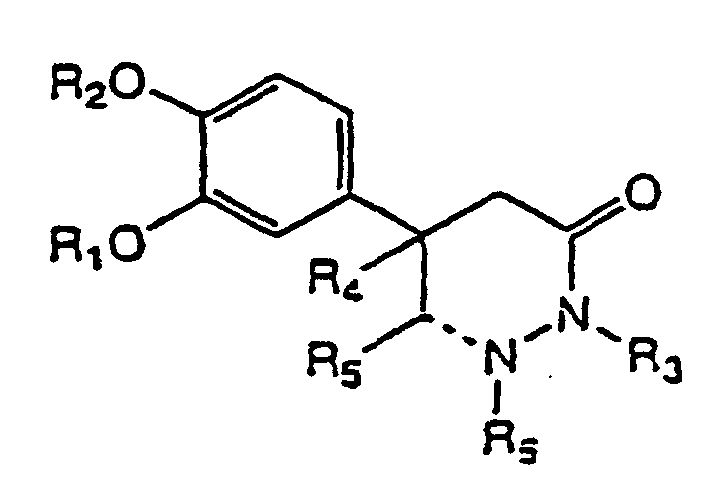 R1 représente un radical alkyle en C1 à C8, linéaire ou ramifié, le cas échéant substitué par le radical phényle, un radical cycloalkyle en C3 à C6, qui peut être le cas échéant substitué par un radical alkyle en C1 à C3; un radical cycloalkyle en C3 à C7, ou un radical indanyle ;R2 représente un radical alkyle en C1 à C4 ;R3 représente l'atome d'hydrogène, un radical alkyle en C1 à C5, linéaire ou ramifié, le cas échéant substitué par un substituant choisi parmi le groupe consistant en les radicaux phényle, pyridyle, thiazolyle, furyle, thiényle, naphtyle et quinolyle ; un radical cycloalkyle en C3 à C7; ou un radical aromatique en C5 à C10, monocyclique ou bicyclique ou un radical hétéroaromatique de 5 à 10 membres, monocyclique ou bicyclique, choisi parmi le groupe consistant en les radicaux phényle, pyridyle, thiazolyle, furyle, thiényle, naphtyle et quinolyle ;R4 et R5 représentent chacun indépendamment, l'atome d'hydrogène, le radical phényle, le radical 4-méthylphényle, le radical 4-chlorophényle, ou un radical hétéroaromatique monocyclique de 5 à 6 membres, choisi parmi le groupe consistant en les radicaux pyridyle, thiazolyle, furyle et thiényle ;une ligne en traits interrompus représente une simple ou double liaison, pourvu que lorsque la ligne en traits interrompus représente une simple liaison,R6 représente l'atome d'hydrogène ou un radical alkyle en C1 à C6 ;un isomère optique de celui-ci, un sel pharmaceutiquement acceptable de celui-ci ou un hydrate ou solvate de celui-ci.
 - Composé selon la revendication 1, dans lequel R1 représente un radical alkyle en C1 à C6, un radical alkyle en C1 à C5 substitué par le radical phényle, un radical alkyle en C1 à C5 substitué par un radical cycloalkyle en C3 à C6, qui peut être substitué par un radical alkyle en C1 à C3 ; un radical cycloalkyle en C4 à C6, ou un radical indanyle ; R2 représente le radical méthyle ou éthyle ; R3 représente l'atome d'hydrogène, un radical alkyle en C1 à C3, le radical phényle, pyridyle, thiazolyle, furyle, thiényle, naphtyle ou quinolyle, ou un radical alkyle en C1 à C2 substitué par un radical aryle ; R4 et R5 représentent indépendamment, l'atome d'hydrogène, le radical phényle ou pyridyle.
- Composé selon la revendication 1 ou 2, dans lequel R1 représente le radical méthyle, le radical butyle, le radical isobutyle, un radical alkyle en C1 à C5 substitué par phényle, le radical cyclopentyle, le radical cyclopropylméthyle, le radical (1-méthylcyclopropyl)méthyle ou le radical 2-indanyle; R3 représente l'atome d'hydrogène, le radical méthyle, éthyle, phényle ou benzyle ; et R4 représente l'atome d'hydrogène, le radical phényle ou pyridyle.
- Composé selon l'une quelconque des revendications 1 à 3, dans lequel R2 représente le radical méthyle et R5 représente l'atome d'hydrogène.
- Composé selon l'une quelconque des revendications 1 à 4, dans lequel la ligne en traits interrompus représente une double liaison.
- Composition pharmaceutique comprenant un composé selon l'une quelconque des revendications 1 à 5 et un véhicule pharmaceutiquement acceptable.
- Médicament pour prévenir ou traiter des maladies inflammatoires, comprenant un composé selon l'une quelconque des revendications 1 à 5 et un véhicule pharmaceutiquement acceptable.
- Médicament pour l'asthme, comprenant un composé selon l'une quelconque des revendications 1 à 5 et un véhicule pharmaceutiquement acceptable.
Applications Claiming Priority (5)
| Application Number | Priority Date | Filing Date | Title |
|---|---|---|---|
| JP17072396 | 1996-06-11 | ||
| JP17072396 | 1996-06-11 | ||
| JP15927397 | 1997-06-03 | ||
| JP15927397A JP4017214B2 (ja) | 1996-06-11 | 1997-06-03 | 5−フェニル−3−ピリダジノン誘導体 |
| PCT/JP1997/001925 WO1997047604A1 (fr) | 1996-06-11 | 1997-06-06 | Derives de 5-phenyl-3-pyridazinone et compositions medicamenteuses les contenant |
Publications (3)
| Publication Number | Publication Date |
|---|---|
| EP0933366A1 EP0933366A1 (fr) | 1999-08-04 |
| EP0933366A4 EP0933366A4 (fr) | 1999-12-01 |
| EP0933366B1 true EP0933366B1 (fr) | 2005-04-06 |
Family
ID=26486124
Family Applications (1)
| Application Number | Title | Priority Date | Filing Date |
|---|---|---|---|
| EP97924332A Expired - Lifetime EP0933366B1 (fr) | 1996-06-11 | 1997-06-06 | Derives de 5-phenyl-3-pyridazinone et compositions medicamenteuses les contenant |
Country Status (6)
| Country | Link |
|---|---|
| US (1) | US6235739B1 (fr) |
| EP (1) | EP0933366B1 (fr) |
| JP (1) | JP4017214B2 (fr) |
| CA (1) | CA2257142C (fr) |
| DE (1) | DE69732974T2 (fr) |
| WO (1) | WO1997047604A1 (fr) |
Families Citing this family (4)
| Publication number | Priority date | Publication date | Assignee | Title |
|---|---|---|---|---|
| CA2715683A1 (fr) | 1999-08-21 | 2001-03-01 | Nycomed Gmbh | Combinaison synergiste |
| IT1317049B1 (it) * | 2000-06-23 | 2003-05-26 | Sigma Tau Ind Farmaceuti | Composti utili per la preparazione di medicamenti ad attivita'inibitrice della fosfodiesterasi iv. |
| US7153824B2 (en) | 2003-04-01 | 2006-12-26 | Applied Research Systems Ars Holding N.V. | Inhibitors of phosphodiesterases in infertility |
| JP5258763B2 (ja) * | 2007-06-20 | 2013-08-07 | 興和株式会社 | 5−フェニル−3−ピリダジノン誘導体 |
Family Cites Families (14)
| Publication number | Priority date | Publication date | Assignee | Title |
|---|---|---|---|---|
| JPS5037800A (fr) | 1973-08-13 | 1975-04-08 | ||
| DE2413935A1 (de) | 1974-03-20 | 1975-10-16 | Schering Ag | 4-(polyalkoxy-phenyl)-2-pyrrolidone |
| GB8323553D0 (en) | 1983-09-02 | 1983-10-05 | Smith Kline French Lab | Pharmaceutical compositions |
| FR2665442B1 (fr) | 1990-07-31 | 1992-12-04 | Sanofi Sa | Derives d'alkyl-6 pyridazine, procede de preparation et compositions pharmaceutiques en contenant. |
| US5461053A (en) * | 1989-02-07 | 1995-10-24 | Sanofi | Pyridazine derivatives |
| GB9007762D0 (en) * | 1990-04-05 | 1990-06-06 | Beecham Group Plc | Novel compounds |
| EP0553174B1 (fr) | 1990-10-16 | 1998-07-08 | Byk Gulden Lomberg Chemische Fabrik Gmbh | Arylpyridazinones |
| US5191084A (en) | 1991-05-01 | 1993-03-02 | American Home Products Corporation | Phenyl pyrazolidinones as bronchodilators and anti-inflammatory agents |
| GB9222253D0 (en) | 1992-10-23 | 1992-12-09 | Celltech Ltd | Chemical compounds |
| NZ257955A (en) * | 1992-12-02 | 1996-05-28 | Pfizer | Catechol diethers pharmaceutical compositions |
| WO1995003794A1 (fr) | 1993-07-30 | 1995-02-09 | Smithkline Beecham Corporation | 3-cyano-(3,4-disubstitues)phenylcyclohexyl-1-carboxylates |
| JPH07101861A (ja) | 1993-08-10 | 1995-04-18 | Tanabe Seiyaku Co Ltd | 抗喘息薬 |
| US5665754A (en) | 1993-09-20 | 1997-09-09 | Glaxo Wellcome Inc. | Substituted pyrrolidines |
| DE19514568A1 (de) * | 1995-04-20 | 1996-10-24 | Merck Patent Gmbh | Arylalkyl-pyridazinone |
-
1997
- 1997-06-03 JP JP15927397A patent/JP4017214B2/ja not_active Expired - Fee Related
- 1997-06-06 WO PCT/JP1997/001925 patent/WO1997047604A1/fr not_active Ceased
- 1997-06-06 US US09/202,317 patent/US6235739B1/en not_active Expired - Fee Related
- 1997-06-06 DE DE69732974T patent/DE69732974T2/de not_active Expired - Fee Related
- 1997-06-06 CA CA002257142A patent/CA2257142C/fr not_active Expired - Fee Related
- 1997-06-06 EP EP97924332A patent/EP0933366B1/fr not_active Expired - Lifetime
Also Published As
| Publication number | Publication date |
|---|---|
| DE69732974D1 (de) | 2005-05-12 |
| EP0933366A4 (fr) | 1999-12-01 |
| JP4017214B2 (ja) | 2007-12-05 |
| WO1997047604A1 (fr) | 1997-12-18 |
| CA2257142C (fr) | 2002-11-26 |
| CA2257142A1 (fr) | 1997-12-18 |
| US6235739B1 (en) | 2001-05-22 |
| DE69732974T2 (de) | 2006-02-23 |
| EP0933366A1 (fr) | 1999-08-04 |
| JPH1059950A (ja) | 1998-03-03 |
Similar Documents
| Publication | Publication Date | Title |
|---|---|---|
| US6235736B1 (en) | 3-anilino-2-cycloalkenone derivatives | |
| IE54667B1 (en) | Dihydropyridine anti-ischaemic and antihypertensive agents, processes for their production, and pharmaceutical compositions containing them | |
| WO1992012148A1 (fr) | Derive de 1,4-benzothiazepine | |
| EP0350403B1 (fr) | Dérivés de (aza)naphtalènesultame, leurs procédés de préparation et les médicaments les contenant | |
| US4670434A (en) | (2-oxo-3-methylene-1,2,3,5-tetrahydroimidazo[2,1-b]quinazolinyl)oxyalkylamides useful as cyclic AMP phosphodiesterase inhibitors | |
| JP4660045B2 (ja) | NF−κB阻害剤を有効成分とする心筋炎、拡張型心筋症および心不全の予防または治療薬 | |
| US5721267A (en) | Chemotherapeutic pyrrolocarbazole derivatives | |
| JP2002518377A (ja) | アリールアルカノイルピリダジン | |
| JP3542482B2 (ja) | 3−アニリノ−2−シクロアルケノン誘導体 | |
| US5508306A (en) | Aromatic amine derivatives | |
| US4134991A (en) | Derivatives of 2-(3-phenyl-2-aminopropionyloxy)-acetic acid | |
| EP0933366B1 (fr) | Derives de 5-phenyl-3-pyridazinone et compositions medicamenteuses les contenant | |
| US6265402B1 (en) | Use of 2-phenylmorpholin-5-one derivatives | |
| JPH1072415A (ja) | 3−アニリノ−2−シクロアルケノン誘導体 | |
| JPH0578554B2 (fr) | ||
| EP0651743B1 (fr) | Derives d'acide n-hydroxamique et n-hydroxyuree indolinyle, utilises comme inhibiteurs de la lipoxygenase | |
| CA2038417A1 (fr) | Composes de piperidine, methode de preparation de ces composes, et une composition pharmaceutique qui en contient. | |
| JP4152002B2 (ja) | 2−フェニルモルホリン−5−オン誘導体およびそれを含む医薬組成物 | |
| FR2639944A1 (fr) | Nouveaux derives de l'indole, leur procede de preparation et les compositions pharmaceutiques qui les contiennent | |
| CH661272A5 (fr) | Derives de 4,7-dihydropyrazolo (3,4-b)pyridine et composition pharmaceutique a action anti-hypertensive et de vasodilatation coronaire les renfermant. | |
| EP0133259A2 (fr) | Dérivés de benzène substitués par des groupes aminoalcoyle, procédé de leur production et leurs compositions pharmaceutiques | |
| JPH11152274A (ja) | 新規ピリダジン誘導体及びこれを有効成分とする医薬 | |
| FR2551753A2 (fr) | Benzotriazine-1,2,3-ones-4, procede de preparation et medicaments les contenant | |
| KR20040104608A (ko) | 피페리디닐-알킬아미노-피리다지논 유도체, 이의 제조방법, 및 이 화합물을 함유하는 약제 조성물 | |
| JPS6022711B2 (ja) | トランス−デカハイドロキノリン誘導体,その製造法,及びそれを含む医薬 |
Legal Events
| Date | Code | Title | Description |
|---|---|---|---|
| PUAI | Public reference made under article 153(3) epc to a published international application that has entered the european phase |
Free format text: ORIGINAL CODE: 0009012 |
|
| 17P | Request for examination filed |
Effective date: 19981209 |
|
| AK | Designated contracting states |
Kind code of ref document: A1 Designated state(s): CH DE FR GB IT LI |
|
| A4 | Supplementary search report drawn up and despatched |
Effective date: 19991015 |
|
| AK | Designated contracting states |
Kind code of ref document: A4 Designated state(s): CH DE FR GB IT LI |
|
| 17Q | First examination report despatched |
Effective date: 20030725 |
|
| GRAP | Despatch of communication of intention to grant a patent |
Free format text: ORIGINAL CODE: EPIDOSNIGR1 |
|
| GRAS | Grant fee paid |
Free format text: ORIGINAL CODE: EPIDOSNIGR3 |
|
| GRAA | (expected) grant |
Free format text: ORIGINAL CODE: 0009210 |
|
| AK | Designated contracting states |
Kind code of ref document: B1 Designated state(s): CH DE FR GB IT LI |
|
| REG | Reference to a national code |
Ref country code: GB Ref legal event code: FG4D |
|
| REG | Reference to a national code |
Ref country code: CH Ref legal event code: EP |
|
| REF | Corresponds to: |
Ref document number: 69732974 Country of ref document: DE Date of ref document: 20050512 Kind code of ref document: P |
|
| REG | Reference to a national code |
Ref country code: CH Ref legal event code: NV Representative=s name: BUGNION S.A. |
|
| ET | Fr: translation filed | ||
| PLBE | No opposition filed within time limit |
Free format text: ORIGINAL CODE: 0009261 |
|
| STAA | Information on the status of an ep patent application or granted ep patent |
Free format text: STATUS: NO OPPOSITION FILED WITHIN TIME LIMIT |
|
| 26N | No opposition filed |
Effective date: 20060110 |
|
| PGFP | Annual fee paid to national office [announced via postgrant information from national office to epo] |
Ref country code: IT Payment date: 20090619 Year of fee payment: 13 Ref country code: FR Payment date: 20090512 Year of fee payment: 13 |
|
| PGFP | Annual fee paid to national office [announced via postgrant information from national office to epo] |
Ref country code: GB Payment date: 20090625 Year of fee payment: 13 Ref country code: DE Payment date: 20090728 Year of fee payment: 13 Ref country code: CH Payment date: 20090708 Year of fee payment: 13 |
|
| REG | Reference to a national code |
Ref country code: CH Ref legal event code: PL |
|
| GBPC | Gb: european patent ceased through non-payment of renewal fee |
Effective date: 20100606 |
|
| REG | Reference to a national code |
Ref country code: FR Ref legal event code: ST Effective date: 20110228 |
|
| PG25 | Lapsed in a contracting state [announced via postgrant information from national office to epo] |
Ref country code: IT Free format text: LAPSE BECAUSE OF NON-PAYMENT OF DUE FEES Effective date: 20100606 |
|
| PG25 | Lapsed in a contracting state [announced via postgrant information from national office to epo] |
Ref country code: LI Free format text: LAPSE BECAUSE OF NON-PAYMENT OF DUE FEES Effective date: 20100630 Ref country code: DE Free format text: LAPSE BECAUSE OF NON-PAYMENT OF DUE FEES Effective date: 20110101 Ref country code: CH Free format text: LAPSE BECAUSE OF NON-PAYMENT OF DUE FEES Effective date: 20100630 |
|
| PG25 | Lapsed in a contracting state [announced via postgrant information from national office to epo] |
Ref country code: FR Free format text: LAPSE BECAUSE OF NON-PAYMENT OF DUE FEES Effective date: 20100630 |
|
| PG25 | Lapsed in a contracting state [announced via postgrant information from national office to epo] |
Ref country code: GB Free format text: LAPSE BECAUSE OF NON-PAYMENT OF DUE FEES Effective date: 20100606 |