EP0933652A2 - Dispositif d'imagerie par émissions de positrons - Google Patents
Dispositif d'imagerie par émissions de positrons Download PDFInfo
- Publication number
- EP0933652A2 EP0933652A2 EP99300676A EP99300676A EP0933652A2 EP 0933652 A2 EP0933652 A2 EP 0933652A2 EP 99300676 A EP99300676 A EP 99300676A EP 99300676 A EP99300676 A EP 99300676A EP 0933652 A2 EP0933652 A2 EP 0933652A2
- Authority
- EP
- European Patent Office
- Prior art keywords
- detectors
- detector
- detector assemblies
- radiation
- view
- Prior art date
- Legal status (The legal status is an assumption and is not a legal conclusion. Google has not performed a legal analysis and makes no representation as to the accuracy of the status listed.)
- Granted
Links
- 238000003384 imaging method Methods 0.000 title claims abstract description 37
- 230000005855 radiation Effects 0.000 claims abstract description 40
- 230000000712 assembly Effects 0.000 claims abstract description 27
- 238000000429 assembly Methods 0.000 claims abstract description 27
- 238000000034 method Methods 0.000 claims description 27
- 210000003484 anatomy Anatomy 0.000 claims description 8
- 230000035945 sensitivity Effects 0.000 description 39
- 229940121896 radiopharmaceutical Drugs 0.000 description 4
- 239000012217 radiopharmaceutical Substances 0.000 description 4
- 230000002799 radiopharmaceutical effect Effects 0.000 description 4
- 238000012937 correction Methods 0.000 description 3
- 238000001514 detection method Methods 0.000 description 3
- 238000002600 positron emission tomography Methods 0.000 description 3
- 230000004075 alteration Effects 0.000 description 2
- 239000013078 crystal Substances 0.000 description 2
- 238000013480 data collection Methods 0.000 description 2
- 238000012986 modification Methods 0.000 description 2
- 230000004048 modification Effects 0.000 description 2
- ZCXUVYAZINUVJD-AHXZWLDOSA-N 2-deoxy-2-((18)F)fluoro-alpha-D-glucose Chemical compound OC[C@H]1O[C@H](O)[C@H]([18F])[C@@H](O)[C@@H]1O ZCXUVYAZINUVJD-AHXZWLDOSA-N 0.000 description 1
- 238000012879 PET imaging Methods 0.000 description 1
- 230000008859 change Effects 0.000 description 1
- 230000003247 decreasing effect Effects 0.000 description 1
- 238000002059 diagnostic imaging Methods 0.000 description 1
- 238000006073 displacement reaction Methods 0.000 description 1
- 230000009977 dual effect Effects 0.000 description 1
- 230000000694 effects Effects 0.000 description 1
- 230000005251 gamma ray Effects 0.000 description 1
- 238000012633 nuclear imaging Methods 0.000 description 1
- 238000009206 nuclear medicine Methods 0.000 description 1
- 230000008569 process Effects 0.000 description 1
- 238000012545 processing Methods 0.000 description 1
- 230000004044 response Effects 0.000 description 1
Images


Classifications
-
- G—PHYSICS
- G01—MEASURING; TESTING
- G01T—MEASUREMENT OF NUCLEAR OR X-RADIATION
- G01T1/00—Measuring X-radiation, gamma radiation, corpuscular radiation, or cosmic radiation
- G01T1/29—Measurement performed on radiation beams, e.g. position or section of the beam; Measurement of spatial distribution of radiation
- G01T1/2914—Measurement of spatial distribution of radiation
- G01T1/2985—In depth localisation, e.g. using positron emitters; Tomographic imaging (longitudinal and transverse section imaging; apparatus for radiation diagnosis sequentially in different planes, steroscopic radiation diagnosis)
-
- A—HUMAN NECESSITIES
- A61—MEDICAL OR VETERINARY SCIENCE; HYGIENE
- A61B—DIAGNOSIS; SURGERY; IDENTIFICATION
- A61B6/00—Apparatus or devices for radiation diagnosis; Apparatus or devices for radiation diagnosis combined with radiation therapy equipment
- A61B6/02—Arrangements for diagnosis sequentially in different planes; Stereoscopic radiation diagnosis
- A61B6/03—Computed tomography [CT]
- A61B6/037—Emission tomography
Definitions
- the present invention relates to the field of positron emission imaging, especially for diagnostic purposes.
- a radiopharmaceutical such as 99m Tc or 201 Tl is introduced into the body of a patient. As the radiopharmaceutical decays, gamma rays are generated. These gamma rays are detected and used to construct a clinically useful image.
- Positron emission tomography is a branch of nuclear medicine in which a positron-emitting radiopharmaceutical such as 18 F-Fluorodeoxyglucose (FDG) is introduced into the body of a patient. Each emitted positron reacts with an electron in what is known as an annihilation event, thereby generating a pair of 511 keV gamma rays.
- the gamma rays are emitted in directions approximately 180° apart, i.e. in opposite directions.
- a pair of detectors registers the position and energy of the respective gamma rays, thereby providing information as to the position of the annihilation event and hence the positron source. Because the gamma rays travel in opposite directions, the positron annihilation is said to have occurred along a line of coincidence connecting the detected gamma rays. A number of such events are collected and used to reconstruct a clinically useful image.
- Non-rotating systems have one or more rings of detector elements disposed in a circle about the patient.
- Other non-rotating systems include cylindrical shell detector systems and hexagonal multi-plate systems. In each of these systems, the detector surrounds or nearly completely surrounds the object to be scanned. Since coincidence events at substantially all transverse angles within a slice can be detected, system sensitivity is does not vary much between locations in a transverse slice.
- Partial ring systems and dual or triple head gamma camera systems with coincidence detection capabilities fall into this category.
- One type of partial ring system includes two arcs of radiation sensitive detectors disposed on a generally circular rotating gantry. The arcs of radiation detectors are fixed with respect to each other so that their centres are generally diametrically opposed, with a slight angular offset.
- Rotating systems have partial transverse angle coverage such that it is necessary to rotate the detectors about the patient (or vice versa) in order to sample the transverse angles needed to reconstruct fully tomographic images. The sensitivity of these systems thus varies across the detector field of view. This variation in sensitivity is taken into account during processing of the coincidence data.
- present invention provides an imaging method for use with an apparatus which includes a plurality of detector assemblies.
- Each detector assembly includes a radiation sensitive face which faces an imaging region, generates an output signal indicative of the axial and transverse coordinates at which radiation has been detected, and has a field of view in the transverse direction.
- the method includes the steps of detecting gamma radiation characteristic of a plurality of positron annihilation events, rotating the detectors about an axis of rotation, the centres of the transverse fields of view of the detectors being offset from the axis of rotation, repeating the step of detecting, and generating an image indicative of the positron annihilation events.
- the apparatus includes two detector assemblies disposed 180 degrees opposite each other and the centres of the transverse fields of view coincide.
- each detector assembly includes a plurality of radiation sensitive elements disposed in a two dimensional array.
- the radiation sensitive elements are photomultiplier tubes.
- the method also includes the step of moving the detectors in a tangential direction until the offset between the centres of the transverse fields of view of the detectors and the axis of rotation reaches a desired value.
- the apparatus includes three detector assemblies.
- the method includes the steps of determining an orbit radius required to image an object located in the imaging region, determining a desired relative angular orientation depending on the required orbit radius, and positioning the detector assemblies in the desired relative angular orientation.
- an imaging method utilizes an apparatus which includes a plurality of detector assemblies disposed about an imaging region.
- the method includes the steps of determining a size of an object within the examination region, adjusting the relative angular orientations of the detector assemblies depending on the size of the object, detecting gamma radiation indicative of a plurality of positron annihilation events, and generating an image indicative of the annihilation events.
- the image is a tomographic image and the method includes the step of rotating the detectors about the examination region.
- the apparatus includes three detector assemblies.
- the method includes the step of positioning the detector assemblies in a first relative angular orientation if the size of the object is less than a threshold value and in a second relative angular orientation if the size of the object is greater than the threshold value.
- the detector assemblies are placed at equal angular intervals about the imaging region if the size of the object is less than a threshold value.
- the detector assemblies are placed at 90 degree angular intervals if the size of the object is greater than the threshold value.
- a method of imaging uses an apparatus which includes a plurality of radiation detectors disposed about an examination region.
- the method includes the steps of determining an orbit radius to be used in an imaging procedure, adjusting the relative angular orientation of the radiation detectors depending on the orbit radius, detecting gamma radiation characteristic of a plurality of positron annihilation events, rotating the radiation detectors with respect to the imaging region, repeating the steps of detecting and rotating, and generating a tomographic image of the positron annihilation event.
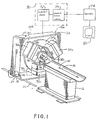
- a diagnostic imaging system includes a subject support or table 10 which is mounted to stationary, vertical supports 12 at opposite ends.
- the subject table is selectively positionable up and down to centre a subject 16 in the centre of a circle along a longitudinal axis 14.
- An outer gantry structure 20 is movably mounted on tracks 22 which extend parallel to the longitudinal axis. This enables the outer gantry structure to be moved parallel to the longitudinal axis 14.
- An outer gantry structure moving assembly 24 is provided for selectively moving the outer gantry structure 20 along the tracks 22 in a path parallel to the longitudinal axis.
- the longitudinal moving assembly includes drive wheels 26 for supporting the outer gantry structure on the tracks.
- the outer gantry can be stationary and the subject support configured to move the subject along the longitudinal axis.
- An inner gantry structure 30 is rotatably mounted on the outer gantry structure 20.
- a first camera or radiation detector head 32a is mounted to the inner gantry structure.
- Second and third radiation detector heads 32b, 32c are mounted to the inner gantry structure orthogonal to the first camera head.
- the detectors may be positioned to oppose each other at any angle suitable for detecting radiation. It is to be further appreciated that a greater or lesser number of detectors can be provided and detectors having non-planar radiation receiving surfaces can be used. In coincidence imaging, at least two detectors are required.
- the detectors 32a, 32b, 32c detect radiation, the type of which depends on the type of imaging performed.
- the radiation comprises 511 keV gamma radiation characteristic of positron annihilation events.
- the inner gantry structure defines a central, subject receiving examination region 36 for receiving the subject table, particularly along the longitudinal axis.
- the examination region 36 is enlarged to receive the detector heads in any of a variety of displacements from a central axis and angular orientations.
- the detectors each include a scintillation crystal disposed behind a radiation receiving face 38a, 38b, 38c, respectively, that is viewed by an array of photomultiplier tubes.
- the scintillation crystal emits a flash of light in response to incident radiation.
- the array of photomultiplier tubes converts the light into electrical signals.
- a resolver circuit resolves the x,y coordinates at of each light flash and the energy of the incident radiation.
- the relative outputs of the photomultiplier tubes are processed and corrected, as is conventional in the art, to generate an output signal indicative of a longitudinal and transverse coordinate on the detector head at which each radiation event is received, and an energy of each event.
- the radiation sensitive face of each detector may extend, for example, 300 mm in the transverse direction.
- a data collection processor 70 is linked to the detectors 32a, 32b, 32c and the motor and drive assemblies 50a, 50b, 50c.
- the data collection processor collects data 72 and includes coincidence logic circuitry 74 which determines whether gamma radiation is detected by two of the detectors 32a, 32b, 32c substantially simultaneously. More specifically, the coincidence logic 74 determines whether both detectors detect a gamma ray within a predetermined coincidence time interval, for example on the order of 15 nanoseconds. If so, the events are captured as corresponding to a coincidence event.
- a reconstruction processor 78 processes the data to generate one or more tomographic image slices indicative of the distribution of the radiopharmaceutical within the patient. The images are displayed in human readable form on a display device 80 such as a monitor, film, or the like.
- a drive assembly 50a, 50b, 50c is associated with each detector assembly 32a, 32b, 32c.
- Each detector may be moved tangentially with respect to the imaging region as well as radially toward and away from the imaging region.
- the relative angular orientations of the detectors 32a, 32b, 32c about the imaging region may also be varied.
- movement of the radiation detectors is carried out using the apparatus described in our co-pending application no. 97309173.9.
- a single motor and drive assembly controls movement of all detector heads individually or as a unit.
- two detectors 32a, 32b may be positioned in a relative angular orientation in which the detectors face each other across the imaging region, i.e. in a 180 degree opposed configuration.
- the sensitivity of such a detector configuration peaks at the centre of the transverse field of view and falls to zero at the edges.
- coincidence events 100a, 100b in Figure 2 this variation occurs because the angle of acceptance for coincidence events depends on the location of an event within the transverse field of view of the detectors.
- the inner gantry portion and hence the detectors are rotated about the imaging region.
- the axis of rotation has coincided with the centre of the detectors' transverse field of view.
- the resultant variation in sensitivity within a slice can be depicted graphically as the sensitivity profile shown in Figure 3.
- a given line of coincidence intersects both detectors only at certain range of detector angles.
- the sensitivity to this line of coincidence is proportional to this angular range.
- the sensitivity profile is triangular in shape.
- This variation in sensitivity can be taken into account by a transverse geometric correction.
- the projection coordinates are rescaled according to this profile in order to normalize the reconstructed images.
- the geometric correction equalizes the apparent sensitivity across the field of view, it cannot equalize the noise statistics across the field of view. Rescaling the data in a low sensitivity region does not change the fact that few actual counts are acquired there. As a result, the signal-to-noise ratio worsens near the edge of the field of view. The clinically usable field of view is therefore limited by the sensitivity fall off.
- the sensitivity profile of the detectors 32a, 32b may be made more uniform by moving them in a transverse direction, i.e. in a direction generally tangential to the imaging region.
- the dashed lines 104a, 104b depict a symmetric configuration where the centre of the transverse field of view of the detectors coincides with the centre of rotation 106.
- the detectors may be positioned so that the centres of their transverse fields of view are offset from the axis of rotation.
- Such an asymmetric detector configuration is depicted by solid lines 108a, 108b.
- the sensitivity profile of a configuration where the centre of the transverse fields of view has been offset from the axis of rotation by 10 cm is depicted in Figure 5.
- the sensitivity within the circle traced by the centres of the fields of view remains substantially constant.
- some of the counts at the centre of the field of view have been redistributed to the edge of the field of view, while the total sensitivity (the area under the profile) has remained substantially unchanged.
- the offset configuration increases the clinically useful field of view, which provides additional flexibility in scanning medium and larger size patients. Alternately, relatively smaller detectors may be used.
- the accuracy in positioning the area of interest at the centre of rotation is less important.
- a triple head coincidence detection system may be understood as three dual-head coincidence systems where head 1 is in coincidence with head 2, head 2 is in coincidence with head 3, and head 3 is in coincidence with head 1.
- the sensitivity profile is a function of both the detector configuration and location within the field of view.
- Figures 6a and 6b Exemplary detector configurations for a three-head system are depicted in Figures 6a and 6b.
- Figure 6a depicts a configuration wherein the detectors 32a, 32b, 32c are disposed at equal angular intervals about the imaging region, e.g. at 120 degree angular intervals.
- Figure 6b depicts a configuration wherein the detectors 32a, 32b, 32c are positioned at 90 degree angular intervals.
- Sensitivity profiles for the configurations depicted in Figures 6a and 6b are depicted at Figures 7a and 7b, respectively. Of course, other detector configurations may also be implemented.
- the configuration of the detectors may be adjusted in order to optimize the sensitivity profile according to the needs of a particular imaging procedure.
- the 120 degree configuration requires only a 120 degree gantry rotation and, as can be seen from Figure 7, has a higher overall sensitivity.
- the sensitivity of the 120 degree configuration depends strongly on radial distance between the radiation sensitive face of a detector and the centre of rotation, i.e. the orbit radius. This is particularly true near the centre of the field of view.
- the minimum permissible orbit radius is influenced by the size of the object or the region of the anatomy being imaged.
- physical contact between the detectors and the object being imaged is generally undesirable.
- relatively larger objects or regions of the anatomy require relatively larger orbit radii, whereas relatively smaller objects or regions of the anatomy permit relatively smaller orbit radii.
- the detectors are movable in tangential and radial directions so that the detectors may be irised as shown in Figure 8.
- minimum orbit radius is not limited by the transverse dimension of the detector assemblies.
- the detectors in a three head configuration may also be offset in the tangential direction to allow improved central coverage.
- the 120 degree configuration is particularly advantageous for scanning relatively smaller objects or regions of the anatomy. As the object becomes larger, however, the orbit radius must be increased, thereby decreasing sensitivity within the centre of the field of view. Thus, the 120 degree configuration is less well suited for imaging relatively larger objects or regions of the anatomy.
- the sensitivity of the 120 degree configuration also peaks near the edges of the field of view.
- the 120 degree configuration is also well suited for imaging procedures in which the region of interest is offset from the centre of the field of view.
- the sensitivity profile of a configuration in which the detectors are positioned at 90 degree angular intervals is shown in Figure 7b.
- the sensitivity is substantially uniform over a relatively large field of view.
- the sensitivity within the centre of the field of view of the 90 degree configuration is less than that of the 120 degree configurations when the orbit radius of the 120 degree configuration is relatively smaller but greater than that of the 120 degree configuration when the orbit radius is relatively larger.
- the 90 degree configuration provides greater sensitivity, especially when the region of interest in the object of interest is near to the centre of the field of view.
- the 90 degree angular interval configuration may be advantageously employed when imaging relatively large regions of the anatomy, large or obese patients, or where a relatively large orbit radius is otherwise required.
- the 120 degree configuration may advantageously be employed to image smaller objects or regions of the anatomy.
- detector configurations may also be used to provide other desirable sensitivity profiles.
- the detectors may be positioned at 102 degree configuration or a 90 degree/120 degree configuration. These configurations have sensitivities in between the 120 and 90 degree angular interval configurations.
- the present invention is also not limited to use with circular orbits. Thus, the detectors may be moved radially toward and away from patients or objects having other than circular cross sections.
- the heads can be moved tangentially to optimize the sensitivity profiles for a particular type of image procedures or to maximize coincidence counts within a desired region of the field of view.
- tangential motion may be used to compensate for regions having poorer sensitivity.
Landscapes
- Health & Medical Sciences (AREA)
- Life Sciences & Earth Sciences (AREA)
- Engineering & Computer Science (AREA)
- Physics & Mathematics (AREA)
- High Energy & Nuclear Physics (AREA)
- Molecular Biology (AREA)
- Medical Informatics (AREA)
- Nuclear Medicine, Radiotherapy & Molecular Imaging (AREA)
- Biomedical Technology (AREA)
- Spectroscopy & Molecular Physics (AREA)
- General Physics & Mathematics (AREA)
- Optics & Photonics (AREA)
- Pathology (AREA)
- Radiology & Medical Imaging (AREA)
- Biophysics (AREA)
- Heart & Thoracic Surgery (AREA)
- Surgery (AREA)
- Animal Behavior & Ethology (AREA)
- General Health & Medical Sciences (AREA)
- Public Health (AREA)
- Veterinary Medicine (AREA)
- Nuclear Medicine (AREA)
- Medicines Containing Antibodies Or Antigens For Use As Internal Diagnostic Agents (AREA)
Applications Claiming Priority (2)
| Application Number | Priority Date | Filing Date | Title |
|---|---|---|---|
| US09/017,505 US5998792A (en) | 1998-02-02 | 1998-02-02 | Positron emission tomography with variable detector geometry |
| US17505 | 1998-02-02 |
Publications (3)
| Publication Number | Publication Date |
|---|---|
| EP0933652A2 true EP0933652A2 (fr) | 1999-08-04 |
| EP0933652A3 EP0933652A3 (fr) | 2001-08-22 |
| EP0933652B1 EP0933652B1 (fr) | 2005-12-07 |
Family
ID=21782963
Family Applications (1)
| Application Number | Title | Priority Date | Filing Date |
|---|---|---|---|
| EP99300676A Expired - Lifetime EP0933652B1 (fr) | 1998-02-02 | 1999-01-29 | Dispositif d'imagerie par émissions de positrons |
Country Status (5)
| Country | Link |
|---|---|
| US (1) | US5998792A (fr) |
| EP (1) | EP0933652B1 (fr) |
| JP (1) | JPH11311675A (fr) |
| AT (1) | ATE312361T1 (fr) |
| DE (1) | DE69928708T2 (fr) |
Cited By (1)
| Publication number | Priority date | Publication date | Assignee | Title |
|---|---|---|---|---|
| WO2006049523A3 (fr) * | 2004-09-30 | 2007-02-15 | Tagusparque Sociedade De Promo | Systeme de tomographie par emission de positrons |
Families Citing this family (19)
| Publication number | Priority date | Publication date | Assignee | Title |
|---|---|---|---|---|
| US6175116B1 (en) * | 1997-06-02 | 2001-01-16 | Picker International, Inc. | Hybrid collimation and coincidence imager for simultaneous positron and single photon imaging |
| CA2212196A1 (fr) * | 1997-08-01 | 1999-02-01 | Is2 Research Inc. | Appareil et methode de diagnostique medical |
| US6242743B1 (en) * | 1998-08-11 | 2001-06-05 | Mosaic Imaging Technology, Inc. | Non-orbiting tomographic imaging system |
| US6359279B1 (en) * | 1998-12-07 | 2002-03-19 | Picker International, Inc. | Detector for nuclear imaging |
| US6628983B1 (en) * | 2000-10-25 | 2003-09-30 | Koninklijke Philips Electronics N.V. | Nuclear imaging systems and methods with feature-enhanced transmission imaging |
| EP1352264A2 (fr) * | 2001-01-16 | 2003-10-15 | The Board Of Regents, The University Of Texas System | Camera a positons comportant des modules de detection a rotation individuelle et/ou des sections de blindage a deplacement individuel |
| US6710349B2 (en) * | 2002-04-16 | 2004-03-23 | General Electric Company | Edge resolved dual scintillator gamma ray detection system and method |
| US7578102B2 (en) * | 2002-08-16 | 2009-08-25 | Mark Banister | Electric tile modules |
| EP1663003A1 (fr) * | 2003-09-08 | 2006-06-07 | Koninklijke Philips Electronics N.V. | Systeme d'imagerie a ouverture non circulaire pour un patient |
| US20070228282A1 (en) * | 2006-03-21 | 2007-10-04 | Frezghi Habte | Rectangular detector geometry for positron emission tomography |
| US8295905B2 (en) | 2006-06-20 | 2012-10-23 | Imris Inc. | Movable integrated scanner for surgical imaging applications |
| US8378305B2 (en) * | 2008-04-10 | 2013-02-19 | Koninklijke Philips Electronics N.V. | Modular multi-geometry PET system |
| JP4703703B2 (ja) * | 2008-09-30 | 2011-06-15 | 株式会社東芝 | 核医学診断装置 |
| US8076644B2 (en) * | 2009-12-02 | 2011-12-13 | General Electric Company | Methods and systems for determining a medical system alignment |
| JP5911214B2 (ja) * | 2011-06-29 | 2016-04-27 | 株式会社東芝 | 核医学診断装置及びspect撮影方法 |
| JP5999528B2 (ja) * | 2012-08-30 | 2016-09-28 | 株式会社島津製作所 | 放射線断層撮影装置 |
| US11029418B2 (en) | 2017-09-06 | 2021-06-08 | The United States Of America, As Represented By The Secretary, Department Of Health And Human Services | Micro-dose calibrator |
| JP7362607B2 (ja) * | 2017-12-01 | 2023-10-17 | コーニンクレッカ フィリップス エヌ ヴェ | 変換可能な作業最適化形状を有するポジトロン放出断層撮影(pet)システム |
| WO2023243364A1 (fr) * | 2022-06-16 | 2023-12-21 | 国立研究開発法人量子科学技術研究開発機構 | Dispositif de mesure de rayonnement, procédé de mesure de rayonnement, programme de mesure de rayonnement, procédé de déplacement des tissus corporels internes et support d'enregistrement non transitoire |
Family Cites Families (16)
| Publication number | Priority date | Publication date | Assignee | Title |
|---|---|---|---|---|
| US4204123A (en) * | 1978-06-20 | 1980-05-20 | Union Carbide Corporation | Radionuclide body function imager |
| JPS5594175A (en) * | 1979-01-12 | 1980-07-17 | Kagaku Gijutsucho Hoshasen Igaku Sogo Kenkyusho | Position tomograph |
| JPS55129781A (en) * | 1979-03-30 | 1980-10-07 | Kagaku Gijutsucho Hoshasen Igaku Sogo Kenkyusho | Proton cross tomography unit |
| US4473749A (en) * | 1982-01-29 | 1984-09-25 | The United States Of America As Represented By The United States Department Of Energy | Clamshell tomograph |
| US4642464A (en) * | 1984-05-24 | 1987-02-10 | Clayton Foundation For Research | Positron emission tomography camera |
| US5338936A (en) * | 1991-06-10 | 1994-08-16 | Thomas E. Kocovsky, Jr. | Simultaneous transmission and emission converging tomography |
| US5349190A (en) * | 1991-12-02 | 1994-09-20 | Adac Laboratories | Adjustable triple-detector image data acquisition system |
| US5331553A (en) * | 1992-04-15 | 1994-07-19 | Ugm Medical Systems, Inc. | Three dimensional image reconstruction for a positron emission tomograph |
| US5304806A (en) * | 1992-11-25 | 1994-04-19 | Adac Laboratories | Apparatus and method for automatic tracking of a zoomed scan area in a medical camera system |
| JPH06347555A (ja) * | 1993-06-10 | 1994-12-22 | Hamamatsu Photonics Kk | ポジトロンイメージング装置 |
| US5451789A (en) * | 1993-07-19 | 1995-09-19 | Board Of Regents, The University Of Texas System | High performance positron camera |
| US5591977A (en) * | 1994-04-29 | 1997-01-07 | The United States Of America As Represented By The Secretary Of The Department Of Health And Human Services | Variable axial aperture positron emission tomography scanner |
| US5608221A (en) * | 1995-06-09 | 1997-03-04 | Adac Laboratories | Multi-head nuclear medicine camera for dual SPECT and PET imaging with monuniform attenuation correction |
| US5602395A (en) * | 1995-10-02 | 1997-02-11 | Adac Laboratories | Gamma camera having partial septas and moving septas for positron emission tomography (PET) |
| US5777331A (en) * | 1996-11-22 | 1998-07-07 | Ugm Laboratory, Inc. | Tomographic emission scanner having offset high detection efficiency area |
| US5838009A (en) * | 1996-11-27 | 1998-11-17 | Picker International, Inc. | Variable angle multiple detector nuclear medicine gantry |
-
1998
- 1998-02-02 US US09/017,505 patent/US5998792A/en not_active Expired - Fee Related
-
1999
- 1999-01-29 AT AT99300676T patent/ATE312361T1/de not_active IP Right Cessation
- 1999-01-29 EP EP99300676A patent/EP0933652B1/fr not_active Expired - Lifetime
- 1999-01-29 DE DE69928708T patent/DE69928708T2/de not_active Expired - Fee Related
- 1999-02-02 JP JP11062124A patent/JPH11311675A/ja not_active Abandoned
Non-Patent Citations (1)
| Title |
|---|
| None |
Cited By (2)
| Publication number | Priority date | Publication date | Assignee | Title |
|---|---|---|---|---|
| WO2006049523A3 (fr) * | 2004-09-30 | 2007-02-15 | Tagusparque Sociedade De Promo | Systeme de tomographie par emission de positrons |
| US7917192B2 (en) | 2004-09-30 | 2011-03-29 | FFCUL/BEB-Fundacao Da Faculdade De Ciencias Da Universidade De Lisboa, Instituto De Biofisica E Engenharia Biomedia | Tomography by emission of positrons (PET) system |
Also Published As
| Publication number | Publication date |
|---|---|
| DE69928708T2 (de) | 2006-08-10 |
| US5998792A (en) | 1999-12-07 |
| DE69928708D1 (de) | 2006-01-12 |
| JPH11311675A (ja) | 1999-11-09 |
| EP0933652B1 (fr) | 2005-12-07 |
| ATE312361T1 (de) | 2005-12-15 |
| EP0933652A3 (fr) | 2001-08-22 |
Similar Documents
| Publication | Publication Date | Title |
|---|---|---|
| US5998792A (en) | Positron emission tomography with variable detector geometry | |
| US6147353A (en) | Image shift for gamma camera | |
| US6628983B1 (en) | Nuclear imaging systems and methods with feature-enhanced transmission imaging | |
| EP0887661B1 (fr) | Imagerie diagnostique | |
| US5338936A (en) | Simultaneous transmission and emission converging tomography | |
| EP0526970B1 (fr) | Procédé et dispositif de formation d'images | |
| US6242743B1 (en) | Non-orbiting tomographic imaging system | |
| US6696686B1 (en) | SPECT for breast cancer detection | |
| US10799200B2 (en) | Pet system with crystal or detector unit spacing | |
| US6040580A (en) | Method and apparatus for forming multi-dimensional attenuation correction data in tomography applications | |
| US20100163736A1 (en) | Spect gamma camera with a fixed detector radius of orbit | |
| US7917192B2 (en) | Tomography by emission of positrons (PET) system | |
| Watanabe et al. | A new high-resolution PET scanner dedicated to brain research | |
| US6787777B1 (en) | Nuclear imaging system and method using segmented field of view | |
| US5750991A (en) | Method and apparatus for forming multidimenstional attenuation correction data in tomography applications | |
| EP0205791B1 (fr) | Caméra pour tomographie à positrons avec plusieurs ensembles coplanaires de détecteurs | |
| US5296708A (en) | Method and apparatus for transmission measurements to form a 3-D image in tomography applications | |
| US20040227091A1 (en) | Methods and apparatus for radiation detecting and imaging using monolithic detectors | |
| US5471061A (en) | Method and apparatus for transmission measurements to form a 2-d or a 3-d image in tomography applications | |
| JP2012515921A (ja) | 2つの共同で登録された対向したガンマ線撮像ヘッドのシステムを使う脳と頚部の高解像度単一光子プレーナ・spect撮像 | |
| US20040217292A1 (en) | PET tomograph having continuously rotating panel detectors | |
| US6429434B1 (en) | Transmission attenuation correction method for PET and SPECT | |
| US5969358A (en) | Whole body scan coincidence imaging | |
| EP1077383B1 (fr) | Dispositif d'imagerie par émissions de positrons | |
| CN117414149A (zh) | 一种pet-spect成像系统和成像方法 |
Legal Events
| Date | Code | Title | Description |
|---|---|---|---|
| PUAI | Public reference made under article 153(3) epc to a published international application that has entered the european phase |
Free format text: ORIGINAL CODE: 0009012 |
|
| AK | Designated contracting states |
Kind code of ref document: A2 Designated state(s): AT BE CH CY DE DK ES FI FR GB GR IE IT LI LU MC NL PT SE |
|
| AX | Request for extension of the european patent |
Free format text: AL;LT;LV;MK;RO;SI |
|
| RAP1 | Party data changed (applicant data changed or rights of an application transferred) |
Owner name: MARCONI MEDICAL SYSTEMS, INC. |
|
| PUAL | Search report despatched |
Free format text: ORIGINAL CODE: 0009013 |
|
| AK | Designated contracting states |
Kind code of ref document: A3 Designated state(s): AT BE CH CY DE DK ES FI FR GB GR IE IT LI LU MC NL PT SE |
|
| AX | Request for extension of the european patent |
Free format text: AL;LT;LV;MK;RO;SI |
|
| RIC1 | Information provided on ipc code assigned before grant |
Free format text: 7G 01T 1/29 A, 7G 01T 1/164 B |
|
| 17P | Request for examination filed |
Effective date: 20020211 |
|
| AKX | Designation fees paid |
Free format text: DE FR IT |
|
| RBV | Designated contracting states (corrected) |
Designated state(s): AT BE CH CY DE DK ES FI FR GB GR IE IT LI LU MC NL PT SE |
|
| RAP1 | Party data changed (applicant data changed or rights of an application transferred) |
Owner name: PHILIPS MEDICAL SYSTEMS (CLEVELAND), INC. |
|
| RAP1 | Party data changed (applicant data changed or rights of an application transferred) |
Owner name: KONINKLIJKE PHILIPS ELECTRONICS N.V. |
|
| 17Q | First examination report despatched |
Effective date: 20040308 |
|
| GRAP | Despatch of communication of intention to grant a patent |
Free format text: ORIGINAL CODE: EPIDOSNIGR1 |
|
| GRAS | Grant fee paid |
Free format text: ORIGINAL CODE: EPIDOSNIGR3 |
|
| GRAA | (expected) grant |
Free format text: ORIGINAL CODE: 0009210 |
|
| AK | Designated contracting states |
Kind code of ref document: B1 Designated state(s): AT BE CH CY DE DK ES FI FR GB GR IE IT LI LU MC NL PT SE |
|
| PG25 | Lapsed in a contracting state [announced via postgrant information from national office to epo] |
Ref country code: NL Free format text: LAPSE BECAUSE OF FAILURE TO SUBMIT A TRANSLATION OF THE DESCRIPTION OR TO PAY THE FEE WITHIN THE PRESCRIBED TIME-LIMIT Effective date: 20051207 Ref country code: LI Free format text: LAPSE BECAUSE OF FAILURE TO SUBMIT A TRANSLATION OF THE DESCRIPTION OR TO PAY THE FEE WITHIN THE PRESCRIBED TIME-LIMIT Effective date: 20051207 Ref country code: IT Free format text: LAPSE BECAUSE OF FAILURE TO SUBMIT A TRANSLATION OF THE DESCRIPTION OR TO PAY THE FEE WITHIN THE PRESCRIBED TIME-LIMIT;WARNING: LAPSES OF ITALIAN PATENTS WITH EFFECTIVE DATE BEFORE 2007 MAY HAVE OCCURRED AT ANY TIME BEFORE 2007. THE CORRECT EFFECTIVE DATE MAY BE DIFFERENT FROM THE ONE RECORDED. Effective date: 20051207 Ref country code: FI Free format text: LAPSE BECAUSE OF FAILURE TO SUBMIT A TRANSLATION OF THE DESCRIPTION OR TO PAY THE FEE WITHIN THE PRESCRIBED TIME-LIMIT Effective date: 20051207 Ref country code: CH Free format text: LAPSE BECAUSE OF FAILURE TO SUBMIT A TRANSLATION OF THE DESCRIPTION OR TO PAY THE FEE WITHIN THE PRESCRIBED TIME-LIMIT Effective date: 20051207 Ref country code: BE Free format text: LAPSE BECAUSE OF FAILURE TO SUBMIT A TRANSLATION OF THE DESCRIPTION OR TO PAY THE FEE WITHIN THE PRESCRIBED TIME-LIMIT Effective date: 20051207 Ref country code: AT Free format text: LAPSE BECAUSE OF FAILURE TO SUBMIT A TRANSLATION OF THE DESCRIPTION OR TO PAY THE FEE WITHIN THE PRESCRIBED TIME-LIMIT Effective date: 20051207 |
|
| REG | Reference to a national code |
Ref country code: GB Ref legal event code: FG4D |
|
| REG | Reference to a national code |
Ref country code: CH Ref legal event code: EP |
|
| REG | Reference to a national code |
Ref country code: IE Ref legal event code: FG4D |
|
| REG | Reference to a national code |
Ref country code: GB Ref legal event code: 746 Effective date: 20051215 |
|
| REF | Corresponds to: |
Ref document number: 69928708 Country of ref document: DE Date of ref document: 20060112 Kind code of ref document: P |
|
| PG25 | Lapsed in a contracting state [announced via postgrant information from national office to epo] |
Ref country code: IE Free format text: LAPSE BECAUSE OF NON-PAYMENT OF DUE FEES Effective date: 20060130 |
|
| PG25 | Lapsed in a contracting state [announced via postgrant information from national office to epo] |
Ref country code: MC Free format text: LAPSE BECAUSE OF NON-PAYMENT OF DUE FEES Effective date: 20060131 Ref country code: LU Free format text: LAPSE BECAUSE OF NON-PAYMENT OF DUE FEES Effective date: 20060131 |
|
| PG25 | Lapsed in a contracting state [announced via postgrant information from national office to epo] |
Ref country code: SE Free format text: LAPSE BECAUSE OF FAILURE TO SUBMIT A TRANSLATION OF THE DESCRIPTION OR TO PAY THE FEE WITHIN THE PRESCRIBED TIME-LIMIT Effective date: 20060307 Ref country code: GR Free format text: LAPSE BECAUSE OF FAILURE TO SUBMIT A TRANSLATION OF THE DESCRIPTION OR TO PAY THE FEE WITHIN THE PRESCRIBED TIME-LIMIT Effective date: 20060307 Ref country code: DK Free format text: LAPSE BECAUSE OF FAILURE TO SUBMIT A TRANSLATION OF THE DESCRIPTION OR TO PAY THE FEE WITHIN THE PRESCRIBED TIME-LIMIT Effective date: 20060307 |
|
| PG25 | Lapsed in a contracting state [announced via postgrant information from national office to epo] |
Ref country code: ES Free format text: LAPSE BECAUSE OF FAILURE TO SUBMIT A TRANSLATION OF THE DESCRIPTION OR TO PAY THE FEE WITHIN THE PRESCRIBED TIME-LIMIT Effective date: 20060318 |
|
| PG25 | Lapsed in a contracting state [announced via postgrant information from national office to epo] |
Ref country code: PT Free format text: LAPSE BECAUSE OF FAILURE TO SUBMIT A TRANSLATION OF THE DESCRIPTION OR TO PAY THE FEE WITHIN THE PRESCRIBED TIME-LIMIT Effective date: 20060508 |
|
| NLV1 | Nl: lapsed or annulled due to failure to fulfill the requirements of art. 29p and 29m of the patents act | ||
| REG | Reference to a national code |
Ref country code: CH Ref legal event code: PL |
|
| PLBE | No opposition filed within time limit |
Free format text: ORIGINAL CODE: 0009261 |
|
| STAA | Information on the status of an ep patent application or granted ep patent |
Free format text: STATUS: NO OPPOSITION FILED WITHIN TIME LIMIT |
|
| REG | Reference to a national code |
Ref country code: IE Ref legal event code: MM4A |
|
| 26N | No opposition filed |
Effective date: 20060908 |
|
| EN | Fr: translation not filed | ||
| PGFP | Annual fee paid to national office [announced via postgrant information from national office to epo] |
Ref country code: GB Payment date: 20070129 Year of fee payment: 9 |
|
| PGFP | Annual fee paid to national office [announced via postgrant information from national office to epo] |
Ref country code: DE Payment date: 20070312 Year of fee payment: 9 |
|
| PG25 | Lapsed in a contracting state [announced via postgrant information from national office to epo] |
Ref country code: FR Free format text: LAPSE BECAUSE OF FAILURE TO SUBMIT A TRANSLATION OF THE DESCRIPTION OR TO PAY THE FEE WITHIN THE PRESCRIBED TIME-LIMIT Effective date: 20070126 |
|
| PG25 | Lapsed in a contracting state [announced via postgrant information from national office to epo] |
Ref country code: FR Free format text: LAPSE BECAUSE OF FAILURE TO SUBMIT A TRANSLATION OF THE DESCRIPTION OR TO PAY THE FEE WITHIN THE PRESCRIBED TIME-LIMIT Effective date: 20060131 |
|
| GBPC | Gb: european patent ceased through non-payment of renewal fee |
Effective date: 20080129 |
|
| PG25 | Lapsed in a contracting state [announced via postgrant information from national office to epo] |
Ref country code: DE Free format text: LAPSE BECAUSE OF NON-PAYMENT OF DUE FEES Effective date: 20080801 |
|
| PG25 | Lapsed in a contracting state [announced via postgrant information from national office to epo] |
Ref country code: FR Free format text: LAPSE BECAUSE OF FAILURE TO SUBMIT A TRANSLATION OF THE DESCRIPTION OR TO PAY THE FEE WITHIN THE PRESCRIBED TIME-LIMIT Effective date: 20051207 Ref country code: CY Free format text: LAPSE BECAUSE OF FAILURE TO SUBMIT A TRANSLATION OF THE DESCRIPTION OR TO PAY THE FEE WITHIN THE PRESCRIBED TIME-LIMIT Effective date: 20051207 |
|
| PG25 | Lapsed in a contracting state [announced via postgrant information from national office to epo] |
Ref country code: GB Free format text: LAPSE BECAUSE OF NON-PAYMENT OF DUE FEES Effective date: 20080129 |