EP0933945A2 - Digitale Signalverarbeitung - Google Patents
Digitale Signalverarbeitung Download PDFInfo
- Publication number
- EP0933945A2 EP0933945A2 EP99101354A EP99101354A EP0933945A2 EP 0933945 A2 EP0933945 A2 EP 0933945A2 EP 99101354 A EP99101354 A EP 99101354A EP 99101354 A EP99101354 A EP 99101354A EP 0933945 A2 EP0933945 A2 EP 0933945A2
- Authority
- EP
- European Patent Office
- Prior art keywords
- signal
- basis function
- basis
- correction coefficient
- digital signal
- Prior art date
- Legal status (The legal status is an assumption and is not a legal conclusion. Google has not performed a legal analysis and makes no representation as to the accuracy of the status listed.)
- Withdrawn
Links
- 238000012545 processing Methods 0.000 title claims abstract description 9
- 238000000034 method Methods 0.000 claims abstract description 35
- 238000012937 correction Methods 0.000 claims abstract description 26
- 230000006835 compression Effects 0.000 claims description 6
- 238000007906 compression Methods 0.000 claims description 6
- 238000010586 diagram Methods 0.000 description 8
- 238000004458 analytical method Methods 0.000 description 3
- 238000005284 basis set Methods 0.000 description 2
- 230000000737 periodic effect Effects 0.000 description 2
- 230000002596 correlated effect Effects 0.000 description 1
- 238000000354 decomposition reaction Methods 0.000 description 1
- 238000013461 design Methods 0.000 description 1
- 238000003909 pattern recognition Methods 0.000 description 1
- 238000010223 real-time analysis Methods 0.000 description 1
- 238000012800 visualization Methods 0.000 description 1
Images



Classifications
-
- H—ELECTRICITY
- H04—ELECTRIC COMMUNICATION TECHNIQUE
- H04N—PICTORIAL COMMUNICATION, e.g. TELEVISION
- H04N19/00—Methods or arrangements for coding, decoding, compressing or decompressing digital video signals
- H04N19/60—Methods or arrangements for coding, decoding, compressing or decompressing digital video signals using transform coding
-
- H—ELECTRICITY
- H04—ELECTRIC COMMUNICATION TECHNIQUE
- H04N—PICTORIAL COMMUNICATION, e.g. TELEVISION
- H04N19/00—Methods or arrangements for coding, decoding, compressing or decompressing digital video signals
- H04N19/90—Methods or arrangements for coding, decoding, compressing or decompressing digital video signals using coding techniques not provided for in groups H04N19/10-H04N19/85, e.g. fractals
- H04N19/97—Matching pursuit coding
Definitions
- This invention relates to improvements in or relating to the processing of digital signals, for example broadcast digital signals.
- Matching Pursuits is an alternative method of decomposing a signal into elementary structures that are locally adapted to the local signal properties.
- Matching Pursuits has excellent performance when compared with other compression techniques.
- Matching Pursuits performs signal analysis using an arbitrary over-complete dictionary set of basis waveforms. With a complete set of basis waveforms it is possible to completely represent a given signal by a unique linear combination of the waveforms. With an over-complete basis set there may be many different combinations of the basis waveforms which can represent the same given signal. This means that the most appropriate representation can be chosen for different circumstances.
- the Matching Pursuits process of decomposing a signal with the elementary structures of a dictionary basis set is shown in the block diagram of Figure 1 and described by the steps below.
- the stored Matching Pursuits structure book will be efficiently coded and stored or transmitted to a decoder.
- Figure 2 shows some waveforms (1, 2 and 3) from an example one-dimensional basis dictionary (not shown) for analysis of a time varying signal.
- the waveforms can be located anywhere in time.
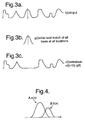
- Figure 3a Application of the example dictionary set to an example function f(t) is shown in Figure 3a. After correlating the signal and the dictionary set of basis waveforms the best match correlation g(t) shown in Figure 2 is chosen ( Figure 3b). The correlation coefficient, basis waveform (elementary structure identifier) and location in time are stored in the structure codebook. The stored element is subtracted from the original signal to generate the residual r(t) shown in Figure 3c. The process iterates by finding the best correlation result of the residual signal and the dictionary set of basis waveforms.
- the multi-dimensional basis functions may be selected to be separable into one dimensional basis functions in orthogonal directions.
- the representation of the multi-dimensional data can then be treated as a series of one-dimensional problems.
- the global optimisation problem is encountered in using a Matching Pursuits technique.
- the basic waveforms used to represent a signal can be considered as building blocks for the signal. A given part of the signal may require several building blocks to represent it accurately. The chosen size of one building block may influence the size chosen for others and vice versa. Optimising all the sizes of the building blocks together to produce the best representation of the signal is the global optimisation problem. Failure to address this problem can mean that there would be far too much computational effort necessary for real time analysis to be carried out. Accordingly a need exists to seek some means by which the global optimisation problem is avoided or minimised.
- the MP algorithm selects basis element a(x) with correlation coefficient A and in a later iteration selects the overlapping basis element b(x) with correlation coefficient B .
- the correlation coefficients A and B have been calculated independently in separate iterations of the MP algorithm. It is clear that since the selected basis elements overlap the correlation coefficients A and B could be best optimised together to minimise the residual signal.
- a method of representing a digital signal in terms of a plurality of basis functions comprising: determining a basis function for each of a plurality of portions of the signal; periodically determining a correction coefficient for each basis function; and generating a basis function structure book based on the original basis function and the correction coefficient.
- processing apparatus producing a representation of a digital signal in terms of a plurality of basis functions comprising: a first processor for determining a basis function for each of a plurality of portions of the signal; a second processor for periodically determining a correction coefficient for each basis function; and a generator for generating a basis function structure book based on the original basis function and the correction coefficient.
- Figure 5 shows a flow diagram of how the Matching Pursuits (MP) algorithm is used on a signal to determine the correlation coefficients of a number of basis elements and how a periodic correction pass is carried out. This correction pass is used to check the successive calculated correlation coefficients in retrospect, in order to determine whether the best match was made for each of the determination.
- MP Matching Pursuits
- the first step is to zero a counter (step A).
- a new basis element is selected and added to a structure book (codebook) as is normal for the MP algorithm (step B).
- the counter is incremented by one (step C).
- step D Checks are made to see if the MP stop criteria have been met or if the value in the counter is N (step D).
- N is an integer which gives an indication of the number of elements which have been added to the structure book. If neither criteria are met the process reverts back to step B and the next run of the MP algorithm is made. If either criteria are met then the process moves on to perform a correlation coefficient correction pass (step E). This correction pass is described in greater detail below.
- the process determines whether it has reached an MP stop point or not (step F). If the MP stop point has not been reached the process reverts back to step A and the counter is reset to zero. If the MP stop criteria has been met the process ends (step G).
- Figure 6 shows the block diagram of the correlation coefficient correction pass.
- a single pass is made to provide correction to the correlation coefficients of all the MP basis elements so far selected and stored in the structure book.
- the first MP basis function is selected (step H).
- the basis function is correlated with the residual signal to find a correction to the correlation coefficient (step I).
- the basis element as weighted by the correlation coefficient is then subtracted from the residual signal (step J). If there are more structures in the codebook which have not yet passed through the correction route, the steps H to J are repeated (step K). If there are no more structures the correction process is stopped (step L).
- the pass updates the correction coefficients of the basis elements in the order they were selected and entered into the structure book.
- the residual signal is updated at each stage before proceeding to the next basis element in the structure book.
- the method of periodic correction to the MP correlation coefficients provides a good and computationally efficient approximation to the global minimisation of the residual signal.
- the number of loops around each of the processes can be any suitable number.
- the routine of looking back over the process may be carried out in a different way.
- Use of the optimal routine proposed herein has been found to be a very close approximation to carrying out a check after every run of the MP algorithm. It will be clear however that much less processing is necessary.
Landscapes
- Engineering & Computer Science (AREA)
- Multimedia (AREA)
- Signal Processing (AREA)
- Compression, Expansion, Code Conversion, And Decoders (AREA)
- Compression Or Coding Systems Of Tv Signals (AREA)
- Measurement Of Velocity Or Position Using Acoustic Or Ultrasonic Waves (AREA)
- Complex Calculations (AREA)
Applications Claiming Priority (2)
| Application Number | Priority Date | Filing Date | Title |
|---|---|---|---|
| GBGB9802238.7A GB9802238D0 (en) | 1998-02-03 | 1998-02-03 | Digital signal processing |
| GB9802238 | 1998-02-03 |
Publications (2)
| Publication Number | Publication Date |
|---|---|
| EP0933945A2 true EP0933945A2 (de) | 1999-08-04 |
| EP0933945A3 EP0933945A3 (de) | 1999-11-17 |
Family
ID=10826342
Family Applications (1)
| Application Number | Title | Priority Date | Filing Date |
|---|---|---|---|
| EP99101354A Withdrawn EP0933945A3 (de) | 1998-02-03 | 1999-01-26 | Digitale Signalverarbeitung |
Country Status (3)
| Country | Link |
|---|---|
| EP (1) | EP0933945A3 (de) |
| JP (1) | JP2000031829A (de) |
| GB (1) | GB9802238D0 (de) |
-
1998
- 1998-02-03 GB GBGB9802238.7A patent/GB9802238D0/en not_active Ceased
-
1999
- 1999-01-26 EP EP99101354A patent/EP0933945A3/de not_active Withdrawn
- 1999-02-03 JP JP11062099A patent/JP2000031829A/ja active Pending
Non-Patent Citations (1)
| Title |
|---|
| ADLER J ; RAO B D ; KREUTZ-DELGADO K : "Comparison of basis selection methods " IEEE COMPUT. SOC. PRESS, [Online] 1997, pages 252-257, XP002115403 Retrieved from the Internet: <URL:iel.ihs.com> [retrieved on 1999-09-15] * |
Also Published As
| Publication number | Publication date |
|---|---|
| GB9802238D0 (en) | 1998-04-01 |
| EP0933945A3 (de) | 1999-11-17 |
| JP2000031829A (ja) | 2000-01-28 |
Similar Documents
| Publication | Publication Date | Title |
|---|---|---|
| US5563960A (en) | Apparatus and method for emphasizing a selected region in the compressed representation of an image | |
| US6862371B2 (en) | Method of compressing images of arbitrarily shaped objects | |
| EP1523196A2 (de) | System zur Codierung Bewegbilder mit beliebigen Objekten enthaltend | |
| EP1702294B1 (de) | Datenkompression unter verwendung von vergleichs-folgeeinrichtungen | |
| US8285064B2 (en) | Method for processing images and the corresponding electronic device | |
| KR101008520B1 (ko) | 오디오 신호 코딩 | |
| CN116939226B (zh) | 一种面向低码率图像压缩的生成式残差修复方法及装置 | |
| CN117354523A (zh) | 一种频域特征感知学习的图像编码、解码、压缩方法 | |
| JP2004505520A (ja) | ウェーブレット分解を用いたビデオ符号化方法 | |
| JPH08140092A (ja) | 画像符号化装置 | |
| Ansari et al. | Image data ordering and compression using Peano scan and LOT | |
| Kountchev et al. | Inverse pyramidal decomposition with multiple DCT | |
| EP0914004A1 (de) | Codierungssystem und -verfahren zur verlustfreien und verlustbehafteten Kompression von stehenden und bewegten Bildern | |
| Saupe et al. | Optimal hierarchical partitions for fractal image compression | |
| KR20040055788A (ko) | 정현파 모델 파라미터들의 주파수 차동 인코딩 | |
| Kwon et al. | Segmentation-based image compression | |
| EP0933945A2 (de) | Digitale Signalverarbeitung | |
| EP0933943A2 (de) | Digitale Signalverarbeitung | |
| WO1997006641A1 (en) | Image encoder, image decoder, image decoding method, and image transmitting system | |
| Staszewski | Vibration data compression with optimal wavelet coefficients | |
| EP0933944A2 (de) | Digitale Signalverarbeitung | |
| US20060013498A1 (en) | Method and apparatus for predicting discrete cosine transform coefficients | |
| Nappi et al. | Linear prediction image coding using iterated function systems | |
| CN115880379B (zh) | 语义可伸缩图像编码方法、系统、设备及存储介质 | |
| Gan et al. | Fast $ M $-Term Pursuit for Sparse Image Representation |
Legal Events
| Date | Code | Title | Description |
|---|---|---|---|
| PUAI | Public reference made under article 153(3) epc to a published international application that has entered the european phase |
Free format text: ORIGINAL CODE: 0009012 |
|
| AK | Designated contracting states |
Kind code of ref document: A2 Designated state(s): AT BE CH CY DE DK ES FI FR GB GR IE IT LI LU MC NL PT SE |
|
| AX | Request for extension of the european patent |
Free format text: AL;LT;LV;MK;RO;SI |
|
| PUAL | Search report despatched |
Free format text: ORIGINAL CODE: 0009013 |
|
| AK | Designated contracting states |
Kind code of ref document: A3 Designated state(s): AT BE CH CY DE DK ES FI FR GB GR IE IT LI LU MC NL PT SE |
|
| AX | Request for extension of the european patent |
Free format text: AL;LT;LV;MK;RO;SI |
|
| AKX | Designation fees paid | ||
| REG | Reference to a national code |
Ref country code: DE Ref legal event code: 8566 |
|
| RAP1 | Party data changed (applicant data changed or rights of an application transferred) |
Owner name: NDS LIMITED |
|
| PUAJ | Public notification under rule 129 epc |
Free format text: ORIGINAL CODE: 0009425 |
|
| 18D | Application deemed to be withdrawn |
Effective date: 20000517 |
|
| STAA | Information on the status of an ep patent application or granted ep patent |
Free format text: STATUS: THE APPLICATION IS DEEMED TO BE WITHDRAWN |
|
| 18D | Application deemed to be withdrawn |
Effective date: 20000518 |