EP0933961A2 - Procédé et dispositif de localisation d'une station mobile - Google Patents
Procédé et dispositif de localisation d'une station mobile Download PDFInfo
- Publication number
- EP0933961A2 EP0933961A2 EP98660112A EP98660112A EP0933961A2 EP 0933961 A2 EP0933961 A2 EP 0933961A2 EP 98660112 A EP98660112 A EP 98660112A EP 98660112 A EP98660112 A EP 98660112A EP 0933961 A2 EP0933961 A2 EP 0933961A2
- Authority
- EP
- European Patent Office
- Prior art keywords
- mobile station
- locating
- burst
- location
- arrival
- Prior art date
- Legal status (The legal status is an assumption and is not a legal conclusion. Google has not performed a legal analysis and makes no representation as to the accuracy of the status listed.)
- Granted
Links
Images





Classifications
-
- H—ELECTRICITY
- H04—ELECTRIC COMMUNICATION TECHNIQUE
- H04W—WIRELESS COMMUNICATION NETWORKS
- H04W64/00—Locating users or terminals or network equipment for network management purposes, e.g. mobility management
Definitions
- the invention relates to the method defined in the preamble of Claim 1 for locating a mobile station.
- the invention also relates to a mobile station defined in the preamble of Claim 10 for locating a mobile station.
- the invention relates to a base station defined in the preamble of Claim 13 for locating a mobile station.
- the invention relates to the arrangement defined in the preamble of Claim 16 for locating a mobile station.
- the invention relates to the location service centre defined in the preamble of Claim 19 for locating a mobile station.
- Methods for determining the position of a mobile station are known previously, which methods are based on transferring radio signals between a mobile station and a mobile station network, and the measurement and signal processing thereof.
- the mobile station network has a central controlling device, which controls the location process and the receivers participating in it.
- location is usually based on two basic arrangements:
- One such location method is a method based on the measurement of the angle of arrival (AOA) of the radio transmission, which uses direction finding (DF), in which method the mobile station transmits a radio signal to at least two base stations, which examine the angle of arrival of the signal and transmit the measurement results to the location service centre.
- AOA angle of arrival
- DF direction finding
- Another such location method is a method based on the transition time of a radio transmission.
- at least three base stations send a radio signal to a mobile station on the basis of the network, and the mobile station examines the observed time difference (OTD) of arrival of the signals, and, based on the mobile station, the mobile station transmits a radio signal to at least three base transceiver stations (BTS), which examine the observed time difference of arrival (TDOA) of the signals.
- the arrival times are used to form at least two hyperbolas, at the intersection of which the mobile station is located. Because of the inaccuracy of the arrival times, the hyperbolas are expanded as wide bands, the intersection of which limits an area and not a certain point. The location of the hyperbolas is determined in relation to the location of the base stations.
- a third such locating method is based on the radio transmission delay, which method uses the transition time between the mobile station and the base station.
- the mobile station and the base station exchange radio signals, the times of arrival (TOA) of which are examined.
- the transition time must be determined between the mobile station and at least three base stations.
- TDMA Time Division Multiple Access
- the distance of the mobile station from the base station is determined as a location circle in which the radius corresponds to distance and in which the central point is at the base station. There must be at least three of the location circles. The intersection of these circles is the location of the mobile station.
- TOA location method is the Timing Advance (TA) method, which is planned to be used in the GSM system.
- TA Timing Advance
- the to-and-from transmission time between the mobile station and the base station is measured. From this it is possible to calculate the distance between the mobile station and the base station.
- Timing Advance In which the mobile station is forced to carry out consecutive connection switchings to the neighbouring base stations for determining its location.
- GPS Satellite-based Global Positioning System
- the known network-based methods have the drawback that heavy signalling is needed between the base stations and the service centre that carries out the location determination.
- the mobile station operates as a transmitter, and the network provides the receivers.
- the location service centre indicates to the receiving base stations which channels they should listen to according to the mobile station to be located, or in accordance with the basic settings of the base station, certain predetermined channels are listened to.
- the channels are indicated by means of time and frequency information, for example.
- the measurement results are transferred in the network, which adds to the load on the network.
- the known system has the drawback that the location process is slow.
- the purpose of the invention is to provide a new method for locating a mobile station and to eliminate the above mentioned drawbacks.
- the method according to the invention is characterized in what is set forth in Claim 1.
- the mobile station according to the invention is characterized in what is set forth in Claim 10.
- the base station according to the invention is characterized in what is set forth in Claim 13.
- the arrangement according to the invention is characterized in what is set forth in Claim 16.
- the invention relates to a method for determining the location of a mobile station by means of radio signals between the mobile station and the mobile station network.
- at least one separate location channel is formed between the mobile station and the network in addition to other channels, to which location channel the radio communications related to the measurement of the location of the mobile station is concentrated. All other radio communication related to the location of the mobile station is also preferably concentrated to this channel.
- Other channels here mean all the known channels used between the mobile station network and the mobile station, such as the channels for ordinary communications and signalling.
- two location channels are formed, of which the first location channel is used for radio communications from the mobile station to the network and the second for radio communications from the network to the mobile station. These are called the Location Access CHannel (LACH) and the Location Receipt CHannel (LRCH).
- LACH Location Access CHannel
- LRCH Location Receipt CHannel
- the location access channel resembles the Random Access CHannel (RACH) in the uplink direction of the GSM system
- the location receipt channel resembles the Access Grant CHannel (AGCH) in the downlink direction.
- Uplink means communications from the mobile station to the network and downlink means communications from the network to the mobile station.
- the location access channel it is possible to send a location signal from the mobile station to the mobile station network at any time without coordination, because the mobile station knows the frequency and interval used in the location access channel, e.g. in the GSM system, and the base stations constantly monitor the channel for location signals.
- a cell can inform the mobile stations of the location access channel by sending information of the frequency and time interval.
- the measurement of the differences between the times of arrival is carried out from the impulse response.
- the first signal burst contains the identification information of the mobile station.
- the identification information is the International Mobile Subscriber Identification (IMSI).
- IMSI International Mobile Subscriber Identification
- the invention also relates to a mobile station, which comprises a locating device for determining the location by means of radio signals between the mobile station and the mobile station network.
- the locating device comprises
- the locating device also comprises a receiver for receiving the acknowledgement signal.
- the receiver is used for receiving the second signal burst
- the locating device also comprises a clock for determining the time of arrival of the burst
- the locating routines include at least determining the time difference between the bursts.
- signal bursts mean bursts received from different base stations.
- the invention also relates to a base station for locating the mobile station by radio signals between the mobile station and the mobile station network. According to the invention, it comprises
- the base station also includes a transmitter and an antenna for transmitting a second burst, and the locating routines include at least the determination of the time of arrival of the burst.
- the antenna is a direction finding antenna for determining the direction of arrival of the first signal burst, and the locating routines include at least the direction finding of the signal bursts.
- the invention also relates to an arrangement for locating a mobile station by means of radio signals between the mobile station and the mobile station network.
- the arrangement consists of a mobile station, which comprises
- the mobile station also comprises a receiver for receiving the acknowledgement signal.
- the receiver of the mobile station is used for receiving a second signal burst
- the mobile station also comprises a clock for determining the time of arrival of the second signal burst
- the locating routines of the processor of the mobile station include at least the determination of the time difference between the bursts
- the base stations also comprise a transmitter and an antenna for transmitting a second signal burst.
- the invention also relates to a location service centre for locating the mobile station by means of radio signals between the mobile station and the mobile station network.
- the Location Service Center is only a computer which performs the calculation routines, maintains data bases, such as base station coordinates, starts the location determination and gives location information to the applications. According to the invention it comprises
- the invention has the advantage that by means of a separate location channel, the need for signalling in the network between the location service centre and the base stations is reduced.
- the first signal burst of the location access channel sent by the mobile station is a kind of command, to which the receivers of the base stations of the mobile station network can react for measuring the necessary location information, for transmitting the measurement results to the location service centre and for sending a possible acknowledgement to the mobile station.
- Two location channels provide the advantage of bi-directional interaction during the location process. With only one location channel available, it is only possible to transmit the first signal burst from the mobile station to the network with predetermined repetition for locating the mobile station.
- a further advantage of the invention is the fact that with a separate location channel, it is possible to transmit long signal bursts, which contain the mobile station identification.
- the invention has the advantage that when an emergency call begins, locating can be carried out quickly and automatically.
- Figure 1a shows some components of the arrangement according to the invention that are essential for the invention in the locating method based on the angle of arrival of the radio transmission.
- the mobile station 5 is situated in the service area of the base stations 1a, 2a, 3a.
- the base stations 1a, 2a, 3a have been switched in the mobile station network to the location service centre 4a.
- the mobile station 5 and the base stations 1a, 2a, 3a preferably exchange signal bursts for locating the mobile station.
- the base stations 1a, 2a, 3a include direction finding antennas, by which the first signal bursts sent by the mobile station 5 are determined as coming from the directions 1aa, 2aa, 3aa.
- the location service centre 4a has the suitable calculation routines for this locating method and information of the locations of the base stations 1a, 2a, 3a.
- Figure 1b shows components of the arrangement according to the invention which are essential for the invention in the locating method based on the time difference of arrival of the radio transmission.
- the mobile station 5 is situated in the service area of the base stations 1b, 2b, 3b.
- the base stations 1b, 2b, 3b are connected to the location determination service centre 4b in the mobile station network.
- the mobile station 5 and the base stations 1b, 2b, 3b preferably exchange signal bursts for the location.
- the base stations 1b, 2b, 3b comprise normal reception antennas by which the first signal bursts sent by the mobile station 5 are received.
- a hyperbola 1-3bb is defined, which hyperbola passes through the mobile station 5 and between the base stations 1b, 3b.
- a hyperbola 2-3bb is defined, which hyperbola passes through the mobile station 5 and between the base stations 2b, 3b. Due to the inaccuracy of the determination, the hyperbolas 1-3bb, 2-3bb are strip-like curves at the intersection of which the mobile station 5 is situated.
- the location service centre 4b has the suitable calculation routines for this locating method and information of the locations of the base stations 1b, 2b, 3b.
- Figure 1c shows components of the arrangement according to the invention which are essential for the invention in the locating method based on the times of arrival of the radio transmission.
- the mobile station 5 is situated in the service area of the base stations 1c, 2c, 3c.
- the base stations 1c, 2c, 3c have been connected to the location service centre 4c in the mobile station network.
- the mobile station 5 and the base stations 1c, 2c, 3c preferably exchange signal bursts for the location.
- the base stations 1c, 2c, 3c include normal reception antennas by which the first signal bursts sent by the mobile station 5 are received.
- the location service centre 4c has the suitable calculation routines for this locating method and information of the location of the base stations 1c, 2c, 3c.
- the locating based on the times of arrival of the radio transmission as described above can be performed by using the Timing Advance measurement.
- the mobile station times its transmission separately to correspond to the timing of each neighbouring base station.
- the mobile station listens to the bursts of the base station in question and adjusts the timing of the transmission accordingly.
- the first bursts sent by the mobile station are received at the base station in question, and their timing is late twice as much as the propagation delay.
- the distance between the mobile station and the base station can be defined from this.
- the mobile station examines different neighbouring base stations in turn, or at least the serving base station and two neighbouring base stations.
- Figure 2a shows the essential steps of operation of the mobile station locating method according to the invention as a flow chart.
- the first signal burst 6a is sent from the mobile station in the location access channel to the receiver of the base station of the mobile station network.
- the next step, 7a is to measure at the base station from the first signal burst the information needed in the locating method in use and to receive the identification of the mobile station. According to different locating methods (cf. figures 1a, 1b, 1c), either the angle of arrival or time of arrival of the first signal burst is measured.
- this information is transferred to the location service centre, in which the mobile station is located, 9a, using that information.
- the process returns to the beginning to wait for the next first signal burst 6a from the mobile station.
- the next step 11a is to send from the base station to the mobile station a second acknowledgement burst in the location receipt channel and to end the process.
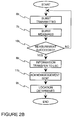
- Figure 2b shows the essential steps of operation of an alternative mobile station locating method in a flow chart.
- a first signal burst is sent from the mobile station in the location access channel to the receiver of the base station of the mobile station network.
- information according to the locating method in use is measured from the first signal burst in the base station and the mobile station identification is received.
- locating methods cf. figures 1a, 1b, 1c
- either the angle of arrival or the time of arrival of the first signal burst is measured. If the measurement of the signal burst at step 7b did not succeed, 10b, the process returns to the beginning to wait for the next first signal burst 6b from the mobile station.
- the measurement results are transferred at step 8b to the location service centre, and a second acknowledgement burst is sent at step 11b from the base station to the mobile station in the location receipt channel, and the mobile station is located, 9b.
- Figure 3 shows the alternative contents of the first signal burst of a location access channel.
- the first signal burst of the location access channel is sent from the mobile station to the mobile station network.
- the first signal burst starts at 12 and ends at 15 with tail bits (TB).
- tail bits tail bits
- the training sequence 13 contains a series of bits, which can be identified in the reception as the training sequence.
- the information part 14 contains alternatively one of the following identifications:
- Figure 4 shows the contents of the second signal burst of a location determination receipt channel.
- the second signal burst of the receipt channel is sent from the mobile station network to the mobile station.
- the second signal burst starts 16 and ends 19 with Tail Bits (TB).
- the first tail bits 16 are followed by a Training sequence 17, followed by an information sequence 18.
- the information sequence 18 contains the identification of the transmitting base station and the identification of the target mobile station 18a.
- the base station identification consists, e.g., of the cell identification or channel number and the base station identification code.
- the identification of the target mobile station is determined by how the mobile station has been identified in the access channel.
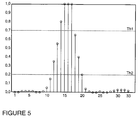
- Figure 5 shows an impulse response of the signal burst in coordinates.
- the impulse response is determined either by the mobile station or the base station.
- the time difference between the signal burst to be transferred in the location channel and the reference, such as the training sequence of the signal burst, is determined from the impulse response.
- These training sequences are identical. When the time difference has been estimated correctly, the training sequences correlate well in the impulse response.
- the horizontal axis of the figure represents time and the vertical axis represents the normalized correlation, which receives values from 0.0 to 1.0.
- the response columns 1 - 9 and 22 - 33 show ignorably little correlation to the training sequence, from which it is concluded that the time difference is not in an area that corresponds to these columns.
- the response columns 10 - 21 show an observable correlation to the training sequence, from which it is concluded that the time difference is in an area that corresponds to these columns.
- the response columns 15 - 17 show a full or nearly full correlation. Thus the time difference is about 15 - 17 time units, such as samples or bits.
- a dashed line in the coordinates represents the Th1 threshold level, which the highest response column must preferably exceed to be acceptable.
- a dashed line is also drawn in the coordinates to represent the Th2 threshold level, below which the surrounding response columns must preferably be so that the highest response column would be acceptable.
- FIG. 6 shows components of a mobile station according to the invention which are essential for the invention in a block diagram.
- the mobile station comprises a processor 21 for performing the locating routines.
- the locating routines include at least the reception of second signal bursts sent from the base station to the mobile station and a possible registration or determination of timing advance on the basis of the correlation of the training sequences.
- the mobile station also comprises a memory 22 for saving the locating routines, such as the calculation formulas of the impulse response and the measurement results, such as the values of the impulse responses.
- the mobile station also comprises a clock 23 and a receiver 24 for receiving the second signal bursts.
- a transmitter 25 is used for sending the first signal bursts from the mobile station to the base station.
- the different units of the mobile station are connected through the connection bus 26.
- FIG. 7 shows components of a base station according to the invention that are essential for the invention as a block diagram.
- the base station comprises a processor 27 for performing the locating routines, such as the calculation formulas of the impulse response, a memory 28 for saving the locating routines and measurement results, such as the values of the impulse responses, a clock 29 for determining the time of arrival of the first signal bursts to be sent from the mobile station to the base station, an ordinary antenna and/or a direction finding antenna 30 for transforming the first signal bursts into electric form and alternatively also for determining the direction of arrival, a receiver 31 for receiving the first signal bursts from the direction finding antenna and a transmitter 32 and an antenna 33 for transmitting second signal bursts from the base station to the mobile station.
- a processor 27 for performing the locating routines, such as the calculation formulas of the impulse response
- a memory 28 for saving the locating routines and measurement results, such as the values of the impulse responses
- a clock 29 for determining the time of arrival
- connection bus 34 When the sake of clarity, devices that are used for connecting to the signalling channels of the location service centre and that connect the base station preferably by wire to the service centre, have been omitted from the figure.
- FIG. 8 shows components of a location service centre (LSC) according to the invention as a block diagram.
- the location service centre is a computer, which at least performs the calculation routines, maintains data bases, such as the coordinates of base stations, starts the locating process and gives location information to applications.
- the service centre comprises a processor 35 for locating the mobile station by means of the information received from the base stations, a memory 36 for saving the location determination routines, such as calculation formulas, and the measurement results, such as the calculated time differences of the signal bursts, a receiver 37 for receiving measurement data from the base stations, and a transmitter 38 for requesting measurement data from the base stations.
- the receiver 37 and the transmitter 38 are in this case preferably devices used for switching the signalling channels, which devices connect the service centre preferably by wire to the base stations and possibly also to the mobile stations.
- the different units of the service centre are switched to one another via a connection bus 39.
- Locating in a manner according to the invention is examined by way of example.
- the location process is started on the initiative of the mobile station user or the mobile station network.
- the user selects an operation that starts the location from the menu of the mobile station, or a request to start the location is sent from the mobile station network.
- On the basis of an emergency call e.g., the location is started automatically.
- the mobile station receives as normally the timing of the neighbouring base stations in synchronization bursts, and normal neighbouring cell measurements are performed by the mobile station.
- the first signal burst is sent 6 from the mobile station to one or more base stations.
- the mobile station and the base stations do not need to be synchronized to one another.
- the transmission from the mobile station is performed in a manner required by the frame structure of the receiving base station, which is important particularly in a locating method based on transition time.
- the first signal burst contains the mobile station identification 14, such as the international mobile subscriber identification, which connects the signal logically with a certain mobile station.
- One prior art random access burst has eight bits, three of which are allocated to the access cause and five to the random separator which identifies different mobile stations.
- the identification according to the invention is preferably also eight bits long.
- the first signal burst of the same channel or different channels are used for different base stations. If different channels are used, the first signal burst is sent separately to each base station participating in the location process. Different locating signals can be sent if many different location access channels are used.
- the local channel configuration is notified to the mobile station from the serving cell.
- the base stations send 8 the identification code contained by the signal burst, their own identification code and the measurement results related to the location to the location service centre.
- the service centre the information received from various base stations are combined 9 and the location of the mobile station is calculated.
- the base stations 1a, 2a, 3a have direction finding antennas, by which the identification 14 of the mobile station is received and the direction of arrival 1aa, 2aa, 3aa is determined 7.
- This information is sent 8 to the location service centre 4a, in which, by processing the information received and the location coordinates of the base stations 1a, 2a, 3a, the location of the mobile station 5 is calculated in a manner known per se.
- the mobile station 5 is situated at the intersection of the directions 1aa, 2aa, 3aa measured by antennas. The location is found with two directions 1aa, 2aa, and more directions make it more accurate.
- all the base stations 1b, 2b, 3b participating in the location process can share the same signal burst of the same location access channel.
- CDMA Code Division Multiple Access
- the identification 14 of the mobile station 5 is received at the base stations 1b, 2b, 3b, like in the case of location determination based on the angle of arrival as described above, and the exact time of arrival 7 of the first signal burst.
- This information is sent 8 to the location service centre 4b, where the data are processed and the location of the mobile station 5 is calculated 9 in a manner known per se.
- Processing the observed time differences provides the hyperbolas 1 - 3bb, 2 - 3bb, passing between the base stations 1b, 2b, 3b, at the intersection of which the mobile station 5 is located. After this, the base station 1b, 2b, 3b sends the mobile station 5 acknowledgement of the location determination as above.
- the time of arrival of the first signal burst sent from the mobile station 5 is measured 7 at the base station 1c, 2c, 3c, the identification 14 of the mobile station 5 is read and this information is sent 8 to the location service centre 4c for calculating 9 the location.
- the arrival times are used to determine the location circles 1cc, 2cc, 3cc around the base stations 1c, 2c, 3c.
- the mobile station 5 is situated at the intersection of these circles 1cc, 2cc, 3cc or some other point which is an optimum location estimate. For example, it can happen that the circles do not intersect at the same point, whereby one possibility is to select as the location estimate of the mobile station the point from which the sum of the distances to different circles is the smallest.
- the first location signal bursts are sent 6 from the mobile station.
- the first bursts can also be sent 6 according to a certain predetermined sequencing or randomly. In the mobile station it is not necessary to wait for the possible acknowledgements 11 of the first bursts before sending the next first burst. For example, the first burst is sent 6 from the mobile station to many different base stations and acknowledgements are waited for between transmissions.
- the base station sends 11 to the mobile station in the location receipt channel the second acknowledgement burst, if this has been implemented. By this it is ensured that all the first bursts have been received and that the location has been determined 9 and no more transmissions are needed.
- the acknowledgement 11 can also be sent by each base station, based on the reception 7 of the first burst at the base station.
- One access channel is preferably dedicated for one base station so that many mobile stations transmit to the uplink direction in the same channel, or the same access channel is divided between many base stations, e.g. for reasons of capacity, whereby the first signal burst must include the identification of the receiving base station.
- the transmissions of different mobile stations can collide, which causes loss of transmission, whereby all the base stations do not receive a location signal.
- CDMA Code Division Multiple Access
- the location receipt channel is used for sending notification from the base station to the mobile station of a successful receipt of the first burst.
- many base stations notify of the receipt at different times so that the transmissions do not collide temporally in the same channel.
- the mobile station it is concluded from the receipts whether a sufficient number of base stations has successfully received the first burst. From the receipts it is also concluded whether a collision has taken place and a decision of a retransmission of the first burst is taken.
- the methods that have to be used are random access methods, such as the Aloha method, whereby there is a random waiting time in the mobile station before retransmission, in order to reduce the likelihood of a new collision in the same channel with the same transmitter.
- the Code Division Multiple Access (CDMA) can also be used in this channel. It is possible to send acknowledgement to the mobile station to indicate that the total procedure of location determination has succeeded.
- CDMA Code Division Multiple Access
- the locating method according to the invention is particularly useful in connection with emergency calls, because the method makes it considerably faster and easier to locate the caller who needs help than the present methods.
- the mobile station is used to make a call to the mobile station network, where the emergency call is detected, the information is sent to the location service centre, which further sends commands to the base stations.
- the method according to the invention is used most preferably, the first bursts are immediately sent from the mobile station to the mobile station network, where these signals are received and transferred to the location service centre, where the location is determined immediately. Possible collisions in the location channels naturally slow down the location determination a little, but this can be solved by dedicating one location access channel entirely for emergency calls.
- the random access bursts have reserve values by which the new type of burst is determined.
- the mobile station sends the first bursts formed like this to the neighbouring base stations, in which these new bursts are received.
- the bursts contain the random temporary identification created by the mobile station for its recognition. Later the mobile station must report its real identity, such as TMSI or IMSI, and the temporary identification used by it to the location service centre, so that the correlation between them is obtzined.
- the base stations measure the first bursts, such as random access bursts, but do not start to establish a connection to the mobile station but only report the measurement results to the location service centre.
- Each measurement result is followed by the temporary identification created by the base station, so that the mobile station can be located in the location service centre. Because the number of alternatives for a temporary identification of random access bursts is small, this implementation can only be used in rare cases, such as emergency calls.
- the invention can be implemented in the present GSM network or in the future systems, such as the Universal Mobile Telecommunication System (UMTS) in the following manner, for example.
- a location channel is determined, which channel allows using longer first bursts than the present random access channel.
- the first burst to be transferred in this location channel preferably contains the mobile station identification, such as the International Mobile Subscriber Identification (IMSI) or the Temporary Mobile Subscriber Identification (TMSI).
- IMSI International Mobile Subscriber Identification
- TMSI Temporary Mobile Subscriber Identification
- the problem of overlapping bursts can partly be solved by using the Code Division Multiple Access (CDMA) with random code. These codes can be selected from a predefined series. Due to this, when several mobile stations send bursts immediately, the base station can decode all of them.
- CDMA Code Division Multiple Access
Landscapes
- Engineering & Computer Science (AREA)
- Computer Networks & Wireless Communication (AREA)
- Signal Processing (AREA)
- Mobile Radio Communication Systems (AREA)
- Position Fixing By Use Of Radio Waves (AREA)
Applications Claiming Priority (2)
| Application Number | Priority Date | Filing Date | Title |
|---|---|---|---|
| FI974153A FI974153A7 (fi) | 1997-11-06 | 1997-11-06 | Menetelmä ja järjestely matkaviestimen sijainnin määrittelemiseksi |
| FI974153 | 1997-11-06 |
Publications (3)
| Publication Number | Publication Date |
|---|---|
| EP0933961A2 true EP0933961A2 (fr) | 1999-08-04 |
| EP0933961A3 EP0933961A3 (fr) | 2000-02-02 |
| EP0933961B1 EP0933961B1 (fr) | 2004-01-21 |
Family
ID=8549882
Family Applications (1)
| Application Number | Title | Priority Date | Filing Date |
|---|---|---|---|
| EP98660112A Expired - Lifetime EP0933961B1 (fr) | 1997-11-06 | 1998-11-04 | Procédé et dispositif de localisation d'une station mobile |
Country Status (4)
| Country | Link |
|---|---|
| US (1) | US6442392B2 (fr) |
| EP (1) | EP0933961B1 (fr) |
| DE (1) | DE69821213T2 (fr) |
| FI (1) | FI974153A7 (fr) |
Cited By (24)
| Publication number | Priority date | Publication date | Assignee | Title |
|---|---|---|---|---|
| KR20010075857A (ko) * | 2000-01-20 | 2001-08-11 | 박병기 | 부호 분할 다중 접속 방식을 사용한 이동 통신에서 부가액세스 채널을 사용한 위치 측정 방법 |
| WO2001089254A1 (fr) * | 2000-05-15 | 2001-11-22 | Nokia Corporation | Procede de calcul de temps de propagation de cycle veritable et localisation d'equipement utilisateur dans amrc/reseau d'acces radio terrestre universel |
| GB2363015A (en) * | 2000-05-16 | 2001-12-05 | Wong Grace Shuk Wai | Locating mobile objects in an urban area |
| WO2002050563A1 (fr) * | 2000-12-19 | 2002-06-27 | Nokia Corporation | Système et procédé à base de réseau pour déterminer la localisation d'un équipement utilisateur dans un réseau amrc |
| DE10105678A1 (de) * | 2001-02-08 | 2002-08-29 | Siemens Ag | Verfahren und Vorrichtung zur Ortsbestimmung von Paketdaten-dienst-fähigen Funkstationen in einem Kommunikationssystem |
| EP1251709A3 (fr) * | 2001-04-20 | 2002-11-06 | Lg Electronics Inc. | Localisation d'un terminal de communication mobile par combiner des mesures de signaux échangés entre le terminal et des stations de base |
| WO2003015447A1 (fr) * | 2001-08-10 | 2003-02-20 | Gould Lawrence A | Procedes de detection, de calcul et de diffusion d'informations de localisation associees a des transmissions sans fil d'appel d'urgence 911 |
| KR100400556B1 (ko) * | 2001-06-02 | 2003-10-08 | 엘지전자 주식회사 | 이동통신 단말기의 위치 추적 방법 |
| WO2003086005A1 (fr) * | 2002-04-09 | 2003-10-16 | Siemens Aktiengesellschaft | Procede, dispositif, programme informatique comportant des elements de code de programme et produit de programme destines a determiner une position d'un appareil de communication mobile dans un reseau de communication |
| KR100404397B1 (ko) * | 2000-12-26 | 2003-11-01 | 엘지전자 주식회사 | Cdma 시스템에서 네트웍 기반 단말기 위치추정 시스템및 방법 |
| WO2004002113A1 (fr) * | 2002-06-24 | 2003-12-31 | Intel Corporation | Procedes et systemes pour determiner si un dispositif sans fil est ou n'est pas a l'interieur d'une zone geographique |
| KR100421956B1 (ko) * | 2001-11-13 | 2004-03-11 | 엘지전자 주식회사 | 이동통신 시스템을 이용한 휴대단말기 측위방법 |
| WO2004029649A1 (fr) * | 2002-09-30 | 2004-04-08 | University Of Victoria Innovation And Development Corporation | Appareil et procede pour determiner l'azimut et la distance par messages horodates |
| WO2004002074A3 (fr) * | 2002-06-24 | 2004-05-21 | Intel Corp | Gestion de reseaux sensibles a la localisation |
| WO2006029277A1 (fr) * | 2004-09-07 | 2006-03-16 | Qualcomm Incorporated | Localisation d'un dispositif sans fil sur la base d'informations relatives a des stations de base appartenant a une pluralite de reseaux |
| US7068704B1 (en) | 2001-09-26 | 2006-06-27 | Itt Manufacturing Enterpprises, Inc. | Embedded chirp signal for position determination in cellular communication systems |
| WO2007107128A1 (fr) * | 2006-03-22 | 2007-09-27 | Siemens Aktiengesellschaft | Procédé de détermination de distance d'un terminal de communication mobile par rapport à des stations radio de base et terminal de communication mobile |
| WO2010151830A3 (fr) * | 2009-06-26 | 2011-02-17 | Qualcomm Incorporated | Initialisation d'une procédure d'accès aléatoire pour déterminer des paramètres de communication |
| EP2205031A3 (fr) * | 2008-12-30 | 2011-11-16 | LG-Ericsson Co., Ltd. | Procédé pour communication de liaison montante dans un environnement de communication mobile |
| CN102917375A (zh) * | 2011-08-04 | 2013-02-06 | 华为技术有限公司 | 基于高级天线系统的通信方法和设备 |
| US8897801B2 (en) | 2008-06-13 | 2014-11-25 | Qualcomm Incorporated | Transmission of location information by a transmitter as an aid to location services |
| USRE45808E1 (en) | 2004-06-18 | 2015-11-17 | Qualcomm Incorporated | Method and apparatus for determining location of a base station using a plurality of mobile stations in a wireless mobile network |
| US9226257B2 (en) | 2006-11-04 | 2015-12-29 | Qualcomm Incorporated | Positioning for WLANs and other wireless networks |
| US9335419B2 (en) | 2003-06-27 | 2016-05-10 | Qualcomm Incorporated | Wireless network hybrid positioning |
Families Citing this family (48)
| Publication number | Priority date | Publication date | Assignee | Title |
|---|---|---|---|---|
| JP3196747B2 (ja) * | 1998-12-18 | 2001-08-06 | 三菱マテリアル株式会社 | 移動無線機、基地局無線機、及び、その記録媒体 |
| US6611688B1 (en) * | 2000-02-22 | 2003-08-26 | Ericsson Inc. | Position reporting method for a mobile terminal in a mobile communication network |
| DE10040222A1 (de) * | 2000-08-17 | 2002-02-28 | Marconi Comm Gmbh | Verfahren zum Betreiben eines Nachrichten-Empfängers |
| US7962162B2 (en) * | 2001-08-07 | 2011-06-14 | At&T Intellectual Property Ii, L.P. | Simulcasting OFDM system having mobile station location identification |
| JP2003116164A (ja) * | 2001-10-03 | 2003-04-18 | Nec Corp | 測位システム、測位サーバ、無線基地局及びそれに用いる端末位置推定方法 |
| US7269427B2 (en) * | 2001-10-09 | 2007-09-11 | General Electric Company | Transmitter location for ultra-wideband, transmitted-reference CDMA communication system |
| US6907246B2 (en) | 2001-11-20 | 2005-06-14 | Navini Networks, Inc. | Method and system for reducing wireless multi-cell interferences through segregated channel assignments and segregated antenna beams |
| CN1281091C (zh) * | 2001-11-28 | 2006-10-18 | 诺基亚公司 | 获取允许对附连到通信网络的终端定位的位置信息的方法 |
| DE60205014T2 (de) * | 2002-02-14 | 2005-12-29 | Matsushita Electric Industrial Co., Ltd., Kadoma | Verfahren zum Steuern der Datenrate in einem drahtlosen Paketdatenkommunikationssystem, Sender und Empfänger zu seiner Verwendung |
| US7016692B2 (en) * | 2002-03-20 | 2006-03-21 | Samsung Electronics Co., Ltd. | Technique to facilitate location determination of wireless data calls |
| GB0207129D0 (en) * | 2002-03-26 | 2002-05-08 | Nokia Corp | Positioning-triggered handover |
| GB0210064D0 (en) * | 2002-05-02 | 2002-06-12 | Koninkl Philips Electronics Nv | Radio system amd method of operating the radio system |
| AU2003259781A1 (en) * | 2002-08-13 | 2004-02-25 | Vanu, Inc. | Convolutional decoding |
| WO2004019579A1 (fr) | 2002-08-13 | 2004-03-04 | Vanu, Inc. | Decodage adaptatif au bruit |
| US20040209580A1 (en) * | 2002-11-15 | 2004-10-21 | Vanu Bose | Communications system |
| CN1268153C (zh) * | 2003-06-12 | 2006-08-02 | 华为技术有限公司 | 位置业务中目标用户设备上报位置报告的交互方法 |
| CN100578253C (zh) * | 2003-06-30 | 2010-01-06 | 樊天蔚 | 无线电发射装置的定位与搜索引导 |
| KR100640375B1 (ko) * | 2003-10-01 | 2006-10-30 | 삼성전자주식회사 | 셀룰러 통신 시스템에서 하드 핸드오버시 빠른 순방향링크서비스 방법 |
| JP3687915B2 (ja) * | 2003-10-27 | 2005-08-24 | 日産ディーゼル工業株式会社 | 液体判別装置 |
| US7541977B2 (en) * | 2003-12-16 | 2009-06-02 | Interdigital Technology Corporation | Method and wireless communication system for locating wireless transmit/receive units |
| US7440762B2 (en) * | 2003-12-30 | 2008-10-21 | Trueposition, Inc. | TDOA/GPS hybrid wireless location system |
| EP1730649A2 (fr) * | 2004-03-05 | 2006-12-13 | Vanu, Inc. | Reduction des effets de gigue |
| US20060009236A1 (en) * | 2004-06-09 | 2006-01-12 | Vanu Bose | Determining a location |
| EP1757033A4 (fr) * | 2004-06-09 | 2009-04-22 | Vanu Inc | Reduction de bande passante d'une liaison terrestre |
| CA2568307A1 (fr) * | 2004-06-09 | 2005-12-29 | Vanu, Inc. | Reduction du cout de la liaison terrestre cellulaire |
| US7353034B2 (en) | 2005-04-04 | 2008-04-01 | X One, Inc. | Location sharing and tracking using mobile phones or other wireless devices |
| US7634277B2 (en) * | 2005-04-28 | 2009-12-15 | Cisco Technology, Inc. | Method for allocating channel resources for improving frequency utilization efficiency of wireless communication systems |
| US7606288B2 (en) * | 2005-05-27 | 2009-10-20 | S5 Wireless, Inc. | Burst spread spectrum radio system and method for asset tracking and data telemetry |
| CN100459794C (zh) * | 2005-06-10 | 2009-02-04 | 上海华为技术有限公司 | 一种对组呼/组播移动台进行实时定位的方法 |
| US7257413B2 (en) | 2005-08-24 | 2007-08-14 | Qualcomm Incorporated | Dynamic location almanac for wireless base stations |
| WO2007044501A2 (fr) * | 2005-10-07 | 2007-04-19 | Vanu, Inc. | Decodage de codes de walsh |
| US9042917B2 (en) | 2005-11-07 | 2015-05-26 | Qualcomm Incorporated | Positioning for WLANS and other wireless networks |
| US20080076435A1 (en) * | 2006-09-22 | 2008-03-27 | Vanu, Inc. | Wireless Backhaul |
| US20080076406A1 (en) * | 2006-09-22 | 2008-03-27 | Vanu, Inc. | Wireless Backhaul |
| US8311018B2 (en) * | 2007-02-05 | 2012-11-13 | Andrew Llc | System and method for optimizing location estimate of mobile unit |
| WO2009033001A2 (fr) * | 2007-09-05 | 2009-03-12 | University Of Utah Research Foundation | Distinction d'emplacement robuste utilisant des signatures de lien temporel |
| US8447319B2 (en) * | 2007-11-15 | 2013-05-21 | Andrew Llc | System and method for locating UMTS user equipment using measurement reports |
| WO2009143559A1 (fr) | 2008-05-26 | 2009-12-03 | Commonwealth Scientific And Industrial Research Organisation | Mesure de temps d'arrivée |
| US8447323B2 (en) * | 2008-09-05 | 2013-05-21 | Lg Electronics Inc. | Downlink silent period for positioning |
| WO2010030950A2 (fr) * | 2008-09-12 | 2010-03-18 | University Of Utah Research Foundation | Procédé et système de détection de points d'accès sans fil non autorisés en utilisant des décalages d'horloge |
| WO2010051847A1 (fr) * | 2008-11-07 | 2010-05-14 | Nokia Siemens Networks Oy | Appareil et procédé de synchronisation |
| US8818288B2 (en) | 2010-07-09 | 2014-08-26 | University Of Utah Research Foundation | Statistical inversion method and system for device-free localization in RF sensor networks |
| CN103379437A (zh) * | 2012-04-28 | 2013-10-30 | 华为终端有限公司 | 一种无线终端定位方法及相关设备、系统 |
| US10557919B2 (en) * | 2014-03-28 | 2020-02-11 | Guangdong Oppo Mobile Telecommunications Corp., Ltd. | Observed time difference of arrival angle of arrival discriminator |
| US20170026792A1 (en) * | 2015-07-23 | 2017-01-26 | Qualcomm Incorporated | Unintrusive position tracking using physical random access channel |
| US10656240B2 (en) * | 2016-08-31 | 2020-05-19 | Harris Global Communications, Inc. | Hybrid TDOA closed form hyperbolic and spherical iteration geo-location technique |
| US10785708B2 (en) | 2018-09-12 | 2020-09-22 | Trespass Tracker Ltd. | System and method of tracking a mobile device |
| WO2021046650A1 (fr) * | 2019-09-12 | 2021-03-18 | Trespass Tracker Ltd. | Système et procédé de suivi d'un dispositif mobile |
Family Cites Families (15)
| Publication number | Priority date | Publication date | Assignee | Title |
|---|---|---|---|---|
| DE3685273D1 (de) | 1985-08-02 | 1992-06-17 | Ant Nachrichtentech | Verfahren zur ortsbestimmung von mobilstationen. |
| US4728959A (en) | 1986-08-08 | 1988-03-01 | Ventana Sciences Inc. | Direction finding localization system |
| DE3816377C2 (de) | 1988-05-13 | 1995-11-16 | Aeg Mobile Communication | Einrichtung zur Eigenstandortbestimmung, insbesondere von Fahrzeugen |
| SE466376B (sv) | 1990-09-13 | 1992-02-03 | Televerket | Foerfarande foer lokalisering i mobilradiosystem |
| US5218618A (en) | 1990-11-07 | 1993-06-08 | Hughes Aircraft Company | Cellular telephone service using spread spectrum transmission |
| US5365516A (en) * | 1991-08-16 | 1994-11-15 | Pinpoint Communications, Inc. | Communication system and method for determining the location of a transponder unit |
| SE9302140L (sv) | 1993-06-21 | 1994-08-29 | Televerket | Förfarande för lokalisering av mobilstationer i digitalt telenät |
| FI941096L (fi) | 1994-03-09 | 1996-01-07 | Zarei Behruz Vazvan | Autokohtainen telepysäköintijärjestelmä |
| EP0752113B1 (fr) | 1994-03-25 | 2001-11-07 | QUALCOMM Incorporated | Methode de determination d'une position et son utilisation dans un systeme cellulaire analogique |
| SE512065C2 (sv) | 1995-02-16 | 2000-01-24 | Europolitan Ab | Förfarande och anordning för positionsbestämning av en mobilstation i ett cellulärt mobiltelefonsystem |
| US5508708A (en) | 1995-05-08 | 1996-04-16 | Motorola, Inc. | Method and apparatus for location finding in a CDMA system |
| FI101668B1 (fi) | 1995-11-13 | 1998-07-31 | Nokia Mobile Phones Ltd | Menetelmä solukkoverkon tilaajapäätelaitteen lisälaitteen ohjaamiseksi sekä tilaajapäätelaitteen lisälaite |
| FI108985B (fi) | 1996-04-04 | 2002-04-30 | Sonera Oyj | Menetelmä ja järjestelmä paikan määrittämiseksi |
| US5970413A (en) * | 1996-06-06 | 1999-10-19 | Qualcomm Incorporated | Using a frequency that is unavailable for carrying telephone voice information traffic for determining the position of a mobile subscriber in a CDMA cellular telephone system |
| US5945948A (en) * | 1996-09-03 | 1999-08-31 | Motorola, Inc. | Method and apparatus for location finding in a communication system |
-
1997
- 1997-11-06 FI FI974153A patent/FI974153A7/fi unknown
-
1998
- 1998-11-04 DE DE1998621213 patent/DE69821213T2/de not_active Expired - Fee Related
- 1998-11-04 EP EP98660112A patent/EP0933961B1/fr not_active Expired - Lifetime
- 1998-11-04 US US09/185,765 patent/US6442392B2/en not_active Expired - Lifetime
Cited By (45)
| Publication number | Priority date | Publication date | Assignee | Title |
|---|---|---|---|---|
| KR20010075857A (ko) * | 2000-01-20 | 2001-08-11 | 박병기 | 부호 분할 다중 접속 방식을 사용한 이동 통신에서 부가액세스 채널을 사용한 위치 측정 방법 |
| WO2001089254A1 (fr) * | 2000-05-15 | 2001-11-22 | Nokia Corporation | Procede de calcul de temps de propagation de cycle veritable et localisation d'equipement utilisateur dans amrc/reseau d'acces radio terrestre universel |
| US6681099B1 (en) | 2000-05-15 | 2004-01-20 | Nokia Networks Oy | Method to calculate true round trip propagation delay and user equipment location in WCDMA/UTRAN |
| GB2363015A (en) * | 2000-05-16 | 2001-12-05 | Wong Grace Shuk Wai | Locating mobile objects in an urban area |
| GB2363015B (en) * | 2000-05-16 | 2002-04-10 | Wong Grace Shuk Wai | Method and system for locating mobile objects in an urban area |
| WO2002050563A1 (fr) * | 2000-12-19 | 2002-06-27 | Nokia Corporation | Système et procédé à base de réseau pour déterminer la localisation d'un équipement utilisateur dans un réseau amrc |
| US7254401B2 (en) | 2000-12-19 | 2007-08-07 | Nokia Corporation | Network-based method and system for determining a location of user equipment in CDMA networks |
| KR100404397B1 (ko) * | 2000-12-26 | 2003-11-01 | 엘지전자 주식회사 | Cdma 시스템에서 네트웍 기반 단말기 위치추정 시스템및 방법 |
| DE10105678A1 (de) * | 2001-02-08 | 2002-08-29 | Siemens Ag | Verfahren und Vorrichtung zur Ortsbestimmung von Paketdaten-dienst-fähigen Funkstationen in einem Kommunikationssystem |
| EP1251709A3 (fr) * | 2001-04-20 | 2002-11-06 | Lg Electronics Inc. | Localisation d'un terminal de communication mobile par combiner des mesures de signaux échangés entre le terminal et des stations de base |
| US7057557B2 (en) | 2001-04-20 | 2006-06-06 | Lg Electronics Inc. | Apparatus and method for estimating position of mobile communication terminal |
| KR100400556B1 (ko) * | 2001-06-02 | 2003-10-08 | 엘지전자 주식회사 | 이동통신 단말기의 위치 추적 방법 |
| WO2003015447A1 (fr) * | 2001-08-10 | 2003-02-20 | Gould Lawrence A | Procedes de detection, de calcul et de diffusion d'informations de localisation associees a des transmissions sans fil d'appel d'urgence 911 |
| US7068704B1 (en) | 2001-09-26 | 2006-06-27 | Itt Manufacturing Enterpprises, Inc. | Embedded chirp signal for position determination in cellular communication systems |
| KR100421956B1 (ko) * | 2001-11-13 | 2004-03-11 | 엘지전자 주식회사 | 이동통신 시스템을 이용한 휴대단말기 측위방법 |
| WO2003086005A1 (fr) * | 2002-04-09 | 2003-10-16 | Siemens Aktiengesellschaft | Procede, dispositif, programme informatique comportant des elements de code de programme et produit de programme destines a determiner une position d'un appareil de communication mobile dans un reseau de communication |
| US7346358B2 (en) | 2002-06-24 | 2008-03-18 | Intel Corporation | Logical boundaries in communications networks |
| WO2004002074A3 (fr) * | 2002-06-24 | 2004-05-21 | Intel Corp | Gestion de reseaux sensibles a la localisation |
| WO2004002113A1 (fr) * | 2002-06-24 | 2003-12-31 | Intel Corporation | Procedes et systemes pour determiner si un dispositif sans fil est ou n'est pas a l'interieur d'une zone geographique |
| US7187622B2 (en) | 2002-09-30 | 2007-03-06 | University Of Victoria Innovation And Development Corporation | Apparatus and methods for determining range and bearing using time-stamped messaging |
| WO2004029649A1 (fr) * | 2002-09-30 | 2004-04-08 | University Of Victoria Innovation And Development Corporation | Appareil et procede pour determiner l'azimut et la distance par messages horodates |
| US9814016B2 (en) | 2003-06-27 | 2017-11-07 | Qualcomm Incorporated | Local area network assisted positioning |
| US9749876B2 (en) | 2003-06-27 | 2017-08-29 | Qualcomm Incorporated | Local area network assisted positioning |
| US10895648B2 (en) | 2003-06-27 | 2021-01-19 | Qualcomm Incorporated | Method and apparatus for wireless network hybrid positioning |
| US9810761B2 (en) | 2003-06-27 | 2017-11-07 | Qualcomm Incorporated | Local area network assisted positioning |
| US10849092B2 (en) | 2003-06-27 | 2020-11-24 | Qualcomm Incorporated | Local area network assisted positioning |
| US10841892B2 (en) | 2003-06-27 | 2020-11-17 | Qualcomm Incorporated | Local area network assisted positioning |
| US9335419B2 (en) | 2003-06-27 | 2016-05-10 | Qualcomm Incorporated | Wireless network hybrid positioning |
| US9778372B2 (en) | 2003-06-27 | 2017-10-03 | Qualcomm Incorporated | Wireless network hybrid positioning |
| USRE45808E1 (en) | 2004-06-18 | 2015-11-17 | Qualcomm Incorporated | Method and apparatus for determining location of a base station using a plurality of mobile stations in a wireless mobile network |
| CN101049041B (zh) * | 2004-09-07 | 2014-07-16 | 高通股份有限公司 | 根据属于多个网络的基站的有关信息对无线装置进行定位 |
| CN103402257A (zh) * | 2004-09-07 | 2013-11-20 | 高通股份有限公司 | 根据属于多个网络的基站的有关信息对无线装置进行定位 |
| WO2006029277A1 (fr) * | 2004-09-07 | 2006-03-16 | Qualcomm Incorporated | Localisation d'un dispositif sans fil sur la base d'informations relatives a des stations de base appartenant a une pluralite de reseaux |
| CN103402257B (zh) * | 2004-09-07 | 2016-08-10 | 高通股份有限公司 | 用于对无线装置的位置进行定位的系统 |
| WO2007107128A1 (fr) * | 2006-03-22 | 2007-09-27 | Siemens Aktiengesellschaft | Procédé de détermination de distance d'un terminal de communication mobile par rapport à des stations radio de base et terminal de communication mobile |
| US9226257B2 (en) | 2006-11-04 | 2015-12-29 | Qualcomm Incorporated | Positioning for WLANs and other wireless networks |
| US10568062B2 (en) | 2006-11-04 | 2020-02-18 | Qualcomm Incorporated | Positioning for WLANs and other wireless networks |
| US8897801B2 (en) | 2008-06-13 | 2014-11-25 | Qualcomm Incorporated | Transmission of location information by a transmitter as an aid to location services |
| EP2205031A3 (fr) * | 2008-12-30 | 2011-11-16 | LG-Ericsson Co., Ltd. | Procédé pour communication de liaison montante dans un environnement de communication mobile |
| US8583099B2 (en) | 2008-12-30 | 2013-11-12 | Lg-Ericsson Co., Ltd. | Method for uplink communication in mobile communication environment |
| US9392621B2 (en) | 2009-06-26 | 2016-07-12 | Qualcomm Incorporated | Initiating a random access procedure for determining communication parameters |
| WO2010151830A3 (fr) * | 2009-06-26 | 2011-02-17 | Qualcomm Incorporated | Initialisation d'une procédure d'accès aléatoire pour déterminer des paramètres de communication |
| CN102917375B (zh) * | 2011-08-04 | 2014-12-24 | 华为技术有限公司 | 基于高级天线系统的通信方法和设备 |
| WO2013017108A1 (fr) * | 2011-08-04 | 2013-02-07 | 华为技术有限公司 | Procédé et dispositif de communication basé sur un système d'antenne avancé |
| CN102917375A (zh) * | 2011-08-04 | 2013-02-06 | 华为技术有限公司 | 基于高级天线系统的通信方法和设备 |
Also Published As
| Publication number | Publication date |
|---|---|
| EP0933961A3 (fr) | 2000-02-02 |
| FI974153A0 (fi) | 1997-11-06 |
| US6442392B2 (en) | 2002-08-27 |
| EP0933961B1 (fr) | 2004-01-21 |
| DE69821213T2 (de) | 2004-11-18 |
| FI974153L (fi) | 1999-05-07 |
| FI974153A7 (fi) | 1999-05-07 |
| US20010051526A1 (en) | 2001-12-13 |
| DE69821213D1 (de) | 2004-02-26 |
Similar Documents
| Publication | Publication Date | Title |
|---|---|---|
| US6442392B2 (en) | Method and arrangement for locating a mobile station | |
| EP1005774B1 (fr) | Procede et systeme d'evaluation de la position de terminaux du service radio mobile | |
| EP0993751B1 (fr) | Technique et dispositif relatifs a des systemes de radiocommunication | |
| US5952969A (en) | Method and system for determining the position of mobile radio terminals | |
| EP0551310B1 (fr) | Procede de localisation pour systeme de radiotelephones mobiles | |
| US7274939B2 (en) | Cellular radio locator system | |
| EP3514565B1 (fr) | Localisation de position améliorée dans des communications sans fil | |
| US6597914B1 (en) | Method for determining timing differences between radio transmitters and a radio network incorporating the same | |
| US6470185B2 (en) | Making time of arrival measurements | |
| US6560462B1 (en) | System and method for determining the location of a mobile station in a wireless network | |
| US6539229B1 (en) | System and method for mobile location detection in synchronous wireless systems | |
| EP0936758A2 (fr) | Methode de determination de differences de temps dans un systeme de telecommunication cellulaire | |
| WO1998015150A1 (fr) | Dispositif et procede a utiliser dans un systeme telephonique mobile cellulaire | |
| WO1997027711A1 (fr) | Localisation d'un poste mobile dans un systeme numerique mobile de communications | |
| EP0946075A2 (fr) | Procédé pour déterminer la position d'une station mobile | |
| WO2002005577A2 (fr) | Procede de reacheminement d'affectations de canaux pour un ou plusieurs canaux de trafic | |
| WO2020226611A1 (fr) | Procédure d'affinement de faisceau tx à base de rach à 2 étapes | |
| CN1330109C (zh) | 在无线通信系统中同步基站的方法 | |
| US6505042B1 (en) | System and method for establishing a communication link between a mobile station and a base station controller | |
| US6064888A (en) | Method and system for determining position of mobile radio terminals | |
| KR100454995B1 (ko) | 무선 통신 시스템에서 통신 셀을 선택하는 방법 및 장치 | |
| WO2004105273A1 (fr) | Procede et systeme de localisation d'un terminal de communication mobile | |
| JPH03101323A (ja) | 無線通信システムのゾーン選択方式 | |
| HK1023896A (zh) | 用於确定移动台位置的方法 |
Legal Events
| Date | Code | Title | Description |
|---|---|---|---|
| PUAI | Public reference made under article 153(3) epc to a published international application that has entered the european phase |
Free format text: ORIGINAL CODE: 0009012 |
|
| AK | Designated contracting states |
Kind code of ref document: A2 Designated state(s): DE FR GB IT |
|
| AX | Request for extension of the european patent |
Free format text: AL;LT;LV;MK;RO;SI |
|
| PUAL | Search report despatched |
Free format text: ORIGINAL CODE: 0009013 |
|
| AK | Designated contracting states |
Kind code of ref document: A3 Designated state(s): AT BE CH CY DE DK ES FI FR GB GR IE IT LI LU MC NL PT SE |
|
| AX | Request for extension of the european patent |
Free format text: AL;LT;LV;MK;RO;SI |
|
| 17P | Request for examination filed |
Effective date: 20000616 |
|
| AKX | Designation fees paid |
Free format text: DE FR GB IT |
|
| RAP1 | Party data changed (applicant data changed or rights of an application transferred) |
Owner name: NOKIA CORPORATION |
|
| 17Q | First examination report despatched |
Effective date: 20021205 |
|
| GRAP | Despatch of communication of intention to grant a patent |
Free format text: ORIGINAL CODE: EPIDOSNIGR1 |
|
| GRAS | Grant fee paid |
Free format text: ORIGINAL CODE: EPIDOSNIGR3 |
|
| GRAA | (expected) grant |
Free format text: ORIGINAL CODE: 0009210 |
|
| AK | Designated contracting states |
Kind code of ref document: B1 Designated state(s): DE FR GB IT |
|
| REG | Reference to a national code |
Ref country code: GB Ref legal event code: FG4D |
|
| REF | Corresponds to: |
Ref document number: 69821213 Country of ref document: DE Date of ref document: 20040226 Kind code of ref document: P |
|
| ET | Fr: translation filed | ||
| PGFP | Annual fee paid to national office [announced via postgrant information from national office to epo] |
Ref country code: GB Payment date: 20041124 Year of fee payment: 7 Ref country code: FR Payment date: 20041124 Year of fee payment: 7 |
|
| PGFP | Annual fee paid to national office [announced via postgrant information from national office to epo] |
Ref country code: DE Payment date: 20041125 Year of fee payment: 7 |
|
| PLBE | No opposition filed within time limit |
Free format text: ORIGINAL CODE: 0009261 |
|
| STAA | Information on the status of an ep patent application or granted ep patent |
Free format text: STATUS: NO OPPOSITION FILED WITHIN TIME LIMIT |
|
| 26N | No opposition filed |
Effective date: 20041022 |
|
| PG25 | Lapsed in a contracting state [announced via postgrant information from national office to epo] |
Ref country code: IT Free format text: LAPSE BECAUSE OF NON-PAYMENT OF DUE FEES Effective date: 20051104 Ref country code: GB Free format text: LAPSE BECAUSE OF NON-PAYMENT OF DUE FEES Effective date: 20051104 |
|
| PG25 | Lapsed in a contracting state [announced via postgrant information from national office to epo] |
Ref country code: DE Free format text: LAPSE BECAUSE OF NON-PAYMENT OF DUE FEES Effective date: 20060601 |
|
| GBPC | Gb: european patent ceased through non-payment of renewal fee |
Effective date: 20051104 |
|
| PG25 | Lapsed in a contracting state [announced via postgrant information from national office to epo] |
Ref country code: FR Free format text: LAPSE BECAUSE OF NON-PAYMENT OF DUE FEES Effective date: 20060731 |
|
| REG | Reference to a national code |
Ref country code: FR Ref legal event code: ST Effective date: 20060731 |