EP0933963A2 - Optischer Leistungsteiler mit variabelem Verhältnis und optische Schalter - Google Patents
Optischer Leistungsteiler mit variabelem Verhältnis und optische Schalter Download PDFInfo
- Publication number
- EP0933963A2 EP0933963A2 EP99101456A EP99101456A EP0933963A2 EP 0933963 A2 EP0933963 A2 EP 0933963A2 EP 99101456 A EP99101456 A EP 99101456A EP 99101456 A EP99101456 A EP 99101456A EP 0933963 A2 EP0933963 A2 EP 0933963A2
- Authority
- EP
- European Patent Office
- Prior art keywords
- ports
- optical
- gmzi
- input
- output
- Prior art date
- Legal status (The legal status is an assumption and is not a legal conclusion. Google has not performed a legal analysis and makes no representation as to the accuracy of the status listed.)
- Withdrawn
Links
Images





Classifications
-
- G—PHYSICS
- G02—OPTICS
- G02B—OPTICAL ELEMENTS, SYSTEMS OR APPARATUS
- G02B6/00—Light guides; Structural details of arrangements comprising light guides and other optical elements, e.g. couplings
- G02B6/10—Light guides; Structural details of arrangements comprising light guides and other optical elements, e.g. couplings of the optical waveguide type
- G02B6/12—Light guides; Structural details of arrangements comprising light guides and other optical elements, e.g. couplings of the optical waveguide type of the integrated circuit kind
- G02B6/12007—Light guides; Structural details of arrangements comprising light guides and other optical elements, e.g. couplings of the optical waveguide type of the integrated circuit kind forming wavelength selective elements, e.g. multiplexer, demultiplexer
- G02B6/12009—Light guides; Structural details of arrangements comprising light guides and other optical elements, e.g. couplings of the optical waveguide type of the integrated circuit kind forming wavelength selective elements, e.g. multiplexer, demultiplexer comprising arrayed waveguide grating [AWG] devices, i.e. with a phased array of waveguides
- G02B6/12011—Light guides; Structural details of arrangements comprising light guides and other optical elements, e.g. couplings of the optical waveguide type of the integrated circuit kind forming wavelength selective elements, e.g. multiplexer, demultiplexer comprising arrayed waveguide grating [AWG] devices, i.e. with a phased array of waveguides characterised by the arrayed waveguides, e.g. comprising a filled groove in the array section
-
- G—PHYSICS
- G02—OPTICS
- G02B—OPTICAL ELEMENTS, SYSTEMS OR APPARATUS
- G02B6/00—Light guides; Structural details of arrangements comprising light guides and other optical elements, e.g. couplings
- G02B6/10—Light guides; Structural details of arrangements comprising light guides and other optical elements, e.g. couplings of the optical waveguide type
- G02B6/12—Light guides; Structural details of arrangements comprising light guides and other optical elements, e.g. couplings of the optical waveguide type of the integrated circuit kind
- G02B6/12007—Light guides; Structural details of arrangements comprising light guides and other optical elements, e.g. couplings of the optical waveguide type of the integrated circuit kind forming wavelength selective elements, e.g. multiplexer, demultiplexer
- G02B6/12009—Light guides; Structural details of arrangements comprising light guides and other optical elements, e.g. couplings of the optical waveguide type of the integrated circuit kind forming wavelength selective elements, e.g. multiplexer, demultiplexer comprising arrayed waveguide grating [AWG] devices, i.e. with a phased array of waveguides
- G02B6/12033—Light guides; Structural details of arrangements comprising light guides and other optical elements, e.g. couplings of the optical waveguide type of the integrated circuit kind forming wavelength selective elements, e.g. multiplexer, demultiplexer comprising arrayed waveguide grating [AWG] devices, i.e. with a phased array of waveguides characterised by means for configuring the device, e.g. moveable element for wavelength tuning
-
- G—PHYSICS
- G02—OPTICS
- G02F—OPTICAL DEVICES OR ARRANGEMENTS FOR THE CONTROL OF LIGHT BY MODIFICATION OF THE OPTICAL PROPERTIES OF THE MEDIA OF THE ELEMENTS INVOLVED THEREIN; NON-LINEAR OPTICS; FREQUENCY-CHANGING OF LIGHT; OPTICAL LOGIC ELEMENTS; OPTICAL ANALOGUE/DIGITAL CONVERTERS
- G02F1/00—Devices or arrangements for the control of the intensity, colour, phase, polarisation or direction of light arriving from an independent light source, e.g. switching, gating or modulating; Non-linear optics
- G02F1/29—Devices or arrangements for the control of the intensity, colour, phase, polarisation or direction of light arriving from an independent light source, e.g. switching, gating or modulating; Non-linear optics for the control of the position or the direction of light beams, i.e. deflection
- G02F1/31—Digital deflection, i.e. optical switching
- G02F1/313—Digital deflection, i.e. optical switching in an optical waveguide structure
- G02F1/3136—Digital deflection, i.e. optical switching in an optical waveguide structure of interferometric switch type
-
- H—ELECTRICITY
- H04—ELECTRIC COMMUNICATION TECHNIQUE
- H04Q—SELECTING
- H04Q11/00—Selecting arrangements for multiplex systems
- H04Q11/0001—Selecting arrangements for multiplex systems using optical switching
- H04Q11/0005—Switch and router aspects
-
- G—PHYSICS
- G02—OPTICS
- G02B—OPTICAL ELEMENTS, SYSTEMS OR APPARATUS
- G02B6/00—Light guides; Structural details of arrangements comprising light guides and other optical elements, e.g. couplings
- G02B6/10—Light guides; Structural details of arrangements comprising light guides and other optical elements, e.g. couplings of the optical waveguide type
- G02B6/12—Light guides; Structural details of arrangements comprising light guides and other optical elements, e.g. couplings of the optical waveguide type of the integrated circuit kind
- G02B2006/12133—Functions
- G02B2006/12145—Switch
-
- G—PHYSICS
- G02—OPTICS
- G02B—OPTICAL ELEMENTS, SYSTEMS OR APPARATUS
- G02B6/00—Light guides; Structural details of arrangements comprising light guides and other optical elements, e.g. couplings
- G02B6/24—Coupling light guides
- G02B6/26—Optical coupling means
- G02B6/28—Optical coupling means having data bus means, i.e. plural waveguides interconnected and providing an inherently bidirectional system by mixing and splitting signals
- G02B6/2804—Optical coupling means having data bus means, i.e. plural waveguides interconnected and providing an inherently bidirectional system by mixing and splitting signals forming multipart couplers without wavelength selective elements, e.g. "T" couplers, star couplers
- G02B6/2808—Optical coupling means having data bus means, i.e. plural waveguides interconnected and providing an inherently bidirectional system by mixing and splitting signals forming multipart couplers without wavelength selective elements, e.g. "T" couplers, star couplers using a mixing element which evenly distributes an input signal over a number of outputs
- G02B6/2813—Optical coupling means having data bus means, i.e. plural waveguides interconnected and providing an inherently bidirectional system by mixing and splitting signals forming multipart couplers without wavelength selective elements, e.g. "T" couplers, star couplers using a mixing element which evenly distributes an input signal over a number of outputs based on multimode interference effect, i.e. self-imaging
-
- G—PHYSICS
- G02—OPTICS
- G02F—OPTICAL DEVICES OR ARRANGEMENTS FOR THE CONTROL OF LIGHT BY MODIFICATION OF THE OPTICAL PROPERTIES OF THE MEDIA OF THE ELEMENTS INVOLVED THEREIN; NON-LINEAR OPTICS; FREQUENCY-CHANGING OF LIGHT; OPTICAL LOGIC ELEMENTS; OPTICAL ANALOGUE/DIGITAL CONVERTERS
- G02F1/00—Devices or arrangements for the control of the intensity, colour, phase, polarisation or direction of light arriving from an independent light source, e.g. switching, gating or modulating; Non-linear optics
- G02F1/01—Devices or arrangements for the control of the intensity, colour, phase, polarisation or direction of light arriving from an independent light source, e.g. switching, gating or modulating; Non-linear optics for the control of the intensity, phase, polarisation or colour
- G02F1/21—Devices or arrangements for the control of the intensity, colour, phase, polarisation or direction of light arriving from an independent light source, e.g. switching, gating or modulating; Non-linear optics for the control of the intensity, phase, polarisation or colour by interference
- G02F1/212—Mach-Zehnder type
-
- G—PHYSICS
- G02—OPTICS
- G02F—OPTICAL DEVICES OR ARRANGEMENTS FOR THE CONTROL OF LIGHT BY MODIFICATION OF THE OPTICAL PROPERTIES OF THE MEDIA OF THE ELEMENTS INVOLVED THEREIN; NON-LINEAR OPTICS; FREQUENCY-CHANGING OF LIGHT; OPTICAL LOGIC ELEMENTS; OPTICAL ANALOGUE/DIGITAL CONVERTERS
- G02F1/00—Devices or arrangements for the control of the intensity, colour, phase, polarisation or direction of light arriving from an independent light source, e.g. switching, gating or modulating; Non-linear optics
- G02F1/01—Devices or arrangements for the control of the intensity, colour, phase, polarisation or direction of light arriving from an independent light source, e.g. switching, gating or modulating; Non-linear optics for the control of the intensity, phase, polarisation or colour
- G02F1/21—Devices or arrangements for the control of the intensity, colour, phase, polarisation or direction of light arriving from an independent light source, e.g. switching, gating or modulating; Non-linear optics for the control of the intensity, phase, polarisation or colour by interference
- G02F1/217—Multimode interference type
-
- G—PHYSICS
- G02—OPTICS
- G02F—OPTICAL DEVICES OR ARRANGEMENTS FOR THE CONTROL OF LIGHT BY MODIFICATION OF THE OPTICAL PROPERTIES OF THE MEDIA OF THE ELEMENTS INVOLVED THEREIN; NON-LINEAR OPTICS; FREQUENCY-CHANGING OF LIGHT; OPTICAL LOGIC ELEMENTS; OPTICAL ANALOGUE/DIGITAL CONVERTERS
- G02F1/00—Devices or arrangements for the control of the intensity, colour, phase, polarisation or direction of light arriving from an independent light source, e.g. switching, gating or modulating; Non-linear optics
- G02F1/01—Devices or arrangements for the control of the intensity, colour, phase, polarisation or direction of light arriving from an independent light source, e.g. switching, gating or modulating; Non-linear optics for the control of the intensity, phase, polarisation or colour
- G02F1/21—Devices or arrangements for the control of the intensity, colour, phase, polarisation or direction of light arriving from an independent light source, e.g. switching, gating or modulating; Non-linear optics for the control of the intensity, phase, polarisation or colour by interference
- G02F1/225—Devices or arrangements for the control of the intensity, colour, phase, polarisation or direction of light arriving from an independent light source, e.g. switching, gating or modulating; Non-linear optics for the control of the intensity, phase, polarisation or colour by interference in an optical waveguide structure
-
- H—ELECTRICITY
- H04—ELECTRIC COMMUNICATION TECHNIQUE
- H04Q—SELECTING
- H04Q11/00—Selecting arrangements for multiplex systems
- H04Q11/0001—Selecting arrangements for multiplex systems using optical switching
- H04Q11/0005—Switch and router aspects
- H04Q2011/0007—Construction
- H04Q2011/0035—Construction using miscellaneous components, e.g. circulator, polarisation, acousto/thermo optical
Definitions
- This invention relates generally to optical communication systems and the like.
- the invention relates to routing optical beams using integrated optical components.
- Multimode interference (MMI) couplers based on the self-imaging effect in slab waveguides are key components In integrated optics. MMIs function as efficient splitters and combiners of optical beams, while possessing a host of advantageous characteristics, such as, low excess losses, low crosstalk, accurate splitting ratios, small device size, and good fabrication tolerances. Furthermore Pennings, et al . have shown that these features can be maintained independent of polarization, and for operation over a broad range of wavelengths and temperatures, in a paper entitled " Ultracompact, low-loss directional couplers on InP based on self-imaging by multimode interference," published in Appl. Phys. Lett ., vol. 59, pp.
- MMI couplers Owing to their superior performance, MMI couplers have been utilized as building blocks in more complex devices.
- One such device is an integrated optical space switch.
- the integrated optical space switch consists of an active phase shifting region disposed between two MMI couplers, and can be regarded as a generalized, multiple-arm, Mach-Zehnder interferometer (GMZI).
- GMZI Mach-Zehnder interferometer
- the first MMI coupler produces N self-images in the arms, each image with differing relative phase.
- the combining of the images in the second MMI coupler is controlled so that the light intensity is switched between the N GMZI outputs.
- phase transfer function of the MMI coupler has previously been used to design 1 ⁇ N GMZI switches and to analyze the active phase shifting requirements for the switch states; this is disclosed by Jenkins et al ., in a paper entitled “ Novel 1 ⁇ N and N ⁇ N integrated optical switches using self-imaging multimode GaAs/AlGaAs waveguides," in Appl. Phys. Lett ., vol. 64, no. 6, pp. 684-686, Feb. 1994; and by Besse, et al ., in a paper entitled “ The integrated prism interpretation of multi-leg Mach-Zehnder interferometers based on multimode interference couplers," in Opt. Quant. Electron ., vol. 27, pp. 909-920, 1995.
- the theory of the GMZI is based primarily upon the phase transfer function of the MMI coupler. Since the MMI coupler is capable of imaging any of N light beams launched into N input ports to all N output ports, the phase transfer function of an N ⁇ N coupler can be described by an N ⁇ N matrix of relative phase factors. This matrix is used to form a transfer matrix for the coupler.
- the transfer matrix formalism was first applied to directional couplers in microwave circuits; for example see, Montgomery et al .,, eds., Principles of Microwave Circuits , 1st Edition. New York: McGraw-Hill, 1948, pp. 146-151, 299-303, and R. Levy, in L. Young, ed., Advances in Microwaves. New York: Academic Press, 1966, pp. 118-128.
- a GMZI switch is manufactured for use in intrinsic switch states, i.e., where light from an input port is switched to any one of N output ports.
- intrinsic switch states There are N distinct intrinsic switch states for a P x N GMZI device comprised of a first splitting P x N MMI and a second combining N x N MMI, i.e., each state corresponding to the light provided to an input port emerging substantially from one of the N output ports.
- the intrinsic switch states can be determined in the following manner.
- the intrinsic switch states allow crude switching of a light beam from a particular input port to a particular target output port, because approximate control solutions, derived from an idealized theory, are used. Generally, a significant amount of power is unintentionally leaked to non-targeted output ports.
- a major problem with the GMZI is that to achieve a perfect switch state with low leakage levels, both the performance of the MMI couplers and manufacturing tolerances are very critical.
- MMI integrated optical multimode interference
- the 1 ⁇ N switch is controlled by applying N sets of phase shifts to N arms.
- the phase shifts are quantized into a small number of discrete levels, and control is possible using digital logic circuitry to drive the phase shifters.
- the driving conditions of the switch become more complex.
- the number of discrete phase shift levels, the number of independent phase shifts, and the maximum phase shift required all increase.
- the operation of larger switches requires elaborate control circuitry and higher power levels.
- an easily controlled N x N switch until now remained elusive.
- N x N GMZI has a limited switching capacity.
- the N x N GMZI has N possible switching states. In view of this, there are many desired switching states that are not accessible. Indeed, once a route has been chosen for light launched into a particular input port of the N x N GMZI to emerge from a selected output port, routes for light launched into all remaining input ports are fixed. For example, if light is switched from a first input port to a fourth output port in a 4 x 4 GMZI, light can only be switched from: a second input port to a second output port; a third input port to a third output port; and a fourth input port to a first output port. This demonstrates blocking switching capacity provided by an isolated N ⁇ N GMZI.
- the present invention provides a method whereby the operation of the known prior art GMZI is extended, to include more general functionality of a GMZI as a variable-ratio power splitter.
- the determination of accurate attenuating states according to the present invention permits the development of new integrated attenuators.
- power and intensity are used herein interchangeably, to describe an optical signal, and one skilled in the art will appreciate that power is simply time-dependent intensity.
- a GMZI is used as a generalized optical power splitter, where a very wide range of possible power splitting ratios are achieved and controlled.
- the device forms a switch, where the light emerges substantially from a single output port. This is akin to no attenuation.
- the present invention is also applicable to a GMZI intentionally manufactured with waveguide arms of unequal optical path length in its passive state. That is, a GMZI with fixed phase shifts incorporated into its passive state.
- the present invention also provides further benefits. By launching a beam of light into a GMZI and measuring the output light distribution, the passive state of a particular GMZI can be characterized.
- a transfer matrix algebra approach is generalized for application to an N ⁇ N MMI coupler.
- a transfer matrix for the N ⁇ N MMI coupler is provided, and a total transfer matrix for the N ⁇ N GMZI is also provided.
- variable-ratio N -way active or passive optical power splitters are designed.
- the N ⁇ N GMZI is shown to operate as a 1 ⁇ N switch, which provides a limited N ⁇ N cross-connect capability.
- Desired variable optical signal ratios emerging from the N output ports of the N ⁇ N GMZI constitute a predetermined intensity state of the variable-ratio power splitter.
- a predetermined intensity state is achieved from the device by first equating this predetermined intensity state, in the form of a normalized set of N light intensity values, to the total transfer matrix for the N ⁇ N GMZI. This provides a system of non-linear equations, which are then solved to yield a set of optical phase shifts, which are applied to the GMZI to obtain the predetermined state.
- the predetermined state corresponds to the N ⁇ N GMZI operating as a 1 ⁇ N switch, the term intrinsic switch state is used.
- the present invention provides an advantage over optimizing a GMZI by a substantial amount of optical path length perturbations and computational iterations. That said, optimization of a GMZI in any fashion for use in other than an intrinsic switching state is believed new.
- the present invention extends the utility of a GMZI, to provide a variable-ratio optical power splitter.
- this device at least two non-zero light intensity values are selected for light emerging from the output ports of the GMZI, that is to say: selecting a predetermined intensity state other than an intrinsic switch state.
- a variable-ratio optical power splitter comprising: a splitting region for splitting light into N sub-beams, the splitting region having P input ports, each input port for receiving light; a combining region having N output ports, the combining region for receiving the N sub-beams, for combining the N sub-beams to produce combined sub-beams, and for providing the combined sub-beams to at least one of the N output ports; N waveguide arms coupling the splitting region to the combining region each for guiding a sub-beam from the N sub-beams from the splitting region to the combining region, where N is greater than 2; and a controller for changing an optical path length of at least one of the N waveguide arms, such that a predetermined intensity state other than an intrinsic switching state emerges from the N output ports.
- the splitting region comprises a first N x N multimode interference coupler having N input ports and N output waveguides
- the combining region comprises a second N x N multimode interference coupler having N input waveguides and N output ports
- the N waveguide arms comprises N output waveguides of the first N x N multimode interference coupler optically coupled to N input waveguides of the second N x N multimode interference coupler thereby forming an integrated optical N x N Mach-Zehnder interferometer.
- the predetermined intensity state is selected from at least N + 1 predetermined intensity states.
- the controller comprises a suitably programmed processor.
- the predetermined intensity state is selected from a look-up table stored and accessed electronically.
- the integrated optical N x N Mach-Zehnder interferometer is characterized by a system of N non-linear equations, the controller comprising: a processor for determining values relating to a change in optical path length of the waveguide arms by solving the system of N non-linear equations based upon predetermined intensity ratios, wherein the controller for changing an optical path length is responsive to the determined values.
- variable-ratio optical splitter is characterized by a system of N non-linear equations in the form of a matrix algebra model, the variable-ratio optical splitter comprising: a processor for determining values relating to a change in optical path length of the waveguide arms by solving the matrix algebra model based upon predetermined intensity ratios, wherein the controller for changing an optical path length is responsive to the determined values.
- variable-ratio optical splitter comprises a monitor for monitoring intensity of a sub-beam emerging from an output port from the N output ports and for providing feedback, wherein the controller is for changing the optical path length of at least one waveguide arm in dependence upon the feedback, the change for maintaining an intensity of the monitored sub-beam within predetermined limits.
- the present invention further provides a method of dividing a beam of light into N sub-beams, each sub-beam having a predetermined intensity within predetermined limits, the method comprising the steps of: (i) launching the beam of light into an input waveguide of an integrated optical Mach-Zehnder interferometer, the integrated optical Mach-Zehnder interferometer comprising a first P x N multimode interference coupler having P input ports and N output waveguides, and a second N x N multimode interference coupler having N input waveguides and N output ports, wherein the N output waveguides of the first P x N multimode interference coupler are optically coupled with the N input waveguides of the second N x N multimode interference coupler thereby forming N waveguide arms, N is greater than 2, and P is less than or equal to N ; and (ii) selecting a predetermined intensity state other than an intrinsic switching state and changing an optical path length of each of a plurality of the N waveguide arms, such that the predetermined intensity state emerges
- the predetermined intensity state is selected from at least N + 1 predetermined intensity states.
- a change in the optical path length of each of the plurality of the N waveguide arms for the predetermined intensity state is selected from a look-up table.
- the integrated optical Mach-Zehnder interferometer is characterized by a system of N non-linear equations, and the change in the optical path length of each of the plurality of the N waveguide arms is determined by solving the system of N non-linear equations based upon predetermined intensity ratios using a processor.
- the change in optical path length of each of the plurality of the N waveguide arms is determined by solving a matrix algebra model of the system of N non-linear equations based upon predetermined intensity ratios.
- the beam of light is the only beam of light launched into any of the P input ports of the integrated optical Mach-Zehnder interferometer at an instant in time.
- the method of dividing a beam of light into N sub-beams comprises monitoring intensity of light emerging from an output port from the N output ports and changing the optical path length of some of the plurality of the N waveguide arms in dependence upon the monitored intensity to maintain the intensity of the monitored sub-beam within predetermined limits.
- variable-ratio optical splitter is a device for dividing a beam of light into N sub-beams, each sub-beam having a predetermined intensity within predetermined limits and naturally the present invention extends to a method.
- the present invention provides a method of characterizing an integrated optical Mach-Zehnder interferometer for dividing a beam of light into N sub-beams comprising the steps of: (i) launching a beam of light into an input waveguide of the integrated optical Mach-Zehnder interferometer, the integrated optical Mach-Zehnder interferometer comprising a first P x N multimode interference coupler having P input ports and N output waveguides, and a second N x N multimode interference coupler having N input waveguides and N output ports, wherein the N output waveguides of the first P x N multimode interference coupler are optically coupled with the N input waveguides of the second N x N multimode interference coupler thereby forming N waveguide arms, N is greater than 2, and P is less than or equal to N ; (ii) measuring light distribution from the N output ports of the second N x N multimode interference coupler; and (iii) providing the measured light distribution to a suitably programmed processor for processing the measured light distribution
- the method of characterizing an integrated optical Mach-Zehnder interferometer for dividing a beam of light into N sub-beams comprises the step of: using the suitably programmed processor, solving a system of N non-linear equations to determine calibration values, the calibration values for compensating for relative optical path length differences in the N arms.
- the system of N non-linear equations is solved using a matrix algebra model.
- a new generation of optical switches is also provided.
- the optical switches provide many switch states.
- a switch state is a specific series of routing connections formed by routing light from one set of ports to another set of ports in a particular optical switch.
- the terms input port and output port are used primarily to define structure. Non-blocking optical switches commonly function in reverse and those described herein are no exception.
- the terms output port and input port do not signify any restriction in direction of light flow in the optical switches of the present invention. For any singular switch state, if a beam of light is launched into an input port to emerge from a particular output port, a beam of light when launched into the output port will emerge from the input port.
- the optical switches defined in this document function in both routing directions. However, a particular direction of flow may be preferred for some switching applications. Obviously, the devices disclosed are able to be made uni-directional such that they operate in one or the other direction of flow by incorporation of other components.
- each of the terms "first ports” and " second ports” refers to either input ports or output ports or input/output ports.
- non-blocking optical switch refers to a "wide sense non-blocking optical switch” which describes a device with input ports and output ports. A signal from any input port is routed to any unoccupied output port. A new path is provided from any input port to any output port; however, to provide the new path, existing connections of the optical switch are disrupted.
- a "wide sense non-blocking optical switch” is distinct from a “strictly non-blocking optical switch”.
- a "strictly non-blocking optical switch” describes a device with input ports and output ports.
- a signal from any input port is capable of being routed to any unoccupied output port, and the new path is capable of being provided from any input port to any output port without disrupting existing connections other than those necessary to make the change.
- the present invention provides an optical switch comprising: an integrated optical N ⁇ N Mach-Zehnder interferometer, N being greater than 2, the integrated optical Mach-Zehnder interferometer comprising a first N ⁇ N multimode interference coupler having N first ports and N second waveguides, and a second N ⁇ N multimode interference coupler having N first waveguides and N second ports, wherein N second waveguides of the first N ⁇ N muitimode interference coupler are optically coupled with N first waveguides of the second N ⁇ N multimode interference coupler thereby forming N waveguide arms; optical path length changers for changing an optical path length of at least 2 of the N waveguide arms; and a P ⁇ P optical switch havin g P second ports and P first ports, P being at least 2 and less than N , at least 2 of the P second ports optically coupled to at least 2 of the N first ports.
- N is greater than 3 and comprising a U ⁇ U optical switch having U second ports and U first ports, U being at least 2 and less than N , at least 2 of the U second ports optically coupled to at least 2 of the N first ports.
- the optical switch comprises a T ⁇ T optical switch having T second ports and T first ports, T being at least 2 and less than N , and at least 2 of the T first ports being optically coupled to at least 2 of the N second ports.
- the optical switch further comprises a Z ⁇ Z optical switch having Z second ports and Z first ports, Z being at least 2 and less than N , at least 2 of the Z first ports optically coupled to at least 2 of the N second ports.
- the optical switch still further comprises an attenuator for reducing light intensity of a beam of light routed through Z of N second ports, Z being at least 2, for providing substantially same attenuation as provided by the T ⁇ T optical switch, and optical path length changers for changing the optical path length of each of the N waveguide arms.
- the P ⁇ P optical switch is a non-blocking optical switch
- the U x U optical is a non-blocking optical switch
- the T ⁇ T optical switch is a non-blocking optical switch
- the optical path length changers comprise ( N - 1) individual optical path length changers, each for changing the optical path length of a waveguide arm.
- the optical switch comprises a T ⁇ T optical switch having T second ports and T first ports, T being at least 2 and less than N , and at least 2 of the T first ports being optically coupled to at least 2 of the N second ports.
- the optical switch comprises a controller for monitoring intensity of a beam of light emerging from a port of the optical switch and for providing a signal to the optical path length changers, wherein the optical path length changers are for changing the optical path length of at least one waveguide arm of the N waveguide arms for maintaining a switch state in dependence upon the signal.
- the P ⁇ P optical switch comprises an ( N - 1) ⁇ ( N - 1) non-blocking optical switch having ( N - 1) first ports and ( N - 1) second ports, the ( N -1) second ports of the ( N - 1) ⁇ ( N - 1) non-blocking optical switch optically coupled to ( N - 1) of the N first ports of the integrated optical N ⁇ N generalized Mach-Zehnder interferometer.
- the ( N - 1) ⁇ ( N - 1) non-blocking optical switch comprises N - 2 GMZIs each having a different number of waveguide arms, the number of waveguide arms from 2 to N - 1, the N - 2 GMZI's arranged in descending order of number of waveguide arms, such that each GMZI other than a terminal GMZI with 2 waveguide arms and an initial GMZI with N - 1 waveguide arms is disposed between two GMZI's, one with one more waveguide arm and one with one less waveguide arm, each GMZI having a single free second port and each port other than the free second port within a GMZI optically coupled to one and only one port of an adjacent GMZI.
- the optical switch comprises an attenuator for reducing light intensity of light emerging from at least one of the free ports.
- the optical switch comprises an attenuator for reducing light intensity of light emerging from a port of the integrated optical N ⁇ N generalized Mach-Zehnder interferometer other than a port optically coupled to the ( N - 1) ⁇ ( N - 1) non-blocking optical switch.
- the optical switch comprises ( N - 1) GMZIs optically coupled in a series, input ports of a GMZI in the series coupled to output ports of another GMZI, the integrated optical N ⁇ N GMZI being one of the ( N - 1) GMZIs, and the P ⁇ P optical switch being one of the ( N - 1) GMZIs, the GMZIs in the series each having a different number of waveguide arms, the number of waveguide arms from 2 to N .
- the optical switch the series of GMZIs is ordered to provide a non-blocking optical switch.
- the present invention also provides an optical switch comprising: a splitting region for splitting input light into N sub-beams, the splitting region having N first ports; a combining region having N second ports, the combining region for combining the N sub-beams and for providing the combined sub-beams to at least one of the N second ports; N waveguide arms coupling the splitting region to the combining region for providing the N sub-beams from the splitting region to the combining region, where N is even and greater than 3; optical path length changers for changing an optical path length of at least ( N - 1) of the N waveguide arms; a P x P non-blocking optical switch having P second ports and P first ports, P is at least 2 and less than N , and at least 2 of the P second ports optically coupled to at least 2 of the N first ports; a U ⁇ U non-blocking optical switch having U second ports and U first ports, U being N - P , at least 2 of the U second ports optically coupled to at least 2 of the N first; a T
- the present invention also extends to a method of extending an ( N - 1) ⁇ ( N -1) non-blocking optical switch which comprises a step of optically coupling N - 1 second ports of an integrated optical N ⁇ N Mach-Zehnder interferometer to N - 1 first ports of the ( N - 1) ⁇ ( N - 1) non-blocking optical switch.
- the method of extending an ( N - 1) ⁇ ( N - 1) non-blocking optical switch comprises a step of attenuating light emerging from at least one port of the N ⁇ N Mach-Zehnder interferometer other than light emerging from a port coupled to the ( N - 1) ⁇ ( N - 1) non-blocking optical switch.
- the method of extending an ( N - 1) ⁇ ( N - 1) non-blocking optical switch comprises a step of providing a controller for monitoring intensity of a beam of light emerging from the optical switch and for providing a signal to the controller, wherein the controller is for changing the optical path length of at least one waveguide arm of the integrated optical N ⁇ N Mach-Zehnder interferometer in dependence upon the signal, the change for maintaining a switch state,
- the method of extending an ( N - 1) ⁇ ( N - 1) non-blocking optical switch comprises a step of providing a controller for monitoring intensity of a beam of light emerging from the optical switch and for providing a signal to the controller, wherein the controller is for changing an optical path length of at least one waveguide arm of the ( N - 1) ⁇ ( N - 1) non-blocking optical switch in dependence upon the signal, the change for maintaining a switch state.
- an optical switch for routing a beam of light from a first input port to a selected output port, the optical switch comprising: a Z x T optical switch having Z input ports including the first input port and T output ports; an integrated optical Mach-Zehnder interferometer comprising a first N x N multimode interference coupler having N input ports and N output waveguides, at least two of the N input ports coupled to at least two of the T output ports of the Z x T optical switch, and a second N x N multimode interference coupler having N output ports including the selected output port and N input waveguides, wherein N output waveguides of the first N x N multimode interference coupler are optically coupled with N input waveguides of the second N x N multimode interference coupler thereby forming N waveguide arms; and a optical path length changer for changing a optical path length of at least one of the N waveguide arms, wherein N is an even value greater than 3, and T is at least 2, such that the beam of light is launched into
- At least one of the T output ports is coupled to an input port of the N input ports selected from input ports of the group K 1 and another of the T output ports is coupled to an input port of the N input ports selected from the group K 2 .
- the group K 1 consists of input ports from the N input ports that, when numbered sequentially along an open path from 1 to N, have port numbers that when divided by 4 have a remainder from the group of 1 and 4 and, wherein the group K 2 consists of input ports from the N input ports that, when numbered sequentially along an open path from 1 to N, have port numbers that when divided by 4 have a remainder from the group of 2 and 3.
- the optical path length changer comprises a thermal source for heating a waveguide arm.
- substantially a same amount of electrical power is applied to the thermal source to heat both waveguide arms within a pair of waveguide arms.
- the N waveguide arms are disposed along an open path and grouped as pairs of waveguide arms, two substantially central waveguide arms forming a first pair of waveguide arms, and each subsequent pair of waveguide arms formed by two waveguide arms, one on each side of the already grouped waveguide arms, and wherein the optical path length changer is for changing path lengths of two individual waveguide arms that form a pair substantially simultaneously such that both optical path lengths of the pair are changed by substantially a same amount.
- the optical path length changer comprises a controller for providing a control signal and an actuator for receiving the control signal and for changing optical path lengths of pairs of waveguide arms from the pairs of waveguide arms in response to the control signal.
- the present invention also provides an optical switch for routing a beam of light from an input port to a selected output port, the optical switch comprising: a first Z x T optical switch having Z input ports, including the first input port, and T output ports; an integrated optical P x U GMZI comprising a splitting region having P input ports at least two of the P input ports coupled to at least two of the T output ports, a combining region having U output ports, including the selected output port, and N waveguide arms coupling the splitting region to the combining region, the N waveguide arms disposed along an open path and grouped as pairs of arms, two substantially central waveguide arms forming a first pair, and each subsequent pair formed by two waveguide arms, one on each side of the already grouped waveguide arms; and a controller for providing a control signal and an actuator for receiving the control signal and for substantially simultaneously changing optical path lengths of two individual waveguide arms that form a pair by substantially a same amount in response to the control signal, wherein N is an even value greater than 3, U is at least 3, T and P
- the first Z x T optical switch comprises an integrated 1 x 2 optical switch.
- the integrated 1 x 2 optical switch comprises a 1 x 2 Mach-Zehender Interferometer.
- the present invention also extends to a method of upgrading an integrated N x N optical Mach-Zehnder interferometer, N being an even value greater than 3, to form an optical switch for routing a beam of light from an input port to a selected output port which comprises the steps of: providing a 1 x 2 optical switch; and, optically coupling two input ports of the integrated N x N optical Mach-Zehnder interferometer to two output ports of the 1 x 2 optical switch.
- monitoring of a beam of light emerging from the optical switch is required.
- a small fraction, or tap, of optical power distributed to a specified port is used to monitor ad ensure a specified intensity or integrity, i.e., switch state.
- a GMZI may drift- the specified intensity or integrity may change under a specific operational condition.
- the integrity of a beam of light may be compromised by contamination from other light beams giving rise to " cross-talk”. If " cross-talk" becomes unacceptable a particular switch state may be reset to reduce " cross-talk”.
- a controller is used for monitoring intensity of the beam of light emerging from the optical switch and for providing a feedback signal to the phase shifters. This feedback signal is for changing the optical path length of at least one waveguide arm of the optical switch, the change for maintaining a particular switch state.
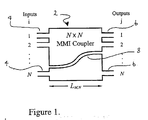
- the MMI coupler 2 is illustrated as a substantially rectangular body, one side of the rectangular body having input ports 4 and the opposing side having output ports 6 .
- the body of the MMI coupler is illustrated as having a break line 8 .
- the break line 8 is used to indicate that the number N of corresponding input ports 4 and output ports 6 varies according to design requirements. Also, the number of input ports 4 may differ from the number of output ports 6 according to design requirements.
- the coupler length is given by Bachmann, et al . in " Overlapping-image multimode interference couplers with a reduced number of self-images for uniform and non-uniform power splitting", Appl. Opt. , vol. 34, no. 30, pp. 6898-6910, Oct. 1995.
- L M , N M N 3 L ⁇ , where L ⁇ is the beat length of the coupler, and M and N are any two positive integers without a common divisor.
- phase associated with imaging a beam of light from input port i to an output port j in an MMI coupler was first derived by Bachmann et al . in "General self-imaging properties in N ⁇ N multimode interference couplers including phase relations", Appl. Opt ., vol. 33, no. 18, pp. 3905-3911, June 1994, and contains two contributions: an absolute phase term, and a relative phase term. In the present analysis, it is the relative phases of tight at the coupler output ports that are important, so it is possible to drop the absolute term without loss of generality. Furthermore, the relative phase relations are recast into a simpler form see M. R. Paiam and R. I.
- ⁇ ij form a matrix ⁇ , with i representing the row number, and j representing the column number.
- the conditions in equation (6) are general properties of a transfer matrix S .
- the matrix S coupler is a transfer matrix for the coupler, i.e., where E in / i is the complex optical field amplitude at input port i and E out / j is the optical field at output 6 port j .
- the basic layout of the N ⁇ N GMZI 5 consists of three components: an N ⁇ N MMI splitter 20 ; an active phase shifting region 22 having N optical path length changers in the form of phase shifters 28 in the active phase shifting region 22 ; and an N ⁇ N MMI combiner 24 .
- output ports of the N ⁇ N MMI splitter 20 and input ports of the N ⁇ N MMI combiner 24 form waveguides arms 26 between the N ⁇ N MMI splitter 20 and the N ⁇ N MMI combiner 24 .
- the waveguide arms are same waveguide arms absent any coupling therebetween. Phase shifters 28 are shown intimate with the waveguide arms 26 .
- An individual phase shifter 28 is shown associated with a single waveguide arm.
- the phase shifters 28 when not active or are not present provide a passive device.
- An active phase shifter 28 changes an optical path length of its associated waveguide arm 26 .
- An individual phase shifter 28 is operated by applying a driving signal in the form of a voltage or current, for example, to shift the phase of the light in one of the waveguide arms 26 .
- a break line 8 is used to indicate that the number N of corresponding input ports 4 and output ports 6 varies according to design requirements.
- the N waveguide arms 26 are shown numbered sequentially from top to bottom, 1 to N . According to an embodiment described herein, the waveguide arms 26 are disposed along a straight path from the waveguide arm designated 1 to the waveguide arm designated N .
- Phase shifting is well known. For example, changing the optical path length of the light medium can perturb the phase of a beam of light passing through the medium. Changing the refractive index of a medium or the length of the medium in which the beam of light is guided changes the optical path length of the medium.
- Many phase shifting effects may be exploited in design of GMZIs, for example, temperature, electro-optic effects, opto-optic effects, stress within a medium, and magnetic effects; information pertaining to phase shifting effects is presented in Nishihara, et al. in " Optical Integrated Circuits". New York: McGraw-Hill, 1989, ch. 5.
- a chromium heater electrode deposited on top of a waveguide arm 26 is used to heat the waveguide arm 26 thereby providing a thermally induced phase shift.
- An optical field at any of the input ports 4 of the MMI splitter 20 is reproduced at all output ports of the splitter, resulting in an equal distribution of light power to all waveguide arms 26 of the active phase shifting region 22 . These distributions of the light have equal intensity, but different phase.
- the function of the active phase shifters 28 is to modify the relative phases of light within these distributions such that a specific distribution of light having relative phases therebetween is obtained at the input ports to the MMI combiner 24 .
- the MMI combiner 24 performs the function of combining light from N input ports of the combiner to form combined light signals at the output ports 6 .
- the positions and intensities of the combined light depend upon the relative phases of light signals at the input ports of the MMI combiner 24 . Since the phase shifters 28 control the relative phases of light signals at input ports of the MMI combiner 24 , control of the positions and intensities is performed by activating the phase shifters 28 to achieve the required phase distribution at the combiner input ports.
- Transfer matrices for the MMI couplers are given by equation (5).
- An MMI splitter is represented by the matrix S splitter with elements s ij and an MMI combiner is represented by the matrix S combiner with elements s jk .
- the phase shifters act independently and produce relative shifts of each phase ⁇ ij of light propagating through a given waveguide arm j by an amount ⁇ j .
- the action of the phase shifters is described by a diagonal N ⁇ N transfer matrix, see for example, C. G. Montgomery, R. H. Dicke, and E. M. Purcell, eds., " Principles of Microwave Circuits", 1st Edition. New York: McGraw-Hill, 1948, pp. 146-151, 299-303,
- the GMZI transfer matrix is used to derive two important results.
- expanding equation (10) provides analytic expressions for the output intensities of tight in terms of the input light intensities and applied phase shifts.
- the transfer matrix is used in equation (9) to solve for the phase shifts ⁇ j required to achieve a given distribution of the output intensity ratios.
- N 2.
- the phase shifts needed to achieve a desired output power distribution are preferably determined numerically. A numerical approach is now provided to address this issue. The approach is then applied within the transfer matrix framework.
- Control of the output intensity distribution is useful in applications such as a tap function, where only a small portion of the light is extracted from a channel.
- a tap function where only a small portion of the light is extracted from a channel.
- Equation (21) is a system of N nonlinear equations with N unknowns: the phase shifts ⁇ j .
- the nonlinear system equation (23) is solved numerically using an iterative procedure. It must be noted, however, that for some intensity distributions, where N > 2, a real solution to the nonlinear system may not exist. This effect occurs for a class of degenerate distributions, where at least one output intensity is near zero, and the others are not intensity extrema (i.e., 0% or 100%). In these cases, the closest real solution is found, which, in general, results in a small deviation of the output intensities from the specified distribution. This effect arises from an interdependence among the nonlinear equations. When light having an extremum in intensity emerges from a port, equation (14) dictates that light having intensity extrema emerge from all other ports.
- An initial guess x 0 is made, after which the following occurs at each iteration: first, the partial derivatives of Y ( x 0 ) are calculated by a finite difference approximation, using a systematic perturbation of each of the elements of x 0 . The partial derivatives are then used in the Levenberg-Marquardt set of linear equations to establish a direction in which to search for decreasing values of the function Y . A step is then taken in this direction, and the iterate is updated.
- a limitation of this numerical method is that an iterate of x may sometimes settle into a local rather than a global minimum. To overcome this, the initial guess x 0 should be perturbed significantly, and the analysis repeated. Confidence in the numerical solution is gained when it is consistently obtained from a variety of initial guesses of x 0 .
- phase shifts x are determined numerically, they are optimized by offsetting the determined phase shifts by a constant amount and shifting individual phase amounts by multiples of 2 ⁇ . This allows the GMZI to be operated with a driving signal that consumes the least possible power.
- the GMZI is implementedin a reconfigurable mode, where active phase shifters are used.
- the GMZI is used in a passive mode, where the phase shifts are achieved by varying the waveguide arm 26 lengths (See Fig. 2).
- the waveguide arm lengths are chosen in such a way as to avoid crossing of the waveguides arms 26 .
- the intended application of the GMZI will dictate whether the GMZI is implemented in an active or a passive mode.
- the maximum phase shift magnitude needed in any single waveguide arm 26 is 1.37 radians which equals 78.5°.
- the optimization routine ensures that the maximum phase shift magnitude needed to achieve any intensity distribution in any N -port GMZI is always ⁇ ⁇ .
- phase shifts in equation (26) result in an intensity distribution with a maximum deviation of 0.38 % from the distribution specified in equation (25).
- the phase shifts must be applied to an accuracy of at least 0.01 radians, which yields a tolerable phase error of 0.01 ⁇ 180/ ⁇ or 0.57°.
- the accuracy of the applied phase shifts diminishes, the output intensities deviate further from the specified distribution; however, the deviation remains small for even a relatively large change in the applied phase shifts.
- the accuracy of solutions varies with a desired intensity distribution and N .
- a set of optimum phase shifts required to achieve the N switch states of a 1 ⁇ N switch is derived.
- the above procedure is repeated N times, replacing I out / k in equation (22) by the successive columns of the identity matrix of order N .
- the result is N vectors x which form the columns of a matrix, referred to as the optimum switching matrix X , which has elements x jk .
- a desired output port is selected by the column k , and the row s j give phase shifts that are ideally applied to the arms j in order to route light launched into input port i to output port k .
- Using a different input port amounts to interchanging the columns of the matrix X .
- the lengths of the phase shifters shown in Fig. 2 are varied so that the application of a voltage with magnitude of V volts induces a phase shift of magnitude 2 ⁇ /3.
- the voltage levels 0 and +V thus represent logic levels 0 and 1, respectively.
- N 3 GMZI switch.
- the driving conditions for the phase shifters become increasingly complex.
- X 2 ⁇ 5 -1 -1 1 1 0 0 1 1 -1 -1 1 0 -1 1 -1 -1 1 -1 0 1 1 -1 0 -1 1 , demonstrating that control of the switch is possible without complicated circuitry.
- variable-ratio optical splitting provides a powerful tool.
- a distinct switching capability as well as splitting would be advantageous. It would also be advantageous to reduce power consumption of any such switching device over similar prior art integrated switching devices.
- the first to N -th waveguide arms 26 are in the form of an open path, i.e., in a substantially linear open path starting at a first end, first waveguide arm 26 , and ending at a second opposing end, N -th waveguide arm 26 .
- the ends of the input and output ports of the MMI splitter 20 and combiner 24 and the wavelength arms 26 connected thereto since, in practice, these waveguides are fabricated as integral, continuous waveguides.
- Two different types of N ⁇ N GMZI are also possible, one in which N is odd and one in which N is even, as explained below.
- the N ⁇ N MMI splitter 20 initially distributes input light equally among the waveguide arms 26 , providing N distributions, while imposing a relative phase difference amongst the input light as discussed by M. Bachmann, et al ., in "General self-imaging properties in N ⁇ N multimode interference couplers including phase relations," Appl . Opt ., vol. 33, no. 18, pp. 3905-3911, June 1994.
- the N ⁇ N MMI combiner 24 substantially identical to the N ⁇ N MMI splitter 20 , recombines the N distributions. By actively controlling the optical path lengths of the N waveguide arms 26 , with phase shifters 28 , the relative phases among the N distributions are changed. The interference between the N distributions in the N ⁇ N MMI combiner 24 is thus controlled, with the result that light launched into an input port 4 may be routed to any of the N output ports 6 .
- the passive GMZI acts like an MMI coupler with K output ports and K is even.
- the geometry of an MMI coupler with an even number of output ports has been described by Bachmann et. al ., ibid for an N ⁇ N MMI coupler.
- the N ⁇ N MMI coupler 20, 24 functions as the N ⁇ N MMI splitter 20 or the N ⁇ N MMI combiner 24.
- the positions of the input distributions and output distributions are specified by a free parameter a , which is limited to the range 0 ⁇ a ⁇ W / N , or half an interval length.
- a free parameter ⁇ is used to describe the positions of the output distributions, where 0 ⁇ ⁇ ' ⁇ W / K .
- the passive GMZI consists of two superimposed K ⁇ K MMI couplers, a first K ⁇ K MMI coupler 30a and a second K ⁇ K MMI coupler 30b , each coupler 30a and 30b with input ports and output ports from the same set.
- the passive GMZI consists of two superimposed K ⁇ K MMI couplers, a first K ⁇ K MMI coupler 62a and a second K ⁇ K MMI coupler 62b , each coupler 62a and 62b with input ports and output ports in different sets. This is shown in Figure 7.
- the above description of a passive GMZI is useful in understanding an improved active GMZI according to the invention.
- the device By operating N phase shifters 28 on the waveguide arms 26 of the N ⁇ N GMZI, the device functions as a 1 ⁇ N switch when the applied phase shifts are multiples of ⁇ / N .
- N sets of phase shifts corresponding to the columns of an optimum phase shift matrix X , are required to route light launched into a given input port to any of the N output ports. This is shown, for example. by R. M. Jenkins, et al ., "Novel 1 ⁇ N and N ⁇ N integrated optical switches using self-imaging multimode GaAs/AlGaAs waveguides," Appl. Phys. Lett. , vol. 64, no. 6, pp. 684-686, Feb. 1994., and P. A.
- the columns of X are divided into two sets of K columns each. For ease of description, one set of columns is designated “ minimal” and the other is designated “ non-minimal”.
- phase shifts have the smallest number of discrete levels of any of the N columns in X which simplifies the control logic.
- non-minimal sets do not have the properties stated above: they are in general neither symmetric nor anti-symmetric, nor do they necessarily have the smallest maximum phase shift or the smallest number of discrete levels of any of the columns in X .
- Each column of X gives the phase shifts required to route light launched into the input port i to the output port k corresponding to the column number, so the sets of minimal and non-minimal columns correspond to sets of minimal and non-minimal output ports. These are interpreted as the output ports, to which light is switched using minimal phase shifts, and using non-minimal phase shifts, respectively. Comparing the minimal and non-minimal port numbers to the analysis of the passive GMZI, it is found that the minimal set always corresponds to the set to which the input light is distributed In the passive GMZI.
- routing light launched into any of the input ports of a given K ⁇ K coupler to any of the output ports of the same K ⁇ K coupler is accomplished using minimal phase shifts, while routing light launched into any of the input ports of a given K ⁇ K coupler to any of the output ports of a different K ⁇ K coupler requires non-minimal phase shifts. This allows improved design of 1 ⁇ N GMZI switches.
- the restriction of launching a beam of light into a single input port of a GMZI is removed by utilizing a 1 ⁇ 2 switch 40 .
- the 1 ⁇ 2 switch 40 has a single input port 45 and output ports of the 1 ⁇ 2 switch 40 are optically coupled to any two GMZI input ports 4 from different sets The different sets correspond to the set numbering given by equation (34) and equation (35).
- the 1 ⁇ 2 switch 40 allows switching of a single beam of light launched into the input port of the 1 ⁇ 2 switch 40 into any of two GMZI input ports 4 from the different sets.
- the 1 ⁇ 2 switch 40 is not restricted to a single input port 45 .
- the 1 ⁇ 2 switch 40 in some cases is formed from two 2 x 2 MMIs 41 optically coupled by two waveguide arms 26 , at least one of the two waveguide arms 26 having a phase shifter 28 . Any desired output of light is then achieved with minimal phase shifts, by operating the 1 ⁇ 2 switch 40 such that the input port of the GMZI corresponds to the same K ⁇ K coupler as the output port.
- the improved 1 ⁇ N switch has a number of advantages over the standard 1 ⁇ N GMZI switch.
- the minimal sets of phase shifts are symmetric, as stated in property 1, above. This means that it is possible to physically connect the phase shifters or their controllers in pairs, so that only K + 1 rather than N independent phase shifters are needed to operate the device; an additional phase shifter is needed to operate the 1 ⁇ 2 switch at the GMZI input ports, if a 1 ⁇ 2 GMZI is chosen as the switch.
- the range of phase shifts are minimized, and the number of different phase shift levels is much smaller than needed to operate an isolated N ⁇ N GMZI switch.
- the number of phase shifters 28 and their positions are generalized for N waveguide arms 26 .
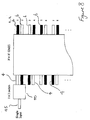
- the waveguide arms 26 are disposed along an open path and grouped as pairs of waveguide arms, two substantially central waveguide arms 26 forming a first pair 26a of waveguide arms, and each subsequent pair of waveguide arms 26b , and so on formed by two waveguide arms, one on each side of the already grouped waveguide arms 26a, 26b, ... and wherein two individual waveguide arms that form a pair have their individual optical path lengths changed in unison such that both optical path lengths of the pair are changed by substantially the same amount.
- Figure 9 shows two grouped sets of waveguide arms 26 , namely 26a and 26b .
- phase shifter 28a which controls optical path length of the first pair of waveguide arms 26a
- phase shifter 28b which controls optical path length of a first subsequent pair of waveguide arms 26b
- phase shifter 28a which controls optical path length of the first pair of waveguide arms 26a
- phase shifter 28b which controls optical path length of a first subsequent pair of waveguide arms 26b
- the improved 1 ⁇ N switch according to the invention is exemplified below by way of an example.
- phase shift sets satisfy the four properties stated above: They are symmetric about a horizontal line bisecting the matrix X , resulting in 2 sets of independent phase shifts, given in bold; The 2 sets of 2 phase shifts are anti-symmetric with respect to each other, about a line bisecting the 2 phase shifts; The phase shifts have a range [0, ⁇ /2] which is the smallest of any of the N columns in X ; and, The phase shifts have two discrete levels, which is the smallest number possible from the N columns in X .
- the N ⁇ N GMZI 5 is capable of variably routing beams of light provided to each of a plurality of input ports to a plurality of output ports.
- N switch states of the N ⁇ N GMZI 5 allow only N possible variations of said routing.
- a non-blocking optical switch architecture is capable of providing N factorial variations, an entire set, of routing of beams of light provided to the input ports to the output ports.
- the switching capacity of the N ⁇ N GMZI 5 is increased by optically coupling at least two input ports 4 of the N ⁇ N GMZI 5 to an optical switch, for example, an ( N - 1) x ( N - 1) optical switch.
- an optical switch for example, an ( N - 1) x ( N - 1) optical switch.
- An example of an expanded capacity optical switch is a 4 x 4 GMZI having two ports thereon optically coupled to two ports of a 2 x 2 GMZI.
- GMZIs of different dimensions are used to achieve an N ⁇ N non-blocking optical switch.
- N ⁇ N non-blocking optical switch two embodiments of non-blocking optical switches according to the invention are described; (i) a cascaded design; and (ii) a balanced design.
- the simplest GMZI is a 2 ⁇ 2 optical switch, which is non-blocking.
- the switch has two input ports and two output ports and light can be routed from either input port to either output port
- the possible routings are referred to herein as light routing permutations. Both light-routing permutations are possible for the 2 ⁇ 2 optical switch, and the light routing permutations are controlled by a single phase shift of magnitude ⁇ in either waveguide arm 26 .
- the six light routing permutations are required.
- the six light routing permutations are listed in the first column of Table 1.
- the first column of Table 1 lists output light routing permutations for non-blocking operation, and the second column lists light routing permutations available from a 3 ⁇ 3 GMZI.
- the first two rows of the first column are described as follows.
- the first row of the first column of Table 1 describes: a beam of light being routed from an input port number 1 to an output port number 1, i.e., (1,1); a beam of light being routed from an input port number 2 to an output port number 2, i.e., (2,2); and a beam of light being routed from an input port number 3 to an output port number 3, i.e., (3,3).
- the second row of the first column of Table 1 describes: (1,1); (2,3); and (3,2). The remaining rows and columns are understood from the preceding description by one of skill in the art.
- the 3 ⁇ 3 GMZI is capable of only three distinct light routing permutations, listed in the second column of Table 1, namely: [(1,1), (2,3), (3,2)]; [(1,2), (2,1), (3,3)]; and [(1,3), (2,2), (3,1)].
- Each of these three light routing permutations corresponds to a single member from each of the three sets in the first column.
- a further capability of switching light from two latter output ports of the GMZI from ascending to descending order, and vice-versa, to obtain the entire set of six light routing permutations is advantageous.
- a 2 ⁇ 2 GMZI is capable of providing the function of switching tight from each of two input ports of the GMZI to each of two output ports thereof.
- the 3 ⁇ 3 non-blocking optical switch is therefore realized using a 3 ⁇ 3 GMZI with two output ports optically coupled to a 2 ⁇ 2 GMZI.
- the ports are adjacent ports.
- non-blocking optical switches For instance, in a 4 ⁇ 4 non-blocking optical switch, 24 light routing permutations are required.
- a 4 ⁇ 4 GMZI has four tight routing permutations, and a 3 ⁇ 3 non-blocking optical switch connected to three of the four GMZI output ports provides at least six light routing permutations for each of the four GMZI light routing permutations.
- the 4 ⁇ 4 non-blocking optical switch is realized by cascading a 4 ⁇ 4 GMZI, a 3 ⁇ 3 GMZI, and a 2 ⁇ 2 GMZI.
- N - 1 cascaded GMZIs form an N ⁇ N non-blocking optical switch as shown in Figure 3.
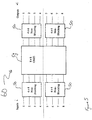
- FIG. 3 a generic cascaded configuration of the cascaded N ⁇ N non-blocking optical switch 3 is shown.
- An N ⁇ N GMZI 5 has 1 to ( N - 1) output ports 6 optically coupled to 1 to ( N -1) input ports 4 of an ( N - 1) ⁇ ( N - 1) GMZI 5a .
- the cascaded non-blocking switch is illustrated with a break in structure 10 from the ( N - 1) ⁇ ( N - 1) GMZI 5a to a 4 ⁇ 4 GMZI 5f .
- the break in structure 10 after the ( N -1) ⁇ ( N - 1) GMZI 5a is used to indicate that the number of cascaded GMZIs varies according to design requirements.
- the cascaded non-blocking optical switch 3 terminates with the first three output ports 6 of a 4 x 4 GMZI 5f optically coupled to three input ports 4 of a 3 ⁇ 3 GMZI 5g, and the first two output ports 6 of a 3 ⁇ 3 GMZI 5g optically coupled to two input ports of a 2 ⁇ 2 GMZI 5h .
- the N ⁇ N GMZI 5 is upstream.
- the 2 x 2 GMZI 5h is upstream. Further alternatively, both are upstream and downstream when light propagates bi-directionally.
- the ( N - 1) ⁇ ( N - 1) non-blocking optical switch comprises N - 2 GMZI's each having a different number of waveguide arms, the number of waveguide arms ranging from 2 to N - 1, where the N - 2 GMZI's are arranged in descending order by the number of waveguide arms, such that each GMZI other than a terminal GMZI with 2 waveguide arms 5h and an initial GMZI with N - 1 waveguide arms 5a is disposed between two GMZI's - one with one more waveguide arm and one with one less waveguide arm - each GMZI having a single free output port and each port other than the free output port within a GMZI optically coupled to one and only one port of an adjacent GMZI.
- each light routing permutation corresponds to a unique state of the optical switch providing an efficient design.
- the number of possible switch states is equal to the number of possible light routing permutations, which ensures that there is no redundancy in the design. This permits use of a small number of MMI couplers, phase shifters, and waveguide crossings to achieve N factorial light routing permutations. Specifically, (2 N - 2) MMI couplers, ( N 2 + N - 2)/2 phase shifters, and zero waveguide crossings are required.
- Attenuations resulting from paths traversed by optical signals in the cascaded design are not identical.
- a signal emerging from the N -th output has traversed two MMI couplers, while the signal emerging from the ( N - 1)-th output port has traversed four MMI couplers, while the signal emerging from the first output port has traversed all (2 N - 2) MMI couplers. Since each MMI coupler has a finite excess loss, a signal emerging from the N -th output port is the least attenuated, while a signal emerging from the first output port is the most attenuated.
- beams of light emerging from the output ports are attenuated and/or amplified such that the beams of light are of similar intensity.
- Another approach to balancing N ⁇ N non-blocking optical switches is by optically coupling smaller optical switches to each of the input ports 4 and the output ports 6 of an N ⁇ N GMZI 5 . As is evident, additional light routing permutations necessary for non-blocking operation are achieved whilst maintaining a symmetric balanced design.
- the basic layout of a balanced 4 ⁇ 4 non-blocking optical switch 50 is formed from a 4 ⁇ 4 GMZI 5f and four 2 ⁇ 2 GMZIs 5h .
- the 4 ⁇ 4 GMZI 5f is shown having four input ports 4 and four output ports 6 .
- a 2 ⁇ 2 GMZI 5h is capable of accessing all of its switch states with only a single phase shifter 28 .
- the first and second input ports 4 of the 4 ⁇ 4 GMZI are optically coupled to two output ports 6 of a first 2 x 2 GMZI 5h .
- the second and third input ports 4 of the 4 x 4 GMZI 5f are optically coupled to two output ports 6 of a second 2 ⁇ 2 GMZI 5h .
- the first and second output ports 6 of the 4 x 4 GMZI 5f are optically coupled to two input ports 6 of a third 2 x 2 GMZI.
- the third and fourth output ports 6 of the 4 ⁇ 4 GMZI 5f are optically coupled to two input ports 6 of a fourth 2 ⁇ 2 GMZI.
- the balanced 4 ⁇ 4 non-blocking switch is constructed such that no waveguide paths cross.
- the 4 x 4 non-blocking optical switch 50 is balanced, since each path from an input port to an output port traverses two 4 ⁇ 4 MMIs and four 2 ⁇ 2 MMIs. Also, non-blocking operation is achieved. Within a resulting 32 light routing permutations are the threshold 24 unique light routing permutations required for a 4 x 4 optical switch to operate as a non-blocking optical switch. Some of the 32 tight routing permutations are redundant.
- a set of cross-connects ( i , k ) for the 4 ⁇ 4 GMZI 5f is shown in Table 2.
- a configuration state of the GMZI corresponds to a single row.
- An imaginary bisection line (dashed line) drawn in Figure 4 splits the N x N GMZI. This is indicated in Table 2 by a dashed line.
- the set of all possible crossovers of the input ports i from one side of the bisection line to the output ports k on the other side is obtained within the four GMZI states.
- non-blocking operation is possible using a 4 ⁇ 4 GMZI 5f .
- This line bisects the 4 ⁇ 4 GMZI 5f , but does not cross any of the other components.
- this bisection of the 4 ⁇ 4 GMZI 5f is represented by shading the inputs on the top and bottom portions of the GMZI differently.
- the optical switch must be capable of routing light launched into any possible number of input ports from the top half of the optical switch to the same number of output ports from the bottom half, and vice-versa. This is because the 4 ⁇ 4 GMZI 5f is the only region in the optical switch where tight launched into input ports within the top half of the optical switch is capable of being routed to the bottom half of optical switch, and vice-versa.
- the 2 ⁇ 2 GMZIs 5h are confined to routing tight within either the top or bottom half of the device, and therefore cannot perform this "crossover" function.
- the 4 ⁇ 4 GMZI 5f is capable of 0, 1, and 2 crossovers of input signals from the top half to output ports in the bottom half, and vice-versa. It is this property of the 4 ⁇ 4 GMZI 5f which results in non-blocking operation of the 4 ⁇ 4 optical switch 50 .
- the balanced 4 x 4 non-blocking optical switch 50 To configure the balanced 4 x 4 non-blocking optical switch 50 , first consider the light routing permutation to determine how many crossovers of the bisection line are necessary. Second, set the 4 ⁇ 4 GMZI 5f to the corresponding state, determined from Table 2. Third, the 2 ⁇ 2 GMZIs are each set in either the bar or cross state to achieve the desired permutation. In this manner, a control table for the 4 ⁇ 4 optical switch is derived. One possible set of control states for the 4 ⁇ 4 balanced non-blocking optical switch is given in Table 3. The 4 ⁇ 4 GMZI state corresponds to the relevant row in Table 2, and is abbreviated by the first pair ( i , k ).
- a balanced non-blocking optical switch results when a passive 2 x 2 GMZI 5h is replaced by a device that attenuates light entering or exiting ports to substantially the same extent as the passive 2 x 2 GMZI 5h .
- a similar attenuation of beam power is found for a beam passing through a specific attenuator as that for a beam passing through the 2 x 2 GMZI 5h .
- a first configuration is one in which all four waveguide arms 26 of the 4 ⁇ 4 GMZI have a means for changing their optical length and the 4 ⁇ 4 GMZI is optically coupled to four 2 ⁇ 2 GMZIs.
- one of the 2 ⁇ 2 GMZIs is passive, i.e., cross-state, and all possible switching states are obtainable.
- one of the 2 ⁇ 2 GMZIs has no means for changing optical path length of connecting waveguide arms 26 between two MMIs that make up the 2 ⁇ 2 GMZI.
- one of the 2 ⁇ 2 GMZIs is replaced by a medium or any device that attenuates a light beam to substantially the same degree as a beam passing through the 2 ⁇ 2 GMZI.
- the design of balanced non-blocking optical switches is possible for larger values of N , where N is even.
- a bisection line is drawn in the cross-connect table of the N ⁇ N GMZI.
- the cross-connect capability of the N ⁇ N GMZI ensures that every possible number of crossovers is achievable within the N states.
- the N ⁇ N balanced non-blocking optical switch is formed by connecting the ports on a given side of the bisection line to a smaller non-blocking optical switch. In general, the smaller non-blocking optical switches are operated actively.
- the basic layout of a balanced 8 ⁇ 8 non-blocking optical switch 60 is formed from an 8 x 8 GMZI 5j and four 4 ⁇ 4 non-blocking optical switches 50 .
- the 8 ⁇ 8 GMZI 5j is constructed in a similar manner as described in Figure 2, however, waveguide arms 26 and phase shifters 28 are not shown.
- the 4 ⁇ 4 non-blocking optical switches 50 are constructed in a similar manner as described in Figure 4.
- the 8 ⁇ 8 GMZI 5j and the four 4 ⁇ 4 non-blocking optical switches 50 are shown as rectangular boxes with input ports 4 and output ports 6 .
- the 8 ⁇ 8 non-blocking optical switch 60 is constructed in a similar manner to the non-blocking optical switch described in Figure 4.
- Table 4 cross-connects for the 8 ⁇ 8 GMZI 5j are given.
- Table 4 provides the set of cross-connects ( i , k ) for the 8 ⁇ 8 GMZI 5f in which a given state of the 8 ⁇ 8 GMZI corresponds to a single row.
- the set of all possible crossovers about a line that divides the device into two regions is obtained within the eight GMZI states.
- non-blocking operation is possible using the 8 ⁇ 8 GMZI.
- the input ports and the output ports are bisected as indicated by the shading, and the number of crossovers for each state are counted. Since the ports are divided into groups of four, it is possible to connect balanced 4 ⁇ 4 non-blocking optical switches to both sides of the 8 ⁇ 8 GMZI to obtain the necessary light routing permutations for the 8 ⁇ 8 balanced non-blocking optical switch.
- Configuration of the GMZIs follows the procedure used in the 4 ⁇ 4 balanced non-blocking optical switch.
- the program first determines which of the GMZI states yields the number of crossovers indicated by the desired output permutation. Once these states are determined, the configuration tables of the smaller non-blocking optical switches are used to arrive at the desired permutations.
- the software program optimizes the switch to eliminate unnecessary phase shifters and to minimise required power for driving the phase shifters where possible.
- the configuration states are not unique, and it may be possible to operate a number of the smaller component GMZIs in a passive mode.
Landscapes
- Physics & Mathematics (AREA)
- Engineering & Computer Science (AREA)
- General Physics & Mathematics (AREA)
- Optics & Photonics (AREA)
- Microelectronics & Electronic Packaging (AREA)
- Nonlinear Science (AREA)
- Computer Networks & Wireless Communication (AREA)
- Optical Modulation, Optical Deflection, Nonlinear Optics, Optical Demodulation, Optical Logic Elements (AREA)
- Instruments For Measurement Of Length By Optical Means (AREA)
Applications Claiming Priority (19)
| Application Number | Priority Date | Filing Date | Title |
|---|---|---|---|
| US227939 | 1994-04-15 | ||
| US7339898P | 1998-01-30 | 1998-01-30 | |
| US7331498P | 1998-01-30 | 1998-01-30 | |
| US73314P | 1998-01-30 | ||
| US73398P | 1998-01-30 | ||
| US22793999A | 1999-01-11 | 1999-01-11 | |
| US227856 | 1999-01-11 | ||
| CA002258333A CA2258333A1 (en) | 1998-01-30 | 1999-01-11 | An n x n non-blocking optical switch |
| US227857 | 1999-01-11 | ||
| US09/227,856 US6222955B1 (en) | 1998-01-30 | 1999-01-11 | Integrated 1×N optical switch |
| US09/227,857 US6292597B1 (en) | 1999-01-11 | 1999-01-11 | N×N non-blocking optical switch |
| CA002258335A CA2258335A1 (en) | 1998-01-30 | 1999-01-11 | An integrated 1 x n optical switch |
| CA2258353 | 1999-01-11 | ||
| US227857P | 1999-01-11 | ||
| US227939P | 1999-01-11 | ||
| US227856P | 1999-01-11 | ||
| CA002258353A CA2258353A1 (en) | 1998-01-30 | 1999-01-11 | Optical variable-ratio power splitter |
| CA2258335 | 1999-01-11 | ||
| CA2258333 | 1999-01-11 |
Publications (2)
| Publication Number | Publication Date |
|---|---|
| EP0933963A2 true EP0933963A2 (de) | 1999-08-04 |
| EP0933963A3 EP0933963A3 (de) | 2000-09-20 |
Family
ID=27570291
Family Applications (1)
| Application Number | Title | Priority Date | Filing Date |
|---|---|---|---|
| EP99101456A Withdrawn EP0933963A3 (de) | 1998-01-30 | 1999-01-27 | Optischer Leistungsteiler mit variabelem Verhältnis und optische Schalter |
Country Status (1)
| Country | Link |
|---|---|
| EP (1) | EP0933963A3 (de) |
Cited By (18)
| Publication number | Priority date | Publication date | Assignee | Title |
|---|---|---|---|---|
| WO2001038924A1 (en) * | 1999-11-23 | 2001-05-31 | Nanovation Technologies, Inc. | Optical mach-zehnder switch having a movable phase shifter |
| WO2001038923A1 (en) * | 1999-11-23 | 2001-05-31 | Nanovation Technologies, Inc. | Optical mach-zehnder switch with movable phase shifter |
| EP1146386A1 (de) * | 2000-04-14 | 2001-10-17 | International Business Machines Corporation | Nichtblockierender Freiraumschalter |
| EP1152630A1 (de) * | 2000-05-05 | 2001-11-07 | Corning Incorporated | Integrieter mehrstufiger planarer optischer Schalter |
| WO2001084759A1 (en) * | 2000-05-03 | 2001-11-08 | Telefonaktiebolaget L M Ericsson | Apparatus and method for wavelength selective switching |
| WO2002031556A1 (en) * | 2000-10-11 | 2002-04-18 | Bookham Technology Plc | Optical star coupler with flared interference region |
| WO2001038922A3 (en) * | 1999-11-23 | 2002-09-12 | Nanovation Tech Inc | Analog optical switch using an integrated mach-zehnder interferometer having a movable phase shifter |
| WO2003027740A1 (en) * | 2001-09-28 | 2003-04-03 | Telefonaktiebolaget L M Ericsson | Multi-mode interference waveguide based switch |
| EP1152632A3 (de) * | 2000-05-05 | 2003-10-15 | Memscap S.A. | Mikroelektromechanische optische Querverbindungsschalter mit reduzierter Anzahl Reflektoren |
| CN102879924A (zh) * | 2012-09-28 | 2013-01-16 | 江苏大学 | 多模干涉马赫-曾德尔全光开关 |
| CN103529619A (zh) * | 2013-10-21 | 2014-01-22 | 东南大学 | 一种基于多模干涉耦合器的硅基光子模数转换器 |
| CN113794557A (zh) * | 2021-09-16 | 2021-12-14 | 广西大学 | 一种多自由度量子密钥分发硅基发射端芯片 |
| US11251876B2 (en) | 2020-11-17 | 2022-02-15 | Intel Corporation | Optical analog matrix multiplier for optical neural networks |
| US20220229340A1 (en) * | 2017-03-17 | 2022-07-21 | Rockley Photonics Limited | Optical modulator and method of use |
| WO2022170829A1 (zh) * | 2021-02-10 | 2022-08-18 | 苏州旭创科技有限公司 | 光子集成芯片及光发射组件和光收发模块 |
| US11474298B2 (en) * | 2020-11-17 | 2022-10-18 | Intel Corporation | 2×2 optical unitary matrix multiplier |
| CN116736561A (zh) * | 2023-02-24 | 2023-09-12 | 桂林电子科技大学 | 一种基于多模干涉耦合器的4×4热光开关 |
| WO2025223189A1 (en) * | 2024-04-24 | 2025-10-30 | Huawei Technologies Co., Ltd. | Co-design of cascaded passive and active layers for optical integrated circuits |
Family Cites Families (1)
| Publication number | Priority date | Publication date | Assignee | Title |
|---|---|---|---|---|
| WO1996024080A2 (de) * | 1995-02-01 | 1996-08-08 | Leuthold Juerg | Kompakte optisch-optische schalter und wellenlängen-konverter mittels multimode-interferenz moden-konvertern |
-
1999
- 1999-01-27 EP EP99101456A patent/EP0933963A3/de not_active Withdrawn
Cited By (28)
| Publication number | Priority date | Publication date | Assignee | Title |
|---|---|---|---|---|
| WO2001038923A1 (en) * | 1999-11-23 | 2001-05-31 | Nanovation Technologies, Inc. | Optical mach-zehnder switch with movable phase shifter |
| WO2001038922A3 (en) * | 1999-11-23 | 2002-09-12 | Nanovation Tech Inc | Analog optical switch using an integrated mach-zehnder interferometer having a movable phase shifter |
| WO2001038924A1 (en) * | 1999-11-23 | 2001-05-31 | Nanovation Technologies, Inc. | Optical mach-zehnder switch having a movable phase shifter |
| EP1146386A1 (de) * | 2000-04-14 | 2001-10-17 | International Business Machines Corporation | Nichtblockierender Freiraumschalter |
| WO2001079926A1 (en) * | 2000-04-14 | 2001-10-25 | International Business Machines Corporation | Free-space non-blocking switch |
| WO2001084759A1 (en) * | 2000-05-03 | 2001-11-08 | Telefonaktiebolaget L M Ericsson | Apparatus and method for wavelength selective switching |
| US6574391B2 (en) | 2000-05-03 | 2003-06-03 | Telefonaktiebolaget Lm Ericsson (Publ) | Apparatus and method for wavelength selective switching |
| EP1152632A3 (de) * | 2000-05-05 | 2003-10-15 | Memscap S.A. | Mikroelektromechanische optische Querverbindungsschalter mit reduzierter Anzahl Reflektoren |
| EP1152630A1 (de) * | 2000-05-05 | 2001-11-07 | Corning Incorporated | Integrieter mehrstufiger planarer optischer Schalter |
| WO2002031556A1 (en) * | 2000-10-11 | 2002-04-18 | Bookham Technology Plc | Optical star coupler with flared interference region |
| CN1299140C (zh) * | 2001-09-28 | 2007-02-07 | 艾利森电话股份有限公司 | 以多模干涉波导为基础的开关 |
| GB2396022B (en) * | 2001-09-28 | 2005-03-02 | Ericsson Telefon Ab L M | Multi-mode interference waveguide based switch |
| US7035500B2 (en) | 2001-09-28 | 2006-04-25 | Telefonaktiebolaget Lm Ericsson (Publ) | Multi-mode interference waveguide based switch |
| WO2003027740A1 (en) * | 2001-09-28 | 2003-04-03 | Telefonaktiebolaget L M Ericsson | Multi-mode interference waveguide based switch |
| DE10297221B4 (de) * | 2001-09-28 | 2011-06-30 | Telefonaktiebolaget Lm Ericsson (Publ) | Einrichtung und Verfahren zum Durchschalten eines optischen Signals |
| GB2396022A (en) * | 2001-09-28 | 2004-06-09 | Ericsson Telefon Ab L M | Multi-mode interference waveguide based switch |
| CN102879924A (zh) * | 2012-09-28 | 2013-01-16 | 江苏大学 | 多模干涉马赫-曾德尔全光开关 |
| CN103529619A (zh) * | 2013-10-21 | 2014-01-22 | 东南大学 | 一种基于多模干涉耦合器的硅基光子模数转换器 |
| CN103529619B (zh) * | 2013-10-21 | 2015-12-23 | 东南大学 | 一种基于多模干涉耦合器的硅基光子模数转换器 |
| US20220229340A1 (en) * | 2017-03-17 | 2022-07-21 | Rockley Photonics Limited | Optical modulator and method of use |
| US12001115B2 (en) * | 2017-03-17 | 2024-06-04 | Rockley Phonics Limited | Optical modulator and method of use |
| US11474298B2 (en) * | 2020-11-17 | 2022-10-18 | Intel Corporation | 2×2 optical unitary matrix multiplier |
| US11251876B2 (en) | 2020-11-17 | 2022-02-15 | Intel Corporation | Optical analog matrix multiplier for optical neural networks |
| WO2022170829A1 (zh) * | 2021-02-10 | 2022-08-18 | 苏州旭创科技有限公司 | 光子集成芯片及光发射组件和光收发模块 |
| CN113794557B (zh) * | 2021-09-16 | 2023-10-13 | 广西大学 | 一种多自由度量子密钥分发硅基发射端芯片 |
| CN113794557A (zh) * | 2021-09-16 | 2021-12-14 | 广西大学 | 一种多自由度量子密钥分发硅基发射端芯片 |
| CN116736561A (zh) * | 2023-02-24 | 2023-09-12 | 桂林电子科技大学 | 一种基于多模干涉耦合器的4×4热光开关 |
| WO2025223189A1 (en) * | 2024-04-24 | 2025-10-30 | Huawei Technologies Co., Ltd. | Co-design of cascaded passive and active layers for optical integrated circuits |
Also Published As
| Publication number | Publication date |
|---|---|
| EP0933963A3 (de) | 2000-09-20 |
Similar Documents
| Publication | Publication Date | Title |
|---|---|---|
| US5953467A (en) | Switchable optical filter | |
| US6292597B1 (en) | N×N non-blocking optical switch | |
| US7590312B2 (en) | Interferometer optical switch and variable optical attenuator | |
| JP3842511B2 (ja) | 多重ポート・カプラを使用する光学的空間スイッチ | |
| Dupuis et al. | Modeling and Characterization of a Nonblocking $4\times 4$ Mach–Zehnder Silicon Photonic Switch Fabric | |
| US6222955B1 (en) | Integrated 1×N optical switch | |
| KR100495286B1 (ko) | 파장 선택 스위치 및 광 파장 채널 스위칭 방법 | |
| Lagali et al. | Theory of variable-ratio power splitters using multimode interference couplers | |
| EP0821263B1 (de) | Nichtlineares optisches Verzweigungselement | |
| Yue et al. | Low-loss silica waveguide 1× 8 thermo-optic switch based on large-scale multimode interference couplers | |
| Fluck et al. | Compact versatile thermooptical space switch based on beam steering by a waveguide array | |
| US12592783B2 (en) | Optical routing network-based quantum array control | |
| NL1003669C2 (nl) | Optisch niet-lineair vertakkingselement met MZ-interferometer. | |
| US20030210845A1 (en) | Constant power operation thermo-optic switch | |
| WO2016174876A1 (ja) | 光信号処理装置 | |
| EP1005247B1 (de) | Kompakter, blockierungsfreier aussetzungsloser optischer Schalter mit Modenumwandlung | |
| US12455488B2 (en) | Optical coupling device with adjustable coupling coefficient | |
| CN1299140C (zh) | 以多模干涉波导为基础的开关 | |
| Le et al. | Multimode waveguides on an SOI platform for arbitrary power splitting ratio couplers | |
| CN119596473A (zh) | 一种n×n光开关架构、设计方法和n×n光开关阵列 | |
| Cheng et al. | Harnessing Self-Heating Effect for Ultralow-Crosstalk Electro-Optic Mach-Zehnder Switches | |
| Wan et al. | Design of WDM cross connect based on interleaved AWG (IAWG) and a phase shifter array | |
| Augustsson | Bragg grating assisted MMIMI coupler for wavelength selective switching | |
| Nguyen et al. | DESIGN AND PERFORMANCE OF 2x2 THERMO-OPTIC MODE SWITCH BASED ON SOI PLATFORM: Array | |
| Le et al. | Photonic signal processing using MMI coupler-based microring resonators |
Legal Events
| Date | Code | Title | Description |
|---|---|---|---|
| PUAI | Public reference made under article 153(3) epc to a published international application that has entered the european phase |
Free format text: ORIGINAL CODE: 0009012 |
|
| AK | Designated contracting states |
Kind code of ref document: A2 Designated state(s): DE FR GB |
|
| AX | Request for extension of the european patent |
Free format text: AL;LT;LV;MK;RO;SI |
|
| PUAL | Search report despatched |
Free format text: ORIGINAL CODE: 0009013 |
|
| AK | Designated contracting states |
Kind code of ref document: A3 Designated state(s): AT BE CH CY DE DK ES FI FR GB GR IE IT LI LU MC NL PT SE |
|
| AX | Request for extension of the european patent |
Free format text: AL;LT;LV;MK;RO;SI |
|
| RIC1 | Information provided on ipc code assigned before grant |
Free format text: 7H 04Q 11/00 A, 7G 02F 1/313 B |
|
| 17P | Request for examination filed |
Effective date: 20010219 |
|
| AKX | Designation fees paid |
Free format text: DE FR GB |
|
| STAA | Information on the status of an ep patent application or granted ep patent |
Free format text: STATUS: THE APPLICATION HAS BEEN WITHDRAWN |
|
| 18W | Application withdrawn |
Withdrawal date: 20021114 |