EP0934732A2 - Cervicalorthese - Google Patents
Cervicalorthese Download PDFInfo
- Publication number
- EP0934732A2 EP0934732A2 EP99101628A EP99101628A EP0934732A2 EP 0934732 A2 EP0934732 A2 EP 0934732A2 EP 99101628 A EP99101628 A EP 99101628A EP 99101628 A EP99101628 A EP 99101628A EP 0934732 A2 EP0934732 A2 EP 0934732A2
- Authority
- EP
- European Patent Office
- Prior art keywords
- cervical
- orthosis
- main body
- silicone rubber
- orthoses
- Prior art date
- Legal status (The legal status is an assumption and is not a legal conclusion. Google has not performed a legal analysis and makes no representation as to the accuracy of the status listed.)
- Granted
Links
- 229920002379 silicone rubber Polymers 0.000 claims abstract description 25
- 239000004945 silicone rubber Substances 0.000 claims abstract description 25
- 238000000034 method Methods 0.000 claims abstract description 8
- 230000000717 retained effect Effects 0.000 claims abstract description 7
- 229920001296 polysiloxane Polymers 0.000 claims description 17
- 230000008093 supporting effect Effects 0.000 claims description 6
- 241000587161 Gomphocarpus Species 0.000 claims description 3
- 210000003739 neck Anatomy 0.000 description 18
- 208000037265 diseases, disorders, signs and symptoms Diseases 0.000 description 11
- 208000035475 disorder Diseases 0.000 description 11
- 230000000694 effects Effects 0.000 description 10
- 208000027418 Wounds and injury Diseases 0.000 description 5
- 238000005452 bending Methods 0.000 description 4
- 239000000463 material Substances 0.000 description 4
- 208000010201 Exanthema Diseases 0.000 description 2
- 206010023204 Joint dislocation Diseases 0.000 description 2
- 230000006378 damage Effects 0.000 description 2
- 229920001971 elastomer Polymers 0.000 description 2
- 201000005884 exanthem Diseases 0.000 description 2
- 238000004519 manufacturing process Methods 0.000 description 2
- 206010037844 rash Diseases 0.000 description 2
- 230000000452 restraining effect Effects 0.000 description 2
- 230000002269 spontaneous effect Effects 0.000 description 2
- 238000002560 therapeutic procedure Methods 0.000 description 2
- XLYOFNOQVPJJNP-UHFFFAOYSA-N water Substances O XLYOFNOQVPJJNP-UHFFFAOYSA-N 0.000 description 2
- 208000008037 Arthrogryposis Diseases 0.000 description 1
- 208000032170 Congenital Abnormalities Diseases 0.000 description 1
- JOYRKODLDBILNP-UHFFFAOYSA-N Ethyl urethane Chemical compound CCOC(N)=O JOYRKODLDBILNP-UHFFFAOYSA-N 0.000 description 1
- 208000012902 Nervous system disease Diseases 0.000 description 1
- 208000025966 Neurological disease Diseases 0.000 description 1
- 239000004698 Polyethylene Substances 0.000 description 1
- 206010071366 Post-traumatic neck syndrome Diseases 0.000 description 1
- 206010040880 Skin irritation Diseases 0.000 description 1
- 208000021567 Whiplash injury Diseases 0.000 description 1
- 210000002632 atlanto-axial joint Anatomy 0.000 description 1
- 230000015572 biosynthetic process Effects 0.000 description 1
- 230000001684 chronic effect Effects 0.000 description 1
- 230000001276 controlling effect Effects 0.000 description 1
- 230000003247 decreasing effect Effects 0.000 description 1
- 230000007547 defect Effects 0.000 description 1
- 230000007812 deficiency Effects 0.000 description 1
- 230000006735 deficit Effects 0.000 description 1
- 230000003292 diminished effect Effects 0.000 description 1
- 239000006260 foam Substances 0.000 description 1
- 208000014674 injury Diseases 0.000 description 1
- 210000000629 knee joint Anatomy 0.000 description 1
- 238000002078 massotherapy Methods 0.000 description 1
- 238000002844 melting Methods 0.000 description 1
- 230000008018 melting Effects 0.000 description 1
- 239000002184 metal Substances 0.000 description 1
- 238000000465 moulding Methods 0.000 description 1
- 210000003205 muscle Anatomy 0.000 description 1
- 230000000399 orthopedic effect Effects 0.000 description 1
- -1 polyethylene Polymers 0.000 description 1
- 229920000573 polyethylene Polymers 0.000 description 1
- 230000002265 prevention Effects 0.000 description 1
- 230000001107 psychogenic effect Effects 0.000 description 1
- 206010039073 rheumatoid arthritis Diseases 0.000 description 1
- 230000036556 skin irritation Effects 0.000 description 1
- 231100000475 skin irritation Toxicity 0.000 description 1
- 210000003625 skull Anatomy 0.000 description 1
- 230000001225 therapeutic effect Effects 0.000 description 1
- 210000001364 upper extremity Anatomy 0.000 description 1
- 238000009423 ventilation Methods 0.000 description 1
- 238000004804 winding Methods 0.000 description 1
Images


Classifications
-
- A—HUMAN NECESSITIES
- A41—WEARING APPAREL
- A41H—APPLIANCES OR METHODS FOR MAKING CLOTHES, e.g. FOR DRESS-MAKING OR FOR TAILORING, NOT OTHERWISE PROVIDED FOR
- A41H37/00—Machines, appliances or methods for setting fastener-elements on garments
- A41H37/001—Methods
-
- A—HUMAN NECESSITIES
- A61—MEDICAL OR VETERINARY SCIENCE; HYGIENE
- A61F—FILTERS IMPLANTABLE INTO BLOOD VESSELS; PROSTHESES; DEVICES PROVIDING PATENCY TO, OR PREVENTING COLLAPSING OF, TUBULAR STRUCTURES OF THE BODY, e.g. STENTS; ORTHOPAEDIC, NURSING OR CONTRACEPTIVE DEVICES; FOMENTATION; TREATMENT OR PROTECTION OF EYES OR EARS; BANDAGES, DRESSINGS OR ABSORBENT PADS; FIRST-AID KITS
- A61F5/00—Orthopaedic methods or devices for non-surgical treatment of bones or joints; Nursing devices ; Anti-rape devices
- A61F5/01—Orthopaedic devices, e.g. long-term immobilising or pressure directing devices for treating broken or deformed bones such as splints, casts or braces
- A61F5/04—Devices for stretching or reducing fractured limbs; Devices for distractions; Splints
- A61F5/05—Devices for stretching or reducing fractured limbs; Devices for distractions; Splints for immobilising
- A61F5/055—Cervical collars
-
- Y—GENERAL TAGGING OF NEW TECHNOLOGICAL DEVELOPMENTS; GENERAL TAGGING OF CROSS-SECTIONAL TECHNOLOGIES SPANNING OVER SEVERAL SECTIONS OF THE IPC; TECHNICAL SUBJECTS COVERED BY FORMER USPC CROSS-REFERENCE ART COLLECTIONS [XRACs] AND DIGESTS
- Y10—TECHNICAL SUBJECTS COVERED BY FORMER USPC
- Y10S—TECHNICAL SUBJECTS COVERED BY FORMER USPC CROSS-REFERENCE ART COLLECTIONS [XRACs] AND DIGESTS
- Y10S128/00—Surgery
- Y10S128/23—Cervical collars
Definitions
- the present invention relates to a cervical orthosis, and more particularly to a structure of a cervical orthosis which is small, lightweight and easily fit on the neck and causes a comfortable feeling in use.
- the present invention does further relate to a method of mounting a fastener on objects.
- Cervical vertebrae is the skeleton which supports the head having substantial weight, suspends the upper limbs and has a large movable range.
- cervical vertebrae is the spine likely to undergo disorders (injuries, derangement, impairment, etc.) and to age.
- cervical vertebrae is known as a part apt to easily have disorders even from a minor car accident, and many people suffer from whiplash injury and its sequela or aftereffect.
- spontaneous subluxation of atlanto-axial joint generally anterior spontaneous subluxation
- the so-called conservative therapy using various cervical orthoses is usually applied to those disorders of cervical vertebrae.
- the cervical orthoses are classified on the basis of design generally into “Cervical (or orthopedic) collars”, “Philadelphia collars”, “Moulded cervical orthoses” and “Cervical orthoses with uprights”, and a suitable type of orthosis is adopted in consideration of doctors' prescription on specific disorders as well as advantages and disadvantages of those cervical orthoses.
- the cervical collars are low in control effect on such movements of cervical vertebrae as bending and extending forward and backward, rotating and lateral flexion but can be easily handled including adjustment of height and hardness.
- the cervical collars are more superior in keeping local temperatures and causing users to have a feeling of being firmly supported or of comfortableness in comparison with others at present.
- ready-made articles of the collars are available usually in four types LL, L, M and S and cheaply.
- the philadelphia collars are made of expanded polyethylene plate formed and characterized in a feeling of excellent comfortableness in use.
- the philadelphia collars are enhanced in supporting effect for submaxilla and occiput of the head in comparison with the cervical collars, so that the collars restrain normal bending and extending movements of cervical vertebrae by about 30% but are said to be poor in restraining effect on movements as rotation and latexion.
- the moulded cervical orthoses and the cervical orthoses with uprights are both extremely high in supporting effect for the head and in controlling effect on the movements of cervical vertebrae and are necessary to severe disorders, such as loss of supportability of skeleton due to deficiency or destruction of cervical vertebrae. (Usable for unstable vertebrae which require higher fixing effect than these orthoses is only the "skull traction”.)
- the moulded cervical orthoses and the cervical orthoses with uprights are made of hard materials by moulding according to specifications of users to thereby be expensive and poor in comfortableness in use.
- cervical orthoses Various types or configurations have been hitherto proposed as above.
- An inherent clinical and therapeutic purpose of cervical orthoses is to mitigate pain and myopalmus caused by increment of movability of cervical vertebrae.
- excessive therapy or long use of the orthoses does or may cause muscle force lowering, myoatrophy, arthrogryposis, conditions turning worse occasionally, or psychogenic disorders originated from orthoses-dependency.
- orthoses which are mild in operation should be used at a minimum from necessity in a short term.
- cases needing cervical orthoses superior in the control effect are rare practically.
- Cervical orthoses to be prescribed or suitable for the patients are those providing feelings of comfortableness and support in use but restraining excessive movement of cervical vertebrae without improved capacities of sustaining the weight of the head and stopping the extending and bending movement of cervical vertebrae.
- the inventor zealously made study the above problems and achieved the cervical orthosis according to the present invention which is characterized in that the cervical orthosis is applied around the neck corresponding to the cervical vertebrae and retained thereat to support and fix the same; is provided with a number of ups and downs at almost the whole of at least the surface close adjoining to the cervical vertebrae; and is made, at the main body, of silicone rubber.
- the present invention is characterized in using silicone rubber as the material and having a number of ups and downs at least on the surface close adjoining to the neck.
- Silicone is an optimal material for the cervical orthoses since it is superior in oil and water resistance and has such properties of not likely to change in quality when long left on a region having perspiration; having an excellent contact with skin without a rash; and easily washable and dried to be kept sanitarily.
- convexed parts (among a lot of ups and downs provided on the surface close adjoining to the neck) suitably press and stimulate the neck to allow users to feel secure.
- the ups and downs feature in the form, for example, of a number of widthwise extending ridges may allow the orthosis to be easily bent and wound around and fixed on the neck while securing a supporting force for the weight of the head of users.
- the orthosis may be provided with the ups and downs also on the opposite surface to the side close adjoining to the neck to make contribution to the supporting effect for the head's weight.
- Hardness of silicone rubber is not particularly limited and silicone rubber of a suitable hardness may be adopted since with orthoses having the same structural feature, high hardness of silicone rubber provides orthoses with high supporting force, in turn, high control effect while the comfortableness in use is deteriorated, and low hardness does to the contrary. It was appreciated from tests carried out by the inventor that non-expanded silicone rubber (hardness about 40 - 60 in JIS A [Shore A] rubber hardness test) when set to be about 5 mm in (average) thickness is enough for securing sufficient strength to support cervical vertebrae, thereby being an ideal material for a lightweight soft orthosis.
- the cervical orthosis according to the present invention is basically in the form of a narrow plate (capable of being deflected) to lie flat when not subjected to a force.
- the orthosis may be moulded into a shape as kept cylindrically bent when unaffected. The shape allows easy attachment to the neck and a less force required for retaining both ends of the orthosis after winding around the neck.
- Means for retaining both ends of the orthosis may preferably employ a "plane (or planar) fastener" enabling fine adjustment of retaining points without use of metal parts.
- the orthosis body is made of silicone rubber which has the advantages as excellent contact with skin and being sanitary as foregoing while having such defects as being fragile and poor in adhesiveness to easily peel off. Mounting the plane fastner on silicone rubber is conventionally only by adhesion (but not by stitching due to the fragility) and there was a fear of the fastener's peeling off from the orthosis body after repeated operation of fastening.
- the inventor has herein also proposed another invention, a method of mounting the plane fastener on the plate-like body of silicone rubber, wherein the plate-like body and the plane fastener are each provided with a plurality of through bores, which through bores are aligned when the plane fastener is placed, in position on the plate-like body, and after placing the plane fasteners in position on the plate-like body melted silicone is applied in the aligned through bores to be solidified in the form of rivets, or silicone rubber formed in a shape having a projecting part like nail heads, in place of the melted silicone, is inserted into the aligned through bores to be melted at one of the projecting parts and solidified again to provide or re-form a projecting part.
- the plate-like body made of silicone rubber may cover or include also all of the same parts comprising a belt portion made of silicone rubber used in lumbar vertebrae orthoses, kneejoint orthoses, etc.
- a receiving means is set to abut against upper or lower side of the disposed plane fastener and orthosis body and receive the melted silicone from the upper side to form the projecting part first at the lower side (followed by making another projecting part at the upper side after completion of feeding the melted silicone). Formation of the projecting parts may be in a separate manner.
- Fig. 1 shows an example of a cervical orthosis 1 according to the present invention (called hereunder “the orthosis 1").
- the orthosis 1 in this example is a plate-like shaped member (body) larger in “width” at the middle as clearly seen in the direction of the line X - X in Fig. 1 and having a plane fastener 2 adhered on each end (the left and right ends in the drawing).
- the fasteners 2 are not placed on the same surface, one (the righthand one in Fig. 1) on the front side and the other on the rear side.
- the orthosis 1 comprises a main body 3 and the plane fasteners 2 without any other members.
- the main body 3 is made of non-expanded (or non-foamed) type of silicone rubber (hardness 45 in JIS A [Shore A] rubber hardness test).
- the main body 3 is not flat on the surface but has a number of convex projections 31 on both of front and rear sides except an area for mounting the plane fasteners 2.
- Small bores 4 are bored in the main body 3 to extend through the same for ventilation.
- the configuration of the convex projections 31 may be in the form of a number of sections of spheres arranged or layed on a plane as overlapping one another in the direction of width (it is actually an integrally formed product).
- This shape of the surface provides that a force required for bending to decrease a distance in the direction of width (between the upper and lower ends in the drawing) is larger than that decreasing a distance in the longitudinal direction (between the lefthand end and the righthand end in the drawing).
- the projections 31 on the front and rear sides of the main body 3 are respectively shifted in position in the longitudinal direction as seen in the sectional views taken in the lines X-X and Y-Y in Fig. 1 wherein the Y-Y portion (a bottom area on the front side) corresponds to a crest on the rear side.
- the bottom areas not having the projections 31 do not align with one another on the front and rear sides of the main body 3, so that the main body 3 does not have an extremely thin part, secures strength and provides a gentle curving shape of the main body 3 when wound around the neck.
- Fig. 2 illustrates another example of ups and downs feature provided on the main body 3.
- On the front surface of the main body 3 (opposite to the side adjoining to the neck) is formed a gentle ups and downs configuration having a plurality of sets of ridges 32 and grooves 33 extending parallel to each other in the direction of width of the main body 3.
- the main body 3 has the same or similar projections 31 as of Fig. 1 on the rear surface. In use of the orthosis those ridges or convex parts press and stimulate the neck to cause patients or users to feel comfortable.
- Fig. 3 shows a further example of the cervical orthosis 1 according to the present invention comprising a combination of main body halves 51 and 52 provided by widthwise dividing the main body.
- the main body halves 51 and 52 are retained to each other with a plurality of plane fasteners 6 arranged at a predetermined interval in the longitudinal direction, thereby enabling fine adjustment of width (i.e., height in use of the orthosis).
- the main body halve 51 has ridges 32 and grooves 33 on the upper surface and another main body half 52 has on the lower surface the projections 31 as shown in Fig. 1 but not clearly seen in Fig. 3.
- the main body halves 51 and 52 do not have the ups and downs feature to be flat on their opposing surfaces, and there may be provided the ups and downs configuration (not shown) in a style not hindering the foregoing adjustment of width (height in use).
- the orthosis 1 in this example does not require any skill in use, i.e., attaching and detaching the orthosis, and users (patients) may merely wind (and fix) around their necks the orthosis 1, i.e., the main body halves 51 and 52 retained to and overlapping with each other as defining a specific width (height in use) prescribed or set by specialists, doctors or the like.
- the cervical orthosis according to the present invention having the above structure are prepared as ready-made articles, a mere small variation of articles is enough for covering almost all cases (patients) and enables manufacturing at a low cost.
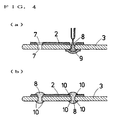
- Fig. 4 schematically shows the method of mounting the plane fastener 2 on the main body 3, exemplifying an intermediate step in the course of process.
- the main body 3 and plane fasteners 2 are bored to have through bores 7 previously or upon mounting the plane fasteners on the main body.
- Melted silicone 8 is fed into the bores 7 (Fig. 4(a)).
- a mould 9 (for forming the projecting part and also serving as prevention of leakage of melted silicone 8) is set at one side of the arranged plane fastener and main body (opposite to the side where the melted silicone 8 is fed) to solidify the melted silicone 8.
- a mould (not shown) in the same or separate shape of the mould 9 may be set at that side of feeding the melted silicone to form the projecting part.
- the melted silicone 8 when completely solidified does, like rivets capable of being deflected and as seen in Fig. 4(b), sandwich between the upper and lower projecting parts 10 the main body 3 and plane fastener 2 to hold them integrally, whereby preventing the plane fastener 2 from peeling off from the main body 3 even when the main body 3 is made of silicone.
- Size and shape of the projecting parts 10 and size and number of the through bores 7 may be selected properly in accordance with required strength or other conditions.
- the present invention is a cervical orthosis to be wound onto the neck around the cervical vertebrae part and retained to support and fix the cervical vertebrae and characterized in that almost the whole of at least the surface adjoining to the neck is provided with a number of ups and downs and the main body is made of silicone rubber.
- the invention does also relate to a method of mounting a plane fastener onto the surface of a plate-like body made of silicone rubber used in the cervical orthoses or the like wherein a plurality of through bores are provided on the plate-like body and the plane fastener and are aligned with one another when the plane fastener is placed in position on the plate-like body, and after placing the plane fastener on the plate-like body melted slicone is fed into the aligned through bores to be solidified in the form of rivets, or silicone rubber having a projecting part like a nail head in place of the melted silicone is inserted into the aligned through bores on the plate-like body and plane fastener followed by melting the projecting part at one end of the inserted silicone rubber and solidifying again the same to re-form the projecting part.
- the present invention is quite highly advanced to have the following various effects.
Landscapes
- Health & Medical Sciences (AREA)
- Engineering & Computer Science (AREA)
- Heart & Thoracic Surgery (AREA)
- Nursing (AREA)
- Orthopedic Medicine & Surgery (AREA)
- Biomedical Technology (AREA)
- Textile Engineering (AREA)
- Vascular Medicine (AREA)
- Life Sciences & Earth Sciences (AREA)
- Animal Behavior & Ethology (AREA)
- General Health & Medical Sciences (AREA)
- Public Health (AREA)
- Veterinary Medicine (AREA)
- Orthopedics, Nursing, And Contraception (AREA)
Applications Claiming Priority (2)
| Application Number | Priority Date | Filing Date | Title |
|---|---|---|---|
| JP4433798 | 1998-02-09 | ||
| JP04433798A JP4015259B2 (ja) | 1998-02-09 | 1998-02-09 | 頸椎用装具 |
Publications (3)
| Publication Number | Publication Date |
|---|---|
| EP0934732A2 true EP0934732A2 (de) | 1999-08-11 |
| EP0934732A3 EP0934732A3 (de) | 2000-02-09 |
| EP0934732B1 EP0934732B1 (de) | 2003-08-20 |
Family
ID=12688713
Family Applications (1)
| Application Number | Title | Priority Date | Filing Date |
|---|---|---|---|
| EP99101628A Expired - Lifetime EP0934732B1 (de) | 1998-02-09 | 1999-02-04 | Cervicalorthese |
Country Status (4)
| Country | Link |
|---|---|
| US (1) | US6027467A (de) |
| EP (1) | EP0934732B1 (de) |
| JP (1) | JP4015259B2 (de) |
| DE (1) | DE69910462T2 (de) |
Cited By (5)
| Publication number | Priority date | Publication date | Assignee | Title |
|---|---|---|---|---|
| EP1090611A1 (de) * | 1999-10-05 | 2001-04-11 | Thämert Orthopädische Hilfsmittel GmbH & Co. KG | Polster mit weichelastischem Bereich |
| EP1634555A1 (de) * | 2004-08-23 | 2006-03-15 | Bauerfeind AG | Mit einem Polster versehene Gelenkbandage |
| CN103083129A (zh) * | 2012-10-26 | 2013-05-08 | 吴亚军 | 一种颈椎矫正器 |
| US20160213503A1 (en) * | 2015-01-28 | 2016-07-28 | Aspen Medical Partners, Llc | Pneumatic orthosis |
| CN107411867A (zh) * | 2017-06-30 | 2017-12-01 | 芜湖启泽信息技术有限公司 | 一种3d打印医疗颈部护套 |
Families Citing this family (23)
| Publication number | Priority date | Publication date | Assignee | Title |
|---|---|---|---|---|
| SE514690C2 (sv) * | 1998-09-15 | 2001-04-02 | Camp Scandinavia Ab | Hallux valgus-ortos |
| US6458090B1 (en) * | 2000-05-03 | 2002-10-01 | Lionel A. Walpin | Multi-positional support device |
| US20050197606A1 (en) * | 2004-03-08 | 2005-09-08 | Alejandro Freire | Adjustable soft neck brace |
| EP2630937B1 (de) * | 2008-12-03 | 2015-10-14 | Ossur HF | Halskrause mit Höhen- und Umfangseinstellung |
| US8679044B2 (en) | 2008-12-03 | 2014-03-25 | Ossur Hf | Cervical collar with reduced vascular obstruction |
| US10292856B2 (en) * | 2009-08-10 | 2019-05-21 | Ossur Hf | Cervical collar having height and circumferential adjustment |
| WO2011054985A2 (es) * | 2009-11-09 | 2011-05-12 | Munoz Saiz Manuel | Sistema y procedimiento para el tratamiento de la apnea del sueño y los ronquidos |
| ES2392625B1 (es) * | 2009-11-09 | 2013-10-18 | Manuel Muñoz Saiz | Sistema para el tratamiento de la apnea del sueño y los ronquidos |
| ES2392778B1 (es) * | 2010-11-04 | 2013-10-18 | Manuel MUÑOZ SÁIZ | Collarin terapeutico para el tratamiento de la apnea del sueño y los ronquidos |
| USD616555S1 (en) | 2009-09-14 | 2010-05-25 | Ossur Hf | Orthopedic device |
| USD616997S1 (en) | 2009-09-14 | 2010-06-01 | Ossur Hf | Orthopedic device |
| USD616996S1 (en) | 2009-09-14 | 2010-06-01 | Ossur Hf | Orthopedic device |
| US8657768B1 (en) | 2010-07-22 | 2014-02-25 | Salvatore Calabrese | Cervical collar having flexible chin support |
| USD647623S1 (en) | 2010-08-06 | 2011-10-25 | Ossur Hf | Height adjustment mechanism for cervical collar |
| USD647624S1 (en) | 2010-08-06 | 2011-10-25 | Ossur Hf | Cervical collar |
| CA2807099C (en) * | 2012-03-09 | 2020-09-22 | Joe Camillo | Wearable sports guard |
| CN105120808B (zh) | 2012-05-21 | 2017-04-26 | 奥索有限责任公司 | 颈托 |
| WO2016164466A1 (en) | 2015-04-06 | 2016-10-13 | Ossur Iceland Ehf | Cervical collar having height adjustment |
| US10512559B2 (en) | 2016-02-25 | 2019-12-24 | Ossur Iceland Ehf | Cervical collar having height adjustment |
| US11452633B2 (en) | 2016-09-19 | 2022-09-27 | Ossur Iceland Ehf | Cervical collar |
| USD870899S1 (en) | 2017-09-06 | 2019-12-24 | Ossur Iceland Ehf | Cervical collar |
| USD866773S1 (en) | 2017-09-06 | 2019-11-12 | Ossur Iceland Ehf | Cervical collar |
| US20240252339A1 (en) * | 2023-01-30 | 2024-08-01 | Deroyal Industries, Inc. | Cervical collar |
Family Cites Families (13)
| Publication number | Priority date | Publication date | Assignee | Title |
|---|---|---|---|---|
| US2366274A (en) * | 1942-06-03 | 1945-01-02 | Brunswick Balke Collender Co | Plastic fastening means and method of applying the same |
| DE1049085B (de) * | 1955-09-28 | 1959-01-22 | Siemens Ag | Verfahren zur Bildung von Nietkoepfen von Nieten aus einem warmgereckten thermoplastischen Isolierstoff, insbesondere Polystyrol |
| GB893375A (en) * | 1959-10-16 | 1962-04-11 | George Sheldon Walsall Ltd | Improvements relating to seams of saddlery, straps, belts, dog collars and the like |
| US3164151A (en) * | 1962-12-14 | 1965-01-05 | Nicoll Esmond D Vere | Inflatable splint |
| CA945313A (en) * | 1970-05-27 | 1974-04-16 | Gopal C. Bhagat | Method of binding |
| US3916885A (en) * | 1974-11-14 | 1975-11-04 | Medical Specialties Inc | Adjustable cervical collar |
| DE3235327A1 (de) * | 1982-09-24 | 1984-03-29 | Ina-Katarina 6209 Heidenrod Lukoschat | Ueberzieheinrichtung ueber einen schuh |
| US4702233A (en) * | 1986-03-19 | 1987-10-27 | Omicioli Florio F | Ventilated neck brace and related structures |
| JPS63272339A (ja) * | 1987-04-30 | 1988-11-09 | Toray Ind Inc | 腸鉗子 |
| US4822671A (en) * | 1987-12-31 | 1989-04-18 | Gencorp Inc. | Heat riveting rubber for effecting a mechanical lock |
| US4881529A (en) * | 1988-08-10 | 1989-11-21 | Richard Santos | Neck support collar |
| DE3827697A1 (de) * | 1988-08-16 | 1990-02-22 | Knebel & Roettger Fa | Einhebelmischbatterie |
| DE3902434A1 (de) * | 1989-01-27 | 1990-08-02 | Uhl Sportartikel Karl | Stuetzbandagen fuer gliedmassen und/oder gelenke |
-
1998
- 1998-02-09 JP JP04433798A patent/JP4015259B2/ja not_active Expired - Lifetime
-
1999
- 1999-02-04 EP EP99101628A patent/EP0934732B1/de not_active Expired - Lifetime
- 1999-02-04 DE DE69910462T patent/DE69910462T2/de not_active Expired - Lifetime
- 1999-02-09 US US09/247,477 patent/US6027467A/en not_active Expired - Lifetime
Non-Patent Citations (1)
| Title |
|---|
| None |
Cited By (9)
| Publication number | Priority date | Publication date | Assignee | Title |
|---|---|---|---|---|
| EP1090611A1 (de) * | 1999-10-05 | 2001-04-11 | Thämert Orthopädische Hilfsmittel GmbH & Co. KG | Polster mit weichelastischem Bereich |
| US6743188B1 (en) | 1999-10-05 | 2004-06-01 | Thämert Orthopädische Hilfsmittel GmbH & Co., KG | Cushion with soft elastic material |
| EP1634555A1 (de) * | 2004-08-23 | 2006-03-15 | Bauerfeind AG | Mit einem Polster versehene Gelenkbandage |
| CN103083129A (zh) * | 2012-10-26 | 2013-05-08 | 吴亚军 | 一种颈椎矫正器 |
| US20160213503A1 (en) * | 2015-01-28 | 2016-07-28 | Aspen Medical Partners, Llc | Pneumatic orthosis |
| CN107257673A (zh) * | 2015-01-28 | 2017-10-17 | 阿斯彭医药合伙有限责任公司 | 用于支架的可调节支撑物 |
| US9839551B2 (en) * | 2015-01-28 | 2017-12-12 | Aspen Medical Partners, Llc | Pneumatic orthosis |
| CN117679228A (zh) * | 2015-01-28 | 2024-03-12 | 斐济制造有限责任公司 | 用于支架的可调节支撑物 |
| CN107411867A (zh) * | 2017-06-30 | 2017-12-01 | 芜湖启泽信息技术有限公司 | 一种3d打印医疗颈部护套 |
Also Published As
| Publication number | Publication date |
|---|---|
| EP0934732B1 (de) | 2003-08-20 |
| JPH11221245A (ja) | 1999-08-17 |
| JP4015259B2 (ja) | 2007-11-28 |
| DE69910462T2 (de) | 2004-06-24 |
| DE69910462D1 (de) | 2003-09-25 |
| EP0934732A3 (de) | 2000-02-09 |
| US6027467A (en) | 2000-02-22 |
Similar Documents
| Publication | Publication Date | Title |
|---|---|---|
| US6027467A (en) | Cervical orthosis | |
| US5121741A (en) | Shaped halo vest | |
| US4562833A (en) | Device for cervical/occipital support | |
| US6254560B1 (en) | Cervical collars | |
| US5072725A (en) | Soft body brace | |
| US4708129A (en) | Cervical/occipital support | |
| EP0109572B1 (de) | Vorrichtung zum Stützen und Positionieren des menschlichen Körpers und Verfahren zum deren Einstellen | |
| US4854306A (en) | Cervical/occipital support | |
| EP1864630B1 (de) | Matratze mit Kopfstütze zum Vorbeugen und Korrigieren nicht-synostotischer Schädeldeformitäten bei Kleinkindern | |
| EP0538525B1 (de) | Weiches Korsett und Herstellungsverfahren | |
| CN102316830B (zh) | 并入有用于预防及矫正婴儿非骨性联接头颅畸形的头枕的床垫 | |
| WO2014181128A1 (en) | Neck orthosis | |
| US20080319365A1 (en) | Adhesive Posture Supports | |
| CN111700720B (zh) | 躯干矫形器 | |
| US20130231597A1 (en) | Immobilization device | |
| US20100042139A1 (en) | Device for reshaping bones | |
| US10342692B2 (en) | Spine support device for maintaining anatomical alignment and stability | |
| US5474523A (en) | Body brace | |
| US6033025A (en) | Notched support pads for cushioning wheelchair seatback | |
| US5320596A (en) | Cervical orthosis | |
| JP2952847B2 (ja) | 健康クッション | |
| US5411038A (en) | Method of using a cervical orthosis | |
| GB2366181A (en) | Personal head-rest | |
| KR100496624B1 (ko) | 척추 보호대 | |
| HK1121012B (en) | Mattress incorporating a headrest for preventing and correcting non-synostotic cranial deformities in infants |
Legal Events
| Date | Code | Title | Description |
|---|---|---|---|
| PUAI | Public reference made under article 153(3) epc to a published international application that has entered the european phase |
Free format text: ORIGINAL CODE: 0009012 |
|
| AK | Designated contracting states |
Kind code of ref document: A2 Designated state(s): DE FR GB |
|
| AX | Request for extension of the european patent |
Free format text: AL;LT;LV;MK;RO;SI |
|
| RIC1 | Information provided on ipc code assigned before grant |
Free format text: 6A 61F 5/055 A, 6A 61F 13/56 B, 6A 41H 37/00 B, 6B 29C 65/60 B |
|
| PUAL | Search report despatched |
Free format text: ORIGINAL CODE: 0009013 |
|
| AK | Designated contracting states |
Kind code of ref document: A3 Designated state(s): AT BE CH CY DE DK ES FI FR GB GR IE IT LI LU MC NL PT SE |
|
| AX | Request for extension of the european patent |
Free format text: AL;LT;LV;MK;RO;SI |
|
| 17P | Request for examination filed |
Effective date: 20000224 |
|
| AKX | Designation fees paid |
Free format text: DE FR GB |
|
| 17Q | First examination report despatched |
Effective date: 20020531 |
|
| GRAH | Despatch of communication of intention to grant a patent |
Free format text: ORIGINAL CODE: EPIDOS IGRA |
|
| GRAH | Despatch of communication of intention to grant a patent |
Free format text: ORIGINAL CODE: EPIDOS IGRA |
|
| GRAA | (expected) grant |
Free format text: ORIGINAL CODE: 0009210 |
|
| AK | Designated contracting states |
Designated state(s): DE FR GB |
|
| REG | Reference to a national code |
Ref country code: GB Ref legal event code: FG4D |
|
| REF | Corresponds to: |
Ref document number: 69910462 Country of ref document: DE Date of ref document: 20030925 Kind code of ref document: P |
|
| ET | Fr: translation filed | ||
| PLBE | No opposition filed within time limit |
Free format text: ORIGINAL CODE: 0009261 |
|
| STAA | Information on the status of an ep patent application or granted ep patent |
Free format text: STATUS: NO OPPOSITION FILED WITHIN TIME LIMIT |
|
| 26N | No opposition filed |
Effective date: 20040524 |
|
| PGFP | Annual fee paid to national office [announced via postgrant information from national office to epo] |
Ref country code: FR Payment date: 20120228 Year of fee payment: 14 |
|
| REG | Reference to a national code |
Ref country code: FR Ref legal event code: ST Effective date: 20131031 |
|
| PG25 | Lapsed in a contracting state [announced via postgrant information from national office to epo] |
Ref country code: FR Free format text: LAPSE BECAUSE OF NON-PAYMENT OF DUE FEES Effective date: 20130228 |
|
| PGFP | Annual fee paid to national office [announced via postgrant information from national office to epo] |
Ref country code: GB Payment date: 20160222 Year of fee payment: 18 |
|
| PGFP | Annual fee paid to national office [announced via postgrant information from national office to epo] |
Ref country code: DE Payment date: 20160412 Year of fee payment: 18 |
|
| REG | Reference to a national code |
Ref country code: DE Ref legal event code: R119 Ref document number: 69910462 Country of ref document: DE |
|
| GBPC | Gb: european patent ceased through non-payment of renewal fee |
Effective date: 20170204 |
|
| PG25 | Lapsed in a contracting state [announced via postgrant information from national office to epo] |
Ref country code: DE Free format text: LAPSE BECAUSE OF NON-PAYMENT OF DUE FEES Effective date: 20170901 |
|
| PG25 | Lapsed in a contracting state [announced via postgrant information from national office to epo] |
Ref country code: GB Free format text: LAPSE BECAUSE OF NON-PAYMENT OF DUE FEES Effective date: 20170204 |