EP0934982B1 - Procédé de préparation de fibres céramique à partir de mélanges de résines de siloxane et de polymères contenant du bore - Google Patents
Procédé de préparation de fibres céramique à partir de mélanges de résines de siloxane et de polymères contenant du bore Download PDFInfo
- Publication number
- EP0934982B1 EP0934982B1 EP99102390A EP99102390A EP0934982B1 EP 0934982 B1 EP0934982 B1 EP 0934982B1 EP 99102390 A EP99102390 A EP 99102390A EP 99102390 A EP99102390 A EP 99102390A EP 0934982 B1 EP0934982 B1 EP 0934982B1
- Authority
- EP
- European Patent Office
- Prior art keywords
- fibers
- boron
- polymers
- green
- value
- Prior art date
- Legal status (The legal status is an assumption and is not a legal conclusion. Google has not performed a legal analysis and makes no representation as to the accuracy of the status listed.)
- Expired - Lifetime
Links
Classifications
-
- C—CHEMISTRY; METALLURGY
- C04—CEMENTS; CONCRETE; ARTIFICIAL STONE; CERAMICS; REFRACTORIES
- C04B—LIME, MAGNESIA; SLAG; CEMENTS; COMPOSITIONS THEREOF, e.g. MORTARS, CONCRETE OR LIKE BUILDING MATERIALS; ARTIFICIAL STONE; CERAMICS; REFRACTORIES; TREATMENT OF NATURAL STONE
- C04B35/00—Shaped ceramic products characterised by their composition; Ceramics compositions; Processing powders of inorganic compounds preparatory to the manufacturing of ceramic products
- C04B35/515—Shaped ceramic products characterised by their composition; Ceramics compositions; Processing powders of inorganic compounds preparatory to the manufacturing of ceramic products based on non-oxide ceramics
- C04B35/56—Shaped ceramic products characterised by their composition; Ceramics compositions; Processing powders of inorganic compounds preparatory to the manufacturing of ceramic products based on non-oxide ceramics based on carbides or oxycarbides
- C04B35/565—Shaped ceramic products characterised by their composition; Ceramics compositions; Processing powders of inorganic compounds preparatory to the manufacturing of ceramic products based on non-oxide ceramics based on carbides or oxycarbides based on silicon carbide
- C04B35/571—Shaped ceramic products characterised by their composition; Ceramics compositions; Processing powders of inorganic compounds preparatory to the manufacturing of ceramic products based on non-oxide ceramics based on carbides or oxycarbides based on silicon carbide obtained from Si-containing polymer precursors or organosilicon monomers
-
- C—CHEMISTRY; METALLURGY
- C03—GLASS; MINERAL OR SLAG WOOL
- C03C—CHEMICAL COMPOSITION OF GLASSES, GLAZES OR VITREOUS ENAMELS; SURFACE TREATMENT OF GLASS; SURFACE TREATMENT OF FIBRES OR FILAMENTS MADE FROM GLASS, MINERALS OR SLAGS; JOINING GLASS TO GLASS OR OTHER MATERIALS
- C03C13/00—Fibre or filament compositions
-
- C—CHEMISTRY; METALLURGY
- C03—GLASS; MINERAL OR SLAG WOOL
- C03C—CHEMICAL COMPOSITION OF GLASSES, GLAZES OR VITREOUS ENAMELS; SURFACE TREATMENT OF GLASS; SURFACE TREATMENT OF FIBRES OR FILAMENTS MADE FROM GLASS, MINERALS OR SLAGS; JOINING GLASS TO GLASS OR OTHER MATERIALS
- C03C3/00—Glass compositions
- C03C3/04—Glass compositions containing silica
- C03C3/045—Silicon oxycarbide, oxynitride or oxycarbonitride glasses
-
- C—CHEMISTRY; METALLURGY
- C08—ORGANIC MACROMOLECULAR COMPOUNDS; THEIR PREPARATION OR CHEMICAL WORKING-UP; COMPOSITIONS BASED THEREON
- C08L—COMPOSITIONS OF MACROMOLECULAR COMPOUNDS
- C08L83/00—Compositions of macromolecular compounds obtained by reactions forming in the main chain of the macromolecule a linkage containing silicon with or without sulfur, nitrogen, oxygen or carbon only; Compositions of derivatives of such polymers
- C08L83/04—Polysiloxanes
-
- C—CHEMISTRY; METALLURGY
- C08—ORGANIC MACROMOLECULAR COMPOUNDS; THEIR PREPARATION OR CHEMICAL WORKING-UP; COMPOSITIONS BASED THEREON
- C08G—MACROMOLECULAR COMPOUNDS OBTAINED OTHERWISE THAN BY REACTIONS ONLY INVOLVING UNSATURATED CARBON-TO-CARBON BONDS
- C08G77/00—Macromolecular compounds obtained by reactions forming a linkage containing silicon with or without sulfur, nitrogen, oxygen or carbon in the main chain of the macromolecule
- C08G77/04—Polysiloxanes
- C08G77/045—Polysiloxanes containing less than 25 silicon atoms
-
- C—CHEMISTRY; METALLURGY
- C08—ORGANIC MACROMOLECULAR COMPOUNDS; THEIR PREPARATION OR CHEMICAL WORKING-UP; COMPOSITIONS BASED THEREON
- C08G—MACROMOLECULAR COMPOUNDS OBTAINED OTHERWISE THAN BY REACTIONS ONLY INVOLVING UNSATURATED CARBON-TO-CARBON BONDS
- C08G77/00—Macromolecular compounds obtained by reactions forming a linkage containing silicon with or without sulfur, nitrogen, oxygen or carbon in the main chain of the macromolecule
- C08G77/04—Polysiloxanes
- C08G77/14—Polysiloxanes containing silicon bound to oxygen-containing groups
- C08G77/16—Polysiloxanes containing silicon bound to oxygen-containing groups to hydroxy groups
-
- C—CHEMISTRY; METALLURGY
- C08—ORGANIC MACROMOLECULAR COMPOUNDS; THEIR PREPARATION OR CHEMICAL WORKING-UP; COMPOSITIONS BASED THEREON
- C08G—MACROMOLECULAR COMPOUNDS OBTAINED OTHERWISE THAN BY REACTIONS ONLY INVOLVING UNSATURATED CARBON-TO-CARBON BONDS
- C08G77/00—Macromolecular compounds obtained by reactions forming a linkage containing silicon with or without sulfur, nitrogen, oxygen or carbon in the main chain of the macromolecule
- C08G77/04—Polysiloxanes
- C08G77/20—Polysiloxanes containing silicon bound to unsaturated aliphatic groups
-
- C—CHEMISTRY; METALLURGY
- C08—ORGANIC MACROMOLECULAR COMPOUNDS; THEIR PREPARATION OR CHEMICAL WORKING-UP; COMPOSITIONS BASED THEREON
- C08G—MACROMOLECULAR COMPOUNDS OBTAINED OTHERWISE THAN BY REACTIONS ONLY INVOLVING UNSATURATED CARBON-TO-CARBON BONDS
- C08G77/00—Macromolecular compounds obtained by reactions forming a linkage containing silicon with or without sulfur, nitrogen, oxygen or carbon in the main chain of the macromolecule
- C08G77/70—Siloxanes defined by use of the MDTQ nomenclature
-
- Y—GENERAL TAGGING OF NEW TECHNOLOGICAL DEVELOPMENTS; GENERAL TAGGING OF CROSS-SECTIONAL TECHNOLOGIES SPANNING OVER SEVERAL SECTIONS OF THE IPC; TECHNICAL SUBJECTS COVERED BY FORMER USPC CROSS-REFERENCE ART COLLECTIONS [XRACs] AND DIGESTS
- Y10—TECHNICAL SUBJECTS COVERED BY FORMER USPC
- Y10S—TECHNICAL SUBJECTS COVERED BY FORMER USPC CROSS-REFERENCE ART COLLECTIONS [XRACs] AND DIGESTS
- Y10S264/00—Plastic and nonmetallic article shaping or treating: processes
- Y10S264/19—Inorganic fiber
Definitions
- This invention provides a method for formation of amorphous boron silicon oxycarbide (SiOCB) ceramics or crystalline boron-doped silicon carbide (SiCB) ceramics from blends of siloxane resins and boron containing polymers. Said blend is both thermally and hydrolytically stable and it can be continuously formed into green bodies. The resultant green bodies are thereafter cured and pyrolyzed to yield either SiOCB or SiCB ceramics.
- SiOCB amorphous boron silicon oxycarbide
- SiCB crystalline boron-doped silicon carbide
- Silicon-based ceramic fibers are used as reinforcement materials in composite applications, such as metal matrix composites and ceramic matrix composites (CMC's).
- CMC's ceramic matrix composites
- crystalline silicon carbide (SiC) fibers have superior thermal stability and chemical resistance over silicon oxycarbide fibers, such as NicalonTM and TyrannoTM fibers.
- Silicon oxycarbide fibers tend to lose oxygen at temperatures above 1,200 °C, and the crystallization of SiC results in formation of a porous structure. As a result, the fiber loses nearly all of its mechanical strength.
- SiC silicon carbide
- U.S. Patents 5,279,780 and 5,366,943 to Lipowitz et al. describe the formation of crystalline SiC fibers by doping commercial NicalonTM and TyrannoTM fibers with boron containing species followed by densification at higher temperature. These commercially available fibers are prepared from expensive polycarbosilane precursors. Use of polycarbosilanes presents several problems in production of boron silicon oxycarbide fibers. For example, the polymers are slow to cross-link and the green fibers produced are fragile. These problems make continuous processing difficult. Also, low yields and complicated processes cause the fibers to be expensive.
- Japanese patent application JP-A-57-56567 by Yajima et al. discloses a heat resistant inorganic fiber and method for its manufacture.
- the fiber typically has 27 to 40 mol% silicon carbide, 10 to 15 mol% B 4 C, and 45 to 63 mol% free carbon.
- the fiber is prepared by dry spinning a polymer that contains mainly Si, B, and 0 into a fiber, curing the fiber by heating, and pyrolyzing the fiber by heating to high temperature.
- JP-A-57-56567 does not disclose the use of a polymer blend for preparation of SiOCB or SiCB fibers.
- siloxane polymers as precursors to crystalline SiC fibers is described in U.S. Patent 5,167,881 to Atwell et al.
- the siloxane polymers are phenyl-containing polyorganosiloxane resins with 3 to 6 weight per cent silanol groups.
- Boron is incorporated into the siloxane polymers either prior to or during formation of the fibers, or during at least one of the infusibilizing or pyrolyzing steps of the process to produce substantially polycrystalline SiC fibers.
- the boron is incorporated by exposing the precursor or fiber to an atmosphere containing a gaseous boron-containing compound such as diborane or boron trichloride.
- US-A-4,927,587, GB-A-1,019,218 and GB-A-989,409 disclose vinyl functional polyorganosiloxane compositions containing boron compounds curable to silicone elstomers.
- US-A-4,927,587 refers to boron nitride, GB-A-1,019,218 to zinc borate and GB-A-989,409 to boron oxygen compounds like boric acid, boron oxides and esters of boric acid.
- One object of this invention is formation of amorphous SiOCB fibers from a blend of a siloxane resin and a boron containing polymer.
- a further object of this invention is to provide a high strength SiOCB ceramic fiber.
- Another object of this invention is formation of crystalline SiCB fibers from a blend of a siloxane resin and a boron containing polymer.
- a further object of this invention is to provide a high strength SiCB ceramic fiber.
- This invention relates to a composition
- a composition comprising:
- the present invention refers to green bodies obtainable from shaping the composition of the present invention. Furthermore a method for formation of amorphous boron silicon oxycarbide (SiOCB) fibers and crystalline boron-doped silicon carbide (SiCB) fibers from the composition of the present invention and the ceramic material obtainable thereby is provided.
- the composition of the instant invention is thermally and hydrolytically stable and can be melt spun into continuous green fibers. The green fibers are cured and pyrolyzed to give SiOCB or SiCB ceramic fibers.
- the present invention pertains to a method for preparing a ceramic material, preferably a ceramic fiber, wherein the method comprises pyrolyzing a blend comprising a siloxane resin and a boron containing polymer at a temperature sufficient to produce the ceramic material.
- the amount of siloxane resin in the blend is 90 to 99.9, preferably 95 to 99.5 weight percent.
- the siloxane resin has excellent thermal stability at melt spin temperatures and can be spun into small diameter green fibers with a non-sticky surface.
- R is preferably an alkenyl group such as vinyl, allyl, propenyl, pentenyl, or hexenyl, with vinyl being most preferred.
- R 1 is preferably a phenyl, tolyl, or xylyl group, with phenyl being most preferred.
- R 2 is preferably an alkyl group such as methyl, ethyl, n-propyl, or isopropyl, with methyl being most preferred.
- e has a value of 0.2 to 0.5
- f has a value of 0.2 to 0.5
- g has a value of 0.15 to 0.3.
- R represents a vinyl group
- R 1 represents a phenyl group
- R 2 represents a methyl group
- e, f, and g are as defined above.
- the siloxane resins are well known in the art and their method of preparation is not critical. One method includes acid catalyzed hydrolysis of alkoxysilanes followed by base catalyzed condensation.
- the siloxane resins produced by methods known in the art typically have a glass transition temperature (Tg) below 40°C.
- Tg glass transition temperature
- These siloxane resins also typically have a broad molecular weight distribution (Mw/Mn), for example, Mw/Mn > 3 (where Mw represents weight average molecular weight and Mn represents number average molecular weight).
- the resins are preferably fractionated to produce a siloxane resin with Tg preferably in the range of 100 to 150°C.
- the resin may be fractionated by any method known in the art such as precipitation, extraction, vacuum distillation, sublimation, and combinations thereof.
- the fractionation process typically results in the removal of low molecular weight oligomers from the siloxane resin.
- solvent precipitation or supercritical fluid extraction is used.
- Solvent precipitation includes dissolving the resin in a solvent such as toluene, and then adding the solution to a nonsolvent such as methanol to precipitate the resin. The precipitate (the fractionated resin) is then collected and dried.
- the fractionated resins are particularly suited to melt spinning.
- the boron containing polymer is selected such that it can be blended with the siloxane resin.
- the boron containing polymer is added in an amount of 0.1 to 10, preferably 0.5 to 5 weight percent, more preferably 1 to 4.0 weight percent of the blend.
- Useful boron containing polymers include, but are not limited to: polymers derived from carboranes, such as carborane-siloxane polymers and poly(carboranesiloxane-acetylene) polymers and borazine-based polymers.
- the boron containing polymer may be a polymer derived from carboranes.
- carborane-siloxane polymers are suitable for this invention.
- Carborane-siloxane polymers and methods for their preparation are known in the art.
- suitable carborane-siloxane polymers are described in High Temperature Siloxane Elastomers, Chapter V. "Carborane-Siloxane Polymers" by P. R. Dvornic and R.W. Lenz and "Decaborane Based Polymers” by S. Packirisamy, in Prog. Polym. Sci. Vol. 21, pp. 707-773 (1996) .
- carborane-siloxane polymers are prepared by condensation polymerization of carborane derivatives with alkylchlorosilanes or alkylchlorosiloxanes in the presence of a catalyst.
- the carborane derivatives are bis(dimethylsily)-m-carborane with bis(chlorosilyl)-m-carborane derivatives.
- Suitable carborane-siloxane polymers typically comprise dialkylsiloxane or diarylsiloxane units linked by m-carborane cage structures.
- These carborane-siloxane polymers include polymers with the general formula: (Si(CH 3 ) 2 CB 10 H 10 CSi(CH 3 ) 2 -O-(Si(CH 3 ) 2 -O-) s ) t where s represents an integer with a value of 0 to 20 and t represents an integer with a value of 2 to 1,000. Preferably s is 0 to 3 and t is 2 to 50.
- DexsilTM produced by Olin Corporation.
- DexsilTM 200, DexsilTM 202, DexsilTM 300, DexsilTM 400, and DexsilTM 500 are examples of preferred carborane-siloxane polymers.
- DexsilTM 300 is particularly preferred.
- poly(carborane-siloxane-acetylene) polymers Another suitable type of polymer derived from carboranes includes poly(carborane-siloxane-acetylene) polymers.
- suitable poly(carborane-siloxane-acetylene) polymers and methods for their preparation are disclosed in "Synthesis and Characterization of Poly(carborane-siloxane-acetylene)" by Henderson and Keller, Macromolecules, Volume 24, pp. 1660 - 1661, (1994).
- These poly(carborane-siloxane-acetylene) polymers can be synthesized by reacting a lithium compound with a diene compound, to form a di-lithiated-diyne compound.
- the di-lithiated-diyne is further reacted with a carborane-siloxane polymer to form a poly(carborane-siloxane-acetylene) polymer.
- a carborane-siloxane polymer equimolar amounts of di-lithiated-diyne and carborane-siloxane polymer are used.
- both reactions run in situ at low temperatures, for example, from less than ambient to -78 °C.
- suitable poly(carboranesiloxane-acetylene) polymers have the formula: where p is 2 to 1,000.
- the boron containing polymer may also be a borazine-based polymer, such as those described in U.S. Patent 4,581,468 to Paciorek et al.
- Suitable borazine-based polymers can be synthesized by condensation reaction of a borazine compound, such as B-trichloro-N-tris(trialkylsilyl)borazine, with ammonia. This reaction typically runs at -78 to 25 °C, within 4 to 24 hours, under an inert atmosphere, preferably nitrogen, helium, or argon. Typically, 2 to 10 times the stoichiometric amount of ammonia is used.
- suitable borazine-based polymers have the following structures: and where D represents an alkyl group, such as methyl, ethyl, propyl, and butyl; and r represents 1, 2, 3, or 4.
- the blend of the siloxane resin and the boron containing polymer may be prepared by first dissolving the siloxane resin and the boron containing polymer in a solvent.
- Suitable solvents are exemplified by alkanes, such as pentane, hexane, and heptane; ethers, such as diethyl ether, methylphenyl ether, and tetrahydrofuran; and aromatic hydrocarbons such as toluene and xylene. Pentane is preferred.
- the solvent is then evaporated, for example, under vacuum or by heating.
- the blend may then be dried by heating at 150 to 200°C under vacuum for 1 to 4 hours. Preferably the blend is dried by heating at a temperature 150 to 180°C for at least 1 hour.
- the blend may then be pyrolyzed to a ceramic material by heating to high temperature under an inert atmosphere such as vacuum; or argon, helium, or nitrogen.
- an inert atmosphere such as vacuum; or argon, helium, or nitrogen.
- the inert atmosphere comprises argon.
- Inert means containing less than 500 ppm oxygen.
- the blend is heated to a temperature of 800 to 2,200 °C to yield a ceramic material.
- the ceramic material formed will be boron silicon oxycarbide when the blend is pyrolyzed by heating to a temperature of 800 to 1,400°C.
- Boron-doped silicon carbide can be formed by further heating the boron silicon oxycarbide to a temperature of 1,500 to 2,200°C.
- boron-doped silicon carbide can be formed from the blend directly by heating the blend to 1,500 to 2,200°C.
- the blend may be formed into any desired shape, preferably fibers, before curing and pyrolyzing.
- the blend may be spun into a green fiber by conventional spinning techniques such as melt spinning, wet spinning, or dry spinning.
- the blend is melt spun by extruding the blend through an orifice such as a spinneret, and the resulting green fiber is taken up continuously on a spool.
- the fiber diameter is 10 to 40 micrometers and preferably 13 to about 25 micrometers.
- the melt spinning is typically carried out at a temperature of 100 to 250°C, preferably 200 to 240°C, depending on the glass transition temperature of the siloxane resin.
- the green fibers are then cured to render them non-fusible and to prevent them from deforming when pyrolyzed.
- Non-fusible fibers will not stick together when heated to the pyrolysis temperature.
- Non-fusibility is tested by determining the solubility of the cured fiber in toluene.
- a non-fusible fiber is essentially insoluble in toluene or has only a limited solubility in toluene.
- the green fibers can be cured, for example, by exposing them to oxidizing gases such as O 3 and NO, or by exposing them to high energy radiation sources such as gamma rays, x-rays, and electron beam radiation.
- the fibers are preferably cured by exposure to high energy radiation, preferably electron beam radiation.
- Units for producing electron beams are known in the art and are commercially available. Generally, such units comprise a cathode (such as a tungsten filament) and an anode. Both heated and cold cathode sources are within the scope of the present invention.
- the cathode produces electrons at a very high rate. Applying a large voltage to the anode accelerates and concentrates the electrons, under vacuum, forming a high energy beam.
- the green fiber is heated by absorbing the kinetic energy of the bombarding electrons of the high energy beam.
- the accelerating voltage is in the range of about 100 to 300 keV
- the vacuum is in the range of about 0.001 to 10 Pa
- the electron currents range from about 0.1 milliampere to 30 amperes
- the power in the beam varies from about 0.1 watt to 90 kilowatts.
- the dose received by the fibers is in the range of 10 to 200 Mrad, preferably 60 to 120 Mrad.
- the green fibers are exposed to the radiation for a time effective to provide a dose required to cure the fibers.
- the time required depends on the current density of the electron beam radiation, however, the time is typically 0.01 to 10 seconds.
- the fibers are exposed to the radiation under an inert atmosphere such as helium, nitrogen, or argon.
- the green fibers may be cured continuously while spinning, batch cured after spinning, or any combination thereof.
- Continuous curing means that the fibers are exposed to the cure mechanism as they are formed and before they are collected on a spool.
- Batch curing occurs by collecting the green fibers on a spool and subsequently exposing them to the cure mechanism.
- the cured fibers may then be pyrolyzed to amorphous SiOCB fibers or crystalline SiCB fibers by heating to a temperature of 800 to 2,200°C.
- amorphous fiber it is meant a primarily non-crystalline fiber including fibers that contain very small crystallites (nano- or micro-crystals) in a non-crystalline continuous phase. Pyrolysis may be performed continuously, or the cured fiber can be collected and batch pyrolyzed. Methods for pyrolyzing polysiloxane fibers into ceramic fibers are well known in the art and can be used herein.
- SiOCB fibers are obtained by heating the cured fibers under an inert atmosphere such as vacuum; or argon, helium, or nitrogen.
- the inert atmosphere comprises argon.
- the fibers are preferably heated to a final temperature of 800 to 1,400°C, more preferably 800 to 1,200°C and then held at the final temperature for a time sufficient to form the SiOCB fibers, preferably up to 1 hour.
- the SiOCB fibers of the present invention are typically obtained in 75 to 85 % ceramic yield.
- the boron content of the fibers ranges from about 0.01 to 5, preferably 0.2 to about 2%.
- the tensile strength of the fibers is typically 1380 to 4140 Mpa (200 to 600 ksi), preferably 1863 to 4140 Mpa (270 to 600 ksi).
- the SiOCB fibers have an amorphous structure, as identified by X-ray diffraction.
- the SiOCB fibers can be further pyrolyzed to form crystalline SiCB fibers by heating under an inert atmosphere such as argon, helium, or nitrogen.
- an inert atmosphere such as argon, helium, or nitrogen.
- the inert atmosphere comprises argon.
- the SiOCB fibers are preferably further heated to a final temperature of 1,500 to 2,200, preferably 1,500 to 1,900°C to remove oxygen.
- the fibers are held at the final temperature for 1 minute to 5 hours, preferably 30 minutes to 5 hours.
- the SiCB fibers produced typically have a diameter of 5 to 30 micrometers, preferably 7 to 20 micrometers.
- the structure may be dense and homogenous or a matrix of microfibers with diameters of about 0.1 micrometer.
- the cured fibers can also be pyrolyzed directly to crystalline SiCB fibers by heating under the inert atmosphere, preferably argon.
- the fibers are preferably heated to a temperature of 1,500 to 2,200 °C, more preferably 1,800 to 1,900°C.
- the fibers are preferably held at the temperature for 1 minute to 5 hours, more preferably 10 minutes to 5 hours.
- Ph represents a phenyl group
- Vi represents a vinyl group
- Me represents a methyl group.
- Phenyltrimethoxysilane, methyltrimethoxysilane, and 1,1,2,2-tetramethyl-1,2-divinyl siloxane were loaded into a reactor in a molar ratio of 2.78: 3.17: 1.00, respectively.
- a 20 weight percent solution of trifluoromethanesulfonic acid in de-ionized water was added to the reactor, and the solution immediately turned yellow.
- the mixture was heated to reflux for 90 minutes, and then toluene and water were added.
- the mixture was heated to reflux for an additional 90 minutes.
- Calcium carbonate was then added and the solvent distilled until the overhead temperature increased to 84 °C. Additional toluene was then added to adjust the solid content to 47 %.
- the polymer solution was fractionated by diluting with toluene and adding the resulting solution to methanol at a solution:methanol volume ratio of 1:8. This yielded white precipitate, which was collected and dried at 160 °C for 1 hour in vacuo.
- X-ray diffraction analyses indicated an amorphous structure for all the 1,200 °C materials obtained from the siloxane polymer and the blends.
- X-ray diffraction analyses showed a mixture of ⁇ -SiC and B 4 C for the 1,800 °C ceramic char and a mixture of ⁇ -SiC, B 2 O 3 , and B 4 C for the 1,200 °C from the DexsilTM 300 polymer. Greater than 99% ⁇ -SiC and small amounts of carbon were observed in the 1800 °C ceramic chars obtained from the siloxane polymer and the blends. No B 4 C was detected in those samples prepared from the blends.
- the polymer blends prepared in Example 1 were melt-spun into single filament fibers as follows. Typically, a 5.2 g sample of the polymer blend was ground into a fine powder with a mortar and pestle and pressed into a rod at 3447 kPa (500 psi). The polymer rod was transferred into an extruder and heated to a spinning temperature of 200 - 240 °C. The resulting fibers had diameters of about 13 to about 25 micrometers, and they were taken up continuously at 50 to 80 m/minute on a spool.
- the green fiber tow collected on the spool was cut and laid on a piece of paper.
- the fibers were then spread out and fixed on a clip board and passed through the electron beam curing zone.
- the fibers were exposed to electron beam radiation of 20 to 120 Mrad to cure.
- the fibers were cured as indicated by their insolubility in toluene.
- the cured fibers produced in Example 3 were heated at 3 °C /minute to 1,200 °C and held at 1,200 °C for 1 hour.
- the SiOCB fibers were obtained at about 75 to 80 percent ceramic yield and were separable.
- the boron content of the fibers ranged from about 0.01 to 5 weight percent.
- X-ray diffraction analysis of the fibers indicated an amorphous structure.
- a scanning electron microscope (SEM) micrograph of the fibers showed a smooth surface and a glassy cross section.
- Example 3 The cured fibers prepared in Example 3 were placed in an Astro carbon resistant furnace and heated at 3°C /min to 1,800°C under argon. The fibers were held at 1,800°C for 10 minutes before cooling to room temperature. A SEM micrograph of a SiCB fiber prepared from blend 2 showed that the fiber had smooth surfaces and dense microstructures.
- the cured fibers prepared in Example 3 were placed in an AstroTM carbon resistant furnace and heated to 1,900°C as follows: 10°C/minute to 1,200°C and 3°C/minute to 1,900°C for 30 minutes. The resulting SiCB fibers were then cooled to room temperature.
- the fibers prepared from the polymer blends had diameters of 7 to 20 micrometers.
- a SEM micrograph of the SiCB fibers from blend 2 showed a dense homogenous microstructure.
- the micrograph of the fiber from blend 4 showed microfibers embedded in a continuous matrix.
- An Auger analysis of the ceramic fiber derived from blend 2 had nearly stoichiometric SiC at ca. 20 nm.
- X-ray diffraction analysis of the fiber from blend 2 indicated >99% ⁇ -SiC with a small amount of carbon.
- Blend Siloxane Resin (g) DexsilTM 300 (g) % DexsilTM 300 Tg (°C) 1 20 0.22 1.09 124 2 20 0.44 2.15 121 3 20 0.66 3.20 127 4 6.7 0.31 4.30 110 Sample 1200 °C 1800 °C Char Yield % Char Yield % Siloxane 78.9 42.5 Blend 1 65.5 39.0 Blend 2 74.4 39.0 Blend 3 70.0 39.0 Blend 4 67.4 39.0 DexsilTM 300 62.5 39.0
Landscapes
- Chemical & Material Sciences (AREA)
- Engineering & Computer Science (AREA)
- Organic Chemistry (AREA)
- Materials Engineering (AREA)
- Chemical Kinetics & Catalysis (AREA)
- General Chemical & Material Sciences (AREA)
- Geochemistry & Mineralogy (AREA)
- Life Sciences & Earth Sciences (AREA)
- Ceramic Engineering (AREA)
- Health & Medical Sciences (AREA)
- Medicinal Chemistry (AREA)
- Polymers & Plastics (AREA)
- Manufacturing & Machinery (AREA)
- Structural Engineering (AREA)
- Inorganic Fibers (AREA)
Claims (16)
- Composition comprenant :a) de 90 à 99,9 % en poids d'une résine siloxane comprenant des unités avec une formule générale RxR1 yR2 zSiO(4-x-y-z)/2, où chaque R est indépendamment choisi parmi des groupes hydrocarbonés monovalents insaturés, chaque R1 est indépendamment choisi parmi des groupes aryle ayant de 6 à 10 atomes de carbone et chaque R2 est indépendamment choisi parmi des groupes hydrocarbonés monovalents saturés, x présente une valeur de 1 ou de 2, y présente une valeur de 0, 1 ou 2 et z a une valeur de 0, 1 ou 2 à condition que x+y+z = 1, 2 ou 3, etb) de 0,1 à 10 % en poids d'un polymère contenant du bore.
- Composition selon la revendication 1, dans laquelle la résine siloxane présente la formule (R1SiO3/2)e(R2SiO3/2)f(RR2 2SiO1/2)g, où 0 ≤ e ≤ 0,98, 0 ≤ f ≤ 0,98, 0 < g ≤ 1 et e+f+g = 1.
- Composition selon la revendication 2, dans laquelle R représente un groupe vinyle, R1 représente un groupe phényle, R2 représente un groupe méthyle, e présente une valeur de 0,3 à 0,5, f présente une valeur de 0,3 à 0,5 et g présente une valeur de 0,15 à 0,3.
- Composition selon l'une quelconque des revendications précédentes, dans laquelle le polymère contenant du bore (b) est choisi parmi des polymères dérivés de carboranes et des polymères à base de borazine.
- Composition selon la revendication 4, dans laquelle le polymère contenant du bore est choisi parmioù D représente un groupe alkyle, tel que méthyle, éthyle, propyle et butyle ; et r représente 1, 2, 3 ou 4.(i) un polymère dérivé de carboranes choisis parmi des polymères de carborane-siloxane avec une formule générale (Si(CH3)2CB10H10CSi(CH3)2-O-(Si(CH3)2-O-)s)t, où s représente un nombre entier avec une valeur de 0 à 20 et t représente de 2 à 1000 et des polymères de poly(carborane-siloxane-acétylène) et(ii) un polymère à base de borazine choisi parmi des polymères des formules
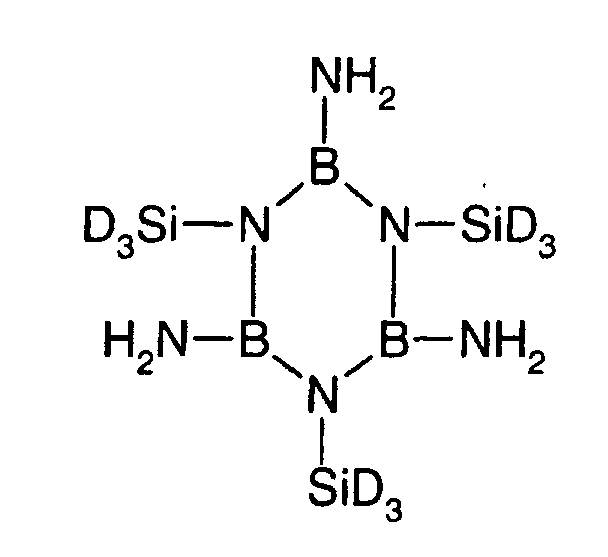 et
et

- Corps à l'état vert pouvant être obtenus par façonnage de la composition selon l'une quelconque des revendications 1-5.
- Fibres à l'état vert pouvant être obtenues par filage à l'état de fusion de la composition selon l'une quelconque des revendications 1-5 en des fibres.
- Fibres à l'état vert selon la revendication 7, dans lesquelles le filage à l'état de fusion a lieu à de 200 à 240°C.
- Procédé pour la préparation de fibres céramiques comprenant :(i) le façonnage d'une composition selon l'une quelconque des revendications 1-5 en des fibres à l'état vert,(ii) le durcissement des fibres à l'état vert de (i) en des fibres durcies ; et(iii) la pyrolyse des fibres durcies de (ii) en des fibres céramiques par chauffage à une température de 800 à 2200°C.
- Procédé selon la revendication 9, dans lequel le durcissement des fibres à l'état vert se fait en les exposant à un rayonnement d'énergie élevée.
- Procédé selon la revendication 9, dans lequel le durcissement des fibres à l'état vert se fait en les exposant à un rayonnement de faisceaux d'électrons.
- Procédé selon l'une quelconque des revendications 9-11, dans lequel les fibres céramiques formées sont des fibres d'oxycarbure de bore et de silicium formées par pyrolyse à une température de 800 à 1400°C.
- Procédé selon la revendication 12, dans lequel lesdites fibres d'oxycarbure de bore et de silicium sont en outre pyrolysées en des fibres de carbure de silicium dopé au bore par chauffage à une température de 1500 à 2200°C.
- Procédé selon l'une quelconque des revendications 9-11, dans lequel les fibres céramiques formées sont des fibres de carbure de silicium dopé au bore formées par pyrolyse à une température de 1500 à 2200°C.
- Procédé pour la préparation d'un matériau céramique comprenant la pyrolyse d'une composition selon l'une quelconque des revendications 1-5 par chauffage de ladite composition à une température de 800 à 2200°C.
- Matériau céramique pouvant être obtenu par un procédé selon l'une quelconque des revendications 9-15.
Applications Claiming Priority (2)
| Application Number | Priority Date | Filing Date | Title |
|---|---|---|---|
| US19577 | 1979-03-12 | ||
| US09/019,577 US5958324A (en) | 1998-02-06 | 1998-02-06 | Method for formation of crystalline boron-doped silicon carbide and amorphous boron silicon oxycarbide fibers from polymer blends containing siloxane and boron |
Publications (2)
| Publication Number | Publication Date |
|---|---|
| EP0934982A1 EP0934982A1 (fr) | 1999-08-11 |
| EP0934982B1 true EP0934982B1 (fr) | 2002-05-02 |
Family
ID=21793945
Family Applications (1)
| Application Number | Title | Priority Date | Filing Date |
|---|---|---|---|
| EP99102390A Expired - Lifetime EP0934982B1 (fr) | 1998-02-06 | 1999-02-08 | Procédé de préparation de fibres céramique à partir de mélanges de résines de siloxane et de polymères contenant du bore |
Country Status (4)
| Country | Link |
|---|---|
| US (2) | US5958324A (fr) |
| EP (1) | EP0934982B1 (fr) |
| JP (1) | JPH11315420A (fr) |
| DE (1) | DE69901355T2 (fr) |
Families Citing this family (36)
| Publication number | Priority date | Publication date | Assignee | Title |
|---|---|---|---|---|
| US5958324A (en) * | 1998-02-06 | 1999-09-28 | Dow Corning Corporation | Method for formation of crystalline boron-doped silicon carbide and amorphous boron silicon oxycarbide fibers from polymer blends containing siloxane and boron |
| US6514897B1 (en) * | 1999-01-12 | 2003-02-04 | Hyperion Catalysis International, Inc. | Carbide and oxycarbide based compositions, rigid porous structures including the same, methods of making and using the same |
| DE10055082A1 (de) * | 2000-11-07 | 2002-05-16 | Bosch Gmbh Robert | Keramischer Verbundwerkstoff |
| MXPA04001370A (es) * | 2001-08-13 | 2005-06-06 | Lcp Tech Holdings Llc | Sustancias quimicas de la tecnologia de los polimeros cristales liquidos y sus aplicaciones. |
| JP4334790B2 (ja) * | 2001-09-19 | 2009-09-30 | 独立行政法人科学技術振興機構 | SiC系複合材料用SiC強化繊維の製造 |
| US6967405B1 (en) | 2003-09-24 | 2005-11-22 | Yongsik Yu | Film for copper diffusion barrier |
| US7420275B1 (en) * | 2003-09-24 | 2008-09-02 | Novellus Systems, Inc. | Boron-doped SIC copper diffusion barrier films |
| TW200526824A (en) * | 2004-02-11 | 2005-08-16 | Ind Tech Res Inst | Manufacturing method of silicon nanowire |
| US7282438B1 (en) | 2004-06-15 | 2007-10-16 | Novellus Systems, Inc. | Low-k SiC copper diffusion barrier films |
| US7579424B2 (en) * | 2005-09-27 | 2009-08-25 | The United States Of America As Represented By The Secretary Of The Navy | Ceramic material made from siloxane-acetylene polymer containing metal-acetylene complex |
| US7576168B2 (en) * | 2005-09-27 | 2009-08-18 | The United States Of America As Represented By The Secretary Of The Navy | Thermoset material made from siloxane-acetylene polymer containing metal-acetylene complex |
| US7700710B2 (en) * | 2005-09-27 | 2010-04-20 | The United States Of America As Represented By The Secretary Of The Navy | Pyrolytic formation of metallic nanoparticles |
| US7579430B2 (en) * | 2005-09-27 | 2009-08-25 | The United States Of America As Represented By The Secretary Of The Navy | Polymeric material made from siloxane-acetylene polymer containing metal-acetylene complex |
| US7674754B2 (en) * | 2005-12-01 | 2010-03-09 | Masco Corporation | Water-based metalworking fluid incorporating polymeric boron materials |
| EP1895032A3 (fr) * | 2006-09-01 | 2009-09-23 | Shin-Etsu Chemical Co., Ltd. | Fibre à base de silicone, étoffe non tissée formée avec celle-ci et ses procédés de production |
| US7915166B1 (en) | 2007-02-22 | 2011-03-29 | Novellus Systems, Inc. | Diffusion barrier and etch stop films |
| US8173537B1 (en) | 2007-03-29 | 2012-05-08 | Novellus Systems, Inc. | Methods for reducing UV and dielectric diffusion barrier interaction |
| US8291174B2 (en) * | 2007-08-15 | 2012-10-16 | Micron Technology, Inc. | Memory device and method having on-board address protection system for facilitating interface with multiple processors, and computer system using same |
| US8124522B1 (en) | 2008-04-11 | 2012-02-28 | Novellus Systems, Inc. | Reducing UV and dielectric diffusion barrier interaction through the modulation of optical properties |
| US8293048B2 (en) * | 2008-09-02 | 2012-10-23 | Weifeng Fei | Methods for synthesizing bulk, composite and hybrid structures from polymeric ceramic precursors as well as other polymeric substances and compounds |
| US8247332B2 (en) * | 2009-12-04 | 2012-08-21 | Novellus Systems, Inc. | Hardmask materials |
| US8710169B2 (en) | 2012-01-18 | 2014-04-29 | United Technologies Corporation | Method of treating a preceramic material |
| US8822360B2 (en) | 2012-01-18 | 2014-09-02 | United Technologies Corporation | Article including ceramic structure |
| US10211310B2 (en) | 2012-06-12 | 2019-02-19 | Novellus Systems, Inc. | Remote plasma based deposition of SiOC class of films |
| US9234276B2 (en) | 2013-05-31 | 2016-01-12 | Novellus Systems, Inc. | Method to obtain SiC class of films of desired composition and film properties |
| US10832904B2 (en) | 2012-06-12 | 2020-11-10 | Lam Research Corporation | Remote plasma based deposition of oxygen doped silicon carbide films |
| US10325773B2 (en) | 2012-06-12 | 2019-06-18 | Novellus Systems, Inc. | Conformal deposition of silicon carbide films |
| US9337068B2 (en) | 2012-12-18 | 2016-05-10 | Lam Research Corporation | Oxygen-containing ceramic hard masks and associated wet-cleans |
| JP5998101B2 (ja) * | 2013-05-24 | 2016-09-28 | 株式会社日立国際電気 | 半導体装置の製造方法、基板処理装置及びプログラム |
| US10297442B2 (en) | 2013-05-31 | 2019-05-21 | Lam Research Corporation | Remote plasma based deposition of graded or multi-layered silicon carbide film |
| US20160314964A1 (en) | 2015-04-21 | 2016-10-27 | Lam Research Corporation | Gap fill using carbon-based films |
| US10002787B2 (en) | 2016-11-23 | 2018-06-19 | Lam Research Corporation | Staircase encapsulation in 3D NAND fabrication |
| US9837270B1 (en) | 2016-12-16 | 2017-12-05 | Lam Research Corporation | Densification of silicon carbide film using remote plasma treatment |
| CN108546127B (zh) * | 2018-05-09 | 2021-05-07 | 华东理工大学 | 一种含B/Zr/Si/C复相陶瓷材料的制备方法 |
| WO2021050632A2 (fr) * | 2019-09-13 | 2021-03-18 | Kansas State University Research Foundation | Fibres de céramique provenant de polymères et leurs méthodes de préparation |
| CN121610062B (zh) * | 2026-02-03 | 2026-04-17 | 西安柯美工业机械装备科技有限公司 | 一种质轻导热工程塑料及其制备方法 |
Family Cites Families (20)
| Publication number | Priority date | Publication date | Assignee | Title |
|---|---|---|---|---|
| US3137719A (en) * | 1961-01-25 | 1964-06-16 | Olin Mathieson | Silicon-containing organoboron compounds and method for their preparation |
| GB989409A (en) * | 1962-08-24 | 1965-04-14 | Gen Electric | Organopolysiloxane compositions |
| NL6406113A (fr) * | 1963-09-09 | 1965-03-10 | ||
| US3388090A (en) * | 1964-04-21 | 1968-06-11 | Olin Mathieson | Resins and elastomers from siloxy carboranyl polymers |
| US3388091A (en) * | 1964-07-21 | 1968-06-11 | Olin Mathieson | Resins and elastomers from siloxy carboranyl polymers |
| US3388092A (en) * | 1964-07-21 | 1968-06-11 | Olin Mathieson | Resins and elastomers from siloxy carboranyl polymers |
| US4100233A (en) * | 1975-04-25 | 1978-07-11 | The Research Institute For Iron, Steel And Other Metals Of The Tohoku University | Silicon carbide fibers having a high strength and a method for producing said fibers |
| JPS6054906B2 (ja) * | 1978-01-31 | 1985-12-02 | 財団法人特殊無機材料研究所 | セラミツクス焼結成形体の製造法 |
| JPS5756567A (en) * | 1980-09-16 | 1982-04-05 | Hanii Sttel Kk | Tufted knife |
| US4581468A (en) * | 1985-05-13 | 1986-04-08 | Ultrasystems, Inc. | Boron nitride preceramic polymers |
| US4832895A (en) * | 1986-11-21 | 1989-05-23 | Hoechst Celanese Corporation | Boron-containing ceramics through the chemical conversian of borane-containing polymers |
| US4931100A (en) * | 1986-11-21 | 1990-06-05 | Hoechst Celanese Corp. | Boron-containing preceramic blend and fiber formed therefrom |
| JPH01221454A (ja) * | 1988-02-29 | 1989-09-04 | Shin Etsu Chem Co Ltd | 押出成形用シリコーンゴム組成物 |
| US5167881A (en) * | 1989-12-12 | 1992-12-01 | The Dow Corning Corporation | Preparation of substantially polycrystalline silicon carbide fibers from polyorganosiloxanes |
| US5545687A (en) * | 1990-02-21 | 1996-08-13 | Dow Corning Corporation | Preparation of high density boron carbide ceramics with preceramic polymer binders |
| GB9008723D0 (en) * | 1990-04-18 | 1990-06-13 | Curran Dennis J G | Transition metal fibres |
| GB9122997D0 (en) * | 1991-10-30 | 1991-12-18 | Curran Dennis J G | Ceramic fibres |
| US5279780A (en) * | 1992-07-22 | 1994-01-18 | Dow Corning Corporation | Preparation of polycrystalline ceramic fibers |
| US5840242A (en) * | 1997-04-22 | 1998-11-24 | Dow Corning Corporation | Amorphous silicon oxycarbide and crystalline silicon carbide fibers from curable alkenyl or alkynyl functional siloxane resins |
| US5958324A (en) * | 1998-02-06 | 1999-09-28 | Dow Corning Corporation | Method for formation of crystalline boron-doped silicon carbide and amorphous boron silicon oxycarbide fibers from polymer blends containing siloxane and boron |
-
1998
- 1998-02-06 US US09/019,577 patent/US5958324A/en not_active Expired - Fee Related
-
1999
- 1999-02-02 US US09/241,613 patent/US6103178A/en not_active Expired - Lifetime
- 1999-02-08 EP EP99102390A patent/EP0934982B1/fr not_active Expired - Lifetime
- 1999-02-08 DE DE69901355T patent/DE69901355T2/de not_active Expired - Fee Related
- 1999-02-08 JP JP11030495A patent/JPH11315420A/ja not_active Withdrawn
Also Published As
| Publication number | Publication date |
|---|---|
| EP0934982A1 (fr) | 1999-08-11 |
| DE69901355D1 (de) | 2002-06-06 |
| US6103178A (en) | 2000-08-15 |
| DE69901355T2 (de) | 2002-12-12 |
| JPH11315420A (ja) | 1999-11-16 |
| US5958324A (en) | 1999-09-28 |
Similar Documents
| Publication | Publication Date | Title |
|---|---|---|
| US5958324A (en) | Method for formation of crystalline boron-doped silicon carbide and amorphous boron silicon oxycarbide fibers from polymer blends containing siloxane and boron | |
| CA1246281A (fr) | Preparation de polymeres de metallo(disilyl) silazane; produits derives | |
| US4604367A (en) | Method for the preparation of an inorganic fiber containing silicon, carbon, boron and nitrogen | |
| EP0536698B1 (fr) | Polymères precéramiques contenant du bore | |
| Wideman et al. | Second‐generation polymeric precursors for BN and SiNCB ceramic materials | |
| US5851942A (en) | Preparation of boron-doped silicon carbide fibers | |
| US4687657A (en) | Fabrication of SiC - AlN alloys | |
| US4888376A (en) | Curable organopolysiloxanes filled with silicon carbide powders and highly densified sintered bodies therefrom | |
| US5112779A (en) | High density silicon carbide sintered bodies from borosiloxanes | |
| US5840242A (en) | Amorphous silicon oxycarbide and crystalline silicon carbide fibers from curable alkenyl or alkynyl functional siloxane resins | |
| US5545687A (en) | Preparation of high density boron carbide ceramics with preceramic polymer binders | |
| US4929573A (en) | Highly densified bodies from organopolysiloxanes filled with silicon carbide powders | |
| EP0435494A2 (fr) | Liants à plusieurs composants pour poudres en carbure de silicium | |
| WO2020032067A1 (fr) | Fibre de carbure de silicium cristallin et son procédé de fabrication, et substrat composite céramique | |
| US5164344A (en) | Borosilazanes as binders for the preparation of sintered silicon carbide monoliths | |
| EP0694508B1 (fr) | Fabrication de céramiques d'une densité élevée en diborure de titane avec liants précéramiques polymères | |
| EP0209360B1 (fr) | Procédé de transformation de polymères de silicium ayant des groupes Si-H en polymères pré-céramiques et en matières céramiques | |
| CA1241973A (fr) | Materiaux ceramiques derives de polycarbosilanes | |
| Clade et al. | A new type of precursor for fibers in the system Si–C | |
| US5863848A (en) | Preparation of substantially crystalline silicon carbide fibers from borosilazanes | |
| JP2904501B2 (ja) | 放射線照射による高性質ケイ素系セラミック繊維の製造方法 | |
| US5814271A (en) | Process of producing fibers from curable alk-1-enyl ether functional siloxane resins | |
| EP0437934B1 (fr) | Corps frittés en carbure de silicium ayant une densité élevée préparés à partir de borosiloxanes | |
| EP0278001B1 (fr) | Procede d'utilisation de precurseurs d'organopolysilazane pour former de nouveaux polymeres preceramiques et des materiaux ceramiques riches en nitrure de silicium | |
| CA2086266A1 (fr) | Preparation de fibres de carbure de silicium pratiquement cristallise a partir de borosilazanes |
Legal Events
| Date | Code | Title | Description |
|---|---|---|---|
| PUAI | Public reference made under article 153(3) epc to a published international application that has entered the european phase |
Free format text: ORIGINAL CODE: 0009012 |
|
| AK | Designated contracting states |
Kind code of ref document: A1 Designated state(s): DE FR GB |
|
| AX | Request for extension of the european patent |
Free format text: AL;LT;LV;MK;RO;SI |
|
| 17P | Request for examination filed |
Effective date: 19991124 |
|
| AKX | Designation fees paid |
Free format text: DE FR GB |
|
| 17Q | First examination report despatched |
Effective date: 20010330 |
|
| GRAG | Despatch of communication of intention to grant |
Free format text: ORIGINAL CODE: EPIDOS AGRA |
|
| RTI1 | Title (correction) |
Free format text: METHOD FOR PRODUCING CERAMIC FIBERS FROM BLENDS OF SILOXANE RESINS AND BORON CONTAINING POLYMERS |
|
| GRAG | Despatch of communication of intention to grant |
Free format text: ORIGINAL CODE: EPIDOS AGRA |
|
| GRAH | Despatch of communication of intention to grant a patent |
Free format text: ORIGINAL CODE: EPIDOS IGRA |
|
| REG | Reference to a national code |
Ref country code: GB Ref legal event code: IF02 |
|
| GRAH | Despatch of communication of intention to grant a patent |
Free format text: ORIGINAL CODE: EPIDOS IGRA |
|
| GRAA | (expected) grant |
Free format text: ORIGINAL CODE: 0009210 |
|
| AK | Designated contracting states |
Kind code of ref document: B1 Designated state(s): DE FR GB |
|
| REG | Reference to a national code |
Ref country code: GB Ref legal event code: FG4D |
|
| REF | Corresponds to: |
Ref document number: 69901355 Country of ref document: DE Date of ref document: 20020606 |
|
| ET | Fr: translation filed | ||
| PLBE | No opposition filed within time limit |
Free format text: ORIGINAL CODE: 0009261 |
|
| STAA | Information on the status of an ep patent application or granted ep patent |
Free format text: STATUS: NO OPPOSITION FILED WITHIN TIME LIMIT |
|
| 26N | No opposition filed |
Effective date: 20030204 |
|
| PG25 | Lapsed in a contracting state [announced via postgrant information from national office to epo] |
Ref country code: DE Free format text: LAPSE BECAUSE OF NON-PAYMENT OF DUE FEES Effective date: 20030902 |
|
| PG25 | Lapsed in a contracting state [announced via postgrant information from national office to epo] |
Ref country code: FR Free format text: LAPSE BECAUSE OF NON-PAYMENT OF DUE FEES Effective date: 20031031 |
|
| REG | Reference to a national code |
Ref country code: FR Ref legal event code: ST |
|
| PGFP | Annual fee paid to national office [announced via postgrant information from national office to epo] |
Ref country code: GB Payment date: 20040512 Year of fee payment: 6 |
|
| PG25 | Lapsed in a contracting state [announced via postgrant information from national office to epo] |
Ref country code: GB Free format text: LAPSE BECAUSE OF NON-PAYMENT OF DUE FEES Effective date: 20050208 |
|
| GBPC | Gb: european patent ceased through non-payment of renewal fee |
Effective date: 20050206 |