EP0935232A1 - Méthode de vérification du calibrage d'un système d'affichage - Google Patents
Méthode de vérification du calibrage d'un système d'affichage Download PDFInfo
- Publication number
- EP0935232A1 EP0935232A1 EP99300545A EP99300545A EP0935232A1 EP 0935232 A1 EP0935232 A1 EP 0935232A1 EP 99300545 A EP99300545 A EP 99300545A EP 99300545 A EP99300545 A EP 99300545A EP 0935232 A1 EP0935232 A1 EP 0935232A1
- Authority
- EP
- European Patent Office
- Prior art keywords
- calibration
- visual
- transfer function
- display system
- test pattern
- Prior art date
- Legal status (The legal status is an assumption and is not a legal conclusion. Google has not performed a legal analysis and makes no representation as to the accuracy of the status listed.)
- Withdrawn
Links
- 238000000034 method Methods 0.000 title claims description 11
- 238000012360 testing method Methods 0.000 claims abstract description 63
- 238000012546 transfer Methods 0.000 claims description 58
- 230000000007 visual effect Effects 0.000 claims description 50
- 238000001514 detection method Methods 0.000 claims description 14
- 238000013178 mathematical model Methods 0.000 claims description 8
- 238000012545 processing Methods 0.000 claims description 4
- 230000006870 function Effects 0.000 description 52
- 238000005259 measurement Methods 0.000 description 8
- 238000002059 diagnostic imaging Methods 0.000 description 5
- 241001484259 Lacuna Species 0.000 description 4
- 210000004556 brain Anatomy 0.000 description 4
- 230000003287 optical effect Effects 0.000 description 2
- 230000008447 perception Effects 0.000 description 2
- 230000035945 sensitivity Effects 0.000 description 2
- 239000003086 colorant Substances 0.000 description 1
- 230000003247 decreasing effect Effects 0.000 description 1
- 238000000424 optical density measurement Methods 0.000 description 1
- 230000002123 temporal effect Effects 0.000 description 1
Images


Classifications
-
- G—PHYSICS
- G09—EDUCATION; CRYPTOGRAPHY; DISPLAY; ADVERTISING; SEALS
- G09G—ARRANGEMENTS OR CIRCUITS FOR CONTROL OF INDICATING DEVICES USING STATIC MEANS TO PRESENT VARIABLE INFORMATION
- G09G5/00—Control arrangements or circuits for visual indicators common to cathode-ray tube indicators and other visual indicators
- G09G5/003—Details of a display terminal, the details relating to the control arrangement of the display terminal and to the interfaces thereto
-
- G—PHYSICS
- G09—EDUCATION; CRYPTOGRAPHY; DISPLAY; ADVERTISING; SEALS
- G09G—ARRANGEMENTS OR CIRCUITS FOR CONTROL OF INDICATING DEVICES USING STATIC MEANS TO PRESENT VARIABLE INFORMATION
- G09G5/00—Control arrangements or circuits for visual indicators common to cathode-ray tube indicators and other visual indicators
-
- H—ELECTRICITY
- H04—ELECTRIC COMMUNICATION TECHNIQUE
- H04N—PICTORIAL COMMUNICATION, e.g. TELEVISION
- H04N1/00—Scanning, transmission or reproduction of documents or the like, e.g. facsimile transmission; Details thereof
- H04N1/40—Picture signal circuits
- H04N1/407—Control or modification of tonal gradation or of extreme levels, e.g. background level
- H04N1/4076—Control or modification of tonal gradation or of extreme levels, e.g. background level dependent on references outside the picture
- H04N1/4078—Control or modification of tonal gradation or of extreme levels, e.g. background level dependent on references outside the picture using gradational references, e.g. grey-scale test pattern analysis
-
- H—ELECTRICITY
- H04—ELECTRIC COMMUNICATION TECHNIQUE
- H04N—PICTORIAL COMMUNICATION, e.g. TELEVISION
- H04N17/00—Diagnosis, testing or measuring for television systems or their details
- H04N17/04—Diagnosis, testing or measuring for television systems or their details for receivers
-
- G—PHYSICS
- G09—EDUCATION; CRYPTOGRAPHY; DISPLAY; ADVERTISING; SEALS
- G09G—ARRANGEMENTS OR CIRCUITS FOR CONTROL OF INDICATING DEVICES USING STATIC MEANS TO PRESENT VARIABLE INFORMATION
- G09G2320/00—Control of display operating conditions
- G09G2320/06—Adjustment of display parameters
- G09G2320/0693—Calibration of display systems
Definitions
- a display system is, for example, a monitor which may or may not be associated with its graphics card or a printer producing a paper proof observed in the light of an office, or a laser reprographics device producing a film observed in a negative viewer, or optionally a combination of several of these display means.
- a display means of a display system receives as input a digital image, each point of which is assigned a brightness value (generally between 0 and 255) which will be referred to below by the expression "digital grey level”.
- Each pixel of the image reproduced by the display means then has a brightness level whose value depends on the digital grey level of the corresponding point in the input digital image.
- the transfer function of a display means is the correspondence law between the input digital grey levels and the output brightness levels.
- a display means is said to be calibrated when its transfer function coincides with a predefined transfer function, called below the "target transfer function".
- the invention aims to provide a radically different solution to the problems of calibrating display systems.
- a method of checking the calibration of a display system characterized in that a visual calibration test pattem intended to be displayed on a display means of the said system and observed by the human eye is generated, this test pattem comprising at least a first part formed by several separate regions each composed of a first area having a first light level and a second area having a second light level, all the light levels being different from one another and the difference between the two levels of the two areas of a region being predetermined and the same for all the regions, an overall transfer function is determined from a first predefined transfer function of the calibrated display system and a second predefined transfer function from a mathematical model of the human visual system, a digital calibration image corresponding to the said calibration test pattern is determined from the said visual calibration test pattem and from the inverse of the said overall transfer function, the said digital calibration image is delivered as input to the display system and the resulting image thus obtained is displayed on the said display means, and the calibration of the display system is checked by displaying the said resulting image
- a method of checking the calibration of a printer forming, with a display system, for example a monitor, a display system connected to common processing means, in which a visual calibration test pattem intended to be displayed on the display means and on the printer and observed by the human eye is generated, this test pattern comprising at least a first part formed by several separate regions each composed of a first area having a first light level and a second area having a second light level, all the light levels being different from one another and the difference
- One embodiment of the invention provides a means of checking the calibration of a display system which is rapid and requires no direct measurement or, at the very least, only a very small number of direct measurements.
- the invention therefore proposes to generate, for given observation conditions and for a given target transfer function, a digital test image the only observation of which by the human eye under these given observation conditions is sufficient to determine whether the actual transfer function of the display system coincides with its target transter function (i.e. the transfer function of the calibrated system) and therefore to determine whether the system is correctly calibrated.
- target transter function i.e. the transfer function of the calibrated system
- the digital test image used in the present invention is perceived by the human eye as being composed of a plurality of individual elements which themselves are composed of two levels, for example two grey levels, and have the same contrast between these two levels from one element to another.
- the invention provides a method of checking the calibration of a display system, in which a visual calibration test pattern intended to be displayed on a display means of the said system and observed by the human eye is generated, this test pattern comprising at least a first part formed by several separate regions each composed of a first area having a first light level (for example, the first grey level) and a second area having a second light level (for example, the second grey level), all the light levels being different from one another and the difference between the two levels (contrasts) of the two areas of a region being predetermined and the same for all the regions.
- a visual calibration test pattern intended to be displayed on a display means of the said system and observed by the human eye is generated, this test pattern comprising at least a first part formed by several separate regions each composed of a first area having a first light level (for example, the first grey level) and a second area having a second light level (for example, the second grey level), all the light levels being different from one another and the difference between the two levels (contrasts
- An overall transfer function is determined from a first predefined transfer function of the calibrated display system (target transfer function) and a second predefined transfer function from a mathematical model of the human visual system.
- a digital calibration image corresponding to the said calibration test pattern is determined from the said visual calibration test pattern and from the inverse of the said overall transfer function.
- the said digital calibration image is delivered as input to the display system and the resulting image thus obtained is displayed on the said display means, and the calibration of the display system is checked by displaying the said existing image.
- the digital levels which are delivered as input to the display system, are determined from the levels which should actually be perceived by the human brain when the calibration test pattern is observed under predetermined observation conditions and when the transfer function of the display system coincides with the target transfer function, that is to say when the system is calibrated.
- These digital input levels are determined by inverting the combination of the target transfer function of the display system and of the transfer function of the human visual system for these observation conditions.
- Several mathematical models of the human visual system are well known and available to those skilled in the art (such as, for example, the Barten model) for determining the transfer function of the human visual system.
- the target transfer function of the display system may, for example, be generated beforehand in a conventional manner using, for example, optical density brightness level measurements.
- the Measurements or invention then makes it possible, in particular when the display signal simply consists of a monitor or a display screen, the target transfer function of which is known beforehand, to then check any subsequent calibration of the monitor by simply displaying the calibration test pattern.
- the invention applies particularly advantageously to the checking of the calibration of a printer connected, for example with a monitor, to common processing means. Mention may be made, for example, of a printer and of a monitor which are connected to the output of the same medical imaging system.
- a visual calibration test pattern intended to be displayed on the display means (for example the monitor) and on the printer and which is to be observed by the human eye is generated.
- This test pattern has the same features as those which have just been described above.
- an overall transfer function of the display system is determined from a first predefined transfer function of the calibrated monitor (target transfer function of the monitor) and from a second predefined transfer function of a mathematical model of the human visual system.
- the digital calibration image corresponding to the said calibration test pattern is also determined from the said calibration test pattem and from the inverse of the said overall function.
- the said digital calibration image is delivered as input to the display system and the resulting image thus obtained is printed by the printer.
- the calibration of the printer is then checked by displaying the said resulting image.
- the invention here makes it possible, using the said calibration test image, to check the calibration of a printer using another calibrated display means, for example a monitor.
- a visual calibration test pattern is advantageously generated which has a first part associated with a first constant difference in light level (constant difference in contrast for all the elements of the test pattern) smaller than the said visual detection threshold and which also has a second part that is structurally similar to the first part and associated with a second constant difference in light level greater than the said visual detection threshold.
- a test pattern composed of two subpatterns is used.
- the contrast of the two elements of the first subpattern is chosen to be slightly lower than the detection threshold of the human visual system, while the contrast of the elements of the second subpattern is chosen to be slightly higher than the detection threshold of the human visual system.
- the system may be tested by contrasts of the elements of if the contrast of one of subpattem can be perceived, least one of the elements cannot be perceived, it may calibration of the display observing the perceived the two subpatterns. Thus, the elements of the first or if the contrast of at of the second subpattem then be concluded that the system is not correctly calibrated.
- a visual calibration test pattem comprising only the said first part is generated and a constant difference in visual level significantly greater than the said discretization increment, for example equal to three or four times this increment, is then chosen.
- a constant difference in visual level significantly greater than the said discretization increment for example equal to three or four times this increment.
- the various elements of the selection of the characteristics of the printer are generated, especially its discretization increment, but the inverse target transfer function of the monitor is used to define the digital calibration image from the visual calibration test pattern.
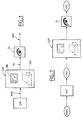
- the label DR denotes a medical imaging system delivering digital images, each composed of a plurality of points each assigned a digital value, typically between 0 and 255, and representative of a digital grey level NGN, to a display system SAF (which may be composed of a single display monitor MN or else the monitor MN and a printer IMP which are connected together to this system DR).
- a display system SAF which may be composed of a single display monitor MN or else the monitor MN and a printer IMP which are connected together to this system DR).
- the display system then delivers an image which may be displayed on the screen or printed on the printer IMP and each pixel of which, corresponding to each input point (digital input value), is assigned a brightness level NL.
- the image is perceived by the human visual system OL and the human brain then perceives a perceived grey level NGP for each brightness level.
- the display system SAP is composed only of the monitor MN.
- the method of checking the calibration according to the invention consists, as illustrated more particularly in Figure 2, in generating a digital test image IMC from a visual display test pattern MRC and from an overall transfer function inverted in processing means MT.
- This digital test image or digital calibration image IMC is then delivered as input to the display system SAF and is reproduced by the display screen, for example.
- the human brain then perceives a resulting perceived image IRL.
- a plurality (n) [lacuna] elements ELi each composed of two perceived grey levels NGPi0 and NGPi1, are defined on the scale of grey levels perceived by the human brain. The difference between these two levels, that is to say the contrast of each element ELi is constant and the same for each of the elements. On the other hand, all the levels NGPi are different from one another.
- a visual calibration test pattern MRC is defined which here is composed only of a first part formed from several (n) separate regions which are also labeled ELi. Each of these regions corresponds to an element ELi of the scale of perceived grey levels. Each region ELi is composed of a first area Zi0 having a first light level, that is to say a first perceived grey level NGPi0, equal to that of the element ELi defined in Figure 3 and of a second area Zi1 having the grey level NGPi1.
- An overall transfer function is then determined from the combination of the target transfer function of the monitor, that is to say the transfer function of the calibrated monitor, and from a transfer function derived from a mathematical model of the human visual system.
- This transfer function of the human visual system makes it possible to associate a perceived grey level with each brightness level.
- Many mathematical models of the human visual system available to those skilled in the art. Thus, mention may be made of the so-called Barten model described, for instance, in the article by P.G.J. Barten: "Physical model for the Contrast Sensitivity of the human eye”; Proc. SPIN 1666, 57-72 (1992) and “Spatio-temporal model for the Contrast Sensitivity of the human eye and its temporal aspects", Proc. SPIE 1913-01 (1993).
- the overall transfer function is inverted, in a conventional and known manner, so as to obtain an inverted transfer function, that is to say a transfer function associating a digital grey level of a point in a digital calibration image with each perceived grey level of a pixel of the visual calibration test pattern.
- the digital calibration image IMC illustrated in Figure 5, and corresponding to the virtual calibration test pattern, is then generated.
- This digital calibration image IMC is defined, in a manner similar to the visual calibration test pattern, by a plurality of digital regions ELCi each composed of a first area ZCi0 and of a second area ZCi1. All the pixels of the first area are assigned a digital grey level NGNiO and all the pixels of the second area are assigned a digital grey level NGNi1.
- the calibration test pattern as defined in Figures 3 and 4, and consequently the corresponding digital calibration image IMC, is especially used when the discretization increment of the monitor is greater than the contrast detection threshold of the human eye.
- Elements ELi will then be chosen whose contrast, that is to say the difference in perceived grey levels, is significantly greater than the discretization increment, for example equal to three or four times this increment.
- the fact that a contrast significantly greater than the discretization increment is chosen makes it possible to minimize the impact of the variation in this discretization increment along the scale of perceived grey levels. However, it is possible to choose smaller contrasts if the scale of perceived grey levels is divided into areas within which the discretization increment remains approximately constant.
- a visual calibration test pattern composed in fact of two parts ( Figure 6) will be defined. More specifically, the first part will be composed of n elements ELAi, each contrast of which is less than the contrast detection threshold SPR of the human eye.
- the second part PB will consist of n elements ELBi, the contrast of which will be chosen to be greater than the threshold SPR.
- a contrast slightly less than the threshold SPR for example 0.8 or 0.9 times this threshold, will be chosen for the elements ELAi
- a contrast slightly greater [lacuna] SPR (for example 1.1 or 1.2 times this threshold) will be chosen for the elements ELBi.
- Each of the parts PA and PB will therefore be composed of an image similar to that illustrated in Figure 4.
- the corresponding complete display test pattem would, if it were fully perceived by the eye, be equal to the juxtaposition of two test patterns such as those illustrated in Figure 4
- Figure 7 shows, in the in the actual solid line, the variation in the actual contrast of the various elements of the image IRL actually perceived by the human eye, compared with the desired contrast of these same elements, that is to say the contrast of these elements as they ought to be perceived in the visual calibration test pattern if the system were correctly calibrated.
- the curve of correspondence between the actual contrast and the desired contrast is in fact the straight line passing through the origin with a slope of 45°, as illustrated by the dotted line in Figure 7.
- the calibration of the display system may be checked by observing the perceived contrast of the elements of the two parts PA and PB.
- the display system is not calibrated. If the contrast of all the elements of the first part PA cannot be perceived, and if the contrast of all the elements of the second part PB can be perceived and if the actual transfer function of the display system is assumed to coincide with the target transfer function, at least at one point, it may be concluded that the display system is calibrated.
- the calibration of the system may be checked by observing the perceived contrast of the various elements. If the perceived contrast of the various elements is not constant but changes from one element to another, it may then be concluded that the display system is not calibrated. If the contrast of all the elements is constant, and if the actual transfer function of the display system is assumed to coincide with the target transfer function, at least at two points, it may be concluded from this that the system is calibrated. If it is not known for certain that this actual transfer function coincides at two points with the target transfer function, it is then necessary to take two direct calibration measurements in order to reach the conclusion that the system is correctly calibrated.
- the display system SAP is composed of the monitor MN and the printer IMP which are connected together to the medical imaging system DR.
- test pattern MRC especially the contrasts and the minimum and maximum values of the grey levels, depending on the characteristics of the printer and in particular on its discretization increment, are then generated.
- the inverted target transfer function of the monitor is used to define the digital calibration image IMC from the test pattern MRC.
Landscapes
- Engineering & Computer Science (AREA)
- Computer Hardware Design (AREA)
- Multimedia (AREA)
- Signal Processing (AREA)
- Theoretical Computer Science (AREA)
- General Physics & Mathematics (AREA)
- Physics & Mathematics (AREA)
- Biomedical Technology (AREA)
- General Health & Medical Sciences (AREA)
- Health & Medical Sciences (AREA)
- Controls And Circuits For Display Device (AREA)
- Testing, Inspecting, Measuring Of Stereoscopic Televisions And Televisions (AREA)
- Control Of Indicators Other Than Cathode Ray Tubes (AREA)
- Accessory Devices And Overall Control Thereof (AREA)
- Measuring And Recording Apparatus For Diagnosis (AREA)
- Facsimile Image Signal Circuits (AREA)
Applications Claiming Priority (2)
| Application Number | Priority Date | Filing Date | Title |
|---|---|---|---|
| FR9801356 | 1998-02-05 | ||
| FR9801356A FR2774498B1 (fr) | 1998-02-05 | 1998-02-05 | Procede de controle de l'etalonnage d'un systeme d'affichage, en particulier d'une imprimante |
Publications (1)
| Publication Number | Publication Date |
|---|---|
| EP0935232A1 true EP0935232A1 (fr) | 1999-08-11 |
Family
ID=9522635
Family Applications (1)
| Application Number | Title | Priority Date | Filing Date |
|---|---|---|---|
| EP99300545A Withdrawn EP0935232A1 (fr) | 1998-02-05 | 1999-01-26 | Méthode de vérification du calibrage d'un système d'affichage |
Country Status (4)
| Country | Link |
|---|---|
| US (1) | US6133950A (fr) |
| EP (1) | EP0935232A1 (fr) |
| JP (1) | JPH11327501A (fr) |
| FR (1) | FR2774498B1 (fr) |
Cited By (3)
| Publication number | Priority date | Publication date | Assignee | Title |
|---|---|---|---|---|
| WO2002039754A1 (fr) * | 2000-11-08 | 2002-05-16 | Andrzej Czyzewski | Tests de controle visuel par ordinateur |
| EP1662477A1 (fr) * | 2004-11-26 | 2006-05-31 | Barco N.V. | Essai ou calibrage des échelles de gris affichées |
| WO2006089556A1 (fr) * | 2005-02-24 | 2006-08-31 | Bang & Olufsen A/S | Systeme pour fournir une qualite d'image uniforme dans des affichages pour une reproduction d'image |
Families Citing this family (2)
| Publication number | Priority date | Publication date | Assignee | Title |
|---|---|---|---|---|
| US20050277815A1 (en) * | 2004-06-15 | 2005-12-15 | Konica Minolta Medical & Graphic, Inc. | Display method of test pattern and medical image display apparatus |
| US8411066B2 (en) | 2010-01-05 | 2013-04-02 | 3M Innovative Properties Company | High speed noise tolerant multi-touch touch device and controller therefor |
Citations (3)
| Publication number | Priority date | Publication date | Assignee | Title |
|---|---|---|---|---|
| US2380244A (en) * | 1942-11-19 | 1945-07-10 | Eastman Kodak Co | Sensitometry |
| EP0542012A1 (fr) * | 1991-11-13 | 1993-05-19 | Eastman Kodak Company | Procédé de calibration pour la reproduction d'images vidéo avec imprimante électronique et écran vidéo |
| EP0750431A2 (fr) * | 1995-06-21 | 1996-12-27 | Eastman Kodak Company | Caractérisation visuelle utilisant des modèles d'affichage |
Family Cites Families (6)
| Publication number | Priority date | Publication date | Assignee | Title |
|---|---|---|---|---|
| US4513318A (en) * | 1982-09-30 | 1985-04-23 | Allied Corporation | Programmable video test pattern generator for display systems |
| US5459678A (en) * | 1992-07-02 | 1995-10-17 | Feasey; Michael F. | Method and calibration apparatus for calibrating computer monitors used in the printing and textile industries |
| US5572444A (en) * | 1992-08-19 | 1996-11-05 | Mtl Systems, Inc. | Method and apparatus for automatic performance evaluation of electronic display devices |
| US5537145A (en) * | 1994-12-06 | 1996-07-16 | Sun Microsystems, Inc. | Evaluation method and system for performance of flat panel displays and interface hardware |
| US5764284A (en) * | 1996-06-26 | 1998-06-09 | Mci Corporations | System and method for measuring the fidelity of video |
| US6057882A (en) * | 1996-10-29 | 2000-05-02 | Hewlett-Packard Company | Testing architecture for digital video transmission system |
-
1998
- 1998-02-05 FR FR9801356A patent/FR2774498B1/fr not_active Expired - Fee Related
-
1999
- 1999-01-26 EP EP99300545A patent/EP0935232A1/fr not_active Withdrawn
- 1999-02-02 US US09/241,811 patent/US6133950A/en not_active Expired - Fee Related
- 1999-02-05 JP JP11028435A patent/JPH11327501A/ja active Pending
Patent Citations (3)
| Publication number | Priority date | Publication date | Assignee | Title |
|---|---|---|---|---|
| US2380244A (en) * | 1942-11-19 | 1945-07-10 | Eastman Kodak Co | Sensitometry |
| EP0542012A1 (fr) * | 1991-11-13 | 1993-05-19 | Eastman Kodak Company | Procédé de calibration pour la reproduction d'images vidéo avec imprimante électronique et écran vidéo |
| EP0750431A2 (fr) * | 1995-06-21 | 1996-12-27 | Eastman Kodak Company | Caractérisation visuelle utilisant des modèles d'affichage |
Non-Patent Citations (1)
| Title |
|---|
| GRAY J E: "ACCEPTANCE AND USE OF THE SMPTE MEDICAL DIAGNOSTIC IMAGING TEST PATTERN FOR TELEVISION MONITORS AND HARD-COPY RECORDING CAMERAS", SMPTE JOURNAL, vol. 99, no. 12, 1 December 1990 (1990-12-01), pages 1001 - 1007, XP000172375 * |
Cited By (5)
| Publication number | Priority date | Publication date | Assignee | Title |
|---|---|---|---|---|
| WO2002039754A1 (fr) * | 2000-11-08 | 2002-05-16 | Andrzej Czyzewski | Tests de controle visuel par ordinateur |
| EP1662477A1 (fr) * | 2004-11-26 | 2006-05-31 | Barco N.V. | Essai ou calibrage des échelles de gris affichées |
| WO2006056030A1 (fr) * | 2004-11-26 | 2006-06-01 | Barco Nv | Test ou calibration de niveaux de gris affiches |
| US7999852B2 (en) | 2004-11-26 | 2011-08-16 | Barco N.V. | Test or calibration of displayed greyscales |
| WO2006089556A1 (fr) * | 2005-02-24 | 2006-08-31 | Bang & Olufsen A/S | Systeme pour fournir une qualite d'image uniforme dans des affichages pour une reproduction d'image |
Also Published As
| Publication number | Publication date |
|---|---|
| US6133950A (en) | 2000-10-17 |
| FR2774498B1 (fr) | 2001-04-27 |
| FR2774498A1 (fr) | 1999-08-06 |
| JPH11327501A (ja) | 1999-11-26 |
Similar Documents
| Publication | Publication Date | Title |
|---|---|---|
| Bijl et al. | Triangle orientation discrimination: the alternative to minimum resolvable temperature difference and minimum resolvable contrast | |
| KR101000623B1 (ko) | 색수차 검출 및 보정 방법, 이를 이용한 영상 처리 장치 및그 방법 | |
| US7852349B2 (en) | Image display method and image display apparatus | |
| US20140307104A1 (en) | Spectral estimation method, system and reference target design method | |
| JP7016892B2 (ja) | 測定対象の表面を光学測定する方法及び装置 | |
| EP0986249A2 (fr) | Détecteur pour détecter des pixels défecteux d'un capteur d'image à l'état solide | |
| EP1363462A3 (fr) | Système de traitement d'image, projecteur, support d'enregistrement d'informations et procédé de traitement d'image | |
| DE102015105071A1 (de) | Bildanzeigevorrichtung und steuerverfahren für diese | |
| CN102461192A (zh) | 三维显示器的光学特性评价装置和光学特性评价方法 | |
| GB2404106A (en) | Generating a test image for use in assessing display crosstalk. | |
| US6865287B1 (en) | Method for adjusting color in an image | |
| US6133950A (en) | Method of checking the calibration of a display system in particular a printer | |
| CN103165099A (zh) | 显示设备 | |
| US20040212680A1 (en) | Device for determining a location-dependent intensity profile and color profile and/or sharpness profile of optical lens system | |
| US5481376A (en) | Method and apparatus for improving image quality | |
| KR100859937B1 (ko) | 디스플레이의 그레이 레벨 대 휘도 곡선을 신속히 생성하는방법 및 장치 | |
| EP3848682B1 (fr) | Procédé de génération d'image d'évaluation de couleur de revêtement et programme de génération et dispositif de génération d'image d'évaluation de couleur de revêtement | |
| CN110537362A (zh) | 颜色处理程序、颜色处理方法、色彩感觉检查系统、输出系统、色觉校正图像处理系统及色觉模拟图像处理系统 | |
| Farrell et al. | A display simulation toolbox for image quality evaluation | |
| US20220072791A1 (en) | Determining a light scattering property of an object based on transmission values of the object under different measurement conditions | |
| US20010048733A1 (en) | Method and computer program for checking an image reproduction apparatus, and method for operating a medical apparatus | |
| Grogan et al. | Image quality evaluation with a contour-based perceptual model | |
| CN109326245A (zh) | 侦测显示装置的图像中高频成分的方法及装置 | |
| JPH0617829B2 (ja) | 赤外線像表示装置 | |
| JP3504040B2 (ja) | カラーディスプレイの色むら識別方法および前記方法による自動識別装置 |
Legal Events
| Date | Code | Title | Description |
|---|---|---|---|
| PUAI | Public reference made under article 153(3) epc to a published international application that has entered the european phase |
Free format text: ORIGINAL CODE: 0009012 |
|
| AK | Designated contracting states |
Kind code of ref document: A1 Designated state(s): DE NL |
|
| AX | Request for extension of the european patent |
Free format text: AL;LT;LV;MK;RO;SI |
|
| 17P | Request for examination filed |
Effective date: 20000211 |
|
| AKX | Designation fees paid |
Free format text: DE NL |
|
| STAA | Information on the status of an ep patent application or granted ep patent |
Free format text: STATUS: THE APPLICATION IS DEEMED TO BE WITHDRAWN |
|
| 18D | Application deemed to be withdrawn |
Effective date: 20060801 |