EP0935238A2 - Méthode de reconnaissance de la parole utilisant des modèles linguistiques statistiques - Google Patents
Méthode de reconnaissance de la parole utilisant des modèles linguistiques statistiques Download PDFInfo
- Publication number
- EP0935238A2 EP0935238A2 EP99200210A EP99200210A EP0935238A2 EP 0935238 A2 EP0935238 A2 EP 0935238A2 EP 99200210 A EP99200210 A EP 99200210A EP 99200210 A EP99200210 A EP 99200210A EP 0935238 A2 EP0935238 A2 EP 0935238A2
- Authority
- EP
- European Patent Office
- Prior art keywords
- words
- speech signal
- sentence elements
- sentence
- training
- Prior art date
- Legal status (The legal status is an assumption and is not a legal conclusion. Google has not performed a legal analysis and makes no representation as to the accuracy of the status listed.)
- Withdrawn
Links
- 238000000034 method Methods 0.000 title claims abstract description 24
- 238000012549 training Methods 0.000 claims abstract description 34
- 238000012360 testing method Methods 0.000 claims abstract description 14
- 238000011156 evaluation Methods 0.000 claims abstract description 3
- 230000015572 biosynthetic process Effects 0.000 claims description 6
- 238000005070 sampling Methods 0.000 abstract 1
- 238000001514 detection method Methods 0.000 description 3
- 230000001427 coherent effect Effects 0.000 description 1
- 230000004069 differentiation Effects 0.000 description 1
- 238000012432 intermediate storage Methods 0.000 description 1
- 238000012545 processing Methods 0.000 description 1
Images
Classifications
-
- G—PHYSICS
- G10—MUSICAL INSTRUMENTS; ACOUSTICS
- G10L—SPEECH ANALYSIS TECHNIQUES OR SPEECH SYNTHESIS; SPEECH RECOGNITION; SPEECH OR VOICE PROCESSING TECHNIQUES; SPEECH OR AUDIO CODING OR DECODING
- G10L15/00—Speech recognition
- G10L15/08—Speech classification or search
- G10L15/18—Speech classification or search using natural language modelling
- G10L15/183—Speech classification or search using natural language modelling using context dependencies, e.g. language models
- G10L15/19—Grammatical context, e.g. disambiguation of the recognition hypotheses based on word sequence rules
- G10L15/197—Probabilistic grammars, e.g. word n-grams
Definitions
- the invention relates to the field of speech recognition and in particular to Generation of models for speech recognition.
- the speech signal to be recognized becomes regular Times are sampled, and test signals are obtained from the samples, which characterize the speech section between two samples. These test signals are compared in parallel with a number of reference signals, with sequences of Reference signals represent words of a given vocabulary. This Reference signals or sequences of reference signals become a training speech signal won and represent an acoustic model for the detection of a Speech signal.
- evaluation values are derived, which indicate the degree of agreement of the Test signal with the reference signal or the difference between the two signals specify.
- a speech signal arises from coherent spoken words constantly "recognized”, i.e. determined words at the same time or also overlapping, because due to the inaccuracies when speaking, an exact Detection is almost never possible.
- additional language model values are used, which indicate the probability of sequences of words.
- valuation values for word sequences are supplemented, whereby words starting with a Relatively high reliability, if deleted in a Related to other words are very unlikely.
- This Language model values are determined from the training text or corpus that corresponds to the Training speech signal corresponds.
- the words that are assigned to the sequences of reference signals form a given vocabulary with those occurring in natural language Words. These words come in very different natural texts Frequency before, especially many short words, whose acoustic recognition or Differentiation is often difficult to occur with greater frequency. Also such a vocabulary leads to a language model that is not very cheap.
- the object of the invention is to provide a method with which the detection of Words in a speech signal can be improved. This includes in particular the improvement of the language model, i.e. identifying better Language model values, and reducing perplexity.
- Perplexity can simply be viewed as a measure of the ambiguity with which the consequence of Words can be specified in a speech signal, with a large one Perplexity means great ambiguity.
- This object is generally achieved according to the invention in that from the Training speech signal a new vocabulary is formed that is not just words, but also contains phrases, with words and phrases below are also generally referred to with sentence elements.
- This new vocabulary contains so additional sentence elements. In individual cases words of the original Vocabulary are dropped, although the probability of this is very low.
- the Additional language elements must be in the training speech signal with at least a predetermined frequency.
- new language model values are determined from the training speech signal. With this new vocabulary and the new language model values are then Test speech signals processed. In this processing, the words from the Test speech signal determined with greater reliability.
- the new vocabulary can be created in different ways. For example, the most common word pair can be determined first and a new one Vocabulary entry can be summarized. Then everyone will be in the training corpus corresponding word pairs replaced by the new sentence element. For this changed training speech signal can then determine the most common pair again become, and so on. According to an advantageous embodiment of the The method according to the invention will thereby form the new vocabulary achieved that all combinations first, that is, all pairs of Sentence elements in which the training speech signal is determined. These couples will be inserted in a list according to a given criterion.
- the new sentence elements determined in this way the word sequences of two or more words are inserted into the existing vocabulary, creating the new Vocabulary is formed. With this new vocabulary, the training speech signal becomes new language model values determined.
- pairs of words or Record elements determined.
- Triples of sentence elements can also be determined will be summarized, such triples in which only the first and the last word or sentence element is the same. If such different triples with occur approximately the same frequency, this means that the middle word in the Tripel is not very meaningful for the language model. Expediently, triples are determined using the procedure for determining pairs of Sentence elements is completed.
- the change ⁇ F in the unigram probability of the training body can also be used. This is defined as follows
- shorter sequences of words e.g. Word pairs may be included in previous steps have been formed.
- the frequency of occurrence such shorter sentence elements are reduced if they are partly in longer ones Sentence elements are included. It can happen that the frequency such shorter sentence elements falls below a predetermined frequency, in particular the frequency that is necessary for a combination of sentence elements in the orderly list is included in the formation of the new vocabulary. In In this case it is advisable to convert such shorter sentence elements into smaller ones Breaking down components, such as word pairs into individual words. This can after each sequence of steps in the formation of the new vocabulary using the ordered list or after a predetermined number of such sequences. After such a split, the specified steps for the New vocabulary was created.
- sentence elements with several words also contain elements with Swap the order of individual words summarized and the same can be treated.
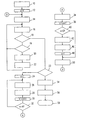
- a Loop counter s the meaning of which will be explained later, is set to the value 1.
- blocks 20 and 22 are repeated and it is finally formed a list in which all pairs of words according to the criterion are contained in an orderly manner, which is more frequent than the value T in the training speech signal appeared.
- query 32 determines that the last list place N is addressed, and the Now proceed to block 34, where the content remaining in the list, that in the first pass contains only word pairs, is cached.
- the loop counter s is increased by one unit, and in Query 40 checks whether a predetermined number S of runs is thereby is reached through the loop. As long as this is not the case, the next step is in the block 50 the list content inserted in the training text. This can e.g. thereby happen that the corresponding pairs of words in the training text marked as a unit become.
- the method now returns to block 14, but not only now Pairs of words but generally pairs of sentence elements are formed where a sentence element is a word, a word pair or in multiple passes can be a longer string of words through the loop. It is also possible that a pair of two word pairs is formed after the first round, see above that in this way possibly a new sentence element of four words arises.
- the further sequence via blocks 16 to 40 takes place in the same Way as previously described.
- block 40 If it is determined in block 40 that a predetermined number S of Passing through the loop, the sequence now goes to block 42 further. It takes into account that some occurrences of a sentence element, the is not just a single word, but two or more words are combined with another sentence element to form a unit, whereby the number of other occurrences of this sentence element under one predetermined threshold can fall. If so, block 46 does so Split sentence element back into its previous components, i.e. this Block element in the accumulated intermediate storage of the block 34 List contents deleted. The loop counter s is then opened again in block 48 set the value 1. Then, as described, in block 50 all become original vocabulary newly formed sentence elements in the training language text inserted, with which a further pass of the loop is carried out.
- the method thus comes to an end 58, which now has a new vocabulary and new language model values are available, and thus new, unknown test speech signals are processed.
- blocks 12, 38, 40 and 48 can be omitted if at each time through the loop, the test indicated by block 42 takes place.
Landscapes
- Engineering & Computer Science (AREA)
- Physics & Mathematics (AREA)
- Probability & Statistics with Applications (AREA)
- Artificial Intelligence (AREA)
- Computational Linguistics (AREA)
- Health & Medical Sciences (AREA)
- Audiology, Speech & Language Pathology (AREA)
- Human Computer Interaction (AREA)
- Acoustics & Sound (AREA)
- Multimedia (AREA)
- Machine Translation (AREA)
- Character Discrimination (AREA)
Applications Claiming Priority (2)
| Application Number | Priority Date | Filing Date | Title |
|---|---|---|---|
| DE1998104603 DE19804603A1 (de) | 1998-02-06 | 1998-02-06 | Verfahren zum Ermitteln von Wörtern in einem Sprachsignal |
| DE19804603 | 1998-02-06 |
Publications (2)
| Publication Number | Publication Date |
|---|---|
| EP0935238A2 true EP0935238A2 (fr) | 1999-08-11 |
| EP0935238A3 EP0935238A3 (fr) | 2000-02-23 |
Family
ID=7856762
Family Applications (1)
| Application Number | Title | Priority Date | Filing Date |
|---|---|---|---|
| EP99200210A Withdrawn EP0935238A3 (fr) | 1998-02-06 | 1999-01-26 | Méthode de reconnaissance de la parole utilisant des modèles linguistiques statistiques |
Country Status (3)
| Country | Link |
|---|---|
| EP (1) | EP0935238A3 (fr) |
| JP (1) | JPH11272290A (fr) |
| DE (1) | DE19804603A1 (fr) |
Cited By (1)
| Publication number | Priority date | Publication date | Assignee | Title |
|---|---|---|---|---|
| WO2000031727A1 (fr) * | 1998-11-24 | 2000-06-02 | Koninklijke Philips Electronics N.V. | Dispositif d'optimisation visant a optimiser le vocabulaire d'un dispositif de reconnaissance vocale |
Families Citing this family (2)
| Publication number | Priority date | Publication date | Assignee | Title |
|---|---|---|---|---|
| DE10006725A1 (de) * | 2000-02-15 | 2001-08-30 | Hans Geiger | Verfahren und Vorrichtung zum Erkennen einer phonetischen Lautfolge oder Zeichenfolge |
| US7966177B2 (en) | 2001-08-13 | 2011-06-21 | Hans Geiger | Method and device for recognising a phonetic sound sequence or character sequence |
-
1998
- 1998-02-06 DE DE1998104603 patent/DE19804603A1/de not_active Withdrawn
-
1999
- 1999-01-26 EP EP99200210A patent/EP0935238A3/fr not_active Withdrawn
- 1999-02-03 JP JP2604799A patent/JPH11272290A/ja active Pending
Non-Patent Citations (4)
| Title |
|---|
| DELIGNE S ET AL: "Inference of variable-length linguistic and acoustic units by multigrams" SPEECH COMMUNICATION,NL,ELSEVIER SCIENCE PUBLISHERS, AMSTERDAM, Bd. 23, Nr. 3, Seite 223-241 XP004112586 ISSN: 0167-6393 * |
| GIACHIN E ET AL: "Language models for spontaneous speech recognition: a bootstrap method for learning phrase bigrams" ICSLP 94. 1994 INTERNATIONAL CONFERENCE ON SPOKEN LANGUAGE PROCESSING, PROCEEDINGS OF 1994 INTERNATIONAL CONFERENCE ON SPOKEN LANGUAGE PROCESSING, YOKOHAMA, JAPAN, 18-22 SEPT. 1994, Seiten 843-846 vol.2, XP000856976 1994, Tokyo, Japan, Acoustical Soc. Japan, Japan * |
| GIACHIN E P: "PHRASE BIGRAMS FOR CONTINUOUS SPEECH RECOGNITION" PROCEEDINGS OF THE INTERNATIONAL CONFERENCE ON ACOUSTICS, SPEECH, AND SIGNAL PROCESSING (ICASSP),US,NEW YORK, IEEE, Seite 225-228 XP000657971 ISBN: 0-7803-2432-3 * |
| KLAKOW D: "Language-model optimization by mapping of corpora" PROCEEDINGS OF THE 1998 IEEE INTERNATIONAL CONFERENCE ON ACOUSTICS, SPEECH AND SIGNAL PROCESSING, ICASSP '98 (CAT. NO.98CH36181), PROCEEDINGS OF THE 1998 IEEE INTERNATIONAL CONFERENCE ON ACOUSTICS, SPEECH AND SIGNAL PROCESSING, SEATTLE, WA, USA, 12-1, Seiten 701-704 vol.2, XP002124207 1998, New York, NY, USA, IEEE, USA ISBN: 0-7803-4428-6 * |
Cited By (1)
| Publication number | Priority date | Publication date | Assignee | Title |
|---|---|---|---|---|
| WO2000031727A1 (fr) * | 1998-11-24 | 2000-06-02 | Koninklijke Philips Electronics N.V. | Dispositif d'optimisation visant a optimiser le vocabulaire d'un dispositif de reconnaissance vocale |
Also Published As
| Publication number | Publication date |
|---|---|
| DE19804603A1 (de) | 1999-08-12 |
| EP0935238A3 (fr) | 2000-02-23 |
| JPH11272290A (ja) | 1999-10-08 |
Similar Documents
| Publication | Publication Date | Title |
|---|---|---|
| EP0299572B1 (fr) | Procédé pour la reconnaissance de mots enchaînés | |
| EP1113420B1 (fr) | Procédé de reconnaissance de parole et de commande d'une unité de synthèse de parole ainsi que d'un moyen de communication | |
| DE69615667T2 (de) | Spracherkennung | |
| EP0702353B1 (fr) | Système et procédé de reproduction synthétique de parole en réponse aux signaux de parole fournis | |
| DE69009522T2 (de) | Diagrammanalysator für stochastische Unifikationsgrammatik. | |
| EP0285221B1 (fr) | Procédé pour la reconnaissance de la parole continue | |
| DE69937176T2 (de) | Segmentierungsverfahren zur Erweiterung des aktiven Vokabulars von Spracherkennern | |
| EP0533260B1 (fr) | Procédé et dispositif pour la reconnaissance des mots prononcés dans un signal de parole | |
| DE60016722T2 (de) | Spracherkennung in zwei Durchgängen mit Restriktion des aktiven Vokabulars | |
| EP0533261A2 (fr) | Procédé et dispositif pour la reconnaissance de mots prononcés dans un signal de parole | |
| EP0862161A2 (fr) | Procédé de reconnaissance de la parole avec adaptation de modèle | |
| DE3852678T2 (de) | Mustererkennung. | |
| DE2753707A1 (de) | Einrichtung zur erkennung des auftretens eines kommandowortes aus einer eingangssprache | |
| DE19510083A1 (de) | Verfahren und Anordnung zur Spracherkennung bei Wortkomposita enthaltenden Sprachen | |
| EP0836175B1 (fr) | Procédé et arrangement pour déduire au moins une suite de mots d'un signal vocal | |
| EP0285222B1 (fr) | Procédé pour la reconnaissance de la parole continue | |
| EP0981129A2 (fr) | Procédé et système d'execution d'une requête de base de données | |
| EP0285211B1 (fr) | Procédé pour la reconnaissance de la parole continue | |
| DE2133638B2 (de) | Verfahren zum Betrieb eines lernfähigen Systems aus in Kaskade geschalteten, zur nicht linearen Datenverarbeitung geeigneten lernfähigen Datenverarbeitungseinheiten | |
| DE2920041C2 (de) | Verfahren zum Verifizieren von Signalen, und Anordnung zum Durchführen des Verfahrens | |
| EP0813734B1 (fr) | Procede de reconnaissance d'au moins un motif modelise au moyen de la modelisation markovienne, dans un signal de mesure variant avec le temps et auquel se superpose au moins un signal parasite | |
| EP0935238A2 (fr) | Méthode de reconnaissance de la parole utilisant des modèles linguistiques statistiques | |
| EP0417854B1 (fr) | Procédé pour la reconnaissance de N suites différentes de mots dans un signal de parole | |
| DE69915817T2 (de) | Vorrichtung und verfahren zur spracherkennung | |
| EP0834859B1 (fr) | Procédé de détermination d'un modèle acoustique pour un mot |
Legal Events
| Date | Code | Title | Description |
|---|---|---|---|
| PUAI | Public reference made under article 153(3) epc to a published international application that has entered the european phase |
Free format text: ORIGINAL CODE: 0009012 |
|
| AK | Designated contracting states |
Kind code of ref document: A2 Designated state(s): DE FR GB |
|
| AX | Request for extension of the european patent |
Free format text: AL;LT;LV;MK;RO;SI |
|
| PUAL | Search report despatched |
Free format text: ORIGINAL CODE: 0009013 |
|
| RAP3 | Party data changed (applicant data changed or rights of an application transferred) |
Owner name: KONINKLIJKE PHILIPS ELECTRONICS N.V. Owner name: PHILIPS CORPORATE INTELLECTUAL PROPERTY GMBH |
|
| AK | Designated contracting states |
Kind code of ref document: A3 Designated state(s): AT BE CH CY DE DK ES FI FR GB GR IE IT LI LU MC NL PT SE |
|
| AX | Request for extension of the european patent |
Free format text: AL;LT;LV;MK;RO;SI |
|
| 17P | Request for examination filed |
Effective date: 20000823 |
|
| AKX | Designation fees paid | ||
| RBV | Designated contracting states (corrected) |
Designated state(s): DE FR GB |
|
| RAP1 | Party data changed (applicant data changed or rights of an application transferred) |
Owner name: KONINKLIJKE PHILIPS ELECTRONICS N.V. Owner name: PHILIPS CORPORATE INTELLECTUAL PROPERTY GMBH |
|
| 17Q | First examination report despatched |
Effective date: 20030212 |
|
| RAP1 | Party data changed (applicant data changed or rights of an application transferred) |
Owner name: KONINKLIJKE PHILIPS ELECTRONICS N.V. Owner name: PHILIPS INTELLECTUAL PROPERTY & STANDARDS GMBH |
|
| GRAP | Despatch of communication of intention to grant a patent |
Free format text: ORIGINAL CODE: EPIDOSNIGR1 |
|
| GRAS | Grant fee paid |
Free format text: ORIGINAL CODE: EPIDOSNIGR3 |
|
| STAA | Information on the status of an ep patent application or granted ep patent |
Free format text: STATUS: THE APPLICATION IS DEEMED TO BE WITHDRAWN |
|
| 18D | Application deemed to be withdrawn |
Effective date: 20050801 |