EP0935353A1 - Un protocole d'accès multiple asymétrique pour un système de communication - Google Patents
Un protocole d'accès multiple asymétrique pour un système de communication Download PDFInfo
- Publication number
- EP0935353A1 EP0935353A1 EP98308353A EP98308353A EP0935353A1 EP 0935353 A1 EP0935353 A1 EP 0935353A1 EP 98308353 A EP98308353 A EP 98308353A EP 98308353 A EP98308353 A EP 98308353A EP 0935353 A1 EP0935353 A1 EP 0935353A1
- Authority
- EP
- European Patent Office
- Prior art keywords
- slots
- compulsory
- base station
- channel
- mobile
- Prior art date
- Legal status (The legal status is an assumption and is not a legal conclusion. Google has not performed a legal analysis and makes no representation as to the accuracy of the status listed.)
- Granted
Links
- 238000004891 communication Methods 0.000 title claims abstract description 37
- 230000010267 cellular communication Effects 0.000 claims abstract description 10
- 238000000034 method Methods 0.000 claims description 6
- 230000002401 inhibitory effect Effects 0.000 description 9
- 230000002452 interceptive effect Effects 0.000 description 4
- 230000001413 cellular effect Effects 0.000 description 3
- 238000010295 mobile communication Methods 0.000 description 2
- 238000001228 spectrum Methods 0.000 description 2
- 230000002411 adverse Effects 0.000 description 1
- 230000005540 biological transmission Effects 0.000 description 1
- 239000002131 composite material Substances 0.000 description 1
- 230000001066 destructive effect Effects 0.000 description 1
- 238000010586 diagram Methods 0.000 description 1
- 238000005516 engineering process Methods 0.000 description 1
- 230000007613 environmental effect Effects 0.000 description 1
- 230000002829 reductive effect Effects 0.000 description 1
- 230000011664 signaling Effects 0.000 description 1
Images

Classifications
-
- H—ELECTRICITY
- H04—ELECTRIC COMMUNICATION TECHNIQUE
- H04B—TRANSMISSION
- H04B7/00—Radio transmission systems, i.e. using radiation field
- H04B7/24—Radio transmission systems, i.e. using radiation field for communication between two or more posts
- H04B7/26—Radio transmission systems, i.e. using radiation field for communication between two or more posts at least one of which is mobile
- H04B7/2643—Radio transmission systems, i.e. using radiation field for communication between two or more posts at least one of which is mobile using time-division multiple access [TDMA]
- H04B7/2656—Radio transmission systems, i.e. using radiation field for communication between two or more posts at least one of which is mobile using time-division multiple access [TDMA] for structure of frame, burst
-
- H—ELECTRICITY
- H04—ELECTRIC COMMUNICATION TECHNIQUE
- H04W—WIRELESS COMMUNICATION NETWORKS
- H04W72/00—Local resource management
- H04W72/20—Control channels or signalling for resource management
- H04W72/27—Control channels or signalling for resource management between access points
-
- H—ELECTRICITY
- H04—ELECTRIC COMMUNICATION TECHNIQUE
- H04W—WIRELESS COMMUNICATION NETWORKS
- H04W28/00—Network traffic management; Network resource management
- H04W28/02—Traffic management, e.g. flow control or congestion control
- H04W28/06—Optimizing the usage of the radio link, e.g. header compression, information sizing, discarding information
-
- H—ELECTRICITY
- H04—ELECTRIC COMMUNICATION TECHNIQUE
- H04W—WIRELESS COMMUNICATION NETWORKS
- H04W72/00—Local resource management
- H04W72/02—Selection of wireless resources by user or terminal
-
- H—ELECTRICITY
- H04—ELECTRIC COMMUNICATION TECHNIQUE
- H04W—WIRELESS COMMUNICATION NETWORKS
- H04W74/00—Wireless channel access
- H04W74/04—Scheduled access
-
- H—ELECTRICITY
- H04—ELECTRIC COMMUNICATION TECHNIQUE
- H04W—WIRELESS COMMUNICATION NETWORKS
- H04W84/00—Network topologies
- H04W84/02—Hierarchically pre-organised networks, e.g. paging networks, cellular networks, WLAN [Wireless Local Area Network] or WLL [Wireless Local Loop]
- H04W84/04—Large scale networks; Deep hierarchical networks
- H04W84/042—Public Land Mobile systems, e.g. cellular systems
-
- H—ELECTRICITY
- H04—ELECTRIC COMMUNICATION TECHNIQUE
- H04W—WIRELESS COMMUNICATION NETWORKS
- H04W88/00—Devices specially adapted for wireless communication networks, e.g. terminals, base stations or access point devices
- H04W88/08—Access point devices
Definitions
- This invention relates to a multiple access protocol for a communication system, and in particular to an asymmetric access protocol for a mobile cellular communication system using time division duplexing (TDD).
- TDD time division duplexing
- EP766416 A describes a wireless multiple access communication systems which dynamically allocates available frame slots to uplink and downlink.
- a cancellation signal corresponding to or otherwise representative of the interfering signal, (from an interfering base station to an interfered-with base station) is used.
- the cancellation signal is used to cancel or otherwise offset the mixed interference produced in a received composite signal which includes both the desired mobile station to base station (uplink) signal and the interfering signal.
- interference cancellation technique timing adjustment, amplitude adjustment, etc
- the base station - base station link needs to be maintained, hence the involvement of a Base Station Control (BSC), which is higher level over BS.
- BSC Base Station Control
- EP766416 describes a system used purely for cancelling or reducing co-channel interference purposes by the means of slot allocation (between downlink and uplink) in a frequency reuse cell (essentially non-adjacent cells system.
- EP 720 321 A1 describes a similar, TDMA only system.
- the system is used in either non-cellular systems or cellular system with identical asymmetric pattern, that is where the asymmetric ratio of each cell is the same.
- the systems uses 'flexible uplink/downlink allocation' achieved by system level flexible uplink/downlink allocation, in which the asymmetric ratio is all the same for all cells.
- a method of time division duplexing in a mobile cellular communication system comprising:
- apparatus for time division duplexing in a mobile cellular communication system comprising:
- the position of the compulsory slots may be determined by a central controller and the position, within the frame, of the compulsory slots will be the same in each cell.
- the invention provides an asymmetric TDD system in which resources are allocated on a cell by cell basis, thereby achieving a more flexible and efficient system. All data packets transmitted in a slot can be arranged into consecutive slots; that is uplink slots and downlink slots can be arranged consecutively, thereby obviating the need for guard time between the same type of slot. Since the invention allows an asymmetric traffic ratio (uplink:downlink) for each cell the channel efficiency is improved. Since each base station may allocate uplink and downlink slots according to the type of traffic experienced by a cell, the traffic ratio may be adjusted dynamically.
- the slots may be arranged into frames, with the asymmetric traffic ratio being repeated on a frame by frame basis.
- the base station may broadcast the traffic ratio (i.e. the uplink and downlink allocation) on a general information channel BCCH, so that each mobile station entering a cell is provided with the traffic ratio.
- the central co-ordinating controller may also organise the length of a frame, and govern the timing of frames from cell to cell.
- Each frame may include a compulsory uplink slot and a compulsory downlink slot, which may for example take the first two slots of each frame.
- the compulsory slots may be the same for each cell, leading to easy handover between cells, for a mobile station travelling between cells.
- the frame rate and compulsory slot allocation may be chosen in such a way that a mobile station, restricted to the compulsory slots only, will not suffer from a reduced QoS, particularly if running a delay sensitive application.
- Figure 1 shows a block diagram of a mobile cellular communication system.
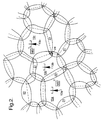
- Figure 2 shows an area of the communication system divided into overlapping cells.
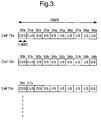
- Figure 3 illustrates frame traffic for adjacent cells within the communication system.
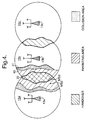
- Figure 4 illustrates the inhibiting area, the collision area and the non-inhibiting area for three adjacent cells.
- An end-user device may use any one of a number of communication protocols to communicate with its nearest base station 13, via antennae 10 and 11, across an air interface 12.
- the communication protocol used is CDMA (code division multiple access). This enables the mobile stations to communicate using a coded spread spectrum signal with codes which are almost uncorrelated, thereby providing a multiple access communications protocol in which the collisions are not destructive of other signals broadcast concurrently.
- the base station continually broadcasts information on its broadcast control channel (BCCH) to all mobile stations within range.
- BCCH information includes various codes and control signals necessary for a mobile station to register into the system and the traffic ratio (uplink:downlink).
- Each mobile station uses the relative strength of the BCCH from neighbouring base stations to determine whether handover to another base station is appropriate.
- a base station may page a mobile station on the paging channel (PCH) or, alternatively, a mobile station may request access to the system on the random access channel (RACH).
- PCH paging channel
- RACH random access channel
- Data transmitted over the TCH is divided into packets, which are transmitted in a particular slot with appropriate control bits.
- Figure 2 shows a communication system with overlapping cell coverage (15a, 15b, 15c) supplied by a number of base stations (13a, 13b, 13c).
- the cell coverage is more often represented as a honeycomb structure, the actual coverage depends on the environmental features, and a large overlap (e.g. 20) can occur.
- the general overlap (21) is the handover area in which the signals from adjacent base stations are received by a mobile station with equal strength. A mobile station may request handover from one base station (13a) to another (13b) in this area (22).
- FIG 3 illustrates the uplink and downlink traffic in a frame for three adjacent cells 15a, 15b, 15c.
- Each frame includes a compulsory downlink slot (CDS) which the central controller 16 has allocated to the first slot of each frame (30a, 30b, 30c).
- the frames also include a compulsory uplink slot (CUS) which the central controller 16 allocates to the second slot of each frame (31a, 31b, 31c).
- CDS compulsory downlink slot
- CCS compulsory uplink slot
- cells 15b and 15c are using the same traffic ratio, which in this case is 4:6 (downlink:uplink) distributed as 1 down: 1 up: 2 down: 5 up: 1 down.
- Cell 15a is using a different traffic ratio of 5:5, distributed as 1 down: 1 up: 3 down: 3 up: 1 down: 1 up.
- the size of the inhibiting area will depend on a number of factors, such as signal power control and the signal processing ability of both the base stations and the mobile stations. Also shown on Figure 4 is the collision area 41, which is the area of cell coverage where collision actually occur, requiring the data packet transmitted in corrupted slot to be retransmitted.
- the inhibiting area is determined by each mobile stations' ability to recognise that it is an area where collisions are likely. A reasonable estimate of the collision area can be determined using existing cellular communications technology, such as the GSM (Group Special Mobile or Global System for Mobile Communications) system. Using a similar algorithm to that used for handover, the inhibiting area will consist of the area of overlap between two cells.
- mobile stations will be continually searching for the beacon signal (BCCH signal) broadcast constantly by all base stations.
- the beacon signal will contain information concerning the traffic ratio currently being employed by the base station. If the adjacent base station beacon signal indicates a different traffic ratio to that currently employed by the mobile station and when the power level of the beacon signal reaches a predetermined threshold, the mobile will consider itself within an inhibiting area. Mobile stations may not recognise the full extent of the collision area since collisions depend upon the presence of two interfering mobile stations.
- Each mobile system may be provided with geographical location mechanism, enabling the mobile station to accurately determine its position relative to each base station. Such a mechanism would utilise, for example, base station triangulation.
- each mobile could be fitted with a satellite positioning system such as a GPS locator.
- the traffic ratio of each cell is known by the central controller. This information, along with the accurate positioning information determined for each mobile station would enable the central controller to determine whether a particular mobile station needs to be fully or partially inhibited. It may not be necessary to restrict mobile stations to the compulsory slots since, as shown in Figure 3, slots 32, 33, 35, 36 and 37 have been given the same allocation by base stations 13a and 13b (cells 15a and 15b). Thus mobile stations 2 and 3 could be partially inhibited, that is prevented from using slots 34, 38 and 39 when in the inhibiting area 40. Mobile stations may be required to use only the compulsory slots at, for example, the intersection of three cells, such as shown by point 24 of Figure 2.
- the frame length is shown as 16ms, and the slot length is 1.6ms.
- coded by a voice coder at a rate of 32000 bits/second, or 512 bits/frame. Assuming 64 information bits are added, for header and other information, this gives a speech data packet of 576 bits. Thus the data rate must be at least 360,000 bits per second, if the mobile station is limited to sending all the speech data in the compulsory uplink.
Landscapes
- Engineering & Computer Science (AREA)
- Computer Networks & Wireless Communication (AREA)
- Signal Processing (AREA)
- Mobile Radio Communication Systems (AREA)
Priority Applications (1)
| Application Number | Priority Date | Filing Date | Title |
|---|---|---|---|
| EP98308353A EP0935353B1 (fr) | 1997-10-31 | 1998-10-13 | Un protocole d'accès multiple asymétrique pour un système de communication |
Applications Claiming Priority (3)
| Application Number | Priority Date | Filing Date | Title |
|---|---|---|---|
| EP97308743 | 1997-10-31 | ||
| EP97308743 | 1997-10-31 | ||
| EP98308353A EP0935353B1 (fr) | 1997-10-31 | 1998-10-13 | Un protocole d'accès multiple asymétrique pour un système de communication |
Publications (2)
| Publication Number | Publication Date |
|---|---|
| EP0935353A1 true EP0935353A1 (fr) | 1999-08-11 |
| EP0935353B1 EP0935353B1 (fr) | 2011-08-24 |
Family
ID=26147672
Family Applications (1)
| Application Number | Title | Priority Date | Filing Date |
|---|---|---|---|
| EP98308353A Expired - Lifetime EP0935353B1 (fr) | 1997-10-31 | 1998-10-13 | Un protocole d'accès multiple asymétrique pour un système de communication |
Country Status (1)
| Country | Link |
|---|---|
| EP (1) | EP0935353B1 (fr) |
Cited By (8)
| Publication number | Priority date | Publication date | Assignee | Title |
|---|---|---|---|---|
| EP1063855A3 (fr) * | 1999-06-24 | 2001-09-05 | Alcatel | Système de transmission asymétrique de données dans un système de communication radio |
| WO2001047307A3 (fr) * | 1999-12-20 | 2001-11-15 | Nokia Networks Oy | Reseaux de communications |
| EP1229671A3 (fr) * | 2001-02-05 | 2003-11-19 | NTT DoCoMo, Inc. | Appareil et méthode d'allocation d'intervalles temporelles, mémoires et programmes, système de communication mobile et méthode d'opération |
| EP1098542A3 (fr) * | 1999-11-04 | 2004-01-14 | NTT DoCoMo, Inc. | Procédé, station de base et station mobile pour sélection et allocation de tranches temporelles |
| WO2007071694A1 (fr) * | 2005-12-19 | 2007-06-28 | Siemens Home And Office Communication Devices Gmbh & Co. Kg | Procede de transmission de donnees specifiques a l'abonne |
| WO2010086498A1 (fr) * | 2009-01-27 | 2010-08-05 | Nokia Corporation | Procédé et appareil de modification dynamique d'une trame de transmission |
| EP2129174A3 (fr) * | 2008-05-28 | 2010-12-22 | NEC Corporation | Système de communication sans fil, terminal sans fil, appareil de gestion, et procédé de contrôle de session |
| EP2468057A4 (fr) * | 2009-08-19 | 2017-01-11 | Samsung Electronics Co., Ltd. | Procédé et appareil de mesure d'utilisation de ressources radio par classe de trafic dans un système de communication sans fil |
Citations (4)
| Publication number | Priority date | Publication date | Assignee | Title |
|---|---|---|---|---|
| EP0720405A2 (fr) | 1994-12-27 | 1996-07-03 | AT&T Corp. | Communication cellulaire à accès multiple possédant une allocation dynamique des canaux temporels et une interférence réduite lors de l'unisation de canaux identiques |
| EP0720321A1 (fr) | 1994-12-27 | 1996-07-03 | AT&T Corp. | Accès multiple dans un système de communication cellulaire avec entrelacement ciculaire et longueur réduite des paquets perdus |
| EP0766416A2 (fr) | 1995-09-29 | 1997-04-02 | AT&T Corp. | Accès multiple communication cellulaire avec annulation de signal pour réduire l'interférence entre canaux adjacents |
| US5619491A (en) * | 1993-06-16 | 1997-04-08 | U.S. Philips Corporation | CDMA transmission system |
-
1998
- 1998-10-13 EP EP98308353A patent/EP0935353B1/fr not_active Expired - Lifetime
Patent Citations (4)
| Publication number | Priority date | Publication date | Assignee | Title |
|---|---|---|---|---|
| US5619491A (en) * | 1993-06-16 | 1997-04-08 | U.S. Philips Corporation | CDMA transmission system |
| EP0720405A2 (fr) | 1994-12-27 | 1996-07-03 | AT&T Corp. | Communication cellulaire à accès multiple possédant une allocation dynamique des canaux temporels et une interférence réduite lors de l'unisation de canaux identiques |
| EP0720321A1 (fr) | 1994-12-27 | 1996-07-03 | AT&T Corp. | Accès multiple dans un système de communication cellulaire avec entrelacement ciculaire et longueur réduite des paquets perdus |
| EP0766416A2 (fr) | 1995-09-29 | 1997-04-02 | AT&T Corp. | Accès multiple communication cellulaire avec annulation de signal pour réduire l'interférence entre canaux adjacents |
Cited By (16)
| Publication number | Priority date | Publication date | Assignee | Title |
|---|---|---|---|---|
| EP1063855A3 (fr) * | 1999-06-24 | 2001-09-05 | Alcatel | Système de transmission asymétrique de données dans un système de communication radio |
| SG148029A1 (en) * | 1999-11-04 | 2008-12-31 | Ntt Docomo Inc | Method, base station and mobile station for timeslot selection and timeslot assignment |
| CN100433583C (zh) * | 1999-11-04 | 2008-11-12 | 株式会社Ntt都科摩 | 用于时隙选择和时隙分配的方法、基站和移动站 |
| EP1098542A3 (fr) * | 1999-11-04 | 2004-01-14 | NTT DoCoMo, Inc. | Procédé, station de base et station mobile pour sélection et allocation de tranches temporelles |
| US7116983B2 (en) | 1999-11-04 | 2006-10-03 | Ntt Docomo, Inc. | Method, base station and mobile station for timeslot selection and timeslot assignment |
| EP1720368A1 (fr) * | 1999-11-04 | 2006-11-08 | NTT DoCoMo INC. | Procédé, station de base et station mobile pour allocation de tranches temporelles dynamique dans un système de communication mobile TDD |
| US7620021B1 (en) | 1999-11-04 | 2009-11-17 | Ntt Docomo, Inc. | Method, base station and mobile station for timeslot selection and timeslot assignment |
| WO2001047307A3 (fr) * | 1999-12-20 | 2001-11-15 | Nokia Networks Oy | Reseaux de communications |
| US7626953B2 (en) | 1999-12-20 | 2009-12-01 | Nokia Corporation | Communications networks |
| EP1229671A3 (fr) * | 2001-02-05 | 2003-11-19 | NTT DoCoMo, Inc. | Appareil et méthode d'allocation d'intervalles temporelles, mémoires et programmes, système de communication mobile et méthode d'opération |
| WO2007071694A1 (fr) * | 2005-12-19 | 2007-06-28 | Siemens Home And Office Communication Devices Gmbh & Co. Kg | Procede de transmission de donnees specifiques a l'abonne |
| US7848344B2 (en) | 2005-12-19 | 2010-12-07 | Gigaset Communications Gmbh | Method for transmitting subscriber-specific data |
| EP2129174A3 (fr) * | 2008-05-28 | 2010-12-22 | NEC Corporation | Système de communication sans fil, terminal sans fil, appareil de gestion, et procédé de contrôle de session |
| WO2010086498A1 (fr) * | 2009-01-27 | 2010-08-05 | Nokia Corporation | Procédé et appareil de modification dynamique d'une trame de transmission |
| EP2468057A4 (fr) * | 2009-08-19 | 2017-01-11 | Samsung Electronics Co., Ltd. | Procédé et appareil de mesure d'utilisation de ressources radio par classe de trafic dans un système de communication sans fil |
| US9832668B2 (en) | 2009-08-19 | 2017-11-28 | Samsung Electronics Co., Ltd. | Method and apparatus for measuring radio resource use per traffic class in a wireless communication system |
Also Published As
| Publication number | Publication date |
|---|---|
| EP0935353B1 (fr) | 2011-08-24 |
Similar Documents
| Publication | Publication Date | Title |
|---|---|---|
| CA2248515C (fr) | Protocole d'acces asymetrique multiple pour un systeme de communication | |
| US5633874A (en) | Automatic retransmission request | |
| US5577046A (en) | Automatic retransmission request | |
| AU712723B2 (en) | A random access scheme for mobile satellite communications | |
| CN1099823C (zh) | 采用频率转换中继站的时分蜂窝系统中的小区扩展 | |
| EP1224747B1 (fr) | Procede et dispositif d'ordonnancement montant | |
| US6134231A (en) | Uplink channel puncturing for reduced interference within a wireless data communications network | |
| AU8959198A (en) | Access to communications systems | |
| CN1204428A (zh) | 用于无线通信中避免碰撞的方法、装置与通信网络 | |
| WO1997040639A9 (fr) | Procede et appareil relatifs a une communication sans fil a mode d'acces multiple par repartition dans le temps (tdma) utilisant un ensemble de collecteurs pour extension de portee | |
| US6980800B2 (en) | System and method for providing contention channel organization for broadband satellite access in a communications network | |
| EP1114567A2 (fr) | Adaptation de liaison et de cellule radio dans des systemes tdd | |
| EP0913970B1 (fr) | Accès à des systèmes de communication | |
| EP0935353B1 (fr) | Un protocole d'accès multiple asymétrique pour un système de communication | |
| EP0860061B1 (fr) | Telephonie numerique utilisant des messages de commande transmis en tranches de temps pour l'attribution de frequences h.f. | |
| CA2281959A1 (fr) | Demande automatique de retransmission | |
| NZ500144A (en) | Polling requests sent coincident with ARQ Mode Begin or Continue frames |
Legal Events
| Date | Code | Title | Description |
|---|---|---|---|
| PUAI | Public reference made under article 153(3) epc to a published international application that has entered the european phase |
Free format text: ORIGINAL CODE: 0009012 |
|
| AK | Designated contracting states |
Kind code of ref document: A1 Designated state(s): DE FI FR GB SE |
|
| AX | Request for extension of the european patent |
Free format text: AL;LT;LV;MK;RO;SI |
|
| 17P | Request for examination filed |
Effective date: 20000201 |
|
| AKX | Designation fees paid |
Free format text: DE FI FR GB SE |
|
| 17Q | First examination report despatched |
Effective date: 20070925 |
|
| RAP3 | Party data changed (applicant data changed or rights of an application transferred) |
Owner name: LUCENT TECHNOLOGIES INC. |
|
| RIC1 | Information provided on ipc code assigned before grant |
Ipc: H04W 74/04 20090101AFI20101006BHEP |
|
| GRAP | Despatch of communication of intention to grant a patent |
Free format text: ORIGINAL CODE: EPIDOSNIGR1 |
|
| GRAC | Information related to communication of intention to grant a patent modified |
Free format text: ORIGINAL CODE: EPIDOSCIGR1 |
|
| RAP1 | Party data changed (applicant data changed or rights of an application transferred) |
Owner name: ALCATEL-LUCENT USA INC. |
|
| GRAS | Grant fee paid |
Free format text: ORIGINAL CODE: EPIDOSNIGR3 |
|
| GRAA | (expected) grant |
Free format text: ORIGINAL CODE: 0009210 |
|
| AK | Designated contracting states |
Kind code of ref document: B1 Designated state(s): DE FI FR GB SE |
|
| REG | Reference to a national code |
Ref country code: GB Ref legal event code: FG4D |
|
| REG | Reference to a national code |
Ref country code: DE Ref legal event code: R096 Ref document number: 69842375 Country of ref document: DE Effective date: 20111020 |
|
| PG25 | Lapsed in a contracting state [announced via postgrant information from national office to epo] |
Ref country code: FI Free format text: LAPSE BECAUSE OF FAILURE TO SUBMIT A TRANSLATION OF THE DESCRIPTION OR TO PAY THE FEE WITHIN THE PRESCRIBED TIME-LIMIT Effective date: 20110824 Ref country code: SE Free format text: LAPSE BECAUSE OF FAILURE TO SUBMIT A TRANSLATION OF THE DESCRIPTION OR TO PAY THE FEE WITHIN THE PRESCRIBED TIME-LIMIT Effective date: 20110824 |
|
| PLBE | No opposition filed within time limit |
Free format text: ORIGINAL CODE: 0009261 |
|
| STAA | Information on the status of an ep patent application or granted ep patent |
Free format text: STATUS: NO OPPOSITION FILED WITHIN TIME LIMIT |
|
| 26N | No opposition filed |
Effective date: 20120525 |
|
| REG | Reference to a national code |
Ref country code: DE Ref legal event code: R097 Ref document number: 69842375 Country of ref document: DE Effective date: 20120525 |
|
| REG | Reference to a national code |
Ref country code: GB Ref legal event code: 732E Free format text: REGISTERED BETWEEN 20131024 AND 20131030 |
|
| REG | Reference to a national code |
Ref country code: FR Ref legal event code: GC Effective date: 20140715 |
|
| REG | Reference to a national code |
Ref country code: FR Ref legal event code: RG Effective date: 20141015 |
|
| REG | Reference to a national code |
Ref country code: FR Ref legal event code: PLFP Year of fee payment: 18 |
|
| REG | Reference to a national code |
Ref country code: FR Ref legal event code: PLFP Year of fee payment: 19 |
|
| REG | Reference to a national code |
Ref country code: FR Ref legal event code: PLFP Year of fee payment: 20 |
|
| PGFP | Annual fee paid to national office [announced via postgrant information from national office to epo] |
Ref country code: DE Payment date: 20171019 Year of fee payment: 20 Ref country code: FR Payment date: 20171024 Year of fee payment: 20 |
|
| PGFP | Annual fee paid to national office [announced via postgrant information from national office to epo] |
Ref country code: GB Payment date: 20171019 Year of fee payment: 20 |
|
| REG | Reference to a national code |
Ref country code: DE Ref legal event code: R071 Ref document number: 69842375 Country of ref document: DE |
|
| REG | Reference to a national code |
Ref country code: GB Ref legal event code: PE20 Expiry date: 20181012 |
|
| PG25 | Lapsed in a contracting state [announced via postgrant information from national office to epo] |
Ref country code: GB Free format text: LAPSE BECAUSE OF EXPIRATION OF PROTECTION Effective date: 20181012 |