EP0936236A2 - Epoxidharz- und Hybridpulverbeschichtungszusammensetzungen - Google Patents
Epoxidharz- und Hybridpulverbeschichtungszusammensetzungen Download PDFInfo
- Publication number
- EP0936236A2 EP0936236A2 EP98124385A EP98124385A EP0936236A2 EP 0936236 A2 EP0936236 A2 EP 0936236A2 EP 98124385 A EP98124385 A EP 98124385A EP 98124385 A EP98124385 A EP 98124385A EP 0936236 A2 EP0936236 A2 EP 0936236A2
- Authority
- EP
- European Patent Office
- Prior art keywords
- acid
- powder coating
- polycarboxylic acids
- coating composition
- composition according
- Prior art date
- Legal status (The legal status is an assumption and is not a legal conclusion. Google has not performed a legal analysis and makes no representation as to the accuracy of the status listed.)
- Withdrawn
Links
- 239000000843 powder Substances 0.000 title claims abstract description 33
- 238000000576 coating method Methods 0.000 title claims abstract description 22
- 229920000647 polyepoxide Polymers 0.000 title claims abstract description 20
- 239000003822 epoxy resin Substances 0.000 title claims abstract description 19
- 239000002253 acid Substances 0.000 claims abstract description 55
- 150000007513 acids Chemical class 0.000 claims abstract description 35
- 150000003839 salts Chemical class 0.000 claims abstract description 27
- 239000004848 polyfunctional curative Substances 0.000 claims abstract description 23
- QQVIHTHCMHWDBS-UHFFFAOYSA-N isophthalic acid Chemical compound OC(=O)C1=CC=CC(C(O)=O)=C1 QQVIHTHCMHWDBS-UHFFFAOYSA-N 0.000 claims abstract description 21
- KKEYFWRCBNTPAC-UHFFFAOYSA-N Terephthalic acid Chemical compound OC(=O)C1=CC=C(C(O)=O)C=C1 KKEYFWRCBNTPAC-UHFFFAOYSA-N 0.000 claims abstract description 20
- 150000001412 amines Chemical class 0.000 claims abstract description 18
- 125000001931 aliphatic group Chemical group 0.000 claims abstract description 17
- XNGIFLGASWRNHJ-UHFFFAOYSA-N o-dicarboxybenzene Natural products OC(=O)C1=CC=CC=C1C(O)=O XNGIFLGASWRNHJ-UHFFFAOYSA-N 0.000 claims abstract description 16
- 125000003118 aryl group Chemical group 0.000 claims abstract description 13
- ZRALSGWEFCBTJO-UHFFFAOYSA-N Guanidine Chemical compound NC(N)=N ZRALSGWEFCBTJO-UHFFFAOYSA-N 0.000 claims abstract description 8
- 125000004430 oxygen atom Chemical group O* 0.000 claims abstract description 8
- 239000006069 physical mixture Substances 0.000 claims abstract description 8
- 150000008064 anhydrides Chemical class 0.000 claims abstract description 6
- 150000002357 guanidines Chemical class 0.000 claims abstract description 5
- CHJJGSNFBQVOTG-UHFFFAOYSA-N N-methyl-guanidine Natural products CNC(N)=N CHJJGSNFBQVOTG-UHFFFAOYSA-N 0.000 claims abstract description 4
- 125000000217 alkyl group Chemical group 0.000 claims abstract description 4
- SWSQBOPZIKWTGO-UHFFFAOYSA-N dimethylaminoamidine Natural products CN(C)C(N)=N SWSQBOPZIKWTGO-UHFFFAOYSA-N 0.000 claims abstract description 4
- 125000004433 nitrogen atom Chemical group N* 0.000 claims abstract description 4
- 125000002496 methyl group Chemical group [H]C([H])([H])* 0.000 claims abstract description 3
- CYIDZMCFTVVTJO-UHFFFAOYSA-N pyromellitic acid Chemical compound OC(=O)C1=CC(C(O)=O)=C(C(O)=O)C=C1C(O)=O CYIDZMCFTVVTJO-UHFFFAOYSA-N 0.000 claims description 22
- 239000008199 coating composition Substances 0.000 claims description 20
- IISBACLAFKSPIT-UHFFFAOYSA-N bisphenol A Chemical compound C=1C=C(O)C=CC=1C(C)(C)C1=CC=C(O)C=C1 IISBACLAFKSPIT-UHFFFAOYSA-N 0.000 claims description 14
- 229920000728 polyester Polymers 0.000 claims description 14
- KRKNYBCHXYNGOX-UHFFFAOYSA-N citric acid Chemical compound OC(=O)CC(O)(C(O)=O)CC(O)=O KRKNYBCHXYNGOX-UHFFFAOYSA-N 0.000 claims description 12
- 238000004519 manufacturing process Methods 0.000 claims description 10
- 229920005989 resin Polymers 0.000 claims description 10
- 239000011347 resin Substances 0.000 claims description 10
- ARCGXLSVLAOJQL-UHFFFAOYSA-N trimellitic acid Chemical compound OC(=O)C1=CC=C(C(O)=O)C(C(O)=O)=C1 ARCGXLSVLAOJQL-UHFFFAOYSA-N 0.000 claims description 10
- QMKYBPDZANOJGF-UHFFFAOYSA-N benzene-1,3,5-tricarboxylic acid Chemical compound OC(=O)C1=CC(C(O)=O)=CC(C(O)=O)=C1 QMKYBPDZANOJGF-UHFFFAOYSA-N 0.000 claims description 8
- LNEPOXFFQSENCJ-UHFFFAOYSA-N haloperidol Chemical compound C1CC(O)(C=2C=CC(Cl)=CC=2)CCN1CCCC(=O)C1=CC=C(F)C=C1 LNEPOXFFQSENCJ-UHFFFAOYSA-N 0.000 claims description 7
- KCXVZYZYPLLWCC-UHFFFAOYSA-N EDTA Chemical compound OC(=O)CN(CC(O)=O)CCN(CC(O)=O)CC(O)=O KCXVZYZYPLLWCC-UHFFFAOYSA-N 0.000 claims description 6
- SJRJJKPEHAURKC-UHFFFAOYSA-N N-Methylmorpholine Chemical compound CN1CCOCC1 SJRJJKPEHAURKC-UHFFFAOYSA-N 0.000 claims description 6
- 125000004432 carbon atom Chemical group C* 0.000 claims description 6
- RLHGFJMGWQXPBW-UHFFFAOYSA-N 2-hydroxy-3-(1h-imidazol-5-ylmethyl)benzamide Chemical compound NC(=O)C1=CC=CC(CC=2NC=NC=2)=C1O RLHGFJMGWQXPBW-UHFFFAOYSA-N 0.000 claims description 5
- 239000004593 Epoxy Substances 0.000 claims description 5
- 238000006243 chemical reaction Methods 0.000 claims description 5
- QSAWQNUELGIYBC-UHFFFAOYSA-N cyclohexane-1,2-dicarboxylic acid Chemical compound OC(=O)C1CCCCC1C(O)=O QSAWQNUELGIYBC-UHFFFAOYSA-N 0.000 claims description 5
- ZFSLODLOARCGLH-UHFFFAOYSA-N isocyanuric acid Chemical compound OC1=NC(O)=NC(O)=N1 ZFSLODLOARCGLH-UHFFFAOYSA-N 0.000 claims description 5
- RXYPXQSKLGGKOL-UHFFFAOYSA-N 1,4-dimethylpiperazine Chemical compound CN1CCN(C)CC1 RXYPXQSKLGGKOL-UHFFFAOYSA-N 0.000 claims description 4
- GQHTUMJGOHRCHB-UHFFFAOYSA-N 2,3,4,6,7,8,9,10-octahydropyrimido[1,2-a]azepine Chemical compound C1CCCCN2CCCN=C21 GQHTUMJGOHRCHB-UHFFFAOYSA-N 0.000 claims description 4
- BRLQWZUYTZBJKN-UHFFFAOYSA-N Epichlorohydrin Chemical compound ClCC1CO1 BRLQWZUYTZBJKN-UHFFFAOYSA-N 0.000 claims description 4
- QPCDCPDFJACHGM-UHFFFAOYSA-N N,N-bis{2-[bis(carboxymethyl)amino]ethyl}glycine Chemical compound OC(=O)CN(CC(O)=O)CCN(CC(=O)O)CCN(CC(O)=O)CC(O)=O QPCDCPDFJACHGM-UHFFFAOYSA-N 0.000 claims description 4
- JLTDJTHDQAWBAV-UHFFFAOYSA-N N,N-dimethylaniline Chemical compound CN(C)C1=CC=CC=C1 JLTDJTHDQAWBAV-UHFFFAOYSA-N 0.000 claims description 4
- STZIXLPVKZUAMV-UHFFFAOYSA-N cyclopentane-1,1,2,2-tetracarboxylic acid Chemical compound OC(=O)C1(C(O)=O)CCCC1(C(O)=O)C(O)=O STZIXLPVKZUAMV-UHFFFAOYSA-N 0.000 claims description 4
- RXOHFPCZGPKIRD-UHFFFAOYSA-N naphthalene-2,6-dicarboxylic acid Chemical compound C1=C(C(O)=O)C=CC2=CC(C(=O)O)=CC=C21 RXOHFPCZGPKIRD-UHFFFAOYSA-N 0.000 claims description 4
- MGFYIUFZLHCRTH-UHFFFAOYSA-N nitrilotriacetic acid Chemical compound OC(=O)CN(CC(O)=O)CC(O)=O MGFYIUFZLHCRTH-UHFFFAOYSA-N 0.000 claims description 4
- 229910052757 nitrogen Inorganic materials 0.000 claims description 4
- 229960003330 pentetic acid Drugs 0.000 claims description 4
- 239000001124 (E)-prop-1-ene-1,2,3-tricarboxylic acid Substances 0.000 claims description 3
- -1 2-methylimidcoline Chemical compound 0.000 claims description 3
- BKCCAYLNRIRKDJ-UHFFFAOYSA-N 2-phenyl-4,5-dihydro-1h-imidazole Chemical compound N1CCN=C1C1=CC=CC=C1 BKCCAYLNRIRKDJ-UHFFFAOYSA-N 0.000 claims description 3
- 229940091181 aconitic acid Drugs 0.000 claims description 3
- GTZCVFVGUGFEME-IWQZZHSRSA-N cis-aconitic acid Chemical compound OC(=O)C\C(C(O)=O)=C\C(O)=O GTZCVFVGUGFEME-IWQZZHSRSA-N 0.000 claims description 3
- XBZSBBLNHFMTEB-UHFFFAOYSA-N cyclohexane-1,3-dicarboxylic acid Chemical compound OC(=O)C1CCCC(C(O)=O)C1 XBZSBBLNHFMTEB-UHFFFAOYSA-N 0.000 claims description 3
- 125000005842 heteroatom Chemical group 0.000 claims description 3
- 125000004435 hydrogen atom Chemical class [H]* 0.000 claims description 3
- 238000002844 melting Methods 0.000 claims description 3
- 230000008018 melting Effects 0.000 claims description 3
- GTZCVFVGUGFEME-UHFFFAOYSA-N trans-aconitic acid Natural products OC(=O)CC(C(O)=O)=CC(O)=O GTZCVFVGUGFEME-UHFFFAOYSA-N 0.000 claims description 3
- KYVBNYUBXIEUFW-UHFFFAOYSA-N 1,1,3,3-tetramethylguanidine Chemical compound CN(C)C(=N)N(C)C KYVBNYUBXIEUFW-UHFFFAOYSA-N 0.000 claims description 2
- FUPAJKKAHDLPAZ-UHFFFAOYSA-N 1,2,3-triphenylguanidine Chemical compound C=1C=CC=CC=1NC(=NC=1C=CC=CC=1)NC1=CC=CC=C1 FUPAJKKAHDLPAZ-UHFFFAOYSA-N 0.000 claims description 2
- GWPDPUZKEHQROA-UHFFFAOYSA-N 1-cyclohexyl-1,2,3,3-tetramethylguanidine Chemical compound CN=C(N(C)C)N(C)C1CCCCC1 GWPDPUZKEHQROA-UHFFFAOYSA-N 0.000 claims description 2
- SHYARJUKNREDGB-UHFFFAOYSA-N 2-ethyl-5-methyl-4,5-dihydro-1h-imidazole Chemical compound CCC1=NCC(C)N1 SHYARJUKNREDGB-UHFFFAOYSA-N 0.000 claims description 2
- 101500021084 Locusta migratoria 5 kDa peptide Proteins 0.000 claims description 2
- SVYKKECYCPFKGB-UHFFFAOYSA-N N,N-dimethylcyclohexylamine Chemical compound CN(C)C1CCCCC1 SVYKKECYCPFKGB-UHFFFAOYSA-N 0.000 claims description 2
- 125000003277 amino group Chemical class 0.000 claims description 2
- NAPSCFZYZVSQHF-UHFFFAOYSA-N dimantine Chemical compound CCCCCCCCCCCCCCCCCCN(C)C NAPSCFZYZVSQHF-UHFFFAOYSA-N 0.000 claims description 2
- 239000001257 hydrogen Substances 0.000 claims description 2
- 229910052739 hydrogen Inorganic materials 0.000 claims description 2
- LRAJIZNKBMCWJE-UHFFFAOYSA-N n,n,2,2,6,6-hexamethylpiperidin-4-amine Chemical compound CN(C)C1CC(C)(C)NC(C)(C)C1 LRAJIZNKBMCWJE-UHFFFAOYSA-N 0.000 claims description 2
- TXXWBTOATXBWDR-UHFFFAOYSA-N n,n,n',n'-tetramethylhexane-1,6-diamine Chemical compound CN(C)CCCCCCN(C)C TXXWBTOATXBWDR-UHFFFAOYSA-N 0.000 claims description 2
- IMNIMPAHZVJRPE-UHFFFAOYSA-N triethylenediamine Chemical compound C1CN2CCN1CC2 IMNIMPAHZVJRPE-UHFFFAOYSA-N 0.000 claims description 2
- DIHAURBCYGTGCV-UHFFFAOYSA-N xi-4,5-Dihydro-2,4(5)-dimethyl-1H-imidazole Chemical compound CC1CN=C(C)N1 DIHAURBCYGTGCV-UHFFFAOYSA-N 0.000 claims description 2
- UJVJGYQUOOQTAW-UHFFFAOYSA-N Pyrimine Natural products OC(=O)C1CCC(C=2N=CC=CC=2)=N1 UJVJGYQUOOQTAW-UHFFFAOYSA-N 0.000 claims 1
- 239000000654 additive Substances 0.000 claims 1
- 239000000203 mixture Substances 0.000 abstract description 15
- 239000011248 coating agent Substances 0.000 abstract description 8
- 230000001588 bifunctional effect Effects 0.000 abstract 2
- 229910052760 oxygen Inorganic materials 0.000 abstract 2
- ZFACJPAPCXRZMQ-UHFFFAOYSA-N phthalic acid Chemical compound OC(=O)C1=CC=CC=C1C(O)=O.OC(=O)C1=CC=CC=C1C(O)=O ZFACJPAPCXRZMQ-UHFFFAOYSA-N 0.000 abstract 2
- 150000001732 carboxylic acid derivatives Chemical class 0.000 abstract 1
- 125000001183 hydrocarbyl group Chemical group 0.000 abstract 1
- 125000003178 carboxy group Chemical group [H]OC(*)=O 0.000 description 8
- 229940106691 bisphenol a Drugs 0.000 description 6
- 239000002904 solvent Substances 0.000 description 6
- PEDCQBHIVMGVHV-UHFFFAOYSA-N Glycerine Chemical compound OCC(O)CO PEDCQBHIVMGVHV-UHFFFAOYSA-N 0.000 description 5
- 239000003795 chemical substances by application Substances 0.000 description 5
- 150000001875 compounds Chemical class 0.000 description 5
- 238000000034 method Methods 0.000 description 5
- 239000003973 paint Substances 0.000 description 5
- LFQSCWFLJHTTHZ-UHFFFAOYSA-N Ethanol Chemical compound CCO LFQSCWFLJHTTHZ-UHFFFAOYSA-N 0.000 description 4
- PXKLMJQFEQBVLD-UHFFFAOYSA-N bisphenol F Chemical compound C1=CC(O)=CC=C1CC1=CC=C(O)C=C1 PXKLMJQFEQBVLD-UHFFFAOYSA-N 0.000 description 4
- 239000004971 Cross linker Substances 0.000 description 3
- LYCAIKOWRPUZTN-UHFFFAOYSA-N Ethylene glycol Chemical compound OCCO LYCAIKOWRPUZTN-UHFFFAOYSA-N 0.000 description 3
- 229910010413 TiO 2 Inorganic materials 0.000 description 3
- 239000011230 binding agent Substances 0.000 description 3
- 230000015572 biosynthetic process Effects 0.000 description 3
- 239000007795 chemical reaction product Substances 0.000 description 3
- MTHSVFCYNBDYFN-UHFFFAOYSA-N diethylene glycol Chemical compound OCCOCCO MTHSVFCYNBDYFN-UHFFFAOYSA-N 0.000 description 3
- 229920005862 polyol Polymers 0.000 description 3
- 150000003077 polyols Chemical class 0.000 description 3
- 239000012463 white pigment Substances 0.000 description 3
- PXGZQGDTEZPERC-UHFFFAOYSA-N 1,4-cyclohexanedicarboxylic acid Chemical compound OC(=O)C1CCC(C(O)=O)CC1 PXGZQGDTEZPERC-UHFFFAOYSA-N 0.000 description 2
- QIGBRXMKCJKVMJ-UHFFFAOYSA-N Hydroquinone Chemical compound OC1=CC=C(O)C=C1 QIGBRXMKCJKVMJ-UHFFFAOYSA-N 0.000 description 2
- GWEVSGVZZGPLCZ-UHFFFAOYSA-N Titan oxide Chemical compound O=[Ti]=O GWEVSGVZZGPLCZ-UHFFFAOYSA-N 0.000 description 2
- ZJCCRDAZUWHFQH-UHFFFAOYSA-N Trimethylolpropane Chemical compound CCC(CO)(CO)CO ZJCCRDAZUWHFQH-UHFFFAOYSA-N 0.000 description 2
- 230000002378 acidificating effect Effects 0.000 description 2
- 238000009835 boiling Methods 0.000 description 2
- YCIMNLLNPGFGHC-UHFFFAOYSA-N catechol Chemical compound OC1=CC=CC=C1O YCIMNLLNPGFGHC-UHFFFAOYSA-N 0.000 description 2
- 238000001816 cooling Methods 0.000 description 2
- 238000004821 distillation Methods 0.000 description 2
- GHLKSLMMWAKNBM-UHFFFAOYSA-N dodecane-1,12-diol Chemical compound OCCCCCCCCCCCCO GHLKSLMMWAKNBM-UHFFFAOYSA-N 0.000 description 2
- 235000011187 glycerol Nutrition 0.000 description 2
- WXZMFSXDPGVJKK-UHFFFAOYSA-N pentaerythritol Chemical compound OCC(CO)(CO)CO WXZMFSXDPGVJKK-UHFFFAOYSA-N 0.000 description 2
- 238000002360 preparation method Methods 0.000 description 2
- GHMLBKRAJCXXBS-UHFFFAOYSA-N resorcinol Chemical compound OC1=CC=CC(O)=C1 GHMLBKRAJCXXBS-UHFFFAOYSA-N 0.000 description 2
- 238000005507 spraying Methods 0.000 description 2
- 239000000758 substrate Substances 0.000 description 2
- 238000001291 vacuum drying Methods 0.000 description 2
- XLYOFNOQVPJJNP-UHFFFAOYSA-N water Substances O XLYOFNOQVPJJNP-UHFFFAOYSA-N 0.000 description 2
- 238000004383 yellowing Methods 0.000 description 2
- DNIAPMSPPWPWGF-VKHMYHEASA-N (+)-propylene glycol Chemical compound C[C@H](O)CO DNIAPMSPPWPWGF-VKHMYHEASA-N 0.000 description 1
- 125000004169 (C1-C6) alkyl group Chemical group 0.000 description 1
- YPFDHNVEDLHUCE-UHFFFAOYSA-N 1,3-propanediol Substances OCCCO YPFDHNVEDLHUCE-UHFFFAOYSA-N 0.000 description 1
- VWSLLSXLURJCDF-UHFFFAOYSA-N 2-methyl-4,5-dihydro-1h-imidazole Chemical compound CC1=NCCN1 VWSLLSXLURJCDF-UHFFFAOYSA-N 0.000 description 1
- SXFJDZNJHVPHPH-UHFFFAOYSA-N 3-methylpentane-1,5-diol Chemical compound OCCC(C)CCO SXFJDZNJHVPHPH-UHFFFAOYSA-N 0.000 description 1
- BGQNNKZAJXZSPQ-UHFFFAOYSA-N 5,6-dimethylheptane-1,6-diol Chemical compound CC(O)(C)C(C)CCCCO BGQNNKZAJXZSPQ-UHFFFAOYSA-N 0.000 description 1
- 0 CC(C)NCCCN(CCC*)CC1NC1 Chemical compound CC(C)NCCCN(CCC*)CC1NC1 0.000 description 1
- FBPFZTCFMRRESA-FSIIMWSLSA-N D-Glucitol Natural products OC[C@H](O)[C@H](O)[C@@H](O)[C@H](O)CO FBPFZTCFMRRESA-FSIIMWSLSA-N 0.000 description 1
- FBPFZTCFMRRESA-KVTDHHQDSA-N D-Mannitol Chemical compound OC[C@@H](O)[C@@H](O)[C@H](O)[C@H](O)CO FBPFZTCFMRRESA-KVTDHHQDSA-N 0.000 description 1
- FBPFZTCFMRRESA-JGWLITMVSA-N D-glucitol Chemical compound OC[C@H](O)[C@@H](O)[C@H](O)[C@H](O)CO FBPFZTCFMRRESA-JGWLITMVSA-N 0.000 description 1
- UFHFLCQGNIYNRP-UHFFFAOYSA-N Hydrogen Chemical compound [H][H] UFHFLCQGNIYNRP-UHFFFAOYSA-N 0.000 description 1
- 229930195725 Mannitol Natural products 0.000 description 1
- 239000004594 Masterbatch (MB) Substances 0.000 description 1
- 241000232261 Napeanthus Species 0.000 description 1
- ALQSHHUCVQOPAS-UHFFFAOYSA-N Pentane-1,5-diol Chemical compound OCCCCCO ALQSHHUCVQOPAS-UHFFFAOYSA-N 0.000 description 1
- 241000170793 Phalaris canariensis Species 0.000 description 1
- 229910000831 Steel Inorganic materials 0.000 description 1
- YIMQCDZDWXUDCA-UHFFFAOYSA-N [4-(hydroxymethyl)cyclohexyl]methanol Chemical compound OCC1CCC(CO)CC1 YIMQCDZDWXUDCA-UHFFFAOYSA-N 0.000 description 1
- 150000007824 aliphatic compounds Chemical class 0.000 description 1
- 150000001491 aromatic compounds Chemical class 0.000 description 1
- OWBTYPJTUOEWEK-UHFFFAOYSA-N butane-2,3-diol Chemical compound CC(O)C(C)O OWBTYPJTUOEWEK-UHFFFAOYSA-N 0.000 description 1
- CQEYYJKEWSMYFG-UHFFFAOYSA-N butyl acrylate Chemical class CCCCOC(=O)C=C CQEYYJKEWSMYFG-UHFFFAOYSA-N 0.000 description 1
- VKONPUDBRVKQLM-UHFFFAOYSA-N cyclohexane-1,4-diol Chemical compound OC1CCC(O)CC1 VKONPUDBRVKQLM-UHFFFAOYSA-N 0.000 description 1
- SZXQTJUDPRGNJN-UHFFFAOYSA-N dipropylene glycol Chemical compound OCCCOCCCO SZXQTJUDPRGNJN-UHFFFAOYSA-N 0.000 description 1
- 230000000694 effects Effects 0.000 description 1
- 150000002148 esters Chemical class 0.000 description 1
- 150000002170 ethers Chemical class 0.000 description 1
- 239000000945 filler Substances 0.000 description 1
- 238000009472 formulation Methods 0.000 description 1
- LEQAOMBKQFMDFZ-UHFFFAOYSA-N glyoxal Chemical compound O=CC=O LEQAOMBKQFMDFZ-UHFFFAOYSA-N 0.000 description 1
- 125000002887 hydroxy group Chemical group [H]O* 0.000 description 1
- 239000004922 lacquer Substances 0.000 description 1
- 239000000594 mannitol Substances 0.000 description 1
- 235000010355 mannitol Nutrition 0.000 description 1
- 230000008774 maternal effect Effects 0.000 description 1
- 239000000155 melt Substances 0.000 description 1
- 238000002156 mixing Methods 0.000 description 1
- SLCVBVWXLSEKPL-UHFFFAOYSA-N neopentyl glycol Chemical compound OCC(C)(C)CO SLCVBVWXLSEKPL-UHFFFAOYSA-N 0.000 description 1
- 229910017464 nitrogen compound Inorganic materials 0.000 description 1
- 150000002830 nitrogen compounds Chemical class 0.000 description 1
- 230000003647 oxidation Effects 0.000 description 1
- 238000007254 oxidation reaction Methods 0.000 description 1
- 239000002245 particle Substances 0.000 description 1
- 150000003016 phosphoric acids Chemical class 0.000 description 1
- 230000000704 physical effect Effects 0.000 description 1
- 239000000049 pigment Substances 0.000 description 1
- 229920001225 polyester resin Polymers 0.000 description 1
- 239000004645 polyester resin Substances 0.000 description 1
- 229920000642 polymer Polymers 0.000 description 1
- 229920000166 polytrimethylene carbonate Polymers 0.000 description 1
- 239000002994 raw material Substances 0.000 description 1
- 239000011541 reaction mixture Substances 0.000 description 1
- 239000012261 resinous substance Substances 0.000 description 1
- 239000011833 salt mixture Substances 0.000 description 1
- 238000005245 sintering Methods 0.000 description 1
- 239000007787 solid Substances 0.000 description 1
- 238000007711 solidification Methods 0.000 description 1
- 230000008023 solidification Effects 0.000 description 1
- 239000000600 sorbitol Substances 0.000 description 1
- 239000003381 stabilizer Substances 0.000 description 1
- 239000010959 steel Substances 0.000 description 1
- 150000003512 tertiary amines Chemical class 0.000 description 1
- ZIBGPFATKBEMQZ-UHFFFAOYSA-N triethylene glycol Chemical compound OCCOCCOCCO ZIBGPFATKBEMQZ-UHFFFAOYSA-N 0.000 description 1
Classifications
-
- C—CHEMISTRY; METALLURGY
- C09—DYES; PAINTS; POLISHES; NATURAL RESINS; ADHESIVES; COMPOSITIONS NOT OTHERWISE PROVIDED FOR; APPLICATIONS OF MATERIALS NOT OTHERWISE PROVIDED FOR
- C09D—COATING COMPOSITIONS, e.g. PAINTS, VARNISHES OR LACQUERS; FILLING PASTES; CHEMICAL PAINT OR INK REMOVERS; INKS; CORRECTING FLUIDS; WOODSTAINS; PASTES OR SOLIDS FOR COLOURING OR PRINTING; USE OF MATERIALS THEREFOR
- C09D163/00—Coating compositions based on epoxy resins; Coating compositions based on derivatives of epoxy resins
-
- C—CHEMISTRY; METALLURGY
- C08—ORGANIC MACROMOLECULAR COMPOUNDS; THEIR PREPARATION OR CHEMICAL WORKING-UP; COMPOSITIONS BASED THEREON
- C08G—MACROMOLECULAR COMPOUNDS OBTAINED OTHERWISE THAN BY REACTIONS ONLY INVOLVING UNSATURATED CARBON-TO-CARBON BONDS
- C08G59/00—Polycondensates containing more than one epoxy group per molecule; Macromolecules obtained by polymerising compounds containing more than one epoxy group per molecule using curing agents or catalysts which react with the epoxy groups
- C08G59/18—Macromolecules obtained by polymerising compounds containing more than one epoxy group per molecule using curing agents or catalysts which react with the epoxy groups ; e.g. general methods of curing
- C08G59/40—Macromolecules obtained by polymerising compounds containing more than one epoxy group per molecule using curing agents or catalysts which react with the epoxy groups ; e.g. general methods of curing characterised by the curing agents used
- C08G59/50—Amines
- C08G59/56—Amines together with other curing agents
- C08G59/58—Amines together with other curing agents with polycarboxylic acids or with anhydrides, halides, or low-molecular-weight esters thereof
-
- C—CHEMISTRY; METALLURGY
- C08—ORGANIC MACROMOLECULAR COMPOUNDS; THEIR PREPARATION OR CHEMICAL WORKING-UP; COMPOSITIONS BASED THEREON
- C08G—MACROMOLECULAR COMPOUNDS OBTAINED OTHERWISE THAN BY REACTIONS ONLY INVOLVING UNSATURATED CARBON-TO-CARBON BONDS
- C08G59/00—Polycondensates containing more than one epoxy group per molecule; Macromolecules obtained by polymerising compounds containing more than one epoxy group per molecule using curing agents or catalysts which react with the epoxy groups
- C08G59/18—Macromolecules obtained by polymerising compounds containing more than one epoxy group per molecule using curing agents or catalysts which react with the epoxy groups ; e.g. general methods of curing
- C08G59/40—Macromolecules obtained by polymerising compounds containing more than one epoxy group per molecule using curing agents or catalysts which react with the epoxy groups ; e.g. general methods of curing characterised by the curing agents used
- C08G59/50—Amines
- C08G59/5093—Complexes of amines
-
- C—CHEMISTRY; METALLURGY
- C09—DYES; PAINTS; POLISHES; NATURAL RESINS; ADHESIVES; COMPOSITIONS NOT OTHERWISE PROVIDED FOR; APPLICATIONS OF MATERIALS NOT OTHERWISE PROVIDED FOR
- C09D—COATING COMPOSITIONS, e.g. PAINTS, VARNISHES OR LACQUERS; FILLING PASTES; CHEMICAL PAINT OR INK REMOVERS; INKS; CORRECTING FLUIDS; WOODSTAINS; PASTES OR SOLIDS FOR COLOURING OR PRINTING; USE OF MATERIALS THEREFOR
- C09D5/00—Coating compositions, e.g. paints, varnishes or lacquers, characterised by their physical nature or the effects produced; Filling pastes
- C09D5/03—Powdery paints
Definitions
- the invention relates to epoxy resin and hybrid powder coating compositions.
- DE-OS 23 24 696 describes a process for the production of matt coatings described by epoxy resins with salts of aromatic polycarboxylic acids, especially pyromellitic acid and cyclic amidines.
- DE-OS 44 03 225 describes salts of pyromellitic acid and tertiary amines which can be used to produce matt epoxy and hybrid coatings can.
- Such physical mixtures of amine component and polycarboxylic acid are e.g. B. described in EP-A 0 504 183.
- the salts are Reaction products from phthalic acid, isophthalic acid and terephthalic acid with Guanidines or amines. Pyromellitic acid and / or come as polycarboxylic acids Trimellitic acid used. The overburning stability is disadvantageous.
- Aromatic polycarboxylic acids are used according to DE 196 30 450 as a hardener component Phosphoric acid salts used in a mixture with polycarboxylic acids. The targeted However, making these complex hardeners is difficult. Fluctuations in the Reacton conditions can lead to a different structure of the salt mixtures and thus lead to different paint results
- the object of the invention was therefore to provide new EP and hybrid powder coating compositions with suitable hardeners with improved To find economy with a simple manufacturing process, also for manufacturing from semi-glossy to matt coatings with a high quality level are.
- Hardener component physical mixtures of aliphatic and / or cycloaliphatic and / or araliphatic and / or aromatic polycarboxylic acids with salts of aliphatic and / or cycloaliphatic and / or araliphatic and / or aromatic polycarboxylic acids and amines.
- the salts a) which can be used according to the invention contain aliphatic and / or cycloaliphatic and / or araliphatic and / or aromatic polycarboxylic acids and optionally their anhydrides (component a1).
- Mixtures of the polycarboxylic acids are possible in any combination.
- Isophthalic acid 2,
- the salts of the polycarboxylic acid contain as amine component a2) and / or a3) Nitrogen compounds that are capable of salt formation are represented by the formulas A-D.
- Nitrogen compounds that are capable of salt formation are represented by the formulas A-D.
- Examples of specific compounds of the formulas A) -C) are N, N-dimethylcyclohexylamine, N, N-dimethylaniline, N-methylmorpholine, N, N'-dimethylpiperazine, 2,2,6,6-tetramethyl-4-dimethylaminopiperidine, N, N-dimethyloctadecylamine, 1,8-diazabicyclo- [5.4.0] -undec-7-ene, N, N, N ', N'-tetramethylhexamethylene diamine, 1,4-diazabicyclo [2.2.2] octane, 2-phenylimidazoline, 2-methylimidazoline, 2,4-dimethylimid
- examples for specific compounds of the formula D) are tetramethylguanidine, Tetramethylcyclohexylguanidine, N, N ', N "triphenylguanidine and N, N'-dicyclohexyl-4-morpholine carbonamide.
- the basic N content of the salts is 0.01 - 30 mmol / g and the carboxyl group content 1-35 mmol / g.
- Component b) which can be used are aliphatic and / or cycloaliphatic and / or Araliphatic and / or aromatic polycarboxylic acids are suitable.
- Explicitly included are isophthalic acid, terephthalic acid and phthalic acid. When using mixtures of Any combination of polycarboxylic acids is possible.
- the hardeners according to the invention from component a) and b) are in two stages prepared, with salt formation taking place in the first stage, and after completion Salt formation the solvent is removed.
- a second step an or several aliphatic, cycloaliphatic, araliphatic or aromatic Polycarboxylic acids physically mixed.
- salts a) are known. They are also not the subject of the invention. She are produced in a known manner, with the being dissolved in water or ethanol Polycarboxylic acid in boiling heat, the amine / guanidine component a2 / a3 in portions is added. After the addition has ended, the mixture is heated for about an hour. The solvent is then removed by distillation. For quantitative Removal of the solvent, the reaction mixture in the vacuum drying cabinet 60 ° C dried for about 10 h. The aliphatic and / or cycloaliphatic and / or araliphatic and / or aromatic polycarboxylic acids.
- the salts a) are composed of 1 mol of polycarboxylic acid and 0.5-3 mol of the compounds A-D together.
- the composition of the hardener mixture according to the invention a) and b) consists of 99-1 mass% salt and 1-99 mass% polycarboxylic acid b).
- the hardener mixture a) and b) according to the invention is mixed with epoxy resins or Hybrid resins combined.
- Hybrids are carboxyl-functional polyester resins that are compatible with Epoxy resins are mixed.
- the Hardener in amounts of 2 - 14% by weight, based on the sum of the resins, used.
- the polyepoxy resins used are solid, resinous substances that in Range 60 - 150 ° C, preferably 70 - 110 ° C, and melt on average contain more than one 1,2-epoxy group per molecule. In principle, everyone comes Compounds in question that contain more than one 1,2-epoxy group per molecule. Examples are polyepoxides such as polyglycidyl ethers of aromatic or aliphatic Compounds that contain multiple hydrogen atoms.
- EP resins such as those obtained by reacting bisphenol A or bisphenol F.
- Epichlorohydrin can be obtained.
- EP resins based on are very particularly preferred the reaction between bisphenol A and epichlorohydrin with an EP equivalent weight between 400-3,000, preferably 800-1,000.
- the carboxyl group-containing polymers are Polyester polycarboxylic acids consisting of polyols and polycarboxylic acids or their Derivatives are made.
- the melting range of these acidic polyesters is in one Range of 60-160 ° C, preferably 80-120 ° C; their acid number varies from 10 - 150 mg KOH / g, preferably 30-60 mg KOH / g.
- the OH counts should be less than 10 mg KOH / g.
- polyester polycarboxylic acids For the production of the polyester polycarboxylic acids to be used Polycarboxylic acids, such as. B. oxal, adipine, 2,2,4 (2,4,4) trimethyladipine, azelaine, Sebacin, Decandicarbon-, Dodecandicarbon-, Fumar-, Phthal-, Isophthal-, Terephthal-, Trimellitic, pyromellitic acid used.
- acidic polyesters are called polyols following examples used.
- Ethylene glycol 1,2- and 1,3-propanediol, 1,2-, 1,3-, 1,4- and 2,3-butanediol, 1,5-pentanediol, 3-methyl-1,5-pentanediol, neopentyl glycol, 1,12-dodecanediol, 2.2.4 (2.4.4) trimethyl-1,6-hexanediol, trimethylolpropane, glycerin, Pentaerythritol, 1,4-bishydroxymethylcyclohexane, cyclohexane-1,4-diol, diethylene glycol, Triethylene glycol and dipropylene glycol.
- Polycarboxylic acids and polyols are produced with polycarboxylic acids and / or Polycarboxylic anhydrides are converted to the polyester polycarboxylic acids.
- the hardener concentration is 2 - 14% by mass.
- mixtures of epoxy resins of the type Diglycidyl ester of bisphenol A and carboxyl-containing polyester aimed the ratio according to the acid number of the carboxyl polyester. So z. B. usually with an acid count of 30 - 50 mg KOH / g the weight ratio EP resin / carboxyl polyester 60:40 to 80:20, preferably 70:30.
- the binders together with the leveling agent, pigment and / or filler and UV and oxidation stabilizers first mixed and in an extruder at approx. 100 ° C homogenized.
- the extruded mass becomes after cooling to room temperature ground a powder coating, the average particle size being about 30-100 ⁇ m, should preferably be 40-80 ⁇ m.
- the coating compositions according to the invention are suitable for production of coating agents, especially for powder coatings with semi-glossy to matt Surfaces of the coatings.
- the amounts of each Powder coating binder components can be varied widely.
- Coating compositions on suitable substrates can be prepared according to the known Methods such as B. by electrostatic powder spraying, fluidized bed or electrostatic vortex sintering. After applying the powder coating after In one of the methods mentioned, the coated substrates are cured Temperatures of 150 - 220 ° C heated within 30 - 8 min. The so produced Lacquer films are characterized by very good flow, good to very good mechanics and a matt surface, the degree of gloss being arbitrary over a wide range is adjustable.
- the hardeners listed in Table 1 below were produced in accordance with the general preparation instructions.
- Bisphenol-A was the basis of the epoxy resin compound used in the application examples. It is characterized by the following key data:
- the ground feedstocks - hardener, epoxy resin and leveling agent masterbatch (10% by mass leveling agent based on polymeric butyl acrylates are homogenized in the melt with the epoxy resins and comminuted after solidification) - with the white pigment (TiO 2 ) intimately mixed in a pan mill and then homogenized in an extruder at 90 to 110 ° C. After cooling, the extrudate was broken and ground in a pin mill to a grain size ⁇ 100 microns (paint examples) .
- the powder prepared as described above was applied with an electrostatic powder spraying system at 60 kV to degreased, optionally pretreated steel sheets and baked in a laboratory convection oven.
- the processing of the raw materials as well as the production and application is carried out analogously to C.
- the hybrid powder coatings contain epoxy resin and polyester polycarboxylic acids in a ratio of 75:25, 40% by mass of white pigment (TiO 2 ) and 1% by mass of leveling agent. Paint samples Mechanical characteristics Example E Crosslinker according to [mass%] Hardening [° C / min] SD GG 60 ° ⁇ ET Ks you.
Landscapes
- Chemical & Material Sciences (AREA)
- Organic Chemistry (AREA)
- Life Sciences & Earth Sciences (AREA)
- Engineering & Computer Science (AREA)
- Materials Engineering (AREA)
- Wood Science & Technology (AREA)
- Health & Medical Sciences (AREA)
- Chemical Kinetics & Catalysis (AREA)
- Medicinal Chemistry (AREA)
- Polymers & Plastics (AREA)
- Paints Or Removers (AREA)
Abstract
Die Erfindung betrifft Epoxidharz- und Hybrid-Pulverbeschichtungszusammensetzungen mit physikalischen Härtergemischen aus Salzen von Polycarbonsäuren und Aminen und Polycarbonsäuren.
Description
Die Erfindung betrifft Epoxidharz- und Hybrid-Pulverbeschichtungszusammensetzungen.
In der DE-OS 23 24 696 wird ein Verfahren zur Herstellung von matten Überzügen
beschrieben, indem man Epoxidharze mit Salzen aus aromatischen Polycarbonsäuren,
speziell Pyromellitsäure und cyclischen Amidinen, härtet.
In der DE-OS 44 00 931 werden Salze der Pyromellitsäure und Guanidinen als Härter
für matte Epoxid- und Hybridbeschichtungen beansprucht.
Die DE-OS 44 03 225 beschreibt Salze aus Pyromellitsäure und tertiären Aminen, die
zur Herstellung von matten Epoxid- und Hybridbeschichtungen verwendet werden
können.
Ferner ist bekannt, daß nur Salze aus cyclischen Amidinen mit Trimellit- bzw.
Pyromellitsäure zur Herstellung von matten EP-Pulverbeschichtungen geeignet sind.
Die entsprechenden Salze der Phthalsäure, Isophthalsäure sowie Terephthalsäure härten
dagegen mit EP-Harzen zu glänzenden Filmen aus.
Bei dem o. g Stand der Technik ist es wesentlich, daß nicht die Einzelkomponenten,
sondern deren Reaktionsprodukte, die Salze, zum Einsatz kommen. Da die Salze
Pyromellitsäure enthalten, besitzen derartige Härter für qualitativ anspruchsvolle
Epoxid- und Hybridbeschichtungen einen relativ hohen Preis. Ein weiterer Nachteil
stellt die Vergilbung der Beschichtungen dar.
Es ist weiterhin bekannt, daß man durch gleichzeitige Verwendung der Einzelhärter -
Aminkomponente und Polycarbonsäure - zwar zu Oberflächen gleichen
Mattierungsgrades gelangt, wie dies bei Einsatz des aus denselben Einzelkomponenten
bestehenden salzförmigen Matthärters der Fall ist. Da keine Salzherstellung erfolgen
muß, sind diese Härter preiswerter. Allerdings müssen Oberflächenstrukturierung und
mindere physikalische Eigenschaften der Beschichtungen wie auch schlechte
Reproduzierbarkeit des Matteffekts in Kaufgenommen werden.
Derartige physikalische Gemische aus Aminkomponente und Polycarbonsäure sind z.
B. in der EP-A 0 504 183 beschrieben.
Physikalische Gemische aus Salzen und Polycarbonsäuren werden erstmals in den
DE-OSS 44 00 929 und DE 44 03 129 beschrieben. Die Salze sind
Umsetzungsprodukte aus Phthalsäure, Isophthalsäure und Terephthalsäure mit
Guanidinen oder Aminen. Als Polycarbonsäuren kommen Pyromellitsäure und/oder
Trimellitsäure zum Einsatz. Nachteilig ist die Überbrennstabilität.
Zur Verbesserung der Vergilbungsresistenz beim Überbrennen glänzender wie auch
matter EP-Pulverbeschichtungen auf Basis von Salzen aus cyclischen Amidinen mit
aromatischen Polycarbonsäuren werden gemäß DE 196 30 450 als Härterkomponente
Phosphorsäuresalze im Gemisch mit Polycarbonsäuren eingesetzt. Die gezielte
Herstellung dieser komplexen Härter ist jedoch schwierig. Schwankungen in den
Reaktonsbedingungen können zu differierendem Aufbau der Salzgemische und damit
zu unterschiedlichen lacktechnischen Ergebnissen führen
Aufgabe der Erfindung war es deshalb, neue EP- und Hybrid-Pulverbeschichtungszusammensetzungen
mit geeigneten Härtern mit verbesserter
Ökonomie bei einfachem Herstellverfahren aufzufinden, die zudem für die Herstellung
von halbglänzenden bis matten Beschichtungen mit hohem Qualitätsniveau geeignet
sind.
Überraschenderweise konnte diese Aufgabe dadurch gelöst werden, daß man als
Härterkomponente physikalische Gemische aus aliphatischen und/oder
cycloaliphatischen und/oder araliphatischen und/oder aromatischen Polycarbonsäuren
mit Salzen aus aliphatischen und/oder cycloaliphatischen und/oder araliphatischen
und/oder aromatischen Polycarbonsäuren und Aminen einsetzte.
Gegenstand der vorliegenden Erfindung sind Epoxidharz- und Hybrid-Pulverbeschichtungszusammensetzungen,
wobei sie als Härter ein physikalisches Gemisch, bestehend aus
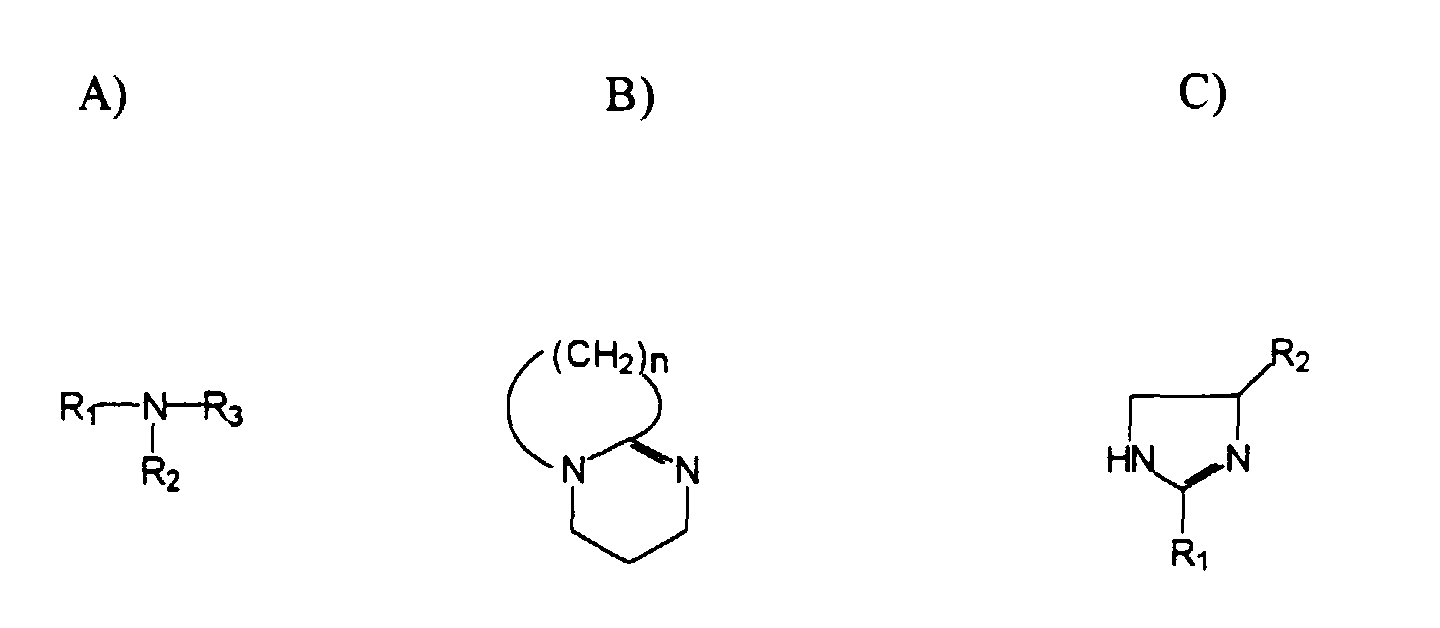
und pro mol Polycarbonsäure a1) 0,5 - 3 mol Amin A) - C) zur Reaktion kommen, und/oder
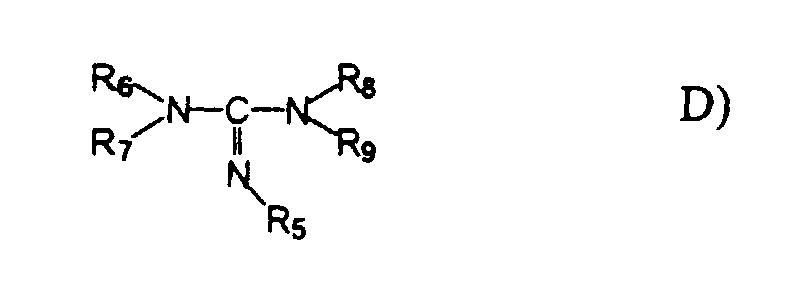
und
im Verhältnis a) : b) von 99 : 1 bis 1 : 99 enthalten, wobei Isophthalsäure, Terephthalsäure und Phthalsäure als Polycarbonsäuren (a1) ausgeschlossen sind.
Die erfindungsgemäß einsetzbaren Salze a) enthalten aliphatische und/oder
cycloaliphatische und/oder araliphatische und/oder aromatische Polycarbonsäuren
sowie gegebenfalls deren Anhydride (Komponente a1). Als Beispiele seien
Cyanursäure, 2,2,4 (2,4,4)-Trimethyladipinsäure, 1,2,3,4-Butantetracarbonsäure,
Ethylendiamintetraessigsäure, Diethylentriaminpentaessigsäure, Nitrilotriessigsäure,
Hexahydrophthalsäure, Hexahydroisophthalsäure, Hexahydroterephthalsäure,
Pyromellitsäure, Trimellitsäure, Trimesinsäure, Cyclopentantetracarbonsäure,
Zitronensäure, Aconitsäure und 2,6-Naphthalendicarbonsäure genannt. Bei Einsatz von
Mischungen der Polycarbonsäuren sind beliebige Kombinationen möglich. Ausdrücklich
ausgeschlossen werden Isophthalsäure, Terephthalsäure und Phthalsäure.
Die Salze der Polycarbonsäure enthalten als Aminkomponente a2) und/oder a3)
Stickstoffverbindungen, die zur Salzbildung befähigt sind dargestellt, durch die Formeln
A-D. Beispiele für konkrete Verbindungen der Formeln A)-C) sind N,N-Dimethylcyclohexylamin,
N,N-Dimethylanilin, N-Methylmorpholin, N,N'-Dimethylpiperazin,
2,2,6,6-Tetramethyl-4-dimethylaminopiperidin, N,N-Dimethyloctadecylamin,
1,8-Diazabicyclo-[5.4.0]-undec-7-en, N,N,N',N'-Tetramethylhexamethylendiamin,
1,4-Diazabicyclo[2.2.2]octan, 2-Phenylimidazolin, 2-Methylimidazolin,
2,4-Dimethylimidazolin, 2-Ethyl-4-methylimidazolin. Beispiele für
konkrete Verbindungen der Formel D) sind Tetramethylguanidin,
Tetramethylcyclohexylguanidin, N,N',N''-Triphenylguanidin und N,N'-Dicyclohexyl-4-morpholincarbonamid.
Der basische N-Gehalt der Salze beträgt 0.01 - 30 mmol/g und
der Carboxylgruppengehalt 1 - 35 mmol/g.
Als einsetzbare Komponente b) sind aliphatische und/oder cycloaliphatische und/oder
araliphatische und/oder aromatische Polycarbonsäuren geeignet. Als Beispiele seien
Cyanursäure, 2,2,4 (2,4,4)-Trimethyladipinsäure, 1,2,3,4-Butantetracarbonsäure,
Ethylendiamintetraessigsäure, Diethylentriaminpentaessigsäure, Nitrilotriessigsäure,
Hexahydrophthalsäure, Hexahydroisophthalsäure, Hexahydroterephthalsäure,
Pyromellitsäure, Trimellitsäure, Trimesinsäure, Cyclopentantetracarbonsäure,
Zitronensäure und 2,6-Naphthalendicarbonsäure genannt. Ausdrücklich eingeschlossen
sind Isophthalsäure, Terephthalsäure und Phthalsäure. Bei Einsatz von Mischungen der
Polycarbonsäuren sind beliebige Kombinationen möglich.
Die erfindungsgemäßen Härter aus Komponente a) und b) werden in zwei Stufen
hergestellt, wobei in der ersten Stufe die Salzbildung erfolgt, und nach beendeter
Salzbildung das Lösemittel entfernt wird. In einem zweiten Schritt werden eine oder
mehrere aliphatische, cycloaliphatische, araliphatische oder aromatische
Polycarbonsäuren physikalisch zugemischt.
Die Salze a) sind teilweise bekannt. Sie sind auch nicht Gegenstand der Erfindung. Sie
werden in bekannter Weise hergestellt, wobei zu der in Wasser oder Ethanol gelösten
Polycarbonsäure in der Siedehitze die Amin-/Guanidinkomponente a2/a3 portionsweise
zugegeben wird. Nach beendeter Zugabe wird noch ca. eine Stunde weitererhitzt.
Anschließend wird das Lösemittel durch Destillation entfernt. Zur quantitativen
Entfernung des Lösemittels wird das Reaktionsgemisch im Vakuumtrockenschrank bei
60 °C ca. 10 h getrocknet. Danach erfolgt das Zumischen der aliphatischen und/oder
cycloaliphatischen und/oder araliphatischen und/oder aromatischen Polycarbonsäuren.
Die Salze a) setzen sich aus 1 mol Polycarbonsäure und 0,5 - 3 mol der Verbindungen
A-D zusammen. Die Zusammensetzung der erfindungsgemäßen Härtermischung a)
und b) besteht aus 99 - 1 Massen-% Salz und 1 - 99 Massen-% Polycarbonsäure b).
Die erfindungsgemäße Härtermischung a) und b) wird mit Epoxidharzen oder
Hybridharzen kombiniert. Hybride sind carboxylfunktionelle Polyesterharze, die mit
Epoxidharzen gemischt sind.
Zur Herstellung der erfindungsgemäßen Beschichtungszusammensetzungen werden die
Härter in Mengen von 2 - 14 Gew.-%, bezogen auf die Summe der Einsatzharze,
eingesetzt. Die verwendeten Polyepoxidharze sind feste, harzartige Stoffe, die im
Bereich 60 - 150 °C, vorzugsweise 70 - 110 °C, schmelzen und die im Durchschnitt
mehr als eine 1,2-Epoxidgruppe pro Molekül enthalten. Im Prinzip kommen alle
Verbindungen in Frage, die mehr als eine 1,2-Epoxidgruppe pro Molekül enthalten.
Beispiele sind Polyepoxide wie Polyglycidylether von aromatischen oder aliphatischen
Verbindungen, die mehrere Wasserstoffatome enthalten. Dazu zählen Resorcinol,
Hydrochinon, Pyrocatechol, Bisphenol A, Bisphenol F, Glycerol, Pentaerythritol,
Mannitol, Sorbitol und Trimethylolpropan. Bevorzugt werden allerdings handelsübliche
EP-Harze, wie sie durch Umsetzung von Bisphenol A oder Bisphenol F mit
Epichlorhydrin erhalten werden. Ganz besonders bevorzugt werden EP-Harze auf Basis
der Reaktion zwischen Bisphenol A und Epichlorhydrin mit einem EP-Äquivalentgewicht
zwischen 400 - 3 000, bevorzugt 800 - 1 000.
Bei den carboxylgruppenhaltigen Polymeren handelt es sich um
Polyesterpolycarbonsäuren, die aus Polyolen und Polycarbonsäuren bzw. deren
Derivaten hergestellt werden. Der Schmelzbereich dieser sauren Polyester liegt in einem
Bereich von 60 - 160 °C, vorzugsweise 80 - 120 °C; ihre Saurezahl variiert von 10 -
150 mg KOH/g, vorzugsweise 30 - 60 mg KOH/g. Die OH-Zählen sollen unter 10 mg
KOH/g liegen.
Für die Herstellung der zu verwendenden Polyesterpolycarbonsäuren werden
Polycarbonsäuren, wie z. B. Oxal-, Adipin-, 2,2,4(2,4,4)-Trimethyladipin-, Azelain-,
Sebacin, Decandicarbon-, Dodecandicarbon-, Fumar-, Phthal-, Isophthal-, Terephthal-,
Tri- mellit-, Pyromellitsäure eingesetzt. Für die sauren Polyester werden als Polyolen
beispielhaft folgende verwendet. Ethylenglykol, 1,2- und 1,3-Propandiol, 1,2-, 1,3-,
1,4- und 2,3-Butandiol, 1,5-Pentandiol, 3-Methyl-1,5-pentandiol, Neopentylglykol,
1,12-Dodecandiol, 2.2.4 (2.4.4)-Trimethyl-1,6-hexandiol, Trimethylolpropan, Glycerin,
Pentaerythrit, 1,4-Bishydroxymethylcyclohexan, Cyclohexan-1,4-diol, Diethylenglykol,
Triethylenglykol sowie Dipropylenglykol. Selbstverständlich können auch
Hydroxylgruppen enthaltende Polyester, die nach bekannten Verfahren aus
Polycarbonsäuren und Polyolen hergestellt werden, mit Polycarbonsäuren und/oder
Polycarbonsäureanhydriden zu den Polyesterpolycarbonsäuren umgesetzt werden.
Im Falle der ausschließlichen Verwendung der handelsüblichen EP-Harze auf
Bisphenol-A-Basis (+ Epichlorhydrin) beträgt die Härterkonzentration 2 - 14 Massen-%.
Im Falle der Verwendung von Gemischen aus Epoxidharzen des Typs
Diglycidylester des Bisphenol A und Carboxylgruppen enthaltender Polyester richtet
sich das Mengenverhältnis nach der Säurezahl des Carboxylpolyesters. So wird z. B.
üblicherweise bei einer Säurezähl von 30 - 50 mg KOH/g das Gewichtsverhältnis EP-Harz/Carboxylpolyester
60 : 40 bis 80 : 20, vorzugsweise 70 : 30, betragen. Die
Konzentration des Härtergemisches a) + b) beträgt in diesen EP-Harz/Carboxylpolyester-Gemischen
2 - 14 Massen-%. Das Härterkomponenten werden
vorzugsweise vor oder nach ihrer Vermischung auf eine mittlere Korngröße kleiner 100
µm, vorzugsweise kleiner 40 µm gemahlen. Zur Herstellung des Pulverlackes werden
die Bindemittel zusammen mit dem Verlaufsmittel, Pigment und/oder Füllstoff und den
UV- wie Oxidationsstabilisatoren zunächst gemischt und in einem Extruder bei ca. 100
°C homogenisiert. Die extrudierte Masse wird nach Abkühlung auf Raumtemperatur zu
einem Pulverlack gemahlen, wobei die mittlere Teilchengröße ca. 30 - 100 µm,
vorzugsweise 40 - 80 µm, betragen sollte.
Die erfindungsgemäßen Beschichtungszusammensetzungen eignen sich zur Herstellung
von Beschichtungsmitteln, insbesondere für Pulverlacke mit halbglänzenden bis matten
Oberflächen der Beschichtungen. Die Mengen der einzelnen
Pulverlackbindemittelkomponenten können weitgehend variiert werden.
Das Auftragen von Pulverlacken auf der Basis der erfindungsgemäßen
Beschichtungszusammensetzungen auf geeignete Substrate kann nach den bekannten
Verfahren, wie z. B. durch elektrostatisches Pulversprühen, Wirbelsintern oder
elektrostatisches Wirbelsintern erfolgen. Nach dem Auftragen des Pulverlackes nach
einem der genannten Verfahren werden die beschichteten Substrate zur Aushärtung auf
Temperaturen von 150 - 220 °C innerhalb von 30 - 8 min erhitzt. Die so hergestellten
Lackfilme zeichnen sich durch sehr guten Verlauf, eine gute bis sehr gute Mechanik
und eine matte Oberfläche aus, wobei der Glanzgrad in einem weiten Bereich beliebig
einstellbar ist.
Die folgenden Beispiele sollen die Erfindung näher erläutern
Zu der Polycarbonsäure a1), die mit der 6- bis 10fachen Menge Ethanol bzw. Wasser
bis zum Siedepunkt des Lösemittels erhitzt wird, wird das Amin (a2 und/oder a3)
portionsweise zugegeben. Nach beendeter Aminzugabe wird noch ca. 1 h weitererhitzt.
Danach erfolgt die Entfernung des Lösemittels, in der Regel durch Abdestillieren. Zur
quantitativen Entfernung des Lösemittels wird das Reaktionsprodukt noch im
Vakuumtrockenschrank bei ca. 60 °C nachbehandelt. Anschließend erfolgt die
physikalische Mischung des Salzes a) mit der Polycarbonsäure b).
Die in der nachfolgenden Tabelle 1 aufgelisteten Härter wurden entsprechend der
allgemeinen Herstellungsvorschrift hergestellt.
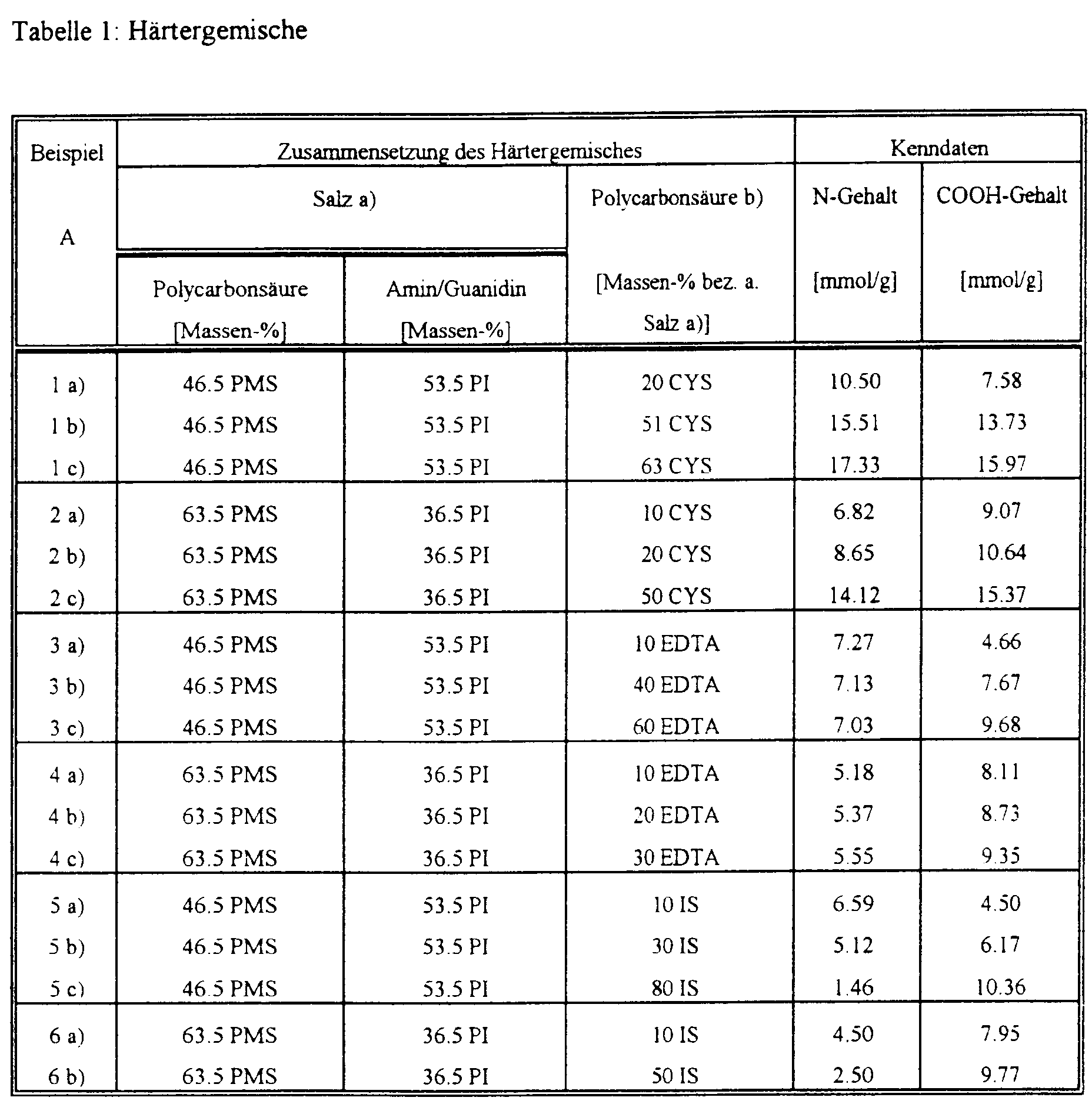
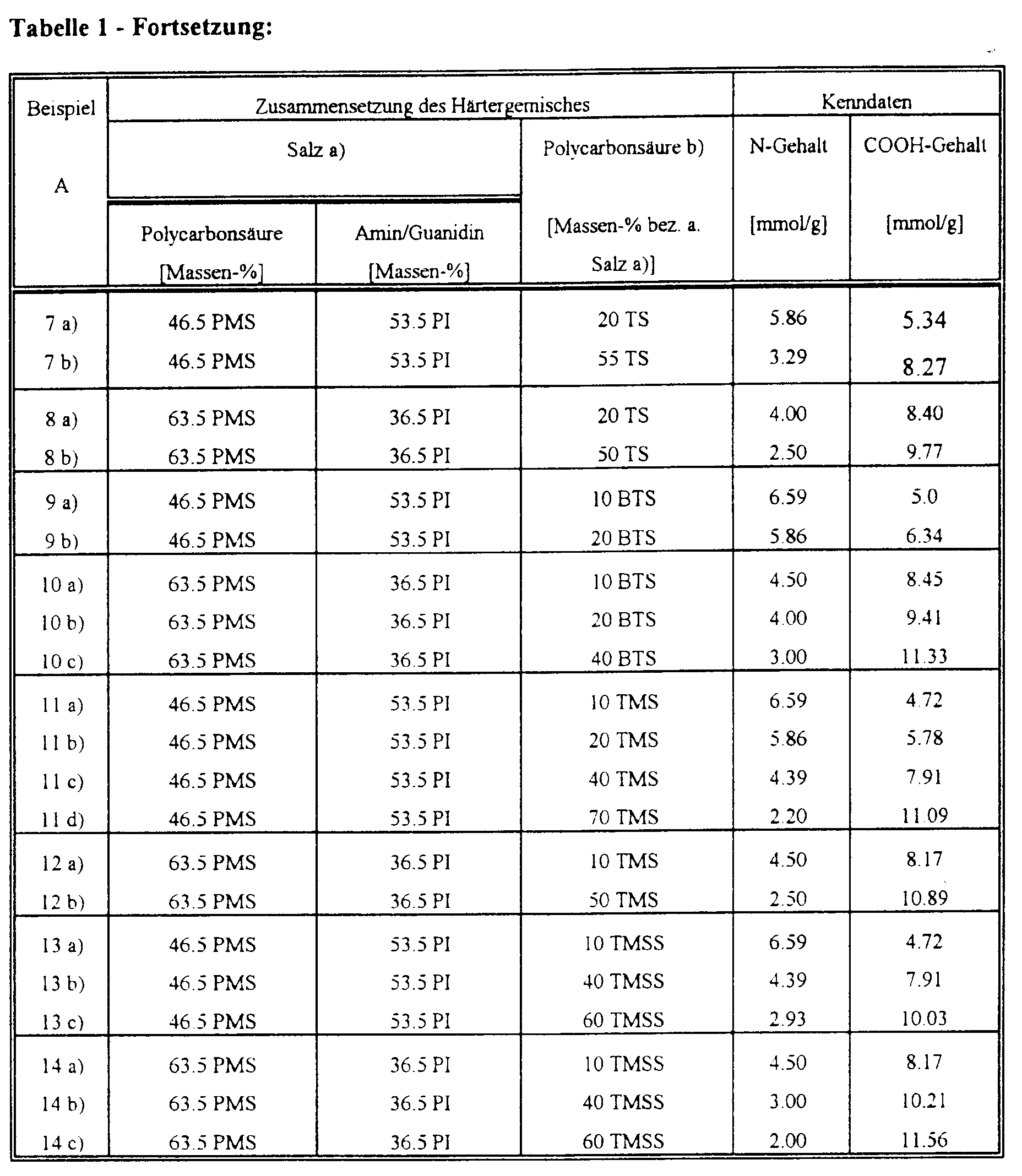
- BTS:
- 1,2,3,4-Butantetracarbonsäure
- CYS:
- Cyanursäure
- IS:
- Isophthalsäure
- PI:
- 2-Phenylimidazolin
- PMS:
- Pyromellitsäure
- TMS:
- Trimellitsäure
- TMSS:
- Trimesinsäure
- TS:
- Terephthalsäure
- EDTA:
- Ethylendiamintetraessigsäure
Bisphenol-A war die Basis der in den Anwendungsbeispielen eingesetzten
Epoixdharzverbindung. Sie ist durch folgende Kenndaten charakterisiert:

Zur Herstellung der erfindungsgemäßen Epoxidharz-Pulverbeschichtungszusammensetzungen
wurden die gemahlenen Einsatzstoffe -
Härter, Epoxidharz und Verlaufsmittel-Masterbatch (10 Massen-% Verlaufsmittel auf
Basis von polymeren Butylacrylaten werden mit den Epoxidharzen in der Schmelze
homogenisiert und nach dem Erstarren zerkleinert) - mit dem Weißpigment (TiO2) in
einem Kollergang innig vermischt und anschließend im Extruder bei 90 bis 110 °C
homogenisiert. Nach dem Erkalten wurde das Extrudat gebrochen und in einer
Stiftsmühle auf eine Korngröße < 100 µm gemahlen (Lackbeispiele). Das wie oben
beschriebene hergestellte Pulver wurde mit einer elektrostatischen Pulverspritzanlage
bei 60 kV auf entfettete, gegebenenfalls vorbehandelte Stahlbleche appliziert und in
einem Labor-Umlufttrockenschrank eingebrannt.
Die Abkürzungen in den folgenden Tabellen bedeuten:
- SD
- = Schichtdicke in µm
- GS
- = Gitterschnittprüfung (DIN 53 151)
- GG 60°∢
- = Glanz n. Gardner (ASTM-D 5233)
- EI
- = Tiefung nach Erichsen in mm (DIN 53 156)
- KS dir.
- = Kugelschlag direkt in inch*lb
- YI
- = Yellowness-Index
Die Berechnung der Lackformulierungen erfolgte nach folgendem Schema:
Massen-% EP = Epoxid
Massen-% EP = Epoxid
- B - V = EP
- B = Massen-% Bindemittel
V = Massen-% Vernetzer - B = 100 - Z
- Z = Massen-% Zuschlagsstoffe
[40 Massen-% Weißpigment (TiO2), 0,5 Massen-% Verlaufsmittel]
| Lackbeispiele | ||||||||
| Mechanische Kenndaten | ||||||||
| Beispiel C | Vernetzer gemäß in [Massen-%] | Härtung [°C/min] | SD | GS | GG 60°∢ | ET | Ks dir. | YI |
| 1 | 3,5 A 1 a) | 200/12 | 48 - 57 | 0 | 18 - 19 | 8,0 - 9,5 | > 80 | 7,2 |
| 2 | 3,5 A 1 b) | 200/12 | 60 - 76 | 0 | 19 - 20 | 9,0 | 50 | 8,0 |
| 3 | 3,5 A 1 c) | 200/12 | 75 - 85 | 0 | 24 - 26 | 9,5 | 50 | 9,1 |
| 4 | 5,0 A 2 a) | 200/15 | 69 - 71 | 1 | 9 | 7,0 | > 80 | 13,8 |
| 5 | 5,0 A 2 b) | 200/15 | 89 - 104 | 0 | 12 - 13 | 7,0 | > 80 | 13,2 |
| 6 | 5,0 A 2 c) | 200/15 | 64 - 82 | 0 | 25 -26 | 8,5 - 9,5 | > 80 | 8,9 |
| 7 | 3,5 A 3 a) | 200/15 | 76 - 89 | 1 | 15 - 16 | 7,5 - 9,5 | > 80 | 18,4 |
| 8 | 3,5 A 3 b) | 200/15 | 61 - 78 | 1 | 10 | 6,5 - 8,0 | 40 | 17,2 |
| 9 | 5,0 A 4 a) | 200/15 | 84 - 99 | 0 - 1 | 6 - 7 | 7,0 | > 80 | 17,9 |
| 10 | 5,0 A 4 b) | 200/15 | 48 - 61 | 1 - 2 | 7 - 8 | 7,5 | > 80 | 15,2 |
| 11 | 5,0 A 4 c) | 200/15 | 53 - 72 | 1 | 7 - 8 | 7,0 | > 80 | 17,1 |
| 12 | 3,5 A 5 a) | 200/15 | 67 - 92 | 1 | 17 - 18 | 9,0 | > 80 | 17,4 |
| 13 | 3,5 A 5 b) | 200/15 | 57 - 72 | 0 | 19 | 8,5 - 9,0 | 60 | 14,8 |
| 14 | 3,5 A 5 c) | 200/25 | 63 - 77 | 0 | 31 - 32 | 8,5 | 60 | 13,2 |
| 15 | 5,0 A 6 a) | 200/15 | 59 - 72 | 0 | 5 | 8,0 | > 80 | 15,1 |
| 16 | 5,0 A 6 b) | 200/15 | 77 - 103 | 1 | 25 - 26 | 9,0 | > 80 | 13,0 |
| 17 | 3,5 A 7 a) | 200/15 | 76 - 85 | 1 | 19 | 8,0 - 8,5 | > 80 | 12,8 |
| 18 | 3,5 A 7 b) | 200/25 | 75 - 91 | 0 - 1 | 16 - 17 | 9,0 | 60 | 12,7 |
| 19 | 5,0 A 8 a) | 200/15 | 40 - 55 | 1 | 8 | 8,0 - 8,5 | > 80 | 11,6 |
| 20 | 5,0 A 8 b) | 200/15 | 50 - 62 | 1 | 31 - 34 | 9,0 | > 80 | 11,0 |
| 21 | 3,5 A 9 a) | 200/15 | 76 - 90 | 0 | 14 | 8,0 | 60 | 18,0 |
| 22 | 3,5 A 9 b) | 200/15 | 82 - 92 | 0 - 1 | 12 - 13 | 6,5 - 7,0 | 60 | 18,4 |
| 23 | 5,0 A 10 a) | 200/15 | 57 - 64 | 0 - 1 | 6 - 7 | 7,5 - 8,5 | > 80 | 13,6 |
| 24 | 5,0 A 10 b) | 200/15 | 78 - 82 | 1 | 7 - 9 | 6,5 - 7,0 | > 80 | 16,2 |
| 25 | 5,0 A 10 c) | 200/15 | 36 - 50 | 1 | 12 - 15 | 7,5 - 8,0 | > 80 | 13,1 |
| 26 | 3,5 A 11 a) | 200/15 | 47 - 62 | 0 | 16 - 17 | 8,0 - 8,5 | > 80 | 13,9 |
| 27 | 3,5 A 11 b) | 200/15 | 67 - 80 | 1 | 14 - 15 | 6,0 | > 80 | 14,7 |
| 28 | 3,5 A 11 c) | 200/15 | 77-88 | 0 | 20 | 7,5 | 60 | 10,6 |
| 29 | 5,0 A 12 a) | 200/15 | 44 - 58 | 1 | 6 | 8,0 | > 80 | 12,5 |
| 30 | 5,0 A 12 b) | 200/15 | 48 - 68 | 1 | 30 - 31 | 8,5 - 9,0 | > 80 | 10,1 |
| 31 | 3,5 A 13 a) | 200/15 | 58 - 81 | 0 - 1 | 17 | 8,0 - 8,5 | 80 | 16,3 |
| 32 | 3,5 A 13 c) | 200/25 | 72 - 92 | 1 | 11 | 4,0 - 7,0 | 40 | 15,0 |
| 33 | 5,0 A 14 a) | 200/15 | 77 - 91 | 0 | 5 | 7,0 - 7,5 | > 80 | 14,5 |
| 34 | 5,0 A 14 b) | 200/25 | 90 - 105 | 0 - 1 | 8 | 6,0 | > 80 | 13,1 |
Zur Herstellung einer Hybrid-Pulverbeschichtungszusammensetzung wurden die
nachfolgend beschriebenen carboxylgruppenhaltigen Polyester mit folgenden Kenndaten
eingesetzt:

Die Aufarbeitung der Rohstoffe sowie die Herstellung und Applikation erfolgt analog
C. Die Hybrid-Pulverlacke enthalten Epoxidharz und Polyesterpolycarbonsäuren im
Verhältnis von 75 : 25, 40 Massen-% Weißpigment ( TiO2) und 1 Massen-%
Verlaufsmittel.
| Lackbeispiele | ||||||
| Mechanische Kenndaten | ||||||
| Beispiel E | Vernetzer gemäß [Massen-%] | Härtung [°C/min] | SD | GG 60°∢ | ET | Ks dir. |
| 1 | 5,0 A 2 b) | 200/15 | 60 - 74 | 16 | 7,0-7,5 | > 80 |
| 2 | 3,5 A 3 a) | 200/15 | 55 - 80 | 13 | 8,5 - 9,5 | > 80 |
| 3 | 3,5 A 3 b) | 200/15 | 59 - 75 | 12 | 6,5 - 7,0 | 40 |
| 4 | 3,5 A 3 c) | 200/15 | 44 - 65 | 12 | 3,5 - 5,5 | 30 |
| 5 | 5,0 A 4 a) | 200/15 | 44 - 64 | 9 | 7,0 - 7,5 | > 80 |
| 6 | 5,0 A 4 b) | 200/15 | 49 - 59 | 9 | 6,0 | > 80 |
| 7 | 5,0 A 6 a) | 200/15 | 55 - 68 | 10 | 8,0 - 8,5 | > 80 |
| 8 | 5,0 A 8 a) | 200/15 | 61 - 72 | 16 | 7,5 - 8,0 | > 80 |
| 9 | 3,5 A 11 a) | 200/15 | 56 - 66 | 16 | 9,0 | 70 |
| 10 | 3,5 A 11 b) | 200/15 | 55 - 69 | 18 | 9,5 | 70 |
| 11 | 3,5 A 11 c) | 200/15 | 57 - 80 | 19 | 9,5 | 80 |
| 12 | 3,5 A 13 a) | 200/15 | 60 - 73 | 15 | 9,0 - 9,5 | > 80 |
| 13 | 3,5 A 13 b) | 200/15 | 59 - 74 | 15 | 9,0 | > 80 |
| 14 | 3,5 A 13 c) | 200/15 | 51 - 70 | 16 | 9,0 - 9,5 | 70 |
Claims (10)
- Epoxidharz- und Hybrid-Pulverbeschichtungszusammensetzung,
dadurch gekennzeichnet,
daß sie als Härter ein physikalisches Gemisch, bestehend ausa) Salzen von mindestens difunktionellen Polycarbonsäuren und Aminen, erhalten durch Reaktion vona1) aliphatischen, cycloaliphatischen, araliphatischen und aromatischen Polycarbonsäuren und deren Anhydridea2) mit mindestens einem der folgenden Aminewobei R1, R2, R3 gleiche oder verschiedene aliphatische, cycloaliphatische, araliphatische oder aromatische Kohlenwasserstoffreste mit 1 - 20 C-Atomen, wobei in der C-Kette eine oder mehrere CH2-Gruppen durch O-Atome, NR4-Gruppen mit R4=C1-6-Alkyl, CH-OH-Gruppen und/oder eine oder mehrere endständige Methylgruppen durch dialkylsubstituierte Aminogruppen mit 1 bis 6 Kohlenstoffatomen ersetzt sein können und R1 und R2 einen gemeinsamen Ring bilden können, in dem eine CH2-Gruppe durch ein O-Atom oder durch eine NR4-Gruppe ersetzt sein kann und R1 = R2 = R3 = -CH2-CH2- über ein gemeinsames N-Atom gebunden sein können, und n: 3 - 11 bedeuten und pro mol Polycarbonsäure a1) 0,5 - 3 mol Amin A) - C) zur Reaktion kommen, und/oder a3) mit Guanidinen der Formel Dwobei R5, R6, R7, R8 und R9 unabhängig voneinander gleiche oder verschiedene aliphatische, cycloaliphatische, araliphatische, aromatische Kohlenwasserstoffreste mit 1 - 9 C-Atomen und Wasserstoff bedeuten, und wobei R6 und R7 sowie R8 und R9 einen gemeinsamen Ring bilden können, der ein Sauerstoffatom als Heteroatom enthalten kann, und pro Mol Polycarbonsäure a1) 0,5 - 3 mol des Guanidins D) zur Reaktion kommen, und
 b) aliphatischen und/oder cycloaliphatischen und/oder araliphatischen und/oder aromatischen Polycarbonsäuren,
im Verhältnis a) : b) von 99 : 1 bis 1 : 99 enthalten, wobei Isophthalsäure, Terephthalsäure und Phthalsäure als Polycarbonsäuren (a1) ausgeschlossen sind. - Pulverbeschichtungszusammensetzung nach Anspruch 1,
dadurch gekennzeichnet,
daß als Polycarbonsäuren a1) Cyanursäure, 2,2,4 (2,4,4)-Trimethyladipinsäure, 1,2,3,4-Butantetracarbonsäure, Ethylendiamintetraessigsäure, Diethylentriaminpentaessigsäure, Nitrilotriessigsäure, Hexahydrophthalsäure, Hexahydroisophthalsäure, Hexahydroterephthalsäure, Pyromellitsäure, Trimellitsäure, Trimesinsäure, Cyclopentantetracarbonsäure, Zitronensäure, Aconitsäure und 2,6-Naphthalendicarbonsäure eingesetzt werden. - Pulverbeschichtungszusammensetzung nach mindestens einem der Ansprüche 1-2,
dadurch gekennzeichnet,
daß als Amine a2) N,N-Dimethylcyclohexylamin, N,N-Dimethylanilin, N-Methylmorpholin, N,N'-Dimethylpiperazin, 2,2,6,6-Tetramethyl-4-dimethylaminopiperidin, N,N-Dimethyloctadecylamin, 1,8-Diazabicyclo-[5.4.0]-undec-7-en, N,N,N',N'-Tetramethylhexamethylendiamin, 1,4-Diazabicyclo[2.2.2]octan, 2-Phenylimidazolin, 2-Methylimidcolin, 2,4-Dimethylimidazolin, 2-Ethyl-4-methylimidazolin, Tetramethylguanidin, Tetramethylcyclohexylguanidin, N,N',N''-Triphenylguanidin und N,N'-Dicyclohexyl-4-morpholincarbonamid eingesetzt werden. - Pulverbeschichtungszusammensetzung nach mindestens einem der Ansprüche 1-3,
dadurch gekennzeichnet,
daß als Polycarbonsäuren b) Cyanursäure, 2,2,4 (2,4,4)-Trimethyladipinsäure, 1,2,3,4-Butantetracarbonsäure, Ethylendiamintetraessigsäure, Diethylentriaminpentaessigsäure, Nitrilotriessigsäure, Isophthalsäure, Terephthalsäure, Phthalsäure, Hexahydrophthalsäure, Hexahydroisophthalsäure, Hexahydroterephthalsäure, Pyromellitsäure, Trimellltsäure, Trimesinsäure, Cyclopentantetracarbonsäure, Zitronensäure, Aconitsäure und 2,6-Naphthalendicarbonsäure eingesetzt werden. - Pulverbeschichtungszusammensetzung nach mindestens einem der Ansprüche 1-4,
dadurch gekennzeichnet,
daß der Härter in Mengen von 2 - 14 Gew.-%, bezogen auf die Summe der eingesetzten Harze, enthalten ist. - Pulverbeschichtungszusammensetzung nach mindestens einem der Ansprüche 1-5,
dadurch gekennzeichnet,
daß die Epoxidharze einen Schmelzpunkt von 60 - 150 °C aufweisen und im Durchschnitt mehr als eine 1,2-Epoxidgruppe pro Molekül enthalten. - Pulverbeschichtungszusammensetzung nach mindestens einem der Ansprüche 1-6,
dadurch gekennzeichnet,
daß die verwendeten Epoxidharze auf der Reaktion zwischen Bisphenol A und Epichlorhydrin basieren und ein Epoxid-Äquivalentgewicht zwischen 400 - 3 000, aufweisen. - Pulverbeschichtungszusammensetzung nach mindestens einem der Ansprüche 1-7,
dadurch gekennzeichnet,
daß die eingesetzten Polyesterpolycarbonsäuren für die Hybridpulverbeschichtungszusammensetzungen einen Schmelzpunkt von 60 - 160 °C, eine Säurezahl von 10-150 mg KOH/g und eine OH-Zahl unter 10 mg KOH/g aufweisen. - Pulverbeschichtungszusammensetzung nach mindestens einem der Ansprüche 1-8, dadurch gekennzeichnet,
daß sie Hilfs- und/oder Zusatzstoffe enthalten. - Verwendung der Pulverbeschichtungszusammensetzung nach mindestens einem der Ansprüche 1-9, Zur Herstellung von halbglänzenden bis matten Beschichtungen.
Applications Claiming Priority (2)
| Application Number | Priority Date | Filing Date | Title |
|---|---|---|---|
| DE19806225 | 1998-02-16 | ||
| DE19806225A DE19806225A1 (de) | 1998-02-16 | 1998-02-16 | Epoxidharz- und Hybridpulverbeschichtungszusammensetzungen |
Publications (1)
| Publication Number | Publication Date |
|---|---|
| EP0936236A2 true EP0936236A2 (de) | 1999-08-18 |
Family
ID=7857821
Family Applications (1)
| Application Number | Title | Priority Date | Filing Date |
|---|---|---|---|
| EP98124385A Withdrawn EP0936236A2 (de) | 1998-02-16 | 1998-12-21 | Epoxidharz- und Hybridpulverbeschichtungszusammensetzungen |
Country Status (4)
| Country | Link |
|---|---|
| EP (1) | EP0936236A2 (de) |
| KR (1) | KR19990072673A (de) |
| CA (1) | CA2261485A1 (de) |
| DE (1) | DE19806225A1 (de) |
Cited By (1)
| Publication number | Priority date | Publication date | Assignee | Title |
|---|---|---|---|---|
| CN103788735A (zh) * | 2012-10-29 | 2014-05-14 | 中冶建筑研究总院有限公司 | 一种无溶剂柔性防腐环氧涂料及其制备方法与使用方法 |
Families Citing this family (2)
| Publication number | Priority date | Publication date | Assignee | Title |
|---|---|---|---|---|
| US20110319564A1 (en) | 2010-06-24 | 2011-12-29 | Larry Steven Corley | Epoxy systems for composites |
| DE102014210708A1 (de) * | 2014-06-05 | 2015-12-17 | Siemens Aktiengesellschaft | Verfahren zur Korrosionsschutzbehandlung |
-
1998
- 1998-02-16 DE DE19806225A patent/DE19806225A1/de not_active Withdrawn
- 1998-12-21 EP EP98124385A patent/EP0936236A2/de not_active Withdrawn
-
1999
- 1999-02-12 CA CA002261485A patent/CA2261485A1/en not_active Abandoned
- 1999-02-13 KR KR1019990005192A patent/KR19990072673A/ko not_active Withdrawn
Cited By (1)
| Publication number | Priority date | Publication date | Assignee | Title |
|---|---|---|---|---|
| CN103788735A (zh) * | 2012-10-29 | 2014-05-14 | 中冶建筑研究总院有限公司 | 一种无溶剂柔性防腐环氧涂料及其制备方法与使用方法 |
Also Published As
| Publication number | Publication date |
|---|---|
| KR19990072673A (ko) | 1999-09-27 |
| DE19806225A1 (de) | 1999-08-19 |
| CA2261485A1 (en) | 1999-08-16 |
Similar Documents
| Publication | Publication Date | Title |
|---|---|---|
| EP0506617B1 (de) | Vernetzungsmittel für Pulverlacke auf Basis von Polyestern | |
| DE2328012C3 (de) | Pulverfdrmige Überzugsmittel | |
| EP0165207A1 (de) | Pulverlacke für die Herstellung matter Ueberzüge | |
| DE2846123A1 (de) | Verfahren zur herstellung gehaerteter formkoerper auf basis von epoxidharzen und harz-haerter-zusammensetzungen | |
| EP0536085B1 (de) | Feste Zusammensetzungen aus Polyglycidylverbindungen eines Molekulargewichts unter 1500 | |
| EP0099338B1 (de) | Mit Thermoplasten modifizierte Epoxyharzsysteme | |
| EP3255103A1 (de) | Zusammensetzung enthaltend ein polymer auf der basis von epoxidverbindungen | |
| DE3233565A1 (de) | Haertungsmittel fuer epoxidharze und verfahren zum haerten von epoxidharzen | |
| DE2838841A1 (de) | Pulverfoermiges beschichtungsmittel aus einem epoxidharz und einer carbonsaeure | |
| EP0936236A2 (de) | Epoxidharz- und Hybridpulverbeschichtungszusammensetzungen | |
| EP0253115B1 (de) | Pulverlacke, deren Herstellung und Verwendung | |
| EP0215740A2 (de) | Verzweigte Polyester | |
| DE1494416B2 (de) | Verfahren zur Erzeugung von Lackbzw. Schutzüberzügen | |
| EP0253101B1 (de) | Pulverlacke, deren Herstellung und Verwendung | |
| EP0663385A2 (de) | Salze der Pyromellitsäure, ein Verfahren zu ihrer Herstellung sowie deren Verwendung | |
| DE2460690A1 (de) | Verfahren zum haerten von epoxyharzen | |
| EP0663384B1 (de) | Salze der Pyromellitsäure, ein Verfahren zu ihrer Herstellung sowie deren Verwendung | |
| DE4400929A1 (de) | Verfahren zur Herstellung von matten Epoxidharzbeschichtungen | |
| DE2640410C2 (de) | Lagerstabile, pulverförmige Überzugsmittel und ihre Verwendung | |
| EP0663414A1 (de) | Verfahren zur Herstellung von matten Epoxidharz- und Hybrid-Pulverbeschichtungen | |
| DE19630450A1 (de) | Verfahren zur Herstellung von Epoxidharz- und Hybrid-Pulverbeschichtungen | |
| DE3610757C2 (de) | ||
| DE19823427A1 (de) | Epoxidharz- und Hybrid-Pulverbeschichtungen | |
| EP0175874B1 (de) | Carboxylgruppenhaltige Härter | |
| WO2007028661A1 (de) | Hybrid-pulverlackzusammensetzung mit niedriger einbrenntemperatur für halbglänzende bis matte überzüge |
Legal Events
| Date | Code | Title | Description |
|---|---|---|---|
| PUAI | Public reference made under article 153(3) epc to a published international application that has entered the european phase |
Free format text: ORIGINAL CODE: 0009012 |
|
| AK | Designated contracting states |
Kind code of ref document: A2 Designated state(s): AT BE CH CY DE DK ES FI FR GB GR IE IT LI LU MC NL PT SE |
|
| AX | Request for extension of the european patent |
Free format text: AL;LT;LV;MK;RO;SI |
|
| RAP1 | Party data changed (applicant data changed or rights of an application transferred) |
Owner name: DEGUSSA-HUELS AKTIENGESELLSCHAFT |
|
| STAA | Information on the status of an ep patent application or granted ep patent |
Free format text: STATUS: THE APPLICATION HAS BEEN WITHDRAWN |
|
| 18W | Application withdrawn |
Withdrawal date: 20000923 |