EP0936302A2 - Vorrichtung zur Zufuhr einer Faserstoffsuspension auf eine Entwässerungseinrichtung - Google Patents
Vorrichtung zur Zufuhr einer Faserstoffsuspension auf eine Entwässerungseinrichtung Download PDFInfo
- Publication number
- EP0936302A2 EP0936302A2 EP98124785A EP98124785A EP0936302A2 EP 0936302 A2 EP0936302 A2 EP 0936302A2 EP 98124785 A EP98124785 A EP 98124785A EP 98124785 A EP98124785 A EP 98124785A EP 0936302 A2 EP0936302 A2 EP 0936302A2
- Authority
- EP
- European Patent Office
- Prior art keywords
- eccentric
- adjustable
- eccentric shaft
- partition
- tip
- Prior art date
- Legal status (The legal status is an assumption and is not a legal conclusion. Google has not performed a legal analysis and makes no representation as to the accuracy of the status listed.)
- Granted
Links
Images



Classifications
-
- D—TEXTILES; PAPER
- D21—PAPER-MAKING; PRODUCTION OF CELLULOSE
- D21F—PAPER-MAKING MACHINES; METHODS OF PRODUCING PAPER THEREON
- D21F1/00—Wet end of machines for making continuous webs of paper
- D21F1/02—Head boxes of Fourdrinier machines
-
- D—TEXTILES; PAPER
- D21—PAPER-MAKING; PRODUCTION OF CELLULOSE
- D21F—PAPER-MAKING MACHINES; METHODS OF PRODUCING PAPER THEREON
- D21F1/00—Wet end of machines for making continuous webs of paper
- D21F1/02—Head boxes of Fourdrinier machines
- D21F1/028—Details of the nozzle section
Definitions
- the invention relates to a device for supplying a fiber suspension on a drainage device, especially for a Tissue machine.
- Such devices also called headbox, affect the Paper formation and thus the paper quality is essential.
- Headboxes are a regulation of the flow rate of the fiber suspension practically only accessible via printing.
- two or Multilayer headboxes that affect the quality of the paper surface however, a different flow rate is possible, such as for different qualities of top and bottom Bottom are required, not realizable.
- the aim of the invention is therefore the scope and Improve control options for headboxes.
- the invention is therefore characterized in that to adjust the Height of the outlet gap between a minimum and maximum value one Eccentric shaft is provided. By adjusting the height of the Outlet gap, the flow rate of the Suspension stream according to the requirements of the end product to adjust. The use of an eccentric ensures one very precise adjustment of the discharge gap height.
- a favorable further development of the invention is characterized in that that the upper lip is adjustable by means of an eccentric, and alternatively or the lower lip can also be adjustable by means of an eccentric.
- the Adjustment of upper and / or lower lip enables depending on the version as a two- or multi-layer headbox the ideal conditions for Regulation of the flow rate of the individual layers.
- An advantageous embodiment of the invention is characterized in that that the eccentric shaft is supported several times over the machine width, the support can take place at regular intervals.
- a favorable embodiment of the invention is characterized in that that the eccentric shaft is connected to a geared motor.
- the outlet height can also be adjusted while the paper machine is in operation and thus the flow rate of the fiber suspension accordingly be adjusted or regulated.
- An advantageous development of the invention for a two-layer or Multilayer headbox is characterized in that for separation of the individual areas one or more one-piece, wedge-shaped Blade tip (s) made of steel is or are. So it is possible stable separation and therefore constant adjustment of the outlet gap heights to achieve even with different inlet pressures that a difference in speed between the individual suspension flows can be adjusted.
- a favorable embodiment of the invention is characterized in that that the lamella tip (s) against the partition by means of a tie rod are biased to the feeder. This makes it particularly stable and this enables exact adjustment of the outlet gap heights.
- a favorable further development of the invention is characterized in that that the distance from the lower lip and / or upper lip to the slat tip is adjustable. This allows the slat tip to be fixed and very stable be carried out.
- An advantageous development of the invention is characterized in that that a partition - slat tip unit adjustable by means of an eccentric is. Due to the adjustable design of a partition - lamella tips - Unit will also have an independent adjustment of the outlet gap heights with multi-layer headboxes.
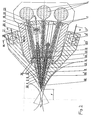
- FIG. 1 shows a two-layer headbox according to the invention
- FIG. 1a a detail from Fig. 1
- Fig. 2 shows a three-layer headbox
- Fig. 2a shows a detail from FIG. 2
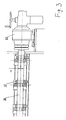
- FIG. 3 a section along line III-III in FIG. 2
- FIG. 4 a Monolayer headbox represents according to the invention.
- Fig. 1 sets up a device for supplying fiber suspensions a drainage device, in particular for a tissue machine, in the form of a two-layer headbox.
- the suspension fed simultaneously via two channels 1 across the machine direction, then the flow direction of the suspension is 90 degrees in Machine direction redirected.
- the suspension through two turbulence generating chambers 2 into the nozzle areas executed discharge chambers 3, 4, the end of which the Leaves device and strikes the drainage device.
- the two nozzle spaces 3, 4 are separated by a wall 8, which means cannulated screws 9 is biased against the support body 10.
- At the outlet end of the partition 8 there is a one-piece, Wedge-shaped lamellar tip 12 made of stainless steel, which by means of tie rods 13 is biased against the partition 8.
- the partition 8 and the Lamella tip 12 form a solid in the assembled state Separating element between the two nozzle spaces 3, 4.
- This pivoting movement is carried out by an eccentric shaft 16, 16 ', across the machine width, at regular intervals in bearings 17, 17 'are supported on the rigid cover plates 20, 20' of the device.
- the eccentricity e of the shafts allows the gap heights to be adjusted a or b between a minimum and maximum value.
- the construction is designed so that even with constant turning the eccentric shaft 16, 16 'by a drive 22, the upper lip 18th and the lower lip 18 'never in contact with the blade tip 12 come and thus no damage can occur.
- the paper quality increases in the operating mode same types of fabric "in both chambers or a very good separation (covering) of the layers in the operating mode different types of fabric "in both chambers compared to single-layer headboxes or multi-layer headboxes with flexible separating elements at the outlet of the nozzle areas, which do not allow a difference between the two layers of material.
- FIG. 1a shows a detail of the outlet gap in FIG. 1. It is clearly shown here different size of the outlet gaps a (nozzle space 3) and b (Nozzle area 4) recognizable.
- Fig. 2 now shows a three-layer headbox, the suspension at the same time into the device via three channels 1 transversely to the machine direction, then the direction of flow of the suspension 90 degrees in the machine direction is redirected.
- the suspension then flows through three turbulence generating chambers 2 in the nozzle chambers called 3, 4, 5 at the end of which they leave the device and on the Dewatering machine.
- it is between two sieves 24, 24 ', which run around two rollers 25, 25', are injected.
- the two nozzle spaces 4, 5 become analogous to the embodiment in FIG. 1 separated by a wall 8, at the end of which is a one-piece, wedge-shaped Blade tip 12 made of stainless steel.
- the partition 8 and in the assembled state, the lamella tip 12 form a firm, non-adjustable separating element between the two nozzle spaces 4, 5. Due to its bias against the support body 10 it is enables differences up to 0.5 bar and therefore different Flow rates of the fiber suspensions in both layers to achieve.
- the two nozzle spaces 3, 4 are separated by a partition 6, which is rotatably mounted about an axis 7 at the outlet end of the Partition 6 is also a one-piece lamella tip 12 ' Stainless steel, which is prestressed against the partition 6 by means of tie rods 11 becomes.
- the partition 6 and the lamella tip 12 'thus form a rigid one Separating element which, however, is pivoted as a whole about the axis of rotation 7 can be. This swivel movement is carried out by a Eccentric shaft 15, which is regular across the machine width Distances in bearings 19 supported on the rigid rear wall 23 of the device are.
- the eccentricity e makes it possible to set the outlet gap height c des Nozzle space 4 between a minimum and maximum value and one Fixation of the same.
- the outlet gap heights a and b of the two nozzle chambers 3 and 5 can also be between a minimum and Maximum value can be set and fixed.
- the upper lip 18 or lower lip 18 'pivoted about the joints 14, 14'. Is performed this pivoting movement by an eccentric shaft 1, 16 ', which on the Machine width at regular intervals in bearings 17, 17 'on the rigid cover plates 20, 20 'of the device are supported.
- the eccentricity e of the shafts 16, 16 ' enables the gap heights a to be adjusted and b between a minimum and maximum value.
- the construction is designed so that even with constant turning the eccentric shafts 16, 16 'through a drive 22 the upper lip 18 and the lower lip 18 'never in contact with the lamella tips 12, 12 'come and thus no damage can occur. This also applies to all positions of the movable partition 6 Blade tip 12 '.
- Fig. 2a shows a detail of the outlet gap in Fig. 2. You can see the different settings of the outlet gap heights a (nozzle area 3), b (nozzle area 5) and c (nozzle area 4).
- FIG. 3 shows a section along line III-III in FIG. 1 and analogously in FIG. 2.
- the eccentric shaft 16 is shown, the multiple over the Machine width is supported in bearings 17.
- Fig. 4 shows the example of a single-layer headbox.
- a rigid one Lower lip 21 provided.
- the outlet gap height and the associated Contour angle ⁇ can also via an eccentric shaft 16, which can optionally be driven by a geared motor 22, be set accordingly. This allows the flow rate regulate the jet and thus influence the paper quality accordingly.
- the invention is not restricted to the examples shown. It can e.g. other types of execution of the middle slat be provided.
Landscapes
- Paper (AREA)
- Preliminary Treatment Of Fibers (AREA)
Abstract
Description

Claims (10)
- Vorrichtung zur Zufuhr einer Faserstoffsuspension auf eine Entwässerungseinrichtung, insbesondere für eine Tissue-Maschine, dadurch gekennzeichnet, daß zur Einstellung der Höhe des Auslaufspaltes zwischen einem Minimal- und Maximalwert eine Exzenterwelle (15, 16, 16') vorgesehen ist.
- Vorrichtung nach Anspruch 1, dadurch gekennzeichnet, daß die Oberlippe (18) mittels Exzenter (16) verstellbar ist.
- Vorrichtung nach Anspruch 1 oder 2, dadurch gekennzeichnet, daß die Unterlippe (18') mittels Exzenter (16') verstellbar ist.
- Vorrichtung nach einem der Ansprüche 1 bis 3, dadurch gekennzeichnet, daß die Exzenterwelle (15, 16, 16') über die Maschinenbreite mehrfach abgestützt ist.
- Vorrichtung nach Anspruch 4, dadurch gekennzeichnet, daß die Exzenterwelle (15, 16, 16') in gleichmäßigen Abständen abgestützt ist.
- Vorrichtung nach einem der Ansprüche 1 bis 5, dadurch gekennzeichnet, daß die Exzenterwelle (15, 16, 16') mit einem Getriebemotor (22) verbunden ist.
- Vorrichtung nach einem der Ansprüche 1 bis 6, dadurch gekennzeichnet, daß für einen Zweischicht- oder Mehrschichtstoffauflauf zur Trennung der einzelnen Bereiche eine bzw. mehrere einteilige, keilförmige Lamellenspitze(n) (12, 12') aus Stahl vorgesehen ist bzw. sind.
- Vorrichtung nach Anspruch 7, dadurch gekennzeichnet, daß die Lamellenspitze(n) (12, 12') mittels eines Zugankers (11, 13) gegen die Trennwand (6, 8) der Zuführvorrichtung vorgespannt sind.
- Vorrichtung nach Anspruch 7 oder 8, dadurch gekennzeichnet, daß der Abstand von Unterlippe (18') und/oder Oberlippe (18) zur Lamellenspitze (12, 12') einstellbar ist.
- Vorrichtung nach einem der Ansprüche 1 bis 9, dadurch gekennzeichnet, daß eine Trennwand (6) - Lamellenspitzen (12') - Einheit mittels Exzenter (15) verstellbar ist.
Applications Claiming Priority (2)
| Application Number | Priority Date | Filing Date | Title |
|---|---|---|---|
| AT20798 | 1998-02-05 | ||
| AT0020798A AT406172B (de) | 1998-02-05 | 1998-02-05 | Vorrichtung zur zufuhr einer faserstoffsuspension auf eine entwässerungseinrichtung |
Publications (3)
| Publication Number | Publication Date |
|---|---|
| EP0936302A2 true EP0936302A2 (de) | 1999-08-18 |
| EP0936302A3 EP0936302A3 (de) | 2000-02-23 |
| EP0936302B1 EP0936302B1 (de) | 2004-04-21 |
Family
ID=3484343
Family Applications (1)
| Application Number | Title | Priority Date | Filing Date |
|---|---|---|---|
| EP98124785A Expired - Lifetime EP0936302B1 (de) | 1998-02-05 | 1998-12-29 | Vorrichtung zur Zufuhr einer Faserstoffsuspension auf eine Entwässerungseinrichtung |
Country Status (6)
| Country | Link |
|---|---|
| US (2) | US6319366B1 (de) |
| EP (1) | EP0936302B1 (de) |
| AT (1) | AT406172B (de) |
| BR (1) | BR9900536B1 (de) |
| DE (1) | DE59811238D1 (de) |
| ES (1) | ES2218752T3 (de) |
Families Citing this family (6)
| Publication number | Priority date | Publication date | Assignee | Title |
|---|---|---|---|---|
| DE10106684A1 (de) * | 2001-02-14 | 2002-08-29 | Voith Paper Patent Gmbh | Lamelle eines Stoffauflaufs einer Papier-, Karton- oder Tissuemaschine |
| DE10159412A1 (de) * | 2001-12-04 | 2003-06-12 | Voith Paper Patent Gmbh | Stoffauflauf |
| US8060363B2 (en) * | 2007-02-13 | 2011-11-15 | Nokia Corporation | Audio signal encoding |
| DE102008000175A1 (de) * | 2008-01-30 | 2009-08-06 | Voith Patent Gmbh | Mehrschichtenstoffauflauf für eine Maschine zur Herstellung einer mehrschichtigen Faserstoffbahn |
| DE102008043145A1 (de) * | 2008-10-24 | 2010-04-29 | Voith Patent Gmbh | Zweischichtenstoffauflauf für eine Maschine zur Herstellung einer zweischichtigen Faserstoffbahn |
| EP2199459A1 (de) * | 2008-12-16 | 2010-06-23 | Voith Patent GmbH | Blattbildungssystem für eine Maschine zur Herstellung einer mehrschichtigen Faserstoffbahn |
Family Cites Families (19)
| Publication number | Priority date | Publication date | Assignee | Title |
|---|---|---|---|---|
| US2005839A (en) * | 1933-01-26 | 1935-06-25 | Downingtown Mfg Co | Cylinder machine |
| US2615374A (en) * | 1948-10-04 | 1952-10-28 | Dominion Eng Works Ltd | Slice assembly for papermaking machines |
| US3556935A (en) * | 1968-04-03 | 1971-01-19 | Procter & Gamble | Papermaking headbox with adjustable hydraulic nozzle and slice |
| CH564639A5 (de) * | 1973-04-17 | 1975-07-31 | Escher Wyss Gmbh | |
| SE7707981L (sv) * | 1976-12-02 | 1978-06-03 | Ahlstroem Dev Gmbh | Anordning for paverkan av ett banformigt material |
| DE3010730C2 (de) * | 1980-03-20 | 1983-01-05 | J.M. Voith Gmbh, 7920 Heidenheim | Stoffauflauf für eine Papiermaschine |
| AT377026B (de) * | 1980-12-19 | 1985-01-25 | Escher Wyss Gmbh | Stoffauflauf fuer eine papiermaschine |
| FI78750B (fi) * | 1982-07-20 | 1989-05-31 | Escher Wyss Gmbh | Flerskiktsinloppslaoda foer matande av pappersmassa till en vira. |
| AT387410B (de) * | 1983-06-09 | 1989-01-25 | Escher Wyss Gmbh | Stoffauflauf fuer eine papiermaschine |
| DE3535849A1 (de) * | 1985-10-08 | 1987-04-09 | Voith Gmbh J M | Stellvorrichtung fuer eine lippe eines papiermaschinen-stoffauflaufs |
| CH672515A5 (de) * | 1987-02-02 | 1989-11-30 | Escher Wyss Gmbh | |
| US4975151A (en) * | 1989-02-17 | 1990-12-04 | Process Automation Business Inc. | Two-speed single lever stepper actuator |
| US4892623A (en) * | 1989-02-17 | 1990-01-09 | Process Automation Business, Inc. | Two-speed stepper actuator |
| FI92230C (fi) * | 1993-07-01 | 1994-10-10 | Valmet Paper Machinery Inc | Menetelmä monikerrosperälaatikon säädössä ja monikerrosperälaatikko |
| DE4440079C2 (de) * | 1994-11-10 | 1997-10-02 | Voith Sulzer Papiermasch Gmbh | Mehrschichten-Stoffauflauf |
| US5578172A (en) * | 1994-12-20 | 1996-11-26 | Voith Sulzer Papiermaschinen Gmbh | Slice beam support plate |
| DE19624052A1 (de) * | 1996-06-17 | 1996-12-12 | Voith Sulzer Papiermasch Gmbh | Dreischichtenstoffauflauf |
| DE19652982A1 (de) * | 1996-12-19 | 1997-05-22 | Voith Sulzer Papiermasch Gmbh | Lösbare Verbindungsvorrichtung zum Trennelement eines Mehrschichtenstoffauflaufes |
| DE19652983A1 (de) * | 1996-12-19 | 1997-05-28 | Voith Sulzer Papiermasch Gmbh | Trennelement eines Mehrschichtenstoffauflaufes |
-
1998
- 1998-02-05 AT AT0020798A patent/AT406172B/de not_active IP Right Cessation
- 1998-12-29 DE DE59811238T patent/DE59811238D1/de not_active Expired - Lifetime
- 1998-12-29 EP EP98124785A patent/EP0936302B1/de not_active Expired - Lifetime
- 1998-12-29 ES ES98124785T patent/ES2218752T3/es not_active Expired - Lifetime
-
1999
- 1999-02-04 BR BRPI9900536-0A patent/BR9900536B1/pt not_active IP Right Cessation
- 1999-02-05 US US09/245,552 patent/US6319366B1/en not_active Expired - Lifetime
-
2001
- 2001-10-02 US US09/969,485 patent/US6475345B2/en not_active Expired - Lifetime
Also Published As
| Publication number | Publication date |
|---|---|
| EP0936302B1 (de) | 2004-04-21 |
| ATA20798A (de) | 1999-07-15 |
| BR9900536B1 (pt) | 2009-05-05 |
| US6475345B2 (en) | 2002-11-05 |
| US6319366B1 (en) | 2001-11-20 |
| BR9900536A (pt) | 2000-04-18 |
| EP0936302A3 (de) | 2000-02-23 |
| AT406172B (de) | 2000-03-27 |
| DE59811238D1 (de) | 2004-05-27 |
| US20020060038A1 (en) | 2002-05-23 |
| ES2218752T3 (es) | 2004-11-16 |
Similar Documents
| Publication | Publication Date | Title |
|---|---|---|
| DE3514554C2 (de) | Stoffauflauf-Vorrichtung für eine Papiermaschine und Verfahren zu deren Betrieb | |
| DE2824608C2 (de) | Stoffauflauf für eine Papiermaschine | |
| EP1219747B2 (de) | Verfahren zum Reinigen eines Transportbandes | |
| EP0711869A2 (de) | Mehrschichten-Stoffauflauf | |
| DE3315023A1 (de) | Formschuh fuer den former einer papiermaschine | |
| DE1761229B2 (de) | Stoffauflauf fur Papiermaschinen | |
| EP0681057B1 (de) | Mehrschichten-Stoffauflauf | |
| EP0761877A2 (de) | Auftragswerk zum direkten oder indirekten Auftragen eines flüssigen oder pastösen Mediums auf eine laufende Materialbahn | |
| EP0639239B1 (de) | Strahlgeschwindigkeitsbeeinflussung im mehrschichtenstoffauflauf | |
| DE8417329U1 (de) | Stoffauflauf fuer eine papiermaschine | |
| DE19651739A1 (de) | Auftragwerk zum direkten oder indirekten Auftragen eines flüssigen oder pastösen Streichmediums auf eine laufende Materialbahn, insbesondere aus Papier oder Karton | |
| DE3109227C2 (de) | Stoffaustrittsschlitz für den Stoffauslauf von Papiermaschinen | |
| DE3126460A1 (de) | Stoffauflaufvorrichtung fuer eine papiermaschine | |
| DE29613687U1 (de) | Auftragwerk zum direkten oder indirekten Auftragen eines flüssigen oder pastösen Streichmediums auf eine laufende Materialbahn, insbesondere aus Papier oder Karton | |
| EP0936302B1 (de) | Vorrichtung zur Zufuhr einer Faserstoffsuspension auf eine Entwässerungseinrichtung | |
| DE29622365U1 (de) | Auftragswerk zum direkten oder indirekten Auftragen eines flüssigen oder pastösen Mediums auf eine laufende Materialbahn | |
| DE3727811A1 (de) | Verfahren und vorrichtung an der siebpartie einer papiermaschine | |
| DE2607822A1 (de) | Stoffauflaufvorrichtung einer papiermaschine | |
| DE2736644B1 (de) | Stoffauflauf | |
| DE4328997C2 (de) | Naßpartie eines Doppelsieb-GAP-Formers | |
| DE2800547B2 (de) | Stoffauflauf für Papiermaschinen | |
| EP0945385B1 (de) | Falztrichter eines Falzapparats einer Rotationsdruckmaschine | |
| EP0936301B1 (de) | Vorrichtung zur Zufuhr einer Faserstoffsuspension auf eine Entwässerungseinrichtung | |
| DE2622046A1 (de) | Vliesformeinrichtung fuer papiermaschinen mit siebformwalze | |
| DE3639823C2 (de) |
Legal Events
| Date | Code | Title | Description |
|---|---|---|---|
| PUAI | Public reference made under article 153(3) epc to a published international application that has entered the european phase |
Free format text: ORIGINAL CODE: 0009012 |
|
| AK | Designated contracting states |
Kind code of ref document: A2 Designated state(s): CH DE ES FI FR GB IT LI SE |
|
| AX | Request for extension of the european patent |
Free format text: AL;LT;LV;MK;RO;SI |
|
| PUAL | Search report despatched |
Free format text: ORIGINAL CODE: 0009013 |
|
| AK | Designated contracting states |
Kind code of ref document: A3 Designated state(s): AT BE CH CY DE DK ES FI FR GB GR IE IT LI LU MC NL PT SE |
|
| AX | Request for extension of the european patent |
Free format text: AL;LT;LV;MK;RO;SI |
|
| 17P | Request for examination filed |
Effective date: 20000317 |
|
| RAP1 | Party data changed (applicant data changed or rights of an application transferred) |
Owner name: ANDRITZ AG |
|
| AKX | Designation fees paid |
Free format text: CH DE ES FI FR GB IT LI SE |
|
| 17Q | First examination report despatched |
Effective date: 20020115 |
|
| GRAP | Despatch of communication of intention to grant a patent |
Free format text: ORIGINAL CODE: EPIDOSNIGR1 |
|
| GRAP | Despatch of communication of intention to grant a patent |
Free format text: ORIGINAL CODE: EPIDOSNIGR1 |
|
| GRAS | Grant fee paid |
Free format text: ORIGINAL CODE: EPIDOSNIGR3 |
|
| GRAA | (expected) grant |
Free format text: ORIGINAL CODE: 0009210 |
|
| AK | Designated contracting states |
Kind code of ref document: B1 Designated state(s): CH DE ES FI FR GB IT LI SE |
|
| REG | Reference to a national code |
Ref country code: GB Ref legal event code: FG4D Free format text: NOT ENGLISH |
|
| REG | Reference to a national code |
Ref country code: CH Ref legal event code: EP |
|
| REF | Corresponds to: |
Ref document number: 59811238 Country of ref document: DE Date of ref document: 20040527 Kind code of ref document: P |
|
| GBT | Gb: translation of ep patent filed (gb section 77(6)(a)/1977) |
Effective date: 20040629 |
|
| REG | Reference to a national code |
Ref country code: SE Ref legal event code: TRGR |
|
| REG | Reference to a national code |
Ref country code: ES Ref legal event code: FG2A Ref document number: 2218752 Country of ref document: ES Kind code of ref document: T3 |
|
| ET | Fr: translation filed | ||
| PLBE | No opposition filed within time limit |
Free format text: ORIGINAL CODE: 0009261 |
|
| STAA | Information on the status of an ep patent application or granted ep patent |
Free format text: STATUS: NO OPPOSITION FILED WITHIN TIME LIMIT |
|
| 26N | No opposition filed |
Effective date: 20050124 |
|
| PGFP | Annual fee paid to national office [announced via postgrant information from national office to epo] |
Ref country code: CH Payment date: 20091224 Year of fee payment: 12 |
|
| PGFP | Annual fee paid to national office [announced via postgrant information from national office to epo] |
Ref country code: GB Payment date: 20101221 Year of fee payment: 13 |
|
| REG | Reference to a national code |
Ref country code: CH Ref legal event code: PL |
|
| PG25 | Lapsed in a contracting state [announced via postgrant information from national office to epo] |
Ref country code: CH Free format text: LAPSE BECAUSE OF NON-PAYMENT OF DUE FEES Effective date: 20101231 Ref country code: LI Free format text: LAPSE BECAUSE OF NON-PAYMENT OF DUE FEES Effective date: 20101231 |
|
| PGFP | Annual fee paid to national office [announced via postgrant information from national office to epo] |
Ref country code: FR Payment date: 20120105 Year of fee payment: 14 Ref country code: ES Payment date: 20111227 Year of fee payment: 14 Ref country code: FI Payment date: 20111214 Year of fee payment: 14 |
|
| PGFP | Annual fee paid to national office [announced via postgrant information from national office to epo] |
Ref country code: DE Payment date: 20111222 Year of fee payment: 14 |
|
| PGFP | Annual fee paid to national office [announced via postgrant information from national office to epo] |
Ref country code: IT Payment date: 20111227 Year of fee payment: 14 |
|
| GBPC | Gb: european patent ceased through non-payment of renewal fee |
Effective date: 20121229 |
|
| PG25 | Lapsed in a contracting state [announced via postgrant information from national office to epo] |
Ref country code: FI Free format text: LAPSE BECAUSE OF NON-PAYMENT OF DUE FEES Effective date: 20121229 |
|
| REG | Reference to a national code |
Ref country code: FR Ref legal event code: ST Effective date: 20130830 |
|
| REG | Reference to a national code |
Ref country code: DE Ref legal event code: R119 Ref document number: 59811238 Country of ref document: DE Effective date: 20130702 |
|
| PG25 | Lapsed in a contracting state [announced via postgrant information from national office to epo] |
Ref country code: DE Free format text: LAPSE BECAUSE OF NON-PAYMENT OF DUE FEES Effective date: 20130702 |
|
| PG25 | Lapsed in a contracting state [announced via postgrant information from national office to epo] |
Ref country code: GB Free format text: LAPSE BECAUSE OF NON-PAYMENT OF DUE FEES Effective date: 20121229 Ref country code: FR Free format text: LAPSE BECAUSE OF NON-PAYMENT OF DUE FEES Effective date: 20130102 |
|
| PG25 | Lapsed in a contracting state [announced via postgrant information from national office to epo] |
Ref country code: IT Free format text: LAPSE BECAUSE OF NON-PAYMENT OF DUE FEES Effective date: 20121229 |
|
| PGFP | Annual fee paid to national office [announced via postgrant information from national office to epo] |
Ref country code: SE Payment date: 20131219 Year of fee payment: 16 |
|
| REG | Reference to a national code |
Ref country code: ES Ref legal event code: FD2A Effective date: 20140307 |
|
| PG25 | Lapsed in a contracting state [announced via postgrant information from national office to epo] |
Ref country code: ES Free format text: LAPSE BECAUSE OF NON-PAYMENT OF DUE FEES Effective date: 20121230 |
|
| PG25 | Lapsed in a contracting state [announced via postgrant information from national office to epo] |
Ref country code: SE Free format text: LAPSE BECAUSE OF NON-PAYMENT OF DUE FEES Effective date: 20141230 |
|
| REG | Reference to a national code |
Ref country code: SE Ref legal event code: EUG |