EP0936787A2 - Rechnersicherheit durch Virusuntersuchung - Google Patents
Rechnersicherheit durch Virusuntersuchung Download PDFInfo
- Publication number
- EP0936787A2 EP0936787A2 EP99300332A EP99300332A EP0936787A2 EP 0936787 A2 EP0936787 A2 EP 0936787A2 EP 99300332 A EP99300332 A EP 99300332A EP 99300332 A EP99300332 A EP 99300332A EP 0936787 A2 EP0936787 A2 EP 0936787A2
- Authority
- EP
- European Patent Office
- Prior art keywords
- probe
- network
- security
- firewall
- private network
- Prior art date
- Legal status (The legal status is an assumption and is not a legal conclusion. Google has not performed a legal analysis and makes no representation as to the accuracy of the status listed.)
- Granted
Links
Images

Classifications
-
- H—ELECTRICITY
- H04—ELECTRIC COMMUNICATION TECHNIQUE
- H04L—TRANSMISSION OF DIGITAL INFORMATION, e.g. TELEGRAPHIC COMMUNICATION
- H04L63/00—Network architectures or network communication protocols for network security
- H04L63/14—Network architectures or network communication protocols for network security for detecting or protecting against malicious traffic
- H04L63/1433—Vulnerability analysis
-
- H—ELECTRICITY
- H04—ELECTRIC COMMUNICATION TECHNIQUE
- H04L—TRANSMISSION OF DIGITAL INFORMATION, e.g. TELEGRAPHIC COMMUNICATION
- H04L63/00—Network architectures or network communication protocols for network security
- H04L63/14—Network architectures or network communication protocols for network security for detecting or protecting against malicious traffic
- H04L63/1441—Countermeasures against malicious traffic
- H04L63/145—Countermeasures against malicious traffic the attack involving the propagation of malware through the network, e.g. viruses, trojans or worms
-
- H—ELECTRICITY
- H04—ELECTRIC COMMUNICATION TECHNIQUE
- H04L—TRANSMISSION OF DIGITAL INFORMATION, e.g. TELEGRAPHIC COMMUNICATION
- H04L9/00—Cryptographic mechanisms or cryptographic arrangements for secret or secure communications; Network security protocols
- H04L9/40—Network security protocols
Definitions
- the present invention relates to network security and, more particularly, to a technique for the verification of security measures employed in computer networks.
- Computer network security at a minimum, is directed to ensuring the reliable operation of computing and networking resources, and protecting information within the network from unauthorized disclosure or access.
- Various security threats exist which pose increasingly difficult challenges to such network security.
- some of the most sophisticated types of security threats are posed by programs which exploit certain vulnerabilities within network computing systems.
- these program-related security threats include well-known logic bombs, trapdoors, trojan horses, viruses and worms, as described, e.g., by W. Stallings, Network and Internetwork Security Principles and Practice, Prentice-Hall, Inc., Englewood Cliffs, NJ, 1995.
- Such well-known software program threats either work independently (e.g., worms) to achieve their desired security breach, or require the invocation of a host program to be invoked to perform the desired disruptive actions (e.g., trapdoors, logic bombs, trojan horses or viruses.) Indeed, there are numerous well publicized accounts of such programs being used to improperly breach the security of private computer networks and cause severe damage (see, e.g., J. Hruska, Computer Viruses and Anti-Virus Warfare, Second edition, Ellis Horwood Limited, New York, 1992.) Such damage has included the destruction of electronic files, alteration of databases, or the disabling of the computer network itself or computer hardware connected to the affected network.
- firewalls Network administrators responsible for the operation of private computer networks employ a variety of security measures to protect the network from external security breaches such as the introduction of computer viruses.
- One technique uses so-called firewalls.
- This security scheme essentially places a separate computer system, i.e., the firewall, between the private network and the public network, e.g., the Internet.
- These firewalls are software-based gateways that are typically installed to protect computers on a local area network ("LAN”) from attacks by outsiders, i.e., unauthorized users.
- the firewall maintains control over communications from and to the private network.
- the firewall imposes certain security measures on all users employing the private network.
- firewalls may block access to new Internet services or sites on the World Wide Web (“WWW”) because the security consequences are unknown or not accounted for by the present firewall configuration.
- WWW clients can no longer directly contact WWW servers.
- proxy servers employ so-called "proxy servers”. Proxy servers are designed with certain features which provide for the forwarding of requests from WWW clients through the firewall thereby providing communication flow to and from servers on the Internet.
- virus filtering features to address critical security issues associated with virus infection. More particularly, this virus filtering at the firewall is conceptually similar to well-known virus scanning typically employed on client machines, e.g., personal computers, which reside within a LAN in a conventional client/server arrangement. In such client-based virus detection, virus scanning is accomplished using a program which searches through, e.g., the operating system, executable files, system files, boot records, and memory, of the client looking for the presence of undesirable software entities. Computer viruses are detected by the virus scanner by using previously defined "virus signatures" associated with each virus.
- the virus signature is typically a fixed-length signature pattern, e.g., a 16 to 24 byte pattern, extracted from the known virus by the vendor of the virus scanning software.
- the virus scanning software contains a list of signatures for known computer viruses and scans the various files in a particular client looking for a match to a particular virus signature. If a match is found, this entity of the client is "infected" and the user is notified accordingly.
- virus filtering within commercially available firewalls provides for virus detection by scanning files transmitted through the firewall. While this provides the firewall with additional network security capabilities, implementing the virus filter at the firewall presents certain operational difficulties which include: (1) a substantial amount of processing must be accomplished at the firewall which degrades network performance through the introduction of latency which affects applications executing in the network; and (2) the firewall itself contains less operational and data intelligence with regard to individual clients in the network which leads to a less precise scan of the incoming data by the firewall as could be accomplished by a client-based virus scanner.
- the present invention provides a technique for determining whether particular clients within a computer network are universally configured in accordance with the desired security features of the computer network.
- a probe is randomly inserted within incoming files in the computer network.
- the insertion of probes occurs in a firewall which separates the computer network from other networks.
- the probe in accordance with an embodiment of the invention, is configured as a function of a particular execution task, e.g. a known virus, such that in a properly configured client the probe will not execute and the firewall does not detect a security breach.
- the probe will execute and trigger a security alert in the firewall indicating that the client is vulnerable to a security breach.
- a network security administrator can take appropriate action to correct those clients which are misconfigured.
- the probe is configured as a virus probe in the form of a trojan horse which, if executed, on a client will launch a signal back to the firewall indicating that the client is misconfigured.
- the signal back to the firewall is a User Datagram Protocol ("UDP") packet.
- the virus probe is inserted upon a first Internet access from a particular IP address or browser type, and thereafter virus probes are inserted at random intervals.
- the present invention provides a technique for determining whether particular clients within a computer network are universally configured in accordance with the desired security features of the computer network.
- a probe is randomly inserted within incoming files, illustratively, at a firewall in the computer network.
- the probe in accordance with an embodiment of the invention, is configured as a function of a particular execution task, e.g. a known virus, such that in a properly configured client the probe will not execute and the firewall does not detect a security breach.
- a particular execution task e.g. a known virus
- the probe will execute and trigger an alarm in the firewall indicating that the client is vulnerable to a security breach.
- a network security administrator can take appropriate action to correct those clients which are misconfigured.
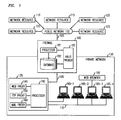
- FIG. 1 shows an exemplary system embodying the principles of the invention.
- the system includes public network 100, e.g., the Internet, and network resources 105, 110, 115, 120 and 125.
- network resources 105 through 125 can be linked together using files written in the well-known Hypertext Mark-up Language ("HTML") thereby representing the well-known WWW.
- HTML Hypertext Mark-up Language
- the WWW and HTML are described in more detail, e.g., by B. White, HTML and the Art of Authoring for the World Wide Web, Kluwer Academic Publishers, Norwell, MA, 1996.
- private network 130 is a network located within a particular user site, e.g., a corporation's headquarters building, having user terminals 165-1, 165-2, 165-3 and 165-4 linked together via LAN 170.
- user terminals 165-1 through 165-4 can be stand-alone personal computers or network terminals.
- private network 130 may include several such LAN configurations similar in nature to LAN 170.
- a particular user of any one of user terminals 165-1 through 165-4 may cause a client program executing on, e.g., user terminal 165-2, to request certain resources which are available on the WWW, e.g., network resources 105-125.
- requests to the WWW via the Internet from private network 130 pose certain security risks to both private network 130 and user terminals 165-1 through 165-4.
- private network 130 includes firewall 180 and proxy server 135 which are configured to delivery certain security features, in accordance with the invention, to protect private network 130 and its various computing resources.
- firewall a separate computer system, i.e., the firewall, between the private network and the public network, e.g., the Internet.
- the firewall monitors and maintains control over communications from and to the private network. More particularly, where a private network employs a firewall, the firewall first determines if the requested connection between a user terminal in the private network and the public network is authorized. The firewall serves as an intermediary between the user terminal in the private network and the public network and, if the connection is authorized, facilitates the requisite connection between the two networks. Alternatively, if the connection is unauthorized, the firewall prevents any connection between the networks from occurring.
- proxy server 135 includes processor 140, web proxy 145, file transport protocol (“FTP") proxy 150 and mail proxy 160.
- FTP file transport protocol
- these illustrative proxies enable the proxy server, working in conjunction with the firewall, to provide security features for WWW/Internet access, file transfers and electronic mail, respectively.
- web proxy 145 is used when a user desires to access particular "web pages" on the WWW from private network 130.
- a user employing user terminal 165-2 may access certain web pages on the WWW using web browser 166.
- Web browsers are well-known software application programs (e.g., Netscape® v.
- web browser 166 receives an input request from the user of user terminal 165-2 and attempts to locate the information on the WWW by establishing a connection with the appropriate resource, e.g., network resource 105, on the WWW through public network 100.
- the connection between user terminal 165-2 and network resource 105 is established using proxy server 135, web proxy 145 and firewall 180. More particularly, web proxy 145, acting on behalf of web browser 166, will attempt to establish a conventional Transfer Control Protocol/Internet Protocol ("TCP/IP”) connection between user terminal 165-2 and network resource 105.
- TCP/IP Transfer Control Protocol/Internet Protocol
- TCP/IP is the protocol which is used in describing the way in which information is transferred across the Internet. Essentially, TCP/IP separates information into individual packets and routes these packets between the sending computer, e.g., server, and the receiving computer, e.g., client. TCP/IP and Internet communications are discussed in more detail, e.g., by D. Comer., Internetworking with TCP/IP, Third edition, Prentice-Hall, Englewood Cliffs, NJ, 1995.
- the TCP/IP connection between user terminal 165-2 and network resource 105 is made across communication channels 190 and 195, respectively, which establish connection between public network 100, private network 130 and, ultimately, user terminal 165-2.
- firewall 180 provides a preferred location for implementing the security advantages of my invention.
- firewall 180 illustratively includes processor 181, database 182, and virus prober 185 which randomly inserts probes within incoming files from, e.g., public network 100, to, e.g., private network 130.
- the probes inserted by the virus prober 185 are individual programs which will trigger particular actions upon execution.
- the probe is a virus probe configured as a trojan horse which, if executed, on a client will launch a signal back to the firewall indicating that the client is misconfigured.
- a trojan horse is a secret, undocumented entry point placed into a useful application program by an unauthorized user, e.g., computer hacker.
- the trojan horse is also executed thereby launching the undesired actions. Trojan horses are described in more detail in Stallings, supra. at pp. 238-241.
- a trojan horse can be created to gain access to the files of another user on a shared computer system, wherein the unauthorized user creates a trojan horse program that, when executed, changes the authorized user's file permissions so that their files become readable by any user.
- This embodiment of the invention utilizes particular features of the trojan horse for delivery of various security advantages to computer networks as discussed in more detail below.
- the virus probe inserted by virus prober 185 at firewall 180 is benign in that the probe is designed to provide a signal back to firewall 180 if executed, rather than perform some destructive action as in the conventional trojan horse sense as described previously.
- the security features of the invention are preferably implemented and realized at the firewall, e.g., firewall 180, because in networks where firewalls are employed all communications traffic must pass through the firewall.
- the firewall is an ideal location for inserting probes in accordance with the invention.
- the principles of the invention are also realized in other network environments and configurations.
- the insertion of probes can be accomplished using a particular proxy server within a network that is known to have a high rate of common access and is trusted.
- a trusted server within a private network which mainly provides an online telephone directory is also an excellent candidate for implementing the principles of the invention due to the fact that this server will be utilized by a high number of user within the private network.
- the security features delivered by the present invention are realized in a variety of network, hardware and software configurations including, but not limited to, the system configuration of FIG. 1.
- FIG. 2 The operations of delivering network security through the insertion, monitoring and execution of probes in accordance with the invention is shown in the illustrative operations of FIG. 2.
- the operations of FIG. 2 are initiated within firewall 180.
- the communications traffic stream e.g., in and out of private network 130
- the communications traffic stream is continually monitored (block 200.)
- probes are randomly inserted into incoming files (block 205) destined for private network 130.
- FIG. 3 the structural aspects of the probe of the invention are described below in more detail with regard to FIG. 3.
- the probes are designed, if executed on a client, to trigger a signal indicative of a security alert.
- the signal can be a request for a network resource. Since all such requests must be made through the firewall, this ensures that when a probe configured in accordance with the invention triggers such a request, the request can effectively be utilized as the signal to the firewall. That is, such signals triggered by the probe will be immediately recognizable by the firewall.
- the signal can be in the form of a conventional User Datagram Protocol ("UDP") packet.
- UDP is a transport protocol which runs on top of the conventional TCP/IP protocol and provides a low overhead mechanism for two applications to quickly exchange small amounts of data. UDP requires less overhead than typical TCP/IP packet exchanges because UDP is a less secure protocol than TCP/IP.
- UDP is transaction oriented, and packets may be duplicated, lost or received in a different order than as originally sent.
- TCP/IP is more reliable because the protocol goes to significant lengths (e.g., generating checksums, acknowledging the receipt of packets, retransmitting lost packets) to insure that data arrives at its destination intact. Since UDP has no such overhead it is considerably faster than TCP/IP and is ideal for applications, as in various embodiments of the invention, that transmit short bursts of data, need faster network throughput, or do not require verification of delivery at the destination.
- other types of signal configurations in addition to those described above, which will be equally effective in delivering the various aspects of the invention.
- firewall 180 when firewall 180 receives the security alert indication, e.g., UDP packet, that a particular probe has executed (block 210), the firewall will identify the probe and client (block 215) and generate the security alert (block 220.)
- the security alert generated by firewall 180 could be an immediate notification to the network administrator indicating that a particular client or clients within the network currently present a security risk.
- a log entry is made in a master file, e.g. stored in database 182, which can be accessed by the network administrator at regular intervals or a printed report could be generated from the log for review by the administrator.
- the invention provides a technique for determining whether particular clients with a computer network are universally configured in accordance with the desired network security features of the computer network.
- one conventional security measure dictated by most network administrators is a policy that all users within a network, e.g., private network 130, disable certain features of their web browser software, e.g. Netscape®, and in particular the Javascript interpreter feature of the web browser.
- Javascript is described in more detail, e.g., by D. Flanagan, Javascript The Definitive Guide, Second edition, O'Reilly & Associates, Sebastopol, CA, 1997. Briefly, Javascript is a well-known interpreted programming language useful, e.g., in developing programs which relate to and involve web browsers and HTML.
- Javascript when a web browser includes a Javascript interpreter, the browser enables executable content, e.g., programs, to be distributed over the Internet (and WWW) in the form of Javascript "scripts".
- executable content e.g., programs
- WWW the Internet
- the script When the script is loaded into a Javascript-enabled browser the script is executable and will produce particular output as defined by the Javascript instructions of the script.
- Javascript allows for the control over the web browser, and also the content of that which appears in a web page, e.g., HTML forms.
- private network 130 includes a plurality of users employing user terminals 165-1 through 165-4.
- each user terminal can be configured with a web browser such as web browser 166 executing on user terminal 165-2.
- the configuration of user terminal 165-2 is easily replicated on each of the other user terminals within the private network but for purposes of clarity herein only one such configuration is shown in FIG. 1.
- firewall 180 is configured, as described above, in accordance with the invention to insert probes into the incoming communications traffic stream to private network 130.
- FIG. 3 shows an illustrative incoming communications traffic stream 300 and the insertion of an illustrative probe in accordance with the principles of the invention.
- communications traffic stream 300 includes a series of individual packets 300-1 through 300-n, e.g., TCP/IP packets, carrying data from public network 100 to private network 130.
- firewall 180 monitors communication traffic stream 300 and randomly inserts probes into incoming files within particular ones of the packets.
- packet 300-4 contains incoming file 305, illustratively a file having a series of HTML instructions 310.
- virus prober 185 inserts probe 315, illustratively, at the end of HTML instructions 310.
- probe 315 is inserted upon a first Internet access from a particular IP address (i.e., client) or browser type, and thereafter virus probes are inserted at random intervals.
- probe 315 is a virus probe in trojan horse form, as previously discussed, wherein the insertion of probe 315 into file 305 results in edited file 325. Thereafter, edited file 325 proceeds in the transmission of communications traffic stream 300 to private network 130.
- probe 315 is a single Javascript instruction 320.
- imagel is a unique string of characters for identifying probe 315.
- probe 315 is a trojan horse which directs the web browser to allocate an off-screen bitmap space, i.e., "new image()" and download a small image, i.e., "imagel”.
- the probes can either be stored in database 182 for access by virus prober 185 or stored locally within virus prober 185 itself.
- probes can be downloaded by network administrators from a central source, e.g., the Internet, and added to the existing probe library.
- a central source e.g., the Internet
- probe 315 will not execute and firewall 180 will not generate any security alert.
- probe 315 will execute causing web browser 166 to initiate a request for the image file, i.e., image1.
- a further embodiment of the invention employs a UDP packet as the signal back to the firewall when a security alert has occurred.
- file 305 is, illustratively, a file containing certain executable instructions.
- files having the extension ".exe” are binary executable files.
- probe 315 will be inserted into file 305 at an appropriate location where it is known to be safe for overwriting a small number of bytes of file 305 for insertion of probe 315.
- probe 315 will launch a UDP packet when a security alert occurs.
- the actual machine instructions inserted into file 305 are generated using, i.e.
Landscapes
- Engineering & Computer Science (AREA)
- Computer Security & Cryptography (AREA)
- Computer Networks & Wireless Communication (AREA)
- Signal Processing (AREA)
- Computer Hardware Design (AREA)
- Computing Systems (AREA)
- General Engineering & Computer Science (AREA)
- Health & Medical Sciences (AREA)
- General Health & Medical Sciences (AREA)
- Virology (AREA)
- Computer And Data Communications (AREA)
- Data Exchanges In Wide-Area Networks (AREA)
Applications Claiming Priority (2)
| Application Number | Priority Date | Filing Date | Title |
|---|---|---|---|
| US15563 | 1993-02-09 | ||
| US09/015,563 US6205551B1 (en) | 1998-01-29 | 1998-01-29 | Computer security using virus probing |
Publications (3)
| Publication Number | Publication Date |
|---|---|
| EP0936787A2 true EP0936787A2 (de) | 1999-08-18 |
| EP0936787A3 EP0936787A3 (de) | 2003-04-23 |
| EP0936787B1 EP0936787B1 (de) | 2004-12-29 |
Family
ID=21772149
Family Applications (1)
| Application Number | Title | Priority Date | Filing Date |
|---|---|---|---|
| EP99300332A Expired - Lifetime EP0936787B1 (de) | 1998-01-29 | 1999-01-19 | Rechnersicherheit durch Virusuntersuchung |
Country Status (5)
| Country | Link |
|---|---|
| US (1) | US6205551B1 (de) |
| EP (1) | EP0936787B1 (de) |
| JP (1) | JPH11316677A (de) |
| CA (1) | CA2254707C (de) |
| DE (1) | DE69922857T2 (de) |
Cited By (3)
| Publication number | Priority date | Publication date | Assignee | Title |
|---|---|---|---|---|
| GB2411747A (en) * | 2000-05-28 | 2005-09-07 | Secureol | Remotely checking the functioning of computer security systems |
| US9213836B2 (en) | 2000-05-28 | 2015-12-15 | Barhon Mayer, Batya | System and method for comprehensive general electric protection for computers against malicious programs that may steal information and/or cause damages |
| CN108809886A (zh) * | 2017-04-26 | 2018-11-13 | 牡丹江医学院 | 一种计算机网络安全防护系统 |
Families Citing this family (84)
| Publication number | Priority date | Publication date | Assignee | Title |
|---|---|---|---|---|
| US8079086B1 (en) | 1997-11-06 | 2011-12-13 | Finjan, Inc. | Malicious mobile code runtime monitoring system and methods |
| US7058822B2 (en) | 2000-03-30 | 2006-06-06 | Finjan Software, Ltd. | Malicious mobile code runtime monitoring system and methods |
| US9219755B2 (en) | 1996-11-08 | 2015-12-22 | Finjan, Inc. | Malicious mobile code runtime monitoring system and methods |
| AU4568299A (en) * | 1998-06-15 | 2000-01-05 | Dmw Worldwide, Inc. | Method and apparatus for assessing the security of a computer system |
| SE515084C2 (sv) * | 1998-08-26 | 2001-06-05 | Ericsson Telefon Ab L M | Förfarande och anordning i ett IP-nät |
| US6321338B1 (en) | 1998-11-09 | 2001-11-20 | Sri International | Network surveillance |
| US6718382B1 (en) * | 1999-02-11 | 2004-04-06 | Yunzhou Li | Technique for detecting leaky points within a network protocol domain |
| US6405204B1 (en) * | 1999-03-02 | 2002-06-11 | Sector Data, Llc | Alerts by sector/news alerts |
| US6880087B1 (en) * | 1999-10-08 | 2005-04-12 | Cisco Technology, Inc. | Binary state machine system and method for REGEX processing of a data stream in an intrusion detection system |
| US7159237B2 (en) * | 2000-03-16 | 2007-01-02 | Counterpane Internet Security, Inc. | Method and system for dynamic network intrusion monitoring, detection and response |
| US7032023B1 (en) * | 2000-05-16 | 2006-04-18 | America Online, Inc. | Throttling electronic communications from one or more senders |
| US7058976B1 (en) | 2000-05-17 | 2006-06-06 | Deep Nines, Inc. | Intelligent feedback loop process control system |
| US6930978B2 (en) * | 2000-05-17 | 2005-08-16 | Deep Nines, Inc. | System and method for traffic management control in a data transmission network |
| US7380272B2 (en) * | 2000-05-17 | 2008-05-27 | Deep Nines Incorporated | System and method for detecting and eliminating IP spoofing in a data transmission network |
| US7299489B1 (en) * | 2000-05-25 | 2007-11-20 | Lucent Technologies Inc. | Method and apparatus for host probing |
| FR2810180B1 (fr) * | 2000-06-08 | 2005-04-29 | Cit Alcatel | Procede destine a assurer un controle d'acces pour et/ou vis-a-vis d'utilisateurs accedant par des terminaux au reseau internet, au travers d'un noeud d'acces prive, et agencements pour la mise en oeuvre d'un tel procede |
| JP3619958B2 (ja) * | 2000-06-13 | 2005-02-16 | 富士通株式会社 | 危機管理システム及びコンピュータ |
| US6721721B1 (en) * | 2000-06-15 | 2004-04-13 | International Business Machines Corporation | Virus checking and reporting for computer database search results |
| US7725587B1 (en) * | 2000-08-24 | 2010-05-25 | Aol Llc | Deep packet scan hacker identification |
| US7711790B1 (en) * | 2000-08-24 | 2010-05-04 | Foundry Networks, Inc. | Securing an accessible computer system |
| US7970886B1 (en) * | 2000-11-02 | 2011-06-28 | Arbor Networks, Inc. | Detecting and preventing undesirable network traffic from being sourced out of a network domain |
| US6996845B1 (en) | 2000-11-28 | 2006-02-07 | S.P.I. Dynamics Incorporated | Internet security analysis system and process |
| US7168093B2 (en) * | 2001-01-25 | 2007-01-23 | Solutionary, Inc. | Method and apparatus for verifying the integrity and security of computer networks and implementation of counter measures |
| US6941478B2 (en) * | 2001-04-13 | 2005-09-06 | Nokia, Inc. | System and method for providing exploit protection with message tracking |
| US7134142B2 (en) * | 2001-04-13 | 2006-11-07 | Nokia Inc. | System and method for providing exploit protection for networks |
| KR20010084950A (ko) * | 2001-06-02 | 2001-09-07 | 유진영 | 시큐어 웜 |
| US20020199116A1 (en) * | 2001-06-25 | 2002-12-26 | Keith Hoene | System and method for computer network virus exclusion |
| US6513122B1 (en) * | 2001-06-29 | 2003-01-28 | Networks Associates Technology, Inc. | Secure gateway for analyzing textual content to identify a harmful impact on computer systems with known vulnerabilities |
| US6873988B2 (en) * | 2001-07-06 | 2005-03-29 | Check Point Software Technologies, Inc. | System and methods providing anti-virus cooperative enforcement |
| US7228566B2 (en) * | 2001-07-10 | 2007-06-05 | Core Sdi, Incorporated | Automated computer system security compromise |
| WO2003010922A1 (en) * | 2001-07-24 | 2003-02-06 | Worldcom, Inc. | Network security architecture |
| US7107446B2 (en) | 2001-08-30 | 2006-09-12 | International Business Machines Corporation | Mechanism independent cluster security services |
| US6892241B2 (en) * | 2001-09-28 | 2005-05-10 | Networks Associates Technology, Inc. | Anti-virus policy enforcement system and method |
| US7210168B2 (en) * | 2001-10-15 | 2007-04-24 | Mcafee, Inc. | Updating malware definition data for mobile data processing devices |
| US8370936B2 (en) * | 2002-02-08 | 2013-02-05 | Juniper Networks, Inc. | Multi-method gateway-based network security systems and methods |
| US7734752B2 (en) * | 2002-02-08 | 2010-06-08 | Juniper Networks, Inc. | Intelligent integrated network security device for high-availability applications |
| US7650634B2 (en) * | 2002-02-08 | 2010-01-19 | Juniper Networks, Inc. | Intelligent integrated network security device |
| RU2211483C1 (ru) * | 2002-02-26 | 2003-08-27 | Кузнецов Александр Александрович | Способ защиты информации |
| US6715084B2 (en) * | 2002-03-26 | 2004-03-30 | Bellsouth Intellectual Property Corporation | Firewall system and method via feedback from broad-scope monitoring for intrusion detection |
| US7058796B2 (en) | 2002-05-20 | 2006-06-06 | Airdefense, Inc. | Method and system for actively defending a wireless LAN against attacks |
| US7042852B2 (en) * | 2002-05-20 | 2006-05-09 | Airdefense, Inc. | System and method for wireless LAN dynamic channel change with honeypot trap |
| US7277937B2 (en) * | 2002-07-17 | 2007-10-02 | Core Sdi, Incorporated | Distributed computing using syscall proxying |
| US7353539B2 (en) * | 2002-11-04 | 2008-04-01 | Hewlett-Packard Development Company, L.P. | Signal level propagation mechanism for distribution of a payload to vulnerable systems |
| US20040146006A1 (en) * | 2003-01-24 | 2004-07-29 | Jackson Daniel H. | System and method for internal network data traffic control |
| US7328454B2 (en) * | 2003-04-24 | 2008-02-05 | At&T Delaware Intellectual Property, Inc. | Systems and methods for assessing computer security |
| US20040254988A1 (en) * | 2003-06-12 | 2004-12-16 | Rodriguez Rafael A. | Method of and universal apparatus and module for automatically managing electronic communications, such as e-mail and the like, to enable integrity assurance thereof and real-time compliance with pre-established regulatory requirements as promulgated in government and other compliance database files and information websites, and the like |
| JP4229013B2 (ja) * | 2003-09-01 | 2009-02-25 | 株式会社デンソー | 交流発電機 |
| US7730137B1 (en) | 2003-12-22 | 2010-06-01 | Aol Inc. | Restricting the volume of outbound electronic messages originated by a single entity |
| US7548956B1 (en) | 2003-12-30 | 2009-06-16 | Aol Llc | Spam control based on sender account characteristics |
| CN100349084C (zh) * | 2004-01-05 | 2007-11-14 | 华为技术有限公司 | 一种在视窗操作系统中保证系统安全的方法 |
| US7707634B2 (en) * | 2004-01-30 | 2010-04-27 | Microsoft Corporation | System and method for detecting malware in executable scripts according to its functionality |
| US7765597B2 (en) * | 2004-02-11 | 2010-07-27 | Hewlett-Packard Development Company, L.P. | Integrated crawling and auditing of web applications and web content |
| US20060282494A1 (en) * | 2004-02-11 | 2006-12-14 | Caleb Sima | Interactive web crawling |
| CA2553552A1 (en) * | 2004-02-11 | 2005-08-25 | Spi Dynamics, Inc. | System and method for testing web applications with recursive discovery and analysis |
| US7529187B1 (en) * | 2004-05-04 | 2009-05-05 | Symantec Corporation | Detecting network evasion and misinformation |
| US8074277B2 (en) * | 2004-06-07 | 2011-12-06 | Check Point Software Technologies, Inc. | System and methodology for intrusion detection and prevention |
| KR100604604B1 (ko) * | 2004-06-21 | 2006-07-24 | 엘지엔시스(주) | 서버 보안 솔루션과 네트워크 보안 솔루션을 이용한시스템 보안 방법 및 이를 구현하는 보안시스템 |
| US7716660B2 (en) * | 2004-12-14 | 2010-05-11 | Microsoft Corporation | Method and system for downloading updates |
| RU2280890C1 (ru) * | 2005-01-18 | 2006-07-27 | Государственное образовательное учреждение высшего профессионального образования Курский государственный технический университет | Способ и устройство блокирования команд для ограничения доступа к записанным на носителе данным |
| US20060185018A1 (en) * | 2005-02-17 | 2006-08-17 | Microsoft Corporation | Systems and methods for shielding an identified vulnerability |
| GB2425679A (en) * | 2005-04-27 | 2006-11-01 | Hewlett Packard Development Co | Scanning computing entities for vulnerabilities |
| US7483424B2 (en) * | 2005-07-28 | 2009-01-27 | International Business Machines Corporation | Method, for securely maintaining communications network connection data |
| US20070130149A1 (en) * | 2005-10-12 | 2007-06-07 | Lenovo (Singapore) Pte. Ltd. | Method, system, and computer program product for troubleshooting/configuring communications settings of a computer system |
| JP4545085B2 (ja) * | 2005-12-08 | 2010-09-15 | 富士通株式会社 | ファイアウォール装置 |
| US8291093B2 (en) * | 2005-12-08 | 2012-10-16 | Microsoft Corporation | Peer-to-peer remediation |
| US8301767B1 (en) | 2005-12-21 | 2012-10-30 | Mcafee, Inc. | System, method and computer program product for controlling network communications based on policy compliance |
| KR20070099201A (ko) * | 2006-04-03 | 2007-10-09 | 삼성전자주식회사 | 휴대형 무선 기기의 보안 관리 방법 및 이를 이용한 보안관리 장치 |
| US8281392B2 (en) | 2006-08-11 | 2012-10-02 | Airdefense, Inc. | Methods and systems for wired equivalent privacy and Wi-Fi protected access protection |
| US20080052508A1 (en) * | 2006-08-25 | 2008-02-28 | Huotari Allen J | Network security status indicators |
| US20080059123A1 (en) * | 2006-08-29 | 2008-03-06 | Microsoft Corporation | Management of host compliance evaluation |
| JP2008071177A (ja) * | 2006-09-14 | 2008-03-27 | Fujitsu Ltd | 情報処理装置、その制御方法及び同方法をコンピュータに実行させるためのプログラム |
| GB2443459A (en) * | 2006-10-31 | 2008-05-07 | Hewlett Packard Development Co | Data packet incuding computing platform indication |
| US20080133639A1 (en) * | 2006-11-30 | 2008-06-05 | Anatoliy Panasyuk | Client Statement of Health |
| JP4925109B2 (ja) * | 2007-01-16 | 2012-04-25 | Kddi株式会社 | 電子機器、プログラム、および記録媒体 |
| RU2320000C1 (ru) * | 2007-02-13 | 2008-03-20 | ГОУ ВПО "Саратовский государственный университет имени Н.Г. Чернышевского" | Дешифратор управляемой побитовой транспозиции информации, хранимой в персональной эвм |
| US8782786B2 (en) * | 2007-03-30 | 2014-07-15 | Sophos Limited | Remedial action against malicious code at a client facility |
| US8024801B2 (en) * | 2007-08-22 | 2011-09-20 | Agere Systems Inc. | Networked computer system with reduced vulnerability to directed attacks |
| US20090119769A1 (en) * | 2007-11-05 | 2009-05-07 | Microsoft Corporation | Cross-site scripting filter |
| US8667583B2 (en) * | 2008-09-22 | 2014-03-04 | Microsoft Corporation | Collecting and analyzing malware data |
| US9342274B2 (en) | 2011-05-19 | 2016-05-17 | Microsoft Technology Licensing, Llc | Dynamic code generation and memory management for component object model data constructs |
| US8881101B2 (en) | 2011-05-24 | 2014-11-04 | Microsoft Corporation | Binding between a layout engine and a scripting engine |
| US8543543B2 (en) * | 2011-09-13 | 2013-09-24 | Microsoft Corporation | Hash-based file comparison |
| US9430452B2 (en) | 2013-06-06 | 2016-08-30 | Microsoft Technology Licensing, Llc | Memory model for a layout engine and scripting engine |
| CN114584330A (zh) * | 2020-11-16 | 2022-06-03 | 华为技术有限公司 | 漏洞测试方法及装置 |
Family Cites Families (19)
| Publication number | Priority date | Publication date | Assignee | Title |
|---|---|---|---|---|
| US4750175A (en) * | 1986-08-29 | 1988-06-07 | Pactel Communications Companies | Network diagnostic apparatus and method |
| US5473769A (en) | 1992-03-30 | 1995-12-05 | Cozza; Paul D. | Method and apparatus for increasing the speed of the detecting of computer viruses |
| US5361359A (en) | 1992-08-31 | 1994-11-01 | Trusted Information Systems, Inc. | System and method for controlling the use of a computer |
| US5440723A (en) | 1993-01-19 | 1995-08-08 | International Business Machines Corporation | Automatic immune system for computers and computer networks |
| US5414833A (en) | 1993-10-27 | 1995-05-09 | International Business Machines Corporation | Network security system and method using a parallel finite state machine adaptive active monitor and responder |
| US5623601A (en) | 1994-11-18 | 1997-04-22 | Milkway Networks Corporation | Apparatus and method for providing a secure gateway for communication and data exchanges between networks |
| US5613002A (en) | 1994-11-21 | 1997-03-18 | International Business Machines Corporation | Generic disinfection of programs infected with a computer virus |
| US5550984A (en) | 1994-12-07 | 1996-08-27 | Matsushita Electric Corporation Of America | Security system for preventing unauthorized communications between networks by translating communications received in ip protocol to non-ip protocol to remove address and routing services information |
| US5706507A (en) | 1995-07-05 | 1998-01-06 | International Business Machines Corporation | System and method for controlling access to data located on a content server |
| US5889943A (en) * | 1995-09-26 | 1999-03-30 | Trend Micro Incorporated | Apparatus and method for electronic mail virus detection and elimination |
| US5623600A (en) * | 1995-09-26 | 1997-04-22 | Trend Micro, Incorporated | Virus detection and removal apparatus for computer networks |
| US5832208A (en) * | 1996-09-05 | 1998-11-03 | Cheyenne Software International Sales Corp. | Anti-virus agent for use with databases and mail servers |
| US5815571A (en) * | 1996-10-28 | 1998-09-29 | Finley; Phillip Scott | Computer system with secured data paths and method of protection |
| US6009475A (en) * | 1996-12-23 | 1999-12-28 | International Business Machines Corporation | Filter rule validation and administration for firewalls |
| US5960170A (en) * | 1997-03-18 | 1999-09-28 | Trend Micro, Inc. | Event triggered iterative virus detection |
| US6041041A (en) * | 1997-04-15 | 2000-03-21 | Ramanathan; Srinivas | Method and system for managing data service systems |
| US5948104A (en) * | 1997-05-23 | 1999-09-07 | Neuromedical Systems, Inc. | System and method for automated anti-viral file update |
| US5961644A (en) * | 1997-09-19 | 1999-10-05 | International Business Machines Corporation | Method and apparatus for testing the integrity of computer security alarm systems |
| US5987610A (en) * | 1998-02-12 | 1999-11-16 | Ameritech Corporation | Computer virus screening methods and systems |
-
1998
- 1998-01-29 US US09/015,563 patent/US6205551B1/en not_active Expired - Lifetime
- 1998-12-01 CA CA002254707A patent/CA2254707C/en not_active Expired - Fee Related
-
1999
- 1999-01-19 DE DE69922857T patent/DE69922857T2/de not_active Expired - Lifetime
- 1999-01-19 EP EP99300332A patent/EP0936787B1/de not_active Expired - Lifetime
- 1999-01-25 JP JP11015683A patent/JPH11316677A/ja active Pending
Cited By (4)
| Publication number | Priority date | Publication date | Assignee | Title |
|---|---|---|---|---|
| GB2411747A (en) * | 2000-05-28 | 2005-09-07 | Secureol | Remotely checking the functioning of computer security systems |
| GB2411747B (en) * | 2000-05-28 | 2005-10-19 | Secureol | System and method for comprehensive general generic protection for computers against malicious programs that may steal information and/or cause damages |
| US9213836B2 (en) | 2000-05-28 | 2015-12-15 | Barhon Mayer, Batya | System and method for comprehensive general electric protection for computers against malicious programs that may steal information and/or cause damages |
| CN108809886A (zh) * | 2017-04-26 | 2018-11-13 | 牡丹江医学院 | 一种计算机网络安全防护系统 |
Also Published As
| Publication number | Publication date |
|---|---|
| CA2254707C (en) | 2002-01-01 |
| CA2254707A1 (en) | 1999-07-29 |
| DE69922857T2 (de) | 2005-12-08 |
| US6205551B1 (en) | 2001-03-20 |
| JPH11316677A (ja) | 1999-11-16 |
| EP0936787A3 (de) | 2003-04-23 |
| EP0936787B1 (de) | 2004-12-29 |
| DE69922857D1 (de) | 2005-02-03 |
Similar Documents
| Publication | Publication Date | Title |
|---|---|---|
| CA2254707C (en) | Computer security using virus probing | |
| US20230362189A1 (en) | System and method for strategic anti-malware monitoring | |
| US9325738B2 (en) | Methods and apparatus for blocking unwanted software downloads | |
| US8074277B2 (en) | System and methodology for intrusion detection and prevention | |
| US8539582B1 (en) | Malware containment and security analysis on connection | |
| US5896499A (en) | Embedded security processor | |
| US6192477B1 (en) | Methods, software, and apparatus for secure communication over a computer network | |
| US7707636B2 (en) | Systems and methods for determining anti-virus protection status | |
| US7343599B2 (en) | Network-based patching machine | |
| US9167000B2 (en) | Dynamic threat event management system and method | |
| EP1330095A1 (de) | Ueberwachung des Datenflusses zur Verbesserung des Netzwerksicherheitsschutzes | |
| JPH11353258A (ja) | ファイアウォ―ルセキュリティ方法および装置 | |
| US11729176B2 (en) | Monitoring and preventing outbound network connections in runtime applications | |
| US12132759B2 (en) | Inline package name based supply chain attack detection and prevention | |
| US20250365311A1 (en) | Inline ransomware detection via server message block (smb) traffic | |
| US7757287B2 (en) | Systems and methods for computer security | |
| Dutta et al. | Intrusion detection systems fundamentals | |
| WO2005114949A1 (en) | Systems and methods for computer security | |
| US20050259657A1 (en) | Using address ranges to detect malicious activity | |
| Foo et al. | Mobile agents for computer intrusion detection | |
| Rødfoss | Comparison of open source network intrusion detection systems | |
| Al-Saleh et al. | Enhancing malware detection: clients deserve more protection | |
| Buchholz et al. | Digging for worms, fishing for answers | |
| Goebel | Advanced honeynet based intrusion detection | |
| Lin et al. | Building an integrated security gateway: Mechanisms, performance evaluations, implementations, and research issues |
Legal Events
| Date | Code | Title | Description |
|---|---|---|---|
| PUAI | Public reference made under article 153(3) epc to a published international application that has entered the european phase |
Free format text: ORIGINAL CODE: 0009012 |
|
| 17P | Request for examination filed |
Effective date: 19990129 |
|
| AK | Designated contracting states |
Kind code of ref document: A2 Designated state(s): AT BE CH CY DE DK ES FI FR GB GR IE IT LI LU MC NL PT SE |
|
| AX | Request for extension of the european patent |
Free format text: AL;LT;LV;MK;RO;SI |
|
| PUAL | Search report despatched |
Free format text: ORIGINAL CODE: 0009013 |
|
| AK | Designated contracting states |
Designated state(s): AT BE CH CY DE DK ES FI FR GB GR IE IT LI LU MC NL PT SE |
|
| AX | Request for extension of the european patent |
Extension state: AL LT LV MK RO SI |
|
| 17Q | First examination report despatched |
Effective date: 20031024 |
|
| AKX | Designation fees paid |
Designated state(s): DE FR GB |
|
| GRAP | Despatch of communication of intention to grant a patent |
Free format text: ORIGINAL CODE: EPIDOSNIGR1 |
|
| GRAS | Grant fee paid |
Free format text: ORIGINAL CODE: EPIDOSNIGR3 |
|
| GRAA | (expected) grant |
Free format text: ORIGINAL CODE: 0009210 |
|
| AK | Designated contracting states |
Kind code of ref document: B1 Designated state(s): DE FR GB |
|
| REG | Reference to a national code |
Ref country code: GB Ref legal event code: FG4D |
|
| REG | Reference to a national code |
Ref country code: IE Ref legal event code: FG4D |
|
| REF | Corresponds to: |
Ref document number: 69922857 Country of ref document: DE Date of ref document: 20050203 Kind code of ref document: P |
|
| PLBE | No opposition filed within time limit |
Free format text: ORIGINAL CODE: 0009261 |
|
| STAA | Information on the status of an ep patent application or granted ep patent |
Free format text: STATUS: NO OPPOSITION FILED WITHIN TIME LIMIT |
|
| ET | Fr: translation filed | ||
| 26N | No opposition filed |
Effective date: 20050930 |
|
| REG | Reference to a national code |
Ref country code: GB Ref legal event code: 732E Free format text: REGISTERED BETWEEN 20131121 AND 20131127 |
|
| REG | Reference to a national code |
Ref country code: FR Ref legal event code: CD Owner name: ALCATEL-LUCENT USA INC. Effective date: 20131122 |
|
| REG | Reference to a national code |
Ref country code: FR Ref legal event code: GC Effective date: 20140410 |
|
| REG | Reference to a national code |
Ref country code: FR Ref legal event code: RG Effective date: 20141015 |
|
| REG | Reference to a national code |
Ref country code: FR Ref legal event code: PLFP Year of fee payment: 17 |
|
| REG | Reference to a national code |
Ref country code: FR Ref legal event code: PLFP Year of fee payment: 18 |
|
| REG | Reference to a national code |
Ref country code: FR Ref legal event code: PLFP Year of fee payment: 19 |
|
| PGFP | Annual fee paid to national office [announced via postgrant information from national office to epo] |
Ref country code: FR Payment date: 20170120 Year of fee payment: 19 Ref country code: DE Payment date: 20170120 Year of fee payment: 19 |
|
| PGFP | Annual fee paid to national office [announced via postgrant information from national office to epo] |
Ref country code: GB Payment date: 20170119 Year of fee payment: 19 |
|
| REG | Reference to a national code |
Ref country code: DE Ref legal event code: R119 Ref document number: 69922857 Country of ref document: DE |
|
| GBPC | Gb: european patent ceased through non-payment of renewal fee |
Effective date: 20180119 |
|
| PG25 | Lapsed in a contracting state [announced via postgrant information from national office to epo] |
Ref country code: FR Free format text: LAPSE BECAUSE OF NON-PAYMENT OF DUE FEES Effective date: 20180131 Ref country code: DE Free format text: LAPSE BECAUSE OF NON-PAYMENT OF DUE FEES Effective date: 20180801 |
|
| REG | Reference to a national code |
Ref country code: FR Ref legal event code: ST Effective date: 20180928 |
|
| PG25 | Lapsed in a contracting state [announced via postgrant information from national office to epo] |
Ref country code: GB Free format text: LAPSE BECAUSE OF NON-PAYMENT OF DUE FEES Effective date: 20180119 |