EP0937683A1 - Ein NU-88 Zeolit und ein Element der Gruppe VB haltender Katalysator und seine Verwendung für die Hydroumwandlung von Kohlenwasserstoffeneinsätzen - Google Patents
Ein NU-88 Zeolit und ein Element der Gruppe VB haltender Katalysator und seine Verwendung für die Hydroumwandlung von Kohlenwasserstoffeneinsätzen Download PDFInfo
- Publication number
- EP0937683A1 EP0937683A1 EP99400374A EP99400374A EP0937683A1 EP 0937683 A1 EP0937683 A1 EP 0937683A1 EP 99400374 A EP99400374 A EP 99400374A EP 99400374 A EP99400374 A EP 99400374A EP 0937683 A1 EP0937683 A1 EP 0937683A1
- Authority
- EP
- European Patent Office
- Prior art keywords
- group
- catalyst
- zeolite
- chosen
- hydrogen
- Prior art date
- Legal status (The legal status is an assumption and is not a legal conclusion. Google has not performed a legal analysis and makes no representation as to the accuracy of the status listed.)
- Granted
Links
- 239000003054 catalyst Substances 0.000 title claims abstract description 142
- 239000010457 zeolite Substances 0.000 title claims abstract description 72
- 229910021536 Zeolite Inorganic materials 0.000 title claims abstract description 68
- HNPSIPDUKPIQMN-UHFFFAOYSA-N dioxosilane;oxo(oxoalumanyloxy)alumane Chemical compound O=[Si]=O.O=[Al]O[Al]=O HNPSIPDUKPIQMN-UHFFFAOYSA-N 0.000 title claims abstract description 68
- 229930195733 hydrocarbon Natural products 0.000 title claims abstract description 12
- 150000002430 hydrocarbons Chemical class 0.000 title claims abstract description 12
- 239000004215 Carbon black (E152) Substances 0.000 title claims description 9
- 229910052751 metal Inorganic materials 0.000 claims abstract description 52
- 239000002184 metal Substances 0.000 claims abstract description 52
- 239000000203 mixture Substances 0.000 claims abstract description 46
- 229910052739 hydrogen Inorganic materials 0.000 claims abstract description 41
- 239000001257 hydrogen Substances 0.000 claims abstract description 39
- UFHFLCQGNIYNRP-UHFFFAOYSA-N Hydrogen Chemical compound [H][H] UFHFLCQGNIYNRP-UHFFFAOYSA-N 0.000 claims abstract description 38
- 229910052710 silicon Inorganic materials 0.000 claims abstract description 36
- 229910052796 boron Inorganic materials 0.000 claims abstract description 29
- 239000011159 matrix material Substances 0.000 claims abstract description 28
- 239000002243 precursor Substances 0.000 claims abstract description 26
- 150000001875 compounds Chemical class 0.000 claims abstract description 24
- 229910052698 phosphorus Inorganic materials 0.000 claims abstract description 24
- 238000001354 calcination Methods 0.000 claims abstract description 19
- 239000007787 solid Substances 0.000 claims abstract description 19
- 229910052782 aluminium Inorganic materials 0.000 claims abstract description 18
- 239000000126 substance Substances 0.000 claims abstract description 16
- 229910052742 iron Inorganic materials 0.000 claims abstract description 14
- 150000001768 cations Chemical class 0.000 claims abstract description 13
- 238000005987 sulfurization reaction Methods 0.000 claims abstract description 13
- 229910052720 vanadium Inorganic materials 0.000 claims abstract description 13
- 238000001035 drying Methods 0.000 claims abstract description 11
- RWSOTUBLDIXVET-UHFFFAOYSA-N Dihydrogen sulfide Chemical compound S RWSOTUBLDIXVET-UHFFFAOYSA-N 0.000 claims abstract description 10
- 229910052785 arsenic Inorganic materials 0.000 claims abstract description 10
- 229910052726 zirconium Inorganic materials 0.000 claims abstract description 10
- 229910000037 hydrogen sulfide Inorganic materials 0.000 claims abstract description 9
- 229910052804 chromium Inorganic materials 0.000 claims abstract description 8
- 229910052787 antimony Inorganic materials 0.000 claims abstract description 7
- 229910052719 titanium Inorganic materials 0.000 claims abstract description 7
- 238000005303 weighing Methods 0.000 claims abstract description 3
- 238000006243 chemical reaction Methods 0.000 claims description 43
- 238000004517 catalytic hydrocracking Methods 0.000 claims description 41
- XUIMIQQOPSSXEZ-UHFFFAOYSA-N Silicon Chemical group [Si] XUIMIQQOPSSXEZ-UHFFFAOYSA-N 0.000 claims description 38
- 238000000034 method Methods 0.000 claims description 33
- 239000010703 silicon Substances 0.000 claims description 28
- 239000010955 niobium Substances 0.000 claims description 26
- XEEYBQQBJWHFJM-UHFFFAOYSA-N Iron Chemical compound [Fe] XEEYBQQBJWHFJM-UHFFFAOYSA-N 0.000 claims description 25
- -1 alkali metal cation Chemical class 0.000 claims description 24
- ZOXJGFHDIHLPTG-UHFFFAOYSA-N Boron Chemical compound [B] ZOXJGFHDIHLPTG-UHFFFAOYSA-N 0.000 claims description 23
- PXHVJJICTQNCMI-UHFFFAOYSA-N Nickel Chemical compound [Ni] PXHVJJICTQNCMI-UHFFFAOYSA-N 0.000 claims description 23
- ZOKXTWBITQBERF-UHFFFAOYSA-N Molybdenum Chemical compound [Mo] ZOKXTWBITQBERF-UHFFFAOYSA-N 0.000 claims description 22
- 229910052758 niobium Inorganic materials 0.000 claims description 22
- GUCVJGMIXFAOAE-UHFFFAOYSA-N niobium atom Chemical compound [Nb] GUCVJGMIXFAOAE-UHFFFAOYSA-N 0.000 claims description 22
- QGZKDVFQNNGYKY-UHFFFAOYSA-O Ammonium Chemical compound [NH4+] QGZKDVFQNNGYKY-UHFFFAOYSA-O 0.000 claims description 20
- OAICVXFJPJFONN-UHFFFAOYSA-N Phosphorus Chemical compound [P] OAICVXFJPJFONN-UHFFFAOYSA-N 0.000 claims description 20
- 238000002360 preparation method Methods 0.000 claims description 20
- 229910052750 molybdenum Inorganic materials 0.000 claims description 19
- 239000011733 molybdenum Substances 0.000 claims description 19
- 239000011574 phosphorus Substances 0.000 claims description 18
- 238000002441 X-ray diffraction Methods 0.000 claims description 16
- XAGFODPZIPBFFR-UHFFFAOYSA-N aluminium Chemical compound [Al] XAGFODPZIPBFFR-UHFFFAOYSA-N 0.000 claims description 15
- 238000010586 diagram Methods 0.000 claims description 13
- 229910052759 nickel Inorganic materials 0.000 claims description 12
- 230000000737 periodic effect Effects 0.000 claims description 12
- GPPXJZIENCGNKB-UHFFFAOYSA-N vanadium Chemical compound [V]#[V] GPPXJZIENCGNKB-UHFFFAOYSA-N 0.000 claims description 12
- 229910017052 cobalt Inorganic materials 0.000 claims description 11
- 239000010941 cobalt Substances 0.000 claims description 11
- GUTLYIVDDKVIGB-UHFFFAOYSA-N cobalt atom Chemical compound [Co] GUTLYIVDDKVIGB-UHFFFAOYSA-N 0.000 claims description 11
- 230000008569 process Effects 0.000 claims description 11
- WFKWXMTUELFFGS-UHFFFAOYSA-N tungsten Chemical compound [W] WFKWXMTUELFFGS-UHFFFAOYSA-N 0.000 claims description 11
- VYZAMTAEIAYCRO-UHFFFAOYSA-N Chromium Chemical compound [Cr] VYZAMTAEIAYCRO-UHFFFAOYSA-N 0.000 claims description 10
- GYHNNYVSQQEPJS-UHFFFAOYSA-N Gallium Chemical compound [Ga] GYHNNYVSQQEPJS-UHFFFAOYSA-N 0.000 claims description 9
- RTAQQCXQSZGOHL-UHFFFAOYSA-N Titanium Chemical compound [Ti] RTAQQCXQSZGOHL-UHFFFAOYSA-N 0.000 claims description 9
- QCWXUUIWCKQGHC-UHFFFAOYSA-N Zirconium Chemical compound [Zr] QCWXUUIWCKQGHC-UHFFFAOYSA-N 0.000 claims description 9
- WATWJIUSRGPENY-UHFFFAOYSA-N antimony atom Chemical compound [Sb] WATWJIUSRGPENY-UHFFFAOYSA-N 0.000 claims description 9
- 230000015572 biosynthetic process Effects 0.000 claims description 9
- 229910052733 gallium Inorganic materials 0.000 claims description 9
- 229910052732 germanium Inorganic materials 0.000 claims description 9
- GNPVGFCGXDBREM-UHFFFAOYSA-N germanium atom Chemical compound [Ge] GNPVGFCGXDBREM-UHFFFAOYSA-N 0.000 claims description 9
- 238000003786 synthesis reaction Methods 0.000 claims description 9
- 229910052721 tungsten Inorganic materials 0.000 claims description 9
- 239000010937 tungsten Substances 0.000 claims description 9
- 239000011651 chromium Substances 0.000 claims description 7
- RQNWIZPPADIBDY-UHFFFAOYSA-N arsenic atom Chemical compound [As] RQNWIZPPADIBDY-UHFFFAOYSA-N 0.000 claims description 6
- 239000011737 fluorine Substances 0.000 claims description 6
- 229910052731 fluorine Inorganic materials 0.000 claims description 6
- WPBNNNQJVZRUHP-UHFFFAOYSA-L manganese(2+);methyl n-[[2-(methoxycarbonylcarbamothioylamino)phenyl]carbamothioyl]carbamate;n-[2-(sulfidocarbothioylamino)ethyl]carbamodithioate Chemical compound [Mn+2].[S-]C(=S)NCCNC([S-])=S.COC(=O)NC(=S)NC1=CC=CC=C1NC(=S)NC(=O)OC WPBNNNQJVZRUHP-UHFFFAOYSA-L 0.000 claims description 6
- 125000001477 organic nitrogen group Chemical group 0.000 claims description 6
- 239000010936 titanium Substances 0.000 claims description 6
- QGZKDVFQNNGYKY-UHFFFAOYSA-N Ammonia Chemical compound N QGZKDVFQNNGYKY-UHFFFAOYSA-N 0.000 claims description 5
- 229910052783 alkali metal Inorganic materials 0.000 claims description 5
- 238000009835 boiling Methods 0.000 claims description 5
- 229910052500 inorganic mineral Inorganic materials 0.000 claims description 5
- 239000011707 mineral Substances 0.000 claims description 5
- 238000007493 shaping process Methods 0.000 claims description 5
- 238000000354 decomposition reaction Methods 0.000 claims description 4
- 229910052715 tantalum Inorganic materials 0.000 claims description 3
- GUVRBAGPIYLISA-UHFFFAOYSA-N tantalum atom Chemical compound [Ta] GUVRBAGPIYLISA-UHFFFAOYSA-N 0.000 claims description 3
- GTKOIJNHZXHJIQ-UHFFFAOYSA-N [N].S Chemical compound [N].S GTKOIJNHZXHJIQ-UHFFFAOYSA-N 0.000 claims description 2
- 239000000945 filler Substances 0.000 claims description 2
- 229910052745 lead Inorganic materials 0.000 claims description 2
- 229910052718 tin Inorganic materials 0.000 claims description 2
- PXGOKWXKJXAPGV-UHFFFAOYSA-N Fluorine Chemical compound FF PXGOKWXKJXAPGV-UHFFFAOYSA-N 0.000 claims 1
- 150000002431 hydrogen Chemical class 0.000 claims 1
- IJGRMHOSHXDMSA-UHFFFAOYSA-N Atomic nitrogen Chemical compound N#N IJGRMHOSHXDMSA-UHFFFAOYSA-N 0.000 abstract description 30
- 229910052757 nitrogen Inorganic materials 0.000 abstract description 15
- 238000005470 impregnation Methods 0.000 abstract description 12
- 239000002131 composite material Substances 0.000 abstract 1
- 230000004907 flux Effects 0.000 abstract 1
- 239000000243 solution Substances 0.000 description 37
- PNEYBMLMFCGWSK-UHFFFAOYSA-N aluminium oxide Inorganic materials [O-2].[O-2].[O-2].[Al+3].[Al+3] PNEYBMLMFCGWSK-UHFFFAOYSA-N 0.000 description 21
- XLYOFNOQVPJJNP-UHFFFAOYSA-N water Substances O XLYOFNOQVPJJNP-UHFFFAOYSA-N 0.000 description 20
- 150000002739 metals Chemical class 0.000 description 17
- 239000002253 acid Substances 0.000 description 16
- NINIDFKCEFEMDL-UHFFFAOYSA-N Sulfur Chemical compound [S] NINIDFKCEFEMDL-UHFFFAOYSA-N 0.000 description 15
- 239000000047 product Substances 0.000 description 15
- 229910001868 water Inorganic materials 0.000 description 15
- 229910052717 sulfur Inorganic materials 0.000 description 14
- 239000011593 sulfur Substances 0.000 description 14
- MUBZPKHOEPUJKR-UHFFFAOYSA-N Oxalic acid Chemical compound OC(=O)C(O)=O MUBZPKHOEPUJKR-UHFFFAOYSA-N 0.000 description 12
- 230000003197 catalytic effect Effects 0.000 description 12
- 150000003839 salts Chemical class 0.000 description 12
- 239000011734 sodium Substances 0.000 description 11
- 239000007864 aqueous solution Substances 0.000 description 10
- 230000000694 effects Effects 0.000 description 10
- NBIIXXVUZAFLBC-UHFFFAOYSA-N Phosphoric acid Chemical compound OP(O)(O)=O NBIIXXVUZAFLBC-UHFFFAOYSA-N 0.000 description 8
- HEMHJVSKTPXQMS-UHFFFAOYSA-M Sodium hydroxide Chemical compound [OH-].[Na+] HEMHJVSKTPXQMS-UHFFFAOYSA-M 0.000 description 8
- 229920001296 polysiloxane Polymers 0.000 description 8
- 239000002585 base Substances 0.000 description 7
- 238000005342 ion exchange Methods 0.000 description 7
- XNHGKSMNCCTMFO-UHFFFAOYSA-D niobium(5+);oxalate Chemical compound [Nb+5].[Nb+5].[O-]C(=O)C([O-])=O.[O-]C(=O)C([O-])=O.[O-]C(=O)C([O-])=O.[O-]C(=O)C([O-])=O.[O-]C(=O)C([O-])=O XNHGKSMNCCTMFO-UHFFFAOYSA-D 0.000 description 7
- 239000003921 oil Substances 0.000 description 7
- 239000003208 petroleum Substances 0.000 description 7
- KRHYYFGTRYWZRS-UHFFFAOYSA-N Fluorane Chemical compound F KRHYYFGTRYWZRS-UHFFFAOYSA-N 0.000 description 6
- YCKRFDGAMUMZLT-UHFFFAOYSA-N Fluorine atom Chemical compound [F] YCKRFDGAMUMZLT-UHFFFAOYSA-N 0.000 description 6
- 229940082150 encore Drugs 0.000 description 6
- 125000004435 hydrogen atom Chemical group [H]* 0.000 description 6
- 229910044991 metal oxide Inorganic materials 0.000 description 6
- 150000004706 metal oxides Chemical group 0.000 description 6
- 229910052708 sodium Inorganic materials 0.000 description 6
- 229910018072 Al 2 O 3 Inorganic materials 0.000 description 5
- KDLHZDBZIXYQEI-UHFFFAOYSA-N Palladium Chemical compound [Pd] KDLHZDBZIXYQEI-UHFFFAOYSA-N 0.000 description 5
- VYPSYNLAJGMNEJ-UHFFFAOYSA-N Silicium dioxide Chemical compound O=[Si]=O VYPSYNLAJGMNEJ-UHFFFAOYSA-N 0.000 description 5
- 239000000446 fuel Substances 0.000 description 5
- BASFCYQUMIYNBI-UHFFFAOYSA-N platinum Chemical compound [Pt] BASFCYQUMIYNBI-UHFFFAOYSA-N 0.000 description 5
- 229910052707 ruthenium Inorganic materials 0.000 description 5
- PAYRUJLWNCNPSJ-UHFFFAOYSA-N Aniline Chemical compound NC1=CC=CC=C1 PAYRUJLWNCNPSJ-UHFFFAOYSA-N 0.000 description 4
- MHAJPDPJQMAIIY-UHFFFAOYSA-N Hydrogen peroxide Chemical compound OO MHAJPDPJQMAIIY-UHFFFAOYSA-N 0.000 description 4
- JUJWROOIHBZHMG-UHFFFAOYSA-N Pyridine Chemical compound C1=CC=NC=C1 JUJWROOIHBZHMG-UHFFFAOYSA-N 0.000 description 4
- KAESVJOAVNADME-UHFFFAOYSA-N Pyrrole Chemical compound C=1C=CNC=1 KAESVJOAVNADME-UHFFFAOYSA-N 0.000 description 4
- KJTLSVCANCCWHF-UHFFFAOYSA-N Ruthenium Chemical compound [Ru] KJTLSVCANCCWHF-UHFFFAOYSA-N 0.000 description 4
- 229910004298 SiO 2 Inorganic materials 0.000 description 4
- UCKMPCXJQFINFW-UHFFFAOYSA-N Sulphide Chemical compound [S-2] UCKMPCXJQFINFW-UHFFFAOYSA-N 0.000 description 4
- 230000002378 acidificating effect Effects 0.000 description 4
- 239000004411 aluminium Substances 0.000 description 4
- QGAVSDVURUSLQK-UHFFFAOYSA-N ammonium heptamolybdate Chemical compound N.N.N.N.N.N.O.O.O.O.O.O.O.O.O.O.O.O.O.O.O.O.O.O.O.O.O.O.O.O.[Mo].[Mo].[Mo].[Mo].[Mo].[Mo].[Mo] QGAVSDVURUSLQK-UHFFFAOYSA-N 0.000 description 4
- VBIXEXWLHSRNKB-UHFFFAOYSA-N ammonium oxalate Chemical compound [NH4+].[NH4+].[O-]C(=O)C([O-])=O VBIXEXWLHSRNKB-UHFFFAOYSA-N 0.000 description 4
- KGBXLFKZBHKPEV-UHFFFAOYSA-N boric acid Chemical compound OB(O)O KGBXLFKZBHKPEV-UHFFFAOYSA-N 0.000 description 4
- 229960002645 boric acid Drugs 0.000 description 4
- 235000010338 boric acid Nutrition 0.000 description 4
- WQOXQRCZOLPYPM-UHFFFAOYSA-N dimethyl disulfide Chemical compound CSSC WQOXQRCZOLPYPM-UHFFFAOYSA-N 0.000 description 4
- 239000003502 gasoline Substances 0.000 description 4
- 239000003350 kerosene Substances 0.000 description 4
- 235000010755 mineral Nutrition 0.000 description 4
- 238000002156 mixing Methods 0.000 description 4
- 150000002894 organic compounds Chemical class 0.000 description 4
- 235000006408 oxalic acid Nutrition 0.000 description 4
- 235000011007 phosphoric acid Nutrition 0.000 description 4
- 239000011541 reaction mixture Substances 0.000 description 4
- QMMFVYPAHWMCMS-UHFFFAOYSA-N Dimethyl sulfide Chemical compound CSC QMMFVYPAHWMCMS-UHFFFAOYSA-N 0.000 description 3
- DGAQECJNVWCQMB-PUAWFVPOSA-M Ilexoside XXIX Chemical compound C[C@@H]1CC[C@@]2(CC[C@@]3(C(=CC[C@H]4[C@]3(CC[C@@H]5[C@@]4(CC[C@@H](C5(C)C)OS(=O)(=O)[O-])C)C)[C@@H]2[C@]1(C)O)C)C(=O)O[C@H]6[C@@H]([C@H]([C@@H]([C@H](O6)CO)O)O)O.[Na+] DGAQECJNVWCQMB-PUAWFVPOSA-M 0.000 description 3
- PWHULOQIROXLJO-UHFFFAOYSA-N Manganese Chemical compound [Mn] PWHULOQIROXLJO-UHFFFAOYSA-N 0.000 description 3
- 229910003294 NiMo Inorganic materials 0.000 description 3
- 241000897276 Termes Species 0.000 description 3
- 150000004645 aluminates Chemical class 0.000 description 3
- 238000004458 analytical method Methods 0.000 description 3
- 239000004327 boric acid Substances 0.000 description 3
- 229910052810 boron oxide Inorganic materials 0.000 description 3
- 239000006185 dispersion Substances 0.000 description 3
- 238000011065 in-situ storage Methods 0.000 description 3
- 229910052741 iridium Inorganic materials 0.000 description 3
- 229910052762 osmium Inorganic materials 0.000 description 3
- 229910052763 palladium Inorganic materials 0.000 description 3
- 229910052697 platinum Inorganic materials 0.000 description 3
- 239000011148 porous material Substances 0.000 description 3
- 239000000843 powder Substances 0.000 description 3
- 229910052703 rhodium Inorganic materials 0.000 description 3
- 239000010948 rhodium Substances 0.000 description 3
- 238000003756 stirring Methods 0.000 description 3
- 150000003568 thioethers Chemical class 0.000 description 3
- ZWVMLYRJXORSEP-LURJTMIESA-N (2s)-hexane-1,2,6-triol Chemical compound OCCCC[C@H](O)CO ZWVMLYRJXORSEP-LURJTMIESA-N 0.000 description 2
- XXZFCJVFXKCILB-UHFFFAOYSA-N 1-methylpyrrolidine;hydrobromide Chemical compound [Br-].C[NH+]1CCCC1 XXZFCJVFXKCILB-UHFFFAOYSA-N 0.000 description 2
- DDFHBQSCUXNBSA-UHFFFAOYSA-N 5-(5-carboxythiophen-2-yl)thiophene-2-carboxylic acid Chemical compound S1C(C(=O)O)=CC=C1C1=CC=C(C(O)=O)S1 DDFHBQSCUXNBSA-UHFFFAOYSA-N 0.000 description 2
- NLXLAEXVIDQMFP-UHFFFAOYSA-N Ammonia chloride Chemical compound [NH4+].[Cl-] NLXLAEXVIDQMFP-UHFFFAOYSA-N 0.000 description 2
- LFQSCWFLJHTTHZ-UHFFFAOYSA-N Ethanol Chemical compound CCO LFQSCWFLJHTTHZ-UHFFFAOYSA-N 0.000 description 2
- CPLXHLVBOLITMK-UHFFFAOYSA-N Magnesium oxide Chemical compound [Mg]=O CPLXHLVBOLITMK-UHFFFAOYSA-N 0.000 description 2
- SMWDFEZZVXVKRB-UHFFFAOYSA-N Quinoline Chemical compound N1=CC=CC2=CC=CC=C21 SMWDFEZZVXVKRB-UHFFFAOYSA-N 0.000 description 2
- BOTDANWDWHJENH-UHFFFAOYSA-N Tetraethyl orthosilicate Chemical compound CCO[Si](OCC)(OCC)OCC BOTDANWDWHJENH-UHFFFAOYSA-N 0.000 description 2
- MCMNRKCIXSYSNV-UHFFFAOYSA-N Zirconium dioxide Chemical compound O=[Zr]=O MCMNRKCIXSYSNV-UHFFFAOYSA-N 0.000 description 2
- LYHKUHHKGREXNQ-UHFFFAOYSA-N [Mo].[Nb].[Co] Chemical compound [Mo].[Nb].[Co] LYHKUHHKGREXNQ-UHFFFAOYSA-N 0.000 description 2
- KIGWXGQMMKJTBW-UHFFFAOYSA-N [Mo].[Nb].[Ni] Chemical compound [Mo].[Nb].[Ni] KIGWXGQMMKJTBW-UHFFFAOYSA-N 0.000 description 2
- 150000007513 acids Chemical class 0.000 description 2
- 230000004913 activation Effects 0.000 description 2
- 229910000272 alkali metal oxide Inorganic materials 0.000 description 2
- 229910000147 aluminium phosphate Inorganic materials 0.000 description 2
- 229910021529 ammonia Inorganic materials 0.000 description 2
- APUPEJJSWDHEBO-UHFFFAOYSA-P ammonium molybdate Chemical compound [NH4+].[NH4+].[O-][Mo]([O-])(=O)=O APUPEJJSWDHEBO-UHFFFAOYSA-P 0.000 description 2
- 239000011609 ammonium molybdate Substances 0.000 description 2
- 229940010552 ammonium molybdate Drugs 0.000 description 2
- 235000018660 ammonium molybdate Nutrition 0.000 description 2
- 238000001636 atomic emission spectroscopy Methods 0.000 description 2
- QVGXLLKOCUKJST-UHFFFAOYSA-N atomic oxygen Chemical compound [O] QVGXLLKOCUKJST-UHFFFAOYSA-N 0.000 description 2
- 150000001638 boron Chemical class 0.000 description 2
- DXHPZXWIPWDXHJ-UHFFFAOYSA-N carbon monosulfide Chemical compound [S+]#[C-] DXHPZXWIPWDXHJ-UHFFFAOYSA-N 0.000 description 2
- 238000004523 catalytic cracking Methods 0.000 description 2
- 239000000470 constituent Substances 0.000 description 2
- 230000018044 dehydration Effects 0.000 description 2
- 238000006297 dehydration reaction Methods 0.000 description 2
- 238000000151 deposition Methods 0.000 description 2
- JKWMSGQKBLHBQQ-UHFFFAOYSA-N diboron trioxide Chemical compound O=BOB=O JKWMSGQKBLHBQQ-UHFFFAOYSA-N 0.000 description 2
- 239000002283 diesel fuel Substances 0.000 description 2
- 238000004821 distillation Methods 0.000 description 2
- 239000000839 emulsion Substances 0.000 description 2
- 150000002148 esters Chemical class 0.000 description 2
- 238000011066 ex-situ storage Methods 0.000 description 2
- 239000007789 gas Substances 0.000 description 2
- 150000004820 halides Chemical class 0.000 description 2
- 238000010438 heat treatment Methods 0.000 description 2
- 125000005842 heteroatom Chemical group 0.000 description 2
- 230000006872 improvement Effects 0.000 description 2
- GKOZUEZYRPOHIO-UHFFFAOYSA-N iridium atom Chemical compound [Ir] GKOZUEZYRPOHIO-UHFFFAOYSA-N 0.000 description 2
- 238000004898 kneading Methods 0.000 description 2
- 238000004519 manufacturing process Methods 0.000 description 2
- VLKZOEOYAKHREP-UHFFFAOYSA-N n-Hexane Chemical compound CCCCCC VLKZOEOYAKHREP-UHFFFAOYSA-N 0.000 description 2
- KBJMLQFLOWQJNF-UHFFFAOYSA-N nickel(ii) nitrate Chemical compound [Ni+2].[O-][N+]([O-])=O.[O-][N+]([O-])=O KBJMLQFLOWQJNF-UHFFFAOYSA-N 0.000 description 2
- 150000002823 nitrates Chemical class 0.000 description 2
- 229910000510 noble metal Inorganic materials 0.000 description 2
- SYQBFIAQOQZEGI-UHFFFAOYSA-N osmium atom Chemical compound [Os] SYQBFIAQOQZEGI-UHFFFAOYSA-N 0.000 description 2
- 229910052760 oxygen Inorganic materials 0.000 description 2
- 239000001301 oxygen Substances 0.000 description 2
- 150000003141 primary amines Chemical class 0.000 description 2
- UMJSCPRVCHMLSP-UHFFFAOYSA-N pyridine Natural products COC1=CC=CN=C1 UMJSCPRVCHMLSP-UHFFFAOYSA-N 0.000 description 2
- MHOVAHRLVXNVSD-UHFFFAOYSA-N rhodium atom Chemical compound [Rh] MHOVAHRLVXNVSD-UHFFFAOYSA-N 0.000 description 2
- 150000003335 secondary amines Chemical class 0.000 description 2
- CGFYHILWFSGVJS-UHFFFAOYSA-N silicic acid;trioxotungsten Chemical compound O[Si](O)(O)O.O=[W]1(=O)O[W](=O)(=O)O[W](=O)(=O)O1.O=[W]1(=O)O[W](=O)(=O)O[W](=O)(=O)O1.O=[W]1(=O)O[W](=O)(=O)O[W](=O)(=O)O1.O=[W]1(=O)O[W](=O)(=O)O[W](=O)(=O)O1 CGFYHILWFSGVJS-UHFFFAOYSA-N 0.000 description 2
- 150000003377 silicon compounds Chemical class 0.000 description 2
- 239000000377 silicon dioxide Substances 0.000 description 2
- 239000012265 solid product Substances 0.000 description 2
- 230000006641 stabilisation Effects 0.000 description 2
- 238000011105 stabilization Methods 0.000 description 2
- 239000004254 Ammonium phosphate Substances 0.000 description 1
- 238000004438 BET method Methods 0.000 description 1
- VEXZGXHMUGYJMC-UHFFFAOYSA-M Chloride anion Chemical compound [Cl-] VEXZGXHMUGYJMC-UHFFFAOYSA-M 0.000 description 1
- RYGMFSIKBFXOCR-UHFFFAOYSA-N Copper Chemical compound [Cu] RYGMFSIKBFXOCR-UHFFFAOYSA-N 0.000 description 1
- KRHYYFGTRYWZRS-UHFFFAOYSA-M Fluoride anion Chemical compound [F-] KRHYYFGTRYWZRS-UHFFFAOYSA-M 0.000 description 1
- YZCKVEUIGOORGS-UHFFFAOYSA-N Hydrogen atom Chemical compound [H] YZCKVEUIGOORGS-UHFFFAOYSA-N 0.000 description 1
- KKCBUQHMOMHUOY-UHFFFAOYSA-N Na2O Inorganic materials [O-2].[Na+].[Na+] KKCBUQHMOMHUOY-UHFFFAOYSA-N 0.000 description 1
- GRYLNZFGIOXLOG-UHFFFAOYSA-N Nitric acid Chemical compound O[N+]([O-])=O GRYLNZFGIOXLOG-UHFFFAOYSA-N 0.000 description 1
- OTRAYOBSWCVTIN-UHFFFAOYSA-N OB(O)O.OB(O)O.OB(O)O.OB(O)O.OB(O)O.N.N.N.N.N.N.N.N.N.N.N.N.N.N.N Chemical compound OB(O)O.OB(O)O.OB(O)O.OB(O)O.OB(O)O.N.N.N.N.N.N.N.N.N.N.N.N.N.N.N OTRAYOBSWCVTIN-UHFFFAOYSA-N 0.000 description 1
- 229910019142 PO4 Inorganic materials 0.000 description 1
- 229920000297 Rayon Polymers 0.000 description 1
- GWEVSGVZZGPLCZ-UHFFFAOYSA-N Titan oxide Chemical compound O=[Ti]=O GWEVSGVZZGPLCZ-UHFFFAOYSA-N 0.000 description 1
- CFOAUMXQOCBWNJ-UHFFFAOYSA-N [B].[Si] Chemical compound [B].[Si] CFOAUMXQOCBWNJ-UHFFFAOYSA-N 0.000 description 1
- UDVYRJZSPDAHDP-UHFFFAOYSA-N [Fe].[Nb].[Mo] Chemical compound [Fe].[Nb].[Mo] UDVYRJZSPDAHDP-UHFFFAOYSA-N 0.000 description 1
- VQPWIIWUJZFNOH-UHFFFAOYSA-N [Mo].[Nb].[Co].[Ni] Chemical compound [Mo].[Nb].[Co].[Ni] VQPWIIWUJZFNOH-UHFFFAOYSA-N 0.000 description 1
- WXCZLQFFMZAUIV-UHFFFAOYSA-N [Mo].[Nb].[Ni].[Ru] Chemical compound [Mo].[Nb].[Ni].[Ru] WXCZLQFFMZAUIV-UHFFFAOYSA-N 0.000 description 1
- LMCBRBGCCDUTAB-UHFFFAOYSA-N [Mo].[Nb].[Ru] Chemical compound [Mo].[Nb].[Ru] LMCBRBGCCDUTAB-UHFFFAOYSA-N 0.000 description 1
- WSAGVELZCNHXBC-UHFFFAOYSA-M [S-2].[S-2].[SH-].[Nb+5] Chemical compound [S-2].[S-2].[SH-].[Nb+5] WSAGVELZCNHXBC-UHFFFAOYSA-M 0.000 description 1
- MNVWSEGSPRQDQT-UHFFFAOYSA-N [W].[Nb].[Co] Chemical compound [W].[Nb].[Co] MNVWSEGSPRQDQT-UHFFFAOYSA-N 0.000 description 1
- IKVNKJLIKRUOGK-UHFFFAOYSA-N [W].[Nb].[Fe] Chemical compound [W].[Nb].[Fe] IKVNKJLIKRUOGK-UHFFFAOYSA-N 0.000 description 1
- XTEZEEGQRHAPDP-UHFFFAOYSA-N [W].[Nb].[Ni] Chemical compound [W].[Nb].[Ni] XTEZEEGQRHAPDP-UHFFFAOYSA-N 0.000 description 1
- 150000001242 acetic acid derivatives Chemical class 0.000 description 1
- 230000009471 action Effects 0.000 description 1
- 239000003513 alkali Substances 0.000 description 1
- 150000001340 alkali metals Chemical class 0.000 description 1
- 229910052784 alkaline earth metal Inorganic materials 0.000 description 1
- 150000001342 alkaline earth metals Chemical class 0.000 description 1
- 150000004703 alkoxides Chemical class 0.000 description 1
- ANBBXQWFNXMHLD-UHFFFAOYSA-N aluminum;sodium;oxygen(2-) Chemical compound [O-2].[O-2].[Na+].[Al+3] ANBBXQWFNXMHLD-UHFFFAOYSA-N 0.000 description 1
- 235000019270 ammonium chloride Nutrition 0.000 description 1
- ZRIUUUJAJJNDSS-UHFFFAOYSA-N ammonium phosphates Chemical class [NH4+].[NH4+].[NH4+].[O-]P([O-])([O-])=O ZRIUUUJAJJNDSS-UHFFFAOYSA-N 0.000 description 1
- 235000019289 ammonium phosphates Nutrition 0.000 description 1
- 150000003863 ammonium salts Chemical class 0.000 description 1
- 229940111121 antirheumatic drug quinolines Drugs 0.000 description 1
- 125000003118 aryl group Chemical group 0.000 description 1
- 230000008901 benefit Effects 0.000 description 1
- 230000001588 bifunctional effect Effects 0.000 description 1
- 230000002902 bimodal effect Effects 0.000 description 1
- 229910001593 boehmite Inorganic materials 0.000 description 1
- 150000003842 bromide salts Chemical class 0.000 description 1
- 125000004432 carbon atom Chemical group C* 0.000 description 1
- 150000004649 carbonic acid derivatives Chemical class 0.000 description 1
- 150000007942 carboxylates Chemical class 0.000 description 1
- 230000008859 change Effects 0.000 description 1
- 150000001805 chlorine compounds Chemical class 0.000 description 1
- 239000003245 coal Substances 0.000 description 1
- 238000007796 conventional method Methods 0.000 description 1
- 239000010949 copper Substances 0.000 description 1
- 229910052802 copper Inorganic materials 0.000 description 1
- 229910052593 corundum Inorganic materials 0.000 description 1
- 239000013078 crystal Substances 0.000 description 1
- 239000008367 deionised water Substances 0.000 description 1
- 229910021641 deionized water Inorganic materials 0.000 description 1
- 230000008021 deposition Effects 0.000 description 1
- RCJVRSBWZCNNQT-UHFFFAOYSA-N dichloridooxygen Chemical compound ClOCl RCJVRSBWZCNNQT-UHFFFAOYSA-N 0.000 description 1
- VLXBWPOEOIIREY-UHFFFAOYSA-N dimethyl diselenide Natural products C[Se][Se]C VLXBWPOEOIIREY-UHFFFAOYSA-N 0.000 description 1
- FOBPTJZYDGNHLR-UHFFFAOYSA-N diphosphorus Chemical compound P#P FOBPTJZYDGNHLR-UHFFFAOYSA-N 0.000 description 1
- 238000009826 distribution Methods 0.000 description 1
- 230000008030 elimination Effects 0.000 description 1
- 238000003379 elimination reaction Methods 0.000 description 1
- 238000001125 extrusion Methods 0.000 description 1
- 150000002222 fluorine compounds Chemical class 0.000 description 1
- 238000005469 granulation Methods 0.000 description 1
- 230000003179 granulation Effects 0.000 description 1
- 229910021472 group 8 element Inorganic materials 0.000 description 1
- 229910052736 halogen Inorganic materials 0.000 description 1
- 150000002367 halogens Chemical class 0.000 description 1
- 150000004679 hydroxides Chemical class 0.000 description 1
- FAHBNUUHRFUEAI-UHFFFAOYSA-M hydroxidooxidoaluminium Chemical compound O[Al]=O FAHBNUUHRFUEAI-UHFFFAOYSA-M 0.000 description 1
- 239000007937 lozenge Substances 0.000 description 1
- 230000001050 lubricating effect Effects 0.000 description 1
- 239000000395 magnesium oxide Substances 0.000 description 1
- QSHDDOUJBYECFT-UHFFFAOYSA-N mercury Chemical compound [Hg] QSHDDOUJBYECFT-UHFFFAOYSA-N 0.000 description 1
- 229910052753 mercury Inorganic materials 0.000 description 1
- 150000002736 metal compounds Chemical class 0.000 description 1
- 229910052976 metal sulfide Inorganic materials 0.000 description 1
- DDTIGTPWGISMKL-UHFFFAOYSA-N molybdenum nickel Chemical group [Ni].[Mo] DDTIGTPWGISMKL-UHFFFAOYSA-N 0.000 description 1
- ZKATWMILCYLAPD-UHFFFAOYSA-N niobium pentoxide Chemical compound O=[Nb](=O)O[Nb](=O)=O ZKATWMILCYLAPD-UHFFFAOYSA-N 0.000 description 1
- WPCMRGJTLPITMF-UHFFFAOYSA-I niobium(5+);pentahydroxide Chemical class [OH-].[OH-].[OH-].[OH-].[OH-].[Nb+5] WPCMRGJTLPITMF-UHFFFAOYSA-I 0.000 description 1
- 229910017604 nitric acid Inorganic materials 0.000 description 1
- TVMXDCGIABBOFY-UHFFFAOYSA-N octane Chemical compound CCCCCCCC TVMXDCGIABBOFY-UHFFFAOYSA-N 0.000 description 1
- MOWNZPNSYMGTMD-UHFFFAOYSA-N oxidoboron Chemical class O=[B] MOWNZPNSYMGTMD-UHFFFAOYSA-N 0.000 description 1
- 235000010603 pastilles Nutrition 0.000 description 1
- 235000021317 phosphate Nutrition 0.000 description 1
- 150000003013 phosphoric acid derivatives Chemical class 0.000 description 1
- IYDGMDWEHDFVQI-UHFFFAOYSA-N phosphoric acid;trioxotungsten Chemical compound O=[W](=O)=O.O=[W](=O)=O.O=[W](=O)=O.O=[W](=O)=O.O=[W](=O)=O.O=[W](=O)=O.O=[W](=O)=O.O=[W](=O)=O.O=[W](=O)=O.O=[W](=O)=O.O=[W](=O)=O.O=[W](=O)=O.OP(O)(O)=O IYDGMDWEHDFVQI-UHFFFAOYSA-N 0.000 description 1
- 239000002574 poison Substances 0.000 description 1
- 231100000614 poison Toxicity 0.000 description 1
- 229920001021 polysulfide Polymers 0.000 description 1
- 239000005077 polysulfide Substances 0.000 description 1
- 150000008117 polysulfides Polymers 0.000 description 1
- 238000002459 porosimetry Methods 0.000 description 1
- 238000000634 powder X-ray diffraction Methods 0.000 description 1
- 150000003248 quinolines Chemical class 0.000 description 1
- 230000005855 radiation Effects 0.000 description 1
- 239000002964 rayon Substances 0.000 description 1
- 238000004064 recycling Methods 0.000 description 1
- 238000007670 refining Methods 0.000 description 1
- ABTOQLMXBSRXSM-UHFFFAOYSA-N silicon tetrafluoride Chemical compound F[Si](F)(F)F ABTOQLMXBSRXSM-UHFFFAOYSA-N 0.000 description 1
- 229910001388 sodium aluminate Inorganic materials 0.000 description 1
- 238000001179 sorption measurement Methods 0.000 description 1
- 241000894007 species Species 0.000 description 1
- 229910001220 stainless steel Inorganic materials 0.000 description 1
- 239000010935 stainless steel Substances 0.000 description 1
- 150000003467 sulfuric acid derivatives Chemical class 0.000 description 1
- 239000013589 supplement Substances 0.000 description 1
- 239000003826 tablet Substances 0.000 description 1
- DLYUQMMRRRQYAE-UHFFFAOYSA-N tetraphosphorus decaoxide Chemical compound O1P(O2)(=O)OP3(=O)OP1(=O)OP2(=O)O3 DLYUQMMRRRQYAE-UHFFFAOYSA-N 0.000 description 1
- 150000003573 thiols Chemical class 0.000 description 1
- 150000003577 thiophenes Chemical class 0.000 description 1
- OGIDPMRJRNCKJF-UHFFFAOYSA-N titanium oxide Inorganic materials [Ti]=O OGIDPMRJRNCKJF-UHFFFAOYSA-N 0.000 description 1
- ITRNXVSDJBHYNJ-UHFFFAOYSA-N tungsten disulfide Chemical compound S=[W]=S ITRNXVSDJBHYNJ-UHFFFAOYSA-N 0.000 description 1
- 238000005406 washing Methods 0.000 description 1
- 239000001993 wax Substances 0.000 description 1
- 229910001845 yogo sapphire Inorganic materials 0.000 description 1
Images
Classifications
-
- B—PERFORMING OPERATIONS; TRANSPORTING
- B01—PHYSICAL OR CHEMICAL PROCESSES OR APPARATUS IN GENERAL
- B01J—CHEMICAL OR PHYSICAL PROCESSES, e.g. CATALYSIS OR COLLOID CHEMISTRY; THEIR RELEVANT APPARATUS
- B01J29/00—Catalysts comprising molecular sieves
- B01J29/04—Catalysts comprising molecular sieves having base-exchange properties, e.g. crystalline zeolites
- B01J29/06—Crystalline aluminosilicate zeolites; Isomorphous compounds thereof
- B01J29/70—Crystalline aluminosilicate zeolites; Isomorphous compounds thereof of types characterised by their specific structure not provided for in groups B01J29/08 - B01J29/65
-
- C—CHEMISTRY; METALLURGY
- C10—PETROLEUM, GAS OR COKE INDUSTRIES; TECHNICAL GASES CONTAINING CARBON MONOXIDE; FUELS; LUBRICANTS; PEAT
- C10G—CRACKING HYDROCARBON OILS; PRODUCTION OF LIQUID HYDROCARBON MIXTURES, e.g. BY DESTRUCTIVE HYDROGENATION, OLIGOMERISATION, POLYMERISATION; RECOVERY OF HYDROCARBON OILS FROM OIL-SHALE, OIL-SAND, OR GASES; REFINING MIXTURES MAINLY CONSISTING OF HYDROCARBONS; REFORMING OF NAPHTHA; MINERAL WAXES
- C10G47/00—Cracking of hydrocarbon oils, in the presence of hydrogen or hydrogen- generating compounds, to obtain lower boiling fractions
- C10G47/02—Cracking of hydrocarbon oils, in the presence of hydrogen or hydrogen- generating compounds, to obtain lower boiling fractions characterised by the catalyst used
- C10G47/10—Cracking of hydrocarbon oils, in the presence of hydrogen or hydrogen- generating compounds, to obtain lower boiling fractions characterised by the catalyst used with catalysts deposited on a carrier
- C10G47/12—Inorganic carriers
- C10G47/16—Crystalline alumino-silicate carriers
- C10G47/20—Crystalline alumino-silicate carriers the catalyst containing other metals or compounds thereof
-
- B—PERFORMING OPERATIONS; TRANSPORTING
- B01—PHYSICAL OR CHEMICAL PROCESSES OR APPARATUS IN GENERAL
- B01J—CHEMICAL OR PHYSICAL PROCESSES, e.g. CATALYSIS OR COLLOID CHEMISTRY; THEIR RELEVANT APPARATUS
- B01J29/00—Catalysts comprising molecular sieves
- B01J29/04—Catalysts comprising molecular sieves having base-exchange properties, e.g. crystalline zeolites
-
- B—PERFORMING OPERATIONS; TRANSPORTING
- B01—PHYSICAL OR CHEMICAL PROCESSES OR APPARATUS IN GENERAL
- B01J—CHEMICAL OR PHYSICAL PROCESSES, e.g. CATALYSIS OR COLLOID CHEMISTRY; THEIR RELEVANT APPARATUS
- B01J29/00—Catalysts comprising molecular sieves
- B01J29/04—Catalysts comprising molecular sieves having base-exchange properties, e.g. crystalline zeolites
- B01J29/06—Crystalline aluminosilicate zeolites; Isomorphous compounds thereof
- B01J29/70—Crystalline aluminosilicate zeolites; Isomorphous compounds thereof of types characterised by their specific structure not provided for in groups B01J29/08 - B01J29/65
- B01J29/78—Crystalline aluminosilicate zeolites; Isomorphous compounds thereof of types characterised by their specific structure not provided for in groups B01J29/08 - B01J29/65 containing arsenic, antimony, bismuth, vanadium, niobium, tantalum, polonium, chromium, molybdenum, tungsten, manganese, technetium or rhenium
-
- C—CHEMISTRY; METALLURGY
- C01—INORGANIC CHEMISTRY
- C01B—NON-METALLIC ELEMENTS; COMPOUNDS THEREOF; METALLOIDS OR COMPOUNDS THEREOF NOT COVERED BY SUBCLASS C01C
- C01B39/00—Compounds having molecular sieve and base-exchange properties, e.g. crystalline zeolites; Their preparation; After-treatment, e.g. ion-exchange or dealumination
- C01B39/02—Crystalline aluminosilicate zeolites; Isomorphous compounds thereof; Direct preparation thereof; Preparation thereof starting from a reaction mixture containing a crystalline zeolite of another type, or from preformed reactants; After-treatment thereof
- C01B39/46—Other types characterised by their X-ray diffraction pattern and their defined composition
- C01B39/48—Other types characterised by their X-ray diffraction pattern and their defined composition using at least one organic template directing agent
-
- B—PERFORMING OPERATIONS; TRANSPORTING
- B01—PHYSICAL OR CHEMICAL PROCESSES OR APPARATUS IN GENERAL
- B01J—CHEMICAL OR PHYSICAL PROCESSES, e.g. CATALYSIS OR COLLOID CHEMISTRY; THEIR RELEVANT APPARATUS
- B01J2229/00—Aspects of molecular sieve catalysts not covered by B01J29/00
- B01J2229/10—After treatment, characterised by the effect to be obtained
- B01J2229/26—After treatment, characterised by the effect to be obtained to stabilize the total catalyst structure
-
- B—PERFORMING OPERATIONS; TRANSPORTING
- B01—PHYSICAL OR CHEMICAL PROCESSES OR APPARATUS IN GENERAL
- B01J—CHEMICAL OR PHYSICAL PROCESSES, e.g. CATALYSIS OR COLLOID CHEMISTRY; THEIR RELEVANT APPARATUS
- B01J2229/00—Aspects of molecular sieve catalysts not covered by B01J29/00
- B01J2229/30—After treatment, characterised by the means used
- B01J2229/42—Addition of matrix or binder particles
Definitions
- the present invention relates to a charge hydrocracking catalyst hydrocarbons, said catalyst comprising at least one NU-88 zeolite, a metal from the VB group, preferably niobium, at least one amorphous or poorly matrix crystallized oxide type, optionally at least one metal chosen from the group VIB and group VIII of the Periodic Table of the Elements, preferably the molybdenum and tungsten, cobalt, nickel and iron.
- the catalyst matrix optionally contains an element chosen from group P, B, Si and possibly at least one element of group VIIA (group 17 of halogens) such as for example fluorine.
- the present invention also relates to the processes for preparing the said catalyst, as well as its use for the hydrocracking of hydrocarbon feedstocks such as petroleum cuts, coal cuts containing aromatic, and / or olefinic, and / or naphthenic, and / or paraffinic compounds, the said charges optionally containing metals, and / or nitrogen, and / or oxygen and / or sulfur.
- hydrocarbon feedstocks such as petroleum cuts, coal cuts containing aromatic, and / or olefinic, and / or naphthenic, and / or paraffinic compounds
- Hydrocracking heavy petroleum fractions is a very important process in refining which makes it possible to produce, from excess heavy loads and little recoverable, lighter fractions such as gasoline, jet fuels and diesel that the refiner is looking for to adapt its production to the structure of the request.
- Certain hydrocracking processes also make it possible to obtain a highly purified residue which can constitute an excellent base for oils.
- the advantage of catalytic hydrocracking is supply very good quality middle distillates, jet fuels and diesel fuels.
- the gasoline produced has a much lower octane number than that from catalytic cracking.
- the catalysts used in hydrocracking are all of the bifunctional type combining an acid function with a hydrogenating function.
- the acid function is provided by supports of large surfaces (150 to 800 m 2 .g -1 generally) having a surface acidity, such as halogenated aluminas (chlorinated or fluorinated in particular), combinations of boron oxides and aluminum, amorphous silica-aluminas and zeolites.
- the hydrogenating function is provided either by one or more metals from group VIII of the periodic table of elements, such as iron, cobalt, nickel, ruthenium, rhodium, palladium, osmium, iridium and platinum, or by a combination of at least one metal from group VI of the periodic table such as molybdenum and tungsten and at least one metal from group VIII.
- the balance between the two acid and hydrogenating functions is the parameter fundamental which governs the activity and selectivity of the catalyst.
- An acid function weak and a strong hydrogenating function give catalysts which are not very active, working at a generally high temperature (greater than or equal to 390 ° C), and at low space velocity of supply (the VVH expressed in volume of load to be treated per unit volume of catalyst per hour is generally less than or equal to 2) but with very good selectivity for middle distillates.
- a strong acid function and weak hydrogenating function give active catalysts but having poorer selectivities for middle distillates. Looking for a suitable catalyst will therefore be centered on a judicious choice of each of the functions to adjust the activity / selectivity couple of the catalyst.
- the conventional catalysts of catalytic hydrocracking are, for their great majority, consisting of weakly acidic supports, such as amorphous silica-aluminas for example. These systems are more particularly used to produce very good quality middle distillates, and again, when their acidity is very low, oil bases.
- Catalysts comprising for example zeolite Y of structural type FAU, or the catalysts comprising for example a beta-type zeolite have as for catalytic activity higher than that of amorphous silica-aluminas, but have higher selectivities for light products.
- simple sulfides of elements of group VB have been described as as constituents of hydrorefining catalysts for hydrocarbon feedstocks, such as for example niobium trisulfide in US-A-5,294,333.
- Mixtures of simple sulfides comprising at least one element of group VB and one element of VIB group have also been tested as catalyst components hydrorefining of hydrocarbon feedstocks, as for example in the patent US-A-4,910,181 or US-A-5,275,994.
- a charge hydrocracking catalyst hydrocarbon characterized in that it comprises at least one NU-88 zeolite, at minus an amorphous or poorly crystallized mineral matrix, generally porous such that alumina, at least one element of group VB of the Periodic Table of elements, such as tantalum, niobium or vanadium, preferably niobium, and possibly at least one element of group VIB of the said Classification, such as chromium, molybdenum or tungsten, preferably molybdenum or tungsten, even more preferably molybdenum, possibly an element of the group VIII, that is to say an element chosen from the group consisting of: Fe, Ru, Os, Co, Rh, Ir, Ni, Pd, Pt, preferably iron, cobalt or nickel, optionally an element chosen from the group formed by P, B and Si,
- Said catalyst has a greater hydrocracking activity than those catalytic formulas based on group VIB element known from the prior art. Without wishing to be bound by any theory, it seems that this activity particularly high catalysts of the present invention is due to the particular properties of the sulfide of the element of group VB. The presence of such sulfide with acidic properties not only improves the crisp properties but also an improvement in the hydrogenating properties, hydrodesulfurizing, hydrodenitrogenous with respect to the sulfide of the group element VIB and in particular molybdenum or tungsten sulfide used usually for the hydrogenating function.
- the metals of group VB, VIB and group VIII of the catalyst of the present invention may be present in whole or in part in metallic form and / or oxide and / or sulfide.
- the catalysts according to the invention can be prepared according to all the methods well known to those skilled in the art.
- the preparation of the precursor of step a) above can be carried out according to all the conventional methods of the skilled person.
- the precursor is obtained by mixing at least one matrix and at least a NU-88 zeolite then shaping, drying and calcination.
- the elements of groups VIB, VIII, and those chosen from phosphorus, boron, silicon and elements of group VIIA, are then possibly introduced by any method known to those skilled in the art, in any of steps a) to e), before or after the shaping and before or after the calcination of the precursor or of the catalyst.
- the shaping can be carried out for example by extrusion, by tableting, by the oil-drop method, by granulation on the turntable or by any other method well known to those skilled in the art.
- At least one calcination can be done after any of the preparation steps, it is usually performed in air at a temperature of at least 150 ° C, preferably at least 300 ° C.
- the product obtained at the end of step a) and / or of step e) and / or optionally after introduction of the element (s) from groups VIB, VIII, those chosen from phosphorus, boron, silicon, and elements of the VIIA group, is then optionally calcined in air, usually at a temperature of at least 150 ° C, preferably at least 250 ° C, commonly from about 350 to 1000 ° C.
- the hydrogenating element can be introduced at any stage of the preparation, from preferably during mixing, or very preferably after shaping. Setting followed by calcination, the hydrogenating element can also be introduced before or after this calcination. Preparation usually ends by calcination at a temperature of 250 to 600 ° C.
- Another of the methods preferred according to the present invention consists in kneading at least one NU-88 zeolite, in a moist alumina gel for a few tens of minutes, then at pass the dough thus obtained through a die to form extrudates of diameter between 0.4 and 4 mm.
- the hydrogenating function can then be only partially introduced (for example, associations of metal oxides groups VIB and VIII) or in full, at the time of mixing at least one NU-88 zeolite, with at least one oxide gel chosen as matrix. She can also be introduced by one or more ion exchange operations on the calcined support consisting of at least one NU-88 zeolite, dispersed in at least a matrix, using solutions containing the precursor salts of the chosen metals when these belong to group VIII.
- the support is impregnated with an aqueous solution.
- the impregnation of the support is preferably carried out by the impregnation method so-called "dry" well known to those skilled in the art. Impregnation can be carried out in a single step with a solution containing all the constituent elements of the final catalyst.
- Boron and / or silicon and / or phosphorus and optionally the element chosen from the group VIIA, preferably fluorine, can be introduced into the catalyst at any level of preparation and according to any technique known to those skilled in the art.
- a preferred method according to the invention consists in depositing the element (s) promoters chosen, for example the boron-silicon pair, on the calcined precursor or no, preferably calcined.
- the element (s) promoters chosen, for example the boron-silicon pair
- an aqueous solution of at least one is prepared.
- boron salt such as ammonium biborate or ammonium pentaborate in medium alkaline and in the presence of hydrogen peroxide and a so-called dry impregnation is carried out, in which the pore volume of the precursor is filled with the solution containing for example boron.
- silicon is also deposited,
- the deposition of boron and silicon can also be carried out simultaneously by using for example a solution containing a boron salt and a compound of silicon type silicon.
- a solution containing a boron salt and a compound of silicon type silicon So, for example in the case where the precursor is a nickel-molybdenum type catalyst supported on alumina and zeolite NU-88, it is possible to impregnate this precursor with aqueous biborate solution ammonium and silicone Rhodorsil E1P from the company Rhône Poulenc to carry out drying for example at 80 ° C., then impregnating with a fluoride solution of ammonium, to carry out a drying for example at 80 ° C., and to carry out a calcination for example and preferably in air in a crossed bed, for example at 500 ° C for 4 hours.
- the element of the group VB is then deposited according to any method known to those skilled in the art.
- the promoter element chosen from the group formed by silicon, boron and phosphorus and the element chosen from the halide ions of group VIIA, can be introduced by one or more impregnation operations with excess solution on the calcined precursor.
- the catalyst of the present invention may optionally contain an element of the group VIII such as iron, cobalt, nickel, ruthenium, rhodium, palladium, osmium, iridium or platinum.
- group VIII metals it is preferred to use a metal chosen from the group formed by iron, cobalt, nickel and ruthenium.
- nickel-niobium-molybdenum cobalt-niobium-molybdenum
- iron-niobium-molybdenum nickel-niobium-tungsten
- cobalt-niobium-tungsten iron-niobium-tungsten
- preferred associations being: nickel-niobium-molybdenum, cobalt-niobium-molybdenum.
- associations of four metals for example nickel-cobalt-niobium-molybdenum.
- We can also use associations containing a noble metal such as ruthenium-niobium-molybdenum, or ruthenium-nickel-niobium-molybdenum.
- an intermediate calcination step of the catalyst should be carried out at a temperature, for example and preferably, included between 250 and 600 ° C.
- molybdenum can be facilitated by adding phosphoric acid in ammonium paramolybdate solutions, which also allows the introduction of phosphorus to promote catalytic activity.
- phosphoric acid in ammonium paramolybdate solutions, which also allows the introduction of phosphorus to promote catalytic activity.
- Other compounds of phosphorus can be used as is well known to those skilled in the art.
- niobium can be facilitated by adding oxalic acid and optionally ammonium oxalate in the solutions of niobium oxalate.
- Other compounds can be used to improve solubility and facilitate the impregnation of niobium as it is well known to those skilled in the art.
- Sulfurization can be done by any method known to those skilled in the art and at any stage of the preparation.
- the preferred method according to the invention consists in heating the non-calcined catalyst under a stream of a hydrogen-hydrogen sulfide mixture or under a stream of a nitrogen-hydrogen sulfide mixture or even under pure hydrogen sulfide at a temperature between 150 and 800 ° C, preferably between 250 and 600 ° C, generally in a crossed bed reaction zone.
- the metal of group VB is niobium and where the metal of group VIB is molybdenum
- the support for example the alumina-NU-88 mixture, with l ammonium heptamolybdate, to carry out a drying at 80 ° C, then to impregnate with niobium oxalate, to carry out a drying at 80 ° C, and to carry out a sulphurization for example and preferably with H 2 S in a crossed bed, for example at 500 ° C for 10 hours.
- the invention also relates to the NU-88 zeolite in hydrogen form, designated by H-NU-88, produced by calcination and / or ion exchange as described below.
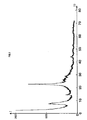
- the H-NU-88 zeolite has an X-ray diffraction diagram including the results presented in Table 2.
- the X-ray diffractograms from which these data were obtained are characterized by broad reflections with numerous peaks forming shoulders on other peaks of higher intensity. It may happen that some or all of the shoulders are not resolved. This can happen for weakly crystalline samples or samples in which the crystals are small enough to give a significant broadening of the X-rays. This can also be the case when the equipment or conditions used to obtain the different diagram of those used here.
- the Nu-88 zeolite is believed to have a new basic structure or topology which is characterized by its X-ray diffraction diagram.
- the NU-88 zeolite under its "raw synthetic form" has substantially the characteristics obtained by X-ray diffraction, presented in Table 1, and is thus distinguished from known zeolites.
- the subject of the invention also includes any zeolite of the same structural type as that NU-88 zeolite.
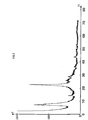
- Tables 1 and 2 and the diffractograms of Figures 1 and 2 are relatively few usual for zeolitic structures. Therefore, these data seem indicate that the NU-88 zeolite has a faulty structure.
- m is generally between 0.1 and 10, preferably between 0.2 and 9, and again more preferred between 0.6 and 8; it appears that the NU-88 zeolite is generally obtained most easily in a very pure form when m is between 0.6 and 8.
- compositions indicated above for the NU-88 zeolite are given on an anhydrous basis, although the NU-88 zeolite in its "crude synthetic form" and the activated forms of the NU-88 zeolite, ie - say resulting from calcination and / or an ion exchange, may contain water.
- the molar H 2 O content of such forms, including the zeolite NU-88 in its "crude form of synthesis”, varies according to the conditions under which they were prepared and stored after synthesis or activation.
- the molar amounts of water contained in these forms are typically between 0 and 100% XO 2 .
- the calcined forms of the NU-88 zeolite do not contain any nitrogenous organic compound, or in less quantity than the "crude form of synthesis", insofar as the organic substance is eliminated for the most part, generally by a heat treatment consisting in burning the organic substance in the presence of air, the hydrogen ion (H + ) then forming the other cation.
- the ammonium form (NH 4 + ) is important because it can be easily converted into the hydrogen form by calcination.
- the hydrogen form and the forms containing metals introduced by ion exchange are described below.
- the fact of subjecting the zeolite according to the invention to the action of an acid can give rise to the partial or total elimination of a basic element such as aluminum, as well as the generation of form. hydrogen. This can be a way to change the composition of the zeolite substance after it has been synthesized.
- the NU-88 zeolite in hydrogen form (acid form), called H-NU-88, is produced by calcination and by ion exchange as described below.
- Such a zeolite generally presents an X-ray diffraction diagram comprising the results presented in Table 1.
- the NU-88 zeolite will preferably be used at least in part in acid form (and preferably wholly in H) form or partially exchanged with cations metallic, for example cations of alkaline earth metals.
- the NU-88 zeolites which form part of the composition according to the invention are used with the silicon and aluminum contents obtained on synthesis.
- the porous mineral matrix usually amorphous or poorly crystallized, usually consists of at least one refractory oxide in amorphous or poorly crystallized form.
- Said matrix is preferably chosen from the group formed by alumina, silica, silica-alumina, or a mixture of at least two of the oxides mentioned above.
- aluminates We can also choose aluminates.
- matrices containing alumina in all these forms known to a person skilled in the art, for example gamma alumina.
- the sources of element of the VB group which can be used are well known to those skilled in the art.
- oxides can be used, such as diniobium pentaoxide Nb 2 O 5 , niobic acid Nb 2 O 5 .H 2 O, niobium hydroxides and polyoxoniobates, alkoxides of niobium of formula Nb (OR 1 ) 3 where R 1 is an alkyl radical, niobium oxalate NbO (HC 2 O 4 ) 5 , ammonium niobate.
- niobium oxalate or ammonium niobate is used.
- the sulfur source can be elemental sulfur, carbon sulfide, hydrogen sulfide, sulfur-containing hydrocarbons such as dimethyl sulfide, dimethyl disulfide, mercaptans, thiophene compounds, thiols, polysulfides such as for example ditertiononylpolysulfide or TPS-37 from the company ATOCHEM, petroleum cuts rich in sulfur such as petrol, kerosene, diesel, alone or in mixtures with one of the sulfur-containing compounds mentioned above.
- Source of preferred sulfur is carbon sulfide or hydrogen sulfide.
- the preferred phosphorus source is orthophosphoric acid H 3 PO 4 , but its salts and esters such as ammonium phosphates are also suitable.
- the phosphorus can for example be introduced in the form of a mixture of phosphoric acid and a basic organic compound containing nitrogen such as ammonia, primary and secondary amines, cyclic amines, compounds of the family of pyridine and quinolines and compounds of the pyrrole family.
- ethyl orthosilicate Si (OEt) 4 siloxanes, polysiloxanes, silicones, silicone emulsions, halide silicates such as ammonium fluorosilicate (NH 4 ) 2 SiF 6 or sodium fluorosilicate Na 2 SiF 6 .
- Silicomolybdic acid and its salts, silicotungstic acid and its salts can also be advantageously used.
- Silicon can be added, for example, by impregnating ethyl silicate in solution in a water / alcohol mixture. The silicon can be added, for example, by impregnating a silicon compound of the silicone type suspended in water.
- the boron source can be boric acid, preferably orthoboric acid H 3 BO 3 , ammonium biborate or pentaborate, boron oxide, boric esters.
- Boron can for example be introduced in the form of a mixture of boric acid, hydrogen peroxide and a basic organic compound containing nitrogen such as ammonia, primary and secondary amines, cyclic amines, compounds of the pyridine and quinoline family and compounds of the pyrrole family. Boron can be introduced for example by a solution of boric acid in a water / alcohol mixture.
- the fluoride anions can be introduced in the form of hydrofluoric acid or its salts. These salts are formed with alkali metals, ammonium or an organic compound. In the latter case, the salt is advantageously formed in the reaction mixture by reaction between the organic compound and hydrofluoric acid. It is also possible to use hydrolyzable compounds which can release fluoride anions in water, such as ammonium fluorosilicate (NH 4 ) 2 SiF 6 , silicon tetrafluoride SiF 4 or sodium Na 2 SiF 6 . Fluorine can be introduced for example by impregnation of an aqueous solution of hydrofluoric acid or ammonium fluoride.
- the sources of VIB group elements that can be used are well known from the skilled person.
- the sources of molybdenum and tungsten there are can use oxides and hydroxides, molybdic and tungstic acids and their salts, in particular ammonium salts such as ammonium molybdate, ammonium heptamolybdate, ammonium tungstate, acid phosphomolybdic, phosphotungstic acid and their salts, silicomolybdic acid, silicotungstic acid and their salts.
- Oxides and salts are preferably used ammonium such as ammonium molybdate, ammonium heptamolybdate and ammonium tungstate.
- group VIII elements which can be used are well known from the skilled person.
- non-noble metals we will use nitrates, sulfates, phosphates, halides for example, chlorides, bromides and fluorides, carboxylates, for example acetates and carbonates.
- halides for example chloride, nitrates, acids such as chloroplatinic acid, oxychlorides such as ammoniacal oxychloride of ruthenium.
- the catalysts obtained by the present invention are generally shaped.
- the grains then obtained have different shapes and dimensions. They are generally used in the form of cylindrical or multi-lobed extrudates such as two-lobed, three-lobed, multi-lobed in straight or twisted shape, but can optionally be manufactured and used in the form of crushed powder, tablets, rings, balls , wheels. They have a specific surface area measured by nitrogen adsorption according to the BET method (Brunauer, Emmett, Teller, J. Am. Chem. Soc., Vol.
- the catalysts obtained by the present invention are used for hydrocracking hydrocarbon charges such as petroleum cuts.
- the charges used in the process are gasolines, kerosene, gas oils, vacuum gas oils, atmospheric residues, vacuum residues, atmospheric distillates, vacuum distillates, heavy fuels, oils, waxes and paraffins, oils used, deasphalted residues or crudes, fillers from processes thermal or catalytic conversions and their mixtures. They contain heteroatoms such as sulfur, oxygen and nitrogen and possibly metals.
- the catalysts thus obtained are advantageously used for hydrocracking in particular of heavy hydrocarbon cuts such as vacuum distillates, residues deasphalted or hydrotreated or equivalent.
- Heavy cuts are preferred made up of at least 80% by volume of compounds with boiling points at least 350 ° C and preferably between 350 and 580 ° C (i.e. corresponding to compounds containing at least 15 to 20 carbon atoms). They contain generally heteroatoms such as sulfur and nitrogen. The nitrogen content is usually between 1 and 5000 ppm by weight and the sulfur content between 0.01 and 5% weight.
- the hydrocracking conditions such as temperature, pressure, hydrogen recycling rate, hourly volume speed, may be very variable depending on the nature of the feed, the quality of the desired products and the facilities available to the refiner.
- the temperature is generally higher than 200 ° C and often between 250 ° C and 480 ° C.
- the pressure is greater than 0.1 MPa and often greater than 1 MPa.
- the quantity of hydrogen is at least 50 liters of hydrogen per liter of charge and often between 80 and 5000 liters of hydrogen per liter of charge.
- the hourly space velocity is generally between 0.1 and 20 volume of charge per volume of catalyst and per hour (h -1 ).
- the catalysts of the present invention are preferably subjected to a treatment of sulfurization making it possible to transform, at least in part, the species metal sulfide before their contact with the load to be treated.
- This activation treatment by sulfurization is well known to those skilled in the art and can be performed by any method already described in the literature.
- a conventional sulfurization method well known to those skilled in the art consists in heat in the presence of hydrogen sulfide at a temperature between 150 and 800 ° C, preferably between 250 and 600 ° C, generally in a reaction zone with crossed bed.
- the catalyst of the present invention can be advantageously used for hydrocracking of hydrocarbon charges, in particular cuts of the type vacuum distillates, more particularly for example sulfur-containing cuts greater than 0.1% by weight and with a nitrogen content greater than 10 ppm.
- the conversion level is less than 55%.
- the catalyst according to the invention is then used at a temperature generally greater than or equal to 230 ° C and preferably between 300 ° C and 480 ° C, and often between 350 ° C and 450 ° C.
- the pressure is generally greater than 2MPa and preferably greater than 3MPa, and less than 12 MPa, preferably less than 10 MPa.
- the quantity of hydrogen is at least 100 liters of hydrogen per liter of charge and often between 200 and 3000 liters of hydrogen per liter of charge.
- the hourly volume speed is generally between 0.1 and 10 h -1 . Under these conditions, the catalysts of the present invention exhibit better activity in conversion, in hydrodesulfurization and in hydrodenitrogenation than the commercial catalysts.
- the catalyst of the present invention can be used for partial hydrocracking, advantageously under conditions of moderate hydrogen pressure, of sections, for example of the vacuum distillate type highly charged with sulfur and nitrogen which have been previously hydrotreated.
- the conversion level is less than 55%.
- the petroleum cut conversion process takes place in two stages, the catalysts according to the invention being used in the second stage.
- the catalyst of the first stage has a hydrotreatment function and comprises a matrix preferably based on alumina, and preferably not containing a zeolite, and at least one metal having a hydrogenating function.
- Said matrix is an porous amorphous or poorly crystallized oxide-type mineral matrix.
- aluminas Mention may be made, by way of nonlimiting example, of aluminas, silicas, silica-alumina. We can also choose aluminates. It is preferred to use matrices containing alumina, in all these forms known to a person skilled in the art, and even more preferably aluminas, for example gamma alumina.
- the hydrotreatment function is provided by at least one metal or group VIII metal compound such as, for example, nickel and cobalt. It is possible to use a combination of at least one metal or compound of group VIB metal (for example molybdenum or tungsten) and of at least one metal or compound of group VIII metal (for example cobalt or nickel) of the Periodic Table of the Elements.
- the total concentration of metal oxides of groups VIB and VIII is preferably between 5 and 40% by weight and very preferably between 7 and 30% by weight and the weight ratio expressed as metal oxide to metal (or metals) of the group VIB on metal (or metals) of group VIII is preferably between 1.25 and 20 and very preferably between 2 and 10.
- this catalyst may contain phosphorus.
- the first step generally takes place at a temperature of 350-460 ° C, preferably 360-450 ° C, a pressure of at least 2MPa; and preferably at least 3 MPa, an hourly space velocity of 0.1-5 h -1, preferably 0.2-2 h -1 and with a quantity of hydrogen of at least 100 liters of hydrogen per liter of feed, and preferably 260-3000 liters of hydrogen per liter of charge.
- the temperatures are generally greater than or equal to 230 ° C and often between 300 ° C and 480 ° C, preferably between 330 ° C and 450 ° C.
- the pressure is generally at least 2MPa and preferably at least 3MPa, and less than 12MPa, preferably less than 10MPa.
- the quantity of hydrogen is at least 100 liters of hydrogen per liter of charge and often between 200 and 3000 liters of hydrogen per liter of charge.
- the hourly volume speed is generally between 0.15 and 10 h -1 . Under these conditions, the catalysts of the present invention exhibit better activity in conversion, in hydrodesulfurization, in hydrodenitrogenation and better selectivity in middle distillates than the commercial catalysts. The service life of the catalysts is also improved in the moderate pressure range.
- the catalyst of the present invention can be used for hydrocracking under high hydrogen pressure conditions at least 5 MPa.
- the treated sections are for example of vacuum distillates type. heavily loaded with sulfur and nitrogen which have been hydrotreated beforehand.
- the conversion level is greater than 55%.
- the petroleum cut conversion process takes place in two stages, the catalyst according to the invention being used in the second step.
- the catalyst of the first stage has a hydrotreatment function and comprises a matrix preferably based on alumina, and preferably not containing a zeolite, and at least one metal having a hydrogenating function.
- Said matrix can also consist of, or contain, silica, silica-alumina, boron oxide, magnesia, zirconia, titanium oxide or a combination of these oxides.
- the hydro-dehydrogenating function is provided by at least one metal or compound of group VIII metal such as nickel and cobalt in particular. It is possible to use a combination of at least one metal or compound of group VI metal (in particular molybdenum or tungsten) and of at least one metal or compound of group VIII metal (especially cobalt or nickel) of the periodic classification of the elements.
- the total concentration of metal oxides of groups VI and VIII is between 5 and 40% by weight and preferably between 7 and 30% by weight and the weight ratio expressed as metal oxide to metal (or metals) of group VI on metal (or metals) of group VIII is between 1.25 and 20 and preferably between 2 and 10.
- this catalyst may contain phosphorus.
- the first stage generally takes place at a temperature of 350-460 ° C, preferably 360-450 ° C, a pressure of at least 2MPa, and preferably of at least 3MPa, an hourly volume speed of 0.1- 5h -1 and preferably 0.2-2h -1 and with a quantity of hydrogen of at least 100 liters of hydrogen per liter of charge, and preferably 260-3000 liters of hydrogen per liter of charge.
- the temperatures are generally greater than or equal to 230 ° C and often between 300 ° C and 480 ° C, and preferably between 300 ° C and 440 ° C.
- the pressure is generally greater than 5MPa and preferably greater than 7MPa.
- the quantity of hydrogen is at least 100 liters of hydrogen per liter of charge and often between 200 and 3000 liters of hydrogen per liter of charge.
- the hourly volume speed is generally between 0.15 and 10 h -1 .
- the catalysts of the present invention exhibit better activity in conversion than commercial catalysts, even for considerably weaker zeolite than that of commercial catalysts.
- Solution A was added to dispersion C with stirring; solution B was then added. Stirring was continued until a homogeneous gel was obtained.
- the mixture obtained was then transferred to a stainless steel autoclave with a capacity of 1 liter. The mixture was brought to a temperature of 160 ° C. This temperature has was maintained for the duration of the reaction. In addition, the mixture was kept stirring using an agitator with inclined paddles.
- the product obtained above is calcined under nitrogen for 24 hours at 550 ° C; this step was immediately followed by a second calcination in air at 450 ° C., for 24 hours.
- the substance obtained was then contacted for 2 hours at temperature room with an aqueous solution of 1 mole of ammonium chloride using 50 ml of solution per gram of solid calcined product.
- the substance was then filtered, washed with deionized water and dried at 110 ° C. This treatment was repeated 3 times.
- the the substance was then calcined in air for 24 hours at 550 ° C.
- the product calcined was analyzed by X-ray diffraction.
- the diffractogram obtained is given figure 2 [on the abscissa 2q (Cu K alpha) and on the ordinate the intensity I (unit arbitrary)].
- the X-ray diffraction diagram agrees with Table 2.
- the dough obtained is passed through a die having cylindrical orifices with a diameter equal to 1.4 mm.
- the extrudates are then dried overnight at 120 ° C in air and then calcined at 550 ° C in air.
- the support extrudates containing a NU-88 zeolite prepared in Example 1 are dry impregnated with an aqueous solution of a mixture of heptamolybdate of ammonium and nickel nitrate, dried overnight at 120 ° C in air and finally calcined in air at 550 ° C.
- the oxide contents by weight of the catalyst CZ10 obtained are shown in Table 2.
- the extrudates are impregnated to dryness with an aqueous solution of a mixture ammonium heptamolybdate, nickel nitrate and orthophosphoric acid, dried overnight at 120 ° C in air and finally calcined in air at 550 ° C.
- the contents by weight in oxides of the catalyst CZ10P obtained are indicated in table 2.
- the catalysts of Example 3 above are impregnated with an aqueous solution of niobium oxalate Nb (HC 2 O 4 ) 5 , oxalic acid and ammonium oxalate.
- the aqueous solution containing niobium is prepared from 1330 ml of water in which 33 g of oxalic acid, 37.2 g of ammonium oxalate and 92.3 g of niobium oxalate are dissolved. This makes it possible to deposit approximately 5% by weight of Nb on the catalyst.
- the oxalic acid and ammonium oxalate mixture is first dissolved and when the solution is clear, said solution is heated to 55 ° C. and the niobium oxalate is added. It is then made up with water to obtain 1330 ml of solution.
- the catalysts of Example 3 above are impregnated by the method known as with excess solution.
- the 1330 ml of solution are brought into contact with 380 g of catalyst. After two hours, the extrudates are recovered. These are then dried overnight at 120 ° C under a stream of dry air.
- the final oxide contents of catalysts CZ10Nb, CZ10NbP and CZ10NbPBSi thus obtained are indicated in the table 2.
- the catalysts are used under the conditions of hydrocracking at moderate pressure on an oil feed, the main characteristics of which are as follows: Density (20/4) 0.921 Sulfur (% by weight) 2.46 Nitrogen (ppm weight) 1130 Simulated distillation initial point 365 ° C point 10% 430 ° C point 50% 472 ° C point 90% 504 ° C period 539 ° C pour point + 39 ° C
- the catalytic test unit comprises two reactors in a fixed bed, with upward flow of the charge. In the first reactor, the one in which the charge passes first, the catalyst of the first hydrotreatment step is introduced.
- HTH548 sold by the company Procatalyse comprising an element of group VI and an element of group VIII deposited on alumina
- the hydrocracking catalysts prepared in examples 1 to 3. 40 ml of catalyst are introduced into each of the reactors The two reactors operate at the same temperature and at the same pressure
- the operating conditions of the test unit are as follows: Total pressure 5 MPa Hydrotreatment catalyst 40 cm 3 Hydrocracking catalyst 40 cm 3 Temperature 400 ° C Hydrogen flow 20 l / h Charge flow 40 cm 3 / h
- the two catalysts undergo an in-situ sulfurization step before reaction. Note that any in-situ or ex-situ sulfurization method is suitable. Once the sulfurization carried out, the charge described above can be transformed.
- the catalytic performances are expressed by the gross conversion at 400 ° C. (CB), by gross selectivity in middle distillates (SB) and by conversions in hydrodesulfurization (HDS) and hydrodenitrogenation (HDN). These performances catalytic are measured on the catalyst after a stabilization period, generally at least 48 hours, has been respected.
- the catalysts containing zeolite NU-88 according to the invention exhibit greater activity, that is to say higher conversions for the same reaction temperature of 400 ° C., than the catalysts not in accordance (CZ10, CZ10P and CZ10PBSi).
- the catalysts according to the invention containing niobium are therefore particularly advantageous for the partial hydrocracking of feeds of the distillate type under vacuum containing nitrogen at a moderate hydrogen pressure.
- the catalysts containing zeolite NU-88 and niobium are used under the conditions of hydrocracking with high conversion (60-100%).
- the petroleum charge is a hydrotreated vacuum distillate, the main characteristics of which are as follows: Density (20/4) 0.869 Sulfur (ppm weight) 502 Nitrogen (ppm weight) 10 Simulated distillation initial point 298 ° C point 10% 369 ° C point 50% 427 ° C point 90% 481 ° C period 538 ° C
- This charge was obtained by hydrotreating a vacuum distillate on a HR360 catalyst sold by the company Procatalyse comprising an element of the group VIB and an element of group VIII deposited on alumina.
- the charge thus prepared is injected into the hydrocracking test unit which comprises a fixed bed reactor, with upward circulation of the charge ("up-flow"), into which 80 ml of catalyst is introduced.
- the catalyst is sulfurized by an n-hexane / DMDS + aniline mixture up to 320 ° C. Any in-situ or ex-situ sulfurization method can be used. Once the sulfurization has been carried out, the charge described above can be transformed.
- the operating conditions of the test unit are as follows: Total pressure 9 MPa Catalyst 80 cm 3 Temperature 360-420 ° C Hydrogen flow 80 l / h Charge flow 80 cm 3 / h
- the catalytic performances are expressed by the temperature which makes it possible to reach a level of gross conversion of 70% and by the gross selectivity in distillates medium 150-380 ° C. These catalytic performances are measured on the catalyst after a stabilization period, generally at least 48 hours, has been observed.
- the gasoline yield (27-150) (below Rdt Ess) is equal to the% weight of compounds with a boiling point between 27 and 150 ° C in the effluents.
- the jet fuel yield (kerosene, 150-250) (below zero yield) is equal to% weight of compounds having a boiling point between 150 and 250 ° C in the effluents.
- the diesel yield (250-380) is equal to the% weight of compounds having a boiling point between 250 and 380 ° C in the effluents.
- the reaction temperature is fixed so as to reach a raw conversion CB equal to 70% by weight.
- a raw conversion CB equal to 70% by weight.
- Table 5 shows that the use of a catalyst according to the invention containing zeolite NU-88 and niobium, leads to higher conversion levels (i.e. lower conversion temperatures for a given conversion of 70% by weight) relative to the nonconforming catalysts containing no niobium. Furthermore, all the catalysts containing a NU-88 zeolite and niobium according to the invention leads to improved gasoline yields compared to those recorded in the case of the catalysts of the prior art containing no niobium.
Landscapes
- Chemical & Material Sciences (AREA)
- Organic Chemistry (AREA)
- Engineering & Computer Science (AREA)
- Chemical Kinetics & Catalysis (AREA)
- Crystallography & Structural Chemistry (AREA)
- Materials Engineering (AREA)
- Inorganic Chemistry (AREA)
- Oil, Petroleum & Natural Gas (AREA)
- Life Sciences & Earth Sciences (AREA)
- General Life Sciences & Earth Sciences (AREA)
- Geology (AREA)
- General Chemical & Material Sciences (AREA)
- Catalysts (AREA)
Applications Claiming Priority (2)
| Application Number | Priority Date | Filing Date | Title |
|---|---|---|---|
| FR9802102A FR2775200B1 (fr) | 1998-02-20 | 1998-02-20 | Catalyseur comprenant une zeolithe nu-88, un element du groupe vb et son utilisation en hydroconversion de charges petrolieres hydrocarbonees |
| FR9802102 | 1998-02-20 |
Publications (2)
| Publication Number | Publication Date |
|---|---|
| EP0937683A1 true EP0937683A1 (de) | 1999-08-25 |
| EP0937683B1 EP0937683B1 (de) | 2002-06-05 |
Family
ID=9523214
Family Applications (1)
| Application Number | Title | Priority Date | Filing Date |
|---|---|---|---|
| EP99400374A Expired - Lifetime EP0937683B1 (de) | 1998-02-20 | 1999-02-16 | Ein NU-88 Zeolit und ein Element der Gruppe VB haltender Katalysator und seine Verwendung für die Hydroumwandlung von Kohlenwasserstoffeneinsätzen |
Country Status (6)
| Country | Link |
|---|---|
| US (1) | US6136180A (de) |
| EP (1) | EP0937683B1 (de) |
| KR (1) | KR19990072702A (de) |
| DE (1) | DE69901635T2 (de) |
| ES (1) | ES2178356T3 (de) |
| FR (1) | FR2775200B1 (de) |
Cited By (1)
| Publication number | Priority date | Publication date | Assignee | Title |
|---|---|---|---|---|
| WO2001000321A1 (fr) * | 1999-06-25 | 2001-01-04 | Institut Français Du Petrole | Catalyseur contenant une zeolithe chargee en element du groupe vb et son utilisation en hydroraffinage et hydrocraquage de coupes hydrocarbonees |
Families Citing this family (18)
| Publication number | Priority date | Publication date | Assignee | Title |
|---|---|---|---|---|
| FR2778582B1 (fr) * | 1998-05-13 | 2000-06-16 | Inst Francais Du Petrole | Procede pour l'amelioration du point d'ecoulement et catalyseur a base d'au moins une zeolithe mtt, ton, fer |
| US7648941B2 (en) * | 2004-09-22 | 2010-01-19 | Exxonmobil Research And Engineering Company | Bulk bimetallic catalysts, method of making bulk bimetallic catalysts and hydroprocessing using bulk bimetallic catalysts |
| US11318453B2 (en) | 2009-04-21 | 2022-05-03 | Albemarle Catalysts Company B.V. | Hydrotreating catalyst containing phosphorus and boron |
| US7964524B2 (en) * | 2009-04-29 | 2011-06-21 | Chevron U.S.A. Inc. | Hydroconversion multi-metallic catalyst and method for making thereof |
| WO2010126690A2 (en) * | 2009-04-29 | 2010-11-04 | Chevron U.S.A. Inc. | Hydroconversion multi-metallic catalyst and method for making thereof |
| US8080492B2 (en) * | 2009-04-29 | 2011-12-20 | Chevron U.S.A. Inc. | Hydroconversion multi-metallic catalyst and method for making thereof |
| US7964526B2 (en) * | 2009-04-29 | 2011-06-21 | Chevron U.S.A. Inc. | Hydroconversion multi-metallic catalyst and method for making thereof |
| AU2010242953B2 (en) * | 2009-04-29 | 2015-03-19 | Chevron U.S.A. Inc. | Hydroconversion multi-metallic catalyst and method for making thereof |
| US8383543B2 (en) * | 2009-04-29 | 2013-02-26 | Chevron U.S.A. Inc. | Hydroconversion multi-metallic catalyst and method for making thereof |
| US8058203B2 (en) * | 2009-04-29 | 2011-11-15 | Chevron U.S.A. Inc. | Hydroconversion multi-metallic catalyst and method for making thereof |
| US7931799B2 (en) * | 2009-04-29 | 2011-04-26 | Chevron U.S.A. Inc. | Hydroconversion multi-metallic catalyst and method for making thereof |
| US7964525B2 (en) * | 2009-04-29 | 2011-06-21 | Chevron U.S.A. Inc. | Hydroconversion multi-metallic catalyst and method for making thereof |
| US8545797B2 (en) * | 2011-04-28 | 2013-10-01 | Chevron U.S.A. Inc. | Germanosilicate SSZ-75 |
| CN106276950B (zh) * | 2015-06-02 | 2018-11-30 | 中国石油化工股份有限公司 | 一种制备nu-88分子筛的方法 |
| CN107285330B (zh) * | 2016-03-30 | 2019-04-16 | 中国石油化工股份有限公司 | 一种nu-88分子筛的制备方法 |
| CN106179524B (zh) * | 2016-07-08 | 2018-02-13 | 昌邑凯特新材料有限公司 | 一种co耐硫变换催化剂的预硫化方法 |
| CN111097500B (zh) * | 2018-10-26 | 2023-05-05 | 中国石油化工股份有限公司 | 负载型催化剂及其制备方法和应用以及一种临氢处理柴油馏分的方法 |
| CN115140747B (zh) * | 2021-03-30 | 2023-11-10 | 中国石油化工股份有限公司 | 一种颗粒状nu-88分子筛及其制备方法 |
Citations (4)
| Publication number | Priority date | Publication date | Assignee | Title |
|---|---|---|---|---|
| DE2709498A1 (de) * | 1976-03-04 | 1977-10-20 | Kaihatsu Kenkyusho Ind Res | Verfahren zur herstellung eines reduktionskatalysators zur abscheidung von stickoxiden aus abgasen |
| EP0135658A2 (de) * | 1983-04-12 | 1985-04-03 | Teijin Petrochemical Industries Ltd. | Herstellung von kristallinen Zeolithen |
| US4676958A (en) * | 1985-03-06 | 1987-06-30 | Chevron Research Company | Preparation of crystalline zeolites using magadiite |
| EP0825152A1 (de) * | 1996-08-23 | 1998-02-25 | Institut Francais Du Petrole | Zeolith NU-88, Verfahren zu seiner Herstellung sowie seine katalytische Verwendungen |
-
1998
- 1998-02-20 FR FR9802102A patent/FR2775200B1/fr not_active Expired - Fee Related
-
1999
- 1999-02-16 ES ES99400374T patent/ES2178356T3/es not_active Expired - Lifetime
- 1999-02-16 EP EP99400374A patent/EP0937683B1/de not_active Expired - Lifetime
- 1999-02-16 DE DE69901635T patent/DE69901635T2/de not_active Expired - Fee Related
- 1999-02-18 KR KR1019990005345A patent/KR19990072702A/ko not_active Withdrawn
- 1999-02-19 US US09/253,011 patent/US6136180A/en not_active Expired - Fee Related
Patent Citations (4)
| Publication number | Priority date | Publication date | Assignee | Title |
|---|---|---|---|---|
| DE2709498A1 (de) * | 1976-03-04 | 1977-10-20 | Kaihatsu Kenkyusho Ind Res | Verfahren zur herstellung eines reduktionskatalysators zur abscheidung von stickoxiden aus abgasen |
| EP0135658A2 (de) * | 1983-04-12 | 1985-04-03 | Teijin Petrochemical Industries Ltd. | Herstellung von kristallinen Zeolithen |
| US4676958A (en) * | 1985-03-06 | 1987-06-30 | Chevron Research Company | Preparation of crystalline zeolites using magadiite |
| EP0825152A1 (de) * | 1996-08-23 | 1998-02-25 | Institut Francais Du Petrole | Zeolith NU-88, Verfahren zu seiner Herstellung sowie seine katalytische Verwendungen |
Cited By (1)
| Publication number | Priority date | Publication date | Assignee | Title |
|---|---|---|---|---|
| WO2001000321A1 (fr) * | 1999-06-25 | 2001-01-04 | Institut Français Du Petrole | Catalyseur contenant une zeolithe chargee en element du groupe vb et son utilisation en hydroraffinage et hydrocraquage de coupes hydrocarbonees |
Also Published As
| Publication number | Publication date |
|---|---|
| FR2775200B1 (fr) | 2000-04-28 |
| US6136180A (en) | 2000-10-24 |
| EP0937683B1 (de) | 2002-06-05 |
| FR2775200A1 (fr) | 1999-08-27 |
| DE69901635D1 (de) | 2002-07-11 |
| ES2178356T3 (es) | 2002-12-16 |
| DE69901635T2 (de) | 2002-09-19 |
| KR19990072702A (ko) | 1999-09-27 |
Similar Documents
| Publication | Publication Date | Title |
|---|---|---|
| EP0967014B1 (de) | Ein einen Beta Zeolith und ein Element der Gruppe VB enthaltender Hydrospaltungskatalysator | |
| EP1353747B1 (de) | Katalysator, der ein siliciumdioxid-aluminiumoxid enthält, und dessen verwendung beim hydrocracking von kohlenwasserstoff-einsatzstoffen | |
| EP0937683B1 (de) | Ein NU-88 Zeolit und ein Element der Gruppe VB haltender Katalysator und seine Verwendung für die Hydroumwandlung von Kohlenwasserstoffeneinsätzen | |
| EP1462167B1 (de) | Katalysator enthaltend mindestens einen Zeolith ZBM-30 und mindestens einen Zeolith Y und Verfahren zur Hydrokonversion von Kohlenwasserstoffen mit einem solchen Katalysator | |
| EP0955093B1 (de) | Katalysator auf Basis von Beta-Zeolith mit Promotorelement und Verfahren zum Hydrocracken | |
| EP0967012A1 (de) | Ein einen nicht globalen entaluminierten Y Zeolith, ein Element der Gruppe VB und einen Promotor enthaltender Hydrospaltungskatalysator | |
| EP0955091B1 (de) | Katalysator auf Basis von Silicium enthaltenden Y-Zeolith verwendbar für Hydrocracking | |
| EP1198538B1 (de) | Ein teilweise amorfe zeolit y enthaltender katalysator und seine verwendung für die wasserstoffumsetzung von kohlenwasserstoffeinsätzen | |
| EP0938926B1 (de) | Katalysator haltende ein Zeolith aus der Gruppe NU-85,NU-86 und NU-87 und seine Verwendung für die Hydroumwandlung von Kohlenwasserstoffeneinsätzen | |
| EP0980708B1 (de) | Zeolit NU85, NU86 oder NU87 Katalysator, welcher eine Gruppe VB Metall enthält und dessen Verwendung in die Wasserstoffumsetzung von Kohlenwasserstoffeinsätzen | |
| EP1198292B1 (de) | Ein teilweise amorfe zeolit y enthaltender katalysator und seine verwendung für die wasserstoffumsetzung und wasserstoffrafinierung von kohlenwasserstoffeinsätzen | |
| FR2780308A1 (fr) | Catalyseur comprenant une argile et un element du groupe vb, et son utilisation en hydrocraquage de charges petrolieres hydrocarbonees | |
| EP0955092A1 (de) | Katalysator auf Basis von nicht gesamt entaluminierten Y-Zeolith, Bor und/oder Silicium und Verfahren zum Hydrocracken | |
| EP0937499B1 (de) | Zeolith NU-88 enthaltenden Katalysator und ihre Verwendung zur Umwandlung von Erdöleinsätzen | |
| FR2780309A1 (fr) | Catalyseur d'hydrocraquage comprenant une zeolithe beta, un element du groupe vb, et un element promoteur choisi dans le groupe forme par le bore, le phosphore et le silicium | |
| EP0939113B1 (de) | Hydrokrackverfahren in Gegenwart eines Katalysators mit mindestens einem NU-85, NU-86 oder NU-87 Zeolithen | |
| FR2793704A1 (fr) | Catalyseur comprenant une zeolithe y partiellement amorphe et son utilisation en hydroconversion de charges petrolieres hydrocarbonees | |
| FR2780310A1 (fr) | Catalyseur d'hydrocraquage comprenant une zeolithe y desaluminee, un element du groupe vb, et un element promoteur choisi dans le groupe forme par le bore, le phosphore et le silicium | |
| FR2790002A1 (fr) | Procede d'hydrocraquage de charges hydrocarbonees en presence d'un catalyseur comprenant une zeolithe im-5 et un element du groupe vb | |
| FR2780307A1 (fr) | Catalyseur d'hydrocraquage a base d'une zeolithe desaluminee et d'une phase sulfure mixte comprenant du soufre, au moins un element du groupe vb et au moins un element du groupe vib | |
| FR2790001A1 (fr) | Procede d'hydrocraquage avec un catalyseur comprenant une zeolithe im-5 et catalyseur comprenant une zeolithe im-5 et un element promoteur | |
| FR2775202A1 (fr) | Catalyseur comprenant une zeolithe choisie dans le groupe forme par les zeolithes nu-86 et nu-87 et son utilisation en hydroconversion de charges petrolieres hydrocarbonees | |
| FR2775442A1 (fr) | Catalyseur comprenant au moins une zeolithe nu-85 et son utilisation en hydroconversion de charges petrolieres hydrocarbonees | |
| FR2778344A1 (fr) | Catalyseur a base de zeolithe beta et d'element promoteur et procede d'hydrocraquage | |
| FR2780306A1 (fr) | Catalyseur d'hydrocraquage a base d'une zeolithe beta et d'une phase sulfure mixte comprenant du soufre, au moins un element du groupe vb et au moins un element du groupe vib |
Legal Events
| Date | Code | Title | Description |
|---|---|---|---|
| PUAI | Public reference made under article 153(3) epc to a published international application that has entered the european phase |
Free format text: ORIGINAL CODE: 0009012 |
|
| AK | Designated contracting states |
Kind code of ref document: A1 Designated state(s): DE ES GB IT NL |
|
| AX | Request for extension of the european patent |
Free format text: AL;LT;LV;MK;RO;SI |
|
| 17P | Request for examination filed |
Effective date: 20000225 |
|
| AKX | Designation fees paid |
Free format text: DE ES GB IT NL |
|
| 17Q | First examination report despatched |
Effective date: 20010312 |
|
| GRAG | Despatch of communication of intention to grant |
Free format text: ORIGINAL CODE: EPIDOS AGRA |
|
| GRAG | Despatch of communication of intention to grant |
Free format text: ORIGINAL CODE: EPIDOS AGRA |
|
| GRAH | Despatch of communication of intention to grant a patent |
Free format text: ORIGINAL CODE: EPIDOS IGRA |
|
| GRAH | Despatch of communication of intention to grant a patent |
Free format text: ORIGINAL CODE: EPIDOS IGRA |
|
| GRAA | (expected) grant |
Free format text: ORIGINAL CODE: 0009210 |
|
| AK | Designated contracting states |
Kind code of ref document: B1 Designated state(s): DE ES GB IT NL |
|
| REG | Reference to a national code |
Ref country code: GB Ref legal event code: FG4D Free format text: NOT ENGLISH |
|
| REF | Corresponds to: |
Ref document number: 69901635 Country of ref document: DE Date of ref document: 20020711 |
|
| GBT | Gb: translation of ep patent filed (gb section 77(6)(a)/1977) |
Effective date: 20020812 |
|
| REG | Reference to a national code |
Ref country code: ES Ref legal event code: FG2A Ref document number: 2178356 Country of ref document: ES Kind code of ref document: T3 |
|
| PGFP | Annual fee paid to national office [announced via postgrant information from national office to epo] |
Ref country code: GB Payment date: 20030124 Year of fee payment: 5 |
|
| PGFP | Annual fee paid to national office [announced via postgrant information from national office to epo] |
Ref country code: ES Payment date: 20030217 Year of fee payment: 5 |
|
| PGFP | Annual fee paid to national office [announced via postgrant information from national office to epo] |
Ref country code: NL Payment date: 20030221 Year of fee payment: 5 |
|
| PGFP | Annual fee paid to national office [announced via postgrant information from national office to epo] |
Ref country code: DE Payment date: 20030306 Year of fee payment: 5 |
|
| PLBE | No opposition filed within time limit |
Free format text: ORIGINAL CODE: 0009261 |
|
| STAA | Information on the status of an ep patent application or granted ep patent |
Free format text: STATUS: NO OPPOSITION FILED WITHIN TIME LIMIT |
|
| 26N | No opposition filed |
Effective date: 20030306 |
|
| PG25 | Lapsed in a contracting state [announced via postgrant information from national office to epo] |
Ref country code: GB Free format text: LAPSE BECAUSE OF NON-PAYMENT OF DUE FEES Effective date: 20040216 |
|
| PG25 | Lapsed in a contracting state [announced via postgrant information from national office to epo] |
Ref country code: ES Free format text: LAPSE BECAUSE OF NON-PAYMENT OF DUE FEES Effective date: 20040217 |
|
| PG25 | Lapsed in a contracting state [announced via postgrant information from national office to epo] |
Ref country code: NL Free format text: LAPSE BECAUSE OF NON-PAYMENT OF DUE FEES Effective date: 20040901 Ref country code: DE Free format text: LAPSE BECAUSE OF NON-PAYMENT OF DUE FEES Effective date: 20040901 |
|
| GBPC | Gb: european patent ceased through non-payment of renewal fee |
Effective date: 20040216 |
|
| NLV4 | Nl: lapsed or anulled due to non-payment of the annual fee |
Effective date: 20040901 |
|
| PG25 | Lapsed in a contracting state [announced via postgrant information from national office to epo] |
Ref country code: IT Free format text: LAPSE BECAUSE OF NON-PAYMENT OF DUE FEES Effective date: 20050216 |
|
| REG | Reference to a national code |
Ref country code: ES Ref legal event code: FD2A Effective date: 20040217 |