EP0937732A2 - Verfahren zur Reduzierung der Sulfankettenlänge Bis(silylorganyl)polysulfanen - Google Patents
Verfahren zur Reduzierung der Sulfankettenlänge Bis(silylorganyl)polysulfanen Download PDFInfo
- Publication number
- EP0937732A2 EP0937732A2 EP98120919A EP98120919A EP0937732A2 EP 0937732 A2 EP0937732 A2 EP 0937732A2 EP 98120919 A EP98120919 A EP 98120919A EP 98120919 A EP98120919 A EP 98120919A EP 0937732 A2 EP0937732 A2 EP 0937732A2
- Authority
- EP
- European Patent Office
- Prior art keywords
- formula
- alk
- bis
- tetrasulfane
- group
- Prior art date
- Legal status (The legal status is an assumption and is not a legal conclusion. Google has not performed a legal analysis and makes no representation as to the accuracy of the status listed.)
- Granted
Links
Classifications
-
- C—CHEMISTRY; METALLURGY
- C07—ORGANIC CHEMISTRY
- C07F—ACYCLIC, CARBOCYCLIC OR HETEROCYCLIC COMPOUNDS CONTAINING ELEMENTS OTHER THAN CARBON, HYDROGEN, HALOGEN, OXYGEN, NITROGEN, SULFUR, SELENIUM OR TELLURIUM
- C07F7/00—Compounds containing elements of Groups 4 or 14 of the Periodic Table
- C07F7/02—Silicon compounds
- C07F7/08—Compounds having one or more C—Si linkages
- C07F7/18—Compounds having one or more C—Si linkages as well as one or more C—O—Si linkages
- C07F7/1804—Compounds having Si-O-C linkages
- C07F7/1872—Preparation; Treatments not provided for in C07F7/20
- C07F7/1892—Preparation; Treatments not provided for in C07F7/20 by reactions not provided for in C07F7/1876 - C07F7/1888
-
- C—CHEMISTRY; METALLURGY
- C08—ORGANIC MACROMOLECULAR COMPOUNDS; THEIR PREPARATION OR CHEMICAL WORKING-UP; COMPOSITIONS BASED THEREON
- C08G—MACROMOLECULAR COMPOUNDS OBTAINED OTHERWISE THAN BY REACTIONS ONLY INVOLVING UNSATURATED CARBON-TO-CARBON BONDS
- C08G75/00—Macromolecular compounds obtained by reactions forming a linkage containing sulfur with or without nitrogen, oxygen, or carbon in the main chain of the macromolecule
-
- C—CHEMISTRY; METALLURGY
- C08—ORGANIC MACROMOLECULAR COMPOUNDS; THEIR PREPARATION OR CHEMICAL WORKING-UP; COMPOSITIONS BASED THEREON
- C08G—MACROMOLECULAR COMPOUNDS OBTAINED OTHERWISE THAN BY REACTIONS ONLY INVOLVING UNSATURATED CARBON-TO-CARBON BONDS
- C08G75/00—Macromolecular compounds obtained by reactions forming a linkage containing sulfur with or without nitrogen, oxygen, or carbon in the main chain of the macromolecule
- C08G75/02—Polythioethers
- C08G75/0204—Polyarylenethioethers
- C08G75/0236—Polyarylenethioethers containing atoms other than carbon or sulfur in a linkage between arylene groups
-
- C—CHEMISTRY; METALLURGY
- C08—ORGANIC MACROMOLECULAR COMPOUNDS; THEIR PREPARATION OR CHEMICAL WORKING-UP; COMPOSITIONS BASED THEREON
- C08G—MACROMOLECULAR COMPOUNDS OBTAINED OTHERWISE THAN BY REACTIONS ONLY INVOLVING UNSATURATED CARBON-TO-CARBON BONDS
- C08G75/00—Macromolecular compounds obtained by reactions forming a linkage containing sulfur with or without nitrogen, oxygen, or carbon in the main chain of the macromolecule
- C08G75/14—Polysulfides
-
- C—CHEMISTRY; METALLURGY
- C08—ORGANIC MACROMOLECULAR COMPOUNDS; THEIR PREPARATION OR CHEMICAL WORKING-UP; COMPOSITIONS BASED THEREON
- C08G—MACROMOLECULAR COMPOUNDS OBTAINED OTHERWISE THAN BY REACTIONS ONLY INVOLVING UNSATURATED CARBON-TO-CARBON BONDS
- C08G77/00—Macromolecular compounds obtained by reactions forming a linkage containing silicon with or without sulfur, nitrogen, oxygen or carbon in the main chain of the macromolecule
Definitions
- the invention relates to a method for reducing the Sulfane chain length of bis (silylorganyl) polysulfanes by Reaction of these compounds with a sulfide and a Haloalkylsilane.
- Polysulfanes of this type have long been known (DE-PS 2255577) and are widely used as reinforcing additives in rubber vulcanizates containing silica, in particular in the tire sector.
- bis (triethoxisilylpropyl) tetrasulfane Si 69, Degussa AG
- Si 69, Degussa AG bis (triethoxisilylpropyl) tetrasulfane
- the disulfanes are manufactured according to the state of the Technology, however, under uncomfortable conditions, since one Must oxidize mercaptosilanes with manganese dioxide (EP-A 0718 302).
- the object of the invention is to provide a method to provide that without these side effects to the leads desired product.
- x stands for one statistical mean since the corresponding pure Polysulfan is often difficult to manufacture.
- reaction ratios are generally chosen so that the compound of the formula (II) is added to the reaction mixture in an amount (mol) which is at least sufficient with the S y resulting from the sulfur content from the desulfurization and the addition of Na 2 S - React groups to compounds of formula (I), wherein y ⁇ x ⁇ 1 corresponds to the length of the sulfane chain formed by the desulfurization.
- the reaction preferably takes place in an organic, preferably polar, solvent which is inert under the test conditions.
- organic, preferably polar, solvent which is inert under the test conditions.
- organic, preferably polar, solvent which is inert under the test conditions.
- aliphatic alcohols with 1 to 6 C atoms include, in particular, aliphatic alcohols with 1 to 6 C atoms, ethers with C 2 -C 12 C atoms, amides, such as, for. B. dimethylformamide, sulfoxides such. B. dimethyl sulfoxide.
- the reaction generally takes place at temperatures from 50 ° C. to the reflux temperature of the solvent used, if appropriate under the pressure which arises at this temperature.
- a tetrasulfane is preferably used in order to shorten the sulfane chain length. This applies in particular to the readily available bis (triethoxysilylpropyl) tetrasulfan.
- the corresponding trisulfane is prepared from a tetrasulfane by changing the molar ratios of the
- Example 1 Reduction of the average chain length from 4 to 2
Landscapes
- Chemical & Material Sciences (AREA)
- Organic Chemistry (AREA)
- Chemical Kinetics & Catalysis (AREA)
- Health & Medical Sciences (AREA)
- Medicinal Chemistry (AREA)
- Polymers & Plastics (AREA)
- Polymers With Sulfur, Phosphorus Or Metals In The Main Chain (AREA)
- Silicon Polymers (AREA)
Abstract
Description
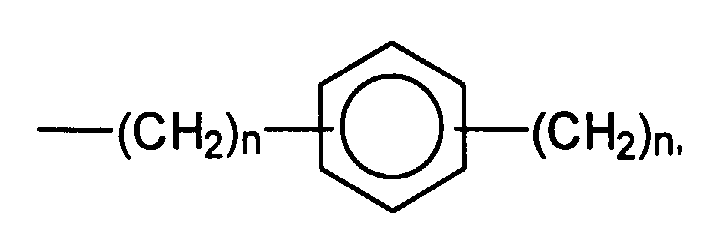
daß man eine Organosiliciumverbindung der allgemeinen Formel

Das erhaltene Produkt weist insbesondere eine Kettenlänge Sy mit y = 2 auf.
Dies gilt insbesondere für das leicht verfügbare Bis (triethoxysilylpropyl) tetrasulfan.
Aus einem Tetrasulfan stellt man das entsprechende Trisulfan her, indem man die Molverhältnisse der
Claims (8)
- Verfahren zur Reduzierung der Sulfankettenlänge von Bis-(silylorganyl)polysulfanen,
dadurch gekennzeichnet,
daß man eine Organosiliciumverbindung der allgemeinen Formelsteht, in denen R1eine lineare oder verzweigte Alkylgruppe mit 1 bis 5 C-Atomen, einen Cycloalkylrest mit 5 bis 8 C-Atomen, den Benzylrest oder den gegebenfalls durch Methyl, Ethyl oder Chlor substituierten Phenylrest darstellt, R2 für eine Alkoxigruppe mit linearer oder verzweigter Kohlenstoffkette mit 1 bis 5 C-Atomen oder für eine Cycloalkoxigruppe mit 5 bis 8 C-Atomen, die Phenoxigruppe oder die Benzylgruppe steht, wobei R1 und R2 jeweils gleiche oder verschiedene Bedeutungen haben können,Alk beschreibt einen zweiwertigen gesättigten oder einfach ungesättigten linearen oder verzweigten Kohlenwasser-stoffrest mit 1-10 C-Atomen oder die Gruppe
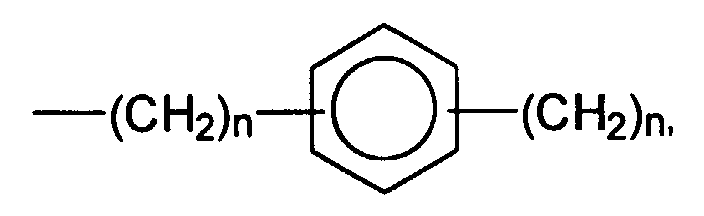 x für eine ganze Zahl von 3 bis 8, insbesondere 4 bis 6 und n für eine ganze Zahl von 1 bis 4 steht,
mit einem wasserfreien Sulfid der allgemeinen FormelY: Cl, Br bedeutet,umsetzt, wobei man das Molverhältnis des Polysulfans und des Me2S entsprechend dem gewünschten Schwefelgehalt des teilweise zu desulfurierenden Polysulfans und des gewünschten Produkts wählt, und das desulfurierte Polysulfan rein oder in Form eines Gemisches mit anderen Polysulfanen gewinnt. - Verfahren gemäß Anspruch 1,
dadurch gekennzeichnet,
daß man der Reaktionsmischung die Verbindung gemäß Formel (II) in einer Menge (Mol) zusetzt, die mindestens ausreicht, mit den durch den Schwefelanteil aus der Desulfurierung und den Na2S-Zusatz neu entstandenen Sy-Gruppen zu Verbindungen der Formel (I) abzureagieren, wobei y <x ≥1 der Länge der durch die Desulfurierung entstandenen Sulfankette entspricht. - Verfahren gemäß den Ansprüchen 1 oder 2,
dadurch gekennzeichnet,
daß man in einem organischen, inerten und bevorzugt polaren Lösungsmittel arbeitet. - Verfahren gemäß Anspruch 3,
dadurch gekennzeichnet,
daß man die Reaktion bei einer Temperatur von 50 ° C bis Rückflußtemperatur des Lösungsmittels durchführt. - Verfahren gemäß den Ansprüche 1 bis 4,
dadurch gekennzeichnet,
daß x in der Formel (I)und entsprechend y einem statistischen Mittelwert entsprechen. - Verfahren gemäß den Ansprüche 1 bis 5,
dadurch gekennzeichnet,
daß man ein Bis-(silylorganyl)tetrasulfan desulfuriert. - Verfahren gemäß Anspruch 6,
dadurch gekennzeichnet,
daß man aus dem Tetrasulfan ein Trisulfan herstellt, indem man die Molverhältnisse der Reaktanden Tetrasulfan, Me2S und Verbindungen gemäß Formel (III) auf 1 : 0,4 bis 0,6 : 0,9 bis 1,1 einstellt. - Verfahren gemäß Anspruch 6,
dadurch gekennzeichnet,
daß man aus dem Tetrasulfan ein Disulfan herstellt, indem man die Molverhältnisse der Reaktanden Tetrasulfan, Me2S und Verbindungen gemäß Formel (III) auf 1 : 1,8 bis 2,2 : 2,5 bis 3,5 einstellt.
Applications Claiming Priority (2)
| Application Number | Priority Date | Filing Date | Title |
|---|---|---|---|
| DE19750503 | 1997-11-14 | ||
| DE19750503A DE19750503A1 (de) | 1997-11-14 | 1997-11-14 | Verfahren zur Reduzierung der Sulfankettenlänge von Bis(silylorganyl)polysulfanen |
Publications (3)
| Publication Number | Publication Date |
|---|---|
| EP0937732A2 true EP0937732A2 (de) | 1999-08-25 |
| EP0937732A3 EP0937732A3 (de) | 2000-11-29 |
| EP0937732B1 EP0937732B1 (de) | 2003-04-23 |
Family
ID=7848752
Family Applications (1)
| Application Number | Title | Priority Date | Filing Date |
|---|---|---|---|
| EP98120919A Expired - Lifetime EP0937732B1 (de) | 1997-11-14 | 1998-11-04 | Verfahren zur Reduzierung der Sulfankettenlänge von Bis(silylorganyl)polysulfanen |
Country Status (14)
| Country | Link |
|---|---|
| US (1) | US5965760A (de) |
| EP (1) | EP0937732B1 (de) |
| JP (1) | JPH11228582A (de) |
| KR (1) | KR19990045254A (de) |
| CN (1) | CN1218053A (de) |
| AT (1) | ATE238312T1 (de) |
| BR (1) | BR9804638A (de) |
| CA (1) | CA2254131A1 (de) |
| DE (2) | DE19750503A1 (de) |
| HU (1) | HUP9802649A3 (de) |
| ID (1) | ID21306A (de) |
| IL (1) | IL127046A (de) |
| PL (1) | PL329670A1 (de) |
| TW (1) | TW505652B (de) |
Cited By (4)
| Publication number | Priority date | Publication date | Assignee | Title |
|---|---|---|---|---|
| DE10034493C1 (de) * | 2000-07-15 | 2001-11-29 | Degussa | Verfahren zur Herstellung von Organosilylalkylpolysulfanen |
| EP1273588A1 (de) * | 2001-07-06 | 2003-01-08 | Degussa AG | Verfahren zur Herstellung von gelben Bis (3-(trialkoxysilyl)alkyl)polysulfanen |
| EP1342750A1 (de) * | 2002-03-08 | 2003-09-10 | Shin-Etsu Chemical Co., Ltd. | Herstellung von Sulfidketten tragenden Organosiliziumverbindungen |
| EP1279675A3 (de) * | 2001-07-25 | 2003-09-17 | Shin-Etsu Chemical Co., Ltd. | Verfahren zur Herstellung von Sulfidketten-haltigen Organosiliziumverbindungen |
Families Citing this family (3)
| Publication number | Priority date | Publication date | Assignee | Title |
|---|---|---|---|---|
| US6452034B2 (en) * | 2000-01-04 | 2002-09-17 | Crompton Corporation | Low-sulfur polysulfide silanes and process for preparation |
| DE10045269A1 (de) * | 2000-09-13 | 2002-03-28 | Degussa | Verfahren zur Herstellung von gelbem Bis(3-[triethoxysilyl]propyl)polysulfan |
| US6433206B1 (en) * | 2001-11-05 | 2002-08-13 | Crompton Corporation | Process for preparing silylorganomercaptans |
Family Cites Families (2)
| Publication number | Priority date | Publication date | Assignee | Title |
|---|---|---|---|---|
| DE19541404A1 (de) * | 1995-11-07 | 1997-05-15 | Degussa | Verfahren zur selektiven Synthese von Silylalkyldisulfiden |
| JP3465558B2 (ja) * | 1997-09-26 | 2003-11-10 | 信越化学工業株式会社 | ポリスルフィドシランの製造方法 |
-
1997
- 1997-11-14 DE DE19750503A patent/DE19750503A1/de not_active Withdrawn
-
1998
- 1998-11-04 DE DE59808060T patent/DE59808060D1/de not_active Expired - Fee Related
- 1998-11-04 AT AT98120919T patent/ATE238312T1/de not_active IP Right Cessation
- 1998-11-04 EP EP98120919A patent/EP0937732B1/de not_active Expired - Lifetime
- 1998-11-11 JP JP10320702A patent/JPH11228582A/ja active Pending
- 1998-11-11 TW TW087118798A patent/TW505652B/zh not_active IP Right Cessation
- 1998-11-12 PL PL98329670A patent/PL329670A1/xx unknown
- 1998-11-12 ID IDP981481A patent/ID21306A/id unknown
- 1998-11-13 BR BR9804638-1A patent/BR9804638A/pt not_active Application Discontinuation
- 1998-11-13 HU HU9802649A patent/HUP9802649A3/hu unknown
- 1998-11-13 IL IL12704698A patent/IL127046A/en active IP Right Grant
- 1998-11-13 CA CA002254131A patent/CA2254131A1/en not_active Abandoned
- 1998-11-13 KR KR1019980048519A patent/KR19990045254A/ko not_active Withdrawn
- 1998-11-13 CN CN98122313A patent/CN1218053A/zh active Pending
- 1998-11-13 US US09/191,190 patent/US5965760A/en not_active Expired - Fee Related
Cited By (7)
| Publication number | Priority date | Publication date | Assignee | Title |
|---|---|---|---|---|
| DE10034493C1 (de) * | 2000-07-15 | 2001-11-29 | Degussa | Verfahren zur Herstellung von Organosilylalkylpolysulfanen |
| EP1172367A3 (de) * | 2000-07-15 | 2003-09-17 | Degussa AG | Verfahren zur Herstellung von Organosilylalkylpolysulfanen |
| EP1273588A1 (de) * | 2001-07-06 | 2003-01-08 | Degussa AG | Verfahren zur Herstellung von gelben Bis (3-(trialkoxysilyl)alkyl)polysulfanen |
| EP1279675A3 (de) * | 2001-07-25 | 2003-09-17 | Shin-Etsu Chemical Co., Ltd. | Verfahren zur Herstellung von Sulfidketten-haltigen Organosiliziumverbindungen |
| US6777474B2 (en) | 2001-07-25 | 2004-08-17 | Shin-Etsu Chemical Co., Ltd. | Preparation of sulfide chain-bearing organosilicon compounds |
| EP1342750A1 (de) * | 2002-03-08 | 2003-09-10 | Shin-Etsu Chemical Co., Ltd. | Herstellung von Sulfidketten tragenden Organosiliziumverbindungen |
| US7041843B2 (en) | 2002-03-08 | 2006-05-09 | Shin-Etsu Chemical Co., Ltd. | Preparation of sulfide chain-bearing organosilicon compounds |
Also Published As
| Publication number | Publication date |
|---|---|
| KR19990045254A (ko) | 1999-06-25 |
| EP0937732A3 (de) | 2000-11-29 |
| DE59808060D1 (de) | 2003-05-28 |
| JPH11228582A (ja) | 1999-08-24 |
| US5965760A (en) | 1999-10-12 |
| DE19750503A1 (de) | 1999-05-20 |
| CA2254131A1 (en) | 1999-05-14 |
| ID21306A (id) | 1999-05-20 |
| EP0937732B1 (de) | 2003-04-23 |
| HUP9802649A2 (hu) | 1999-09-28 |
| TW505652B (en) | 2002-10-11 |
| ATE238312T1 (de) | 2003-05-15 |
| BR9804638A (pt) | 1999-11-23 |
| HUP9802649A3 (en) | 2002-05-28 |
| IL127046A (en) | 2001-04-30 |
| CN1218053A (zh) | 1999-06-02 |
| HU9802649D0 (en) | 1999-02-01 |
| IL127046A0 (en) | 1999-09-22 |
| PL329670A1 (en) | 1999-05-24 |
Similar Documents
| Publication | Publication Date | Title |
|---|---|---|
| EP0773224B1 (de) | Verfahren zur selektiven Synthese von Silylalkyldisulfiden | |
| DE19734295C1 (de) | Verfahren zur Herstellung von Organosiliciumdisulfanen hoher Reinheit | |
| DE69521001T2 (de) | Verfahren zur Herstellung von Silanpolysulfiden | |
| EP0348693B1 (de) | Verfahren zur Herstellung von Diorganodialkoxysilanen | |
| EP0955302B1 (de) | Verfahren zur Herstellung von Gemischen von Organosiliciumoligosulfanen mit einem hohen Anteil an Organosiliciumdisulfanen | |
| EP1700861B1 (de) | Verfahren zur Herstellung von Organosilanen | |
| EP0937732B1 (de) | Verfahren zur Reduzierung der Sulfankettenlänge von Bis(silylorganyl)polysulfanen | |
| EP0348620A2 (de) | Verfahren zur Herstellung ein- oder mehrfach substituierter organyloxysilylfunktioneller Thioharnstoffe und diese Verbindungen | |
| DE19860439C1 (de) | Verfahren zur Herstellung von Silylalkylthiolen | |
| EP0277642B1 (de) | Verfahren zur Herstellung von Oximosilanen | |
| EP0894803B1 (de) | Mischungen, bestehend aus Bis(silylorganyl)polysulfanen und Silylorganylthiocyanaten, ihre Herstellung und Verwendung | |
| DE60209085T2 (de) | Verfahren zur Herstellung von Sulfidketten-haltigen Organosiliziumverbindungen | |
| EP3645615B1 (de) | Verfahren zur herstellung eines silans, verfahren zur modifizierung einer kieselsäure mit dem silan und modifizierte kieselsäure | |
| DE3025034A1 (de) | Silane und verfahren zu ihrer herstellung | |
| EP0003299B1 (de) | Silylester der Perfluoralkansulfonsäuren sowie Verfahren zu deren Herstellung | |
| EP0411313B1 (de) | N,N'-Disubstituierte und N,N,N'-/N,N',N'-trisubstituierte Thioharnstoffe und Verfahren zur Herstellung (II) | |
| DE102010061816A1 (de) | Verfahren zur Herstellung von Carbamatoorganosilanen | |
| DE19848482C1 (de) | Verfahren zur Herstellung von Organosiliciumdisulfanen | |
| DE69907094T2 (de) | Organosiliziumverbindungen und deren Herstellung | |
| DE69020790T2 (de) | Organosilicium-Verbindungen. | |
| DE102010028170A1 (de) | Verfahren zur Herstellung metallierter Hydridosilanverbindungen | |
| EP4161940A1 (de) | Silylierte oligogermane und polycyclische silicium-germanium-verbindungen, verfahren zur herstellung derselben sowie die verwendung derselben zum herstellen eines si- und ge-enthaltenden festkörpers | |
| DE102011108324A1 (de) | Verfahren zur Herstellung von Bis(perfluoralkyl)phosphinsäureanhydriden | |
| DD215085B1 (de) | Verfahren zur herstellung von phosphonoformiaten | |
| DE102018203648A1 (de) | Verfahren zur Herstellung eines Silans, Verfahren zur Modifizierung einer Kieselsäure mit dem Silan und modifizierte Kieselsäure |
Legal Events
| Date | Code | Title | Description |
|---|---|---|---|
| PUAI | Public reference made under article 153(3) epc to a published international application that has entered the european phase |
Free format text: ORIGINAL CODE: 0009012 |
|
| AK | Designated contracting states |
Kind code of ref document: A2 Designated state(s): AT BE CH DE DK ES FI FR GB GR IE IT LI LU NL PT SE |
|
| AX | Request for extension of the european patent |
Free format text: AL;LT;LV;MK;RO;SI |
|
| RAP3 | Party data changed (applicant data changed or rights of an application transferred) |
Owner name: DEGUSSA-HUELS AKTIENGESELLSCHAFT |
|
| PUAL | Search report despatched |
Free format text: ORIGINAL CODE: 0009013 |
|
| AK | Designated contracting states |
Kind code of ref document: A3 Designated state(s): AT BE CH CY DE DK ES FI FR GB GR IE IT LI LU MC NL PT SE |
|
| AX | Request for extension of the european patent |
Free format text: AL;LT;LV;MK;RO;SI |
|
| 17P | Request for examination filed |
Effective date: 20001104 |
|
| RAP1 | Party data changed (applicant data changed or rights of an application transferred) |
Owner name: DEGUSSA AG |
|
| AKX | Designation fees paid |
Free format text: AT BE CH DE DK ES FI FR GB GR IE IT LI LU NL PT SE |
|
| 17Q | First examination report despatched |
Effective date: 20020124 |
|
| GRAH | Despatch of communication of intention to grant a patent |
Free format text: ORIGINAL CODE: EPIDOS IGRA |
|
| GRAH | Despatch of communication of intention to grant a patent |
Free format text: ORIGINAL CODE: EPIDOS IGRA |
|
| GRAA | (expected) grant |
Free format text: ORIGINAL CODE: 0009210 |
|
| AK | Designated contracting states |
Designated state(s): AT BE CH DE DK ES FI FR GB GR IE IT LI LU NL PT SE |
|
| PG25 | Lapsed in a contracting state [announced via postgrant information from national office to epo] |
Ref country code: NL Free format text: LAPSE BECAUSE OF FAILURE TO SUBMIT A TRANSLATION OF THE DESCRIPTION OR TO PAY THE FEE WITHIN THE PRESCRIBED TIME-LIMIT Effective date: 20030423 Ref country code: IT Free format text: LAPSE BECAUSE OF FAILURE TO SUBMIT A TRANSLATION OF THE DESCRIPTION OR TO PAY THE FEE WITHIN THE PRESCRIBED TIME-LIMIT;WARNING: LAPSES OF ITALIAN PATENTS WITH EFFECTIVE DATE BEFORE 2007 MAY HAVE OCCURRED AT ANY TIME BEFORE 2007. THE CORRECT EFFECTIVE DATE MAY BE DIFFERENT FROM THE ONE RECORDED. Effective date: 20030423 Ref country code: IE Free format text: LAPSE BECAUSE OF NON-PAYMENT OF DUE FEES Effective date: 20030423 Ref country code: GB Free format text: LAPSE BECAUSE OF FAILURE TO SUBMIT A TRANSLATION OF THE DESCRIPTION OR TO PAY THE FEE WITHIN THE PRESCRIBED TIME-LIMIT Effective date: 20030423 Ref country code: FR Free format text: LAPSE BECAUSE OF FAILURE TO SUBMIT A TRANSLATION OF THE DESCRIPTION OR TO PAY THE FEE WITHIN THE PRESCRIBED TIME-LIMIT Effective date: 20030423 Ref country code: FI Free format text: LAPSE BECAUSE OF FAILURE TO SUBMIT A TRANSLATION OF THE DESCRIPTION OR TO PAY THE FEE WITHIN THE PRESCRIBED TIME-LIMIT Effective date: 20030423 |
|
| REG | Reference to a national code |
Ref country code: GB Ref legal event code: FG4D Free format text: NOT ENGLISH |
|
| REG | Reference to a national code |
Ref country code: CH Ref legal event code: EP |
|
| REF | Corresponds to: |
Ref document number: 59808060 Country of ref document: DE Date of ref document: 20030528 Kind code of ref document: P |
|
| REG | Reference to a national code |
Ref country code: IE Ref legal event code: FG4D Free format text: GERMAN |
|
| PG25 | Lapsed in a contracting state [announced via postgrant information from national office to epo] |
Ref country code: SE Free format text: LAPSE BECAUSE OF FAILURE TO SUBMIT A TRANSLATION OF THE DESCRIPTION OR TO PAY THE FEE WITHIN THE PRESCRIBED TIME-LIMIT Effective date: 20030723 Ref country code: PT Free format text: LAPSE BECAUSE OF FAILURE TO SUBMIT A TRANSLATION OF THE DESCRIPTION OR TO PAY THE FEE WITHIN THE PRESCRIBED TIME-LIMIT Effective date: 20030723 Ref country code: GR Free format text: LAPSE BECAUSE OF FAILURE TO SUBMIT A TRANSLATION OF THE DESCRIPTION OR TO PAY THE FEE WITHIN THE PRESCRIBED TIME-LIMIT Effective date: 20030723 Ref country code: DK Free format text: LAPSE BECAUSE OF FAILURE TO SUBMIT A TRANSLATION OF THE DESCRIPTION OR TO PAY THE FEE WITHIN THE PRESCRIBED TIME-LIMIT Effective date: 20030723 |
|
| NLV1 | Nl: lapsed or annulled due to failure to fulfill the requirements of art. 29p and 29m of the patents act | ||
| GBV | Gb: ep patent (uk) treated as always having been void in accordance with gb section 77(7)/1977 [no translation filed] |
Effective date: 20030423 |
|
| PG25 | Lapsed in a contracting state [announced via postgrant information from national office to epo] |
Ref country code: ES Free format text: LAPSE BECAUSE OF FAILURE TO SUBMIT A TRANSLATION OF THE DESCRIPTION OR TO PAY THE FEE WITHIN THE PRESCRIBED TIME-LIMIT Effective date: 20031030 |
|
| PG25 | Lapsed in a contracting state [announced via postgrant information from national office to epo] |
Ref country code: LU Free format text: LAPSE BECAUSE OF NON-PAYMENT OF DUE FEES Effective date: 20031104 Ref country code: AT Free format text: LAPSE BECAUSE OF NON-PAYMENT OF DUE FEES Effective date: 20031104 |
|
| REG | Reference to a national code |
Ref country code: IE Ref legal event code: FD4D Ref document number: 0937732E Country of ref document: IE |
|
| PG25 | Lapsed in a contracting state [announced via postgrant information from national office to epo] |
Ref country code: LI Free format text: LAPSE BECAUSE OF NON-PAYMENT OF DUE FEES Effective date: 20031130 Ref country code: CH Free format text: LAPSE BECAUSE OF NON-PAYMENT OF DUE FEES Effective date: 20031130 Ref country code: BE Free format text: LAPSE BECAUSE OF NON-PAYMENT OF DUE FEES Effective date: 20031130 |
|
| PLBE | No opposition filed within time limit |
Free format text: ORIGINAL CODE: 0009261 |
|
| STAA | Information on the status of an ep patent application or granted ep patent |
Free format text: STATUS: NO OPPOSITION FILED WITHIN TIME LIMIT |
|
| 26N | No opposition filed |
Effective date: 20040126 |
|
| EN | Fr: translation not filed | ||
| BERE | Be: lapsed |
Owner name: *DEGUSSA A.G. Effective date: 20031130 |
|
| PG25 | Lapsed in a contracting state [announced via postgrant information from national office to epo] |
Ref country code: DE Free format text: LAPSE BECAUSE OF NON-PAYMENT OF DUE FEES Effective date: 20040602 |
|
| REG | Reference to a national code |
Ref country code: CH Ref legal event code: PL |