EP0938209A2 - Verfahren und Vorrichtung zur Ausführung eines Kryptoinitialisierungsverfahrens zwischen Kundenvorrichtungen mit beschränkter Funktionalität und Servervorrichtungen über Datennetzwerken - Google Patents
Verfahren und Vorrichtung zur Ausführung eines Kryptoinitialisierungsverfahrens zwischen Kundenvorrichtungen mit beschränkter Funktionalität und Servervorrichtungen über Datennetzwerken Download PDFInfo
- Publication number
- EP0938209A2 EP0938209A2 EP99301078A EP99301078A EP0938209A2 EP 0938209 A2 EP0938209 A2 EP 0938209A2 EP 99301078 A EP99301078 A EP 99301078A EP 99301078 A EP99301078 A EP 99301078A EP 0938209 A2 EP0938209 A2 EP 0938209A2
- Authority
- EP
- European Patent Office
- Prior art keywords
- server
- client
- key
- secret key
- side secret
- Prior art date
- Legal status (The legal status is an assumption and is not a legal conclusion. Google has not performed a legal analysis and makes no representation as to the accuracy of the status listed.)
- Withdrawn
Links
- 238000000034 method Methods 0.000 title claims abstract description 129
- 230000008569 process Effects 0.000 title claims abstract description 92
- 238000004891 communication Methods 0.000 claims abstract description 42
- 238000012795 verification Methods 0.000 claims abstract description 26
- 230000004044 response Effects 0.000 claims description 10
- 230000000977 initiatory effect Effects 0.000 claims 1
- 230000001172 regenerating effect Effects 0.000 claims 1
- 230000006870 function Effects 0.000 description 30
- 230000015654 memory Effects 0.000 description 12
- 230000002085 persistent effect Effects 0.000 description 5
- 230000002452 interceptive effect Effects 0.000 description 4
- 230000001413 cellular effect Effects 0.000 description 3
- 238000012545 processing Methods 0.000 description 3
- 238000012546 transfer Methods 0.000 description 3
- 238000012384 transportation and delivery Methods 0.000 description 3
- 240000005020 Acaciella glauca Species 0.000 description 2
- 230000008901 benefit Effects 0.000 description 2
- 230000005540 biological transmission Effects 0.000 description 2
- 238000010586 diagram Methods 0.000 description 2
- 230000003993 interaction Effects 0.000 description 2
- 230000007246 mechanism Effects 0.000 description 2
- 235000003499 redwood Nutrition 0.000 description 2
- 230000001131 transforming effect Effects 0.000 description 2
- 230000001755 vocal effect Effects 0.000 description 2
- 230000003936 working memory Effects 0.000 description 2
- PCTMTFRHKVHKIS-BMFZQQSSSA-N (1s,3r,4e,6e,8e,10e,12e,14e,16e,18s,19r,20r,21s,25r,27r,30r,31r,33s,35r,37s,38r)-3-[(2r,3s,4s,5s,6r)-4-amino-3,5-dihydroxy-6-methyloxan-2-yl]oxy-19,25,27,30,31,33,35,37-octahydroxy-18,20,21-trimethyl-23-oxo-22,39-dioxabicyclo[33.3.1]nonatriaconta-4,6,8,10 Chemical compound C1C=C2C[C@@H](OS(O)(=O)=O)CC[C@]2(C)[C@@H]2[C@@H]1[C@@H]1CC[C@H]([C@H](C)CCCC(C)C)[C@@]1(C)CC2.O[C@H]1[C@@H](N)[C@H](O)[C@@H](C)O[C@H]1O[C@H]1/C=C/C=C/C=C/C=C/C=C/C=C/C=C/[C@H](C)[C@@H](O)[C@@H](C)[C@H](C)OC(=O)C[C@H](O)C[C@H](O)CC[C@@H](O)[C@H](O)C[C@H](O)C[C@](O)(C[C@H](O)[C@H]2C(O)=O)O[C@H]2C1 PCTMTFRHKVHKIS-BMFZQQSSSA-N 0.000 description 1
- 208000015976 Corneal dystrophy-perceptive deafness syndrome Diseases 0.000 description 1
- RWSOTUBLDIXVET-UHFFFAOYSA-N Dihydrogen sulfide Chemical compound S RWSOTUBLDIXVET-UHFFFAOYSA-N 0.000 description 1
- 206010000210 abortion Diseases 0.000 description 1
- 230000003213 activating effect Effects 0.000 description 1
- 230000004913 activation Effects 0.000 description 1
- 238000013459 approach Methods 0.000 description 1
- 238000004364 calculation method Methods 0.000 description 1
- 230000000994 depressogenic effect Effects 0.000 description 1
- 238000013461 design Methods 0.000 description 1
- 238000005516 engineering process Methods 0.000 description 1
- 230000036039 immunity Effects 0.000 description 1
- 230000007774 longterm Effects 0.000 description 1
- 238000007726 management method Methods 0.000 description 1
- 238000013507 mapping Methods 0.000 description 1
- 230000005055 memory storage Effects 0.000 description 1
- 230000000737 periodic effect Effects 0.000 description 1
- 230000002688 persistence Effects 0.000 description 1
- 230000000717 retained effect Effects 0.000 description 1
- 230000002441 reversible effect Effects 0.000 description 1
- 239000000126 substance Substances 0.000 description 1
- 238000012360 testing method Methods 0.000 description 1
- 238000013519 translation Methods 0.000 description 1
Images


Classifications
-
- H—ELECTRICITY
- H04—ELECTRIC COMMUNICATION TECHNIQUE
- H04L—TRANSMISSION OF DIGITAL INFORMATION, e.g. TELEGRAPHIC COMMUNICATION
- H04L9/00—Cryptographic mechanisms or cryptographic arrangements for secret or secure communications; Network security protocols
- H04L9/14—Cryptographic mechanisms or cryptographic arrangements for secret or secure communications; Network security protocols using a plurality of keys or algorithms
-
- H—ELECTRICITY
- H04—ELECTRIC COMMUNICATION TECHNIQUE
- H04L—TRANSMISSION OF DIGITAL INFORMATION, e.g. TELEGRAPHIC COMMUNICATION
- H04L9/00—Cryptographic mechanisms or cryptographic arrangements for secret or secure communications; Network security protocols
- H04L9/08—Key distribution or management, e.g. generation, sharing or updating, of cryptographic keys or passwords
- H04L9/0816—Key establishment, i.e. cryptographic processes or cryptographic protocols whereby a shared secret becomes available to two or more parties, for subsequent use
- H04L9/0838—Key agreement, i.e. key establishment technique in which a shared key is derived by parties as a function of information contributed by, or associated with, each of these
- H04L9/0841—Key agreement, i.e. key establishment technique in which a shared key is derived by parties as a function of information contributed by, or associated with, each of these involving Diffie-Hellman or related key agreement protocols
-
- H—ELECTRICITY
- H04—ELECTRIC COMMUNICATION TECHNIQUE
- H04L—TRANSMISSION OF DIGITAL INFORMATION, e.g. TELEGRAPHIC COMMUNICATION
- H04L2209/00—Additional information or applications relating to cryptographic mechanisms or cryptographic arrangements for secret or secure communication H04L9/00
- H04L2209/34—Encoding or coding, e.g. Huffman coding or error correction
-
- H—ELECTRICITY
- H04—ELECTRIC COMMUNICATION TECHNIQUE
- H04L—TRANSMISSION OF DIGITAL INFORMATION, e.g. TELEGRAPHIC COMMUNICATION
- H04L2209/00—Additional information or applications relating to cryptographic mechanisms or cryptographic arrangements for secret or secure communication H04L9/00
- H04L2209/76—Proxy, i.e. using intermediary entity to perform cryptographic operations
-
- H—ELECTRICITY
- H04—ELECTRIC COMMUNICATION TECHNIQUE
- H04L—TRANSMISSION OF DIGITAL INFORMATION, e.g. TELEGRAPHIC COMMUNICATION
- H04L2209/00—Additional information or applications relating to cryptographic mechanisms or cryptographic arrangements for secret or secure communication H04L9/00
- H04L2209/80—Wireless
Definitions
- the invention relates to secure and authenticated data communications between client computers and server computers, and more particularly relates to methods and apparatus for conducting crypto-ignition processes between two-way interactive communication devices and server computers over data networks that may be wireless network or the Internet; wherein the two-way interactive communication devices, such as mobile devices, cellular phones, landline phones and Internet appliance controllers, have generally limited computing resources such as computing power, memory and graphical display capability.
- two-way interactive communication devices such as mobile devices, cellular phones, landline phones and Internet appliance controllers, have generally limited computing resources such as computing power, memory and graphical display capability.
- a fast-growing trend on the Internet is electronic commerce.
- the electronic commerce is an integrative concept designed to draw together a wide range of business support services, trading support systems for commodities, products, customized products and custom-built goods and services; ordering and logistic support systems; settlement support systems; and management information and statistical reporting systems, all via the global Internet.
- companies or individuals To transact business over the Internet, companies or individuals must have an efficient, reliable and secured manner to conduct private communications among themselves.
- There have been many efforts in progress aimed at protecting the proprietary information travelling across the Internet, mostly for computer devices in landline networks.
- One of the ongoing efforts is to use cryptographic techniques to secure a private communication session between a client computer and a server computer.
- the cryptographic techniques provide a way to transmit information across an insecure communication channel without disclosing the contents of the information to anyone eavesdropping on the communication channel.
- Encryption is a process of transforming a set of data into some unreadable "encrypted" form. The purpose thereof is to ensure privacy by keeping the actual contents of the information hidden from unintended recipients such as eavesdroppers that might access the encrypted data.
- Decryption is the reverse process of the encryption.
- Decryption is a process of transforming encrypted data back into some intelligible form such that the actual contents can be accessed. Both encryption and decryption require the use of some secret information, usually referred to as a "key.” Depending on the type of encryption mechanism used, the same key might be used for both encryption and decryption, while for other mechanisms, the keys used for encryption and decryption might be different.
- a relatively new concept of encryption known as public-key cryptography uses two different keys.
- each user has two keys: a public key that is published and a private key that is kept secret.
- a sender encrypts a message using the recipient's public key.
- the recipient then decrypts the message using his private key.
- secure communication can commence without having to transfer a secret key across a secure channel.
- the primary advantage of the public-key cryptography is that private keys never need to be transmitted or revealed to anyone.
- the secret keys or information to generate them must be transmitted (either manually or through a secure communication channel).
- one known disadvantage of using the public-key cryptography for encryption is the encryption speed.
- there are popular private-key encryption methods that are significantly faster than any currently available public-key encryption method.
- encryption speed becomes a very important factor in considering the private-key cryptography versus the public-key cryptography when a cryptographic technique is used in a secure communication session involving a thin client device with limited computing resources.
- the thin client device referred to is considered to be a two-way interactive communication device such as a mobile computing device, cellular phone, landline phone or an Internet appliance controller.
- a thin client device is generally designed small in size, light in weight, low in power consumption and as economically and portably as possible.
- Such thin client designs often result in very limited computing resources, for example, the computing power therein is, perhaps, typically equivalent to less than one percent of what is provided in a typical desktop or portable computer, and the memory capacity thereof is generally less than 250 kilobytes.
- the communication between the thin client and a landline server computer is often via a wireless network that is characterized with low bandwidth, the airtime thereof is expensively measured. Therefore the private-key cryptography is often used in the communication session between thin clients and landline computers to accommodate the speed requirement.
- the distribution of the private encryption keys between two trusted communicating devices is called the crypto-ignition process.
- Manual delivery of private encryption keys in a secret manner can be used as one of the crypto-ignition methods, but the cost can be considerable when there are hundreds, perhaps thousands of the thin clients in communication with one landline server computer. Further the human errors and trust associated with this approach make it infeasible to use in reality. Therefore, there is a great need for a generic crypto-ignition process that allows automatic deliveries of the private keys between each of the thin clients respectively with the landline server computer.
- the detailed description of the present invention in the following are presented largely in terms of procedures, steps, logic blocks, processing, and other symbolic representations that resemble of data processing devices coupled to networks. These process descriptions and representations are the means used by those experienced or skilled in the art to most effectively convey the substance of their work to others skilled in the art.
- the present invention is a method and apparatus for conducting a crypto-ignition process between a two- way interactive communication device and a server device over a data network.
- the method along with the architecture to be described in detail below is a self-consistent sequence of processes or steps leading to a desired result. These steps or processes are those requiring physical manipulations of physical quantities.
- these quantities may take the form of electrical signals capable of being stored, transferred, combined, compared, displayed and otherwise manipulated in a computer system or electronic computing devices. It proves convenient at times, principally for reasons of common usage, to refer to these signals as bits, values, elements, symbols, operations, messages, terms, numbers, or the like. It should be borne in mind that all of these similar terms are to be associated with the appropriate physical quantities and are merely convenient labels applied to these quantities.
- the Diffie-Hellman key agreement protocol also called exponential key agreement, allows two users to exchange a secret key over an insecure medium without any prior secrets.
- the protocol has two system parameters p and g . Both p and g public and may be used by all the users in a system.
- Parameter p is a prime )number
- parameter g (usually called a generator) is an integer less than p , which is capable of generating every element from 1 to p - 1 when multiplied by itself a certain number of times, modulo the prime p .
- the Diffie-Hellman key exchange is vulnerable to a middleman attack.
- an opponent Party X, intercepts Party A's public value and sends his own public value to Party B.
- Party B transmits his public value
- Party X substitutes it with his own and sends it to Party A.
- Party X and Party A thus agree on one shared key and Party X and Party B agree on another shared key.
- Party X simply decrypts any messages sent out by Party A or Party B, and then reads and possibly modifies them before re- encrypting with the appropriate key and transmitting them to the correct party.
- This vulnerability is due to the fact that Diffie-Hellman key exchange does not authenticate the participants.
- Party A computes a signature on certain messages using her private key and sends Party B the public value g a mod p together with her signature and her public-key certificate.
- Party B also computes a signature using his private key and sends Party A the public value g a mod p together with her signature and her public-key certificate.
- Party X is still able to intercept messages between Party A and Party B, she cannot forge signatures without Party A's private key and Party B's private key. Hence, the enhanced protocol defeats the middleman attack.
- a crypto-ignition process to deliver an identical secret key to two communicating parties is conducted between a thin client device and a server computer over a data network.
- the thin client device generally has limited computing power and limited working memory.
- the server computer may communicate with a plurality of such thin client devices.
- To ensure the security of the secret key on both sides and reduce traffic in the network only a pair of public values is exchanged between the thin client device and the server computer over the data network.
- Each side generates its own secret key from a self-generated private value along with the received counterpart's public value according to a commonly used key agreement protocol, such as the Diffie-Hellman key agreement protocol.
- verification processes are followed by exchanging a message encrypted by the generated client-side secret key and a manual verification of signatures generated from the two generated secret keys.
- the secret keys are proved to be identical when the encrypted message is successfully decrypted by the other secret key and secure when the signatures are verified.
- the verification process is piggybacked with a session request from the thin device to establish a secure and authentic communication session with the server computer.
- the present invention enables the automatic delivery of the secret keys, without requiring significant computing power and working memory, between each of the thin clients respectively with the server computer.
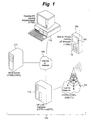
- FIG. 1 shows a schematic representation of a data network 100 in which the present invention may be practised.
- the data network 100 comprises an airnet 102 that is generally called wireless network and a landnet 104 that is generally a landline network, each acting as a communication medium for data transmission therethrough.
- the airnet 102 in which the data transmission is via the air, is sometimes referred to as a carrier network because each airnet is controlled and operated by a carrier, for example AT&T and GTE.
- Each carrier my have its own communication scheme, such as CDPD, CDMA, GSM and TDMA for the airnet 102.
- the landnet 104 may be the global Internet, an Intranet or other private networks.
- Referenced by 106 is of the mobile devices that can be a mobile device, a cellular phone, a landline telephone or an Internet appliance controller, capable of communicating with the airnet 102 via an antenna 108. It is generally understood that the airnet 102 communicates simultaneously with a plurality of two-way communication devices, of which only one example mobile device 106 is shown in Figure 1.
- connected to the Internet 104 are a plurality of desktop PCs 110 and a plurality of server computers 112, though only one representative respectively shown in Figure 1.
- the PC 110 as shown in the figure, may be a personal computer SPL 300 from NEC Technologies Inc.
- the PC 110 may execute a HyperText Markup Language (HTML) Web browser such as Netscape Navigator or Microsoft Internet Explorer to access information on the Internet 104 using HyperText Transport Protocol (HTTP).
- HTTP HyperText Markup Language
- the PC 110 may access HTML information stored in the web server 112 that may be a workstation from Sun Microsystems Inc. It is understood to those skilled in the art that the PC 110 can store accessible information therein so as to become a web server as well.
- the proxy server computer 114 may be a workstation or a personal computer that performs mapping or translation functions.
- the proxy server computer 114 may map information from one protocol to another, such that the mobile device 106 can be in communication with any dne of the servers 112 or the PCs 110, respectively.
- HTTP HyperText Transfer Protocol
- HTTPS HTTPS
- HTTP uses the well known Transport Control Protocol (TCP) to build a connection for carrying HyperText Markup Language (HTML) information.
- TCP Transport Control Protocol
- HTML HyperText Markup Language
- an HTML Web browser in the proxy server 114 may access HTML information stored in the Web server 112.
- the communication protocol between the mobile device 106 and the proxy server 114 via the airnet 102 is the Handheld Device Transport Protocol (HDTP) or Secure Uplink Gateway Protocol (SUGP) which preferably runs on User Datagram Protocol (UDP).
- HDTP controls the connection of a small Web browser in the mobile device 106 to the proxy server 114.
- the browser in the mobile device 106 may be a Handheld Device Markup Language (HDML) browser.
- the Handheld Device Markup Language (HDML) is similar to HTML in that it is a tag based document language and comprises a set of commands or statements that specify how information is to be displayed on a display device.
- HDML is a specific markup language designed to specify in a "card” how information should be displayed on a small screen of the mobile device 106. Normally a number of cards are grouped into a deck that is the smallest unit of HDML information that can be exchanged between the mobile device 106 and the proxy server 114. More description on the HDML cards and deck will be described below wherever appropriate.
- the specifications of HDTP, entitled “HDTP Specification” and HDML, entitled “HDML 2.0 Language Reference” are enclosed and incorporated herein by reference in their entirety.
- the HDTP is a session-level protocol that resembles the HTTP but without incurring the overhead thereof and is highly optimized for use in thin devices that have significantly less computing power and memory.
- UDP User Datagram Protocol
- the HDTP does not require a connection to be established between a client device and a server device before information can be exchanged, which eliminates the need of exchanging a large number of packets during a session creation between a client and a server. Exchanging a very small number of packets during a transaction is one of the desired features for a mobile device with very limited computing power and memory to effectively interact with a landline device.
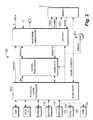
- FIG 2 there is showed a block diagram of a typical GSM digital mobile phone 120 that can be used in Figure 1 to practice the present invention.
- Each of the hardware components in the mobile phone 120 is known to those skilled in the art and so the hardware components are not to be described in detail herein.
- a user of the phone 120 can interactively communicate with a server device (not shown in Figure 2) over the data network.
- server device not shown in Figure 2
- compiled and linked processes of the present invention are stored in ROM 122 as a client module 124 and support module 126.
- a physical layer processor or microcontroller 128 Upon activation of a predetermined key sequence utilizing the keypad 118, a physical layer processor or microcontroller 128 initiates a communication session request to a server device (not shown) using the client module 124 in the ROM 122.
- the phone 120 Upon establishing the communication session, the phone 120 typically receives a single HDML deck from the server device and stores the deck as cached in RAM 134.
- An HDML deck or deck is the smallest unit of HDML information that can be exchanged between a thin client device and a server device. Each deck has a unique address identifier such as a URL and includes one or more cards. A card includes the information required to generate a screen display on the display screen 116. Thus, a deck is simply a group of screen displays.
- a display driver 130 receives and interprets information from the deck in the RAM134 and causes the screen 116 to display the information accordingly.
- the keypad driver 132 receives signals representing what buttons or keys in the keypad 118 are depressed and converts the signals to a representation understood by the microcontroller 128 that in turn responds, for example, by activating a respective card in the deck or a new link to the server for a new deck if necessary depending on what choice is made through the phone keypad 118.
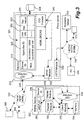
- FIG. 3 there is depicted the architecture of the present invention.
- Referenced by 302, 304 and 306 are three representatives of a plurality of the mobile devices coupled to the airnet 102, similarly referenced by 310, 312 and 314 are three representatives of a plurality of landline devices coupled to the landnet 104.
- the link server device 370 couples the airnet 102 to the landnet 104, therefore any mobile devices can communicate with the landline devices via the airnet 102 through the link server 370 to the landnet 104.
- the mobile devices may be the one shown in Figure 2.
- the internal block diagrams of the mobile device 302 and the link server 370 are respectively illustrated. Other processes and hardware are known to those skilled in the art and are not illustrated in detail in the figure for clarity.
- Each of the mobile devices is assigned to a device ID 316.
- the device ID 316 can be a phone number of the device or a combination of an IP address and a port number, for example: 204.163.165.132:01905 where 204.163.165.132 is the IP address and 01905 is the port number.
- the device ID 316 is further associated with a subscriber ID 318 authorized by a carrier in the link server 370 as part of the procedures to activate a subscriber account 320 for the mobile device 302.
- the subscriber ID 318 may take the form of, for example, 861234567-10900_pn.mobile.att.net by AT&T Wireless Service, it is a unique identification to the mobile device 302.
- each of the mobile devices 302, 304 and 306 has a unique device ID that corresponds to a respective user account in the link server device 370.
- the following description is focussed on the mobile device 302 and the associated account 320, it will be appreciated by those skilled in the art that the description is equally applied to a plurality of the mobile devices in communication simultaneously with the link server 370.
- the subscriber account 320 is a data structure comprising the subscriber information such as a subscriber number 318, user info 322, key state 321 and a signature 325.
- the user info 322 may include the account configuration and other account related information, such as username, a URL, a device version and date.
- the key state 321 indicates the state of a shared secret key.
- the signature 325 is a result generated from the shared secret key by using the symmetric encryption algorithms such as RC5. When the account is newly established, the key state 321 is set to "Exchange" and no signature is available in the signature 325. More on the key state and signature will be described below.
- the URL of the account may take the form of, for example, http://www.att.com/Pocketnet, which indicates that the airnet 102 is operated by AT&T wireless service. It can be appreciated that when the link server 370 provides services to a number of mobile devices, there will be the same number of such accounts, preferably kept in a database server 328, each of the accounts designated respectively to one of the mobile devices.
- the database server 328 is not necessary in the present invention.
- the database server 328 providing means for storing the accounts, may be a separate computer or a memory storage in the link server 370.
- the link server 370 is one of the landline devices, any of the landline devices can function as the link server 370 and be either a client device or a server device depending on what applications being used in the devices.
- the mobile device shall be referred to as the client device or thin client device hereafter and the link server 370 shall be simply referred to as the server device.
- the compiled and linked processes of the present invention are stored in a memory as the client module 332 in the client device 302. Similarly a corresponding compiled and linked processes of the present invention are loaded in a memory as the server module 320 in the server device 370.
- the communication between the client device 302 and the server device 370 is conducted between the client module 332 and the server module 320 via a pair of User Datagram Protocol (UDP) interfaces 336 and 324.
- UDP User Datagram Protocol
- the client module 332 When a user of the client device 302 presses a predetermined key to interact with the server device 370, for example, to fetch price information on a particular stock, the client module 332 sends a corresponding request in form of the HDML deck to the UDP interface 336 which further transmits the request to the counterpart UDP interface 324 in the server device 370.
- the request is processed by the link server 370 and may result in a further connection to another server device 310 or 312 on the Internet if the link server 370 does not host the stock price information. Nevertheless the stock price information is eventually packed into one or more cards in an HDML deck at 340.
- the HDML deck is sent back by the server module 320 to the client 302 through the UDP interfaces 336 and 324.
- the client module With the received HDML deck, preferably cached in a RAM, the client module displays the card or cards on the display screen of the client device 302. If the information exchanging between the client device 302 and the link server device 370 needs to be secret, then a secure communication using encryption/decryption technique must be established on both sides before any secret information can be exchanged.
- SR 402 session request signal 402
- the signal components in SR 402 depend on the status of the client device 302 and generally comprise:
- the cipher in SR 402 includes an identifier to a particular encryption algorithm and associated parameters thereof, namely the first byte in the cipher represents the identifier to a combination of the encryption algorithm, the key size (e.g. 128- bit for US or 40-bit for foreign countries) and content of a security attachment thereto and the second byte in the cipher indicates the additional parameters related to the first byte.
- the key size e.g. 128- bit for US or 40-bit for foreign countries
- the second byte in the cipher indicates the additional parameters related to the first byte.
- value 1 in the first byte indicates that the encryption algorithm is a block cipher RC5
- the key size thereof is 128 bit
- a two byte check-sum therein is used as Message Authentication Code (MAC)
- MAC Message Authentication Code
- IV Initialization Vector
- block ciphers therefor is transmitted over the network
- padding bytes are added if necessary.
- Information about block ciphers and the various available encryption algorithms can be found in almost any book on contemporary cryptography or M.J.B. Robshaw, "Block Ciphers", Technical Report TR-601, version 2.0, RSA Laboratories, 100 Marine Parkway, Redwood City, CA 94065-1031, August 1995.
- the identifier in the cipher may be assigned to a unique value to identify a non-secure session if so desired.
- the C-nonce is a non-repeatable number initially and randomly generated in the client and the modified version thereof, C-nonceModified, is generated from the C-nonce through a operational relationship.
- Both C-nonce and C-nonceModified are encrypted by the cipher using a secret encryption key possessed by the client device 302.
- the purpose of the C-nonceModified is to provide the server that receives the SR with means for ensuring that C-nonce is correctly decrypted and validated by examining the C-nonce and its relationship with the C- nonceModified. If the server device 370 has a valid secret key that is identical to the one in the client device 302, the encrypted C-nonce and C-nonceModified should be decrypted by the valid secret key and the relationship therebetween remains the same.
- the server module 320 attempts to decrypt Encry[C-nonce, C-nonceModified] when SR 402 is received. From the decrypting process, the server device 370 can determine the state of the secret keys on both sides. There are four possible secret key states, "Valid”, “Verify”, “Exchange” and "Force”.
- the "Valid” key state resulting from a successful decryption of the encrypted message in SR 402, means that the pair of the secret keys on both sides are identical, hence each, the client device 302 or the server device 370, possesses a shared secret key (SSK) and a new crypto-ignition process is not needed.
- SSK shared secret key
- the "Verify” state indicates that the SSK generated by a new crypto-ignition process has not been verified, it must be followed by a verification process.
- the "Exchange” key state indicates that the crypto ignition process is allowed at any time at a request by the client device 302, this is usually the case when the user account of the client device 302 is newly established.
- the "Force” key state indicates that the crypto- ignition process must be conducted before any new session can be created.
- the “Force” state may be entered as a result from a complete failure of decrypting the encrypted message in SR 402.
- the key state is automatically set to "Exchange" by default.
- the key request 406 is then sent to the server device 370 for a crypto-ignition process to start.
- the C-nonce and C-nonceModified in SR are not encrypted, which results in errors when the server module 320 tries to decrypt Encry[C-nonce, C-nonceModified].
- the server sends to the client 332 a Request Response 404 with the errors indicating that the communication session can not be established without first conducting the crypto-ignition process.
- the crypto-ignition process is always initiated by sending the key request 406 by the client device 302 to the server device 370 if the key state is either Exchange or Force. Nevertheless the process can also be started if the server device 370 initiates and the client device 302 agrees to proceed with the crypto-ignition process. This may occur when the current SSK expires.
- a SSK has limited lifetimes for a number of reasons. The most important reason is protection against what is called cryptanalysis. Each time the SKK key is used, it generates a number of ciphertexts. Using a key repetitively allows an attacker to build up a store of ciphertexts (and possibly plain texts) which may prove sufficient for a successful cryptanalysis of the key value.
- SRR 404 session request response
- SRR 404 comprises a key error message due to the expiration or mismatch of the SSKs on both sides.
- the client module 332 Before the client device 302 sends out the key request 406, the client module 332 generates a private value, referred to as the client private value, from a random number.
- a random number generator normally takes in a random number seed. It is understood to those skilled in the art that there are many random number generators available, such as the rand( ) function available in standard C libraries. Furthermore, there are many ways to get a random number seed such as examining a noise signal off the antenna, a hard coded-in source or provided by the client device manufacturer. With the random number seed, the client private value is then generated by the random number generator that may be a one-way hash function as its core engine.
- the one-way means that it is significantly easier to perform in one direction (the forward direction) than in the opposite direction (the inverse direction), which makes it unlikely to derive the random number seed from the random number generated.
- One example of the hash functions is to multiply a value itself a certain number of times and followed by a modulo operation.
- the client private value generally takes the form of a 16 byte long binary number.
- the client private value is so generated and sufficiently large enough that it is unlikely to statistically duplicate the client private value based on trying all possible random numbers.
- the generated client private value is then used as an input to generate a public value, referred to as the client public value according to a key agreement protocol, such as the Diffie-Hellman key agreement protocol.
- the client public value is often a 96 byte binary number for communications within US and a 64 byte binary number for communications outside US.
- a library called LIBDH is used to generate the client public value.
- the LIBDH is part of the product, called BSAFE, that is a general purpose and low-level cryptographic toolkit from RSA Laboratories having a business of 100 Marine Parkway, Suite 500, Redwood City, CA 94065 1031.
- the engine comprises the Diffie-Hellman key agreement protocol, the ciphers and hashing functions.
- the client private value is retained within the client device 302 and the client public value is to be transmitted to the server device 370.
- the client module then sends a key request signal 406 to the server device 370.
- the key request 406 comprises the device ID 316 of the client device 302 and the generated client public value.
- the crypto-ignition process in the server device 370 starts when receiving the key request 406 from the client device 302.
- the key request 406 from the client device 302 may result from the error message sent from the server device 370 or a manual request by the user of the client device.
- the server device 370 proceeds with the crypto-ignition process, after performing a series of authentication processes based on the device ID 326, by generating a private value, referred to as the server private value. Similar to the client private and public values, the server private value is generated from a random number seed that can be produced from a noise source such as a noisy diode or traffic events in the server device 370.
- the private value is also a 16 byte long binary number. With the server private value as an input, a public value, or server public value, also a 96 or 64 byte binary number, is generated therefrom using the library LIBDH.
- the Diffie-Hellman key agreement protocol requires two numbers to generate a secret key.
- the server module 320 uses the client public value in the received key request signal 406 along with the self-generated server private value to generate a server- side secret key based on the Diffie-Hellman key agreement protocol provided in LIBDH.
- the server 370 sends a key reply signal 408 that comprises the server public value.
- the client module 332 Based on the received server public value and self-generated client private value, the client module 332 generates a client-side secret key based on the same key agreement protocol provided in LIBDH.
- the client-side secret key must be the same as the server-side secret key, referred to as shared secret key (SSK) under normal circumstances.
- SSK shared secret key
- the first step is to send a new SR 410 by the client module 332 to the server device 370.
- the components C-nonce and C-nonceModified in the new SR 410 are now encrypted by the newly generated client-side secret key.
- the server module 320 tries to decrypt Encry[C-nonce, C-nonceModified] using the newly generated server-side secret key. If the decryption is successful, that means the secret keys on both sides are identical with the assumption that there is no middle-man attacks when the public values are exchanged in the data networks.
- the secret key can be regarded as the valid shared secret key (SSK) and is committed in server's persistent storage. That SSK is subject to further verification as defined as the second step .
- SSK shared secret key
- a new crypto-ignition process may be restarted by sending another request response 404 including the error message to the client device 302, which indicates that the crypto ignition process is failed and another new crypto ignition process can be restarted.
- the second step is to examine signatures resulted from both secret keys.
- a secret key is a 16 byte binary number.
- the first 8 bytes are used as data to be encrypted by the second 8 bytes as the encryption key according to a mutually agreed cipher, for example, the block cipher RC5 in the RCA engine, the encrypted result is referred to as the signature of the secret key.
- the signature may take the form of, for example, FE63 ABCD 47FA 3DA3. If the public values have not been altered, the secret keys on both sides will be the same, hence the signatures.
- the use of signatures provides a means for direct verification between the client side and the server side.
- the user of the client device may call the operator of the service device to verify if there is a match between the two signatures respectively resulted from the client secret key and the server secret key. If the signatures are identical, it indicates that there was no middleman attack, otherwise the crypto-ignition process is considered failed.
- the step one verification process is piggybacked with a new session to be created.
- the verification process is started by the client device 302 by sending a new session request to the server device 370. If the verification succeeds, namely, the encryption keys on both sides are identical, the new session will be continued with a series of authentication between the client device 302 and the server device 370 through the session reply 412 and the complete message 414. A secure and authenticated communication session is thereby established.
- Source files SessionTxn.c and netsugp.c describe all detailed steps and procedures of the crypto-ignition process in the server device 370 and the client device 320 respectively.
- a function named KeyExchlnit() in the netsugp.c performs the initialization for the crypto- ignition process by starting KeyExchangeDoPhaseOne() function which first allocates a memory area to perform the key exchange protocol through DHlnit() function.
- a random number is obtained from DevGetRandom() function and is to be used in DHPhaseOne() function as the client private value.
- DHPhaseOne() generates and the client public values for the client device 332.
- the crypto-ignition process starts in the function TsessionTxn::lgnition in SessionTxn.c when a KeyRequest PDU is received by the server module 320 from the client device 302.
- the server device 302 is set by function to Clgnition to start the process, creates a proto-session, pulling out the corresponding record 321 out of the database 328.
- the server device 370 then verifies if the client device 302 is registered or disabled temporarily, and if the crypto-ignition is allowed. If any one of those conditions are not met, the crypto-ignition process will be aborted and an error code is sent from the server device 370 to the client device 302.
- the server module 320 creates an instance object of the TkeyAgree, keyagree, for the client device 302 that sends the KeyRequest PDU.
- the server module 320 operates on the keyagree object with operations such as Init(), PubKeyGen(), GetSSKey(), and IsWeakKey().
- Init() operation initializes the calculation for the key agreement protocol; PubKeyGen() generates the public value and the private value through the key agreement protocol and the random number generator; PubKeyGen() is internally linked with a random number engine, from which the server private value is generated; GetSSKey() calculates the server-side secret key with inputs of the client public value in the KeyRequest PDU from the client device 302 and the private value of its own.
- IsWeakKey() checks if the generated server-side secret key can be safely used as an encryption key. If not, the above process will be repeated until a good server-side secret key is found.
- Function CmaxKeyTries controls the iterations before the server module 320 gives 0 up and subsequently sends an error message to the client. Upon receiving the error message, the client device 302 sends another KeyRequest PDU to repeat the whole process until a good server-side secret key is generated to the server's satisfaction in CmaxKeyTries.
- the server device 370 then delivers the server public value to the client device 302 in KeyReply PDU for the client device 302 to complete the crypto ignition process by using m_rAirlink-> Deliver() function. Meanwhile the server device 370 saves the server-side secret key in m_pNewCipher and wait for the client device 302 to initiate the verification process that commits the server-side secret key to the SSK that is then )loaded into the persistent database through a new session creation request from the client device 302.
- KeyReply PDU is received through the function NetDataArrived() function, and is passed into netHandleKeyRply() function.
- the server public value in KeyReply PDU from the server is extracted and is fed into KeyExchDoPhaseTwo() function to generate the client-side secret key.
- the client module 332 saves it into its persistence storage and clears its needs for crypto-ignition request by calling ClearNeeds(kKeyExch) function.
- the client device 302 To verify both secret keys generated respectively in the client device 302 and the server device 370, the client device 302 then makes a new session request to create a new session by using the newly generated client-side secret key to encrypt C-nonce and C-nonceModified in the SessionRequest PDU, which can be observed in the function netSetupSess() function.
- the SessionRequest PDU is sent from the client device 302 to the server device 370.
- SessionTxn.C when the SessionRequest PDU is received by the server device 370, the server module 320 calls TSessionTxn::Start() to process the request. As far as the crypto- ignition process is concerned, a successful decryption on the coming SessionRequest PDU by using the newly generated server-side secret key will commit the server-side secret key to the SSK that is then loaded into its persistent database. In the same function, the server module 320 checks if there is a pending crypto-ignition process by checking if m_pNewCipher exists. If so, it is used to decrypt the SessionRequest PDU.
- the server saves the server-side secret key as the shared secret key by using the functions m_rSession->m_pSubscriber-> SetKey() and m_rSession- > m_pSubscriber-> ExchangeComplete().
- the signature is also taken and saved at that point by using m_pNewCipher-> MakeSignature() function. This completes the crypto-ignition process in the server 370.
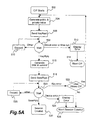
- FIGS 5A and 5B there are shown data flowcharts of the crypto- ignition process (CIP) respectively in the client device 302 and the server device 370. Both Figures 5A and 5B should be understood in conjunction with Figures 3 and 4.
- the crypto-ignition process may be started in several ways of which one is to initiate the process by manually requesting a new crypto-ignition process to be conducted between the client device 302 and the server device 370.
- a second way is from the error message in the session request response 404 sent by the server device 370 due to, for example, complete failure of decrypting the SR 402, the expiration or mismatch of the SSKs on both sides.
- the client device starts the crypto-ignition process (CIP) at 502 in Figure 5A.
- the client module generates the client private value followed by generating the client public value, the processes thereof have been described above.
- the client module sends a key request signal 406 to the server module at step 506.
- the client device starts waiting for a key reply 408 from the server device at step 508.
- the client device may receive signals other than the desired key reply 408 from the intended server device. If the received signals are not the desired key reply 408, they are discarded at step 510.
- a time limit is placed upon the waiting, for example, 60 seconds. Within the time limit, the desired key reply 408 must be received otherwise an error message is displayed on the display screen of the client device at step 512 to inform the user thereof that the current crypto-ignition is aborted at step 514.
- the server module upon receiving key request signal 406 at step 552 from a client device, creates a server proto session at step 554 for the client device with a session identifier, referred to as session ID, to identify the session requested by the client device to be created with the server.
- a server proto-session is a session entry marked as a proto status in a session table, which indicates that the session is not authenticated and is not able to conduct any transactions with the client. It is understood to those skilled in the art that the proto-session can be kept in the RAM of the server and there could be more than one proto-sessions if the server device is in communication with other client devices. If a proto- session already exists for the particular client device, it is re-used.
- the information in the received SR is saved in the proto-session.
- the server device conducts a series of verifications.
- the server device first examines if the device ID in received SR 402 is valid by comparing the received ID with the device ID assigned in the account. If the received device ID is valid, the server module further examines if the client device is enabled at 558. Sometimes a client device may have a valid device ID but the client device is disabled for certain reasons.
- the server module examines if the crypto-ignition process is enabled by examining the key state in the user account. As described, the key state is set to "Exchange" when the user account is newly established. The states that allow the crypto-ignition process are the "Exchange" and "Force", which considers the current crypto-ignition process is enabled; otherwise, it is not enabled.
- the server module will send a device error at 562 to inform the client that the attempted CIP has been aborted.
- the server then removes the created proto session for this particular session at step 586 and aborts the CIP at step 590.
- the server module proceeds with generating the server private value and the server public value, the procedures of which have been described above.
- the server module With the received client public value and the server-self generated private value, the server module generates a server-side secret key according to a commonly key agreement protocol at step 564.
- the server-side secret key generated at step 526 is put through a key examination process at step 566.
- the key examination process is to ensure that the generated secret key has a sufficient random pattern and is not easily reproduced by the cryptanalysis. Some of the patterns that may be easily statistically detected are the keys with periodic 0's and 1's, such as 0101010101à01, which is easily subject to unauthorized duplication.
- step 568 there is a counter to monitor the number of times a generated secret key has to be regenerated. If the counter is greater than a certain number, for example 10, the server device gives up and then sends an error message to the client at 578, requesting the client to start the CIP all over again. If the generated secret or the regenerated secret key passes the key examination process at step 566, the server at step 570 sends a key reply signal with the server public value to the client module and causes the client module to generate a client-side secret key. Similar to the client device, the server module starts waiting for a reply from the client device at step 572. Any unwanted signals will be discarded at 574. If the server module waits for too long, the initially created proto-session will be removed at 586 and the current crypto-ignition process is aborted at 590.
- a certain number for example 10
- the client module is waiting for the key reply signal at step 508.
- the client module generates a client-side secret key at step 516 upon receiving the key reply signal from the server device.
- the client module relies upon the server to test for weak SSKs.
- the client module starts the similar key generating process, using the server public value and the client- self generated private value to generate the client-side secret key according to the commonly used key agreement protocol at 516.
- the generated client-side secret key is assumed valid and the client module commits the generated client-side secret key to the SSK by loading it to its persistent memory or RAM.
- the client then initiates a new session request 410 with Encry[C-nonce, C- nonceModified] by the client generated SSK.
- server when server receives the new session request 410 at step 572, the server looks up the proto session entry in the proto session table and performs a series of the verification process using the device ID in the new session request 410 at step 576.
- the server module checks if Encry[C-nonce, C-nonceModified] is successfully decrypted by the current server-side secret key, if successful, it indicates that the server-side secret key is a SSK with the client device.
- the server module commits the server- side secret key to the SSK with the client device by loading it into a persistent memory in the server device at 582.
- Encry[C-nonce, C-nonceModified] can be successfully decrypted by the old SSK, that indicates that the client device has failed in the current crypto-ignition process. Then, the current crypto-ignition process is silently aborted (without sending an error message to the client) at 590 and a new session is created with the old SSK. So the process preserves the existing old SSK in case the current crypto-ignition process fails.
- two signatures from the two SSKs are verified at 592. This may be proceeded by a verbal verification between the user of the client device and an operator of the server device. As described above, a signature at the client side can be generated when the client-side secret key is produced. S, similarly, a signature at the server side can be generated when the server-side secret key is produced. If the two signatures are not matched, the current crypto-ignition process is failed and no secure communication sessions can be established. If the verification is successful, the current crypto-ignition process succeeds at 594. It should be noted that the verbal verification is not a necessary part of the current invention and used in one embodiment to illustrate that the means for verifying the SSKs by comparing the signatures resulted from the SSKs is provided.
Landscapes
- Engineering & Computer Science (AREA)
- Computer Security & Cryptography (AREA)
- Computer Networks & Wireless Communication (AREA)
- Signal Processing (AREA)
- Computer And Data Communications (AREA)
- Mobile Radio Communication Systems (AREA)
- Communication Control (AREA)
Applications Claiming Priority (2)
| Application Number | Priority Date | Filing Date | Title |
|---|---|---|---|
| US09/026,025 US6263437B1 (en) | 1998-02-19 | 1998-02-19 | Method and apparatus for conducting crypto-ignition processes between thin client devices and server devices over data networks |
| US26025 | 1998-02-19 |
Publications (2)
| Publication Number | Publication Date |
|---|---|
| EP0938209A2 true EP0938209A2 (de) | 1999-08-25 |
| EP0938209A3 EP0938209A3 (de) | 2000-04-19 |
Family
ID=21829440
Family Applications (1)
| Application Number | Title | Priority Date | Filing Date |
|---|---|---|---|
| EP99301078A Withdrawn EP0938209A3 (de) | 1998-02-19 | 1999-02-15 | Verfahren und Vorrichtung zur Ausführung eines Kryptoinitialisierungsverfahrens zwischen Kundenvorrichtungen mit beschränkter Funktionalität und Servervorrichtungen über Datennetzwerken |
Country Status (5)
| Country | Link |
|---|---|
| US (1) | US6263437B1 (de) |
| EP (1) | EP0938209A3 (de) |
| JP (1) | JPH11331147A (de) |
| KR (1) | KR19990072733A (de) |
| CN (1) | CN1234662A (de) |
Cited By (4)
| Publication number | Priority date | Publication date | Assignee | Title |
|---|---|---|---|---|
| EP1422864A1 (de) * | 2002-11-19 | 2004-05-26 | Lg Electronics Inc. | Verfahren zur Sprach/Daten-Verschlüsselungsaktivierung-deaktivierung in einem Mobilkommunikationssystem |
| WO2005114954A1 (en) * | 2004-05-19 | 2005-12-01 | Computer Associates Think, Inc. | Method and system for authentication in a computer network |
| CN102932345A (zh) * | 2012-10-26 | 2013-02-13 | 山东中创软件商用中间件股份有限公司 | 一种信息传输方法、装置及系统 |
| CN116015732A (zh) * | 2019-09-26 | 2023-04-25 | 通用电气公司 | 与分布式控制系统中的装置安全地通信 |
Families Citing this family (119)
| Publication number | Priority date | Publication date | Assignee | Title |
|---|---|---|---|---|
| US6473609B1 (en) * | 1995-12-11 | 2002-10-29 | Openwave Systems Inc. | Method and architecture for interactive two-way communication devices to interact with a network |
| US6742022B1 (en) * | 1995-12-11 | 2004-05-25 | Openwave Systems Inc. | Centralized service management system for two-way interactive communication devices in data networks |
| US5809415A (en) * | 1995-12-11 | 1998-09-15 | Unwired Planet, Inc. | Method and architecture for an interactive two-way data communication network |
| US8225089B2 (en) * | 1996-12-04 | 2012-07-17 | Otomaku Properties Ltd., L.L.C. | Electronic transaction systems utilizing a PEAD and a private key |
| US6065120A (en) * | 1997-12-09 | 2000-05-16 | Phone.Com, Inc. | Method and system for self-provisioning a rendezvous to ensure secure access to information in a database from multiple devices |
| US5974550A (en) * | 1997-12-12 | 1999-10-26 | Intel Corporation | Method for strongly authenticating another process in a different address space |
| US7107246B2 (en) * | 1998-04-27 | 2006-09-12 | Esignx Corporation | Methods of exchanging secure messages |
| US7025209B2 (en) * | 1998-05-29 | 2006-04-11 | Palmsource, Inc. | Method and apparatus for wireless internet access |
| US6343318B1 (en) | 1998-05-29 | 2002-01-29 | Palm, Inc. | Method and apparatus for communicating information over low bandwidth communications networks |
| US6606663B1 (en) * | 1998-09-29 | 2003-08-12 | Openwave Systems Inc. | Method and apparatus for caching credentials in proxy servers for wireless user agents |
| JP3644579B2 (ja) * | 1998-10-29 | 2005-04-27 | 富士通株式会社 | セキュリティ強化方法及び装置 |
| WO2000045539A1 (en) | 1999-01-29 | 2000-08-03 | General Instrument Corporation | Key management for telephone calls to protect signaling and call packets between cta's |
| US7904951B1 (en) | 1999-03-16 | 2011-03-08 | Novell, Inc. | Techniques for securely accelerating external domains locally |
| US8060926B1 (en) | 1999-03-16 | 2011-11-15 | Novell, Inc. | Techniques for securely managing and accelerating data delivery |
| US6081900A (en) * | 1999-03-16 | 2000-06-27 | Novell, Inc. | Secure intranet access |
| US7249377B1 (en) * | 1999-03-31 | 2007-07-24 | International Business Machines Corporation | Method for client delegation of security to a proxy |
| FR2792482A1 (fr) * | 1999-04-13 | 2000-10-20 | Thomson Multimedia Sa | Reseau numerique local, notamment reseau numerique domestique, et procede de creation et de mise a jour d'un tel reseau |
| US6584567B1 (en) * | 1999-06-30 | 2003-06-24 | International Business Machines Corporation | Dynamic connection to multiple origin servers in a transcoding proxy |
| US7290142B1 (en) * | 1999-09-28 | 2007-10-30 | Thomas Licensing | System and method for initializing a simple network management protocol (SNMP) agent |
| US6707942B1 (en) * | 2000-03-01 | 2004-03-16 | Palm Source, Inc. | Method and apparatus for using pressure information for improved computer controlled handwriting recognition, data entry and user authentication |
| AU2001261078A1 (en) * | 2000-04-26 | 2001-11-07 | Venice Technologies, Inc. | Methods and systems for securing computer software |
| US6766453B1 (en) * | 2000-04-28 | 2004-07-20 | 3Com Corporation | Authenticated diffie-hellman key agreement protocol where the communicating parties share a secret key with a third party |
| US6641091B1 (en) * | 2000-06-01 | 2003-11-04 | General Electric Company | Highway railroad crossing vehicle detection methods and systems |
| US7080147B2 (en) * | 2000-09-04 | 2006-07-18 | International Business Machines Corporation | Computer network system, computer system, method for communication between computer systems, method for measuring computer system performance, and storage medium |
| US7684786B2 (en) * | 2003-08-26 | 2010-03-23 | Nokia Corporation | Method and system for establishing a connection between network elements |
| US7403980B2 (en) | 2000-11-08 | 2008-07-22 | Sri International | Methods and apparatus for scalable, distributed management of virtual private networks |
| US20020146129A1 (en) | 2000-11-09 | 2002-10-10 | Kaplan Ari D. | Method and system for secure wireless database management |
| EP2378733B1 (de) * | 2000-11-10 | 2013-03-13 | AOL Inc. | System zur Verteilung und Abonnierung von digitalen Inhalten |
| US20020078352A1 (en) * | 2000-12-15 | 2002-06-20 | International Business Machines Corporation | Secure communication by modification of security codes |
| US7254237B1 (en) | 2001-01-12 | 2007-08-07 | Slt Logic, Llc | System and method for establishing a secure connection |
| US7017175B2 (en) * | 2001-02-02 | 2006-03-21 | Opentv, Inc. | Digital television application protocol for interactive television |
| US7305697B2 (en) | 2001-02-02 | 2007-12-04 | Opentv, Inc. | Service gateway for interactive television |
| US7360075B2 (en) * | 2001-02-12 | 2008-04-15 | Aventail Corporation, A Wholly Owned Subsidiary Of Sonicwall, Inc. | Method and apparatus for providing secure streaming data transmission facilities using unreliable protocols |
| US7353380B2 (en) * | 2001-02-12 | 2008-04-01 | Aventail, Llc, A Subsidiary Of Sonicwall, Inc. | Method and apparatus for providing secure streaming data transmission facilities using unreliable protocols |
| US7383329B2 (en) | 2001-02-13 | 2008-06-03 | Aventail, Llc | Distributed cache for state transfer operations |
| US20020194501A1 (en) * | 2001-02-25 | 2002-12-19 | Storymail, Inc. | System and method for conducting a secure interactive communication session |
| US6981144B2 (en) * | 2001-04-06 | 2005-12-27 | International Business Machines Corporation | System console device authentication in a network environment |
| US7607023B2 (en) * | 2001-04-24 | 2009-10-20 | Nti, Inc. | Data transfer method, data transfer apparatus, data transmission device, and data reception device |
| US20040049676A1 (en) * | 2001-04-26 | 2004-03-11 | Bruno Dutertre | Methods and protocols for intrusion-tolerant management of collaborative network groups |
| US20020177431A1 (en) * | 2001-05-22 | 2002-11-28 | Hamilton Thomas E. | Packet switched data service on a wireless network |
| US20020176377A1 (en) * | 2001-05-22 | 2002-11-28 | Hamilton Thomas E. | Service platform on wireless network |
| US20020176378A1 (en) * | 2001-05-22 | 2002-11-28 | Hamilton Thomas E. | Platform and method for providing wireless data services |
| US7272232B1 (en) * | 2001-05-30 | 2007-09-18 | Palmsource, Inc. | System and method for prioritizing and balancing simultaneous audio outputs in a handheld device |
| FI114062B (fi) * | 2001-06-08 | 2004-07-30 | Nokia Corp | Menetelmä tiedonsiirron turvallisuuden varmistamiseksi, tiedonsiirtojärjestelmä ja tiedonsiirtolaite |
| US7424615B1 (en) * | 2001-07-30 | 2008-09-09 | Apple Inc. | Mutually authenticated secure key exchange (MASKE) |
| US8819253B2 (en) * | 2001-11-13 | 2014-08-26 | Oracle America, Inc. | Network message generation for automated authentication |
| KR100412041B1 (ko) * | 2002-01-04 | 2003-12-24 | 삼성전자주식회사 | 시큐러티 프로토콜의 기능을 수행하는 홈 게이트웨이 및그 방법 |
| US20030182464A1 (en) * | 2002-02-15 | 2003-09-25 | Hamilton Thomas E. | Management of message queues |
| US20030177283A1 (en) * | 2002-03-18 | 2003-09-18 | Hamilton Thomas E. | Application program interface |
| JP3764125B2 (ja) * | 2002-04-26 | 2006-04-05 | 富士通株式会社 | ゲートウェイ、通信端末装置、および通信制御プログラム |
| US7475248B2 (en) | 2002-04-29 | 2009-01-06 | International Business Machines Corporation | Enhanced message security |
| US7346167B2 (en) * | 2002-05-10 | 2008-03-18 | Harris Corporation | Secure mobile ad-hoc network and related methods |
| US6931132B2 (en) * | 2002-05-10 | 2005-08-16 | Harris Corporation | Secure wireless local or metropolitan area network and related methods |
| JP2004032001A (ja) * | 2002-05-10 | 2004-01-29 | Sony Corp | データ暗号化,復号化もしくは暗号化・復号化方法及び装置 |
| US7246232B2 (en) * | 2002-05-31 | 2007-07-17 | Sri International | Methods and apparatus for scalable distributed management of wireless virtual private networks |
| US20040003282A1 (en) * | 2002-06-28 | 2004-01-01 | Smith Alrick Lockhart | Method of storing data |
| US7352867B2 (en) * | 2002-07-10 | 2008-04-01 | General Instrument Corporation | Method of preventing unauthorized distribution and use of electronic keys using a key seed |
| US7221757B2 (en) * | 2002-08-15 | 2007-05-22 | Opentv, Inc. | Method and system for accelerated data encryption |
| US7600118B2 (en) * | 2002-09-27 | 2009-10-06 | Intel Corporation | Method and apparatus for augmenting authentication in a cryptographic system |
| US7454785B2 (en) * | 2002-12-19 | 2008-11-18 | Avocent Huntsville Corporation | Proxy method and system for secure wireless administration of managed entities |
| US7386619B1 (en) * | 2003-01-06 | 2008-06-10 | Slt Logic, Llc | System and method for allocating communications to processors in a multiprocessor system |
| ATE444617T1 (de) * | 2003-01-07 | 2009-10-15 | Qualcomm Inc | System, vorrichtung und verfahren zum auswechseln eines kryptographischen schlüssels |
| KR100512954B1 (ko) * | 2003-03-12 | 2005-09-07 | 삼성전자주식회사 | 안전한 통신을 위한 rr 방법 |
| US7168091B2 (en) * | 2003-03-14 | 2007-01-23 | Citibank, N.A. | Method and system of transaction security |
| US7451305B1 (en) * | 2003-04-10 | 2008-11-11 | Cisco Technology, Inc. | Method and apparatus for securely exchanging cryptographic identities through a mutually trusted intermediary |
| US7394761B2 (en) * | 2003-04-29 | 2008-07-01 | Avocent Huntsville Corporation | System and method for delivering messages using alternate modes of communication |
| US7333806B2 (en) * | 2003-07-23 | 2008-02-19 | Midland Radio Corporation | System and method for enabling two-way radio communications over a computer network |
| US8161146B2 (en) * | 2003-08-05 | 2012-04-17 | International Business Machines Corporation | Method, system, and program product for assigning device identifiers |
| US20050033833A1 (en) * | 2003-08-05 | 2005-02-10 | International Business Machines Corporation | Method, system, and program product fo rmanaging device identifiers |
| KR101000918B1 (ko) * | 2003-09-01 | 2010-12-13 | 삼성전자주식회사 | 공개 키/개인 키 쌍을 재사용하는 장치 및 방법 |
| US7434051B1 (en) * | 2003-09-29 | 2008-10-07 | Sun Microsystems, Inc. | Method and apparatus for facilitating secure cocktail effect authentication |
| DE10352071A1 (de) * | 2003-11-07 | 2005-06-23 | Daimlerchrysler Ag | Verfahren zur Erkennung von unberechtigten Komponententausch |
| TWI234380B (en) * | 2003-12-31 | 2005-06-11 | Benq Corp | Mobile communication system and verification method |
| US8065720B1 (en) | 2004-01-06 | 2011-11-22 | Novell, Inc. | Techniques for managing secure communications |
| US7346773B2 (en) * | 2004-01-12 | 2008-03-18 | Cisco Technology, Inc. | Enabling stateless server-based pre-shared secrets |
| JP2005210193A (ja) * | 2004-01-20 | 2005-08-04 | Matsushita Electric Works Ltd | 共通秘密鍵生成装置 |
| US7434054B2 (en) * | 2004-03-31 | 2008-10-07 | Microsoft Corporation | Asynchronous enhanced shared secret provisioning protocol |
| EP1607821A1 (de) * | 2004-06-17 | 2005-12-21 | Nagracard S.A. | Methode zur sicheren Programmaktualisierung in einem Sicherheitsmodul |
| US7428754B2 (en) * | 2004-08-17 | 2008-09-23 | The Mitre Corporation | System for secure computing using defense-in-depth architecture |
| US7430664B2 (en) * | 2005-02-02 | 2008-09-30 | Innomedia Pte, Ltd | System and method for securely providing a configuration file over and open network |
| US7757274B2 (en) * | 2005-04-05 | 2010-07-13 | Mcafee, Inc. | Methods and systems for exchanging security information via peer-to-peer wireless networks |
| US7350227B2 (en) * | 2005-04-26 | 2008-03-25 | Cisco Technology, Inc. | Cryptographic peer discovery, authentication, and authorization for on-path signaling |
| US20070016767A1 (en) * | 2005-07-05 | 2007-01-18 | Netdevices, Inc. | Switching Devices Avoiding Degradation of Forwarding Throughput Performance When Downloading Signature Data Related to Security Applications |
| JP4828931B2 (ja) * | 2005-12-21 | 2011-11-30 | パナソニック株式会社 | コンテンツ受信装置 |
| EP1969516A1 (de) * | 2005-12-30 | 2008-09-17 | Telecom Italia S.p.A. | Verfahren und system zur geschützten verteilung von digitalisierten heiklen informationen |
| US20080115125A1 (en) * | 2006-11-13 | 2008-05-15 | Cingular Wireless Ii, Llc | Optimizing static dictionary usage for signal compression and for hypertext transfer protocol compression in a wireless network |
| JP4360417B2 (ja) * | 2007-04-13 | 2009-11-11 | フェリカネットワークス株式会社 | 情報提供システム、情報処理サーバ、提供サーバ、通信装置、プログラムおよび情報提供方法 |
| US8478988B2 (en) * | 2007-05-15 | 2013-07-02 | At&T Intellectual Property I, L.P. | System and method for authentication of a communication device |
| US8122482B2 (en) * | 2008-01-24 | 2012-02-21 | Cisco Technology, Inc. | Cryptographic peer discovery, authentication, and authorization for on-path signaling |
| KR101495722B1 (ko) * | 2008-01-31 | 2015-02-26 | 삼성전자주식회사 | 홈 네트워크에서의 통신 보안성을 보장하는 방법 및 이를위한 장치 |
| US20090240942A1 (en) * | 2008-03-20 | 2009-09-24 | Canon Kabushiki Kaisha | Long term key establishment for embedded devices |
| US8543091B2 (en) * | 2008-06-06 | 2013-09-24 | Ebay Inc. | Secure short message service (SMS) communications |
| US20090307140A1 (en) | 2008-06-06 | 2009-12-10 | Upendra Mardikar | Mobile device over-the-air (ota) registration and point-of-sale (pos) payment |
| CN102035644B (zh) * | 2009-09-29 | 2013-02-27 | 国基电子(上海)有限公司 | 主密钥动态配置系统及方法 |
| US20120063597A1 (en) * | 2010-09-15 | 2012-03-15 | Uponus Technologies, Llc. | Apparatus and associated methodology for managing content control keys |
| KR101020470B1 (ko) * | 2010-09-29 | 2011-03-08 | 주식회사 엔피코어 | 네트워크 침입차단 방법 및 장치 |
| US8713300B2 (en) | 2011-01-21 | 2014-04-29 | Symantec Corporation | System and method for netbackup data decryption in a high latency low bandwidth environment |
| US8495178B1 (en) | 2011-04-01 | 2013-07-23 | Symantec Corporation | Dynamic bandwidth discovery and allocation to improve performance for backing up data |
| US8862767B2 (en) | 2011-09-02 | 2014-10-14 | Ebay Inc. | Secure elements broker (SEB) for application communication channel selector optimization |
| US20130110675A1 (en) * | 2011-10-31 | 2013-05-02 | Microsoft Corporation | Marketplace for Composite Application and Data Solutions |
| CN104396184B (zh) * | 2012-04-12 | 2017-12-01 | 丁津泰 | 基于有错配对的新密码系统 |
| US9420008B1 (en) * | 2012-05-10 | 2016-08-16 | Bae Systems Information And Electronic Systems Integration Inc. | Method for repurposing of communications cryptographic capabilities |
| US20150113283A1 (en) * | 2012-06-23 | 2015-04-23 | Pomian & Corella | Protecting credentials against physical capture of a computing device |
| US9948614B1 (en) * | 2013-05-23 | 2018-04-17 | Rockwell Collins, Inc. | Remote device initialization using asymmetric cryptography |
| US9515997B1 (en) * | 2013-07-19 | 2016-12-06 | Amazon Technologies, Inc. | Inline data encryption |
| US10044835B1 (en) | 2013-12-11 | 2018-08-07 | Symantec Corporation | Reducing redundant transmissions by polling clients |
| KR101508859B1 (ko) * | 2013-12-30 | 2015-04-07 | 삼성에스디에스 주식회사 | 클라이언트와 서버 간 보안 세션을 수립하기 위한 방법 및 장치 |
| US9992118B2 (en) | 2014-10-27 | 2018-06-05 | Veritas Technologies Llc | System and method for optimizing transportation over networks |
| US9667600B2 (en) | 2015-04-06 | 2017-05-30 | At&T Intellectual Property I, L.P. | Decentralized and distributed secure home subscriber server device |
| CN107347058B (zh) | 2016-05-06 | 2021-07-23 | 阿里巴巴集团控股有限公司 | 数据加密方法、数据解密方法、装置及系统 |
| CN111630810B (zh) * | 2017-11-10 | 2023-05-30 | 日本电信电话株式会社 | 密钥交换装置、密钥交换系统、密钥交换方法及记录介质 |
| WO2019136496A1 (en) * | 2018-01-03 | 2019-07-11 | Alibaba Group Holding Limited | System and method for secure communication |
| CN109994115B (zh) * | 2018-01-03 | 2023-07-07 | 阿里巴巴集团控股有限公司 | 通讯方法及装置、数据处理方法及设备 |
| US11489821B2 (en) * | 2020-02-26 | 2022-11-01 | International Business Machines Corporation | Processing a request to initiate a secure data transfer in a computing environment |
| US11652616B2 (en) | 2020-02-26 | 2023-05-16 | International Business Machines Corporation | Initializing a local key manager for providing secure data transfer in a computing environment |
| US11184160B2 (en) | 2020-02-26 | 2021-11-23 | International Business Machines Corporation | Channel key loading in a computing environment |
| US11502834B2 (en) | 2020-02-26 | 2022-11-15 | International Business Machines Corporation | Refreshing keys in a computing environment that provides secure data transfer |
| US11546137B2 (en) | 2020-02-26 | 2023-01-03 | International Business Machines Corporation | Generation of a request to initiate a secure data transfer in a computing environment |
| US11546176B2 (en) * | 2020-08-26 | 2023-01-03 | Rockwell Collins, Inc. | System and method for authentication and cryptographic ignition of remote devices |
Family Cites Families (8)
| Publication number | Priority date | Publication date | Assignee | Title |
|---|---|---|---|---|
| US5434918A (en) * | 1993-12-14 | 1995-07-18 | Hughes Aircraft Company | Method for providing mutual authentication of a user and a server on a network |
| US5416842A (en) * | 1994-06-10 | 1995-05-16 | Sun Microsystems, Inc. | Method and apparatus for key-management scheme for use with internet protocols at site firewalls |
| US5638444A (en) * | 1995-06-02 | 1997-06-10 | Software Security, Inc. | Secure computer communication method and system |
| FR2741465B1 (fr) * | 1995-11-20 | 1997-12-19 | Bull Sa | Procede d'authentification d'un utilisateur travaillant dans un environnement distribue en mode client/serveur |
| US5602918A (en) * | 1995-12-22 | 1997-02-11 | Virtual Open Network Environment Corp. | Application level security system and method |
| US5850444A (en) * | 1996-09-09 | 1998-12-15 | Telefonaktienbolaget L/M Ericsson (Publ) | Method and apparatus for encrypting radio traffic in a telecommunications network |
| US5909491A (en) * | 1996-11-06 | 1999-06-01 | Nokia Mobile Phones Limited | Method for sending a secure message in a telecommunications system |
| US5953424A (en) * | 1997-03-18 | 1999-09-14 | Hitachi Data Systems Corporation | Cryptographic system and protocol for establishing secure authenticated remote access |
-
1998
- 1998-02-19 US US09/026,025 patent/US6263437B1/en not_active Expired - Lifetime
-
1999
- 1999-02-12 CN CN99101897A patent/CN1234662A/zh active Pending
- 1999-02-15 JP JP11036454A patent/JPH11331147A/ja active Pending
- 1999-02-15 EP EP99301078A patent/EP0938209A3/de not_active Withdrawn
- 1999-02-18 KR KR1019990005406A patent/KR19990072733A/ko not_active Ceased
Non-Patent Citations (4)
| Title |
|---|
| DIFFIE W ET AL: "AUTHENTICATION AND AUTHENTICATED KEY EXCHANGES" DESIGNS, CODES AND CRYPTOGRAPHY,US,KLUWER ACADEMIC PUBLISHERS, BOSTON, vol. 2, no. 2, 1 June 1992 (1992-06-01), pages 107-125, XP000653208 ISSN: 0925-1022 * |
| ISHAI BEN-AROYA ET AL: "DIFFERENTIAL CRYPTANALYSIS OF LUCIFER" PROCEEDINGS OF THE ANNUAL INTERNATIONAL CRYPTOLOGY CONFERENCE (CRYPTO),DE,BERLIN, SPRINGER, vol. CONF. 13, 1993, pages 187-199, XP000502366 ISBN: 3-540-57766-1 * |
| MENEZES, A.J., VAN OORSCHOT, P.C., VANSTONE, S.A.: "Handbook of applied cryptography" 1997 , CRC PRESS , US, BOCA RATON, FL XP002130486 85237 * page 397 - page 405 * * page 515 - page 524 * * page 538 * * page 717 * * |
| YAIR FRANKEL ET AL: "SECURITY ISSUES IN A CDPD WIRELESS NETWORK" IEEE PERSONAL COMMUNICATIONS,US,IEEE COMMUNICATIONS SOCIETY, vol. 2, no. 4, 1 August 1995 (1995-08-01), pages 16-27, XP000517586 ISSN: 1070-9916 * |
Cited By (7)
| Publication number | Priority date | Publication date | Assignee | Title |
|---|---|---|---|---|
| EP1422864A1 (de) * | 2002-11-19 | 2004-05-26 | Lg Electronics Inc. | Verfahren zur Sprach/Daten-Verschlüsselungsaktivierung-deaktivierung in einem Mobilkommunikationssystem |
| US7564975B2 (en) | 2002-11-19 | 2009-07-21 | Lg Electronics Inc. | Method of ciphering data and/or voice call to be transferred in mobile communication system and method of deactivating the ciphering |
| WO2005114954A1 (en) * | 2004-05-19 | 2005-12-01 | Computer Associates Think, Inc. | Method and system for authentication in a computer network |
| US9088561B2 (en) | 2004-05-19 | 2015-07-21 | Ca, Inc. | Method and system for authentication in a computer network |
| CN102932345A (zh) * | 2012-10-26 | 2013-02-13 | 山东中创软件商用中间件股份有限公司 | 一种信息传输方法、装置及系统 |
| CN102932345B (zh) * | 2012-10-26 | 2015-11-18 | 山东中创软件商用中间件股份有限公司 | 一种信息传输方法、装置及系统 |
| CN116015732A (zh) * | 2019-09-26 | 2023-04-25 | 通用电气公司 | 与分布式控制系统中的装置安全地通信 |
Also Published As
| Publication number | Publication date |
|---|---|
| CN1234662A (zh) | 1999-11-10 |
| KR19990072733A (ko) | 1999-09-27 |
| EP0938209A3 (de) | 2000-04-19 |
| US6263437B1 (en) | 2001-07-17 |
| JPH11331147A (ja) | 1999-11-30 |
Similar Documents
| Publication | Publication Date | Title |
|---|---|---|
| US6263437B1 (en) | Method and apparatus for conducting crypto-ignition processes between thin client devices and server devices over data networks | |
| EP0915590B1 (de) | Verfahren und Vorrichtung zur Leichtgewichtstransaktion in drahtlosen Datennetzwerken | |
| US7646872B2 (en) | Systems and methods to securely generate shared keys | |
| CN103763631B (zh) | 认证方法、服务器和电视机 | |
| CN1969501B (zh) | 安全地产生共享密钥的系统和方法 | |
| JP2004515117A (ja) | 暗号化データセキュリティシステムおよび方法 | |
| JP2017063432A (ja) | 証明書不要公開鍵基盤に基づく安全なクライアント・サーバ通信プロトコルを設計するシステムと方法 | |
| CN110020524B (zh) | 一种基于智能卡的双向认证方法 | |
| CN112637136A (zh) | 加密通信方法及系统 | |
| CN115001705B (zh) | 一种基于加密设备的网络协议安全提升方法 | |
| CN114707158B (zh) | 基于tee的网络通信认证方法以及网络通信认证系统 | |
| CN119995859A (zh) | 一种用于客户端和服务端的加密通信方法及相关装置 | |
| CN119766433A (zh) | 一种支持后量子算法的加密通信方法、装置及系统 | |
| CN119766437A (zh) | 支持后量子算法的ssl vpn远程访问方法、系统及相关装置 | |
| CN111262693A (zh) | 一种信息处理方法及系统 | |
| CN119766447B (zh) | 支持后量子算法的ipsec vpn远程访问方法、系统和计算机设备 | |
| CN119814308A (zh) | 基于国密加密网络协议的通信方法、服务器和客户端 | |
| CN114928503B (zh) | 一种安全通道的实现方法及数据传输方法 | |
| CN112822015A (zh) | 信息传输方法及相关装置 | |
| JP2012060366A (ja) | 通信システム、通信方法、およびコンピュータ・プログラム | |
| CN115442127B (zh) | 传输数据处理方法及装置 | |
| Dorey et al. | Indiscreet Logs: Persistent Diffie-Hellman Backdoors in TLS | |
| Bani-Hani | Enhancing the IKE preshared key authentication method | |
| Komninos | Universal Security Architecture for Future Communication Systems | |
| HK1159349B (en) | A system and method for designing secure client-server communication protocols based on certificateless public key infrastructure |
Legal Events
| Date | Code | Title | Description |
|---|---|---|---|
| PUAI | Public reference made under article 153(3) epc to a published international application that has entered the european phase |
Free format text: ORIGINAL CODE: 0009012 |
|
| AK | Designated contracting states |
Kind code of ref document: A2 Designated state(s): AT BE CH DE DK ES FI FR GB GR IE IT LI NL PT SE |
|
| AX | Request for extension of the european patent |
Free format text: AL;LT;LV;MK;RO;SI |
|
| RAP1 | Party data changed (applicant data changed or rights of an application transferred) |
Owner name: PHONE.COM, INC. |
|
| PUAL | Search report despatched |
Free format text: ORIGINAL CODE: 0009013 |
|
| RIC1 | Information provided on ipc code assigned before grant |
Free format text: 7H 04L 9/08 A, 7H 04B 7/26 B |
|
| AK | Designated contracting states |
Kind code of ref document: A3 Designated state(s): AT BE CH CY DE DK ES FI FR GB GR IE IT LI LU MC NL PT SE |
|
| AX | Request for extension of the european patent |
Free format text: AL;LT;LV;MK;RO;SI |
|
| 17P | Request for examination filed |
Effective date: 20001018 |
|
| AKX | Designation fees paid |
Free format text: AT BE CH DE DK ES FI FR GB IT LI NL SE |
|
| RBV | Designated contracting states (corrected) |
Designated state(s): AT BE CH DE DK ES FI FR GB GR IE IT LI NL PT SE |
|
| STAA | Information on the status of an ep patent application or granted ep patent |
Free format text: STATUS: THE APPLICATION IS DEEMED TO BE WITHDRAWN |
|
| 18D | Application deemed to be withdrawn |
Effective date: 20050901 |