EP0938564B1 - Krankheitsresistenz in vitis - Google Patents
Krankheitsresistenz in vitis Download PDFInfo
- Publication number
- EP0938564B1 EP0938564B1 EP97930134A EP97930134A EP0938564B1 EP 0938564 B1 EP0938564 B1 EP 0938564B1 EP 97930134 A EP97930134 A EP 97930134A EP 97930134 A EP97930134 A EP 97930134A EP 0938564 B1 EP0938564 B1 EP 0938564B1
- Authority
- EP
- European Patent Office
- Prior art keywords
- plant
- lytic peptide
- transgenic
- cell
- transgenic plant
- Prior art date
- Legal status (The legal status is an assumption and is not a legal conclusion. Google has not performed a legal analysis and makes no representation as to the accuracy of the status listed.)
- Expired - Lifetime
Links
Images

Classifications
-
- C—CHEMISTRY; METALLURGY
- C07—ORGANIC CHEMISTRY
- C07K—PEPTIDES
- C07K14/00—Peptides having more than 20 amino acids; Gastrins; Somatostatins; Melanotropins; Derivatives thereof
- C07K14/005—Peptides having more than 20 amino acids; Gastrins; Somatostatins; Melanotropins; Derivatives thereof from viruses
-
- A—HUMAN NECESSITIES
- A01—AGRICULTURE; FORESTRY; ANIMAL HUSBANDRY; HUNTING; TRAPPING; FISHING
- A01H—NEW PLANTS OR NON-TRANSGENIC PROCESSES FOR OBTAINING THEM; PLANT REPRODUCTION BY TISSUE CULTURE TECHNIQUES
- A01H6/00—Angiosperms, i.e. flowering plants, characterised by their botanic taxonomy
- A01H6/88—Vitaceae, e.g. Vitus [grape]
-
- C—CHEMISTRY; METALLURGY
- C12—BIOCHEMISTRY; BEER; SPIRITS; WINE; VINEGAR; MICROBIOLOGY; ENZYMOLOGY; MUTATION OR GENETIC ENGINEERING
- C12N—MICROORGANISMS OR ENZYMES; COMPOSITIONS THEREOF; PROPAGATING, PRESERVING, OR MAINTAINING MICROORGANISMS; MUTATION OR GENETIC ENGINEERING; CULTURE MEDIA
- C12N15/00—Mutation or genetic engineering; DNA or RNA concerning genetic engineering, vectors, e.g. plasmids, or their isolation, preparation or purification; Use of hosts therefor
- C12N15/09—Recombinant DNA-technology
- C12N15/63—Introduction of foreign genetic material using vectors; Vectors; Use of hosts therefor; Regulation of expression
- C12N15/79—Vectors or expression systems specially adapted for eukaryotic hosts
- C12N15/82—Vectors or expression systems specially adapted for eukaryotic hosts for plant cells, e.g. plant artificial chromosomes (PACs)
- C12N15/8201—Methods for introducing genetic material into plant cells, e.g. DNA, RNA, stable or transient incorporation, tissue culture methods adapted for transformation
- C12N15/8202—Methods for introducing genetic material into plant cells, e.g. DNA, RNA, stable or transient incorporation, tissue culture methods adapted for transformation by biological means, e.g. cell mediated or natural vector
- C12N15/8205—Agrobacterium mediated transformation
-
- C—CHEMISTRY; METALLURGY
- C12—BIOCHEMISTRY; BEER; SPIRITS; WINE; VINEGAR; MICROBIOLOGY; ENZYMOLOGY; MUTATION OR GENETIC ENGINEERING
- C12N—MICROORGANISMS OR ENZYMES; COMPOSITIONS THEREOF; PROPAGATING, PRESERVING, OR MAINTAINING MICROORGANISMS; MUTATION OR GENETIC ENGINEERING; CULTURE MEDIA
- C12N15/00—Mutation or genetic engineering; DNA or RNA concerning genetic engineering, vectors, e.g. plasmids, or their isolation, preparation or purification; Use of hosts therefor
- C12N15/09—Recombinant DNA-technology
- C12N15/63—Introduction of foreign genetic material using vectors; Vectors; Use of hosts therefor; Regulation of expression
- C12N15/79—Vectors or expression systems specially adapted for eukaryotic hosts
- C12N15/82—Vectors or expression systems specially adapted for eukaryotic hosts for plant cells, e.g. plant artificial chromosomes (PACs)
- C12N15/8241—Phenotypically and genetically modified plants via recombinant DNA technology
- C12N15/8261—Phenotypically and genetically modified plants via recombinant DNA technology with agronomic (input) traits, e.g. crop yield
- C12N15/8271—Phenotypically and genetically modified plants via recombinant DNA technology with agronomic (input) traits, e.g. crop yield for stress resistance, e.g. heavy metal resistance
- C12N15/8279—Phenotypically and genetically modified plants via recombinant DNA technology with agronomic (input) traits, e.g. crop yield for stress resistance, e.g. heavy metal resistance for biotic stress resistance, pathogen resistance, disease resistance
- C12N15/8281—Phenotypically and genetically modified plants via recombinant DNA technology with agronomic (input) traits, e.g. crop yield for stress resistance, e.g. heavy metal resistance for biotic stress resistance, pathogen resistance, disease resistance for bacterial resistance
-
- C—CHEMISTRY; METALLURGY
- C12—BIOCHEMISTRY; BEER; SPIRITS; WINE; VINEGAR; MICROBIOLOGY; ENZYMOLOGY; MUTATION OR GENETIC ENGINEERING
- C12N—MICROORGANISMS OR ENZYMES; COMPOSITIONS THEREOF; PROPAGATING, PRESERVING, OR MAINTAINING MICROORGANISMS; MUTATION OR GENETIC ENGINEERING; CULTURE MEDIA
- C12N15/00—Mutation or genetic engineering; DNA or RNA concerning genetic engineering, vectors, e.g. plasmids, or their isolation, preparation or purification; Use of hosts therefor
- C12N15/09—Recombinant DNA-technology
- C12N15/63—Introduction of foreign genetic material using vectors; Vectors; Use of hosts therefor; Regulation of expression
- C12N15/79—Vectors or expression systems specially adapted for eukaryotic hosts
- C12N15/82—Vectors or expression systems specially adapted for eukaryotic hosts for plant cells, e.g. plant artificial chromosomes (PACs)
- C12N15/8241—Phenotypically and genetically modified plants via recombinant DNA technology
- C12N15/8261—Phenotypically and genetically modified plants via recombinant DNA technology with agronomic (input) traits, e.g. crop yield
- C12N15/8271—Phenotypically and genetically modified plants via recombinant DNA technology with agronomic (input) traits, e.g. crop yield for stress resistance, e.g. heavy metal resistance
- C12N15/8279—Phenotypically and genetically modified plants via recombinant DNA technology with agronomic (input) traits, e.g. crop yield for stress resistance, e.g. heavy metal resistance for biotic stress resistance, pathogen resistance, disease resistance
- C12N15/8282—Phenotypically and genetically modified plants via recombinant DNA technology with agronomic (input) traits, e.g. crop yield for stress resistance, e.g. heavy metal resistance for biotic stress resistance, pathogen resistance, disease resistance for fungal resistance
-
- C—CHEMISTRY; METALLURGY
- C12—BIOCHEMISTRY; BEER; SPIRITS; WINE; VINEGAR; MICROBIOLOGY; ENZYMOLOGY; MUTATION OR GENETIC ENGINEERING
- C12N—MICROORGANISMS OR ENZYMES; COMPOSITIONS THEREOF; PROPAGATING, PRESERVING, OR MAINTAINING MICROORGANISMS; MUTATION OR GENETIC ENGINEERING; CULTURE MEDIA
- C12N15/00—Mutation or genetic engineering; DNA or RNA concerning genetic engineering, vectors, e.g. plasmids, or their isolation, preparation or purification; Use of hosts therefor
- C12N15/09—Recombinant DNA-technology
- C12N15/63—Introduction of foreign genetic material using vectors; Vectors; Use of hosts therefor; Regulation of expression
- C12N15/79—Vectors or expression systems specially adapted for eukaryotic hosts
- C12N15/82—Vectors or expression systems specially adapted for eukaryotic hosts for plant cells, e.g. plant artificial chromosomes (PACs)
- C12N15/8241—Phenotypically and genetically modified plants via recombinant DNA technology
- C12N15/8261—Phenotypically and genetically modified plants via recombinant DNA technology with agronomic (input) traits, e.g. crop yield
- C12N15/8271—Phenotypically and genetically modified plants via recombinant DNA technology with agronomic (input) traits, e.g. crop yield for stress resistance, e.g. heavy metal resistance
- C12N15/8279—Phenotypically and genetically modified plants via recombinant DNA technology with agronomic (input) traits, e.g. crop yield for stress resistance, e.g. heavy metal resistance for biotic stress resistance, pathogen resistance, disease resistance
- C12N15/8283—Phenotypically and genetically modified plants via recombinant DNA technology with agronomic (input) traits, e.g. crop yield for stress resistance, e.g. heavy metal resistance for biotic stress resistance, pathogen resistance, disease resistance for virus resistance
-
- C—CHEMISTRY; METALLURGY
- C12—BIOCHEMISTRY; BEER; SPIRITS; WINE; VINEGAR; MICROBIOLOGY; ENZYMOLOGY; MUTATION OR GENETIC ENGINEERING
- C12N—MICROORGANISMS OR ENZYMES; COMPOSITIONS THEREOF; PROPAGATING, PRESERVING, OR MAINTAINING MICROORGANISMS; MUTATION OR GENETIC ENGINEERING; CULTURE MEDIA
- C12N2770/00—MICROORGANISMS OR ENZYMES; COMPOSITIONS THEREOF; PROPAGATING, PRESERVING, OR MAINTAINING MICROORGANISMS; MUTATION OR GENETIC ENGINEERING; CULTURE MEDIA ssRNA viruses positive-sense
- C12N2770/00011—Details
- C12N2770/00022—New viral proteins or individual genes, new structural or functional aspects of known viral proteins or genes
-
- C—CHEMISTRY; METALLURGY
- C12—BIOCHEMISTRY; BEER; SPIRITS; WINE; VINEGAR; MICROBIOLOGY; ENZYMOLOGY; MUTATION OR GENETIC ENGINEERING
- C12N—MICROORGANISMS OR ENZYMES; COMPOSITIONS THEREOF; PROPAGATING, PRESERVING, OR MAINTAINING MICROORGANISMS; MUTATION OR GENETIC ENGINEERING; CULTURE MEDIA
- C12N2770/00—MICROORGANISMS OR ENZYMES; COMPOSITIONS THEREOF; PROPAGATING, PRESERVING, OR MAINTAINING MICROORGANISMS; MUTATION OR GENETIC ENGINEERING; CULTURE MEDIA ssRNA viruses positive-sense
- C12N2770/00011—Details
- C12N2770/18011—Comoviridae
- C12N2770/18022—New viral proteins or individual genes, new structural or functional aspects of known viral proteins or genes
Definitions
- This application relates to disease resistance in Vitis.
- Grape (Vitis spp.) is a deciduous temperate fruit crop of ancient origin. Grape production (65 x 10 6 metic tons) exceeds that of any other temperate fruit crop and ranks after Citrus and banana among all fruit crops worldwide (FAO Production Yearbook, 1990). Grape surpasses all other fruit crops in value due to its multiple uses for fresh fruit, juice, jelly, raisins, and wine. For example, in the United States, seedless grapes represent about 80% and 98% of the total table and raisin grape production, respectively (In: 1994-95: The Distribution and Per Capita Consumption of California Table Grapes By Major Varieties in the United States and Canada, California Table Grape Commission, Fresno, CA 1995).
- Vitis spp. is generally considered to have desirable fruit quality, it is susceptible to many pests and diseases, including anthracnose, black rot, botrytis bunch rot, crown gall, downy mildew, eutypa dieback, various nematodes, phomopsis cane and leaf spot, phylloxera, Pierce's disease, and powdery mildew.
- Hybridization with resistant species has been the only method available to produce resistant cultivars (Galet and Morton, In : Compendium of Grape Diseases, R.C. Pearson and A.C. Goheen, eds., APS Press, St. Paul, 1990, pp. 2-3).
- the invention features a method for producing a transgenic plant of the genus Vitis having resistance to a plant pathogen.
- the method in general, includes the step of transforming a plant cell with a nucleic acid which expresses a lytic peptide, where the expression of such a lytic peptide provides resistance to a plant pathogen.
- the method further includes propagating a grape plant from the transformed plant cell.
- the method involves transforming a plant cell that is a part of a somatic embryo and propagating or regenerating a transgenic grape plant from the transformed somatic embryo. Expression of the lytic peptide confers disease resistance or tolerance or both to grapevine pathogens and pests including, without limitation, bacterial, fungal, and viral pathogens.
- Vitis is transformed by introducing into a plant cell or somatic or zygotic embryos a nucleic acid that includes a lytic peptide by using A. tumefaciens , microprojectile bombardment, or any combination of these methods (for example, by bombarding the plant cell with microprojectiles, followed by infecting the bombarded cells with Agrobacterium tumefaciens including a nucleic acid which expresses the lytic peptide).
- the method of the invention involves the use of the lytic peptides Shiva-1 or cecropin B or both.
- the methods of the invention are useful for providing disease resistance or tolerance or both to a variety of grape plants (for example, Vitis spp., Vitis spp. hybrids, and all members of the subgenera Euvitis and Muscadinia ), including scion or rootstock cultivars.
- Exemplary scion cultivars include, without limitation, those which are referred to as table or raisin grapes and those used in wine production such as Cabernet Franc, Cabernet Sauvignon, Chardonnay (e.g., CH 01, CH 02, CH Dijon), Merlot, Pinot Noir (PN, PN Dijon), Semillon, White Riesling, Lambrusco, Thompson Seedless, Autumn Seedless, Niagrara Seedless, and Seval Blanc.
- Rootstock cultivars that are useful in the invention include, without limitation, Vitis rupestris Constantia, Vitis rupestris St. George, Vitis California, Vitis girdiana , Vitis rotundifolia , Vitis rotundifolia Carlos, Richter 110 ( Vitis berlandieri x rupestris ), 101-14 Millarder et de Grasset (Vitis riparia x rupestris), Teleki 5C ( Vitis berlandieri x riparia ), 3309 Courderc ( Vitis riparia x rupestris), Riparia Gloire de Montpellier ( Vitis riparia) , 5BB Teleki (selection Kober, Vitis berlandieri x riparia ), SO 4 ( Vitis berlandieri x rupestris ), 41B Millardet ( Vitis vinifera x berlandieri ), and 039-16 ( Vitis vinifera x Muscadinia ).
- the invention features a transgenic plant or plant cell of the genus Vitis transformed with a nucleic acid which expresses a lytic peptide, wherein expression of the lytic peptide provides resistance to a plant pathogen.
- the transgenic grapevine or cell with the nucleic acid includes an expression vector.
- the transgenic grapevine or cell is Vitis vinifera 'Thompson Seedless' and the expression of the lytic peptide provides resistance to the bacterium Xylella fastidiosa , the causative agent of Pierce's Disease.
- the transgenic grapevine is a somatic embryo, a scion, or a rootstock.
- the invention features a method of transforming Vitis with a nucleic acid which expresses a tomato ringspot virus coat protein (TomRSV-CP) gene, where the expression of such a coat protein gene provides resistance to a plant pathogen.
- a tomato ringspot virus coat protein TomRSV-CP
- the invention features a method of transforming Vitis with a nucleic acid which expresses a TomRSV-CP gene and a lytic peptide gene, where the expression of such genes in a grapevine provides resistance to a plant pathogen.
- the invention also features scions, rootstocks, somatic or zygotic embryos, cells, or seeds that are produced from any of the transgenic grape plants described herein.
- lytic peptide is meant a gene encoding a polypeptide capable of lysing a cell.
- exemplary lytic peptides include, without limitation, apidaceins, attacins, cercropins (e.g., cercropin B), caerulins, bombinins, lysozyme, magainins, melittins, sapecin, sarcotoxins, and xenopsins.
- peptide any chain of amino acids, regardless of length or post-translational modification (for example, glycosylation or phosphorylation).
- positioned for expression is meant that the DNA molecule is positioned adjacent to a DNA sequence which directs transcription and translation of the sequence (i.e., facilitates the production of, for example, a lytic peptide).
- operably linked is meant that a gene and a regulatory sequence(s) are connected in such a way as to permit gene expression when the appropriate molecules (for example, transcriptional activator proteins) are bound to the regulatory sequence(s).
- plant cell any self-propagating cell bounded by a semipermeable membrane and containing a plastid. Such a cell also requires a cell wall if further propagation is desired.
- a plant cell as used herein, is obtained from, without limitation, seeds, suspension cultures, embryos, meristematic regions, callus tissue, leaves, roots, shoots, somatic and zygotic embryos, as well as any part of a reproductive or vegetative tissue or organ.
- transgenic is meant any cell which includes a DNA sequence which is inserted by artifice into a cell and becomes part of the genome of the organism which develops from that cell.
- the transgenic organisms are generally transgenic grapevines and the DNA (transgene) is inserted by artifice into the nuclear or plastidic genome.
- a transgenic grapevine according to the invention contains at least one lytic peptide or TomRSV-CP or both.
- transgene any piece of DNA which is inserted by artifice into a cell, and becomes part of the genome of the organism which develops from that cell.
- a transgene may include a gene which is partly or entirely heterologous (i.e., foreign) to the transgenic organism, or may represent a gene homologous to an endogenous gene of the organism.
- the invention provides a number of important advances and advantages for viticulturists.
- the invention facilitates an effective and economical means for protection against Pierce's Disease. Such protection reduces or minimizes the need for traditional chemical practices that are typically used by viticulturists for controlling the spread of plant pathogens and providing protection against disease-causing pathogens in vineyards.
- the invention further provides for increased production efficiency, as well as for improvements in quality, color, flavor, and yield of grapes. Furthermore, because the invention reduces the necessity for chemical protection against plant pathogens, the invention benefits the environment where the crops are grown. In addition, the expression of a lytic peptide gene or TomRSV-CP or both in a grapevine provides resistance to plant pathogens and can be used to protect grapevines from pathogen infestation that reduces productivity and viability.
- the methods of the invention are useful for producing grapevines having resistance to diseases including, without limitation, Pierce's disease, crown gall, bunch rot, downy and powdery mildews, and viral diseases caused by arabis mosaic virus, grapevine fanleaf virus, tomato ringspot virus, grapevine leafroll associated virus.
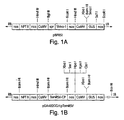
- Figure 1A shows the partial map of the T-DNA region of pBRS1.
- Figure 1B shows the partial map of the T-DNA region of pGA482GG/cpTomRSV.
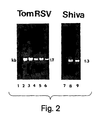
- FIG. 2 is a photograph showing the results of PCR amplified TomRSV-CP and Shiva-1 fragments from transgenic 'Thompson Seedless' grape plants.
- PCR analysis using TomRSV-CP primers are as follows: pGA482GG transformant (without the TomRSV-CP gene); lane 2, transformant 3-2; lane 3, transformant 3-3; lane 4, transformant 3S-2; lane 5, transformant 3S-6; lane 6, transformant 3SB-X.
- PCR analysis using Shiva-1 primers are as follows: lane 7, untransformed 'Thompson Seedless' plant; lane 8, transformant 4-3; lane 9, transformant 4S-2.
- Transgenic plants 3-2, 3-3, and 4-3 were obtained from A. tumefaciens infection alone. Plants 3S-2, 3S-3, 3SB-X, and 4S-2 were obtained from A. tumefaciens infection after microprojectile bombardment.
- Figure 3 is a photograph showing the results of a Southern analysis of transgenic 'Thompson Seedless' grape plants.
- DNA extracted from TomRSV-CP transformants that was digested with EcoRI and probed with a NOS/NPTII fragment is shown in lanes 1 through 9.
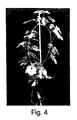
- Figure 4 is a photograph showing a transgenic 'Thompson Seedless' grape plant four months after transfer to the greenhouse.
- Transgenic grape plants expressing either lytic peptide or TomRSV coat protein genes were regenerated from somatic embryos derived from leaves of in vitro -grown plants of 'Thompson Seedless' grape ( Vitis vinifera L.) plants. Somatic embryos were either exposed directly to engineered A . tumefaciens or they were bombarded twice with 1- ⁇ m gold particles and then exposed to A. tumefaciens . Somatic embryos were transformed with either the lytic peptide Shiva-1 gene or the tomato ringspot virus coat protein (TomRSV-CP) gene.
- TomRSV-CP tomato ringspot virus coat protein
- kan kanamycin
- GUS positive ⁇ -glucuronidase
- PCR polymerase chain-reaction
- Leaves from 'Thompson Seedless' in vitro cultures were used to produce somatic embryos following the method of Stamp et al. (J. Amer . Hort . Sci. 115:1038-1042, 1990). Expanding leaves (approximately 0.5 cm long) excised from in vitro -grown shoots were cultured on a modified Nitsch and Nitsch (Science 163:85-87, 1969) (NN) medium containing 5 ⁇ M of 2,4-D, 1 ⁇ M of BA, 60 grams/liter of sucrose, 2 grams/liter of activated charcoal, and 7 grams/liter of agar, pH 5.7. After a three- to twelve-week culture period, somatic embryos formed.
- MS Murashige and Skoog ( Plant Physiol. 15:473-497, 1962) (MS) medium containing 120 grams/liter of sucrose, 2 grams/liter of activated charcoal, and 7 grams/liter of agar, pH 5.7.
- MS Murashige and Skoog
- EPP Emershad and Ramming proliferation
- a . tumefaciens strains were EHA101 and EHA105 (Hood et al., J. Bacterial. 168:1283-1290, 1986) containing plasmid pGA482GG/cpTomRSV (Slightom, Gene 100:252-255, 1991; Slightom et al., In : Plant Mol . Biol. Man ., S. B. Gelivn, R. A. Schilperoot, and D.P.S. Verma, eds., Kluwer, Dordrecht, The Netherlands) or pBPRS1 (WO 94/07356), respectively, were used (Figs. 1A -1B).
- Plasmid pGA482GG/cpTomRSV contained the tomato ringsport virus coat protein (TomRSV-CP) gene and pBRPS contained the Shiva-1 lytic peptide gene (Destefano-Beltran et al., In : The Molecular and Cellular Biology of the Potato, M. Vayada and W. Parks, eds., C.A.B. Int'l Wallingford, U.K.; Jaynes et al., Acta Hort. 336:33-39, 1993).
- a . tumefaciens transformants were cocultivated and selected as described by Scorza et al. ( Plant Cell Rpt. 14:589-592, 1995). Briefly, A . tumefaciens cultures were grown overnight at 28°C in LB medium containing selective antibiotics for each plasmid. These cultures were centrifuged (5,000 x g , 10 minutes) and resuspended in a medium consisting of MS salts containing 20 grams/liter of sucrose, 100 ⁇ M of acetosyringone, and 1.0 ⁇ M of betaine phosphate. The cultures were then shaken for about six hours at 20°C before use in the transformation treatments that are described below.
- Somatic embryos were either bombarded with gold microprojectiles and then exposed to A . tumefaciens as described by Scorza et al. ( J . Amer. Soc. Hort. Sci. 119:1091-1098, 1994) or they were exposed to A . tumefaciens without prior bombardment as follows. Microprojectile bombardment was accomplished using the Biolistic PDS-1000/He device (Bio-Rad Laboratories). A total of 700 somatic embryos were separated into groups of 100. Each group was placed onto a 25-mm polycarbonate membrane in the center of a 100-mm petri plate containing ERP medium twenty-four hours before bombardment.
- Somatic embryos were shot with 1.0- ⁇ m diameter gold particles following the general procedures of Sanford et al. ( Meth. Enzmol. 217:483-509, 1991) using the parameters described by Scorza et al. ( Plant Cell Rpt. 14:589-592, 1995). All plates were bombarded twice. Within two hours of bombardment, embryos were cocultivated with A. tumefaciens . After bombardment, somatic embryos were immersed in the resuspended A. tumefaciens culture that was prepared as described above. After fifteen to twenty minutes, the A .
- tumefaciens culture medium was removed and somatic embryos were placed onto cocultivation medium (ERP medium containing 100 ⁇ m acetosyringone). Somatic embryos were cocultivated for two days and then washed with liquid ERP medium (without charcoal) containing 300 ⁇ g/ml of cefotaxime and 200 ⁇ g/ml of carbenicillin. Somatic embryos were then plated on agar-solidified ERP medium (0.75% agar) with the above-mentioned selective antibiotics. All somatic embryo cultures were allowed to proliferate for two passages (3 weeks each) before being placed onto selection medium. Selection was carried out on ERP medium containing the above specified amounts of cefotaxime and carbenicillin, and 40 ⁇ g/ml of kanamycin.
- Transformed somatic embryos and shoots produced after somatic embryo germination were assayed by growth on kanamycin-containing medium and through a histological GUS assay (Jefferson, Plant Mol. Biol. Rpt. 5:387-405, 1987). Leaf samples of the plants surviving kanamycin selection were observed to produce the characteristic blue GUS positive reaction, indicating the presence and activity of the GUS gene in these plants. Leaves from untransformed control plants showed no blue staining.
- Leaves sampled from plants growing in vitro were also cultured for one week in liquid LB medium to assay for the presence of contaminating A. tumefaciens.
- Excised leaves from putative transformants cultured in liquid LB medium were negative for the presence of contaminating A . tumefaciens.
- transformed plants were subjected to PCR and Southern analysis. PCR amplification was conducted on DNA isolated from leaves of putatively transformed grape plants. Specific oligonucleotide primers from TomRSV-CP and Shiva-1 gene sequences were used to identify the presence of these genes in DNA from the different clones.
- the first cycle used an additional 3 minutes melt at 95°C and the last five cycles had a 4 minute extension time period at 72°C.
- the PCR products were analyzed by agarose gel electrophoresis and stained with ethidium bromide. PCR analysis using TomRSV-CP and Shiva-1 primers indicated that the thirteen plants that survived kanamycin selection after being exposed to TomRSV-CP or Shiva-1 transformation treatments contained the predicted gene sequences ( Figure 2).
- Southern analysis was used to demonstrate the incorporation of the foreign genes into the grape genome.
- Southern analysis was carried out using a PCR-generated 1.1-kb NOS/NPTII probe. Digestion with Eco RI was then used to test for unique insertion events that would include segments of grape DNA in pGA482GG/cpTomRSV transformants. BamHI restriction digestion was used for the pBPRS1(Shiva-1) transformants. Extraction of DNA from transformants followed the procedures of Callahan et al. ( Plant Physiol. 100:482-488, 1992). Conditions for Southern analysis were described by Scorza et al. ( In Vitro Cell Dev. Biol. 26:829-834, 1990).
- the NOS/NPTII probe was radioactively labeled according to standard methods using random primers according to the instructions with the BioRad Random Primer DNA Labeling Kit (BioRad, Hercules, CA).
- PD is a fatal disease of grapevine known throughout the world. PD kills grapevines by blocking the plant's water-transporting tissue, the xylem. The disease is caused by the bacterium, Xyllella fastidiosa , and is spread by a leafhopper, the blue-green sharpshooter that feeds on the xylem fluid of grape. The sharpshooter transmits the bacteria from vine to vine. As the bacteria multiply inside the plant, they plug the xylem vessels, inhibiting water and nutrient transport throughout the plant. Infected vines die for reasons related to water uptake.
- the symptoms of PD therefore resemble those of water stress and include the drying, marginal burning, or scorching of leaves due to initial clogging of fine vessel elements, and eventual dieback of the vine due to total occlusion of the vessels in the trunk.
- Other symptoms include the shriveling and dying of fruit clusters.
- transgenic grapevines expressing the Shiva-1 construct have been evaluated for resistance to X . fastidiosa. These included a non-transformed control; a transformed grapevine containing one Shiva-1 insert (designated clone B); and a transgenic grapevine containing four Shiva-1 inserts (designated clone A). Each of these plants were vegetatively propagated and then inoculated with X . fastidiosa according to the methods described by Hopkins ( Phytopathology 75:713-717, 1985). While replicate plants of all three clones eventually succumbed to PD, clone A was observed to exhibit milder PD symptomology, which did not include the typical signs of marginal leaf burn when compared to the non-transformed control plant.
- Transgenic grapevines expressing a transgene containing a lytic peptide e.g., Shiva-1 or cecropin B
- TomRSV-CP are operably linked to a constitutive promoter or to a controllable promoter such as a tissue-specific promoter, cell-type specific promoter, or to a promoter that is induced by an external signal or agent such as a pathogen- or wound-inducible control element, thus limiting the temporal or tissue expression or both.
- a transgene containing a lytic peptide e.g., Shiva-1 or cecropin B
- TomRSV-CP e.g., TomRSV-CP
- Such transgenes may also be expressed in roots, leaves, or fruits, or at a site of a grapevine that is susceptible to pathogen penetration and infection.
- a lytic peptide gene may be engineered for constitutive low level expression in xylem-tissue expression and then transformed into a Vitis host plant. To achieve pathogen resistance or disease resistance or both, it is important to express the transgene at an effective level. Evaluation of the level of pathogen protection conferred to a plant by expression of such a transgene is determined according to conventional methods and assays as described herein.
- expression of a lytic peptide is used to control bacterial infection, for example, to control Agrobacterium, the causative agent of crown gall disease.
- a lytic peptide e.g., Shiva-1 or cecropin B
- the Shiva-1 expression vector described herein or a plant expression vector containing the cecropin B gene is used to transform somatic embryos according to the methods described above.
- transformed plants and appropriate controls are grown, and the stems are inoculated with a suspension of Agrobacterium according to standard methods. Transformed grape plants are subsequently incubated in a growth chamber, and the inoculated stems are analyzed for signs of resistance to crown gall formation according to standard methods.
- the number of galls per inoculation are recorded and evaluated after inoculation. From a statistical analysis of these data, levels of resistance to Agrobacterium and crown gall formation are determined.
- Transformed grape plants that express a lytic peptide e.g., Shiva-1 or cecropin B or both
- a lytic peptide e.g., Shiva-1 or cecropin B or both
- the level of resistance in a transgenic plant of the invention is at least 5-10% (and preferably 30% or 40%) greater than the resistance of a control plant.
- the level of resistance to a disease-causing pathogen is 50% greater, 60% greater, and more preferably even 75% or 90% greater than a control plant; with up to 100% above the level of resistance as compared to a control plant being most preferred.
- the level of resistance or tolerance is measured using conventional methods.
- the level of resistance to a pathogen may be determined by comparing physical features and characteristics (for example, plant height and weight, or by comparing disease symptoms, for example, delayed lesion development, reduced lesion size, leaf wilting, shriveling, and curling, decay of fruit clusters, water-soaked spots, leaf scorching and marginal burning, and discoloration of cells) of transgenic grape plants.
- constitutive expression of a lytic peptide is used to control the fungus Botrytis , the causative agent of bunch rot disease.
- a plant expression vector is constructed that contains a transgene sequence that expresses the lytic peptide(s). This expression vector is then used to transform somatic embryos according to the methods described above.
- transformed plants and appropriate controls are grown to approximately 30 cm vinelength, and young leaves and shoots are inoculated with a mycelial suspension of Botrytis. For example, plugs of Botrytis mycelia are inoculated on each side of the leaf midvein of developing leaves.
- Plants are subsequently incubated in a growth chamber at 30 °C with constant fluorescent light and high humidity.
- Leaves of transformed and control grapevines are then evaluated for resistance to Botrytis infection and disease according to conventional experimental methods. For this evaluation, for example, the number of lesions per leaf and percentage of leaf area infected are recorded every twenty-four hours for seven days after inoculation. From these data, levels of resistance to Botrytis are determined.
- fruit clusters can be sprayed with a suspension of Botrytis and infection monitored at 15-20°C at 90% relative humidity after fifteen to twenty-four hours.
- Transformed grapevines that express a lytic peptide gene having an increased level of resistance to Botrytis and infection and disease relative to control plants are taken as being useful in the invention.
- transformed and control grapevines are transplanted to potting soil containing an inoculum of Botrytis. Plants are then evaluated for symptoms of fungal infection (for example, wilting or decayed leaves) over a period of time lasting from several days to weeks. Again, transformed grapevines expressing the lytic peptide gene(s) having an increased level of resistance to the fungal pathogen, Botrytis, relative to control plants are taken as being useful in the invention.
- the invention further includes analogs of any naturally-occurring lytic peptide.
- Analogs can differ from the naturally-occurring lytic peptide by amino acid sequence differences, by post-translational modifications, or by both.
- lytic peptide analogs used in the invention will generally exhibit about 30%, more preferably 50%, and most preferably 60% or even having 70%, 80%, or 90% identity with all or part of a naturally-occurring lytic peptide amino acid sequence.
- the length of sequence comparison is at least 10 to 15 ammo acid residues, preferably at least 25 amino acid residues, and more preferably more than 35 amino acid residues.
- Modifications include chemical derivatization of polypeptides, e.g., acetylation, carboxylation, phosphorylation, or glycosylation; such modifications may occur during polypeptide synthesis or processing or following treatment with isolated modifying enzymes.
- Lytic peptide analogs can also differ from the naturally-occurring by alterations in primary sequence. These include genetic variants, both natural and induced (for example, resulting from random mutagenesis by irradiation or exposure to ethyl methylsulfate or by site-specific mutagenesis as described in Sambrook, Fritsch and Maniatis, Molecular Cloning: A Laboratory Manual (2d ed.), CSH Press, 1989, or Ausubel et al., supra ).
- cyclized peptides, molecules, and analogs which contain residues other than L-amino acids, e.g., D-amino acids or non-haturally occurring or synthetic amino acids, e.g., ⁇ or ⁇ amino acids.
- fragments means at least 10 contiguous amino acids, preferably at least 15 contiguous amino acids, more preferably at least 20 contiguous amino acids, and most preferably at least 30 to 40 or more contiguous amino acids. Fragments of lytic peptides can be generated by methods known to those skilled in the art or may result from normal protein processing (e.g., removal of amino acids from the nascent polypeptide that are not required for biological activity or removal of amino acids by alternative mRNA splicing or alternative protein processing events).
Landscapes
- Health & Medical Sciences (AREA)
- Life Sciences & Earth Sciences (AREA)
- Genetics & Genomics (AREA)
- Engineering & Computer Science (AREA)
- Chemical & Material Sciences (AREA)
- Organic Chemistry (AREA)
- Biomedical Technology (AREA)
- Molecular Biology (AREA)
- Biotechnology (AREA)
- Wood Science & Technology (AREA)
- Bioinformatics & Cheminformatics (AREA)
- General Engineering & Computer Science (AREA)
- Zoology (AREA)
- Biochemistry (AREA)
- Biophysics (AREA)
- General Health & Medical Sciences (AREA)
- Cell Biology (AREA)
- Microbiology (AREA)
- Plant Pathology (AREA)
- Physics & Mathematics (AREA)
- Virology (AREA)
- Medicinal Chemistry (AREA)
- Gastroenterology & Hepatology (AREA)
- Proteomics, Peptides & Aminoacids (AREA)
- Natural Medicines & Medicinal Plants (AREA)
- Physiology (AREA)
- Botany (AREA)
- Developmental Biology & Embryology (AREA)
- Environmental Sciences (AREA)
- Breeding Of Plants And Reproduction By Means Of Culturing (AREA)
- Agricultural Chemicals And Associated Chemicals (AREA)
- Peptides Or Proteins (AREA)
Claims (32)
- Verfahren zur Herstellung einer transgenen Pflanze der Gattung Vitis mit einer Resistenz gegenüber einem Pflanzenpathogen, wobei das Verfahren umfasst:die Transformation einer Pflanzenzelle der Gattung Vitis mit einer Nukleinsäure, die ein lytisches Peptid exprimiert, wobei die Expression des lytischen Peptids eine Resistenz gegenüber einem Pflanzenpathogen bereitstellt, undPropagieren einer Pflanze aus der Pflanzenzelle.
- Verfahren gemäß Anspruch 1, wobei die Pflanzenzelle Teil eines somatischen Embryos ist.
- Verfahren gemäß Anspruch 2, das ferner das Propagieren einer Pflanze aus dem somatischen Embryo umfasst.
- Verfahren gemäß Anspruch 1, wobei die Transformation eine Infektion der Pflanzenzelle mit Agrobacterium tumefaciens umfasst, das die Nukleinsäure umfasst, die das lytische Peptid exprimiert.
- Verfahren gemäß Anspruch 1, wobei die Transformation eine Bombardierung der Pflanzenzelle mit Mikroprojektilen umfasst, die die Nukleinsäure umfassen, die das lytische Peptid exprimiert.
- Verfahren gemäß Anspruch 1, wobei die Transformation eine Bombardierung der Pflanzenzelle mit Mikroprojektilen umfasst, gefolgt von einer Infektion der bombardierten Zellen mit Agrobacterium tumefaciens, das die Nukleinsäure umfasst, die das lytische Peptid exprimiert.
- Verfahren gemäß Anspruch 1, wobei das lytische Peptid Shiva-1 ist.
- Verfahren gemäß Anspruch 1, wobei die Pflanzenzelle Vitis vinifera "Thompson Seedless" ist.
- Verfahren gemäß Anspruch 1, wobei die Expression des lytischen Peptids eine Resistenz gegenüber dem Bakterium Xylella fastidiosa, dem Erreger der Pierce-Krankheit, bereitstellt.
- Transgene Pflanzenzelle der Gattung Vitis, die mit einer Nukleinsäure transformiert ist, die ein lytisches Peptid exprimiert, wobei eine Expression des lytischen Peptids eine Resistenz gegenüber einem Pflanzenpathogen bereitstellt.
- Transgene Pflanzenzelle gemäß Anspruch 10, wobei die Nukleinsäure von einem Expressionsvektor umfasst ist.
- Transgene Pflanzenzelle gemäß Anspruch 10, wobei das lytische Peptid Shiva-1 ist.
- Transgene Pflanzenzelle gemäß Anspruch 10, wobei die transgene Pflanzenzelle Vitis vinifera "Thompson Seedless" ist.
- Transgene Pflänzenzelle gemäß Anspruch 10, wobei die Expression des lytischen Peptids eine Resistenz gegenüber dem Bakterium Xylella fastidiosa, dem Erreger der Pierce-Krankheit, bereitstellt.
- Transgene Pflanze oder Pflanzenbestandteil der Gattung Vitis, transformiert mit einer Nukleinsäure, die ein lytisches Peptid exprimiert, wobei eine Expression des lytischen Peptids eine Resistenz gegenüber einem Pflanzenpathogen bereitstellt.
- Pflanzenbestandteil gemäß Anspruch 15, der ein somatischer Embryo ist.
- Pflanzenbestandteil gemäß Anspruch 15, der ein Pfropfreis ist.
- Pflanzenbestandteil gemäß Anspruch 15, der ein Wurzelstock ist.
- Transgene Pflanze gemäß Anspruch 15, wobei die transgene Pflanze Vitis vinifera "Thompson Seedless" ist.
- Transgene Pflanze gemäß Anspruch 15, wobei die Nukleinsäure einen Expressionsvektor umfasst.
- Transgene Pflanze gemäß Anspruch 15, wobei das lytische Peptid Shiva-1 ist.
- Transgene Pflanze gemäß Anspruch 15, wobei die Expression des lytischen Peptids eine Resistenz gegenüber dem Bakterium Xylella fastidiosa, dem Erreger der Pierce-Krankheit, bereitstellt.
- Pfropfreis, Wurzelstock, somatischer Embryo, Zelle oder Samen einer transgenen Pflanze gemäß Anspruch 15.
- Verfahren gemäß Anspruch 1, wobei das Pflanzenpathogen ein Pilz-Pflanzenpathogen ist.
- Verfahren gemäß Anspruch 24, wobei das Pilz-Pflanzenpathogen Botrytis ist.
- Verfahren gemäß Anspruch 1, wobei die transgene Pflanze gegenüber Grauschimmelfäule resistent ist.
- Transgene Pflanzenzelle gemäß Anspruch 10, wobei das Pflanzenpathogen ein Pilz-Pflanzenpathogen ist.
- Transgene Pflanzenzelle gemäß Anspruch 27, wobei das Pilz-Pflanzenpathogen Botrytis ist.
- Transgene Pflanzenzelle gemäß Anspruch 10, wobei die transgene Pflanzenzelle gegenüber Grauschimmelfäule resistent ist.
- Transgene Pflanze oder Pflanzenbestandteil gemäß Anspruch 15, wobei das Pflanzenpathogen ein Pilz-Pflanzenpathogen ist.
- Transgene Pflanze oder Pflanzenbestandteil gemäß Anspruch 30, wobei das Pilz-Pflanzenpathogen Botrytis ist.
- Transgene Pflanze oder Pflanzenbestandteil gemäß Anspruch 15, wobei die Pflanze oder der Pflanzenbestandteil gegenüber Grauschimmelfäule resistent ist.
Priority Applications (2)
| Application Number | Priority Date | Filing Date | Title |
|---|---|---|---|
| SI9730290T SI0938564T1 (en) | 1996-06-26 | 1997-06-20 | Disease resistance in vitis |
| EP01115118A EP1138767B1 (de) | 1996-06-26 | 1997-06-20 | Krankheitsresistenz in Vitis |
Applications Claiming Priority (3)
| Application Number | Priority Date | Filing Date | Title |
|---|---|---|---|
| US2056996P | 1996-06-26 | 1996-06-26 | |
| US20569P | 1996-06-26 | ||
| PCT/US1997/010646 WO1997049277A1 (en) | 1996-06-26 | 1997-06-20 | DISEASE RESISTANCE IN $i(VITIS) |
Related Child Applications (1)
| Application Number | Title | Priority Date | Filing Date |
|---|---|---|---|
| EP01115118A Division EP1138767B1 (de) | 1996-06-26 | 1997-06-20 | Krankheitsresistenz in Vitis |
Publications (3)
| Publication Number | Publication Date |
|---|---|
| EP0938564A4 EP0938564A4 (de) | 1999-07-07 |
| EP0938564A1 EP0938564A1 (de) | 1999-09-01 |
| EP0938564B1 true EP0938564B1 (de) | 2002-01-23 |
Family
ID=21799347
Family Applications (1)
| Application Number | Title | Priority Date | Filing Date |
|---|---|---|---|
| EP97930134A Expired - Lifetime EP0938564B1 (de) | 1996-06-26 | 1997-06-20 | Krankheitsresistenz in vitis |
Country Status (12)
| Country | Link |
|---|---|
| US (3) | US6232528B1 (de) |
| EP (1) | EP0938564B1 (de) |
| AR (1) | AR007631A1 (de) |
| AT (2) | ATE212377T1 (de) |
| CA (1) | CA2258265A1 (de) |
| DE (2) | DE69710094T2 (de) |
| ES (2) | ES2171960T3 (de) |
| IL (1) | IL127630A0 (de) |
| NZ (1) | NZ333455A (de) |
| PT (2) | PT938564E (de) |
| WO (1) | WO1997049277A1 (de) |
| ZA (1) | ZA975681B (de) |
Families Citing this family (26)
| Publication number | Priority date | Publication date | Assignee | Title |
|---|---|---|---|---|
| US6232528B1 (en) * | 1996-06-26 | 2001-05-15 | University Of Florida Research Foundation Incorporated | Disease resistance in vitis |
| US6667426B1 (en) * | 1997-09-29 | 2003-12-23 | Cornell Research Foundation, Inc. | Grapevine fanleaf virus resistance in grapevine expressing grapevine fanleaf virus coat protein |
| US6071746A (en) * | 1998-02-02 | 2000-06-06 | Agriculture And Agri-Food Canada | Regeneration of somatic embryos from plant tissues |
| FR2775001B1 (fr) * | 1998-02-13 | 2000-05-12 | Lvmh Rech | Acide nucleique comprenant la sequence d'un promoteur inductible par un stress et une sequence d'un gene codant pour une stilbene synthase, cellule et plante transformees par cet acide nucleique |
| FR2775000B1 (fr) * | 1998-02-13 | 2002-02-08 | Lvmh Rech | Promoteur inductible dans les plantes, sequence incorporant ce promoteur et produit obtenu |
| CN1273506A (zh) | 1998-05-15 | 2000-11-15 | 佛罗里达大学 | 葡萄的再生系统及其应用 |
| EP1095145A1 (de) | 1999-05-14 | 2001-05-02 | University Of Florida | Pathogen-resistente weinpflanzen |
| MXPA04001906A (es) * | 2001-08-28 | 2005-03-07 | Eden Research Plc | Tratamiento y prevencion de infecciones en plantas. |
| CN1951411B (zh) * | 2002-08-23 | 2010-08-25 | 纽约州立大学研究基金会 | 一氧化氮及其生物医学重要作用 |
| ES2899590T3 (es) | 2004-01-23 | 2022-03-14 | Eden Research Plc | Métodos de eliminación de nematodos que comprenden la aplicación de un componente terpénico |
| NZ551644A (en) * | 2004-05-20 | 2010-06-25 | Eden Research Plc | Compositions containing a hollow glucan particle or a cell wall particle encapsulating a terpene component, methods of making and using them |
| US8592651B2 (en) * | 2005-06-13 | 2013-11-26 | University Of Florida Research Foundation, Inc. | Antimicrobial peptides and uses thereof |
| BRPI0619219B8 (pt) | 2005-11-30 | 2021-11-16 | Univ Cornell | Método para matar ácaros, método para tratar ou impedir a infestação por um ácaro em uma planta e uso de uma composição |
| WO2007063268A1 (en) | 2005-11-30 | 2007-06-07 | Eden Research Plc | Compositions and methods comprising terpenes or terpene mixtures selected from thymol, eugenol, geraniol, citral, and l-carvone |
| WO2008062310A2 (en) * | 2006-05-19 | 2008-05-29 | Hornedo Jose Luis Stephano | Elimination of the bacteria that cause pierce's disease |
| WO2008094684A1 (en) * | 2007-02-01 | 2008-08-07 | University Of Florida Research Foundation, Inc. | Hybrid peptides having antimicrobial activity and methods of making and using hybrid peptides |
| AR075465A1 (es) | 2008-10-22 | 2011-04-06 | Basf Se | Uso de herbicidas de sulfonilurea en plantas cultivadas |
| AR075466A1 (es) | 2008-10-22 | 2011-04-06 | Basf Se | Uso de herbicidas tipo auxina en plantas cultivadas |
| US20150250174A1 (en) | 2012-10-01 | 2015-09-10 | Basf Se | Use of n-thio-anthranilamide compounds on cultivated plants |
| GB201220940D0 (en) | 2012-11-21 | 2013-01-02 | Eden Research Plc | Method P |
| WO2014079820A1 (en) | 2012-11-22 | 2014-05-30 | Basf Se | Use of anthranilamide compounds for reducing insect-vectored viral infections |
| EP3028573A1 (de) | 2014-12-05 | 2016-06-08 | Basf Se | Verwendung eines triazolfungizids auf transgenen pflanzen |
| WO2016091674A1 (en) | 2014-12-12 | 2016-06-16 | Basf Se | Use of cyclaniliprole on cultivated plants |
| WO2016162371A1 (en) | 2015-04-07 | 2016-10-13 | Basf Agrochemical Products B.V. | Use of an insecticidal carboxamide compound against pests on cultivated plants |
| EP3338552A1 (de) | 2016-12-21 | 2018-06-27 | Basf Se | Verwendung eines tetrazolinon fungizids bei transgenen pflanzen |
| EP4385997A1 (de) | 2022-12-16 | 2024-06-19 | Fraunhofer-Gesellschaft zur Förderung der angewandten Forschung e.V. | Chitinopeptine, ihre verwendung und rekombinante synthese in organismen für den pflanzenschutz |
Family Cites Families (9)
| Publication number | Priority date | Publication date | Assignee | Title |
|---|---|---|---|---|
| ATE123528T1 (de) | 1986-07-25 | 1995-06-15 | Univ Louisiana State | Verfahren zum verleihen bei pflanzen eines widerstands gegen krankheiten und pest sowie neue gene in pflanzen die hierfür kodieren. |
| US5597945A (en) | 1986-07-25 | 1997-01-28 | Board Of Supervisors Of Louisiana State University And Agricultural And Mechanical College | Plants genetically enhanced for disease resistance |
| EP0299828B1 (de) | 1987-07-01 | 1994-06-15 | Plant Genetic Systems N.V. | Bakteriozide und/oder bakteriostatische Peptide, Verfahren zu ihrer Isolierung, Herstellung und Verwendung |
| PH30997A (en) | 1990-03-12 | 1997-12-23 | Ciba Geigy | Antipathologenically effective compositions comprising lytic peptides and hydrolytic enzymes. |
| US5631007A (en) | 1990-03-12 | 1997-05-20 | Ciba-Geigy Corporation | Anti-pathogenically effective compositions comprising lytic peptides and hydrolytic enzymes |
| ATE308562T1 (de) | 1990-08-10 | 2005-11-15 | Virtual Drug Dev Inc | Antimikrobielle peptide wirksam gegen pflanzenpathogene, ihre verwendung und auf sie bezogene nachweismethoden |
| EP0684759A4 (de) | 1992-09-30 | 1996-05-08 | Cornell Res Foundation Inc | Transgenischem apfelartigem obst mit feuerbrandresistenz. |
| US5548075A (en) | 1993-08-30 | 1996-08-20 | Utah State University | DNA cassette and transgenic organisms carrying lytic peptide-encoding genes |
| US6232528B1 (en) * | 1996-06-26 | 2001-05-15 | University Of Florida Research Foundation Incorporated | Disease resistance in vitis |
-
1997
- 1997-06-19 US US08/878,750 patent/US6232528B1/en not_active Expired - Fee Related
- 1997-06-20 PT PT97930134T patent/PT938564E/pt unknown
- 1997-06-20 AT AT97930134T patent/ATE212377T1/de active
- 1997-06-20 DE DE69710094T patent/DE69710094T2/de not_active Expired - Fee Related
- 1997-06-20 ES ES97930134T patent/ES2171960T3/es not_active Expired - Lifetime
- 1997-06-20 EP EP97930134A patent/EP0938564B1/de not_active Expired - Lifetime
- 1997-06-20 IL IL12763097A patent/IL127630A0/xx unknown
- 1997-06-20 WO PCT/US1997/010646 patent/WO1997049277A1/en not_active Ceased
- 1997-06-20 DE DE69735171T patent/DE69735171T2/de not_active Expired - Fee Related
- 1997-06-20 ES ES01115118T patent/ES2255527T3/es not_active Expired - Lifetime
- 1997-06-20 CA CA002258265A patent/CA2258265A1/en not_active Abandoned
- 1997-06-20 NZ NZ333455A patent/NZ333455A/xx unknown
- 1997-06-20 AT AT01115118T patent/ATE317010T1/de not_active IP Right Cessation
- 1997-06-20 PT PT01115118T patent/PT1138767E/pt unknown
- 1997-06-26 ZA ZA975681A patent/ZA975681B/xx unknown
- 1997-06-26 AR ARP970102829A patent/AR007631A1/es active IP Right Grant
-
2001
- 2001-06-06 US US09/876,202 patent/US20010047522A1/en not_active Abandoned
-
2003
- 2003-05-19 US US10/441,669 patent/US7151203B2/en not_active Expired - Fee Related
Non-Patent Citations (1)
| Title |
|---|
| JAYNES JM: "USES OF GENES ENCODING NOVEL LYTIC PEPTIDES AND PROTEINS THAT ENHANCE MICROBIAL DISEASE RESISTANCE IN PLANTS", ACTA HORTICULUTIRA, vol. 336, 1993, pages 33 - 39 * |
Also Published As
| Publication number | Publication date |
|---|---|
| PT1138767E (pt) | 2006-05-31 |
| ATE317010T1 (de) | 2006-02-15 |
| DE69735171T2 (de) | 2006-10-26 |
| US20010047522A1 (en) | 2001-11-29 |
| ES2255527T3 (es) | 2006-07-01 |
| US6232528B1 (en) | 2001-05-15 |
| NZ333455A (en) | 2000-01-28 |
| PT938564E (pt) | 2002-06-28 |
| ZA975681B (en) | 1998-07-31 |
| EP0938564A4 (de) | 1999-07-07 |
| CA2258265A1 (en) | 1997-12-31 |
| US20030182686A1 (en) | 2003-09-25 |
| DE69735171D1 (de) | 2006-04-13 |
| ATE212377T1 (de) | 2002-02-15 |
| ES2171960T3 (es) | 2002-09-16 |
| US7151203B2 (en) | 2006-12-19 |
| EP0938564A1 (de) | 1999-09-01 |
| WO1997049277A1 (en) | 1997-12-31 |
| IL127630A0 (en) | 1999-10-28 |
| DE69710094D1 (de) | 2002-03-14 |
| AR007631A1 (es) | 1999-11-10 |
| DE69710094T2 (de) | 2002-08-29 |
Similar Documents
| Publication | Publication Date | Title |
|---|---|---|
| US7151203B2 (en) | Disease resistance in Vitis | |
| Scorza et al. | Producing TransgenicThompson Seedless' Grape (Vitis vinifera L.) Plants | |
| CA1341565C (en) | Protection of plants against viral infection | |
| Yao et al. | Regeneration of transgenic plants from the commercial apple cultivar Royal Gala | |
| Regner et al. | Coat protein mediated resistance to Plum Pox Virus in Nicotiana clevelandii and N. benthamiana | |
| AU4365200A (en) | Plant transformation process | |
| AU707935B2 (en) | Transgenic plants exhibiting heterologous virus resistance | |
| AU5005100A (en) | Pathogen-resistant grape plants | |
| EP1026941B1 (de) | Nepovirusresistenz in wein | |
| AU723058C (en) | Disease resistance in vitis | |
| AU759417B2 (en) | Disease resistance in vitis | |
| EP1138767B1 (de) | Krankheitsresistenz in Vitis | |
| Scorza et al. | Disease resistance in Vitis | |
| Martinelli et al. | Genetic transformation of tobacco and grapevine for resistance to viruses related to the rugose wood disease complex | |
| Fang et al. | Transformation in Muskmelon (Cucumis Melo L.) | |
| AU727208C (en) | Grapevine leafroll virus proteins and their uses | |
| CN109678942A (zh) | 一种提高水稻远缘杂交后代育性的方法与所用蛋白质 | |
| Krasatanova et al. | Genetic Engineering of Grape for Resistance to Crown Gall | |
| MXPA00003651A (en) | Bacterial resistance in grapevine | |
| MXPA00003023A (en) | Nepovirus resistance in grapevine |
Legal Events
| Date | Code | Title | Description |
|---|---|---|---|
| A4 | Supplementary search report drawn up and despatched | ||
| AK | Designated contracting states |
Kind code of ref document: A4 Designated state(s): AT CH DE ES FR GR IT LI PT |
|
| PUAI | Public reference made under article 153(3) epc to a published international application that has entered the european phase |
Free format text: ORIGINAL CODE: 0009012 |
|
| 17P | Request for examination filed |
Effective date: 19990121 |
|
| A4 | Supplementary search report drawn up and despatched |
Effective date: 19990707 |
|
| AK | Designated contracting states |
Kind code of ref document: A1 Designated state(s): AT CH DE ES FR GR IT LI PT |
|
| AX | Request for extension of the european patent |
Free format text: SI PAYMENT 19990121 |
|
| 17Q | First examination report despatched |
Effective date: 19991110 |
|
| RIC1 | Information provided on ipc code assigned before grant |
Free format text: 7C 12N 15/52 A, 7C 12N 15/82 B, 7C 12N 5/14 B, 7A 01H 5/08 B, 7A 01H 5/10 B |
|
| GRAG | Despatch of communication of intention to grant |
Free format text: ORIGINAL CODE: EPIDOS AGRA |
|
| GRAG | Despatch of communication of intention to grant |
Free format text: ORIGINAL CODE: EPIDOS AGRA |
|
| GRAH | Despatch of communication of intention to grant a patent |
Free format text: ORIGINAL CODE: EPIDOS IGRA |
|
| GRAG | Despatch of communication of intention to grant |
Free format text: ORIGINAL CODE: EPIDOS AGRA |
|
| GRAH | Despatch of communication of intention to grant a patent |
Free format text: ORIGINAL CODE: EPIDOS IGRA |
|
| GRAA | (expected) grant |
Free format text: ORIGINAL CODE: 0009210 |
|
| AK | Designated contracting states |
Kind code of ref document: B1 Designated state(s): AT CH DE ES FR GR IT LI PT |
|
| AX | Request for extension of the european patent |
Free format text: SI PAYMENT 19990121 |
|
| PG25 | Lapsed in a contracting state [announced via postgrant information from national office to epo] |
Ref country code: LI Free format text: LAPSE BECAUSE OF FAILURE TO SUBMIT A TRANSLATION OF THE DESCRIPTION OR TO PAY THE FEE WITHIN THE PRESCRIBED TIME-LIMIT Effective date: 20020123 Ref country code: CH Free format text: LAPSE BECAUSE OF FAILURE TO SUBMIT A TRANSLATION OF THE DESCRIPTION OR TO PAY THE FEE WITHIN THE PRESCRIBED TIME-LIMIT Effective date: 20020123 Ref country code: AT Free format text: LAPSE BECAUSE OF FAILURE TO SUBMIT A TRANSLATION OF THE DESCRIPTION OR TO PAY THE FEE WITHIN THE PRESCRIBED TIME-LIMIT Effective date: 20020123 |
|
| REF | Corresponds to: |
Ref document number: 212377 Country of ref document: AT Date of ref document: 20020215 Kind code of ref document: T |
|
| REG | Reference to a national code |
Ref country code: CH Ref legal event code: EP |
|
| REF | Corresponds to: |
Ref document number: 69710094 Country of ref document: DE Date of ref document: 20020314 |
|
| REG | Reference to a national code |
Ref country code: PT Ref legal event code: SC4A Free format text: AVAILABILITY OF NATIONAL TRANSLATION Effective date: 20020318 |
|
| ET | Fr: translation filed | ||
| REG | Reference to a national code |
Ref country code: CH Ref legal event code: PL |
|
| REG | Reference to a national code |
Ref country code: GR Ref legal event code: EP Ref document number: 20020401172 Country of ref document: GR |
|
| REG | Reference to a national code |
Ref country code: ES Ref legal event code: FG2A Ref document number: 2171960 Country of ref document: ES Kind code of ref document: T3 |
|
| PLBE | No opposition filed within time limit |
Free format text: ORIGINAL CODE: 0009261 |
|
| STAA | Information on the status of an ep patent application or granted ep patent |
Free format text: STATUS: NO OPPOSITION FILED WITHIN TIME LIMIT |
|
| 26N | No opposition filed | ||
| PGFP | Annual fee paid to national office [announced via postgrant information from national office to epo] |
Ref country code: PT Payment date: 20080620 Year of fee payment: 12 Ref country code: IT Payment date: 20080626 Year of fee payment: 12 |
|
| PGFP | Annual fee paid to national office [announced via postgrant information from national office to epo] |
Ref country code: ES Payment date: 20080717 Year of fee payment: 12 Ref country code: DE Payment date: 20080626 Year of fee payment: 12 |
|
| PGFP | Annual fee paid to national office [announced via postgrant information from national office to epo] |
Ref country code: FR Payment date: 20080617 Year of fee payment: 12 |
|
| PGFP | Annual fee paid to national office [announced via postgrant information from national office to epo] |
Ref country code: GR Payment date: 20080515 Year of fee payment: 12 |
|
| REG | Reference to a national code |
Ref country code: PT Ref legal event code: MM4A Free format text: LAPSE DUE TO NON-PAYMENT OF FEES Effective date: 20091221 |
|
| REG | Reference to a national code |
Ref country code: FR Ref legal event code: ST Effective date: 20100226 |
|
| PG25 | Lapsed in a contracting state [announced via postgrant information from national office to epo] |
Ref country code: PT Free format text: LAPSE BECAUSE OF NON-PAYMENT OF DUE FEES Effective date: 20091221 |
|
| PG25 | Lapsed in a contracting state [announced via postgrant information from national office to epo] |
Ref country code: FR Free format text: LAPSE BECAUSE OF NON-PAYMENT OF DUE FEES Effective date: 20090630 |
|
| PG25 | Lapsed in a contracting state [announced via postgrant information from national office to epo] |
Ref country code: DE Free format text: LAPSE BECAUSE OF NON-PAYMENT OF DUE FEES Effective date: 20100101 |
|
| REG | Reference to a national code |
Ref country code: ES Ref legal event code: FD2A Effective date: 20090622 |
|
| PG25 | Lapsed in a contracting state [announced via postgrant information from national office to epo] |
Ref country code: GR Free format text: LAPSE BECAUSE OF NON-PAYMENT OF DUE FEES Effective date: 20100107 Ref country code: ES Free format text: LAPSE BECAUSE OF NON-PAYMENT OF DUE FEES Effective date: 20090622 |
|
| PG25 | Lapsed in a contracting state [announced via postgrant information from national office to epo] |
Ref country code: IT Free format text: LAPSE BECAUSE OF NON-PAYMENT OF DUE FEES Effective date: 20090620 |