EP0939002A2 - Anzeigesystem und Abstandskontrolle für Kraftfahrzeug - Google Patents
Anzeigesystem und Abstandskontrolle für Kraftfahrzeug Download PDFInfo
- Publication number
- EP0939002A2 EP0939002A2 EP99108812A EP99108812A EP0939002A2 EP 0939002 A2 EP0939002 A2 EP 0939002A2 EP 99108812 A EP99108812 A EP 99108812A EP 99108812 A EP99108812 A EP 99108812A EP 0939002 A2 EP0939002 A2 EP 0939002A2
- Authority
- EP
- European Patent Office
- Prior art keywords
- vehicle
- display system
- indicator
- deceleration
- signal
- Prior art date
- Legal status (The legal status is an assumption and is not a legal conclusion. Google has not performed a legal analysis and makes no representation as to the accuracy of the status listed.)
- Withdrawn
Links
Images




Classifications
-
- G—PHYSICS
- G01—MEASURING; TESTING
- G01S—RADIO DIRECTION-FINDING; RADIO NAVIGATION; DETERMINING DISTANCE OR VELOCITY BY USE OF RADIO WAVES; LOCATING OR PRESENCE-DETECTING BY USE OF THE REFLECTION OR RERADIATION OF RADIO WAVES; ANALOGOUS ARRANGEMENTS USING OTHER WAVES
- G01S15/00—Systems using the reflection or reradiation of acoustic waves, e.g. sonar systems
- G01S15/88—Sonar systems specially adapted for specific applications
- G01S15/93—Sonar systems specially adapted for specific applications for anti-collision purposes
- G01S15/931—Sonar systems specially adapted for specific applications for anti-collision purposes of land vehicles
-
- B—PERFORMING OPERATIONS; TRANSPORTING
- B60—VEHICLES IN GENERAL
- B60Q—ARRANGEMENT OF SIGNALLING OR LIGHTING DEVICES, THE MOUNTING OR SUPPORTING THEREOF OR CIRCUITS THEREFOR, FOR VEHICLES IN GENERAL
- B60Q1/00—Arrangement of optical signalling or lighting devices, the mounting or supporting thereof or circuits therefor
- B60Q1/26—Arrangement of optical signalling or lighting devices, the mounting or supporting thereof or circuits therefor the devices being primarily intended to indicate the vehicle, or parts thereof, or to give signals, to other traffic
- B60Q1/44—Arrangement of optical signalling or lighting devices, the mounting or supporting thereof or circuits therefor the devices being primarily intended to indicate the vehicle, or parts thereof, or to give signals, to other traffic for indicating braking action or preparation for braking, e.g. by detection of the foot approaching the brake pedal
- B60Q1/444—Arrangement of optical signalling or lighting devices, the mounting or supporting thereof or circuits therefor the devices being primarily intended to indicate the vehicle, or parts thereof, or to give signals, to other traffic for indicating braking action or preparation for braking, e.g. by detection of the foot approaching the brake pedal with indication of the braking strength or speed changes, e.g. by changing shape or intensity of the indication
-
- B—PERFORMING OPERATIONS; TRANSPORTING
- B60—VEHICLES IN GENERAL
- B60Q—ARRANGEMENT OF SIGNALLING OR LIGHTING DEVICES, THE MOUNTING OR SUPPORTING THEREOF OR CIRCUITS THEREFOR, FOR VEHICLES IN GENERAL
- B60Q1/00—Arrangement of optical signalling or lighting devices, the mounting or supporting thereof or circuits therefor
- B60Q1/26—Arrangement of optical signalling or lighting devices, the mounting or supporting thereof or circuits therefor the devices being primarily intended to indicate the vehicle, or parts thereof, or to give signals, to other traffic
- B60Q1/50—Arrangement of optical signalling or lighting devices, the mounting or supporting thereof or circuits therefor the devices being primarily intended to indicate the vehicle, or parts thereof, or to give signals, to other traffic for indicating other intentions or conditions, e.g. request for waiting or overtaking
- B60Q1/52—Arrangement of optical signalling or lighting devices, the mounting or supporting thereof or circuits therefor the devices being primarily intended to indicate the vehicle, or parts thereof, or to give signals, to other traffic for indicating other intentions or conditions, e.g. request for waiting or overtaking for indicating emergencies
-
- B—PERFORMING OPERATIONS; TRANSPORTING
- B60—VEHICLES IN GENERAL
- B60Q—ARRANGEMENT OF SIGNALLING OR LIGHTING DEVICES, THE MOUNTING OR SUPPORTING THEREOF OR CIRCUITS THEREFOR, FOR VEHICLES IN GENERAL
- B60Q1/00—Arrangement of optical signalling or lighting devices, the mounting or supporting thereof or circuits therefor
- B60Q1/26—Arrangement of optical signalling or lighting devices, the mounting or supporting thereof or circuits therefor the devices being primarily intended to indicate the vehicle, or parts thereof, or to give signals, to other traffic
- B60Q1/50—Arrangement of optical signalling or lighting devices, the mounting or supporting thereof or circuits therefor the devices being primarily intended to indicate the vehicle, or parts thereof, or to give signals, to other traffic for indicating other intentions or conditions, e.g. request for waiting or overtaking
- B60Q1/525—Arrangement of optical signalling or lighting devices, the mounting or supporting thereof or circuits therefor the devices being primarily intended to indicate the vehicle, or parts thereof, or to give signals, to other traffic for indicating other intentions or conditions, e.g. request for waiting or overtaking automatically indicating risk of collision between vehicles in traffic or with pedestrians, e.g. after risk assessment using the vehicle sensor data
- B60Q1/535—Arrangement of optical signalling or lighting devices, the mounting or supporting thereof or circuits therefor the devices being primarily intended to indicate the vehicle, or parts thereof, or to give signals, to other traffic for indicating other intentions or conditions, e.g. request for waiting or overtaking automatically indicating risk of collision between vehicles in traffic or with pedestrians, e.g. after risk assessment using the vehicle sensor data to prevent rear-end collisions, e.g. by indicating safety distance at the rear of the vehicle
-
- B—PERFORMING OPERATIONS; TRANSPORTING
- B60—VEHICLES IN GENERAL
- B60Q—ARRANGEMENT OF SIGNALLING OR LIGHTING DEVICES, THE MOUNTING OR SUPPORTING THEREOF OR CIRCUITS THEREFOR, FOR VEHICLES IN GENERAL
- B60Q1/00—Arrangement of optical signalling or lighting devices, the mounting or supporting thereof or circuits therefor
- B60Q1/26—Arrangement of optical signalling or lighting devices, the mounting or supporting thereof or circuits therefor the devices being primarily intended to indicate the vehicle, or parts thereof, or to give signals, to other traffic
- B60Q1/50—Arrangement of optical signalling or lighting devices, the mounting or supporting thereof or circuits therefor the devices being primarily intended to indicate the vehicle, or parts thereof, or to give signals, to other traffic for indicating other intentions or conditions, e.g. request for waiting or overtaking
- B60Q1/54—Arrangement of optical signalling or lighting devices, the mounting or supporting thereof or circuits therefor the devices being primarily intended to indicate the vehicle, or parts thereof, or to give signals, to other traffic for indicating other intentions or conditions, e.g. request for waiting or overtaking for indicating speed outside of the vehicle
-
- G—PHYSICS
- G01—MEASURING; TESTING
- G01P—MEASURING LINEAR OR ANGULAR SPEED, ACCELERATION, DECELERATION, OR SHOCK; INDICATING PRESENCE, ABSENCE, OR DIRECTION, OF MOVEMENT
- G01P1/00—Details of instruments
- G01P1/07—Indicating devices, e.g. for remote indication
- G01P1/08—Arrangements of scales, pointers, lamps or acoustic indicators, e.g. in automobile speedometers
-
- G—PHYSICS
- G01—MEASURING; TESTING
- G01P—MEASURING LINEAR OR ANGULAR SPEED, ACCELERATION, DECELERATION, OR SHOCK; INDICATING PRESENCE, ABSENCE, OR DIRECTION, OF MOVEMENT
- G01P3/00—Measuring linear or angular speed; Measuring differences of linear or angular speeds
- G01P3/42—Devices characterised by the use of electric or magnetic means
- G01P3/44—Devices characterised by the use of electric or magnetic means for measuring angular speed
- G01P3/48—Devices characterised by the use of electric or magnetic means for measuring angular speed by measuring frequency of generated current or voltage
- G01P3/481—Devices characterised by the use of electric or magnetic means for measuring angular speed by measuring frequency of generated current or voltage of pulse signals
- G01P3/486—Devices characterised by the use of electric or magnetic means for measuring angular speed by measuring frequency of generated current or voltage of pulse signals delivered by photo-electric detectors
-
- G—PHYSICS
- G01—MEASURING; TESTING
- G01P—MEASURING LINEAR OR ANGULAR SPEED, ACCELERATION, DECELERATION, OR SHOCK; INDICATING PRESENCE, ABSENCE, OR DIRECTION, OF MOVEMENT
- G01P3/00—Measuring linear or angular speed; Measuring differences of linear or angular speeds
- G01P3/42—Devices characterised by the use of electric or magnetic means
- G01P3/44—Devices characterised by the use of electric or magnetic means for measuring angular speed
- G01P3/48—Devices characterised by the use of electric or magnetic means for measuring angular speed by measuring frequency of generated current or voltage
- G01P3/481—Devices characterised by the use of electric or magnetic means for measuring angular speed by measuring frequency of generated current or voltage of pulse signals
- G01P3/489—Digital circuits therefor
-
- G—PHYSICS
- G01—MEASURING; TESTING
- G01S—RADIO DIRECTION-FINDING; RADIO NAVIGATION; DETERMINING DISTANCE OR VELOCITY BY USE OF RADIO WAVES; LOCATING OR PRESENCE-DETECTING BY USE OF THE REFLECTION OR RERADIATION OF RADIO WAVES; ANALOGOUS ARRANGEMENTS USING OTHER WAVES
- G01S13/00—Systems using the reflection or reradiation of radio waves, e.g. radar systems; Analogous systems using reflection or reradiation of waves whose nature or wavelength is irrelevant or unspecified
- G01S13/02—Systems using reflection of radio waves, e.g. primary radar systems; Analogous systems
- G01S13/50—Systems of measurement based on relative movement of target
- G01S13/58—Velocity or trajectory determination systems; Sense-of-movement determination systems
- G01S13/60—Velocity or trajectory determination systems; Sense-of-movement determination systems wherein the transmitter and receiver are mounted on the moving object, e.g. for determining ground speed, drift angle, ground track
-
- G—PHYSICS
- G01—MEASURING; TESTING
- G01S—RADIO DIRECTION-FINDING; RADIO NAVIGATION; DETERMINING DISTANCE OR VELOCITY BY USE OF RADIO WAVES; LOCATING OR PRESENCE-DETECTING BY USE OF THE REFLECTION OR RERADIATION OF RADIO WAVES; ANALOGOUS ARRANGEMENTS USING OTHER WAVES
- G01S13/00—Systems using the reflection or reradiation of radio waves, e.g. radar systems; Analogous systems using reflection or reradiation of waves whose nature or wavelength is irrelevant or unspecified
- G01S13/88—Radar or analogous systems specially adapted for specific applications
- G01S13/93—Radar or analogous systems specially adapted for specific applications for anti-collision purposes
- G01S13/931—Radar or analogous systems specially adapted for specific applications for anti-collision purposes of land vehicles
-
- G—PHYSICS
- G01—MEASURING; TESTING
- G01S—RADIO DIRECTION-FINDING; RADIO NAVIGATION; DETERMINING DISTANCE OR VELOCITY BY USE OF RADIO WAVES; LOCATING OR PRESENCE-DETECTING BY USE OF THE REFLECTION OR RERADIATION OF RADIO WAVES; ANALOGOUS ARRANGEMENTS USING OTHER WAVES
- G01S13/00—Systems using the reflection or reradiation of radio waves, e.g. radar systems; Analogous systems using reflection or reradiation of waves whose nature or wavelength is irrelevant or unspecified
- G01S13/88—Radar or analogous systems specially adapted for specific applications
- G01S13/93—Radar or analogous systems specially adapted for specific applications for anti-collision purposes
- G01S13/931—Radar or analogous systems specially adapted for specific applications for anti-collision purposes of land vehicles
- G01S2013/932—Radar or analogous systems specially adapted for specific applications for anti-collision purposes of land vehicles using own vehicle data, e.g. ground speed, steering wheel direction
-
- G—PHYSICS
- G01—MEASURING; TESTING
- G01S—RADIO DIRECTION-FINDING; RADIO NAVIGATION; DETERMINING DISTANCE OR VELOCITY BY USE OF RADIO WAVES; LOCATING OR PRESENCE-DETECTING BY USE OF THE REFLECTION OR RERADIATION OF RADIO WAVES; ANALOGOUS ARRANGEMENTS USING OTHER WAVES
- G01S13/00—Systems using the reflection or reradiation of radio waves, e.g. radar systems; Analogous systems using reflection or reradiation of waves whose nature or wavelength is irrelevant or unspecified
- G01S13/88—Radar or analogous systems specially adapted for specific applications
- G01S13/93—Radar or analogous systems specially adapted for specific applications for anti-collision purposes
- G01S13/931—Radar or analogous systems specially adapted for specific applications for anti-collision purposes of land vehicles
- G01S2013/9323—Alternative operation using light waves
-
- G—PHYSICS
- G01—MEASURING; TESTING
- G01S—RADIO DIRECTION-FINDING; RADIO NAVIGATION; DETERMINING DISTANCE OR VELOCITY BY USE OF RADIO WAVES; LOCATING OR PRESENCE-DETECTING BY USE OF THE REFLECTION OR RERADIATION OF RADIO WAVES; ANALOGOUS ARRANGEMENTS USING OTHER WAVES
- G01S13/00—Systems using the reflection or reradiation of radio waves, e.g. radar systems; Analogous systems using reflection or reradiation of waves whose nature or wavelength is irrelevant or unspecified
- G01S13/88—Radar or analogous systems specially adapted for specific applications
- G01S13/93—Radar or analogous systems specially adapted for specific applications for anti-collision purposes
- G01S13/931—Radar or analogous systems specially adapted for specific applications for anti-collision purposes of land vehicles
- G01S2013/9324—Alternative operation using ultrasonic waves
-
- G—PHYSICS
- G01—MEASURING; TESTING
- G01S—RADIO DIRECTION-FINDING; RADIO NAVIGATION; DETERMINING DISTANCE OR VELOCITY BY USE OF RADIO WAVES; LOCATING OR PRESENCE-DETECTING BY USE OF THE REFLECTION OR RERADIATION OF RADIO WAVES; ANALOGOUS ARRANGEMENTS USING OTHER WAVES
- G01S13/00—Systems using the reflection or reradiation of radio waves, e.g. radar systems; Analogous systems using reflection or reradiation of waves whose nature or wavelength is irrelevant or unspecified
- G01S13/88—Radar or analogous systems specially adapted for specific applications
- G01S13/93—Radar or analogous systems specially adapted for specific applications for anti-collision purposes
- G01S13/931—Radar or analogous systems specially adapted for specific applications for anti-collision purposes of land vehicles
- G01S2013/9327—Sensor installation details
- G01S2013/93272—Sensor installation details in the back of the vehicles
Definitions
- This invention relates to a display system for a motor vehicle.
- the display system according to the invention enables an observer to gain some appreciation of the magnitude of the deceleration of an observed motor vehicle, for example, from a following motor vehicle and to be informed if that observed motor vehicle is stationary or moving.
- Known vehicle display systems include a system which indicates the severity of vehicle braking.
- One such system is disclosed in Road Research Laboratory Report LR287 issued by the UK Ministry of Transport.
- Report LR287 discloses a system comprising a multiple brakelight visual display. The number of brake indicator lights which are illuminated in a display is dependent upon the magnitude of deceleration of the vehicle.
- Report LR287 also refers to a throttle-operated brakelight which is activated to indicate a low level of vehicle deceleration.
- a motor vehicle display system which preferably comprises vehicle deceleration detection means and an indicator in which the vehicle deceleration detection means operatively communicates with the indicator to generate a predetermined signal independently of the braking system of the vehicle so that said indicator presents a visual display indicative of the magnitude of deceleration of the vehicle.
- the deceleration detection means may comprise a piezo-resistive seismic accelerometer, or a vehicle velocity measuring and timing reference device which device calculates vehicle deceleration. With respect to the latter device this may comprise a part of a vehicle's anti-lock braking system.
- Another aspect of the invention provides a motor vehicle display system which preferably comprises vehicle motion detection means and an indicator which vehicle motion means operatively communicate with said indicator to generate a predetermined signal so that said indicator presents a visual display indicative of the vehicle being stationary.
- a motor vehicle display system which preferably comprises vehicle motion detection means and an indicator which vehicle motion means operatively communicate with said indicator to generate a predetermined signal so that said indicator presents a visual display indicative of the vehicle being stationary.
- this stationary indicator and the progressive brake warning system are provided in the same display system.
- the predetermined signal generated by the indicator may be a random signal.
- the vehicle motion detection means may comprise a vehicle velocity measuring device such as an opto-sensor associated with the vehicle speedometer.
- a vehicle velocity measuring device such as an opto-sensor associated with the vehicle speedometer.
- information relating to the velocity of the vehicle generated by an anti-lock braking system as source data for the vehicle traction detection means.
- the indicator may comprise an array of lamps which are illuminated and extinguished in a time dependent manner to indicate that the vehicle is stationary.
- This animate display may be a predetermined sequence of activating and deactivating the lamps or it may be random; if the sequence is predetermined, it may be cyclic.
- the stationary vehicle display can be deactivated after vehicle traction begins.
- the display may remain observable while the vehicle engine is running and the vehicle is stationary until a second vehicle is detected as being a predetermined distance behind the first vehicle using a vehicle distance measuring device. This feature will avoid annoying following drivers in slow moving and stationary traffic.
- a vehicle proximity detector which preferably comprises a transducer and a control module wherein said transducer is operative to produce an output signal and to receive an input signal.
- the time delay between the output and input signals being indicative of the distance between the transducer and an object, such as a following vehicle, and wherein said control module is operative to drive said transducer and to provide a module output signal dependent on the time delay between transducer output and input signals.
- a vehicle display system comprises all previous aspects of the invention.
- the vehicle display system having a vehicle deceleration detection means, a vehicle motion detection means, an indicator and a vehicle proximity detector all of which are operatively interconnected to produce an indicator signal indicative of the magnitude of deceleration of the vehicle and whether the vehicle is stationary.
- the vehicle proximity detector operating to alter the indicator signal and thereby minimise any annoyance effect caused by the indicator signal on observers in nearby vehicles.
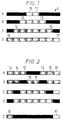
- a motor vehicle display system 1 comprises an array 2 of eight lights 10 to 17 which normally would be displayed as red lights in a horizontal array.
- Figures 1A to D show a progressive increase in the number of lights which are illuminated dependent upon the magnitude of deceleration of the vehicle. The lights are represented as 'on' in the drawings by light shading, compared to 'off' which is indicated by a black rectangle.
- Figure 1A shows central lights 10 and 11 whilst Figure 1 D shows all eight lights 10 to 17 illuminated.
- the display may comprise a different number of lamps, for example, lights 10 and 11 might preferably be replaced by a single unit.
- the display would then comprise seven lights but it would of course also be possible to have say nine or eleven lights. Whilst rectangular lights are shown here it is also possible to have lights of different shapes. The lights may be of different colours, though red or amber lights are preferred.
- the array of lights 2 can be carried at the rear of a vehicle such as in the standard high level brake light position in the rear window of a motor car, for example.
- the lights face rearwardly and are located so that they are readily visible to an observer, e.g. the driver of a motor vehicle travelling or positioned behind the motor vehicle in which the lighting display is mounted.
- the lights 10 to 17 are lit in pairs from the centre pair 10 and 11 out to outer pair 16 and 17 during a progressive brake warning (PBW) display. As the vehicle slows, the deceleration is indicated by the number of lights which are lit.
- PBW progressive brake warning
- each pair of lights might be a different colour, shade or intensity to other pairs of lights.
- different tones of amber might be used starting from a light shade for inner pair 10 and 11 and darkening towards outer pair 16 and 17, or possibly outer pair 16 and 17 might be red.
- a further method would be to change the relative intensity of the pairs of lights so that outer pair 16 and 17 might be brighter than inner pair 10 and 11.
- a combination of these parameters might be used in a PBW display and also a vehicle stationary indicator to be described.
- the lights themselves might comprise electroluminescent bulbs which radiate light through translucent, coloured filters. Alternatively, reflective lights might be used having phosphorescent targets: this can reduce the effect of dazzle of the display. Other forms of light source are envisaged such as light emitting diodes, for example.
- the display may also comprise a control which enables the intensity of the overall display to be varied, for example, enabling adjustment from a bright day setting to a night setting.
- the operation of the light sequence indicative of deceleration can be independent of the braking system of the vehicle and dependent principally on the absolute vehicle deceleration, except that it is possible to illuminate lights 10 and 11 when the vehicle brake pedal is depressed independent of the actual deceleration caused.
- the initial indication from the light display is similar to the known brake light displays such as high mounted single centre brake light presently in use on some motor vehicles.
- the initial deceleration is independent of both the vehicle accelerator or brake controls. This might not always be possible since certain national laws may require that the first lights are illuminated only when the brake pedal is depressed.
- An advantage of a display system according to the present invention is that it can be mounted in a vehicle during manufacture, or alternatively, at a later time by making minor modifications to a vehicle, so that a retrofit unit or kit could be made available for the 'after sales' market. This is possible since deceleration can be detected by an accelerometer (described later) which is independent of any existing vehicle components.
- the display system can be used to generate a display indicative of a vehicle having come to rest. This particular arrangement is termed a vehicle stationary indicator (VSI).
- VSI vehicle stationary indicator
- the display may be animate or static.
- An animate visual display sequence is shown schematically in Figure 2A to D, by way of example. In this case, six of the eight lights in array 2 are lit at all times and pairs of lights are deactivated sequentially. Thus, in figure 2A lights 10 and 11 are deactivated whilst lights 12 to 17 are illuminated, and in Figure 2B lights 12 and 13 are deactivated whilst the rest of the display is illuminated.
- Figures 2C and D show lights 14 and 15 deactivated and 16 and 17 deactivated respectively whilst the rest are lit.
- This sequence can be operated cyclically whilst the vehicle is stationary, for example, having a repeat period of about 1 second.
- the dynamic animate effect is useful in catching the attention of drivers in following vehicles.
- the effect of the animate display is such that it is intended to indicate that the associated vehicle is stationary and not just braking, this fact should be apparent from the display and/or sequence and consequently a number of different sequences could be used.
- the animate sequence of the vehicle stationary indicator can be disabled when a following vehicle is less than a certain distance behind the vehicle carrying the display system 1. This has the beneficial effect of avoiding annoyance or mesmerisation of occupants of following vehicles, for example, when in heavy traffic or when stopped at traffic control lights.
- An indication that the vehicle is stationary can still be effected by maintaining the outer pair of lights 16 and 17 in a continuously lit mode as shown in Figure 2E. This in itself has a further benefit of avoiding misinterpretation by the driver of a following vehicle that the vehicle ahead is about to accelerate away.
- the intensity of illumination of lights 10 to 17 can be reduced when a following vehicle is a predetermined distance behind.
- the lights 10 to 17 may be dimmed simply by dividing the voltage across the lamps when a proximity sensor, described later, gives a signal indicative of a nearby trailing vehicle. It is apparent that the 'vehicle stationary indicator' display should be terminated when the vehicle starts to move off thus it is appropriate for the display system 1 to comprise a vehicle motion detector (described in detail later) which operates to detect whether the vehicle is moving.
- the animate display may change to an even intensity, static display when a trailing vehicle is detected by the proximity sensor.
- the static display might be a linear array of amber triangular lights for example.
- the display only provides a static VSI signal and comprises lights of a preset intensity which is sufficiently low not to dazzle drivers in trailing vehicles. In this latter form a proximity sensor may be omitted thereby reducing the cost of the overall display system.
- the VSI signal might be generated by the same lights used for the PBW signal where in this latter case the lights are red rectangles, for example and in the former case the lights change to amber triangles, for example, when the vehicle stops.
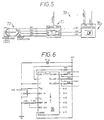
- Electronic circuitry used to control the light display is shown in Figures 3 and 4.
- the circuit diagram is schematic but can be seen to generate a logic sequence dependent on various inputs, which actuates the light display shown in Figures 1 and 2.
- the vehicle display system 1 shown comprises the array 2 of eight lights 10 to 17 which are 12V 5W (or 21W) lamps for example.
- the traditional red brake light is generated in the usual way by using a translucent red filter.
- Pairs of lights 10 and 11, 12 and 13, 14 and 15, and 16 and 17 are connected to power transistors 20, 21, 22 and 23 respectively.
- Each lamp is connected to a + 12V DC supply and is illuminated when the relevant power transistor is opened to earth. Since the lamps are connected in pairs as shown, only one input is required to the relevant transistor 20 to 23 to illuminate or deactivate each pair of lamps.
- the combined display effect of progressive brake warning and vehicle stationary indication are generated in this example using the circuitry shown to open and close transistors 20 to 23 between the lamps and earth.
- the circuit comprises a +12V DC power supply (not shown) and a regulator circuit 3C which generates a + 5V output.
- Accelerometer unit 32 and 33 is a piezo-resistive seismic mass type accelerometer arranged in a wheatstone bridge with integral control and temperature compensation as shown in Figure 5. This provides art output signal proportional to the acceleration (or deceleration) of the vehicle which is fed to variable resistor 52 and which signal is independent of the mechanical braking system operated by the brake pedal and therefore allows for factors such as skid.
- Accelerator unit 32 and 33 is driven by + 12V output, which is fed to a DC-DC converter 70.
- the converter 70 can be a miniature encapsulated 750mW device which provides a + and -12V supply to signal amplifier 71.
- the converter 70 is fully reverse polarity protected and each of the input and output rails are decoupled using electrolytic capacitors (not shown).
- Amplifier 71 comprises a wheatstone bridge 72 (such as that described in Radio Spares data sheet 8155 issued November 1987 for example).
- the amplifier 71 may be an off the shelf item or modified such that in a specific form the amplifier 71 has a gain of 250 and zero adjust from ⁇ 6.7V output. The gain and zero adjustment are set to values compatible with the accelerometer.
- the accelerometer 32 may be an Entran EGD-240-10 for example.
- the strain gauge amplifier 71 is used to raise the signal level from 10mV g to a level compatible with bar graph driver 36 which might be 2.5V g in this specific example.
- This device as a whole has the advantages of giving a steady state (DC) response, miniature size, robustness, low cost and ease of application.
- the analogue output from the accelerometer passes through a 10kOhm variable resistor to a bar graph driver 36 which is a LM3914 device for example as shown in Figure 6.
- Variation of the gain and offset of the output signal from amplifier 33 together with variation of potentiometer 52 can be used to alter the input voltage of driver 36 for any given vehicle deceleration.
- the driver 36 has a linear output to input signal relationship.
- the number of lights illuminated by the progressive brake warning system may be selected in four levels representative of vehicle deceleration of 0.05g to 0.2g, 0.2g to 0.4g, 0.4g to 0.6g, and 0.6g and above for example.
- the lowest threshold level which causes the first deceleration light to come on is preferably set to a level such that simply changing gear does not cause the light to come on but preferably should enable a signal to be generated when the driver is deliberately decelerating, albeit gently, by reducing pressure on the accelerator pedal for example.
- the incrementation of the levels need not be even, as is approximately the case in the above example, and might vary non-linearly such as exponentially.
- Power transistors 20 and 23 are caused to turn lamps 10 to 17 on by generating a high output from the relevant OR gates 40 to 43.
- the input to transistor 20, which controls central lamps 10 and 11, is connected to OR gate 40.
- the default input to OR gate 40 is low since the + 5V supply passes through a resistor and invertor 44.
- invertor 44 The output from invertor 44 is high when driver 36 enables pin P1 to take the input to invertor 44 low.
- driver 36 causes a high output from invertors 45, 46 and 47 by enabling pins P2, P3 and P4 respectively.
- driver 36 causes only P1 to generate a low input at invertor 44.
- a high input signal at OR gate 40 causes a high input at the input base of transistor 20 which thereby illuminates lights 10 and 11.
- Figures 3 and 4 also show how, using device 80, a brake pedal signal can be used to illuminate central pair of lights 10 and 11 whenever the brake pedal is depressed. This might be used to indicate very slight deceleration below the preset threshold of the progressive brake warning system.
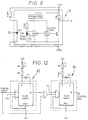
- the vehicle stationary indication display described with reference to Figure 2 can be effected using opto-switch 34 and circuitry shown in Figures 3, 4 and 8 which make up a vehicle motion detector which measures the vehicles velocity, although for the vehicle stationary indication display it is only essential to know whether the vehicle is stationary or moving.
- the information that the vehicle is stationary can be obtained using a slotted opto-sensor 34 attached to the rear of a vehicle speedometer (not shown).
- the speedometer drive cable spins a slotted disk 91 housed in a nylon casing 95.
- the slotted disk 91 is attached to a spindle 94 which is placed serially between the speedometer and cable.
- the opto-switch 34 comprises LED 92 and photo-diode 93. As the spindle turns, infra-red light from LED 92 is alternately obscured then allowed to fall on photo-diode 93.
- Integrated circuitry filters the output from photo-diode 93 to produce a clean TTL (Transistor/Transistor Logic) compatible square wave, the frequency of which is proportional to vehicle speed.
- TTL Transistor/Transistor Logic
- the signal output from opto-switch 34 is applied to the RC (resistor/capacitor) network 100 shown in Figure 3.
- the small 0.1 microfarad capacitor quickly charges through the first 10 kilo-Ohm resistor.
- the signal voltage falls back to zero the current stored in the small capacitor discharges through the route of least resistance, in this case through the diode and into the relatively large 100 microF capacitator. Without a potential applied across the capacitator however the charge leaks away through the 10 kilo-Ohm resistor as it cannot pass back through the diode.
- the frequency of the square wave is low enough the charge in the 100 microF capacitator leaks away almost completely before being charged once more.
- the voltage seen by the positive terminal on the comparator 25 (such as the 339 device for example) will be virtually zero with small peaks of around 12mV as each packet of charge is pumped through.
- the small capacitor pumps more small amounts of charge into the large capacitor, raising the potential across it and thus the voltage at the terminal of the comparator 25. This time the frequency is such that the charge has not enough time to leak completely away through the second resistor so that the charge in the large capacitor increases with each amount of charge delivered to it.
- the system After a number of cycles the system will reach an equilibrium and a steady voltage will be present at the positive terminal of the comparator, the voltage increasing in some proportion with the vehicle speed.
- the comparator 25 has a reference voltage adjusted by the voltage divider 53 applied to its negative input. When the positive terminal is below the reference voltage the output of the comparator 25 is kept high by the 5V pull up. Above the reference voltage the comparator 25 pulls its output to ground.
- the components in the RC network 100 and the voltage reference are adjusted so that the transition occurs at very low vehicle speed close to stationary. Thus a binary signal is available to the control system indicating 'vehicle stationary' (logic 1) or 'vehicle not stationary' (logic 0).
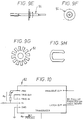
- Figure 9A shows an end elevation from the cable side and Figure 9B is a sectional side elevation along axis A-A of housing part 95A.
- Figure 9C shows an end elevation from the speedometer end and Figure 9D is a sectional side elevation on axis B-B of housing part 95B.
- Figure 9E shows a side elevation of spindle 94 whilst Figure 9F is an end elevation thereof.
- Figure 9G is an end elevation of slotted disk 91 and Figure 9H a view of a clip used to complete the assembly.
- the opto-switch device is given by way of example only and it is envisaged that the vehicle stationary indication display may be enabled using input data for any form of stationary detection such as from an electronic speedometer or from an anti-lock braking system (ABS). With regard to the latter it is possible to modify the present, commonly used ABS components to provide the information required by the display system in both its PBW and VSI roles.
- Anti-lock braking systems typically comprise a device connected to a wheel hub which device rotates with the wheel to provide an electronic signal proportional to the rate of revolution of the wheel, for example by using an electromagnetic inductive technique.
- ABS purposes it is only required to know if the wheel locks. However, for the purposes of the present display system, greater information about the vehicle's speed is required in order for deceleration to be calculated. Therefore, modification of the ABS inductive device can be carried out to provide appropriate information, discussed later, in the device output signal.
- a square wave generator 37 triggers a counter 38 which is a 74161 device for example.
- a counter 38 which is a 74161 device for example.
- AND gates 24a and 24b only when the outputs from comparator 25 and oscillator 37 are high and proximity sensor 60 (described later) is low, is the clock input to counter 38 high. Whilst the vehicle is stationary the count rate is determined by oscillator 37 which can be configured to generate a specific time interval between the change of display signals shown in Figures 2A to D.
- Counter 38 generates a binary output from 0 to 4 which is fed to multiplexor 39, which is a 74138 device for example.
- the multiplexor generates high and low outputs at pins M1, M2, M3 and M4 dependent on the input signal from counter 38.
- Pin M1, M2, M3 and M4 are connected to one input terminal of AND gates 48, 49, 59 and 51 respectively.
- the other input to AND gates 48 to 51 is taken from the output of comparator 25 and proximity sensor 60 at gate 24a which is thus the output signal which enables the animate vehicle stationary indication display.
- Outputs from AND gates 48 to 51 are connected to an input of OR gates 40 to 43 previously described in respect of the progressive brake warning displays.
- the input to OR gates 40 to 43 from invertors 44 to 47 will be low since there is no change in speed to generate a signal output from accelerometer 32.
- any of the inputs to OR gates 40 to 43 from AND gates 48 to 51 go high the relevant pair of lamps will be illuminated.
- the animated cyclic display described with reference to Figure 2 is effected by the timing of oscillator 37 and the switching sequence generated by multiplexor 39. The display sequence can easily be varied by altering these components or, indeed, configuring the electrical circuit differently, for example by wiring individual lamps and not pairs of lamps.
- the termination of the animate vehicle stationary display can be achieved in various ways such as by using proximity sensor 60 shown in Figures 3, 4, 10, 11 and 12 for example.
- a variety of devices could be used such as infra-red, optical, microwave or radar systems, however an ultrasonic device is described here since, inter alia, it is found easy to weather-proof and has small dimensions and low cost.
- the ultrasonic transducer 61 can be a small (for example 25mm) 26kHz transducer with a maximum range of 9m when used with a small directional horn, for example.
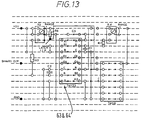
- the proximity sensor 60 includes a remote ranging module 62 which drives the transducer 61 and filters the output from it. Module 62 provides a digital latch output labelled C in Figure 11.
- the latch As the transducer is triggered the latch is switched low. It stays low until the first echo is received whereby it switches high. It remains high until triggered low again by the start of the next trigger pulse (A in Figure 11). If the object is out of range of the sensor 60 (greater than 9m in this example) then the latch is not switched high by the returning echo. In which case the trigger switches the latch high momentarily then back low, the pulse width being similar to that of the trigger at approximately 180 microseconds say, as shown in Figure 11. The duration of the low pulse from the latch provides a means to calculate the distance of an object, in this case a trailing vehicle.
- the digital latch signal is used to set a monostable device 63, such as a 74123 dual resettable for example, running high.
- the latch output is tied to + 5V as a logic high state and when it is switched hard on by the module 62 the latch output is pulled to ground, logic low; otherwise the output is logic high.
- the total output is applied to the 'A' input of first monostable 63 as shown in Figure 12. Each time the transducer is triggered the falling edge of the latch sets the monostable high as shown in trace D of Figure 11.
- the monostable timing circuit is calibrated such that it resets the monostable 63 after a period of 0.018s which corresponds to a range of approximately 3m from the transducer. That is a total of 6m travelled by sound at 330m/s.
- the period of the pulse repetition rate PRR is set at 0.06s (i.e. greater than the time equivalent of the length of sound travel path) in this example.
- the digital latch output from module 62 and the output from monostable 63 are coupled using a logic AND gate.
- the output of this gate thus gives a logic high state if a car is detected within the specified range, three meters in this example, as shown in trace E of Figure 11.
- This pulse signal is fed to the 'B' input of a second monostable device 64, again a 74123 device for example.
- the delay period of device 64 is set to correspond to approximately 110% of the period of PRR.
- the output of the second monostable 64 remains high. If the following vehicle moves out of range then monostable 64 is not reactivated and falls back low after 0.066s (110% PRR period) and remains low until a vehicle is again detected in range. Thus, a binary signal is output from proximity sensor 60 indicating vehicles less than 3m behind (logic high) or, vehicle or vehicles greater than 3m behind (logic low). This is shown as trace F in Figure 11.
- the output from proximity sensor 60 is inverted and fed to AND gate 24a which also has as input the output from comparator 25. If the vehicle is stopped and there is no vehicle within the range of sensor 60 then both inputs to gate 24a will be high and the animate display is enabled as previously described.
- the output from proximity sensor 60 is also fed to AND gate 24C to which is also applied the output from comparator 25. If the vehicle is stationary and there is a vehicle within the set range then both inputs to AND gate 24C will be high and outer pair of lights 16 and 17 will be illuminated until such time as the vehicle behind moves out of range, or as is apparently more likely, the vehicle with the display system 1 starts to move in which case the vehicle stationary indicators deactivated entirely
- an accelerometer 32 and opto-switch 34 are used in this example it is possible to make use of a vehicle's anti-lock brake system (ABS) and the wheel speed sensors therein in a display system according to the invention. It is possible to continuously measure the speed of a vehicle from this source (or indeed any independent vehicle velocity measuring device) and thereby calculate acceleration using a time reference. It would then be possible to use this source to drive the logic circuit just described to illuminate and deactivate lamps 10 to 17 in accordance with the sequence described with respect to Figures 1 and 2. This technique has the benefit that it substantially uses a system already fitted to generate relevant vehicle data independent of the actual braking system itself.
- ABS vehicle's anti-lock brake system
- ABS devices may be required in order specifically to enhance the signal generated using such a device.
- the present display system would derive input data from ABS devices attached to diagonally opposite wheels on a vehicle.
- the ABS device and a time reference system as just described could be used to provide a signal to a display which is indicative of the vehicle travelling at constant speed or accelerating.
- the display for the latter might comprise an array of green lights for example the number of which that are activated depending on the magnitude of acceleration.
- a display indicator for presenting a PBW or VSI signal to a driver may be fitted in vehicles to be visible to the driver of that vehicle, where the display indicator is responsive to a vehicle motion detection means or a vehicle deceleration detection means in another vehicle.
- a display indicator in a trailing vehicle might receive a radio signal from a leading vehicle which radio signal contains information about the state of motion of the leading vehicle.
- the display indicator would therefore comprise a radio receiver and means either to distinguish the signal from the immediately leading vehicle when presented with several signals from several leading vehicles or to terminate the display in order not to present erroneous information to a driver in such circumstances of several signals being received by the radio receiver.
Landscapes
- Engineering & Computer Science (AREA)
- Physics & Mathematics (AREA)
- General Physics & Mathematics (AREA)
- Mechanical Engineering (AREA)
- Radar, Positioning & Navigation (AREA)
- Remote Sensing (AREA)
- Computer Networks & Wireless Communication (AREA)
- Acoustics & Sound (AREA)
- Lighting Device Outwards From Vehicle And Optical Signal (AREA)
- Instrument Panels (AREA)
- Radar Systems Or Details Thereof (AREA)
- Control Of Electric Motors In General (AREA)
- Indicating Or Recording The Presence, Absence, Or Direction Of Movement (AREA)
- Arrangements For Transmission Of Measured Signals (AREA)
Applications Claiming Priority (3)
| Application Number | Priority Date | Filing Date | Title |
|---|---|---|---|
| GB929202472A GB9202472D0 (en) | 1992-02-05 | 1992-02-05 | Motor vehicle display system and ranging device |
| GB9202472 | 1992-02-05 | ||
| EP93904172A EP0680418B1 (de) | 1992-02-05 | 1993-02-05 | Kraftfahrzeuganzeige-system und -verfahren zum anzeigen des bewegungszustands des kraftfahrzeugs |
Related Parent Applications (1)
| Application Number | Title | Priority Date | Filing Date |
|---|---|---|---|
| EP93904172A Division EP0680418B1 (de) | 1992-02-05 | 1993-02-05 | Kraftfahrzeuganzeige-system und -verfahren zum anzeigen des bewegungszustands des kraftfahrzeugs |
Publications (2)
| Publication Number | Publication Date |
|---|---|
| EP0939002A2 true EP0939002A2 (de) | 1999-09-01 |
| EP0939002A3 EP0939002A3 (de) | 1999-10-13 |
Family
ID=10709896
Family Applications (2)
| Application Number | Title | Priority Date | Filing Date |
|---|---|---|---|
| EP93904172A Expired - Lifetime EP0680418B1 (de) | 1992-02-05 | 1993-02-05 | Kraftfahrzeuganzeige-system und -verfahren zum anzeigen des bewegungszustands des kraftfahrzeugs |
| EP99108812A Withdrawn EP0939002A3 (de) | 1992-02-05 | 1993-02-05 | Anzeigesystem und Abstandskontrolle für Kraftfahrzeug |
Family Applications Before (1)
| Application Number | Title | Priority Date | Filing Date |
|---|---|---|---|
| EP93904172A Expired - Lifetime EP0680418B1 (de) | 1992-02-05 | 1993-02-05 | Kraftfahrzeuganzeige-system und -verfahren zum anzeigen des bewegungszustands des kraftfahrzeugs |
Country Status (12)
| Country | Link |
|---|---|
| US (2) | US5828319A (de) |
| EP (2) | EP0680418B1 (de) |
| JP (1) | JPH09503176A (de) |
| KR (1) | KR100328324B1 (de) |
| AT (1) | ATE188175T1 (de) |
| AU (1) | AU3505893A (de) |
| CA (1) | CA2129234C (de) |
| DE (1) | DE69327472T2 (de) |
| ES (1) | ES2144457T3 (de) |
| GB (1) | GB9202472D0 (de) |
| PT (1) | PT680418E (de) |
| WO (1) | WO1993015931A2 (de) |
Cited By (3)
| Publication number | Priority date | Publication date | Assignee | Title |
|---|---|---|---|---|
| GB2351858A (en) * | 1999-07-07 | 2001-01-10 | Robert Keith Jordan | Vehicle deceleration indicator |
| EP1152922A1 (de) * | 1999-02-11 | 2001-11-14 | Innovative Brake Lighting Systems CC | Progressive bremsanlage |
| GB2434262A (en) * | 2006-01-17 | 2007-07-18 | Peter Fabian Mark Kittoe | A brake light system for a vehicle in which a display is generated which is indicative of the magnitude of the vehicle deceleration |
Families Citing this family (61)
| Publication number | Priority date | Publication date | Assignee | Title |
|---|---|---|---|---|
| GB2291244B (en) * | 1994-07-15 | 1998-02-11 | Design Technology & Innovation | Vehicle safety systems |
| US6133852A (en) * | 1994-08-05 | 2000-10-17 | Design Technology | Motor vehicle system and ranging device |
| GB2301954A (en) * | 1995-06-05 | 1996-12-18 | Terence Watts | Vehicle deceleration indicator system |
| GB2306811A (en) * | 1995-11-02 | 1997-05-07 | Kenneth Blakeley | Vehicle deceleration warning lamp system |
| GB2319124B (en) * | 1996-11-07 | 2001-04-11 | Design Technology & Innovation | Motor vehicle display system and ranging device |
| DE19712457A1 (de) * | 1997-03-25 | 1998-10-01 | Bosch Gmbh Robert | System zur Erzeugung eines Bremssignals bei einem Kraftfahrzeug |
| GB2329704B (en) * | 1997-09-26 | 2002-02-13 | Design Technology & Innovation | An improved motor vehicle display apparatus |
| US6268792B1 (en) * | 1998-05-14 | 2001-07-31 | John D. Newton | Progressive brake light gauge |
| US6081188A (en) * | 1998-06-08 | 2000-06-27 | Emergency Warning Systems, Inc. | Vehicular hazard warning system |
| GB9816376D0 (en) * | 1998-07-29 | 1998-09-23 | Ball Racing Developments Limit | Indicating means |
| FR2787400B1 (fr) * | 1998-12-21 | 2001-01-26 | Valeo Vision | Installation de signalisation de la deceleration d'un vehicule automobile comprenant un feu emettant un flux lumneux d'intensite constante |
| GB2347027A (en) * | 1999-02-17 | 2000-08-23 | George Aitchieson Nor Longmuir | Vehicle braking warning indicator |
| US6150933A (en) * | 1999-04-07 | 2000-11-21 | Matsumoto; Kiyoto | Vehicle brake light system |
| US6411204B1 (en) * | 1999-11-15 | 2002-06-25 | Donnelly Corporation | Deceleration based anti-collision safety light control for vehicle |
| WO2001042045A1 (en) * | 1999-12-11 | 2001-06-14 | Youngking Pty. Ltd. | Deceleration warning system |
| US6351211B1 (en) * | 2000-01-25 | 2002-02-26 | M&P Ventures, Inc. | Brake warning method and system |
| US6333688B1 (en) * | 2000-03-17 | 2001-12-25 | Tyrone A. Brown | Tail light enhancement system |
| IL138838A0 (en) * | 2000-10-03 | 2001-10-31 | Menachem Hadar | Vehicle brake light system and method |
| DE20017568U1 (de) | 2000-10-13 | 2001-01-18 | Schmelzle, Jürgen E., 78586 Deilingen | Sicherheitsabstandswarner |
| US6753769B1 (en) * | 2001-03-29 | 2004-06-22 | Lawrence T. Elliott | Progressive slow-stop signaling system |
| GB2382404A (en) * | 2001-11-22 | 2003-05-28 | Aco Esapov | Lights displaying braking intensity |
| US6870474B1 (en) * | 2002-11-25 | 2005-03-22 | Budd Brothers | Vehicle safety signaling system |
| US7075423B2 (en) * | 2003-10-06 | 2006-07-11 | Joseph Edward Currie | Combination illuminating inverse function power indicator and a brake light |
| DE10355023A1 (de) * | 2003-11-25 | 2004-12-23 | Daimlerchrysler Ag | Vorrichtung zum Abdecken einer Fahrzeugoberfläche |
| US7057501B1 (en) | 2004-04-23 | 2006-06-06 | Darryl Davis | Tailgate warning and reporting system |
| US7155329B2 (en) * | 2004-05-24 | 2006-12-26 | General Motors Of Canada | Vehicle deceleration display system and calculation method |
| ES2251309B1 (es) * | 2004-10-07 | 2007-06-16 | Jose Luis De La Torre Barreiro | Dispositivo indicador de frenada. |
| US7242287B1 (en) | 2004-10-19 | 2007-07-10 | Joseph Giovinazzo | Vehicle warning system and method |
| FR2892988A1 (fr) * | 2005-11-10 | 2007-05-11 | Robeert Christian Coron | Dispositif de signalisation pour vehicule automobile, vehicule automobile comprenant un tel dispositif, et methode de signalisation de la situation d'acceleration d'un vehicule automobile. |
| AU2006211855B2 (en) * | 2006-09-01 | 2014-02-13 | Mark William Gallon | Braking Display Apparatus |
| US20090261963A1 (en) * | 2008-04-22 | 2009-10-22 | Ault Scott T | Vehicle Deceleration Warning System |
| CN101482243B (zh) * | 2008-08-27 | 2010-12-22 | 奇瑞汽车股份有限公司 | 一种可分级点亮的高位制动灯控制系统及控制方法 |
| US8188850B2 (en) * | 2009-05-15 | 2012-05-29 | Jepp Industries, Inc. | System for enhancing perception of a motor vehicle's mark emblem |
| US8823506B2 (en) | 2009-05-15 | 2014-09-02 | Jepp Industries, Inc. | System for enhancing perception of a motor vehicle's mark emblem |
| US9639688B2 (en) | 2010-05-27 | 2017-05-02 | Ford Global Technologies, Llc | Methods and systems for implementing and enforcing security and resource policies for a vehicle |
| ES2379247B1 (es) | 2010-08-10 | 2012-11-27 | Pere Pi I Parera | Sistema de seguridad indicador de la desaceleración de un vehículo. |
| JP2014507327A (ja) * | 2011-01-26 | 2014-03-27 | アダック プラスティックス,インク. | センターハイマウントブレーキライトシステム |
| US9452735B2 (en) | 2011-02-10 | 2016-09-27 | Ford Global Technologies, Llc | System and method for controlling a restricted mode in a vehicle |
| US10145960B2 (en) | 2011-02-24 | 2018-12-04 | Ford Global Technologies, Llc | System and method for cell phone restriction |
| US8522320B2 (en) | 2011-04-01 | 2013-08-27 | Ford Global Technologies, Llc | Methods and systems for authenticating one or more users of a vehicle communications and information system |
| US8938224B2 (en) | 2011-05-12 | 2015-01-20 | Ford Global Technologies, Llc | System and method for automatically enabling a car mode in a personal communication device |
| US8788113B2 (en) | 2011-06-13 | 2014-07-22 | Ford Global Technologies, Llc | Vehicle driver advisory system and method |
| US10097993B2 (en) | 2011-07-25 | 2018-10-09 | Ford Global Technologies, Llc | Method and apparatus for remote authentication |
| US8849519B2 (en) | 2011-08-09 | 2014-09-30 | Ford Global Technologies, Llc | Method and apparatus for vehicle hardware theft prevention |
| BR102012017584B1 (pt) * | 2011-12-08 | 2019-03-26 | Agco Do Brasil Máquinas E Equipamentos Agrícolas Ltda. | Sistema e método de auxílio de correção de velocidade |
| KR101364487B1 (ko) * | 2012-02-03 | 2014-02-20 | (주)에핏라이트 | 차량용 제동램프 운영장치 |
| US9569403B2 (en) | 2012-05-03 | 2017-02-14 | Ford Global Technologies, Llc | Methods and systems for authenticating one or more users of a vehicle communications and information system |
| US8866604B2 (en) | 2013-02-14 | 2014-10-21 | Ford Global Technologies, Llc | System and method for a human machine interface |
| US9688246B2 (en) | 2013-02-25 | 2017-06-27 | Ford Global Technologies, Llc | Method and apparatus for in-vehicle alarm activation and response handling |
| US8947221B2 (en) | 2013-02-26 | 2015-02-03 | Ford Global Technologies, Llc | Method and apparatus for tracking device connection and state change |
| US9141583B2 (en) | 2013-03-13 | 2015-09-22 | Ford Global Technologies, Llc | Method and system for supervising information communication based on occupant and vehicle environment |
| US9002536B2 (en) | 2013-03-14 | 2015-04-07 | Ford Global Technologies, Llc | Key fob security copy to a mobile phone |
| RU2570843C2 (ru) * | 2013-09-18 | 2015-12-10 | Федеральное государственное унитарное предприятие "Центральный ордена Трудового Красного Знамени научно-исследовательский автомобильный и автомоторный институт "НАМИ" | Способ определения замедлений вращающихся тел |
| WO2015148174A1 (en) * | 2014-03-24 | 2015-10-01 | Bailey Christopher Lee | Automatic braking indicator |
| US10249123B2 (en) | 2015-04-09 | 2019-04-02 | Ford Global Technologies, Llc | Systems and methods for mobile phone key fob management |
| DE102015223171A1 (de) * | 2015-11-24 | 2017-05-24 | Osram Gmbh | Sicherheitsvorrichtung und Verfahren zum Anzeigen eines Abstands für Fahrzeuge und Fahrzeug mit der Sicherheitsvorrichtung |
| US10246008B2 (en) * | 2016-11-14 | 2019-04-02 | Samuel Dingus | Variable accelerator light assembly |
| US20190071002A1 (en) * | 2017-09-05 | 2019-03-07 | Cary Scott | Dynamic brake light system |
| US11208034B2 (en) | 2018-02-20 | 2021-12-28 | Ford Global Technologies, Llc | Vehicle lamp assembly |
| US20210394616A1 (en) * | 2020-06-23 | 2021-12-23 | Bruce Matthew Paggeot | Method and Apparatus for Real-Time Acceleration Indication |
| DE102020120596A1 (de) | 2020-08-05 | 2022-02-10 | Audi Aktiengesellschaft | Verfahren zum Betrieb einer Heckleuchte eines Kraftfahrzeugs und Kraftfahrzeug |
Family Cites Families (25)
| Publication number | Priority date | Publication date | Assignee | Title |
|---|---|---|---|---|
| US3846749A (en) * | 1973-02-01 | 1974-11-05 | Massachusetts Inst Technology | Vehicle brake light control system |
| US4258353A (en) * | 1979-12-13 | 1981-03-24 | Carlson Robert W | Vehicle acceleration/deceleration warning system |
| US4467313A (en) * | 1980-11-14 | 1984-08-21 | Nippon Soken, Inc. | Automotive rear safety checking apparatus |
| GB2114826B (en) * | 1982-01-18 | 1985-09-11 | Nan Mu Chiou | Safety indicator systems for motor vehicles |
| US4566862A (en) * | 1982-02-23 | 1986-01-28 | General Pneumatics Corporation | Fluid apparatus and methods, as for inflating inflatable structures |
| NL8300073A (nl) * | 1983-01-10 | 1984-08-01 | Arjeh Tal | Inrichting voor het aanwijzen van een snelheidsverandering van een voertuig. |
| US4556862A (en) * | 1983-05-16 | 1985-12-03 | Meinershagen Charles I | Vehicle direction signal and slow warning system employing moving pattern of simultaneously ON lamps |
| US4626850A (en) * | 1983-05-16 | 1986-12-02 | David Chey | Vehicle detection and collision avoidance apparatus |
| JPS60197442A (ja) * | 1984-03-20 | 1985-10-05 | Nippon Denso Co Ltd | 車両用後方確認装置 |
| US4600913A (en) * | 1984-12-24 | 1986-07-15 | Caine Harold A | Collision avoidance device |
| US4663609A (en) * | 1985-10-21 | 1987-05-05 | Rosario George M | Brake alert device |
| KR910001149B1 (ko) * | 1986-04-23 | 1991-02-25 | 주식회사 금성사 | 차량 충돌 경보장치 |
| DE3634302A1 (de) * | 1986-10-08 | 1988-04-21 | Porsche Ag | Abstandsregelungssystem fuer kraftfahrzeuge |
| KR910005721B1 (ko) * | 1988-08-12 | 1991-08-02 | 현대전자산업 주식회사 | 차량용 제동표시장치 및 그 제어방법 |
| US4894641A (en) * | 1989-01-24 | 1990-01-16 | Cotron Corporation | Real-time speed display apparatus |
| DE3907714A1 (de) * | 1989-03-10 | 1990-09-20 | Battelle Institut E V | Anordnung zur anzeige des abbremsens eines kaftfahrzeuges |
| GB8925384D0 (en) * | 1989-11-09 | 1989-12-28 | Ongar Enterprises Ltd | Vehicle spacing system |
| US5162794A (en) * | 1989-11-21 | 1992-11-10 | Nancy Seith | Safe trailing distance warning for vehicles |
| US5017904A (en) * | 1990-04-16 | 1991-05-21 | General Motors Corporation | Braking indicator system |
| US5164701A (en) * | 1990-04-30 | 1992-11-17 | Nan Mu Chiou | Car-operation-condition indicating apparatus |
| US5089805A (en) * | 1990-05-07 | 1992-02-18 | Salsman Robert K | Brake light system to indicate intensity of slow down |
| US4987405A (en) * | 1990-06-04 | 1991-01-22 | Jakobowski Walter T | Elevated brake light signal module |
| DE4020610A1 (de) * | 1990-06-28 | 1992-01-02 | Schreiber Hans | Verfahren und vorrichtung zur warnsignaluebermittlung von kraftfahrzeugen |
| US5150098A (en) * | 1990-11-13 | 1992-09-22 | Robert Rakow | Brake signaling system and process |
| US5148147A (en) * | 1990-12-03 | 1992-09-15 | Kobres Arthur L | Vehicle deceleration measurement system |
-
1992
- 1992-02-05 GB GB929202472A patent/GB9202472D0/en active Pending
-
1993
- 1993-02-05 AU AU35058/93A patent/AU3505893A/en not_active Abandoned
- 1993-02-05 US US08/284,540 patent/US5828319A/en not_active Expired - Fee Related
- 1993-02-05 EP EP93904172A patent/EP0680418B1/de not_active Expired - Lifetime
- 1993-02-05 ES ES93904172T patent/ES2144457T3/es not_active Expired - Lifetime
- 1993-02-05 CA CA002129234A patent/CA2129234C/en not_active Expired - Fee Related
- 1993-02-05 JP JP5513885A patent/JPH09503176A/ja active Pending
- 1993-02-05 PT PT93904172T patent/PT680418E/pt unknown
- 1993-02-05 DE DE69327472T patent/DE69327472T2/de not_active Expired - Fee Related
- 1993-02-05 AT AT93904172T patent/ATE188175T1/de not_active IP Right Cessation
- 1993-02-05 WO PCT/GB1993/000251 patent/WO1993015931A2/en not_active Ceased
- 1993-02-05 EP EP99108812A patent/EP0939002A3/de not_active Withdrawn
-
1994
- 1994-08-03 KR KR1019940702663A patent/KR100328324B1/ko not_active Expired - Fee Related
-
1997
- 1997-02-05 US US08/795,076 patent/US5856793A/en not_active Expired - Fee Related
Cited By (3)
| Publication number | Priority date | Publication date | Assignee | Title |
|---|---|---|---|---|
| EP1152922A1 (de) * | 1999-02-11 | 2001-11-14 | Innovative Brake Lighting Systems CC | Progressive bremsanlage |
| GB2351858A (en) * | 1999-07-07 | 2001-01-10 | Robert Keith Jordan | Vehicle deceleration indicator |
| GB2434262A (en) * | 2006-01-17 | 2007-07-18 | Peter Fabian Mark Kittoe | A brake light system for a vehicle in which a display is generated which is indicative of the magnitude of the vehicle deceleration |
Also Published As
| Publication number | Publication date |
|---|---|
| EP0680418A1 (de) | 1995-11-08 |
| ATE188175T1 (de) | 2000-01-15 |
| WO1993015931A2 (en) | 1993-08-19 |
| DE69327472T2 (de) | 2000-08-10 |
| EP0939002A3 (de) | 1999-10-13 |
| CA2129234C (en) | 2008-01-15 |
| ES2144457T3 (es) | 2000-06-16 |
| CA2129234A1 (en) | 1993-08-19 |
| JPH09503176A (ja) | 1997-03-31 |
| DE69327472D1 (de) | 2000-02-03 |
| WO1993015931A3 (en) | 1993-11-11 |
| EP0680418B1 (de) | 1999-12-29 |
| PT680418E (pt) | 2000-06-30 |
| US5856793A (en) | 1999-01-05 |
| KR100328324B1 (ko) | 2002-09-05 |
| GB9202472D0 (en) | 1992-03-18 |
| AU3505893A (en) | 1993-09-03 |
| US5828319A (en) | 1998-10-27 |
Similar Documents
| Publication | Publication Date | Title |
|---|---|---|
| CA2129234C (en) | Motor vehicle display system and ranging device | |
| US5838259A (en) | Motor vehicle display system and ranging device | |
| US6133852A (en) | Motor vehicle system and ranging device | |
| EP1077833B1 (de) | Anzeigesystem für kraftfahrzeuge und entfernungsmesseinrichtung | |
| US4208658A (en) | Radar-operated vehicle safety assurance system | |
| US5548274A (en) | Strobe light for a vehicle tire and wheel | |
| US20020133282A1 (en) | Brake light system using sequential lamp array and input from velocity measuring device | |
| US5659290A (en) | Speed minder | |
| US20100308985A1 (en) | Spacer lamp in passenger and/or goods traffic | |
| EP0475952A1 (de) | Verfahren zur eichung von fahrzeuggeschwindigkeitssignalen. | |
| US7155329B2 (en) | Vehicle deceleration display system and calculation method | |
| GB2260209A (en) | Braking distance indicating and warning device | |
| EP3789738A1 (de) | Tachometeranzeige | |
| GB2319124A (en) | Indicating state of motion of a vehicle; vehicle ranging device | |
| CN1569517A (zh) | 一只传感器实现车辆加速或减速/刹车分级显示方法及装置 | |
| US5818332A (en) | Automobile speed indicator | |
| GB2205698A (en) | Vehicle warning system | |
| KR100413255B1 (ko) | 안티록 브레이크 시스템의 이씨유를 이용한 차량용 속도계및 주행거리계 | |
| JPS6357348A (ja) | 一般道路用速度計 | |
| JPS61155814A (ja) | 車両用バ−グラフ式タコメ−タ− | |
| KR100514389B1 (ko) | 차량의 타이어 공기압 및 속도 측정장치 | |
| CN1075989C (zh) | 汽车防追尾信号显示装置 | |
| CN2328551Y (zh) | 汽车防追尾信号显示装置 | |
| GB2208979A (en) | Method and apparatus for detecting and signalling changes in speed of a vehicle | |
| JPH08332873A (ja) | 車両用虚像式メータ |
Legal Events
| Date | Code | Title | Description |
|---|---|---|---|
| PUAI | Public reference made under article 153(3) epc to a published international application that has entered the european phase |
Free format text: ORIGINAL CODE: 0009012 |
|
| PUAL | Search report despatched |
Free format text: ORIGINAL CODE: 0009013 |
|
| 17P | Request for examination filed |
Effective date: 19990504 |
|
| AC | Divisional application: reference to earlier application |
Ref document number: 680418 Country of ref document: EP |
|
| AK | Designated contracting states |
Kind code of ref document: A2 Designated state(s): AT BE DE DK ES FR GB IT NL PT SE |
|
| RIC1 | Information provided on ipc code assigned before grant |
Free format text: 6G 01S 13/93 A, 6G 08G 1/16 B, 6B 60Q 1/44 B, 6G 01P 1/08 B, 6G 01P 3/489 B, 6G 01P 3/486 B |
|
| AK | Designated contracting states |
Kind code of ref document: A3 Designated state(s): AT BE DE DK ES FR GB IT NL PT SE |
|
| STAA | Information on the status of an ep patent application or granted ep patent |
Free format text: STATUS: THE APPLICATION HAS BEEN WITHDRAWN |
|
| 18W | Application withdrawn |
Withdrawal date: 20010330 |