EP0940450A1 - Colorants de transfert d'énergie ayant une fluorescence améliorée - Google Patents
Colorants de transfert d'énergie ayant une fluorescence améliorée Download PDFInfo
- Publication number
- EP0940450A1 EP0940450A1 EP99201120A EP99201120A EP0940450A1 EP 0940450 A1 EP0940450 A1 EP 0940450A1 EP 99201120 A EP99201120 A EP 99201120A EP 99201120 A EP99201120 A EP 99201120A EP 0940450 A1 EP0940450 A1 EP 0940450A1
- Authority
- EP
- European Patent Office
- Prior art keywords
- dye
- dyes
- acceptor
- energy transfer
- donor
- Prior art date
- Legal status (The legal status is an assumption and is not a legal conclusion. Google has not performed a legal analysis and makes no representation as to the accuracy of the status listed.)
- Granted
Links
- 239000000975 dye Substances 0.000 title claims abstract description 577
- 238000012546 transfer Methods 0.000 title claims abstract description 170
- 239000007850 fluorescent dye Substances 0.000 claims abstract description 85
- 108091034117 Oligonucleotide Proteins 0.000 claims description 93
- 238000000034 method Methods 0.000 claims description 77
- 239000001226 triphosphate Substances 0.000 claims description 64
- 235000011178 triphosphate Nutrition 0.000 claims description 64
- JLCPHMBAVCMARE-UHFFFAOYSA-N [3-[[3-[[3-[[3-[[3-[[3-[[3-[[3-[[3-[[3-[[3-[[5-(2-amino-6-oxo-1H-purin-9-yl)-3-[[3-[[3-[[3-[[3-[[3-[[5-(2-amino-6-oxo-1H-purin-9-yl)-3-[[5-(2-amino-6-oxo-1H-purin-9-yl)-3-hydroxyoxolan-2-yl]methoxy-hydroxyphosphoryl]oxyoxolan-2-yl]methoxy-hydroxyphosphoryl]oxy-5-(5-methyl-2,4-dioxopyrimidin-1-yl)oxolan-2-yl]methoxy-hydroxyphosphoryl]oxy-5-(6-aminopurin-9-yl)oxolan-2-yl]methoxy-hydroxyphosphoryl]oxy-5-(6-aminopurin-9-yl)oxolan-2-yl]methoxy-hydroxyphosphoryl]oxy-5-(6-aminopurin-9-yl)oxolan-2-yl]methoxy-hydroxyphosphoryl]oxy-5-(6-aminopurin-9-yl)oxolan-2-yl]methoxy-hydroxyphosphoryl]oxyoxolan-2-yl]methoxy-hydroxyphosphoryl]oxy-5-(5-methyl-2,4-dioxopyrimidin-1-yl)oxolan-2-yl]methoxy-hydroxyphosphoryl]oxy-5-(4-amino-2-oxopyrimidin-1-yl)oxolan-2-yl]methoxy-hydroxyphosphoryl]oxy-5-(5-methyl-2,4-dioxopyrimidin-1-yl)oxolan-2-yl]methoxy-hydroxyphosphoryl]oxy-5-(5-methyl-2,4-dioxopyrimidin-1-yl)oxolan-2-yl]methoxy-hydroxyphosphoryl]oxy-5-(6-aminopurin-9-yl)oxolan-2-yl]methoxy-hydroxyphosphoryl]oxy-5-(6-aminopurin-9-yl)oxolan-2-yl]methoxy-hydroxyphosphoryl]oxy-5-(4-amino-2-oxopyrimidin-1-yl)oxolan-2-yl]methoxy-hydroxyphosphoryl]oxy-5-(4-amino-2-oxopyrimidin-1-yl)oxolan-2-yl]methoxy-hydroxyphosphoryl]oxy-5-(4-amino-2-oxopyrimidin-1-yl)oxolan-2-yl]methoxy-hydroxyphosphoryl]oxy-5-(6-aminopurin-9-yl)oxolan-2-yl]methoxy-hydroxyphosphoryl]oxy-5-(4-amino-2-oxopyrimidin-1-yl)oxolan-2-yl]methyl [5-(6-aminopurin-9-yl)-2-(hydroxymethyl)oxolan-3-yl] hydrogen phosphate Polymers Cc1cn(C2CC(OP(O)(=O)OCC3OC(CC3OP(O)(=O)OCC3OC(CC3O)n3cnc4c3nc(N)[nH]c4=O)n3cnc4c3nc(N)[nH]c4=O)C(COP(O)(=O)OC3CC(OC3COP(O)(=O)OC3CC(OC3COP(O)(=O)OC3CC(OC3COP(O)(=O)OC3CC(OC3COP(O)(=O)OC3CC(OC3COP(O)(=O)OC3CC(OC3COP(O)(=O)OC3CC(OC3COP(O)(=O)OC3CC(OC3COP(O)(=O)OC3CC(OC3COP(O)(=O)OC3CC(OC3COP(O)(=O)OC3CC(OC3COP(O)(=O)OC3CC(OC3COP(O)(=O)OC3CC(OC3COP(O)(=O)OC3CC(OC3COP(O)(=O)OC3CC(OC3COP(O)(=O)OC3CC(OC3COP(O)(=O)OC3CC(OC3CO)n3cnc4c(N)ncnc34)n3ccc(N)nc3=O)n3cnc4c(N)ncnc34)n3ccc(N)nc3=O)n3ccc(N)nc3=O)n3ccc(N)nc3=O)n3cnc4c(N)ncnc34)n3cnc4c(N)ncnc34)n3cc(C)c(=O)[nH]c3=O)n3cc(C)c(=O)[nH]c3=O)n3ccc(N)nc3=O)n3cc(C)c(=O)[nH]c3=O)n3cnc4c3nc(N)[nH]c4=O)n3cnc4c(N)ncnc34)n3cnc4c(N)ncnc34)n3cnc4c(N)ncnc34)n3cnc4c(N)ncnc34)O2)c(=O)[nH]c1=O JLCPHMBAVCMARE-UHFFFAOYSA-N 0.000 claims description 51
- 238000012163 sequencing technique Methods 0.000 claims description 37
- 239000000203 mixture Substances 0.000 claims description 35
- UNXRWKVEANCORM-UHFFFAOYSA-N triphosphoric acid Chemical compound OP(O)(=O)OP(O)(=O)OP(O)(O)=O UNXRWKVEANCORM-UHFFFAOYSA-N 0.000 claims description 33
- 150000007523 nucleic acids Chemical group 0.000 claims description 31
- 125000002264 triphosphate group Chemical class [H]OP(=O)(O[H])OP(=O)(O[H])OP(=O)(O[H])O* 0.000 claims description 27
- 108091028043 Nucleic acid sequence Proteins 0.000 claims description 20
- GNBHRKFJIUUOQI-UHFFFAOYSA-N fluorescein Chemical class O1C(=O)C2=CC=CC=C2C21C1=CC=C(O)C=C1OC1=CC(O)=CC=C21 GNBHRKFJIUUOQI-UHFFFAOYSA-N 0.000 claims description 20
- 230000005284 excitation Effects 0.000 claims description 18
- 102000016928 DNA-directed DNA polymerase Human genes 0.000 claims description 15
- 108010014303 DNA-directed DNA polymerase Proteins 0.000 claims description 15
- 238000010521 absorption reaction Methods 0.000 claims description 4
- ANRHNWWPFJCPAZ-UHFFFAOYSA-M thionine Chemical compound [Cl-].C1=CC(N)=CC2=[S+]C3=CC(N)=CC=C3N=C21 ANRHNWWPFJCPAZ-UHFFFAOYSA-M 0.000 claims 6
- 125000001424 substituent group Chemical group 0.000 abstract description 44
- 125000000217 alkyl group Chemical group 0.000 abstract description 28
- VOPWNXZWBYDODV-UHFFFAOYSA-N Chlorodifluoromethane Chemical compound FC(F)Cl VOPWNXZWBYDODV-UHFFFAOYSA-N 0.000 abstract description 22
- 229910052760 oxygen Inorganic materials 0.000 abstract description 18
- QVGXLLKOCUKJST-UHFFFAOYSA-N atomic oxygen Chemical compound [O] QVGXLLKOCUKJST-UHFFFAOYSA-N 0.000 abstract description 17
- 239000001301 oxygen Substances 0.000 abstract description 17
- 150000001336 alkenes Chemical class 0.000 abstract description 16
- 150000001345 alkine derivatives Chemical class 0.000 abstract description 16
- 125000002915 carbonyl group Chemical group [*:2]C([*:1])=O 0.000 abstract description 14
- 229910052717 sulfur Inorganic materials 0.000 abstract description 13
- NINIDFKCEFEMDL-UHFFFAOYSA-N Sulfur Chemical compound [S] NINIDFKCEFEMDL-UHFFFAOYSA-N 0.000 abstract description 11
- 239000011593 sulfur Substances 0.000 abstract description 11
- 125000000524 functional group Chemical group 0.000 abstract description 9
- 150000001993 dienes Chemical class 0.000 abstract description 8
- VILAVOFMIJHSJA-UHFFFAOYSA-N dicarbon monoxide Chemical group [C]=C=O VILAVOFMIJHSJA-UHFFFAOYSA-N 0.000 abstract description 7
- 125000005647 linker group Chemical group 0.000 description 90
- 239000013615 primer Substances 0.000 description 88
- -1 hydroxysuccinimide ester Chemical class 0.000 description 50
- ZMXDDKWLCZADIW-UHFFFAOYSA-N N,N-Dimethylformamide Chemical compound CN(C)C=O ZMXDDKWLCZADIW-UHFFFAOYSA-N 0.000 description 41
- 238000006243 chemical reaction Methods 0.000 description 41
- 239000003153 chemical reaction reagent Substances 0.000 description 41
- 239000001257 hydrogen Substances 0.000 description 40
- 229910052739 hydrogen Inorganic materials 0.000 description 40
- 239000002773 nucleotide Substances 0.000 description 35
- 125000003729 nucleotide group Chemical group 0.000 description 33
- 238000003786 synthesis reaction Methods 0.000 description 32
- 239000002777 nucleoside Substances 0.000 description 31
- 230000015572 biosynthetic process Effects 0.000 description 28
- 150000002431 hydrogen Chemical class 0.000 description 28
- UHOVQNZJYSORNB-UHFFFAOYSA-N Benzene Chemical compound C1=CC=CC=C1 UHOVQNZJYSORNB-UHFFFAOYSA-N 0.000 description 26
- YMWUJEATGCHHMB-UHFFFAOYSA-N Dichloromethane Chemical compound ClCCl YMWUJEATGCHHMB-UHFFFAOYSA-N 0.000 description 24
- 125000001997 phenyl group Chemical group [H]C1=C([H])C([H])=C(*)C([H])=C1[H] 0.000 description 24
- 239000000243 solution Substances 0.000 description 24
- 239000001018 xanthene dye Substances 0.000 description 21
- 125000003178 carboxy group Chemical group [H]OC(*)=O 0.000 description 19
- OKKJLVBELUTLKV-UHFFFAOYSA-N Methanol Chemical compound OC OKKJLVBELUTLKV-UHFFFAOYSA-N 0.000 description 18
- ZMANZCXQSJIPKH-UHFFFAOYSA-N Triethylamine Chemical compound CCN(CC)CC ZMANZCXQSJIPKH-UHFFFAOYSA-N 0.000 description 18
- IAZDPXIOMUYVGZ-UHFFFAOYSA-N Dimethylsulphoxide Chemical compound CS(C)=O IAZDPXIOMUYVGZ-UHFFFAOYSA-N 0.000 description 17
- 150000007942 carboxylates Chemical class 0.000 description 16
- 239000012634 fragment Substances 0.000 description 16
- 150000003833 nucleoside derivatives Chemical class 0.000 description 16
- WEVYAHXRMPXWCK-UHFFFAOYSA-N Acetonitrile Chemical compound CC#N WEVYAHXRMPXWCK-UHFFFAOYSA-N 0.000 description 15
- 238000002835 absorbance Methods 0.000 description 15
- 150000001412 amines Chemical class 0.000 description 15
- 125000002496 methyl group Chemical group [H]C([H])([H])* 0.000 description 15
- 108020004414 DNA Proteins 0.000 description 14
- 238000001712 DNA sequencing Methods 0.000 description 14
- 239000000047 product Substances 0.000 description 14
- 239000002157 polynucleotide Substances 0.000 description 13
- QTBSBXVTEAMEQO-UHFFFAOYSA-N Acetic acid Chemical compound CC(O)=O QTBSBXVTEAMEQO-UHFFFAOYSA-N 0.000 description 12
- UFHFLCQGNIYNRP-UHFFFAOYSA-N Hydrogen Chemical compound [H][H] UFHFLCQGNIYNRP-UHFFFAOYSA-N 0.000 description 12
- XSQUKJJJFZCRTK-UHFFFAOYSA-N Urea Chemical compound NC(N)=O XSQUKJJJFZCRTK-UHFFFAOYSA-N 0.000 description 12
- 238000004458 analytical method Methods 0.000 description 12
- 108091033319 polynucleotide Proteins 0.000 description 12
- 102000040430 polynucleotide Human genes 0.000 description 12
- 239000000523 sample Substances 0.000 description 12
- 102000039446 nucleic acids Human genes 0.000 description 11
- 108020004707 nucleic acids Proteins 0.000 description 11
- PYWVYCXTNDRMGF-UHFFFAOYSA-N rhodamine B Chemical compound [Cl-].C=12C=CC(=[N+](CC)CC)C=C2OC2=CC(N(CC)CC)=CC=C2C=1C1=CC=CC=C1C(O)=O PYWVYCXTNDRMGF-UHFFFAOYSA-N 0.000 description 11
- 239000007787 solid Substances 0.000 description 11
- 238000001228 spectrum Methods 0.000 description 11
- 238000005119 centrifugation Methods 0.000 description 10
- 150000001875 compounds Chemical class 0.000 description 10
- 239000005546 dideoxynucleotide Substances 0.000 description 10
- 125000001495 ethyl group Chemical group [H]C([H])([H])C([H])([H])* 0.000 description 10
- 125000002887 hydroxy group Chemical group [H]O* 0.000 description 10
- 238000002372 labelling Methods 0.000 description 10
- 125000003835 nucleoside group Chemical group 0.000 description 10
- 150000008300 phosphoramidites Chemical class 0.000 description 10
- 238000000926 separation method Methods 0.000 description 10
- BDHFUVZGWQCTTF-UHFFFAOYSA-M sulfonate Chemical compound [O-]S(=O)=O BDHFUVZGWQCTTF-UHFFFAOYSA-M 0.000 description 10
- 150000003732 xanthenes Chemical class 0.000 description 10
- 125000001834 xanthenyl group Chemical group C1=CC=CC=2OC3=CC=CC=C3C(C12)* 0.000 description 10
- QGKMIGUHVLGJBR-UHFFFAOYSA-M (4z)-1-(3-methylbutyl)-4-[[1-(3-methylbutyl)quinolin-1-ium-4-yl]methylidene]quinoline;iodide Chemical compound [I-].C12=CC=CC=C2N(CCC(C)C)C=CC1=CC1=CC=[N+](CCC(C)C)C2=CC=CC=C12 QGKMIGUHVLGJBR-UHFFFAOYSA-M 0.000 description 9
- IHXWECHPYNPJRR-UHFFFAOYSA-N 3-hydroxycyclobut-2-en-1-one Chemical compound OC1=CC(=O)C1 IHXWECHPYNPJRR-UHFFFAOYSA-N 0.000 description 9
- ZAMOUSCENKQFHK-UHFFFAOYSA-N Chlorine atom Chemical compound [Cl] ZAMOUSCENKQFHK-UHFFFAOYSA-N 0.000 description 9
- 125000003368 amide group Chemical group 0.000 description 9
- 239000000460 chlorine Substances 0.000 description 9
- 229910052801 chlorine Inorganic materials 0.000 description 9
- 238000001514 detection method Methods 0.000 description 9
- 238000000295 emission spectrum Methods 0.000 description 9
- 238000011160 research Methods 0.000 description 9
- 230000004044 response Effects 0.000 description 9
- VVZRKVYGKNFTRR-UHFFFAOYSA-N 12h-benzo[a]xanthene Chemical compound C1=CC=CC2=C3CC4=CC=CC=C4OC3=CC=C21 VVZRKVYGKNFTRR-UHFFFAOYSA-N 0.000 description 8
- IJGRMHOSHXDMSA-UHFFFAOYSA-N Atomic nitrogen Chemical compound N#N IJGRMHOSHXDMSA-UHFFFAOYSA-N 0.000 description 8
- OAKJQQAXSVQMHS-UHFFFAOYSA-N Hydrazine Chemical compound NN OAKJQQAXSVQMHS-UHFFFAOYSA-N 0.000 description 8
- UFWIBTONFRDIAS-UHFFFAOYSA-N Naphthalene Chemical compound C1=CC=CC2=CC=CC=C21 UFWIBTONFRDIAS-UHFFFAOYSA-N 0.000 description 8
- IQFYYKKMVGJFEH-XLPZGREQSA-N Thymidine Chemical compound O=C1NC(=O)C(C)=CN1[C@@H]1O[C@H](CO)[C@@H](O)C1 IQFYYKKMVGJFEH-XLPZGREQSA-N 0.000 description 8
- OIRDTQYFTABQOQ-KQYNXXCUSA-N adenosine Chemical compound C1=NC=2C(N)=NC=NC=2N1[C@@H]1O[C@H](CO)[C@@H](O)[C@H]1O OIRDTQYFTABQOQ-KQYNXXCUSA-N 0.000 description 8
- 230000000295 complement effect Effects 0.000 description 8
- OPTASPLRGRRNAP-UHFFFAOYSA-N cytosine Chemical compound NC=1C=CNC(=O)N=1 OPTASPLRGRRNAP-UHFFFAOYSA-N 0.000 description 8
- 238000010828 elution Methods 0.000 description 8
- IEQIEDJGQAUEQZ-UHFFFAOYSA-N phthalocyanine Chemical compound N1C(N=C2C3=CC=CC=C3C(N=C3C4=CC=CC=C4C(=N4)N3)=N2)=C(C=CC=C2)C2=C1N=C1C2=CC=CC=C2C4=N1 IEQIEDJGQAUEQZ-UHFFFAOYSA-N 0.000 description 8
- 239000001022 rhodamine dye Substances 0.000 description 8
- WGTODYJZXSJIAG-UHFFFAOYSA-N tetramethylrhodamine chloride Chemical compound [Cl-].C=12C=CC(N(C)C)=CC2=[O+]C2=CC(N(C)C)=CC=C2C=1C1=CC=CC=C1C(O)=O WGTODYJZXSJIAG-UHFFFAOYSA-N 0.000 description 8
- 102000004190 Enzymes Human genes 0.000 description 7
- 108090000790 Enzymes Proteins 0.000 description 7
- VYPSYNLAJGMNEJ-UHFFFAOYSA-N Silicium dioxide Chemical compound O=[Si]=O VYPSYNLAJGMNEJ-UHFFFAOYSA-N 0.000 description 7
- 239000002253 acid Substances 0.000 description 7
- 125000003545 alkoxy group Chemical group 0.000 description 7
- 239000000872 buffer Substances 0.000 description 7
- 238000001962 electrophoresis Methods 0.000 description 7
- QDLAGTHXVHQKRE-UHFFFAOYSA-N lichenxanthone Natural products COC1=CC(O)=C2C(=O)C3=C(C)C=C(OC)C=C3OC2=C1 QDLAGTHXVHQKRE-UHFFFAOYSA-N 0.000 description 7
- 230000037230 mobility Effects 0.000 description 7
- 150000002825 nitriles Chemical class 0.000 description 7
- 239000000741 silica gel Substances 0.000 description 7
- 229910002027 silica gel Inorganic materials 0.000 description 7
- 238000004809 thin layer chromatography Methods 0.000 description 7
- YBYIRNPNPLQARY-UHFFFAOYSA-N 1H-indene Chemical compound C1=CC=C2CC=CC2=C1 YBYIRNPNPLQARY-UHFFFAOYSA-N 0.000 description 6
- GJCOSYZMQJWQCA-UHFFFAOYSA-N 9H-xanthene Chemical compound C1=CC=C2CC3=CC=CC=C3OC2=C1 GJCOSYZMQJWQCA-UHFFFAOYSA-N 0.000 description 6
- WKBOTKDWSSQWDR-UHFFFAOYSA-N Bromine atom Chemical compound [Br] WKBOTKDWSSQWDR-UHFFFAOYSA-N 0.000 description 6
- PXGOKWXKJXAPGV-UHFFFAOYSA-N Fluorine Chemical compound FF PXGOKWXKJXAPGV-UHFFFAOYSA-N 0.000 description 6
- YLQBMQCUIZJEEH-UHFFFAOYSA-N Furan Chemical compound C=1C=COC=1 YLQBMQCUIZJEEH-UHFFFAOYSA-N 0.000 description 6
- NYHBQMYGNKIUIF-UUOKFMHZSA-N Guanosine Chemical compound C1=NC=2C(=O)NC(N)=NC=2N1[C@@H]1O[C@H](CO)[C@@H](O)[C@H]1O NYHBQMYGNKIUIF-UUOKFMHZSA-N 0.000 description 6
- SIKJAQJRHWYJAI-UHFFFAOYSA-N Indole Chemical compound C1=CC=C2NC=CC2=C1 SIKJAQJRHWYJAI-UHFFFAOYSA-N 0.000 description 6
- KYQCOXFCLRTKLS-UHFFFAOYSA-N Pyrazine Chemical compound C1=CN=CC=N1 KYQCOXFCLRTKLS-UHFFFAOYSA-N 0.000 description 6
- JUJWROOIHBZHMG-UHFFFAOYSA-N Pyridine Chemical compound C1=CC=NC=C1 JUJWROOIHBZHMG-UHFFFAOYSA-N 0.000 description 6
- KAESVJOAVNADME-UHFFFAOYSA-N Pyrrole Chemical compound C=1C=CNC=1 KAESVJOAVNADME-UHFFFAOYSA-N 0.000 description 6
- YTPLMLYBLZKORZ-UHFFFAOYSA-N Thiophene Chemical compound C=1C=CSC=1 YTPLMLYBLZKORZ-UHFFFAOYSA-N 0.000 description 6
- GDTBXPJZTBHREO-UHFFFAOYSA-N bromine Substances BrBr GDTBXPJZTBHREO-UHFFFAOYSA-N 0.000 description 6
- 229910052794 bromium Inorganic materials 0.000 description 6
- 239000004202 carbamide Substances 0.000 description 6
- MGNZXYYWBUKAII-UHFFFAOYSA-N cyclohexa-1,3-diene Chemical compound C1CC=CC=C1 MGNZXYYWBUKAII-UHFFFAOYSA-N 0.000 description 6
- HGCIXCUEYOPUTN-UHFFFAOYSA-N cyclohexene Chemical compound C1CCC=CC1 HGCIXCUEYOPUTN-UHFFFAOYSA-N 0.000 description 6
- ZSWFCLXCOIISFI-UHFFFAOYSA-N cyclopentadiene Chemical compound C1C=CC=C1 ZSWFCLXCOIISFI-UHFFFAOYSA-N 0.000 description 6
- LPIQUOYDBNQMRZ-UHFFFAOYSA-N cyclopentene Chemical compound C1CC=CC1 LPIQUOYDBNQMRZ-UHFFFAOYSA-N 0.000 description 6
- 229910052731 fluorine Inorganic materials 0.000 description 6
- 239000011737 fluorine Substances 0.000 description 6
- 239000000178 monomer Substances 0.000 description 6
- 229910052757 nitrogen Inorganic materials 0.000 description 6
- 239000011541 reaction mixture Substances 0.000 description 6
- 229940086542 triethylamine Drugs 0.000 description 6
- 0 **C(N[Np]O)=O Chemical compound **C(N[Np]O)=O 0.000 description 5
- OAKPWEUQDVLTCN-NKWVEPMBSA-N 2',3'-Dideoxyadenosine-5-triphosphate Chemical compound C1=NC=2C(N)=NC=NC=2N1[C@H]1CC[C@@H](CO[P@@](O)(=O)O[P@](O)(=O)OP(O)(O)=O)O1 OAKPWEUQDVLTCN-NKWVEPMBSA-N 0.000 description 5
- NJYVEMPWNAYQQN-UHFFFAOYSA-N 5-carboxyfluorescein Chemical compound C12=CC=C(O)C=C2OC2=CC(O)=CC=C2C21OC(=O)C1=CC(C(=O)O)=CC=C21 NJYVEMPWNAYQQN-UHFFFAOYSA-N 0.000 description 5
- XKRFYHLGVUSROY-UHFFFAOYSA-N Argon Chemical compound [Ar] XKRFYHLGVUSROY-UHFFFAOYSA-N 0.000 description 5
- NQTADLQHYWFPDB-UHFFFAOYSA-N N-Hydroxysuccinimide Chemical compound ON1C(=O)CCC1=O NQTADLQHYWFPDB-UHFFFAOYSA-N 0.000 description 5
- HDRRAMINWIWTNU-NTSWFWBYSA-N [[(2s,5r)-5-(2-amino-6-oxo-3h-purin-9-yl)oxolan-2-yl]methoxy-hydroxyphosphoryl] phosphono hydrogen phosphate Chemical compound C1=2NC(N)=NC(=O)C=2N=CN1[C@H]1CC[C@@H](COP(O)(=O)OP(O)(=O)OP(O)(O)=O)O1 HDRRAMINWIWTNU-NTSWFWBYSA-N 0.000 description 5
- 230000008033 biological extinction Effects 0.000 description 5
- 230000002255 enzymatic effect Effects 0.000 description 5
- 150000002148 esters Chemical class 0.000 description 5
- 108090000623 proteins and genes Proteins 0.000 description 5
- 230000003595 spectral effect Effects 0.000 description 5
- XKKCQTLDIPIRQD-JGVFFNPUSA-N 1-[(2r,5s)-5-(hydroxymethyl)oxolan-2-yl]-5-methylpyrimidine-2,4-dione Chemical compound O=C1NC(=O)C(C)=CN1[C@@H]1O[C@H](CO)CC1 XKKCQTLDIPIRQD-JGVFFNPUSA-N 0.000 description 4
- DWRXFEITVBNRMK-UHFFFAOYSA-N Beta-D-1-Arabinofuranosylthymine Natural products O=C1NC(=O)C(C)=CN1C1C(O)C(O)C(CO)O1 DWRXFEITVBNRMK-UHFFFAOYSA-N 0.000 description 4
- 102000053602 DNA Human genes 0.000 description 4
- ZHNUHDYFZUAESO-UHFFFAOYSA-N Formamide Chemical compound NC=O ZHNUHDYFZUAESO-UHFFFAOYSA-N 0.000 description 4
- CZPWVGJYEJSRLH-UHFFFAOYSA-N Pyrimidine Chemical compound C1=CN=CN=C1 CZPWVGJYEJSRLH-UHFFFAOYSA-N 0.000 description 4
- QAOWNCQODCNURD-UHFFFAOYSA-N Sulfuric acid Chemical compound OS(O)(=O)=O QAOWNCQODCNURD-UHFFFAOYSA-N 0.000 description 4
- 229910052786 argon Inorganic materials 0.000 description 4
- IQFYYKKMVGJFEH-UHFFFAOYSA-N beta-L-thymidine Natural products O=C1NC(=O)C(C)=CN1C1OC(CO)C(O)C1 IQFYYKKMVGJFEH-UHFFFAOYSA-N 0.000 description 4
- 229910052799 carbon Inorganic materials 0.000 description 4
- 229940104302 cytosine Drugs 0.000 description 4
- 238000004128 high performance liquid chromatography Methods 0.000 description 4
- 125000000325 methylidene group Chemical group [H]C([H])=* 0.000 description 4
- 238000002515 oligonucleotide synthesis Methods 0.000 description 4
- 229920002401 polyacrylamide Polymers 0.000 description 4
- 238000002360 preparation method Methods 0.000 description 4
- 239000000376 reactant Substances 0.000 description 4
- 125000000547 substituted alkyl group Chemical group 0.000 description 4
- 150000003457 sulfones Chemical class 0.000 description 4
- 239000013076 target substance Substances 0.000 description 4
- 229940104230 thymidine Drugs 0.000 description 4
- AVBGNFCMKJOFIN-UHFFFAOYSA-N triethylammonium acetate Chemical compound CC(O)=O.CCN(CC)CC AVBGNFCMKJOFIN-UHFFFAOYSA-N 0.000 description 4
- FCEHBMOGCRZNNI-UHFFFAOYSA-N 1-benzothiophene Chemical compound C1=CC=C2SC=CC2=C1 FCEHBMOGCRZNNI-UHFFFAOYSA-N 0.000 description 3
- VKIGAWAEXPTIOL-UHFFFAOYSA-N 2-hydroxyhexanenitrile Chemical compound CCCCC(O)C#N VKIGAWAEXPTIOL-UHFFFAOYSA-N 0.000 description 3
- MGADZUXDNSDTHW-UHFFFAOYSA-N 2H-pyran Chemical compound C1OC=CC=C1 MGADZUXDNSDTHW-UHFFFAOYSA-N 0.000 description 3
- ZPSJGADGUYYRKE-UHFFFAOYSA-N 2H-pyran-2-one Chemical compound O=C1C=CC=CO1 ZPSJGADGUYYRKE-UHFFFAOYSA-N 0.000 description 3
- JZIBVTUXIVIFGC-UHFFFAOYSA-N 2H-pyrrole Chemical compound C1C=CC=N1 JZIBVTUXIVIFGC-UHFFFAOYSA-N 0.000 description 3
- BCHZICNRHXRCHY-UHFFFAOYSA-N 2h-oxazine Chemical compound N1OC=CC=C1 BCHZICNRHXRCHY-UHFFFAOYSA-N 0.000 description 3
- OALHHIHQOFIMEF-UHFFFAOYSA-N 3',6'-dihydroxy-2',4',5',7'-tetraiodo-3h-spiro[2-benzofuran-1,9'-xanthene]-3-one Chemical compound O1C(=O)C2=CC=CC=C2C21C1=CC(I)=C(O)C(I)=C1OC1=C(I)C(O)=C(I)C=C21 OALHHIHQOFIMEF-UHFFFAOYSA-N 0.000 description 3
- FPQQSJJWHUJYPU-UHFFFAOYSA-N 3-(dimethylamino)propyliminomethylidene-ethylazanium;chloride Chemical compound Cl.CCN=C=NCCCN(C)C FPQQSJJWHUJYPU-UHFFFAOYSA-N 0.000 description 3
- BZTDTCNHAFUJOG-UHFFFAOYSA-N 6-carboxyfluorescein Chemical class C12=CC=C(O)C=C2OC2=CC(O)=CC=C2C11OC(=O)C2=CC=C(C(=O)O)C=C21 BZTDTCNHAFUJOG-UHFFFAOYSA-N 0.000 description 3
- WFDIJRYMOXRFFG-UHFFFAOYSA-N Acetic anhydride Chemical compound CC(=O)OC(C)=O WFDIJRYMOXRFFG-UHFFFAOYSA-N 0.000 description 3
- 239000002126 C01EB10 - Adenosine Substances 0.000 description 3
- MIKUYHXYGGJMLM-GIMIYPNGSA-N Crotonoside Natural products C1=NC2=C(N)NC(=O)N=C2N1[C@H]1O[C@@H](CO)[C@H](O)[C@@H]1O MIKUYHXYGGJMLM-GIMIYPNGSA-N 0.000 description 3
- NYHBQMYGNKIUIF-UHFFFAOYSA-N D-guanosine Natural products C1=2NC(N)=NC(=O)C=2N=CN1C1OC(CO)C(O)C1O NYHBQMYGNKIUIF-UHFFFAOYSA-N 0.000 description 3
- XEKOWRVHYACXOJ-UHFFFAOYSA-N Ethyl acetate Chemical compound CCOC(C)=O XEKOWRVHYACXOJ-UHFFFAOYSA-N 0.000 description 3
- 102000003960 Ligases Human genes 0.000 description 3
- 108090000364 Ligases Proteins 0.000 description 3
- 108091092878 Microsatellite Proteins 0.000 description 3
- KWYHDKDOAIKMQN-UHFFFAOYSA-N N,N,N',N'-tetramethylethylenediamine Chemical class CN(C)CCN(C)C KWYHDKDOAIKMQN-UHFFFAOYSA-N 0.000 description 3
- PCNDJXKNXGMECE-UHFFFAOYSA-N Phenazine Natural products C1=CC=CC2=NC3=CC=CC=C3N=C21 PCNDJXKNXGMECE-UHFFFAOYSA-N 0.000 description 3
- WTKZEGDFNFYCGP-UHFFFAOYSA-N Pyrazole Chemical compound C=1C=NNC=1 WTKZEGDFNFYCGP-UHFFFAOYSA-N 0.000 description 3
- 229960005305 adenosine Drugs 0.000 description 3
- 150000001413 amino acids Chemical class 0.000 description 3
- 125000003118 aryl group Chemical group 0.000 description 3
- 238000003556 assay Methods 0.000 description 3
- RFRXIWQYSOIBDI-UHFFFAOYSA-N benzarone Chemical compound CCC=1OC2=CC=CC=C2C=1C(=O)C1=CC=C(O)C=C1 RFRXIWQYSOIBDI-UHFFFAOYSA-N 0.000 description 3
- 239000011545 carbonate/bicarbonate buffer Substances 0.000 description 3
- 239000007795 chemical reaction product Substances 0.000 description 3
- 239000003795 chemical substances by application Substances 0.000 description 3
- 210000000349 chromosome Anatomy 0.000 description 3
- 238000005859 coupling reaction Methods 0.000 description 3
- 230000001419 dependent effect Effects 0.000 description 3
- 238000007865 diluting Methods 0.000 description 3
- 229940029575 guanosine Drugs 0.000 description 3
- 150000002430 hydrocarbons Chemical group 0.000 description 3
- PZOUSPYUWWUPPK-UHFFFAOYSA-N indole Natural products CC1=CC=CC2=C1C=CN2 PZOUSPYUWWUPPK-UHFFFAOYSA-N 0.000 description 3
- RKJUIXBNRJVNHR-UHFFFAOYSA-N indolenine Natural products C1=CC=C2CC=NC2=C1 RKJUIXBNRJVNHR-UHFFFAOYSA-N 0.000 description 3
- 125000000959 isobutyl group Chemical group [H]C([H])([H])C([H])(C([H])([H])[H])C([H])([H])* 0.000 description 3
- 125000001449 isopropyl group Chemical group [H]C([H])([H])C([H])(*)C([H])([H])[H] 0.000 description 3
- 239000000463 material Substances 0.000 description 3
- 239000011159 matrix material Substances 0.000 description 3
- 125000001971 neopentyl group Chemical group [H]C([*])([H])C(C([H])([H])[H])(C([H])([H])[H])C([H])([H])[H] 0.000 description 3
- 125000004430 oxygen atom Chemical group O* 0.000 description 3
- RGSFGYAAUTVSQA-UHFFFAOYSA-N pentamethylene Natural products C1CCCC1 RGSFGYAAUTVSQA-UHFFFAOYSA-N 0.000 description 3
- 239000012071 phase Substances 0.000 description 3
- 150000004713 phosphodiesters Chemical class 0.000 description 3
- 125000001436 propyl group Chemical group [H]C([*])([H])C([H])([H])C([H])([H])[H] 0.000 description 3
- PBMFSQRYOILNGV-UHFFFAOYSA-N pyridazine Chemical compound C1=CC=NN=C1 PBMFSQRYOILNGV-UHFFFAOYSA-N 0.000 description 3
- UMJSCPRVCHMLSP-UHFFFAOYSA-N pyridine Natural products COC1=CC=CN=C1 UMJSCPRVCHMLSP-UHFFFAOYSA-N 0.000 description 3
- 125000002914 sec-butyl group Chemical group [H]C([H])([H])C([H])([H])C([H])(*)C([H])([H])[H] 0.000 description 3
- 230000035945 sensitivity Effects 0.000 description 3
- 125000000999 tert-butyl group Chemical group [H]C([H])([H])C(*)(C([H])([H])[H])C([H])([H])[H] 0.000 description 3
- 125000001973 tert-pentyl group Chemical group [H]C([H])([H])C([H])([H])C(*)(C([H])([H])[H])C([H])([H])[H] 0.000 description 3
- 125000003396 thiol group Chemical group [H]S* 0.000 description 3
- 238000013519 translation Methods 0.000 description 3
- XLYOFNOQVPJJNP-UHFFFAOYSA-N water Substances O XLYOFNOQVPJJNP-UHFFFAOYSA-N 0.000 description 3
- MESJRHHDBDCQTH-UHFFFAOYSA-N 3-(dimethylamino)phenol Chemical compound CN(C)C1=CC=CC(O)=C1 MESJRHHDBDCQTH-UHFFFAOYSA-N 0.000 description 2
- CWLKGDAVCFYWJK-UHFFFAOYSA-N 3-aminophenol Chemical class NC1=CC=CC(O)=C1 CWLKGDAVCFYWJK-UHFFFAOYSA-N 0.000 description 2
- UNGMOMJDNDFGJG-UHFFFAOYSA-N 5-carboxy-X-rhodamine Chemical compound [O-]C(=O)C1=CC(C(=O)O)=CC=C1C1=C(C=C2C3=C4CCCN3CCC2)C4=[O+]C2=C1C=C1CCCN3CCCC2=C13 UNGMOMJDNDFGJG-UHFFFAOYSA-N 0.000 description 2
- KDCGOANMDULRCW-UHFFFAOYSA-N 7H-purine Chemical compound N1=CNC2=NC=NC2=C1 KDCGOANMDULRCW-UHFFFAOYSA-N 0.000 description 2
- VHUUQVKOLVNVRT-UHFFFAOYSA-N Ammonium hydroxide Chemical compound [NH4+].[OH-] VHUUQVKOLVNVRT-UHFFFAOYSA-N 0.000 description 2
- BTBUEUYNUDRHOZ-UHFFFAOYSA-N Borate Chemical compound [O-]B([O-])[O-] BTBUEUYNUDRHOZ-UHFFFAOYSA-N 0.000 description 2
- 102000007260 Deoxyribonuclease I Human genes 0.000 description 2
- 108010008532 Deoxyribonuclease I Proteins 0.000 description 2
- KCXVZYZYPLLWCC-UHFFFAOYSA-N EDTA Chemical compound OC(=O)CN(CC(O)=O)CCN(CC(O)=O)CC(O)=O KCXVZYZYPLLWCC-UHFFFAOYSA-N 0.000 description 2
- VEXZGXHMUGYJMC-UHFFFAOYSA-N Hydrochloric acid Chemical compound Cl VEXZGXHMUGYJMC-UHFFFAOYSA-N 0.000 description 2
- CSNNHWWHGAXBCP-UHFFFAOYSA-L Magnesium sulfate Chemical compound [Mg+2].[O-][S+2]([O-])([O-])[O-] CSNNHWWHGAXBCP-UHFFFAOYSA-L 0.000 description 2
- PEEHTFAAVSWFBL-UHFFFAOYSA-N Maleimide Chemical compound O=C1NC(=O)C=C1 PEEHTFAAVSWFBL-UHFFFAOYSA-N 0.000 description 2
- JGFZNNIVVJXRND-UHFFFAOYSA-N N,N-Diisopropylethylamine (DIPEA) Chemical compound CCN(C(C)C)C(C)C JGFZNNIVVJXRND-UHFFFAOYSA-N 0.000 description 2
- 239000007832 Na2SO4 Substances 0.000 description 2
- 229910052779 Neodymium Inorganic materials 0.000 description 2
- 108091081062 Repeated sequence (DNA) Proteins 0.000 description 2
- PMZURENOXWZQFD-UHFFFAOYSA-L Sodium Sulfate Chemical compound [Na+].[Na+].[O-]S([O-])(=O)=O PMZURENOXWZQFD-UHFFFAOYSA-L 0.000 description 2
- 239000007983 Tris buffer Substances 0.000 description 2
- ISAKRJDGNUQOIC-UHFFFAOYSA-N Uracil Chemical compound O=C1C=CNC(=O)N1 ISAKRJDGNUQOIC-UHFFFAOYSA-N 0.000 description 2
- 238000000862 absorption spectrum Methods 0.000 description 2
- 239000008351 acetate buffer Substances 0.000 description 2
- QCTBMLYLENLHLA-UHFFFAOYSA-N aminomethylbenzoic acid Chemical compound NCC1=CC=C(C(O)=O)C=C1 QCTBMLYLENLHLA-UHFFFAOYSA-N 0.000 description 2
- 229960003375 aminomethylbenzoic acid Drugs 0.000 description 2
- 239000000908 ammonium hydroxide Substances 0.000 description 2
- MWPLVEDNUUSJAV-UHFFFAOYSA-N anthracene Chemical compound C1=CC=CC2=CC3=CC=CC=C3C=C21 MWPLVEDNUUSJAV-UHFFFAOYSA-N 0.000 description 2
- 230000008901 benefit Effects 0.000 description 2
- 125000005605 benzo group Chemical group 0.000 description 2
- 150000001721 carbon Chemical group 0.000 description 2
- 125000004432 carbon atom Chemical group C* 0.000 description 2
- VYXSBFYARXAAKO-WTKGSRSZSA-N chembl402140 Chemical compound Cl.C1=2C=C(C)C(NCC)=CC=2OC2=C\C(=N/CC)C(C)=CC2=C1C1=CC=CC=C1C(=O)OCC VYXSBFYARXAAKO-WTKGSRSZSA-N 0.000 description 2
- 238000009833 condensation Methods 0.000 description 2
- 230000005494 condensation Effects 0.000 description 2
- SUYVUBYJARFZHO-RRKCRQDMSA-N dATP Chemical compound C1=NC=2C(N)=NC=NC=2N1[C@H]1C[C@H](O)[C@@H](COP(O)(=O)OP(O)(=O)OP(O)(O)=O)O1 SUYVUBYJARFZHO-RRKCRQDMSA-N 0.000 description 2
- HAAZLUGHYHWQIW-KVQBGUIXSA-N dGTP Chemical compound C1=NC=2C(=O)NC(N)=NC=2N1[C@H]1C[C@H](O)[C@@H](COP(O)(=O)OP(O)(=O)OP(O)(O)=O)O1 HAAZLUGHYHWQIW-KVQBGUIXSA-N 0.000 description 2
- NHVNXKFIZYSCEB-XLPZGREQSA-N dTTP Chemical compound O=C1NC(=O)C(C)=CN1[C@@H]1O[C@H](COP(O)(=O)OP(O)(=O)OP(O)(O)=O)[C@@H](O)C1 NHVNXKFIZYSCEB-XLPZGREQSA-N 0.000 description 2
- JXTHNDFMNIQAHM-UHFFFAOYSA-N dichloroacetic acid Chemical compound OC(=O)C(Cl)Cl JXTHNDFMNIQAHM-UHFFFAOYSA-N 0.000 description 2
- ZUOUZKKEUPVFJK-UHFFFAOYSA-N diphenyl Chemical compound C1=CC=CC=C1C1=CC=CC=C1 ZUOUZKKEUPVFJK-UHFFFAOYSA-N 0.000 description 2
- 238000000684 flow cytometry Methods 0.000 description 2
- 238000001502 gel electrophoresis Methods 0.000 description 2
- UYTPUPDQBNUYGX-UHFFFAOYSA-N guanine Chemical compound O=C1NC(N)=NC2=C1N=CN2 UYTPUPDQBNUYGX-UHFFFAOYSA-N 0.000 description 2
- 125000005179 haloacetyl group Chemical group 0.000 description 2
- 238000009396 hybridization Methods 0.000 description 2
- 238000005286 illumination Methods 0.000 description 2
- 150000002540 isothiocyanates Chemical class 0.000 description 2
- 238000012986 modification Methods 0.000 description 2
- 230000004048 modification Effects 0.000 description 2
- 239000003068 molecular probe Substances 0.000 description 2
- QEFYFXOXNSNQGX-UHFFFAOYSA-N neodymium atom Chemical compound [Nd] QEFYFXOXNSNQGX-UHFFFAOYSA-N 0.000 description 2
- 125000004433 nitrogen atom Chemical group N* 0.000 description 2
- 239000012038 nucleophile Substances 0.000 description 2
- 230000003647 oxidation Effects 0.000 description 2
- 238000007254 oxidation reaction Methods 0.000 description 2
- 229920000642 polymer Polymers 0.000 description 2
- 229920000137 polyphosphoric acid Polymers 0.000 description 2
- 125000002924 primary amino group Chemical group [H]N([H])* 0.000 description 2
- 125000006239 protecting group Chemical group 0.000 description 2
- 102000004169 proteins and genes Human genes 0.000 description 2
- 239000011734 sodium Substances 0.000 description 2
- 229910052938 sodium sulfate Inorganic materials 0.000 description 2
- 239000002904 solvent Substances 0.000 description 2
- 239000000126 substance Substances 0.000 description 2
- 239000000758 substrate Substances 0.000 description 2
- 230000002194 synthesizing effect Effects 0.000 description 2
- RWQNBRDOKXIBIV-UHFFFAOYSA-N thymine Chemical compound CC1=CNC(=O)NC1=O RWQNBRDOKXIBIV-UHFFFAOYSA-N 0.000 description 2
- YNJBWRMUSHSURL-UHFFFAOYSA-N trichloroacetic acid Chemical compound OC(=O)C(Cl)(Cl)Cl YNJBWRMUSHSURL-UHFFFAOYSA-N 0.000 description 2
- LENZDBCJOHFCAS-UHFFFAOYSA-N tris Chemical compound OCC(N)(CO)CO LENZDBCJOHFCAS-UHFFFAOYSA-N 0.000 description 2
- 125000004178 (C1-C4) alkyl group Chemical group 0.000 description 1
- MCTWTZJPVLRJOU-UHFFFAOYSA-N 1-methyl-1H-imidazole Chemical compound CN1C=CN=C1 MCTWTZJPVLRJOU-UHFFFAOYSA-N 0.000 description 1
- YKBGVTZYEHREMT-KVQBGUIXSA-N 2'-deoxyguanosine Chemical compound C1=NC=2C(=O)NC(N)=NC=2N1[C@H]1C[C@H](O)[C@@H](CO)O1 YKBGVTZYEHREMT-KVQBGUIXSA-N 0.000 description 1
- JNGRENQDBKMCCR-UHFFFAOYSA-N 2-(3-amino-6-iminoxanthen-9-yl)benzoic acid;hydrochloride Chemical compound [Cl-].C=12C=CC(=[NH2+])C=C2OC2=CC(N)=CC=C2C=1C1=CC=CC=C1C(O)=O JNGRENQDBKMCCR-UHFFFAOYSA-N 0.000 description 1
- KDELTXNPUXUBMU-UHFFFAOYSA-N 2-[2-[bis(carboxymethyl)amino]ethyl-(carboxymethyl)amino]acetic acid boric acid Chemical compound OB(O)O.OB(O)O.OB(O)O.OC(=O)CN(CC(O)=O)CCN(CC(O)=O)CC(O)=O KDELTXNPUXUBMU-UHFFFAOYSA-N 0.000 description 1
- 125000001731 2-cyanoethyl group Chemical group [H]C([H])(*)C([H])([H])C#N 0.000 description 1
- WFLALXNBVTWGKP-UHFFFAOYSA-N 3,6-dichlorobenzene-1,2,4-tricarboxylic acid Chemical compound OC(=O)C1=CC(Cl)=C(C(O)=O)C(C(O)=O)=C1Cl WFLALXNBVTWGKP-UHFFFAOYSA-N 0.000 description 1
- UHVIHQSYQVURFV-UHFFFAOYSA-N 4,6-dichlorotriazin-5-amine Chemical compound NC1=C(Cl)N=NN=C1Cl UHVIHQSYQVURFV-UHFFFAOYSA-N 0.000 description 1
- CKTSBUTUHBMZGZ-ULQXZJNLSA-N 4-amino-1-[(2r,4s,5r)-4-hydroxy-5-(hydroxymethyl)oxolan-2-yl]-5-tritiopyrimidin-2-one Chemical compound O=C1N=C(N)C([3H])=CN1[C@@H]1O[C@H](CO)[C@@H](O)C1 CKTSBUTUHBMZGZ-ULQXZJNLSA-N 0.000 description 1
- DNWRLMRKDSGSPL-UHFFFAOYSA-N 5-iodopyrimidine Chemical compound IC1=CN=CN=C1 DNWRLMRKDSGSPL-UHFFFAOYSA-N 0.000 description 1
- WQZIDRAQTRIQDX-UHFFFAOYSA-N 6-carboxy-x-rhodamine Chemical compound OC(=O)C1=CC=C(C([O-])=O)C=C1C(C1=CC=2CCCN3CCCC(C=23)=C1O1)=C2C1=C(CCC1)C3=[N+]1CCCC3=C2 WQZIDRAQTRIQDX-UHFFFAOYSA-N 0.000 description 1
- ZCYVEMRRCGMTRW-UHFFFAOYSA-N 7553-56-2 Chemical compound [I] ZCYVEMRRCGMTRW-UHFFFAOYSA-N 0.000 description 1
- HRPVXLWXLXDGHG-UHFFFAOYSA-N Acrylamide Chemical compound NC(=O)C=C HRPVXLWXLXDGHG-UHFFFAOYSA-N 0.000 description 1
- 229930024421 Adenine Natural products 0.000 description 1
- GFFGJBXGBJISGV-UHFFFAOYSA-N Adenine Chemical compound NC1=NC=NC2=C1N=CN2 GFFGJBXGBJISGV-UHFFFAOYSA-N 0.000 description 1
- 244000105975 Antidesma platyphyllum Species 0.000 description 1
- 241000894006 Bacteria Species 0.000 description 1
- BVKZGUZCCUSVTD-UHFFFAOYSA-M Bicarbonate Chemical compound OC([O-])=O BVKZGUZCCUSVTD-UHFFFAOYSA-M 0.000 description 1
- LSNNMFCWUKXFEE-UHFFFAOYSA-M Bisulfite Chemical compound OS([O-])=O LSNNMFCWUKXFEE-UHFFFAOYSA-M 0.000 description 1
- QUPVGEALYWZRBH-VULFUBBASA-N CN(C)c(cc1O2)ccc1C(c(c(C(O)=O)c1)ccc1C(O)=O)=C(C=C1)C2=C/C1=N/CI Chemical compound CN(C)c(cc1O2)ccc1C(c(c(C(O)=O)c1)ccc1C(O)=O)=C(C=C1)C2=C/C1=N/CI QUPVGEALYWZRBH-VULFUBBASA-N 0.000 description 1
- PNWYQWLZYJIOJY-ZVHZXABRSA-N CN(C)c(cc1O2)ccc1C(c(cccc1)c1C(O)=O)=C(C=C1)C2=C/C1=N/C Chemical compound CN(C)c(cc1O2)ccc1C(c(cccc1)c1C(O)=O)=C(C=C1)C2=C/C1=N/C PNWYQWLZYJIOJY-ZVHZXABRSA-N 0.000 description 1
- PCDQPRRSZKQHHS-XVFCMESISA-N CTP Chemical compound O=C1N=C(N)C=CN1[C@H]1[C@H](O)[C@H](O)[C@@H](COP(O)(=O)OP(O)(=O)OP(O)(O)=O)O1 PCDQPRRSZKQHHS-XVFCMESISA-N 0.000 description 1
- BVKZGUZCCUSVTD-UHFFFAOYSA-L Carbonate Chemical compound [O-]C([O-])=O BVKZGUZCCUSVTD-UHFFFAOYSA-L 0.000 description 1
- 102000004594 DNA Polymerase I Human genes 0.000 description 1
- 108010017826 DNA Polymerase I Proteins 0.000 description 1
- 108020003215 DNA Probes Proteins 0.000 description 1
- 239000003155 DNA primer Substances 0.000 description 1
- 239000003298 DNA probe Substances 0.000 description 1
- 230000004543 DNA replication Effects 0.000 description 1
- 230000006820 DNA synthesis Effects 0.000 description 1
- QOSSAOTZNIDXMA-UHFFFAOYSA-N Dicylcohexylcarbodiimide Chemical compound C1CCCCC1N=C=NC1CCCCC1 QOSSAOTZNIDXMA-UHFFFAOYSA-N 0.000 description 1
- BWGNESOTFCXPMA-UHFFFAOYSA-N Dihydrogen disulfide Chemical compound SS BWGNESOTFCXPMA-UHFFFAOYSA-N 0.000 description 1
- QXNVGIXVLWOKEQ-UHFFFAOYSA-N Disodium Chemical compound [Na][Na] QXNVGIXVLWOKEQ-UHFFFAOYSA-N 0.000 description 1
- DGAQECJNVWCQMB-PUAWFVPOSA-M Ilexoside XXIX Chemical compound C[C@@H]1CC[C@@]2(CC[C@@]3(C(=CC[C@H]4[C@]3(CC[C@@H]5[C@@]4(CC[C@@H](C5(C)C)OS(=O)(=O)[O-])C)C)[C@@H]2[C@]1(C)O)C)C(=O)O[C@H]6[C@@H]([C@H]([C@@H]([C@H](O6)CO)O)O)O.[Na+] DGAQECJNVWCQMB-PUAWFVPOSA-M 0.000 description 1
- 208000026350 Inborn Genetic disease Diseases 0.000 description 1
- KDXKERNSBIXSRK-UHFFFAOYSA-N Lysine Natural products NCCCCC(N)C(O)=O KDXKERNSBIXSRK-UHFFFAOYSA-N 0.000 description 1
- 239000004472 Lysine Substances 0.000 description 1
- VLVTYHUYONGTQG-UHFFFAOYSA-O Nc(cc1O2)ccc1C(c(c(C(O)=O)c1)ccc1C(O)=O)=C(C=C1Cl)C2=CC1=[NH2+] Chemical compound Nc(cc1O2)ccc1C(c(c(C(O)=O)c1)ccc1C(O)=O)=C(C=C1Cl)C2=CC1=[NH2+] VLVTYHUYONGTQG-UHFFFAOYSA-O 0.000 description 1
- 238000012408 PCR amplification Methods 0.000 description 1
- 229910019142 PO4 Inorganic materials 0.000 description 1
- 108091093037 Peptide nucleic acid Proteins 0.000 description 1
- ZLMJMSJWJFRBEC-UHFFFAOYSA-N Potassium Chemical compound [K] ZLMJMSJWJFRBEC-UHFFFAOYSA-N 0.000 description 1
- 108020004682 Single-Stranded DNA Proteins 0.000 description 1
- ARLKCWCREKRROD-POYBYMJQSA-N [[(2s,5r)-5-(4-amino-2-oxopyrimidin-1-yl)oxolan-2-yl]methoxy-hydroxyphosphoryl] phosphono hydrogen phosphate Chemical compound O=C1N=C(N)C=CN1[C@@H]1O[C@H](COP(O)(=O)OP(O)(=O)OP(O)(O)=O)CC1 ARLKCWCREKRROD-POYBYMJQSA-N 0.000 description 1
- 229960000643 adenine Drugs 0.000 description 1
- 230000002411 adverse Effects 0.000 description 1
- 230000002776 aggregation Effects 0.000 description 1
- 238000004220 aggregation Methods 0.000 description 1
- 125000006319 alkynyl amino group Chemical group 0.000 description 1
- 238000012801 analytical assay Methods 0.000 description 1
- 239000003957 anion exchange resin Substances 0.000 description 1
- 238000013459 approach Methods 0.000 description 1
- 239000008346 aqueous phase Substances 0.000 description 1
- 125000004429 atom Chemical group 0.000 description 1
- 150000001540 azides Chemical class 0.000 description 1
- 150000001555 benzenes Chemical group 0.000 description 1
- 229920001222 biopolymer Polymers 0.000 description 1
- 239000004305 biphenyl Substances 0.000 description 1
- 235000010290 biphenyl Nutrition 0.000 description 1
- PFYXSUNOLOJMDX-UHFFFAOYSA-N bis(2,5-dioxopyrrolidin-1-yl) carbonate Chemical compound O=C1CCC(=O)N1OC(=O)ON1C(=O)CCC1=O PFYXSUNOLOJMDX-UHFFFAOYSA-N 0.000 description 1
- 125000001246 bromo group Chemical group Br* 0.000 description 1
- 239000011203 carbon fibre reinforced carbon Substances 0.000 description 1
- BVKZGUZCCUSVTD-UHFFFAOYSA-N carbonic acid Chemical group OC(O)=O BVKZGUZCCUSVTD-UHFFFAOYSA-N 0.000 description 1
- 150000001735 carboxylic acids Chemical class 0.000 description 1
- 210000004027 cell Anatomy 0.000 description 1
- 125000001309 chloro group Chemical group Cl* 0.000 description 1
- 238000004587 chromatography analysis Methods 0.000 description 1
- 238000003776 cleavage reaction Methods 0.000 description 1
- 230000008878 coupling Effects 0.000 description 1
- 238000010168 coupling process Methods 0.000 description 1
- 125000004093 cyano group Chemical group *C#N 0.000 description 1
- SUYVUBYJARFZHO-UHFFFAOYSA-N dATP Natural products C1=NC=2C(N)=NC=NC=2N1C1CC(O)C(COP(O)(=O)OP(O)(=O)OP(O)(O)=O)O1 SUYVUBYJARFZHO-UHFFFAOYSA-N 0.000 description 1
- RGWHQCVHVJXOKC-SHYZEUOFSA-J dCTP(4-) Chemical compound O=C1N=C(N)C=CN1[C@@H]1O[C@H](COP([O-])(=O)OP([O-])(=O)OP([O-])([O-])=O)[C@@H](O)C1 RGWHQCVHVJXOKC-SHYZEUOFSA-J 0.000 description 1
- 238000007405 data analysis Methods 0.000 description 1
- URGJWIFLBWJRMF-JGVFFNPUSA-N ddTTP Chemical compound O=C1NC(=O)C(C)=CN1[C@@H]1O[C@H](COP(O)(=O)OP(O)(=O)OP(O)(O)=O)CC1 URGJWIFLBWJRMF-JGVFFNPUSA-N 0.000 description 1
- 238000004925 denaturation Methods 0.000 description 1
- 230000036425 denaturation Effects 0.000 description 1
- 239000005549 deoxyribonucleoside Substances 0.000 description 1
- 229960005215 dichloroacetic acid Drugs 0.000 description 1
- 150000004816 dichlorobenzenes Chemical class 0.000 description 1
- WGLUMOCWFMKWIL-UHFFFAOYSA-N dichloromethane;methanol Chemical compound OC.ClCCl WGLUMOCWFMKWIL-UHFFFAOYSA-N 0.000 description 1
- PGUYAANYCROBRT-UHFFFAOYSA-N dihydroxy-selanyl-selanylidene-lambda5-phosphane Chemical compound OP(O)([SeH])=[Se] PGUYAANYCROBRT-UHFFFAOYSA-N 0.000 description 1
- NAGJZTKCGNOGPW-UHFFFAOYSA-K dioxido-sulfanylidene-sulfido-$l^{5}-phosphane Chemical compound [O-]P([O-])([S-])=S NAGJZTKCGNOGPW-UHFFFAOYSA-K 0.000 description 1
- 239000001177 diphosphate Substances 0.000 description 1
- XPPKVPWEQAFLFU-UHFFFAOYSA-J diphosphate(4-) Chemical compound [O-]P([O-])(=O)OP([O-])([O-])=O XPPKVPWEQAFLFU-UHFFFAOYSA-J 0.000 description 1
- 235000011180 diphosphates Nutrition 0.000 description 1
- 201000010099 disease Diseases 0.000 description 1
- 208000037265 diseases, disorders, signs and symptoms Diseases 0.000 description 1
- 230000000694 effects Effects 0.000 description 1
- 230000032050 esterification Effects 0.000 description 1
- 238000005886 esterification reaction Methods 0.000 description 1
- VYXSBFYARXAAKO-UHFFFAOYSA-N ethyl 2-[3-(ethylamino)-6-ethylimino-2,7-dimethylxanthen-9-yl]benzoate;hydron;chloride Chemical compound [Cl-].C1=2C=C(C)C(NCC)=CC=2OC2=CC(=[NH+]CC)C(C)=CC2=C1C1=CC=CC=C1C(=O)OCC VYXSBFYARXAAKO-UHFFFAOYSA-N 0.000 description 1
- 230000005281 excited state Effects 0.000 description 1
- 239000000706 filtrate Substances 0.000 description 1
- 238000001914 filtration Methods 0.000 description 1
- 238000003818 flash chromatography Methods 0.000 description 1
- 238000002189 fluorescence spectrum Methods 0.000 description 1
- 125000001153 fluoro group Chemical group F* 0.000 description 1
- 238000011010 flushing procedure Methods 0.000 description 1
- 125000002485 formyl group Chemical class [H]C(*)=O 0.000 description 1
- 238000005194 fractionation Methods 0.000 description 1
- 230000005021 gait Effects 0.000 description 1
- 239000000499 gel Substances 0.000 description 1
- 238000012252 genetic analysis Methods 0.000 description 1
- 208000016361 genetic disease Diseases 0.000 description 1
- 230000002068 genetic effect Effects 0.000 description 1
- 238000010353 genetic engineering Methods 0.000 description 1
- 150000004676 glycans Chemical class 0.000 description 1
- 235000009424 haa Nutrition 0.000 description 1
- 150000004820 halides Chemical class 0.000 description 1
- 125000001188 haloalkyl group Chemical group 0.000 description 1
- 125000004435 hydrogen atom Chemical group [H]* 0.000 description 1
- 150000002463 imidates Chemical class 0.000 description 1
- 238000010348 incorporation Methods 0.000 description 1
- 229920000592 inorganic polymer Polymers 0.000 description 1
- 239000000543 intermediate Substances 0.000 description 1
- 239000011630 iodine Substances 0.000 description 1
- 229910052740 iodine Inorganic materials 0.000 description 1
- 125000002346 iodo group Chemical group I* 0.000 description 1
- PGLTVOMIXTUURA-UHFFFAOYSA-N iodoacetamide Chemical compound NC(=O)CI PGLTVOMIXTUURA-UHFFFAOYSA-N 0.000 description 1
- 239000012948 isocyanate Substances 0.000 description 1
- 150000002513 isocyanates Chemical class 0.000 description 1
- 238000001499 laser induced fluorescence spectroscopy Methods 0.000 description 1
- 150000002632 lipids Chemical class 0.000 description 1
- 239000007791 liquid phase Substances 0.000 description 1
- 238000011068 loading method Methods 0.000 description 1
- 229910052943 magnesium sulfate Inorganic materials 0.000 description 1
- 235000019341 magnesium sulphate Nutrition 0.000 description 1
- 210000004962 mammalian cell Anatomy 0.000 description 1
- 238000004519 manufacturing process Methods 0.000 description 1
- 230000007246 mechanism Effects 0.000 description 1
- QSHDDOUJBYECFT-UHFFFAOYSA-N mercury Chemical compound [Hg] QSHDDOUJBYECFT-UHFFFAOYSA-N 0.000 description 1
- 244000005700 microbiome Species 0.000 description 1
- 238000010369 molecular cloning Methods 0.000 description 1
- 150000004712 monophosphates Chemical class 0.000 description 1
- ZIUHHBKFKCYYJD-UHFFFAOYSA-N n,n'-methylenebisacrylamide Chemical compound C=CC(=O)NCNC(=O)C=C ZIUHHBKFKCYYJD-UHFFFAOYSA-N 0.000 description 1
- 210000004940 nucleus Anatomy 0.000 description 1
- 230000003287 optical effect Effects 0.000 description 1
- 229920000620 organic polymer Polymers 0.000 description 1
- 239000007800 oxidant agent Substances 0.000 description 1
- 150000002972 pentoses Chemical class 0.000 description 1
- 125000001805 pentosyl group Chemical group 0.000 description 1
- NMHMNPHRMNGLLB-UHFFFAOYSA-N phloretic acid Chemical compound OC(=O)CCC1=CC=C(O)C=C1 NMHMNPHRMNGLLB-UHFFFAOYSA-N 0.000 description 1
- 239000010452 phosphate Substances 0.000 description 1
- 125000006245 phosphate protecting group Chemical group 0.000 description 1
- PTMHPRAIXMAOOB-UHFFFAOYSA-L phosphoramidate Chemical compound NP([O-])([O-])=O PTMHPRAIXMAOOB-UHFFFAOYSA-L 0.000 description 1
- OJMIONKXNSYLSR-UHFFFAOYSA-N phosphorous acid Chemical compound OP(O)O OJMIONKXNSYLSR-UHFFFAOYSA-N 0.000 description 1
- LGRFSURHDFAFJT-UHFFFAOYSA-N phthalic anhydride Chemical class C1=CC=C2C(=O)OC(=O)C2=C1 LGRFSURHDFAFJT-UHFFFAOYSA-N 0.000 description 1
- 239000001007 phthalocyanine dye Substances 0.000 description 1
- 238000002264 polyacrylamide gel electrophoresis Methods 0.000 description 1
- 102000054765 polymorphisms of proteins Human genes 0.000 description 1
- 229920001184 polypeptide Polymers 0.000 description 1
- 239000005017 polysaccharide Substances 0.000 description 1
- 229920001282 polysaccharide Polymers 0.000 description 1
- 239000011591 potassium Substances 0.000 description 1
- 229910052700 potassium Inorganic materials 0.000 description 1
- 239000002243 precursor Substances 0.000 description 1
- 239000002987 primer (paints) Substances 0.000 description 1
- 108090000765 processed proteins & peptides Proteins 0.000 description 1
- 102000004196 processed proteins & peptides Human genes 0.000 description 1
- 230000005588 protonation Effects 0.000 description 1
- 238000000746 purification Methods 0.000 description 1
- 239000002718 pyrimidine nucleoside Substances 0.000 description 1
- 238000006862 quantum yield reaction Methods 0.000 description 1
- 238000010791 quenching Methods 0.000 description 1
- 239000012048 reactive intermediate Substances 0.000 description 1
- 239000011347 resin Substances 0.000 description 1
- 229920005989 resin Polymers 0.000 description 1
- 238000007894 restriction fragment length polymorphism technique Methods 0.000 description 1
- 238000004007 reversed phase HPLC Methods 0.000 description 1
- 238000012552 review Methods 0.000 description 1
- 239000002342 ribonucleoside Substances 0.000 description 1
- JRPHGDYSKGJTKZ-UHFFFAOYSA-K selenophosphate Chemical compound [O-]P([O-])([O-])=[Se] JRPHGDYSKGJTKZ-UHFFFAOYSA-K 0.000 description 1
- 238000001542 size-exclusion chromatography Methods 0.000 description 1
- 239000002002 slurry Substances 0.000 description 1
- 229910052708 sodium Inorganic materials 0.000 description 1
- 108010068698 spleen exonuclease Proteins 0.000 description 1
- 238000010561 standard procedure Methods 0.000 description 1
- 239000007858 starting material Substances 0.000 description 1
- 125000000446 sulfanediyl group Chemical group *S* 0.000 description 1
- 150000003461 sulfonyl halides Chemical class 0.000 description 1
- 125000004434 sulfur atom Chemical group 0.000 description 1
- YBBRCQOCSYXUOC-UHFFFAOYSA-N sulfuryl dichloride Chemical compound ClS(Cl)(=O)=O YBBRCQOCSYXUOC-UHFFFAOYSA-N 0.000 description 1
- 238000001308 synthesis method Methods 0.000 description 1
- YBRBMKDOPFTVDT-UHFFFAOYSA-N tert-butylamine Chemical compound CC(C)(C)N YBRBMKDOPFTVDT-UHFFFAOYSA-N 0.000 description 1
- 238000012360 testing method Methods 0.000 description 1
- 150000003536 tetrazoles Chemical class 0.000 description 1
- RYYWUUFWQRZTIU-UHFFFAOYSA-K thiophosphate Chemical compound [O-]P([O-])([O-])=S RYYWUUFWQRZTIU-UHFFFAOYSA-K 0.000 description 1
- 229940113082 thymine Drugs 0.000 description 1
- 210000001519 tissue Anatomy 0.000 description 1
- 229940035893 uracil Drugs 0.000 description 1
Images



Classifications
-
- C—CHEMISTRY; METALLURGY
- C07—ORGANIC CHEMISTRY
- C07H—SUGARS; DERIVATIVES THEREOF; NUCLEOSIDES; NUCLEOTIDES; NUCLEIC ACIDS
- C07H21/00—Compounds containing two or more mononucleotide units having separate phosphate or polyphosphate groups linked by saccharide radicals of nucleoside groups, e.g. nucleic acids
-
- C—CHEMISTRY; METALLURGY
- C09—DYES; PAINTS; POLISHES; NATURAL RESINS; ADHESIVES; COMPOSITIONS NOT OTHERWISE PROVIDED FOR; APPLICATIONS OF MATERIALS NOT OTHERWISE PROVIDED FOR
- C09B—ORGANIC DYES OR CLOSELY-RELATED COMPOUNDS FOR PRODUCING DYES, e.g. PIGMENTS; MORDANTS; LAKES
- C09B11/00—Diaryl- or thriarylmethane dyes
- C09B11/04—Diaryl- or thriarylmethane dyes derived from triarylmethanes, i.e. central C-atom is substituted by amino, cyano, alkyl
-
- C—CHEMISTRY; METALLURGY
- C09—DYES; PAINTS; POLISHES; NATURAL RESINS; ADHESIVES; COMPOSITIONS NOT OTHERWISE PROVIDED FOR; APPLICATIONS OF MATERIALS NOT OTHERWISE PROVIDED FOR
- C09B—ORGANIC DYES OR CLOSELY-RELATED COMPOUNDS FOR PRODUCING DYES, e.g. PIGMENTS; MORDANTS; LAKES
- C09B11/00—Diaryl- or thriarylmethane dyes
- C09B11/04—Diaryl- or thriarylmethane dyes derived from triarylmethanes, i.e. central C-atom is substituted by amino, cyano, alkyl
- C09B11/06—Hydroxy derivatives of triarylmethanes in which at least one OH group is bound to an aryl nucleus and their ethers or esters
- C09B11/08—Phthaleins; Phenolphthaleins; Fluorescein
-
- C—CHEMISTRY; METALLURGY
- C09—DYES; PAINTS; POLISHES; NATURAL RESINS; ADHESIVES; COMPOSITIONS NOT OTHERWISE PROVIDED FOR; APPLICATIONS OF MATERIALS NOT OTHERWISE PROVIDED FOR
- C09B—ORGANIC DYES OR CLOSELY-RELATED COMPOUNDS FOR PRODUCING DYES, e.g. PIGMENTS; MORDANTS; LAKES
- C09B11/00—Diaryl- or thriarylmethane dyes
- C09B11/04—Diaryl- or thriarylmethane dyes derived from triarylmethanes, i.e. central C-atom is substituted by amino, cyano, alkyl
- C09B11/10—Amino derivatives of triarylmethanes
- C09B11/24—Phthaleins containing amino groups ; Phthalanes; Fluoranes; Phthalides; Rhodamine dyes; Phthaleins having heterocyclic aryl rings; Lactone or lactame forms of triarylmethane dyes
-
- C—CHEMISTRY; METALLURGY
- C09—DYES; PAINTS; POLISHES; NATURAL RESINS; ADHESIVES; COMPOSITIONS NOT OTHERWISE PROVIDED FOR; APPLICATIONS OF MATERIALS NOT OTHERWISE PROVIDED FOR
- C09B—ORGANIC DYES OR CLOSELY-RELATED COMPOUNDS FOR PRODUCING DYES, e.g. PIGMENTS; MORDANTS; LAKES
- C09B23/00—Methine or polymethine dyes, e.g. cyanine dyes
- C09B23/02—Methine or polymethine dyes, e.g. cyanine dyes the polymethine chain containing an odd number of >CH- or >C[alkyl]- groups
- C09B23/08—Methine or polymethine dyes, e.g. cyanine dyes the polymethine chain containing an odd number of >CH- or >C[alkyl]- groups more than three >CH- groups, e.g. polycarbocyanines
- C09B23/083—Methine or polymethine dyes, e.g. cyanine dyes the polymethine chain containing an odd number of >CH- or >C[alkyl]- groups more than three >CH- groups, e.g. polycarbocyanines five >CH- groups
-
- C—CHEMISTRY; METALLURGY
- C09—DYES; PAINTS; POLISHES; NATURAL RESINS; ADHESIVES; COMPOSITIONS NOT OTHERWISE PROVIDED FOR; APPLICATIONS OF MATERIALS NOT OTHERWISE PROVIDED FOR
- C09B—ORGANIC DYES OR CLOSELY-RELATED COMPOUNDS FOR PRODUCING DYES, e.g. PIGMENTS; MORDANTS; LAKES
- C09B69/00—Dyes not provided for by a single group of this subclass
-
- C—CHEMISTRY; METALLURGY
- C12—BIOCHEMISTRY; BEER; SPIRITS; WINE; VINEGAR; MICROBIOLOGY; ENZYMOLOGY; MUTATION OR GENETIC ENGINEERING
- C12Q—MEASURING OR TESTING PROCESSES INVOLVING ENZYMES, NUCLEIC ACIDS OR MICROORGANISMS; COMPOSITIONS OR TEST PAPERS THEREFOR; PROCESSES OF PREPARING SUCH COMPOSITIONS; CONDITION-RESPONSIVE CONTROL IN MICROBIOLOGICAL OR ENZYMOLOGICAL PROCESSES
- C12Q1/00—Measuring or testing processes involving enzymes, nucleic acids or microorganisms; Compositions therefor; Processes of preparing such compositions
- C12Q1/68—Measuring or testing processes involving enzymes, nucleic acids or microorganisms; Compositions therefor; Processes of preparing such compositions involving nucleic acids
- C12Q1/6869—Methods for sequencing
Definitions
- the present invention relates to fluorescent dyes and, more specifically, energy transfer fluorescent dyes and their use.
- fluorescent dyes have been developed for labeling and detecting components in a sample.
- fluorescent dyes preferably have a high quantum yield and a large extinction coefficient so that the dye may be used to detect small quantities of the component being detected.
- Fluorescent dyes also preferably have a large Stokes shift (i.e., the difference between the wavelength at which the dye has maximum absorbance and the wavelength at which the dye has maximum emission) so that the fluorescent emission is readily distinguished from the light source used to excite the dye.
- energy transfer fluorescent dyes include a donor fluorophore and an acceptor fluorophore.
- donor fluorophore When the donor and acceptor fluorophores are positioned in proximity with each other and with the proper orientation relative to each other, the energy emission from the donor fluorophore is absorbed by the acceptor fluorophore and causes the acceptor fluorophore to fluoresce. It is therefore important that the excited donor fluorophore be able to efficiently absorb the excitation energy of the donor fluorophore and efficiently transfer the energy to the acceptor fluorophore.
- the use of multiple spectrally resolvable fluorescent dyes reduces the number of reaction tubes that are needed, thereby simplifying the experimental protocols and facilitating the manufacturing of application-specific kits.
- the use of multiple spectrally resolvable fluorescent dyes allows for the analysis of all four bases in a single lane thereby increasing throughput over single-color methods and eliminating uncertainties associated with inter-lane electrophoretic mobility variations.
- each dye in the set must be spectrally resolvable from the other dyes. It is difficult to find a collection of dyes whose emission spectra are spectrally resolved, since the typical emission band half-width for organic fluorescent dyes is about 40-80 nanometers (nm) and the width of the available spectrum is limited by the excitation light source.
- spectral resolution in reference to a set of dyes means that the fluorescent emission bands of the dyes are sufficiently distinct, i.e., sufficiently non-overlapping, that reagents to which the respective dyes are attached, e.g. polynucleotides, can be distinguished on the basis of the fluorescent signal generated by the respective dyes using standard photodetection systems, e.g. employing a system of band pass filters and photomultiplier tubes, charged-coupled devices and spectrographs, or the like, as exemplified by the systems described in U.S. Pat. Nos. 4,230,558, 4,811,218, or in Wheeless et al, pgs. 21-76, in Flow Cytometry: Instrumentation and Data Analysis (Academic Press, New York, 1985).
- the fluorescent signal of each of the dyes must also be sufficiently strong so that each component can be detected with sufficient sensitivity.
- increased sample loading can not compensate for low fluorescence efficiencies, Pringle et al., DNA Core Facilities Newsletter , 1 15-21 (1988).
- the fluorescent signal generated by a dye is generally greatest when the dye is excited at its absorbance maximum. It is therefore preferred that each dye be excited at about its absorbance maximum.
- a further difficulty associated with the use of a set of dyes is that the dyes generally do not have the same absorbance maximum.
- a trade off is created between the higher cost associated with providing multiple light sources to excite each dye at its absorbance maximum, and the lower sensitivity arising from each dye not being excited at its absorbance maximum.
- the fluorescent dyes must also be compatible with the chemistry used to create or manipulate the fragments, e.g., DNA synthesis solvents and reagents, buffers, polymerase enzymes, ligase enzymes, and the like.
- rhodamine dyes e.g., tetramethylrhodamine (TAMRA), rhodamine X (ROX), rhodamine 6G (R6G), rhodamine 110 (R110), and the like.
- TAMRA tetramethylrhodamine
- ROX rhodamine X
- R6G rhodamine 6G
- R110 rhodamine 110
- Rhodamine dyes are particularly attractive relative to fluorescein dyes because (1) rhodamines are typically more photostable than fluoresceins, (2) rhodamine-labeled dideoxynucleotides are better substrates for thermostable polymerase enzymes, and (3) the emission spectra of rhodamine dyes is significantly to the red (higher wavelength) of fluoresceins.
- One drawback associated with currently available rhodamine dyes is the relatively broad emission spectrum of the rhodamine dyes. This broad emission spectrum limits spectral resolution between spectrally neighboring dyes, making the multicomponent analysis of such dye combinations difficult.
- a second drawback associated with currently available rhodamine dyes is that their absorption spectrum does not match the wavelength of currently available solid state frequency-doubled green diode lasers, e.g., neodymium solid-state YAG lasers, which have an emission line at approximately 532 nm. It is highly advantageous to use such lasers because of their compact size, long useful life, and efficient use of power.
- Energy transfer fluorescent dyes possess several features which make them attractive for use in the simultaneous detection of multiple target substances in a sample, such as in DNA sequencing.
- a single donor fluorophore can be used in a set of energy transfer fluorescent dyes so that each dye has strong absorption at a common wavelength. Then, by varying the acceptor fluorophore in the energy transfer dye, a series of energy transfer dyes having spectrally resolvable fluorescence emissions can be generated.
- Energy transfer fluorescent dyes also provide a larger effective Stokes shift than non-energy transfer fluorescent dyes. This is because the Stokes shift for an energy transfer fluorescent dye is based on the difference between the wavelength at which the donor fluorophore maximally absorbs light and the wavelength at which the acceptor fluorophore maximally emits light. In general, a need exists for fluorescent dyes having larger Stokes shifts.
- the sensitivity of any assay using a fluorescent dye is dependent on the strength of the fluorescent signal generated by the fluorescent dye.
- the fluorescence signal strength of these dyes is dependent on how efficiently the acceptor fluorophore absorbs the energy emission of the donor fluorophore. This, in turn, depends on a variety of variables, including the proximity of the donor fluorophore to the acceptor fluorophore and the orientation of the donor fluorophore relative to the acceptor fluorophore.
- the present invention relates to linkers for linking a donor dye to an acceptor dye in an energy transfer fluorescent dye.
- the present invention also relates to energy transfer fluorescent dyes having enhanced fluorescence.
- the present invention also relates to reagents which include the energy transfer dyes of the present invention, methods for using the dyes and reagents, and kits within which the dyes and reagents are included.
- One linker according to the present invention for linking a donor dye to an acceptor dye in an energy transfer fluorescent dye has the general structure R 21 Z 1 C(o)R 22 R 23 , as illustrated below, where R 21 is a C 1-5 alkyl attached to the donor dye, C(O) is a carbonyl group, Z 1 is either NH, sulfur or oxygen, R 22 is a substituent attached to the carbonyl carbon which includes a functional group selected from the group consisting of an alkene, diene, alkyne, a five or six membered ring having at least one unsaturated bond or a fused ring structure, and R 28 includes a functional group which attaches the linker to the acceptor dye.
- the R 28 group used in the linker may be any group known in the art which can be used to attach the R 22 group to an acceptor dye. Typically, the R 28 group will be attached to a benzene ring or other aromatic ring structure on the acceptor dye.
- R 28 is preferably formed by forming an electrophilic functional group on the benzene ring or other aromatic ring structure of the acceptor dye, such as a carboxylic acids, acid halide, sulfonic acid, ester, aldehyde, thio, disulfide, isothiocyanate, isocyanate, sulfonyl halide, maleimide, hydroxysuccinimide ester, haloacetyl, hydroxysulfosuccinimide ester, imido ester, hydrazine, azidonitrophenyl, and azide.
- an electrophilic functional group on the benzene ring or other aromatic ring structure of the acceptor dye, such as a carboxylic acids, acid halide, sulfonic acid, ester, aldehyde, thio, disulfide, isothiocyanate, isocyanate, sulfonyl halide, maleimide, hydroxys
- the R 22 group can then be added to the acceptor dye, either before or after attachment of the donor dye to the R 22 group, by reacting the electrophilic agent on the acceptor dye with a nucleophile, such as an amino, hydroxyl or sulfhydryl nucleophile.
- a nucleophile such as an amino, hydroxyl or sulfhydryl nucleophile.
- the linker has the general structure R 21 Z 1 C(O)R 22 R 29 Z 2 C(O) where R 21 and R 22 are as detailed above, Z 1 and Z 2 are each independently either NH, sulfur or oxygen, and R 29 is a C 1-5 alkyl, and the terminal carbonyl group is attached to the ring structure of the acceptor dye.
- Z 1 and Z 2 are each independently either NH, sulfur or oxygen
- R 29 is a C 1-5 alkyl
- the terminal carbonyl group is attached to the ring structure of the acceptor dye.
- Z 2 is nitrogen
- the C(O)R 22 R 29 Z 2 subunit forms an amino acid subunit.
- the linker may be formed by the reaction of an activated carbonyl group (NHS ester) with a amine, hydroxyl or thiol group. It is noted that a wide variety of other mechanisms for attaching an R 22 group to an acceptor dye are envisaged and are intended to fall within the scope of the invention.
- Particular examples of five or six membered rings which may be used as R 22 in the linker include, but are not limited to cyclopentene, cyclohexene, cyclopentadiene, cyclohexadiene, furan, thiofuran, pyrrole, isopyrole, isoazole, pyrazole, isoimidazole, pyran, pyrone, benzene, pyridine, pyridazine, pyrimidine, pyrazine and oxazine.
- fused ring structures include, but are not limited to indene, benzofuran, thionaphthene, indole and naphthalene.
- a preferred embodiment of this linker is where R 21 and R 29 are methylene, Z 1 and Z 2 are NH, and R 22 is benzene, as shown below.
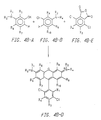
- One class of energy transfer fluorescent dyes according to the present invention includes a donor dye which has the following xanthene ring structure with a 4' ring position where Y 1 and Y 2 taken separately are either hydroxyl, oxygen, iminium or amine, the iminium and amine preferably being a tertiary iminium or amine.
- R 11 -R 17 may be any substituent which is compatible with the energy transfer dyes of the present invention, it being noted that the R 11 -R 17 may be widely varied in order to alter the spectral and mobility properties of the dyes.
- the energy transfer dye also includes an acceptor dye which absorbs the excitation energy emitted by the donor dye and fluoresces at a second wavelength in response.
- the energy transfer dye also includes a linker which attaches the donor dye to the acceptor dye.
- the linker has the general structure R 21 Z 1 C(O)R 22 R 28 , as illustrated above, where R 21 is a C 1-5 alkyl attached to the 4' position of the xanthene donor dye, C(O) is a carbonyl group, Z 1 is either NH, sulfur or oxygen, R 22 is a substituent attached to the carbonyl carbon which may be either an alkene, diene, alkyne, a five or six membered ring having at least one unsaturated bond or a fused ring structure, and R 28 includes a functional group which attaches the linker to the acceptor dye.
- the linker has the general structure R 21 Z 1 C(O)R 22 R 29 Z 2 C(O), as illustrated above, where R 21 and R 22 are as detailed above, Z 1 and Z 2 are each independently either NH, sulfur or oxygen, and R 29 is a C 1-5 alkyl, and the terminal carbonyl group is attached to the ring structure of the acceptor dye.
- Z 2 is nitrogen
- -C(O)R 22 R 29 Z 2 forms an amino acid subunit.
- the linker is where R 21 and R 29 are methylene, Z 1 and Z 2 are NH, and R 22 is benzene, as shown below.
- the donor dye may optionally be a member of the class of dyes where R 17 is a phenyl or substituted phenyl.
- R 17 is a phenyl or substituted phenyl.
- the dye is a member of the fluorescein class of dyes.
- the acceptor dye may optionally be a member of the xanthene, cyanine, phthalocyanine and squaraine classes of dyes.
- the energy transfer fluorescent dyes have donor and acceptor dyes with the general structure where Y 1 and Y 2 taken separately are either hydroxyl, oxygen, iminium or amine, the iminium and amine preferably being a tertiary iminium or amine and R 11 -R 16 are any substituents which are compatible with the energy transfer dyes of the present invention.
- the linker is preferably short and/or rigid as this has been found to enhance the transfer of energy between the donor and acceptor dyes.
- the energy transfer fluorescent dyes include a donor dye which is a member of the xanthene class of dyes, an acceptor dye which is a member of the xanthene, cyanine, phthalocyanine and squaraine classes of dyes which is capable of absorbing the excitation energy emitted by the donor dye and fluorescing at a second wavelength in response, and a linker attaching the donor dye to the acceptor dye.
- the acceptor has an emission maximum that is greater than about 600 nm or at least about 100 nm greater than the absorbance maximum of the donor dye.
- the present invention also relates to fluorescent reagents containing the energy transfer fluorescent dyes.
- these reagents include any molecule or material to which the energy transfer dyes of the invention can be attached and used to detect the presence of the reagent based on the fluorescence of the energy transfer dye.
- a fluorescent reagent is provided which includes a nucleoside or a mono-, di- or triphosphate nucletotide labeled with an energy transfer fluorescent dye.
- the nucleotide may be a deoxynucleotide which may be used for example, in the preparation of dye labeled oligonucleotides.
- the nucleotide may also be a dideoxynucleoside which may be used, for example, in dye terminator sequencing.
- the fluorescent reagent includes an oligonucleotide labeled with an energy transfer fluorescent dye. These reagents may be used, for example, in dye primer sequencing.
- the present invention also relates to methods which use the energy transfer fluorescent dyes and reagents of the present invention.
- the method includes forming a series of different sized oligonucleotides labeled with an energy transfer fluorescent dye of the present invention, separating the series of labeled oligonucleotides based on size, detecting the separated labeled oligonucleotides based on the fluorescence of the energy transfer dye.
- a mixture of extended labeled primers is formed by hybridizing a nucleic acid sequence with an oligonucleotide primer in the presence of deoxynucleotide triphosphates, and at least one dye labeled dideoxynucleotide triphosphate and a DNA polymerase.
- the DNA polymerase serves to extend the primer with the deoxynucleotide triphosphates until a dideoxynucleotide triphosphate is incorporated which terminates extension of the primer.
- the mixture of extended primers are separated and detected based on the fluorescence of the dye on the dideoxynucleoside.
- oligonucleotide primer is fluorescently labeled as opposed to the deoxynucleotide triphosphate.
- the present invention also relates to kits containing the dyes and reagents for performing DNA sequencing using the dyes and reagents of present invention.
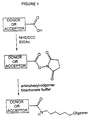
- Figure 1 illustrates the modification of a carboxy substituent on a energy transfer dye to an activated N-hydroxysuccinimidyl (NHS) ester which is then reacted with an aminohexyl-oligomer to form a dye labeled oligonucleotide primer.
- NHS N-hydroxysuccinimidyl
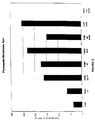
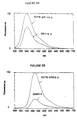
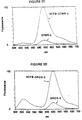
- Figure 2 compares the fluorescence emission strength of a series of energy transfer dyes of the present invention to other energy transfer dyes and the acceptor dye alone.
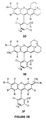
- FIGS 3A and 3B show several particularly preferred embodiments of 4,7-dichlororhodamine dye compounds which can be used in the energy transfer dyes of the present invention.
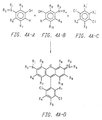
- Figures 4A and 4B show preferred generalized synthesis schemes for the preparation of the 4,7-dichlororhodamine dyes of the invention.
- Figure 4A shows a generalized synthesis wherein the substituent X 1 can be other than carboxylate.
- Figure 4B shows a generalized synthesis wherein the substituent X 1 is carboxylate.
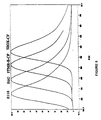
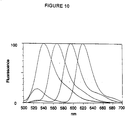
- Figure 5 illustrates a set of four dyes (3-carboxy-R110, 5-carboxy-R6G, 5TMR-B-CF and 5ROX-CF) which are spectrally resolvable from each other.
- Figure 6 illustrates a set of four dyes (3-carboxy-R110, 5-carboxy-R6G, 5ROX-CF and Cy5-CF) which are spectrally resolvable from each other.
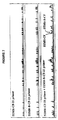
- Figure 7 is a plot of a mixture of labeled oligonucleotides generated during dye primer sequencing using 5TMR-CF and STMR-B-CF labeled primers.
- Figure 8 is a four color plot of dye primer sequencing using a four dye set including 3-carboxy-R110, 5-carboxy-R6G, 5TMR-CF and 5TMR-B-CF.
- Figures 9A-D compare the fluorescence emission strength of a series of energy transfer dyes of the present invention to the corresponding acceptor dye alone.
- Figure 9A provides the overlaid spectra of 6-CFB-DR110-2 and DR110-2.
- Figure 9B provides an overlaid spectra of 5-CFB-DR6G-2 and DR6G-2.
- Figure 9C provides an overlaid spectra of 6-CFB-DTMR-2 and DTMR-2.
- Figure 9D provides an overlaid spectra of 6-CFB-DROX-2 and DROX-2.
- Figure 10 illustrates a set of four dyes (5-CFB-DR110-2, 5-CFB-DR6G-2, 6-CFB-DTMR-2, and 6-CFB-DROX-2) which are spectrally resolvable from each other.
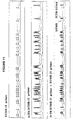
- Figure 11 is a plot of a mixture of labeled oligonucleotides generated during dye primer sequencing using 6-CFB-DTMR-2 and DTMR-2 labeled primers.
- Figure 12 is a plot of a mixture of labeled oligonucleotides generated during dye primer sequencing using 5-CF-TMR-2 and 5-CF-B-TMR-2 labeled primers.
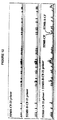
- Figure 13 is a four color plot of dye primer sequencing using a four dye set including 5-CFB-DR110-2, 6-CFB-DR6g-2, 5-CFB-DTMR-2, and 5-CFB-DROX-2.
- the present invention relates to novel linkers for linking a donor dye to an acceptor dye in an energy transfer fluorescent dye.
- the present invention also relates to energy transfer fluorescent dyes which incorporate these linkers. These linkers have been found to faciliate the efficient transfer of energy between a donor and acceptor dye in an energy transfer dye.
- One linker according to the present invention for linking a donor dye to an acceptor dye in an energy transfer fluorescent dye has the general structure R 21 Z 1 C(O)R 22 R 28 , as illustrated below, where R 21 is a C 1-5 alkyl attached to the donor dye, C(O) is a carbonyl group, Z 1 is either NH, sulfur or oxygen, R 22 is a substituent which includes an alkene, diene, alkyne, a five and six membered ring having at least one unsaturated bond or a fused ring structure which is attached to the carbonyl carbon, and R 28 includes a functional group which attaches the linker to the acceptor dye.
- the linker has the general structure R 21 Z 1 C(O)R 22 R 29 Z 2 C(O) where R 21 and R 22 are as detailed above, Z 1 and Z 2 are each independently either NH, sulfur or oxygen, R 29 is a C 1-5 alkyl, and the terminal carbonyl group is attached to the ring structure of the acceptor dye.
- Z 1 and Z 2 are each independently either NH, sulfur or oxygen
- R 29 is a C 1-5 alkyl
- the terminal carbonyl group is attached to the ring structure of the acceptor dye.
- Z 2 is nitrogen
- the C(O)R 22 R 29 Z 2 subunit forms an amino acid subunit.
- Particular examples of five or six membered rings which may be used as R 22 in the linker include, but are not limited to cyclopentene, cyclohexene, cyclopentadiene, cyclohexadiene, furan, thiofuran, pyrrole, isopyrole, isoazole, pyrazole, isoimidazole, pyran, pyrone, benzene, pyridine, pyridazine, pyrimidine, pyrazine and oxazine.
- fused ring structures include, but are not limited to indene, benzofuran, thionaphthene, indole and naphthalene.
- a preferred embodiment of this linker is where R 21 and R 29 are methylene, Z 1 and Z 2 are NH, and R 22 is benzene, as shown below.
- Table 3 illustrates examples of -C(O)R 22 - subunits of linkers which may be used in the linkers of the present invention.
- the energy transfer dyes of the present invention include a donor dye which absorbs light at a first wavelength and emits excitation energy in response, an acceptor dye which is capable of absorbing the excitation energy emitted by the donor dye and fluorescing at a second wavelength in response, and a linker which attaches the donor dye to the acceptor dye.
- a donor dye which absorbs light at a first wavelength and emits excitation energy in response
- an acceptor dye which is capable of absorbing the excitation energy emitted by the donor dye and fluorescing at a second wavelength in response
- a linker which attaches the donor dye to the acceptor dye.
- One class of energy transfer fluorescent dyes includes a donor dye which is a member of the xanthene class of dyes, an acceptor dye and a linker which is a member of the group of linkers described in Section I.
- xanthene dyes include all molecules having the general structure where Y 1 and Y 2 taken secarately are either hydroxyl, oxygen, iminium or amine, the iminium and amine preferably being a tertiary iminium or amine.
- Y 1 is hydroxyl and Y 2 is oxygen
- R 17 is a phenyl or substituted phenyl
- the dye is a member of the fluorescein class of dyes.
- Y 1 is amine and Y 2 is iminium
- R 17 is a phenyl or substituted phenyl
- the dye is a member of the rhodamine class of dyes.
- R 11 -R 17 may be any substituent which is compatible with the energy transfer dyes of the present invention, it being noted that the R 11 -R 17 may be widely varied in order to alter the spectral and mobility properties of the dyes.
- the number indicated in the ring structure indicates the 4' position on the xanthene ring structure.
- the R 14 substituent corresponds to the linker.
- R 11 -R 17 substituents include, but not limited to hydrogen, fluorine, chlorine, bromine, iodine, carboxyl, alkyl, alkene, alkyne, sulfonate, amino, ammonium, amido, nitrile, alkoxy, phenyl, substituted phenyl, where adjacent substituents are taken together to form a ring, and combinations thereof.
- R 15 and R 16 are taken together to form a substituted or unsubstituted benzene ring.
- This class of xanthene dyes are referred to herein as asymmetric benzoxanthene dyes and are described in WO 97/36960 based on U.S. Application Serial No. 08/626,085, filed April 1, 1996, entitled Asymmetric Benzoxanthene Dyes, by Scott C. Benson, et al.
- R 17 is a phenyl or substituted phenyl having the general formula
- Substituents X 1 -X 5 on the phenyl ring can include hydrogen, fluorine, chlorine, bromine, iodine, carboxyl, alkyl, alkene, alkyne, sulfonate, amino, ammonium, amido, nitrile, alkoxy, where adjacent substituents are taken together to form a ring, and combinations thereof.
- the donor dye is a member of the class of dyes where Y 1 , is amine, Y 2 is iminium, and X 2 and X 5 are chlorine, referred to herein as 4,7-dichlororhodamine dyes.
- Dyes falling within the 4,7-dichlororhodamine class of dyes and their synthesis are described herein as well as in WO 97/49769 based on U.S. Application Serial No.: 08/672,196; filed: June 27, 1996; entitled: "4,7-DICHLORORHODAMINE DYES”.
- alkyl denotes straight-chain and branched hydrocarbon moieties, i.e., methyl, ethyl, propyl, isopropyl, tert-butyl, isobutyl, sec-butyl, neopentyl, tert-pentyl, and the like.
- Substituted alkyl denotes an alkyl moiety substituted with any one of a variety of substituents, including, but not limited to hydroxy, amino, thio, cyano, nitro, sulfo, and the like.
- Haloalkyl denotes a substituted alkyl with one or more halogen atom substituents, usually fluoro, chloro, bromo, or iodo.
- Alkene denotes a hydocarbon wherein one or more of the carbon-carbon bonds are double bonds, and the non-double bonded carbons are alkyl or substituted alkyl.
- Alkyne denotes a hydocarbon where one or more of the carbons are bonded with a triple bond and where the non-triple bonded carbons are alkyl or substituted alkyl moieties.
- Sulfonate refers to moieties including a sulfur atom bonded to 3 oxygen atoms, including mono- and di-salts thereof, e.g., sodium sulfonate, potassium sulfonate, disodium sulfonate, and the like.
- Amino refers to moieties including a nitrogen atom bonded to 2 hydrogen atoms, alkyl moieties, or any combination thereof.
- Amido refers to moieties including a carbon atom double bonded to an oxygen atom and single bonded to an amino moiety.
- Nitrile refers to moieties including a carbon atom triple bonded to a nitrogen atom.
- Alkoxy refers to a moiety including an alkyl moiety single bonded to an oxygen atom.
- Aryl refers to single or multiple phenyl or substituted phenyl, e.g., benzene, naphthalene, anthracene, biphenyl, and the like.
- R 11 -R 17 may also each independently be a linking moiety which may be used to attach the energy transfer dye to a reagent, such as a nucleotide, nucleoside or oligonucleotide.
- linking moieties include isothiocyanate, sulfonyl chloride, 4,6-dichlorotriazinylamine, succinimidyl ester, or other active carboxylate whenever the complementary functionality is amine.
- the linking group is maleimide, halo acetyl, or iodoacetamide whenever the complementary functionality is sulfhydryl. See R. Haugland, Molecular Probes Handbook of Fluorescent Probes and Research Chemicals , Molecular probes, Inc.
- the linking group is an activated NHS ester formed from a carboxyl group on either the donor or acceptor dye which can be reacted with an aminohexyl-oligomer to form a dye labeled oligonucleotide primer.
- the energy transfer fluorescent dyes of this embodiment also include an acceptor dye which is capable of absorbing the excitation energy emitted by the donor dye and fluorescing at a second wavelength in response, and a linker which attaches the donor dye to the acceptor dye.
- the linker is a member of the class of linkers described in Section I and is attached to the donor dye at the 4' position of the xanthene ring structure.
- Energy transfer dyes of this first class exhibit enhanced fluorescent strength as compared to the acceptor fluorophore itself and energy transfer fluorescent dyes having the same donor - acceptor pair where the linkage between the donor - acceptor pair is different.
- the present invention also relates to a second class of energy transfer fluorescent dyes in which the donor and acceptor dyes each have the general structure where Y 1 , Y 2 , R 11 -R 16 and X 1 -X 5 are as specified above.
- the linker is attached to the donor and acceptor dyes by one of X 3 and X 4 substituents of each of the donor and acceptor dyes.
- the linker is attached to the donor and acceptor dyes by the X 3 substituent of each of the donor and acceptor dyes.
- the linker is preferably short and/or rigid as this has been found to enhance the transfer of energy between the donor and acceptor dyes.
- the present invention also relates to a third class of energy transfer fluorescent dyes in which the acceptor dye is a member of the 4,7-dichlororhodamine class of dyes, i.e., dyes having the general structure where
- R 1 - R 10 , X 3 and X 4 , R 1 and R 5 , R 2 and R 6 , R 3 and R 5 , R 4 and R 9 , and X 3 and X 4 may each independently be taken together to form a 5, 6, or 7 membered ring.
- the numbers (4', 5, 6) indicated in the ring structure indicate the 4', 5 and 6 ring positions on the rhodamine ring structure.
- the 4' and 5 ring positions are preferred sites for attachment of the linker used in the energy transfer dyes of the present invention which attaches the donor to the acceptor fluorophore.
- the 4', 5 and 6 ring positions are also preferred sites for attachment of a biomolecule, such as a nucleotide or oligonucleotide to the energy transfer dye.
- Donor dyes within this class of energy transfer dyes may include any dye which emits excitation energy which a 4,7-dichlororhodamine dye is capable of absorbing and producing an energy emission in response.
- the donor dye has a xanthene ring structure with a 4' ring position where the 4,7-dichlororhodamine acceptor dye is attached to the donor dye by a linker which is attached to the 4' ring position of the xanthene dye.
- the linker is preferably attached to the 5 or 6 ring positions of the 4,7-dichlororhodamine acceptor dye.
- Energy transfer dyes according to this third class of dyes i.e., where 4,7-dichlororhodamine is the acceptor dye, provide the advantage of having a relatively narrow emission spectrum as compared to other rhodamine dyes. This narrow emission spectrum enhances the spectral resolution achievable by a set of these dyes, thereby facilitating multicomponent analysis using these dyes.
- the present invention also relates to a fourth class of energy transfer fluorescent dyes in which the donor dye is a member of the xanthene class of dyes, the acceptor dye is a member of the xanthene, cyanine, phthalocyanine and squaraine classes of dyes, and the acceptor has an emission maximum that is greater than about 600 nm and/or preferably has an emission maximum that is at least about 100 nm greater than the absorbance maximum of the donor dye.
- the donor is preferably a member of the fluorescein class of dyes.
- the fourth class of energy transfer dyes of the present invention exhibit unusually large Stoke shifts, as measured by the difference between the absorbance of the donor and the emission of the acceptor. In addition, these dyes exhibit efficient energy transfer in that minimal donor fluorescence is observed.
- the first class of energy transfer dyes according to the present invention includes a donor dye which is a member of the xanthene class of dyes and hence has a xanthene ring structure with a 4' ring position.
- the acceptor dye is a dye which is capable of absorbing the excitation energy emitted by the donor dye and fluorescing at a second wavelength in response.
- the donor may be a member of the fluorescein, rhodamine or asymmetric benzoxanthene classes of dyes, these dyes each being members of the broader xanthene class of dyes. Illustrated below are the general structural formulas for these xanthene dyes. The substituents illustrated on these dyes may be selected from the wide variety of substituents which may be incorporated onto these different classes of dyes since all dyes having the general xanthene, fluorescein, rhodamine, and asymmetric benzoxanthene ring structures are intended to fall within the scope of this invention..
- acceptor dyes which may be used in the energy transfer fluorescent dye of this embodiment include, but are not limited to, xanthene dyes, cyanine dyes, phthalocyanine dyes and squaraine dyes.
- the general structures of these dyes are illustrated in Table 1A.
- the substituents illustrated on these dyes may be selected from the wide variety of substituents which may be incorporated onto these different classes of dyes since all dyes having the general xanthene, fluorescein, rhodamine, asymmetric benzoxanthene, cyanine, phthalocyanine and squaraine ring structures are intended to fall within the scope of this invention.
- donor dyes which may be used in this embodiment include, but are not limited to fluorescein, isomers of carboxyfluorescein (e.g., 5 and 6 carboxy), isomers of carboxy-HEX (e.g., 5 and 6 carboxy), NAN, CI-FLAN, TET, JOE, ZOE, rhodamine, isomers of carboxyrhodamine (e.g., 5 and 6 carboxy), isomers of carboxy R110 (e.g., 5 and 6 carboxy), isomers of carboxy R6G (e.g., 5 and 6 carboxy), 4,7-dichlorofluoresceins ( See U.S. Patent No.
- acceptor dyes which may be used in this embodiment include, but are not limited to isomers of carboxyfluorescein (e.g., 5 and 6 carboxy), 4,7-dichlorofluoresceins, 4,7-dichlororhodamines, fluoresceins, asymmetric benzoxanthene dyes, isomers of carboxy-HEX (e.g., 5 and 6 carboxy), NAN, CI-FLAN, TET, JOE, ZOE, rhodamine, isomers of carboxyrhodamine (e.g., 5 and 6 carboxy), isomers of carboxy R110 (e.g., 5 and 6 carboxy), isomers of carboxy R6G (e.g., 5 and 6 carboxy), isomers of N,N,N',N'-tetramethyl carboxyrhodamine (TAMRA) (e.g., 5 and 6 carboxy), isomers of carboxy-X-rhodamine (ROX
- the linker is attached to the donor dye at the 4' position of the xanthene ring structure.
- the linker has the general structure R 21 Z 1 C(O)R 22 R 28 , as illustrated below, where R 21 is a C 1-5 alkyl which is attached to the 4' ring position of the donor xanthene dye, Z 1 is either NH, sulfur or oxygen, C(O) is a carbonyl group, R 22 is a substituent which includes an alkene, diene, alkyne, a five and six membered ring having at least one unsaturated bond or a fused ring structure which is attached to the carbonyl carbon, and R 28 is a functional group which attaches the linker to the acceptor dye.
- Examples of five or six membered rings which may be used in R 22 include, but are not limited to cyclopentene, cyclohexene, cyclopentadiene, cyclohexadiene, furan, thiofuran, pyrrole, isopyrole, isoazole, pyrazole, isoimidazole, pyran, pyrone, benzene, pyridine, pyridazine, pyrimidine, pyrazine and oxazine.
- Examples of fused ring structures include, but are not limited to indene, benzofuran, thionaphthene, indole and naphthalene.
- the linker has the general structure R 21 Z 1 C(O)R 22 R 29 Z 2 C(O) where R 21 is a C 1-5 alkyl which is attached to the 4' ring position of the donor xanthene dye, Z 1 and Z 2 are each independently either NH, sulfur or oxygen, C(O) is a carbonyl group, R 22 is a substituent which includes an alkene, diene, alkyne, a five and six membered ring having at least one unsaturated bond or a fused ring structure which is attached to the carbonyl carbon, R 29 is a C 1-5 alkyl, and the terminal carbonyl group is attached to the ring structure of the acceptor dye.
- a preferred embodiment of this linker is where R 21 and R 29 are methylene, Z 1 and Z 2 are NH, and R 22 is benzene, as shown below.
- energy transfer dyes such as 5-TMR-B-CF, which include a donor, acceptor and linker as specified above exhibit enhanced fluorescence as compared to the acceptor itself and energy transfer fluorescent dyes having the same donor - acceptor pair where the linker between the donor - acceptor pair is different.
- the enhanced fluorescence intensity observed is believed to be due to an improved energy transfer orientation between the donor and acceptor dye which is achieved and maintained by the relatively rigid R 22 portion of the linker.
- the energy transfer fluorescent dyes of the present invention exhibit enhanced fluorescent strength as compared to the acceptor fluorophore itself and energy transfer fluorescent dyes having the same donor - acceptor pair where the linkage between the donor - acceptor pair is different.
- the enhanced fluorescent strength of these dyes is particularly evident in the presence of 8 M urea which serves to reduce dye stacking.
- the acceptor is a member of the xanthene class of dyes having the general structure where Y 1 , Y 2 , R 11 -R 16 and X 1 -X 5 are as specified above.
- a linker such as the ones described above, is attached to the acceptor xanthene dye via the X 3 or X 4 substituent of the acceptor xanthene dye.
- the linker is attached to the X 3 substituent of the acceptor xanthene dye.
- Table 4 provides examples of the above-described energy transfer dyes according to this embodiment of the invention. It is noted that although the dyes illustrated in Table 4 include a 5-carboxyfluorescein donor dye and a TAMRA acceptor dye, it should be understood that a wide variety of other xanthene dyes can be readily substituted as the donor dye. It should also be understood that a wide variety of other xanthene dyes, as well as cyanine, phthalocyanine and squaraine dyes can be readily substituted for the TAMRA acceptor dye, as has been described above, all of these variations with regard to the donor and acceptor dyes falling within the scope of the invention.
- the present invention also relates to a second class of energy transfer fluorescent dyes, illustrated below, in which the donor dye and acceptor each are members of the xanthene class of dyes having the general structure where Y 1 , Y 2 , R 11 -R 16 and X 1 -X 5 are as specified above.
- the linker is attached to the X 3 or X 4 substituent of both the donor and acceptor dyes, as illustrated below.
- the linker is preferably short and/or rigid as this has been found to enhance the transfer of energy between the donor and acceptor dyes.
- the linker preferably has a backbone attaching the donor to the acceptor which is less than 9 atoms in length.
- the linker includes a functional group which gives the linker some degree of structural rigidity, such as an alkene, diene, an alkyne, a five and six membered ring having at least one unsaturated bond or fused ring structure.
- the linker has the general Formula R 25 Z 3 C(O)R 37 or R 25 Z 3 C(O)R 24 Z 4 C(O) where R 25 is attached to the donor dye, C(O) is a carbonyl group and R 37 is a substituent attached to the acceptor dye, R 25 and R 26 are each selected from the group of C 1-4 alkyl, and Z 3 and Z 4 are each independently either NH, O or S.
- donor and acceptor dyes which may be used in this embodiment include, but are not limited to fluorescein, 5 or 6 carboxyfluorescein, 5 or 6 carboxy-HEX, NAN, CI-FLAN, TET, JOE, ZOE, 4,7-dichlorofluoresceins, asymmetric benzoxanthene dyes, rhodamine, 5 or 6 carboxyrhodamine, 5 or 6 carboxy-R110, 5 or 6 carboxy-R6G, N,N,N',N'-tetramethyl (5 or 6)-carboxyrhodamine (TAMRA), 5 or 6 carboxy-X-rhodamine (ROX) and 4,7-dichlororhodamines. Illustrated in Table 2 are the structures of these dyes.
- the linker includes a R 27 Z 5 C(O)R 37 group where R 27 is a C 1-5 alkyl attached to the donor dye, Z 5 is either NH, sulfur or oxygen, and C(O) is a carbonyl group attached to the acceptor dye.
- Table 5 provides examples of the second class of energy transfer dyes according to the present invention. It is noted that although the dyes illustrated in Table 5 include a 5-aminomethylfluorescein donor dye, it should be understood that a wide variety of other xanthene dyes can be readily substituted as the donor dye. It should also be understood that a wide variety of other xanthene dyes, as well as cyanine, phthalocyanine and squaraine dyes can be readily substituted for the TAMRA acceptor dye, as has been described above, all of these variations with regard to the donor and acceptor dyes falling within the scope of the invention.
- the third class of energy transfer fluorescent dyes include a 4,7-dichlororhodamine dye as the acceptor dye and a dye which produces an emission which the 4,7-dichlororhodamine dye can absorb as the donor dye. These dyes exhibit enhanced fluorescence intensity as compared to the acceptor dye alone. In addition, 4,7-dichlororhodamine dyes exhibit a narrower emission spectrum than other rhodamine dyes which facilitates their use in multiple component analyses.
- these energy transfer dyes include those dyes according to the first and second classes of dyes in which the acceptor is a 4,7-dichlororhodamine dye.
- 4,7-dichlororhodamine dye compounds have the general structure where:
- alkyl substituents may include between about 1 to 8 carbon atoms (i.e., methyl, ethyl, propyl, isopropyl, tert-butyl, isobutyl, sec-butyl, neopentyl, tert-pentyl, and the like) and may be straight-chain and branched hydrocarbon moieties.
- R 1 - R 4 are each independently either hydrogen, methyl, or ethyl and more preferably either hydrogen or methyl.
- alkyl, alkene, alkyne and alkoxy substituents preferably include between about 1 to 8 carbon atoms (i.e., methyl, ethyl, propyl, isopropyl, tert-butyl, isobutyl, sec-butyl, neopentyl, tert-pentyl, and the like) and may be straight-chain and branched hydrocarbon moieties.
- R 1 - R 10 , R 1 and R 5 , R 2 and R 6 , R 3 and R 8 , R 4 and R 9 may each independently be taken together to form a 5, 6, or 7 membered ring.
- R 6 and R 7 is benzo, and/or, R 9 and R 10 is benzo.
- R 5 - R 10 are each independently either hydrogen, methyl, or ethyl and more preferably either hydrogen or methyl.
- X 1 is preferably a carboxylate and one of X 3 and X 4 may include 3 substituent which is used to link the 4,7-dichlororhodamine acceptor dye to a donor dye or to link a nucleotide or an oligonucleotide to the energy transfer dye.
- the R 8 substituent at the 4' ring position may also be used to link the acceptor to either the donor dye or to a biomolecule such as a nucleotide or oligonucleotide.
- R 1 -R 10 taken separately are hydrogen
- X 1 is carboxylate
- X 3 and X 4 is a linking group (L), the other being hydrogen.
- L linking group
- DR6G-2 In a second particularly preferred acceptor dye that may be used in the present invention, referred to herein as DR6G-2, one of R 1 and R 2 is ethyl, the other being hydrogen, one of R 3 and R 4 is ethyl, the other being hydrogen, R 5 and R 8 taken separately are methyl, R 6 , R 7 , R 9 , and R 10 are hydrogen, X 1 is carboxylate, and one of X 3 and X 4 is a linking group, the other being hydrogen.
- R 1 and R 2 is ethyl
- R 3 and R 4 is ethyl
- R 5 and R 8 taken separately are methyl
- R 6 , R 7 , R 9 , and R 10 are hydrogen
- X 1 is carboxylate
- X 3 and X 4 is a linking group
- DTMR In a third particularly preferred acceptor dye that may be used in the present invention, referred to herein as DTMR, R 1 -R 6 taken separately are hydrogen, Y 1 -Y 4 taken separately are methyl, X 1 is carboxylate, and one of X 2 and X 3 is linking group, the other being hydrogen.
- the structure of DTMR is shown below.
- DROX particularly preferred acceptor dye that may be used in the present invention
- R 1 and R 6 are taken together to form a six membered ring
- R 2 and R 5 are taken together to form a six membered ring
- R 3 and R 7 are taken together to form a six membered ring
- R 4 and R 8 are taken together to form a six membered ring
- R 5 and R 6 are hydrogen
- X 1 is carboxylate
- one of X 3 and X 4 is a linking group, the other being hydrogen.
- the structure of DROX is shown below.
- Figures 3A and 3B show several additional preferred embodiments of 4,7-dichlororhodamine dyes which can be used in the energy transfer dyes of the present invention.
- one of R 1 and R 2 is ethyl, the other being hydrogen, R 3 and R 4 taken separately are hydrogen, R 6 is methyl, R 5 and R 7 -R 10 taken separately are hydrogen, X 1 is carboxylate, and one of X 3 and X 4 is a linking group, the other being hydrogen.
- one of R 1 and R 2 is ethyl, the other being hydrogen, R 3 and R 4 taken separately are methyl, R 5 is methyl, R 6 -R 10 taken separately are hydrogen, X 1 is carboxylate, and, one of X 3 and X 4 is a linking group, the other being hydrogen.
- R 1 and R 2 taken separately are methyl
- R 3 and R 9 taken together form a six membered ring
- R 4 and R 8 taken together form a six membered ring
- R 5 , R 6 , R 7 and R 10 taken separately are hydrogen
- X 1 is carboxylate
- one of X 3 and X 4 is a linking group, the other being hydrogen.
- R 1 and R 2 taken separately are hydrogen
- R 3 and R 9 taken together form a six membered ring
- R 4 and R 8 taken together form a six membered ring
- R 5 , R 6 , R 7 , and R 10 taken separately are hydrogen
- X 1 is carboxylate
- one of X 3 and X 4 is a linking group, the other being hydrogen.
- one of R 1 and R 2 is ethyl, the other being hydrogen, R3 and R 9 taken together form a six membered ring, R4 and R 8 taken together form a six membered ring, R 5 is methyl, R 6 , R 7 and R 10 taken separately are hydrogen, X 1 is carboxylate, and, one of X 3 and X 4 is a linking group, the other being hydrogen.
- R 1 and R 2 taken separately are hydrogen
- R3 and R 4 taken separately are methyl
- R 5 -R 10 taken separately are hydrogen
- X 1 is carboxylate
- one of X 3 and X 4 is linking group, the other being hydrogen.
- Figures 4A and 4B show preferred generalized synthesis schemes for the preparation of 4,7-dichlororhodamine dyes used in the energy transfer dyes of this invention.
- the variable substituents indicated in each figure are as previously defined.
- Figure 4A shows a generalized synthesis wherein the substituent X 1 can be other than carboxylate.
- X' indicates moieties which are precursors to X 1 .
- two equivalents of a 3-aminophenol derivative 4A-A/4A-B such as 3-dimethylaminophenol, is reacted with one equivalent of a dichlorobenzene derivative 4A-C, e.g., 4-carboxy-3,6,dichloro-2-sulfobenzoic acid cyclic anhydride, i.e., where the X 1 ' moieties of 4c taken together are,
- the reactants are then heated for 12 h in a strong acid, e.g., polyphosphoric acid or sulfuric acid, at 180 °C.
- a strong acid e.g., polyphosphoric acid or sulfuric acid
- the crude dye 4A-D is precipitated by addition to water and isolated by centrifugation.
- the substituents of reactants 4A-A and 4A-B are the same, while to form an asymmetrical product, the substituents are different.
- Figure 4B shows a generalized synthesis wherein the substituent X 1 is carboxylate.
- two equivalents of a 3-aminophenol derivative 4A-A/4A-B such as 3-dimethylaminophenol
- a phthalic anhydride derivative 4e e.g. 3,6-dichlorotrimellitic acid anhydride.
- the reactants are then heated for 12 h in a strong acid, e.g., polyphosphoric acid or sulfuric acid, at 180°C.
- the crude dye 4A-D is precipitated by addition to water and isolated by centrifugation.
- the substituents of reactants 4A-A and 4A-B are the same, while to form an asymmetrical product, the substituents are different.
- the energy transfer dyes of the present invention include a donor dye which absorbs light at a first wavelength and emits excitation energy in response, a 4,7-dichlororhodamine acceptor dye which is capable of absorbing the excitation energy emitted by the donor dye and fluorescing at a second wavelength in response, and a linker which attaches the donor dye to the acceptor dye.
- a donor dye which absorbs light at a first wavelength and emits excitation energy in response
- a 4,7-dichlororhodamine acceptor dye which is capable of absorbing the excitation energy emitted by the donor dye and fluorescing at a second wavelength in response
- a linker which attaches the donor dye to the acceptor dye.
- acceptor dyes which may be used in this class of dyes include, but are not limited to DR110-2, DR6G-2, DTMR, DROX, as illustrated above, as well as the dyes illustrated in Figures 3A-3B.
- One subclass of these energy transfer fluorescent dyes are the dyes according to the first class of dyes of the present invention in which the acceptor dye is a 4,7-dichlororhodamine dye.
- the general structure of these dyes is illustrated below.
- Table 4 provides examples of the energy transfer dyes belonging to the first class of dyes in which a 4,7 dichlororhodamine is used as the acceptor dye. It is noted that although the dyes illustrated in Table 4 include a 5-carboxyfluorescein donor dye and a 5 or 6 carboxy DTMR as the acceptor dye, it should be understood that a wide variety of other xanthene dyes can be readily substituted as the donor dye and a wide variety of other 4,7-dichlororhodamine dyes can be readily substituted for the DTMR acceptor dye, all of these variations with regard to the donor and acceptor dyes being intended to fall within the scope of the invention.
- Another subclass of these energy transfer fluorescent dyes are the dyes according to the second class of dyes of the present invention in which the acceptor dye is a 4,7-dichlororhodamine dye.
- the acceptor dye is a 4,7-dichlororhodamine dye.
- the general structure of these dyes where the donor xanthene dye and acceptor 4,7-dichlororhodamine dye are linked to each other at either the five or six ring positions of the donor and acceptor dyes is illustrated below.
- the linker attaching the donor to the acceptor dye is preferably short and/or rigid as this has been found to enhance the transfer of energy between the donor and acceptor dyes.
- the substituent labels shown above correspond to the same groups of substituents as has been specified with regard to the other dyes.
- Table 5 provides examples of the second class of energy transfer dyes according to the present invention in which 4,7 dichlororhodamine is used as the acceptor dye. It is noted that although the dyes illustrated in Table 5 include a 5-aminomethylfluorescein donor dye, it should be understood that a wide variety of other xanthene dyes can be readily substituted as the donor dye. It should also be understood that a wide variety of other 4,7-dichlororhodamine dyes can be readily substituted for the acceptor dye shown in Table 5 since, as has been described above, all of these variations with regard to the donor and acceptor dyes are intended to fall within the scope of the invention.
- the present invention also relates to a fourth class of energy transfer fluorescent dyes in which the donor dye is a member of the xanthene class of dyes, and the acceptor dye is a member of the xanthene, cyanine, phthalocyanine or squaraine classes of dyes.
- the donor be a member of the fluorescein class of dyes and the acceptor dye have an emission maximum that is greater than about 600 nm and/or an emission maximum that is at least about 100 nm greater than the absorbance maximum of the donor dye.
- the fourth class of dyes of the present invention exhibit unusually large Stoke shifts, as measured by the difference between the absorbance of the donor and the emission of the acceptor.
- these dyes exhibit efficient energy transfer in that minimal donor fluorescence is observed.
- energy is transfered from the donor to the acceptor in some of the dyes belonging to this class even though the absorbance spectrum of the acceptor dye does not overlap with the emission spectrum of the donor dye.
- acceptor dyes which may be used in this embodiment include, but are not limited to 5-carboxy-X-rhodamine (ROX) and Cy5.
- the energy transfer dyes of this embodiment also include a linker which attaches the donor to the acceptor.
- the linker used to attach the donor to the acceptor dye may be any linker according to the first and second classes of dyes. However, it is foreseen that alternate linkers may be used in this class of dyes.
- the linker is attached to the 4' position of the donor dye's xanthene ring structure.
- the linker preferably has a general structure R 21 Z 1 C(O)R 22 R 28 , as described above where R 21 is a C 1-5 alkyl which is attached to the 4' ring position of the donor xanthene dye, Z 1 is either NH, sulfur or oxygen, C(O) is a carbonyl group, R 22 is a substituent which includes an alkene, diene, alkyne, a five and six membered ring having at least one unsaturated bond or a fused ring structure which is attached to the carbonyl carbon, and R 28 is a functional group which attaches the linker to the acceptor dye.
- the linker is preferably attached to acceptor at the 5 position of the xanthene ring structure.
- Table 6 provides examples of the above-described energy transfer dyes according to the present invention. It is noted that although the dyes illustrated in Table 6 include a 5-carboxyfluorescein donor dye it should be understood that a wide variety of other xanthene dyes can be readily substituted as the donor dye. It should also be understood that a wide variety of other xanthene dyes, as well as cyanine, phthalocyanine and squaraine dyes can be readily substituted for the 5-carboxy ROX and Cy5 acceptor dyes, as has been described above, all of these variations with regard to the donor and acceptor dyes falling within the scope of the invention.
- the energy transfer dyes of this embodiment exhibit unusually large Stoke shifts which make these dyes particularly well suited for use with dyes having smaller Stoke shifts in four dye DNA sequencing.
- Figures 5 and 6 illustrate two sets of four dyes which are spectrally resolvable from each other.
- 5ROX-CF is a dye falling within the scope of the fourth class of dyes described above.
- Figure 6 includes 5ROX-CF and Cy5-CF which both fall within the scope of the fourth class of dyes described above.
- the present invention also relates to fluorescent reagents which incorporate an energy transfer fluorescent dye according to the present invention. As described in greater detail in Section III, these reagents may be used in a wide variety of methods for detecting the presence of a component in a sample.
- the fluorescent reagents of the present invention include any molecule or material to which the energy transfer dyes of the invention can be attached and used to detect the presence of the reagent based on the fluorescence of the energy transfer dye.
- Types of molecules and materials to which the dyes of the present invention may be attached to form a reagent include, but are not limited to proteins, polypeptides, polysaccharides, nucleotides, nucleosides, oligonucleotides, oligonucleotide analogs (such as a peptide nucleic acid), lipids, solid supports, organic and inorganic polymers, and combinations and assemblages thereof, such as chromosomes, nuclei, living cells, such as bacteria, other microorganisms, mammalian cells, and tissues.
- Preferred classes of reagents of the present invention are nucleotides, nucleosides, oligonucleotides and oligonucleotide analogs which have been modified to include an energy transfer dye of the invention.
- nucleotide and nucleoside reagents include, but are not limited to, labeling oligonucleotides formed by enzymatic synthesis, e.g., nucleoside triphosphates used in the context of PCR amplification, Sanger-type oligonucleotide sequencing, and nick-translation reactions.
- Examples of uses for oligonucleotide reagents include, but are not limited to, as DNA sequencing primers, PCR primers, oligonucleotide hybridization probes, and the like.
- NTP labeled nucleosides
- cytosine such as cytosine, adenosine, guanosine, and thymidine
- thymidine labeled with an energy transfer fluorescent dye of the present invention.
- NTP labeled nucleosides
- reagents may be used in a wide variety of methods involving oligonucleotide synthesis.
- Another related embodiment are labeled nucleotides, e.g., mono-, di- and triphosphate nucleoside phosphate esters.
- reagents include, in particular, deoxynucleoside triphosphates (dNTP), such as deoxycytosine triphosphate, deoxyadenosine triphosphate, deoxyguanosine triphosphate, and deoxythymidine triphosphate, labeled with an energy transfer fluorescent dye of the present invention.
- dNTP deoxynucleoside triphosphates
- These reagents may be used, for example, as polymerase substrates in the preparation of dye labeled oligonucleotides.
- reagents also include labeled dideoxynucleoside triphosphates (ddNTP), such as dideoxycytosine triphosphate, dideoxyadenosine triphosphate, dideoxyguanosine triphosphate, and dideoxythymidine triphosphate, labeled with an energy transfer fluorescent dye of the present invention.
- ddNTP dideoxynucleoside triphosphates
- These reagents may be used, for example, in dye termination sequencing.
- reagents are oligonucleotides which includes an energy transfer fluorescent dye of the present invention. These reagents may be used, for example, in dye primer sequencing.
- nucleoside refers to a compound consisting of a purine, deazapurine, or pyrimidine nucleoside base, e.g., adenine, guanine, cytosine, uracil, thymine, deazaadenine, deazaguanosine, and the like, linked to a pentose at the 1' position, including 2'-deoxy and 2'-hydroxyl forms, e.g. as described in Kornberg and Baker, DNA Replication, 2nd Ed. (Freeman, San Francisco, 1992).
- adenine, guanine, cytosine, uracil, thymine, deazaadenine, deazaguanosine, and the like linked to a pentose at the 1' position, including 2'-deoxy and 2'-hydroxyl forms, e.g. as described in Kornberg and Baker, DNA Replication, 2nd Ed. (Freeman, San Francisco, 1992).
- nucleotide refers to a phosphate ester of a nucleoside, e.g., mono, di and triphosphate esters, wherein the most common site of esterification is the hydroxyl group attached to the C-5 position of the pentose.
- "Analogs" in reference to nucleosides include synthetic nucleosides having modified base moieties and/or modified sugar moieties, e.g. described generally by Scheit, Nucleotide Analogs (John Wiley, New York, 1980).
- labeleled nucleoside and labeleled nucleotide refer to nucleosides and nucleotides which are covalently attached to an energy transfer dye through a linkage.
- oligonucleotide refers to linear polymers of natural or modified nucleoside monomers, including double and single stranded deoxyribonucleosides, ribonucleosides, ⁇ -anomeric forms thereof, and the like.
- nucleoside monomers are linked by phosphodiester linkages, where as used herein, the term “phosphodiester linkage” refers to phosphodiester bonds or analogs thereof including phosphorothioate, phosphorodithioate, phosphoroselenoate, phosphorodiselenoate, phosphoroanilothioate, phosphoranilidate, phosphoramidate, and the like, including associated counterions, e.g., H, NH 4 , Na, and the like if such counterions are present.
- the oligonucleotides range in size form a few monomeric units, e.g. 8-40, to several thousands of monomeric units.
- oligonucleotide is represented by a sequence of letters, such as "ATGCCTG,” it will be understood that the nucleotides are in 5'->3' order from left to right and that "A” denotes deoxyadenosine, “C” denotes deoxycytidine, “G” denotes deoxyguanosine, and “T” denotes thymidine, unless otherwise noted.
- Nucleoside labeling can be accomplished using any of a large number of known nucleoside labeling techniques using known linkages, linking groups, and associated complementary functionalities.
- the linkage linking the dye and nucleoside should (i) be stable to oligonucleotide synthesis conditions, (ii) not interfere with oligonucleotide-target hybridization, (iii) be compatible with relevant enzymes, e.g., polymerases, ligases, and the like, and (iv) not quench the fluorescence of the dye.
- the dyes are covalently linked to the 5-carbon of pyrimidine bases and to the 7-carbon of 7-deazapurine bases.
- suitable base labeling procedures have been reported that can be used with the invention, e.g. Gibson et al, Nucleic Acids Research , 15 6455-6467 (1987); Gebeyehu et al, Nucleic Acids Research , 15 4513-4535 (1987); Haralambidis et al, Nucleic Acids Research , 15 4856-4876 (1987); Nelson et al., Nucleosides and Nucleotides , 5(3) 233-241 (1986); Bergstrom, et al., JACS , 111 374-375 (1989); U.S. Patent Nos. 4,855,225, 5,231,191, and 5,449,767, each of which is incorporated herein by reference.
- the linkages are acetylenic amido or alkenic amido linkages, the linkage between the dye and the nucleotide base being formed by reacting an activated N-hydroxysuccinimide (NHS) ester of the dye with an alkynylamino-, alkynylethoxyamino- or alkenylamino-derivatized base of a nucleotide. More preferably, the resulting linkage is proargyl-1-ethoxyamido (3-(amino)ethoxy-1-propynyl), 3-(carboxy)amino-1-propynyl or 3-amino-1-propyn-1-yl.
- NHS N-hydroxysuccinimide
- R 1 and R 2 taken separately are H, alkyl, a protecting group or a fluorescent dye.
- alkynylamino-derivatized nucleosides are taught by Hobbs et al. in European Patent Application No. 87305844.0, and Hobbs et al., J. Org. Chem. , 54 3420 (1989), which is incorporated herein by reference. Briefly, the alkynylamino-derivatized nucleotides are formed by placing the appropriate halodideoxynucleoside (usually 5-iodopyrimidine and 7-iodo-7-deazapurine dideoxynucleosides as taught by Hobbs et al.
- the appropriate halodideoxynucleoside usually 5-iodopyrimidine and 7-iodo-7-deazapurine dideoxynucleosides as taught by Hobbs et al.
- the alkynylaminonucleoside can be isolated by concentrating the reaction mixture and chromatographing on silica gel using an eluting solvent which contains ammonium hydroxide to neutralize the hydrohalide generated in the coupling reaction.
- methanol/methylene chloride can be added to the reaction mixture, followed by the bicarbonate form of a strongly basic anion exchange resin.
- the slurry can then be stirred for about 45 minutes, filtered, and the resin rinsed with additional methanol/methylene chloride.
- the combined filtrates can be concentrated and purified by flash-chromatography on silica gel using a methanol-methylene chloride gradient.
- the triphosphates are obtained by standard techniques.
- oligonucleotides labeled with an energy transfer dye of the present invention can be accomplished using any of a large number of known oligonucleotide labeling techniques using known linkages, linking groups, and associated complementary functionalities.
- labeled oligonucleotides may be synthesized enzymatically, e.g., using a DNA polymerase or ligase, e.g., Stryer, Biochemistry, Chapter 24, W. H.
- Labels may be introduced during enzymatic synthesis utilizing labeled nucleoside triphosphate monomers, or introduced during chemical synthesis using labeled non-nucleotide or nucleotide phosphoramidites, or may be introduced subsequent to synthesis.
- the labeled oligonucleotide is made using enzymatic synthesis, the following procedure may be used.
- a template DNA is denatured and an oligonucleotide primer is annealed to the template DNA.
- a mixture of deoxynucleoside triphosphates is added to the reaction including dGTP, dATP, dCTP, and dTTP where at least a fraction of one of the deoxynucleotides is labeled with a dye compound of the invention as described above.
- a polymerase enzyme is added under conditions where the polymerase enzyme is active.
- a labeled polynucleotide is formed by the incorporation of the labeled deoxynucleotides during polymerase strand synthesis.
- two primers are used instead of one, one primer complementary to the + strand and the other complementary to the - strand of the target, the polymerase is a thermostable polymerase, and the reaction temperature is cycled between a denaturation temperature and an extension temperature, thereby exponentially synthesizing a labeled complement to the target sequence by PCR, e.g., PCR Protocols, Innis et al. eds., Academic Press (1990).
- the labeled oligonucleotide is made using a chemical synthesis, it is preferred that a phosphoramidite method be used.
- Phosphoramidite compounds and the phosphoramidite method of polynucleotide synthesis are preferred in synthesizing cligonucleotides because of the efficient and rapid coupling and the stability of the starting materials.
- the synthesis is performed with the growing cligonucleotite chain attached to a solid support, so that excess reagents, which are in the liquid phase, can be easily removed by filtration, thereby eliminating the need for purification steps between cycles.
- the present invention also relates to phosphoramidite compounds which include an energy transfer dye of the present invention.
- a solid support including a protected nucleotide monomer is treated with acid, e.g., trichloroacetic acid, to remove a 5'-hydroxyl protecting group, freeing the hydroxyl for a subsequent coupling reaction.
- acid e.g., trichloroacetic acid
- An activated intermediate is then formed by simultaneously adding a protected phosphoramidite nucleoside monomer and a weak acid, e.g., tetrazole, to the reaction.
- the weak acid protonates the nitrogen of the phosphoramidite forming a reactive intermediate. Nucleoside addition is complete within 30 s.
- a capping step is performed which terminates any polynucleotide chains that did not undergo nucleoside addition.
- Capping is preferably done with acetic anhydride and 1-methylimidazole.
- the internucleotide linkage is then converted from the phosphite to the more stable phosphotriester by oxidation using iodine as the preferred oxidizing agent and water as the oxygen donor.
- the hydroxyl protecting group is removed with a protic acid, e.g., trichloroacetic acid or dichloroacetic acid, and the cycle is repeated until chain elongation is complete.
- the polynucleotide chain is cleaved from the support using a base, e.g., ammonium hydroxide or t-butyl amine.
- a base e.g., ammonium hydroxide or t-butyl amine.
- the cleavage reaction also removes any phosphate protecting groups, e.g., cyanoethyl.
- the protecting groups on the exocyclic amines of the bases and the hydroxyl protecting groups on the dyes are removed by treating the polynucleotide solution in base at an elevated temperature, e.g., 55 °C.
- any of the phosphoramidite nucleoside monomers may be dye-labeled phosphoramidites. If the 5'-terminal position of the nucleotide is labeled, a labeled non-nucleotidic phosphoramidite of the invention may be used during the final condensation step. If an internal position of the oligonucleotide is to be labeled, a labeled nucleotidic phosphoramidite of the invention may be used during any of the condensation steps.
- oligonucleotides may be labeled at a number of positions including the 5'-terminus. See Oligonucleotides and Analogs, Eckstein ed., Chapter 8, IRL Press (1991) and Orgel et al., Nucleic Acids Research 11(18)6513 (1983); U.S. Patent No. 5,118,800.
- Oligonucleotides may also be labeled on their phosphodiester backbone ( Oligonucleolides and Analogs, Eckstein ed.. Chapter 9) or at the 3 -terminus (Nelson, Nucleic Acids Research 20(23) 6253-6259, and U.S. Patent Nos. 5,401,837 and 5,141,813.
- Oligonucleotide labeling procedures see R. Haugland in Excited States of Biopolymers, Steiner ed., Plenum Press, NY (1983).
- an oligonucleotide is labeled as follows.
- a dye including a carboxy linking group is converted to the n-hydroxysuccinimide ester by reacting with approximately 1 equivalent of 1,3-dicyclohexylcarbodiimide and approximately 3 equivalents of n-hydroxysuccinimide in dry ethyl acetate for 3 hours at room temperature.
- the reaction mixture is washed with 5 % HCI, dried over magnesium sulfate, filtered, and concentrated to a solid which is resuspended in DMSO.
- the DMSO dye stock is then added in excess (10-20 x) to an aminohexyl derivatized oligonucleotide in 0.25 M bicarbonate/carbonate buffer at pH 9.4 and allowed to react for 6 hours, e.g., U.S. Patent No. 4,757,141.
- the dye labeled oligonucleotide is separated from unreacted dye by passage through a size-exclusion chromatography column eluting with buffer, e.g., 0.1 molar triethylamine acetate (TEAA).
- buffer e.g., 0.1 molar triethylamine acetate (TEAA).
- the fraction containing the crude labeled oligonucleotide is further purified by reverse phase HPLC employing gradient elution.
- the energy transfer dyes and reagents of the present invention may be used in a wide variety of methods for detecting the presence of a component in a sample by labeling the component in the sample with a reagent containing the dye.
- the energy transfer dyes and reagents of the present invention are well suited for use in methods which combine separation and fluorescent detection techniques, particularly methods requiring the simultaneous detection of multiple spatially-overlapping analytes.
- the dyes and reagents are particularly well suited for identifying classes of oligonucleotides that have been subjected to a biochemical separation procedure, such as electrophoresis, where a series of bands or spots of target substances having similar physiochemical properties, e.g.
- bands includes any spatial grouping or aggregation of analytes on the basis of similar or identical physiochemical properties. Usually bands arise in the separation of dye-oligonucleotide conjugates by electrophoresis.
- Classes of oligonucleotides can arise in a variety of contexts.
- fragment analysis or “genetic analysis” methods
- labeled oligonucleotide fragments are generated through template-directed enzymatic synthesis using labeled primers or nucleotides, e.g., by ligation or polymerase-directed primer extension; the fragments are subjected to a size-dependent separation process, e.g., electrophoresis or chromatography; and, the separated fragments are detected subsequent to the separation, e.g., by laser-induced fluorescence.
- a size-dependent separation process e.g., electrophoresis or chromatography
- the separated fragments are detected subsequent to the separation, e.g., by laser-induced fluorescence.
- multiple classes of oligonucleotides are separated simultaneously and the different classes are distinguished by spectrally resolvable labels.
- amplified fragment length polymorphisim detection is amplified fragment length polymorphisim detection (AmpFLP) and is based on amplified fragment length polymorphisms, i.e., restriction fragment length polymorphisms that are amplified by PCR. These amplified fragments of varying size serve as linked markers for following mutant genes through families. The closer the amplified fragment is to the mutant gene on the chromosome, the higher the linkage correlation. Because genes for many genetic disorders have not been identified, these linkage markers serve to help evaluate disease risk or paternity.
- the polynucleotides may be labeled by using a labeled oligonucleotide PCR primer, or by utilizing labeled nucleotide triphosphates in the PCR.
- nick translation involves a reaction to replace unlabeled nucleotide triphosphates in a double-stranded DNA molecule with labeled ones. Free 3'-hydroxyl groups are created within the unlabeled DNA by "nicks" caused by deoxyribonuclease I (DNAase I) treatment. DNA polymerase I then catalyzes the addition of a labeled nucleotide to the 3'-hydroxyl terminus of the nick. At the same time, the 5' to 3'-exonuclease activity of this enzyme eliminates the nucleotide unit from the 5'-phosphoryl terminus of the nick.
- DNAase I deoxyribonuclease I
- a new nucleotide with a free 3'-OH group is incorporated at the position of the original excised nucleotide, and the nick is shifted along by one nucleotide unit in the 3' direction. This 3' shift will result in the sequential addition of new labeled nucleotides to the DNA with the removal of existing unlabeled nucleotides.
- the nick-translated polynucleotide is then analyzed using a separation process, e.g., electrophoresis.
- VNTRs are regions of double-stranded DNA that contain adjacent multiple copies of a particular sequence, with the number of repeating units being variable. Examples of VNTR loci are pYNZ22, pMCT118, and Apo B.
- a subset of VNTR methods are those methods based on the detection of microsatellite repeats, or short tandem repeats (STRs), i.e., tandem repeats of DNA characterized by a short (2-4 bases) repeated sequence.
- STRs short tandem repeats
- DNA sequencing involves an extension / termination reaction of an oligonucleotide primer. Included in the reaction mixture are deoxynucleoside triphosphates (dNTPs) which are used to extend the primer. Also included in the reaction mixture is at least one dideoxynucleoside triphosphate (ddNTP) which when incorporated onto the extended primer prevents the further extension of the primer.
- dNTPs deoxynucleoside triphosphates
- ddNTP dideoxynucleoside triphosphate
- the different termination products that are formed are separated and analyzed in order to determine the positioning of the different nucleosides.
- Fluorescent DNA sequencing may generally be divided into two categories, “dye primer sequencing” and “dye terminator sequencing”.
- dye primer sequencing a fluorescent dye is incorporated onto the primer being extended.
- Four separate extension / termination reactions are then run in parallel, each extension reaction containing a different dideoxynucleoside triphosphate (ddNTP) to terminate the extension reaction.
- ddNTP dideoxynucleoside triphosphate
- the reaction products are separated by gel electrophoresis and analyzed. See , for example, Ansorge et al., Nucleic Acids Res. 15 4593-4602 (1987).
- dye primer sequencing different primers are used in the four separate extension / termination reactions, each primer containing a different spectrally resolvable dye. After termination, the reaction products from the four extension / termination reactions are pooled, electrophoretically separated, and detected in a single lane. See , for example, Smith et al., Nature 321 674-679 (1986).
- primers containing a set of spectrally resolvable dyes products from more than one extension / termination reactions can be simultaneously detected.
- a fluorescent dye is attached to each of the dideoxynucleoside triphosphates.
- An extension / termination reaction is then conducted where a primer is extended using deoxynucleoside triphosphates until the labeled dideoxynucleoside triphosphate is incorporated into the extended primer to prevent further extension of the primer.
- the reaction products for each dideoxynucleoside triphosphate are separated and detected.
- separate extension / termination reactions are conducted for each of the four dideoxynucleoside triphosphates.
- a single extension/termination reaction is conducted which contains the four dideoxynucleoside triphosphates, each labeled with a different, spectrally resolvable fluorescent dye.
- a method for conducting dye primer sequencing using one or more oligonucleotide reagents of the present invention.
- a mixture of extended labeled primers are formed by hybridizing a nucleic acid sequence with a fluorescently labeled oligonucleotide primer in the presence of deoxynucleoside triphosphates, at least one dideoxynucleoside triphosphate and a DNA polymerase.
- the fluorescently labeled oligonucleotide primer includes an oligonucleotide sequence complementary to a portion of the nucleic acid sequence being sequenced, and an energy transfer fluorescent dye attached to the oligonucleotide.
- the DNA polymerase extends the primer with the deoxynucleoside triphosphates until a dideoxynucleoside triphosphate is incorporated which terminates extension of the primer. After termination, the mixture of extended primers are separated. The sequence of the nucleic acid sequence is then determined by fluorescently detecting the mixture of extended primers formed.
- each primer sequencing reaction including a different fluorescently labeled oligonucleotide primer and a different dideoxynucleoside triphosphate (ddATP, ddCTP, ddGTP and ddTTP).
- ddATP dideoxynucleoside triphosphate
- ddCTP dideoxynucleoside triphosphate
- ddGTP dideoxynucleoside triphosphate
- ddTTP dideoxynucleoside triphosphate
- the resulting mixtures of extended primers may be pooled.
- the mixture of extended primers may then be separated, for example by electrophoresis and the fluorescent signal from each of the four different fluorescently labeled oligonucleotide primers detected in order to determine the sequence of the nucleic acid sequence.
- a method for conducting dye terminator sequencing using one or more dideoxynucleoside triphosphates labeled with an energy transfer dye of the present invention.
- a mixture of extended primers are formed by hybridizing a nucleic acid sequence with an oligonucleotide primer in the presence of deoxynucleoside triphosphates, at least one fluorescently labeled dideoxynucleotide triphosphate and a DNA polymerase.
- the fluorescently labeled dideoxynucleotide triphosphate includes a dideoxynucleoside triphosphate labeled with an energy transfer fluorescent dye of the present invention.
- the DNA polymerase extends the primer with the deoxynucleoside triphosphates until a fluorescently labeled dideoxynucleoside triphosphate is incorporated into the extended primer. After termination, the mixture of extended primers are separated. The sequence of the nucleic acid sequence is then determined by detecting the fluorescently labeled dideoxynucleoside attached to the extended primer.
- the step of forming a mixture of extended primers includes hybridizing the nucleic acid sequence with four different fluorescently labeled dideoxynucleoside triphosphates, i.e., a fluorescently labeled dideoxycytosine triphosphate, a fluorescently labeled dideoxyadenosine triphosphate, a fluorescently labeled dideoxyguanosine triphosphate, and a fluorescently labeled dideoxythymidine triphosphate.
- the labeled oligonucleotides are preferably separated by electrophoretic procedures, e.g. Gould and Matthews, cited above; Rickwood and Hames, Eds., Gel Electrophoresis of Nucleic Acids: A Practical Approach, (IRL Press Limited, London, 1981); or Osterman, Methods of Protein and Nucleic Acid Research, Vol. 1 Springer-Verlag, Berlin, 1984).
- the type of electrophoretic matrix is crosslinked or uncrosslinked polyacrylamide having a concentration (weight to volume) of between about 2-20 weight percent. More preferably, the polyacrylamide concentration is between about 4-8 percent.
- the electrophoresis matrix includes a strand separating, or denaturing, agent, e.g., urea, formamide, and the like.
- a strand separating, or denaturing, agent e.g., urea, formamide, and the like.
- Detailed procedures for constructing such matrices are given by Maniatis et al., "Fractionation of Low Molecular Weight DNA and RNA in Polyacrylamide Gels Containing 98% Formamide or 7 M Urea," in Methods in Enzymology , 65 299-305 (1980); Maniatis et al., “Chain Length Determination of Small Double-and Single-Stranded DNA Molecules by Polyacrylamide Gel Electrophoresis," Biochemistry , 14 3787-3794 (1975); Maniatis et al., Molecular Cloning: A Laboratory Manual (Cold Spring Harbor Laboratory, New York, 1982), pgs.
- oligonucleotides having sizes in the range of between about 20-300 bases have been separated and detected in accordance with the invention in the following matrix: 6 percent polyacrylamide made from 19 parts to 1 part acrylamide to bisacrylamide, formed in a Tris-borate EDTA buffer at pH 8.3.
- the dye-oligonucleotide conjugates are detected by measuring the fluorescence emission from the dye labeled polynucleotides.
- the labeled polynucleotides are illuminated by standard means, e.g. high intensity mercury vapor lamps, lasers, or the like.
- the illumination means is a laser having an illumination beam at a wavelength between 488 and 550 nm.
- the dye-polynucleotides are illuminated by laser light generated by an argon ion laser, particularly the 488 and 514 nm emission lines. of an argon ion laser, or an the 532 emission line of a neodymium solid-state YAG laser.
- argon ion lasers are available commercially which lase simultaneously at these lines, e.g. Cyonics, Ltd. (Sunnyvale, Calif.) Model 2001, or the like.
- the fluorescence is then detected by a light-sensitive detector, e.g., a photomultiplier tube, a charged coupled device, or the like.
- kits having combinations of energy transfer fluorescent dyes and/or reagents.
- the kit includes at least two spectrally resolvable energy transfer dyes according to the present invention.
- the energy transfer dyes preferably include the same donor dye so that a single light source is needed to excite the dyes.
- the kit includes dideoxycytosine triphosphate, dideoxyadenosine triphosphate, dideoxyguanosine triphosphate, and dideoxythymidine triphosphate, each dideoxynucleotide triphosphate labeled with an energy transfer dye according to the present invention.
- each energy transfer dye is spectrally resolvable from the other energy transfer dyes attached to the other dideoxynucleotide triphosphates.
- the energy transfer dyes preferably include the same first xanthene dye.
- the kit includes at least two oligonucleotides, each oligonucleotide including an energy transfer dye according to the present invention.
- each oligonucleotide contains an energy transfer dye which is spectrally resolvable from the energy transfer dyes attached to the other oligonucleotides.
- the kit includes at least four oligonucleotides which each contain a spectrally resolvable energy transfer dye.
- 5TMR-B-CF was synthesized from 5-TMR NHS and 4'-aminomethyl-5-carboxyfluorescein according to the reaction sequences described in Examples 1A-C. 5TMR-B-CF was then converted to 5TMR-B-CF-NHS according to the reaction sequence described in 1 D so that the dye could be coupled to a nucleoside, nucleotide or oligonucleotide primer.
- the insoluble 5TMR-B was separated by centrifugation, washed with 5% HCI (2x1 mL) and dried in a vacuum centrifuge. The product was dissolved in DMF (200 ⁇ L) and used to prepare 5TMR-B-NHS.
- the solid was dissolved in DMF (100 ⁇ L). The yield was determined by diluting an aliquot into pH 9 buffer and measuring the absorbance at 552 nm. Using an extinction coefficient of 50,000 cm -1 M -1 , the concentration of 5TMR-B-NHS was 4.8 mM. Yield from 5TMR NHS was 8%.
- the reaction was diluted with 5% HCI (1mL) and the product separated by centrifugation, leaving the unreacted CF in the aqueous phase.
- the solid was washed with 5% HCI (4x1 mL), dried in a vacuum centrifuge and taken up in DMF (300 ⁇ L). The yield was quantitative.
- the following example compares the fluorescence emission strength of a series of energy transfer dyes according to the present invention.
- Dye solutions of 5TMR, 6TMR-CF, 5TMR-gIy-CF, 5TMR-CF, 5TMR-B-CF, 5TMR-gIy-5AMF, 5TMR-5AMF and 5TMR-lys-5FAM were measured in 1 ⁇ TBE/8M urea. Each dye solution had an optical density of 0.1 at 560 nm and was excited at 488 nm.
- energy transfer dyes where the linker is attached to the acceptor at the 5 ring position (5TMR-CF and 5-TMR-B-CF were found to exhibit significantly stronger fluorescence than the acceptor dye itself or when the acceptor dye is linked at the 6 ring position (6TMR-CF).
- energy transfer dyes where the linker has the formula R 1 XC(O)R 2 where R 2 is benzene (5TMR-B-CF) were found to have significantly enhanced fluorescence as compared to the dye where the linker has the formula -CH 2 NHCO-(5TMR-CF) or -CH 2 NHCOCH 2 NHCO- (5TMR-gly-5AMF).
- dye primer sequencing was performed on M13 (SEQ. ID. NO.: 1) in order to compare the relative brightness of STMR-CF and 5TMR-B-CF labeled oligonucelotides.
- dye primer sequencing was performed according to the ABI PRISMTM 377 DNA Sequencer User's Manual, Rev. B, January 1995, Chapter 2 (p/n 402114, The Perkin-Elmer Corporation, Foster City, CA).
- 5TMR-CF and 5TMR-B-CF were each attached to the 5' end of M13-21 primer (SEQ. ID. NO.:2). Equimolar solutions of each primer were mixed with the M13 (SEQ. ID.
- oligonucleotides labeled with 5TMR-B-CF are brighter than oligonucleotides labeled with 5TMR-CF.
- the mobility of oligonucleotides labeled with 5TMR-B-CF are about one nucleotide slower than the oligonucleotides labeled with 5TMR-CF.
- Dye primer sequencing was performed on the M13 (SEQ. ID. NO.: 1) using a set of four dyes attached to the M13-21 primer (SEQ. ID. NO. 2) as described in Example 5.
- Figure 8 is a four color plot of the dye labeled oligonucleotides produced from the sequencing.
- the peak for cytosine corresponds to the fluorescence of 5-carboxy-R110.
- the peak for adenosine corresponds to the fluorescence of 5-carboxy-R6G.
- the peak for guanosine corresponds to the fluorescence of TMR-B-CF.
- the peak for thymidine corresponds to the fluorescence of ROX-CF.
- each of the dye labeled oligonucleotides exhibit significant fluorescence intensity.
- the different dye labeled oligonucleotides exhibit sufficiently similar mobility so that good resolution of the series of peaks is achieved.
- 6-CFB-DTMR-2 was synthesized from DTMR-2 and 6-CFB according to the reaction sequences described in Examples 1A-B. 6-CFB-DTMR-2 was then converted to 6-CFB-DTMR-2-NHS according to the reaction sequence described in 1C so that the dye could be coupled to a nucleoside, nucleotide or oligonucleotide primer.
- the concentration of the dye solution was determined by diluting an aliquot into 40% acetonitrile / 0.1 M triethylammonium acetate buffer (pH 7). Assuming an extinction coefficient of 80,000 cm -1 m -1 for fluorescein, the 6-CF-B-DTMR-2 solution was found to be 4mM (70% yield).
- the solid was dried in a vacuum centrifuge and dissolved in dimethylformamide (100 ⁇ L).
- concentration of the dye solution was determined by diluting an aliquot into 40% acetonitrile / 0.1 M triethylammonium acetate buffer (pH 7). Assuming an extinction coefficient of 80,000 cm -1 m -1 for fluorescein, the 6-CF-B-DTMR-NHS solution was found to be 5.4 mM (68% yield).
- each dye was attached to a 21 primer sequence (5'-TGTAAAACGACGGCCAGT) (SEQ. ID. NO.: 1) with an aminohexyl linkage at the 5' end.
- the oligonucleotides were quantitated based on the absorbance at 260 nm, assuming an extinction coefficient of 180,000 cm -1 M -1 .
- Spectra were obtained at a primer concentration of 0.4 ⁇ M in 8M urea, 1X Tris/Borate/EDTA (TBE) buffer with 488nm excitation.
- Figure 9A provides the overlaid spectra of 5-CFB-DR110-2 and DR110-2.
- Figure 9B provides the overlaid spectra of 5-CFB-DR6G-2 and DR6G-2.
- Figure 9C provides the overlaid spectra of 6-CFB-DTMR-2 and DTMR-2.
- Figure 9D provides the overlaid spectra of 6-CFB-DROX-2 and DROX-2.
- Figure 10 shows the normalized fluorescence emission spectra of four dye-labeled oligonucleotides. Spectra were obtained at a primer concentration of 0.4 ⁇ M in 8M urea, 1X Tris/Borate/EDTA (TBE) buffer with 488nm excitation.
- the dyes shown in Figure 10 include 5-CFB-DR110-2, 5-CFB-DR6G-2, 6-CFB-DTMR-2, and 6-CFB-DROX-2. As can be seen from Figure 10, all four energy transfer dyes are well resolved relative to each other.
- dye primer sequencing was performed on M13 (SEQ. ID. NO.: 2) using 5-CF-TMR-2, 5-CF-B-TMR-2, 6-CF-B-DTMR-2 and DTMR-2 labeled primers.
- dye primer sequencing was performed according to the ABI PRISM TM 377 DNA Sequencer User's Manual, Rev. B, January 1995, Chapter 2 (p/n 402114, The Perkin-Elmer Corporation, Foster City, CA).
- the dye was attached to the 5' end of M13-21 primer (SEQ. ID. NO.:3). Equimolar solutions of each primer were mixed with the M13 (SEQ. ID.
- Dye primer sequencing was performed on the M13 (SEQ. ID. NO.: 2) using a set of four dyes attached to the M13-21 primer (SEQ. ID. NO. 3) as described in Example 5.
- Figure 13 is a four color plot of the dye labeled oligonucleotides produced from the sequencing.
- the peak for cytosine corresponds to the fluorescence of 5-CFB-DR110-2.
- the peak for adenosine corresponds to the fluorescence of 6-CFB-DR6g-2.
- the peak for guanosine corresponds to the fluorescence of 5-CFB-DTMR-2.
- the peak for thymidine corresponds to the fluorescence of 5-CFB-DROX-2.
- each of the dye labeled oligonucleotides exhibit significant fluorescence intensity.
- the different dye labeled oligonucleotides exhibit sufficiently similar mobility so that good resolution of the series of peaks is achieved.
Landscapes
- Chemical & Material Sciences (AREA)
- Organic Chemistry (AREA)
- Life Sciences & Earth Sciences (AREA)
- Health & Medical Sciences (AREA)
- Engineering & Computer Science (AREA)
- Molecular Biology (AREA)
- Biochemistry (AREA)
- Proteomics, Peptides & Aminoacids (AREA)
- Biotechnology (AREA)
- General Health & Medical Sciences (AREA)
- Genetics & Genomics (AREA)
- Zoology (AREA)
- Wood Science & Technology (AREA)
- Immunology (AREA)
- Biophysics (AREA)
- Microbiology (AREA)
- Analytical Chemistry (AREA)
- Physics & Mathematics (AREA)
- Bioinformatics & Cheminformatics (AREA)
- General Engineering & Computer Science (AREA)
- Measuring Or Testing Involving Enzymes Or Micro-Organisms (AREA)
- Luminescent Compositions (AREA)
- Investigating Or Analysing Biological Materials (AREA)
- Plural Heterocyclic Compounds (AREA)
- Investigating Or Analysing Materials By The Use Of Chemical Reactions (AREA)
- Coloring (AREA)
- Compositions Of Macromolecular Compounds (AREA)
- Nitrogen Condensed Heterocyclic Rings (AREA)
- Investigating Or Analyzing Non-Biological Materials By The Use Of Chemical Means (AREA)
Applications Claiming Priority (5)
| Application Number | Priority Date | Filing Date | Title |
|---|---|---|---|
| US08/642,330 US5863727A (en) | 1996-05-03 | 1996-05-03 | Energy transfer dyes with enhanced fluorescence |
| US642330 | 1996-05-03 | ||
| US08/726,462 US5800996A (en) | 1996-05-03 | 1996-10-04 | Energy transfer dyes with enchanced fluorescence |
| US726462 | 1996-10-04 | ||
| EP97303039A EP0805190B1 (fr) | 1996-05-03 | 1997-05-02 | Colorants de transfert d'énergie ayant une fluorescence améliorée |
Related Parent Applications (1)
| Application Number | Title | Priority Date | Filing Date |
|---|---|---|---|
| EP97303039A Division EP0805190B1 (fr) | 1996-05-03 | 1997-05-02 | Colorants de transfert d'énergie ayant une fluorescence améliorée |
Publications (2)
| Publication Number | Publication Date |
|---|---|
| EP0940450A1 true EP0940450A1 (fr) | 1999-09-08 |
| EP0940450B1 EP0940450B1 (fr) | 2006-08-02 |
Family
ID=27093992
Family Applications (2)
| Application Number | Title | Priority Date | Filing Date |
|---|---|---|---|
| EP97303039A Expired - Lifetime EP0805190B1 (fr) | 1996-05-03 | 1997-05-02 | Colorants de transfert d'énergie ayant une fluorescence améliorée |
| EP99201120A Expired - Lifetime EP0940450B1 (fr) | 1996-05-03 | 1997-05-02 | Colorants de transfert d'énergie ayant une fluorescence améliorée |
Family Applications Before (1)
| Application Number | Title | Priority Date | Filing Date |
|---|---|---|---|
| EP97303039A Expired - Lifetime EP0805190B1 (fr) | 1996-05-03 | 1997-05-02 | Colorants de transfert d'énergie ayant une fluorescence améliorée |
Country Status (6)
| Country | Link |
|---|---|
| US (1) | US5800996A (fr) |
| EP (2) | EP0805190B1 (fr) |
| JP (8) | JP3090626B2 (fr) |
| AT (2) | ATE187752T1 (fr) |
| CA (1) | CA2203494C (fr) |
| DE (2) | DE69700935T2 (fr) |
Cited By (9)
| Publication number | Priority date | Publication date | Assignee | Title |
|---|---|---|---|---|
| WO2001057264A3 (fr) * | 2000-02-07 | 2002-02-21 | Applera Corp | Colorants a base de fluoresceine substituee par un heterocycle azote pauvre en electrons |
| WO2002044416A3 (fr) * | 2000-11-28 | 2002-10-31 | Pe Corp Ny | Colorants de diarylrhodamine sulfonee |
| US6566071B2 (en) | 1997-11-25 | 2003-05-20 | Applera Corporation | Methods of labelling polynucleotides with dibenzorhodamine dyes |
| EP1389638A1 (fr) * | 2002-08-06 | 2004-02-18 | Roche Diagnostics GmbH | Sondes améliorées de FRET |
| EP1405920A3 (fr) * | 2002-10-02 | 2004-04-14 | Roche Diagnostics GmbH | Méthode améliorée de FRET |
| EP1403382A3 (fr) * | 2002-08-06 | 2004-05-06 | Roche Diagnostics GmbH | Sondes améliorées de FRET |
| WO2005059037A1 (fr) * | 2003-12-16 | 2005-06-30 | Precisense A/S | Reactif pour detecter un analyte |
| CN102618086A (zh) * | 2012-03-07 | 2012-08-01 | 东华大学 | 一种一步法制备梯形宽波段吸收聚炔方酸菁染料的方法 |
| CN102634225A (zh) * | 2012-03-24 | 2012-08-15 | 大连理工大学 | 5(6)取代的罗丹明异构体的拆分合成方法 |
Families Citing this family (368)
| Publication number | Priority date | Publication date | Assignee | Title |
|---|---|---|---|---|
| US6723556B1 (en) * | 1982-12-02 | 2004-04-20 | Cornell Research Foundation, Inc. | Nucleic acid encoding a fragment of bovine luteinizing hormone/chorionic gonadotropin receptor |
| US5935522A (en) * | 1990-06-04 | 1999-08-10 | University Of Utah Research Foundation | On-line DNA analysis system with rapid thermal cycling |
| US6787304B1 (en) | 1994-12-28 | 2004-09-07 | Georgetown University | Fluorometric assay for detecting nucleic acid cleavage |
| US20030165908A1 (en) * | 1994-12-30 | 2003-09-04 | Georgetown University | Fluorometric assay for detecting nucleic acid cleavage |
| US5863727A (en) * | 1996-05-03 | 1999-01-26 | The Perkin-Elmer Corporation | Energy transfer dyes with enhanced fluorescence |
| US5847162A (en) * | 1996-06-27 | 1998-12-08 | The Perkin Elmer Corporation | 4, 7-Dichlororhodamine dyes |
| US5945526A (en) * | 1996-05-03 | 1999-08-31 | Perkin-Elmer Corporation | Energy transfer dyes with enhanced fluorescence |
| US5800996A (en) * | 1996-05-03 | 1998-09-01 | The Perkin Elmer Corporation | Energy transfer dyes with enchanced fluorescence |
| US7825237B2 (en) * | 1996-05-03 | 2010-11-02 | Applied Biosystems, Llc | Oligonucleotides and analogs labeled with energy transfer dyes |
| US7388092B2 (en) | 1996-05-03 | 2008-06-17 | Applera Corporation | Oligonucleotides and analogs labeled with energy transfer dyes |
| PT2298931E (pt) * | 1996-06-04 | 2013-11-11 | Univ Utah Res Found | Aparelho para executar uma pcr e monitorização fluorescente contínua da reacção de pcr |
| ATE428801T1 (de) * | 1996-06-04 | 2009-05-15 | Univ Utah Res Found | Überwachung der hybridisierung während pcr |
| US5804386A (en) * | 1997-01-15 | 1998-09-08 | Incyte Pharmaceuticals, Inc. | Sets of labeled energy transfer fluorescent primers and their use in multi component analysis |
| EP1009802B1 (fr) | 1997-02-12 | 2004-08-11 | Eugene Y. Chan | PROCEDES d ANALYSE DES POLYMERES |
| CA2283789C (fr) | 1997-03-12 | 2005-07-05 | Applied Biosystems, Llc | Adn polymerases presentant des proprietes ameliorees d'incorporation de nucleotides marques |
| WO1999002544A1 (fr) * | 1997-07-11 | 1999-01-21 | The Institute Of Physical And Chemical Research | Composes possedant une fonction de transfert d'energie et procede de sequencage des bases d'adn a l'aide de ces composes |
| US7070921B2 (en) | 2000-04-28 | 2006-07-04 | Molecular Devices Corporation | Molecular modification assays |
| US7632651B2 (en) | 1997-09-15 | 2009-12-15 | Mds Analytical Technologies (Us) Inc. | Molecular modification assays |
| US7745142B2 (en) | 1997-09-15 | 2010-06-29 | Molecular Devices Corporation | Molecular modification assays |
| US6130101A (en) * | 1997-09-23 | 2000-10-10 | Molecular Probes, Inc. | Sulfonated xanthene derivatives |
| US6210885B1 (en) * | 1997-10-09 | 2001-04-03 | Transgenomic, Inc. | Modifying double stranded DNA to enhance separations by matched ion polynucleotide chromatography |
| US6355421B1 (en) * | 1997-10-27 | 2002-03-12 | Boston Probes, Inc. | Methods, kits and compositions pertaining to PNA molecular beacons |
| US6485901B1 (en) | 1997-10-27 | 2002-11-26 | Boston Probes, Inc. | Methods, kits and compositions pertaining to linear beacons |
| JP2002502034A (ja) * | 1998-02-03 | 2002-01-22 | アマーシャム・ファルマシア・バイオテック・インコーポレーテッド | エネルギー転移色素 |
| WO1999049293A2 (fr) | 1998-03-24 | 1999-09-30 | Boston Probes, Inc. | Procedes, kits et compositions se rapportant a des complexes de detection |
| DE19824535A1 (de) * | 1998-06-03 | 1999-12-09 | Roche Diagnostics Gmbh | Neue Rhodamin-Derivate und deren Verwendung |
| GB2341189B (en) * | 1998-08-31 | 2001-06-13 | Amersham Pharm Biotech Inc | Energy transfer dyes |
| US6379957B1 (en) | 1998-09-21 | 2002-04-30 | Leslie A. Johnston-Dow | Methods for HIV sequencing and genotyping |
| DE19850593A1 (de) * | 1998-11-03 | 2000-05-04 | Biochip Technologies Gmbh | Verfahren zum Nachweis von Hybridisierungsereignissen bei DNA |
| JP4638043B2 (ja) | 1998-12-14 | 2011-02-23 | パシフィック バイオサイエンシーズ オブ カリフォルニア, インコーポレイテッド | ポリメラーゼ合成による、単一分子の核酸の配列決定のためのシステムおよび方法 |
| US6635419B1 (en) | 1999-02-16 | 2003-10-21 | Applera Corporation | Polynucleotide sequencing method |
| EP1090073B1 (fr) | 1999-04-23 | 2003-03-05 | Molecular Probes Inc. | Colorants a base de xanthene et leur utilisation en tant que composes d'extinction de luminescence |
| US6248884B1 (en) * | 1999-06-03 | 2001-06-19 | The Perkin-Elmer Corporation | Extended rhodamine compounds useful as fluorescent labels |
| US6358684B1 (en) * | 1999-08-27 | 2002-03-19 | Pe Corporation | UV excitable fluorescent energy transfer dyes |
| US6982146B1 (en) * | 1999-08-30 | 2006-01-03 | The United States Of America As Represented By The Department Of Health And Human Services | High speed parallel molecular nucleic acid sequencing |
| US6372907B1 (en) * | 1999-11-03 | 2002-04-16 | Apptera Corporation | Water-soluble rhodamine dye peptide conjugates |
| US6191278B1 (en) * | 1999-11-03 | 2001-02-20 | Pe Corporation | Water-soluble rhodamine dyes and conjugates thereof |
| US6716994B1 (en) | 2000-01-04 | 2004-04-06 | Applera Corporation | Mobility-Modifying Cyanine Dyes |
| AU3599601A (en) * | 2000-02-28 | 2001-09-03 | Daiichi Pure Chemicals Co Ltd | Measuring method using long life fluorescence of excitation type |
| DE10012326A1 (de) * | 2000-03-14 | 2001-09-20 | Philips Corp Intellectual Pty | Flüssigkristall-Farbbildschirm |
| US6346384B1 (en) | 2000-03-27 | 2002-02-12 | Dade Behring Inc. | Real-time monitoring of PCR using LOCI |
| US6465644B1 (en) | 2000-05-02 | 2002-10-15 | Applera Corporation | Sulfonated [8,9] benzophenoxazine dyes and the use of their labelled conjugates |
| US6936702B2 (en) * | 2000-06-07 | 2005-08-30 | Li-Cor, Inc. | Charge-switch nucleotides |
| US6869764B2 (en) | 2000-06-07 | 2005-03-22 | L--Cor, Inc. | Nucleic acid sequencing using charge-switch nucleotides |
| CA2425663C (fr) * | 2000-10-11 | 2009-12-29 | Applera Corporation | Conjugues fluorescents a nucleobase contenant des lieurs anioniques |
| US6448407B1 (en) | 2000-11-01 | 2002-09-10 | Pe Corporation (Ny) | Atropisomers of asymmetric xanthene fluorescent dyes and methods of DNA sequencing and fragment analysis |
| US7211414B2 (en) | 2000-12-01 | 2007-05-01 | Visigen Biotechnologies, Inc. | Enzymatic nucleic acid synthesis: compositions and methods for altering monomer incorporation fidelity |
| US7129346B2 (en) * | 2000-12-20 | 2006-10-31 | Molecular Probes, Inc. | Crown ether derivatives |
| US7579463B2 (en) * | 2000-12-20 | 2009-08-25 | Life Technologies Corporation | Crown ether derivatives |
| US6962992B2 (en) | 2000-12-20 | 2005-11-08 | Molecullar Probes, Inc. | Crown ether derivatives |
| EP1276734A1 (fr) * | 2001-04-02 | 2003-01-22 | Theratechnologies Inc. | Derives halogenes de la rhodamine et leurs applications |
| WO2002095356A2 (fr) | 2001-05-21 | 2002-11-28 | Aclara Biosciences, Inc. | Procedes et compositions pour l'analyse de proteines |
| EP1402069A4 (fr) * | 2001-06-08 | 2006-01-25 | Us Genomics Inc | Procedes et produits permettant d'analyser des acides nucleiques au moyen de la translation de coupure |
| US6887690B2 (en) * | 2001-06-22 | 2005-05-03 | Pe Corporation | Dye-labeled ribonucleotide triphosphates |
| US20050042629A1 (en) | 2002-09-13 | 2005-02-24 | Applera Corporation | Thermus scotoductus nucleic acid polymerases |
| AU2002362013B2 (en) | 2001-11-21 | 2008-04-24 | Applied Biosystems, Llc. | Digital assay |
| AU2002346498A1 (en) | 2001-11-30 | 2003-06-17 | Applera Corporation | Thermus brockianus nucleic acid polymerases |
| US7026166B2 (en) * | 2002-01-22 | 2006-04-11 | Chiron Corporation | Fluorogenic dyes |
| US7166478B2 (en) * | 2002-03-12 | 2007-01-23 | Enzo Life Sciences, Inc., C/O Enzo Biochem, Inc. | Labeling reagents and labeled targets, target labeling processes and other processes for using same in nucleic acid determinations and analyses |
| CA2490961A1 (fr) * | 2002-07-01 | 2004-01-08 | Guava Technologies, Inc. | Colorants fluorescents, couples de transfert d'energie et procedes associes |
| JP4206378B2 (ja) * | 2002-07-08 | 2009-01-07 | 哲雄 長野 | 蛍光プローブ |
| JP2006500065A (ja) * | 2002-09-25 | 2006-01-05 | アマシャム・バイオサイエンス・コーポレイション | エネルギー移動色素、ダイターミネーター及びその使用 |
| US7407747B2 (en) * | 2002-10-15 | 2008-08-05 | Applera Corporation | Method for drying dye-terminator sequencing reagents |
| AU2003275553A1 (en) * | 2002-10-16 | 2004-05-25 | Daiichi Pure Chemicals Co., Ltd. | Reagents for the measurement of peroxynitrites |
| WO2004039962A2 (fr) * | 2002-10-30 | 2004-05-13 | Pointilliste, Inc. | Procedes de production de groupes marques par polypeptides et systemes de capture contenant ces polypeptides marques |
| US7704756B2 (en) * | 2003-01-21 | 2010-04-27 | Novartis Vaccines And Diagnostics, Inc. | Fluorogenic dyes |
| WO2004071641A2 (fr) * | 2003-02-10 | 2004-08-26 | Pointilliste, Inc. | Reseaux a assemblage autonome et utilisation de ceux-ci |
| US7696245B2 (en) * | 2003-03-28 | 2010-04-13 | Sekisui Medical Co., Ltd. | Fluorescent probe for zinc |
| US20050250214A1 (en) * | 2004-05-05 | 2005-11-10 | Gee Kyle R | Zinc binding compounds and their method of use |
| US8445702B2 (en) * | 2003-05-05 | 2013-05-21 | Life Technologies Corporation | Zinc binding compounds and their method of use |
| US7491830B2 (en) * | 2003-05-09 | 2009-02-17 | Applied Biosystems Inc. | Phenyl xanthene dyes |
| US7432298B2 (en) * | 2003-05-09 | 2008-10-07 | Applied Biosystems Inc. | Fluorescent polymeric materials containing lipid soluble rhodamine dyes |
| CA2445420A1 (fr) | 2003-07-29 | 2005-01-29 | Invitrogen Corporation | Tests de kinase et de phosphatase |
| US7727752B2 (en) | 2003-07-29 | 2010-06-01 | Life Technologies Corporation | Kinase and phosphatase assays |
| US7619059B2 (en) | 2003-07-29 | 2009-11-17 | Life Technologies Corporation | Bimolecular optical probes |
| US7271265B2 (en) | 2003-08-11 | 2007-09-18 | Invitrogen Corporation | Cyanine compounds and their application as quenching compounds |
| US7570443B2 (en) | 2003-09-19 | 2009-08-04 | Applied Biosystems, Llc | Optical camera alignment |
| US7417726B2 (en) * | 2003-09-19 | 2008-08-26 | Applied Biosystems Inc. | Normalization of data using controls |
| US20060029948A1 (en) * | 2003-09-19 | 2006-02-09 | Gary Lim | Sealing cover and dye compatibility selection |
| WO2005051967A2 (fr) * | 2003-11-19 | 2005-06-09 | Allelogic Biosciences Corp. | Oligonucleotides marques avec une pluralite de fluorophores |
| US7504495B2 (en) * | 2003-11-20 | 2009-03-17 | Exiqon A/S | Quencher compositions comprising anthraquinone moieties |
| US7446202B2 (en) | 2003-12-05 | 2008-11-04 | Molecular Probes, Inc. | Cyanine dye compounds |
| US7776529B2 (en) | 2003-12-05 | 2010-08-17 | Life Technologies Corporation | Methine-substituted cyanine dye compounds |
| JP4127204B2 (ja) * | 2003-12-17 | 2008-07-30 | セイコーエプソン株式会社 | 液晶表示装置の製造方法 |
| JP2005194244A (ja) * | 2004-01-09 | 2005-07-21 | Shigenobu Yano | 亜鉛イオン蛍光センサー |
| WO2005071096A2 (fr) | 2004-01-21 | 2005-08-04 | Molecular Probes, Inc. | Substrats d'enzyme aptes a la detection optique et leur procede d'utilisation |
| US20060141487A1 (en) * | 2004-01-26 | 2006-06-29 | Applera Corporation | Methods, compositions, and kits for amplifying and sequencing polynucleotides |
| WO2005102176A1 (fr) * | 2004-04-13 | 2005-11-03 | Biosearch Technologies, Inc. | Colorants au xanthene |
| US7344701B2 (en) | 2004-02-03 | 2008-03-18 | Biosearch Technologies, Inc. | Xanthene dyes |
| WO2005077125A2 (fr) * | 2004-02-11 | 2005-08-25 | Applera Corporation | Procedes et compositions de detection d'acides nucleiques |
| EP1725587A2 (fr) * | 2004-03-19 | 2006-11-29 | U.S. Genomics, Inc. | Compositions et procede de detection de molecules simples |
| US20050255485A1 (en) * | 2004-05-14 | 2005-11-17 | Livak Kenneth J | Detection of gene duplications |
| US20080103053A1 (en) * | 2005-11-22 | 2008-05-01 | Helicos Biosciences Corporation | Methods and compositions for sequencing a nucleic acid |
| EP2290073A3 (fr) * | 2004-05-28 | 2011-08-31 | Asuragen, Inc. | Procédés et compositions impliquant du microARN |
| EP1766089A1 (fr) * | 2004-06-30 | 2007-03-28 | Applera Corporation | Complexes sondes analogiques |
| US20060024833A1 (en) | 2004-07-27 | 2006-02-02 | Molecular Probes, Inc. | Fluorescent metal ion indicators with large stokes shift |
| EP1791982B1 (fr) | 2004-09-21 | 2011-01-05 | Life Technologies Corporation | Quantification temps reel/point final a deux couleurs de micro-arn (miarn) |
| CA2857878A1 (fr) | 2004-11-12 | 2006-12-28 | Asuragen, Inc. | Procedes et compositions comprenant des molecules de micro-arn et des molecules d'inhibiteur de micro-arn |
| US20060292586A1 (en) * | 2004-12-17 | 2006-12-28 | Schroth Gary P | ID-tag complexes, arrays, and methods of use thereof |
| US20060166238A1 (en) * | 2004-12-22 | 2006-07-27 | Ramsing Niels B | Probes, libraries and kits for analysis of mixtures of nucleic acids and methods for constructing the same |
| US20060228726A1 (en) * | 2005-01-06 | 2006-10-12 | Martin Patrick K | Polypeptides having nucleic acid binding activity and compositions and methods for nucleic acid amplification |
| AU2006203892B2 (en) | 2005-01-07 | 2011-03-24 | State Of Oregon Acting By And Through The State Board Of Higher Education On Behalf Of Oregon State University | Method to trigger RNA interference |
| EP1872135A2 (fr) | 2005-03-15 | 2008-01-02 | Applera Corporation | Utilisation de systemes d'antigenes a substituts d'anticorps a des fins de detection d'analytes |
| EP1886145A2 (fr) | 2005-05-03 | 2008-02-13 | Applera Corporation | Systeme de detection fluorescent et ensemble de colorants pouvant etre utilises avec ce systeme |
| JP5306811B2 (ja) | 2005-05-11 | 2013-10-02 | ライフ テクノロジーズ コーポレーション | 2本鎖dnaへの高い選択性を有する蛍光化学物質及びそれらの使用 |
| US7569695B2 (en) * | 2005-05-24 | 2009-08-04 | Enzo Life Sciences, Inc. | Dyes for the detection or quantification of desirable target molecules |
| US8362250B2 (en) | 2005-05-24 | 2013-01-29 | Enzo Biochem, Inc. | Fluorescent dyes and compounds, methods and kits useful for identifying specific organelles and regions in cells of interest |
| US7737281B2 (en) * | 2005-05-24 | 2010-06-15 | Enzo Life Sciences, Inc. C/O Enzo Biochem, Inc. | Purine based fluorescent dyes |
| US8357801B2 (en) | 2005-05-24 | 2013-01-22 | Enzo Life Sciences, Inc. | Labeling of target molecules, identification of organelles and other applications, novel compositions, methods and kits |
| AU2006259565B2 (en) | 2005-06-15 | 2011-01-06 | Complete Genomics, Inc. | Single molecule arrays for genetic and chemical analysis |
| US20070087360A1 (en) * | 2005-06-20 | 2007-04-19 | Boyd Victoria L | Methods and compositions for detecting nucleotides |
| US7663750B2 (en) * | 2005-06-30 | 2010-02-16 | Applied Biosystems, Llc | Two-dimensional spectral imaging system |
| US7817273B2 (en) * | 2005-06-30 | 2010-10-19 | Life Technologies Corporation | Two-dimensional spectral imaging system |
| JP4963015B2 (ja) * | 2005-07-28 | 2012-06-27 | 学校法人日本大学 | ヌクレオチド誘導体及びその利用 |
| US7955864B2 (en) * | 2005-08-22 | 2011-06-07 | Life Technologies Corporation | Device and method for making discrete volumes of a first fluid in contact with a second fluid, which are immiscible with each other |
| WO2007030521A1 (fr) * | 2005-09-06 | 2007-03-15 | Invitrogen Corporation | Regulation de la modification chimique |
| US20070059713A1 (en) | 2005-09-09 | 2007-03-15 | Lee Jun E | SSB-DNA polymerase fusion proteins |
| ATE519863T1 (de) * | 2005-10-05 | 2011-08-15 | Hoffmann La Roche | Nicht-fluoreszente energieübertragung |
| WO2007133831A2 (fr) | 2006-02-24 | 2007-11-22 | Callida Genomics, Inc. | Séquençage génomique à haut débit sur des puces à adn |
| EP1951900B1 (fr) | 2005-10-07 | 2016-06-15 | Callida Genomics, Inc. | Biopuces à molécules simples autoassemblées et utilisations |
| US8703734B2 (en) | 2005-12-12 | 2014-04-22 | The United States Of America, As Represented By The Secretary, Department Of Health And Human Services | Nanoprobes for detection or modification of molecules |
| ATE481505T1 (de) | 2005-12-12 | 2010-10-15 | Us Gov Health & Human Serv | Sonde zum sequenzieren von nukleinsäure und verwendungsverfahren |
| US7521577B2 (en) | 2006-01-12 | 2009-04-21 | Molecular Probes, Inc. | Heavy metal binding compounds and their method of use |
| SG170028A1 (en) | 2006-02-24 | 2011-04-29 | Callida Genomics Inc | High throughput genome sequencing on dna arrays |
| US9677123B2 (en) | 2006-03-15 | 2017-06-13 | Siemens Healthcare Diagnostics Inc. | Degenerate nucleobase analogs |
| WO2007140015A2 (fr) | 2006-05-26 | 2007-12-06 | Althea Technologies, Inc | Analyse biochimique de cellules partagées |
| WO2008070352A2 (fr) | 2006-10-27 | 2008-06-12 | Complete Genomics, Inc. | Réseaux efficaces de polynucléotides amplifiés |
| US20090111706A1 (en) | 2006-11-09 | 2009-04-30 | Complete Genomics, Inc. | Selection of dna adaptor orientation by amplification |
| US20080131878A1 (en) * | 2006-12-05 | 2008-06-05 | Asuragen, Inc. | Compositions and Methods for the Detection of Small RNA |
| WO2008073919A2 (fr) * | 2006-12-08 | 2008-06-19 | Asuragen, Inc. | Gènes et voies génétiques régulés par le mir-20 en tant que cibles en vue d'une intervention thérapeutique |
| US8586743B2 (en) * | 2007-01-30 | 2013-11-19 | Life Technologies Corporation | Labeling reagents and methods of their use |
| US11940413B2 (en) | 2007-02-05 | 2024-03-26 | IsoPlexis Corporation | Methods and devices for sequencing nucleic acids in smaller batches |
| EP2137523A1 (fr) | 2007-04-04 | 2009-12-30 | Network Biosystems, Inc. | Plate-formes microfluidiques en plastique de détection et de séparation |
| US20080274458A1 (en) * | 2007-05-01 | 2008-11-06 | Latham Gary J | Nucleic acid quantitation methods |
| US8513451B2 (en) * | 2007-05-30 | 2013-08-20 | Hee Chol Kang | Fluorescent phospholipase A2 indicators |
| US7816135B2 (en) | 2007-07-05 | 2010-10-19 | Becton, Dickinson And Company | Method of analyzing lymphocytes |
| EP2198050A1 (fr) | 2007-09-14 | 2010-06-23 | Asuragen, INC. | Microarn exprimés de manière différentielle dans le cancer du col de l'utérus et leurs utilisations |
| US8617811B2 (en) | 2008-01-28 | 2013-12-31 | Complete Genomics, Inc. | Methods and compositions for efficient base calling in sequencing reactions |
| US8017338B2 (en) | 2007-11-20 | 2011-09-13 | Life Technologies Corporation | Reversible di-nucleotide terminator sequencing |
| WO2009067632A1 (fr) * | 2007-11-20 | 2009-05-28 | Applied Biosystems Inc. | Procédé de séquençage d'acides nucléiques utilisant des composés phosphorothiolate de nucléotide élaborés |
| WO2009070805A2 (fr) | 2007-12-01 | 2009-06-04 | Asuragen, Inc. | Gènes régulés par le mir-124 et cheminements servant de cibles pour une intervention thérapeutique |
| US9017973B2 (en) | 2008-03-19 | 2015-04-28 | Intelligent Biosystems, Inc. | Methods and compositions for incorporating nucleotides |
| US20090246762A1 (en) * | 2008-03-31 | 2009-10-01 | Applera Corporation, Applied Biosystems Group | Nucleic acid terminators incorporating a cationic moiety and methods for their use |
| US8258111B2 (en) | 2008-05-08 | 2012-09-04 | The Johns Hopkins University | Compositions and methods related to miRNA modulation of neovascularization or angiogenesis |
| CN104263816B (zh) | 2008-05-16 | 2018-10-19 | 生命技术公司 | 用于测量细胞增殖的双标记法 |
| US9250249B2 (en) | 2008-09-08 | 2016-02-02 | Enzo Biochem, Inc. | Autophagy and phospholipidosis pathway assays |
| US9334281B2 (en) * | 2008-09-08 | 2016-05-10 | Enzo Life Sciences, Inc. | Fluorochromes for organelle tracing and multi-color imaging |
| US20100159452A1 (en) * | 2008-12-22 | 2010-06-24 | Roche Molecular Systems, Inc. | Method For Detecting a Target Nucleic Acid in a Sample |
| WO2010135692A2 (fr) | 2009-05-22 | 2010-11-25 | Asuragen, Inc. | Biomarqueurs miarn d'une maladie prostatique |
| WO2010147654A2 (fr) | 2009-06-15 | 2010-12-23 | Netbio Inc. | Procédés perfectionnés pour une quantification d'adn à des fins médicolégales |
| CN102725632A (zh) | 2009-08-28 | 2012-10-10 | 奥斯瑞根公司 | 肺病的miRNA生物标志物 |
| US9133343B2 (en) | 2009-11-30 | 2015-09-15 | Enzo Biochem, Inc. | Dyes and compositions, and processes for using same in analysis of protein aggregation and other applications |
| SG182303A1 (en) | 2009-12-31 | 2012-08-30 | Ventana Med Syst Inc | Methods for producing uniquely specific nucleic acid probes |
| CA2786853A1 (fr) | 2010-02-26 | 2011-09-01 | Ventana Medical Systems, Inc. | Analyse cytogene de chromosomes en metaphase |
| ES2606012T3 (es) | 2010-02-26 | 2017-03-17 | Ventana Medical Systems, Inc. | Hibridación in situ con sondas PolyTag |
| JP5841992B2 (ja) * | 2010-03-15 | 2016-01-13 | パーデュー・リサーチ・ファウンデーションPurdue Research Foundation | 光学特性が向上した高次構造化色素 |
| JP5540867B2 (ja) * | 2010-04-26 | 2014-07-02 | コニカミノルタ株式会社 | 有機蛍光色素内包シリカナノ粒子、その製造方法、それを用いた生体物質標識剤 |
| US20130261003A1 (en) | 2010-08-06 | 2013-10-03 | Ariosa Diagnostics, In. | Ligation-based detection of genetic variants |
| US20120034603A1 (en) | 2010-08-06 | 2012-02-09 | Tandem Diagnostics, Inc. | Ligation-based detection of genetic variants |
| DE102010042634A1 (de) * | 2010-10-19 | 2012-04-19 | Atto-Tec Gmbh | Neue Amin-substituierte tricyclische Fluoreszenzfarbstoffe |
| BR112013010585B1 (pt) | 2010-10-29 | 2020-12-01 | Asuragen, Inc. | método de caracterização de um locus de fmr1 ou um locus de frm2 em uma amostra de dna e método de análise de um locus fmr1 ou um locus fmr2 de uma amostra de dna humana |
| US10131947B2 (en) | 2011-01-25 | 2018-11-20 | Ariosa Diagnostics, Inc. | Noninvasive detection of fetal aneuploidy in egg donor pregnancies |
| US20120190020A1 (en) | 2011-01-25 | 2012-07-26 | Aria Diagnostics, Inc. | Detection of genetic abnormalities |
| WO2012103235A1 (fr) | 2011-01-25 | 2012-08-02 | Ko Minoru S H | Zscan4 en tant que marqueur de cellules souches et de cellules progénitrices pancréatiques et son utilisation |
| US20120219950A1 (en) | 2011-02-28 | 2012-08-30 | Arnold Oliphant | Assay systems for detection of aneuploidy and sex determination |
| CN103534359B (zh) | 2011-03-14 | 2016-07-06 | 文塔纳医疗系统公司 | 分析染色体易位的方法及其系统 |
| AU2012251027B2 (en) | 2011-05-04 | 2015-03-26 | Htg Molecular Diagnostics, Inc. | Quantitative nuclease protection Assay (qNPA) and sequencing (qNPS) improvements |
| CN103917661A (zh) | 2011-05-12 | 2014-07-09 | 网络百奥有限公司 | 用于快速多重扩增str基因座的方法和组合物 |
| WO2012159025A2 (fr) | 2011-05-18 | 2012-11-22 | Life Technologies Corporation | Analyse de conformation de chromosome |
| AU2011372509B2 (en) | 2011-07-01 | 2017-02-09 | Htg Molecular Diagnostics, Inc. | Methods of detecting gene fusions |
| JP5826071B2 (ja) | 2011-08-30 | 2015-12-02 | 富士フイルム株式会社 | キサンテン誘導体の多量体構造を有する新規化合物、着色組成物、インクジェット記録用インク、インクジェット記録方法、カラーフィルター、及びカラートナー |
| AU2012309824A1 (en) | 2011-09-12 | 2013-04-18 | Abbvie Biotherapeutics Inc. | Artificial NK cells and uses thereof |
| WO2013040251A2 (fr) | 2011-09-13 | 2013-03-21 | Asurgen, Inc. | Méthodes et compositions incluant mir-135b, permettant de faire la distinction entre un cancer du pancréas et une maladie pancréatique bénigne |
| US9416153B2 (en) | 2011-10-11 | 2016-08-16 | Enzo Life Sciences, Inc. | Fluorescent dyes |
| EP3604555B1 (fr) | 2011-10-14 | 2024-12-25 | President and Fellows of Harvard College | Séquençage par assemblage de structure |
| WO2013057586A1 (fr) | 2011-10-19 | 2013-04-25 | Oslo Universitetssykehus Hf | Compositions et procédés de production de récepteurs solubles des lymphocytes t |
| WO2013108126A2 (fr) | 2012-01-16 | 2013-07-25 | University Of Oslo | Méthyltransférases et leurs utilisations |
| WO2013167387A1 (fr) | 2012-05-10 | 2013-11-14 | Ventana Medical Systems, Inc. | Sondes spécifiques uniques pour pten, pik3ca, met, top2a et mdm2 |
| US9968901B2 (en) | 2012-05-21 | 2018-05-15 | The Scripps Research Institute | Methods of sample preparation |
| US9914967B2 (en) | 2012-06-05 | 2018-03-13 | President And Fellows Of Harvard College | Spatial sequencing of nucleic acids using DNA origami probes |
| WO2014009535A2 (fr) | 2012-07-12 | 2014-01-16 | INSERM (Institut National de la Santé et de la Recherche Médicale) | Procédés de prédiction de la durée de survie et de la réponse au traitement d'un patient souffrant d'un cancer solide avec une signature d'au moins 7 gènes |
| US9952200B2 (en) | 2012-07-20 | 2018-04-24 | President And Fellows Of Harvard College | Cell based quality control bioassays for nutriceutical and medicinal products |
| WO2014048942A1 (fr) | 2012-09-25 | 2014-04-03 | Ventana Medical Systems, Inc. | Sondes pour pten, pik3ca, met et top2a, et procédés d'utilisation de ces sondes |
| US9476089B2 (en) | 2012-10-18 | 2016-10-25 | President And Fellows Of Harvard College | Methods of making oligonucleotide probes |
| US20160008783A1 (en) * | 2013-02-15 | 2016-01-14 | Empire Technology Development Llc | Photocatalytic degradation of sugar |
| US9540685B2 (en) | 2013-03-15 | 2017-01-10 | President And Fellows Of Harvard College | Methods of identifying homologous genes using FISH |
| WO2015036405A1 (fr) | 2013-09-10 | 2015-03-19 | INSERM (Institut National de la Santé et de la Recherche Médicale) | Méthodes de diagnostic et de traitement d'un carcinome basocellulaire |
| EP3066218B1 (fr) | 2013-11-05 | 2018-12-26 | HTG Molecular Diagnostics, Inc. | Procédés de détection d'acides nucléiques |
| CN122038564A (zh) | 2014-01-05 | 2026-05-15 | G·索兹 | 使用mirna比率确定肺癌 |
| US10619210B2 (en) | 2014-02-07 | 2020-04-14 | The Johns Hopkins University | Predicting response to epigenetic drug therapy |
| EP3617322A1 (fr) | 2014-02-24 | 2020-03-04 | Ventana Medical Systems, Inc. | Détection automatisée d'arn à l'aide de sondes oligonucléotidiques d'arn 2'-o-méthyle marquées et de systèmes d'amplification de signal |
| WO2015169854A1 (fr) * | 2014-05-07 | 2015-11-12 | Danmarks Tekniske Universitet | Procédé pour la préparation d'intermédiaires pour des carboxy-fluorescéines et nouvelle carboxy-fluorescéine |
| US20180320226A1 (en) | 2014-08-19 | 2018-11-08 | President And Fellows Of Harvard College | RNA-Guided Systems For Probing And Mapping Of Nucleic Acids |
| ES2832748T3 (es) | 2014-08-19 | 2021-06-11 | Hoffmann La Roche | Procedimientos y composiciones para la detección de ácidos nucleicos |
| AU2015315103B2 (en) | 2014-09-09 | 2022-01-27 | Igenomx International Genomics Corporation | Methods and compositions for rapid nucleic acid library preparation |
| EP3009147A1 (fr) | 2014-10-16 | 2016-04-20 | INSERM (Institut National de la Santé et de la Recherche Médicale) | Procédé de traitement de glioblastome résistant |
| US20160194701A1 (en) | 2014-11-21 | 2016-07-07 | Nanostring Technologies, Inc. | Enzyme- and amplification-free sequencing |
| WO2016094330A2 (fr) | 2014-12-08 | 2016-06-16 | 20/20 Genesystems, Inc | Procédés et systèmes d'apprentissage par machine pour prédire la probabilité ou le risque d'avoir le cancer |
| WO2016113233A1 (fr) | 2015-01-12 | 2016-07-21 | INSERM (Institut National de la Santé et de la Recherche Médicale) | Méthodes pour le diagnostic du cancer du pancréas |
| US9957393B2 (en) | 2015-03-30 | 2018-05-01 | Enzo Biochem, Inc. | Monoazo dyes with cyclic amine as fluorescence quenchers |
| EP3292214A1 (fr) | 2015-05-04 | 2018-03-14 | Academisch Medisch Centrum | Procédé de quantification des mi-arn à l'aide de la normalisation |
| WO2017015543A1 (fr) | 2015-07-23 | 2017-01-26 | Asuragen, Inc. | Procédés, compositions, trousses, et utilisations pour l'analyse d'acides nucléiques comprenant des segments de répétition riches en a/t |
| WO2017029391A1 (fr) | 2015-08-20 | 2017-02-23 | INSERM (Institut National de la Santé et de la Recherche Médicale) | Nouvelle méthode de traitement du cancer |
| US10584161B2 (en) | 2015-09-21 | 2020-03-10 | The United States Of America, As Represented By The Secretary, Department Of Health And Human Services | Monoclonal antibodies specific for heartland virus and methods of their use |
| WO2017055321A1 (fr) | 2015-09-29 | 2017-04-06 | INSERM (Institut National de la Santé et de la Recherche Médicale) | Procédés de quantification de la population de fibroblastes dans un prélèvement de tissu |
| WO2017055325A1 (fr) | 2015-09-29 | 2017-04-06 | INSERM (Institut National de la Santé et de la Recherche Médicale) | Procédés de quantification de la population de cellules nk dans un prélèvement de tissu |
| WO2017055326A1 (fr) | 2015-09-29 | 2017-04-06 | INSERM (Institut National de la Santé et de la Recherche Médicale) | Procédés de quantification de la population de cellules dendritiques myéloïdes dans un prélèvement de tissu |
| WO2017055320A1 (fr) | 2015-09-29 | 2017-04-06 | INSERM (Institut National de la Santé et de la Recherche Médicale) | Procédé de quantification de la population de lymphocytes cytotoxiques dans un prélèvement de tissu |
| WO2017055327A1 (fr) | 2015-09-29 | 2017-04-06 | INSERM (Institut National de la Santé et de la Recherche Médicale) | Procédés de quantification de la population de cellules endothéliales dans un échantillon de tissu |
| WO2017055324A1 (fr) | 2015-09-29 | 2017-04-06 | INSERM (Institut National de la Santé et de la Recherche Médicale) | Procédés de quantification de la population de cellules d'origine monocytaire dans un prélèvement de tissu |
| WO2017055319A1 (fr) | 2015-09-29 | 2017-04-06 | INSERM (Institut National de la Santé et de la Recherche Médicale) | Procédés de quantification de la population de cellules b dans un prélèvement de tissu |
| WO2017055322A1 (fr) | 2015-09-29 | 2017-04-06 | INSERM (Institut National de la Santé et de la Recherche Médicale) | Procédés de quantification de la population de neutrophiles dans un prélèvement de tissu |
| WO2017060397A1 (fr) | 2015-10-09 | 2017-04-13 | INSERM (Institut National de la Santé et de la Recherche Médicale) | Procédés de prédiction du temps de survie de sujets souffrant de métastases d'un mélanome |
| WO2017067944A1 (fr) | 2015-10-19 | 2017-04-27 | INSERM (Institut National de la Santé et de la Recherche Médicale) | Procédés de prédiction du temps de survie de patientes souffrant du cancer du sein triple négatif |
| RU2743169C2 (ru) | 2015-11-06 | 2021-02-15 | Вентана Медикал Системз, Инк. | Репрезентативная диагностика |
| WO2017081073A1 (fr) | 2015-11-10 | 2017-05-18 | INSERM (Institut National de la Santé et de la Recherche Médicale) | Procédés pour prévoir la durée de survie de patients atteints d'une cirrhose alcoolique décompensée |
| US10760135B2 (en) | 2016-01-13 | 2020-09-01 | Inserm (Institut National De La Sante Et De La Recherche Medicale) | Methods for predicting pancreatic cancer treatment response |
| WO2017182834A1 (fr) | 2016-04-19 | 2017-10-26 | INSERM (Institut National de la Santé et de la Recherche Médicale) | Nouvelle méthode de traitement d'un glioblastome résistant |
| US20170327876A1 (en) | 2016-05-16 | 2017-11-16 | Nanostring Technologies, Inc. | Methods for detecting target nucleic acids in a sample |
| US11155885B2 (en) | 2016-05-20 | 2021-10-26 | The United States Of America, As Represented By The Secretary, Department Of Health And Human Services | Real-time reverse transcriptase-polymerase chain reaction assay with modified probe for the diagnosis of rabies viruses and other lyssaviruses |
| EP3463452A1 (fr) | 2016-05-24 | 2019-04-10 | Institut National de la Sante et de la Recherche Medicale (INSERM) | Procédés et compositions pharmaceutiques pour le traitement du cancer du poumon non à petites cellules (cbnpc) qui coexiste avec la bronchopneumopathie chronique obstructive (bpco) |
| WO2017218339A1 (fr) | 2016-06-13 | 2017-12-21 | The United States Of America, As Represented By The Secretary, Department Of Health And Human Services | Acides nucléiques codant pour des particules du type du virus zika et leur utilisation dans des vaccins contre le virus zika et des dosages de diagnostic |
| EP3469098A1 (fr) | 2016-06-14 | 2019-04-17 | INSERM - Institut National de la Santé et de la Recherche Médicale | Procédés de prédiction de la réponse au traitement de la colite grave aiguë |
| EP3475701B1 (fr) * | 2016-06-28 | 2023-02-22 | Ventana Medical Systems, Inc. | Nouvelles couleurs pour la coloration chromogène de type marquage ihc et ish à base de conjugués multicolorants méthide-tyramide de quinone |
| WO2018011107A1 (fr) | 2016-07-11 | 2018-01-18 | INSERM (Institut National de la Santé et de la Recherche Médicale) | Utilisation d'er-alpha 46 dans des procédés et des trousses pour évaluer le statut d'un cancer du sein |
| WO2018011166A2 (fr) | 2016-07-12 | 2018-01-18 | INSERM (Institut National de la Santé et de la Recherche Médicale) | Procédés de quantification de la population de cellules dendritiques myéloïdes dans un échantillon de tissu |
| WO2018045162A1 (fr) | 2016-09-01 | 2018-03-08 | Biogen Ma Inc. | Biomarqueurs prédictifs de la sclérose en plaques progressive primaire et leurs utilisations |
| WO2018046736A1 (fr) | 2016-09-12 | 2018-03-15 | INSERM (Institut National de la Santé et de la Recherche Médicale) | Procédés de prédiction du temps de survie de patients souffrant d'un cancer |
| WO2018046738A1 (fr) | 2016-09-12 | 2018-03-15 | INSERM (Institut National de la Santé et de la Recherche Médicale) | Procédés de prédiction du temps de survie de patients souffrant d'un cancer |
| WO2018054960A1 (fr) | 2016-09-21 | 2018-03-29 | INSERM (Institut National de la Santé et de la Recherche Médicale) | Procédés de prédiction et de traitement de la résistance à la chimiothérapie dans le lagc à npm-alk(+) |
| WO2018055080A1 (fr) | 2016-09-22 | 2018-03-29 | INSERM (Institut National de la Santé et de la Recherche Médicale) | Méthodes et compositions pharmaceutiques permettant la reprogrammation de l'environnement immunitaire chez un sujet en ayant besoin |
| JP7492826B2 (ja) | 2016-10-21 | 2024-05-30 | ザ ユナイテッド ステイツ オブ アメリカ, アズ リプレゼンテッド バイ ザ セクレタリー, デパートメント オブ ヘルス アンド ヒューマン サービシーズ | 分子ナノタグ |
| KR102476709B1 (ko) | 2016-11-21 | 2022-12-09 | 나노스트링 테크놀로지스, 인크. | 화학적 조성물 및 이것을 사용하는 방법 |
| WO2018122245A1 (fr) | 2016-12-28 | 2018-07-05 | INSERM (Institut National de la Santé et de la Recherche Médicale) | Procédés de prédiction de la durée de survie de patients souffrant d'un cancer colorectal cms3 |
| WO2018122249A1 (fr) | 2016-12-28 | 2018-07-05 | INSERM (Institut National de la Santé et de la Recherche Médicale) | Méthodes permettant de prédire le temps de survie de patients souffrant d'un cancer colorectal stable microsatellitaire |
| WO2018146239A1 (fr) | 2017-02-10 | 2018-08-16 | INSERM (Institut National de la Santé et de la Recherche Médicale) | Biomarqueur de pronostic chez des patients atteints de lam |
| WO2018162404A1 (fr) | 2017-03-06 | 2018-09-13 | INSERM (Institut National de la Santé et de la Recherche Médicale) | Biomarqueur pour l'issue chez des patients atteints de lam |
| WO2018172540A1 (fr) | 2017-03-24 | 2018-09-27 | INSERM (Institut National de la Santé et de la Recherche Médicale) | Procédé de prédiction de la progression de la maladie d'alzheimer |
| US11230736B2 (en) | 2017-03-29 | 2022-01-25 | Inserm (Institut National De La Santé De La Recherche Médicale) | Methods for assessing pregnancy outcome |
| WO2018189215A1 (fr) | 2017-04-12 | 2018-10-18 | INSERM (Institut National de la Santé et de la Recherche Médicale) | Procédé de prédiction du temps de survie d'un patient souffrant d'un carcinome hépatocellulaire |
| US11441174B2 (en) | 2017-06-02 | 2022-09-13 | Affymetrix, Inc. | Array-based methods for analysing mixed samples using differently labelled allele-specific probes |
| CN110914448A (zh) | 2017-06-02 | 2020-03-24 | 昂飞股份有限公司 | 使用差异性标记的等位基因特异性探针分析混合样品的基于阵列的方法 |
| WO2019038219A1 (fr) | 2017-08-21 | 2019-02-28 | INSERM (Institut National de la Santé et de la Recherche Médicale) | Nouveau procédé de pronostic du cancer du pancréas |
| WO2019043138A1 (fr) | 2017-09-01 | 2019-03-07 | INSERM (Institut National de la Santé et de la Recherche Médicale) | Procédé de prédiction de l'issue d'un cancer |
| US11579147B2 (en) | 2017-09-25 | 2023-02-14 | INSERM (Institut National de la Santé et de la Recherche Médicale) | Use of VNN1 as a biomarker and a therapeutic target in sarcomas |
| US11639930B2 (en) | 2017-11-02 | 2023-05-02 | The United States Of America, As Represented By The Secretary, Department Of Health And Human Services | Enhanced chemiluminescent enzyme-linked immunosorbent assay for detection of antibodies against Babesia microti |
| EP3710820B1 (fr) | 2017-11-13 | 2025-06-11 | F. Hoffmann-La Roche AG | Appareil d'analyse d'échantillon avec epitachophorèse |
| WO2019104070A1 (fr) | 2017-11-21 | 2019-05-31 | Nanostring Technologies, Inc. | Lieur bifonctionnel photoclivable o-nitrobenzyle |
| WO2019133727A1 (fr) | 2017-12-29 | 2019-07-04 | The United States Of America, As Represented By The Secretary, Department Of Health And Human Services | Ensemble de sondes universelles de virus de la grippe pour l'enrichissement d'un quelconque acide nucléique du virus de la grippe |
| WO2019207030A1 (fr) | 2018-04-26 | 2019-10-31 | INSERM (Institut National de la Santé et de la Recherche Médicale) | Procédés de prédiction d'une réponse à un inhibiteur de point de contrôle immunitaire chez un patient souffrant d'un cancer du poumon |
| JP7525402B2 (ja) | 2018-05-14 | 2024-07-30 | ナノストリング テクノロジーズ,インコーポレイティド | 化学的組成物とそれを利用する方法 |
| WO2019229489A1 (fr) | 2018-05-31 | 2019-12-05 | INSERM (Institut National de la Santé et de la Recherche Médicale) | Utilisation de mir-146a-5p et de mir-186 en tant que biomarqueurs de l'arthrose |
| WO2020030954A1 (fr) | 2018-08-09 | 2020-02-13 | Integrative Medicine Clinic, Sia | Protéines sanp de type théragnostique conjuguées à des peptides de ciblage de l'intégrine et de la pmsa et thérapie du cancer de la prostate |
| US10513610B1 (en) * | 2018-08-20 | 2019-12-24 | Laiqiang Ying | Sulfonated 4,7-dichlororhodamine dyes and their application |
| WO2020089432A1 (fr) | 2018-11-02 | 2020-05-07 | INSERM (Institut National de la Santé et de la Recherche Médicale) | Nouvelle méthode de pronostic du cancer du pancréas |
| WO2020089428A1 (fr) | 2018-11-02 | 2020-05-07 | INSERM (Institut National de la Santé et de la Recherche Médicale) | Nouvelle methode de pronostic du cancer du pancréas |
| CA3124333A1 (fr) | 2018-12-20 | 2020-06-25 | Life Technologies Corporation | Colorant rhodamine modifiee et son utilisation dans des dosages biologiques |
| MX2021007492A (es) | 2018-12-20 | 2021-10-13 | Life Technologies Corp | Colorante de rodamina asimétrica y uso de este en ensayos biológicos. |
| WO2020141199A1 (fr) | 2019-01-03 | 2020-07-09 | INSERM (Institut National de la Santé et de la Recherche Médicale) | Méthodes et compositions pharmaceutiques pour améliorer les réponses immunitaires dépendantes des lymphocytes t cd8+ chez des sujets souffrant d'un cancer |
| JP2022522265A (ja) | 2019-01-16 | 2022-04-15 | アンスティチュ ナショナル ドゥ ラ サンテ エ ドゥ ラ ルシェルシュ メディカル | エリスロフェロンの変異体及びその使用 |
| EP3918096B1 (fr) | 2019-01-31 | 2026-03-04 | The United States of America, as represented by the Secretary, Department of Health and Human Services | Procédés et compositions destinés à détecter des pathogènes transmis par tranfusion |
| US20220098674A1 (en) | 2019-02-13 | 2022-03-31 | Inserm (Institut National De La Santé Et Dr La Recherch Médicale) | Methods and compositions for selecting a cancer treatment in a subject suffering from cancer |
| WO2020182932A1 (fr) | 2019-03-13 | 2020-09-17 | INSERM (Institut National de la Santé et de la Recherche Médicale) | Nouvelles signatures géniques pour prédire le temps de survie chez des patients souffrant d'un carcinome à cellules rénales |
| WO2020193740A1 (fr) | 2019-03-28 | 2020-10-01 | INSERM (Institut National de la Santé et de la Recherche Médicale) | Nouvelle stratégie de traitement du cancer du pancréas |
| US20220177978A1 (en) | 2019-04-02 | 2022-06-09 | INSERM (Institut National de la Santé et de la Recherche Médicale) | Methods of predicting and preventing cancer in patients having premalignant lesions |
| EP3719144A1 (fr) | 2019-04-05 | 2020-10-07 | Fundación para la Investigación Biomédica del Hospital Universitario de la Paz (FIBHULP) | Mir-151a-3p en tant que contrôle endogène universel pour la normalisation d'un chargement d'exosomes |
| KR20210151842A (ko) | 2019-04-15 | 2021-12-14 | 엥스띠뛰 나씨오날 드 라 쌍떼 에 드 라 흐쉐르슈 메디깔 (인쎄름) | 세포의 집단의 활동적 물질대사를 프로파일링하는 방법 |
| US20220211741A1 (en) | 2019-04-18 | 2022-07-07 | INSERM (Institut National de la Santé et de la Recherche Médicale) | Methods for the treatment and prognosis of cancer |
| JP2022530390A (ja) | 2019-04-24 | 2022-06-29 | アンスティチュ ナショナル ドゥ ラ サンテ エ ドゥ ラ ルシェルシュ メディカル | 抗精神病剤の応答を予測するための方法 |
| WO2020229437A1 (fr) | 2019-05-14 | 2020-11-19 | F. Hoffmann-La Roche Ag | Dispositifs et procédés d'analyse d'échantillons |
| WO2020229521A1 (fr) | 2019-05-14 | 2020-11-19 | INSERM (Institut National de la Santé et de la Recherche Médicale) | Méthodes pour inhiber ou réduire des biolfilms bactériens sur une surface |
| WO2021001539A1 (fr) | 2019-07-04 | 2021-01-07 | INSERM (Institut National de la Santé et de la Recherche Médicale) | Nouvelle stratégie pour détecter et traiter une fasciite à éosinophile |
| CN114040919A (zh) * | 2019-07-05 | 2022-02-11 | 南京金斯瑞生物科技有限公司 | 一种荧光标记核酸及其合成方法 |
| US20220267857A1 (en) | 2019-07-19 | 2022-08-25 | Fundación Para La Investigación Biomédikca Del Hospital Universitario La Paz (Fibhulp) | Method for determining the response to treatment of a patient affected by non-small cell lung carcinoma (nsclc) |
| US20220340975A1 (en) | 2019-09-05 | 2022-10-27 | INSERM (Institute National de la Santé et de la Recherche Médicale) | Method of treatment and pronostic of acute myeloid leukemia |
| WO2021063968A1 (fr) | 2019-09-30 | 2021-04-08 | INSERM (Institut National de la Santé et de la Recherche Médicale) | Procédé et composition pour diagnostiquer une maladie pulmonaire chronique obstructive |
| US20240301497A1 (en) | 2019-10-17 | 2024-09-12 | INSERM (Institut National de la Santé et de la Recherche Médicale) | Methods for diagnosing nasal intestinal type adenocarcinomas |
| US20230109070A1 (en) | 2019-10-18 | 2023-04-06 | The Board of Trustees og the Leland Standford Junior University | Clinical- and industrial-scale intact-tissue sequencing |
| WO2021170777A1 (fr) | 2020-02-28 | 2021-09-02 | INSERM (Institut National de la Santé et de la Recherche Médicale) | Procédés de diagnostic, de pronostic et de gestion du traitement du cancer du sein |
| US11359238B2 (en) | 2020-03-06 | 2022-06-14 | Singular Genomics Systems, Inc. | Linked paired strand sequencing |
| EP4121768A1 (fr) | 2020-03-20 | 2023-01-25 | INSERM (Institut National de la Santé et de la Recherche Médicale) | Méthode de prédiction de la durée de survie d'un patient atteint d'un cancer |
| JP2023528978A (ja) | 2020-06-10 | 2023-07-06 | アンスティチュ ナショナル ドゥ ラ サンテ エ ドゥ ラ ルシェルシュ メディカル | 悪性膠芽腫のような癌の治療及び予防方法 |
| US12209273B2 (en) | 2020-06-12 | 2025-01-28 | 10X Genomics, Inc. | Nucleic acid assays using click chemistry bioconjugation |
| US20230218608A1 (en) | 2020-06-18 | 2023-07-13 | INSERM (Institut National de la Santé et de la Recherche Médicale) | New strategy for treating pancreatic cancer |
| EP4153606A4 (fr) | 2020-07-13 | 2024-10-02 | Singular Genomics Systems, Inc. | Procédés de séquençage de polynucléotides complémentaires |
| WO2022018163A1 (fr) | 2020-07-22 | 2022-01-27 | INSERM (Institut National de la Santé et de la Recherche Médicale) | Méthode de prédiction du temps de survie de patients atteints d'un cancer |
| CN116419977A (zh) | 2020-07-23 | 2023-07-11 | 生命技术公司 | 用于生物分析的系统和方法 |
| US20230304932A1 (en) | 2020-07-23 | 2023-09-28 | Life Technologies Corporation | Compositions, systems and methods for biological analysis involving energy transfer dye conjugates and analytes comprising the same |
| WO2022056078A1 (fr) | 2020-09-11 | 2022-03-17 | The United States Of America, As Represented By The Secretary, Department Of Health And Human Services | Dosage de détection assisté par rnase h d'arn (radar) |
| JP7844447B2 (ja) | 2020-09-16 | 2026-04-13 | ブルカー スペーシャル バイオロジー,インコーポレイティド | 化学組成物およびその使用方法 |
| WO2022064049A1 (fr) | 2020-09-28 | 2022-03-31 | INSERM (Institut National de la Santé et de la Recherche Médicale) | Procédé pour diagnostiquer une infection à brucella |
| WO2022084327A1 (fr) | 2020-10-20 | 2022-04-28 | INSERM (Institut National de la Santé et de la Recherche Médicale) | Procédés pour prédire la réponse à des inhibiteurs du tnf |
| WO2022087485A1 (fr) | 2020-10-22 | 2022-04-28 | Singular Genomics Systems, Inc. | Circularisation et amplification d'acide nucléique sur une surface |
| US12071667B2 (en) | 2020-11-04 | 2024-08-27 | 10X Genomics, Inc. | Sequence analysis using meta-stable nucleic acid molecules |
| WO2022096633A1 (fr) | 2020-11-06 | 2022-05-12 | INSERM (Institut National de la Santé et de la Recherche Médicale) | Procédés de diagnostic et de traitement du syndrome des ovaires polykystiques (sopk) |
| WO2022135753A1 (fr) | 2020-12-21 | 2022-06-30 | INSERM (Institut National de la Santé et de la Recherche Médicale) | Procédés de pronostic de la réponse humorale d'un sujet avant la vaccination |
| WO2022136252A1 (fr) | 2020-12-21 | 2022-06-30 | INSERM (Institut National de la Santé et de la Recherche Médicale) | Méthodes de pronostic de la réponse humorale d'un sujet avant une vaccination |
| WO2022152698A1 (fr) | 2021-01-12 | 2022-07-21 | INSERM (Institut National de la Santé et de la Recherche Médicale) | Utilisation de npdk-d pour évaluer un pronostic du cancer |
| US12060603B2 (en) | 2021-01-19 | 2024-08-13 | 10X Genomics, Inc. | Methods for internally controlled in situ assays using padlock probes |
| US11486001B2 (en) | 2021-02-08 | 2022-11-01 | Singular Genomics Systems, Inc. | Methods and compositions for sequencing complementary polynucleotides |
| US20240044901A1 (en) | 2021-02-09 | 2024-02-08 | Institut National de la Santé et de la Recherche Médicale | New method to pronostic lung cancer |
| US11884977B2 (en) | 2021-03-12 | 2024-01-30 | Singular Genomics Systems, Inc. | Nanoarrays and methods of use thereof |
| EP4263868A4 (fr) | 2021-03-12 | 2024-11-27 | Singular Genomics Systems, Inc. | Nanoréseaux et leurs procédés d'utilisation |
| EP4308934A1 (fr) | 2021-03-17 | 2024-01-24 | INSERM (Institut National de la Santé et de la Recherche Médicale) | Procédé permettant de diagnostiquer un cancer du pancréas |
| WO2022207566A1 (fr) | 2021-03-29 | 2022-10-06 | INSERM (Institut National de la Santé et de la Recherche Médicale) | Nouveau procédé pour l'évaluation du pronostic du cancer pancréatique |
| EP4326903A1 (fr) | 2021-04-23 | 2024-02-28 | Inserm (Institut National De La Sante Et De La Recherche Medicale) | Procédés et compositions pour le traitement des maladies liées à l'accumulation de sénescence cellulaire |
| US11578320B2 (en) | 2021-04-27 | 2023-02-14 | Singular Genomics Systems, Inc. | High density sequencing and multiplexed priming |
| WO2022235764A1 (fr) | 2021-05-05 | 2022-11-10 | Singular Genomics Systems, Inc. | Dispositif d'analyse multiomique et ses procédés d'utilisation |
| EP4347877A1 (fr) | 2021-06-01 | 2024-04-10 | 10X Genomics, Inc. | Procédés et compositions pour la détection d'analytes et la résolution de sondes |
| EP4347880B1 (fr) | 2021-06-02 | 2026-02-04 | 10X Genomics, Inc. | Analyse d'échantillon à l'aide de sondes circularisables asymétriques |
| EP4367269A1 (fr) | 2021-07-05 | 2024-05-15 | Inserm (Institut National De La Sante Et De La Recherche Medicale) | Signatures génétiques pour prédire la durée de survie chez les patients souffrant d'un carcinome des cellules rénales |
| US20230026886A1 (en) | 2021-07-13 | 2023-01-26 | 10X Genomics, Inc. | Methods for preparing polymerized matrix with controllable thickness |
| CA3224093A1 (fr) | 2021-07-30 | 2023-02-02 | Jorge Ivan Hernandez Neuta | Procedes et compositions pour la synchronisation de reactions in situ |
| US12139751B2 (en) | 2021-07-30 | 2024-11-12 | 10X Genomics, Inc. | Circularizable probes for in situ analysis |
| US12529096B2 (en) | 2021-08-03 | 2026-01-20 | 10X Genomics, Inc. | Stabilization and/or compaction of nucleic acid structures |
| US12391984B2 (en) | 2021-08-03 | 2025-08-19 | 10X Genomics, Inc. | Compositions and methods for rolling circle amplification |
| US12460251B2 (en) | 2021-08-03 | 2025-11-04 | 10X Genomics, Inc. | Stabilization and/or compaction of nucleic acid molecules |
| WO2023015192A1 (fr) | 2021-08-03 | 2023-02-09 | 10X Genomics, Inc. | Concatémères d'acide nucléique et procédés de stabilisation et/ou de compactage de ceux-ci |
| WO2023023484A1 (fr) | 2021-08-16 | 2023-02-23 | 10X Genomics, Inc. | Sondes comprenant une région de code-barres divisée et procédés d'utilisation |
| WO2023023638A1 (fr) | 2021-08-20 | 2023-02-23 | Singular Genomics Systems, Inc. | Procédés d'amplification d'acides nucléiques assistés par voie chimique et thermique |
| EP4423664A4 (fr) | 2021-10-25 | 2025-08-27 | Singular Genomics Systems Inc | Manipulation et détection d'échantillons biologiques |
| EP4422792A4 (fr) | 2021-10-26 | 2025-12-17 | Singular Genomics Systems Inc | Amplification ciblée multiplexée de polynucléotides |
| WO2023089159A1 (fr) | 2021-11-22 | 2023-05-25 | INSERM (Institut National de la Santé et de la Recherche Médicale) | Nouvelle stratégie ciblant la diaphonie stroma/cellule tumorale pour traiter un cancer |
| US20230242974A1 (en) | 2021-12-27 | 2023-08-03 | 10X Genomics, Inc. | Methods and compositions for rolling circle amplification |
| WO2023141588A1 (fr) | 2022-01-21 | 2023-07-27 | 10X Genomics, Inc. | Signaux de lecture multiples pour analyser un échantillon |
| EP4472740A1 (fr) | 2022-01-31 | 2024-12-11 | INSERM (Institut National de la Santé et de la Recherche Médicale) | Cd38 en tant que biomarqueur et biocible dans des lymphomes t |
| WO2023152133A1 (fr) | 2022-02-08 | 2023-08-17 | INSERM (Institut National de la Santé et de la Recherche Médicale) | Procédé de diagnostic du cancer colorectal |
| AU2023223467A1 (en) | 2022-02-23 | 2024-08-08 | Insitro, Inc. | Pooled optical screening and transcriptional measurements of cells comprising barcoded genetic perturbations |
| US11795505B2 (en) | 2022-03-10 | 2023-10-24 | Singular Genomics Systems, Inc. | Nucleic acid delivery scaffolds |
| AU2023243205A1 (en) | 2022-04-01 | 2024-09-19 | 10X Genomics, Inc. | Compositions and methods for targeted masking of autofluorescence |
| US12559791B2 (en) | 2022-05-06 | 2026-02-24 | 10X Genomics, Inc. | Methods and compositions for in situ analysis of V(D)J sequences |
| EP4519674A1 (fr) | 2022-05-06 | 2025-03-12 | 10X Genomics, Inc. | Analyse d'un antigène et des interactions antigène-récepteur |
| WO2023220300A1 (fr) | 2022-05-11 | 2023-11-16 | 10X Genomics, Inc. | Compositions et procédés de séquençage in situ |
| EP4540607A1 (fr) | 2022-06-17 | 2025-04-23 | 10X Genomics, Inc. | Dé-réticulation catalytique d'échantillons pour analyse in situ |
| WO2024036304A1 (fr) | 2022-08-12 | 2024-02-15 | 10X Genomics, Inc. | Polymérases puma1 et leurs utilisations |
| US12116626B2 (en) | 2022-08-16 | 2024-10-15 | 10X Genomics, Inc. | AP50 polymerases and uses thereof |
| WO2024061930A1 (fr) | 2022-09-22 | 2024-03-28 | Institut National de la Santé et de la Recherche Médicale | Nouveau procédé de traitement et de diagnostic du lymphome périphérique à cellules t (lcpt) |
| CN120129825A (zh) | 2022-10-14 | 2025-06-10 | 10X基因组学有限公司 | 用于评估生物样品质量的方法、组合物和系统 |
| WO2024102736A1 (fr) | 2022-11-08 | 2024-05-16 | 10X Genomics, Inc. | Procédés et compositions d'immobilisation pour détection in situ |
| EP4573210B1 (fr) | 2022-11-16 | 2026-05-06 | 10X Genomics, Inc. | Procédé pour analyser l'expression des gènes dans un pellet des céllules |
| WO2024115935A1 (fr) | 2022-11-29 | 2024-06-06 | Inserm | Méthodes de traitement d'un lymphome à cellules b à l'aide d'inhibiteurs de cd39 |
| US20240218437A1 (en) | 2022-12-16 | 2024-07-04 | 10X Genomics, Inc. | Methods and compositions for assessing performance |
| EP4646492A1 (fr) | 2023-01-06 | 2025-11-12 | 10X Genomics, Inc. | Procédés et compositions pour l'analyse in situ de séquences variantes |
| WO2024163948A2 (fr) | 2023-02-03 | 2024-08-08 | 10X Genomics, Inc. | Analyse in situ de séquences variantes dans des échantillons biologiques |
| WO2024191684A1 (fr) | 2023-03-10 | 2024-09-19 | The United States Of America, As Represented By The Secretary, Department Of Health And Human Services | Détection virale de l'acide ribonucléique du virus de l'hépatite c dans le sang total par utilisation de l'amplification isotherme médiée par boucles en transcription inverse |
| WO2024196764A2 (fr) | 2023-03-17 | 2024-09-26 | Nanostring Technologies, Inc. | Dosage pour chromatine accessible par recombinase, compositions et méthodes associées |
| WO2025090132A2 (fr) | 2023-05-12 | 2025-05-01 | Life Technolohgies Corporation | Procédés et kits de détection d'endotoxine |
| WO2024236131A1 (fr) | 2023-05-17 | 2024-11-21 | Institut National de la Santé et de la Recherche Médicale | Stratifié et procédé pour traiter un patient souffrant d'un cancer |
| WO2024245951A1 (fr) | 2023-05-26 | 2024-12-05 | Institut National de la Santé et de la Recherche Médicale | Combinaison d'un inhibiteur de slc8a1 et d'un antioxydant ciblant les mitochondries pour le traitement du mélanome |
| WO2025029831A1 (fr) | 2023-07-31 | 2025-02-06 | 10X Genomics, Inc. | Procédés et systèmes de clivage d'arn ciblé et d'amplification de cercle roulant amorcé par arn cible |
| WO2025027127A1 (fr) | 2023-08-02 | 2025-02-06 | Institut National de la Santé et de la Recherche Médicale | Nouvelle méthode de pronostic d'insuffisance rénale |
| WO2025045894A1 (fr) | 2023-08-28 | 2025-03-06 | Institut National de la Santé et de la Recherche Médicale | Méthodes et trousses de diagnostic de cause du syndrome néphrotique et d'orientation de la thérapie |
| WO2025059422A1 (fr) | 2023-09-14 | 2025-03-20 | Bruker Spatial Biology, Inc. | Méthodes pour détecter des acides nucléiques dans un échantillon |
| WO2025068340A1 (fr) | 2023-09-27 | 2025-04-03 | Institut National de la Santé et de la Recherche Médicale | Procédé pour prédire l'évolution d'une leucémie myéloïde aiguë (lma) |
| WO2025073765A1 (fr) | 2023-10-03 | 2025-04-10 | Institut National de la Santé et de la Recherche Médicale | Méthodes de pronostic et de traitement de patients souffrant de mélanome |
| WO2025078632A1 (fr) | 2023-10-12 | 2025-04-17 | Institut National de la Santé et de la Recherche Médicale | Méthodes de pronostic et de traitement de patients souffrant de cancer |
| WO2025101775A1 (fr) | 2023-11-07 | 2025-05-15 | The United States Of America, As Represented By The Secretary, Department Of Health And Human Services | Compositions immunogènes comprenant des sous-unités de protéine neuraminidase du virus de la grippe pleine longueur et méthodes d'utilisation |
| WO2025109147A1 (fr) | 2023-11-24 | 2025-05-30 | Institut National de la Santé et de la Recherche Médicale | Méthode de prédiction du risque d'événement cardiovasculaire chez un patient atteint de diabète de type 2 |
| WO2025114473A1 (fr) | 2023-11-29 | 2025-06-05 | Institut National de la Santé et de la Recherche Médicale | Procédé d'évaluation des maladies associées à une perte de fonction de p53 chez des sujets en ayant besoin |
| US20250207203A1 (en) | 2023-12-20 | 2025-06-26 | 10X Genomics, Inc. | In situ detection of copy number variations in biological samples |
| WO2025147587A1 (fr) | 2024-01-05 | 2025-07-10 | Glyphic Biotechnologies, Inc. | Séquençage de protéines à l'aide d'une imagerie à super-résolution |
| WO2025240918A1 (fr) | 2024-05-17 | 2025-11-20 | 10X Genomics, Inc. | Systèmes et procédés de génération de livres de codes |
| WO2025264702A1 (fr) | 2024-06-18 | 2025-12-26 | 10X Genomics, Inc. | Hydrogels 3d pour le séquençage d'acides nucléiques |
| WO2026013153A1 (fr) | 2024-07-10 | 2026-01-15 | Institut National de la Santé et de la Recherche Médicale | Méthodes de pronostic et de traitement de patients souffrant de tumeur à haut niveau de myc |
| WO2026030369A1 (fr) | 2024-07-31 | 2026-02-05 | 10X Genomics, Inc. | Procédés et compositions pour la détection d'analytes in situ |
| WO2026055487A1 (fr) | 2024-09-06 | 2026-03-12 | 10X Genomics, Inc. | Nucléotides modifiés avec espaceurs oligomères |
| WO2026093526A1 (fr) | 2024-10-31 | 2026-05-07 | Institut National de la Santé et de la Recherche Médicale | Procédés de prédiction du cancer chez des patients ayant des lésions précancéreuses |
| WO2026097020A1 (fr) | 2024-11-04 | 2026-05-07 | 10X Genomics, Inc. | Polymérase pour séquençage par synthèse |
Citations (6)
| Publication number | Priority date | Publication date | Assignee | Title |
|---|---|---|---|---|
| EP0229943A2 (fr) * | 1985-12-23 | 1987-07-29 | Molecular Biosystems, Inc. | Sondes fluorescentes du type déplacement de stokes pour les essais d'hybridisation des polynucléotides |
| WO1995021266A1 (fr) * | 1994-02-01 | 1995-08-10 | The Regents Of The University Of California | Sondes marquees avec des colorants couples par transfert d'energie |
| WO1996004405A1 (fr) * | 1994-07-29 | 1996-02-15 | The Regents Of The University Of California | Nouveaux colorants dimeres fluorescents transferant l'energie comprenant des chromophores asymetriques cyanine azole indolenine |
| WO1996030540A2 (fr) * | 1995-03-20 | 1996-10-03 | The Regents Of The University Of California | Substrats pour beta-lactamase et utilisations de ces substrats |
| EP0747700A2 (fr) * | 1995-06-07 | 1996-12-11 | Carnegie-Mellon University | Complexe avec un grand décalage de stokes pour marquage fluorescent formé par couplage de cyanine et autres fluorochromes capables de transfert d'énergie résonance |
| WO1997011084A1 (fr) * | 1995-09-20 | 1997-03-27 | The Regents Of The University Of California | Colorants a espaceurs universels/de transfert d'energie |
Family Cites Families (19)
| Publication number | Priority date | Publication date | Assignee | Title |
|---|---|---|---|---|
| DE3382053D1 (de) * | 1982-09-30 | 1991-01-17 | Iro Ab | Garnspeicher- und zufuehrvorrichtung. |
| US4490543A (en) * | 1982-11-12 | 1984-12-25 | University Of Northern Iowa Foundation | Low toxicity radiation sensitizer |
| EP0201751A2 (fr) * | 1985-05-08 | 1986-11-20 | Abbott Laboratories | Dérivés de 4-aminométhylfluorescéine pour l'utilisation dans les immuno-essais de fluorescence polarisée |
| US4996143A (en) * | 1985-12-23 | 1991-02-26 | Syngene, Inc. | Fluorescent stokes shift probes for polynucleotide hybridization |
| US4780421A (en) * | 1986-04-03 | 1988-10-25 | Sclavo Inc. | Cleavable labels for use in binding assays |
| US5188934A (en) * | 1989-11-14 | 1993-02-23 | Applied Biosystems, Inc. | 4,7-dichlorofluorescein dyes as molecular probes |
| US5401847A (en) * | 1990-03-14 | 1995-03-28 | Regents Of The University Of California | DNA complexes with dyes designed for energy transfer as fluorescent markers |
| US5453517A (en) * | 1992-02-25 | 1995-09-26 | Molecular Probes, Inc. | Reactive derivatives of bapta used to make ion-selective chelators |
| US5405975A (en) * | 1993-03-29 | 1995-04-11 | Molecular Probes, Inc. | Fluorescent ion-selective diaryldiaza crown ether conjugates |
| JPH04107559A (ja) * | 1990-08-29 | 1992-04-09 | Kao Corp | 感光性組成物及びそれを用いた硬化像の形成方法 |
| US5187085A (en) * | 1990-09-28 | 1993-02-16 | Applied Biosystems, Inc. | Nucleic acid sequence analysis with nucleoside-5'-o-(1-thiotriphosphates) |
| CA2119126C (fr) * | 1991-09-16 | 1996-09-03 | Molecular Probes, Inc. | Dimeres de colorants a base de cyanine asymetrique |
| US5747244A (en) * | 1991-12-23 | 1998-05-05 | Chiron Corporation | Nucleic acid probes immobilized on polystyrene surfaces |
| CA2087413A1 (fr) * | 1992-01-17 | 1993-07-18 | Joseph R. Lakowicz | Dosage immunologique fluorimetrique |
| EP0658167B1 (fr) * | 1992-09-03 | 1999-04-14 | The Perkin-Elmer Corporation | Colorants a base de 4,7-dichlorofluoresceine utilises comme sondes moleculaires |
| EP0601889A2 (fr) * | 1992-12-10 | 1994-06-15 | Maine Medical Center Research Institute | Sondes d'acides nucléiques |
| JP3368011B2 (ja) * | 1993-10-04 | 2003-01-20 | キヤノン株式会社 | 核酸検出法 |
| WO1996004059A1 (fr) * | 1994-08-03 | 1996-02-15 | Langley James S | Appareil d'amelioration de la vapeur |
| US5800996A (en) * | 1996-05-03 | 1998-09-01 | The Perkin Elmer Corporation | Energy transfer dyes with enchanced fluorescence |
-
1996
- 1996-10-04 US US08/726,462 patent/US5800996A/en not_active Expired - Lifetime
-
1997
- 1997-04-23 CA CA002203494A patent/CA2203494C/fr not_active Expired - Fee Related
- 1997-05-02 DE DE69700935T patent/DE69700935T2/de not_active Expired - Lifetime
- 1997-05-02 EP EP97303039A patent/EP0805190B1/fr not_active Expired - Lifetime
- 1997-05-02 EP EP99201120A patent/EP0940450B1/fr not_active Expired - Lifetime
- 1997-05-02 AT AT97303039T patent/ATE187752T1/de not_active IP Right Cessation
- 1997-05-02 DE DE69736434T patent/DE69736434T2/de not_active Expired - Lifetime
- 1997-05-02 AT AT99201120T patent/ATE335051T1/de not_active IP Right Cessation
- 1997-05-06 JP JP09115920A patent/JP3090626B2/ja not_active Expired - Fee Related
-
2000
- 2000-01-19 JP JP2000010933A patent/JP3592173B2/ja not_active Expired - Lifetime
- 2000-01-19 JP JP2000010932A patent/JP2000187036A/ja active Pending
- 2000-01-19 JP JP2000010931A patent/JP2000154381A/ja not_active Withdrawn
-
2003
- 2003-02-05 JP JP2003028821A patent/JP3499238B2/ja not_active Expired - Fee Related
- 2003-08-06 JP JP2003288286A patent/JP2004068023A/ja not_active Withdrawn
- 2003-08-06 JP JP2003288285A patent/JP2004043819A/ja not_active Withdrawn
-
2004
- 2004-04-30 JP JP2004136932A patent/JP2004250713A/ja not_active Withdrawn
Patent Citations (6)
| Publication number | Priority date | Publication date | Assignee | Title |
|---|---|---|---|---|
| EP0229943A2 (fr) * | 1985-12-23 | 1987-07-29 | Molecular Biosystems, Inc. | Sondes fluorescentes du type déplacement de stokes pour les essais d'hybridisation des polynucléotides |
| WO1995021266A1 (fr) * | 1994-02-01 | 1995-08-10 | The Regents Of The University Of California | Sondes marquees avec des colorants couples par transfert d'energie |
| WO1996004405A1 (fr) * | 1994-07-29 | 1996-02-15 | The Regents Of The University Of California | Nouveaux colorants dimeres fluorescents transferant l'energie comprenant des chromophores asymetriques cyanine azole indolenine |
| WO1996030540A2 (fr) * | 1995-03-20 | 1996-10-03 | The Regents Of The University Of California | Substrats pour beta-lactamase et utilisations de ces substrats |
| EP0747700A2 (fr) * | 1995-06-07 | 1996-12-11 | Carnegie-Mellon University | Complexe avec un grand décalage de stokes pour marquage fluorescent formé par couplage de cyanine et autres fluorochromes capables de transfert d'énergie résonance |
| WO1997011084A1 (fr) * | 1995-09-20 | 1997-03-27 | The Regents Of The University Of California | Colorants a espaceurs universels/de transfert d'energie |
Non-Patent Citations (1)
| Title |
|---|
| L.G. LEE: "dna sequencing with dye-labeled terminators and t7 dna polymerase", NUCLEIC ACIDS RESEARCH, vol. 20, no. 10, 1992, pages 2471 - 2483, XP002045850 * |
Cited By (16)
| Publication number | Priority date | Publication date | Assignee | Title |
|---|---|---|---|---|
| US7018431B2 (en) | 1997-11-25 | 2006-03-28 | Applera Corporation | Sulfonated diarylrhodamine dyes |
| US6566071B2 (en) | 1997-11-25 | 2003-05-20 | Applera Corporation | Methods of labelling polynucleotides with dibenzorhodamine dyes |
| US7833756B2 (en) | 1997-11-25 | 2010-11-16 | Applied Biosystems, Llc | Methods of labelling polynucleotides with dibenzorhodamine dyes |
| US6919445B2 (en) | 1997-11-25 | 2005-07-19 | Applera Corporation | Methods of labelling polynucleotides with dibenzorhodamine dyes |
| WO2001057264A3 (fr) * | 2000-02-07 | 2002-02-21 | Applera Corp | Colorants a base de fluoresceine substituee par un heterocycle azote pauvre en electrons |
| WO2002044416A3 (fr) * | 2000-11-28 | 2002-10-31 | Pe Corp Ny | Colorants de diarylrhodamine sulfonee |
| EP1389638A1 (fr) * | 2002-08-06 | 2004-02-18 | Roche Diagnostics GmbH | Sondes améliorées de FRET |
| EP1403382A3 (fr) * | 2002-08-06 | 2004-05-06 | Roche Diagnostics GmbH | Sondes améliorées de FRET |
| EP1405920A3 (fr) * | 2002-10-02 | 2004-04-14 | Roche Diagnostics GmbH | Méthode améliorée de FRET |
| WO2005059037A1 (fr) * | 2003-12-16 | 2005-06-30 | Precisense A/S | Reactif pour detecter un analyte |
| US7892748B2 (en) | 2003-12-16 | 2011-02-22 | Precisense A/S | Reagent for detecting an analyte |
| US8318443B2 (en) | 2003-12-16 | 2012-11-27 | Medtronic Minimed, Inc. | Reagent for detecting an analyte |
| CN102618086A (zh) * | 2012-03-07 | 2012-08-01 | 东华大学 | 一种一步法制备梯形宽波段吸收聚炔方酸菁染料的方法 |
| CN102618086B (zh) * | 2012-03-07 | 2013-12-11 | 东华大学 | 一种一步法制备梯形宽波段吸收聚炔方酸菁染料的方法 |
| CN102634225A (zh) * | 2012-03-24 | 2012-08-15 | 大连理工大学 | 5(6)取代的罗丹明异构体的拆分合成方法 |
| CN102634225B (zh) * | 2012-03-24 | 2013-11-06 | 大连理工大学 | 5(6)取代的罗丹明异构体的拆分合成方法 |
Also Published As
| Publication number | Publication date |
|---|---|
| EP0940450B1 (fr) | 2006-08-02 |
| DE69700935T2 (de) | 2000-04-27 |
| JP3090626B2 (ja) | 2000-09-25 |
| JP2004250713A (ja) | 2004-09-09 |
| JP2000187036A (ja) | 2000-07-04 |
| JP2000154381A (ja) | 2000-06-06 |
| ATE335051T1 (de) | 2006-08-15 |
| AU691143B2 (en) | 1998-05-07 |
| JP2003274999A (ja) | 2003-09-30 |
| EP0805190A3 (fr) | 1998-01-07 |
| CA2203494A1 (fr) | 1997-11-03 |
| JP3592173B2 (ja) | 2004-11-24 |
| JP2004043819A (ja) | 2004-02-12 |
| JP3499238B2 (ja) | 2004-02-23 |
| CA2203494C (fr) | 2000-12-26 |
| JPH1088124A (ja) | 1998-04-07 |
| DE69736434D1 (de) | 2006-09-14 |
| AU1999597A (en) | 1997-11-20 |
| US5800996A (en) | 1998-09-01 |
| EP0805190B1 (fr) | 1999-12-15 |
| ATE187752T1 (de) | 2000-01-15 |
| DE69736434T2 (de) | 2007-03-01 |
| JP2000154332A (ja) | 2000-06-06 |
| JP2004068023A (ja) | 2004-03-04 |
| DE69700935D1 (de) | 2000-01-20 |
| EP0805190A2 (fr) | 1997-11-05 |
Similar Documents
| Publication | Publication Date | Title |
|---|---|---|
| EP0805190B1 (fr) | Colorants de transfert d'énergie ayant une fluorescence améliorée | |
| US6849745B2 (en) | Energy transfer dyes with enhanced fluorescence | |
| US8604186B2 (en) | UV excitable fluorescent energy transfer dyes | |
| US5863727A (en) | Energy transfer dyes with enhanced fluorescence | |
| US20090118485A1 (en) | Oligonucleotides and analogs labeled with energy transfer dyes | |
| US6218124B1 (en) | Method for detecting oligonucleotides using UV light source | |
| CA2297589C (fr) | Colorants de transfert d'energie a fluorescence accrue | |
| US7825237B2 (en) | Oligonucleotides and analogs labeled with energy transfer dyes |
Legal Events
| Date | Code | Title | Description |
|---|---|---|---|
| PUAI | Public reference made under article 153(3) epc to a published international application that has entered the european phase |
Free format text: ORIGINAL CODE: 0009012 |
|
| 17P | Request for examination filed |
Effective date: 19990430 |
|
| AC | Divisional application: reference to earlier application |
Ref document number: 805190 Country of ref document: EP |
|
| AK | Designated contracting states |
Kind code of ref document: A1 Designated state(s): AT BE CH DE DK ES FI FR GB GR IE IT LI LU MC NL PT SE |
|
| AX | Request for extension of the european patent |
Free format text: AL PAYMENT 19990430;LT PAYMENT 19990430;LV PAYMENT 19990430;RO PAYMENT 19990430;SI PAYMENT 19990430 |
|
| 17Q | First examination report despatched |
Effective date: 20000627 |
|
| RAP1 | Party data changed (applicant data changed or rights of an application transferred) |
Owner name: PE CORPORATION |
|
| RAP1 | Party data changed (applicant data changed or rights of an application transferred) |
Owner name: APPLERA CORPORATION |
|
| GRAP | Despatch of communication of intention to grant a patent |
Free format text: ORIGINAL CODE: EPIDOSNIGR1 |
|
| GRAS | Grant fee paid |
Free format text: ORIGINAL CODE: EPIDOSNIGR3 |
|
| GRAA | (expected) grant |
Free format text: ORIGINAL CODE: 0009210 |
|
| AC | Divisional application: reference to earlier application |
Ref document number: 0805190 Country of ref document: EP Kind code of ref document: P |
|
| AK | Designated contracting states |
Kind code of ref document: B1 Designated state(s): AT BE CH DE DK ES FI FR GB GR IE IT LI LU MC NL PT SE |
|
| AX | Request for extension of the european patent |
Extension state: AL LT LV RO SI |
|
| PG25 | Lapsed in a contracting state [announced via postgrant information from national office to epo] |
Ref country code: NL Free format text: LAPSE BECAUSE OF FAILURE TO SUBMIT A TRANSLATION OF THE DESCRIPTION OR TO PAY THE FEE WITHIN THE PRESCRIBED TIME-LIMIT Effective date: 20060802 Ref country code: IT Free format text: LAPSE BECAUSE OF FAILURE TO SUBMIT A TRANSLATION OF THE DESCRIPTION OR TO PAY THE FEE WITHIN THE PRE;WARNING: LAPSES OF ITALIAN PATENTS WITH EFFECTIVE DATE BEFORE 2007 MAY HAVE OCCURRED AT ANY TIME BEFORE 2007. THE CORRECT EFFECTIVE DATE MAY BE DIFFERENT FROM THE ONE RECORDED.SCRIBED TIME-LIMIT Effective date: 20060802 Ref country code: FI Free format text: LAPSE BECAUSE OF FAILURE TO SUBMIT A TRANSLATION OF THE DESCRIPTION OR TO PAY THE FEE WITHIN THE PRESCRIBED TIME-LIMIT Effective date: 20060802 Ref country code: BE Free format text: LAPSE BECAUSE OF FAILURE TO SUBMIT A TRANSLATION OF THE DESCRIPTION OR TO PAY THE FEE WITHIN THE PRESCRIBED TIME-LIMIT Effective date: 20060802 Ref country code: AT Free format text: LAPSE BECAUSE OF FAILURE TO SUBMIT A TRANSLATION OF THE DESCRIPTION OR TO PAY THE FEE WITHIN THE PRESCRIBED TIME-LIMIT Effective date: 20060802 |
|
| REG | Reference to a national code |
Ref country code: GB Ref legal event code: FG4D |
|
| REG | Reference to a national code |
Ref country code: CH Ref legal event code: EP |
|
| REG | Reference to a national code |
Ref country code: IE Ref legal event code: FG4D |
|
| REF | Corresponds to: |
Ref document number: 69736434 Country of ref document: DE Date of ref document: 20060914 Kind code of ref document: P |
|
| REG | Reference to a national code |
Ref country code: CH Ref legal event code: NV Representative=s name: MICHELI & CIE INGENIEURS-CONSEILS |
|
| PG25 | Lapsed in a contracting state [announced via postgrant information from national office to epo] |
Ref country code: DK Free format text: LAPSE BECAUSE OF FAILURE TO SUBMIT A TRANSLATION OF THE DESCRIPTION OR TO PAY THE FEE WITHIN THE PRESCRIBED TIME-LIMIT Effective date: 20061102 |
|
| PG25 | Lapsed in a contracting state [announced via postgrant information from national office to epo] |
Ref country code: ES Free format text: LAPSE BECAUSE OF FAILURE TO SUBMIT A TRANSLATION OF THE DESCRIPTION OR TO PAY THE FEE WITHIN THE PRESCRIBED TIME-LIMIT Effective date: 20061113 |
|
| REG | Reference to a national code |
Ref country code: SE Ref legal event code: TRGR |
|
| NLV1 | Nl: lapsed or annulled due to failure to fulfill the requirements of art. 29p and 29m of the patents act | ||
| PG25 | Lapsed in a contracting state [announced via postgrant information from national office to epo] |
Ref country code: PT Free format text: LAPSE BECAUSE OF FAILURE TO SUBMIT A TRANSLATION OF THE DESCRIPTION OR TO PAY THE FEE WITHIN THE PRESCRIBED TIME-LIMIT Effective date: 20070102 |
|
| LTIE | Lt: invalidation of european patent or patent extension |
Effective date: 20060802 |
|
| ET | Fr: translation filed | ||
| PLBE | No opposition filed within time limit |
Free format text: ORIGINAL CODE: 0009261 |
|
| STAA | Information on the status of an ep patent application or granted ep patent |
Free format text: STATUS: NO OPPOSITION FILED WITHIN TIME LIMIT |
|
| 26N | No opposition filed |
Effective date: 20070503 |
|
| PG25 | Lapsed in a contracting state [announced via postgrant information from national office to epo] |
Ref country code: MC Free format text: LAPSE BECAUSE OF NON-PAYMENT OF DUE FEES Effective date: 20070531 |
|
| PG25 | Lapsed in a contracting state [announced via postgrant information from national office to epo] |
Ref country code: GR Free format text: LAPSE BECAUSE OF FAILURE TO SUBMIT A TRANSLATION OF THE DESCRIPTION OR TO PAY THE FEE WITHIN THE PRESCRIBED TIME-LIMIT Effective date: 20061103 |
|
| PG25 | Lapsed in a contracting state [announced via postgrant information from national office to epo] |
Ref country code: IE Free format text: LAPSE BECAUSE OF NON-PAYMENT OF DUE FEES Effective date: 20070502 |
|
| REG | Reference to a national code |
Ref country code: GB Ref legal event code: 732E Free format text: REGISTERED BETWEEN 20090514 AND 20090520 |
|
| PG25 | Lapsed in a contracting state [announced via postgrant information from national office to epo] |
Ref country code: LU Free format text: LAPSE BECAUSE OF NON-PAYMENT OF DUE FEES Effective date: 20070502 |
|
| REG | Reference to a national code |
Ref country code: GB Ref legal event code: 732E Free format text: REGISTERED BETWEEN 20100121 AND 20100127 |
|
| PGFP | Annual fee paid to national office [announced via postgrant information from national office to epo] |
Ref country code: SE Payment date: 20110527 Year of fee payment: 15 Ref country code: CH Payment date: 20110525 Year of fee payment: 15 |
|
| PGFP | Annual fee paid to national office [announced via postgrant information from national office to epo] |
Ref country code: IT Payment date: 20110526 Year of fee payment: 15 |
|
| REG | Reference to a national code |
Ref country code: CH Ref legal event code: PL |
|
| REG | Reference to a national code |
Ref country code: SE Ref legal event code: EUG |
|
| PG25 | Lapsed in a contracting state [announced via postgrant information from national office to epo] |
Ref country code: LI Free format text: LAPSE BECAUSE OF NON-PAYMENT OF DUE FEES Effective date: 20120531 Ref country code: CH Free format text: LAPSE BECAUSE OF NON-PAYMENT OF DUE FEES Effective date: 20120531 |
|
| PG25 | Lapsed in a contracting state [announced via postgrant information from national office to epo] |
Ref country code: SE Free format text: LAPSE BECAUSE OF NON-PAYMENT OF DUE FEES Effective date: 20120503 Ref country code: IT Free format text: LAPSE BECAUSE OF NON-PAYMENT OF DUE FEES Effective date: 20120502 |
|
| REG | Reference to a national code |
Ref country code: DE Ref legal event code: R082 Ref document number: 69736434 Country of ref document: DE |
|
| REG | Reference to a national code |
Ref country code: FR Ref legal event code: PLFP Year of fee payment: 20 |
|
| PGFP | Annual fee paid to national office [announced via postgrant information from national office to epo] |
Ref country code: DE Payment date: 20160426 Year of fee payment: 20 Ref country code: GB Payment date: 20160427 Year of fee payment: 20 |
|
| PGFP | Annual fee paid to national office [announced via postgrant information from national office to epo] |
Ref country code: FR Payment date: 20160412 Year of fee payment: 20 |
|
| REG | Reference to a national code |
Ref country code: DE Ref legal event code: R071 Ref document number: 69736434 Country of ref document: DE |
|
| REG | Reference to a national code |
Ref country code: GB Ref legal event code: PE20 Expiry date: 20170501 |
|
| PG25 | Lapsed in a contracting state [announced via postgrant information from national office to epo] |
Ref country code: GB Free format text: LAPSE BECAUSE OF EXPIRATION OF PROTECTION Effective date: 20170501 |