EP0940848A2 - Verlustarme Leiterbahn und Verfahren zu ihrer Herstellung - Google Patents
Verlustarme Leiterbahn und Verfahren zu ihrer Herstellung Download PDFInfo
- Publication number
- EP0940848A2 EP0940848A2 EP99870037A EP99870037A EP0940848A2 EP 0940848 A2 EP0940848 A2 EP 0940848A2 EP 99870037 A EP99870037 A EP 99870037A EP 99870037 A EP99870037 A EP 99870037A EP 0940848 A2 EP0940848 A2 EP 0940848A2
- Authority
- EP
- European Patent Office
- Prior art keywords
- substrate
- layer
- conductive layer
- recited
- conductive pattern
- Prior art date
- Legal status (The legal status is an assumption and is not a legal conclusion. Google has not performed a legal analysis and makes no representation as to the accuracy of the status listed.)
- Withdrawn
Links
Images



Classifications
-
- H—ELECTRICITY
- H10—SEMICONDUCTOR DEVICES; ELECTRIC SOLID-STATE DEVICES NOT OTHERWISE PROVIDED FOR
- H10W—GENERIC PACKAGES, INTERCONNECTIONS, CONNECTORS OR OTHER CONSTRUCTIONAL DETAILS OF DEVICES COVERED BY CLASS H10
- H10W20/00—Interconnections in chips, wafers or substrates
- H10W20/40—Interconnections external to wafers or substrates, e.g. back-end-of-line [BEOL] metallisations or vias connecting to gate electrodes
- H10W20/497—Inductive arrangements or effects of, or between, wiring layers
-
- H—ELECTRICITY
- H10—SEMICONDUCTOR DEVICES; ELECTRIC SOLID-STATE DEVICES NOT OTHERWISE PROVIDED FOR
- H10W—GENERIC PACKAGES, INTERCONNECTIONS, CONNECTORS OR OTHER CONSTRUCTIONAL DETAILS OF DEVICES COVERED BY CLASS H10
- H10W44/00—Electrical arrangements for controlling or matching impedance
- H10W44/20—Electrical arrangements for controlling or matching impedance at high-frequency [HF] or radio frequency [RF]
Definitions
- the present invention is related to a low-loss conductive pattern, like e.g. a spiral inductor or an interconnect line, and a method of fabricating said conductive pattern.
- Conductive patterns in general are key components in the design and the manufacture of integrated circuits. They are used frequently in a wide range of applications, especially for telecom applications, and can be inserted in MCM's as well as fully integrated in existing semiconductor processes.
- Conductor losses are caused by the resistive nature of the conductive pattern.
- the current density is maximum at the surface of the conductive pattern and decreases exponentially with depth in the conductive pattern.
- the penetration depth of the current is characterised by the skin depth, which is the depth in the conductive pattern where the current density is decreased to 1/e (which is about 30%) of its surface value. In other words, if the skin depth ⁇ equals the thickness of the conductive pattern, then the current density at the backside of the conductive pattern is about 30% of its surface value.
- the skin depth increases if the specific resistance of the conductive pattern, p, increases and decreases with increasing frequency, f, while the relative permeability ⁇ r of the conductive pattern equals 1 for non-ferromagnetic materials.
- the frequency at which the skin depth equals the thickness of the conductive pattern hereafter called the skin depth frequency, f s .
- aluminum conductive patterns have a skin depth frequency in the range from about 1 GHz for a thickness of about 3 ⁇ m to about 10 GHz for a thickness of about 1 ⁇ m.
- the quasi-static approach provides a good approximation for the impedance of such an aluminum conductive pattern substantially below the skin depth frequency resulting in an essentially frequency independent behaviour of the real part of the impedance of the conductive pattern.
- the quasi-static approach is no longer valid at frequencies around and beyond f s due to the conductor losses caused by the skin effect. At these frequencies, the real part of the impedance of the conductive pattern increases with increasing frequency.
- Substrate losses are caused due to the penetration of the electrical field, induced by the signal flow through a conductive pattern, into the substrate.
- the frequency regime at which these losses occur is strongly correlated with the resistivity and the thickness of the substrate.
- two critical frequencies are of major importance: the so-called Maxwell-Wagner relaxation frequency, f MW , and the substrate relaxation frequency, f sr .
- the Maxwell-Wagner relaxation frequency is inversely proportional to the product of the substrate resistance and the capacitance of the insulator between the conductive pattern and the substrate.
- the substrate relaxation frequency is inversely proportional to the product of the permittivity and the resistivity of the substrate.
- the substrate and the conductive pattern are chosen such that said conductive pattern is operated in either one of the aforementioned skin-effect mode or the lossy-substrate mode in a predetermined frequency region, then one can easily predict the behaviour of said conductive pattern versus frequency.
- the predetermined frequency region is in the transition region between the skin-effect mode and the lossy-substrate mode, then the predictions of the frequency behaviour of said conductive pattern become very complicated and unreliable.
- the use of semi-transparent screening layers is suggested.
- these semi-screening layers can be introduced to suppress the cross-talk between different interconnect lines as well as between an interconnect line and the substrate as well as between different parts of a substrate as e.g. a substrate with analog and digital parts.
- Q quality factor
- the noise performance of a conductive pattern i.e. an inductor, can be improved in a predetermined frequency region.
- a device for reducing the dispersion of frequency characteristics of an electromagnetic signal of a conductive pattern in a predetermined frequency region comprising:
- a device for reducing the dispersion of frequency characteristics of an electromagnetic signal of a conductive pattern in a predetermined frequency region comprising:
- a method for reducing the dispersion of frequency characteristics of an electromagnetic signal of a conductive pattern in a predetermined frequency region, said conductive pattern being formed on a lossy substrate of a semiconductor material with at least one insulating layer between said conductive pattern and said substrate, wherein said dispersion of frequency characteristics is reduced by the introduction of a conductive layer of a predetermined thickness, said conductive layer being located near or at the interface of said substrate and said insulating layer, and said predetermined thickness of said conductive layer being such that in said predetermined frequency region said conductive layer screens the electrical field generated by said electromagnetic signal and is transparent for the magnetic field generated by said electromagnetic signal, and wherein a substantially zero potential is applied to said conductive layer.
- Said conductive pattern is formed on a lossy substrate with at least one insulating layer between said conductive pattern and said substrate.
- Said insulating layer can be at least one oxide layer or a nitride layer or a layer of a low permittivity dielectric like e.g. a BCB layer or a SILK layer or a combination of these layers.
- Said semi-transparent screening layer can be located in the substrate near or at the interface of said substrate and said insulating layer and an electrical contact is provided to said semi-screening layer for applying a substantially zero potential.
- Said semi-screening layer can be any highly doped layer formed in the substrate. Furthermore, the thickness of said semi-screening layer should be chosen such that its skin depth frequency is beyond a predetermined frequency region in order to guarantee transparency for the magnetic field.
- Said highly doped layer can be a highly doped buried layer or a highly doped surface layer.
- said semi-screening layer can be located on the substrate near or at the interface of said substrate and said insulating layer and an electrical contact is provided to said semi-screening layer for applying a substantially zero potential.
- Said semi-screening layer can be a highly conductive layer formed on said substrate.
- the thickness of said semi-screening layer should be chosen such that its skin depth frequency is beyond a predetermined frequency region in order to guarantee transparency for the magnetic field.
- said highly conductive layer is a highly doped polysilicon layer
- its thickness is typically in the range from 0.1 ⁇ m to 1 ⁇ m
- said highly conductive layer is a thin metal layer
- its thickness is typically in the range below 0.3 ⁇ m.
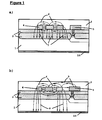
- Figure 1 depicts a conductive pattern comprising three metal fingers. In fig. 1 a) the capacitances of these fingers are indicated in the low-frequency limiting case, while in fig. 1 b) the capacitances of these fingers are indicated in the high-frequency limiting case.
- Figure 2 a depicts a schematic top view of a device comprising a conductive pattern, i.e. a spiral inductor, on a silicon wafer.
- Figure 2 b depicts a cross-section (from A to B as indicated in fig. 2 a))of a device comprising a conductive pattern, i.e. a spiral inductor, on a silicon wafer.
- a conductive pattern i.e. a spiral inductor
- Figure 2 c) depicts, according to an embodiment of the invention, the characteristic impedance of a typical spiral inductor versus frequency.
- (11) is a measured curve (the symbols) of said inductor, said inductor being formed on a substrate without a semi-transparent screening layer, while (12) is a simulated curve of said inductor.
- (13) is a simulated curve of an inductor being formed on a substrate with a semi-transparent screening layer.
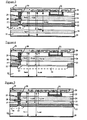
- Figure 3 depicts a cross-section of a device comprising a conductive pattern, i.e. a spiral inductor, on a silicon wafer.
- said device further comprises a highly doped p-type buried layer used as a semi-transparent screening layer.
- the same parameters as defined above in fig.2 are indicated in figure 3.
- Figure 4 depicts a cross-section of a device comprising a conductive pattern, i.e. a spiral inductor, on a silicon wafer.
- said device further comprises a highly doped p-type source/drain layer used as a semi-transparent screening layer.
- the same parameters as defined above in fig.2 are indicated in figure 4.
- Figure 5 depicts a cross-section of a device comprising a conductive pattern, i.e. a spiral inductor, on a silicon wafer.
- said device further comprises a highly doped p-type polysilicon layer used as a semi-transparent screening layer.
- a highly doped p-type polysilicon layer used as a semi-transparent screening layer.
- Figure 6 depicts a cross-section of a device comprising a conductive pattern, i.e. a spiral inductor, on a silicon wafer.
- said device further comprises a very thin (first) metal layer, having a thickness of 0.3 ⁇ m, used as a semi-transparent screening layer.
- first metal layer having a thickness of 0.3 ⁇ m, used as a semi-transparent screening layer.
- Figure 7 depicts a cross-section of a device comprising a conductive pattern, i.e. a spiral inductor based on a coil structure, on a silicon wafer.
- said device further comprises a highly doped p-type buried layer used as a semi-transparent screening layer.
- the same parameters as defined above in fig.2 are indicated in figure 7.
- these parameters can be the skin depth frequency of the conductive pattern, f s,con , the skin depth frequency of the substrate, f s,sub , the Maxwell-Wagner relaxation frequency, f MW , and the substrate relaxation frequency, f sr .
- the skin depth frequency of the conductive pattern, f s,con is determined by the thickness and resistivity of the conductive pattern, while f s,sub is determined by the thickness and resistivity of the substrate.
- the Maxwell-Wagner relaxation frequency, f MW depends amongst others on the resistivity and the thickness of the substrate and the thickness and permittivity of the insulating layer.
- the substrate relaxation frequency, f sr is determined by the permittivity and the resistivity of the substrate.
- the substrate can be at least a part of a partly processed or a pristine wafer or slice of a semi-conductive material, like Si, or GaAs, or Ge, or SiGe.
- Said substrate can comprise an epitaxial layer of a semiconductive material.
- Said substrate can comprise a patterned conductive layer. Particularly, in case said substrate is a partly processed wafer or slice; at least a part of the active and/or passive devices can already be formed and even at least a part of the structures interconnecting these devices can be formed.
- a problem can arise when the conductive patterns are formed on a lossy substrate like e.g. a semi-conductive wafer, i.e. a silicon wafer, with an insulating layer, e.g. an oxide layer, between said conductive pattern and said substrate.
- a conductive pattern (4) is depicted comprising three conductive fingers, wherein said pattern is isolated from the substrate (1) by two insulating layers (2) and said fingers are isolated one another by an intra-metal dielectric (3).
- Said substrate can be provided with a ground contact at its backside (10) and/or with a surface ground contact (5).
- said conductive pattern has a capacitance to the substrate (7) which is dependent on the main parameters of the insulating layer, i.e. its thickness and permittivity.
- the electrical wall i.e. the location where the potential is zero, at these low frequencies is located at about the interface between the substrate and the insulating layer (fig. 1 a)).
- the electrical wall is shifted (fig.
- the conductive pattern comprises parts which are located dose one to another also the capacitance between said parts (6) increases. If this transition region coincides with a predetermined frequency region the main parameters of the conductive pattern are strongly frequency dependent which leads to a significant increase in loss, distortions and cross-talk.
- a semi-transparent screening layer in or on said substrate the transition region can be shifted to higher frequencies, i.e. beyond a predetermined frequency region.
- the transition region no longer coincides with the predetermined frequency region which leads to a predictable frequency behaviour of the main parameters of the conductive pattern. Consequently, the capacitance to the substrate is frequency independent because the ground is located at the semi-screening layer instead of moving from the interface between the substrate and the insulating layer to the backside of the substrate. For the same reason, the parasitic capacitance as well as the capacitance between different parts of a conductive pattern are much smaller in the predetermined frequency region. Therefore cross-talk between the conductive pattern and the substrate as well as cross-talk between different parts of a conductive pattern or between different conductive patterns is significantly reduced.
- predetermined frequency region the frequency range between 1 GHz and 10 GHz, which is the typical range for the modern digital applications fabricated in CMOS technologies. Furthermore this range includes also most of the operating frequencies for modern analogue applications, particularly the telecommunication applications with operating frequencies in the range between about 1 GHz and about 4 GHz, fabricated in MOS, Bipolar or BiCMOS technologies.
- the choice of the resistivity of the substrate is crucial because one wants to assure a predictable frequency behaviour and minimize losses of the conductive patterns, e.g. interconnect lines or spiral inductors, processed on this substrate in a predetermined frequency region.
- the present invention is not limited to the frequency region between 1 GHz and 10 GHz as predetermined frequency region.
- Frequency ranges from 0.1 GHz to 100 GHz, or from 0.1 GHz to 10 GHz, or from 1GHz to 100 GHz can be used.
- a typical substrate and a typical conductor as used in MOS technology.
- a silicon wafer is chosen with a specific resistance of 20 ⁇ cm and a thickness of 700 um, while as a conductor an aluminum interconnect line is chosen with a thickness of 1 um.
- a silicon oxide layer of about 3 um is formed inbetween said conductor and said substrate.
- the specific resistance of aluminum is about 2.73 ⁇ 10 -6 ⁇ cm, yielding a skin depth frequency f s of about 6.9 GHz.
- the relevant parameters of the substrate are the skin depth frequency f s , which is about 1.03 THz, the substrate relaxation frequency f sr of about 7.56 GHz and the Maxwell-Wagner relaxation frequency of about 1 GHz. Consequently the transition region between the skin-effect mode and the lossy-substrate mode of the aluminum line coincides with a predetermined frequency region, which is highly undesirable because the predictions of the behaviour of interconnect lines and spiral inductors in a predetermined frequency region are very complicated and unreliable. Moreover the interconnect lines and spiral inductors in the predetermined frequency region will be rather lossy because in this region the capacitance between the interconnect line and the substrate decreases while the parasitic capacitance between the input and output ports increases. Furthermore there is an increase of the parasitic series resistance.
- the use of semi-transparent screening layers is suggested.
- these semi-screening layers can be introduced to suppress the cross-talk between different interconnect lines as well as between an interconnect line and the substrate as well as between different parts of a substrate as e.g. a substrate with analog and digital parts.
- these layers are introduced to shift the transition region between the skin-effect mode and the lossy-substrate mode of a conductive pattern outside a predetermined frequency region.
- the predetermined frequency region is the region ranging from 1 GHz to 10 GHz.
- the characteristic impedance and the propagation constant of a conductive pattern are frequency independent in a range from about 0.1 GHz to about 100 GHz, except potentially for the narrow frequency range in the vicinity of the self-resonance frequency, said self-resonance frequency being inversely proportional to the square root of the product of the total inductance and the total parasitic capacitance of said conductive pattern.
- the aforementioned semi-transparent screening layers are thin conductive layers located in the vicinity of the interface between the substrate and the insulating layer.
- the resistivity of said semi-transparent screening layer should be sufficiently low. Therefore highly doped layers can be formed in or on the substrate with a resistivity typically about 10 -3 ⁇ cm or below 10 -3 ⁇ cm. Examples of such layers are a highly doped surface layer as e.g. the source/drain layer in a MOS technology, a highly doped buried layer or a highly doped polysilicon layer. Also metal layers can be used as e.g. the first level metallisation layer in a MOS or bipolar technology.
- said semi-transparent screening layer should also be thin enough to guarantee transparency for the magnetic field in a predetermined frequency region. This is a prerequisite, because shifting the frequency transition region of an electromagnetic signal of a conductive pattern beyond the predetermined frequency region is insufficient to solve the problem of dispersion of frequency characteristics of said electromagnetic signal.
- a typical thickness should be in the range from 0.1 ⁇ m to 2 ⁇ m, while for metal layers as semi-transparent screening layers, a thickness typically about 0.3 ⁇ m or below is requested.
- a device for reducing the dispersion of frequency characteristics of a conductive pattern in a predetermined frequency region comprising:
- a square spiral inductor with three turns is considered and depicted in figure 2 a) and 2 b).
- This inductor is formed in the third metallization level (31).
- the second metallization level (32) is used at one side of said inductor.
- a substrate contact is provided at the bottom of the substrate (35) and at the surface of the substrate, i.e. a highly doped p-type region (33), i.e. the source/drain region, formed in a medium doped p-type well region (34) which is formed in a lowly doped p-type silicon substrate (21).
- Said surface contact comprises a contacting area in the third metallization level (31); a second level via (30), i.e. a via short-circuiting the third and second metallization level; a first level via (29), i.e. a via short-circuiting the second and first metallization level (28); and a selective contact metallization level (27) in order to contact said highly doped p-type region (33).
- Said inductor is isolated from said substrate by a number of insulating layers: a LOCOS layer (22) and four inter- or intra-metal dielectric layers, particularly 4 oxide layers: (23), (24), (25) and (26).
- the invention is not limited to this particular inductor but one can easily construct similar configurations e.g. by changing the metallization layer(s) wherein said inductor is formed, by changing the number and/or thickness and/or composition of the insulating layers, by changing the contact region, by using an arbitrary highly doped surface region, i.e. said highly doped surface region can either be an n-type or a p-type region dependent on the type of the substrate, or by changing the dimensions of the inductor.
- said highly doped surface region can either be an n-type or a p-type region dependent on the type of the substrate, or by changing the dimensions of the inductor.
- the frequency dependence of the characteristic impedance of such an inductor is presented for 3 cases.
- (11) is a measured curve of said inductor, said inductor being formed on a substrate without a semi-transparent screening layer (as e.g. in fig. 2 b)), while (12) is a simulated curve of said inductor.
- (12) is a simulated curve of an inductor being formed on a substrate with a semi-transparent screening layer (as e.g. in fig. 3).
- a conductive pattern i.e. a spiral inductor with three turns, is formed in the 3-th metallisation level (31) on a substrate, i.e. a lowly doped p-type silicon wafer (21), with oxide layers (22), (23), (24), (25) inbetween said wafer and said inductor.
- a substrate i.e. a lowly doped p-type silicon wafer (21), with oxide layers (22), (23), (24), (25) inbetween said wafer and said inductor.
- a highly doped p-type layer (36) i.e. with dopant concentrations typically between about 3X10 19 cm -3 and 3X10 20 cm -3 , is formed in said substrate near the interface of said substrate and said oxide, i.e. typically at a distance from about 1 ⁇ m to 5 ⁇ m from said interface.
- a highly doped n-type layer can be formed.
- Said semi-screening layer has a thickness of about 0.3 ⁇ m to 2 ⁇ m and is contacted using a surface substrate contact in order to supply a substantially zero potential.
- the invention described in this and the following examples is not limited to a particular inductor but one can easily construct similar configurations e.g. by changing the metallization layer(s) wherein said inductor is formed, by changing the number and/or thickness and/or composition of the insulating layers, by changing the contact region by using an arbitrary highly doped surface region, i.e. said highly doped surface region can either be a n-type or a p-type region dependent on the type of the substrate, by changing the dimensions of the inductor.
- a conductive pattern i.e. a spiral inductor with three turns, is formed in the 3-th metallisation level (31) on a substrate, i.e. a lowly doped p-type silicon wafer (21), with oxide layers (22), (23), (24), (25) inbetween said wafer and said inductor.
- a substrate i.e. a lowly doped p-type silicon wafer (21), with oxide layers (22), (23), (24), (25) inbetween said wafer and said inductor.
- a highly doped p-type surface layer (33) i.e. a source/drain layer with dopant concentrations typically between about 3X10 19 cm -3 and 3X10 20 cm -3 , is formed in said substrate at the interface of said substrate and said oxide.
- a highly doped n-type layer can be formed.
- Said semi-screening layer has a thickness of about 0.2 ⁇ m to 2 ⁇ m and is contacted using a frontside surface substrate contact in order to supply a substantially zero potential.
- the emitter or base layer can be used as a semi-screening layer provided that a substantially zero potential is applied to this layer.
- a device comprising a semi-transparent screening layer located on the substrate near or at the interface of said substrate and said insulating layer and an electrical contact to said semi-screening layer for applying a substantially zero potential.
- Said semi-screening layers can be any highly conductive thin layer formed on the substrate with a resistivity typically below 10 -3 ⁇ cm like e.g. a thin metal layer or a highly doped polysilicon layer.
- the thickness of said semi-screening layer should be chosen such that its skin depth frequency is beyond a predetermined frequency region in order to guarantee transparency for the magnetic field, therefore in case a metal layer is used as a semi-screening layer, said thickness is typically in the range of 0.3 ⁇ m or below.
- a conductive pattern i.e. a spiral inductor with three turns, is formed in the 3-th metallisation level (31) on a substrate, i.e. a lowly doped p-type silicon wafer (21), with oxide layers (22), (23), (24), (25) inbetween said wafer and said inductor.
- a semi-transparent screening layer a highly doped p-type polysilicon layer (51), i.e. with dopant concentrations typically between about 3X10 19 cm -3 and 3X10 20 cm -3 , is formed on said substrate near the interface of said substrate and said oxide, i.e. said polysilicon layer is formed on a LOCOS layer (22).
- Said semi-screening layer has a thickness of about 0.3 ⁇ m to 1 ⁇ m and is contacted using a surface contact in order to supply a substantially zero potential. It is obvious to a person skilled in the art that the invention described in this and the following examples is not limited to a particular inductor but one can easily construct similar configurations e.g. by changing the metallization layer(s) wherein said inductor is formed, by changing the number and/or thickness and/or composition of the insulating layers between said inductor an said semi-transparent screening layer, by changing the dimensions of the inductor.
- a conductive pattern i.e. a spiral inductor with three turns, is formed in the 3-th metallisation level (31) on a substrate, i.e. a lowly doped p-type silicon wafer (21), with oxide layers (22), (23), (24), (25) inbetween said wafer and said inductor.
- a semi-transparent screening layer a thin metal layer (28), i.e. the first metallization layer composed of Aluminum, is formed on said substrate near the interface of said substrate and said oxide, i.e. said metal layer is formed on the intra-metal dielectric (23).
- Said semi-screening layer has a thickness of about 0.3 ⁇ m and is contacted using a surface contact in order to supply a substantially zero potential.
- a method for shifting the frequency transition region of a conductive pattern beyond a predetermined frequency region, said conductive pattern being formed on a lossy substrate with at least one insulating layer inbetween said conductive pattern and said substrate, wherein said shift of said transition region is accomplished by the introduction of a semi-transparent screening layer, said semi-screening layer being located near or at the interface of said substrate and said insulating layer, and wherein a substantially zero potential is applied to said semi-screening layer.
- Said conductive pattern is formed on a substrate with at least one insulating layer inbetween said conductive pattern and said substrate.
- Said substrate can be a semiconductive wafer or slice, e.g. a doped silicon wafer with or without a doped epitaxial layer.
- Said substrate has a specific resistivity which can be between 10 m ⁇ cm and 1 k ⁇ cm, but preferably between 10 ⁇ cm and 100 ⁇ cm.
- Said insulating layer can be at least one oxide layer or a nitride layer or a layer of a low permittivity dielectric like e.g. a BCB layer or a SILK layer or a combination of these layers.
- Said conductive pattern can be composed of a metal like e.g. Al or Cu or Au or an alloy of one of the aforementioned metals.
- Said conductive pattern can also comprise a highly conductive layer, e.g. a metal layer, and a barrier layer, e.g. TiN.
- Said conductive pattern is defined using at least one metallisation level, like e.g. the fourth and the fifth metallisation level in a CMOS or a BICMOS process.
- Said substrate can be provided with or without a ground contact to the substrate. This ground contact can be located at the backside and/or at the topside of the substrate.
- Said shift of the transition region is accomplished by the introduction of a semi-transparent screening layer, i.e. a layer which forms an electrical wall and therefore a semi-screening layer for the electric field.
- the thickness of said semi-screening layer is such that this layer is transparent for the magnetic field in a predetermined frequency region.
- Said semi-screening layer is located in the substrate near or at the interface of said substrate and said insulating layer and an electrical contact is provided to said semi-screening layer for applying a substantially zero potential.
- Said semi-screening layer can be any highly doped layer formed in the substrate with a resistivity typically about 10 -3 ⁇ cm or below 10 -3 ⁇ cm.
- the thickness of said semi-screening layer should be chosen such that its skin depth frequency is beyond a predetermined frequency region in order to guarantee transparency for the magnetic field, therefore said thickness is typically in the range from 0.1 ⁇ m to 2 ⁇ m.
- Said highly doped layer can be a highly doped buried layer or a highly doped surface layer like e.g. a source/drain layer in a CMOS process.
- said semi-screening layer can be located on the substrate near or at the interface of said substrate and said insulating layer and an electrical contact is provided to said semi-screening layer for applying a substantially zero potential.
- Said semi-screening layer can be any highly conductive layer formed on said substrate with a resistivity typically below 10 -3 ⁇ cm.
- the thickness of said semi-screening layer should be chosen such that its skin depth frequency is beyond a predetermined frequency region in order to guarantee transparency for the magnetic field.
- said highly conductive layer is a highly doped polysilicon layer
- its thickness is typically in the range from 0.1 ⁇ m to 1 ⁇ m
- its thickness is typically in the range below 0.3 ⁇ m.
Landscapes
- Parts Printed On Printed Circuit Boards (AREA)
- Semiconductor Integrated Circuits (AREA)
Priority Applications (1)
| Application Number | Priority Date | Filing Date | Title |
|---|---|---|---|
| EP99870037A EP0940848A3 (de) | 1998-03-05 | 1999-02-26 | Verlustarme Leiterbahn und Verfahren zu ihrer Herstellung |
Applications Claiming Priority (3)
| Application Number | Priority Date | Filing Date | Title |
|---|---|---|---|
| EP98870046A EP0940849A1 (de) | 1998-03-05 | 1998-03-05 | Verlustarmes elektrisch-leitendes Muster auf einem Substrat und dessen Herstellungsverfahren |
| EP98870046 | 1998-03-05 | ||
| EP99870037A EP0940848A3 (de) | 1998-03-05 | 1999-02-26 | Verlustarme Leiterbahn und Verfahren zu ihrer Herstellung |
Publications (2)
| Publication Number | Publication Date |
|---|---|
| EP0940848A2 true EP0940848A2 (de) | 1999-09-08 |
| EP0940848A3 EP0940848A3 (de) | 2000-03-22 |
Family
ID=26152230
Family Applications (1)
| Application Number | Title | Priority Date | Filing Date |
|---|---|---|---|
| EP99870037A Withdrawn EP0940848A3 (de) | 1998-03-05 | 1999-02-26 | Verlustarme Leiterbahn und Verfahren zu ihrer Herstellung |
Country Status (1)
| Country | Link |
|---|---|
| EP (1) | EP0940848A3 (de) |
Cited By (1)
| Publication number | Priority date | Publication date | Assignee | Title |
|---|---|---|---|---|
| EP4421866A1 (de) * | 2023-02-24 | 2024-08-28 | Infineon Technologies AG | Radiofrequenzhalbleiterbauelement und verfahren zur herstellung eines radiofrequenzhalbleiterbauelements |
Family Cites Families (5)
| Publication number | Priority date | Publication date | Assignee | Title |
|---|---|---|---|---|
| DE3632943A1 (de) * | 1986-09-27 | 1988-03-31 | Bosch Gmbh Robert | Hochfrequenz-leistungs-transistor in bipolar-epitaxial-technik |
| JP2924450B2 (ja) * | 1992-05-22 | 1999-07-26 | 日本電気株式会社 | 半導体装置 |
| WO1995005007A1 (en) * | 1993-08-10 | 1995-02-16 | Loral Vought Systems Corporation | Photoconductive impedance-matched infrared detector with heterojunction blocking contacts |
| JPH08204133A (ja) * | 1995-01-27 | 1996-08-09 | Hitachi Ltd | 高周波集積回路 |
| US5528209A (en) * | 1995-04-27 | 1996-06-18 | Hughes Aircraft Company | Monolithic microwave integrated circuit and method |
-
1999
- 1999-02-26 EP EP99870037A patent/EP0940848A3/de not_active Withdrawn
Cited By (1)
| Publication number | Priority date | Publication date | Assignee | Title |
|---|---|---|---|---|
| EP4421866A1 (de) * | 2023-02-24 | 2024-08-28 | Infineon Technologies AG | Radiofrequenzhalbleiterbauelement und verfahren zur herstellung eines radiofrequenzhalbleiterbauelements |
Also Published As
| Publication number | Publication date |
|---|---|
| EP0940848A3 (de) | 2000-03-22 |
Similar Documents
| Publication | Publication Date | Title |
|---|---|---|
| US8049301B2 (en) | Semiconductor transformers | |
| Niknejad et al. | Design, simulation and applications of inductors and transformers for Si RF ICs | |
| JP3941127B2 (ja) | マイクロ波集積回路受動素子構造および信号伝搬損失を低減する方法 | |
| Burghartz | Progress in RF inductors on silicon-understanding substrate losses | |
| US6950590B2 (en) | Transmission lines and components with wavelength reduction and shielding | |
| US8101494B2 (en) | Structure, design structure and method of manufacturing a structure having VIAS and high density capacitors | |
| US8866226B2 (en) | SOI radio frequency switch with enhanced electrical isolation | |
| KR100939648B1 (ko) | 반도체 기판에 형성되는 다층 인덕터 | |
| CN101764104B (zh) | 半导体结构及其制造或操作方法 | |
| KR20130020553A (ko) | 수직 배향된 반도체 소자 및 그 차폐 구조물 | |
| US20040233010A1 (en) | Atomic layer deposition (ALD) high permeability layered magnetic films to reduce noise in high speed interconnection | |
| Rack et al. | Low-loss Si-substrates enhanced using buried PN junctions for RF applications | |
| US8951812B2 (en) | Vertically oriented semiconductor device and shielding structure thereof | |
| KR100829067B1 (ko) | 혼합 신호 집적회로용의 저누화 기판 | |
| KR100929125B1 (ko) | 반도체 기판에 형성되는 박막 다층 하이 q 변압기 | |
| US6635550B2 (en) | Semiconductor on insulator device architecture and method of construction | |
| US8164397B2 (en) | Method, structure, and design structure for an impedance-optimized microstrip transmission line for multi-band and ultra-wide band applications | |
| Rack et al. | Silicon-substrate enhancement technique enabling high quality integrated RF passives | |
| CN109545776B (zh) | 集成电路中的屏蔽 | |
| Burghartz | Spiral inductors on silicon—status and trends (invited article) | |
| EP0940849A1 (de) | Verlustarmes elektrisch-leitendes Muster auf einem Substrat und dessen Herstellungsverfahren | |
| EP0940848A2 (de) | Verlustarme Leiterbahn und Verfahren zu ihrer Herstellung | |
| US8004061B1 (en) | Conductive trace with reduced RF impedance resulting from the skin effect | |
| CN1951004A (zh) | 电子装置 | |
| CN101814645A (zh) | 耦合微条线结构及其制造方法 |
Legal Events
| Date | Code | Title | Description |
|---|---|---|---|
| PUAI | Public reference made under article 153(3) epc to a published international application that has entered the european phase |
Free format text: ORIGINAL CODE: 0009012 |
|
| AK | Designated contracting states |
Kind code of ref document: A2 Designated state(s): BE DE ES FI FR GB IE IT NL |
|
| AX | Request for extension of the european patent |
Free format text: AL;LT;LV;MK;RO;SI |
|
| PUAL | Search report despatched |
Free format text: ORIGINAL CODE: 0009013 |
|
| AK | Designated contracting states |
Kind code of ref document: A3 Designated state(s): AT BE CH CY DE DK ES FI FR GB GR IE IT LI LU MC NL PT SE |
|
| AX | Request for extension of the european patent |
Free format text: AL;LT;LV;MK;RO;SI |
|
| 17P | Request for examination filed |
Effective date: 20000901 |
|
| AKX | Designation fees paid |
Free format text: BE DE ES FI FR GB IE IT NL |
|
| 17Q | First examination report despatched |
Effective date: 20011204 |
|
| STAA | Information on the status of an ep patent application or granted ep patent |
Free format text: STATUS: THE APPLICATION IS DEEMED TO BE WITHDRAWN |
|
| 18D | Application deemed to be withdrawn |
Effective date: 20020416 |