EP0940933A2 - A method and apparatus for controlling the power radiated by a wireless terminal in a telecommunications system - Google Patents
A method and apparatus for controlling the power radiated by a wireless terminal in a telecommunications system Download PDFInfo
- Publication number
- EP0940933A2 EP0940933A2 EP99301552A EP99301552A EP0940933A2 EP 0940933 A2 EP0940933 A2 EP 0940933A2 EP 99301552 A EP99301552 A EP 99301552A EP 99301552 A EP99301552 A EP 99301552A EP 0940933 A2 EP0940933 A2 EP 0940933A2
- Authority
- EP
- European Patent Office
- Prior art keywords
- power control
- signal
- step size
- threshold
- control signals
- Prior art date
- Legal status (The legal status is an assumption and is not a legal conclusion. Google has not performed a legal analysis and makes no representation as to the accuracy of the status listed.)
- Granted
Links
Images


Classifications
-
- H—ELECTRICITY
- H04—ELECTRIC COMMUNICATION TECHNIQUE
- H04B—TRANSMISSION
- H04B1/00—Details of transmission systems, not covered by a single one of groups H04B3/00 - H04B13/00; Details of transmission systems not characterised by the medium used for transmission
- H04B1/38—Transceivers, i.e. devices in which transmitter and receiver form a structural unit and in which at least one part is used for functions of transmitting and receiving
- H04B1/40—Circuits
- H04B1/54—Circuits using the same frequency for two directions of communication
- H04B1/58—Hybrid arrangements, i.e. arrangements for transition from single-path two-direction transmission to single-direction transmission on each of two paths or vice versa
-
- H—ELECTRICITY
- H04—ELECTRIC COMMUNICATION TECHNIQUE
- H04W—WIRELESS COMMUNICATION NETWORKS
- H04W52/00—Power management, e.g. Transmission Power Control [TPC] or power classes
- H04W52/04—Transmission power control [TPC]
- H04W52/18—TPC being performed according to specific parameters
- H04W52/22—TPC being performed according to specific parameters taking into account previous information or commands
- H04W52/221—TPC being performed according to specific parameters taking into account previous information or commands using past power control commands
-
- H—ELECTRICITY
- H04—ELECTRIC COMMUNICATION TECHNIQUE
- H04W—WIRELESS COMMUNICATION NETWORKS
- H04W52/00—Power management, e.g. Transmission Power Control [TPC] or power classes
- H04W52/04—Transmission power control [TPC]
- H04W52/18—TPC being performed according to specific parameters
- H04W52/24—TPC being performed according to specific parameters using SIR [Signal to Interference Ratio] or other wireless path parameters
- H04W52/241—TPC being performed according to specific parameters using SIR [Signal to Interference Ratio] or other wireless path parameters taking into account channel quality metrics, e.g. SIR, SNR, CIR or Eb/lo
-
- H—ELECTRICITY
- H04—ELECTRIC COMMUNICATION TECHNIQUE
- H04W—WIRELESS COMMUNICATION NETWORKS
- H04W52/00—Power management, e.g. Transmission Power Control [TPC] or power classes
- H04W52/04—Transmission power control [TPC]
- H04W52/30—Transmission power control [TPC] using constraints in the total amount of available transmission power
- H04W52/36—Transmission power control [TPC] using constraints in the total amount of available transmission power with a discrete range or set of values, e.g. step size, ramping or offsets
- H04W52/362—Aspects of the step size
Definitions
- the present invention relates to telecommunications in general, and, more particularly, to a technique for controlling the power of a signal that is transmitted by a wireless terminal in a wireless telecommunications system.
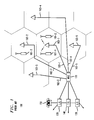
- wireless terminal 101-1 transmits a signal to base station 103-1
- two factors dominate the determination of how much power wireless terminal 101-l uses to transmit the signal.
- the first factor pertains to the quality of the received signal and the second factor pertains to the amount of interference caused by the transmission of the signal.
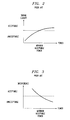
- FIG. 2 depicts a graph that illustrates the relationship between the received signal quality of a signal as a function of the amount of power used to transmit the signal.
- the signal quality can be measured in accordance with a variety of well-known criteria (e.g., signal-to-noise ratio, signal-to-interference ratio, frame error rate, bit error rate, etc.).
- the amount of power used to transmit a signal can be measured in accordance with a variety of well-known criteria (e.g., absolute power as measured in dBm, average power as measured in dBm, etc. ).
- the operation of the first technique is described in detail in the flowchart of FIG. 4.
- the first technique begins at step 401 at which base station 103-1 establishes a minimum acceptable level of signal quality for the signals received from wireless terminal 101-1. This minimum is called the SIR Target.
- base station 103-1 receives a signal, S i-l , from wireless terminal 101-1 and compares the quality of the signal against the SIR Target. If at step 403 the measured signal quality is below the SIR Target, control passes to step 404 and a power control signal b i is set to +1, which will direct wireless terminal 101-1 to transmit its next signal at an increased power level equal to the old power level, P i-l , plus a step size, Q . Alternatively, control passes to step 405 and the power control signal b i is set to -l, which will direct wireless terminal 101-l to transmit its next signal at a decreased power level equal to the old power level, P i-l , minus the step size, Q .
- the disadvantage of the second technique is that base station 103-l only transmits one bit per power control signal, and, therefore, there is no mechanism for quickly and efficiently directly when wireless terminal 101-1 should use a given step size.
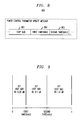
- the proposed solution to this deficiency is to enable base station 103-1 to send a special message, called a power control parameter update message ("PCPUM"), to wireless terminal 101-1 periodically or sporadically to set the step size that wireless terminal 101-1 uses at any given time.
- PCPUM power control parameter update message
- One embodiment of the present invention comprises: transmitting a first signal at a first power level; receiving a series of n power control signals, b i-n+l through b i ; setting a step size based on a measure of dispersion of the n power control signals; and transmitting a second signal at a second power level that is based on the first power level and the step size.
- FIG. 5 depicts a schematic diagram of a base station and a wireless terminal in accordance with the illustrative embodiment of the present invention.
- FIG. 7 depicts a flowchart of the operation of the illustrative embodiment.
- FIG. 9 depicts a graph of the criterion and relevant thresholds for determining the step size in accordance with the illustrative embodiment.
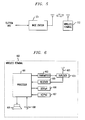
- FIG. 5 depicts a block diagram of the illustrative embodiment of the present invention, which comprises base station 501 and wireless terminal 502.
- Base station 501 is capable of receiving signals from wireless terminal 502 and fonvarding them to a wireless switching center (not shown), in well-known fashion.
- base station 501 is capable of receiving signals from the wireless switching center and transmitting them to wireless terminal 502, also in well-known fashion.
- base station 501 participates in a process for controlling the amount of power that wireless terminal 502 uses to transmit its signals. The functionality performed by base station 501 with regard to this process is discussed below.
- Processor 601 is advantageously a general-purpose digital processor with associated RAM, ROM, and I/O that is programmed to function as a wireless terminal and to perform the steps depicted in FIG. 7.
- Transmitter 602 is advantageously capable of transmitting a signal, S i , at a power level, Pi, via duplexer 604 and antenna 603 and under the direction of processor 601. It will be clear to those skilled in the art how to make and use transmitter 602.
- Receiver 605 is capable of receiving, in well-known fashion, a power control signal, b i, in response to a signal, S i-l , that was previously transmitted by transmitter 602 at a power level, P i-l .
- a power control signal b i
- S i-n through S i-l transmitted by transmitter 602
- receiver 605 is therefore capable of receiving a series of n power control signals, b i-n+l through b i .
- each of the n power control signals represents either +l or -l, which represents a command to increase or decrease, respectively, the transmit power level.
- base station 501 advantageously analyzes the last k power control signals, b i-k+l through b k , using conventional statistical techniques to estimate if the value of one or more of the three parameters that wireless terminal 502 uses in determining P i is hindering the efficacy of wireless terminal 502 to track the SIR Target.
- the nature of the three parameters and their effect on the efficacy of wireless terminal 502 to track the SIR Target will be discussed below.
- Step Size - Q 1.0 dB, 0.5 dB, and 0.25 dB
- wireless terminal 502 receives the power control signal b i transmitted at step 707.
- wireless terminal 502 analyzes the last n received power control signals, b i-n+l through b i , in order to determine the step size by which the last power level P i-l should be adjusted to create the power level Pi for the next signal to be transmitted, S i .
- the analysis is based on a statistical measure of the dispersion, D, of the last n received power control signals, b i-n+l through b i .
- the measure could be based on the standard deviation, the dispersion or on the absolute value of the sum of the last n received power control signals, b i-n+l through b i , as shown in Equation 1.
- the range of values that D can take is from 0 to n . It will be clear to those skilled in the art that the range of values that D can assume is based on the particular measure of dispersion used and the meaning ascribed to the power control signals b i-n+l through b i .
- Equation 1 provides large values of D in this case.
- wireless terminal 502 when the ability of wireless terminal 502 to radiate at the SIR Target is not taxed, then one of the smaller step sizes should be used by wireless terminal 502 to prevent unnecessarily wild fluctuations in the radiated power. In such case, the tendency will be for the last n received power control signals to be more evenly divided between +1 and -1, which results in small values of D.
- the value of D is compared against the two parameters from above: (1) the first threshold, T 1 , and (2) the second threshold, T 2 .
- processor 601 sets the step size to a first value (e.g., 0.25 dB).
- processor 601 sets the step size to a second value (e.g., 0.5 dB), and when D is greater than or equal to the second threshold, processor 601 sets the step size to a third value (e.g., 1.0 dB).
- a first value e.g. 0.25 dB
- processor 601 sets the step size to a second value (e.g., 0.5 dB)
- processor 601 sets the step size to a third value (e.g., 1.0 dB).
- wireless terminal 502 adjusts to using the step size that is most appropriate for the circumstances.
- T 1 Q s Q l n
- Q s the smallest step size
- Q l the largest step size
- n the number of power control signals over which D is computed.
- T 2 Q m Q l n
- Q m is the intermediate step size
- Q l is the largest step size
- n is the number of power control signals over which D is computed.
- wireless terminal 502 determines the power level, P i , at which signal, S i , is to be transmitted.
- the power level, P i is based on the previous power level, P i-l , the power control signal, b i , received at step 710, and the step size determined at step 711.
- P i P i -l + Q * b i where the power levels are in the logarithmic domain.
- control passes to step 713, at which the signal, S i , is transmitted at the power level P i , and the process repeats.
Landscapes
- Engineering & Computer Science (AREA)
- Computer Networks & Wireless Communication (AREA)
- Signal Processing (AREA)
- Quality & Reliability (AREA)
- Mobile Radio Communication Systems (AREA)
- Transmitters (AREA)
- Detection And Prevention Of Errors In Transmission (AREA)
Abstract
Description
| Parameter | Permissible Values |
| Step Size - Q | 1.0 dB, 0.5 dB, and 0.25 dB |
| First Threshold - | 0 ≤ T1 ≤ T2≤ n |
| Second Threshold - | 0 ≤ T1 ≤ T2 ≤ n |

Claims (13)
- A method comprising:transmitting a first signal at a first power level;receiving a series of n power control signals, bi-n+l through bi,setting a step size based on a measure of dispersion of said n power control signals; andtransmitting a second signal at a second power level that is based on said first power level and said step size.
- A wireless terminal comprising:a receiver for receiving a series of n power control signals, bi-n+l through bi;a transmitter for transmitting a first signal at a first power level and a second signal at a second power level that is based on said first power level and a step size;a processor for receiving said n power control signals from said receiver, and for setting said step size based on a measure of dispersion of said n power control signals.
- A method comprising:transmitting a first signal at a first power level;receiving a series of n power control signals, bi-n+l through bi;setting a step size to a first value when a measure of dispersion of said n power control signals is less than a first threshold;setting said step size to a second value when said measure of dispersion of said n power control signals is greater than said first threshold; andtransmitting a second signal at a second power level that is based on said first power level and said step size.
- A wireless terminal comprising:a receiver for receiving a series of n power control signals, bi-n+l through bi;a transmitter for transmitting a first signal at a first power level and a second signal at a second power level that is based on said first power level and a step size;a processor for receiving said n power control signals from said receiver, for setting said step size to a first value when a measure of dispersion of said n power control signals is less than a first threshold, and for setting said step size to a second value when said measure of dispersion of said n power control signals is greater than said first threshold.
- A method comprising:transmitting a first signal at a first power level;receiving a series of n power control signals, bi-n+l through bi;setting a step size to a first value when a measure of dispersion of said n power control signals is less than a first threshold;setting said step size to said second value when said measure of dispersion of said n power control signals is greater than said first threshold and less than a second threshold; andsetting said step size to a third value when said measure of dispersion of said n power control signals is greater than said second threshold; andtransmitting a second signal at a second power level that is based on said first power level and said step size.
- A wireless terminal comprising:a receiver for receiving a series of n power control signals, bi-n+l through bi;a transmitter for transmitting a first signal at a first power level and a second signal at a second power level that is based on said first power level and a step size;a processor for receiving said n power control signals from said receiver, for setting said step size to a first value when a measure of dispersion of said n power control signals is less than a first threshold; setting said step size to said second value when said measure of dispersion of said n power control signals is greater than said first threshold and less than a second threshold; and setting said step size to a third value when said measure of dispersion of said n power control signals is greater than said second threshold.
- The method of claim 1 or 3, or 5, or the terminal of claim 2, 4 or 6, wherein said second power level is also based on said power control signal bi .
- The method of claim 3, or 4, or the terminal of claim 4, wherein said second power level equals said first power level plus said step size times said power control signal bi.
- The method of claim 3 or 5, further comprising the step of receiving a power control parameter update message that sets said first threshold or the first and second thresholds or the terminal of claim 4 or 6, wherein the processor is capable of receiving a power control parameter update message that set the first threshold or the first and second threshold.
- The method of claim 3 or 5 further comprising the steps of:setting said step size to said second value when said measure of dispersion of said n power control signals is greater than said first threshold and less than a second threshold; andsetting said step size to a third value when said measure of dispersion of said n power control signals is greater than said second threshold, or the terminal of claim 4 or 6, wherein said processor sets said step size to said second value when said measure of dispersion of said n power control signals is greater than said first threshold and less than a second threshold, and sets said step size to a third value when said measure of dispersion of said n power control signals is greater than said second threshold.
- The method of claim 10 further comprising the step of receiving a power control parameter update message that sets said first threshold and said second threshold, and sets said step size to one of said first value, said second value, and said third value, or the terminal of claim 4 wherein said processor is capable of receiving a power control parameter update message that sets said first threshold and said second threshold, and sets said step size to one of said first value, said second value, and said third value.
- The method or terminal of claim 10, wherein said first threshold equals n/4 and said second threshold equals n/2.
- The method of claim 5, or the terminal of claim 6. wherein said first value is 1.0 dB, said second value is 0.5 dB, said third value is 0.25 dB, and said second power level equals said first power level plus said step size times said power control signal bi .
Applications Claiming Priority (2)
| Application Number | Priority Date | Filing Date | Title |
|---|---|---|---|
| US36153 | 1998-03-06 | ||
| US09/036,153 US6212399B1 (en) | 1998-03-06 | 1998-03-06 | Method and apparatus for controlling the power radiated by a wireless terminal in a telecommunications system based on a variable step size |
Publications (3)
| Publication Number | Publication Date |
|---|---|
| EP0940933A2 true EP0940933A2 (en) | 1999-09-08 |
| EP0940933A3 EP0940933A3 (en) | 2002-08-07 |
| EP0940933B1 EP0940933B1 (en) | 2004-09-15 |
Family
ID=21886960
Family Applications (1)
| Application Number | Title | Priority Date | Filing Date |
|---|---|---|---|
| EP99301552A Expired - Lifetime EP0940933B1 (en) | 1998-03-06 | 1999-03-02 | A method and apparatus for controlling the power radiated by a wireless terminal in a telecommunications system |
Country Status (5)
| Country | Link |
|---|---|
| US (1) | US6212399B1 (en) |
| EP (1) | EP0940933B1 (en) |
| JP (1) | JPH11340911A (en) |
| KR (1) | KR100326695B1 (en) |
| DE (1) | DE69920079T2 (en) |
Cited By (4)
| Publication number | Priority date | Publication date | Assignee | Title |
|---|---|---|---|---|
| WO2001052440A3 (en) * | 2000-01-14 | 2002-06-06 | Siemens Ag | Power control in mobile radio telephone systems when transmission is interrupted |
| EP1209824A4 (en) * | 2000-07-03 | 2004-06-23 | Matsushita Electric Industrial Co Ltd | BASE STATION UNIT AND RADIO COMMUNICATION METHOD |
| EP1548955A1 (en) * | 2003-12-22 | 2005-06-29 | Evolium S.A.S. | A method for improving the performances of a mobile radiocommunication system using a power control algorithm |
| EP3780773A4 (en) * | 2018-04-12 | 2021-09-01 | Vivo Mobile Communication Co., Ltd. | POWER CONTROL PROCESS FOR SIDE LINK AND TERMINAL DEVICE |
Families Citing this family (28)
| Publication number | Priority date | Publication date | Assignee | Title |
|---|---|---|---|---|
| GB0107746D0 (en) * | 2001-03-28 | 2001-05-16 | Nokia Networks Oy | Transmissions in a communication system |
| US7020111B2 (en) | 1996-06-27 | 2006-03-28 | Interdigital Technology Corporation | System for using rapid acquisition spreading codes for spread-spectrum communications |
| US7929498B2 (en) | 1995-06-30 | 2011-04-19 | Interdigital Technology Corporation | Adaptive forward power control and adaptive reverse power control for spread-spectrum communications |
| US7123600B2 (en) | 1995-06-30 | 2006-10-17 | Interdigital Technology Corporation | Initial power control for spread-spectrum communications |
| US6885652B1 (en) | 1995-06-30 | 2005-04-26 | Interdigital Technology Corporation | Code division multiple access (CDMA) communication system |
| ZA965340B (en) | 1995-06-30 | 1997-01-27 | Interdigital Tech Corp | Code division multiple access (cdma) communication system |
| JP3587346B2 (en) * | 1998-08-07 | 2004-11-10 | 松下電器産業株式会社 | Wireless communication device and transmission power control method in wireless communication device |
| CN1135733C (en) * | 1999-01-16 | 2004-01-21 | 皇家菲利浦电子有限公司 | wireless communication system |
| EP1079542B1 (en) * | 1999-03-29 | 2005-10-05 | Alcatel | Transmit power control in a mobile communication system |
| US6490461B1 (en) * | 1999-06-24 | 2002-12-03 | Telefonaktiebolaget Lm Ericsson (Publ) | Power control based on combined quality estimates |
| US6877166B1 (en) * | 2000-01-18 | 2005-04-05 | Cisco Technology, Inc. | Intelligent power level adjustment for cable modems in presence of noise |
| US7032238B2 (en) * | 2000-07-19 | 2006-04-18 | Sedna Patent Services, Llc | Real-time autoleveling system |
| ATE276633T1 (en) * | 2000-11-28 | 2004-10-15 | Interdigital Tech Corp | CONTENT ACCESS CONTROL SYSTEM AND METHOD |
| JP3769468B2 (en) * | 2001-03-21 | 2006-04-26 | 株式会社エヌ・ティ・ティ・ドコモ | Communication quality control method, communication quality control system, packet analysis device, and data transmission terminal device |
| US7027420B2 (en) * | 2001-07-24 | 2006-04-11 | Nokia Mobile Phones Ltd. | Method for determining whether to perform link adaptation in WCDMA communications |
| US7046966B2 (en) * | 2001-08-24 | 2006-05-16 | Kyocera Wireless Corp. | Method and apparatus for assigning data rate in a multichannel communication system |
| US6845088B2 (en) * | 2001-10-19 | 2005-01-18 | Interdigital Technology Corporation | System and method for fast dynamic link adaptation |
| US6760598B1 (en) | 2002-05-01 | 2004-07-06 | Nokia Corporation | Method, device and system for power control step size selection based on received signal quality |
| US7339994B2 (en) * | 2002-11-25 | 2008-03-04 | Texas Instruments Incorporated | Method and apparatus for fast convergent power control in a spread spectrum communication system |
| US20040203462A1 (en) * | 2002-11-25 | 2004-10-14 | Wei Lin | Method and apparatus for setting the threshold of a power control target in a spread spectrum communication system |
| US7330504B2 (en) * | 2002-11-25 | 2008-02-12 | Texas Instruments Incorporated | Method and apparatus for low power-rise power control using sliding-window-weighted QoS measurements |
| US6882857B2 (en) * | 2002-11-26 | 2005-04-19 | Qualcomm, Incorporated | Method and apparatus for efficient processing of data for transmission in a communication system |
| US7174184B2 (en) * | 2002-12-20 | 2007-02-06 | Nokia Corporation | Method and apparatus for controlling communication between user equipment and a base station in a radio access network |
| US20050136960A1 (en) * | 2003-12-17 | 2005-06-23 | Telefonaktiebolaget Lm Ericsson (Publ) | Power control method |
| JP2008271180A (en) * | 2007-04-20 | 2008-11-06 | Matsushita Electric Ind Co Ltd | Wireless communication device |
| US20140226499A1 (en) * | 2013-02-10 | 2014-08-14 | Qualcomm Incorporated | Transmit power control systems, devices, and methods |
| US9332509B2 (en) * | 2013-02-10 | 2016-05-03 | Qualcomm Incorporated | Transmit power control systems, devices, and methods |
| KR102377878B1 (en) * | 2017-06-15 | 2022-03-24 | 후지쯔 가부시끼가이샤 | Base station apparatus, terminal apparatus, wireless communication system and communication method |
Family Cites Families (15)
| Publication number | Priority date | Publication date | Assignee | Title |
|---|---|---|---|---|
| US4613990A (en) * | 1984-06-25 | 1986-09-23 | At&T Bell Laboratories | Radiotelephone transmission power control |
| US5056109A (en) * | 1989-11-07 | 1991-10-08 | Qualcomm, Inc. | Method and apparatus for controlling transmission power in a cdma cellular mobile telephone system |
| US5129098A (en) * | 1990-09-24 | 1992-07-07 | Novatel Communication Ltd. | Radio telephone using received signal strength in controlling transmission power |
| FI94579C (en) * | 1994-01-12 | 1995-09-25 | Nokia Mobile Phones Ltd | Data Transfer method |
| JP2980156B2 (en) * | 1994-05-12 | 1999-11-22 | エヌ・ティ・ティ移動通信網株式会社 | Transmission power control method and spread spectrum communication apparatus using the control method |
| JP2974274B2 (en) * | 1994-05-12 | 1999-11-10 | エヌ・ティ・ティ移動通信網株式会社 | Transmission power control method and transmission power control device |
| JPH0865205A (en) * | 1994-08-24 | 1996-03-08 | Matsushita Electric Ind Co Ltd | CDMA mobile communication device |
| US5574747A (en) * | 1995-01-04 | 1996-11-12 | Interdigital Technology Corporation | Spread spectrum adaptive power control system and method |
| US5710982A (en) * | 1995-06-29 | 1998-01-20 | Hughes Electronics | Power control for TDMA mobile satellite communication system |
| FI100072B (en) * | 1996-01-19 | 1997-09-15 | Nokia Mobile Phones Ltd | Procedure for controlling transmission power and radio system |
| US5745520A (en) * | 1996-03-15 | 1998-04-28 | Motorola, Inc. | Method and apparatus for power control in a spread spectrum communication system using threshold step-down size adjustment |
| JP2803626B2 (en) * | 1996-04-05 | 1998-09-24 | 日本電気株式会社 | Transmission power control method for mobile radio terminals |
| FI104025B1 (en) * | 1996-08-28 | 1999-10-29 | Nokia Telecommunications Oy | Power control method and cellular radio system |
| JP3254390B2 (en) * | 1996-10-18 | 2002-02-04 | 三菱電機株式会社 | Transmission power control device |
| US5896411A (en) * | 1997-05-05 | 1999-04-20 | Northern Telecom Limited | Enhanced reverse link power control in a wireless communication system |
-
1998
- 1998-03-06 US US09/036,153 patent/US6212399B1/en not_active Expired - Fee Related
-
1999
- 1999-03-02 EP EP99301552A patent/EP0940933B1/en not_active Expired - Lifetime
- 1999-03-02 DE DE69920079T patent/DE69920079T2/en not_active Expired - Fee Related
- 1999-03-05 JP JP11057824A patent/JPH11340911A/en active Pending
- 1999-03-05 KR KR1019990007270A patent/KR100326695B1/en not_active Expired - Fee Related
Cited By (12)
| Publication number | Priority date | Publication date | Assignee | Title |
|---|---|---|---|---|
| WO2001052440A3 (en) * | 2000-01-14 | 2002-06-06 | Siemens Ag | Power control in mobile radio telephone systems when transmission is interrupted |
| US7020483B2 (en) | 2000-01-14 | 2006-03-28 | Siemens Aktiengesellschaft | Power control in mobile radio telephone systems when transmission is interrupted |
| CN100459451C (en) * | 2000-01-14 | 2009-02-04 | 西门子公司 | Transmission power control method and corresponding wireless communication system and radio station |
| CN101453254B (en) * | 2000-01-14 | 2013-01-09 | 西门子公司 | Power control in mobile radio telephone system when transmission is interrupted |
| EP1209824A4 (en) * | 2000-07-03 | 2004-06-23 | Matsushita Electric Industrial Co Ltd | BASE STATION UNIT AND RADIO COMMUNICATION METHOD |
| EP1437841A1 (en) * | 2000-07-03 | 2004-07-14 | Matsushita Electric Industrial Co., Ltd. | Base station apparatus and radio communication method for high-speed data communication |
| US6847828B2 (en) | 2000-07-03 | 2005-01-25 | Matsushita Electric Industrial Co., Ltd. | Base station apparatus and radio communication method |
| US7386321B2 (en) | 2000-07-03 | 2008-06-10 | Matsushita Electric Industrial Co., Ltd | Base station apparatus and radio communication method |
| EP1548955A1 (en) * | 2003-12-22 | 2005-06-29 | Evolium S.A.S. | A method for improving the performances of a mobile radiocommunication system using a power control algorithm |
| US7454224B2 (en) | 2003-12-22 | 2008-11-18 | Evolium S.A.S. | Method for improving the performances of a mobile radiocommunication system using a power control algorithm |
| EP3780773A4 (en) * | 2018-04-12 | 2021-09-01 | Vivo Mobile Communication Co., Ltd. | POWER CONTROL PROCESS FOR SIDE LINK AND TERMINAL DEVICE |
| US11564174B2 (en) | 2018-04-12 | 2023-01-24 | Vivo Mobile Communication Co., Ltd. | Sidelink power control method and terminal device |
Also Published As
| Publication number | Publication date |
|---|---|
| KR100326695B1 (en) | 2002-03-04 |
| US6212399B1 (en) | 2001-04-03 |
| JPH11340911A (en) | 1999-12-10 |
| DE69920079T2 (en) | 2005-04-21 |
| KR19990077622A (en) | 1999-10-25 |
| EP0940933A3 (en) | 2002-08-07 |
| DE69920079D1 (en) | 2004-10-21 |
| EP0940933B1 (en) | 2004-09-15 |
Similar Documents
| Publication | Publication Date | Title |
|---|---|---|
| EP0940933B1 (en) | A method and apparatus for controlling the power radiated by a wireless terminal in a telecommunications system | |
| US6269250B1 (en) | Method and apparatus for controlling transmit power thresholds based on classification of wireless communication subscribers | |
| AU673576B2 (en) | Access burst power control | |
| EP1606891B1 (en) | Method and system for power control during the traffic channel initialization period in a cdma network | |
| US6334047B1 (en) | Adaptive power control in a mobile radio communications system | |
| US8837319B2 (en) | Method and system for integrated link adaptation and power control to improve error and throughput performance in wireless packet networks | |
| EP0814624B1 (en) | CDMA communication system having means for controlling access in dependence on communication quality | |
| US6490461B1 (en) | Power control based on combined quality estimates | |
| EP2089989B1 (en) | Base station repeater | |
| JPH10173593A (en) | Sending power controller for mobile communication system | |
| KR20050091028A (en) | Power control for mobile station in a cdma-tdd system | |
| US20040162075A1 (en) | Systems and methods for using selectable frame durations in a wireless communication system | |
| US6418322B1 (en) | Method for forward power control in cellular system | |
| US6952568B2 (en) | Tracking power levels in a wireless telecommunications network | |
| CN1274247A (en) | Open-loop power control of radio mobile station | |
| US20030156554A1 (en) | Method for regulating transmission power in a radiocommunications system | |
| US6636724B1 (en) | Method for indoor operation of a wireless telecommunication device | |
| KR100575551B1 (en) | Method and apparatus and network elements for controlling transmission power | |
| US6650904B1 (en) | Optimization of radio receiver uplink power | |
| EP1708384A1 (en) | Method of detecting mobile stations not following power control commands | |
| US20060223565A1 (en) | Method to optimize forward link capacity from a mixed population of single- and dual-diversity mobile stations | |
| EP1261145A1 (en) | Downlink transmission power control | |
| US8107988B1 (en) | Conducting power control based on reverse-link RF conditions | |
| WO2006006895A1 (en) | Method and arrangement in a radio communication system | |
| HK1084791B (en) | Method and system for power control during the traffic channel initialization period in a cdma network |
Legal Events
| Date | Code | Title | Description |
|---|---|---|---|
| PUAI | Public reference made under article 153(3) epc to a published international application that has entered the european phase |
Free format text: ORIGINAL CODE: 0009012 |
|
| AK | Designated contracting states |
Kind code of ref document: A2 Designated state(s): AT BE CH CY DE DK ES FI FR GB GR IE IT LI LU MC NL PT SE |
|
| AX | Request for extension of the european patent |
Free format text: AL;LT;LV;MK;RO;SI |
|
| PUAL | Search report despatched |
Free format text: ORIGINAL CODE: 0009013 |
|
| AK | Designated contracting states |
Kind code of ref document: A3 Designated state(s): AT BE CH CY DE DK ES FI FR GB GR IE IT LI LU MC NL PT SE |
|
| AX | Request for extension of the european patent |
Free format text: AL;LT;LV;MK;RO;SI |
|
| 17P | Request for examination filed |
Effective date: 20030125 |
|
| AKX | Designation fees paid |
Designated state(s): DE FR GB |
|
| 17Q | First examination report despatched |
Effective date: 20030409 |
|
| GRAP | Despatch of communication of intention to grant a patent |
Free format text: ORIGINAL CODE: EPIDOSNIGR1 |
|
| GRAS | Grant fee paid |
Free format text: ORIGINAL CODE: EPIDOSNIGR3 |
|
| GRAA | (expected) grant |
Free format text: ORIGINAL CODE: 0009210 |
|
| AK | Designated contracting states |
Kind code of ref document: B1 Designated state(s): DE FR GB |
|
| REG | Reference to a national code |
Ref country code: GB Ref legal event code: FG4D |
|
| REG | Reference to a national code |
Ref country code: IE Ref legal event code: FG4D |
|
| REF | Corresponds to: |
Ref document number: 69920079 Country of ref document: DE Date of ref document: 20041021 Kind code of ref document: P |
|
| ET | Fr: translation filed | ||
| PLBE | No opposition filed within time limit |
Free format text: ORIGINAL CODE: 0009261 |
|
| STAA | Information on the status of an ep patent application or granted ep patent |
Free format text: STATUS: NO OPPOSITION FILED WITHIN TIME LIMIT |
|
| 26N | No opposition filed |
Effective date: 20050616 |
|
| PGFP | Annual fee paid to national office [announced via postgrant information from national office to epo] |
Ref country code: DE Payment date: 20070222 Year of fee payment: 9 |
|
| PGFP | Annual fee paid to national office [announced via postgrant information from national office to epo] |
Ref country code: GB Payment date: 20070228 Year of fee payment: 9 |
|
| PGFP | Annual fee paid to national office [announced via postgrant information from national office to epo] |
Ref country code: FR Payment date: 20070308 Year of fee payment: 9 |
|
| GBPC | Gb: european patent ceased through non-payment of renewal fee |
Effective date: 20080302 |
|
| REG | Reference to a national code |
Ref country code: FR Ref legal event code: ST Effective date: 20081125 |
|
| PG25 | Lapsed in a contracting state [announced via postgrant information from national office to epo] |
Ref country code: DE Free format text: LAPSE BECAUSE OF NON-PAYMENT OF DUE FEES Effective date: 20081001 |
|
| PG25 | Lapsed in a contracting state [announced via postgrant information from national office to epo] |
Ref country code: FR Free format text: LAPSE BECAUSE OF NON-PAYMENT OF DUE FEES Effective date: 20080331 |
|
| PG25 | Lapsed in a contracting state [announced via postgrant information from national office to epo] |
Ref country code: GB Free format text: LAPSE BECAUSE OF NON-PAYMENT OF DUE FEES Effective date: 20080302 |