EP0940943A2 - Procédé et dispositif de chiffrage de données - Google Patents
Procédé et dispositif de chiffrage de données Download PDFInfo
- Publication number
- EP0940943A2 EP0940943A2 EP99301651A EP99301651A EP0940943A2 EP 0940943 A2 EP0940943 A2 EP 0940943A2 EP 99301651 A EP99301651 A EP 99301651A EP 99301651 A EP99301651 A EP 99301651A EP 0940943 A2 EP0940943 A2 EP 0940943A2
- Authority
- EP
- European Patent Office
- Prior art keywords
- data block
- output signal
- unit
- key
- modulo
- Prior art date
- Legal status (The legal status is an assumption and is not a legal conclusion. Google has not performed a legal analysis and makes no representation as to the accuracy of the status listed.)
- Withdrawn
Links
Images



Classifications
-
- H—ELECTRICITY
- H04—ELECTRIC COMMUNICATION TECHNIQUE
- H04L—TRANSMISSION OF DIGITAL INFORMATION, e.g. TELEGRAPHIC COMMUNICATION
- H04L9/00—Cryptographic mechanisms or cryptographic arrangements for secret or secure communications; Network security protocols
- H04L9/06—Cryptographic mechanisms or cryptographic arrangements for secret or secure communications; Network security protocols the encryption apparatus using shift registers or memories for block-wise or stream coding, e.g. DES systems or RC4; Hash functions; Pseudorandom sequence generators
- H04L9/0618—Block ciphers, i.e. encrypting groups of characters of a plain text message using fixed encryption transformation
- H04L9/0637—Modes of operation, e.g. cipher block chaining [CBC], electronic codebook [ECB] or Galois/counter mode [GCM]
-
- H—ELECTRICITY
- H04—ELECTRIC COMMUNICATION TECHNIQUE
- H04L—TRANSMISSION OF DIGITAL INFORMATION, e.g. TELEGRAPHIC COMMUNICATION
- H04L2209/00—Additional information or applications relating to cryptographic mechanisms or cryptographic arrangements for secret or secure communication H04L9/00
- H04L2209/08—Randomization, e.g. dummy operations or using noise
-
- H—ELECTRICITY
- H04—ELECTRIC COMMUNICATION TECHNIQUE
- H04L—TRANSMISSION OF DIGITAL INFORMATION, e.g. TELEGRAPHIC COMMUNICATION
- H04L2209/00—Additional information or applications relating to cryptographic mechanisms or cryptographic arrangements for secret or secure communication H04L9/00
- H04L2209/12—Details relating to cryptographic hardware or logic circuitry
-
- H—ELECTRICITY
- H04—ELECTRIC COMMUNICATION TECHNIQUE
- H04L—TRANSMISSION OF DIGITAL INFORMATION, e.g. TELEGRAPHIC COMMUNICATION
- H04L2209/00—Additional information or applications relating to cryptographic mechanisms or cryptographic arrangements for secret or secure communication H04L9/00
- H04L2209/24—Key scheduling, i.e. generating round keys or sub-keys for block encryption
Definitions
- the invention is directed to encrypting and decrypting blocks of digital data, more specifically, to a cipher method and device for the block-by-block conversion of a first digital block into a second digital block using at least one freely selectable control block.
- An object of the present invention is to provide a scaleable block cipher device, block cipher device which overcomes the disadvantages of the prior art.
- Another object of the present invention is to provide a novel method of converting an initial block to a final block for use in encrypting and decrypting digital communications, having multiple stages which is suitable for encrypting and decrypting digital information, which minimizes the possibility of signal interception, and is scaleable and customizable.
- the present invention includes a block cipher device for use in encrypting and decrypting information in a cryptographically secured digital communication system comprising:
- the present invention also includes a method for converting an initial data block into a final data block for use in encrypting and decrypting information in a communication system comprising the steps of:
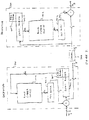
- Figure 1 illustrates a communication system using an embodiment of the present invention.
- Figure 2 illustrates a communication system using an embodiment of the present invention.
- Figure 3 illustrates a communication system using an embodiment of the present invention.
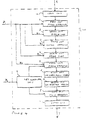
- Figure 4 illustrates a high level block diagram of an embodiment of the present invention.
- Figure 5 illustrates a schematic diagram of an embodiment of the present invention.
- Figure 4 refers to a block cipher device 100 is non-recursive and may include an input unit 10, eight units 1-8, an output unit 11, and a key scheduling unit 9.
- the input unit 10 and output unit 11 assemble and buffer input and output data to and from the block cipher device 100.
- the structure of the input unit 10 and output unit 11 generally depends on an application ( e . g ., serial or parallel).
- the input unit 10 and output unit 11 are not unique to the block cipher device 100.
- the block cipher device receives three input variables, X, Z 1 , and Z 6 and produces an output variable, Y.
- X is the primary traffic input to the block cipher device 100 and Y is the primary traffic output.
- Z 1 and Z 6 may be externally applied variables.
- Z 6 may be a secret "Key” variable which is input to the block cipher device 100 via a secure channel ( e . g ., a courier with sealed cover) prior to encryption or decryption.
- Z 1 or "customer algorithm modification" variable
- the output Y of the block cipher device 100 is a unique function of the primary traffic X, the Key variable Z 6 and the variable Z 1 .
- the first, fifth, sixth, and eighth units 1, 5, 6, and 8 may consist primarily of modular arithmetic logic gates.
- the seventh unit 7 performs a non-invertible operation (for example, a mid transform).
- Units 2 and 4 perform "nibble swapping."
- the third unit 3 provides a custom operation substituting or expanding a block based on Z 3 .
- the key scheduling unit 9 receives an externally applied input variable, Z 6 , and deterministically generates two pseudo random key blocks, Z 7 and Z 8 .
- the key blocks Z 7 and Z 8 are used as operands in the fifth unit 5 and the eighth unit 8, respectively.
- FIG. 1 illustrates 64 bit block implementations.
- 64 bit blocks are used only as an example.
- each unit includes at least a 64 bit input/output space.
- a block cipher device of the present invention having any input or output size can be designed by appropriately scaling the size of block cipher device operations.
- Figure 5 shows the first unit 1 performs a modulo 2 addition (Exclusive-Or) on primary traffic input X with variable Z 1 resulting in first unit 1 output W 1 .
- the second unit 2 performs a nibble swap operation.
- the second unit 2 segments W 1 into 8 pairs of nibbles; each nibble holding 4 bits.
- the second unit 2 transposes each segment based on Z 2 ( e . g ., bits 0-7 of Z 1 ) resulting in second unit 2 output W 2 .
- Z 2 e . g ., bits 0-7 of Z 1
- bit “0" in Z 2 is equal to binary "1” then the order of the nibbles pair "0" will be transposed.
- bit "0" in Z 2 is equal to binary "0” then the order is left unchanged.
- the order of each nibble pair will be determined by the value of the corresponding bit in Z 2 .
- the value of bit 0 controls the order of nibble pair 0, the value of bit 1 the order of nibble pair 1 continuing through to bit 7 which controls the order of nibble pair 7.
- the third unit 3 is a custom unit providing a custom substitution and expansion operation.
- the custom operation with inputs W 2 and Z 3 and output W 3 may be inserted into the block cipher device 100 in the form of a look-up table.
- Z 3 may be bits 24 through 31 of Z 1 .
- the fourth unit 4 may be another nibble swap operation where W 3 is segmented into 16 nibbles.
- Z 4 controls the re-ordering of W 3 in a slightly different manner than explained for the second unit 2. For example, when the value of bit "8" in Z 4 is equal to a binary "0" then the first nibble in the pair will be written to the first position in the high order segment of W 4 and the second nibble will be written to the first position in the low order segment of W 4 . when the value of bit "8" in Z 4 is equal to a binary "1" then the two nibbles will be transposed before being written to W 4 . As with the second unit 2, the re-ordering of each nibble pair will be determined by a corresponding bit in Z 4 .
- the fifth unit 5 performs a modulo addition operation.
- W 4 and Z 7 are operands of the fifth unit 5.
- W 4 is the output of the fourth unit 4 and Z 7 is an output from the key scheduler unit 9.
- the sixth unit 6 performs a modular cubing operation. In other words, W 5 is raised to the third power modulo p and the result is designated as W 6 .
- the seventh unit 7 performs a non-invertible operation such as an operation known as a mid transform.
- the input to the operation, W 6 is 128 bits in length and the output of the operation, W 7 , is 64 bits in length.
- the mid transform simply maps bits 64 bits of the input to a 64 bit output. For example, the mid transform may map bits 30 through 93 of W 6 to bits 0 through 63 of W 7 . The rest of the bits in W 6 are discarded.
- the eighth unit 8 performs another modulo addition operation.
- W 7 and Z 8 are operands of this unit.
- W 7 is an output from the seventh unit 7 and Z 8 is an output from the Key Scheduler 9.
- the modulus of the operation is chosen as 2 64 .
- the output of this stage is the output of the block cipher device and is designated as Y 1 .
- moduli of the first, fifth, sixth, and eighth units 1, 5, 6, and 8 the objective of the block cipher device will be satisfied by a range of choices. It is required, however, that the constraint of equ. 3 be satisfied and that a unique modulus be used in each stage.
- the "modulo" units 1, 5, 6, and 8 along with "non-invertible" unit 7 are not segmentable into a set of lower level operations.
- the key scheduler unit 9 comprises a first function unit 12, a second function unit 13, a third function unit 14, shift register 15 and a mod 2 add logic gate 16.
- the key scheduler unit 9 processes key variable Z 6 to produce variable Z 7 and Z 8 .
- Z 7 and Z 8 are used during the block cipher device operation.
- Z 9 is an output of the third function unit 14 and is stored in the shift register 15.
- the third function unit 14 may be a deterministic function operating on Z 6 .
- the contents of the shift register are shifted to the right one bit at a time until its content have been completely recirculated. With each shift, the least significant bit in shift register 15 is mod 2 added to the output of first function unit 12. The result being moved into the most significant bit position of the shift register 15.
- the shift register is output as Z 7 .
- Z 7 is input to the second function unit 13 to produce Z 8 .
- the first function unit 12 may be a custom look-up table mapping, for example, six one bit inputs to a single one bit output. Each of the inputs to the first function unit 12 is a tap connected to an individual bit position in the shift register 15. The tap locations may be arbitrarily chosen with the following constraint: no tap can be connected to either the least significant or to the most significant bit positions of the shift register 15.
- the first function unit 12 must meet secure design. For example, a design for the first function unit may be customized and disclosed only to an intended end user.
- the second function unit 13 performs a bit-wise mod 2 sum without carry of the higher and lower order halves of Z 7 to produce Z 8 .
- the third function unit 14 performs a bit-wise mod 2 sum without carry of variable Z 6 and a custom bit pattern of equal length to produce variable Z 9 .
- the custom bit pattern is disclosed only to an intended end user.
- the value of the original key variable Z 6 may be recovered by first reloading Z 7 into shift register 15. Shift register 15 is then shifted to the left one bit a time until its content have been completely recirculated. With each shift, the most significant bit in the shift register 15 is mod 2 summed to the output of the first function unit 12. The result is moved into the least significant bit position of shift register 15. When the contents of shift register 15 have been completely processed, it is input to third function unit 14. In the third function unit 14, the custom bit pattern is bit-wise mod 2 summed to reproduce Z 6 .
- the block cipher device may be operated in various modes such as a self-synchronizing cipher feedback mode (SSCFB), a minimum error propagation (or counter) mode (MEP), or a block cipher feedback mode (BCFB).
- SSCFB self-synchronizing cipher feedback mode
- MEP minimum error propagation (or counter) mode
- BCFB block cipher feedback mode
- Figure 1 illustrates a BCFB mode, a block of unencrypted data or "Plain Text" (PT) is applied to the input of the encrypter 500 labeled PT E .
- PT E is then modulo 2 added to a block of "Key Stream" KS.
- KS represents the output of the block cipher device 100-1.
- CT represents the resulting block ( i . e ., cipher text).
- CT is output at the port labeled CT E and is then transmitted over a channel 200.
- CT is fed back as input to the block cipher device 100-1.
- the block cipher device processes the fed back block to produce a new block of KS.
- KS is then combined with the next block of PT and the encryption process continues.
- received CT is represented by CT D .
- CT D is combined with a block of KS to produce as output a block of recovered plain text PT D .
- the CT D block is simultaneously applied to the input of the block cipher device 100-2.
- the block cipher device 100-2 uses the CT D block as input to produce another block of KS.
- This KS block is used to process the next block of CT D .
- This mode is intended for relatively error free communication channels.
- FIG. 2 illustrates a MEP mode, unencrypted data or "Plain Text" PT is applied to the input of the encrypter 500 labeled PT E .
- PT E is then modulo 2 added to a block of KS to produce a block of cipher text.
- CT is output at a port labeled CT E and is then transmitted over the channel 200.
- encrypter counter 300-1 is incremented and the output of the counter 300-1 is input to the block cipher device 100-1.
- the block cipher device 100-1 processes to produce a new block of KS.
- the new block of KS is then combined with the next block of PT and the encryption process continues.
- received CT is represented by CT D .
- CT D is combined with a block of KS to produce as output a block of recovered plain text PT D and decrypter counter 300-2 is incremented.
- the block cipher device 100-2 uses the output of the counter to produce another block of KS.
- This KS block is used to process the next block of CT D .
- This mode is intended for noisy or error prone communication channels. A toggled bit error on the channel will likely result in only a one bit error on PT D . In other words, in this mode the cryptographic system will likely have only one bit of error extension.
- FIG 3 illustrates a SSCFB mode, unencrypted data or "Plain Text" (PT) is applied one bit at time to the input labeled PT E .
- PT Packet Text
- Each PT E bit is modulo 2 added to a bit of KS to produce a bit of cipher text CT. Encryption continues until another iteration is initiated. Another iteration may begin when either the entire block of KS is consumed or when the pattern detector 400-1 is triggered.
- the pattern detector 400-1 continually monitors CT for a specific bit sequence and when the sequence is detected a new iteration is triggered. Because CT appears statistically random, this mechanism will initiate a new iteration at pseudo-random intervals.
- the block cipher device 100-1 uses the most recent block as input to produce another block of KS.
- the new block of KS is stored in the key buffer 401-1 and is used to continue the encryption process.
- the received CT is applied one bit at time to input labeled CT D .
- Each CT D bit is modulo 2 added with a bit of KS to produce a bit of recovered "Plain Text" as output PT D .
- the CT bit stream is simultaneously applied to the input buffer 402-2 (CB1) of the block cipher device 100-2.
- the encrypter 500 and the decrypter 600 must first be initialized such that their internal states are all identical. Initialization may be obtained using an initialization vector "IV" which is generated on the encrypter side and is used to initialize all internal states of the encrypter. The IV is then transmitted over the channel 200 to the decrypter 600. Using the IV, all internal states of the decrypter 600 are initialized to the same values.
- IV initialization vector
- a method and apparatus for use in encrypting and decrypting digital communications converting an initial block to final block based on freely selectable control information and secret key information.
- the apparatus or method having a plurality of units or steps operating on plain text or cipher text to provide a final block.
- the steps or methods including three module operations having distinct modulus and meeting a specified constraint.
Landscapes
- Engineering & Computer Science (AREA)
- Computer Security & Cryptography (AREA)
- Computer Networks & Wireless Communication (AREA)
- Signal Processing (AREA)
- Storage Device Security (AREA)
Applications Claiming Priority (2)
| Application Number | Priority Date | Filing Date | Title |
|---|---|---|---|
| US09/035,765 US6108421A (en) | 1998-03-06 | 1998-03-06 | Method and apparatus for data encryption |
| US35765 | 1998-03-06 |
Publications (2)
| Publication Number | Publication Date |
|---|---|
| EP0940943A2 true EP0940943A2 (fr) | 1999-09-08 |
| EP0940943A3 EP0940943A3 (fr) | 2003-10-01 |
Family
ID=21884659
Family Applications (1)
| Application Number | Title | Priority Date | Filing Date |
|---|---|---|---|
| EP99301651A Withdrawn EP0940943A3 (fr) | 1998-03-06 | 1999-03-05 | Procédé et dispositif de chiffrage de données |
Country Status (4)
| Country | Link |
|---|---|
| US (1) | US6108421A (fr) |
| EP (1) | EP0940943A3 (fr) |
| JP (1) | JPH11298471A (fr) |
| IL (1) | IL128846A (fr) |
Families Citing this family (13)
| Publication number | Priority date | Publication date | Assignee | Title |
|---|---|---|---|---|
| KR100377172B1 (ko) * | 2000-06-13 | 2003-03-26 | 주식회사 하이닉스반도체 | 데이터 암호화 표준 알고리즘을 이용한 암호화 장치의 키스케쥴러 |
| US20020114453A1 (en) * | 2001-02-21 | 2002-08-22 | Bartholet Thomas G. | System and method for secure cryptographic data transport and storage |
| AU2002254548A1 (en) * | 2001-04-07 | 2002-10-21 | Telehublink Coporation | Methods and systems for securing information communicated between communication devices |
| US7251326B2 (en) | 2001-06-29 | 2007-07-31 | Harris Corporation | Method and apparatus for data encryption |
| US7076059B1 (en) * | 2002-01-17 | 2006-07-11 | Cavium Networks | Method and apparatus to implement the data encryption standard algorithm |
| US7346160B2 (en) * | 2003-04-23 | 2008-03-18 | Michaelsen David L | Randomization-based encryption apparatus and method |
| US7257225B2 (en) * | 2003-12-29 | 2007-08-14 | American Express Travel Related Services Company, Inc. | System and method for high speed reversible data encryption |
| US7613295B2 (en) * | 2004-02-18 | 2009-11-03 | Harris Corporation | Cryptographic device and associated methods |
| US7599490B2 (en) * | 2004-03-03 | 2009-10-06 | Harris Corporation | Method and apparatus for data encryption |
| US7600115B2 (en) * | 2005-04-05 | 2009-10-06 | Cisco Technology, Inc. | Control key capable of storing multiple and variable data packet classification results |
| US7620181B2 (en) * | 2005-04-20 | 2009-11-17 | Harris Corporation | Communications system with minimum error cryptographic resynchronization |
| US8379847B2 (en) * | 2010-06-30 | 2013-02-19 | International Business Machines Corporation | Data and control encryption |
| US11870884B2 (en) | 2021-04-13 | 2024-01-09 | Harris Global Communications, Inc. | Self-synchronizing mode of operation for an encryption/decryption algorithm |
Family Cites Families (12)
| Publication number | Priority date | Publication date | Assignee | Title |
|---|---|---|---|---|
| US4658094A (en) * | 1985-03-28 | 1987-04-14 | Itt Corporation | Encryption apparatus and methods for raising a large unsigned integer to a large unsigned integer power modulo a large unsigned integer |
| FR2582174B1 (fr) * | 1985-05-15 | 1990-03-09 | Thomson Csf | Dispositif de chiffrement par substitutions-permutations |
| US5231662A (en) * | 1989-08-01 | 1993-07-27 | Tulip Computers International B.V. | Method and device for enciphering data to be transferred and for deciphering the enciphered data, and a computer system comprising such a device |
| US5003597A (en) * | 1989-12-21 | 1991-03-26 | Xerox Corporation | Method and apparatus for data encryption |
| US5054067A (en) * | 1990-02-21 | 1991-10-01 | General Instrument Corporation | Block-cipher cryptographic device based upon a pseudorandom nonlinear sequence generator |
| EP0482154B1 (fr) * | 1990-05-18 | 1993-06-30 | Ascom Tech Ag | Dispositif de conversion de blocs numeriques et son utilisation |
| US5517614A (en) * | 1992-05-29 | 1996-05-14 | Kabushiki Kaisha Toshiba | Data compression/encryption processing apparatus |
| US5317638A (en) * | 1992-07-17 | 1994-05-31 | International Business Machines Corporation | Performance enhancement for ANSI X3.92 data encryption algorithm standard |
| US5381480A (en) * | 1993-09-20 | 1995-01-10 | International Business Machines Corporation | System for translating encrypted data |
| US5511123A (en) * | 1994-08-04 | 1996-04-23 | Northern Telecom Limited | Symmetric cryptographic system for data encryption |
| US5838794A (en) * | 1996-01-11 | 1998-11-17 | Teledyne Electronic Technologies | Method and apparatus for inter-round mixing in iterated block substitution systems |
| US5745577A (en) * | 1996-07-25 | 1998-04-28 | Northern Telecom Limited | Symmetric cryptographic system for data encryption |
-
1998
- 1998-03-06 US US09/035,765 patent/US6108421A/en not_active Expired - Lifetime
-
1999
- 1999-03-05 IL IL12884699A patent/IL128846A/en not_active IP Right Cessation
- 1999-03-05 EP EP99301651A patent/EP0940943A3/fr not_active Withdrawn
- 1999-03-08 JP JP11060242A patent/JPH11298471A/ja active Pending
Also Published As
| Publication number | Publication date |
|---|---|
| US6108421A (en) | 2000-08-22 |
| IL128846A (en) | 2004-01-04 |
| IL128846A0 (en) | 2000-01-31 |
| EP0940943A3 (fr) | 2003-10-01 |
| JPH11298471A (ja) | 1999-10-29 |
Similar Documents
| Publication | Publication Date | Title |
|---|---|---|
| Ekdahl et al. | SNOW-a new stream cipher | |
| McLoone et al. | High performance single-chip FPGA Rijndael algorithm implementations | |
| EP0839418B1 (fr) | Procede et appareil cryptographiques de fusion non lineaire d'un bloc de donnees et d'un code | |
| Cheng et al. | Puffin: A novel compact block cipher targeted to embedded digital systems | |
| EP1410545B1 (fr) | Procede et dispositif de cryptage de donnees | |
| US5623549A (en) | Cipher mechanisms with fencing and balanced block mixing | |
| Kim et al. | The related-key rectangle attack–application to SHACAL-1 | |
| EP2460310B1 (fr) | Procédé de chiffrement à clé symétrique et système cryptographique employant le procédé | |
| US7110539B1 (en) | Method and apparatus for encrypting and decrypting data | |
| US20110211691A1 (en) | Common key block encryption device, common key block encryption method, and program | |
| EP1302022A2 (fr) | Procede et systemes d'authentification pour la protection de l'integrite des donnees | |
| US6108421A (en) | Method and apparatus for data encryption | |
| Moldovyan et al. | Stream Deniable-Encryption Algorithms. | |
| EP1571776B1 (fr) | Procédé et dispositif pour le chiffrement de données | |
| JPH1117673A (ja) | 共通鍵暗号通信方法及びその通信ネットワーク | |
| Lu et al. | Related-key attacks on the full-round Cobra-F64a and Cobra-F64b | |
| KR100416971B1 (ko) | 암호시스템에 사용하기 위한 랜덤 키스트림 생성 장치 및방법 | |
| JPH0918468A (ja) | 暗号通信装置及び暗号化装置 | |
| Kitsos | Hardware implementations for the ISO/IEC 18033-4: 2005 standard for stream ciphers | |
| Beuchat et al. | A low-area unified hardware architecture for the AES and the cryptographic hash function ECHO | |
| Guerrero et al. | Implementing block ciphering algorithms in hardware | |
| JP2001215874A (ja) | 副鍵生成装置およびそのプログラム記録媒体 |
Legal Events
| Date | Code | Title | Description |
|---|---|---|---|
| PUAI | Public reference made under article 153(3) epc to a published international application that has entered the european phase |
Free format text: ORIGINAL CODE: 0009012 |
|
| AK | Designated contracting states |
Kind code of ref document: A2 Designated state(s): AT BE CH CY DE DK ES FI FR GB GR IE IT LI LU MC NL PT SE |
|
| AX | Request for extension of the european patent |
Free format text: AL;LT;LV;MK;RO;SI |
|
| PUAL | Search report despatched |
Free format text: ORIGINAL CODE: 0009013 |
|
| AK | Designated contracting states |
Kind code of ref document: A3 Designated state(s): AT BE CH CY DE DK ES FI FR GB GR IE IT LI LU MC NL PT SE |
|
| AX | Request for extension of the european patent |
Extension state: AL LT LV MK RO SI |
|
| AKX | Designation fees paid | ||
| REG | Reference to a national code |
Ref country code: DE Ref legal event code: 8566 |
|
| 17P | Request for examination filed |
Effective date: 20040927 |
|
| RBV | Designated contracting states (corrected) |
Designated state(s): CH DE FR GB LI NL |
|
| 17Q | First examination report despatched |
Effective date: 20041215 |
|
| STAA | Information on the status of an ep patent application or granted ep patent |
Free format text: STATUS: THE APPLICATION HAS BEEN WITHDRAWN |
|
| 18W | Application withdrawn |
Effective date: 20061120 |