EP0941285B1 - Compositions obtenues a partir de melanges de polymeres styrene/acrylonitrile et possedant une grande resistance aux impacts - Google Patents
Compositions obtenues a partir de melanges de polymeres styrene/acrylonitrile et possedant une grande resistance aux impacts Download PDFInfo
- Publication number
- EP0941285B1 EP0941285B1 EP97946690A EP97946690A EP0941285B1 EP 0941285 B1 EP0941285 B1 EP 0941285B1 EP 97946690 A EP97946690 A EP 97946690A EP 97946690 A EP97946690 A EP 97946690A EP 0941285 B1 EP0941285 B1 EP 0941285B1
- Authority
- EP
- European Patent Office
- Prior art keywords
- composition
- weight
- copolymer
- parts
- mole
- Prior art date
- Legal status (The legal status is an assumption and is not a legal conclusion. Google has not performed a legal analysis and makes no representation as to the accuracy of the status listed.)
- Expired - Lifetime
Links
- 0 C(*1)C1[C@@]1NC2CC1CC2 Chemical compound C(*1)C1[C@@]1NC2CC1CC2 0.000 description 4
Classifications
-
- C—CHEMISTRY; METALLURGY
- C08—ORGANIC MACROMOLECULAR COMPOUNDS; THEIR PREPARATION OR CHEMICAL WORKING-UP; COMPOSITIONS BASED THEREON
- C08K—Use of inorganic or non-macromolecular organic substances as compounding ingredients
- C08K5/00—Use of organic ingredients
- C08K5/04—Oxygen-containing compounds
- C08K5/09—Carboxylic acids; Metal salts thereof; Anhydrides thereof
- C08K5/098—Metal salts of carboxylic acids
-
- C—CHEMISTRY; METALLURGY
- C08—ORGANIC MACROMOLECULAR COMPOUNDS; THEIR PREPARATION OR CHEMICAL WORKING-UP; COMPOSITIONS BASED THEREON
- C08L—COMPOSITIONS OF MACROMOLECULAR COMPOUNDS
- C08L25/00—Compositions of, homopolymers or copolymers of compounds having one or more unsaturated aliphatic radicals, each having only one carbon-to-carbon double bond, and at least one being terminated by an aromatic carbocyclic ring; Compositions of derivatives of such polymers
- C08L25/02—Homopolymers or copolymers of hydrocarbons
- C08L25/04—Homopolymers or copolymers of styrene
- C08L25/08—Copolymers of styrene
- C08L25/12—Copolymers of styrene with unsaturated nitriles
-
- C—CHEMISTRY; METALLURGY
- C08—ORGANIC MACROMOLECULAR COMPOUNDS; THEIR PREPARATION OR CHEMICAL WORKING-UP; COMPOSITIONS BASED THEREON
- C08L—COMPOSITIONS OF MACROMOLECULAR COMPOUNDS
- C08L23/00—Compositions of homopolymers or copolymers of unsaturated aliphatic hydrocarbons having only one carbon-to-carbon double bond; Compositions of derivatives of such polymers
- C08L23/02—Compositions of homopolymers or copolymers of unsaturated aliphatic hydrocarbons having only one carbon-to-carbon double bond; Compositions of derivatives of such polymers not modified by chemical after-treatment
- C08L23/18—Homopolymers or copolymers of hydrocarbons having four or more carbon atoms
- C08L23/20—Homopolymers or copolymers of hydrocarbons having four or more carbon atoms having four to nine carbon atoms
- C08L23/22—Copolymers of isobutene; Butyl rubber; Homopolymers or copolymers of other iso-olefins
Definitions
- the invention relates to toughened styrene/acrylonitrile polymer compositions containing a halogenated monoolefin/alkylstyrene copolymer.
- Styrene/acrylonitrile (SAN) copolymers are well known resins having extremely good weatherability (resistance to UV attack) which makes them extremely useful in the production of molded articles for applications such as automotive or marine body parts, packaging and building panels.
- these resins possess relatively poor room temperature impact properties, thereby limiting their use in many such applications requiring good impact strength.
- ABS resins exhibit a marked increased in impact properties, but at the cost of diminished weatherability because the residual unsaturation present in the polybutadiene molecular structure is susceptible to U.V. and ozone attack.
- SAN properties have also been modified by polymerizing styrene and acrylonitrile in the presence of a C 4 -C 7 isomonoolefin copolymer containing an unsaturated conjugated diene (prepared by dehydrohalogenating halogenated butyl rubber), as for example disclosed in U.S. Patent 4, 142,098, or in the presence of a pre-crosslinked bromobutyl rubber, as disclosed in U.S. Patent 4,026,968.
- these resulting compositions containing ethylenically unsaturated components may also be susceptible to U.V. or ozone attack.
- the present invention provides SAN resin compositions having both good room temperature impact properties and enhanced weatherability. These compositions comprise a mixture of
- component (a) is a saturated halogenated elastomeric random copolymer having a number average molecular weight of at least 10,000 comprising at least about 80 mole % of polymerized isomonoolefin containing from 4 to 7 carbon atoms and from about 0.05 up to about 20 mole % of para-substituted styrene aromatic monomer units.
- halogenation elastomeric copolymers which are useful as blend component (a) are random copolymers comprising at least one C 2 to C 12 monoolefin component and a halogenated alkyl styrene containing from 1-3 alkyl substituent groups which may be positioned at the ortho, meta, para, ortho/meta, ortho/para, meta/para or ortho/meta/para ring positions.
- Preferred monoolefin components include polymers of ethylene alone or copolymerized with a different C 3 to C 12 monoolefin, e.g., propylene, butene, hexene, octene and the like; polymers of propylene; polymers containing a C 4 -C 7 isomonoolefin as well as terpolymers of ethylene, propylene and a non-conjugated diene such as ethylidene norbornene.
- Many polymers of this type may be prepared by conventional free radical or transitional metal catalyst systems, such as metallocene catalysts of the type disclosed in U.S. Patent 5,384,299 and PCT publication WO 96/04319.
- Copolymers containing at least one C 2 to C 12 alpha olefin and a para-alkylstyrene comonomer prepared by metallocene catalysis are disclosed in U.S. Patent 5,543,484, the complete disclosure of which is incorporated herein by reference.
- Preferred copolymers are those containing from about 0.5 to 20 mole % of aromatic monomer(s) and less than 5wt%, preferably less than 2 wt %, of halogen, preferably bromine, and those where n in the formula is 1.
- the alkyl substituent group is positioned at the para ring position.
- the most preferred elastomeric copolymers used as a blend component in the present invention are the halogenation product of random copolymers of a c 4 to C 7 isomonoolefin, such as isobutylene, and para-alkylstyrene comonomer, preferably para-methylstyrene containing at least about 80%, more preferably at least about 90% by weight of the para isomer, and wherein at least some of the alkyl substituent groups present in the styrene monomer units contain halogen.
- a c 4 to C 7 isomonolefin such as isobutylene
- para-alkylstyrene comonomer preferably para-methylstyrene containing at least about 80%, more preferably at least about 90% by weight of the para isomer, and wherein at least some of the alkyl substituent groups present in the styrene monomer units contain halogen.
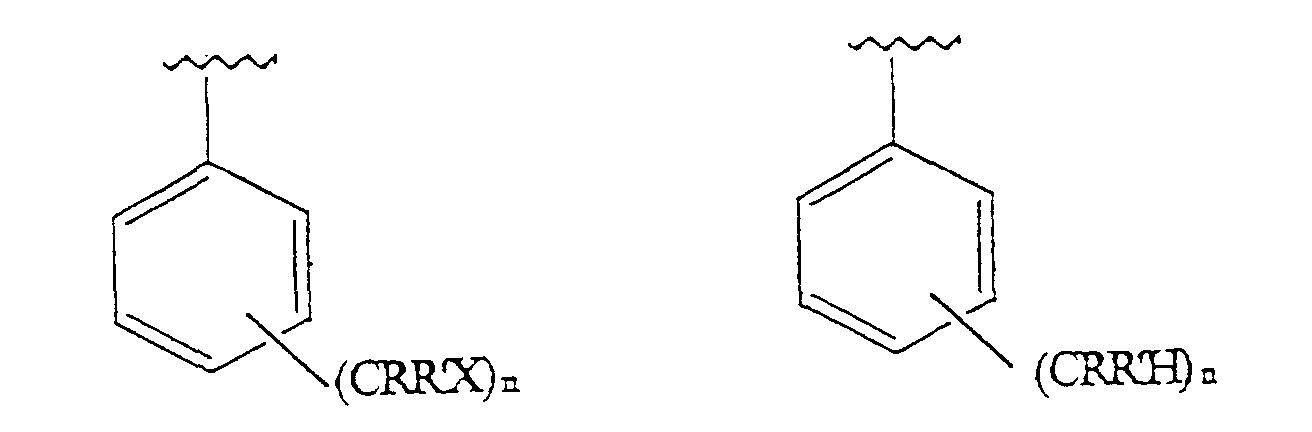
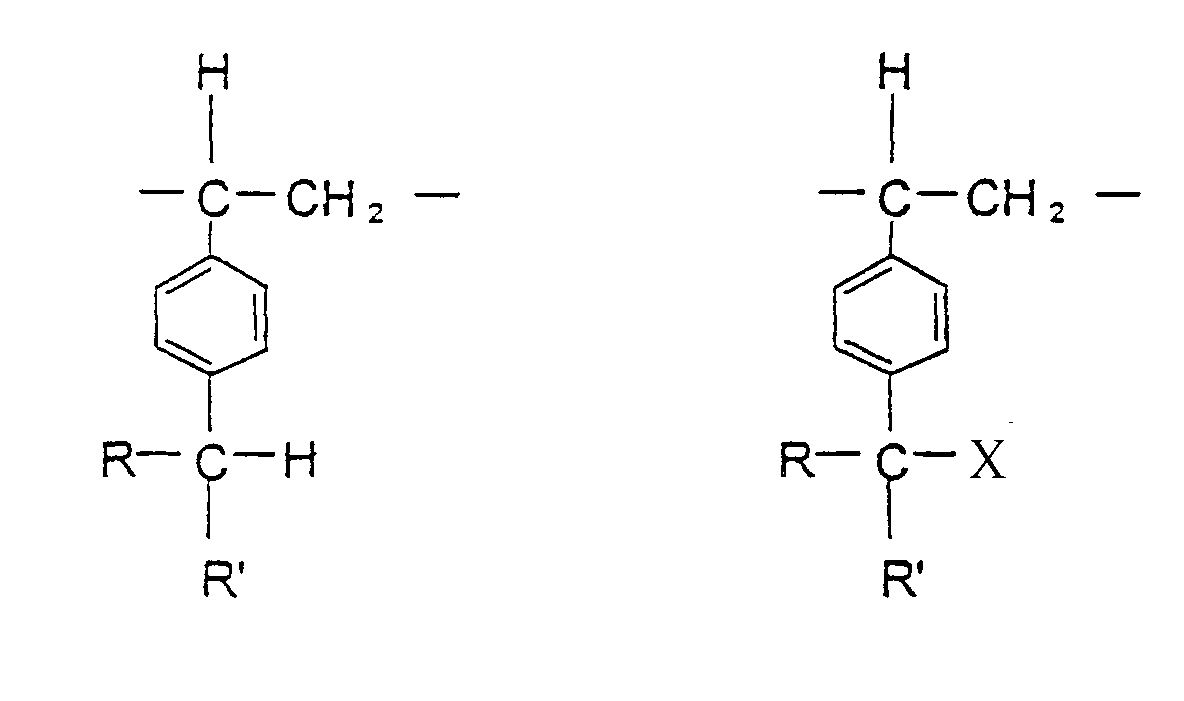
- Preferred materials may be characterized as isobutylene copolymers containing the following monomer units randomly spaced along the polymer chain: wherein R and R' are independently selected from the group consisting of hydrogen and C 1 to C 4 alkyl, and X is bromine or chlorine, and wherein the copolymer is otherwise substantially free of ring halogen or halogen in the polymer backbone chain.
- R and R' are each hydrogen. From about 5 up to about 60 mole % of the para-alkylstyrene present in the copolymer structure may be the halogenated structure (2) above.
- elastomeric copolymers of isobutylene and para-methylstyrene containing from about 0.5 to about 20 mole % para-methylstyrene wherein up to about 60 mole % of the methyl substituent groups present on the benzyl ring contain a bromine or chlorine atom, preferably a bromine atom
- These copolymers have a substantially homogeneous compositional distribution such that at least 95% by weight of the polymer has a para-alkyistyrene content within 10% of the average para-alkylstyrene content of the polymer.
- Mw/Mn molecular weight distribution
- the copolymers may be prepared by slurry polymerization of the monomer mixture using a Lewis Acid catalyst, followed by halogenation, preferably bromination, in solution in the presence of halogen and a radical initiator such as heat and/or light and/or a chemical initiator.
- a Lewis Acid catalyst followed by halogenation, preferably bromination, in solution in the presence of halogen and a radical initiator such as heat and/or light and/or a chemical initiator.
- Preferred brominated copolymers generally contain from about 0.1 to about 5 mole % of bromomethyl groups, most of which is monobromomethyl, with less than 0.05 mole % dibromomethyl substituents present in the copolymer. More preferred copolymers contain at least about 0.75 mole % of bromomethyl groups.
- the SAN component of the blends of this invention are well known materials prepared by well known copolymerization processes.
- Preferred copolymers exhibit a number average molecular weight in the range of about 50,000 to about 200,000 and contain at least about 50 wt % of copolymerized styrene, more preferably from about 60 to about 80 wt % of copolymerized styrene, and the balance acrylonitrile.
- styrene also includes other vinyl aromatic monomers such as alpha-methylstyrene or para-methylstyrene, used alone or in combination with pure styrene.
- Preferred SAN resins contain about 20-35 wt% of polymerized acrylonitrile.
- Preferred blends contain the halogenated elastomeric copolymer at a level of from about 5 to 80 parts by weight, more preferably from about 10 to 50 parts by weight per 100 parts by weight of the SAN resin present in the blend.
- carboxylates selected from the group consisting of one or a mixture of aluminum, iron, tin and zinc compounds (salts) of a halide or a carboxylic acid selected from the group consisting of alicyclic, naphthenic, benzoic and C 10 to C 28 fatty acids such as stearic and oleic acids.
- Typical acids include monocarboxylic saturated or unsaturated acids such as capric, lauric, palmitic, stearic and behenic acids as well as their unsaturated analogs such as oleic and ricinoleic acids.
- the carboxylic acid may also include aromatic acids such as benzoic or naphthenic acids and their derivatives.
- Zinc stearate is the most preferred of these compounds and the invention is illustrated using this preferred material.
- the compound may be incorporated in the composition as such or it may be formed in the composition in-situ such as, for example, by the addition of stearic acid and zinc oxide to the composition, followed by the in-situ reaction of these components under conditions of mixing and heat to from zinc stearate.
- Metal oxides such as zinc or magnesium oxide may also be included in the composition in addition to the carboxylate compounds.
- the quantity of the carboxylate compound present in the composition should be sufficient to provide a composition of improved impact strength and compatibility, generally in the range of from about 0.5 to about 10 parts by weight, more preferably from about 1 to about 5 parts by weight, per 100 parts by weight of the total polymer content of the blend composition.
- the composition may also contain up to about 30 parts by weight of one or more other elastomeric components such as hydrogenated polybutadiene and/or AB or ABA block copolymers of styrene (A) and polybutadiene (B) or polyisobutylene (B) and/or elastomeric terpolymers of ethylene/propylene and a non-conjugated diene such as ethylidene norbornene.
- one or more other elastomeric components such as hydrogenated polybutadiene and/or AB or ABA block copolymers of styrene (A) and polybutadiene (B) or polyisobutylene (B) and/or elastomeric terpolymers of ethylene/propylene and a non-conjugated diene such as ethylidene norbornene.
- compositions of this invention may also contain other conventional additives normally present in molded plastics such as fillers, dyes, plasticizers, antioxidants, UV retarders, fire retardants and like additives.
- the blend composition of this invention may be prepared and blended using any suitable mixing device such as an internal mixer (Brabender Plasticorder), a Banbury Mixer, an extruder, a mill mixer, a kneader or a similar mixing device. Preferred blending temperatures and times may range from about 150°C to 250°C and from about 1 to 15 minutes respectively. All ingredients, i.e., the polymer components and the zinc stearate, may be combined simultaneously in the mixer or mixed in sequence. Also, a polymer blend may be prepared by polymerizing the styrene and acrylonitrile in the presence of a dispersion containing the halogenated elastomer in organic solvent solution, followed by recovery of the resulting polymer product. This product is then mixed with the carboxylate compound as described above.
- any suitable mixing device such as an internal mixer (Brabender Plasticorder), a Banbury Mixer, an extruder, a mill mixer, a kneader or a similar mixing device.
- compositions of this invention may be molded, extruded or spun to form shaped articles, e.g., fibers, films, sheets or other shapes useful in automotive, appliance or construction industries.
- the material identified as BR-IPMS is a brominated copolymer of isobutylene and para-methylstyrene having a Mooney Viscosity of 45(ML 1+8, 125°), 7.5 wt% of copolymerized PMS and 1.2 mol. % brominated PMS.
- the material identified as SAN is a copolymer containing about 72% styrene and 28% acrylonitrile having a melt index of 3.
- a series of resin mixtures having the formulation of Table 1 were prepared by combining the ingredients in a Banbury Mixer for 5 minutes at 230°C, followed by removal of each mixture to a two roll mill where it was cooled. The cooled mixtures were ground to chips in a Pullman Grinder and then injection molded to form test samples for mechanical property evaluation. Results are shown in Table 1.
- SAMPLE 1 2 3 4 SAN(wt%) 100 70 70 70 BR-IPMS(wt%) - 30 30 30 Zn(St) 2 (PHP) - 2 4 4 ZnO (PHP) - 1 - - IRGANOXTM 1076 (PHP) - - - 0.2 Notched Izod (R.T) FT/LB/IN 0.2 5.41 6.15 6.87
- Example 2 Six additional mixtures having the composition described in Table 2 were prepared as in Example 1 by mixing the polymer components on a Banbury mixer at a temperature of about 195°C, followed by addition of the listed additive and continued mixing for about 2-4 minutes. The mixtures were then cooled on a two roll mill and injection molded to form Izod test specimens.
- ADDITIVE R.T. IZOD NOT. IMPACT (FT/LB/IN) EX. 2 SAN (70) BR-IPMS(30) ZnSt 2 (4) 5.5 EX. 3 SAN (70) BR-IPMS(30) Zn0(4) 0.48 EX. 4 SAN (70) IPMS(30) ZnSt 2 (4) 0.36 EX. 5 SAN (70) BR-IPMS(30) Mg0(4) 0.35 EX. 6 SAN (70) Mal. EP (30) -- 0.43 EX. 7 SAN (100) -- -- 0.28
- Example 2 The number in parenthesis in Table 2 shows the weight ratio of each ingredient present in the composition.
- the Control (Example 7) shows an Izod value of 0.28; Examples 3 and 5 where zinc oxide and magnesium oxide respectively are the additives, show very little increase in Izod value.
- Example 4 a non-halogenated version of the BR-IPMS copolymer (IPMS) in conjunction with zinc stearate was used, and again a very poor Izod value was achieved.
- Example 6 a maleated ethylene/propylene copolymer containing 0.5 wt% grafted maleic acid (Mal. EP) and having a Mooney Viscosity of about 30 (1 + 4, 125°C) was used without any additive, and again very little increase in Izod value compared with the control was achieved.
- Mal. EP 0.5 wt% grafted maleic acid
Landscapes
- Chemical & Material Sciences (AREA)
- Health & Medical Sciences (AREA)
- Chemical Kinetics & Catalysis (AREA)
- Medicinal Chemistry (AREA)
- Polymers & Plastics (AREA)
- Organic Chemistry (AREA)
- Compositions Of Macromolecular Compounds (AREA)
- Addition Polymer Or Copolymer, Post-Treatments, Or Chemical Modifications (AREA)
- Graft Or Block Polymers (AREA)
Claims (12)
- Composition polymère thermoplastique comprenant un mélange :a) d'un copolymère statistique élastomère halogéné ayant un segment polymère de squelette saturé ou à faible insaturation comprenant une mono-oléfine en C2 à C12 et contenant des motifs monomères aromatiques ayant la structure suivante distribués le long de la chaíne du squelette du polymère :formules dans lesquelles R et R' sont choisis indépendamment dans le groupe consistant en l'hydrogène et un groupe alkyle en C1 à C4, X représente le brome ou le chlore, n a une valeur de 1 à 3, la teneur en halogène du copolymère étant égale ou inférieure à 7 % en moles et la teneur en halogène du polymère du squelette étant égale ou inférieure à 2 % en moles ;
 b) d'un copolymère de styrène et d'acrylonitrile ; etc) d'environ 0,5 à environ 10 parties en poids, pour 100 parties en poids des polymères présents dans le mélange, d'un composé choisi dans le groupe consistant en un composé ou un mélange de composés d'aluminium, de fer, d'étain et de zinc d'un halogénure ou d'un acide carboxylique choisi dans le groupe consistant en l'acide benzoïque, l'acide naphténique, un acide alicyclique et des acides gras en C10 à C28, ledit copolymère statistique élastomère étant présent dans ladite composition en un rapport pondéral d'environ 5 à environ 80 parties en poids pour 100 parties en poids dudit copolymère styrène / acrylonitrile.
 - Composition suivant la revendication 1, dans laquelle le copolymère statistique contient environ 0,5 jusqu'à 20 % en moles des motifs monomères aromatiques.
- Composition suivant la revendication 1, dans laquelle le composé comprend le stéarate de zinc.
- Composition suivant la revendication 1, dans laquelle X représente le brome.
- Composition suivant la revendication 1, dans laquelle le copolymère statistique élastomère halogéné a une moyenne en nombre du poids moléculaire d'au moins 10 000, comprenant au moins environ 80 % en moles d'une isomono-oléfine polymérisée contenant 4 à 7 atomes de carbone et environ 0,05 jusqu'à environ 20 % en moles de motifs monomères aromatiques comprenant un mélange des structures suivantes, distribués de manière aléatoire dans ce copolymère :formules dans lesquelles R et R' sont choisis indépendamment dans le groupe consistant en l'hydrogène et un groupe alkyle en C1 à C4 et X représente le brome ou le chlore.
- Composition suivant la revendication 5, dans laquelle l'agent compatibilisant comprend le stéarate de zinc.
- Composition suivant la revendication 5, dans laquelle X représente le brome.
- Composition suivant la revendication 5, dans laquelle le copolymère halogéné est un copolymère d'isobutylène et de paraméthylstyrène.
- Composition suivant la revendication 8, dans laquelle une quantité d'environ 5 à environ 60 % des motifs monomères paraméthylstyrène contient un groupe monobromométhyle.
- Composition suivant la revendication 9, dans laquelle le copolymère a une teneur en brome comprise dans l'intervalle d'environ 0,1 à environ 5 % en moles.
- Composition suivant la revendication 5, contenant environ 1 à environ 5 parties en poids de stéarate de zinc pour 100 parties en poids des polymères présents dans ladite composition.
- Composition suivant la revendication 1, contenant environ 10 à 50 parties en poids du copolymère statistique élastomère pour 100 parties en poids du polymère styrène / acrylonitrile.
Applications Claiming Priority (3)
| Application Number | Priority Date | Filing Date | Title |
|---|---|---|---|
| US08/756,470 US6008282A (en) | 1990-08-07 | 1996-11-26 | High impact styrene/acrylonitrile polymer blend compositions |
| US756470 | 1996-11-26 | ||
| PCT/US1997/021130 WO1998023679A1 (fr) | 1996-11-26 | 1997-11-20 | Compositions obtenues a partir de melanges de polymeres styrene/acrylonitrile et possedant une grande resistance aux impacts |
Publications (2)
| Publication Number | Publication Date |
|---|---|
| EP0941285A1 EP0941285A1 (fr) | 1999-09-15 |
| EP0941285B1 true EP0941285B1 (fr) | 2001-05-09 |
Family
ID=25043630
Family Applications (1)
| Application Number | Title | Priority Date | Filing Date |
|---|---|---|---|
| EP97946690A Expired - Lifetime EP0941285B1 (fr) | 1996-11-26 | 1997-11-20 | Compositions obtenues a partir de melanges de polymeres styrene/acrylonitrile et possedant une grande resistance aux impacts |
Country Status (13)
| Country | Link |
|---|---|
| EP (1) | EP0941285B1 (fr) |
| JP (1) | JP2001506678A (fr) |
| KR (1) | KR20000057192A (fr) |
| CN (1) | CN1235624A (fr) |
| AT (1) | ATE201039T1 (fr) |
| BR (1) | BR9713541A (fr) |
| CA (1) | CA2267236A1 (fr) |
| DE (1) | DE69704788T2 (fr) |
| EA (1) | EA199900423A1 (fr) |
| ES (1) | ES2156404T3 (fr) |
| HU (1) | HUP9904213A3 (fr) |
| PL (1) | PL333096A1 (fr) |
| WO (1) | WO1998023679A1 (fr) |
Families Citing this family (5)
| Publication number | Priority date | Publication date | Assignee | Title |
|---|---|---|---|---|
| DE19655417B4 (de) * | 1995-11-02 | 2008-11-20 | The Yokohama Rubber Co., Ltd. | Thermoplastische Elastomerzusammensetzung und Verfahren zu deren Herstellung, sowie Verwendung der Zusammensetzung für einen Schlauch mit niedriger Permeabilität |
| CA2490248C (fr) * | 2002-07-05 | 2011-12-20 | Exxonmobil Chemical Patents Inc. | Nanocomposite elastomere fonctionnalise |
| EP1599540B1 (fr) * | 2003-03-06 | 2009-09-02 | The Yokohama Rubber Co., Ltd. | Composition elastomere thermoplastique obtenue par un procede de pelletisation de caoutchouc ameliore |
| US7560514B2 (en) * | 2003-03-06 | 2009-07-14 | Exxonmobil Chemical Patents Inc. | Thermoplastic elastomer composition having moderate cure state |
| US8119720B2 (en) * | 2008-12-29 | 2012-02-21 | Cheil Industries Inc. | Thermoplastic resin composition having improved flowability |
Family Cites Families (2)
| Publication number | Priority date | Publication date | Assignee | Title |
|---|---|---|---|---|
| NL8104413A (nl) * | 1981-09-25 | 1983-04-18 | Stamicarbon | Polymeercompositie. |
| US6013727A (en) * | 1988-05-27 | 2000-01-11 | Exxon Chemical Patents, Inc. | Thermoplastic blend containing engineering resin |
-
1997
- 1997-11-20 HU HU9904213A patent/HUP9904213A3/hu unknown
- 1997-11-20 KR KR1019990704511A patent/KR20000057192A/ko not_active Withdrawn
- 1997-11-20 BR BR9713541A patent/BR9713541A/pt not_active Application Discontinuation
- 1997-11-20 JP JP52472298A patent/JP2001506678A/ja active Pending
- 1997-11-20 AT AT97946690T patent/ATE201039T1/de not_active IP Right Cessation
- 1997-11-20 CN CN97199209A patent/CN1235624A/zh active Pending
- 1997-11-20 CA CA002267236A patent/CA2267236A1/fr not_active Abandoned
- 1997-11-20 EP EP97946690A patent/EP0941285B1/fr not_active Expired - Lifetime
- 1997-11-20 ES ES97946690T patent/ES2156404T3/es not_active Expired - Lifetime
- 1997-11-20 WO PCT/US1997/021130 patent/WO1998023679A1/fr not_active Ceased
- 1997-11-20 EA EA199900423A patent/EA199900423A1/ru unknown
- 1997-11-20 PL PL97333096A patent/PL333096A1/xx unknown
- 1997-11-20 DE DE69704788T patent/DE69704788T2/de not_active Expired - Fee Related
Also Published As
| Publication number | Publication date |
|---|---|
| JP2001506678A (ja) | 2001-05-22 |
| CN1235624A (zh) | 1999-11-17 |
| CA2267236A1 (fr) | 1998-06-04 |
| DE69704788D1 (de) | 2001-06-13 |
| ATE201039T1 (de) | 2001-05-15 |
| DE69704788T2 (de) | 2001-08-23 |
| ES2156404T3 (es) | 2001-06-16 |
| BR9713541A (pt) | 2000-03-21 |
| EA199900423A1 (ru) | 1999-12-29 |
| HUP9904213A2 (hu) | 2000-04-28 |
| EP0941285A1 (fr) | 1999-09-15 |
| PL333096A1 (en) | 1999-11-08 |
| HUP9904213A3 (en) | 2000-05-29 |
| KR20000057192A (ko) | 2000-09-15 |
| WO1998023679A1 (fr) | 1998-06-04 |
Similar Documents
| Publication | Publication Date | Title |
|---|---|---|
| US6008282A (en) | High impact styrene/acrylonitrile polymer blend compositions | |
| EP1334150B1 (fr) | Compositions thermoplastiques d'elastomeres halogenes | |
| EP0991717B1 (fr) | Melanges de copolymeres ethylene-acetate de vinyle et de terpolymeres ethylene-acetate de vinyle-monoxyde de carbone | |
| EP0034704A1 (fr) | Mélanges à base de polyamide à ténacité améliorée et procédé de préparation | |
| EP0773255A1 (fr) | Vulcanisé thermoplastique de caoutchouc de isobutylène et EPDM à caoutchouc diène conjugé | |
| WO1991019762A1 (fr) | Composition de resine thermoplastique | |
| US4921914A (en) | Thermoplastic rubber compositions of carboxyl ethylene polymer and blends with polyamide | |
| EP0941285B1 (fr) | Compositions obtenues a partir de melanges de polymeres styrene/acrylonitrile et possedant une grande resistance aux impacts | |
| US5597866A (en) | Propylene polymer compositions having improved impact strength | |
| EP0451918B1 (fr) | Compositions de polycétones et de polymères | |
| KR20140080506A (ko) | 할로겐-무함유 열가소성 엘라스토머 조성물의 연속적 제조 방법 | |
| US7019058B2 (en) | Halogenated elastomeric compositions having enhanced viscosity | |
| EP0782600B1 (fr) | Compositions de polyphenylene ether a resistance elevee aux impacts | |
| CZ176799A3 (cs) | Thermoplastická polymerní vysoce rázuvzdorná směs | |
| US5373062A (en) | Curing systems for halogenated elastomers | |
| EP0823926B1 (fr) | Melanges compatibilises de polymeres de polypropylene et de poly(phenylene ether) | |
| USH1403H (en) | Polyketone polymer blends | |
| MXPA97010420A (en) | Compositions of propylene polymer being improved impa resistance | |
| MXPA97001925A (es) | Composiciones de eter de polifenileno de alto impacto | |
| TW201329152A (zh) | 無鹵熱塑性彈性體之連續製造方法 | |
| JPS6238384B2 (fr) | ||
| MXPA97008472A (en) | Compatibilized physical mixtures of polypropylene and polymer polymers (phenylene et |
Legal Events
| Date | Code | Title | Description |
|---|---|---|---|
| PUAI | Public reference made under article 153(3) epc to a published international application that has entered the european phase |
Free format text: ORIGINAL CODE: 0009012 |
|
| 17P | Request for examination filed |
Effective date: 19990413 |
|
| AK | Designated contracting states |
Kind code of ref document: A1 Designated state(s): AT BE DE ES FR GB IT LU NL |
|
| 17Q | First examination report despatched |
Effective date: 19990827 |
|
| GRAG | Despatch of communication of intention to grant |
Free format text: ORIGINAL CODE: EPIDOS AGRA |
|
| GRAG | Despatch of communication of intention to grant |
Free format text: ORIGINAL CODE: EPIDOS AGRA |
|
| GRAH | Despatch of communication of intention to grant a patent |
Free format text: ORIGINAL CODE: EPIDOS IGRA |
|
| GRAH | Despatch of communication of intention to grant a patent |
Free format text: ORIGINAL CODE: EPIDOS IGRA |
|
| GRAH | Despatch of communication of intention to grant a patent |
Free format text: ORIGINAL CODE: EPIDOS IGRA |
|
| GRAH | Despatch of communication of intention to grant a patent |
Free format text: ORIGINAL CODE: EPIDOS IGRA |
|
| GRAA | (expected) grant |
Free format text: ORIGINAL CODE: 0009210 |
|
| ITF | It: translation for a ep patent filed | ||
| AK | Designated contracting states |
Kind code of ref document: B1 Designated state(s): AT BE DE ES FR GB IT LU NL |
|
| REF | Corresponds to: |
Ref document number: 201039 Country of ref document: AT Date of ref document: 20010515 Kind code of ref document: T |
|
| RAP2 | Party data changed (patent owner data changed or rights of a patent transferred) |
Owner name: EXXONMOBIL CHEMICAL PATENTS INC. |
|
| REF | Corresponds to: |
Ref document number: 69704788 Country of ref document: DE Date of ref document: 20010613 |
|
| REG | Reference to a national code |
Ref country code: ES Ref legal event code: FG2A Ref document number: 2156404 Country of ref document: ES Kind code of ref document: T3 |
|
| ET | Fr: translation filed | ||
| NLT2 | Nl: modifications (of names), taken from the european patent patent bulletin |
Owner name: EXXONMOBIL CHEMICAL PATENTS INC. |
|
| REG | Reference to a national code |
Ref country code: GB Ref legal event code: IF02 |
|
| PLBE | No opposition filed within time limit |
Free format text: ORIGINAL CODE: 0009261 |
|
| STAA | Information on the status of an ep patent application or granted ep patent |
Free format text: STATUS: NO OPPOSITION FILED WITHIN TIME LIMIT |
|
| 26N | No opposition filed | ||
| PGFP | Annual fee paid to national office [announced via postgrant information from national office to epo] |
Ref country code: GB Payment date: 20021002 Year of fee payment: 6 Ref country code: AT Payment date: 20021002 Year of fee payment: 6 |
|
| PGFP | Annual fee paid to national office [announced via postgrant information from national office to epo] |
Ref country code: NL Payment date: 20021011 Year of fee payment: 6 |
|
| PGFP | Annual fee paid to national office [announced via postgrant information from national office to epo] |
Ref country code: LU Payment date: 20021024 Year of fee payment: 6 |
|
| PGFP | Annual fee paid to national office [announced via postgrant information from national office to epo] |
Ref country code: FR Payment date: 20021105 Year of fee payment: 6 |
|
| PGFP | Annual fee paid to national office [announced via postgrant information from national office to epo] |
Ref country code: ES Payment date: 20021119 Year of fee payment: 6 |
|
| PGFP | Annual fee paid to national office [announced via postgrant information from national office to epo] |
Ref country code: DE Payment date: 20021127 Year of fee payment: 6 |
|
| PGFP | Annual fee paid to national office [announced via postgrant information from national office to epo] |
Ref country code: BE Payment date: 20021213 Year of fee payment: 6 |
|
| PG25 | Lapsed in a contracting state [announced via postgrant information from national office to epo] |
Ref country code: LU Free format text: LAPSE BECAUSE OF NON-PAYMENT OF DUE FEES Effective date: 20031120 Ref country code: GB Free format text: LAPSE BECAUSE OF NON-PAYMENT OF DUE FEES Effective date: 20031120 Ref country code: AT Free format text: LAPSE BECAUSE OF NON-PAYMENT OF DUE FEES Effective date: 20031120 |
|
| PG25 | Lapsed in a contracting state [announced via postgrant information from national office to epo] |
Ref country code: ES Free format text: LAPSE BECAUSE OF NON-PAYMENT OF DUE FEES Effective date: 20031121 |
|
| PG25 | Lapsed in a contracting state [announced via postgrant information from national office to epo] |
Ref country code: BE Free format text: LAPSE BECAUSE OF NON-PAYMENT OF DUE FEES Effective date: 20031130 |
|
| BERE | Be: lapsed |
Owner name: *EXXON CHEMICAL PATENTS INC. Effective date: 20031130 |
|
| PG25 | Lapsed in a contracting state [announced via postgrant information from national office to epo] |
Ref country code: NL Free format text: LAPSE BECAUSE OF NON-PAYMENT OF DUE FEES Effective date: 20040601 |
|
| PG25 | Lapsed in a contracting state [announced via postgrant information from national office to epo] |
Ref country code: DE Free format text: LAPSE BECAUSE OF NON-PAYMENT OF DUE FEES Effective date: 20040602 |
|
| GBPC | Gb: european patent ceased through non-payment of renewal fee |
Effective date: 20031120 |
|
| PG25 | Lapsed in a contracting state [announced via postgrant information from national office to epo] |
Ref country code: FR Free format text: LAPSE BECAUSE OF NON-PAYMENT OF DUE FEES Effective date: 20040730 |
|
| NLV4 | Nl: lapsed or anulled due to non-payment of the annual fee |
Effective date: 20040601 |
|
| REG | Reference to a national code |
Ref country code: FR Ref legal event code: ST |
|
| REG | Reference to a national code |
Ref country code: ES Ref legal event code: FD2A Effective date: 20031121 |
|
| PG25 | Lapsed in a contracting state [announced via postgrant information from national office to epo] |
Ref country code: IT Free format text: LAPSE BECAUSE OF NON-PAYMENT OF DUE FEES Effective date: 20051120 |