EP0941398B1 - Verfahren und vorrichtung zum behandeln von brennstoff - Google Patents
Verfahren und vorrichtung zum behandeln von brennstoff Download PDFInfo
- Publication number
- EP0941398B1 EP0941398B1 EP97949689A EP97949689A EP0941398B1 EP 0941398 B1 EP0941398 B1 EP 0941398B1 EP 97949689 A EP97949689 A EP 97949689A EP 97949689 A EP97949689 A EP 97949689A EP 0941398 B1 EP0941398 B1 EP 0941398B1
- Authority
- EP
- European Patent Office
- Prior art keywords
- fuel
- catalyst
- tin
- antimony
- zinc
- Prior art date
- Legal status (The legal status is an assumption and is not a legal conclusion. Google has not performed a legal analysis and makes no representation as to the accuracy of the status listed.)
- Expired - Lifetime
Links
Images






Classifications
-
- B—PERFORMING OPERATIONS; TRANSPORTING
- B01—PHYSICAL OR CHEMICAL PROCESSES OR APPARATUS IN GENERAL
- B01J—CHEMICAL OR PHYSICAL PROCESSES, e.g. CATALYSIS OR COLLOID CHEMISTRY; THEIR RELEVANT APPARATUS
- B01J23/00—Catalysts comprising metals or metal oxides or hydroxides, not provided for in group B01J21/00
- B01J23/38—Catalysts comprising metals or metal oxides or hydroxides, not provided for in group B01J21/00 of noble metals
- B01J23/54—Catalysts comprising metals or metal oxides or hydroxides, not provided for in group B01J21/00 of noble metals combined with metals, oxides or hydroxides provided for in groups B01J23/02 - B01J23/36
- B01J23/56—Platinum group metals
- B01J23/64—Platinum group metals with arsenic, antimony, bismuth, vanadium, niobium, tantalum, polonium, chromium, molybdenum, tungsten, manganese, technetium or rhenium
- B01J23/644—Arsenic, antimony or bismuth
- B01J23/6445—Antimony
-
- B—PERFORMING OPERATIONS; TRANSPORTING
- B01—PHYSICAL OR CHEMICAL PROCESSES OR APPARATUS IN GENERAL
- B01J—CHEMICAL OR PHYSICAL PROCESSES, e.g. CATALYSIS OR COLLOID CHEMISTRY; THEIR RELEVANT APPARATUS
- B01J23/00—Catalysts comprising metals or metal oxides or hydroxides, not provided for in group B01J21/00
- B01J23/38—Catalysts comprising metals or metal oxides or hydroxides, not provided for in group B01J21/00 of noble metals
- B01J23/54—Catalysts comprising metals or metal oxides or hydroxides, not provided for in group B01J21/00 of noble metals combined with metals, oxides or hydroxides provided for in groups B01J23/02 - B01J23/36
- B01J23/66—Silver or gold
-
- B—PERFORMING OPERATIONS; TRANSPORTING
- B01—PHYSICAL OR CHEMICAL PROCESSES OR APPARATUS IN GENERAL
- B01J—CHEMICAL OR PHYSICAL PROCESSES, e.g. CATALYSIS OR COLLOID CHEMISTRY; THEIR RELEVANT APPARATUS
- B01J23/00—Catalysts comprising metals or metal oxides or hydroxides, not provided for in group B01J21/00
- B01J23/38—Catalysts comprising metals or metal oxides or hydroxides, not provided for in group B01J21/00 of noble metals
- B01J23/54—Catalysts comprising metals or metal oxides or hydroxides, not provided for in group B01J21/00 of noble metals combined with metals, oxides or hydroxides provided for in groups B01J23/02 - B01J23/36
- B01J23/66—Silver or gold
- B01J23/68—Silver or gold with arsenic, antimony, bismuth, vanadium, niobium, tantalum, polonium, chromium, molybdenum, tungsten, manganese, technetium or rhenium
- B01J23/681—Silver or gold with arsenic, antimony, bismuth, vanadium, niobium, tantalum, polonium, chromium, molybdenum, tungsten, manganese, technetium or rhenium with arsenic, antimony or bismuth
-
- C—CHEMISTRY; METALLURGY
- C10—PETROLEUM, GAS OR COKE INDUSTRIES; TECHNICAL GASES CONTAINING CARBON MONOXIDE; FUELS; LUBRICANTS; PEAT
- C10L—FUELS NOT OTHERWISE PROVIDED FOR; NATURAL GAS; SYNTHETIC NATURAL GAS OBTAINED BY PROCESSES NOT COVERED BY SUBCLASSES C10G OR C10K; LIQUIFIED PETROLEUM GAS; USE OF ADDITIVES TO FUELS OR FIRES; FIRE-LIGHTERS
- C10L1/00—Liquid carbonaceous fuels
- C10L1/10—Liquid carbonaceous fuels containing additives
- C10L1/12—Inorganic compounds
- C10L1/1208—Inorganic compounds elements
-
- C—CHEMISTRY; METALLURGY
- C10—PETROLEUM, GAS OR COKE INDUSTRIES; TECHNICAL GASES CONTAINING CARBON MONOXIDE; FUELS; LUBRICANTS; PEAT
- C10L—FUELS NOT OTHERWISE PROVIDED FOR; NATURAL GAS; SYNTHETIC NATURAL GAS OBTAINED BY PROCESSES NOT COVERED BY SUBCLASSES C10G OR C10K; LIQUIFIED PETROLEUM GAS; USE OF ADDITIVES TO FUELS OR FIRES; FIRE-LIGHTERS
- C10L10/00—Use of additives to fuels or fires for particular purposes
- C10L10/02—Use of additives to fuels or fires for particular purposes for reducing smoke development
-
- F—MECHANICAL ENGINEERING; LIGHTING; HEATING; WEAPONS; BLASTING
- F02—COMBUSTION ENGINES; HOT-GAS OR COMBUSTION-PRODUCT ENGINE PLANTS
- F02M—SUPPLYING COMBUSTION ENGINES IN GENERAL WITH COMBUSTIBLE MIXTURES OR CONSTITUENTS THEREOF
- F02M25/00—Engine-pertinent apparatus for adding non-fuel substances or small quantities of secondary fuel to combustion-air, main fuel or fuel-air mixture
-
- F—MECHANICAL ENGINEERING; LIGHTING; HEATING; WEAPONS; BLASTING
- F02—COMBUSTION ENGINES; HOT-GAS OR COMBUSTION-PRODUCT ENGINE PLANTS
- F02M—SUPPLYING COMBUSTION ENGINES IN GENERAL WITH COMBUSTIBLE MIXTURES OR CONSTITUENTS THEREOF
- F02M27/00—Apparatus for treating combustion-air, fuel, or fuel-air mixture, by catalysts, electric means, magnetism, rays, sound waves, or the like
-
- F—MECHANICAL ENGINEERING; LIGHTING; HEATING; WEAPONS; BLASTING
- F02—COMBUSTION ENGINES; HOT-GAS OR COMBUSTION-PRODUCT ENGINE PLANTS
- F02M—SUPPLYING COMBUSTION ENGINES IN GENERAL WITH COMBUSTIBLE MIXTURES OR CONSTITUENTS THEREOF
- F02M27/00—Apparatus for treating combustion-air, fuel, or fuel-air mixture, by catalysts, electric means, magnetism, rays, sound waves, or the like
- F02M27/02—Apparatus for treating combustion-air, fuel, or fuel-air mixture, by catalysts, electric means, magnetism, rays, sound waves, or the like by catalysts
-
- F—MECHANICAL ENGINEERING; LIGHTING; HEATING; WEAPONS; BLASTING
- F23—COMBUSTION APPARATUS; COMBUSTION PROCESSES
- F23K—FEEDING FUEL TO COMBUSTION APPARATUS
- F23K5/00—Feeding or distributing other fuel to combustion apparatus
- F23K5/02—Liquid fuel
- F23K5/08—Preparation of fuel
-
- F—MECHANICAL ENGINEERING; LIGHTING; HEATING; WEAPONS; BLASTING
- F02—COMBUSTION ENGINES; HOT-GAS OR COMBUSTION-PRODUCT ENGINE PLANTS
- F02B—INTERNAL-COMBUSTION PISTON ENGINES; COMBUSTION ENGINES IN GENERAL
- F02B3/00—Engines characterised by air compression and subsequent fuel addition
- F02B3/06—Engines characterised by air compression and subsequent fuel addition with compression ignition
Definitions
- the present invention relates in general to methods and devices for treating fuels prior to combustion in order to increase combustion efficiency and thereby reduce exhaust emissions.
- US Patent Number 4, 930, 483 discloses a fuel treatment device for internal combustion engines having a housing with an inlet and an exit.
- a first metallic core and a second metallic housing are provided in the housing.
- the second metallic housing is adapted to form a non-linear flow path in cooperation with the first metallic core.
- the first metallic core comprises aluminium
- the second metallic housing comprises an alloy of aluminium, copper, tin, zinc, iron, nickel, lead, sulfur and phosphorus.
- US Patent Number 5, 249, 552 discloses an apparatus for improving fuel combustion efficiency which comprises a fuel additive made from a formulation of metals as a plurality of identical solid cones. Each of the cones is located within the magnetic field of a pair of permanent ferrite magnets. The apparatus is locatable in a fuel line near the point of fuel combustion.
- a fuel catalyst for improving combustion efficiency includes at least one hydride producing element, and at least one element of greater activity on the electrolytic scale than the hydride producing element and at least one element of lesser activity on the electrolytic scale than the hydride producing element.
- the hydride producing element preferably includes an element from at least one of a Group IV and Group V of the periodic table.
- the element of greater activity and the element of lesser activity preferably includes at least one of zinc, magnesium, aluminum, palladium, silver, copper and cerium.
- Preferred formulations of the catalyst element include: a) 20-60 %wt antimony, 10-30 %wt tin, 10-80 %wt zinc and 1-5 %wt silver; b) 40 %wt antimony, 18 %wt tin, 40 %wt zinc and 2 %wt silver; c) 20-60 %wt antimony, 10-30 %wt tin, 20-80 %wt magnesium, 1-8 %wt cerium and 0.1-1.0 %wt palladium; d) 40 %wt antimony, 25 %wt tin, 30 %wt magnesium, 4.8 %wt cerium and 0.2 %wt palladium; and e) 25 %wt antimony, 25 %wt tin, 39 %wt zinc and 11 %wt aluminum.
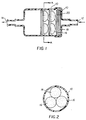
- Fig. 1 illustrates a fuel treatment device comprising a cylindrical two-part in-line housing or container 10 including a fuel flow inlet 12 and a fuel flow outlet 14.
- the container 10 can be manufactured from a plastic material, metal, composites and other synthetic materials.
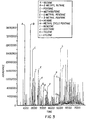
- a plurality of catalyst elements 16 are located within the container 10 and are arranged in two sets of three elements as illustrated in Fig. 2.
- the catalyst elements 16 are located between element spacers 18 and mild steel mesh disks 20.
- the element spacers 18 are preferably plastic disks with perforations that permit, as with the steel mesh disks 20, the passage of fuel from the fuel flow inlet 12 to the fuel flow outlet 14, during which time the fuel comes into contact with the elements 16. If the container 10 is made from mild steel, it is not necessary to include separate mild steel mesh disks 20.
- the elements 16 preferably include, apart from impurities, 60 to 80 %wt tin, 15 to 30 %wt antimony, 2 to 7 %wt lead, and 3 to 12 %wt mercury, and may be formed by casting, extruding, cutting or shaping to have any desired configuration.
- the elements 16 have a base diameter of approximately 20 mm.
- the particular number required naturally depends upon the desired application and implementation of the fuel treatment device. Further, altering the number of elements 16 will naturally change the number of element spacers 18 and steel mesh disks 20 employed in the device. A catalytic reaction takes place between the fuel and the elements 16 as the fuel passes through the container 10, which causes an improvement in the combustion of the fuel when burned.
- the elements 16 are composed of a composition of 70 to 75 %wt tin, 15 to 25%wt antimony, 2 to 4 %wt lead and 3 to 7 %wf mercury and are manufactured by the following method:
- mis-cast elements or any of the formulation allowed to solidify in the melting pot, may be remelted and re-cast provided that the total time lapse after the addition of the mercury does not exceed 45 minutes.
- the elements 16 may be made from an alloy that is approximately 75 %wt tin, 21 %wt antimony and 4 %wt lead, wherein 0.5 kg of mercury and 0.020 kg platinum is added to 5.0 kg of the alloy.
- Empirical evidence has demonstrated that the fuel catalyst improves the combustion process in diesel, gasoline, alcohol (both methanol and ethanol), and heating oil.
- the method of analysis chosen was gas chromatography followed by mass spectrometric detection (GC/MS).
- GC/MS is capable of determining the chemical composition of complex mixtures of organic compounds such as fuels. Testing was conducted using catalyst packs containing 3.5 inch diameter elements, of the type described above, in a polyethylene cage.
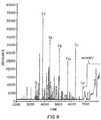
- Figs. 3-8 The six reconstructed ion chromatograms for the treated and untreated gasoline, Indolene, and diesel fuels, respectively, are shown in Figs. 3-8. Detailed data analysis was performed using the Chemstation software. The results of these experiments show major changes occurred in the fuel samples. Cursory comparison of the untreated and treated fuels in Fig. 3-8 show that the elements changed the amounts of individual components in the fuel samples by large amounts. As shown in Fig. 3, the treated gasoline, shows many more large peaks eluting between 40 and 80 minutes of the run, in comparison to the untreated gasoline in Fig. 4. It should be noted that concentration is proportional to peak height in the figures. When peaks could be identified, based on their mass spectrum, their identity has been indicated next to the peak.
- the three peaks in Fig. 4 between 50 and 51.2 minutes are identified as the three isomers of xylene.
- the peaks range in height from about 200,000 to 500,000 units.
- the same isomers of xylene range in height from 1,200,000 to 2,500,000, an increase of approximately five-fold in concentration. Similar changes in peak height are observed for the diesel fuel and the Indolene.
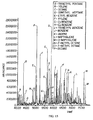
- Fig. 15 shows an annotated chromatogram of the 40-80 minute portion of the treated gasoline in Fig. 3.
- Fig. 4 shows almost no compounds eluting in this region, there are many which were tentatively identified in Fig. 15.
- These compounds are mostly aromatic in nature, meaning they are based on benzene.
- Fig. 15 shows toluene (methyl benzene), the xylenes, ethyl benzenes, and various isomers of C 3 -benzene and C 4 -benzene.
- the aromatic hydrocarbons have the most energy per unit carbon, and thus have the highest octane rating, so the catalyst treatment appears to increase octane and energy content of the gasoline by forming aromatic compounds.
- Figs. 16-18 and 19-21 show masses 77, 91, and 105, indicative of benzene, toluene, and xylene, respectively, for the treated and untreated Indolene.
- the treated Indolene shows a much higher proportion of xylenes than the untreated fuel. It is believed that the C 3 - benzenes and C 4 -benzenes are being converted by the catalyst elements to these compounds.
- Diesel fuel is primarily made up of C 8 to C 18 saturated alkanes, with the bulk cut being between C 12 and C 16 . The lighter ends lower the cetane number of diesel, and the heavier ends are not efficiently burned.
- Figs. 7 and 8 are annotated to show the different C values.
- the fuel catalyst described above utilizes antimony, tin, lead and mercury. Antimony and tin, in particular, act as hydride producers in protonic solvents.
- the elements of the fuel catalyst act in a similar manner to an electrolysis cell. The elements act as a set of short-circuited galvanic cells, in which the one or more elements is a common anode (with a high overvoltage for hydrogen evolution) and one or more elements act as a cathode (with relatively low hydrogen overvoltages). Metal ions leave the common anode while hydrogen gas is evolved from the cathode.
- both antimony and tin produce the hydrides Stibine (SbH3) and Stannane (SnH4) when a more active electrolytic element (less noble) and a less active electrolytic element (more noble), for example lead and mercury, are present.
- SbH3 Stibine
- SnH4 Stannane
- These hydrides are very unstable and decompose rapidly to produce hydrogen and the parent metal, especially in the presence of dissimilar metals.
- hydrocarbon fuels there are always acidic impurities and water, which is soluble to some extent in all fuels. These supply labile hydrogen ions to the fuel catalyst to allow the liberation of hydrogen in small and safe quantities. It is therefore believed that the hydrogen resulting from the catalytic action is responsible for improving the combustion process, allowing the improvements that have been observed in power, reduction of pollutants and particulates, and an increase in mileage.
- fuel catalyst elements having 40 %wt zinc, 40 %wt antimony, 18 %wt tin and 2 % wt silver were prepared using a smelting process. For example, the antimony, tin and silver are combined and melted in a crucible at a temperature of 1100-1200 degrees F and stirred until completely alloyed.
- the zinc is then added to the mixture and it is either poured into molds and cast or dropped to form shot.
- the fuel catalyst was then compared with the fuel catalyst of U.S. Patent 5,580,359 described above and a control using no fuel catalyst. Six independent runs were made for the control, the fuel catalyst of U.S. Patent 5,580,359 and the analytically developed new fuel catalyst described above, while measurements of CO, CO 2 , HC and O 2 were taken. The averaged results of the six runs are illustrated in Table 1.
- a further preferred embodiment includes 0.1-1.0 %wt palladium, 20-80 %wt magnesium, 20-60 %wt antimony, 10-30 %wt tin and 1-8 %wt cerium, with a further preferred embodiment within the above ranges includes 0.2 %wt palladium, 30 %wt magnesium, 40 %wt antimony, 25 %wt tin and 4.8 %wt cerium.
- a still further embodiment includes 39 %wt zinc, 11 %wt aluminum, 25 %wt tin and 25 %wt antimony.
- the interaction between the catalyst elements and the mild steel is not fully appreciated at this time. It is believed that the mild steel is also acting in combination with the catalyst elements as a material that is more active on the electrolytic scale. In order to avoid problems with corrosion of steel mesh, attempts were made to replace the steel screens with non-corrosive #316 stainless steel screens. It was found, however, that #316 stainless steel appeared to adversely impact the efficiency of the fuel catalyst. It was discovered, however, that an alloy of nickel and copper, for example Monel 400 could be successfully utilized in place of the mild steel. Other alloys may also be utilized including Monel 404, Monel 405 and Monel K500, as well as other types of alloys having equivalent properties. For example, brass, copper and alloys of copper and nickel are also suitable. In such cases, it is believed that the copper is acting in combination with the fuel catalyst elements as an element of greater activity on the electrolytic scale.
- the use of a steel or alloy container or screens may not be required.
- the fuel catalyst alone is sufficient to cause the generation of hydrogen when combined with fuel.
- the fuel catalyst works in conjunction with the acid in the fuel, as the fuel catalyst actually works better for "dirty" fuels, i.e. acid containing, as compared with "clean" fuels.
- Figs. 22 and 23 illustrate a further embodiment of an in-line housing 26 in which a plurality of catalyst elements 16 are separated into three levels by mild steel screens or separators 28.
- Fig. 24 illustrates an in-line housing 30 wherein a plurality of elements 16 are retained within mild steel screen mesh retainer 32 located in the cylindrical housing 30 having threaded end caps 34.
- Fig. 25 illustrates an in-line housing 35 in which a plurality of elements 16 are retained in element spacers 37, of a type illustrated in Figs. 26 and 27, in combination with Monel screens or washers.
- Figs. 28-301 illustrate a drop-in housing or cage 36 comprising a snap-fit plastic container in which a plurality of elements 16 can be retained. Holes 38, 40 are provided in the housing 36 to permit fuel to pass through the housing 36 and contact the elements 16.
- the drop-in housing 36 is dropped into a steel fuel tank in order to treat fuel, and is particularly useful for small engine applications including, for example, lawn maintenance equipment.
- the housing be made of mild steel, Monel or an appropriate alloy or that screens be used to retain the elements.
- the catalyst element can be formed into any desired shape f or use within any desired type of housing
- the catalyst element can be formed as a dry power or a semi-dry paste and poured directly into a fuel tank or formed as part of the fuel distribution system of a vehicle, burner, furnace or other combustion device.
- the housing or container retaining the elements may also be formed in any desired shape.
Landscapes
- Chemical & Material Sciences (AREA)
- Engineering & Computer Science (AREA)
- Chemical Kinetics & Catalysis (AREA)
- Combustion & Propulsion (AREA)
- Organic Chemistry (AREA)
- Mechanical Engineering (AREA)
- General Engineering & Computer Science (AREA)
- Oil, Petroleum & Natural Gas (AREA)
- Materials Engineering (AREA)
- General Chemical & Material Sciences (AREA)
- Inorganic Chemistry (AREA)
- Catalysts (AREA)
- Feeding And Controlling Fuel (AREA)
- Hydrogen, Water And Hydrids (AREA)
Claims (19)
- Vorrichtung zur Verbesserung des Verbrennungswirkungsgrads umfassend:mindestens ein Katalysatorelement (16), das mindestens ein Hydrid-erzeugendes Element, mindestens ein Element mit größerer Aktivität auf der elektrolytischen Skala als das Hydrid-erzeugende Element, und mindestens ein Element mit geringerer Aktivität auf der elektrolytischen Skala als das Hydrid-erzeugende Element enthält; undMittel zum Inkontaktbringen von Kraftstoff mit dem Katalysatorelement;
worin das Katalysatorelement mindestens eines von Zink, Aluminium, Antimon und Zinn umfasst, dadurch gekennzeichnet, dass das Katalysatorelement weiterhin mindestens eines von Magnesium, Palladium, Silber und Cer umfasst. - Vorrichtung nach Anspruch 1, worin das Element mit größerer Aktivität und das Element mit geringerer Aktivität mindestens eines von Zink, Magnesium, Aluminium, Palladium, Silber, Kupfer und Cer umfasst.
- Vorrichtung nach Anspruch 1 oder 2, worin das Katalysatorelement (16) 10-80 Gew.-% Zink, 20-60 Gew.-% Antimon, 1-5 Gew.-% Silber und 10-30 Gew.-% Zinn umfasst.
- Vorrichtung nach Anspruch 3, worin das Katalysatorelement (16) 40 Gew.-% Zink, 40 Gew.-% Antimon, 18 Gew.-% Zinn und 2 Gew.-% Silber umfasst.
- Vorrichtung nach Anspruch 1 oder 2, worin das Katalysatorelement (16) 0,1-1,0 Gew.-% Palladium, 20-80 Gew.-% Magnesium, 20-60 Gew.-% Antimon, 10-30 Gew.-% Zinn und 1-8 Gew.-% Cer umfasst.
- Vorrichtung nach Anspruch 5, worin das Katalysatorelement (16) 0,2 Gew.-% Palladium, 30 Gew.-% Magnesium, 40 Gew.-% Antimon, 25 Gew.-% Zinn und 4,8 Gew.-% Cer umfasst.
- Vorrichtung nach Anspruch 1 oder 2, worin das Katalysatorelement (16) 39 Gew.-% Zink, 11 Gew.-% Aluminium, 25 Gew.-% Zinn und 25 Gew.-% Antimon umfasst.
- Vorrichtung nach Anspruch 1, worin das Mittel zum Inkontaktbringen von Kraftstoff mit dem Katalysatorelement (16) ein drop-in Gehäuse umfasst.
- Verfahren zur Verbesserung des Wirkungsgrads der Kraftstoffverbrennung umfassend:Inkontaktbringen eines Kraftstoffs mit einem Katalysatorelement (16), das mindestens ein Hydrid-erzeugendes Element, mindestens ein Element mit größerer Aktivität auf der elektrolytischen Skala als das Hydrid-erzeugende Element, und mindestens ein Element mit geringerer Aktivität auf der elektrolytischen Skala als das Hydrid-erzeugende Element enthält; undVerbrennen des Kraftstoffs in einem Verbrennungsverfahren;
worin das Katalysatorelement mindestens eines von Zink, Aluminium, Antimon und Zinn umfasst, dadurch gekennzeichnet, dass das Katalysatorelement weiterhin mindestens eines von Magnesium, Palladium, Silber und Cer umfasst. - Verfahren nach Anspruch 9, wobei das Element mit größerer Aktivität und das Element mit geringerer Aktivität jeweils mindestens eines von Zink, Magnesium, Aluminium, Palladium, Silber, Kupfer und Cer umfasst.
- Verfahren nach Anspruch 9 oder 10, wobei das Katalysatorelement (16) 10-80 Gew.-% Zink, 20-60 Gew.-% Antimon, 1-5 Gew.-% Silber und 10-30 Gew.-% Zinn umfasst.
- Verfahren nach Anspruch 11, wobei das Katalysatorelement (16) 40 Gew.-% Zink, 40 Gew.-% Antimon, 18 Gew.-% Zinn und 2 Gew.-% Silber umfasst.
- Verfahren nach Anspruch 9 oder 10, wobei das Katalysatorelement (16) 0,1-1,0 Gew.-% Palladium, 20-80 Gew.-% Magnesium, 20-60 Gew.-% Antimon, 10-30 Gew.-% Zinn und 1-8 Gew.-% Cer umfasst.
- Verfahren nach Anspruch 13, wobei das Katalysatorelement (16) 0,2 Gew.-% Palladium, 30 Gew.-% Magnesium, 40 Gew.-% Antimon, 25 Gew.-% Zinn und 4,8 Gew.-% Cer umfasst.
- Verfahren nach Anspruch 9 oder 10, wobei das Katalysatorelement (16) 39 Gew.-% Zink, 11 Gew.-% Aluminium, 25 Gew.-% Zinn und 25 Gew.-% Antimon umfasst.
- Vorrichtung nach Anspruch 1 oder 2, worin das Hydrid-erzeugende Element mindestens eines von 20-60 Gew.-% Antimon und 10-30 Gew.-% Zinn umfasst; und worin das Element mit größerer Aktivität und das Element mit geringerer Aktivität jeweils mindestens eines von 20-80 Gew.-% Magnesium, 1-8 Gew.-% Cer und 0,1-1,0 Gew.% Palladium umfasst.
- Vorrichtung nach Anspruch 16, worin das Hydrid-erzeugende Element mindestens eines von 40 Gew.-% Antimon und 25 Gew.-% Zinn umfasst; und worin das Element mit größerer Aktivität und das Element mit geringerer Aktivität jeweils mindestens eines von 30 Gew.-% Magnesium, 4,8 Gew.-% Cer und 0,2 Gew.% Palladium umfasst.
- Vorrichtung nach Anspruch 1 oder 2, worin das Hydrid-erzeugende Element mindestens eines von 25 Gew.-% Antimon und 25 Gew.-% Zinn umfasst; und worin das Element mit größerer Aktivität und das Element mit geringerer Aktivität jeweils mindestens eines von 39 Gew.-% Zink und 11 Gew.% Aluminium umfasst.
- Vorrichtung nach Anspruch 1 oder 2, worin der Treibstoffkatalysator Wasserstoff freisetzt, wenn er mit einem Treibstoff in Kontakt gebracht wird.
Priority Applications (1)
| Application Number | Priority Date | Filing Date | Title |
|---|---|---|---|
| EP06004910A EP1666715A3 (de) | 1996-11-29 | 1997-11-28 | Methode und Vorrichtung für Brennstoffbehandlung |
Applications Claiming Priority (5)
| Application Number | Priority Date | Filing Date | Title |
|---|---|---|---|
| US08/757,612 US5738692A (en) | 1989-05-26 | 1996-11-29 | Fuel treatment device |
| US757612 | 1996-11-29 | ||
| US961710 | 1997-10-31 | ||
| US08/961,710 US6000381A (en) | 1989-05-26 | 1997-10-31 | Method and apparatus for treating fuel |
| PCT/US1997/021887 WO1998023856A1 (en) | 1996-11-29 | 1997-11-28 | Method and device for treating fuel |
Related Child Applications (1)
| Application Number | Title | Priority Date | Filing Date |
|---|---|---|---|
| EP06004910A Division EP1666715A3 (de) | 1996-11-29 | 1997-11-28 | Methode und Vorrichtung für Brennstoffbehandlung |
Publications (3)
| Publication Number | Publication Date |
|---|---|
| EP0941398A1 EP0941398A1 (de) | 1999-09-15 |
| EP0941398A4 EP0941398A4 (de) | 2000-11-22 |
| EP0941398B1 true EP0941398B1 (de) | 2006-03-15 |
Family
ID=27116414
Family Applications (1)
| Application Number | Title | Priority Date | Filing Date |
|---|---|---|---|
| EP97949689A Expired - Lifetime EP0941398B1 (de) | 1996-11-29 | 1997-11-28 | Verfahren und vorrichtung zum behandeln von brennstoff |
Country Status (7)
| Country | Link |
|---|---|
| EP (1) | EP0941398B1 (de) |
| JP (1) | JP2001527460A (de) |
| AT (1) | ATE320553T1 (de) |
| AU (1) | AU741732B2 (de) |
| CA (1) | CA2272294A1 (de) |
| DE (1) | DE69735504T2 (de) |
| WO (1) | WO1998023856A1 (de) |
Cited By (1)
| Publication number | Priority date | Publication date | Assignee | Title |
|---|---|---|---|---|
| WO2026017986A1 (en) * | 2024-07-17 | 2026-01-22 | Fuelogical Ltd. | Fuel catalyst assembly |
Families Citing this family (2)
| Publication number | Priority date | Publication date | Assignee | Title |
|---|---|---|---|---|
| GB2355491B (en) * | 1999-10-21 | 2003-11-05 | Michael Leonard Lucas | Fuel conditioning device |
| PE20160647A1 (es) * | 2015-12-31 | 2016-07-08 | Sanchez-Concha Rodrigo Coquis | Dispositivo para el tratamiento y la eliminacion de bacterias en hidrocarburos combustibles y proceso para su fabricacion y la activacion de su superficie |
Family Cites Families (5)
| Publication number | Priority date | Publication date | Assignee | Title |
|---|---|---|---|---|
| GB8912592D0 (en) * | 1989-05-26 | 1989-07-19 | Wribro Ltd | Fuel additives |
| US4930483A (en) * | 1989-08-11 | 1990-06-05 | Jones Wallace R | Fuel treatment device |
| US5048499A (en) * | 1990-03-29 | 1991-09-17 | Daywalt Clark L | Fuel treatment device |
| US5059217A (en) * | 1990-10-10 | 1991-10-22 | Arroyo Melvin L | Fluid treating device |
| US5154153A (en) * | 1991-09-13 | 1992-10-13 | Macgregor Donald C | Fuel treatment device |
-
1997
- 1997-11-28 EP EP97949689A patent/EP0941398B1/de not_active Expired - Lifetime
- 1997-11-28 WO PCT/US1997/021887 patent/WO1998023856A1/en not_active Ceased
- 1997-11-28 DE DE69735504T patent/DE69735504T2/de not_active Expired - Lifetime
- 1997-11-28 CA CA002272294A patent/CA2272294A1/en not_active Abandoned
- 1997-11-28 AU AU74111/98A patent/AU741732B2/en not_active Ceased
- 1997-11-28 JP JP52487498A patent/JP2001527460A/ja not_active Ceased
- 1997-11-28 AT AT97949689T patent/ATE320553T1/de not_active IP Right Cessation
Cited By (1)
| Publication number | Priority date | Publication date | Assignee | Title |
|---|---|---|---|---|
| WO2026017986A1 (en) * | 2024-07-17 | 2026-01-22 | Fuelogical Ltd. | Fuel catalyst assembly |
Also Published As
| Publication number | Publication date |
|---|---|
| CA2272294A1 (en) | 1998-06-04 |
| AU7411198A (en) | 1998-06-22 |
| DE69735504T2 (de) | 2006-12-14 |
| DE69735504D1 (de) | 2006-05-11 |
| AU741732B2 (en) | 2001-12-06 |
| JP2001527460A (ja) | 2001-12-25 |
| EP0941398A4 (de) | 2000-11-22 |
| WO1998023856A1 (en) | 1998-06-04 |
| ATE320553T1 (de) | 2006-04-15 |
| EP0941398A1 (de) | 1999-09-15 |
Similar Documents
| Publication | Publication Date | Title |
|---|---|---|
| US6770105B2 (en) | Method and device for treating fuel | |
| US6000381A (en) | Method and apparatus for treating fuel | |
| Lee et al. | Catalytic hydrodeoxygenation of bio-oil model compounds over Pt/HY catalyst | |
| EP0807754B1 (de) | Vorrichtung zur Behandlung von aus Mineralöl oder Pflanzen gewonnenen Treib- und Brennstoffen | |
| US5069190A (en) | Fuel treatment methods, compositions and devices | |
| US5167782A (en) | Method and apparatus for treating fuel | |
| US5741414A (en) | Method of manufacturing gas oil containing low amounts of sulfur and aromatic compounds | |
| AU741732B2 (en) | Method and device for treating fuel | |
| Aboul-Fotouh et al. | High octane number gasoline-ether blend | |
| EP1666715A2 (de) | Methode und Vorrichtung für Brennstoffbehandlung | |
| AU1881502A (en) | Method and device for treating fuel | |
| Sassykova et al. | Synthesis of catalysts on the metal block carriers and testing their effectiveness in the real conditions of operation | |
| DE3927958C2 (de) | ||
| CN100392046C (zh) | 低温或常温脱除液态石油烃中高沸点砷化物的脱砷剂 | |
| JPH08283751A (ja) | 合成燃料並びに低公害燃料の製造方法及びその製造装置 | |
| Ho et al. | Adsorptive Desulfurization of Diesel for Fuel Cell Applications: A Screening Test | |
| DE2119798A1 (de) | Verfahren und Vorrichtung, die Menge schädlicher Bestandteile in einem Abgasstrom zu reduzieren | |
| US20090199465A1 (en) | Procedure of obtaining automotive fuels and the modified fuels obtained by means of this procedure | |
| Stavinoha et al. | Evaluation of Motor Gasoline Stability | |
| CN1052324A (zh) | 柴油添加剂 | |
| JP2510913B2 (ja) | 排ガス中の窒素酸化物の除去方法 | |
| Hall et al. | Effect of lead antiknock regulations on gasoline aromatics and aromatic exhaust emissions | |
| DE19637032A1 (de) | Verfahren zum Entfernen von Stickstoffoxiden aus mageren Abgasen | |
| Wittmann | Determination of wear metals in used lubricating oils by atomic absorption spectrometry | |
| KR20250012945A (ko) | 폐플라스틱 열분해유를 기반으로 한 지속가능항공유 생산방법 |
Legal Events
| Date | Code | Title | Description |
|---|---|---|---|
| PUAI | Public reference made under article 153(3) epc to a published international application that has entered the european phase |
Free format text: ORIGINAL CODE: 0009012 |
|
| 17P | Request for examination filed |
Effective date: 19990522 |
|
| AK | Designated contracting states |
Kind code of ref document: A1 Designated state(s): AT BE CH DE DK ES FI FR GB GR IE IT LI NL PT SE |
|
| A4 | Supplementary search report drawn up and despatched |
Effective date: 20001011 |
|
| AK | Designated contracting states |
Kind code of ref document: A4 Designated state(s): AT BE CH DE DK ES FI FR GB GR IE IT LI NL PT SE |
|
| 17Q | First examination report despatched |
Effective date: 20031124 |
|
| GRAP | Despatch of communication of intention to grant a patent |
Free format text: ORIGINAL CODE: EPIDOSNIGR1 |
|
| GRAS | Grant fee paid |
Free format text: ORIGINAL CODE: EPIDOSNIGR3 |
|
| GRAA | (expected) grant |
Free format text: ORIGINAL CODE: 0009210 |
|
| AK | Designated contracting states |
Kind code of ref document: B1 Designated state(s): AT BE CH DE DK ES FI FR GB GR IE IT LI NL PT SE |
|
| PG25 | Lapsed in a contracting state [announced via postgrant information from national office to epo] |
Ref country code: NL Free format text: LAPSE BECAUSE OF FAILURE TO SUBMIT A TRANSLATION OF THE DESCRIPTION OR TO PAY THE FEE WITHIN THE PRESCRIBED TIME-LIMIT Effective date: 20060315 Ref country code: LI Free format text: LAPSE BECAUSE OF FAILURE TO SUBMIT A TRANSLATION OF THE DESCRIPTION OR TO PAY THE FEE WITHIN THE PRESCRIBED TIME-LIMIT Effective date: 20060315 Ref country code: IT Free format text: LAPSE BECAUSE OF FAILURE TO SUBMIT A TRANSLATION OF THE DESCRIPTION OR TO PAY THE FEE WITHIN THE PRESCRIBED TIME-LIMIT;WARNING: LAPSES OF ITALIAN PATENTS WITH EFFECTIVE DATE BEFORE 2007 MAY HAVE OCCURRED AT ANY TIME BEFORE 2007. THE CORRECT EFFECTIVE DATE MAY BE DIFFERENT FROM THE ONE RECORDED. Effective date: 20060315 Ref country code: FI Free format text: LAPSE BECAUSE OF FAILURE TO SUBMIT A TRANSLATION OF THE DESCRIPTION OR TO PAY THE FEE WITHIN THE PRESCRIBED TIME-LIMIT Effective date: 20060315 Ref country code: CH Free format text: LAPSE BECAUSE OF FAILURE TO SUBMIT A TRANSLATION OF THE DESCRIPTION OR TO PAY THE FEE WITHIN THE PRESCRIBED TIME-LIMIT Effective date: 20060315 Ref country code: BE Free format text: LAPSE BECAUSE OF FAILURE TO SUBMIT A TRANSLATION OF THE DESCRIPTION OR TO PAY THE FEE WITHIN THE PRESCRIBED TIME-LIMIT Effective date: 20060315 Ref country code: AT Free format text: LAPSE BECAUSE OF FAILURE TO SUBMIT A TRANSLATION OF THE DESCRIPTION OR TO PAY THE FEE WITHIN THE PRESCRIBED TIME-LIMIT Effective date: 20060315 |
|
| REG | Reference to a national code |
Ref country code: GB Ref legal event code: FG4D Ref country code: CH Ref legal event code: EP |
|
| REG | Reference to a national code |
Ref country code: IE Ref legal event code: FG4D |
|
| REF | Corresponds to: |
Ref document number: 69735504 Country of ref document: DE Date of ref document: 20060511 Kind code of ref document: P |
|
| PG25 | Lapsed in a contracting state [announced via postgrant information from national office to epo] |
Ref country code: SE Free format text: LAPSE BECAUSE OF FAILURE TO SUBMIT A TRANSLATION OF THE DESCRIPTION OR TO PAY THE FEE WITHIN THE PRESCRIBED TIME-LIMIT Effective date: 20060615 Ref country code: DK Free format text: LAPSE BECAUSE OF FAILURE TO SUBMIT A TRANSLATION OF THE DESCRIPTION OR TO PAY THE FEE WITHIN THE PRESCRIBED TIME-LIMIT Effective date: 20060615 |
|
| PG25 | Lapsed in a contracting state [announced via postgrant information from national office to epo] |
Ref country code: ES Free format text: LAPSE BECAUSE OF FAILURE TO SUBMIT A TRANSLATION OF THE DESCRIPTION OR TO PAY THE FEE WITHIN THE PRESCRIBED TIME-LIMIT Effective date: 20060626 |
|
| PG25 | Lapsed in a contracting state [announced via postgrant information from national office to epo] |
Ref country code: PT Free format text: LAPSE BECAUSE OF FAILURE TO SUBMIT A TRANSLATION OF THE DESCRIPTION OR TO PAY THE FEE WITHIN THE PRESCRIBED TIME-LIMIT Effective date: 20060816 |
|
| NLV1 | Nl: lapsed or annulled due to failure to fulfill the requirements of art. 29p and 29m of the patents act | ||
| REG | Reference to a national code |
Ref country code: CH Ref legal event code: PL |
|
| ET | Fr: translation filed | ||
| PG25 | Lapsed in a contracting state [announced via postgrant information from national office to epo] |
Ref country code: IE Free format text: LAPSE BECAUSE OF NON-PAYMENT OF DUE FEES Effective date: 20061128 |
|
| PLBE | No opposition filed within time limit |
Free format text: ORIGINAL CODE: 0009261 |
|
| STAA | Information on the status of an ep patent application or granted ep patent |
Free format text: STATUS: NO OPPOSITION FILED WITHIN TIME LIMIT |
|
| 26N | No opposition filed |
Effective date: 20061218 |
|
| PG25 | Lapsed in a contracting state [announced via postgrant information from national office to epo] |
Ref country code: GR Free format text: LAPSE BECAUSE OF FAILURE TO SUBMIT A TRANSLATION OF THE DESCRIPTION OR TO PAY THE FEE WITHIN THE PRESCRIBED TIME-LIMIT Effective date: 20060616 |
|
| PGFP | Annual fee paid to national office [announced via postgrant information from national office to epo] |
Ref country code: GB Payment date: 20101126 Year of fee payment: 14 |
|
| PGFP | Annual fee paid to national office [announced via postgrant information from national office to epo] |
Ref country code: FR Payment date: 20111215 Year of fee payment: 15 |
|
| PGFP | Annual fee paid to national office [announced via postgrant information from national office to epo] |
Ref country code: DE Payment date: 20120131 Year of fee payment: 15 |
|
| GBPC | Gb: european patent ceased through non-payment of renewal fee |
Effective date: 20121128 |
|
| REG | Reference to a national code |
Ref country code: FR Ref legal event code: ST Effective date: 20130731 |
|
| REG | Reference to a national code |
Ref country code: DE Ref legal event code: R119 Ref document number: 69735504 Country of ref document: DE Effective date: 20130601 |
|
| PG25 | Lapsed in a contracting state [announced via postgrant information from national office to epo] |
Ref country code: DE Free format text: LAPSE BECAUSE OF NON-PAYMENT OF DUE FEES Effective date: 20130601 |
|
| PG25 | Lapsed in a contracting state [announced via postgrant information from national office to epo] |
Ref country code: GB Free format text: LAPSE BECAUSE OF NON-PAYMENT OF DUE FEES Effective date: 20121128 Ref country code: FR Free format text: LAPSE BECAUSE OF NON-PAYMENT OF DUE FEES Effective date: 20121130 |