EP0941969A1 - Wasserbehandlungsvorrichtungen mit körnigem, Turmalin enthaltenden Verbundmaterial - Google Patents
Wasserbehandlungsvorrichtungen mit körnigem, Turmalin enthaltenden Verbundmaterial Download PDFInfo
- Publication number
- EP0941969A1 EP0941969A1 EP19990104743 EP99104743A EP0941969A1 EP 0941969 A1 EP0941969 A1 EP 0941969A1 EP 19990104743 EP19990104743 EP 19990104743 EP 99104743 A EP99104743 A EP 99104743A EP 0941969 A1 EP0941969 A1 EP 0941969A1
- Authority
- EP
- European Patent Office
- Prior art keywords
- water
- tourmaline
- tower
- grains
- tank
- Prior art date
- Legal status (The legal status is an assumption and is not a legal conclusion. Google has not performed a legal analysis and makes no representation as to the accuracy of the status listed.)
- Withdrawn
Links
- XLYOFNOQVPJJNP-UHFFFAOYSA-N water Substances O XLYOFNOQVPJJNP-UHFFFAOYSA-N 0.000 title claims abstract description 204
- 229910052613 tourmaline Inorganic materials 0.000 title claims abstract description 119
- 229940070527 tourmaline Drugs 0.000 title claims abstract description 119
- 239000011032 tourmaline Substances 0.000 title claims abstract description 119
- 239000002131 composite material Substances 0.000 title claims abstract description 47
- 238000005406 washing Methods 0.000 claims abstract description 54
- 239000011521 glass Substances 0.000 claims abstract description 48
- 239000000843 powder Substances 0.000 claims abstract description 42
- 239000002351 wastewater Substances 0.000 claims abstract description 41
- 239000011159 matrix material Substances 0.000 claims abstract description 23
- 238000002844 melting Methods 0.000 claims abstract description 21
- 230000008018 melting Effects 0.000 claims abstract description 21
- 230000007704 transition Effects 0.000 claims abstract description 8
- 238000004064 recycling Methods 0.000 claims abstract description 4
- 239000000126 substance Substances 0.000 claims description 24
- 230000005855 radiation Effects 0.000 claims description 22
- 239000011230 binding agent Substances 0.000 claims description 16
- 239000000463 material Substances 0.000 claims description 16
- 230000001680 brushing effect Effects 0.000 claims description 14
- 239000011701 zinc Substances 0.000 claims description 12
- ZOXJGFHDIHLPTG-UHFFFAOYSA-N Boron Chemical compound [B] ZOXJGFHDIHLPTG-UHFFFAOYSA-N 0.000 claims description 11
- 229910052796 boron Inorganic materials 0.000 claims description 11
- HCHKCACWOHOZIP-UHFFFAOYSA-N Zinc Chemical compound [Zn] HCHKCACWOHOZIP-UHFFFAOYSA-N 0.000 claims description 10
- 239000004033 plastic Substances 0.000 claims description 10
- 229920003023 plastic Polymers 0.000 claims description 10
- 229910052725 zinc Inorganic materials 0.000 claims description 10
- 241001148470 aerobic bacillus Species 0.000 claims description 4
- 239000012535 impurity Substances 0.000 claims description 4
- 238000007781 pre-processing Methods 0.000 claims description 3
- 229910052761 rare earth metal Inorganic materials 0.000 claims description 3
- 150000002910 rare earth metals Chemical class 0.000 claims description 3
- 239000003599 detergent Substances 0.000 abstract description 13
- 239000000203 mixture Substances 0.000 abstract description 7
- XEEYBQQBJWHFJM-UHFFFAOYSA-N Iron Chemical compound [Fe] XEEYBQQBJWHFJM-UHFFFAOYSA-N 0.000 description 14
- 239000002932 luster Substances 0.000 description 13
- XLOMVQKBTHCTTD-UHFFFAOYSA-N Zinc monoxide Chemical compound [Zn]=O XLOMVQKBTHCTTD-UHFFFAOYSA-N 0.000 description 12
- 235000020679 tap water Nutrition 0.000 description 9
- 239000008399 tap water Substances 0.000 description 9
- 238000000354 decomposition reaction Methods 0.000 description 8
- 238000005245 sintering Methods 0.000 description 8
- 229910052742 iron Inorganic materials 0.000 description 7
- 239000003921 oil Substances 0.000 description 7
- VYPSYNLAJGMNEJ-UHFFFAOYSA-N silicon dioxide Inorganic materials O=[Si]=O VYPSYNLAJGMNEJ-UHFFFAOYSA-N 0.000 description 7
- 239000002349 well water Substances 0.000 description 7
- 235000020681 well water Nutrition 0.000 description 7
- CPLXHLVBOLITMK-UHFFFAOYSA-N Magnesium oxide Chemical compound [Mg]=O CPLXHLVBOLITMK-UHFFFAOYSA-N 0.000 description 6
- 230000008901 benefit Effects 0.000 description 6
- 239000011248 coating agent Substances 0.000 description 6
- 238000000576 coating method Methods 0.000 description 6
- 239000013078 crystal Substances 0.000 description 6
- 239000011787 zinc oxide Substances 0.000 description 6
- 229910000831 Steel Inorganic materials 0.000 description 5
- 239000002585 base Substances 0.000 description 5
- 230000003247 decreasing effect Effects 0.000 description 5
- 239000002245 particle Substances 0.000 description 5
- 239000010959 steel Substances 0.000 description 5
- 238000004018 waxing Methods 0.000 description 5
- 230000003213 activating effect Effects 0.000 description 4
- 230000000694 effects Effects 0.000 description 4
- 229910052751 metal Inorganic materials 0.000 description 4
- 239000002184 metal Substances 0.000 description 4
- 238000000034 method Methods 0.000 description 4
- -1 polyethylene Polymers 0.000 description 4
- 230000008569 process Effects 0.000 description 4
- 239000000377 silicon dioxide Substances 0.000 description 4
- PNEYBMLMFCGWSK-UHFFFAOYSA-N aluminium oxide Inorganic materials [O-2].[O-2].[O-2].[Al+3].[Al+3] PNEYBMLMFCGWSK-UHFFFAOYSA-N 0.000 description 3
- 229910052681 coesite Inorganic materials 0.000 description 3
- 239000004567 concrete Substances 0.000 description 3
- 229910052906 cristobalite Inorganic materials 0.000 description 3
- 239000003814 drug Substances 0.000 description 3
- 229940079593 drug Drugs 0.000 description 3
- 239000000428 dust Substances 0.000 description 3
- 239000011777 magnesium Substances 0.000 description 3
- 239000000395 magnesium oxide Substances 0.000 description 3
- 244000005700 microbiome Species 0.000 description 3
- XLYOFNOQVPJJNP-UHFFFAOYSA-O oxonium Chemical compound [OH3+] XLYOFNOQVPJJNP-UHFFFAOYSA-O 0.000 description 3
- 239000011734 sodium Substances 0.000 description 3
- 229910052682 stishovite Inorganic materials 0.000 description 3
- 229910052905 tridymite Inorganic materials 0.000 description 3
- 238000002441 X-ray diffraction Methods 0.000 description 2
- 239000003513 alkali Substances 0.000 description 2
- 238000004458 analytical method Methods 0.000 description 2
- 239000011324 bead Substances 0.000 description 2
- 230000003796 beauty Effects 0.000 description 2
- 239000011575 calcium Substances 0.000 description 2
- 238000006243 chemical reaction Methods 0.000 description 2
- 238000005260 corrosion Methods 0.000 description 2
- 230000007797 corrosion Effects 0.000 description 2
- 238000010586 diagram Methods 0.000 description 2
- 238000010438 heat treatment Methods 0.000 description 2
- 229910052500 inorganic mineral Inorganic materials 0.000 description 2
- 239000011707 mineral Substances 0.000 description 2
- 230000004048 modification Effects 0.000 description 2
- 238000012986 modification Methods 0.000 description 2
- 238000000634 powder X-ray diffraction Methods 0.000 description 2
- 238000004080 punching Methods 0.000 description 2
- 239000011347 resin Substances 0.000 description 2
- 229920005989 resin Polymers 0.000 description 2
- 229910052708 sodium Inorganic materials 0.000 description 2
- 125000006850 spacer group Chemical group 0.000 description 2
- 238000003756 stirring Methods 0.000 description 2
- 229910011255 B2O3 Inorganic materials 0.000 description 1
- OYPRJOBELJOOCE-UHFFFAOYSA-N Calcium Chemical compound [Ca] OYPRJOBELJOOCE-UHFFFAOYSA-N 0.000 description 1
- 235000008733 Citrus aurantifolia Nutrition 0.000 description 1
- DGAQECJNVWCQMB-PUAWFVPOSA-M Ilexoside XXIX Chemical compound C[C@@H]1CC[C@@]2(CC[C@@]3(C(=CC[C@H]4[C@]3(CC[C@@H]5[C@@]4(CC[C@@H](C5(C)C)OS(=O)(=O)[O-])C)C)[C@@H]2[C@]1(C)O)C)C(=O)O[C@H]6[C@@H]([C@H]([C@@H]([C@H](O6)CO)O)O)O.[Na+] DGAQECJNVWCQMB-PUAWFVPOSA-M 0.000 description 1
- FYYHWMGAXLPEAU-UHFFFAOYSA-N Magnesium Chemical compound [Mg] FYYHWMGAXLPEAU-UHFFFAOYSA-N 0.000 description 1
- 239000004698 Polyethylene Substances 0.000 description 1
- 229910006016 Si6O18 Inorganic materials 0.000 description 1
- 235000011941 Tilia x europaea Nutrition 0.000 description 1
- 230000009471 action Effects 0.000 description 1
- 230000004913 activation Effects 0.000 description 1
- 229910052782 aluminium Inorganic materials 0.000 description 1
- 229910052791 calcium Inorganic materials 0.000 description 1
- 239000008162 cooking oil Substances 0.000 description 1
- 229910052593 corundum Inorganic materials 0.000 description 1
- 238000009826 distribution Methods 0.000 description 1
- 230000001804 emulsifying effect Effects 0.000 description 1
- 238000001704 evaporation Methods 0.000 description 1
- 230000008020 evaporation Effects 0.000 description 1
- 239000010419 fine particle Substances 0.000 description 1
- 230000005764 inhibitory process Effects 0.000 description 1
- 150000002500 ions Chemical class 0.000 description 1
- UQSXHKLRYXJYBZ-UHFFFAOYSA-N iron oxide Inorganic materials [Fe]=O UQSXHKLRYXJYBZ-UHFFFAOYSA-N 0.000 description 1
- SZVJSHCCFOBDDC-UHFFFAOYSA-N iron(II,III) oxide Inorganic materials O=[Fe]O[Fe]O[Fe]=O SZVJSHCCFOBDDC-UHFFFAOYSA-N 0.000 description 1
- JEIPFZHSYJVQDO-UHFFFAOYSA-N iron(III) oxide Inorganic materials O=[Fe]O[Fe]=O JEIPFZHSYJVQDO-UHFFFAOYSA-N 0.000 description 1
- 239000011499 joint compound Substances 0.000 description 1
- 239000004571 lime Substances 0.000 description 1
- 229910052744 lithium Inorganic materials 0.000 description 1
- 229910001947 lithium oxide Inorganic materials 0.000 description 1
- 229910052749 magnesium Inorganic materials 0.000 description 1
- 238000004519 manufacturing process Methods 0.000 description 1
- 230000007246 mechanism Effects 0.000 description 1
- 239000011368 organic material Substances 0.000 description 1
- 238000000053 physical method Methods 0.000 description 1
- 229920000573 polyethylene Polymers 0.000 description 1
- 102000004169 proteins and genes Human genes 0.000 description 1
- 108090000623 proteins and genes Proteins 0.000 description 1
- 238000010298 pulverizing process Methods 0.000 description 1
- 230000005616 pyroelectricity Effects 0.000 description 1
- 230000009291 secondary effect Effects 0.000 description 1
- 239000004065 semiconductor Substances 0.000 description 1
- 239000007787 solid Substances 0.000 description 1
- 238000009834 vaporization Methods 0.000 description 1
- 230000008016 vaporization Effects 0.000 description 1
- 229910001845 yogo sapphire Inorganic materials 0.000 description 1
Images



Classifications
-
- C—CHEMISTRY; METALLURGY
- C02—TREATMENT OF WATER, WASTE WATER, SEWAGE, OR SLUDGE
- C02F—TREATMENT OF WATER, WASTE WATER, SEWAGE, OR SLUDGE
- C02F1/00—Treatment of water, waste water, or sewage
- C02F1/48—Treatment of water, waste water, or sewage with magnetic or electric fields
-
- C—CHEMISTRY; METALLURGY
- C02—TREATMENT OF WATER, WASTE WATER, SEWAGE, OR SLUDGE
- C02F—TREATMENT OF WATER, WASTE WATER, SEWAGE, OR SLUDGE
- C02F1/00—Treatment of water, waste water, or sewage
- C02F1/30—Treatment of water, waste water, or sewage by irradiation
-
- C—CHEMISTRY; METALLURGY
- C02—TREATMENT OF WATER, WASTE WATER, SEWAGE, OR SLUDGE
- C02F—TREATMENT OF WATER, WASTE WATER, SEWAGE, OR SLUDGE
- C02F1/00—Treatment of water, waste water, or sewage
- C02F1/68—Treatment of water, waste water, or sewage by addition of specified substances, e.g. trace elements, for ameliorating potable water
-
- C—CHEMISTRY; METALLURGY
- C02—TREATMENT OF WATER, WASTE WATER, SEWAGE, OR SLUDGE
- C02F—TREATMENT OF WATER, WASTE WATER, SEWAGE, OR SLUDGE
- C02F3/00—Biological treatment of water, waste water, or sewage
- C02F3/02—Aerobic processes
- C02F3/06—Aerobic processes using submerged filters
-
- C—CHEMISTRY; METALLURGY
- C02—TREATMENT OF WATER, WASTE WATER, SEWAGE, OR SLUDGE
- C02F—TREATMENT OF WATER, WASTE WATER, SEWAGE, OR SLUDGE
- C02F2103/00—Nature of the water, waste water, sewage or sludge to be treated
- C02F2103/44—Nature of the water, waste water, sewage or sludge to be treated from vehicle washing facilities
-
- Y—GENERAL TAGGING OF NEW TECHNOLOGICAL DEVELOPMENTS; GENERAL TAGGING OF CROSS-SECTIONAL TECHNOLOGIES SPANNING OVER SEVERAL SECTIONS OF THE IPC; TECHNICAL SUBJECTS COVERED BY FORMER USPC CROSS-REFERENCE ART COLLECTIONS [XRACs] AND DIGESTS
- Y02—TECHNOLOGIES OR APPLICATIONS FOR MITIGATION OR ADAPTATION AGAINST CLIMATE CHANGE
- Y02W—CLIMATE CHANGE MITIGATION TECHNOLOGIES RELATED TO WASTEWATER TREATMENT OR WASTE MANAGEMENT
- Y02W10/00—Technologies for wastewater treatment
- Y02W10/10—Biological treatment of water, waste water, or sewage
-
- Y—GENERAL TAGGING OF NEW TECHNOLOGICAL DEVELOPMENTS; GENERAL TAGGING OF CROSS-SECTIONAL TECHNOLOGIES SPANNING OVER SEVERAL SECTIONS OF THE IPC; TECHNICAL SUBJECTS COVERED BY FORMER USPC CROSS-REFERENCE ART COLLECTIONS [XRACs] AND DIGESTS
- Y02—TECHNOLOGIES OR APPLICATIONS FOR MITIGATION OR ADAPTATION AGAINST CLIMATE CHANGE
- Y02W—CLIMATE CHANGE MITIGATION TECHNOLOGIES RELATED TO WASTEWATER TREATMENT OR WASTE MANAGEMENT
- Y02W10/00—Technologies for wastewater treatment
- Y02W10/30—Wastewater or sewage treatment systems using renewable energies
- Y02W10/37—Wastewater or sewage treatment systems using renewable energies using solar energy
Definitions
- the present invention relates to an apparatus which processes water by using composite grains of tourmaline.
- a structure such as an automobile, a railroad train, an airplane or an outer wall of a building exposed to outdoor environment is washed to remove dirt due to adherence of dust, oil or mud.
- a detergent or a drug is used to improve washing performance.
- an automobile is washed to remove dirt adhered on the body thereof, and it is waxed thereafter to improve its luster and to suppress adhesion of dust or the like.
- a main object of the present invention is to provide an apparatus which solves these problems.
- a water supply apparatus for supplying wash water comprises a tank for storing raw water, a water supplier which supplies the raw water stored in he tank, and a tower containing tourmaline composite grains.
- the tower receives the raw water supplied from the tank by the water supplier, and makes the raw water flow therethrough to contact with the tourmaline composite grains.
- raw water is converted to activated water by contacting with the tourmaline composite grains, and the activated water can be supplied.
- the tourmaline composite comprises a glass matrix and fine powders of tourmaline dispersed therein of weight ratio equal to or larger than 30 %.
- the glass matrix is made of glass having melting point between 500 °C and transition point of tourmaline.
- the glass matrix contains zinc, or it contains boron.
- the tower comprises an outer tube and a plurality of inner tubes stacked inside the outer tube, the inner tubes having an open top end a bottom plate having openings, the tourmaline composite grains being contained in each of the inner tubes.
- the plurality of inner tubes are made of a plastics material.
- the tourmaline composite grains are arranged in the inner tubes to form a fluidized layer by the raw water flowing through the openings into the inner tubes.
- the water supplier applies a pressure to an air portion in the tank to send the raw water to the tower.
- an apparatus for recycling water comprises a tank for storing waste water after washing, and a tower which contains the above-mentioned tourmaline composite grains.
- the tower converts water received from the tank to activated water by contacting the water to the tourmaline composite grains and supplies the activated water for washing.
- a preprocessor is provided between the tank and the tower for processing the waste water for improving the activation in the tank.
- a washing machine may be connected to the tank for washing an object physically with the activated water.
- the apparatus further comprises a second tower provided between the reservoir and the first tower.
- the second tower decomposes organic substances in the waste water received from the reservoir and supplies the waste water to the first tower after decomposing organic substances.
- the second tower comprises an outer tube of a hollow cylinder, a radiation processor which contains grains of natural radiator substance combined with a binder, and a biological processor which contains aerobic bacteria.
- the water received from the reservoir passes through the radiation processor and the biological processor in the outer tube.
- the grains of natural radiator substance includes a rare earth having natural radiations.
- the apparatus further comprises a washing machine which washes an object physically with use of water, and a supply path which supplies the activated water from the first tower to the washing machine.
- the washing machine washes an object with brushing.
- the apparatus further comprises a preprocessing tank provided between the reservoir and the second tower to control concentration of impurities included in the waste water.
- the first tower further comprises a supplier which supplies virgin water into the first tower.
- the reservoir comprises a filter for removing dirt floating in the waste water.
- An advantage of the present invention is that the washing performance of water is enhanced largely.
- Another advantage of the present invention is that water can be recycled efficiently.
- a further advantage of the present invention is that a structure such as an automobile can be washed with a physical means without a detergent.
- the tourmaline composite grain comprises a glass matrix and powders of tourmaline dispersed therein of weight ratio equal to or larger than 30 %. Because such a very large amount of tourmaline powders are dispersed in the glass matrix, the tourmaline powders are in contact with each other. Then, there is a large probability that tourmaline powders are aligned in series.
- the lower limit of 30 % denotes a limit where tourmaline powders are dispersed while being contact in series in the matrix. Though the upper limit is not described, there exists a practical limit for having a sufficient strength with the glass matrix, for example about 70 %.
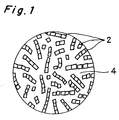
- the tourmaline composite grain consists of a large amount (equal to or larger than 30%) of tourmaline fine powders 2 and a glass matrix (binder) 4.
- Fig. 1 shows schematically series arrangement of tourmaline fine powders 2 in the glass matrix 4.
- the tourmaline fine particles 2 exist not only on the surface of the grain, but are connected in series inside the grain, and this enhances the electric potential therein.
- tourmaline sintered material of this structure tourmaline is pulverized to provide tourmaline fine powders, and they are mixed with glass powders having melting point between 500 °C and the transition temperature of tourmaline. Then, the composite mixture is formed into grains, and the grains are sintered at a temperature lower than the melting point of the glass.
- the glass matrix is made of glass powders having melting point between 500 °C and transition point of tourmaline.
- the glass matrix is sintered at a temperature below the melting point of the glass powders.
- the tourmaline powders are also sintered at the same time at a temperature between 450 °C and the transition temperature, and this improves the properties of tourmaline in the matrix.
- the upper limit of the temperature is set so as to prevent the crystal structure of tourmaline to be destroyed which makes the desired properties of tourmaline lost.
- the temperature of lower limit of 450 °C is the lowest limit at which sintering effect is expected in a conventional furnace. The sintering improves washing performance or the like of the tourmaline composite grains.
- the sintering temperature is set to a temperature lower than the melting point by 50 °C or more.
- the obtained tourmaline composite grains are sintered materials, and they are preferable for uses such as washing which require porosity.
- the sintering of the glass serves also as the sintering of tourmaline between 450 °C and the transition temperature of tourmaline (preferably between 600 and 800 °C), and as already explained above, the sintering improves the properties of the tourmaline fine powders.
- Each of the tourmaline fine powders is an electric cell having plus and minus electric poles (+-).
- the amount of tourmaline fine powders is increased, there appear many series connection such as (+-) (+-) (+-) ⁇ of the plus and minus poles of tourmaline inside a sintered grain and on the surface thereof.
- a probability that the electric potential is increased becomes larger.
- parallel distribution and reverse connection such as (+-) (-+) are increased in proportion to the amount of tourmaline.
- the potential difference of one tourmaline is 2 - 10 eV.
- the tourmaline is pulverized as small as possible, to provide the largest magnitude of electric potential for a single cell, and (2) the tourmaline is collected as much as possible.
- tourmaline fine powders 2 of median size of about 1.0 ⁇ m which can be pulverized with a conventional industrial process, and the particles 2 are connected as much as possible in the sintered grains to increase the entire electric potential. As shown schematically in Fig.
- a minus pole at the bottom of a particle 2 contacts with a plus pole at the top of a next particle 2
- a minus pole at the bottom of the particle 2 contacts with a plus pole at the top of a further particle 2, and so on.
- many tourmaline fine powders 2 are connected in series. Though there are isolated powders and electrically neutralized ones, the grains are produced to increase connections so as to enhance the entire electric potential. Thus, it is necessary to distribute the tourmaline powders homogeneously in the binder 4, and it is preferable to form grains by using water-containing material pulverized and mixed with a wet process.
- a glass powder of low melting point (of dielectric constant of about 4 - 8) is adopted as the binder for sintering which has melting point of 500 - 850 °C similar to the heat treatment temperature range of the tourmaline fine powders 2 explained above and has similar composition to tourmaline. That is, the binder can perform the heating for generating electric potential of tourmaline, and the collection and fixing of tourmaline fine powders at the same temperature simultaneously.
- the binder is fine powder having a composition similar to tourmaline (SiO 2 , B 2 O 3 , Al 2 O 3 , MgO, ZnO etc.) and having been transformed to glass already.
- the thermal conduction and the expansion coefficient thereof are about the same as those of tourmaline, and the shift in the tourmaline crystals is generated smoothly.
- the glass powders can sinter a large amount of tourmaline powders (between about 30 % and 70%) at a temperature near the melting point.
- the upper limit of the tourmaline component is a value at which the fixing with the binder is possible, and the strength of fixing is maintained to about 70 %.
- the lower limit of 30 % is a value to which advantages of the invention are confirmed and the tourmaline fine powders are arranged in series. It is considered that the grains can be used practically even if the amount is less than 30 %.
- diffraction peaks denoted with "T" are ascribed to tourmaline, and this means that tourmaline exists not deteriorated. It is to be noted that diffraction lines of the matrix 4 do not appear because the matrix is a glass.
- the sample grains used for observation have three kinds of weight ratio of tourmaline to glass of 3:7, 5:5 and 7:3, prepared as explained above.
- the degree of oil decomposition is observed for two months by stirring for two minutes twice a day.
- decomposition process of emulsifying ⁇ rubber-like viscous state ⁇ low viscous state ⁇ gruel state proceeds efficiently in the order of weight ratio of 7:3 > 5:5 > 3:7, the resistance on stirring is decreased and turbidity is increased. This means that oil decomposition proceeds faster as the amount of tourmaline increases.
- Grains are produced in a wide range of ratio of tourmaline to glass, and powder X-ray diffraction is measured thereon.
- the existence of tourmaline is confirmed at least in the range between 3:7 and 7:3 of weight ratio of tourmaline to glass. No diffraction peak due to different crystal structures are observed. Diffraction peaks due to tourmaline are also observed in samples outside the above range.
- Tourmaline is a far infrared radiator.
- glass having high far infrared emissivity is selected as the low melting point glass powder used for combining the tourmaline powders.
- the binder glass powders having a skeleton of silicic acid-boric acid-alumina and added with lime, magnesia and alkali is selected as the binder glass powders having a skeleton of silicic acid-boric acid-alumina and added with lime, magnesia and alkali.
- the glass powders having low melting point 550 °C is prepared which includes mainly silicic acid-boric acid-alumina and zinc and alkali.
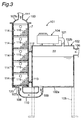
- the apparatus 101 includes a raw water tank 102 for storing raw water, an activated water tower 103 for activating water (that is, for supplying water rich in OH - ions and relatively small clusters) by converting the raw water, and a pressure pump (or compressor) 104 for transferring the raw water in the tank 102 to the activated water tower 103.
- the tank 102 is made of steel plates and mounted on a base 105.
- Raw water is introduced through an inlet 106 into the tank 102.
- the inner face of the tank 102 is subjected to coating or lining with a resin or the like in order to improve corrosion inhibition.
- Raw water is for example tap water, underground water or well water.
- the material of the tank 102 is not limited to steel plates, and any material can be used as far as the strength is sufficient (for example, so as not to destroy the tank until the inner pressure in the tank is increased up to about 2 kg/cm 2 ).
- the activated water tower 103 is also mounted to the base 105.
- the tower 103 has an outer tube 107 of hollow cylinder made of steel plates.
- An inlet 108 provided at the bottom end wall 107a of the outer tube 107 is connected through a supply tube 10 to an outlet 109 of the raw water tank 102 provided at the bottom 102a thereof.
- an outlet 111 is provided at the top wall 107b of the tower 103 to supply activated water.
- the outer tube 107 is fixed with fixing members 112 and 113 to the raw water tank 102.
- the grains 115 are made of fine tourmaline powders combined with a binder of low melting point glass as explained above. As the glass, the low melting point glass powders including zinc explained above are used.
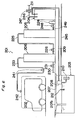
- the inner tube 114 is made of a tube part 116 made of a plastics material and having a form of hollow cylinder, and a base plate 118 made of punching metal, fixed to the bottom of the tube part 116 and having many openings 117.
- Each opening 117 is rectangular, and its shorter size is smaller than the diameter of the tourmaline composite grains so as for them not to pass therethrough.
- a handle 119 is fixed to the inner tube 114 (tube part 116) for carrying the inner tube easily.
- the tube part and the bottom of the inner tube 114 may be made of a plastics material as an integral product without using punching metal.
- the lowest inner tube 114 among the five stacked inner tubes is arranged above the bottom wall 107a of the outer tube 107 on a spacer 120.
- the spacer 120 is set in order to introduce the raw water received through the inlet 108 in the outer tube 107, into the lowest inner tube 114 uniformly.
- the pressure pump (compressor) 104 is put on the top wall 102b of the raw water tank 102, and air pressurized by the pump 104 is introduced through a path 21 into an air portion 122 in the tank 102.
- the inlet 106 is closed with a valve (not shown), and the pressurized air is supplied by the pump 104 in the tank 102.
- the air pressure in the air portion 122 presses the raw water in the tank 102 toward the activated water tower 103.
- the air pressure in the air portion 122 is for example 1.5 kg/cm 2 .
- the raw water introduced from the tank 102 is converted to activated water by contacting with the tourmaline composite grains 115 inside the inner tubes 114.
- the raw water flows upward. This flow moves the grains 115 vigorously, and the tourmaline composite grains 115 form a fluidized layer in the inner tube 114.
- friction contact of water with the grains or friction contact between the grains is accelerated, and the conversion from raw water to activated water is improved.
- H 3 O + ions hydrogen ions
- water includes many OH - ions (or H 3 O 2 - ions).
- the binder in the tourmaline composite grains includes zinc component (Zn)
- Zn zinc component
- a very small amount of zinc is dissolved in water from the tourmaline composite grains in the activated water tower 103, and the wash water includes the very small amount of zinc.
- ZnO zinc oxide
- the electrical conduction occurs to release the electrostatic charges on the surface or removes them.
- the surface becomes hard for dust or the like to adhere thereto.
- tourmaline or the binder in the grains include boron (B)
- boron a very small amount of boron is dissolved in water from the tourmaline composite grains in the activated water tower 103, and the wash water includes the very small amount of boron.
- boron included in the wash water deposits by a very small amount on the surface of the structure to form a thin coating (coexistence of ZnO).
- the boron coating protects the surface of the structure, and increases the luster of the surface. Thus, the luster or the beauty of the structure is improved.
- raw water is converted to activated water in the activated water tower 103, and the activated water is supplied from the tower 103 as wash water.
- the activated water is supplied from the tower 103 as wash water.
- Table 1 shows an example of water compositions in the unit of mg/liter of raw water (well water in this example) and activated water obtained from the raw water.
- Composition of well water and washing water (activated water) Component (mg/liter) Activated water
- Fig. 6 shows an apparatus 201 for a motor vehicle 202 which supplies wash water by recycling.
- the object to be washed is not limited to the motor vehicle.
- the apparatus 201 has a waste water reservoir 203 which stores waste water after washing a motor vehicle 202 such as an automobile, a water tank 204 which controls the concentrations of dirt contents included in the waste water introduced from the waste water reservoir 203 at a constant level, a second tower 205 which decomposes organic substances in the water received from the water tank 204 to purify the water, and a first tower or an activated water tower 206 which converts the water purified by the second tower 205 to activated water (rich in OH - ions and including relatively small water clusters) by the tourmaline composite grains and supplied the activated water.
- the water tank 204 and the second tower 205 are provided for preprocessing the waste water supplied for the waste water reservoir 203 before supplying it to the first tower 206 for activating the waste water.
- the waste water reservoir 203 is a water reservoir made of concrete and built underground.
- the waste water reservoir 203 has a top cover 207 which closes the top end thereof, and the top cover has a member 207a for collecting waste water after washing.
- a first pump 208 sends the waste water in the tank 203 through a supply pipe 209 to the water tank 204 for controlling concentration.
- a filter 210 is provided at an inlet end of the first pump 209 and it removes dirts such as solid substances and oil floating in the waste water.
- a valve 211 is provided at an outlet end of the supply pipe 209 for opening and closing the pipe.
- a fence 212 is set in the reservoir 203 near the inlet end of the first pump 208 or the filter 210 in order to remove oil floating in the water.
- a discharge path 245 is provided to discharge the waste water in the reservoir 203 to the external.
- the waste water tank 204 for controlling the concentration has a supplier 246 for supplying virgin water (such as tap water or well water) into the water tank 204. According to the concentration of the impurities included in the waste water in the water tank 204, a valve 247 is opened or closed to add virgin water to the waste water. An outlet is provided at the lower portion of the water tank 204, and the waste water after controlling the concentration is introduced by a second pump 224 through a path 249 with a valve 248 to the second tower 205 for decomposing organic substances.
- virgin water such as tap water or well water
- the second tower 205 has an outer tube 213 having a shape of hollow cylinder and made of steel plate, and the outer tube 213 contains a radiation processor 214 at the lower part and a biological processor 215 at the upper part. It is desirable that the distance between the two processors 214 and 215 is separated as far as possible.
- the radiation processor 214 has a tray 216 made of a plastics material, and the tray 216 has a tapered section extending upward and a cylindrical section contacting closely to the outer tube 213.
- the tray 216 contains many grains 217 which include very fine natural radiator substances combined with a binder.
- the natural radiator substance is for example a rare earth mineral which generates radiations naturally.
- the grains 217 is hereafter referred to as natural radiation source composite grains.
- the materials of the outer tube 213 and the tray 216 are not limited to the above ones.
- the outer tube 213 may be made of a plastics material, or the tray 216 may be made of a metal.
- the form of the radiation processor 214 is not limited to the above one, and the inner tubes 114 for holding tourmaline composite grains as explained above may be used therefor.
- the second or organic substance decomposition tower 205 has an inlet 218 at its lower side for introducing the waste water after concentration control, and the inlet 218 is connected through an L-shaped pipe 219 to the downstream side of the path 249. Therefore, the waste water after concentration control in the water tank 204 is introduced through the path 249 and the pipe 219 to the radiation processor 214, and it flows upward in the tray 216 to contact with the natural radiation source composite grains 217. Thus, the grains 217 are fluidized vigorously by the upward flow of the waste water to accelerate the contact thereof with the waste water. Thus, the decomposition of the organic substances in the waste water is accelerated.
- OH - ions and OH radicals are produced from water molecules in the waste water by radiations ( ⁇ , ⁇ , ⁇ rays) radiated from the natural radiator substances in the natural radiation source composite grains 217, and they decompose organic substances (oil, fat, protein and the like). Further, far infrared rays radiated from the grains 217 divide water clusters in the water, and organic substances contained in the clusters therein are let out, and this also accelerates the decomposition of organic materials by the radiations.
- the biological processor 215 mounted above the radiation processor 214 has an upper porous plate 221, a lower porous plate 222 and a biological filter 223 between them.
- the porous plates 211 and 222 are fixed to the outer tube 213.
- the biological filter 223 comprises a honeycomb or fibrous base made of a plastics material or the like and a microorganism film on the base.
- the microorganism film includes many aerobic bacteria.
- the waste water processed by the radiation processor 214 to decompose organic substances rises in the outer tube 213 to pass through the biological processor 215.
- the organic substances which have not been decomposed by the radiation processor 214 are decomposed by the aerobic bacteria biologically when it passes through the biological processor 223.
- the waste water purified by the radiation and biological processors 214, 215 by decomposing organic substances is supplied through a supply path 225 to the first or activated water tower 206.
- a valve 226 is provided at an outlet side of the supply path 225 for opening or closing the path 225.
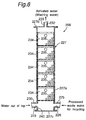
- the first tower 206 has a similar structure to the activated water tower 103 shown in Fig. 3.
- the first tower 206 has an outer tube 227 of hollow cylinder made of steel plates.
- a first inlet 228 provided at the lower side of the outer tube 227 is connected to the down stream end of the supply path 225 to introduce waste water from the second tower 205.
- at a second inlet 229 provided at the lower side of the outer tube 227 is connected to another supply path 30 for introducing tap water as virgin water, and a valve 31 is provided to open or close the supply path 30.
- tap water can be introduced into the first tower 206.
- Underground water or well water may be used as virgin water instead of tap water.
- an outlet 232 is provided at a top wall 227b covering the outer tube 227 to send the activated water, and a hose 233 is connected to the outlet 232 for supplying the activated water.
- the inner tubes 234 are similar to the inner tubes 114 shown in Figs. 4 and 5.
- the water introduced into the first tower 206 is activated as explained above on the activated water tower 103, and the detailed explanation is omitted here.
- the waste water supplied from the second tower 205 or tap water is converted to activated water in the first tower 206, and the activated water is used as wash water. That is, when an automobile 202 is washed by a washing machine 242, a valve 241 provided in the hose 233 is opened, and the automobile 202 is washed by the washing machine 242 with the wash water (activated water) supplied from the first tower 206.
- the washing machine 242 washes the automobile with water by using a physical means, without using a detergent. In this example, the washing machine 242 washes the automobile with brushing.
- the blast pressure of the wash water depends on the discharge pressure of the second pump 224 or the supply pressure of tap water.
- the activated water which have been purified and converted as explained above shows that it is perfectly transparent, and the remains after evaporation is 87 mg/liter.
- the activated water includes calcium, magnesium, sodium and silica somewhat, but it does not include iron.
- the analysis result means that the wash water has similar water quality as tap water as far as the above components are concerned.
- Washing effect is compared in a gate-type washing machine for motor vehicle.
- An automobile is washed with (a) brushing and waxing using underground water, (b) brushing using the activated water and (c) brushing using underground water.
- Table 2 summarizes the results.
- the luster of the automobile after washing is measured with a luster meter (Minolta GM-60). It is apparent that the brushing using the activated water according to the embodiment of the invention is far superior than the prior art brushing with underground water and has a similar effect as the prior art washing with brushing and waxing.
- Luster of automobiles after washing Washing process Luster Underground water + brushing and waxing 170 Activated water + brushing 165 Underground water + brushing 123 NB: Luster is measured with Minolta GM-60.
- the washing of automobile with the above-mentioned apparatus 201 has following advantages.
- the activated water obtained by activating waste water after washing has a similar washing performance as a detergent, it is not necessary to use a detergent, and a moving vehicle can be washed efficiently only with a physical means such as brushing with water. Therefore, even if washing is repeated, the coating on the surface of the body of a moving vehicle is not changed in quality or is not deteriorated, and the water does not become dirty. Washer's hands are not harmed. Further, washing operation becomes simple, and washing cost is decreased. Because no microorganisms grow in the activated water, green moss or the like does not grow on the surface of the body.
- zinc included in the binder prevents adhesion of dirts on the surface of the body
- boron included in tourmaline and the binder protects the surface of the body. Because the film including boron enhances luster of the surface, the luster or the beauty of the body becomes good even without waxing.
Landscapes
- Life Sciences & Earth Sciences (AREA)
- Chemical & Material Sciences (AREA)
- Water Supply & Treatment (AREA)
- Hydrology & Water Resources (AREA)
- Engineering & Computer Science (AREA)
- Environmental & Geological Engineering (AREA)
- Organic Chemistry (AREA)
- Health & Medical Sciences (AREA)
- Toxicology (AREA)
- Biodiversity & Conservation Biology (AREA)
- Microbiology (AREA)
- Medicinal Chemistry (AREA)
- Physical Water Treatments (AREA)
- Water Treatment By Sorption (AREA)
Applications Claiming Priority (6)
| Application Number | Priority Date | Filing Date | Title |
|---|---|---|---|
| JP6108398 | 1998-03-12 | ||
| JP6108498 | 1998-03-12 | ||
| JP6108498 | 1998-03-12 | ||
| JP10061083A JP3123712B2 (ja) | 1998-03-12 | 1998-03-12 | 洗浄水供給装置 |
| JP13201198A JP2901961B1 (ja) | 1998-03-12 | 1998-05-14 | 自動車洗浄装置 |
| JP13201198 | 1998-05-14 |
Publications (1)
| Publication Number | Publication Date |
|---|---|
| EP0941969A1 true EP0941969A1 (de) | 1999-09-15 |
Family
ID=27297383
Family Applications (1)
| Application Number | Title | Priority Date | Filing Date |
|---|---|---|---|
| EP19990104743 Withdrawn EP0941969A1 (de) | 1998-03-12 | 1999-03-10 | Wasserbehandlungsvorrichtungen mit körnigem, Turmalin enthaltenden Verbundmaterial |
Country Status (1)
| Country | Link |
|---|---|
| EP (1) | EP0941969A1 (de) |
Cited By (2)
| Publication number | Priority date | Publication date | Assignee | Title |
|---|---|---|---|---|
| EP1095909A1 (de) * | 1999-10-29 | 2001-05-02 | Mino Ganryo Kagaku Corporation | Vorrichtung zur Produktion von aktivem Wasser |
| CN111675425A (zh) * | 2020-05-21 | 2020-09-18 | 上源环工生态环境科技(苏州)有限公司 | 一种人工湿地填料及其制备方法 |
Citations (8)
| Publication number | Priority date | Publication date | Assignee | Title |
|---|---|---|---|---|
| EP0421702A2 (de) * | 1989-10-03 | 1991-04-10 | Yugenkaisha Kubo Technic Office | Verfahren und Vorrichtung zur Grenzflächenreinigung mittels Turmalin und dazu benutztes körniges Material |
| JPH06210285A (ja) * | 1993-01-13 | 1994-08-02 | Hitachi Zosen Eng Kk | 汚水処理方法 |
| US5531869A (en) * | 1990-02-27 | 1996-07-02 | Kubo Technical Office | Metal catalyst carried on carrier making use of tourmaline and its production |
| EP0728703A1 (de) * | 1993-11-09 | 1996-08-28 | HUKAI, Toshiko | Verfahren und vorrichtung zur herstellung von wasser mit kläreigenschaften |
| JPH09110468A (ja) * | 1995-08-10 | 1997-04-28 | Mino Ganryo Kagaku Kk | 電気石成形体およびその製造法 |
| JPH09323087A (ja) * | 1996-06-05 | 1997-12-16 | Kenichi Taniguchi | 自動車洗浄用美装化装置 |
| JPH1024298A (ja) * | 1996-07-11 | 1998-01-27 | Rooreru Kk | 濾過装置 |
| US5770089A (en) * | 1989-10-03 | 1998-06-23 | Kubo; Tetsujiro | Water treatment method using tourmaline |
-
1999
- 1999-03-10 EP EP19990104743 patent/EP0941969A1/de not_active Withdrawn
Patent Citations (8)
| Publication number | Priority date | Publication date | Assignee | Title |
|---|---|---|---|---|
| EP0421702A2 (de) * | 1989-10-03 | 1991-04-10 | Yugenkaisha Kubo Technic Office | Verfahren und Vorrichtung zur Grenzflächenreinigung mittels Turmalin und dazu benutztes körniges Material |
| US5770089A (en) * | 1989-10-03 | 1998-06-23 | Kubo; Tetsujiro | Water treatment method using tourmaline |
| US5531869A (en) * | 1990-02-27 | 1996-07-02 | Kubo Technical Office | Metal catalyst carried on carrier making use of tourmaline and its production |
| JPH06210285A (ja) * | 1993-01-13 | 1994-08-02 | Hitachi Zosen Eng Kk | 汚水処理方法 |
| EP0728703A1 (de) * | 1993-11-09 | 1996-08-28 | HUKAI, Toshiko | Verfahren und vorrichtung zur herstellung von wasser mit kläreigenschaften |
| JPH09110468A (ja) * | 1995-08-10 | 1997-04-28 | Mino Ganryo Kagaku Kk | 電気石成形体およびその製造法 |
| JPH09323087A (ja) * | 1996-06-05 | 1997-12-16 | Kenichi Taniguchi | 自動車洗浄用美装化装置 |
| JPH1024298A (ja) * | 1996-07-11 | 1998-01-27 | Rooreru Kk | 濾過装置 |
Non-Patent Citations (4)
| Title |
|---|
| PATENT ABSTRACTS OF JAPAN vol. 018, no. 575 (C - 1268) 4 November 1994 (1994-11-04) * |
| PATENT ABSTRACTS OF JAPAN vol. 097, no. 008 29 August 1997 (1997-08-29) * |
| PATENT ABSTRACTS OF JAPAN vol. 098, no. 004 31 March 1998 (1998-03-31) * |
| PATENT ABSTRACTS OF JAPAN vol. 098, no. 005 30 April 1998 (1998-04-30) * |
Cited By (2)
| Publication number | Priority date | Publication date | Assignee | Title |
|---|---|---|---|---|
| EP1095909A1 (de) * | 1999-10-29 | 2001-05-02 | Mino Ganryo Kagaku Corporation | Vorrichtung zur Produktion von aktivem Wasser |
| CN111675425A (zh) * | 2020-05-21 | 2020-09-18 | 上源环工生态环境科技(苏州)有限公司 | 一种人工湿地填料及其制备方法 |
Similar Documents
| Publication | Publication Date | Title |
|---|---|---|
| Narkis et al. | Adsorption of non-ionic surfactants on activated carbon and mineral clay | |
| CN101838053B (zh) | 一种采用矿化垃圾构建人工湿地处理污水的方法 | |
| CN106396134B (zh) | 一种用于地下水渗透反应格栅脱氮除磷的复合反应介质及其制备方法 | |
| Ahsan et al. | Use of some natural and waste materials for waste water treatment | |
| US6034013A (en) | Tourmaline composite grains and apparatus using them | |
| CN110589973A (zh) | 人工湿地滤材颗粒及其铺设施工方法 | |
| Oladoja et al. | The use of fortified soil-clay as on-site system for domestic wastewater purification | |
| CN119638064A (zh) | 一种硫-锰复合自养反硝化填料及其制备方法和应用 | |
| EP0941969A1 (de) | Wasserbehandlungsvorrichtungen mit körnigem, Turmalin enthaltenden Verbundmaterial | |
| CN108275782B (zh) | 一体化立体湿地污水处理出水tn控制装置及方法 | |
| CN109574233A (zh) | 一种添加沸石负载纳米零价铁的人工湿地系统 | |
| CN212121575U (zh) | 一种用于水玻璃砂再生的脱水净化装置 | |
| Bhargava et al. | Effects of adsorbent dose and size on phosphate-removal from wastewaters | |
| CN218709651U (zh) | 一种处理农田排水的复合人工湿地系统 | |
| JP2901961B1 (ja) | 自動車洗浄装置 | |
| Detho et al. | Adsorption of chemical oxygen demand and ammoniacal nitrogen removal from leachate using seafood waste (green mussel shell) as low-cost adsorbent | |
| CN112624499B (zh) | 一体化单户联户农村生活污水处理方法 | |
| CN213924213U (zh) | 一种用于降低tp和bod的人工湿地填料结构 | |
| KR100449414B1 (ko) | 콘크리트 구조물 | |
| CN110342646B (zh) | 一种微生物污水处理系统和污水处理方法 | |
| CN209412044U (zh) | Bmr生物净化除磷一体机 | |
| Park et al. | Weighted coagulation with glass and diatomite for storm water treatment and sludge disposal | |
| King et al. | Treatability of Type A Zeolite in Wastewater-Part I | |
| Mohamad et al. | Enhancement of Landfill Daily Cover in Minimizing the Migration of Heavy Metals in Landfill Leachate by Using Natural Soil, Pressmud Empty Fruit Bunch (EFB) in PulauBurung Landfill | |
| US6843932B1 (en) | Inorganic electrolytic coagulant and a method of transforming sludge by using this inorganic electrolytic coagulant |
Legal Events
| Date | Code | Title | Description |
|---|---|---|---|
| PUAI | Public reference made under article 153(3) epc to a published international application that has entered the european phase |
Free format text: ORIGINAL CODE: 0009012 |
|
| AK | Designated contracting states |
Kind code of ref document: A1 Designated state(s): DE FR GB |
|
| AX | Request for extension of the european patent |
Free format text: AL;LT;LV;MK;RO;SI |
|
| 17P | Request for examination filed |
Effective date: 20000218 |
|
| AKX | Designation fees paid |
Free format text: DE FR GB |
|
| 17Q | First examination report despatched |
Effective date: 20010828 |
|
| GRAP | Despatch of communication of intention to grant a patent |
Free format text: ORIGINAL CODE: EPIDOSNIGR1 |
|
| STAA | Information on the status of an ep patent application or granted ep patent |
Free format text: STATUS: THE APPLICATION IS DEEMED TO BE WITHDRAWN |
|
| 18D | Application deemed to be withdrawn |
Effective date: 20060713 |