EP0942294A2 - Méthode pour la réduction des lobes latéraux et appareil mono-impulsions d'amplitude ou de phase - Google Patents
Méthode pour la réduction des lobes latéraux et appareil mono-impulsions d'amplitude ou de phase Download PDFInfo
- Publication number
- EP0942294A2 EP0942294A2 EP99810184A EP99810184A EP0942294A2 EP 0942294 A2 EP0942294 A2 EP 0942294A2 EP 99810184 A EP99810184 A EP 99810184A EP 99810184 A EP99810184 A EP 99810184A EP 0942294 A2 EP0942294 A2 EP 0942294A2
- Authority
- EP
- European Patent Office
- Prior art keywords
- antenna
- function
- signals
- functions
- fkv
- Prior art date
- Legal status (The legal status is an assumption and is not a legal conclusion. Google has not performed a legal analysis and makes no representation as to the accuracy of the status listed.)
- Withdrawn
Links
Images




Classifications
-
- G—PHYSICS
- G01—MEASURING; TESTING
- G01S—RADIO DIRECTION-FINDING; RADIO NAVIGATION; DETERMINING DISTANCE OR VELOCITY BY USE OF RADIO WAVES; LOCATING OR PRESENCE-DETECTING BY USE OF THE REFLECTION OR RERADIATION OF RADIO WAVES; ANALOGOUS ARRANGEMENTS USING OTHER WAVES
- G01S13/00—Systems using the reflection or reradiation of radio waves, e.g. radar systems; Analogous systems using reflection or reradiation of waves whose nature or wavelength is irrelevant or unspecified
- G01S13/02—Systems using reflection of radio waves, e.g. primary radar systems; Analogous systems
- G01S13/06—Systems determining position data of a target
- G01S13/42—Simultaneous measurement of distance and other co-ordinates
- G01S13/44—Monopulse radar, i.e. simultaneous lobing
-
- G—PHYSICS
- G01—MEASURING; TESTING
- G01S—RADIO DIRECTION-FINDING; RADIO NAVIGATION; DETERMINING DISTANCE OR VELOCITY BY USE OF RADIO WAVES; LOCATING OR PRESENCE-DETECTING BY USE OF THE REFLECTION OR RERADIATION OF RADIO WAVES; ANALOGOUS ARRANGEMENTS USING OTHER WAVES
- G01S7/00—Details of systems according to groups G01S13/00, G01S15/00, G01S17/00
- G01S7/02—Details of systems according to groups G01S13/00, G01S15/00, G01S17/00 of systems according to group G01S13/00
- G01S7/28—Details of pulse systems
- G01S7/2813—Means providing a modification of the radiation pattern for cancelling noise, clutter or interfering signals, e.g. side lobe suppression, side lobe blanking, null-steering arrays
Definitions
- the present invention relates to a method according to the preamble of patent claims 1 and 8, respectively.
- Monopulse radar devices are normally used for locating and possibly tracking flying objects used, such as are described in [2]. With monopulse radars are received with everyone Pulse in azimuth and elevation generates angle error signals that become zero when the antenna or boresight axis is aimed precisely at the target. Alignment and where appropriate The boresight axis is adjusted mechanically on horn antennas. Array antennas often use the Measuring range electronically scanned in elevation and mechanically scanned in azimuth (see [3], pages 30 and 31).
- Known amplitude or phase monopulse radars provide accurate angle measurement data with respect a flying object, as long as in addition to the signals received directly from the monitored flying object, no signals from other objects or single or multiple reflected signals from the first or the other objects can be received.
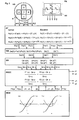
- FIG. 1 shows two flying objects T1 and T2, which are detected by the main lobe ml of an antenna, of which there are the first is above and the second below the boresight axis bx (cf. [8], Fig. 6).
- pages 201 - 210 can use a conventional monopulse radar device to determine the spatial position of a flying object can no longer be determined precisely as soon as a second flying object is in the same Radar steel is located. The phase of the resulting difference signal changes compared to the single-target case regarding the sum signal.
- conventional monopulse radars deliver faulty ones Angle measurement data, provided the targets cannot be separated by distance.
- a special case of the two-target case is the reflection of the radar echo reflected by a flying object e.g. on a Water surface. It is also shown that a third flying object T3 from a side tip sl of the antenna was recorded, which affects the measurement of the first two flying objects T1 and T2 is, or (in the case of missing objects T1, T2) incorrectly discovering the object T3 in the Direction of the main lobe is reported.
- So-called SLS and SLC methods are used to suppress signals received from the side-end region.
- SLS method sidelobe blanking or sidelobe suppression
- a suitable measurement method is used to determine whether a signal has been received from the side lobe area.
- the received signals are either processed further or completely suppressed.
- the useful signal component is also lost.
- the SLC method sidelobe cancellation
- the SLC method sidelobe cancellation is achieved by shaping the antenna beam accordingly so that the antenna function has a zero in the angular range in which the interference signal occurs . As a result, the interference signal is suppressed without affecting the useful signal.
- Auxiliary antennas whose phase centers do not coincide with that of the main antenna are according to [6] only partially suitable for RSLS and ISLS methods.
- the SLS method can also be carried out one of the antenna functions, the curvature function, can also be used as an auxiliary function.
- the phase centers of the main and auxiliary functions are also close together, so various advantages described in [8] can be realized.
- the auxiliary antenna functions have no omni-directional Characteristic, but a high antenna gain in the direction of incidence of an interference signal.
- the received and weighted interference signals of the auxiliary paths are separated from the signal of the Main path subtracted, after which the latter is largely freed from interference. That in [8]
- the SLC method described requires several antenna functions to suppress interference signals.
- the present invention is therefore based on the object of the SLS method improve that for radar devices that target measurement per axis three antenna functions have no additional for the detection of signals received via a side peak Antenna functions or auxiliary antennas are required. Furthermore, according to the invention Specify the method working monopulse radar.
- Fig. 2 shows the block diagram of a radar system described in [5], in which for target measurement Three antenna functions per measuring axis, namely an inclination function Fe (X), a curvature function Fk (X) and a sum function Fs (X) are provided (X is the target placement angle).
- the above Antenna functions Fe (X), Fk (X) and Fs (X) are known to result from Fourier transformation of the associated ones Illumination functions Je (Lx), Jk (Lx) and Js (Lx), which are shown in Fig. 3.
- the functions Fe (X) and Je (Lx), Fk (X) and Jk (Lx) as well as Fs (X) and Js (Lx) are Fourier transform pairs.
- a well known property of the Fourier transform is that the Fourier transform is the derivative a function is X times the Fourier transform of the non-derived function, where X is the independent variable, in the present case the goal is. With double derived functions there is a quadratic dependence on the target direction (see [2], page 338). In addition, pro Derivation of a 90 ° rotation or a multiplication by the imaginary unit j.
- quotient functions Qe (X) and Qk (X) of a derived pair are therefore linearly or quadratically dependent on the target direction X.
- Straight lines are provided parallel to the abscissa, which correspond to the threshold values + - ⁇ th e .
- the threshold values th e are set such that for arguments X that lie outside the angular range of the main lobe of the antenna, the power Pe (X) of the quotient function Qe (X) is above the threshold value th e .
- a comparator that compares the power Pe (X) of the quotient function Qe (X) with the defined threshold value th e can therefore easily determine whether signals have been received via the main lobe or via side lobes.
- a straight line is provided parallel to the abscissa, which corresponds to a threshold value - ⁇ th k .
- the threshold value thk is set such that for arguments X that lie outside the angular range of the main lobe of the antenna, the power Pk (X) of the quotient function Qk (X) is above the threshold value th k .
- a comparator which compares the power Pk (X) of the quotient function Qk (X) with the defined threshold value thk can therefore easily determine whether signals have been received via the main lobe or via side lobes.
- the powers Pe (X), Pk (X) are determined by quadrature of the quotient functions Qe (X) and Qk (X) determined.
- an improvement of the method is achieved by the performances Pe (X), Pk (X) of the quotient functions Qe (X), Qk (X) weighted with factors r1, r2, added and only then with one Threshold are compared.
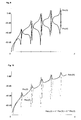
- the zeros of the one function Fe (X) or Fk (X) decrease and the zeros of the other function Fk (X) or Fe (X) to higher values than the zeros of the Sum function Fs (X) are shifted, whereby e.g. a compressed tilt function Fev (X) and an expanded curvature function Fkv (X) arises (see FIG. 7).
- the displacement factors ve and vk, which are normally the same are chosen accordingly small.
- the abscissa X of the functions Fe (X) and Fk (X) slightly distorted, which results in the desired shift of the zeros.
- the quotient power sum function Pekv (X) r1 * Pev (X) + r2 * Pkv (X) formed by adding the powers Pev (X), Pkv (X) of the quotient functions Qev (X) and Qkv (X) has no zeros or downward swings which could fall below the defined threshold value (see FIG. 10). Swings that occur between the zeros of the functions Fev (X), Fkv (X) run upwards above the intended threshold value and are not critical since they lie outside the main lobe of the antenna. The positions at which positive peaks occur in the course of the quotient power sum function Pekv (X) are therefore already in the region of the side peaks, within which the threshold value is exceeded anyway.
- the method according to the invention thus fulfills all the requirements for a reliable SLS method.
- the method described above can preferably be used for radar systems according to [5] (see FIG. 2), and generally suitable for systems with three functions per measuring axis.
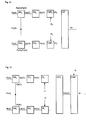
- FIG. 11 shows a circuit arrangement suitable for carrying out the SLS method for the monopulse radar device known from [5], in which the received signals are processed in accordance with the antenna functions Fe (X), Fk (X), Fs (X) provided for each measuring axis be forwarded to a division level NM e or NMk.
- the signals of the first two antenna functions Fe (X), Fk (X) are divided by the signal of the third antenna function Fs (X), whereby the signals of the quotient functions Qe (X) and Qk (X ) arise, which are fed via quadrature stages SQ e or SQ k to a comparator CMP e or CMP k .
- the powers Pe (X) and Pk (X) of the signals of the quotient functions Qe (X) and Qk (X) emitted by the quadrature stages SQ e and SQ k are in the comparators CMP e and CMP k with threshold values th e and th k compared.
- the logic signals en e and enk which are fed from the output of the comparators CMP e or CMP k to a logic circuit OR, indicate whether the signal power Pe (X) or Pk (X) has the threshold value th e or th k exceeds.
- the powers Pe (X) and Pk (X) output by the quadrature stages SQ e and SQ k are weighted in stages W e and W k , taking into account weighting factors r1, r2 and then one Addition stage ADD supplied, in which the quotient power sum function Pek (X) (or Pekv (X)) is formed from the weighted powers Pe (X) and Pk (X) (analogously for Pev (X) and Pkv (X) with distorted antenna functions) becomes.
- the signals of the quotient power sum function Pek (X) or Pekv (X) are compared in the comparator CMP with a threshold value th. Depending on this, a logic signal en is emitted by the comparator CMP, on the basis of which signals received via side peaks sl can be suppressed.
- the signals of the antenna functions Fe (X), Fk (X) which are phase-shifted relative to each other by 90 ° are weighted in stages W e and W k , taking into account the weighting factors r1, r2, and then vectorially added in an addition stage VADD.
- the output signal of the addition stage VADD or the sum vector Fek (X), like the signal of the sum function Fs (X), is fed via a quadrature stage SQ ek or SQ s to a division stage NM, from which the normalized power Pek to the quotient power sum function Pek (X) is output to a comparator CMP, which compares the signals of the quotient power sum function Pek (X) with a threshold value and outputs a control signal en dependent thereon, by means of which the processing of signals received via side lobes sl can thus be suppressed.
- the invention is not only applicable for the suppression of the effect of signals that are Side tip sl of the radar antenna of one working with three antenna functions Fe (X), Fk (X) and Fs (X) Radar systems can be received (RSLS). Signals that go over the side peaks sl of the radar antenna can be transmitted when received in a transponder according to the invention as follows and a transponder response as an effect can be suppressed (ISLS). To check whether a If the signal was emitted via the main lobe or a side lobe, a comparison is made again Signals that on the one hand about the sum and on the other hand about the inclination and Curvature diagram can be broadcast.
- a quotient is again formed, which is compared with a threshold value.
- a threshold value the performance of the signal emitted via the sum diagram, the power of the signal via the inclination and Curvature diagram of the signal emitted by a certain amount, it is assumed that received signal was transmitted via the main lobe of the radar antenna. However, the prevails Power of the signal emitted via the tilt and curvature diagram, so assumed that the received signal is transmitted via a side peak sl of the radar antenna has been. In this case, a transponder response can be suppressed.
- the measures mentioned are therefore carried out analogously to the measures according to the invention described at the outset, through which Signals received via side peaks sl are identified and their effects suppressed.
- RSLS Signal comparison according to the invention takes place internally (RSLS) in the first case (reception case) and in the second Case (transmission case) external (ISLS) in the transponder.
- the signals are defined in a sum using the sum, inclination and curvature diagram Sequence broadcast in time. E.g. will first be a signal over the sum diagram broadcast. Then there is a signal via the inclination and curvature diagram broadcast. The radiation is preferably carried out via the inclination and curvature diagram at the same time.
- the signals weighted with factors r1, r2 are shifted in phase by 90 ° the tilt and curvature diagrams are broadcast.
- the base station has a transmission stage XMT, from which a first pulse p1 can be emitted via the summation diagram at a time t1 and a second pulse p2 can be output at a time t2 and is divided in a signal divider SPL.
- the signal components emitted by the signal divider SPL are each weighted in a stage W e or W k and, if necessary after a phase shift by 90 °, are radiated out of phase via the inclination and curvature diagram of the radar antenna HA.
- the first pulse p1 and at time t2 + ⁇ the second pulse p2 or the sum signal of the signals emitted via the inclination and curvature diagram are therefore received by the antenna TPA of the transponder TP.
- the mutual displacement of the signals emitted via the inclination and curvature diagram by 90 ° avoids mutual cancellation of the signals.
- the power of the sum of the signals out of phase by 90 ° gives the sum of the powers of both signals (Pythagoras).
- the received signals are emitted from the antenna TPA of the transponder TP via a receiving stage RCV to a quadrature stage SQ T , from which the values of the powers P p1 , P p2 of the received pulses p1, p2 are fed to a memory unit MEM.
- a quotient q L P p2 / P p1 is formed in a division stage NM T , which is used in a comparator CMP T with a threshold value th T is compared.
- the received signals were transmitted via a side tip sl of the radar antenna HA of the ground station KMP.
- the function of the circuit arrangement according to FIG. 14 corresponds to that of FIG. 13, however the elements antenna function / phase shift and weighting of the signal are carried out in reverse order and the vectorial addition of the transmitted signals of the inclination and curvature functions Fe (X) and Fk ( X) does not take place in a module (VADD) but in the propagation path of the electromagnetic wave.
- the signals of the sum function Fs (X) (time t1) and the inclination and curvature functions Fe (X) and Fk (X) (time t2) are also transmitted sequentially, as is customary in the ISLS method.
Landscapes
- Engineering & Computer Science (AREA)
- Radar, Positioning & Navigation (AREA)
- Remote Sensing (AREA)
- Computer Networks & Wireless Communication (AREA)
- Physics & Mathematics (AREA)
- General Physics & Mathematics (AREA)
- Radar Systems Or Details Thereof (AREA)
Applications Claiming Priority (2)
| Application Number | Priority Date | Filing Date | Title |
|---|---|---|---|
| CH56598 | 1998-03-09 | ||
| CH56598 | 1998-03-09 |
Publications (2)
| Publication Number | Publication Date |
|---|---|
| EP0942294A2 true EP0942294A2 (fr) | 1999-09-15 |
| EP0942294A3 EP0942294A3 (fr) | 2000-06-07 |
Family
ID=4189959
Family Applications (1)
| Application Number | Title | Priority Date | Filing Date |
|---|---|---|---|
| EP99810184A Withdrawn EP0942294A3 (fr) | 1998-03-09 | 1999-03-04 | Méthode pour la réduction des lobes latéraux et appareil mono-impulsions d'amplitude ou de phase |
Country Status (2)
| Country | Link |
|---|---|
| US (1) | US6118402A (fr) |
| EP (1) | EP0942294A3 (fr) |
Cited By (4)
| Publication number | Priority date | Publication date | Assignee | Title |
|---|---|---|---|---|
| RU2176399C1 (ru) * | 2000-10-30 | 2001-11-27 | Государственное унитарное предприятие Центральный научно-исследовательский институт "Гранит" | Одноканальная моноимпульсная радиолокационная система определения направления на цель |
| CN104569926A (zh) * | 2015-01-06 | 2015-04-29 | 北京环境特性研究所 | 一种地物波谱rcs测量的控制方法及系统 |
| CN105373139A (zh) * | 2015-11-25 | 2016-03-02 | 北京环境特性研究所 | 一种条带式rcs成像测量用运动模拟系统与方法 |
| CN107045120A (zh) * | 2017-01-20 | 2017-08-15 | 南京航空航天大学 | 一种基于因子分析模型的一维距离像自适应分帧方法 |
Families Citing this family (19)
| Publication number | Priority date | Publication date | Assignee | Title |
|---|---|---|---|---|
| US6759983B2 (en) | 2001-03-28 | 2004-07-06 | Strategic Analysis, Inc. | Method and device for precise geolocation of low-power, broadband, amplitude-modulated signals |
| EP1248119B1 (fr) * | 2001-04-03 | 2005-11-02 | Mitsubishi Electric Information Technology Centre Europe B.V. | Procédé et dispositif de détection d'un signal cible et systéme de détection d'obstacles |
| USRE39620E1 (en) | 2002-06-10 | 2007-05-08 | The Aerospace Corporation | GPS airborne target geolocating method |
| US6535816B1 (en) | 2002-06-10 | 2003-03-18 | The Aerospace Corporation | GPS airborne target geolocating method |
| US7218268B2 (en) * | 2003-05-14 | 2007-05-15 | Veridian Systems | Self-calibrating interferometric synthetic aperture radar altimeter |
| RU2255353C2 (ru) * | 2003-06-26 | 2005-06-27 | Открытое акционерное общество "Научно-исследовательский институт приборостроения" | Способ сопровождения цели моноимпульсной радиолокационной станцией и устройство для его реализации |
| RU2287839C2 (ru) * | 2004-06-24 | 2006-11-20 | Федеральное государственное унитарное предприятие "Таганрогский научно-исследовательский институт связи" (ФГУП "ТНИИС") | Устройство для моноимпульсного измерения пеленга источников радиосигналов |
| RU2349928C2 (ru) * | 2005-10-24 | 2009-03-20 | Ямчук Андрей Юрьевич | Способ радиолокации с фар |
| RU2297645C1 (ru) * | 2005-11-02 | 2007-04-20 | Открытое акционерное общество "Корпорация "Фазотрон - научно-исследовательский институт радиостроения" | Моноимпульсный пеленгатор |
| RU2309430C1 (ru) * | 2006-02-21 | 2007-10-27 | Открытое акционерное общество "Концерн "Гранит-Электрон" | Моноимпульсная радиолокационная система |
| RU2315332C1 (ru) * | 2006-03-28 | 2008-01-20 | ОАО "Уральское проектно-конструкторское бюро "Деталь" | Радиолокационная станция |
| RU2338219C1 (ru) * | 2007-02-05 | 2008-11-10 | ОАО "Уральское проектно-конструкторское бюро "Деталь" | Способ сопровождения цели и устройство моноимпульсной рлс, реализующей способ |
| RU2361230C1 (ru) * | 2007-12-13 | 2009-07-10 | Открытое акционерное общество "Научно-производственное предприятие "Радар ммс" | Моноимпульсный пеленгатор |
| RU2456631C1 (ru) * | 2011-02-17 | 2012-07-20 | Федеральное государственное военное образовательное учреждение высшего профессионального образования "Военный авиационный инженерный университет" (г. Воронеж) Министерства обороны Российской Федерации | Способ адаптивной пространственной компенсации помех при моноимпульсном амплитудном суммарно-разностном пеленговании и наличии ошибок калибровки приемных каналов |
| RU2455658C1 (ru) * | 2011-02-17 | 2012-07-10 | Федеральное государственное военное образовательное учреждение высшего профессионального образования "Военный авиационный инженерный университет" (г. Воронеж) Министерства обороны Российской Федерации | Способ адаптивной пространственной компенсации помех при моноимпульсном амплитудном суммарно-разностном пеленговании |
| JP6415386B2 (ja) * | 2015-05-28 | 2018-10-31 | 三菱電機株式会社 | 測角装置、レーダ装置、及び測角方法 |
| RU2608360C1 (ru) * | 2016-02-08 | 2017-01-18 | Акционерное общество "НИИ измерительных приборов-Новосибирский завод имени Коминтерна" /АО "НПО НИИИП-НЗиК"/ | Способ определения пеленга на источник непрерывной помехи и радиолокационное устройство для его осуществления |
| RU2674467C1 (ru) * | 2017-10-13 | 2018-12-11 | Федеральное государственное бюджетное образовательное учреждение высшего образования "Рязанский государственный радиотехнический университет" | Фильтр компенсации пассивных помех |
| RU2674468C1 (ru) * | 2017-10-16 | 2018-12-11 | Федеральное государственное бюджетное образовательное учреждение высшего образования "Рязанский государственный радиотехнический университет" | Фильтр режектирования помех |
Family Cites Families (16)
| Publication number | Priority date | Publication date | Assignee | Title |
|---|---|---|---|---|
| US3859661A (en) * | 1963-12-23 | 1975-01-07 | Us Air Force | Anti-jamming radar receiver |
| US3599208A (en) * | 1969-04-25 | 1971-08-10 | Us Navy | Radar system |
| US3772695A (en) * | 1972-03-22 | 1973-11-13 | Harris Intertype Corp | False null detection in automatic tracking systems |
| US4450448A (en) * | 1981-08-28 | 1984-05-22 | Grumman Aerospace Corporation | Apparatus and method for improving antenna sidelobe cancellation |
| FR2527785A1 (fr) * | 1982-05-27 | 1983-12-02 | Thomson Csf | Procede et dispositif de reduction de la puissance des signaux de brouillage recus par les lobes lateraux d'une antenne radar |
| US5576711A (en) * | 1984-10-17 | 1996-11-19 | Martin Marietta Corporation | Monopulse signal processor and method using same |
| FR2729764B1 (fr) * | 1986-09-16 | 1997-04-11 | Thomson Csf | Radar a champ angulaire instantane important et haut pouvoir instantane de resolution angulaire, notamment pour autodirecteur de missile |
| DE3716858A1 (de) * | 1987-05-20 | 1988-12-15 | Licentia Gmbh | Flugzeug-radarantenne |
| US5311192A (en) * | 1989-01-03 | 1994-05-10 | Hughes Aircraft Company | Polarization ECCM technique for radar systems |
| US5017929A (en) * | 1989-09-06 | 1991-05-21 | Hughes Aircraft Company | Angle of arrival measuring technique |
| US5101209A (en) * | 1990-03-09 | 1992-03-31 | The United States Of America As Represented By The Secretary Of The Air Force | Jam strobe resolution using a monopulse antenna |
| US5072224A (en) * | 1990-07-02 | 1991-12-10 | Cardion Electronics, Inc. | Monopulse processing systems |
| US5414428A (en) * | 1993-08-06 | 1995-05-09 | Martin Marietta Corp. | Radar system with pulse compression and range sidelobe suppression preceding doppler filtering |
| US5400035A (en) * | 1993-12-23 | 1995-03-21 | Hughes Aircraft Company | False track discrimination in the sidelobe region of a monopulse antenna |
| US5450089A (en) * | 1994-06-30 | 1995-09-12 | Hughes Aircraft Company | Monopulse thresholding |
| EP0809811B1 (fr) * | 1995-12-19 | 2001-07-11 | Siemens Schweiz AG | Procede et appareil radar monopulse en amplitude ou en phase pour reperer des objets volants |
-
1999
- 1999-03-04 EP EP99810184A patent/EP0942294A3/fr not_active Withdrawn
- 1999-03-08 US US09/264,001 patent/US6118402A/en not_active Expired - Fee Related
Cited By (5)
| Publication number | Priority date | Publication date | Assignee | Title |
|---|---|---|---|---|
| RU2176399C1 (ru) * | 2000-10-30 | 2001-11-27 | Государственное унитарное предприятие Центральный научно-исследовательский институт "Гранит" | Одноканальная моноимпульсная радиолокационная система определения направления на цель |
| CN104569926A (zh) * | 2015-01-06 | 2015-04-29 | 北京环境特性研究所 | 一种地物波谱rcs测量的控制方法及系统 |
| CN105373139A (zh) * | 2015-11-25 | 2016-03-02 | 北京环境特性研究所 | 一种条带式rcs成像测量用运动模拟系统与方法 |
| CN107045120A (zh) * | 2017-01-20 | 2017-08-15 | 南京航空航天大学 | 一种基于因子分析模型的一维距离像自适应分帧方法 |
| CN107045120B (zh) * | 2017-01-20 | 2019-10-11 | 南京航空航天大学 | 一种基于因子分析模型的一维距离像自适应分帧方法 |
Also Published As
| Publication number | Publication date |
|---|---|
| US6118402A (en) | 2000-09-12 |
| EP0942294A3 (fr) | 2000-06-07 |
Similar Documents
| Publication | Publication Date | Title |
|---|---|---|
| EP0942294A2 (fr) | Méthode pour la réduction des lobes latéraux et appareil mono-impulsions d'amplitude ou de phase | |
| EP0809811B1 (fr) | Procede et appareil radar monopulse en amplitude ou en phase pour reperer des objets volants | |
| DE60302379T2 (de) | Radarverarbeitungssystem und Verfahren zur Erkennung und Überwachung von Zielen | |
| EP2353029B1 (fr) | Dispositif pour la réception de signaux radar secondaires avec sectorisation quasidynamique ou dynamique de l'espace à surveiller, et procédé à cette fin | |
| DE60109990T2 (de) | Monopuls-Radar-Prozessor zur Bestimmung des Azimuth- und Elevationswinkels zweier Ziele über eine Matrix von Amplitudenverhältnissen | |
| DE102007054298B4 (de) | Radarvorrichtung | |
| DE60027418T2 (de) | Verfahren zur anzeige ausser-axialer signale für monopulsradar | |
| DE102010002474A1 (de) | Radarvorrichtung zum Unterdrücken von Wirkungen von Gitterkeulen bei der Erfassung einer Richtung eines Ziels auf der Grundlage einer Phasendifferenz zwischen empfangenen reflektierten Wellen | |
| DE3110532C2 (fr) | ||
| DE102009046499A1 (de) | Radarvorrichtung | |
| EP3673292A1 (fr) | Système radar imageur pourvu d'un réseau récepteur et permettant la détermination angulaire d'objets bidimensionnels par l'intermédiaire d'un dispositif à spectre étalé des antennes réceptrices d'une dimension | |
| DE2650832A1 (de) | Impulsradargeraet mit mechanischer und elektronischer strahlschwenkung | |
| EP3534178B1 (fr) | Appareil radar pourvu d'antenne réseau et procédé de localisation de source au moyen d'une antenne réseau radar bidimensionnelle | |
| DE69428766T2 (de) | Falschradarspurenunterscheidung in Nebenzipfeln von Monopulsantennen | |
| DE19627218B4 (de) | Radarvorrichtung | |
| DE2706875A1 (de) | Impulsradargeraet | |
| EP1500952B1 (fr) | Procédé pour la détermination de directions dans la présence de cibles multiples pour un radar monopulse à lobes multiples | |
| DE102021201073A1 (de) | MIMO-Radarsensor | |
| EP0023606B1 (fr) | Système d'antennes pour le repérage d'une source de signaux de micro-ondes | |
| EP3082273B1 (fr) | Procédé et dispositif de réduction de signaux parasites corrélés dans des systèmes de réception multi-canaux à formation de faisceau numérique | |
| EP1308745B1 (fr) | Procédé de localisation passif des cibles rayonnants des ondes sonores | |
| DE102018214586A1 (de) | Vorrichtung zum Empfangen von Licht zur Detektion eines Objekts | |
| DE2055981A1 (de) | Schaltung fur ein räumliches Mono pulsradarsystem | |
| EP2333574A2 (fr) | Procédé d'amélioration de l'exactitude de mesure, dispositif d'amélioration de l'exactitude de mesure et installation solaire | |
| DE102018117331B4 (de) | Verfahren zum Ermitteln einer Empfangsrichtung eines akustischen Signals, Auswertungsvorrichtung und System |
Legal Events
| Date | Code | Title | Description |
|---|---|---|---|
| PUAI | Public reference made under article 153(3) epc to a published international application that has entered the european phase |
Free format text: ORIGINAL CODE: 0009012 |
|
| AK | Designated contracting states |
Kind code of ref document: A2 Designated state(s): CH DE ES FR GB IT LI NL |
|
| AX | Request for extension of the european patent |
Free format text: AL;LT;LV;MK;RO;SI |
|
| PUAL | Search report despatched |
Free format text: ORIGINAL CODE: 0009013 |
|
| AK | Designated contracting states |
Kind code of ref document: A3 Designated state(s): AT BE CH CY DE DK ES FI FR GB GR IE IT LI LU MC NL PT SE |
|
| AX | Request for extension of the european patent |
Free format text: AL;LT;LV;MK;RO;SI |
|
| 17P | Request for examination filed |
Effective date: 20001120 |
|
| AKX | Designation fees paid |
Free format text: CH DE ES FR GB IT LI NL |
|
| STAA | Information on the status of an ep patent application or granted ep patent |
Free format text: STATUS: THE APPLICATION IS DEEMED TO BE WITHDRAWN |
|
| 18D | Application deemed to be withdrawn |
Effective date: 20021001 |