EP0942482A2 - Verwendung von katalytisch aktiven Gasdiffusionselektroden mit Faservliessubstrat in einer Direkt-Methanol-Brennstoffzelle - Google Patents
Verwendung von katalytisch aktiven Gasdiffusionselektroden mit Faservliessubstrat in einer Direkt-Methanol-Brennstoffzelle Download PDFInfo
- Publication number
- EP0942482A2 EP0942482A2 EP99109991A EP99109991A EP0942482A2 EP 0942482 A2 EP0942482 A2 EP 0942482A2 EP 99109991 A EP99109991 A EP 99109991A EP 99109991 A EP99109991 A EP 99109991A EP 0942482 A2 EP0942482 A2 EP 0942482A2
- Authority
- EP
- European Patent Office
- Prior art keywords
- gas diffusion
- diffusion electrode
- electrode according
- layer
- fibres
- Prior art date
- Legal status (The legal status is an assumption and is not a legal conclusion. Google has not performed a legal analysis and makes no representation as to the accuracy of the status listed.)
- Granted
Links
Images
Classifications
-
- H—ELECTRICITY
- H01—ELECTRIC ELEMENTS
- H01M—PROCESSES OR MEANS, e.g. BATTERIES, FOR THE DIRECT CONVERSION OF CHEMICAL ENERGY INTO ELECTRICAL ENERGY
- H01M4/00—Electrodes
- H01M4/86—Inert electrodes with catalytic activity, e.g. for fuel cells
- H01M4/88—Processes of manufacture
- H01M4/8803—Supports for the deposition of the catalytic active composition
- H01M4/8807—Gas diffusion layers
-
- C—CHEMISTRY; METALLURGY
- C25—ELECTROLYTIC OR ELECTROPHORETIC PROCESSES; APPARATUS THEREFOR
- C25B—ELECTROLYTIC OR ELECTROPHORETIC PROCESSES FOR THE PRODUCTION OF COMPOUNDS OR NON-METALS; APPARATUS THEREFOR
- C25B11/00—Electrodes; Manufacture thereof not otherwise provided for
- C25B11/02—Electrodes; Manufacture thereof not otherwise provided for characterised by shape or form
- C25B11/03—Electrodes; Manufacture thereof not otherwise provided for characterised by shape or form perforated or foraminous
- C25B11/031—Porous electrodes
-
- C—CHEMISTRY; METALLURGY
- C25—ELECTROLYTIC OR ELECTROPHORETIC PROCESSES; APPARATUS THEREFOR
- C25B—ELECTROLYTIC OR ELECTROPHORETIC PROCESSES FOR THE PRODUCTION OF COMPOUNDS OR NON-METALS; APPARATUS THEREFOR
- C25B11/00—Electrodes; Manufacture thereof not otherwise provided for
- C25B11/02—Electrodes; Manufacture thereof not otherwise provided for characterised by shape or form
- C25B11/03—Electrodes; Manufacture thereof not otherwise provided for characterised by shape or form perforated or foraminous
- C25B11/031—Porous electrodes
- C25B11/032—Gas diffusion electrodes
-
- H—ELECTRICITY
- H01—ELECTRIC ELEMENTS
- H01M—PROCESSES OR MEANS, e.g. BATTERIES, FOR THE DIRECT CONVERSION OF CHEMICAL ENERGY INTO ELECTRICAL ENERGY
- H01M4/00—Electrodes
- H01M4/86—Inert electrodes with catalytic activity, e.g. for fuel cells
- H01M4/8605—Porous electrodes
-
- H—ELECTRICITY
- H01—ELECTRIC ELEMENTS
- H01M—PROCESSES OR MEANS, e.g. BATTERIES, FOR THE DIRECT CONVERSION OF CHEMICAL ENERGY INTO ELECTRICAL ENERGY
- H01M4/00—Electrodes
- H01M4/86—Inert electrodes with catalytic activity, e.g. for fuel cells
- H01M4/88—Processes of manufacture
- H01M4/8817—Treatment of supports before application of the catalytic active composition
-
- H—ELECTRICITY
- H01—ELECTRIC ELEMENTS
- H01M—PROCESSES OR MEANS, e.g. BATTERIES, FOR THE DIRECT CONVERSION OF CHEMICAL ENERGY INTO ELECTRICAL ENERGY
- H01M4/00—Electrodes
- H01M4/86—Inert electrodes with catalytic activity, e.g. for fuel cells
- H01M4/90—Selection of catalytic material
- H01M4/92—Metals of platinum group
- H01M4/925—Metals of platinum group supported on carriers, e.g. powder carriers
- H01M4/926—Metals of platinum group supported on carriers, e.g. powder carriers on carbon or graphite
-
- H—ELECTRICITY
- H01—ELECTRIC ELEMENTS
- H01M—PROCESSES OR MEANS, e.g. BATTERIES, FOR THE DIRECT CONVERSION OF CHEMICAL ENERGY INTO ELECTRICAL ENERGY
- H01M4/00—Electrodes
- H01M4/86—Inert electrodes with catalytic activity, e.g. for fuel cells
- H01M4/90—Selection of catalytic material
- H01M4/92—Metals of platinum group
- H01M4/928—Unsupported catalytic particles; loose particulate catalytic materials, e.g. in fluidised state
-
- H—ELECTRICITY
- H01—ELECTRIC ELEMENTS
- H01M—PROCESSES OR MEANS, e.g. BATTERIES, FOR THE DIRECT CONVERSION OF CHEMICAL ENERGY INTO ELECTRICAL ENERGY
- H01M8/00—Fuel cells; Manufacture thereof
- H01M8/10—Fuel cells with solid electrolytes
- H01M8/1004—Fuel cells with solid electrolytes characterised by membrane-electrode assemblies [MEA]
-
- H—ELECTRICITY
- H01—ELECTRIC ELEMENTS
- H01M—PROCESSES OR MEANS, e.g. BATTERIES, FOR THE DIRECT CONVERSION OF CHEMICAL ENERGY INTO ELECTRICAL ENERGY
- H01M4/00—Electrodes
- H01M4/86—Inert electrodes with catalytic activity, e.g. for fuel cells
- H01M2004/8678—Inert electrodes with catalytic activity, e.g. for fuel cells characterised by the polarity
- H01M2004/8684—Negative electrodes
-
- H—ELECTRICITY
- H01—ELECTRIC ELEMENTS
- H01M—PROCESSES OR MEANS, e.g. BATTERIES, FOR THE DIRECT CONVERSION OF CHEMICAL ENERGY INTO ELECTRICAL ENERGY
- H01M4/00—Electrodes
- H01M4/86—Inert electrodes with catalytic activity, e.g. for fuel cells
- H01M2004/8678—Inert electrodes with catalytic activity, e.g. for fuel cells characterised by the polarity
- H01M2004/8689—Positive electrodes
-
- H—ELECTRICITY
- H01—ELECTRIC ELEMENTS
- H01M—PROCESSES OR MEANS, e.g. BATTERIES, FOR THE DIRECT CONVERSION OF CHEMICAL ENERGY INTO ELECTRICAL ENERGY
- H01M2300/00—Electrolytes
- H01M2300/0017—Non-aqueous electrolytes
- H01M2300/0065—Solid electrolytes
-
- H—ELECTRICITY
- H01—ELECTRIC ELEMENTS
- H01M—PROCESSES OR MEANS, e.g. BATTERIES, FOR THE DIRECT CONVERSION OF CHEMICAL ENERGY INTO ELECTRICAL ENERGY
- H01M2300/00—Electrolytes
- H01M2300/0017—Non-aqueous electrolytes
- H01M2300/0065—Solid electrolytes
- H01M2300/0082—Organic polymers
-
- H—ELECTRICITY
- H01—ELECTRIC ELEMENTS
- H01M—PROCESSES OR MEANS, e.g. BATTERIES, FOR THE DIRECT CONVERSION OF CHEMICAL ENERGY INTO ELECTRICAL ENERGY
- H01M4/00—Electrodes
- H01M4/86—Inert electrodes with catalytic activity, e.g. for fuel cells
- H01M4/90—Selection of catalytic material
- H01M4/92—Metals of platinum group
- H01M4/921—Alloys or mixtures with metallic elements
-
- Y—GENERAL TAGGING OF NEW TECHNOLOGICAL DEVELOPMENTS; GENERAL TAGGING OF CROSS-SECTIONAL TECHNOLOGIES SPANNING OVER SEVERAL SECTIONS OF THE IPC; TECHNICAL SUBJECTS COVERED BY FORMER USPC CROSS-REFERENCE ART COLLECTIONS [XRACs] AND DIGESTS
- Y02—TECHNOLOGIES OR APPLICATIONS FOR MITIGATION OR ADAPTATION AGAINST CLIMATE CHANGE
- Y02E—REDUCTION OF GREENHOUSE GAS [GHG] EMISSIONS, RELATED TO ENERGY GENERATION, TRANSMISSION OR DISTRIBUTION
- Y02E60/00—Enabling technologies; Technologies with a potential or indirect contribution to GHG emissions mitigation
- Y02E60/30—Hydrogen technology
- Y02E60/50—Fuel cells
-
- Y—GENERAL TAGGING OF NEW TECHNOLOGICAL DEVELOPMENTS; GENERAL TAGGING OF CROSS-SECTIONAL TECHNOLOGIES SPANNING OVER SEVERAL SECTIONS OF THE IPC; TECHNICAL SUBJECTS COVERED BY FORMER USPC CROSS-REFERENCE ART COLLECTIONS [XRACs] AND DIGESTS
- Y02—TECHNOLOGIES OR APPLICATIONS FOR MITIGATION OR ADAPTATION AGAINST CLIMATE CHANGE
- Y02P—CLIMATE CHANGE MITIGATION TECHNOLOGIES IN THE PRODUCTION OR PROCESSING OF GOODS
- Y02P70/00—Climate change mitigation technologies in the production process for final industrial or consumer products
- Y02P70/50—Manufacturing or production processes characterised by the final manufactured product
Definitions
- the present invention relates to the use of a gas diffusion electrode structure in a Direct Methanol Fuel Cell.
- Electrochemical cells invariably comprise at their fundamental level a solid or liquid electrolyte and two electrodes, the anode and cathode, at which the desired electrochemical reactions take place.
- Gas diffusion electrodes are employed in a range of electrochemical devices, in which a gaseous reactant and/or product has to be diffused into and/or out of one of the cell electrode structures. They are designed to optimise the contact between the reactant and the electrolyte to maximise the reaction rate. Catalysts are often incorporated into gas diffusion electrode structures to increase the rates of the desired electrode reactions.
- Gas diffusion electrodes are employed in many different electrochemical devices, including metal-air batteries, electrochemical gas sensors, electrosynthesis of useful chemical compounds, and in particular, fuel cells.
- a fuel cell is an energy conversion device that efficiently converts the stored chemical energy of its fuel into electrical energy by combining either hydrogen, stored as a gas, or methanol stored as a liquid or gas, with oxygen to generate electrical power.
- the hydrogen or methanol are oxidised at the anode and oxygen is reduced at the cathode.
- Both electrodes are of the gas diffusion type.
- the electrolyte has to be in contact with both electrodes and may be acidic or alkaline, liquid or solid, in nature.
- PEMFC proton exchange membrane fuel cells
- the electrolyte is a solid proton-conducting polymer membrane, commonly based on perfluorosulphonic acid materials, and the combined structure formed from the membrane and the two gas diffusion electrodes is known as the membrane electrode assembly (MEA).
- the anode gas diffusion electrode is designed to be porous and allow the reactant hydrogen or methanol to enter the electrode from the face of the electrode exposed to the reactant fuel supply, and diffuse through the thickness of the electrode to the reaction sites which contain catalysts, usually platinum metal based, to maximise the electrochemical oxidation of hydrogen or methanol.
- the anode is also designed to allow electrolyte to penetrate through the face of the electrode exposed to the electrolyte and to also contact the same reaction sites. With acidic electrolyte types the product of the anode reaction are protons and these can then be efficiently transported from the anode reaction sites through the electrolyte to the cathode gas diffusion electrode.
- the cathode is also designed to be porous and allow oxygen or air to enter the electrode and diffuse through to the reaction sites. Catalysts are again commonly incorporated to maximise the rate of the reaction at the cathode reaction sites which combines the protons with oxygen to produce water. Product water then has to diffuse out of the electrode structure.
- the structure of the cathode has to be designed such that it enables the efficient removal of the product water. If water builds up in the electrode, it becomes more difficult for the reactant oxygen to diffuse to the reaction sites, and thus the performance of the fuel cell decreases.
- the gas diffusion electrodes of the PEMFC comprise many components and are typically made up of one, two or even more layers of these components.
- the gas diffusion electrode will comprise one or more catalyst containing layers, which are supported onto a more rigid porous substrate layer.
- the catalyst containing layers enhance the desired electrode reactions and comprise a catalyst, which may be formed from a high surface area catalytic metal, often one of the precious metals, particularly platinum, either unsupported, as a metal black (for example US 4927514, EP 0357077), or in a very high surface area form in which it is dispersed and supported on a high surface area electrically conducting gas porous carbon black or graphite (for example US 4447505).
- the catalyst component may also be a non precious metal, such as one of the transition metals.
- the cathode gas diffusion electrode can comprise catalysts based on macrocyclic compounds of cobalt (US 4179359, EP 0 512 713).
- the catalyst layers may also comprise the high surface area carbon black itself, with no additional metal catalysts, in for example EP 0 026 995 where the catalyst layer for an air depolarised cathode in a chlor-alkali cell comprises carbon black materials.
- the catalyst layers also comprise other non-catalytic components in addition to the catalyst material, usually polymeric materials which acts as binders to hold the electrode layer together and may also perform an additional function in controlling the hydrophobic/hydrophilic nature of the final structure.
- the catalyst layers can also comprise other polymeric materials, such as proton conducting polymers, including forms of the proton conducting electrolyte itself, which are often mixed with the catalyst components or coated onto the catalyst containing layers, from solutions of the proton conducting polymer.
- catalyst layers are usually formed into suitable mixtures of the components and deposited onto a suitable porous substrate, for example conducting carbon materials such as semi graphitised papers, cloths or foams, or particularly in the case of alkaline electrolyte systems, metal meshes such as nickel or stainless steel, or in the case of sensors, various forms of porous PTFE sheet.
- conducting carbon materials such as semi graphitised papers, cloths or foams, or particularly in the case of alkaline electrolyte systems, metal meshes such as nickel or stainless steel, or in the case of sensors, various forms of porous PTFE sheet.
- the substrate is usually based on carbon paper or woven cloth materials (EP 0 026 995). These materials generally have a high bulk fibre density of greater than 0.4 g/cm 3 .
- the primary role of the substrate is to act as a physical support for the catalyst containing layers and to provide an electrically conducting structure in direct contact with the catalyst layer. Additionally it also enables a mechanically stable gas diffusion electrode to be produced.
- a major problem with conventional gas diffusion electrodes based on the carbon fibre paper substrates is the lack of flexibility due to the rigid substrate that is typically used.
- the conventional electrodes are consequently easily damaged on handling which leads to high reject rates during the electrode and MEA fabrication process. This obviously has an impact on cost.
- conventional gas diffusion electrodes based on woven cloth substrates a problem concerns the lack of good dimensional stability, as the cloth can easily be stretched in the directions of the major planar faces (x and y directions). This can make the manufacturing of electrodes and MEAs using these substrates very difficult and therefore costly.
- the complexity of the conventional gas diffusion electrode requires a number of separate components such as the substrate and the catalyst layers to be brought together which results in a lengthy manufacturing process requiring a number of steps. Again, this increases the cost per unit of these gas diffusion electrodes to higher than is currently acceptable to make applications in power generation devices, such as fuel cells, commercially viable.
- the present invention provides the use of a gas diffusion electrode comprising a non-woven network of fibres, one or more catalyst components and at least one polymeric substance characterised in that the catalyst component is embedded within the fibre network in a DMFC.
- the non-woven network of fibres has a density of less than 0.3 g/cm 3 , suitably less than 0.2 g/cm 3 and preferably less than 0.1 g/cm 3 .
- the fibres, within the matrix are normally randomly orientated in the x and y direction (in-plane) producing a two dimensional isotropic structure. Additionally, random orientation in the z direction (through-plane) occurs with the inclusion of very short fibres, typically lengths of ⁇ 2mm or very fine fibres, typically of diameters ⁇ 1 ⁇ m. It is also possible to introduce anisotropic character into the fibre matrix by using longer fibres, typically ⁇ 50mm, in the composition, in combination with any method of laying down the layer that imparts a directional force into the mixture; such as extrusion or a paper making type processes.
- Fibres which are suitable for use in the present invention include carbon, glass, polymer, metal or ceramic fibres, preferably carbon, glass, metal or ceramic, typically of diameters in the range of 0.2 ⁇ m to 50 ⁇ m and with lengths from 0.05mm to 300mm, suitably 0.5mm to 150mm. If fibres other than carbon fibres or other electrically conducting fibres are used it is necessary that the catalyst component comprises carbon and optionally one or more other catalyst components such as a metal or a metal supported on carbon in order that the final electrode structure is electrically conducting.
- the catalyst component or components selected will depend on the application for which the gas diffusion electrode is being used. These may be, for example, a precious metal or a transition metal as the metal or metal oxide, either unsupported or supported in a dispersed form on a carbon support; a carbon or an organic complex, in the form of a high surface area finely divided powder or fibre, or a combination of these options.
- the polymeric substances act as a binder to hold the electrode layer together. Depending on the polymeric substance used it may also act to provide essential electrode structural properties, such as control of the hydrophobic/hydrophilic balance.
- examples of such polymers include polytetrafluoroethylene (PTFE), fluorinated ethylene-propylene (FEP), polyethylene, polypropylene, ethylene-propylene.
- PTFE polytetrafluoroethylene
- FEP fluorinated ethylene-propylene
- the polymeric material can also act to provide the ionic conduction pathway in the electrode.
- proton conducting polymers are for example the perfluorosulphonic acid materials, produced by E.I. DuPont de Nemours, referred to as Nafion®.
- a first embodiment of the present invention provides the use of a gas diffusion electrode as hereinbefore described wherein the catalyst component is one or more metals or their oxides in the form of finely divided unsupported powders or as metals in a dispersed form on a carbon support in a DMFC.
- the one or more metals may be a precious metal (Pt, Pd, Ru, Rh, Ir, Os, Au and Ag) or a transition metal selected from groups IVB, VB, VIB, VIIB, VIII, IB or IIB of the Periodic Table in "Handbook of Chemistry and Physics", 64th Edition, CRC Press, or a combination or alloy thereof.
- the one or more metals is a precious metal, particularly Pt, or an alloy thereof,
- a second embodiment of the invention provides the use of a gas diffusion electrode as hereinbefore described in a DMFC wherein the catalyst component is one or more carbon blacks.
- a major advantage of the present invention is that a free-standing, dimensionally stable and highly flexible gas diffusion electrode is obtained.
- the incidence of damage to the electrode on handling during manufacture is therefore minimised thus reducing the number of faulty or rejected electrodes, and consequently the cost is reduced.
- the intrinsic material cost is significantly reduced over carbon paper or woven cloths.
- the electrode of the invention is more amenable to high volume continuous production processes due to its high dimensional stability.
- a further advantage of the gas diffusion electrodes of the present invention is improved performance due to reduced mass transport losses.
- product water is produced at the cathode. This has to be efficiently removed from the electrode structure so that it does not build up in the structure and impede further oxygen diffusion (mass transport) to the reaction sites. With conventional electrodes this is not possible to fully achieve, and it becomes difficult to operate the cell efficiently at higher current densities, which is a desirable goal to improve power density.
- the presence of fibres in the catalyst layers can help to improve the efficiency of removal of the product water from the catalyst sites where it is produced into the reactant gas stream where it is transported out of the cell by the reactant gas flow.
- a further embodiment of the present invention provides a gas diffusion electrode suitable for use in electrochemical cells, said electrode comprising a current collector and a catalyst structure and characterised in that a continuous network of fibres for two-way transport is distributed in the catalyst containing layer.
- the materials of the invention can be employed as either the anode or cathode, and indeed both anode and cathode in the electrochemical cells of the specific application.
- the electrodes are incorporated as the cathode in membrane electrode assemblies (MEAs) and evaluated in a fuel cell.
- MEAs membrane electrode assemblies
- the MEAs were fabricated by hot pressing the anode and cathode against each face of the solid proton conducting electrolyte membrane, as is commonly practised in the art.
- the anodes were of the more conventional type, currently widely employed in the PEMFC. They comprised a conventional pre-teflonated rigid conducting carbon fibre paper substrate (Toray TGP-H-090, available from Toray Industries Inc, Tokyo, Japan) to which was applied a layer of a 40 wt% platinum, 20 wt% ruthenium catalyst, supported on Cabot Vulcan XC72R (from Johnson Matthey Inc, New Jersey, USA), at an electrode platinum loading of 1.08 mg/cm 2 of electrode geometric area.
- Toray TGP-H-090 commercial pre-teflonated rigid conducting carbon fibre paper substrate
- Cabot Vulcan XC72R from Johnson Matthey Inc, New Jersey, USA
- a first particulate catalyst component was provided by dispersing 50 weight parts of a carbon black (Shawinigan black, from Chevron Chemicals, Houston, Texas, USA) in 1200 parts of demineralised water. To this was added 6 weight parts of polytetrafluoroethylene (PTFE) as a dispersion in water (ICI Fluon GP1, 64 wt% solids suspension) and the mixture stirred to entrain the PTFE particles within the carbon catalyst material. The slurry was redispersed using a high shear mixer to produce a smooth mixture.
- a carbon black Shawinigan black, from Chevron Chemicals, Houston, Texas, USA
- ICI Fluon GP1 6 weight parts
- the slurry was redispersed using a high shear mixer to produce a smooth mixture.
- a second particulate catalyst material was provided by dispersing 100 weight parts of a 40 wt % platinum catalyst, supported on carbon black (Johnson Matthey FC-40) in 30 parts of a 9.5% dispersion of Nafion EW1100 (E I DuPont De Nemours & Co.) in water, prepared according to methods described in EPA 731,520.
- the particulate catalyst was dispersed using a high shear mixer to produce a smooth mixture.
- a pre-formed non-woven carbon fibre structure was a 17g/m 2 ( ⁇ 0.07g/cm 3 ) density carbon fibre mat, supplied as Optimat 203 (from Technical Fibre Products, Kendal, Cumbria, UK). This was precoated with PTFE by soaking for 5 minutes in a solution of 120 parts by weight of GP1 PTFE emulsion in 2100 parts by weight of water then draining and allowing to dry giving a loading of 24.8% PTFE in the non-woven structure. The coated carbon fibre mat was heated to 350°C in air to sinter the PTFE.
- the electrode of the invention was formed by pressing the first particulate catalyst material into the non-woven carbon fibre structure using a vacuum bed to remove the water and pull the particulate catalyst material into the structure. A total fill of 3.2mg Shawinigan carbon per cm 2 carbon fibre paper geometric area was achieved. The resulting structure was heated in air to 300°C for 30 minutes. A layer of the second particulate catalyst material was then applied to one face of the filled non-woven structure to provide a platinum loading of 0.9 mg/cm 2 geometric area within the remaining carbon fibre structure and pressed at 200lb per square inch to compact the layer.
- the electrode formed the cathode of an MEA, with the face of the electrode comprising the platinum catalyst component bonded to the membrane electrolyte face.
- the membrane employed was Du Pont Nafion 117.
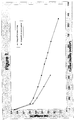
- FIG. 1 The single cell results for air operation are shown in Figure 1 alongside an MEA containing a cathode of the more conventional type, currently employed in direct methanol PEMFC.
- This cathode comprised a conventional pre-teflonated rigid conducting carbon fibre paper substrate (Toray TGP-H-090, available from Toray Industries Inc, Tokyo, Japan) to which was applied a layer of the second particulate catalyst material to provide a platinum loading of 0.9 mg/cm 2 geometric area.
- Comparison of Example 1 with the more conventional MEA illustrates that across the current density range there is higher performance due to improved mass transport properties at operationally viable air stoichiometries. This feature of the electrode is particularly important for applications of the direct methanol PEMFC in powering vehicles, where cell operations at ever increasing current densities is a requirement to reduce the size, weight and cost of the fuel cell stack.
Landscapes
- Chemical & Material Sciences (AREA)
- Chemical Kinetics & Catalysis (AREA)
- Electrochemistry (AREA)
- General Chemical & Material Sciences (AREA)
- Engineering & Computer Science (AREA)
- Materials Engineering (AREA)
- Manufacturing & Machinery (AREA)
- Life Sciences & Earth Sciences (AREA)
- Organic Chemistry (AREA)
- Metallurgy (AREA)
- Sustainable Development (AREA)
- Sustainable Energy (AREA)
- Composite Materials (AREA)
- Inert Electrodes (AREA)
- Electrodes For Compound Or Non-Metal Manufacture (AREA)
- Fuel Cell (AREA)
- Catalysts (AREA)
Applications Claiming Priority (5)
| Application Number | Priority Date | Filing Date | Title |
|---|---|---|---|
| GBGB9604191.8A GB9604191D0 (en) | 1996-02-28 | 1996-02-28 | Water transport in electrodes |
| GB9604191 | 1996-02-28 | ||
| GBGB9626802.4A GB9626802D0 (en) | 1996-12-23 | 1996-12-23 | Gas diffusion electrodes |
| GB9626802 | 1996-12-23 | ||
| EP97300921A EP0791974B2 (de) | 1996-02-28 | 1997-02-13 | Katalytisch aktive Gasdiffusionselektroden mit Faservliessubstrat |
Related Parent Applications (1)
| Application Number | Title | Priority Date | Filing Date |
|---|---|---|---|
| EP97300921A Division EP0791974B2 (de) | 1996-02-28 | 1997-02-13 | Katalytisch aktive Gasdiffusionselektroden mit Faservliessubstrat |
Publications (3)
| Publication Number | Publication Date |
|---|---|
| EP0942482A2 true EP0942482A2 (de) | 1999-09-15 |
| EP0942482A3 EP0942482A3 (de) | 2000-08-16 |
| EP0942482B1 EP0942482B1 (de) | 2001-11-21 |
Family
ID=26308820
Family Applications (2)
| Application Number | Title | Priority Date | Filing Date |
|---|---|---|---|
| EP99109991A Expired - Lifetime EP0942482B1 (de) | 1996-02-28 | 1997-02-13 | Verwendung von katalytisch aktiven Gasdiffusionselektroden mit Faservliessubstrat in einer Direkt-Methanol-Brennstoffzelle |
| EP97300921A Expired - Lifetime EP0791974B2 (de) | 1996-02-28 | 1997-02-13 | Katalytisch aktive Gasdiffusionselektroden mit Faservliessubstrat |
Family Applications After (1)
| Application Number | Title | Priority Date | Filing Date |
|---|---|---|---|
| EP97300921A Expired - Lifetime EP0791974B2 (de) | 1996-02-28 | 1997-02-13 | Katalytisch aktive Gasdiffusionselektroden mit Faservliessubstrat |
Country Status (8)
| Country | Link |
|---|---|
| US (2) | US5865968A (de) |
| EP (2) | EP0942482B1 (de) |
| JP (1) | JP3576739B2 (de) |
| AU (1) | AU717536B2 (de) |
| BR (1) | BR9701086A (de) |
| CA (1) | CA2198553C (de) |
| DE (2) | DE69701103T3 (de) |
| ES (1) | ES2141578T3 (de) |
Cited By (5)
| Publication number | Priority date | Publication date | Assignee | Title |
|---|---|---|---|---|
| GB2352868A (en) * | 1999-07-30 | 2001-02-07 | Aisin Seiki | A solid polymer electrolyte cell |
| US6686096B1 (en) | 2000-01-27 | 2004-02-03 | New Billion Investments Limited | Rechargeable solid state chromium-fluorine-lithium electric battery |
| US7049025B2 (en) | 2000-11-07 | 2006-05-23 | Johnson Matthey Public Limited Company | Gas diffusion substrate |
| WO2013021145A1 (en) | 2011-08-11 | 2013-02-14 | Cmr Fuel Cells (Uk) Limited | Improvements in or relating to catalysts |
| WO2013093449A2 (en) | 2011-12-20 | 2013-06-27 | Ucl Business Plc | Fuel cell |
Families Citing this family (87)
| Publication number | Priority date | Publication date | Assignee | Title |
|---|---|---|---|---|
| JP3583897B2 (ja) * | 1997-04-11 | 2004-11-04 | 三洋電機株式会社 | 燃料電池 |
| GB9708365D0 (en) * | 1997-04-25 | 1997-06-18 | Johnson Matthey Plc | Proton conducting membranes |
| US6103077A (en) * | 1998-01-02 | 2000-08-15 | De Nora S.P.A. | Structures and methods of manufacture for gas diffusion electrodes and electrode components |
| JPH11204114A (ja) | 1998-01-20 | 1999-07-30 | Daikin Ind Ltd | 電極材料 |
| GB2337150B (en) * | 1998-05-07 | 2000-09-27 | Nat Power Plc | Carbon based electrodes |
| US6489051B1 (en) * | 1998-05-27 | 2002-12-03 | Toray Industries, Inc. | Carbon fiber paper for solid polymer fuel cells |
| DE19837669A1 (de) * | 1998-08-20 | 2000-03-09 | Degussa | Katalysatorschicht für Polymer-Elektrolyt-Brennstoffzellen |
| GB9822576D0 (en) * | 1998-10-16 | 1998-12-09 | Johnson Matthey Plc | Membrane |
| CA2359869C (en) * | 1999-01-22 | 2007-04-24 | California Institute Of Technology | Improved membrane electrode assembly for a fuel cell |
| GB9903320D0 (en) * | 1999-02-15 | 1999-04-07 | Johnson Matthey Plc | Substrates |
| GB9905950D0 (en) | 1999-03-16 | 1999-05-05 | Johnson Matthey Plc | Substrates |
| GB9914023D0 (en) | 1999-06-17 | 1999-08-18 | Johnson Matthey Plc | Gas diffusion substrate and electrode |
| GB9914492D0 (en) * | 1999-06-22 | 1999-08-25 | Johnson Matthey Plc | Non-woven fibre webs |
| GB9914499D0 (en) * | 1999-06-22 | 1999-08-25 | Johnson Matthey Plc | Non-woven fibre webs |
| DE20022262U1 (de) | 1999-07-07 | 2001-08-09 | SGL CARBON AG, 65203 Wiesbaden | Elektrodensubstrat für elektrochemische Zellen |
| US6479188B1 (en) | 1999-10-13 | 2002-11-12 | The Gillette Company | Cathode tube and method of making the same |
| JP2003515236A (ja) | 1999-11-17 | 2003-04-22 | ネア・パワー・システムズ・インコーポレイテッド | シリコン基板および/またはゾルゲル法で誘導された担体構造を有する燃料電池 |
| US6666961B1 (en) | 1999-11-18 | 2003-12-23 | Proton Energy Systems, Inc. | High differential pressure electrochemical cell |
| KR100425889B1 (ko) * | 2000-01-27 | 2004-04-03 | 미쯔비시 레이온 가부시끼가이샤 | 다공질 탄소 전극 기재 |
| GB0006429D0 (en) | 2000-03-17 | 2000-05-03 | Johnson Matthey Plc | Electrochemical cell |
| JP4470271B2 (ja) * | 2000-03-31 | 2010-06-02 | 株式会社エクォス・リサーチ | 燃料電池および燃料電池装置 |
| CA2405318C (en) | 2000-04-17 | 2009-10-20 | Johnson Matthey Public Limited Company | Gas diffusion substrate |
| DE20009127U1 (de) | 2000-05-23 | 2000-11-09 | wifatec Fahrzeug-System-Technik GmbH, 32469 Petershagen | Verfahrbare Plattform zum Tragen von Lasten und Fahrzeugaufbau mit einer solchen Plattform |
| DE10027339A1 (de) * | 2000-06-02 | 2001-12-06 | Bayer Ag | Dimensionsstabile Gasdiffusionselektrode |
| GB0016752D0 (en) | 2000-07-08 | 2000-08-30 | Johnson Matthey Plc | Electrochemical structure |
| GB0016750D0 (en) * | 2000-07-08 | 2000-08-30 | Johnson Matthey Plc | Improved material for electrode manufacture |
| WO2002009214A1 (en) * | 2000-07-25 | 2002-01-31 | Apollo Energy Systems, Incorporated | Electrodes for alkaline fuel cells with circulating electrolyte |
| US6740220B1 (en) * | 2000-07-28 | 2004-05-25 | The United States Of America As Represented By The Secretary Of The Navy | Electrocatalytic cathode device of palladium and iridium on a high density or porous carbon support and a method for making such a cathode |
| DE10050512A1 (de) * | 2000-10-11 | 2002-05-23 | Freudenberg Carl Kg | Leitfähiger Vliesstoff |
| DE10052190B4 (de) * | 2000-10-21 | 2009-10-22 | BDF IP Holdings Ltd., Vancouver | Gasdiffusionselektrode, Membranelektrodenanordnung, Verfahren zur Herstellung einer Gasdiffusionselektrode und Verwendung einer Membranelektrodenanordnung |
| US6733639B2 (en) * | 2000-11-13 | 2004-05-11 | Akzo Nobel N.V. | Electrode |
| US7047273B2 (en) | 2000-11-28 | 2006-05-16 | Navic Systems, Inc. | Load balancing in set top cable box environment |
| EP1354366A4 (de) * | 2001-01-16 | 2009-01-14 | Showa Denko Kk | Katalysatorzusammensetzung für eine zelle, gasdiffusionsschicht und brennstoffzelle damit |
| US20030091891A1 (en) * | 2001-01-16 | 2003-05-15 | Tomoaki Yoshida | Catalyst composition for cell, gas diffusion layer, and fuel cell comprising the same |
| US6797422B2 (en) | 2001-01-25 | 2004-09-28 | Gas Technology Institute | Air-breathing direct methanol fuel cell with metal foam current collectors |
| KR20030087006A (ko) * | 2001-02-23 | 2003-11-12 | 에비오닉스, 인크. | 금속 공기 전기 화학 셀용 섬유 전극 |
| ITMI20010402A1 (it) * | 2001-02-28 | 2002-08-28 | De Nora Elettrodi Spa | Nuova composizione elettrocatalitica per catodo depolarizzato ad ossigeno |
| US6500319B2 (en) * | 2001-04-05 | 2002-12-31 | Giner Electrochemical Systems, Llc | Proton exchange membrane (PEM) electrochemical cell having an integral, electrically-conductive, compression pad |
| GB0112021D0 (en) | 2001-05-17 | 2001-07-11 | Johnson Matthey Plc | Substrate |
| EP1263073A1 (de) * | 2001-05-31 | 2002-12-04 | Asahi Glass Co., Ltd. | Membran-Elektroden-Einheit für Festelektrolyt-Brennstoffzelle und Verfahren zu ihrer Herstellung |
| US7601262B1 (en) | 2001-06-22 | 2009-10-13 | Argonide Corporation | Sub-micron filter |
| US7147761B2 (en) * | 2001-08-13 | 2006-12-12 | Mine Safety Appliances Company | Electrochemical sensor |
| US7094492B2 (en) * | 2001-10-11 | 2006-08-22 | Honda Giken Kogyo Kabushiki Kaisha | Electrode for polymer electrolyte fuel cell |
| US6716549B2 (en) * | 2001-12-27 | 2004-04-06 | Avista Laboratories, Inc. | Fuel cell having metalized gas diffusion layer |
| US7144476B2 (en) | 2002-04-12 | 2006-12-05 | Sgl Carbon Ag | Carbon fiber electrode substrate for electrochemical cells |
| US20040001991A1 (en) * | 2002-07-01 | 2004-01-01 | Kinkelaar Mark R. | Capillarity structures for water and/or fuel management in fuel cells |
| DE10244228B4 (de) * | 2002-09-23 | 2008-01-17 | Proton Motor Fuel Cell Gmbh | Verfahren zur Herstellung einer Gasdiffusionselektrode und deren Verwendung |
| JP4130792B2 (ja) * | 2002-11-25 | 2008-08-06 | 本田技研工業株式会社 | 膜−電極構造体及びそれを用いる固体高分子型燃料電池 |
| NO320029B1 (no) * | 2003-07-07 | 2005-10-10 | Revolt Technology As | Fremgangsmate for fremstilling av gassdiffusjonselektroder |
| US7455928B2 (en) * | 2003-08-18 | 2008-11-25 | General Motors Corporation | Diffusion media for use in a PEM fuel cell |
| WO2005024981A2 (en) * | 2003-09-03 | 2005-03-17 | Hollingsworth & Vose Company | Fuel cell gas diffusion layer |
| US20050079403A1 (en) * | 2003-09-10 | 2005-04-14 | Hollingsworth & Vose Company | Fuel cell gas diffusion layer |
| DE10342199B4 (de) * | 2003-09-13 | 2007-02-08 | Daimlerchrysler Ag | Verfahren zur Herstellung einer Gasdiffusionsschicht für eine Brennstoffzelle |
| KR100696462B1 (ko) * | 2003-09-26 | 2007-03-19 | 삼성에스디아이 주식회사 | 연료전지용 전극 확산층 |
| US7396611B2 (en) | 2003-12-15 | 2008-07-08 | Plug Power Inc. | Fuel cell catalyst layer |
| GB0413324D0 (en) | 2004-06-15 | 2004-07-21 | Johnson Matthey Plc | Gas diffusion substrate |
| GB0419062D0 (en) | 2004-08-27 | 2004-09-29 | Johnson Matthey Plc | Platinum alloy catalyst |
| US7629071B2 (en) * | 2004-09-29 | 2009-12-08 | Giner Electrochemical Systems, Llc | Gas diffusion electrode and method of making the same |
| GB0423812D0 (en) * | 2004-10-27 | 2004-12-01 | Johnson Matthey Plc | Fuel cell stack |
| WO2006075681A1 (ja) * | 2005-01-14 | 2006-07-20 | Matsushita Electric Industrial Co., Ltd. | 燃料電池用スタック及び燃料電池 |
| GB2422716B (en) * | 2005-01-26 | 2007-08-22 | Intelligent Energy Ltd | Multi-layer fuel cell diffuser |
| JP2006219694A (ja) * | 2005-02-08 | 2006-08-24 | Permelec Electrode Ltd | ガス拡散電極 |
| EP1931441B1 (de) * | 2005-09-12 | 2025-03-19 | Argonide Corporation | Elektrostatischer luftfilter |
| US7390343B2 (en) * | 2005-09-12 | 2008-06-24 | Argonide Corporation | Drinking water filtration device |
| US20080280190A1 (en) * | 2005-10-20 | 2008-11-13 | Robert Brian Dopp | Electrochemical catalysts |
| KR101082810B1 (ko) * | 2005-11-01 | 2011-11-11 | 가부시키가이샤 도모에가와 세이시쇼 | 가스 확산 전극, 막-전극 접합체, 고체 고분자형 연료 전지및 이들의 제조 방법 |
| GB0601943D0 (en) | 2006-02-01 | 2006-03-15 | Johnson Matthey Plc | Microporous layer |
| US7955755B2 (en) | 2006-03-31 | 2011-06-07 | Quantumsphere, Inc. | Compositions of nanometal particles containing a metal or alloy and platinum particles |
| JP4898568B2 (ja) * | 2007-06-15 | 2012-03-14 | 株式会社ノリタケカンパニーリミテド | 触媒層および膜−電極接合体 |
| KR100957302B1 (ko) * | 2007-09-07 | 2010-05-12 | 현대자동차주식회사 | 연료전지용 막-전극 접합체의 제조방법 |
| WO2011114949A1 (ja) * | 2010-03-19 | 2011-09-22 | 旭硝子株式会社 | 固体高分子形燃料電池用膜電極接合体、および固体高分子形燃料電池用カソードの製造方法 |
| US9093721B2 (en) * | 2010-09-24 | 2015-07-28 | The United States Of America, As Represented By The Secretary Of The Navy | Dual-function air cathode nanoarchitectures for metal-air batteries with pulse-power capability |
| DE102010042729A1 (de) * | 2010-10-21 | 2012-04-26 | Bayer Materialscience Aktiengesellschaft | Sauerstoffverzehrkathode und Verfahren zu ihrer Herstellung |
| US9123963B2 (en) * | 2011-03-25 | 2015-09-01 | GM Global Technology Operations LLC | Direct coated membrane electrode assembly on external reinforcement for fuel cells |
| US8962213B2 (en) * | 2011-03-25 | 2015-02-24 | GM Global Technology Operations LLC | Direct catalyst coating on free standing microporous layer |
| GB201118020D0 (en) | 2011-10-19 | 2011-11-30 | Johnson Matthey Plc | Gas diffusion substrate |
| US9108968B2 (en) | 2012-04-25 | 2015-08-18 | Ppg Industries Ohio, Inc. | Methods for producing 1,5,7-triazabicyclo[4.4.0]dec-5-ene by reaction of a disubstituted carbodiimide and dipropylene triamine |
| CN104507548A (zh) | 2012-06-27 | 2015-04-08 | 阿尔戈耐德公司 | 铝化硅质粉末和包含其的水纯化装置 |
| CN104981929B (zh) * | 2013-02-13 | 2017-07-04 | 东丽株式会社 | 燃料电池用气体扩散层、及其制造方法 |
| WO2014205259A1 (en) | 2013-06-20 | 2014-12-24 | Gencell Ltd. | Gas diffusion electrode and process for making same |
| GB201401952D0 (en) | 2014-02-05 | 2014-03-19 | Johnson Matthey Fuel Cells Ltd | Gas diffusion substrate |
| DE102014226714A1 (de) | 2014-12-19 | 2015-11-19 | Heraeus Deutschland GmbH & Co. KG | Katalysatorvlies |
| JP6182741B2 (ja) * | 2015-12-15 | 2017-08-23 | パナソニックIpマネジメント株式会社 | 電解装置用電極、電解装置、及び電解生成物を生成する方法 |
| WO2018189005A1 (en) * | 2017-04-13 | 2018-10-18 | Nv Bekaert Sa | Gas diffusion layer |
| WO2020065455A1 (en) * | 2018-09-24 | 2020-04-02 | 3M Innovative Properties Company | Porous electrode, membrane-electrode assembly, liquid flow battery and method of making a porous electrode |
| US12237515B2 (en) * | 2021-10-22 | 2025-02-25 | Textron Innovations Inc. | Fuel cell metallic gas diffusion layer |
| WO2025101926A1 (en) * | 2023-11-09 | 2025-05-15 | Olin Corporation | Electrode coatings containing nanomaterials or microfibers |
Family Cites Families (29)
| Publication number | Priority date | Publication date | Assignee | Title |
|---|---|---|---|---|
| US3203834A (en) * | 1961-07-26 | 1965-08-31 | Leesona Corp | Fuel cell |
| FR1499879A (fr) * | 1965-12-16 | 1967-11-03 | Inst Francais Du Petrole | Nouvelles électrodes de piles à combustible et leur procédé de fabrication |
| US3544381A (en) * | 1967-10-05 | 1970-12-01 | Hooker Chemical Corp | Fuel cell with wicking-type electrode |
| US3706602A (en) * | 1969-12-18 | 1972-12-19 | Hooker Chemical Corp | Fuel cell electrode structure utilizing capillary action |
| JPS50334A (de) * | 1973-05-08 | 1975-01-06 | ||
| JPS5318603B2 (de) † | 1973-07-10 | 1978-06-16 | ||
| US3972735A (en) * | 1974-02-15 | 1976-08-03 | United Technologies Corporation | Method for making electrodes for electrochemical cells |
| US4115627A (en) * | 1977-08-15 | 1978-09-19 | United Technologies Corporation | Electrochemical cell comprising a ribbed electrode substrate |
| US4185131A (en) † | 1978-06-28 | 1980-01-22 | United Technologies Corporation | Screen printing method for making an electrochemical cell electrode |
| US4680100A (en) * | 1982-03-16 | 1987-07-14 | American Cyanamid Company | Electrochemical cells and electrodes therefor |
| KR930000425B1 (ko) * | 1984-10-17 | 1993-01-21 | 가부시기가이샤 히다찌세이사꾸쇼 | 가요성전극을 사용한 연료전지 |
| US4647359A (en) * | 1985-10-16 | 1987-03-03 | Prototech Company | Electrocatalytic gas diffusion electrode employing thin carbon cloth layer |
| DE3672975D1 (de) * | 1985-12-09 | 1990-08-30 | Dow Chemical Co | Festkoerperpolymerelektrolyt-elektrode. |
| DE3672589D1 (de) * | 1985-12-09 | 1990-08-16 | Dow Chemical Co | Methode zur herstellung einer festkoerperpolymerelektrolyt-elektrode mit einer fluessigkeit oder mit einem loesungsmittel. |
| JPH0633490B2 (ja) * | 1985-12-27 | 1994-05-02 | 田中貴金属工業株式会社 | ガス拡散電極とその製造方法 |
| JPH065619B2 (ja) * | 1986-02-06 | 1994-01-19 | 田中貴金属工業株式会社 | ガス拡散電極の製造方法 |
| JPS62232861A (ja) * | 1986-04-01 | 1987-10-13 | Tanaka Kikinzoku Kogyo Kk | ガス拡散電極とその製造方法 |
| JPS62232860A (ja) * | 1986-04-01 | 1987-10-13 | Tanaka Kikinzoku Kogyo Kk | ガス拡散電極とその製造方法 |
| US4729932A (en) * | 1986-10-08 | 1988-03-08 | United Technologies Corporation | Fuel cell with integrated cooling water/static water removal means |
| US4780437A (en) * | 1987-02-11 | 1988-10-25 | The United States Of America As Represented By The United States Department Of Energy | Fabrication of catalytic electrodes for molten carbonate fuel cells |
| US5234776A (en) * | 1990-08-03 | 1993-08-10 | Fuji Electric Co., Ltd. | Solid polymer electrolyte fuel cell system with ribbed configuration |
| JP3107229B2 (ja) * | 1991-02-14 | 2000-11-06 | 田中貴金属工業株式会社 | 固体高分子電解質燃料電池及び電解セルの隔膜加湿構造 |
| DE4140972A1 (de) * | 1991-12-12 | 1993-06-17 | Metallgesellschaft Ag | Membran fuer eine gasdiffusionselektrode, verfahren zur herstellung der membran und gasdiffusionselektrode mit membran |
| US5242765A (en) * | 1992-06-23 | 1993-09-07 | Luz Electric Fuel Israel Limited | Gas diffusion electrodes |
| US5300206A (en) * | 1992-08-03 | 1994-04-05 | Metallgesellschaft Ag | Antipercolation gas-diffusion electrode and method of making same |
| US5292600A (en) * | 1992-08-13 | 1994-03-08 | H-Power Corp. | Hydrogen power cell |
| JP3242736B2 (ja) * | 1993-03-10 | 2001-12-25 | 三菱電機株式会社 | 電気化学デバイス |
| GB9324101D0 (en) * | 1993-11-23 | 1994-01-12 | Johnson Matthey Plc | Improved manufacture of electrodes |
| DE19544323A1 (de) † | 1995-11-28 | 1997-06-05 | Magnet Motor Gmbh | Gasdiffusionselektrode für Polymerelektrolytmembran-Brennstoffzellen |
-
1997
- 1997-02-13 EP EP99109991A patent/EP0942482B1/de not_active Expired - Lifetime
- 1997-02-13 EP EP97300921A patent/EP0791974B2/de not_active Expired - Lifetime
- 1997-02-13 ES ES97300921T patent/ES2141578T3/es not_active Expired - Lifetime
- 1997-02-13 DE DE69701103T patent/DE69701103T3/de not_active Expired - Lifetime
- 1997-02-13 DE DE69709784T patent/DE69709784T2/de not_active Expired - Fee Related
- 1997-02-18 AU AU14737/97A patent/AU717536B2/en not_active Ceased
- 1997-02-19 US US08/802,556 patent/US5865968A/en not_active Expired - Fee Related
- 1997-02-26 BR BR9701086A patent/BR9701086A/pt active Search and Examination
- 1997-02-26 CA CA002198553A patent/CA2198553C/en not_active Expired - Fee Related
- 1997-02-28 JP JP04625897A patent/JP3576739B2/ja not_active Expired - Fee Related
-
1998
- 1998-11-12 US US09/189,842 patent/US6010606A/en not_active Expired - Lifetime
Cited By (6)
| Publication number | Priority date | Publication date | Assignee | Title |
|---|---|---|---|---|
| GB2352868A (en) * | 1999-07-30 | 2001-02-07 | Aisin Seiki | A solid polymer electrolyte cell |
| GB2352868B (en) * | 1999-07-30 | 2003-09-17 | Aisin Seiki | A solid polymer electrolyte fuel cell |
| US6686096B1 (en) | 2000-01-27 | 2004-02-03 | New Billion Investments Limited | Rechargeable solid state chromium-fluorine-lithium electric battery |
| US7049025B2 (en) | 2000-11-07 | 2006-05-23 | Johnson Matthey Public Limited Company | Gas diffusion substrate |
| WO2013021145A1 (en) | 2011-08-11 | 2013-02-14 | Cmr Fuel Cells (Uk) Limited | Improvements in or relating to catalysts |
| WO2013093449A2 (en) | 2011-12-20 | 2013-06-27 | Ucl Business Plc | Fuel cell |
Also Published As
| Publication number | Publication date |
|---|---|
| US5865968A (en) | 1999-02-02 |
| BR9701086A (pt) | 1998-11-24 |
| EP0791974A1 (de) | 1997-08-27 |
| AU1473797A (en) | 1997-09-04 |
| EP0942482A3 (de) | 2000-08-16 |
| DE69709784T2 (de) | 2002-08-08 |
| DE69709784D1 (de) | 2002-02-21 |
| AU717536B2 (en) | 2000-03-30 |
| JPH09326256A (ja) | 1997-12-16 |
| ES2141578T3 (es) | 2000-03-16 |
| US6010606A (en) | 2000-01-04 |
| DE69701103T2 (de) | 2000-06-15 |
| CA2198553C (en) | 2008-10-28 |
| DE69701103D1 (de) | 2000-02-17 |
| CA2198553A1 (en) | 1997-08-28 |
| JP3576739B2 (ja) | 2004-10-13 |
| EP0942482B1 (de) | 2001-11-21 |
| DE69701103T3 (de) | 2006-02-02 |
| EP0791974B1 (de) | 2000-01-12 |
| EP0791974B2 (de) | 2005-08-17 |
Similar Documents
| Publication | Publication Date | Title |
|---|---|---|
| EP0942482B1 (de) | Verwendung von katalytisch aktiven Gasdiffusionselektroden mit Faservliessubstrat in einer Direkt-Methanol-Brennstoffzelle | |
| US7014944B2 (en) | Electrodes for alkaline fuel cells with circulating electrolyte | |
| EP1169743B1 (de) | Gasdiffusionsubstrat | |
| EP1096586B1 (de) | Herstellungsverfahren von Elektroden | |
| JP3430113B2 (ja) | 電気化学電池用の電極及び膜−電極アセンブリ | |
| CA2171386C (en) | Improved materials for use in electrode manufacture | |
| US5521020A (en) | Method for catalyzing a gas diffusion electrode | |
| US7678162B2 (en) | Gas diffusion substrate and electrode | |
| EP1519433A1 (de) | Diffusionselektrode für Brennstoffzellen | |
| EP1063716B1 (de) | Kohlenstofffasern enthaltendes nicht-gewobenes Faservlies verwendbar als Gasdiffusionselektrodensubstrat für Brennstoffzellen | |
| EP1165885B1 (de) | Vliesbahn | |
| US8445163B2 (en) | Membrane electrode assembly for fuel cell having catalyst layer with mesopore volume, method of preparing same, and fuel cell system including the same | |
| EP3011625B1 (de) | Gasdiffusionselektrode und verfahren zur herstellung davon | |
| JP2005183263A (ja) | 多孔質構造体 | |
| JP2006085984A (ja) | 燃料電池用mea、および、これを用いた燃料電池 | |
| JP2010049931A (ja) | ダイレクトメタノール型燃料電池、およびダイレクトメタノール型燃料電池用カソード | |
| KR102903719B1 (ko) | 라디칼 스캐빈저 복합체의 제조방법, 이를 이용하여 제조된 라디칼 스캐빈저 복합체 및 막-전극 어셈블리 | |
| JP2008218269A (ja) | 電極触媒 |
Legal Events
| Date | Code | Title | Description |
|---|---|---|---|
| PUAI | Public reference made under article 153(3) epc to a published international application that has entered the european phase |
Free format text: ORIGINAL CODE: 0009012 |
|
| AC | Divisional application: reference to earlier application |
Ref document number: 791974 Country of ref document: EP |
|
| AK | Designated contracting states |
Kind code of ref document: A2 Designated state(s): BE DE ES FR GB IT NL SE |
|
| PUAL | Search report despatched |
Free format text: ORIGINAL CODE: 0009013 |
|
| RIC1 | Information provided on ipc code assigned before grant |
Free format text: 7H 01M 4/86 A, 7H 01M 4/88 B, 7H 01M 8/10 B, 7C 25B 11/12 B, 7C 25B 11/03 B |
|
| AK | Designated contracting states |
Kind code of ref document: A3 Designated state(s): BE DE ES FR GB IT NL SE |
|
| 17P | Request for examination filed |
Effective date: 20010125 |
|
| GRAG | Despatch of communication of intention to grant |
Free format text: ORIGINAL CODE: EPIDOS AGRA |
|
| GRAG | Despatch of communication of intention to grant |
Free format text: ORIGINAL CODE: EPIDOS AGRA |
|
| GRAH | Despatch of communication of intention to grant a patent |
Free format text: ORIGINAL CODE: EPIDOS IGRA |
|
| 17Q | First examination report despatched |
Effective date: 20010504 |
|
| GRAH | Despatch of communication of intention to grant a patent |
Free format text: ORIGINAL CODE: EPIDOS IGRA |
|
| GRAA | (expected) grant |
Free format text: ORIGINAL CODE: 0009210 |
|
| AC | Divisional application: reference to earlier application |
Ref document number: 791974 Country of ref document: EP |
|
| AK | Designated contracting states |
Kind code of ref document: B1 Designated state(s): BE DE ES FR GB IT NL SE |
|
| PG25 | Lapsed in a contracting state [announced via postgrant information from national office to epo] |
Ref country code: BE Free format text: LAPSE BECAUSE OF FAILURE TO SUBMIT A TRANSLATION OF THE DESCRIPTION OR TO PAY THE FEE WITHIN THE PRESCRIBED TIME-LIMIT Effective date: 20011121 |
|
| REG | Reference to a national code |
Ref country code: GB Ref legal event code: IF02 |
|
| ET | Fr: translation filed | ||
| PG25 | Lapsed in a contracting state [announced via postgrant information from national office to epo] |
Ref country code: SE Free format text: LAPSE BECAUSE OF FAILURE TO SUBMIT A TRANSLATION OF THE DESCRIPTION OR TO PAY THE FEE WITHIN THE PRESCRIBED TIME-LIMIT Effective date: 20020221 |
|
| REF | Corresponds to: |
Ref document number: 69709784 Country of ref document: DE Date of ref document: 20020221 |
|
| PG25 | Lapsed in a contracting state [announced via postgrant information from national office to epo] |
Ref country code: ES Free format text: LAPSE BECAUSE OF FAILURE TO SUBMIT A TRANSLATION OF THE DESCRIPTION OR TO PAY THE FEE WITHIN THE PRESCRIBED TIME-LIMIT Effective date: 20020530 |
|
| PLBE | No opposition filed within time limit |
Free format text: ORIGINAL CODE: 0009261 |
|
| STAA | Information on the status of an ep patent application or granted ep patent |
Free format text: STATUS: NO OPPOSITION FILED WITHIN TIME LIMIT |
|
| 26N | No opposition filed | ||
| PGFP | Annual fee paid to national office [announced via postgrant information from national office to epo] |
Ref country code: NL Payment date: 20090217 Year of fee payment: 13 Ref country code: DE Payment date: 20090219 Year of fee payment: 13 |
|
| PGFP | Annual fee paid to national office [announced via postgrant information from national office to epo] |
Ref country code: GB Payment date: 20090219 Year of fee payment: 13 |
|
| PGFP | Annual fee paid to national office [announced via postgrant information from national office to epo] |
Ref country code: IT Payment date: 20090226 Year of fee payment: 13 |
|
| PGFP | Annual fee paid to national office [announced via postgrant information from national office to epo] |
Ref country code: FR Payment date: 20090213 Year of fee payment: 13 |
|
| REG | Reference to a national code |
Ref country code: NL Ref legal event code: V1 Effective date: 20100901 |
|
| GBPC | Gb: european patent ceased through non-payment of renewal fee |
Effective date: 20100213 |
|
| REG | Reference to a national code |
Ref country code: FR Ref legal event code: ST Effective date: 20101029 |
|
| PG25 | Lapsed in a contracting state [announced via postgrant information from national office to epo] |
Ref country code: NL Free format text: LAPSE BECAUSE OF NON-PAYMENT OF DUE FEES Effective date: 20100901 Ref country code: FR Free format text: LAPSE BECAUSE OF NON-PAYMENT OF DUE FEES Effective date: 20100301 |
|
| PG25 | Lapsed in a contracting state [announced via postgrant information from national office to epo] |
Ref country code: DE Free format text: LAPSE BECAUSE OF NON-PAYMENT OF DUE FEES Effective date: 20100901 |
|
| PG25 | Lapsed in a contracting state [announced via postgrant information from national office to epo] |
Ref country code: IT Free format text: LAPSE BECAUSE OF NON-PAYMENT OF DUE FEES Effective date: 20100213 Ref country code: GB Free format text: LAPSE BECAUSE OF NON-PAYMENT OF DUE FEES Effective date: 20100213 |