EP0943290A1 - Verfahren zur Messung und Anzeige der Grenzen der Bewegungsmöglichkeiten während täglicher Aktivitäten - Google Patents
Verfahren zur Messung und Anzeige der Grenzen der Bewegungsmöglichkeiten während täglicher Aktivitäten Download PDFInfo
- Publication number
- EP0943290A1 EP0943290A1 EP99200821A EP99200821A EP0943290A1 EP 0943290 A1 EP0943290 A1 EP 0943290A1 EP 99200821 A EP99200821 A EP 99200821A EP 99200821 A EP99200821 A EP 99200821A EP 0943290 A1 EP0943290 A1 EP 0943290A1
- Authority
- EP
- European Patent Office
- Prior art keywords
- individual
- activities
- measuring
- examined
- ratios
- Prior art date
- Legal status (The legal status is an assumption and is not a legal conclusion. Google has not performed a legal analysis and makes no representation as to the accuracy of the status listed.)
- Withdrawn
Links
- 230000000694 effects Effects 0.000 title claims abstract description 49
- 230000033001 locomotion Effects 0.000 title claims abstract description 45
- 238000000034 method Methods 0.000 title claims abstract description 38
- 238000005259 measurement Methods 0.000 claims abstract description 16
- 230000037023 motor activity Effects 0.000 claims abstract description 6
- 230000036544 posture Effects 0.000 claims abstract description 5
- 230000006870 function Effects 0.000 claims description 36
- 238000012546 transfer Methods 0.000 claims description 3
- 230000009194 climbing Effects 0.000 claims description 2
- 230000037081 physical activity Effects 0.000 claims description 2
- 230000002354 daily effect Effects 0.000 description 8
- 238000009826 distribution Methods 0.000 description 5
- 210000000629 knee joint Anatomy 0.000 description 5
- 210000003127 knee Anatomy 0.000 description 4
- 230000001133 acceleration Effects 0.000 description 3
- 230000000875 corresponding effect Effects 0.000 description 3
- 230000004064 dysfunction Effects 0.000 description 3
- RZVAJINKPMORJF-UHFFFAOYSA-N Acetaminophen Chemical compound CC(=O)NC1=CC=C(O)C=C1 RZVAJINKPMORJF-UHFFFAOYSA-N 0.000 description 2
- 210000000988 bone and bone Anatomy 0.000 description 2
- 238000010586 diagram Methods 0.000 description 2
- 210000002414 leg Anatomy 0.000 description 2
- 238000013160 medical therapy Methods 0.000 description 2
- 238000001356 surgical procedure Methods 0.000 description 2
- 238000012935 Averaging Methods 0.000 description 1
- 210000000544 articulatio talocruralis Anatomy 0.000 description 1
- 238000006243 chemical reaction Methods 0.000 description 1
- 230000006378 damage Effects 0.000 description 1
- 238000011156 evaluation Methods 0.000 description 1
- 230000003203 everyday effect Effects 0.000 description 1
- 238000009472 formulation Methods 0.000 description 1
- 239000000203 mixture Substances 0.000 description 1
- 230000000399 orthopedic effect Effects 0.000 description 1
- 230000008447 perception Effects 0.000 description 1
- 238000000554 physical therapy Methods 0.000 description 1
- 238000012360 testing method Methods 0.000 description 1
- 238000011541 total hip replacement Methods 0.000 description 1
Images



Classifications
-
- A—HUMAN NECESSITIES
- A61—MEDICAL OR VETERINARY SCIENCE; HYGIENE
- A61B—DIAGNOSIS; SURGERY; IDENTIFICATION
- A61B5/00—Measuring for diagnostic purposes; Identification of persons
- A61B5/103—Measuring devices for testing the shape, pattern, colour, size or movement of the body or parts thereof, for diagnostic purposes
- A61B5/11—Measuring movement of the entire body or parts thereof, e.g. head or hand tremor or mobility of a limb
- A61B5/1118—Determining activity level
-
- A—HUMAN NECESSITIES
- A61—MEDICAL OR VETERINARY SCIENCE; HYGIENE
- A61B—DIAGNOSIS; SURGERY; IDENTIFICATION
- A61B5/00—Measuring for diagnostic purposes; Identification of persons
- A61B5/103—Measuring devices for testing the shape, pattern, colour, size or movement of the body or parts thereof, for diagnostic purposes
- A61B5/11—Measuring movement of the entire body or parts thereof, e.g. head or hand tremor or mobility of a limb
- A61B5/1116—Determining posture transitions
-
- A—HUMAN NECESSITIES
- A61—MEDICAL OR VETERINARY SCIENCE; HYGIENE
- A61B—DIAGNOSIS; SURGERY; IDENTIFICATION
- A61B5/00—Measuring for diagnostic purposes; Identification of persons
- A61B5/45—For evaluating or diagnosing the musculoskeletal system or teeth
- A61B5/4528—Joints
Definitions
- This invention relates to a method for measuring and indicating the extent to which an individual is limited in daily life activities.
- the object of the present invention is to provide a method by which the extent of limitation in daily life activities can be measured and indicated in a more objective manner.
- the stated object is achieved, in accordance with the invention, through a method which comprises measuring, with the aid of at least one sensor to be fastened to the body of the individual to be examined, postures, movements and/or motional changes of the body and/or parts of the body of the individual in a selected number of motor activities to be performed by the individual, wherein the measuring data of the at least one sensor are inputted into a suitably programmed computing device, where those data, as far as necessary, are converted into data concerning position and/or movement and/or motional change of the body and/or parts of the body, and are subsequently compared to corresponding reference data inputted into the computing device, coming from one or more standard persons and/or standard groups, in order to determine per measurement or series of measurements a percentage or ratio indicating the extent to which the individual is limited as regards the activity in question.
- U.S. Patent 5,375,610 discloses a method for measuring and indicating the functional mobility of an individual.
- the different positions of the body or parts of the body of a disabled individual are compared to corresponding positions of able-bodied individuals.
- the individual to be examined must wear a body suit, fitting the body closely, in which sensors are incorporated at a large number of points.
- the measuring apparatus available for this known method provides a graphic representation of the activity profile of the subject and reference persons.
- a possibility for analysis whereby tables of data concerning different body positions of different individuals are compared and an error percentage is computed and displayed.
- the known method is a descriptive one. The qualitative assessment is left to the user of the method and the associated apparatus. From the multiplicity of data produced, the user must draw conclusions.
- a disadvantage of the method known from U.S. Patent 5,375,610 is further that the individuals to be examined must wear a body suit, which fits the body closely. This gives the subjects a feeling of unfreedom.
- the idea underlying the invention is to obtain in a standardized test objective measuring data of the total motor apparatus of an individual to be examined at the level of the limitation, and to use same for determining a ratio or score expressing the limitation in the daily life activities.
- the method according to the invention is suitable to be used in respect of all kinds of limitations in daily life activities. Mentioned above, by way of example, were patients having knee prostheses. Equally, patients having a hip prosthesis, having a dysfunction of the ankle joint, or having back complaints can be considered.
- the standard persons and/or standard groups which provide the reference data can be, for instance, a reference group of persons without the complaints/problems in question and/or a reference group of persons having comparable complaints to the individual to be examined but not having been treated/operated yet.
- the gross motor activity of the individual to be examined is recorded under highly faithful, everyday circumstances, while nonetheless the posture and movement of the body and the parts of the body are determined with a high degree of accuracy. Measuring the gross motor activity can occur, for instance, in the manner as described in EP-A-0 791 328.
- the method according to the invention further provides a status overview, consisting of the computed scores, of the limitation on the motor apparatus, for diagnostic purposes and, for instance, for evaluation of medical therapy in the medical disciplines of orthopedics, physiotherapy and rehabilitation.
- ratios are determined for a number of movement characteristics per activity and then averaged at least per activity, in order to determine for each of those activities a percentage or ratio, followed by determining from the ratios of activities belonging to one main function a ratio for that main function, and determining from the ratios for each of the number of main functions one total percentage or total ratio that is representative of the total limitation in daily life activities (the total function) of the individual in question.
- the number of movement characteristics per activity is preferably at least three, but more preferably a large number, up to as many as 10 or more.
- the measuring data concerning movement characteristics can be of different natures.
- Movement characteristics that could be measured are, for instance, the intensity, the velocity, the angular change, the step frequency, the step phases, and the push-off acceleration.
- the method according to the invention can yield a single score concerning the total function of the individual under examination. If this were not possible, the method according to the invention would not have been clinically useful. In none of the above-discussed methods is it possible to arrive at such a score concerning the total function.
- the measurements are performed on activities selected from at least each of the groups (main functions) of locomotion, rise and descend, transfer (change of body posture), lifting and moving loads.
- the measurements are then performed on activities at least comprising walking, climbing stairs, descending stairs, sitting down in a chair, getting up from a chair, lying down on a bed, getting up from a bed, lifting an object and carrying an object.
- the measurements are performed with at least two sensors to be fastened to the body of the individual to be examined.
- a sensor fitted in a strap to be fitted around the waist of the individual under examination, and of a sensor fitted in a strap or other element to be fastened to a lower or upper leg of the individual to be examined.
- Fig. 1 schematically depicts a subject 1.
- a subject having a disorder of the knee joint has been chosen.
- the measurements to be performed take place with the aid of sensors to be fastened to the body of the subject.
- sensors can, for instance, be included in respective fastening straps, which are fastened around the waist of the subject (strap 2), around the left upper leg (strap 3), and beneath each of the knee joints (straps 4 and 5).
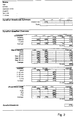
- Fig. 2 shows an example of a score table such as can be used in the examination on the condition of the knee joint of the subject according to Fig. 1.
- the score table of Fig. 2 first some data regarding the individual under examination are recorded, such as the name, gender, date of the operation (if applicable) and the name of the surgeon, as well as the date of the examination and the name of the examiner.
- the examinations take place, for instance, at predetermined times.
- the score table further has room for including a summary of those examinations at different times. Under the heading Summary, there is room for the knee score (the total percentage) prior to an operation (PRE), and the respective scores 3, 6 and 12 months after the operation.
- the score table further contains a total overview, for a single examination, of the ratios per main function (Locomotion, Rise & Descend, Transfers and Lift and Move Loads) and, within a main function, per activity.
- the score per main function is computed with a suitably programmed computing device from the scores per activity within a main function.
- a total score is computed from the scores per main function.
- the total score is 31%.
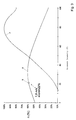
- the curve 7 represents the assumed normal distribution of the characteristic of movement intensity of a group of healthy standard persons (N G ) and the curve 6 represents the assumed normal distribution of the characteristic of movement intensity of an examined group of standard persons having a comparable disorder (N A ), who have been examined at an earlier time.
- the lower and upper limits for the standard groups are, respectively, 1.09 and 2.96 m/s 2 .
- the cube 8 represents how the movement intensity of individual X while walking a distance of 9 meters relates to the normal distributions of the standard groups.
- the characteristics are: time K T needed to cover the distance, the time K MT that movement is involved, the movement intensity K MI , the movement impact K IM , the movement intensity K ATMI of the affected upper leg, the step frequency K SF , the movement angle K ATA of the upper leg on the affected side, the movement intensity K ASMI of the affected lower leg, the movement intensity K NSMI of the non-affected lower leg, the forward acceleration during push off with the affected leg (K AFA ) and with the non-affected leg (K NFA ).
- this resultant can be read in column 9 m against the activity of Walking under the main function of Locomotion in the overview of the ratios.
- a similar determination procedure as described above holds for the other ratios for the activities.
- Each of the ratios per main function gives the average of the ratios per activity (A 1 ....A n ).
- the main function of locomotion for instance, is determined with the ratios for walking a distance of 9 meters, walking outside, interval walking (average of 3, 6 and 9 meters) and walking a curve.
- Fig. 4 represents how the data of the sensors fastened to the body of a subject are imaged graphically on a monitor. Depicted is the screen of the monitor for the part 'walking' of an examination on the condition of a knee of the subject.
- the various measuring values are entered in a suitably programmed computing device and compared to the measuring values of pre-selected standard groups, to compute ratios therefrom.
- Fig. 5 shows a flow diagram of an embodiment of the method according to the invention.
- step 1 it is determined which activities the patient will perform within the various main functions. Within the main function of locomotion, those activities will include walking over a distance of 9 meters and walking outside. Other activities are indicated by a dotted line in step 1.
- the activities of the patient will be compared to corresponding activities of the selected standard groups. This is indicated in the right-hand column at step 1.
- measuring values are determined for the patient.
- those measuring values comprise values regarding the characteristics of velocity and movement intensity, as mentioned, and many others, as indicated by the dotted line.
- measuring values of standard groups are available. These measuring values have been previously determined. The availability of reference measuring values is indicated in the right-hand column at step 2.
- step 3 the measuring values of the movement characteristics of the patient and those of the standard groups are compared to each other and ratios are computed for each movement characteristic.
- step 4 the ratios of the movement characteristics are averaged per activity to determine a ratio for each activity.
- step 5 the ratios of the activities are averaged per main function to determine a ratio for each main function.
- step 5 it is indicated that thus ratios are obtained for the main functions of locomotion, rise & descend, and other main functions represented by a dotted line.
- step 6 finally, by averaging, a total percentage is computed from the ratios for the main functions.
Landscapes
- Health & Medical Sciences (AREA)
- Life Sciences & Earth Sciences (AREA)
- Engineering & Computer Science (AREA)
- Medical Informatics (AREA)
- Physics & Mathematics (AREA)
- Dentistry (AREA)
- Biophysics (AREA)
- Pathology (AREA)
- Physiology (AREA)
- Biomedical Technology (AREA)
- Heart & Thoracic Surgery (AREA)
- Oral & Maxillofacial Surgery (AREA)
- Molecular Biology (AREA)
- Surgery (AREA)
- Animal Behavior & Ethology (AREA)
- General Health & Medical Sciences (AREA)
- Public Health (AREA)
- Veterinary Medicine (AREA)
- Measurement Of The Respiration, Hearing Ability, Form, And Blood Characteristics Of Living Organisms (AREA)
Applications Claiming Priority (2)
| Application Number | Priority Date | Filing Date | Title |
|---|---|---|---|
| NL1008619A NL1008619C2 (nl) | 1998-03-17 | 1998-03-17 | Werkwijze voor het meten en aangeven van de mate waarin een persoon beperkt is in activiteiten van het dagelijks leven. |
| NL1008619 | 1999-03-17 |
Publications (1)
| Publication Number | Publication Date |
|---|---|
| EP0943290A1 true EP0943290A1 (de) | 1999-09-22 |
Family
ID=19766758
Family Applications (1)
| Application Number | Title | Priority Date | Filing Date |
|---|---|---|---|
| EP99200821A Withdrawn EP0943290A1 (de) | 1998-03-17 | 1999-03-16 | Verfahren zur Messung und Anzeige der Grenzen der Bewegungsmöglichkeiten während täglicher Aktivitäten |
Country Status (3)
| Country | Link |
|---|---|
| US (1) | US6165143A (de) |
| EP (1) | EP0943290A1 (de) |
| NL (1) | NL1008619C2 (de) |
Cited By (17)
| Publication number | Priority date | Publication date | Assignee | Title |
|---|---|---|---|---|
| WO2002071945A1 (en) * | 2001-03-12 | 2002-09-19 | University Of Strathclyde | Activity monitor |
| WO2015188867A1 (de) * | 2014-06-12 | 2015-12-17 | Gaia Ag | Analyse und bewertung der qualität von körperbewegungen |
| CN111035394A (zh) * | 2014-09-02 | 2020-04-21 | 苹果公司 | 身体活动和健身监视器 |
| US10790063B2 (en) | 2010-07-26 | 2020-09-29 | Michael Chillemi | Computer-aided multiple standard-based functional evaluation and medical reporting system |
| US11660503B2 (en) | 2016-06-11 | 2023-05-30 | Apple Inc. | Activity and workout updates |
| US11712179B2 (en) | 2018-05-07 | 2023-08-01 | Apple Inc. | Displaying user interfaces associated with physical activities |
| US11716629B2 (en) | 2020-02-14 | 2023-08-01 | Apple Inc. | User interfaces for workout content |
| US11791031B2 (en) | 2019-05-06 | 2023-10-17 | Apple Inc. | Activity trends and workouts |
| US11896871B2 (en) | 2022-06-05 | 2024-02-13 | Apple Inc. | User interfaces for physical activity information |
| US11908343B2 (en) | 2015-08-20 | 2024-02-20 | Apple Inc. | Exercised-based watch face and complications |
| US11931625B2 (en) | 2021-05-15 | 2024-03-19 | Apple Inc. | User interfaces for group workouts |
| US11977729B2 (en) | 2022-06-05 | 2024-05-07 | Apple Inc. | Physical activity information user interfaces |
| US11979467B2 (en) | 2019-06-01 | 2024-05-07 | Apple Inc. | Multi-modal activity tracking user interface |
| US11996190B2 (en) | 2013-12-04 | 2024-05-28 | Apple Inc. | Wellness aggregator |
| US12036018B2 (en) | 2016-09-22 | 2024-07-16 | Apple Inc. | Workout monitor interface |
| US12039146B2 (en) | 2017-05-15 | 2024-07-16 | Apple Inc. | Displaying a scrollable list of affordances associated with physical activities |
| US12644702B2 (en) | 2022-09-06 | 2026-06-02 | Apple Inc. | Physical activity user interfaces |
Families Citing this family (65)
| Publication number | Priority date | Publication date | Assignee | Title |
|---|---|---|---|---|
| JP4487054B2 (ja) * | 1998-12-17 | 2010-06-23 | バイオフィリア研究所有限会社 | 下肢機能訓練装置 |
| US6360615B1 (en) * | 2000-06-06 | 2002-03-26 | Technoskin, Llc | Wearable effect-emitting strain gauge device |
| EP1195139A1 (de) * | 2000-10-05 | 2002-04-10 | Ecole Polytechnique Féderale de Lausanne (EPFL) | Körperbewegungsüberwachungssystem und -Verfahren |
| JP2002189809A (ja) * | 2000-12-21 | 2002-07-05 | Kyoukosan Kk | 機能回復及び筋力強化運動実施管理方法 |
| US6834436B2 (en) * | 2001-02-23 | 2004-12-28 | Microstrain, Inc. | Posture and body movement measuring system |
| JP3833921B2 (ja) * | 2001-10-18 | 2006-10-18 | 本田技研工業株式会社 | 歩行状態判定装置及び方法 |
| US6821257B1 (en) | 2002-05-28 | 2004-11-23 | Jeffrey Jolley | Method and apparatus for evaluating back flexibility |
| US20040005959A1 (en) * | 2002-06-17 | 2004-01-08 | Shigeo Takizawa | Rehabilitation device |
| US8396565B2 (en) | 2003-09-15 | 2013-03-12 | Medtronic, Inc. | Automatic therapy adjustments |
| US8894576B2 (en) * | 2004-03-10 | 2014-11-25 | University Of Virginia Patent Foundation | System and method for the inference of activities of daily living and instrumental activities of daily living automatically |
| US7981058B2 (en) * | 2004-03-12 | 2011-07-19 | The Trustees Of Dartmouth College | Intelligent wearable monitor systems and methods |
| US7330760B2 (en) | 2004-03-16 | 2008-02-12 | Medtronic, Inc. | Collecting posture information to evaluate therapy |
| US7717848B2 (en) | 2004-03-16 | 2010-05-18 | Medtronic, Inc. | Collecting sleep quality information via a medical device |
| US7881798B2 (en) | 2004-03-16 | 2011-02-01 | Medtronic Inc. | Controlling therapy based on sleep quality |
| US8725244B2 (en) | 2004-03-16 | 2014-05-13 | Medtronic, Inc. | Determination of sleep quality for neurological disorders |
| US8055348B2 (en) | 2004-03-16 | 2011-11-08 | Medtronic, Inc. | Detecting sleep to evaluate therapy |
| US20050209512A1 (en) | 2004-03-16 | 2005-09-22 | Heruth Kenneth T | Detecting sleep |
| US7792583B2 (en) | 2004-03-16 | 2010-09-07 | Medtronic, Inc. | Collecting posture information to evaluate therapy |
| US7395113B2 (en) | 2004-03-16 | 2008-07-01 | Medtronic, Inc. | Collecting activity information to evaluate therapy |
| US7491181B2 (en) | 2004-03-16 | 2009-02-17 | Medtronic, Inc. | Collecting activity and sleep quality information via a medical device |
| US7805196B2 (en) | 2004-03-16 | 2010-09-28 | Medtronic, Inc. | Collecting activity information to evaluate therapy |
| WO2005089646A1 (en) | 2004-03-16 | 2005-09-29 | Medtronic, Inc. | Sensitivity analysis for selecting therapy parameter sets |
| US8308661B2 (en) | 2004-03-16 | 2012-11-13 | Medtronic, Inc. | Collecting activity and sleep quality information via a medical device |
| US7366572B2 (en) | 2004-03-16 | 2008-04-29 | Medtronic, Inc. | Controlling therapy based on sleep quality |
| US7313440B2 (en) | 2004-04-14 | 2007-12-25 | Medtronic, Inc. | Collecting posture and activity information to evaluate therapy |
| US8135473B2 (en) | 2004-04-14 | 2012-03-13 | Medtronic, Inc. | Collecting posture and activity information to evaluate therapy |
| NZ533460A (en) * | 2004-06-10 | 2006-10-27 | Movement Metrics Ltd | Biomechanical monitoring apparatus with motion detectors and accumulation means to indicate time period where threshold activity is exceeded |
| US20080194998A1 (en) * | 2005-05-24 | 2008-08-14 | Nils Holmstrom | Method, Device and Computer-Readable Medium for Evaluating Prevalence of Different Patient Postures |
| WO2006130268A1 (en) | 2005-06-01 | 2006-12-07 | Medtronic, Inc. | Correlating a non-polysomnographic physiological parameter set with sleep states |
| US7957809B2 (en) | 2005-12-02 | 2011-06-07 | Medtronic, Inc. | Closed-loop therapy adjustment |
| US20070129769A1 (en) | 2005-12-02 | 2007-06-07 | Medtronic, Inc. | Wearable ambulatory data recorder |
| US7978081B2 (en) | 2006-01-09 | 2011-07-12 | Applied Technology Holdings, Inc. | Apparatus, systems, and methods for communicating biometric and biomechanical information |
| US8744587B2 (en) | 2006-03-24 | 2014-06-03 | Medtronic, Inc. | Collecting gait information for evaluation and control of therapy |
| US7980141B2 (en) | 2007-07-27 | 2011-07-19 | Robert Connor | Wearable position or motion sensing systems or methods |
| US20090137933A1 (en) * | 2007-11-28 | 2009-05-28 | Ishoe | Methods and systems for sensing equilibrium |
| US9050471B2 (en) | 2008-07-11 | 2015-06-09 | Medtronic, Inc. | Posture state display on medical device user interface |
| US8688225B2 (en) | 2008-07-11 | 2014-04-01 | Medtronic, Inc. | Posture state detection using selectable system control parameters |
| US8504150B2 (en) | 2008-07-11 | 2013-08-06 | Medtronic, Inc. | Associating therapy adjustments with posture states using a stability timer |
| US8282580B2 (en) | 2008-07-11 | 2012-10-09 | Medtronic, Inc. | Data rejection for posture state analysis |
| US8644945B2 (en) | 2008-07-11 | 2014-02-04 | Medtronic, Inc. | Patient interaction with posture-responsive therapy |
| US8437861B2 (en) | 2008-07-11 | 2013-05-07 | Medtronic, Inc. | Posture state redefinition based on posture data and therapy adjustments |
| US8708934B2 (en) | 2008-07-11 | 2014-04-29 | Medtronic, Inc. | Reorientation of patient posture states for posture-responsive therapy |
| US9440084B2 (en) | 2008-07-11 | 2016-09-13 | Medtronic, Inc. | Programming posture responsive therapy |
| US8315710B2 (en) | 2008-07-11 | 2012-11-20 | Medtronic, Inc. | Associating therapy adjustments with patient posture states |
| US8280517B2 (en) | 2008-09-19 | 2012-10-02 | Medtronic, Inc. | Automatic validation techniques for validating operation of medical devices |
| WO2010099361A1 (en) * | 2009-02-25 | 2010-09-02 | Sherlock Nmd, Llc | Devices, systems and methods for capturing biomechanical motion |
| DE102009002547A1 (de) * | 2009-04-21 | 2010-10-28 | Robert Bosch Gmbh | Von einem Patienten zu tragende Vorrichtung zur Kontrolle von Bewegungen des Patienten |
| US8231555B2 (en) | 2009-04-30 | 2012-07-31 | Medtronic, Inc. | Therapy system including multiple posture sensors |
| US9327070B2 (en) | 2009-04-30 | 2016-05-03 | Medtronic, Inc. | Medical device therapy based on posture and timing |
| US8175720B2 (en) | 2009-04-30 | 2012-05-08 | Medtronic, Inc. | Posture-responsive therapy control based on patient input |
| US9956418B2 (en) | 2010-01-08 | 2018-05-01 | Medtronic, Inc. | Graphical manipulation of posture zones for posture-responsive therapy |
| US8579834B2 (en) | 2010-01-08 | 2013-11-12 | Medtronic, Inc. | Display of detected patient posture state |
| US8758274B2 (en) | 2010-01-08 | 2014-06-24 | Medtronic, Inc. | Automated adjustment of posture state definitions for a medical device |
| US9357949B2 (en) | 2010-01-08 | 2016-06-07 | Medtronic, Inc. | User interface that displays medical therapy and posture data |
| US9566441B2 (en) | 2010-04-30 | 2017-02-14 | Medtronic, Inc. | Detecting posture sensor signal shift or drift in medical devices |
| US9069380B2 (en) | 2011-06-10 | 2015-06-30 | Aliphcom | Media device, application, and content management using sensory input |
| US9282897B2 (en) | 2012-02-13 | 2016-03-15 | MedHab, LLC | Belt-mounted movement sensor system |
| US9907959B2 (en) | 2012-04-12 | 2018-03-06 | Medtronic, Inc. | Velocity detection for posture-responsive therapy |
| US9737719B2 (en) | 2012-04-26 | 2017-08-22 | Medtronic, Inc. | Adjustment of therapy based on acceleration |
| US9588582B2 (en) | 2013-09-17 | 2017-03-07 | Medibotics Llc | Motion recognition clothing (TM) with two different sets of tubes spanning a body joint |
| US9591997B2 (en) * | 2014-08-22 | 2017-03-14 | Shenzhen Mindray Bio-Medical Electronics Co. Ltd. | Device, system, and method for patient activity monitoring |
| US20160324447A1 (en) * | 2015-05-08 | 2016-11-10 | Sharp Laboratories of America (SLA), Inc. | System and Method for Determining Orientation of Body Segments Using Inertial Measurement Units |
| WO2017095951A1 (en) | 2015-11-30 | 2017-06-08 | Nike Innovate C.V. | Apparel with ultrasonic position sensing and haptic feedback for activities |
| US11596795B2 (en) | 2017-07-31 | 2023-03-07 | Medtronic, Inc. | Therapeutic electrical stimulation therapy for patient gait freeze |
| US12453859B2 (en) | 2021-02-24 | 2025-10-28 | Medtronic, Inc. | Posture state definition calibration |
Citations (6)
| Publication number | Priority date | Publication date | Assignee | Title |
|---|---|---|---|---|
| US5375610A (en) | 1992-04-28 | 1994-12-27 | University Of New Hampshire | Apparatus for the functional assessment of human activity |
| WO1996004848A1 (en) * | 1994-08-15 | 1996-02-22 | Harri Arikka | Method and device for the simultaneous analysis of ambulatorily recorded movements of an individual's different body parts |
| WO1996029006A1 (en) | 1995-03-22 | 1996-09-26 | Wills Bruce R | Objective measurement tool for evaluating medical therapy outcome in accordance with quantified physical therapy data |
| WO1996029007A1 (en) * | 1995-03-21 | 1996-09-26 | David John Walker | Activity recording device |
| EP0791328A1 (de) | 1996-02-21 | 1997-08-27 | Robert Christiaan Van Lummel | Messung von Bewegungen eines Probanden |
| WO1997041775A1 (en) | 1996-05-07 | 1997-11-13 | Interlogics, Inc. | Method for evaluating, reducing and managing injuries |
Family Cites Families (8)
| Publication number | Priority date | Publication date | Assignee | Title |
|---|---|---|---|---|
| US4882677A (en) * | 1987-09-03 | 1989-11-21 | Curran Thomas M | Isometric strength testing method and equipment for disability evaluation |
| US5313968A (en) * | 1990-04-23 | 1994-05-24 | Washington University | Joint range of motion analyzer using euler angle |
| US5163440A (en) * | 1990-05-30 | 1992-11-17 | Trustees Of Boston University | Method for monitoring performance of back muscles |
| US5080105A (en) * | 1990-07-19 | 1992-01-14 | Thornton William E | Cardiovascular monitoring system |
| US5263491A (en) * | 1992-05-12 | 1993-11-23 | William Thornton | Ambulatory metabolic monitor |
| US5919149A (en) * | 1996-03-19 | 1999-07-06 | Allum; John H. | Method and apparatus for angular position and velocity based determination of body sway for the diagnosis and rehabilitation of balance and gait disorders |
| US5885231A (en) * | 1997-01-07 | 1999-03-23 | The General Hospital Corporation | Digital motor event recording system |
| US5980429A (en) * | 1997-03-12 | 1999-11-09 | Neurocom International, Inc. | System and method for monitoring training programs |
-
1998
- 1998-03-17 NL NL1008619A patent/NL1008619C2/nl not_active IP Right Cessation
-
1999
- 1999-03-16 EP EP99200821A patent/EP0943290A1/de not_active Withdrawn
- 1999-03-17 US US09/270,719 patent/US6165143A/en not_active Expired - Fee Related
Patent Citations (6)
| Publication number | Priority date | Publication date | Assignee | Title |
|---|---|---|---|---|
| US5375610A (en) | 1992-04-28 | 1994-12-27 | University Of New Hampshire | Apparatus for the functional assessment of human activity |
| WO1996004848A1 (en) * | 1994-08-15 | 1996-02-22 | Harri Arikka | Method and device for the simultaneous analysis of ambulatorily recorded movements of an individual's different body parts |
| WO1996029007A1 (en) * | 1995-03-21 | 1996-09-26 | David John Walker | Activity recording device |
| WO1996029006A1 (en) | 1995-03-22 | 1996-09-26 | Wills Bruce R | Objective measurement tool for evaluating medical therapy outcome in accordance with quantified physical therapy data |
| EP0791328A1 (de) | 1996-02-21 | 1997-08-27 | Robert Christiaan Van Lummel | Messung von Bewegungen eines Probanden |
| WO1997041775A1 (en) | 1996-05-07 | 1997-11-13 | Interlogics, Inc. | Method for evaluating, reducing and managing injuries |
Non-Patent Citations (3)
| Title |
|---|
| "A selfadministered hip-rating questionnaire for the assessment of outcome after total hip replacement", THE JOURNAL OF BONE AND JOINT SURGERY, vol. 74-A, no. 4, April 1992 (1992-04-01), pages 587 FF. |
| "The patient-specific index: asking patients what they want", THE JOURNAL OF BONE AND JOINT SURGERY, vol. 79-A, 1997, pages 974-983 |
| BUSSER ET AL.: "De DynaPort ADL monitor", KLINISCHE FYSICA, no. 4, 1995, pages 9 - 13, XP000606587 * |
Cited By (36)
| Publication number | Priority date | Publication date | Assignee | Title |
|---|---|---|---|---|
| US8342045B2 (en) | 2001-03-12 | 2013-01-01 | University Of Strathclyde | Activity monitor |
| WO2002071945A1 (en) * | 2001-03-12 | 2002-09-19 | University Of Strathclyde | Activity monitor |
| US10790063B2 (en) | 2010-07-26 | 2020-09-29 | Michael Chillemi | Computer-aided multiple standard-based functional evaluation and medical reporting system |
| US12080421B2 (en) | 2013-12-04 | 2024-09-03 | Apple Inc. | Wellness aggregator |
| US11996190B2 (en) | 2013-12-04 | 2024-05-28 | Apple Inc. | Wellness aggregator |
| US12394523B2 (en) | 2013-12-04 | 2025-08-19 | Apple Inc. | Wellness aggregator |
| US12094604B2 (en) | 2013-12-04 | 2024-09-17 | Apple Inc. | Wellness aggregator |
| WO2015188867A1 (de) * | 2014-06-12 | 2015-12-17 | Gaia Ag | Analyse und bewertung der qualität von körperbewegungen |
| CN111035394A (zh) * | 2014-09-02 | 2020-04-21 | 苹果公司 | 身体活动和健身监视器 |
| US11798672B2 (en) | 2014-09-02 | 2023-10-24 | Apple Inc. | Physical activity and workout monitor with a progress indicator |
| US12243444B2 (en) | 2015-08-20 | 2025-03-04 | Apple Inc. | Exercised-based watch face and complications |
| US11908343B2 (en) | 2015-08-20 | 2024-02-20 | Apple Inc. | Exercised-based watch face and complications |
| US12274918B2 (en) | 2016-06-11 | 2025-04-15 | Apple Inc. | Activity and workout updates |
| US11918857B2 (en) | 2016-06-11 | 2024-03-05 | Apple Inc. | Activity and workout updates |
| US11660503B2 (en) | 2016-06-11 | 2023-05-30 | Apple Inc. | Activity and workout updates |
| US12036018B2 (en) | 2016-09-22 | 2024-07-16 | Apple Inc. | Workout monitor interface |
| US12039146B2 (en) | 2017-05-15 | 2024-07-16 | Apple Inc. | Displaying a scrollable list of affordances associated with physical activities |
| US11712179B2 (en) | 2018-05-07 | 2023-08-01 | Apple Inc. | Displaying user interfaces associated with physical activities |
| US12224051B2 (en) | 2019-05-06 | 2025-02-11 | Apple Inc. | Activity trends and workouts |
| US11972853B2 (en) | 2019-05-06 | 2024-04-30 | Apple Inc. | Activity trends and workouts |
| US11791031B2 (en) | 2019-05-06 | 2023-10-17 | Apple Inc. | Activity trends and workouts |
| US11979467B2 (en) | 2019-06-01 | 2024-05-07 | Apple Inc. | Multi-modal activity tracking user interface |
| US11985506B2 (en) | 2020-02-14 | 2024-05-14 | Apple Inc. | User interfaces for workout content |
| US12413981B2 (en) | 2020-02-14 | 2025-09-09 | Apple Inc. | User interfaces for workout content |
| US11716629B2 (en) | 2020-02-14 | 2023-08-01 | Apple Inc. | User interfaces for workout content |
| US11938376B2 (en) | 2021-05-15 | 2024-03-26 | Apple Inc. | User interfaces for group workouts |
| US11992730B2 (en) | 2021-05-15 | 2024-05-28 | Apple Inc. | User interfaces for group workouts |
| US11931625B2 (en) | 2021-05-15 | 2024-03-19 | Apple Inc. | User interfaces for group workouts |
| US12239884B2 (en) | 2021-05-15 | 2025-03-04 | Apple Inc. | User interfaces for group workouts |
| US12186645B2 (en) | 2022-06-05 | 2025-01-07 | Apple Inc. | User interfaces for physical activity information |
| US12197716B2 (en) | 2022-06-05 | 2025-01-14 | Apple Inc. | Physical activity information user interfaces |
| US12194366B2 (en) | 2022-06-05 | 2025-01-14 | Apple Inc. | User interfaces for physical activity information |
| US11896871B2 (en) | 2022-06-05 | 2024-02-13 | Apple Inc. | User interfaces for physical activity information |
| US12023567B2 (en) | 2022-06-05 | 2024-07-02 | Apple Inc. | User interfaces for physical activity information |
| US11977729B2 (en) | 2022-06-05 | 2024-05-07 | Apple Inc. | Physical activity information user interfaces |
| US12644702B2 (en) | 2022-09-06 | 2026-06-02 | Apple Inc. | Physical activity user interfaces |
Also Published As
| Publication number | Publication date |
|---|---|
| NL1008619A1 (nl) | 1999-09-20 |
| NL1008619C2 (nl) | 1999-10-01 |
| US6165143A (en) | 2000-12-26 |
Similar Documents
| Publication | Publication Date | Title |
|---|---|---|
| US6165143A (en) | Method for measuring and indicating the extent to which an individual is limited in daily life activities | |
| Greenough et al. | Assessment of outcome in patients with low-back pain | |
| Morlock et al. | Duration and frequency of every day activities in total hip patients | |
| Sarathy et al. | Clinical examination of children with cerebral palsy | |
| Corriveau et al. | Postural control in the elderly: an analysis of test-retest and interrater reliability of the COP-COM variable | |
| Chino et al. | Stroke impairment assessment set (SIAS) a new evaluation instrument for stroke patients | |
| Brocklehurst et al. | Clinical correlates of sway in old age—sensory modalities | |
| Hirose et al. | Posture of the trunk in the sagittal plane is associated with gait in community-dwelling elderly population | |
| Resnick et al. | Measurement of activity in older adults: reliability and validity of the Step Activity Monitor | |
| Rejeski et al. | Assessing performance-related disability in patients with knee osteoarthritis | |
| Bussmann et al. | Validity and reliability of measurements obtained with an “activity monitor” in people with and without a transtibial amputation | |
| Pool et al. | The interexaminer reproducibility of physical examination of the cervical spine | |
| Crowther et al. | Relationship between temporal-spatial gait parameters, gait kinematics, walking performance, exercise capacity, and physical activity level in peripheral arterial disease | |
| van den Berg-Emons et al. | Everyday physical activity in adolescents and young adults with meningomyelocele as measured with a novel activity monitor | |
| Borhani et al. | An alternative technical marker set for the pelvis is more repeatable than the standard pelvic marker set | |
| Alviso et al. | Intertester reliability for measuring pelvic tilt in standing | |
| Era | Sensory, psychomotor, and motor functions in men of different ages | |
| Newton | Balance abilities in individuals with moderate and severe traumatic brain injury | |
| Öberg et al. | Validity and reliability of a new assessment of lower-extremity dysfunction | |
| Macnicol et al. | Exercise testing before and after hip arthroplasty | |
| de Bruin et al. | Angle-angle diagrams in monitoring and quantification of gait patterns for children with cerebral palsy | |
| Kuruganti et al. | High-density electromyography provides improved understanding of muscle function for those with amputation | |
| Passmore et al. | Measuring femoral torsion in vivo using freehand 3-D ultrasound imaging | |
| Van Dam et al. | Measuring physical activity in patients after surgery for a malignant tumour in the leg: the reliability and validity of a continuous ambulatory activity monitor | |
| Lee et al. | The influence of the length of lower-limb prosthesis on spinal kinematics |
Legal Events
| Date | Code | Title | Description |
|---|---|---|---|
| PUAI | Public reference made under article 153(3) epc to a published international application that has entered the european phase |
Free format text: ORIGINAL CODE: 0009012 |
|
| AK | Designated contracting states |
Kind code of ref document: A1 Designated state(s): AT BE CH DE ES FR GB LI NL SE |
|
| AX | Request for extension of the european patent |
Free format text: AL;LT;LV;MK;RO;SI |
|
| 17P | Request for examination filed |
Effective date: 20000320 |
|
| AKX | Designation fees paid |
Free format text: AT BE CH DE ES FR GB LI NL SE |
|
| 17Q | First examination report despatched |
Effective date: 20030627 |
|
| 17Q | First examination report despatched |
Effective date: 20030627 |
|
| STAA | Information on the status of an ep patent application or granted ep patent |
Free format text: STATUS: THE APPLICATION IS DEEMED TO BE WITHDRAWN |
|
| 18D | Application deemed to be withdrawn |
Effective date: 20061003 |