EP0943399A1 - Procede de rhabillage optique, dispositif de meulage base sur ledit procede, meule et tissu a polir - Google Patents
Procede de rhabillage optique, dispositif de meulage base sur ledit procede, meule et tissu a polir Download PDFInfo
- Publication number
- EP0943399A1 EP0943399A1 EP98938885A EP98938885A EP0943399A1 EP 0943399 A1 EP0943399 A1 EP 0943399A1 EP 98938885 A EP98938885 A EP 98938885A EP 98938885 A EP98938885 A EP 98938885A EP 0943399 A1 EP0943399 A1 EP 0943399A1
- Authority
- EP
- European Patent Office
- Prior art keywords
- photo
- grinding wheel
- reactive
- dressing
- light irradiation
- Prior art date
- Legal status (The legal status is an assumption and is not a legal conclusion. Google has not performed a legal analysis and makes no representation as to the accuracy of the status listed.)
- Withdrawn
Links
Images


Classifications
-
- B—PERFORMING OPERATIONS; TRANSPORTING
- B24—GRINDING; POLISHING
- B24B—MACHINES, DEVICES, OR PROCESSES FOR GRINDING OR POLISHING; DRESSING OR CONDITIONING OF ABRADING SURFACES; FEEDING OF GRINDING, POLISHING, OR LAPPING AGENTS
- B24B53/00—Devices or means for dressing or conditioning abrasive surfaces
- B24B53/013—Application of loose grinding agent as auxiliary tool during truing operation
-
- B—PERFORMING OPERATIONS; TRANSPORTING
- B24—GRINDING; POLISHING
- B24B—MACHINES, DEVICES, OR PROCESSES FOR GRINDING OR POLISHING; DRESSING OR CONDITIONING OF ABRADING SURFACES; FEEDING OF GRINDING, POLISHING, OR LAPPING AGENTS
- B24B53/00—Devices or means for dressing or conditioning abrasive surfaces
-
- B—PERFORMING OPERATIONS; TRANSPORTING
- B24—GRINDING; POLISHING
- B24B—MACHINES, DEVICES, OR PROCESSES FOR GRINDING OR POLISHING; DRESSING OR CONDITIONING OF ABRADING SURFACES; FEEDING OF GRINDING, POLISHING, OR LAPPING AGENTS
- B24B53/00—Devices or means for dressing or conditioning abrasive surfaces
- B24B53/095—Cooling or lubricating during dressing operation
-
- B—PERFORMING OPERATIONS; TRANSPORTING
- B24—GRINDING; POLISHING
- B24D—TOOLS FOR GRINDING, BUFFING OR SHARPENING
- B24D3/00—Physical features of abrasive bodies, or sheets, e.g. abrasive surfaces of special nature; Abrasive bodies or sheets characterised by their constituents
- B24D3/02—Physical features of abrasive bodies, or sheets, e.g. abrasive surfaces of special nature; Abrasive bodies or sheets characterised by their constituents the constituent being used as bonding agent
- B24D3/20—Physical features of abrasive bodies, or sheets, e.g. abrasive surfaces of special nature; Abrasive bodies or sheets characterised by their constituents the constituent being used as bonding agent and being essentially organic
- B24D3/28—Resins or natural or synthetic macromolecular compounds
-
- B—PERFORMING OPERATIONS; TRANSPORTING
- B24—GRINDING; POLISHING
- B24D—TOOLS FOR GRINDING, BUFFING OR SHARPENING
- B24D3/00—Physical features of abrasive bodies, or sheets, e.g. abrasive surfaces of special nature; Abrasive bodies or sheets characterised by their constituents
- B24D3/34—Physical features of abrasive bodies, or sheets, e.g. abrasive surfaces of special nature; Abrasive bodies or sheets characterised by their constituents characterised by additives enhancing special physical properties, e.g. wear resistance, electric conductivity, self-cleaning properties
-
- B—PERFORMING OPERATIONS; TRANSPORTING
- B24—GRINDING; POLISHING
- B24D—TOOLS FOR GRINDING, BUFFING OR SHARPENING
- B24D3/00—Physical features of abrasive bodies, or sheets, e.g. abrasive surfaces of special nature; Abrasive bodies or sheets characterised by their constituents
- B24D3/34—Physical features of abrasive bodies, or sheets, e.g. abrasive surfaces of special nature; Abrasive bodies or sheets characterised by their constituents characterised by additives enhancing special physical properties, e.g. wear resistance, electric conductivity, self-cleaning properties
- B24D3/346—Physical features of abrasive bodies, or sheets, e.g. abrasive surfaces of special nature; Abrasive bodies or sheets characterised by their constituents characterised by additives enhancing special physical properties, e.g. wear resistance, electric conductivity, self-cleaning properties utilised during polishing, or grinding operation
Definitions
- the present invention relates to method and device in which a grinding wheel and an abrasive cloth are dressed using light.
- polishing work is an indispensable technique as a CMP technique in the semiconductor manufacture process.
- a dressing technique as a means for stable processing while preventing a tool from being clogged can be exemplified.
- many means such as mechanical/electrical means, means using a laser, and the like have been proposed and are properly used according to the kind of a tool to be used or the like.
- the mechanical dressing means uses a single dresser, a rotary dresser, or the like to mechanically remove a tool surface and perform dressing, and is used for many tools.
- electrical means there are means for electrolyzing an electrically-conductive tool to melt a tool surface, means for discharging electricity to crush a tool surface by the energy, and the like.
- the electrical means is effective dressing means for a rigid tool such as a metal bond grinding wheel, which is difficult to be dressed, by the mechanical means.
- the means using a laser is means for converging light energy by a high-output laser, irradiating a tool surface, converting the energy into thermal energy, and melting and removing the tool surface. It can be said that this dressing means can be applied to various tools.
- the mechanical dressing method, the means for injecting slurry, the means using free abrasive grains, the means for melting the bond material by a solvent, and the like are difficult to be carried out when the controllability and automation of the dressing and in-process dressing are considered.
- the metal bond grinding wheel is mainly used in the electrical dressing method, a soft material is easily damaged in the processing, and it is difficult to realize high-grade surface roughness. Moreover, since a bond material of metal is dissolved as a metal ion in the dressing operation, the method is not suited for processing of an electronic part, which is easily affected by a metal ion.
- an object of the present invention is to provide a photo-dressing method, a processing device using the method, a grinding wheel, and an abrasive cloth in which processing can be performed without causing clogging in a resin-bond grinding wheel containing fine abrasive grains, high-grade surface roughness can be realized, processing efficiency is relatively high, it is unnecessary to design a grinding wheel of an optimum bond degree without causing breaking or clogging in accordance with the material of a workpiece, the controllability of dressing is excellent, automation of dressing and in-process dressing can also be performed, a system containing no metal ion in the whole processing can be designed, an expensive device is not required, and handling is easy.
- a photo-dressing method characterized in that a light irradiation device is provided opposite to a photo-reactive grinding wheel, and the grinding wheel is irradiated with light, thereby bringing about a chemical reaction to remove the surface of the grinding wheel.
- the photo-reactive grinding wheel is irradiated with light to bring about a photochemical reaction, and contains a substance whose property changes before and after light irradiation.
- the surface of the grinding wheel is either decomposition-removed or dissolution-removed by using a specific solution in accordance with the property of the substance contained in the photo-reactive grinding wheel.
- a dressing method can be realized in which processing can be performed without causing clogging in a resin-bond grinding wheel containing fine abrasive grains, high-grade surface roughness can be realized, processing efficiency is relatively high, it is unnecessary to design a grinding wheel of an optimum bond degree without causing breaking or clogging in accordance with the material of a workpiece, the controllability of dressing is excellent, automation of dressing and in-process dressing can also be performed, a system containing no metal ion in the whole processing can be designed, an expensive device is not required, and handling is easy.
- the photo-reactive grinding wheel contains fine abrasive grains in the above description, but it may contain relatively large abrasive grains such as pillar-shaped diamonds or may not contain abrasive grains like an abrasive cloth.
- a photo-dressing processing device comprising a photo-reactive grinding wheel and a light irradiation device provided opposite to the grinding wheel, in which the grinding wheel is irradiated with light to bring about a chemical reaction and the surface of the grinding wheel is removed. It is preferable to perform the chemical reaction continuously or intermittently during processing.
- a photo-reactive grinding wheel which is irradiated with light to bring about a photochemical reaction and which contains a photo-reactive material whose property changes before and after light irradiation, and abrasive grains.
- a photo-reactive abrasive cloth which is irradiated with light to bring about a photochemical reaction and which contains a photo-reactive material whose property changes before and after light irradiation.
- the photo-reactive material is a positive type photo resist, which can be dissolved/removed after ultraviolet rays are radiated.
- the photo-reactive material can be dissolved/removed using an abrasive liquid or the like after ultraviolet rays are radiated, and photo-dressing can effectively be performed.
- the photo-reactive material is preferably a resin material whose chemical structure or high-order structure is changed to become brittle after ultraviolet rays are radiated.
- the photo-reactive material after ultraviolet rays are radiated, the surface of the grinding wheel or the abrasive cloth can be removed by a frictional force at the time of processing without using weak-alkaline aqueous solution or the like, so that photo-dressing can effectively be performed.
- the photo-reactive material may be benzoyl peroxide which is photochemically decomposed by light irradiation.
- benzoyl peroxide can be photochemically decomposed only by light irradiation and efficiently removed, so that photo-dressing can effectively be performed.
- Fig. 1(A) is a schematic front view of a photo-dressing processing device according to the present invention
- Fig. 1(B) is a schematic top view of the device.
- the photo-dressing processing device of the present invention is provided with a photo-reactive grinding wheel 1 and a light irradiation device 2 provided opposite to the grinding wheel 1.
- the grinding wheel 1 is irradiated with light to bring about a chemical reaction, and the surface of the grinding wheel is removed.
- the chemical reaction is performed continuously or intermittently during the processing.
- the photo-reactive grinding wheel 1 is irradiated with light by the light irradiation device 2, its property is changed by the chemical reaction, and the surface is dissolved/removed by a solution 4. Simultaneously, a workpiece 5 is processed by the photo-reactive grinding wheel 1.
- Fig. 2 is a diagram showing the principle of the photo-dressing method of the present invention.
- the chemical reaction is brought about by irradiating the surface of the photo-reactive grinding wheel 1 with light to remove the surface of the grinding wheel, so that abrasive grains 10 are protruded from a bond material 11, and processing can be preferably performed.
- the bond material is removed by light irradiation, so that the abrasive grains can be protruded again from the bond material.
- Fig. 3 is another diagram showing the principle of the method of the present invention.
- the bond material 11 of the photo-reactive grinding wheel 1 is made by materials of two or more kinds.
- the bond material 11 is partially removed by light irradiation and a thin coat 15 is formed on the surface of the grinding wheel, thereby enhancing the holding power of the abrasive grains and increasing the impact absorption of the bond material. Furthermore, heat generated in the processing can be efficiently escaped.
- the photo-reactive grinding wheel 1 shown in Figs. 1 to 3 brings about a photochemical reaction by light irradiation, and contains a photo-reactive material whose property changes before and after light irradiation and abrasive grains.
- the photo-reactive material itself does not function as the bond material, it additionally contains the bond material for holding the photo-reactive material and the abrasive grains.
- a photo-reactive abrasive cloth may be used together with free abrasive grains.
- the photo-reactive abrasive cloth is irradiated with light to bring about a photochemical reaction, and contains a photo-reactive material whose property changes before and after light irradiation.
- a positive type photo resist can be used which can be dissolved/removed after ultraviolet rays are radiated.
- the photo-reactive material can be dissolved/removed using an abrasive liquid or the like after ultraviolet rays are radiated, and photo-dressing can effectively be performed.
- the photo-reactive material is preferably a resin material whose chemical structure or high-order structure is changed to become brittle after ultraviolet rays are radiated.
- the resin material for example, a positive type photo resist is used.
- benzoyl peroxide may be used which is photochemically decomposed by light irradiation. Since benzoyl peroxide generates carbon dioxide gas by photochemical decomposition, by using benzoyl peroxide as the photo-reactive material, carbon dioxide gas is generated to partially produce cracks and remove the surface of the grinding wheel or the abrasive cloth.
- Fig. 4 shows a manufacture procedure of the photo-reactive grinding wheel.
- the abrasive grains and the photo-reactive material were mixed in a solvent, and when they were uniformly mixed, vacuum drying was performed, and solvent components were removed; (2) dried powder was sufficiently ground, to obtain powder composed of the abrasive grains and the photo-reactive material; and (3) the powder was mixed with the bond material, and the mixed powder was placed in a mold for pressure molding and allowed to stand for an appropriate time, so that the bond material was solidified to complete the grinding wheel.
- powder average particle diameter of about 20 ⁇ m
- white alundum (alumina) was used as the abrasive grains
- epoxy resin was used as the bond material.
- ethyl cellosolve acetate was used as the solvent.
- process (1) and (2) are unnecessary. By directly mixing the abrasive grains and the bond material (photo-reactive material), the photo-reactive grinding wheel can be manufactured. Moreover, when benzoyl peroxide performing photochemical decomposition is used as the photo-reactive material, process (1) can be omitted because benzoyl peroxide is solid at normal temperatures.
- a lap grinding test was conducted using the photo-reactive grinding wheel manufactured in the above-mentioned procedure.
- the photo-dressing processing device shown in Fig. 1 was used.
- the photo-reactive grinding wheel 1 is mounted on a lower face, while the workpiece 5 is pressed at a constant pressure onto a top surface, so that processing can be performed.
- the light irradiation device 2 is disposed opposite to the grinding wheel 1, and the grinding wheel can be dressed by irradiating the surface of the grinding wheel with light.
- grinding liquid coolant
- the grinding liquid is weak alkaline, and has a function of dissolving/removing the positive type photo resist contained in the grinding wheel 1 after ultraviolet rays are radiated.
- the photo-dressing processing was performed according to the present invention while light was radiated.
- the grinding-wheel rotational speed, the workpiece rotational speed, and the applied pressure were 100 rpm, 80 rpm, and 2.9 kgf/cm 2 , respectively.
- Figs. 5(A) and 5(B) show the surface roughness of the workpiece before and after processing, respectively. It is seen from the drawings that the surface roughness is largely enhanced by the photo-dressing processing of the present invention.
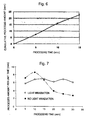
- Fig. 6 is a graph showing the thickness of the workpiece measured every five minutes. The cumulative processed amount is increased substantially straight relative to time, which indicates that the sharpness of the grinding wheel is kept constant by the photo-dressing.
- Fig. 7 is a comparison diagram of the processed amount per unit time depending on the presence of ultraviolet rays.
- white circles represent the case ultraviolet rays are radiated, while black circles represent the case no ultraviolet rays are radiated. It is seen from the drawings that when no ultraviolet rays are radiated, the processed amount per unit time is remarkably lowered by clogging, but when ultraviolet rays are radiated, the processed amount becomes substantially constant.
- the photo-dressing method of the present invention the processing device by the method, the grinding wheel and the abrasive cloth have excellent effects such that processing can be performed without causing clogging in the resin-bond grinding wheel containing fine abrasive grains, high-grade surface roughness can be realized, processing efficiency is relatively high, it is unnecessary to design a grinding wheel having an optimum bond degree and causing neither breaking nor clogging in accordance with the material of the workpiece, the controllability of dressing is excellent, automation of dressing and in-process dressing can also be realized, a system containing no metal ion in the whole processing can be designed, an expensive device is not required, and handling is easy.
Landscapes
- Engineering & Computer Science (AREA)
- Mechanical Engineering (AREA)
- Grinding-Machine Dressing And Accessory Apparatuses (AREA)
- Polishing Bodies And Polishing Tools (AREA)
- Wing Frames And Configurations (AREA)
Applications Claiming Priority (3)
| Application Number | Priority Date | Filing Date | Title |
|---|---|---|---|
| JP24281597 | 1997-09-08 | ||
| JP24281597 | 1997-09-08 | ||
| PCT/JP1998/003662 WO1999012705A1 (fr) | 1997-09-08 | 1998-08-19 | Procede de rhabillage optique, dispositif de meulage base sur ledit procede, meule et tissu a polir |
Publications (1)
| Publication Number | Publication Date |
|---|---|
| EP0943399A1 true EP0943399A1 (fr) | 1999-09-22 |
Family
ID=17094710
Family Applications (1)
| Application Number | Title | Priority Date | Filing Date |
|---|---|---|---|
| EP98938885A Withdrawn EP0943399A1 (fr) | 1997-09-08 | 1998-08-19 | Procede de rhabillage optique, dispositif de meulage base sur ledit procede, meule et tissu a polir |
Country Status (5)
| Country | Link |
|---|---|
| US (1) | US6126523A (fr) |
| EP (1) | EP0943399A1 (fr) |
| JP (1) | JP3594199B2 (fr) |
| TW (1) | TW431939B (fr) |
| WO (1) | WO1999012705A1 (fr) |
Cited By (2)
| Publication number | Priority date | Publication date | Assignee | Title |
|---|---|---|---|---|
| WO2002066207A1 (fr) * | 2001-02-20 | 2002-08-29 | Ebara Corporation | Appareil de polissage et procede de decrassage |
| EP1080839A3 (fr) * | 1999-08-20 | 2003-09-17 | Ebara Corporation | Dispositif de dressage et de polissage |
Families Citing this family (13)
| Publication number | Priority date | Publication date | Assignee | Title |
|---|---|---|---|---|
| US20040047804A1 (en) * | 1998-10-29 | 2004-03-11 | The General Hospital Corporation, A Massachusetts Corporation | Enhanced radiation therapy |
| JP4030247B2 (ja) * | 1999-05-17 | 2008-01-09 | 株式会社荏原製作所 | ドレッシング装置及びポリッシング装置 |
| US6277236B1 (en) * | 1999-06-17 | 2001-08-21 | National Semiconductor Corporation | Light sensitive chemical-mechanical polishing apparatus and method |
| US6652764B1 (en) | 2000-08-31 | 2003-11-25 | Micron Technology, Inc. | Methods and apparatuses for making and using planarizing pads for mechanical and chemical-mechanical planarization of microelectronic substrates |
| US7121919B2 (en) * | 2001-08-30 | 2006-10-17 | Micron Technology, Inc. | Chemical mechanical polishing system and process |
| JP2004025418A (ja) * | 2002-06-28 | 2004-01-29 | Ebara Corp | 研磨工具及びそのドレッシング方法 |
| US6899592B1 (en) * | 2002-07-12 | 2005-05-31 | Ebara Corporation | Polishing apparatus and dressing method for polishing tool |
| JP2004042213A (ja) * | 2002-07-12 | 2004-02-12 | Ebara Corp | 研磨装置、および研磨工具のドレッシング方法 |
| US7169031B1 (en) * | 2005-07-28 | 2007-01-30 | 3M Innovative Properties Company | Self-contained conditioning abrasive article |
| JP6293000B2 (ja) * | 2014-07-07 | 2018-03-14 | 日本特殊陶業株式会社 | 成形体の製造方法、スパークプラグ用絶縁体の製造方法、及びスパークプラグの製造方法 |
| JP7127972B2 (ja) * | 2017-09-05 | 2022-08-30 | 株式会社ディスコ | 加工方法 |
| JP7033485B2 (ja) * | 2018-04-17 | 2022-03-10 | 株式会社ディスコ | 切削ブレードの整形方法 |
| US11602896B2 (en) | 2019-08-14 | 2023-03-14 | Mighty Buildings, Inc. | 3D printing of a composite material via sequential dual-curing polymerization |
Family Cites Families (2)
| Publication number | Priority date | Publication date | Assignee | Title |
|---|---|---|---|---|
| JPS61152367A (ja) * | 1984-12-27 | 1986-07-11 | Agency Of Ind Science & Technol | Cbn研削砥石のレ−ザドレツシング装置 |
| JPH09285962A (ja) * | 1996-04-23 | 1997-11-04 | Citizen Watch Co Ltd | 砥石の砥粒突き出し量調整方法およびその装置 |
-
1998
- 1998-08-19 EP EP98938885A patent/EP0943399A1/fr not_active Withdrawn
- 1998-08-19 JP JP51532499A patent/JP3594199B2/ja not_active Expired - Fee Related
- 1998-08-19 US US09/297,820 patent/US6126523A/en not_active Expired - Fee Related
- 1998-08-19 WO PCT/JP1998/003662 patent/WO1999012705A1/fr not_active Ceased
- 1998-08-28 TW TW087114249A patent/TW431939B/zh active
Non-Patent Citations (1)
| Title |
|---|
| See references of WO9912705A1 * |
Cited By (2)
| Publication number | Priority date | Publication date | Assignee | Title |
|---|---|---|---|---|
| EP1080839A3 (fr) * | 1999-08-20 | 2003-09-17 | Ebara Corporation | Dispositif de dressage et de polissage |
| WO2002066207A1 (fr) * | 2001-02-20 | 2002-08-29 | Ebara Corporation | Appareil de polissage et procede de decrassage |
Also Published As
| Publication number | Publication date |
|---|---|
| WO1999012705A1 (fr) | 1999-03-18 |
| TW431939B (en) | 2001-05-01 |
| JP3594199B2 (ja) | 2004-11-24 |
| US6126523A (en) | 2000-10-03 |
Similar Documents
| Publication | Publication Date | Title |
|---|---|---|
| US6126523A (en) | Optical dressing method, machining device based on this method, grindstone and polishing cloth | |
| US6679769B2 (en) | Polishing pad having an advantageous micro-texture and methods relating thereto | |
| US6406589B1 (en) | Processing apparatus for etching the edge of a silicon wafer | |
| US4548617A (en) | Abrasive and method for manufacturing the same | |
| EP1320443B1 (fr) | Tampon de polissage a microstructure interessante | |
| US5827112A (en) | Method and apparatus for grinding wafers | |
| EP1072357B1 (fr) | Appareil de rectification sans centre | |
| JP2006021320A (ja) | 研磨パッド調整装置および製造およびリサイクル方法 | |
| KR20010050142A (ko) | 폴리싱 장치 및 드레싱 방법 | |
| JPWO1999012705A1 (ja) | 光ドレッシング方法とこの方法による加工装置と砥石及び研磨布 | |
| JPH0516070A (ja) | ダイヤモンド研削砥石と、これのツルーイング法と、ツルーイング装置と、研削仕上げされた磁気ヘツド | |
| JP2008277602A (ja) | 半導体集積回路装置の製造方法 | |
| KR100567083B1 (ko) | 성형 경면 연삭방법 및 장치 | |
| US4068416A (en) | Grinding wheel dressing method | |
| Mekata et al. | Mirror finishing of SiC by UV-assisted constant-pressure grinding | |
| KR100411256B1 (ko) | 웨이퍼 연마공정 및 이를 이용한 웨이퍼 후면 처리방법 | |
| JPS61152367A (ja) | Cbn研削砥石のレ−ザドレツシング装置 | |
| JP7370667B2 (ja) | 被加工物の加工方法 | |
| Inasaki | Dressing of resinoid bonded diamond grindling wheels | |
| US20020086625A1 (en) | Vacuum mount wafer polishing methods and apparatus | |
| JP3209437B2 (ja) | レジンボンド超砥粒砥石の製造法 | |
| JP2565385B2 (ja) | 電解ドレッシング研削法と導電性砥石を工具に兼用した研磨法の複合加工方法および装置 | |
| JPH05162071A (ja) | 研削砥石のドレッシング方法および装置 | |
| JPH08107093A (ja) | 半導体基板の加工方法 | |
| JP3128164B2 (ja) | メカノケミカル作用を生じる電解ドレッシング用砥石 |
Legal Events
| Date | Code | Title | Description |
|---|---|---|---|
| PUAI | Public reference made under article 153(3) epc to a published international application that has entered the european phase |
Free format text: ORIGINAL CODE: 0009012 |
|
| 17P | Request for examination filed |
Effective date: 19990728 |
|
| AK | Designated contracting states |
Kind code of ref document: A1 Designated state(s): CH DE FR GB LI NL SE |
|
| STAA | Information on the status of an ep patent application or granted ep patent |
Free format text: STATUS: THE APPLICATION IS DEEMED TO BE WITHDRAWN |
|
| 18D | Application deemed to be withdrawn |
Effective date: 20050901 |