EP0944285B1 - Dispositif et méthode pour activer et désactiver des services - Google Patents
Dispositif et méthode pour activer et désactiver des services Download PDFInfo
- Publication number
- EP0944285B1 EP0944285B1 EP99102974A EP99102974A EP0944285B1 EP 0944285 B1 EP0944285 B1 EP 0944285B1 EP 99102974 A EP99102974 A EP 99102974A EP 99102974 A EP99102974 A EP 99102974A EP 0944285 B1 EP0944285 B1 EP 0944285B1
- Authority
- EP
- European Patent Office
- Prior art keywords
- exchange
- interface
- terminal device
- data
- performance parameters
- Prior art date
- Legal status (The legal status is an assumption and is not a legal conclusion. Google has not performed a legal analysis and makes no representation as to the accuracy of the status listed.)
- Expired - Lifetime
Links
- 238000000034 method Methods 0.000 title claims abstract description 11
- 230000003213 activating effect Effects 0.000 title description 3
- 238000004891 communication Methods 0.000 claims abstract description 22
- 230000009849 deactivation Effects 0.000 claims abstract description 7
- 238000001514 detection method Methods 0.000 claims description 11
- 230000004913 activation Effects 0.000 claims description 9
- 230000005540 biological transmission Effects 0.000 claims description 9
- 230000004044 response Effects 0.000 claims description 9
- 230000000977 initiatory effect Effects 0.000 claims description 4
- 230000008878 coupling Effects 0.000 abstract 1
- 238000010168 coupling process Methods 0.000 abstract 1
- 238000005859 coupling reaction Methods 0.000 abstract 1
- 239000011159 matrix material Substances 0.000 description 7
- 230000001629 suppression Effects 0.000 description 5
- 230000006870 function Effects 0.000 description 3
- 239000004744 fabric Substances 0.000 description 2
- 230000005236 sound signal Effects 0.000 description 2
- 238000011161 development Methods 0.000 description 1
- 230000018109 developmental process Effects 0.000 description 1
- 230000009977 dual effect Effects 0.000 description 1
- 238000011156 evaluation Methods 0.000 description 1
Images
Classifications
-
- H—ELECTRICITY
- H04—ELECTRIC COMMUNICATION TECHNIQUE
- H04N—PICTORIAL COMMUNICATION, e.g. TELEVISION
- H04N1/00—Scanning, transmission or reproduction of documents or the like, e.g. facsimile transmission; Details thereof
- H04N1/00127—Connection or combination of a still picture apparatus with another apparatus, e.g. for storage, processing or transmission of still picture signals or of information associated with a still picture
- H04N1/00281—Connection or combination of a still picture apparatus with another apparatus, e.g. for storage, processing or transmission of still picture signals or of information associated with a still picture with a telecommunication apparatus, e.g. a switched network of teleprinters for the distribution of text-based information, a selective call terminal
- H04N1/00312—Connection or combination of a still picture apparatus with another apparatus, e.g. for storage, processing or transmission of still picture signals or of information associated with a still picture with a telecommunication apparatus, e.g. a switched network of teleprinters for the distribution of text-based information, a selective call terminal with a digital transmission apparatus, e.g. a switched network of teleprinters for the distribution of text-based information, SMS or ISDN device
-
- H—ELECTRICITY
- H04—ELECTRIC COMMUNICATION TECHNIQUE
- H04M—TELEPHONIC COMMUNICATION
- H04M3/00—Automatic or semi-automatic exchanges
- H04M3/42—Systems providing special services or facilities to subscribers
-
- H—ELECTRICITY
- H04—ELECTRIC COMMUNICATION TECHNIQUE
- H04M—TELEPHONIC COMMUNICATION
- H04M3/00—Automatic or semi-automatic exchanges
- H04M3/42—Systems providing special services or facilities to subscribers
- H04M3/42127—Systems providing several special services or facilities from groups H04M3/42008 - H04M3/58
-
- H—ELECTRICITY
- H04—ELECTRIC COMMUNICATION TECHNIQUE
- H04M—TELEPHONIC COMMUNICATION
- H04M3/00—Automatic or semi-automatic exchanges
- H04M3/42—Systems providing special services or facilities to subscribers
- H04M3/42136—Administration or customisation of services
-
- H—ELECTRICITY
- H04—ELECTRIC COMMUNICATION TECHNIQUE
- H04Q—SELECTING
- H04Q1/00—Details of selecting apparatus or arrangements
- H04Q1/18—Electrical details
- H04Q1/30—Signalling arrangements; Manipulation of signalling currents
- H04Q1/44—Signalling arrangements; Manipulation of signalling currents using alternate current
- H04Q1/444—Signalling arrangements; Manipulation of signalling currents using alternate current with voice-band signalling frequencies
- H04Q1/45—Signalling arrangements; Manipulation of signalling currents using alternate current with voice-band signalling frequencies using multi-frequency signalling
-
- H—ELECTRICITY
- H04—ELECTRIC COMMUNICATION TECHNIQUE
- H04Q—SELECTING
- H04Q2213/00—Indexing scheme relating to selecting arrangements in general and for multiplex systems
- H04Q2213/13109—Initializing, personal profile
-
- H—ELECTRICITY
- H04—ELECTRIC COMMUNICATION TECHNIQUE
- H04Q—SELECTING
- H04Q2213/00—Indexing scheme relating to selecting arrangements in general and for multiplex systems
- H04Q2213/1315—Call waiting
-
- H—ELECTRICITY
- H04—ELECTRIC COMMUNICATION TECHNIQUE
- H04Q—SELECTING
- H04Q2213/00—Indexing scheme relating to selecting arrangements in general and for multiplex systems
- H04Q2213/13174—Data transmission, file transfer
-
- H—ELECTRICITY
- H04—ELECTRIC COMMUNICATION TECHNIQUE
- H04Q—SELECTING
- H04Q2213/00—Indexing scheme relating to selecting arrangements in general and for multiplex systems
- H04Q2213/13179—Fax, still picture
-
- H—ELECTRICITY
- H04—ELECTRIC COMMUNICATION TECHNIQUE
- H04Q—SELECTING
- H04Q2213/00—Indexing scheme relating to selecting arrangements in general and for multiplex systems
- H04Q2213/13199—Modem, modulation
-
- H—ELECTRICITY
- H04—ELECTRIC COMMUNICATION TECHNIQUE
- H04Q—SELECTING
- H04Q2213/00—Indexing scheme relating to selecting arrangements in general and for multiplex systems
- H04Q2213/13405—Dual frequency signaling, DTMF
-
- H—ELECTRICITY
- H04—ELECTRIC COMMUNICATION TECHNIQUE
- H04Q—SELECTING
- H04Q2213/00—Indexing scheme relating to selecting arrangements in general and for multiplex systems
- H04Q2213/13407—Detection of data transmission mode
Definitions
- the invention relates to a device for the automatic activation and deactivation of features for a voice communication in a fixed network exchange according to claim 1 and to a method for the automatic activation and deactivation of features according to claim 6.
- Advanced Subscriber Services In order to be able to make analogue telephone connections in the fixed network more attractive to customers, in addition to the classic features such as the setting up, routing and disconnection of connections, so-called “Advanced Subscriber Services” are offered. These include, for example, call waiting, three-way conference, callback on busy, lock and call forwarding. Typically, these comfort features are enabled or disabled before, during, or after establishing a connection using special keystrokes that the user enters on their phone. During an existing connection, it is then possible for the associated switching center to transmit warning tones to the telephone, which remind the user that he has activated a specific feature. If, for example, the comfort feature "call waiting" is activated, it can be signaled during an existing connection by an advisory signal transmitted to the user's telephone that another connection has arrived for him at the exchange and is held there.
- Analogue telephone connections are not only used for voice communication but also increasingly for the transmission of data, such as text data.
- data such as text data.
- facsimile machines and modems for data transmission via personal computer.
- analog telephone connections are not only used for voice communication but increasingly also for the transmission of data, such as voice data.
- Text data used.
- facsimile machines and modems for data transmission via personal computer.
- alert tones transmitted during an existing data transmission that indicate an activated comfort feature for voice communication may interfere or even disrupt the connection between the data terminals.
- previously activated comfort features remain enabled regardless of the type of connection (voice communication or data communication)
- users of analog telephone connections are forced to deactivate the activated comfort features from their telephone prior to establishing a connection for data or telefax transmission and after a completed data transmission to re-activate in order to use them again.
- the US 5,546,451 A discloses a call waiting suppression device in which incoming connections are evaluated.
- the call-knock suppression device In a first mode in which calls are initiated by a telecommunication device, the call-knock suppression device is initially not in operation.
- a CWC device In a second mode, where calls arrive at a telecommunications device connected to the suppression device, a CWC device is activated to transmit a suppression code to the central office.
- the condition under which a deactivation of features takes place provides that it is first checked whether a call sign has arrived from the exchange. It is also checked whether, in response to the received call signal, a telecommunication device connected to the suppression device has moved into the active state, that is, into the off-hook state. Only when this is the case, a control signal for deactivating the features is transmitted to the exchange.
- the invention is therefore based on the object to provide an apparatus and a method that enable a functionally reliable data communication over an analog telephone line, even if comfort features are activated for voice communication in the exchange.
- the core idea of the invention is to be able to automatically deactivate activated features for voice communication in the assigned exchange before the start of a connection setup, and to automatically reactivate them after the data connection has been disconnected. According to one aspect of the present invention, this is achieved with the features of claim 1.
- a device has at least one first interface for connection to an analog subscriber terminal device.
- a telephone can be connected via at least one second interface and a data terminal device, for example a fax machine or a modem, via at least one third interface.
- a known switching network is provided, which can connect the second and third interface with the first interface.
- An interface recognition device can be connected to the second and third interface and serves to recognize from which interface a connection setup is desired.
- a transmitting device in particular a DTMF (Dual Tone Multifrequence) transmitter has the task of transmitting predetermined control signals to the switching center for activating and / or deactivating the features.
- Connected to the transmitting device is a control device, which is programmed in such a way that, before the establishment of a data connection, it causes the transmitting device to send control signals to the switching center, which deactivates the activated features in the switching center.
- the control device initiates the transmitting device, control signals to the switching center send out, which cause activation of the features.
- the device is not only intended to deactivate or activate subscriber-related features in the exchange when a data connection is made from a data terminal connected to it, but also when a data connection is to be established from a data terminal connected to another analog subscriber terminal.
- a device for identifying identification signals is implemented in the device, which detects whether the connection setup has been initiated by a telephone or a data terminal.
- This recognition device is expediently designed to be able to recognize the modem or CNG (calling) tones transmitted between the call signals, ie the identification signals of a modem or a facsimile machine.
- the means for detecting identification signals applies a control signal to the control means, which then causes the sending means to deactivate the features in its assigned exchange before switching on a data connection.
- a loop current detector or a busy detection circuit For detecting the initiation of a data connection, a loop current detector or a busy detection circuit is provided which, in response to a disconnection of the data connection, applies a control signal to the control device which, in turn, causes the transmitting device to initiate control signals for activating the features of the associated switch after the data connection is initiated send out.
- a buffer for storing at least one destination number of one to be called Data terminal be provided. Before deactivating the features in the central office, the destination number is placed in the buffer and transferred to the central office after the features have been deactivated.
- the device has a detector for detecting acknowledgment signals from the exchange, which are transmitted from the exchange to the device after the activation of the features.
- the controller in response to a control signal from the acknowledgment signal detector indicating receipt of an acknowledgment signal, quiesces the device.
- the device has an external power supply.
- the invention is achieved according to a further aspect by the method steps according to claim 6.
- the termination of the data connection is detected and, in response to the initiation of the data connection, control signals for re-enabling the features are transmitted to the central office.
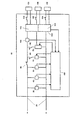
- the figure shows an automatic feature control device, generally designated 10, also referred to as an ADSS (Advanced Subscriber Services) controller, which is connected to a customer via a first interface with an analog subscriber line socket.
- the subscriber line not shown, terminates the A and B wires 20 of an analog subscriber line connecting the ADSS controller 10 to a central office.
- the ADSS controller 10 further includes a second interface to which a telephone 130 is connected.
- two further interfaces are provided, to each of which a data terminal device, such as a facsimile machine 150 and a modem 140 for turning on a personal computer (not shown) are turned on.
- a call signal detector 30 known per se is implemented in the ADSS controller 10, which detects the call signals transmitted by the exchange and can supply them to the control devices 160 and the switching devices 130, 140 and 150 via the switching matrix 112 implemented in a function block 110.
- functional block 110 includes, by way of example, switch fabric 112 and port detection logic 114, the function of which will be discussed below.
- the ADSS controller 10 has a terminal type detector 40 which can detect the modem or CNG audio signals coming from a data terminal connected to another subscriber terminal and forward it to the controller 160.
- One Acknowledgment signal detector 50 is provided which is capable of detecting acknowledgment signals from the central office and forwarding them to the controller 160.
- the exchange sends acknowledgment signals when the features for voice communication have been activated.
- the ADSS controller 10 Via a switch 80, the ADSS controller 10, as will be explained in more detail, close or selectively interrupt a loop via the subscriber line 20 to the exchange.
- the ADSS controller 10 further includes a DTMF transmitter 70, which can be looped via a switch 60 in the subscriber line 20.
- the controller 160 is connected to both the DTMF transmitter 70 and the switches 60 and 80.
- An intermediate memory 75 can be connected to the modem 140 or the remote copier 150 via the switching matrix 112. By means of a switch 90, the latch 75 can be looped into the subscriber line 20.
- the buffer memory 75 serves to store a destination call number of a data terminal device to be called by the modem 140 or by the facsimile computer 150.
- the telephone 130, the modem 140 and the telecopier 150 are each connected via a switch 120, 123 and 124 to the switching matrix 112. As will be described in more detail below, the switches 120, 123 and 124 are switched such that always only one terminal device 130, 140 or 150 is connected to the subscriber line 20.
- a holding and delay circuit (not shown) is provided, which ensures that the stored in the latch 75 destination number is only transmitted via the subscriber line 20 to the exchange when the features have been disabled in the exchange.
- the operation of the ADSS controller 10 is included an incoming connection described.
- the terminal type detector 40 is activated which receives the CNG signals transmitted from the calling facsimile and signals the controller 160 that a data connection is to be established. Thereafter, the controller closes the loop via the switches 80 and 60 via the subscriber line 20 to the central office and causes the DTMF transmitter 70 to transmit a previously programmed DTMF control sequence to the central office.
- the DTMF control sequence is used in the central office to disable the voice communication enabled features associated with the subscriber terminal to which the ADSS controller 10 is turned on. In addition to the DTMF control sequences, a hook flash can also be transmitted to control the central office.
- the switch 60 is opened again and the connection from the calling fax machine via the associated exchanges, the subscriber line 20, the switching matrix 112, the switch 124 to the fax machine 150 through.
- the Existing data connection may be initiated after data transmission either from the facsimile machine 150 or from the calling facsimile machine in conjunction with the central office.
- the triggering of the data connection is detected by the loop current detector 100.
- the loop current detector 100 informs the control device 160 about the triggering of the data connection, whereupon the control device 160 generates a loop interruption of a predetermined duration via the switch 80 and subsequently in turn closes the switch 60.
- the controller 160 activates the DTMF transmitter 70 to transmit a preprogrammed control sequence over the subscriber line 20 to the exchange, which causes the previously deactivated features to be re-activated in the central office. This ensures that in a subsequent voice connection to the subscriber line the user of the phone 130 again all features, such as call waiting, three-way conference, call forwarding and the like are available.
- the switch transmits acknowledgment signals over the subscriber line 20 to the ADSS controller 10, which are detected in the acknowledgment signal detector 50.
- the acknowledgment signal detector 50 signals the receipt of the acknowledgment signals from the controller 160, which then sets the ADSS controller 10 to sleep.
- the power supply of the ADSS controller 10 can be done via an external power supply, not shown.
- the terminal type detector 40 detects the absence of a modem or CNG audio signal within the ringing signal , whereupon the control device directs the incoming connection directly to Phone 130 goes through.
- the terminal device 130, 140 or 150 is always connected to the switching network 112, which wishes to establish a connection.
- the modem 140 to which, for example, a personal computer is connected, should establish a data connection to a personal computer connected to another analog subscriber line.
- the controller opens the switches 120 and 124 which disconnect the telephone 130 and the facsimile machine 150, respectively, from the switch fabric 112.
- the personal computer transmits via the modem 140, the destination number of the personal computer to be called via the switching matrix 112 in the latch 75.
- known per se port detection logic 114 is designed such that it can determine which terminal 130th , 140 or 150 wants to establish a connection.
- the port detection logic 114 detects that the personal computer wants to establish a data connection via the modem 140. This signals the port detection logic 114 to the controller 160, which then uses the switch 60 to loop the DTMF transmitter 70 into the subscriber line 20. Further, the controller 160 activates the DTMF transmitter 70 to transmit the previously programmed DTMF control sequence to the central office. The DTMF control sequence provides for disabling the features enabled for voice communication. Subsequently, the switch 60 is opened again and the switch 90 is closed, via which the latch 75 in the subscriber line 20th is looped.
- the controller 160 activates the latch 75 to transmit the destination number previously input from the modem 140 to the exchange via the subscriber line 20.
- the exchange in conjunction with other exchanges establishes a data connection to the called personal computer.
- the features remain disabled in the switch throughout the data connection. If the existing data connection is disconnected again, this state is detected by the loop current detector 100 and communicated to the control device 160.
- the control device 160 first generates a loop interruption of a predetermined duration via the switch 80 and then grinds the DTMF transmitter 70 into the subscriber line 20 via the switch 60. Subsequently, the DTMF transmitter 70 sends the previously programmed DTMF control sequence to the central office to re-enable the features.
- the switch Upon activation of the features, the switch transmits acknowledgment signals to the ADSS controller 10, which are recognized by the acknowledgment signal detector 50 and forwarded to the controller 60, which then sets the ADSS controller 10 to sleep.
Landscapes
- Engineering & Computer Science (AREA)
- Signal Processing (AREA)
- Computer Networks & Wireless Communication (AREA)
- General Engineering & Computer Science (AREA)
- Human Computer Interaction (AREA)
- Multimedia (AREA)
- Telephonic Communication Services (AREA)
- Interface Circuits In Exchanges (AREA)
- Exchange Systems With Centralized Control (AREA)
- Burglar Alarm Systems (AREA)
- Electrotherapy Devices (AREA)
Claims (8)
- Dispositif de désactivation automatique de facilités pour une communication vocale dans un centre de commutation d'un réseau fixe analogique comprenant :- au moins une première interface pour la connexion à un équipement d'abonné analogique (20) reliant le dispositif au centre de commutation,- au moins une deuxième interface pour la connexion d'un téléphone (130),- au moins une troisième interface pour la connexion d'un équipement terminal de traitement de données (140, 150),- une matrice de commutation (112) apte à être reliée à la deuxième et à la troisième interface,- un détecteur de type d'équipement terminal (40) apte à être relié à la première interface pour la reconnaissance de signaux entrants d'un équipement terminal de traitement de données connecté à un autre équipement d'abonné,- un système de détection d'interface (114) apte à être relié à la deuxième et à la troisième interface pour la reconnaissance d'une requête d'établissement de liaison provenant de la deuxième ou de la troisième interface,- un émetteur (70) apte à être relié à la première interface pour l'émission de signaux de commande d'activation et de désactivation des facilités en direction du centre de commutation,- et une unité de commande (160) reliée à l'émetteur, au détecteur de type d'équipement terminal (40) et au système de détection d'interface (114) pour amener l'émetteur (70) à émettre des signaux de commande de désactivation des facilités avant l'établissement d'une liaison de données, si le détecteur de type d'équipement terminal (40) ou le système de détection d'interface (114) signale à l'unité de commande (160) qu'une liaison de données entrante ou sortante doit être établie.
- Dispositif selon la revendication 1, caractérisé en ce que l'unité de commande est programmée de manière à amener l'émetteur (70), après le déclenchement de la liaison de données, à émettre des signaux de commande d'activation automatique des facilités en direction du centre de commutation.
- Dispositif selon l'une des revendications 1 ou 2,
caractérisé par
une installation de reconnaissance de signaux d'identification d'un équipement terminal de traitement de données connectée à une ligne d'abonné distante, un détecteur de courant de boucle (100) pour la détection du déclenchement d'une liaison de données et un détecteur de signal d'appel (30). - Dispositif selon l'une des revendications 1 à 3,
caractérisé par
une mémoire tampon (75) pour le stockage d'au moins un numéro d'appel cible d'un équipement terminal de traitement de données à appeler, la transmission du numéro d'appel cible au centre de commutation n'intervenant qu'après la désactivation des facilités. - Dispositif selon l'une des revendications 1 à 4,
caractérisé par
un détecteur pour la détection de signaux d'accusé de réception du centre de commutation après l'activation des facilités et une alimentation électrique externe, l'unité de commande mettant le dispositif à l'état de repos en réponse à un signal de sortie du détecteur de signal d'accusé de réception. - Procédé de désactivation automatique de facilités pour une communication vocale dans un centre de commutation d'un réseau fixe analogique à l'aide d'un dispositif selon l'une des revendications 1 à 5, comprenant les étapes suivantes :a) vérification de la présence d'une requête d'établissement de liaison émanant d'un téléphone (130) ou d'un équipement terminal de traitement de données (140, 150) ;b) en réponse à une requête d'établissement de liaison avec un équipement terminal de traitement de données (140, 150), transmission de signaux de commande de désactivation des facilités pour une communication vocale à un centre de commutation avant l'établissement de la liaison de données ;c) établissement de la liaison de données.
- Procédé selon la revendication 6, caractérisé en ce que l'étape c) est suivie des étapes suivantes :d) reconnaissance d'un déclenchement de la liaison de données ;e) en réponse au déclenchement de la liaison de données, transmission de signaux de commande de réactivation des facilités au centre de commutation.
- Procédé selon l'une des revendications 6 ou 7,
caractérisé en ce que, dans le cas d'une liaison de données sortante, l'étape 6b) comprend les étapes suivantes :le numéro d'appel cible d'un équipement terminal de traitement de données à appeler est stocké dans une mémoire tampon pour une durée prédéterminée et transmis au centre de commutation après la désactivation des facilités.
Applications Claiming Priority (2)
| Application Number | Priority Date | Filing Date | Title |
|---|---|---|---|
| DE19812283 | 1998-03-20 | ||
| DE19812283A DE19812283B4 (de) | 1998-03-20 | 1998-03-20 | Vorrichtung zum automatischen Deaktivieren von Leistungsmerkmalen in einer Vermittlungsstelle |
Publications (3)
| Publication Number | Publication Date |
|---|---|
| EP0944285A2 EP0944285A2 (fr) | 1999-09-22 |
| EP0944285A3 EP0944285A3 (fr) | 2006-01-04 |
| EP0944285B1 true EP0944285B1 (fr) | 2008-04-30 |
Family
ID=7861684
Family Applications (1)
| Application Number | Title | Priority Date | Filing Date |
|---|---|---|---|
| EP99102974A Expired - Lifetime EP0944285B1 (fr) | 1998-03-20 | 1999-02-15 | Dispositif et méthode pour activer et désactiver des services |
Country Status (3)
| Country | Link |
|---|---|
| EP (1) | EP0944285B1 (fr) |
| AT (1) | ATE394016T1 (fr) |
| DE (2) | DE19812283B4 (fr) |
Family Cites Families (7)
| Publication number | Priority date | Publication date | Assignee | Title |
|---|---|---|---|---|
| JPH03157043A (ja) * | 1989-11-15 | 1991-07-05 | Nec Corp | 非音声呼接続中コールウエイテイング機能停止方式 |
| JPH047945A (ja) * | 1990-04-25 | 1992-01-13 | Nec Corp | コールウェイティング方式 |
| US5493609A (en) * | 1990-09-27 | 1996-02-20 | Radish Communications Systems, Inc. | Telecommunication system for automatic switching between voice and data communications |
| HU215038B (hu) * | 1992-03-20 | 1998-09-28 | At & T Corp. | Eljárás és kapcsolórendszer speciális szolgáltatási hívás létrehozására, valamint eljárás vonalhoz hozzárendelt szolgáltatások módosítására |
| CA2085280C (fr) * | 1992-12-14 | 2000-08-15 | Carole Quirk | Annulation temporaire de la mise en attente des appels |
| US5546451A (en) * | 1995-05-31 | 1996-08-13 | Aastra Technologies Inc. | Call waiting cancellation device |
| GB2303272B (en) * | 1995-07-10 | 2000-02-23 | Hong Kong Telecommunications L | Telephone network |
-
1998
- 1998-03-20 DE DE19812283A patent/DE19812283B4/de not_active Expired - Fee Related
-
1999
- 1999-02-15 DE DE59914742T patent/DE59914742D1/de not_active Expired - Lifetime
- 1999-02-15 EP EP99102974A patent/EP0944285B1/fr not_active Expired - Lifetime
- 1999-02-15 AT AT99102974T patent/ATE394016T1/de not_active IP Right Cessation
Also Published As
| Publication number | Publication date |
|---|---|
| DE19812283B4 (de) | 2005-11-10 |
| EP0944285A3 (fr) | 2006-01-04 |
| DE19812283A1 (de) | 1999-09-23 |
| EP0944285A2 (fr) | 1999-09-22 |
| DE59914742D1 (de) | 2008-06-12 |
| ATE394016T1 (de) | 2008-05-15 |
Similar Documents
| Publication | Publication Date | Title |
|---|---|---|
| DE69715594T2 (de) | Verfahren zur bereitstellung von sprachanrufbenachrichtigung und nachrichtensteurerung über einen datenweg | |
| DE68925703T2 (de) | Schnittstelle für und Betrieb eines Sprachnachrichtensystem | |
| DE69516335T2 (de) | Verfahren und Vorrichtung zur Durchführung von intelligenten Netzwerkdiensten mit einer ISDN-Netzabschlusseinrichtung | |
| US3956595A (en) | Circuitry for providing executive ringback in a PBX system | |
| DE3687404T2 (de) | Verfahren zu bereitstellung einer anzeige fuer einen gehaltenen teilnehmer. | |
| US4991203A (en) | Line switching apparatus and method | |
| EP0712230B1 (fr) | Système de communication | |
| DE3785823T2 (de) | Schnurloses Telefonsystem. | |
| DE3877259T3 (de) | Schnurloser Telefonapparat und Steuerungsverfahren dafür. | |
| DE69733871T2 (de) | Deckungsbereich von umgelenkten Fernsprechanrufen | |
| DE69317807T2 (de) | Methode zur selektiven Kontrolle der Übertragung von DTMF-Signalen | |
| DE69637129T2 (de) | Erhöhung der Kapazität eines Personenkommunikationssystems durch vielfache Verbindungen mit einzelnen Telefonübertragungsstrecken | |
| DE3856195T2 (de) | Kommunikationsgerät | |
| EP0944285B1 (fr) | Dispositif et méthode pour activer et désactiver des services | |
| JPH01235447A (ja) | 有線端末装置 | |
| US5392341A (en) | Automatic telephone line monitoring and selection apparatus and method | |
| DE60100561T2 (de) | Antwortstondetektion für IP Telephone | |
| DE69531183T2 (de) | Modemsystem für Teleheimarbeiter | |
| US3917910A (en) | Circuitry for providing call override in a PBX system in accordance with a supplied class of service | |
| EP0785660B1 (fr) | Dispositif de télécommunication sans fil | |
| DE69734772T2 (de) | Verbesserungen bei oder bezogen auf anrufbearbeitung | |
| DE4141486A1 (de) | Schaltkreis und verfahren zum betrieb eines telefonvermittlungssystems | |
| US4660219A (en) | Extension ringing arrangement key telephone system | |
| DE68922763T2 (de) | Telefonapparat und Steuerungsverfahren dafür. | |
| DE69025709T2 (de) | Verfahren zur Verwaltung ankommender Anrufe in einem Fernkopierapparat, der eine Fernsprechleitung gemeinsam mit seinem zugehörigen Telefonapparat und einem zweiten Apparat benutzt |
Legal Events
| Date | Code | Title | Description |
|---|---|---|---|
| PUAI | Public reference made under article 153(3) epc to a published international application that has entered the european phase |
Free format text: ORIGINAL CODE: 0009012 |
|
| AK | Designated contracting states |
Kind code of ref document: A2 Designated state(s): AT BE CH CY DE DK ES FI FR GB GR IE IT LI LU MC NL PT SE |
|
| AX | Request for extension of the european patent |
Free format text: AL;LT;LV;MK;RO;SI |
|
| PUAL | Search report despatched |
Free format text: ORIGINAL CODE: 0009013 |
|
| AK | Designated contracting states |
Kind code of ref document: A3 Designated state(s): AT BE CH CY DE DK ES FI FR GB GR IE IT LI LU MC NL PT SE |
|
| AX | Request for extension of the european patent |
Extension state: AL LT LV MK RO SI |
|
| 17P | Request for examination filed |
Effective date: 20060704 |
|
| AKX | Designation fees paid |
Designated state(s): AT BE CH CY DE DK ES FI FR GB GR IE IT LI LU MC NL PT SE |
|
| 17Q | First examination report despatched |
Effective date: 20060925 |
|
| GRAP | Despatch of communication of intention to grant a patent |
Free format text: ORIGINAL CODE: EPIDOSNIGR1 |
|
| GRAS | Grant fee paid |
Free format text: ORIGINAL CODE: EPIDOSNIGR3 |
|
| GRAA | (expected) grant |
Free format text: ORIGINAL CODE: 0009210 |
|
| AK | Designated contracting states |
Kind code of ref document: B1 Designated state(s): AT BE CH CY DE DK ES FI FR GB GR IE IT LI LU MC NL PT SE |
|
| REG | Reference to a national code |
Ref country code: GB Ref legal event code: FG4D Free format text: NOT ENGLISH |
|
| REG | Reference to a national code |
Ref country code: CH Ref legal event code: EP |
|
| REG | Reference to a national code |
Ref country code: IE Ref legal event code: FG4D Free format text: LANGUAGE OF EP DOCUMENT: GERMAN |
|
| REF | Corresponds to: |
Ref document number: 59914742 Country of ref document: DE Date of ref document: 20080612 Kind code of ref document: P |
|
| NLV1 | Nl: lapsed or annulled due to failure to fulfill the requirements of art. 29p and 29m of the patents act | ||
| PG25 | Lapsed in a contracting state [announced via postgrant information from national office to epo] |
Ref country code: PT Free format text: LAPSE BECAUSE OF FAILURE TO SUBMIT A TRANSLATION OF THE DESCRIPTION OR TO PAY THE FEE WITHIN THE PRESCRIBED TIME-LIMIT Effective date: 20080930 Ref country code: NL Free format text: LAPSE BECAUSE OF FAILURE TO SUBMIT A TRANSLATION OF THE DESCRIPTION OR TO PAY THE FEE WITHIN THE PRESCRIBED TIME-LIMIT Effective date: 20080430 Ref country code: FI Free format text: LAPSE BECAUSE OF FAILURE TO SUBMIT A TRANSLATION OF THE DESCRIPTION OR TO PAY THE FEE WITHIN THE PRESCRIBED TIME-LIMIT Effective date: 20080430 Ref country code: ES Free format text: LAPSE BECAUSE OF FAILURE TO SUBMIT A TRANSLATION OF THE DESCRIPTION OR TO PAY THE FEE WITHIN THE PRESCRIBED TIME-LIMIT Effective date: 20080810 |
|
| REG | Reference to a national code |
Ref country code: IE Ref legal event code: FD4D |
|
| ET | Fr: translation filed | ||
| PG25 | Lapsed in a contracting state [announced via postgrant information from national office to epo] |
Ref country code: SE Free format text: LAPSE BECAUSE OF FAILURE TO SUBMIT A TRANSLATION OF THE DESCRIPTION OR TO PAY THE FEE WITHIN THE PRESCRIBED TIME-LIMIT Effective date: 20080731 Ref country code: IE Free format text: LAPSE BECAUSE OF FAILURE TO SUBMIT A TRANSLATION OF THE DESCRIPTION OR TO PAY THE FEE WITHIN THE PRESCRIBED TIME-LIMIT Effective date: 20080430 Ref country code: DK Free format text: LAPSE BECAUSE OF FAILURE TO SUBMIT A TRANSLATION OF THE DESCRIPTION OR TO PAY THE FEE WITHIN THE PRESCRIBED TIME-LIMIT Effective date: 20080430 |
|
| PLBE | No opposition filed within time limit |
Free format text: ORIGINAL CODE: 0009261 |
|
| STAA | Information on the status of an ep patent application or granted ep patent |
Free format text: STATUS: NO OPPOSITION FILED WITHIN TIME LIMIT |
|
| 26N | No opposition filed |
Effective date: 20090202 |
|
| BERE | Be: lapsed |
Owner name: DEUTSCHE TELEKOM A.G. Effective date: 20090228 |
|
| PG25 | Lapsed in a contracting state [announced via postgrant information from national office to epo] |
Ref country code: IT Free format text: LAPSE BECAUSE OF FAILURE TO SUBMIT A TRANSLATION OF THE DESCRIPTION OR TO PAY THE FEE WITHIN THE PRESCRIBED TIME-LIMIT Effective date: 20080430 |
|
| PG25 | Lapsed in a contracting state [announced via postgrant information from national office to epo] |
Ref country code: MC Free format text: LAPSE BECAUSE OF NON-PAYMENT OF DUE FEES Effective date: 20090228 |
|
| REG | Reference to a national code |
Ref country code: CH Ref legal event code: PL |
|
| PG25 | Lapsed in a contracting state [announced via postgrant information from national office to epo] |
Ref country code: LI Free format text: LAPSE BECAUSE OF NON-PAYMENT OF DUE FEES Effective date: 20090228 Ref country code: CH Free format text: LAPSE BECAUSE OF NON-PAYMENT OF DUE FEES Effective date: 20090228 |
|
| PG25 | Lapsed in a contracting state [announced via postgrant information from national office to epo] |
Ref country code: BE Free format text: LAPSE BECAUSE OF NON-PAYMENT OF DUE FEES Effective date: 20090228 |
|
| PG25 | Lapsed in a contracting state [announced via postgrant information from national office to epo] |
Ref country code: AT Free format text: LAPSE BECAUSE OF NON-PAYMENT OF DUE FEES Effective date: 20090215 |
|
| PG25 | Lapsed in a contracting state [announced via postgrant information from national office to epo] |
Ref country code: GR Free format text: LAPSE BECAUSE OF FAILURE TO SUBMIT A TRANSLATION OF THE DESCRIPTION OR TO PAY THE FEE WITHIN THE PRESCRIBED TIME-LIMIT Effective date: 20080731 |
|
| PG25 | Lapsed in a contracting state [announced via postgrant information from national office to epo] |
Ref country code: LU Free format text: LAPSE BECAUSE OF NON-PAYMENT OF DUE FEES Effective date: 20090215 |
|
| PG25 | Lapsed in a contracting state [announced via postgrant information from national office to epo] |
Ref country code: CY Free format text: LAPSE BECAUSE OF FAILURE TO SUBMIT A TRANSLATION OF THE DESCRIPTION OR TO PAY THE FEE WITHIN THE PRESCRIBED TIME-LIMIT Effective date: 20080430 |
|
| REG | Reference to a national code |
Ref country code: FR Ref legal event code: PLFP Year of fee payment: 18 |
|
| PGFP | Annual fee paid to national office [announced via postgrant information from national office to epo] |
Ref country code: DE Payment date: 20160218 Year of fee payment: 18 |
|
| PGFP | Annual fee paid to national office [announced via postgrant information from national office to epo] |
Ref country code: GB Payment date: 20160222 Year of fee payment: 18 Ref country code: FR Payment date: 20160222 Year of fee payment: 18 |
|
| REG | Reference to a national code |
Ref country code: DE Ref legal event code: R119 Ref document number: 59914742 Country of ref document: DE |
|
| GBPC | Gb: european patent ceased through non-payment of renewal fee |
Effective date: 20170215 |
|
| REG | Reference to a national code |
Ref country code: FR Ref legal event code: ST Effective date: 20171031 |
|
| PG25 | Lapsed in a contracting state [announced via postgrant information from national office to epo] |
Ref country code: FR Free format text: LAPSE BECAUSE OF NON-PAYMENT OF DUE FEES Effective date: 20170228 Ref country code: DE Free format text: LAPSE BECAUSE OF NON-PAYMENT OF DUE FEES Effective date: 20170901 |
|
| PG25 | Lapsed in a contracting state [announced via postgrant information from national office to epo] |
Ref country code: GB Free format text: LAPSE BECAUSE OF NON-PAYMENT OF DUE FEES Effective date: 20170215 |