EP0944980B1 - Verfahren und einrichtung zur verbesserung der sicherheit in netzwerkanwendungen - Google Patents
Verfahren und einrichtung zur verbesserung der sicherheit in netzwerkanwendungen Download PDFInfo
- Publication number
- EP0944980B1 EP0944980B1 EP97946968A EP97946968A EP0944980B1 EP 0944980 B1 EP0944980 B1 EP 0944980B1 EP 97946968 A EP97946968 A EP 97946968A EP 97946968 A EP97946968 A EP 97946968A EP 0944980 B1 EP0944980 B1 EP 0944980B1
- Authority
- EP
- European Patent Office
- Prior art keywords
- computer
- biometric information
- security
- data
- biometric
- Prior art date
- Legal status (The legal status is an assumption and is not a legal conclusion. Google has not performed a legal analysis and makes no representation as to the accuracy of the status listed.)
- Expired - Lifetime
Links
Images








Classifications
-
- G—PHYSICS
- G06—COMPUTING OR CALCULATING; COUNTING
- G06F—ELECTRIC DIGITAL DATA PROCESSING
- G06F21/00—Security arrangements for protecting computers, components thereof, programs or data against unauthorised activity
- G06F21/30—Authentication, i.e. establishing the identity or authorisation of security principals
- G06F21/31—User authentication
- G06F21/32—User authentication using biometric data, e.g. fingerprints, iris scans or voiceprints
-
- G—PHYSICS
- G06—COMPUTING OR CALCULATING; COUNTING
- G06F—ELECTRIC DIGITAL DATA PROCESSING
- G06F21/00—Security arrangements for protecting computers, components thereof, programs or data against unauthorised activity
- G06F21/30—Authentication, i.e. establishing the identity or authorisation of security principals
- G06F21/44—Program or device authentication
- G06F21/445—Program or device authentication by mutual authentication, e.g. between devices or programs
-
- G—PHYSICS
- G06—COMPUTING OR CALCULATING; COUNTING
- G06Q—INFORMATION AND COMMUNICATION TECHNOLOGY [ICT] SPECIALLY ADAPTED FOR ADMINISTRATIVE, COMMERCIAL, FINANCIAL, MANAGERIAL OR SUPERVISORY PURPOSES; SYSTEMS OR METHODS SPECIALLY ADAPTED FOR ADMINISTRATIVE, COMMERCIAL, FINANCIAL, MANAGERIAL OR SUPERVISORY PURPOSES, NOT OTHERWISE PROVIDED FOR
- G06Q20/00—Payment architectures, schemes or protocols
- G06Q20/38—Payment protocols; Details thereof
- G06Q20/40—Authorisation, e.g. identification of payer or payee, verification of customer or shop credentials; Review and approval of payers, e.g. check credit lines or negative lists
- G06Q20/401—Transaction verification
- G06Q20/4014—Identity check for transactions
- G06Q20/40145—Biometric identity checks
-
- G—PHYSICS
- G07—CHECKING-DEVICES
- G07C—TIME OR ATTENDANCE REGISTERS; REGISTERING OR INDICATING THE WORKING OF MACHINES; GENERATING RANDOM NUMBERS; VOTING OR LOTTERY APPARATUS; ARRANGEMENTS, SYSTEMS OR APPARATUS FOR CHECKING NOT PROVIDED FOR ELSEWHERE
- G07C9/00—Individual registration on entry or exit
- G07C9/30—Individual registration on entry or exit not involving the use of a pass
- G07C9/32—Individual registration on entry or exit not involving the use of a pass in combination with an identity check
- G07C9/37—Individual registration on entry or exit not involving the use of a pass in combination with an identity check using biometric data, e.g. fingerprints, iris scans or voice recognition
-
- H—ELECTRICITY
- H04—ELECTRIC COMMUNICATION TECHNIQUE
- H04L—TRANSMISSION OF DIGITAL INFORMATION, e.g. TELEGRAPHIC COMMUNICATION
- H04L63/00—Network architectures or network communication protocols for network security
- H04L63/04—Network architectures or network communication protocols for network security for providing a confidential data exchange among entities communicating through data packet networks
- H04L63/0428—Network architectures or network communication protocols for network security for providing a confidential data exchange among entities communicating through data packet networks wherein the data content is protected, e.g. by encrypting or encapsulating the payload
- H04L63/0442—Network architectures or network communication protocols for network security for providing a confidential data exchange among entities communicating through data packet networks wherein the data content is protected, e.g. by encrypting or encapsulating the payload wherein the sending and receiving network entities apply asymmetric encryption, i.e. different keys for encryption and decryption
Definitions
- This invention relates generally to computer network communications. More particularly this invention relates to network security and remote execution of security processes.
- the Internet is one of the fastest growing and ubiquitous modes of commerce. Many companies have Internet servers prepared for commercial delivery of goods and services. At first, the products found on the Internet or more specifically, the world wide web (WWW) were computer-based products, but today, more and more businesses are competing to set up commercial services on the world wide web.
- WWW world wide web
- a common problem with the Internet is a lack of secure communication channels.
- privacy and security must be ensured. Further, many consumers are hesitant about providing credit card information via the Internet.
- a server is provided with an encryption unit; and, encryption keys are stored within the encryption unit.
- a known encryption algorithm is used such as a public-key/ private-key system.
- a user sends information in an encrypted form so that only the encryption means using a private-key can decrypt (or decipher) the encrypted information.
- an Internet server Upon receiving the information, an Internet server provides it to an encryption means for decryption. Decrypted data is passed back to the Internet server. Often, the encryption means forms part of the server.
- a method of enhancing network security in a client/server environment comprising the steps of:
- a method of enhancing network security comprising the steps of:
- a method of enhancing network security comprising the steps of:
- Network security is an essential feature for enabling commerce via a public computer network such as the Internet and for enabling access to confidential information via a public computer network.
- encryption methods rely on private-key/public-key algorithms incorporated into both a first computer in the form of a server and a second computer in the form of a client computer.
- a server 1 is provided with encryption means 3 for encrypting data prior to transmission via a public network.
- the encryption means 3 uses a public-key provided by another party to a communication and stored in volatile memory 5 .
- the server is further provided with a decryption means 7 for deciphering received encrypted data.
- a private-key is required.
- the private-key is stored in a non-volatile storage means 8 .
- the private-key is generated by a private-key generating means 9 or alternatively is stored in the non-volatile storage means 8 during manufacture.
- a client computer 2 is provided with similar components in the form of encryption means 3 for encrypting data prior to transmission via a public network.
- the encryption means 3 uses a public-key provided by another party to a communication and stored in volatile memory 5 .
- the server is further provided with a decryption means 7 for deciphering received encrypted data.
- a private-key is required.
- the private-key is stored in a non-volatile storage means 8 .
- the private-key is generated by a private-key generating means 9 or alternatively is stored in the non-volatile storage means 8 during manufacture.
- the client computer 2 initiates communication with the server 1 .
- the server upon authorising access by the client computer 2 , provides to the client computer 2 a public-key associated with a private-key stored in the non-volatile storage means 8 .
- the client computer 2 responds by providing a public-key to the server 1 associated with a private-key stored in the non-volatile storage means 8 .
- Data for transmission from the client computer 2 to the server 1 is encrypted in the encryption means 3 using a predetermined encryption algorithm and the public-key associated with the private-key stored in the non-volatile storage means 8 prior to transmission to the server 1 .
- the decryption means 7 When the data is received by the server 1 , it is deciphered by the decryption means 7 using a predetermined corresponding decryption algorithm and the associated private-key. Similarly, data for transmission from the server 1 to the client computer 2 is encrypted in the encryption means 3 using the public-key associated with the private-key stored in the non-volatile storage means 8 prior to transmission to the client computer 2 . When the data is received by the client computer 2 it is deciphered by the decryption means 7 using the associated private-key. In this fashion, data is transmitted and received securely.
- the private-key is generated as needed and stored in volatile memory.
- An associated public-key is generated in dependence upon the generated private-key and stored associated with the private-key in volatile memory 5 .
- a server 51 is provided with encryption means 53 for encrypting data prior to transmission via a public network.
- the encryption means 53 uses a public-key provided by another party to a communication and stored in volatile memory 55 .
- the server is further provided with a decryption means 57 for deciphering received data encrypted with said key.
- a private-key is required.
- the private-key is stored in a non-volatile storage means 58 .
- the private-key is generated by a private-key generating means 59 or, alternatively, is stored in the non-volatile storage means 58 during manufacture.
- a client computer 52 is provided with similar components in the form of encryption means 53 for encrypting data prior to transmission via a public network.
- the encryption means 53 uses a public-key provided by another party to a communication and stored in volatile memory 55 .
- the server is further provided with a decryption means 57 for deciphering received encrypted data.
- a private-key is required.
- the private-key is stored in a non-volatile storage means 58 .
- the private-key is generated by a private-key generating means 59 or alternatively is stored in the non-volatile storage means 58 during manufacture.
- Both the server and the client comprise a processor 54 .
- the processor 54 , the encryption means 53 , and the decryption means 57 are a same processor means.
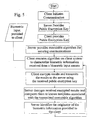
- the client computer 52 initiates communications with the server 51 .
- the server 51 and the client computer 52 exchange public-keys according to the prior art.
- the second public-key transferred may be encrypted using the first public-key.
- the server 51 prepares a security process for transmission to the client computer 52 .
- the preparation comprises selecting a security process, formatting the process for implementation on the client computer 52 , and encrypting the resulting data representative of said prepared process.
- the prepared process is then transmitted from the server 51 to the client computer 52 where it is received and deciphered.
- the client computer 52 uses the prepared process to process data prior to transmission to the server 51 .
- the processed data is encrypted using the public-key received from the server 51 and is transmitted to the server 51 via a public network.
- the process comprises an encryption algorithm, further encryption is obviated but may still be performed.
- the server 51 When the server 51 receives the encrypted processed information, the server 51 deciphers the information using a private-key associated with the public-key provided. The processed information is then accessible to the server 51 .
- a security process for securing information to be transferred is dynamically modifiable; the modifiable process reduces chances for breaches of security.
- advances in security of transmissions are readily implemented in the server 51 by modifying the method employed for process preparation.
- Client computers 52 accessing the server 51 benefit from the implemented enhancements.
- a process may be modified to reduce likelihood of breaches occurring and to prevent ongoing security breaches from continuing.
- Biometric information poses a different set of problems from regular network data transmissions.
- the amount of information contained within a biometric sample in the form of a fingerprint, a voiceprint, a retinal scan, a palm print, or any other biometric sample is generally quite large.
- Processing of the information contained in the biometric sample is often accomplished first by characterising the information to extract features or other indicia, and then by comparing the features or indicia to known features or indicia of stored template biometric information thereby attempting to identify a provider of the biometric information.
- the stored template biometric information is often stored during an enrolment process.
- the client computer 52 characterises the biometric information and transmits to the server 51 a result of the characterisation, or the client computer 52 transmits to the server 51 a digitised sample of biometric information provided.
- a hybrid of both scenarios is used.
- the former method requires that each client/server pair have an identical characterisation process; the latter requires a large amount of bandwidth.
- a fingerprint imaged using a capacitive fingerprint scanner may be represented by 400x600 individual values or pixels resulting in a total of 240,000 values. When a value has 8 bits, 240,000 bytes is required.
- biometric information presented to a biometric input apparatus is not well suited to user identification and a user is required to enter further samples of biometric information for identification to occur. It will be clear to those of skill in the art of computer networking that further instances of biometric information transmitted via a network increase bandwidth requirements.
- biometric information sample refers to an instance of biometric information.
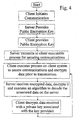
- a flow diagram of a method according to the present invention for transmitting biometric information in a secure fashion is shown.
- the client computer 52 initiates communications with the server 51 .
- the server 51 and the client computer 52 exchange public-keys according to the prior art.
- the second public-key transferred may be encrypted using the first public-key but this is not necessary.
- the server 51 prepares a characterisation process for transmission to the client computer 52 .
- the preparation comprises selecting a characterisation process, formatting the process for implementation on the client computer 52 when necessary, and encrypting the resulting data representative of said prepared process.
- the preparation process comprises selecting an appropriate process for the client computer 52 and for the biometric information being characterised.
- the prepared process is then transmitted from the server 51 to the client computer 52 where it is received and deciphered.
- the client computer 52 uses the prepared process to characterise biometric information received from an individual, encrypts the characterised biometric information using the public-key received from the server 51 and transmits the encrypted characterised biometric information to the server 51 via the public network.
- the process comprises a process for encrypting the characterised data and, therefore, further encryption is obviated. Of course, further encryption may still be used.
- the server 51 When the server 51 receives the encrypted characterised biometric information, the server 51 deciphers the information using a private-key associated with the public-key provided. The characterised biometric information is then compared against templates of characterised biometric information to determine an identification for the user of the client computer 52 . When a substantial match occurs between a template and the characterised biometric information, the user is identified. When no match occurs, the server 51 requests a further instance of encrypted characterised biometric information from the client computer 52 . In turn, the process in execution on the client computer 52 prompts the user for a further instance of biometric information. Alternatively, the server 51 transmits a second other characterisation process to the client computer 52 , and the biometric information is re-characterised according to the second other process received from the server 51 .
- a further biometric information sample is provided to the client computer 52 and transmitted to the server computer 51 ; the further sample may have been captured along with the previous biometric information sample, or the further sample may be captured anew when a biometric input means 80 (shown in Fig. 3) allowing for periodic or constant monitoring of biometric information in the form of a mouse provided with a biometric input means 80 is used.
- the encrypted characterised biometric information is compared against an encrypted template.
- This provides enhanced security for a variety of reasons.
- Destructive encryption algorithms are known in the art of computer security and are often used prior to storing or verifying user passwords.
- biometric information characterisation is a lossy process so record playback attacks on security are difficult when different characterisation processes are employed even when encryption security is breached. Since different characterisations result in different information extracted from the biometric information, unless two characterisation processes rely - upon identical information, insufficient information is present in a single recorded characterisation to properly breach security of another characterisation.
- An Internet server 51 is provided with a plurality of security processes (or characterisation processes for use with biometric identification systems) implemented using the JAVA programming language.
- a client computer 52 provided with a JAVA interpreter is capable of executing the security processes.
- the server 51 transmits an encrypted security process implemented in the JAVA-programming language to the client computer 52 where it is deciphered and executed. Once the process has executed, the resulting secured data is encrypted and transmitted to the server 51 .
- the security process includes encryption and transmission therein, further encryption and transmission is obviated.
- the security process is changed for each client connection. Alternatively, the security process is changed for each transmission. Alternatively, the security process is determined randomly. Further alternatively, the security process is changed at intervals.
- the subroutine characterise is different for each different characterisation process and the remainder of the script is unchanged. Alternatively, the entire script is different each time.
- Characterisation processes for biometric information are known in the art and any such process may be employed with the present invention.
- the characterisation processes employed reduce the information transmitted to the server to a subset of the biometric information or to a subset of information obtained from the biometric information.
- the server is provided with a corresponding process.
- An example of a JAVA pseudo-code shell for supporting the corresponding process is as follows:
- connection to a server is established.
- the server is already be running and listening on port 3001 for connections.
- the client then enters a loop to read in data from a file, characterise it, and transmit the characterised data to the server.
- the server on the other hand, merely reads in data from a socket connection it is monitoring, verifies the data, and then writes the data to a log file.
- a client computer 52 provides information regarding the client computer operating system, communication software, and hardware platform.
- the server 51 is provided with a plurality of security processes in the form of characterisation processes for use with biometric identification systems each implemented for a platform, operating system, and communication software from a plurality of platforms, operating systems, and communication software packages.
- the server 51 selects an implementation of a security process from those compatible with the client computer 52 and transmits same to the client computer 52 .
- the client computer 52 provided with a security process, is capable of executing same.
- the server 51 transmits the selected security process in an encrypted form to the client computer 52 where it is deciphered and executed. Once the process has executed, the resulting secured data is encrypted and transmitted to the server 51 .
- the process includes steps of encryption and/or transmission, these steps are obviated once the process is completed.
- the security process is changed for each client connection. Alternatively, the security process is changed for each transmission. Further alternatively, the security process is changed at intervals. Optionally, encryption is not used.
- remote locations are more secure than others.
- a dial up connection from another secure location or from an employee's home is likely more secure than a connection from a public location such as a university computer system or another network computer.
- Establishing different levels of security for different types of system access is advantageous. However, commonly a more remote system requires more security while rendering manual identification difficult.
- Thresholds from a set of distinct finger prints from a candidate that would usually be rejected for being too insecure are combined following a process for use with the invention to allow acceptance in dependence upon a plurality of biometric information samples.
- a candidate lowers the chance of being falsely rejected by supplying multiple biometric information samples in the form of fingerprints for authentication.
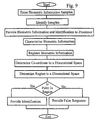
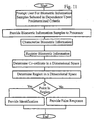
- a flow diagram of a process for use with the invention is shown.
- the process when executing accepts biometric information samples in the form of fingerprints provided to a client computer in the form of a second other computer.
- a plurality of samples from at least two biometric information sources are provided. These samples are in the form of fingerprints, palm prints, voice samples, retinal scans, or other biometric information samples.
- Requiring an individual to enter biometric information samples from at least two biometric information sources allows for improved registration results and reduced false acceptance.
- some individuals are known to be commonly falsely accepted or identified.
- the false acceptance often is a result of similarities between biometric information samples from a biometric information source of a registered individual and from a biometric information source of another individual. These similarities are often only present for a specific similar biometric information source such as a left index finger or a right thumb.
- the provision and registration of two biometric information samples reduces likelihood of similarity because, where before similarity of a single biometric information source resulted in false acceptance, now similarity in two different sources is unlikely. Therefore, requiring a minimum of two biometric information sources reduces any likelihood of false acceptance.
- the use of a plurality of varied biometric information sources in the form of retinal scans, voice prints, finger prints, palm prints, toe prints, etc. further reduces probability of false registration; it is unlikely that the varied biometric information from two individuals is similar.
- Each biometric information sample is associated with a biometric information source in the form of a fingertip, a retina, a voice, a palm, etc.
- the association allows for comparison between the biometric information sample and a template associated with the biometric information source.
- the biometric information samples are each characterised prior to transmission to the server in the form of a first computer. The characterisation is performed according to the process provided to the client computer. Optionally, the characterised information is encrypted prior to transmission.
- the characterised biometric information sample is only compared to a single template associated with the biometric information source. Alternatively, the characterised biometric information sample is compared against a plurality of templates. Comparing characterisations of biometric information samples is often referred to as registering the biometric information samples. Many methods are known for performing the registration to determine a registration value. The registration value is then used to determine identification; to provide access to a system or structure; to log access; to monitor use; for billing; or for other purposes.
- the characterised biometric information is registered against templates stored in a database of templates in order to locate those registrations which are indicative of a predetermined characteristic.
- the characteristic is often identity. Because characterisations of a plurality of biometric information samples are provided, the registration against templates is for locating a plurality of templates which are indicative of a predetermined characteristic.
- the templates are from a same individual and the registration process tries to locate a set of templates that registers with the characterised biometric information samples resulting in a set of values indicative of accurate identification.
- the server 51 uses the identification for further transactions.
- Some examples of transactions where user identity is important include access to secure systems, access to data, charging purchases or access time, write privileges on the server 51 , logging use, and logging operations.
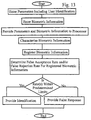
- FIG. 7b a flow diagram of another embodiment of a process for use with the invention for identifying an individual is shown.
- An individual seeking authentication by a user authorisation system is presented with a parameter entry means in the form of software for execution on the client computer and for providing an individual with means for selecting or customising parameters.
- Some known means include prompts, a command line, or a graphical user interface, voice recognition software, magnetic strip readers, card readers, and wireless communication means.
- the individual determines biometric information sample parameters.
- the parameters are selected from a known group of available parameters. Examples of known groups of biometric information samples include (right index finger, left index finger, left thumb); (right index finger, voice); (retinal scan, voice); (left thumb, left middle finger); etc. Groupings reduce user entry requirements; however, groupings also reduce flexibility.
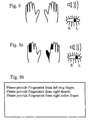
- parameters are entered by an individual selecting from all available parameters in order to determine a group. For example, an individual is presented with a graphical display, as shown in Fig. 8, of biometric information sources in the form offingers and selects a number of samples for each source. When a voice recognition system is incorporated into the user authorisation system, an icon representing voice is also displayed. When a retinal scanning system is incorporated, an icon representing the retinal scan is displayed. Other icons are displayed when corresponding biometric identification systems are present.
- the individual enters parameters in the form of identifying biometric information sources and for each source a quantity of samples being provided.
- a minimum set of requirements exist which, though flexible, ensures sufficient levels of security. Requiring each individual to enter information from a minimum number of biometric information sources and perhaps a maximum number of samples from a same biometric information source, allows for maintenance of at least a predetermined security level.
- the minimum set of requirements is determined by the process while executing on a client computer based on available biometric input devices.
- the client computer 52 transmits information concerning available biometric input devices to the server and the server 51 determines a minimum set of requirements. In this latter case, the location of the client in a secure environment, in a university computer lab, mobile computer, etc. - is also a factor to consider.
- the individual enters biometric information in the form of fingerprints into the system in accordance with the parameters.
- the parameters once selected are analysed and the individual is prompted to enter each biometric information sample.
- the parameters and the biometric information in the form of representations of fingerprints are provided simultaneously.
- the biometric information provided by the individual is related to the parameters selected. For example, referring to Figs..8a, when the individual selects left ring finger once, right thumb once, and right index finger once, the individual then provides a sample of a fingerprint from the left ring finger, a fingerprint sample from the right thumb and a fingerprint sample from the right index finger. Prompting, shown in Fig. 8b, allows the individual to select very complicated sets of biometric information sources or to select from predetermined sets without remembering the parameters and/or an order for the parameters. Alternatively, prompting is performed by flashing selected biometric information sources in a graphical user interface as shown in Fig. 8a or in another fashion.
- a biometric input means 80 in the form of a live fingerprint scanning device is used to collect the biometric information in the form of images of fingerprints of the individual which are entered in a predetermined order.
- Each biometric information sample is identified with its known source.
- the client computer associates the samples with labels.
- an individual enters parameters and biometric information simultaneously by entering a biometric information sample and identifying the sample as, for example, a specific fingerprint or a voice sample.
- the individual is provided with a means of reviewing and accepting or discarding biometric information samples.
- Each biometric information sample is characterised according to the process provided from the server 51 to the client computer 52 .
- the characterised biometric information is then transmitted to the server 51 for authentication.
- the authentication procedure determines an independent sequence of comparison scores from the input provided by the candidate. This sequence is considered to be a point, hereinafter referred to as P, in n-dimensional vector space, R n .
- a threshold function h ⁇ : R n ⁇ R is used to determine whether or not the point belongs to a set U ⁇ by P ⁇ U ⁇ ⁇ h ⁇ (P) ⁇ C ⁇ . The identity of the individual is confirmed if and only if P ⁇ U ⁇ .
- the biometric information sample identifiers are used to uniquely identify the characterised biometric samples transmitted to the server 51 .
- l the set of input images
- I ⁇ I i
- Id i be the identifier of an image
- T i be the transmitted characterisation or template of the fingerprint image (to the server 51 from the client computer 52 )
- T i * be the reference template of the image.
- I R ⁇ I j ⁇ H k
- score (T j , T j *) max ⁇ score (T i , T i *) ⁇ , l ⁇ k ⁇ N ⁇ l i ⁇ H k
- the set I R ⁇ I is then a set of images of the distinct input fingerprints that achieve the highest scores. Alternatively, multiple samples of a same fingerprint are considered.
- the characterised biometric information samples are provided to the server. Registration is conducted against known templates in dependence upon the parameters selected whether by the server 51 , the client computer 52 , or the individual. Once registration is complete, a single point is determined having co-ordinates equal to each of at least some of the registration results. Alternatively, the point has co-ordinates determined in dependence upon the registration results but not equal thereto. Plotting the point results in a point plotted in n-dimensional space.
- the server 51 determines a probability distribution for the selected parameters. Alternatively, this is performed prior to the registration process for characterised biometric information samples. For example, once a process is transmitted to a client computer 52 , the server 51 computes probability distributions. Further, Alternatively the probability distributions are determined or approximated in advance and stored in non-volatile memory.
- a comparison determines whether or not the point falls below or above the function and optionally within or outside other known ranges. Stated differently, the point is analysed to determine whether it falls within a suitable region wherein region is defined as an n-dimensional region having at least some known boundaries. When the point falls within a predetermined or suitable region, the individual is identified. When the point falls outside the predetermined-or suitable region, the individual is not identified. The identification system then responds accordingly. Responses in the form of locking an individual out, denying an individual access, logging an attempted entry by an unidentified individual, etc. are well known.
- biometric information samples are provided to the client computer 52 and associated with their biometric information sources in the form of finger tips, eyes, palm, or voice.
- the processor 54 of the client computer 52 characterises the biometric information samples according to the received process and transmits the characterised biometric information samples to the server 51 .
- the client computer 52 communicates with the server 51 and receives characterisation processes in dependence upon the user identity and the entered parameters.
- the characterised information is encrypted prior to transmission to the server 51 .
- the server receives the characterised biometric information samples and registers them against templates. When the individual's alleged identification is known, registration is performed against templates associated with the individual and associated with same biometric information sources. Identification of an individual is conducted in a fashion similar to that set out for Fig. 7b above.
- a client computer prompts an individual for biometric information samples associated with biometric information sources selected by the client computer at random.
- the biometric information samples are provided to the processor.
- the processor characterises the biometric information samples and transmits the characterisations to the server.
- the server registers the characterisations against templates. When the individual's alleged identification is known, registration is performed against templates associated with the same biometric information sources of the individual. Identification of an individual is conducted in a fashion similar to that set out for Fig. 7b above.
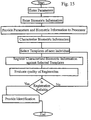
- Biometric information samples and associated parameters are provided to the processor 54 of the client computer 52 .
- the processor 54 characterises the biometric information samples and the characterisations are transmitted to the server 51 .
- characterisations comprise information relating to biometric information sources.
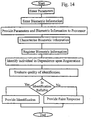
- the server receives the characterisations and registers them against templates. When the individual's alleged identification is known, registration is performed against templates associated with the individual and associated with same biometric information sources. Identification of an individual is performed by evaluating resulting values from the registration to determine a probability, for those results, of false acceptance and false rejection. When the value is within predetermined limits for an acceptable value, identification is provided. When the value falls outside the predetermined limits identification is not provided. Identification is used to provide user access to the server, for user authentication, for billing, or for other purposes where user identification is desirable.
- Biometric information samples and associated parameters including an alleged identification of the individual are provided to the processor 54 in the client computer 52 .
- the processor 54 characterises the biometric information samples in accordance with the process received from the server 51 and the characterisations are transmitted to the server 51 .
- the server registers them against templates.
- Identification of an individual is performed by evaluating resulting values from the registration to determine a probability, for those results, of false acceptance and false rejection. When the value is within predetermined limits for an acceptable value, identification is provided. When the value falls outside the predetermined limits identification is not provided.
- Biometric information samples and associated parameters are provided to the processor 54 of the client computer 52 .
- the processor 54 characterises the biometric information samples according to a process provided from the server 51 to the client computer 52 and the characterisations are transmitted to the server 51 .
- the characterisation process is determined in dependence upon the parameters.
- the characterisations are encrypted.
- the server receives the characterisations and registers them against templates. When the individual's alleged identification is known, registration is performed against templates associated with the individual and associated with same biometric information sources. Identification of an individual is performed by evaluating resulting values from the registration to determine a quality of user identification. When the quality is within predetermined limits for an acceptable quality, identification is provided. When the value falls outside the predetermined limits identification is not provided.
- Biometric information samples from an individual and associated parameters are provided to the processor 54 of the client computer 52 .
- the processor 54 characterises the biometric information samples and the characterisations are transmitted to the server 51 .
- the server 51 registers the characterisation against templates.
- a first set of templates associated with an individual and associated with same biometric information sources is selected. Registration of the biometric information samples is performed against the selected templates producing registration values.
- a quality of user identification is determined. When the quality is within predetermined limits for an acceptable quality, identification is provided. When the value falls outside the predetermined limits identification is not provided and a next set of templates is selected.
- a process is determined in dependence upon the next set of templates and the process is transmitted to the client computer for execution thereon. The steps repeat a number of times or until user identification occurs.
- an indication of failure to identify is provided.
- a two dimensional probability distribution is shown.
- the total area below the distribution curve is 1 unit area.
- false acceptance or false registration is described.
- Most biometric information samples are easily characterised.
- the high initial point on the probability curve and the steep decent to an asymptotic curve approaching 0 shows this.
- the line t marks the cutoff for registration effectiveness. This is determined in dependence upon an algorithm chosen and upon system limitations such as processor speed, memory, and security requirements.
- the shaded region bounded by Y 0, X > t, and the probability curve represents false acceptances.
- a truncated two dimensional probability distribution curve is shown. Now, false acceptance is represented by a region of three dimensional space having a volume of 1 unit 2 .
- a plot showing an acceptance curve for registration is contained below the curved surface of Fig. 17.
- two parameters either from separate registrations or from a same biometric information sample registration are evaluated to determine a point.
- the biometric information is not identified and correspondingly the individual is not identified.
- registration occurs. Extending this to a plurality of biometric information samples results in regions allowing for excellent registration of some samples, as shown in Fig. 17 , with moderate registrations of other samples.
- Using a plurality of biometric information samples allows equivalent registration algorithms to provide greatly enhanced security or Alternatively, allows faster and simpler registration algorithms to provide equivalent security.
- a security system is characterised as allowing 1 in 1,000 false acceptances or, alternatively, 1 in 1,000,000. Extending the graph of Fig. 17 to n dimensions, results in a different distribution for a region representing acceptance and, therefore, a match scores of a single biometric information sample that falls outside the shaded region of Fig. 17, when combined with several other similarly weak biometric information samples, is more likely to fall within an acceptable region. A reasonable correlation among several identifiers is a good indication of identity. Alternatively, using only a single biometric information sample, a low match score results in failure to authorise an individual.
- U ⁇ ⁇ Sn is defined, bounded "below" by a function, h ⁇ : Rn ⁇ R.
- U ⁇ ⁇ P ⁇ Sn
- G(P) gives the probability that the n independent scores, ⁇ x i ⁇ of non-matching finger prints occur in a particular sequence. (Note that g(P) does not give a probability at any specific point since the measure, and hence the integral, over a single point is zero).
- the second condition indicates that regions are bounded below by a threshold function where C ⁇ , C ⁇ are non-negative constants.
- the third condition states that when a point is a member of a false acceptance region with a lower probability, it also belongs to a false acceptance region associated with a higher probability.
- the last condition attempts to ensure that points along or proximate the region boundaries retain substantially level contours on the n-dimensional probability density function. This reduces uneven boundaries "favouring" certain combinations of match scores.
- n-dimensional false rejection rates are calculated assuming that an analogous n-dimensional probability density function, g* is constructed from the probability density function of fingerprint match scores.
- the corresponding false rejection rate for an n-dimensional false rejection rate ⁇ is given by: ⁇ S n - U a g*
- the method is employed with retinal scanned biometric information. Further Alternatively, the method is employed with palm prints. Further Alternatively, the method is employed with non image biometric data such as voice prints.
- a process for improving security without requiring performance of additional steps by most individuals for use in accordance with the invention is shown.
- a user presents biometric information to a biometric input device in communication with the client computer 52 .
- the information is characterised and the characterised information is transmitted to the server 51 .
- the server 51 receives the characterised information and matches it against a template.
- the server transmits an indication of such to the client computer 52 executing the process provided thereto.
- another process is provided to the client computer form the server.
- the client computer prompts the user for another biometric information sample.
- the system prompts for samples from each biometric information source a plurality of consecutive times.
- a user presents their index finger to a fingerprint scanner.
- the fingerprint is characterised.
- the characterisation is sent to the server 51 for registration.
- the server transmits an indication of such to the client computer 52 .
- another different characterisation process is provided to the client computer 52 .
- the user again presents their index finger to the fingerprint scanner.
- the server transmits an indication of such to the client computer 52 .
- the user again presents their index finger to the fingerprint scanner.
- the server transmits an indication of such to the client computer 52 .
- the server transmits an indication of such to the client computer 52 .
- the server transmits another process for characterising a different biometric information sample.
- the user is prompted to present their middle finger to the fingerprint scanner. Alternatively, the user selects and identifies their middle finger as the next biometric information source.
- the biometric information sample is characterised and transmitted to the server 51 .
- the registration of the characterised data derived from the biometric sample of the middle finger is performed according to the invention and therefore is not a same registration process as when the middle finger is the first finger presented to the scanner.
- the registration relies on the best registration value from the index fingerprints and, with the registration results from the middle finger, determines whether identification should proceed.
- unsuccessful registration occurs, the server transmits an indication of such to the client computer according to the invention and the middle finger is presented up to two more times.
- registration is still unsuccessful, another biometric source is requested or is selected by the user.
- user identification fails when registration results fall below a predetermined threshold.
- user identification fails when known biometric information sources of the user are exhausted.
- a resulting registration value considered with previous registration values according to the process results in a sufficiently accurate identification, the user is identified.
- each biometric source supplies information thrice, this is only exemplary. Though the above example refers to an index finger and a middle finger, any fingers or other biometric information may be employed within a process as described above. Registration disclosed according to the above process is performed on the server 51 . Biometric information input is provided on the client computer 52 .
- the client computer 52 prompts a user for their identity.
- the identification is provided to the server 51 .
- a process from the server is selected based on the identity and transmitted to the client computer 52 .
- the process is selected such that biometric information is requested from sources in an order that is most likely determinative of the user identity.
- biometric information from an index finger is provided and registered but fails to sufficiently identify the user
- further biometric information is requested.
- the biometric information requested is selected such that a highest likelihood of identification results.
- the biometric information source is selected such that a highest likelihood of rejection results. Should the next sample of biometric information fail to be determinative - identification or rejection, further biometric information from another source is requested again attempting to make a final determination fastest.
- a data structure indicating a next biometric information source to request is produced from all biometric information.
- the requested information is determined based on the known biometric information and registration values associated therewith. For example, biometric information is provided from a first biometric information source. Registration is performed and is inconclusive. It is determined that a particular biometric information source comprises information most likely to result in identification or failure thereby being determinative.
- the server 51 transmits an indication of the desired biometric information and that biometric information source is polled by the process executing on the client computer 52 .
- biometric information sources When selecting subsequent biometric information sources, preferably, all possible outcomes are analysed and the outcome of failed identification is not itself considered a single outcome but is weighted more heavily.
- the data is arranged such that in dependence upon previous registration results a next biometric information source is polled. Using such a system, searching large databases for accurate registration is facilitated and reliability is greatly increased.
- the database is precompiled to enhance performance during the identification process.
Landscapes
- Engineering & Computer Science (AREA)
- Computer Security & Cryptography (AREA)
- Theoretical Computer Science (AREA)
- Physics & Mathematics (AREA)
- General Physics & Mathematics (AREA)
- Computer Hardware Design (AREA)
- Software Systems (AREA)
- General Engineering & Computer Science (AREA)
- Business, Economics & Management (AREA)
- Accounting & Taxation (AREA)
- Strategic Management (AREA)
- Finance (AREA)
- Human Computer Interaction (AREA)
- General Business, Economics & Management (AREA)
- Computing Systems (AREA)
- Computer Networks & Wireless Communication (AREA)
- Signal Processing (AREA)
- Computer And Data Communications (AREA)
- Collating Specific Patterns (AREA)
- Burglar Alarm Systems (AREA)
- Small-Scale Networks (AREA)
- Communication Control (AREA)
- Storage Device Security (AREA)
- Selective Calling Equipment (AREA)
Claims (27)
- Ein Verfahren zur Erhöhung der Netzwerksicherheit in einer Client/Server-Umgebung, umfassend die Schritte vona) Beginnen einer Kommunikationssitzung zwischen einem ersten Computer (51) und einem zweiten, anderen Computer (52), einschließlich des Schrittes vona1) Übermitteln einer Aufforderung von dem zweiten Computer (52), um das Verfahren zur Erhöhung der Netzwerksicherheit mit dem ersten Computer (51) zu initialiseren;
gekennzeichnet durch die Schritte vona2) Vorbereiten eines Sicherheitsverfahrens an dem ersten Computer (51) zur Übermittlung an den zweiten, anderen Computer (52) in einer derartigen Weise, daß der zweite, andere Computer (52) in der Lage ist, das auf diese Weise vorbereitete Sicherheitsverfahren auszuführen, umfassend den Schritt von a3) Auswählen eines Sicherheitsverfahrens aus einer Vielzahl von Sicherheitsverfahren;a3) Auswählen eines Sicherheitsverfahrens aus einer Vielzahl von Sicherheitsverfahren;b) Übermittlung von Daten, die repräsentativ für das vorbereitete Verfahren zur Sicherung der Kommunikation zwischen denselben sind, von dem ersten Computer (51) an den zweiten, anderen Computer (52) in Kommunikation mit demselben;b1) Empfangen der Daten an dem zweiten, anderen Computer (52) und Abrufen des ausgewählten Sicherheitsverfahrens aus den empfangenen Daten;c) Sichern der Kommunikationen auf dem zweiten, anderen Computer (52) unter Verwendung des Verfahrens, um andere Daten vor der Übermittlung an den ersten Computer zu verarbeiten.c1) Übermittlung der verarbeiteten anderen Daten von dem zweiten, anderen Computer (52) an den ersten Computer (51); undd) Sichern der Kommunikationen auf dem ersten Computer (51) unter Verwendung eines Verfahrens, das mit dem übermittelten Verfahren verknüpft ist, umfassend die Schritte von:d1) Empfangen der anderen verarbeiteten Daten an dem ersten Computer (51); undd2) Ausführen der Umkehrung des Sicherungsverfahrens oder des Analysierens der verarbeiteten anderen Daten auf dem ersten Computer (51). - Ein Verfahren zur Erhöhung der Netzwerksicherheit wie in Anspruch 1 definiert,
wobei das übermittelte Verfahren während einer gleichen Kommunikationssitzung an den zweiten, anderen Computer (52) übermittelt und von dem zweiten, anderen Computer (52) angewendet wird. - Ein Verfahren zur Erhöhung der Netzwerksicherheit wie in Anspruch 2 definiert,
wobei das Verfahren im Wesentlichen bei der Beendigung der Kommunikationssitzung auf dem zweiten, anderen Computer (52) gelöscht wird. - Ein Verfahren zur Erhöhung der Netzwerksicherheit wie in Anspruch 1 definiert,
wobei das Verfahren von dem ersten Computer (51) ausgewählt wird in Abhängigkeit von mindestens einem der Elemente, ausgewählt aus dem Betriebssystem, dem Kommunikationssystem und der Hardware des zweiten, anderen Computers (52). - Ein Verfahren zur Erhöhung der Netzwerksicherheit wie in Anspruch 1 definiert,
wobei der Schritt derc) Sicherung der Kommunikationen auf dem zweiten, anderen Computer (52) unter Verwendung des Verfahrens den Schritt der Übermittlung an den ersten Computer (51) einer Teilmenge von die Anwenderberechtigung betreffender Information, bestimmt in Abhängigkeit von dem Verfahren, umfasst. - Ein Verfahren zur Erhöhung der Netzwerksicherheit wie in Anspruch 1 definiert,
wobei der Schritt derc) Sicherung der Kommunikationen auf dem zweiten, anderen Computer (52) durch Verwendung des Verfahrens den Schritt der Kennzeichnung von auf dem zweiten, anderen Computer (52) empfangener Anwenderberechtigungsinformation und der Übermittlung von Daten in Abhängigkeit von der Kennzeichnung an den ersten Computer (51) umfasst. - Ein Verfahren zur Verbesserung der Netzwerkkoinmunikationssicherheit für ein System mit einem ersten Computer (51) in Kommunikationen mit einem zweiten, anderen Computer (52) wie in Anspruch 1 definiert, umfassend den Schritt der Kommunikationssicherung unter Verwendung von Verschlüsselung.
- Ein Verfahren zur Verbesserung der Netzwerkkommunikationssicherheit für ein System mit einem ersten Computer (51) in Kommunikationen mit einem zweiten, anderen Computer (52) wie in Anspruch 1 definiert, umfassend den Schritt das Sicherungsverfahren in zeitlichen Abständen zu verändern.
- Ein Verfahren zur Erhöhung der Netzwerksicherheit wie in Anspruch 6 definiert,
wobei die Anwenderberechtigungsinformation biometrische Information ist. - Ein Verfahren zur Erhöhung der Netzwerksicherheit wie in Anspruch 9 definiert,
wobei der Schritt von d2) Ausführen der Umkehrung des Sicherungsverfahrens oder des Analysierens der verarbeiteten anderen Daten auf dem ersten Computer (51) die Schritte umfasst von:d3) abgleichen der Daten mit gemäß einem kompatiblen Kennzeichungsverfahren bestimmten Mustern biometrischer Information, um ein Abgleichergebnis zu erhalten; undd4) wenn das Abgleichergebnis innerhalb eines vorbestimmten Bereichs liegt, Durchführen des Identifizierens einer Quelle der biometrischen Information oder des Berechtigens des zweiten, anderen Computers (52) zum Zugang zu auf dem ersten Computer (51) gespeicherter Information. - Ein Verfahren zur Erhöhung der Netzwerksicherheit wie in Anspruch 9 definiert,
wobei das Verfahren zur Kennzeichnung von Anwenderinformation eine nicht wieder umkehrbare Umwandlung der Information umfasst. - Ein Verfahren zur Erhöhung der Netzwerksicherheit wie in Anspruch 11 definiert, wobei die Anwenderberechtigungsinformation einen Fingerabdruck umfasst.
- Ein Verfahren zur Erhöhung der Netzwerksicherheit wie in Anspruch 9 definiert,
wobei der Schritt von d2) Ausführen der Umkehrung des Sicherungsverfahrens oder des Analysierens der verarbeiteten anderen Daten auf dem ersten Computer (51) die Schritte umfasst von:d3) Vergleichen der von dem ersten Computer (51) empfangenen Daten mit Information auf dem ersten Computer (51), um einen Wert zu bestimmen; undd4) wenn der Wert innerhalb vorbestimmter Grenzen liegt, Durchführen des Identifizierens einer Quelle der Berechtigungsinformation oder der Berechtigung von Zugang von dem zweiten, anderen Computer (52) auf Information, die von dem ersten Computer (51) gesichert ist. - Ein Verfahren zur Erhöhung der Netzwerksicherheit wie in Anspruch 1 definiert,
wobei die anderen Daten für eine Anwenderidentität bezeichnende Daten sind, umfassend die Schritte von:Zur Verfügung stellen der für eine Anwenderidentität bezeichnenden Daten an den zweiten, anderen Computer (52); undÜbermitteln der für eine Anwenderidentität bezeichnenden Daten an den ersten Computer (51), wobei die für eine Anwenderidentität bezeichnenden Daten biometrische Information sind, wobei das Verfahren von dem ersten Computer (51) in Abhängigkeit von den für eine Anwenderidentität bezeichnenden Daten ausgewählt wird, und wobei das Verfahren zur Kennzeichnung'der zu dem zweiten Computer (52) übermittelten Anwenderberechtigungsinformation den Schritt der Extraktion von besonderen Merkmalen aus der biometrischen Information aufweist. - Ein Verfahren zur Erhöhung der Netzwerksicherheit wie in Anspruch 13 definiert, umfassend die Schritte von:zur Verfügung stellen einer biometrischen Informationsprobe einem biometrischen Eingabegerät (80) in Kommunikation mit dem zweiten, anderen Computer (52);zur Verfügung stellen für eine biometrische Informationsquelle der biometrischen Informationsprobe bezeichnender Daten;zur Verfügung stellen für eine Anwenderidentität bezeichnender Daten;Übermitteln der für eine Anwenderidentität und die biometrische Informationsquelle bezeichnenden Daten an den ersten Computer (51);Auswählen eines Verfahrens aus einer Vielzahl von Verfahren, das mit einem aus einer Vielzahl von Mustern, die mit der biometrischen Informationsquelle der identifizierten Person verknüpft sind, verknüpft ist;und wobei der Schritt von d4) Ausführen der Identifikation einer Quelle der biometrischen Information oder Gewähren von Zugang vom zweiten, anderen Computer (52) zu von dem ersten Computer (51) gesicherter Information den Schritt umfasst, innerhalb einer vorbestimmten Sicherheitsstufe zu bestimmen, ob die zur Verfügung gestellte biometrische Information von der gleichen Person stammt, wie der identifizierten.
- Ein Verfahren zur Erhöhung der Netzwerksicherheit wie in Anspruch 9 definiert,
wobei der Schritt d2) den Schritt des Vergleichens der von dem ersten Computer (51) empfangenen Daten mit Information auf dem ersten Computer (51) umfasst, um einen Wert zu bestimmen, und wenn der Wert innerhalb vorbestimmter Grenzen liegt, Ausführen der Identifikation einer Quelle der Berechtigungsinformation oder des Berechtigens von Zugang für den zweiten, anderen Computer (52) zu Information, gesichert von dem ersten Computer (51). - Ein Verfahren zur Verbesserung der Netzwerksicherheit wie in Anspruch 13 definiert, umfassend die Schritte von
Gewinnung von Daten bezeichnend für eine Anwenderidentität;
wobei das Verfahren eines einer Vielzahl von mit den für eine Anwenderidentität kennzeichnenden Daten verknüpften Verfahren umfasst und wobei das Verfahren den Schritt aufweist von :und wobei der Schritt von d4) Ausführen der Identifikation einer Quelle der biometrischen Information oder der Berechtigung von Zugang vom zweiten, anderen Computer (52) zu von dem ersten Computer (51) gesicherter Information den Schritt umfasst, innerhalb einer vorbestimmten Sicherheitsstufe zu bestimmen, ob die zur Verfügung gestellte biometrische Information von der gleichen Person stammt, wie die Anwenderidentität.Veranlassen des Anwenders zur Verfügungstellung einer biometrischen Informationsprobe von einer vorbestimmten biometrischen Informationsquelle an ein biometrisches Eingabegerät (80), in Kommunikation mit dem zweiten, anderen Computer (52); - Ein Verfahren zur Erhöhung der Netzwerksicherheit wie in Anspruch 13 definiert, wobei das Verfahren ein Verfahren zur Kennzeichnung biometrischer Information aufweist und wobei der Schritt c) umfasst den Schritt des Kennzeichnens der biometrischen Informationsprobe, zur Verfügung gestellt dem zweiten, anderen Computer (52) gemäß dem von dem ersten Computer (51) übermittelten Verfahren, um Daten herzustellen, und umfassend die Schritte von:und wobei der Schritt d4) den Schritt des Vergleichens der von dem ersten Computer (51) während der Sitzung zur Information des ersten Computers (51) empfangenen Daten umfasst, um mit einer vorbestimmten Sicherheitsstufe eine Identifikation einer Person festzulegen, von der die biometrische Informationsprobe abgegeben wurde.zur Verfügung stellen einer biometrischen Informationsprobe von einer biometrischen Informationsquelle an den zweiten, anderen Computer (52) unter Verwendung eines biometrischen Eingabegerätes (80);
- Ein Verfahren zur Verbesserung der Netzwerkkommunikationssicherheit für ein System mit einem ersten Computer (51) in Kommunikationen mit einem zweiten, anderen Computer (52) wie in Anspruch 18 definiert, umfassend den Schritt, das Sicherungsverfahren in zeitlichen Abständen zu verändern
- Ein Verfahren zur Erhöhung der Netzwerksicherheit wie in Anspruch 18 definiert, umfassend die Schritte von:zur Verfügung stellen an den zweiten, anderen Computer (52) von Daten bezeichnend für eine Anwenderidentität; undübermitteln der für eine Anwenderidentität bezeichnenden Daten an den ersten Computer (51).
- Ein Verfahren zur Erhöhung der Netzwerksicherheit wie in Anspruch 20 definiert, umfassend die Schritte von:Auswählen eines Verfahrens aus einer Vielzahl von Verfahren, das mit den für eine Benutzeridentität bezeichnenden Daten verknüpft ist, wobei das von dem ersten Computer (51) an den zweiten, anderen Computer (52) übermittelte Verfahren das ausgewählte Verfahren ist.
- Ein Verfahren zur Erhöhung der Netzwerksicherheit wie in Anspruch 18 definiert, umfassend die Schritte von:wobei der Schritt d4) die Schritte umfasst von:zur Verfügung stellen einer zweiten biometrischen Informationsprobe von einer zweiten, anderen biometrischen Informationsquelle an den zweiten, anderen Computer (52) unter Verwendung eines biometrischen Eingabegerätes (80);Kennzeichnen der dem zweiten, anderen Computer (52) zur Verfügung gestellten zweiten biometrischen Informationsprobe gemäß dem von dem ersten Computer (51) übermittelten Verfahren, um zweite Daten herzustellen;Übermitteln der zweiten Daten an den ersten Computer (51); undAbgleichen der Daten und eines Musters, um einen Abgleichwert zu bestimmen;Abgleichen der zweiten Daten und eines zweiten Musters, um einen zweiten Abgleichwert zu bestimmen;bestimmen, ob ein Punkt in einem mehrdimensionalen Raum und mit Koordinaten, die im Wesentlichen dem Abgleichwert und dem zweiten Abgleichwert entsprechen, in einen mehrdimensionalen Bereich fällt, der in Abhängigkeit von einer vorbestimmten Fehlerrate wegen fälschlicher Akzeptierung festgelegt ist.
- Ein Verfahren zur Erhöhung der Netzwerksicherheit wie in Anspruch 18 definiert, umfassend die Schritte von:wobei der Schritt d4) den Schritt aufweist von:zur Verfügung stellen einer zweiten biometrischen Informationsprobe von einer zweiten anderen biometrischen Informationsquelle an den zweiten, anderen Computer unter Verwendung eines biometrischen Eingabegerätes (80); kennzeichnen der dem zweiten, anderen Computer (52) zur Verfügung gestellten zweiten biometrischen Informationsprobe gemäß dem von dem ersten Computer (51) übermittelten Verfahren, um zweite Daten herzustellen;Übermitteln der zweiten Daten an den ersten Computer (51); undBestimmen innerhalb einer vorbestimmten Sicherheitsstufe, ob die Vielzahl der zur Verfügung gestellten biometrischen Informationsproben von einer gleichen, bekannten Person stammt.
- Ein Verfahren zur Erhöhung der Netzwerksicherheit wie in Anspruch 6 definiert,
wobei das Verfahren ein Verfahren zur Ausführung auf dem zweiten, anderen Computer (52) zur Kennzeichnung biometrischer Information aufweist, wobei das Verfahren die Schritte umfasst von:Und wobei der Schritt c) durch Ausführung des Verfahrens auf dem zweiten, anderen Computer (52) durchgeführt wird;Entgegennehmen einer ersten biometrischen Informationsprobe von einer biometrischen Quelle der Person in ein biometrisches Eingabegerät (80) in Kommunikation mit einem Wirtsprozessor (54), undVerwenden des Prozessors (54) des zweiten, anderen Computers (52), um die biometrische Informationsprobe zu kennzeichnen;
wobei der Schritt d) durch Übermittlung der ersten gekennzeichneten biometrischen Information an den ersten Computer (51) durchgeführt wird;
und wobei der Schritt d4) die Schritte umfasst von:e) Verwenden des Prozessors (54) des ersten Computers (51), Abgleichen der gekennzeichneten ersten Informationsprobe mit einem ersten Muster, um einen ersten Abgleichwert herzustellen;f) die Person zu identifizieren, wenn der erste Abgleichwert innerhalb festgelegter Grenzen liegt; undg) wenn der erste Abgleichwert innerhalb anderer festgelegter Grenzen liegt, ein für dies kennzeichnendes Signal an den zweiten, anderen Computer (52) zu übermitteln und die Schritte auszuführen von:g1) Ausführen des Verfahrens auf dem zweiten, anderen Computer (52) mit einer anderen, verschiedenen biometrische Informationsquelle,g2) Übermittlung der ersten gekennzeichneten biometrischen Information an den ersten Computer (51);g3) Verwenden des Prozessors (54) des ersten Computers (51), Abgleichen der aktuellen Informationsprobe mit einem Muster, um einen aktuellen Abgleichwert herzustellen;g4) die Person zu identifizieren, wenn der erste Abgleichwert und der aktuelle Abgleichwert innerhalb festgelegter Grenzen liegen; undg5) wenn der erste Abgleichwert und der aktuelle Abgleichwert innerhalb zweiter festgelegter Grenzen liegen, den Schritt g) zu wiederholen. - Ein Verfahren zur Verbesserung der Netzwerkkommunikationssicherheit für ein System mit einem ersten Computer (51) in Kommunikationen mit einem zweiten, anderen Computer (52) wie in Anspruch 24 definiert, umfassend den Schritt das Sicherungsverfahren in zeitlichen Abständen zu verändern.
- Ein Verfahren zur Erhöhung der Netzwerksicherheit wie in Anspruch 24 definiert, umfassend den Schritt von:zur Verfügung stellen an den zweiten, anderen Computer (52) von Daten, bezeichnend für eine Anwenderidentität; undÜbermitteln der für eine Anwenderidentität bezeichnenden Daten an den ersten Computer (51), wobei das Verfahren zur Kennzeichnung der an den zweiten, anderen Computer (52) übermittelten biometrischer Information von dem ersten Computer (51) in Abhängigkeit von den eine Anwenderidentität bezeichnenden Daten ausgewählt wird.
- Ein Verfahren zur Erhöhung der Netzwerksicherheit wie in Anspruch 24 definiert, wobei der Schritt g) den Schritt umfasst von:wobei das Verfahren zur Kennzeichnung der aktuellen, an den zweiten, anderen Computer (52) übermittelten biometrischen Information von dem ersten Computer (51) in Abhängigkeit von einem vorhergehenden Abgleichwert ausgewählt wird.g0) Übermitteln von dem ersten Computer (51) zu dem zweiten, anderen Computer (52) in Kommunikation mit demselben eines Verfahrens zur Kennzeichnung biometrischer Information zur Ausführung auf dem zweiten, anderen Computer (52), wobei das Verfahren die Schritte umfasst vonEntgegennehmen einer aktuellen biometrischen Informationsprobe von einer biometrischen Quelle der Person in ein biometrisches Eingabegerät (80) in Kommunikation mit einem Wirtsprozessor (54); undVerwenden des Prozessors des zweiten, anderen Computers (52) um die biometrische Informationsprobe zu kennzeichnen;
Applications Claiming Priority (5)
| Application Number | Priority Date | Filing Date | Title |
|---|---|---|---|
| US3234796P | 1996-12-04 | 1996-12-04 | |
| US32347P | 1996-12-04 | ||
| US907958 | 1997-08-11 | ||
| US08/907,958 US6076167A (en) | 1996-12-04 | 1997-08-11 | Method and system for improving security in network applications |
| PCT/CA1997/000926 WO1998025385A1 (en) | 1996-12-04 | 1997-12-02 | Method and system for improving security in network applications |
Publications (2)
| Publication Number | Publication Date |
|---|---|
| EP0944980A1 EP0944980A1 (de) | 1999-09-29 |
| EP0944980B1 true EP0944980B1 (de) | 2003-03-26 |
Family
ID=26708297
Family Applications (1)
| Application Number | Title | Priority Date | Filing Date |
|---|---|---|---|
| EP97946968A Expired - Lifetime EP0944980B1 (de) | 1996-12-04 | 1997-12-02 | Verfahren und einrichtung zur verbesserung der sicherheit in netzwerkanwendungen |
Country Status (7)
| Country | Link |
|---|---|
| US (2) | US6076167A (de) |
| EP (1) | EP0944980B1 (de) |
| AT (1) | ATE235771T1 (de) |
| AU (1) | AU5218598A (de) |
| CA (1) | CA2273252A1 (de) |
| DE (1) | DE69720251T2 (de) |
| WO (1) | WO1998025385A1 (de) |
Cited By (2)
| Publication number | Priority date | Publication date | Assignee | Title |
|---|---|---|---|---|
| RU2453917C1 (ru) * | 2010-12-30 | 2012-06-20 | Закрытое акционерное общество "Лаборатория Касперского" | Система и способ для оптимизации выполнения антивирусных задач в локальной сети |
| CN107431714A (zh) * | 2015-05-29 | 2017-12-01 | 谷歌公司 | 控制经由用户设备在资源的控制点处对资源功能的访问 |
Families Citing this family (163)
| Publication number | Priority date | Publication date | Assignee | Title |
|---|---|---|---|---|
| US10361802B1 (en) | 1999-02-01 | 2019-07-23 | Blanding Hovenweep, Llc | Adaptive pattern recognition based control system and method |
| JP4169790B2 (ja) * | 1997-03-03 | 2008-10-22 | ブリティッシュ・テレコミュニケーションズ・パブリック・リミテッド・カンパニー | セキュリティチェックの実行 |
| US6125192A (en) * | 1997-04-21 | 2000-09-26 | Digital Persona, Inc. | Fingerprint recognition system |
| US6671810B1 (en) * | 1997-09-18 | 2003-12-30 | Intel Corporation | Method and system for establishing secure communication over computer networks |
| US6539101B1 (en) * | 1998-04-07 | 2003-03-25 | Gerald R. Black | Method for identity verification |
| US7809642B1 (en) | 1998-06-22 | 2010-10-05 | Jpmorgan Chase Bank, N.A. | Debit purchasing of stored value card for use by and/or delivery to others |
| US6615189B1 (en) | 1998-06-22 | 2003-09-02 | Bank One, Delaware, National Association | Debit purchasing of stored value card for use by and/or delivery to others |
| JP2000049770A (ja) * | 1998-07-31 | 2000-02-18 | Hitachi Ltd | 暗号化通信方法、暗号アルゴリズム共有管理方法、暗号アルゴリズム変換方法、ネットワーク通信システム |
| US6032136A (en) | 1998-11-17 | 2000-02-29 | First Usa Bank, N.A. | Customer activated multi-value (CAM) card |
| US7660763B1 (en) | 1998-11-17 | 2010-02-09 | Jpmorgan Chase Bank, N.A. | Customer activated multi-value (CAM) card |
| US20020056043A1 (en) * | 1999-01-18 | 2002-05-09 | Sensar, Inc. | Method and apparatus for securely transmitting and authenticating biometric data over a network |
| US6507912B1 (en) * | 1999-01-27 | 2003-01-14 | International Business Machines Corporation | Protection of biometric data via key-dependent sampling |
| US6317834B1 (en) * | 1999-01-29 | 2001-11-13 | International Business Machines Corporation | Biometric authentication system with encrypted models |
| US7961917B2 (en) * | 1999-02-10 | 2011-06-14 | Pen-One, Inc. | Method for identity verification |
| JP4176898B2 (ja) * | 1999-02-19 | 2008-11-05 | 株式会社東芝 | 個人認証システム、それに使用される携帯装置及び記憶媒体 |
| US7305562B1 (en) | 1999-03-09 | 2007-12-04 | Citibank, N.A. | System, method and computer program product for an authentication management infrastructure |
| US6882984B1 (en) | 1999-06-04 | 2005-04-19 | Bank One, Delaware, National Association | Credit instrument and system with automated payment of club, merchant, and service provider fees |
| US6981007B1 (en) * | 1999-07-09 | 2005-12-27 | Whitmyer Jr Wesley W | Onsite backup for internet-based data processing |
| US7370348B1 (en) * | 1999-07-30 | 2008-05-06 | Intel Corporation | Technique and apparatus for processing cryptographic services of data in a network system |
| US6925565B2 (en) * | 2001-05-25 | 2005-08-02 | Pen-One, Inc | Pen-based transponder identity verification system |
| US7047419B2 (en) | 1999-09-17 | 2006-05-16 | Pen-One Inc. | Data security system |
| US7370004B1 (en) | 1999-11-15 | 2008-05-06 | The Chase Manhattan Bank | Personalized interactive network architecture |
| US8793160B2 (en) | 1999-12-07 | 2014-07-29 | Steve Sorem | System and method for processing transactions |
| US7761715B1 (en) * | 1999-12-10 | 2010-07-20 | International Business Machines Corporation | Semiotic system and method with privacy protection |
| US6802009B1 (en) * | 1999-12-17 | 2004-10-05 | International Business Machines Corporation | Operating system security checking system, method, and program |
| US7609862B2 (en) * | 2000-01-24 | 2009-10-27 | Pen-One Inc. | Method for identity verification |
| US6615190B1 (en) | 2000-02-09 | 2003-09-02 | Bank One, Delaware, National Association | Sponsor funded stored value card |
| US6941279B1 (en) | 2000-02-23 | 2005-09-06 | Banke One Corporation | Mutual fund card method and system |
| US6453301B1 (en) | 2000-02-23 | 2002-09-17 | Sony Corporation | Method of using personal device with internal biometric in conducting transactions over a network |
| US6920561B1 (en) * | 2000-03-31 | 2005-07-19 | International Business Machines Corporation | Method and system for enabling free seating using biometrics through a centralized authentication |
| US7113914B1 (en) | 2000-04-07 | 2006-09-26 | Jpmorgan Chase Bank, N.A. | Method and system for managing risks |
| US7836491B2 (en) * | 2000-04-26 | 2010-11-16 | Semiconductor Energy Laboratory Co., Ltd. | System for identifying an individual, a method for identifying an individual or a business method |
| US6944773B1 (en) * | 2000-05-19 | 2005-09-13 | Sony Corporation | Method and apparatus for fingerprint authentication during on-line transactions |
| FR2810822B1 (fr) | 2000-06-23 | 2004-09-17 | France Telecom | Procede d'authentification/identification biometrique securise, module de saisie et module de verification de donnees biometriques permettant de mettre en oeuvre le procede |
| US9380414B2 (en) | 2000-06-27 | 2016-06-28 | Ortiz & Associates Consulting, Llc | Systems, methods and apparatuses for brokering data between wireless devices, servers and data rendering devices |
| US7630721B2 (en) | 2000-06-27 | 2009-12-08 | Ortiz & Associates Consulting, Llc | Systems, methods and apparatuses for brokering data between wireless devices and data rendering devices |
| AU7182701A (en) | 2000-07-06 | 2002-01-21 | David Paul Felsher | Information record infrastructure, system and method |
| WO2002011019A1 (en) | 2000-08-01 | 2002-02-07 | First Usa Bank, N.A. | System and method for transponder-enabled account transactions |
| US7254619B2 (en) * | 2000-10-13 | 2007-08-07 | Matsushita Electric Industrial Co., Ltd. | Apparatus for outputting individual authentication information connectable to a plurality of terminals through a network |
| WO2002032308A1 (en) * | 2000-10-17 | 2002-04-25 | Kent Ridge Digital Labs | Biometrics authentication system and method |
| KR100353731B1 (ko) * | 2000-11-01 | 2002-09-28 | (주)니트 젠 | 일회성 지문템플릿을 이용한 사용자 인증시스템 및 방법 |
| US6631849B2 (en) | 2000-12-06 | 2003-10-14 | Bank One, Delaware, National Association | Selectable multi-purpose card |
| US7433829B2 (en) | 2000-12-12 | 2008-10-07 | Jpmorgan Chase Bank, N.A. | System and method for managing global risk |
| US6985873B2 (en) | 2001-01-18 | 2006-01-10 | First Usa Bank, N.A. | System and method for administering a brokerage rebate card program |
| JP2002236667A (ja) * | 2001-02-09 | 2002-08-23 | Sony Corp | 認証方法、認証システム、認証装置および認証用モジュール |
| IL141389A0 (en) * | 2001-02-12 | 2002-03-10 | Weiss Golan | A system and a method for person's identity authentication |
| US20020124190A1 (en) * | 2001-03-01 | 2002-09-05 | Brian Siegel | Method and system for restricted biometric access to content of packaged media |
| EP1239629B1 (de) * | 2001-03-05 | 2011-01-12 | TELEFONAKTIEBOLAGET LM ERICSSON (publ) | Verfahren zur gesicherten Benutzung und Übertragung von biometrischen Daten zur Authentifizierung |
| JP2002271320A (ja) * | 2001-03-13 | 2002-09-20 | Sony Corp | 情報処理装置及び方法、並びに記憶媒体 |
| US7181017B1 (en) | 2001-03-23 | 2007-02-20 | David Felsher | System and method for secure three-party communications |
| US6778688B2 (en) | 2001-05-04 | 2004-08-17 | International Business Machines Corporation | Remote authentication of fingerprints over an insecure network |
| US7660756B2 (en) * | 2001-05-09 | 2010-02-09 | Sony Corporation | Client terminal device, storage medium product, bank server apparatus, information transmitting method, information transmitting program, and information transmitting/receiving program |
| WO2002095554A2 (en) * | 2001-05-18 | 2002-11-28 | Imprivata Inc. | System and method for authentication using biometrics |
| US7313546B2 (en) | 2001-05-23 | 2007-12-25 | Jp Morgan Chase Bank, N.A. | System and method for currency selectable stored value instrument |
| US7609863B2 (en) * | 2001-05-25 | 2009-10-27 | Pen-One Inc. | Identify authentication device |
| JP2002358065A (ja) * | 2001-06-01 | 2002-12-13 | Seiko Epson Corp | 表示サービス提供システム及び映像表示装置 |
| US7724923B2 (en) * | 2001-07-09 | 2010-05-25 | Laurence Hamid | Removable swipe-imaging device and method for identifying same |
| US7860789B2 (en) | 2001-07-24 | 2010-12-28 | Jpmorgan Chase Bank, N.A. | Multiple account advanced payment card and method of routing card transactions |
| US7809641B2 (en) | 2001-07-26 | 2010-10-05 | Jpmorgan Chase Bank, National Association | System and method for funding a collective account |
| US8020754B2 (en) | 2001-08-13 | 2011-09-20 | Jpmorgan Chase Bank, N.A. | System and method for funding a collective account by use of an electronic tag |
| US7311244B1 (en) | 2001-08-13 | 2007-12-25 | Jpmorgan Chase Bank, N.A. | System and method for funding a collective account by use of an electronic tag |
| US6945453B1 (en) | 2001-08-13 | 2005-09-20 | Bank One Delaware N.A. | System and method for funding a collective account by use of an electronic tag |
| US8800857B1 (en) | 2001-08-13 | 2014-08-12 | Jpmorgan Chase Bank, N.A. | System and method for crediting loyalty program points and providing loyalty rewards by use of an electronic tag |
| JP2003058504A (ja) * | 2001-08-13 | 2003-02-28 | Sony Corp | 個人認証処理装置、および個人認証処理方法、並びにコンピュータ・プログラム |
| DE10142959A1 (de) * | 2001-09-03 | 2003-04-03 | Siemens Ag | Verfahren, System und Rechner zum Aushandeln einer Sicherheitsbeziehung auf der Anwendungsschicht |
| US7103576B2 (en) | 2001-09-21 | 2006-09-05 | First Usa Bank, Na | System for providing cardless payment |
| US7099850B1 (en) | 2001-09-21 | 2006-08-29 | Jpmorgan Chase Bank, N.A. | Methods for providing cardless payment |
| US20030061493A1 (en) * | 2001-09-24 | 2003-03-27 | Angelo Michael F. | Portable voice encrypter |
| US7512566B1 (en) | 2001-12-11 | 2009-03-31 | Jpmorgan Chase Bank, N.A. | System and method for using a stored value account having subaccount feature |
| BR0215411A (pt) * | 2001-12-28 | 2005-09-06 | Jeffrey James Jonas | Métodos para processar dados e para separar registros previamente conjugados, e, meio legìvel por computador |
| US8166562B2 (en) | 2002-05-31 | 2012-04-24 | Peoplechart Corporation | Method and system for protecting information on a computer system |
| US7647320B2 (en) * | 2002-01-18 | 2010-01-12 | Peoplechart Corporation | Patient directed system and method for managing medical information |
| US7756896B1 (en) | 2002-03-11 | 2010-07-13 | Jp Morgan Chase Bank | System and method for multi-dimensional risk analysis |
| US20180165441A1 (en) | 2002-03-25 | 2018-06-14 | Glenn Cobourn Everhart | Systems and methods for multifactor authentication |
| US7899753B1 (en) | 2002-03-25 | 2011-03-01 | Jpmorgan Chase Bank, N.A | Systems and methods for time variable financial authentication |
| US20040210498A1 (en) | 2002-03-29 | 2004-10-21 | Bank One, National Association | Method and system for performing purchase and other transactions using tokens with multiple chips |
| US8751391B2 (en) | 2002-03-29 | 2014-06-10 | Jpmorgan Chase Bank, N.A. | System and process for performing purchase transactions using tokens |
| US6785820B1 (en) * | 2002-04-02 | 2004-08-31 | Networks Associates Technology, Inc. | System, method and computer program product for conditionally updating a security program |
| CA2491628A1 (en) * | 2002-07-03 | 2004-01-15 | Aurora Wireless Technologies, Ltd. | Biometric private key infrastructure |
| WO2004008683A2 (en) * | 2002-07-16 | 2004-01-22 | Haim Engler | Automated network security system and method |
| US8239304B1 (en) | 2002-07-29 | 2012-08-07 | Jpmorgan Chase Bank, N.A. | Method and system for providing pre-approved targeted products |
| EP1529367A4 (de) * | 2002-08-06 | 2011-08-03 | Privaris Inc | Verfahren zur sicheren aufnahme und sicherungsspeicherung von personengebondenen identitätsbereitigungen in elektronischen vorrichtungen |
| EP1547298B1 (de) * | 2002-09-09 | 2016-12-14 | U.S. Encode Corporation | Systeme und verfahren zur sicheren authentifikation elektronischer transaktionen |
| US20050044385A1 (en) * | 2002-09-09 | 2005-02-24 | John Holdsworth | Systems and methods for secure authentication of electronic transactions |
| US20040267673A1 (en) * | 2002-09-13 | 2004-12-30 | Ballard Claudio R. | Processing of credit card transactions using internet protocol |
| US7809595B2 (en) | 2002-09-17 | 2010-10-05 | Jpmorgan Chase Bank, Na | System and method for managing risks associated with outside service providers |
| US7525558B2 (en) * | 2002-09-18 | 2009-04-28 | Seiko Epson Corporation | Display-service providing system and image display apparatus |
| US20040122736A1 (en) | 2002-10-11 | 2004-06-24 | Bank One, Delaware, N.A. | System and method for granting promotional rewards to credit account holders |
| US8239917B2 (en) * | 2002-10-16 | 2012-08-07 | Enterprise Information Management, Inc. | Systems and methods for enterprise security with collaborative peer to peer architecture |
| EP1563628A4 (de) * | 2002-11-06 | 2010-03-10 | Ibm | Gemeinsame benutzung vertraulicher daten und auflösung anonymer entitäten |
| US7346927B2 (en) | 2002-12-12 | 2008-03-18 | Access Business Group International Llc | System and method for storing and accessing secure data |
| US8620937B2 (en) * | 2002-12-27 | 2013-12-31 | International Business Machines Corporation | Real time data warehousing |
| US7571472B2 (en) * | 2002-12-30 | 2009-08-04 | American Express Travel Related Services Company, Inc. | Methods and apparatus for credential validation |
| US7143095B2 (en) * | 2002-12-31 | 2006-11-28 | American Express Travel Related Services Company, Inc. | Method and system for implementing and managing an enterprise identity management for distributed security |
| US20110202565A1 (en) * | 2002-12-31 | 2011-08-18 | American Express Travel Related Services Company, Inc. | Method and system for implementing and managing an enterprise identity management for distributed security in a computer system |
| JP2006512864A (ja) * | 2002-12-31 | 2006-04-13 | インターナショナル・ビジネス・マシーンズ・コーポレーション | 許可された匿名の認証 |
| US9818136B1 (en) | 2003-02-05 | 2017-11-14 | Steven M. Hoffberg | System and method for determining contingent relevance |
| US7200602B2 (en) * | 2003-02-07 | 2007-04-03 | International Business Machines Corporation | Data set comparison and net change processing |
| AU2003900586A0 (en) * | 2003-02-11 | 2003-02-27 | Argus Solutions Pty Ltd | Delivery of metered doses |
| US20040187029A1 (en) * | 2003-03-21 | 2004-09-23 | Ting David M. T. | System and method for data and request filtering |
| US7660880B2 (en) * | 2003-03-21 | 2010-02-09 | Imprivata, Inc. | System and method for automated login |
| EP1631908A4 (de) * | 2003-03-24 | 2012-01-25 | Ibm | Sicheres koordinatenidentifikationsverfahren, system und programm |
| US6804781B1 (en) * | 2003-05-12 | 2004-10-12 | Hewlett-Packard Development Company, L.P. | System and method for security of information in a memory |
| US8306907B2 (en) | 2003-05-30 | 2012-11-06 | Jpmorgan Chase Bank N.A. | System and method for offering risk-based interest rates in a credit instrument |
| WO2005008399A2 (en) * | 2003-07-09 | 2005-01-27 | Cross Match Technologies, Inc. | Systems and methods for facilitating transactions |
| US7086586B1 (en) | 2003-08-13 | 2006-08-08 | Bank One, Delaware, National Association | System and method for a card payment program providing mutual benefits to card issuers and cardholders based on financial performance |
| US7953663B1 (en) | 2003-09-04 | 2011-05-31 | Jpmorgan Chase Bank, N.A. | System and method for financial instrument pre-qualification and offering |
| US8239323B2 (en) | 2003-09-23 | 2012-08-07 | Jpmorgan Chase Bank, N.A. | Method and system for distribution of unactivated bank account cards |
| US7363505B2 (en) * | 2003-12-03 | 2008-04-22 | Pen-One Inc | Security authentication method and system |
| US7770202B2 (en) * | 2004-02-03 | 2010-08-03 | Microsoft Corporation | Cross assembly call interception |
| JP3761557B2 (ja) * | 2004-04-08 | 2006-03-29 | 株式会社日立製作所 | 暗号化通信のための鍵配付方法及びシステム |
| US20050228993A1 (en) * | 2004-04-12 | 2005-10-13 | Silvester Kelan C | Method and apparatus for authenticating a user of an electronic system |
| US7057183B2 (en) * | 2004-04-30 | 2006-06-06 | Electronic Instrumentation And Technology, Inc. | Distributed UV sensor system and method |
| GB0410201D0 (en) * | 2004-05-07 | 2004-06-09 | Yarg Biometrics Ltd | User identification system |
| US7467106B1 (en) | 2004-06-18 | 2008-12-16 | Jpmorgan Chase Bank, N.A. | System and method for offer management |
| US8429006B1 (en) | 2004-06-18 | 2013-04-23 | Jpmorgan Chase Bank, N.A. | System and method for offer targeting |
| US8528078B2 (en) * | 2004-07-15 | 2013-09-03 | Anakam, Inc. | System and method for blocking unauthorized network log in using stolen password |
| US7676834B2 (en) * | 2004-07-15 | 2010-03-09 | Anakam L.L.C. | System and method for blocking unauthorized network log in using stolen password |
| US8533791B2 (en) | 2004-07-15 | 2013-09-10 | Anakam, Inc. | System and method for second factor authentication services |
| US8296562B2 (en) * | 2004-07-15 | 2012-10-23 | Anakam, Inc. | Out of band system and method for authentication |
| US20100100967A1 (en) * | 2004-07-15 | 2010-04-22 | Douglas James E | Secure collaborative environment |
| EP1766839B1 (de) * | 2004-07-15 | 2013-03-06 | Anakam, Inc. | System und verfahren zum blockieren eines unautorisierten netzwerk-log bei der verwendung eines gestohlenen passworts |
| US7254383B2 (en) | 2004-07-30 | 2007-08-07 | At&T Knowledge Ventures, L.P. | Voice over IP based biometric authentication |
| US7392222B1 (en) | 2004-08-03 | 2008-06-24 | Jpmorgan Chase Bank, N.A. | System and method for providing promotional pricing |
| US8015595B2 (en) * | 2004-09-23 | 2011-09-06 | Igt | Methods and apparatus for negotiating communications within a gaming network |
| US8630898B1 (en) | 2005-02-22 | 2014-01-14 | Jpmorgan Chase Bank, N.A. | Stored value card provided with merchandise as rebate |
| US7401731B1 (en) | 2005-05-27 | 2008-07-22 | Jpmorgan Chase Bank, Na | Method and system for implementing a card product with multiple customized relationships |
| US20070061590A1 (en) * | 2005-09-13 | 2007-03-15 | Boye Dag E | Secure biometric authentication system |
| US8874477B2 (en) | 2005-10-04 | 2014-10-28 | Steven Mark Hoffberg | Multifactorial optimization system and method |
| US7784682B2 (en) | 2006-02-08 | 2010-08-31 | Jpmorgan Chase Bank, N.A. | System and method for granting promotional rewards to both customers and non-customers |
| US8408455B1 (en) | 2006-02-08 | 2013-04-02 | Jpmorgan Chase Bank, N.A. | System and method for granting promotional rewards to both customers and non-customers |
| US20070220594A1 (en) * | 2006-03-04 | 2007-09-20 | Tulsyan Surendra K | Software based Dynamic Key Generator for Multifactor Authentication |
| US7950021B2 (en) | 2006-03-29 | 2011-05-24 | Imprivata, Inc. | Methods and systems for providing responses to software commands |
| US7753259B1 (en) | 2006-04-13 | 2010-07-13 | Jpmorgan Chase Bank, N.A. | System and method for granting promotional rewards to both customers and non-customers |
| WO2008011205A2 (en) * | 2006-04-18 | 2008-01-24 | Ultra-Scan Corporation | Augmented biomertic authorization system and method |
| US7505918B1 (en) | 2006-05-26 | 2009-03-17 | Jpmorgan Chase Bank | Method and system for managing risks |
| US8412947B2 (en) * | 2006-10-05 | 2013-04-02 | Ceelox Patents, LLC | System and method of secure encryption for electronic data transfer |
| US8204831B2 (en) * | 2006-11-13 | 2012-06-19 | International Business Machines Corporation | Post-anonymous fuzzy comparisons without the use of pre-anonymization variants |
| US8676642B1 (en) | 2007-07-05 | 2014-03-18 | Jpmorgan Chase Bank, N.A. | System and method for granting promotional rewards to financial account holders |
| US9237018B2 (en) * | 2007-07-05 | 2016-01-12 | Honeywell International Inc. | Multisystem biometric token |
| US8417601B1 (en) | 2007-10-18 | 2013-04-09 | Jpmorgan Chase Bank, N.A. | Variable rate payment card |
| USD582977S1 (en) | 2008-02-21 | 2008-12-16 | Jpmorgan Chase Bank, N.A. | Transaction device |
| US8468358B2 (en) | 2010-11-09 | 2013-06-18 | Veritrix, Inc. | Methods for identifying the guarantor of an application |
| US8516562B2 (en) | 2008-05-13 | 2013-08-20 | Veritrix, Inc. | Multi-channel multi-factor authentication |
| US8006291B2 (en) | 2008-05-13 | 2011-08-23 | Veritrix, Inc. | Multi-channel multi-factor authentication |
| US8536976B2 (en) * | 2008-06-11 | 2013-09-17 | Veritrix, Inc. | Single-channel multi-factor authentication |
| US8166297B2 (en) * | 2008-07-02 | 2012-04-24 | Veritrix, Inc. | Systems and methods for controlling access to encrypted data stored on a mobile device |
| WO2010051342A1 (en) | 2008-11-03 | 2010-05-06 | Veritrix, Inc. | User authentication for social networks |
| US8595804B2 (en) * | 2008-11-06 | 2013-11-26 | At&T Intellectual Property I, L.P. | System and method for device security with a plurality of authentication modes |
| US9042608B2 (en) | 2010-10-25 | 2015-05-26 | Pen-One, Inc. | Data security system |
| US8474014B2 (en) | 2011-08-16 | 2013-06-25 | Veritrix, Inc. | Methods for the secure use of one-time passwords |
| US8607319B2 (en) * | 2011-11-22 | 2013-12-10 | Daon Holdings Limited | Methods and systems for determining biometric data for use in authentication transactions |
| US9262613B1 (en) * | 2011-12-06 | 2016-02-16 | Imageware Systems, Inc. | Anonymous biometric identification |
| JP2013122679A (ja) * | 2011-12-12 | 2013-06-20 | Hitachi Ltd | 安全性の高い生体認証システム |
| US8880874B2 (en) * | 2012-03-23 | 2014-11-04 | Biolution Identity Networks, LLC | Automated computer biometric identity assurance |
| US9344419B2 (en) | 2014-02-27 | 2016-05-17 | K.Y. Trix Ltd. | Methods of authenticating users to a site |
| US9584489B2 (en) | 2015-01-29 | 2017-02-28 | Google Inc. | Controlling access to resource functions at a control point of the resource via a user device |
| US9577992B2 (en) | 2015-02-04 | 2017-02-21 | Aerendir Mobile Inc. | Data encryption/decryption using neuro and neuro-mechanical fingerprints |
| US9836896B2 (en) * | 2015-02-04 | 2017-12-05 | Proprius Technologies S.A.R.L | Keyless access control with neuro and neuro-mechanical fingerprints |
| FR3032540B1 (fr) | 2015-02-06 | 2018-09-07 | Dover Europe Sarl | Systeme de protection avancee d'elements consommables ou detachables |
| US11140171B1 (en) | 2015-06-05 | 2021-10-05 | Apple Inc. | Establishing and verifying identity using action sequences while protecting user privacy |
| US10868672B1 (en) | 2015-06-05 | 2020-12-15 | Apple Inc. | Establishing and verifying identity using biometrics while protecting user privacy |
| US11070533B2 (en) * | 2019-10-10 | 2021-07-20 | Forcepoint Llc | Encrypted server name indication inspection |
Family Cites Families (14)
| Publication number | Priority date | Publication date | Assignee | Title |
|---|---|---|---|---|
| DE3003998A1 (de) * | 1980-02-04 | 1981-09-24 | Licentia Patent-Verwaltungs-Gmbh, 6000 Frankfurt | System zur ver- und entschluesselung von daten |
| US4964163A (en) * | 1988-04-04 | 1990-10-16 | Motorola, Inc. | Method and apparatus for controlling access to a communication system |
| US5153918A (en) * | 1990-11-19 | 1992-10-06 | Vorec Corporation | Security system for data communications |
| EP0722596A4 (de) * | 1991-11-12 | 1997-03-05 | Security Domain Pty Ltd | Verfahren und system zur gesicherten, dezentralisierten personifizierung von chipkarten |
| US5291554A (en) * | 1992-05-28 | 1994-03-01 | Tv Answer, Inc. | Shared-price custom video rentals via interactive TV |
| US5465300A (en) * | 1993-12-27 | 1995-11-07 | Motorola, Inc. | Secure communication setup method |
| ES2105936B1 (es) * | 1994-03-21 | 1998-06-01 | I D Tec S L | Perfeccionamientos introducidos en la patente de invencion n. p-9400595/8 por: procedimiento biometrico de seguridad y autentificacion de tarjetas de identidad y de credito, visados, pasaportes y reconocimiento facial. |
| EP0752143B2 (de) * | 1994-03-24 | 2005-07-20 | Minnesota Mining And Manufacturing Company | Biometrisches personenauthentisationssystem |
| US5619572A (en) * | 1994-06-16 | 1997-04-08 | Motorola, Inc. | Method and apparatus for providing secure communications for a requested call |
| US5870723A (en) * | 1994-11-28 | 1999-02-09 | Pare, Jr.; David Ferrin | Tokenless biometric transaction authorization method and system |
| US5615266A (en) * | 1995-07-13 | 1997-03-25 | Motorola, Inc | Secure communication setup method |
| US6006328A (en) * | 1995-07-14 | 1999-12-21 | Christopher N. Drake | Computer software authentication, protection, and security system |
| US5784566A (en) * | 1996-01-11 | 1998-07-21 | Oracle Corporation | System and method for negotiating security services and algorithms for communication across a computer network |
| US5822737A (en) * | 1996-02-05 | 1998-10-13 | Ogram; Mark E. | Financial transaction system |
-
1997
- 1997-08-11 US US08/907,958 patent/US6076167A/en not_active Expired - Lifetime
- 1997-12-02 AU AU52185/98A patent/AU5218598A/en not_active Abandoned
- 1997-12-02 WO PCT/CA1997/000926 patent/WO1998025385A1/en not_active Ceased
- 1997-12-02 CA CA002273252A patent/CA2273252A1/en not_active Abandoned
- 1997-12-02 AT AT97946968T patent/ATE235771T1/de not_active IP Right Cessation
- 1997-12-02 DE DE69720251T patent/DE69720251T2/de not_active Expired - Lifetime
- 1997-12-02 EP EP97946968A patent/EP0944980B1/de not_active Expired - Lifetime
-
1999
- 1999-09-20 US US09/399,175 patent/US6446210B1/en not_active Expired - Lifetime
Cited By (3)
| Publication number | Priority date | Publication date | Assignee | Title |
|---|---|---|---|---|
| RU2453917C1 (ru) * | 2010-12-30 | 2012-06-20 | Закрытое акционерное общество "Лаборатория Касперского" | Система и способ для оптимизации выполнения антивирусных задач в локальной сети |
| CN107431714A (zh) * | 2015-05-29 | 2017-12-01 | 谷歌公司 | 控制经由用户设备在资源的控制点处对资源功能的访问 |
| CN107431714B (zh) * | 2015-05-29 | 2019-06-07 | 谷歌有限责任公司 | 控制经由用户设备在资源的控制点处对资源功能的访问 |
Also Published As
| Publication number | Publication date |
|---|---|
| US6076167A (en) | 2000-06-13 |
| AU5218598A (en) | 1998-06-29 |
| EP0944980A1 (de) | 1999-09-29 |
| ATE235771T1 (de) | 2003-04-15 |
| DE69720251D1 (de) | 2003-04-30 |
| WO1998025385A1 (en) | 1998-06-11 |
| DE69720251T2 (de) | 2004-01-29 |
| US6446210B1 (en) | 2002-09-03 |
| CA2273252A1 (en) | 1998-06-11 |
Similar Documents
| Publication | Publication Date | Title |
|---|---|---|
| US6076167A (en) | Method and system for improving security in network applications | |
| CA3104384C (en) | Cluster-based security for network devices | |
| CN111654468B (zh) | 免密登录方法、装置、设备及存储介质 | |
| US6038334A (en) | Method of gathering biometric information | |
| US6072891A (en) | Method of gathering biometric information | |
| US7840034B2 (en) | Method, system and program for authenticating a user by biometric information | |
| US7571472B2 (en) | Methods and apparatus for credential validation | |
| US8312521B2 (en) | Biometric authenticaton system and method with vulnerability verification | |
| CA2277276C (en) | Security apparatus and method | |
| CN117371048B (zh) | 远程访问的数据处理方法、装置、设备及存储介质 | |
| US20240013198A1 (en) | Validate digital ownerships in immutable databases via physical devices | |
| KR20090041436A (ko) | 인증 방법 및 시스템 | |
| JP2004536384A (ja) | ネットワークを介した指紋のリモート認証方法、システムおよびコンピュータ・プログラム | |
| US12395332B2 (en) | Key management method and apparatus | |
| CN104820814A (zh) | 第二代身份证防伪验证系统 | |
| JP2006209697A (ja) | 個人認証システム、この個人認証システムに使用される認証装置、および個人認証方法 | |
| US12267320B2 (en) | Multi-user biometric authentication | |
| CN114996727A (zh) | 基于掌纹掌静脉识别的生物特征隐私加密方法及系统 | |
| CN115758398A (zh) | 门禁数据处理方法、装置、门禁系统及存储介质 | |
| CN114297612B (zh) | 基于改进密码算法的鉴权方法、系统和装置 | |
| KR20030052194A (ko) | 생체정보를 이용한 사용자 인증 시스템, 상기 시스템에서인증서를 등록하는 방법 및 사용자 인증방법 | |
| CN115664728B (zh) | 增强密码管理应用安全性的方法、装置、设备及存储介质 | |
| KR101988365B1 (ko) | 얼굴 인식 시스템 및 그 방법 | |
| US12395485B2 (en) | Fraud resistant passcode entry system | |
| JP2004013865A (ja) | 連想記憶による本人認証方法 |
Legal Events
| Date | Code | Title | Description |
|---|---|---|---|
| PUAI | Public reference made under article 153(3) epc to a published international application that has entered the european phase |
Free format text: ORIGINAL CODE: 0009012 |
|
| 17P | Request for examination filed |
Effective date: 19990701 |
|
| AK | Designated contracting states |
Kind code of ref document: A1 Designated state(s): AT BE CH DE DK ES FI FR GB GR IE IT LI LU MC NL PT SE |
|
| 17Q | First examination report despatched |
Effective date: 20010706 |
|
| RAP1 | Party data changed (applicant data changed or rights of an application transferred) |
Owner name: ACTIVCARD IRELAND LIMITED |
|
| GRAH | Despatch of communication of intention to grant a patent |
Free format text: ORIGINAL CODE: EPIDOS IGRA |
|
| GRAH | Despatch of communication of intention to grant a patent |
Free format text: ORIGINAL CODE: EPIDOS IGRA |
|
| GRAA | (expected) grant |
Free format text: ORIGINAL CODE: 0009210 |
|
| AK | Designated contracting states |
Designated state(s): AT BE CH DE DK ES FI FR GB GR IE IT LI LU MC NL PT SE |
|
| PG25 | Lapsed in a contracting state [announced via postgrant information from national office to epo] |
Ref country code: NL Free format text: LAPSE BECAUSE OF FAILURE TO SUBMIT A TRANSLATION OF THE DESCRIPTION OR TO PAY THE FEE WITHIN THE PRESCRIBED TIME-LIMIT Effective date: 20030326 Ref country code: LI Free format text: LAPSE BECAUSE OF FAILURE TO SUBMIT A TRANSLATION OF THE DESCRIPTION OR TO PAY THE FEE WITHIN THE PRESCRIBED TIME-LIMIT Effective date: 20030326 Ref country code: IT Free format text: LAPSE BECAUSE OF FAILURE TO SUBMIT A TRANSLATION OF THE DESCRIPTION OR TO PAY THE FEE WITHIN THE PRESCRIBED TIME-LIMIT;WARNING: LAPSES OF ITALIAN PATENTS WITH EFFECTIVE DATE BEFORE 2007 MAY HAVE OCCURRED AT ANY TIME BEFORE 2007. THE CORRECT EFFECTIVE DATE MAY BE DIFFERENT FROM THE ONE RECORDED. Effective date: 20030326 Ref country code: GR Free format text: LAPSE BECAUSE OF FAILURE TO SUBMIT A TRANSLATION OF THE DESCRIPTION OR TO PAY THE FEE WITHIN THE PRESCRIBED TIME-LIMIT Effective date: 20030326 Ref country code: FI Free format text: LAPSE BECAUSE OF FAILURE TO SUBMIT A TRANSLATION OF THE DESCRIPTION OR TO PAY THE FEE WITHIN THE PRESCRIBED TIME-LIMIT Effective date: 20030326 Ref country code: CH Free format text: LAPSE BECAUSE OF FAILURE TO SUBMIT A TRANSLATION OF THE DESCRIPTION OR TO PAY THE FEE WITHIN THE PRESCRIBED TIME-LIMIT Effective date: 20030326 Ref country code: BE Free format text: LAPSE BECAUSE OF FAILURE TO SUBMIT A TRANSLATION OF THE DESCRIPTION OR TO PAY THE FEE WITHIN THE PRESCRIBED TIME-LIMIT Effective date: 20030326 Ref country code: AT Free format text: LAPSE BECAUSE OF FAILURE TO SUBMIT A TRANSLATION OF THE DESCRIPTION OR TO PAY THE FEE WITHIN THE PRESCRIBED TIME-LIMIT Effective date: 20030326 |
|
| REG | Reference to a national code |
Ref country code: GB Ref legal event code: FG4D |
|
| REG | Reference to a national code |
Ref country code: CH Ref legal event code: EP |
|
| REF | Corresponds to: |
Ref document number: 69720251 Country of ref document: DE Date of ref document: 20030430 Kind code of ref document: P |
|
| REG | Reference to a national code |
Ref country code: IE Ref legal event code: FG4D |
|
| PG25 | Lapsed in a contracting state [announced via postgrant information from national office to epo] |
Ref country code: SE Free format text: LAPSE BECAUSE OF FAILURE TO SUBMIT A TRANSLATION OF THE DESCRIPTION OR TO PAY THE FEE WITHIN THE PRESCRIBED TIME-LIMIT Effective date: 20030626 Ref country code: PT Free format text: LAPSE BECAUSE OF FAILURE TO SUBMIT A TRANSLATION OF THE DESCRIPTION OR TO PAY THE FEE WITHIN THE PRESCRIBED TIME-LIMIT Effective date: 20030626 Ref country code: DK Free format text: LAPSE BECAUSE OF FAILURE TO SUBMIT A TRANSLATION OF THE DESCRIPTION OR TO PAY THE FEE WITHIN THE PRESCRIBED TIME-LIMIT Effective date: 20030626 |
|
| NLV1 | Nl: lapsed or annulled due to failure to fulfill the requirements of art. 29p and 29m of the patents act | ||
| PG25 | Lapsed in a contracting state [announced via postgrant information from national office to epo] |
Ref country code: ES Free format text: LAPSE BECAUSE OF FAILURE TO SUBMIT A TRANSLATION OF THE DESCRIPTION OR TO PAY THE FEE WITHIN THE PRESCRIBED TIME-LIMIT Effective date: 20030930 |
|
| REG | Reference to a national code |
Ref country code: CH Ref legal event code: PL |
|
| PG25 | Lapsed in a contracting state [announced via postgrant information from national office to epo] |
Ref country code: LU Free format text: LAPSE BECAUSE OF NON-PAYMENT OF DUE FEES Effective date: 20031202 Ref country code: IE Free format text: LAPSE BECAUSE OF NON-PAYMENT OF DUE FEES Effective date: 20031202 |
|
| ET | Fr: translation filed | ||
| PG25 | Lapsed in a contracting state [announced via postgrant information from national office to epo] |
Ref country code: MC Free format text: LAPSE BECAUSE OF NON-PAYMENT OF DUE FEES Effective date: 20031231 |
|
| PLBE | No opposition filed within time limit |
Free format text: ORIGINAL CODE: 0009261 |
|
| STAA | Information on the status of an ep patent application or granted ep patent |
Free format text: STATUS: NO OPPOSITION FILED WITHIN TIME LIMIT |
|
| 26N | No opposition filed |
Effective date: 20031230 |
|
| REG | Reference to a national code |
Ref country code: IE Ref legal event code: MM4A |
|
| REG | Reference to a national code |
Ref country code: FR Ref legal event code: PLFP Year of fee payment: 19 |
|
| REG | Reference to a national code |
Ref country code: FR Ref legal event code: PLFP Year of fee payment: 20 |
|
| PGFP | Annual fee paid to national office [announced via postgrant information from national office to epo] |
Ref country code: GB Payment date: 20161125 Year of fee payment: 20 Ref country code: FR Payment date: 20161117 Year of fee payment: 20 |
|
| PGFP | Annual fee paid to national office [announced via postgrant information from national office to epo] |
Ref country code: DE Payment date: 20161220 Year of fee payment: 20 |
|
| REG | Reference to a national code |
Ref country code: DE Ref legal event code: R071 Ref document number: 69720251 Country of ref document: DE |
|
| REG | Reference to a national code |
Ref country code: GB Ref legal event code: PE20 Expiry date: 20171201 |
|
| PG25 | Lapsed in a contracting state [announced via postgrant information from national office to epo] |
Ref country code: GB Free format text: LAPSE BECAUSE OF EXPIRATION OF PROTECTION Effective date: 20171201 |