EP0945171A2 - Verfahren zum Dosieren einer flüssigen Zugabe in eine silikonhaltige Flüssigkeit - Google Patents
Verfahren zum Dosieren einer flüssigen Zugabe in eine silikonhaltige Flüssigkeit Download PDFInfo
- Publication number
- EP0945171A2 EP0945171A2 EP99302325A EP99302325A EP0945171A2 EP 0945171 A2 EP0945171 A2 EP 0945171A2 EP 99302325 A EP99302325 A EP 99302325A EP 99302325 A EP99302325 A EP 99302325A EP 0945171 A2 EP0945171 A2 EP 0945171A2
- Authority
- EP
- European Patent Office
- Prior art keywords
- rotary gear
- displacement pump
- positive displacement
- containing material
- gear positive
- Prior art date
- Legal status (The legal status is an assumption and is not a legal conclusion. Google has not performed a legal analysis and makes no representation as to the accuracy of the status listed.)
- Withdrawn
Links
Images
Classifications
-
- F—MECHANICAL ENGINEERING; LIGHTING; HEATING; WEAPONS; BLASTING
- F04—POSITIVE - DISPLACEMENT MACHINES FOR LIQUIDS; PUMPS FOR LIQUIDS OR ELASTIC FLUIDS
- F04B—POSITIVE-DISPLACEMENT MACHINES FOR LIQUIDS; PUMPS
- F04B13/00—Pumps specially modified to deliver fixed or variable measured quantities
- F04B13/02—Pumps specially modified to deliver fixed or variable measured quantities of two or more fluids at the same time
-
- B—PERFORMING OPERATIONS; TRANSPORTING
- B01—PHYSICAL OR CHEMICAL PROCESSES OR APPARATUS IN GENERAL
- B01F—MIXING, e.g. DISSOLVING, EMULSIFYING OR DISPERSING
- B01F35/00—Accessories for mixers; Auxiliary operations or auxiliary devices; Parts or details of general application
- B01F35/80—Forming a predetermined ratio of the substances to be mixed
- B01F35/83—Forming a predetermined ratio of the substances to be mixed by controlling the ratio of two or more flows, e.g. using flow sensing or flow controlling devices
- B01F35/831—Forming a predetermined ratio of the substances to be mixed by controlling the ratio of two or more flows, e.g. using flow sensing or flow controlling devices using one or more pump or other dispensing mechanisms for feeding the flows in predetermined proportion, e.g. one of the pumps being driven by one of the flows
-
- B—PERFORMING OPERATIONS; TRANSPORTING
- B29—WORKING OF PLASTICS; WORKING OF SUBSTANCES IN A PLASTIC STATE IN GENERAL
- B29B—PREPARATION OR PRETREATMENT OF THE MATERIAL TO BE SHAPED; MAKING GRANULES OR PREFORMS; RECOVERY OF PLASTICS OR OTHER CONSTITUENTS OF WASTE MATERIAL CONTAINING PLASTICS
- B29B7/00—Mixing; Kneading
- B29B7/002—Methods
- B29B7/007—Methods for continuous mixing
-
- B—PERFORMING OPERATIONS; TRANSPORTING
- B01—PHYSICAL OR CHEMICAL PROCESSES OR APPARATUS IN GENERAL
- B01F—MIXING, e.g. DISSOLVING, EMULSIFYING OR DISPERSING
- B01F35/00—Accessories for mixers; Auxiliary operations or auxiliary devices; Parts or details of general application
- B01F35/71—Feed mechanisms
- B01F35/712—Feed mechanisms for feeding fluids
-
- B—PERFORMING OPERATIONS; TRANSPORTING
- B01—PHYSICAL OR CHEMICAL PROCESSES OR APPARATUS IN GENERAL
- B01F—MIXING, e.g. DISSOLVING, EMULSIFYING OR DISPERSING
- B01F35/00—Accessories for mixers; Auxiliary operations or auxiliary devices; Parts or details of general application
- B01F35/71—Feed mechanisms
- B01F35/717—Feed mechanisms characterised by the means for feeding the components to the mixer
- B01F35/7176—Feed mechanisms characterised by the means for feeding the components to the mixer using pumps
-
- B—PERFORMING OPERATIONS; TRANSPORTING
- B01—PHYSICAL OR CHEMICAL PROCESSES OR APPARATUS IN GENERAL
- B01F—MIXING, e.g. DISSOLVING, EMULSIFYING OR DISPERSING
- B01F35/00—Accessories for mixers; Auxiliary operations or auxiliary devices; Parts or details of general application
- B01F35/80—Forming a predetermined ratio of the substances to be mixed
- B01F35/83—Forming a predetermined ratio of the substances to be mixed by controlling the ratio of two or more flows, e.g. using flow sensing or flow controlling devices
- B01F35/831—Forming a predetermined ratio of the substances to be mixed by controlling the ratio of two or more flows, e.g. using flow sensing or flow controlling devices using one or more pump or other dispensing mechanisms for feeding the flows in predetermined proportion, e.g. one of the pumps being driven by one of the flows
- B01F35/8311—Forming a predetermined ratio of the substances to be mixed by controlling the ratio of two or more flows, e.g. using flow sensing or flow controlling devices using one or more pump or other dispensing mechanisms for feeding the flows in predetermined proportion, e.g. one of the pumps being driven by one of the flows with means for controlling the motor driving the pumps or the other dispensing mechanisms
-
- B—PERFORMING OPERATIONS; TRANSPORTING
- B29—WORKING OF PLASTICS; WORKING OF SUBSTANCES IN A PLASTIC STATE IN GENERAL
- B29B—PREPARATION OR PRETREATMENT OF THE MATERIAL TO BE SHAPED; MAKING GRANULES OR PREFORMS; RECOVERY OF PLASTICS OR OTHER CONSTITUENTS OF WASTE MATERIAL CONTAINING PLASTICS
- B29B7/00—Mixing; Kneading
- B29B7/80—Component parts, details or accessories; Auxiliary operations
- B29B7/88—Adding charges, i.e. additives
- B29B7/94—Liquid charges
-
- F—MECHANICAL ENGINEERING; LIGHTING; HEATING; WEAPONS; BLASTING
- F04—POSITIVE - DISPLACEMENT MACHINES FOR LIQUIDS; PUMPS FOR LIQUIDS OR ELASTIC FLUIDS
- F04B—POSITIVE-DISPLACEMENT MACHINES FOR LIQUIDS; PUMPS
- F04B9/00—Piston machines or pumps characterised by the driving or driven means to or from their working members
- F04B9/02—Piston machines or pumps characterised by the driving or driven means to or from their working members the means being mechanical
- F04B9/04—Piston machines or pumps characterised by the driving or driven means to or from their working members the means being mechanical the means being cams, eccentrics or pin-and-slot mechanisms
- F04B9/042—Piston machines or pumps characterised by the driving or driven means to or from their working members the means being mechanical the means being cams, eccentrics or pin-and-slot mechanisms the means being cams
-
- G—PHYSICS
- G05—CONTROLLING; REGULATING
- G05D—SYSTEMS FOR CONTROLLING OR REGULATING NON-ELECTRIC VARIABLES
- G05D11/00—Control of flow ratio
- G05D11/005—Control of flow ratio using synchronised pumps
-
- B—PERFORMING OPERATIONS; TRANSPORTING
- B01—PHYSICAL OR CHEMICAL PROCESSES OR APPARATUS IN GENERAL
- B01F—MIXING, e.g. DISSOLVING, EMULSIFYING OR DISPERSING
- B01F35/00—Accessories for mixers; Auxiliary operations or auxiliary devices; Parts or details of general application
- B01F35/71—Feed mechanisms
-
- B—PERFORMING OPERATIONS; TRANSPORTING
- B29—WORKING OF PLASTICS; WORKING OF SUBSTANCES IN A PLASTIC STATE IN GENERAL
- B29K—INDEXING SCHEME ASSOCIATED WITH SUBCLASSES B29B, B29C OR B29D, RELATING TO MOULDING MATERIALS OR TO MATERIALS FOR MOULDS, REINFORCEMENTS, FILLERS OR PREFORMED PARTS, e.g. INSERTS
- B29K2083/00—Use of polymers having silicon, with or without sulfur, nitrogen, oxygen, or carbon only, in the main chain, as moulding material
-
- B—PERFORMING OPERATIONS; TRANSPORTING
- B29—WORKING OF PLASTICS; WORKING OF SUBSTANCES IN A PLASTIC STATE IN GENERAL
- B29K—INDEXING SCHEME ASSOCIATED WITH SUBCLASSES B29B, B29C OR B29D, RELATING TO MOULDING MATERIALS OR TO MATERIALS FOR MOULDS, REINFORCEMENTS, FILLERS OR PREFORMED PARTS, e.g. INSERTS
- B29K2105/00—Condition, form or state of moulded material or of the material to be shaped
- B29K2105/0005—Condition, form or state of moulded material or of the material to be shaped containing compounding ingredients
- B29K2105/0011—Biocides
-
- B—PERFORMING OPERATIONS; TRANSPORTING
- B29—WORKING OF PLASTICS; WORKING OF SUBSTANCES IN A PLASTIC STATE IN GENERAL
- B29K—INDEXING SCHEME ASSOCIATED WITH SUBCLASSES B29B, B29C OR B29D, RELATING TO MOULDING MATERIALS OR TO MATERIALS FOR MOULDS, REINFORCEMENTS, FILLERS OR PREFORMED PARTS, e.g. INSERTS
- B29K2105/00—Condition, form or state of moulded material or of the material to be shaped
- B29K2105/0005—Condition, form or state of moulded material or of the material to be shaped containing compounding ingredients
- B29K2105/0032—Pigments, colouring agents or opacifiyng agents
-
- B—PERFORMING OPERATIONS; TRANSPORTING
- B29—WORKING OF PLASTICS; WORKING OF SUBSTANCES IN A PLASTIC STATE IN GENERAL
- B29K—INDEXING SCHEME ASSOCIATED WITH SUBCLASSES B29B, B29C OR B29D, RELATING TO MOULDING MATERIALS OR TO MATERIALS FOR MOULDS, REINFORCEMENTS, FILLERS OR PREFORMED PARTS, e.g. INSERTS
- B29K2105/00—Condition, form or state of moulded material or of the material to be shaped
- B29K2105/0005—Condition, form or state of moulded material or of the material to be shaped containing compounding ingredients
- B29K2105/0038—Plasticisers
-
- F—MECHANICAL ENGINEERING; LIGHTING; HEATING; WEAPONS; BLASTING
- F05—INDEXING SCHEMES RELATING TO ENGINES OR PUMPS IN VARIOUS SUBCLASSES OF CLASSES F01-F04
- F05B—INDEXING SCHEME RELATING TO WIND, SPRING, WEIGHT, INERTIA OR LIKE MOTORS, TO MACHINES OR ENGINES FOR LIQUIDS COVERED BY SUBCLASSES F03B, F03D AND F03G
- F05B2210/00—Working fluid
- F05B2210/10—Kind or type
- F05B2210/11—Kind or type liquid, i.e. incompressible
-
- Y—GENERAL TAGGING OF NEW TECHNOLOGICAL DEVELOPMENTS; GENERAL TAGGING OF CROSS-SECTIONAL TECHNOLOGIES SPANNING OVER SEVERAL SECTIONS OF THE IPC; TECHNICAL SUBJECTS COVERED BY FORMER USPC CROSS-REFERENCE ART COLLECTIONS [XRACs] AND DIGESTS
- Y10—TECHNICAL SUBJECTS COVERED BY FORMER USPC
- Y10S—TECHNICAL SUBJECTS COVERED BY FORMER USPC CROSS-REFERENCE ART COLLECTIONS [XRACs] AND DIGESTS
- Y10S417/00—Pumps
Definitions
- This invention is a method of metering a liquid additive into a liquid silicon-containing material.
- the method comprises feeding a liquid silicon-containing material through a first rotary gear positive displacement pump causing a driving mechanism connecting the first rotary gear positive displacement pump to a second rotary gear positive displacement pump to rotate.
- the rotating driving mechanism causes the second rotary gear positive displacement pump to pump a liquid additive at a volume flow rate proportionate to the volume flow rate of the liquid silicon-containing material through the first rotary gear positive displacement pump.
- the first method includes positive displacement pumps such as gear pumps or progressive cavity pumps controlled by variable speed drives in which the desired flow rate of silicone sealant and pigment is controlled by changing the rotational speed of the pumps according to a pre-determined calibration curve developed for the particular liquids being pumped.
- positive displacement pumps such as gear pumps or progressive cavity pumps controlled by variable speed drives
- the desired flow rate of silicone sealant and pigment is controlled by changing the rotational speed of the pumps according to a pre-determined calibration curve developed for the particular liquids being pumped.
- Another method utilizes the same concept described above but includes a flow controller capable of generating a control signal which can be sent back to the pump drive through a feedback loop.
- This method is an improvement over the method previously described but it is very expensive requiring investment in flow controllers that have been especially designed for use with viscous liquids such as silicone sealants and pigments. There is also added difficulty in changing from one formulation to another since the flow controllers must be cleaned to avoid contamination of the new material. There is also a potential problem as to whether the flow controller will work if the viscosity of the silicone sealant or additive changes.
- Another method of metering pigments into silicone sealants utilizes volumetric displacement cylinders or dosing cylinders in which silicone sealants and pigments may be alternately filled, then emptied by forcing the liquids out under mechanical or hydraulic methods.
- dosing cylinders are not capable of smooth, uninterrupted flow of material which makes this a very ineffective method of pigmenting silicone sealants.
- Other problems with this method relate to the overall size of the equipment and that this reciprocating-type equipment tends to wear out quickly.
- a liquid additive may be metered into a liquid silicon-containing material by using the flow of the liquid silicon-containing material through a first rotary gear positive displacement pump to provide the motive force to drive a second rotary gear positive displacement pump.
- the liquid additive is pumped at a volume flow rate proportionate to the volume flow rate of the liquid silicon-containing material through the first rotary gear positive displacement pump.
- This invention is a method of metering a liquid additive into a liquid silicon-containing material comprising feeding a liquid silicon-containing material through a first rotary gear positive displacement pump causing a driving mechanism connecting the first rotary gear positive displacement pump to a second rotary gear positive displacement pump to rotate causing the second rotary gear positive displacement pump to pump a liquid additive at a volume flow rate proportionate to the volume flow rate of the liquid silicon-containing material through the first rotary gear positive displacement pump.
- silicon-containing material is used herein to include any material comprising at least one component which comprises at least one silicon atom per molecule.
- silicon-containing materials include fluids, gums, rubbers, pastes, sealants, caulks, adhesives and resins.
- components which comprise at least one silicon atom per molecule include polysiloxanes, silanes, silazanes and silcarbanes.
- the silicon-containing material comprises a polydiorganosiloxane. More preferably the silicon-containing material comprises a silicone sealant.
- Silicone sealants typically comprise a polydiorganosiloxane, a filler, a crosslinker and a curing catalyst.
- additives such as pigments, adhesion promoters, rheology additives, fungicides and plasticizers may also be added as desired.
- Silicone sealants are made by mixing these various ingredients in predetermined defined weight or volume ratios.
- polydiorganosiloxanes are endblocked with silanol or other appropriate hydrolyzable groups, such as alkoxysilanes. These polydiorganosiloxanes typically have a viscosity in excess of 1000 mPa ⁇ s as measured at 25°C., preferably from 1000 to 100,000 mPa ⁇ s as measured at 25°C.
- Useful fillers are (i) reinforcing fillers such as silica and carbon black; and (ii) non-reinforcing or semi-reinforcing fillers such as titanium dioxide, quartz, diatomaceous earth, calcium carbonate and alumina.
- the crosslinking agents are generally silanes or partial hydrolysis products of silanes. These silanes include acetoxysilanes, alkoxysilanes, ketoximosilanes, aminosilanes and amidosilanes.
- the crosslinking silanes have three to four hydrolyzable groups per molecule, while the partial hydrolysis products may have more than three hydrolyzable groups per molecule.
- Catalysts for curing the silicone sealant mixtures are dependent upon the type of crosslinking agent and include compounds such as metal carboxylates, organotin compounds, tetraalkyltitanates, titanate chelates and zirconium alkoxides and chelates.
- Desired additives may be added as the silicone sealant is prepared or in a separate processing step.
- additive comprises any material which can be added to a liquid silicon-containing material without being detrimental to its intended use.
- an additive comprises a material which is not required for preparing the liquid silicon-containing material but is added to the liquid silicon-containing material as desired to tailor the liquid silicon-containing material for its intended use.
- additives include pigments, adhesion promoters, rheology additives, fungicides and plasticizers.
- the preferred additive comprises a pigment.
- both the silicon-containing material and the additive must be liquid.
- the term "liquid" for both silicon-containing material and additive means those materials and additives capable of being pumped.
- the viscosity of the liquid silicon-containing material and the liquid additive should each be within the range of 0.1 to 3,000,000 mPa ⁇ s as measured at 25°C., and preferably each should have a viscosity within the range of 0.1 to 300,000 mPa ⁇ s as measured at 25°C. Most preferably, to ensure thorough mixing, the viscosity of the liquid silicon-containing material and the liquid additive should have similar viscosities.
- the viscosity of the liquid silicon-containing material or liquid additive may be adjusted by methods known in the art. Examples of such methods include, dispersing an additive such as a pigment in a liquid carrier, polymer blending, for instance a low viscosity oligomer can be utilized to reduce the viscosity of a gum or by mixing a polymer and a solvent or a low viscosity plasticizer.
- rotary gear positive displacement pump describes pumps comprising one or more pump apparatuses in a pump casing which rotate as a liquid flows through the pump causing a first drive shaft connected thereto to rotate. If this first drive shaft is connected to a second drive shaft of another rotary gear positive displacement pump, as the first drive shaft rotates it can provide the motive force necessary to rotate the second drive shaft.
- Preferred pump apparatuses are gears or rotating lobes.
- Preferred rotary gear positive displacement pumps comprise two gears which rotate with an extremely small clearance between each other and between the surface of the gears and the pump casing.
- the gears can take the form of toothed-gear wheels, helical gears or lobed cams, and are preferably toothed-gears.
- a driving mechanism connects the first rotary gear positive displacement pump and the second rotary gear positive displacement pump.
- the driving mechanism can include any conventional method for transferring rotary power from one apparatus to another such as a belt, gears, drive shaft or flexible drive shaft and the driving mechanism may be connected through a variable speed gear reducer.
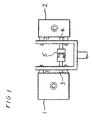
- a preferred driving mechanism comprises a three piece flexible coupling providing an aligned connection of the drive shafts of the first rotary gear positive displacement pump and the second rotary gear positive displacement pump.
- FIG. 1 is a sectional view of a form of connection, between pumps, illustrates such a driving mechanism.
- a first rotary gear positive displacement pump 1 and a second rotary gear positive displacement pump 2 are provided with shafts 3 and 4 which extend from their respective housings.
- An aligned connection of shafts is provided by a flexible three-piece coupling 5 including bodies connected on to the ends of the shafts with the spider connecting between the two bodies.
- the liquid silicon-containing material is fed through the first rotary gear positive displacement pump, preferably under positive pressure.
- positive pressure means the pressure at the inlet of the rotary gear positive displacement pump is greater than the pressure at the outlet of the rotary gear positive displacement pump.
- the positive pressure may be obtained by feeding the liquid silicon-containing material by conventional methods such as from a continuous compounder or extruder or using a gear pump or piston pump.
- the liquid silicon-containing material is fed through the first displacement pump under a positive pressure in the range of 0.0007 to 13.8 MPa and more preferably under a positive pressure in the range of 0.0007 to 4 MPa.
- the volume flow rate of the liquid silicon-containing material through the first displacement pump is not critical so long as the liquid silicon-containing material is moving through the first displacement pump at a rate which will cause the driving mechanism to rotate.
- the volume flow rate of the liquid silicon-containing material is from 24 to 15,000 liters/hour (l/hr) and more preferably from 37 to 7000 l/hr.
- the temperature at which the liquid silicon-containing material is fed through the first displacement pump is also not critical.
- the liquid silicon-containing material is fed to the first displacement pump at temperatures less than the boiling point of any of the components of the liquid silicon-containing material or 200°C. or less, whichever is lower, and more preferably at temperatures between 20 and 50°C.
- the liquid additive fed to the second rotary gear positive displacement pump is preferably contained in a reservoir which is connected to the second rotary gear positive displacement pump.
- the type of reservoir holding the liquid additive is not critical and any conventional holding devices can be used.
- the liquid additive is fed from the reservoir to the second rotary gear positive displacement pump by conventional methods such as a pump or other liquid feed system which preferably feeds the liquid additive to the second rotary gear positive displacement pump under positive pressure. More preferably, the liquid additive is fed to the second rotary gear positive displacement pump under a positive pressure less than 1.4 MPa and most preferably the liquid additive is fed to the second rotary gear positive displacement pump under a positive pressure no higher than 0.17 MPa.
- the liquid silicon-containing material flowing through the first rotary gear displacement pump causes the driving mechanism connecting the first rotary gear positive displacement pump to the second rotary gear positive displacement pump to rotate.
- the driving mechanism rotates it causes the second rotary gear positive displacement pump to pump a liquid additive at a volume flow rate proportionate to the volume flow rate of the liquid silicon-containing material through the first rotary gear positive displacement pump.
- the first rotary gear positive displacement pump may have the same or a different volume flow rate as the second rotary gear positive displacement pump depending on the volume of liquid additive it is desired to have metered into the liquid silicon-containing material.
- volume flow rate describes the volume of material that a rotary gear positive displacement pump can pump during a specific period of time.
- the first rotary gear positive displacement pump has a volume flow rate of 1 to 200 times the volume flow rate of the second rotary gear positive displacement pump with a volume flow rate of 1 to 60 times being more preferred.
- the volume flow rates of the liquid silicon-containing material and the liquid additive will be proportionate.
- the term "proportionate” means that other than normal variations which occur when operating equipment of this type, the ratio of the volume flow rate of the liquid silicon-containing material to the volume flow rate of the liquid additive should remain proportionate.
- the specific volumetric ratio of liquid silicon-containing material to liquid additive desired for a particular composition will determine the needed volume flow rates of each rotary gear positive displacement pump used.
- the volume flow rates of the rotary gear positive displacement pumps may be changed by conventional means, such as by using variable speed gear reducers or variable speed belt drives or by changing the pumps to others capable of providing different volume flow rates.
- the volume flow rates are changed by substituting rotary gear positive displacement pumps capable of providing the needed volume flow rates.
- the liquid additive which is metered into the liquid silicon-containing material by the present method may then be thoroughly mixed with the liquid silicon-containing material by any conventional means such as a static or dynamic mixer. Recovery of the mixed material is then accomplished by conventional means such as transferring into pails, drums, bulk containers or cartridges.
- an Energy Exchange Pump Assembly having a first rotary gear positive displacement pump (GS3310) connected to a second first rotary gear positive displacement pump (GM-1) purchased from Rotor-Tech, Inc., Houston, TX was used.
- the assembly had a calculated volumetric ratio of 49.6 to 1 (first rotary gear positive displacement pump to second rotary gear positive displacement pump).
- the relevant sealant was pumped out of a drum under positive pressure through the first rotary gear positive displacement pump using a 10:1 pneumatic piston pump.
- the amount of pressure at the inlet of the first rotary gear positive displacement pump and the discharge of the first rotary gear positive displacement pump were varied to simulate a wide range of potential run conditions, however a positive pressure was always maintained to overcome line losses and achieve maximum flow from the piston pump through the system.
- the relevant additive was supplied to the second rotary gear positive displacement pump using a 10:1 pneumatic piston pump under a positive pressure of 0.17 MPa.
- the temperature of both sealant and additive when fed through the assembly was 25°C.
Landscapes
- Chemical & Material Sciences (AREA)
- Chemical Kinetics & Catalysis (AREA)
- Engineering & Computer Science (AREA)
- Mechanical Engineering (AREA)
- General Engineering & Computer Science (AREA)
- General Physics & Mathematics (AREA)
- Physics & Mathematics (AREA)
- Automation & Control Theory (AREA)
- Rotary Pumps (AREA)
- Feeding, Discharge, Calcimining, Fusing, And Gas-Generation Devices (AREA)
- Accessories For Mixers (AREA)
- Processing And Handling Of Plastics And Other Materials For Molding In General (AREA)
- Measuring Volume Flow (AREA)
Applications Claiming Priority (2)
| Application Number | Priority Date | Filing Date | Title |
|---|---|---|---|
| US4950198A | 1998-03-27 | 1998-03-27 | |
| US49501 | 1998-03-27 |
Publications (2)
| Publication Number | Publication Date |
|---|---|
| EP0945171A2 true EP0945171A2 (de) | 1999-09-29 |
| EP0945171A3 EP0945171A3 (de) | 2001-03-28 |
Family
ID=21960159
Family Applications (1)
| Application Number | Title | Priority Date | Filing Date |
|---|---|---|---|
| EP99302325A Withdrawn EP0945171A3 (de) | 1998-03-27 | 1999-03-25 | Verfahren zum Dosieren einer flüssigen Zugabe in eine silikonhaltige Flüssigkeit |
Country Status (8)
| Country | Link |
|---|---|
| EP (1) | EP0945171A3 (de) |
| JP (1) | JPH11326005A (de) |
| KR (1) | KR19990082770A (de) |
| CN (1) | CN1233749A (de) |
| CA (1) | CA2266937A1 (de) |
| ID (1) | ID23632A (de) |
| SG (1) | SG76601A1 (de) |
| TW (1) | TW380219B (de) |
Cited By (7)
| Publication number | Priority date | Publication date | Assignee | Title |
|---|---|---|---|---|
| WO2002016097A3 (en) * | 2000-08-23 | 2002-05-02 | Gen Electric | Compounding heat cured rubber compositions |
| WO2004013386A3 (de) * | 2002-07-24 | 2005-05-26 | Saurer Gmbh & Co Kg | Vorrichtung und verfahren zum einspeisen einer flüssigen farbe in eine polymerschmelze |
| EP1570899A3 (de) * | 2004-03-05 | 2006-01-04 | Hans Georg Hagleitner | Verfahren und Vorrichtung zur Herstellung verdünnter Lösungen |
| EP1795988A1 (de) * | 2005-12-10 | 2007-06-13 | de Schrijver, Aster | Anordnung für verhältnisgesteuerte Ausgabe von Mehrkomponentenmaterialien |
| WO2008062486A1 (en) * | 2006-11-23 | 2008-05-29 | Hero Europe S.R.L. | Improved multi -pump delivering device for dye-meter |
| WO2022175937A1 (en) | 2021-02-17 | 2022-08-25 | Strauss Water Ltd | System for in-line enrichment of liquids |
| EP3861299B1 (de) * | 2018-10-05 | 2023-07-05 | Covestro Intellectual Property GmbH & Co. KG | Verfahren zum einstellen des volumetrischen durchflussverhältnisses von mindestens zwei verschiedenen fluiden |
Families Citing this family (1)
| Publication number | Priority date | Publication date | Assignee | Title |
|---|---|---|---|---|
| JP5225298B2 (ja) * | 2007-03-21 | 2013-07-03 | ディバーシー・インコーポレーテッド | 流体吐出装置及び流体吐出方法 |
Family Cites Families (6)
| Publication number | Priority date | Publication date | Assignee | Title |
|---|---|---|---|---|
| FR1383116A (fr) * | 1963-11-13 | 1964-12-24 | Perfectionnements à des dispositifs d'incorporation, notamment à ceux destinés àla confection d'aliments composés pour le bétail | |
| US4789100A (en) * | 1980-11-04 | 1988-12-06 | Adhesive Engineering Company | Multiple fluid pumping system |
| US4511378A (en) * | 1981-06-30 | 1985-04-16 | Greene George J | Liquid-gas contacting apparatus and pump therefor |
| GB2114905B (en) * | 1982-02-17 | 1986-04-09 | Roberts Richard Gwilym | Mixing water and fuel oil in proportions |
| US5198171A (en) * | 1988-10-11 | 1993-03-30 | Toshiba Silicone Co., Ltd. | Process for continuously producing heat-vulcanizable silicone rubber compound |
| AU4830496A (en) * | 1995-02-25 | 1996-09-18 | Koch Marmorit Gmbh | Method and device for producing and applying a two-component resin |
-
1999
- 1999-03-23 ID IDP990258D patent/ID23632A/id unknown
- 1999-03-24 CA CA002266937A patent/CA2266937A1/en not_active Abandoned
- 1999-03-25 SG SG1999001421A patent/SG76601A1/en unknown
- 1999-03-25 EP EP99302325A patent/EP0945171A3/de not_active Withdrawn
- 1999-03-25 TW TW088104734A patent/TW380219B/zh not_active IP Right Cessation
- 1999-03-26 JP JP11082766A patent/JPH11326005A/ja not_active Withdrawn
- 1999-03-26 KR KR1019990010429A patent/KR19990082770A/ko not_active Withdrawn
- 1999-03-26 CN CN99104385A patent/CN1233749A/zh active Pending
Cited By (10)
| Publication number | Priority date | Publication date | Assignee | Title |
|---|---|---|---|---|
| WO2002016097A3 (en) * | 2000-08-23 | 2002-05-02 | Gen Electric | Compounding heat cured rubber compositions |
| US6474971B1 (en) | 2000-08-23 | 2002-11-05 | General Electric Company | Compounding heat cured rubber compositions |
| WO2004013386A3 (de) * | 2002-07-24 | 2005-05-26 | Saurer Gmbh & Co Kg | Vorrichtung und verfahren zum einspeisen einer flüssigen farbe in eine polymerschmelze |
| US7278776B2 (en) | 2002-07-24 | 2007-10-09 | Saurer Gmbh & Co. Kg | Apparatus and method for injecting a liquid dye into a polymer melt |
| EP1570899A3 (de) * | 2004-03-05 | 2006-01-04 | Hans Georg Hagleitner | Verfahren und Vorrichtung zur Herstellung verdünnter Lösungen |
| EP1795988A1 (de) * | 2005-12-10 | 2007-06-13 | de Schrijver, Aster | Anordnung für verhältnisgesteuerte Ausgabe von Mehrkomponentenmaterialien |
| WO2007065724A3 (en) * | 2005-12-10 | 2007-10-04 | Schrijver Aster De | Method and arrangement for ratio-controlled dispensing of plural component materials |
| WO2008062486A1 (en) * | 2006-11-23 | 2008-05-29 | Hero Europe S.R.L. | Improved multi -pump delivering device for dye-meter |
| EP3861299B1 (de) * | 2018-10-05 | 2023-07-05 | Covestro Intellectual Property GmbH & Co. KG | Verfahren zum einstellen des volumetrischen durchflussverhältnisses von mindestens zwei verschiedenen fluiden |
| WO2022175937A1 (en) | 2021-02-17 | 2022-08-25 | Strauss Water Ltd | System for in-line enrichment of liquids |
Also Published As
| Publication number | Publication date |
|---|---|
| CA2266937A1 (en) | 1999-09-27 |
| KR19990082770A (ko) | 1999-11-25 |
| ID23632A (id) | 2000-05-04 |
| JPH11326005A (ja) | 1999-11-26 |
| EP0945171A3 (de) | 2001-03-28 |
| SG76601A1 (en) | 2000-11-21 |
| CN1233749A (zh) | 1999-11-03 |
| TW380219B (en) | 2000-01-21 |
Similar Documents
| Publication | Publication Date | Title |
|---|---|---|
| US4493286A (en) | Method and apparatus for applying a multi-component adhesive | |
| JP3575553B2 (ja) | ゴムの連続混合方法および装置 | |
| EP0945171A2 (de) | Verfahren zum Dosieren einer flüssigen Zugabe in eine silikonhaltige Flüssigkeit | |
| EP0909777B1 (de) | Verfahren zur kontinuierlichen Herstellung von Silikongummi-Zusammensetzungen | |
| JPH1029213A (ja) | 液状材料連続混合装置 | |
| JP4928555B2 (ja) | 液状着色材を混合するための装置及び方法、並びに液状着色材によってプラスチックを着色するための方法 | |
| RU2374273C2 (ru) | Способ приготовления наполненной композиции силиконового каучука | |
| WO2004108263A1 (en) | Apparatus for preparing liquid silicone elastomers of uniform composition and hue | |
| CN100519659C (zh) | 连续制造高粘度可交联聚硅氧烷组合物的方法 | |
| CN1658962A (zh) | 浆料混合的控制系统和方法 | |
| US8851328B2 (en) | Method for metering compounds based on organopolysiloxanes | |
| EP0614812B1 (de) | Mischdüse-Anordnung | |
| HK1019569A (en) | Method of metering a liquid additive into a liquid silicon-containing material | |
| CN110394106A (zh) | 一种绿色型水性涂料制备专用给料设备 | |
| EP0664192A1 (de) | Verfahren zum kontinuierlichem Mischen von zwei oder mehreren Materialien in nicht pulsierendem Mischen und Füllen von Speicherbehälter | |
| CN221207683U (zh) | 一种双组分涂料混合设备 | |
| CN100546792C (zh) | 高粘稠物料定量输送装置 | |
| JP2009507641A (ja) | 動的ならせん型攪拌素子および該らせん型攪拌素子を用いた攪拌器 | |
| CN212097018U (zh) | 一种用于生产硅树脂的捏合机 | |
| CN207463110U (zh) | 一种全自动微机配料生产线 | |
| CN119236741B (zh) | 一种硅铝合金冶炼的锭模涂料混合制备装置 | |
| CN207446101U (zh) | 一种液体低发泡陶瓷化硅胶生产用自带搅拌机构的反应釜 | |
| CN112354447A (zh) | 一种涂料生产原料定量配比装置 | |
| CN218462651U (zh) | 一种硅橡胶生产用捏合机均匀下料仓 | |
| CN222396851U (zh) | 一种防出料口堵塞的饼干喷浆机 |
Legal Events
| Date | Code | Title | Description |
|---|---|---|---|
| PUAI | Public reference made under article 153(3) epc to a published international application that has entered the european phase |
Free format text: ORIGINAL CODE: 0009012 |
|
| AK | Designated contracting states |
Kind code of ref document: A2 Designated state(s): DE ES FR GB IT NL |
|
| AX | Request for extension of the european patent |
Free format text: AL;LT;LV;MK;RO;SI |
|
| PUAL | Search report despatched |
Free format text: ORIGINAL CODE: 0009013 |
|
| AK | Designated contracting states |
Kind code of ref document: A3 Designated state(s): AT BE CH CY DE DK ES FI FR GB GR IE IT LI LU MC NL PT SE |
|
| AX | Request for extension of the european patent |
Free format text: AL;LT;LV;MK;RO;SI |
|
| RIC1 | Information provided on ipc code assigned before grant |
Free format text: 7B 01F 15/04 A, 7B 29B 7/60 B, 7B 29B 7/94 B, 7G 05D 11/02 B, 7B 29K 83:00 Z |
|
| AKX | Designation fees paid |
Free format text: DE ES FR GB IT NL |
|
| STAA | Information on the status of an ep patent application or granted ep patent |
Free format text: STATUS: THE APPLICATION IS DEEMED TO BE WITHDRAWN |
|
| 18D | Application deemed to be withdrawn |
Effective date: 20010929 |
|
| REG | Reference to a national code |
Ref country code: HK Ref legal event code: WD Ref document number: 1019569 Country of ref document: HK |