EP0945451B1 - Diarylnaphtopyranne photochrome avec au moins un reste aryle amino substitué - Google Patents
Diarylnaphtopyranne photochrome avec au moins un reste aryle amino substitué Download PDFInfo
- Publication number
- EP0945451B1 EP0945451B1 EP99106019A EP99106019A EP0945451B1 EP 0945451 B1 EP0945451 B1 EP 0945451B1 EP 99106019 A EP99106019 A EP 99106019A EP 99106019 A EP99106019 A EP 99106019A EP 0945451 B1 EP0945451 B1 EP 0945451B1
- Authority
- EP
- European Patent Office
- Prior art keywords
- group
- diaryl
- photochromic
- mono
- phenyl
- Prior art date
- Legal status (The legal status is an assumption and is not a legal conclusion. Google has not performed a legal analysis and makes no representation as to the accuracy of the status listed.)
- Expired - Lifetime
Links
- 0 *c(c(c(*)c1*)c2c(C=C3)c1OC3(C1=CC=CCC1)C1=CCC(CN3CCOCC3)C=C1)c(*)c(O*)c2O* Chemical compound *c(c(c(*)c1*)c2c(C=C3)c1OC3(C1=CC=CCC1)C1=CCC(CN3CCOCC3)C=C1)c(*)c(O*)c2O* 0.000 description 1
Classifications
-
- C—CHEMISTRY; METALLURGY
- C07—ORGANIC CHEMISTRY
- C07D—HETEROCYCLIC COMPOUNDS
- C07D407/00—Heterocyclic compounds containing two or more hetero rings, at least one ring having oxygen atoms as the only ring hetero atoms, not provided for by group C07D405/00
- C07D407/02—Heterocyclic compounds containing two or more hetero rings, at least one ring having oxygen atoms as the only ring hetero atoms, not provided for by group C07D405/00 containing two hetero rings
- C07D407/04—Heterocyclic compounds containing two or more hetero rings, at least one ring having oxygen atoms as the only ring hetero atoms, not provided for by group C07D405/00 containing two hetero rings directly linked by a ring-member-to-ring-member bond
-
- C—CHEMISTRY; METALLURGY
- C07—ORGANIC CHEMISTRY
- C07D—HETEROCYCLIC COMPOUNDS
- C07D311/00—Heterocyclic compounds containing six-membered rings having one oxygen atom as the only hetero atom, condensed with other rings
- C07D311/02—Heterocyclic compounds containing six-membered rings having one oxygen atom as the only hetero atom, condensed with other rings ortho- or peri-condensed with carbocyclic rings or ring systems
- C07D311/78—Ring systems having three or more relevant rings
- C07D311/92—Naphthopyrans; Hydrogenated naphthopyrans
-
- C—CHEMISTRY; METALLURGY
- C09—DYES; PAINTS; POLISHES; NATURAL RESINS; ADHESIVES; COMPOSITIONS NOT OTHERWISE PROVIDED FOR; APPLICATIONS OF MATERIALS NOT OTHERWISE PROVIDED FOR
- C09K—MATERIALS FOR MISCELLANEOUS APPLICATIONS, NOT PROVIDED FOR ELSEWHERE
- C09K9/00—Tenebrescent materials, i.e. materials for which the range of wavelengths for energy absorption is changed as a result of excitation by some form of energy
- C09K9/02—Organic tenebrescent materials
Definitions
- the invention relates to photochromic diaryl naphthopyrans with at least one amino-substituted Aryl. They are photochromic compounds in the o-position to the Oxygen atom of the pyran system one correspondingly substituted with an amino group Have phenyl or naphthyl.
- US Pat. No. 5,384,077 discloses compounds in which one of the two aryl radicals in the 3-position can be an oxygen-containing heterocycle.
- the carbocyclic aryl group may also be substituted with -NH 2 , mono- or di- (C 5 -C 7 ) alkylamino groups. According to the specified ⁇ max values, these are yellow-orange compounds.
- the amino substituents according to the invention are not mentioned.
- US Pat. No. 5,578,252 discloses 3H-naphtho [2,1-b] pyrans which have an oxygen-containing substituent (eg methoxy) in the 8-position and either an alkyl group in the 7-position or a carbonyl group in the 9-position (loc. cit., column 2, lines 19-25). These compounds are said to show colors reaching yellow to orange and red (loc. Cit., Column 9, lines 24-27).
- 2,2-diaryl-2H-naphtho [1,2-b] pyrans in particular are also among the listed classes of compounds of interest, as these compounds are known a distinct bathochrome compared to the analog 3,3-derivatives in the open state Exhibit displacement.
- the disadvantage is that these known compounds are usually unacceptably slow in their lightening, provided they not be substituted accordingly in the 5-position of the naphthopyran system.
- No. 5,651,923 also describes long-wave absorbing naphthopyran systems which are also formed by heterocyclic ring systems fused to the naphthalene rings.
- the aryl and heteroaryl groups possible in the 2-position can be amino, mono- and di- (C 1 -C 6 ) -alkylamino groups, morpholine, piperidine, 1-indolinyl, pyrrolidyl, 1-imidazolidyl, 2-imidazolin-1-yl Represent 2-pyrazolidyl, pyrazolinyl and 1-piperazinyl, and the abovementioned bicyclic N-containing systems 5-indolinyl and 6-THN which are bonded directly to the naphthopyran system are also described as substituents. These amines are not explained in the description.
- the present invention therefore has the task of new photochromic compounds to provide improved properties over those in the prior art Have structures described technology.
- the connections do not have a pronounced basic function, as experience has shown that both in the manufacture of photochromic plastic glasses using the mass coloring process easily add protons and color deviations result as also in long-term use under the influence of light to side reactions that tend to result in a loss of photochromic response.
- R 5 to R 10 are, independently of one another, identical or different and selected from the group Z defined above;
- R 5 to R 10 are, independently of one another, identical or different and selected from the group Z defined above, and X and X 'are both selected from one of groups (2) or (3) with the above-mentioned restriction.
- X and X ' selected from the same group, in particular X and X 'are the same.
- substituents described in the context of the invention include which are introduced into the compounds according to the invention, too the bathochromic groups known to those skilled in the art.
- substitutions such as the introduction of a methoxy group act in the 8-position of the naphthopyran system on the naphthalene backbone additive.
- the present invention also relates to the photochromic 2,2-diphenyl-2H-naphtho [1,2-b] pyrans with the following chemical structural formula (III): and the photochromic 3,3-diphenyl-3H-naphtho [2,1-b] pyrans with the following chemical structural formulas (IV) or (V): in which R 5 to R 10 are selected from the group Z defined above and Y is selected from the group of halogens F, Cl and Br.
- the 2,2-diaryl-2H-naphtho [1,2-b] pyrans and 3,3-diaryl-3H-naphtho [2,1-b] pyranes substituted according to the invention show in a light-excited form compared to comparable known compounds a bathochromically shifted long wave Absorption in the visible part of the spectrum. This surprising shift occurs in the same way in both the 2H and 3H naphthopyran systems mentioned on.
- the compounds according to the invention are not special have a basic function in the molecule, as substituents either cyclic amino groups such as carbazole, morpholine, pyrrole, pyrazole, imidazole and the like are particularly preferred, or amino groups less or none at all Basicity, such as substituted or unsubstituted diphenylamine. Most notably Compounds of the structural formulas (III) to (V) with the abovementioned are preferred Substituents.
- the naphthopyran systems of the present invention show overall good photochromic response to darkening and brightening. It is completely surprising that these compounds absorb even longer waves in the excited state than compounds with a basic amine function such as dimethylamine. Also surprising is the unexpected visual impression that the connections according to the invention produce. Because of the absorption which extends far into the yellow spectral range, the compounds of the present invention show a pink to violet coloration despite the nominally low ⁇ max value. This is in no way predictable and is an unusual out-of-order property for such connections.
- the non-basic amino substituents preferred according to the invention are shown in particularly advantageous in the production of photochromic plastic glasses usable. Traces of acid that occur during the hydrolysis of the casting resin, do not attack these amino compounds and do not cause any disruptive effects Side reactions, which would result in the loss of the photochromic reaction.
- the 2H and 3H naphthopyran compounds according to the invention also have a much better life compared to that from the Basic amino compounds known in the art.
- the photochromic naphthopyrans according to the invention can generally be found in plastics all types of use, especially for ophthalmic purposes.
- the areas of application are extremely diverse and range from lenses, Protective glasses, visors of protective helmets, windows, glasses up to Protective covers, covers, roofs or the like.
- the basic structure G in diglyme solution has a long-wave absorption just below 420 nm. If the second (unsubstituted) phenyl ring is substituted with an electron-donating group, such as a methoxy group, ⁇ max shifts to 455 nm. An even stronger electron donor such as morpholine even shifts ⁇ max to 508 nm. Generally, one skilled in the art would expect that a less electron-donating group such as diphenylamine would hypsochromically shift the long-wave absorption to shorter wavelengths. However, the opposite effect is observed, namely a further bathochromic shift to 515 nm.
- Step iii) provides 3- (2-fluorophenyl) -3- [4- (N-morpholinyl) phenyl] -3H-naphtho [2,1-b] pyran (3.1g) as a colorless powder, which was identified by means of the NMR spectrum.
- Step i) is carried out according to B. Staskun, J. Org. Chem. 1968, p. 3031.
- 1- (4-diphenylaminophenyl) -1-phenyl-1-propinol is formed (19.8 g), which is analogous to step iii) with 1-naphthol instead of 2-naphthol is implemented.
- the light violet solid was identified by means of NMR spectrum as 2- (diphenylaminophenyl) -2-phenyl-2H-naphtho [9,2-b] pyran (2.3 g) identified.
Landscapes
- Chemical & Material Sciences (AREA)
- Organic Chemistry (AREA)
- Engineering & Computer Science (AREA)
- Materials Engineering (AREA)
- Non-Silver Salt Photosensitive Materials And Non-Silver Salt Photography (AREA)
- Eyeglasses (AREA)
- Optical Filters (AREA)
Claims (12)
- Diaryl-naphtopyranes photochromes avec les formules générales de structure chimiques (I) ou (II) suivantes :
 dans lesquels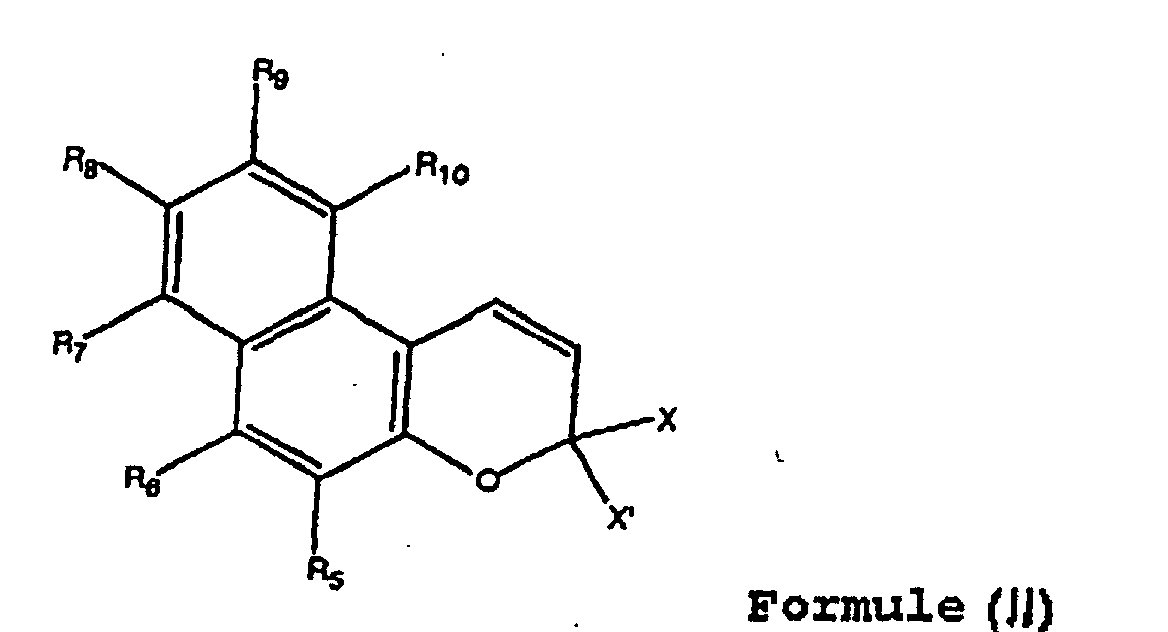
R5 à R10 sont indépendamment l'un de l'autre identiques ou différents et sont choisis dans le groupe Z constitué de H, OH, alkyle en C1 à C10, alcoxy en C1 à C6, cycloalkyle en C5 à C7, phényle, benzyle, allyle, alcoxy en C1 à C6-alkyle en C1 à C4, phényle substitué par un mono- ou di-alkyle en C1 à C6, furyle, thiényle, phényle substitué par un mono- ou di-alcoxy en C1 à C6, haloalkyle en C1 à C6 et halogène, l'halogène étant F, Cl ou Br et R5 n'étant pas un hydrogène ;
X et X' sont indépendamment l'un de l'autre identiques ou différents et sont choisis dans l'un des groupes suivants :et X ou X' sont choisis dans l'un des groupes (2) ou (3) définis ci-dessus, sous réserve que dans les composés de formule développée (I) les substituants aminocycliques morpholine, pipéridine, 1-indolinyle, pyrrolidyle, 1-imidazolidyle, 2-imidazolin-1-yle, 2-pyrazolidyle, pyrazolinyle et 1-pipérazinyle du groupe (2) sont exclus.Groupe (1) : groupes aryle, phényle ou naphtyle non substitués, mono-, di- ou trisubstitués, où les substituants aryles sont choisis dans le groupe Z ;Groupe (2) : groupes aryle, phényle ou naphtyle, mono-, di- ou trisubstitués, où au moins un substituant est choisi dans le groupe A constitué des substituants amino cycliques, comme la morpholine, la pipéridine, la pyridine, le pyrrole, la pyrazole, la pyrazolinidine, le pipérazole, l'indoline, l'imidazole, la phénothiazine, la phénoxazine, la phénazine, l'acridine, le carbazole, qui sont non substitués, mono-, di- ou trisubstitués et le ou les substituants étant choisis dans le groupe Z, et d'autres substituants étant choisis dans le groupe Z ; ouGroupe (3) : groupes aryle, phényle ou naphtyle, mono-, di- ou trisubstitué, où au moins un des substituants est choisi dans le groupe A' constitué de l'aminodiphényle, dans lequel un ou deux noyaux phényle. sont indépendamment l'un de l'autre non substitués, mono-, di- ou trisubstitués, et les substituants sont choisis dans le groupe Z, - Diaryl-naphtopyranes photochromes avec les formules générales de structure chimiques (I) ou (II) selon la revendication 1, dans lesquelles
R5 à R1 0 sont indépendamment l'un de l'autre identiques ou différents et sont choisis dans le groupe Z défini dans la revendication 1,
X et X' sont choisis dans le groupe constitué par le groupe aryle, phényle ou naphtyle non substitué, mono-, di- ou trisubstitué, où les substituants aryle sont choisis dans le groupe constitué de OH, alkyle en C1 à C10, alcoxy en C1 à C6 et halogène, et le X ou X' restant est choisi dans le groupe (2) ou (3) avec la limitation de la revendication 1. - Diaryl-naphtyl pyranes photochromes avec les formules générales de strucutre chimiques (I) ou (II) selon la revendication 1, dans lesquelles
R5 à R10 sont indépendamment l'un de l'autre identiques ou différents et sont choisis dans le groupe Z défini dans la revendication 1,
et X et X' sont tous deux choisis dans l'un des groupes (2) ou (3) avec la limitation de la revendication 1. - Diaryl-naphtopyranes photochromes selon la revendication 3, dans lesquels X et X' sont choisis dans le même groupe.
- Diaryl-naphtopyranes photochromes selon la revendication 4, dans lesquels X et X' sont identiques.
- Diaryl-naphtopyranes photochromes selon l'une des revendication 1 à 5, caractérisés en ce qu'un groupe méthoxy est présent en position 8 du noyau naphtopyrane.
- 2,2-diphényl-2H-naphto[1,2-b]-pyranes photochromes avec la formule chimique de structure (III) suivante :dans laquelle

R5 à R10 sont choisis dans le groupe Z défini dans la revendication 1 et
Y est choisi dans le groupe des halogènes F, Cl et Br. - Diaryl-naphtopyranes photochromes selon la revendication 7, dans lesquels le substituant diphényle dans la formule de structure chimique (III) est mono-, di- ou trisubstitué sur au moins un noyau phényle et le ou les substituants sont choisis dans le groupe Z défini dans la revendication 1.
- 3,3-diphényl-3H-naphto[2,1-d]pyranes photochromes avec les formules de structure chimiques (IV) ou (V) suivantes :
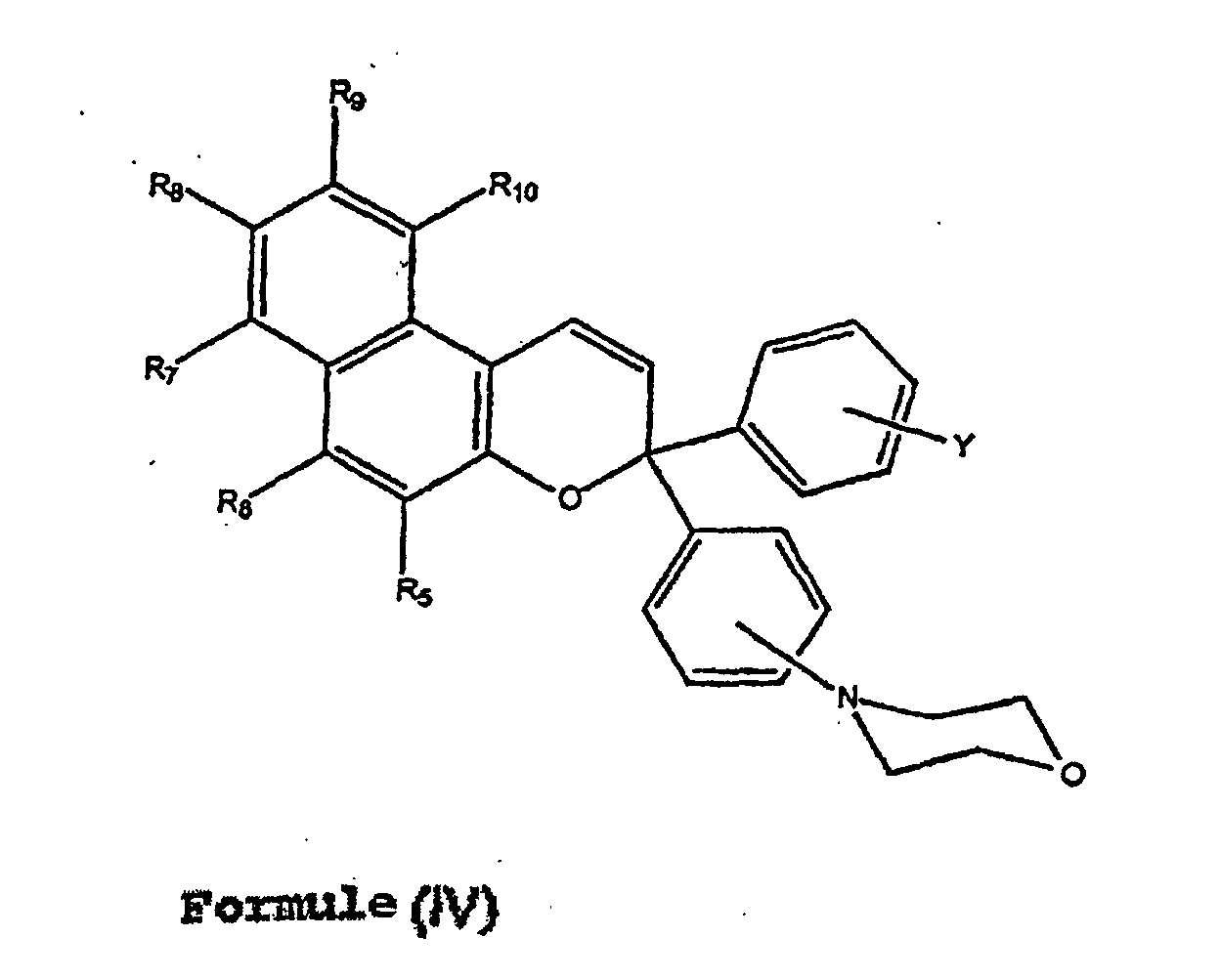 dans lesquelles R5 à R10 sont choisis dans le groupe Z défini dans la revendication 1 et
Y est choisi dans le groupe des halogènes, F, Cl et Br. - Diarylnaphtopyranes photochromes selon la revendication 9, dans lesquels le substituant aminodiphényle dans la formule de structure chimique (V) est mono-, di- ou trisubstitué sur au moins un noyau phényle et le ou les substituants sont choisis dans le groupe Z défini dans la revendication 1.
- Utilisation d'un ou plusieurs des 2,2-diaryl-2H- et/ou 3,3-diaryl-3H-naphtopyranes photochromes selon l'une des revendications 1 à 10 dans des matières synthétiques de tous types, en particulier dans des buts ophtalmiques.
- Utilisation d'un ou plusieurs des 2,2-diaryl-2H- et/ou 3,3-diaryl-3H-naphtopyranes photochromes selon l'une des revendications 1 à 10 dans des objets en matière synthétique, en particulier des lentilles, des verres protecteurs, des visières de casques protecteurs, des fenêtres, des verres de lunettes, des pare-brises, des revêtements, des toits ou analogues.
Applications Claiming Priority (2)
| Application Number | Priority Date | Filing Date | Title |
|---|---|---|---|
| DE19820781 | 1998-03-25 | ||
| DE19820781 | 1998-03-25 |
Publications (2)
| Publication Number | Publication Date |
|---|---|
| EP0945451A1 EP0945451A1 (fr) | 1999-09-29 |
| EP0945451B1 true EP0945451B1 (fr) | 2002-12-18 |
Family
ID=7867210
Family Applications (1)
| Application Number | Title | Priority Date | Filing Date |
|---|---|---|---|
| EP99106019A Expired - Lifetime EP0945451B1 (fr) | 1998-03-25 | 1999-03-25 | Diarylnaphtopyranne photochrome avec au moins un reste aryle amino substitué |
Country Status (2)
| Country | Link |
|---|---|
| EP (1) | EP0945451B1 (fr) |
| DE (2) | DE19913687A1 (fr) |
Families Citing this family (4)
| Publication number | Priority date | Publication date | Assignee | Title |
|---|---|---|---|---|
| GB9706939D0 (en) * | 1997-04-04 | 1997-05-21 | James Robinson Ltd | Red colouring hyperchromic 3H-naptho[2,1-6]pyrans |
| FR2800738B1 (fr) | 1999-11-04 | 2002-02-08 | Corning Sa | Naphtopyranes ayant un substituant perfluoroalkyle en position 5, preparation et compositions et matrices (co)polymeres les renfermant |
| EP1461330B1 (fr) * | 2002-01-03 | 2008-03-12 | Rodenstock GmbH | DERIVES DE 3H-NAPHTHO[2,1-b]-PYRANNE ET LEUR UTILISATION |
| JP2007505842A (ja) | 2003-09-18 | 2007-03-15 | ローデンストック.ゲゼルシャフト.ミット.ベシュレンクテル.ハフツング | 置換されたフェナントロピラン |
Family Cites Families (6)
| Publication number | Priority date | Publication date | Assignee | Title |
|---|---|---|---|---|
| GB8614680D0 (en) * | 1986-06-17 | 1986-07-23 | Plessey Co Plc | Photoreactive lenses |
| US5238981A (en) * | 1992-02-24 | 1993-08-24 | Transitions Optical, Inc. | Photochromic naphthopyrans |
| US5658500A (en) * | 1995-06-14 | 1997-08-19 | Transitions Optical, Inc. | Substituted naphthopyrans |
| JPH09124645A (ja) * | 1995-11-02 | 1997-05-13 | Tokuyama Corp | クロメン化合物 |
| US5940863A (en) * | 1996-07-26 | 1999-08-17 | Zenith Electronics Corporation | Apparatus for de-rotating and de-interleaving data including plural memory devices and plural modulo memory address generators |
| GB9706939D0 (en) * | 1997-04-04 | 1997-05-21 | James Robinson Ltd | Red colouring hyperchromic 3H-naptho[2,1-6]pyrans |
-
1999
- 1999-03-25 DE DE19913687A patent/DE19913687A1/de not_active Ceased
- 1999-03-25 DE DE59903800T patent/DE59903800D1/de not_active Expired - Fee Related
- 1999-03-25 EP EP99106019A patent/EP0945451B1/fr not_active Expired - Lifetime
Also Published As
| Publication number | Publication date |
|---|---|
| DE59903800D1 (de) | 2003-01-30 |
| DE19913687A1 (de) | 1999-12-02 |
| EP0945451A1 (fr) | 1999-09-29 |
Similar Documents
| Publication | Publication Date | Title |
|---|---|---|
| EP0958288B1 (fr) | Colorants de naphtopyrane photochromiques, leur procede de production, leur utilisation, ainsi qu'objet photochromique | |
| DE69806367T2 (de) | Rot färbende hyperchromische 3h-naphto(2,1-b)pyranen | |
| EP0987260B1 (fr) | Spirofluorénopyrannes photochromes | |
| EP0521823B1 (fr) | Phénylthiophényl-cétones | |
| DE3781454T2 (de) | Fotochrome spiropyran-verbindungen. | |
| DE3787932T2 (de) | Fotoreactive Linsen. | |
| EP1194424B1 (fr) | Derives de pyrane photochromiques | |
| EP1005464B1 (fr) | Naphtopyranes photochromes | |
| DE69126284T2 (de) | Photochrome Indolinospirobenzoxazine und Verfahren zu ihrer Herstellung | |
| EP1144416A1 (fr) | Derives indenochromes heterocycliquement anneles | |
| EP1109802A1 (fr) | Spirofluorenepyrannes | |
| DE1597586A1 (de) | Photographische Halogensilberemulsion | |
| EP0945451A1 (fr) | Diarylnaphtopyranne photochrome avec au moins un reste aryle amino substitué | |
| DE19902771A1 (de) | Photochrome Spirofluorenopyrane | |
| EP1485369B1 (fr) | Derives bleus de 3h-naphtho 2,1-b -pyranne et utilisation de ces derives | |
| EP1235823A1 (fr) | Benzo f]chromenes h anneles | |
| EP0686685A2 (fr) | Colorant photochromique | |
| EP1805278B1 (fr) | Derives photochromes de benzo(f)chromenes h-anneles | |
| EP2872517B1 (fr) | Fluorénopyranes photochromes présentant une annellation dibenzo[b,d]-pyrano définie | |
| EP2788340B1 (fr) | Naphtopyranes bi-indéno-annelés photochromes | |
| EP0212373B1 (fr) | Composés photoréactifs | |
| DE2910668C2 (de) | Lichtempfindliches Aufzeichnungsmaterial und Verwendung von 9,10-Diphenylanthracenderivaten | |
| EP2115533B1 (fr) | Photochromes de benzo(f)chromènes h-annelés | |
| DE3521432A1 (de) | Verfahren zur herstellung von (1,8a)-dihydroindolizinen, dadurch herstellbare neue photochrome verbindungen und deren verwendung | |
| DE69011556T2 (de) | Methode zur Herstellung von photochromem Material. |
Legal Events
| Date | Code | Title | Description |
|---|---|---|---|
| PUAI | Public reference made under article 153(3) epc to a published international application that has entered the european phase |
Free format text: ORIGINAL CODE: 0009012 |
|
| AK | Designated contracting states |
Kind code of ref document: A1 Designated state(s): DE FR GB IT |
|
| AX | Request for extension of the european patent |
Free format text: AL;LT;LV;MK;RO;SI |
|
| 17P | Request for examination filed |
Effective date: 20000221 |
|
| AKX | Designation fees paid |
Free format text: DE FR GB IT |
|
| 17Q | First examination report despatched |
Effective date: 20000918 |
|
| GRAG | Despatch of communication of intention to grant |
Free format text: ORIGINAL CODE: EPIDOS AGRA |
|
| GRAG | Despatch of communication of intention to grant |
Free format text: ORIGINAL CODE: EPIDOS AGRA |
|
| GRAH | Despatch of communication of intention to grant a patent |
Free format text: ORIGINAL CODE: EPIDOS IGRA |
|
| GRAH | Despatch of communication of intention to grant a patent |
Free format text: ORIGINAL CODE: EPIDOS IGRA |
|
| GRAA | (expected) grant |
Free format text: ORIGINAL CODE: 0009210 |
|
| AK | Designated contracting states |
Kind code of ref document: B1 Designated state(s): DE FR GB IT |
|
| REG | Reference to a national code |
Ref country code: GB Ref legal event code: FG4D Free format text: NOT ENGLISH |
|
| REF | Corresponds to: |
Ref document number: 59903800 Country of ref document: DE Date of ref document: 20030130 Kind code of ref document: P Ref document number: 59903800 Country of ref document: DE Date of ref document: 20030130 |
|
| ET | Fr: translation filed | ||
| GBT | Gb: translation of ep patent filed (gb section 77(6)(a)/1977) |
Effective date: 20030329 |
|
| REG | Reference to a national code |
Ref country code: GB Ref legal event code: 732E |
|
| PLBE | No opposition filed within time limit |
Free format text: ORIGINAL CODE: 0009261 |
|
| STAA | Information on the status of an ep patent application or granted ep patent |
Free format text: STATUS: NO OPPOSITION FILED WITHIN TIME LIMIT |
|
| 26N | No opposition filed |
Effective date: 20030919 |
|
| REG | Reference to a national code |
Ref country code: FR Ref legal event code: TP |
|
| REG | Reference to a national code |
Ref country code: FR Ref legal event code: TP |
|
| REG | Reference to a national code |
Ref country code: GB Ref legal event code: 732E |
|
| REG | Reference to a national code |
Ref country code: GB Ref legal event code: 732E |
|
| REG | Reference to a national code |
Ref country code: FR Ref legal event code: TP Ref country code: FR Ref legal event code: CD |
|
| PGFP | Annual fee paid to national office [announced via postgrant information from national office to epo] |
Ref country code: GB Payment date: 20090325 Year of fee payment: 11 |
|
| PGFP | Annual fee paid to national office [announced via postgrant information from national office to epo] |
Ref country code: IT Payment date: 20090330 Year of fee payment: 11 Ref country code: DE Payment date: 20090202 Year of fee payment: 11 |
|
| PGFP | Annual fee paid to national office [announced via postgrant information from national office to epo] |
Ref country code: FR Payment date: 20090313 Year of fee payment: 11 |
|
| GBPC | Gb: european patent ceased through non-payment of renewal fee |
Effective date: 20100325 |
|
| REG | Reference to a national code |
Ref country code: FR Ref legal event code: ST Effective date: 20101130 |
|
| PG25 | Lapsed in a contracting state [announced via postgrant information from national office to epo] |
Ref country code: FR Free format text: LAPSE BECAUSE OF NON-PAYMENT OF DUE FEES Effective date: 20100331 |
|
| PG25 | Lapsed in a contracting state [announced via postgrant information from national office to epo] |
Ref country code: DE Free format text: LAPSE BECAUSE OF NON-PAYMENT OF DUE FEES Effective date: 20101001 |
|
| PG25 | Lapsed in a contracting state [announced via postgrant information from national office to epo] |
Ref country code: GB Free format text: LAPSE BECAUSE OF NON-PAYMENT OF DUE FEES Effective date: 20100325 Ref country code: IT Free format text: LAPSE BECAUSE OF NON-PAYMENT OF DUE FEES Effective date: 20100325 |