EP0945482B1 - Kautschukmischung für Laufflächen und ihre Verwendung in Luftreifen - Google Patents
Kautschukmischung für Laufflächen und ihre Verwendung in Luftreifen Download PDFInfo
- Publication number
- EP0945482B1 EP0945482B1 EP99302296A EP99302296A EP0945482B1 EP 0945482 B1 EP0945482 B1 EP 0945482B1 EP 99302296 A EP99302296 A EP 99302296A EP 99302296 A EP99302296 A EP 99302296A EP 0945482 B1 EP0945482 B1 EP 0945482B1
- Authority
- EP
- European Patent Office
- Prior art keywords
- weight
- rubber
- parts
- group
- carbon atoms
- Prior art date
- Legal status (The legal status is an assumption and is not a legal conclusion. Google has not performed a legal analysis and makes no representation as to the accuracy of the status listed.)
- Expired - Lifetime
Links
- 229920001971 elastomer Polymers 0.000 title claims description 117
- 239000005060 rubber Substances 0.000 title claims description 117
- 239000000203 mixture Substances 0.000 title claims description 83
- VYPSYNLAJGMNEJ-UHFFFAOYSA-N Silicium dioxide Chemical compound O=[Si]=O VYPSYNLAJGMNEJ-UHFFFAOYSA-N 0.000 claims description 46
- 238000004073 vulcanization Methods 0.000 claims description 46
- 125000004432 carbon atom Chemical group C* 0.000 claims description 41
- -1 dithiophosphoric acid compound Chemical class 0.000 claims description 31
- 239000000843 powder Substances 0.000 claims description 29
- 239000000377 silicon dioxide Substances 0.000 claims description 27
- BWGNESOTFCXPMA-UHFFFAOYSA-N Dihydrogen disulfide Chemical compound SS BWGNESOTFCXPMA-UHFFFAOYSA-N 0.000 claims description 24
- 125000004429 atom Chemical group 0.000 claims description 24
- 229910052760 oxygen Inorganic materials 0.000 claims description 23
- 125000000217 alkyl group Chemical group 0.000 claims description 21
- WNROFYMDJYEPJX-UHFFFAOYSA-K aluminium hydroxide Chemical compound [OH-].[OH-].[OH-].[Al+3] WNROFYMDJYEPJX-UHFFFAOYSA-K 0.000 claims description 20
- 229910021502 aluminium hydroxide Inorganic materials 0.000 claims description 20
- 239000006229 carbon black Substances 0.000 claims description 19
- PPBRXRYQALVLMV-UHFFFAOYSA-N Styrene Chemical compound C=CC1=CC=CC=C1 PPBRXRYQALVLMV-UHFFFAOYSA-N 0.000 claims description 18
- 229920003048 styrene butadiene rubber Polymers 0.000 claims description 18
- IOJUPLGTWVMSFF-UHFFFAOYSA-N cyclobenzothiazole Natural products C1=CC=C2SC=NC2=C1 IOJUPLGTWVMSFF-UHFFFAOYSA-N 0.000 claims description 17
- 125000004435 hydrogen atom Chemical group [H]* 0.000 claims description 17
- 239000007822 coupling agent Substances 0.000 claims description 11
- 125000003118 aryl group Chemical group 0.000 claims description 9
- 229910052751 metal Inorganic materials 0.000 claims description 9
- 239000002184 metal Substances 0.000 claims description 9
- 229920003051 synthetic elastomer Polymers 0.000 claims description 9
- 125000000753 cycloalkyl group Chemical group 0.000 claims description 8
- 150000001993 dienes Chemical class 0.000 claims description 8
- NAGJZTKCGNOGPW-UHFFFAOYSA-N dithiophosphoric acid Chemical compound OP(O)(S)=S NAGJZTKCGNOGPW-UHFFFAOYSA-N 0.000 claims description 8
- 150000003839 salts Chemical class 0.000 claims description 8
- 239000005061 synthetic rubber Substances 0.000 claims description 8
- 229910052725 zinc Inorganic materials 0.000 claims description 8
- 125000003342 alkenyl group Chemical group 0.000 claims description 6
- 125000003277 amino group Chemical group 0.000 claims description 6
- 125000000113 cyclohexyl group Chemical group [H]C1([H])C([H])([H])C([H])([H])C([H])(*)C([H])([H])C1([H])[H] 0.000 claims description 6
- 239000002245 particle Substances 0.000 claims description 6
- 244000043261 Hevea brasiliensis Species 0.000 claims description 5
- BLRPTPMANUNPDV-UHFFFAOYSA-N Silane Chemical compound [SiH4] BLRPTPMANUNPDV-UHFFFAOYSA-N 0.000 claims description 5
- 229910052787 antimony Inorganic materials 0.000 claims description 5
- 229920003052 natural elastomer Polymers 0.000 claims description 5
- 229920001194 natural rubber Polymers 0.000 claims description 5
- 229910000077 silane Inorganic materials 0.000 claims description 5
- 150000001875 compounds Chemical class 0.000 claims description 4
- 229910052802 copper Chemical group 0.000 claims description 4
- 230000000052 comparative effect Effects 0.000 description 18
- 230000003014 reinforcing effect Effects 0.000 description 15
- UCKMPCXJQFINFW-UHFFFAOYSA-N Sulphide Chemical compound [S-2] UCKMPCXJQFINFW-UHFFFAOYSA-N 0.000 description 14
- 239000000446 fuel Substances 0.000 description 13
- 150000001879 copper Chemical class 0.000 description 12
- 238000002156 mixing Methods 0.000 description 12
- 238000012360 testing method Methods 0.000 description 12
- 150000003751 zinc Chemical class 0.000 description 12
- 238000000034 method Methods 0.000 description 11
- DOIRQSBPFJWKBE-UHFFFAOYSA-N dibutyl phthalate Chemical compound CCCCOC(=O)C1=CC=CC=C1C(=O)OCCCC DOIRQSBPFJWKBE-UHFFFAOYSA-N 0.000 description 8
- 238000005096 rolling process Methods 0.000 description 8
- 239000004636 vulcanized rubber Substances 0.000 description 8
- 230000003245 working effect Effects 0.000 description 8
- 239000002174 Styrene-butadiene Substances 0.000 description 7
- 230000000694 effects Effects 0.000 description 7
- 238000011156 evaluation Methods 0.000 description 7
- 230000002349 favourable effect Effects 0.000 description 7
- 125000003545 alkoxy group Chemical group 0.000 description 6
- 230000002542 deteriorative effect Effects 0.000 description 6
- 230000000704 physical effect Effects 0.000 description 5
- 239000011701 zinc Substances 0.000 description 5
- IJGRMHOSHXDMSA-UHFFFAOYSA-N Atomic nitrogen Chemical compound N#N IJGRMHOSHXDMSA-UHFFFAOYSA-N 0.000 description 4
- OKTJSMMVPCPJKN-UHFFFAOYSA-N Carbon Chemical compound [C] OKTJSMMVPCPJKN-UHFFFAOYSA-N 0.000 description 4
- XLOMVQKBTHCTTD-UHFFFAOYSA-N Zinc monoxide Chemical compound [Zn]=O XLOMVQKBTHCTTD-UHFFFAOYSA-N 0.000 description 4
- 230000007423 decrease Effects 0.000 description 4
- 230000008569 process Effects 0.000 description 4
- 125000000999 tert-butyl group Chemical group [H]C([H])([H])C(*)(C([H])([H])[H])C([H])([H])[H] 0.000 description 4
- CJKAKWRPJJOEBS-UHFFFAOYSA-N 4-butoxy-3h-1,3-benzothiazole-2-thione Chemical compound CCCCOC1=CC=CC2=C1NC(=S)S2 CJKAKWRPJJOEBS-UHFFFAOYSA-N 0.000 description 3
- IWGFUVJLHFWGNC-UHFFFAOYSA-N 4-ethoxy-3h-1,3-benzothiazole-2-thione Chemical compound CCOC1=CC=CC2=C1NC(=S)S2 IWGFUVJLHFWGNC-UHFFFAOYSA-N 0.000 description 3
- JAZHYBLNLKNZHA-UHFFFAOYSA-N 4-methoxy-3h-1,3-benzothiazole-2-thione Chemical compound COC1=CC=CC2=C1N=C(S)S2 JAZHYBLNLKNZHA-UHFFFAOYSA-N 0.000 description 3
- NTJHCCFSQPRTPC-UHFFFAOYSA-N 5-butoxy-3h-1,3-benzothiazole-2-thione Chemical compound CCCCOC1=CC=C2SC(=S)NC2=C1 NTJHCCFSQPRTPC-UHFFFAOYSA-N 0.000 description 3
- BOMGEAFCXXOLPG-UHFFFAOYSA-N 5-ethoxy-3h-1,3-benzothiazole-2-thione Chemical compound CCOC1=CC=C2SC(S)=NC2=C1 BOMGEAFCXXOLPG-UHFFFAOYSA-N 0.000 description 3
- JDPITNFDYXOKRM-UHFFFAOYSA-N 5-methoxy-3h-1,3-benzothiazole-2-thione Chemical compound COC1=CC=C2SC(=S)NC2=C1 JDPITNFDYXOKRM-UHFFFAOYSA-N 0.000 description 3
- HBJXSYPFDGAADD-UHFFFAOYSA-N 6-butoxy-3h-1,3-benzothiazole-2-thione Chemical compound CCCCOC1=CC=C2NC(=S)SC2=C1 HBJXSYPFDGAADD-UHFFFAOYSA-N 0.000 description 3
- HOASVNMVYBSLSU-UHFFFAOYSA-N 6-ethoxy-3h-1,3-benzothiazole-2-thione Chemical compound CCOC1=CC=C2N=C(S)SC2=C1 HOASVNMVYBSLSU-UHFFFAOYSA-N 0.000 description 3
- WBKYNVBTKLKJBG-UHFFFAOYSA-N 6-methoxy-3h-1,3-benzothiazole-2-thione Chemical compound COC1=CC=C2N=C(S)SC2=C1 WBKYNVBTKLKJBG-UHFFFAOYSA-N 0.000 description 3
- IALFBSOCWGPHDI-UHFFFAOYSA-N 7-butoxy-3h-1,3-benzothiazole-2-thione Chemical compound CCCCOC1=CC=CC2=C1SC(=S)N2 IALFBSOCWGPHDI-UHFFFAOYSA-N 0.000 description 3
- DRJXMMJEDPRNJY-UHFFFAOYSA-N 7-ethoxy-3h-1,3-benzothiazole-2-thione Chemical compound CCOC1=CC=CC2=C1SC(S)=N2 DRJXMMJEDPRNJY-UHFFFAOYSA-N 0.000 description 3
- FIDWAAQFVRHGAU-UHFFFAOYSA-N 7-methoxy-3h-1,3-benzothiazole-2-thione Chemical compound COC1=CC=CC2=C1SC(S)=N2 FIDWAAQFVRHGAU-UHFFFAOYSA-N 0.000 description 3
- 239000013043 chemical agent Substances 0.000 description 3
- 239000010949 copper Chemical group 0.000 description 3
- AFZSMODLJJCVPP-UHFFFAOYSA-N dibenzothiazol-2-yl disulfide Chemical compound C1=CC=C2SC(SSC=3SC4=CC=CC=C4N=3)=NC2=C1 AFZSMODLJJCVPP-UHFFFAOYSA-N 0.000 description 3
- 230000002708 enhancing effect Effects 0.000 description 3
- 239000000945 filler Substances 0.000 description 3
- 239000012763 reinforcing filler Substances 0.000 description 3
- ZNRLMGFXSPUZNR-UHFFFAOYSA-N 2,2,4-trimethyl-1h-quinoline Chemical compound C1=CC=C2C(C)=CC(C)(C)NC2=C1 ZNRLMGFXSPUZNR-UHFFFAOYSA-N 0.000 description 2
- JACGKHGTBZGVMW-UHFFFAOYSA-N 4-methyl-3h-1,3-benzothiazole-2-thione Chemical compound CC1=CC=CC2=C1N=C(S)S2 JACGKHGTBZGVMW-UHFFFAOYSA-N 0.000 description 2
- ILDUPWKUQLPLKK-UHFFFAOYSA-N 5-methyl-3h-1,3-benzothiazole-2-thione Chemical compound CC1=CC=C2SC(S)=NC2=C1 ILDUPWKUQLPLKK-UHFFFAOYSA-N 0.000 description 2
- CZGGKXNYNPJFAX-UHFFFAOYSA-N Dimethyldithiophosphate Chemical compound COP(S)(=S)OC CZGGKXNYNPJFAX-UHFFFAOYSA-N 0.000 description 2
- 229920000459 Nitrile rubber Polymers 0.000 description 2
- 235000021355 Stearic acid Nutrition 0.000 description 2
- OYTQVJGORRKHTG-UHFFFAOYSA-K antimony(3+);di(propan-2-yloxy)-sulfanylidene-sulfido-$l^{5}-phosphane Chemical compound [Sb+3].CC(C)OP([S-])(=S)OC(C)C.CC(C)OP([S-])(=S)OC(C)C.CC(C)OP([S-])(=S)OC(C)C OYTQVJGORRKHTG-UHFFFAOYSA-K 0.000 description 2
- FAGBSIUCVJPTKG-UHFFFAOYSA-K antimony(3+);dibutoxy-sulfanylidene-sulfido-$l^{5}-phosphane Chemical compound [Sb+3].CCCCOP([S-])(=S)OCCCC.CCCCOP([S-])(=S)OCCCC.CCCCOP([S-])(=S)OCCCC FAGBSIUCVJPTKG-UHFFFAOYSA-K 0.000 description 2
- 239000003963 antioxidant agent Substances 0.000 description 2
- 229920005549 butyl rubber Polymers 0.000 description 2
- 238000013329 compounding Methods 0.000 description 2
- 238000007796 conventional method Methods 0.000 description 2
- 230000006866 deterioration Effects 0.000 description 2
- IRDLUHRVLVEUHA-UHFFFAOYSA-N diethyl dithiophosphate Chemical compound CCOP(S)(=S)OCC IRDLUHRVLVEUHA-UHFFFAOYSA-N 0.000 description 2
- ZUNFAOLVHKUWCL-UHFFFAOYSA-N dipropoxy-sulfanyl-sulfanylidene-$l^{5}-phosphane Chemical compound CCCOP(S)(=S)OCCC ZUNFAOLVHKUWCL-UHFFFAOYSA-N 0.000 description 2
- 125000001301 ethoxy group Chemical group [H]C([H])([H])C([H])([H])O* 0.000 description 2
- 230000009477 glass transition Effects 0.000 description 2
- 238000011835 investigation Methods 0.000 description 2
- 238000004519 manufacturing process Methods 0.000 description 2
- 238000003801 milling Methods 0.000 description 2
- IUJLOAKJZQBENM-UHFFFAOYSA-N n-(1,3-benzothiazol-2-ylsulfanyl)-2-methylpropan-2-amine Chemical compound C1=CC=C2SC(SNC(C)(C)C)=NC2=C1 IUJLOAKJZQBENM-UHFFFAOYSA-N 0.000 description 2
- 229910052757 nitrogen Inorganic materials 0.000 description 2
- QIQXTHQIDYTFRH-UHFFFAOYSA-N octadecanoic acid Chemical compound CCCCCCCCCCCCCCCCCC(O)=O QIQXTHQIDYTFRH-UHFFFAOYSA-N 0.000 description 2
- OQCDKBAXFALNLD-UHFFFAOYSA-N octadecanoic acid Natural products CCCCCCCC(C)CCCCCCCCC(O)=O OQCDKBAXFALNLD-UHFFFAOYSA-N 0.000 description 2
- 229920001084 poly(chloroprene) Polymers 0.000 description 2
- 238000001179 sorption measurement Methods 0.000 description 2
- 239000008117 stearic acid Substances 0.000 description 2
- 238000003860 storage Methods 0.000 description 2
- PXQLVRUNWNTZOS-UHFFFAOYSA-N sulfanyl Chemical class [SH] PXQLVRUNWNTZOS-UHFFFAOYSA-N 0.000 description 2
- KUAZQDVKQLNFPE-UHFFFAOYSA-N thiram Chemical compound CN(C)C(=S)SSC(=S)N(C)C KUAZQDVKQLNFPE-UHFFFAOYSA-N 0.000 description 2
- 229960002447 thiram Drugs 0.000 description 2
- 125000000391 vinyl group Chemical group [H]C([*])=C([H])[H] 0.000 description 2
- 229920002554 vinyl polymer Polymers 0.000 description 2
- 239000011787 zinc oxide Substances 0.000 description 2
- CVDZJQFKUVADND-UHFFFAOYSA-L zinc;di(propan-2-yloxy)-sulfanylidene-sulfido-$l^{5}-phosphane Chemical compound [Zn+2].CC(C)OP([S-])(=S)OC(C)C.CC(C)OP([S-])(=S)OC(C)C CVDZJQFKUVADND-UHFFFAOYSA-L 0.000 description 2
- MECFLMNXIXDIOF-UHFFFAOYSA-L zinc;dibutoxy-sulfanylidene-sulfido-$l^{5}-phosphane Chemical compound [Zn+2].CCCCOP([S-])(=S)OCCCC.CCCCOP([S-])(=S)OCCCC MECFLMNXIXDIOF-UHFFFAOYSA-L 0.000 description 2
- WYTZZXDRDKSJID-UHFFFAOYSA-N (3-aminopropyl)triethoxysilane Chemical compound CCO[Si](OCC)(OCC)CCCN WYTZZXDRDKSJID-UHFFFAOYSA-N 0.000 description 1
- 229940054266 2-mercaptobenzothiazole Drugs 0.000 description 1
- HFGLXKZGFFRQAR-UHFFFAOYSA-N 3-(1,3-benzothiazol-2-yltetrasulfanyl)propyl-trimethoxysilane Chemical compound C1=CC=C2SC(SSSSCCC[Si](OC)(OC)OC)=NC2=C1 HFGLXKZGFFRQAR-UHFFFAOYSA-N 0.000 description 1
- IKYAJDOSWUATPI-UHFFFAOYSA-N 3-[dimethoxy(methyl)silyl]propane-1-thiol Chemical compound CO[Si](C)(OC)CCCS IKYAJDOSWUATPI-UHFFFAOYSA-N 0.000 description 1
- DCQBZYNUSLHVJC-UHFFFAOYSA-N 3-triethoxysilylpropane-1-thiol Chemical compound CCO[Si](OCC)(OCC)CCCS DCQBZYNUSLHVJC-UHFFFAOYSA-N 0.000 description 1
- SJECZPVISLOESU-UHFFFAOYSA-N 3-trimethoxysilylpropan-1-amine Chemical compound CO[Si](OC)(OC)CCCN SJECZPVISLOESU-UHFFFAOYSA-N 0.000 description 1
- UUEWCQRISZBELL-UHFFFAOYSA-N 3-trimethoxysilylpropane-1-thiol Chemical compound CO[Si](OC)(OC)CCCS UUEWCQRISZBELL-UHFFFAOYSA-N 0.000 description 1
- DEAAWKMSZZNHBL-UHFFFAOYSA-N 4,5-diethyl-3h-1,3-benzothiazole-2-thione Chemical compound CCC1=CC=C2SC(=S)NC2=C1CC DEAAWKMSZZNHBL-UHFFFAOYSA-N 0.000 description 1
- JDXTUXWKLCGUQZ-UHFFFAOYSA-N 4,5-dimethyl-3h-1,3-benzothiazole-2-thione Chemical compound CC1=CC=C2SC(S)=NC2=C1C JDXTUXWKLCGUQZ-UHFFFAOYSA-N 0.000 description 1
- YKBYBYAFEAREKR-UHFFFAOYSA-N 4-(3-dimethoxysilylbutyltetrasulfanyl)butan-2-yl-dimethoxysilane Chemical compound CO[SiH](OC)C(C)CCSSSSCCC(C)[SiH](OC)OC YKBYBYAFEAREKR-UHFFFAOYSA-N 0.000 description 1
- HEGFHOVPTMHOEK-UHFFFAOYSA-N 4-ethyl-3h-1,3-benzothiazole-2-thione Chemical compound CCC1=CC=CC2=C1N=C(S)S2 HEGFHOVPTMHOEK-UHFFFAOYSA-N 0.000 description 1
- GUISIVZZEFLXQH-UHFFFAOYSA-N 4-phenyl-3h-1,3-benzothiazole-2-thione Chemical compound C1=CC=C2SC(=S)NC2=C1C1=CC=CC=C1 GUISIVZZEFLXQH-UHFFFAOYSA-N 0.000 description 1
- BJRSPYMMTDYKQF-UHFFFAOYSA-N 5-ethyl-3h-1,3-benzothiazole-2-thione Chemical compound CCC1=CC=C2SC(S)=NC2=C1 BJRSPYMMTDYKQF-UHFFFAOYSA-N 0.000 description 1
- PNVQWHLXRYACFG-UHFFFAOYSA-N 5-phenyl-3h-1,3-benzothiazole-2-thione Chemical compound C=1C=C2SC(=S)NC2=CC=1C1=CC=CC=C1 PNVQWHLXRYACFG-UHFFFAOYSA-N 0.000 description 1
- LEPCXHJXNAUYNN-UHFFFAOYSA-N 6-ethyl-3h-1,3-benzothiazole-2-thione Chemical compound CCC1=CC=C2N=C(S)SC2=C1 LEPCXHJXNAUYNN-UHFFFAOYSA-N 0.000 description 1
- KECHYAFVYLLNCH-UHFFFAOYSA-N 6-methyl-3h-1,3-benzothiazole-2-thione Chemical compound CC1=CC=C2N=C(S)SC2=C1 KECHYAFVYLLNCH-UHFFFAOYSA-N 0.000 description 1
- MOMXPQZJSAEPOU-UHFFFAOYSA-N 6-phenyl-3h-1,3-benzothiazole-2-thione Chemical compound C1=C2SC(S)=NC2=CC=C1C1=CC=CC=C1 MOMXPQZJSAEPOU-UHFFFAOYSA-N 0.000 description 1
- 101100366940 Mus musculus Stom gene Proteins 0.000 description 1
- OUBMGJOQLXMSNT-UHFFFAOYSA-N N-isopropyl-N'-phenyl-p-phenylenediamine Chemical compound C1=CC(NC(C)C)=CC=C1NC1=CC=CC=C1 OUBMGJOQLXMSNT-UHFFFAOYSA-N 0.000 description 1
- 239000005062 Polybutadiene Substances 0.000 description 1
- 239000004902 Softening Agent Substances 0.000 description 1
- NINIDFKCEFEMDL-UHFFFAOYSA-N Sulfur Chemical compound [S] NINIDFKCEFEMDL-UHFFFAOYSA-N 0.000 description 1
- FZWLAAWBMGSTSO-UHFFFAOYSA-N Thiazole Chemical compound C1=CSC=N1 FZWLAAWBMGSTSO-UHFFFAOYSA-N 0.000 description 1
- 238000010521 absorption reaction Methods 0.000 description 1
- 239000006230 acetylene black Substances 0.000 description 1
- 238000005054 agglomeration Methods 0.000 description 1
- 230000002776 aggregation Effects 0.000 description 1
- 230000004075 alteration Effects 0.000 description 1
- PNEYBMLMFCGWSK-UHFFFAOYSA-N aluminium oxide Inorganic materials [O-2].[O-2].[O-2].[Al+3].[Al+3] PNEYBMLMFCGWSK-UHFFFAOYSA-N 0.000 description 1
- YFWVKOLIXWKESV-UHFFFAOYSA-K antimony(3+) bis[(2-methylpropan-2-yl)oxy]-sulfanylidene-sulfido-lambda5-phosphane Chemical compound [Sb+3].CC(C)(C)OP([S-])(=S)OC(C)(C)C.CC(C)(C)OP([S-])(=S)OC(C)(C)C.CC(C)(C)OP([S-])(=S)OC(C)(C)C YFWVKOLIXWKESV-UHFFFAOYSA-K 0.000 description 1
- ISGONVLJPILQGR-UHFFFAOYSA-K antimony(3+) di(butan-2-yloxy)-sulfanylidene-sulfido-lambda5-phosphane Chemical compound [Sb+3].CCC(C)OP([S-])(=S)OC(C)CC.CCC(C)OP([S-])(=S)OC(C)CC.CCC(C)OP([S-])(=S)OC(C)CC ISGONVLJPILQGR-UHFFFAOYSA-K 0.000 description 1
- CHPVDLKCIXWCFB-UHFFFAOYSA-K antimony(3+) dicyclohexyloxy-sulfanylidene-sulfido-lambda5-phosphane Chemical compound [Sb+3].[S-]P(=S)(OC1CCCCC1)OC1CCCCC1.[S-]P(=S)(OC1CCCCC1)OC1CCCCC1.[S-]P(=S)(OC1CCCCC1)OC1CCCCC1 CHPVDLKCIXWCFB-UHFFFAOYSA-K 0.000 description 1
- YXXHSLAFSLSKRQ-UHFFFAOYSA-K antimony(3+) diphenoxy-sulfanylidene-sulfido-lambda5-phosphane Chemical compound [Sb+3].[S-]P(=S)(Oc1ccccc1)Oc1ccccc1.[S-]P(=S)(Oc1ccccc1)Oc1ccccc1.[S-]P(=S)(Oc1ccccc1)Oc1ccccc1 YXXHSLAFSLSKRQ-UHFFFAOYSA-K 0.000 description 1
- 230000003078 antioxidant effect Effects 0.000 description 1
- 239000010426 asphalt Substances 0.000 description 1
- YXIWHUQXZSMYRE-UHFFFAOYSA-N benzothiazolyl mercaptan Natural products C1=CC=C2SC(S)=NC2=C1 YXIWHUQXZSMYRE-UHFFFAOYSA-N 0.000 description 1
- 230000015572 biosynthetic process Effects 0.000 description 1
- VTEKOFXDMRILGB-UHFFFAOYSA-N bis(2-ethylhexyl)carbamothioylsulfanyl n,n-bis(2-ethylhexyl)carbamodithioate Chemical compound CCCCC(CC)CN(CC(CC)CCCC)C(=S)SSC(=S)N(CC(CC)CCCC)CC(CC)CCCC VTEKOFXDMRILGB-UHFFFAOYSA-N 0.000 description 1
- LJFZXKPXORQNRR-UHFFFAOYSA-K bis(dipropoxyphosphinothioylsulfanyl)stibanylsulfanyl-dipropoxy-sulfanylidene-$l^{5}-phosphane Chemical compound [Sb+3].CCCOP([S-])(=S)OCCC.CCCOP([S-])(=S)OCCC.CCCOP([S-])(=S)OCCC LJFZXKPXORQNRR-UHFFFAOYSA-K 0.000 description 1
- 125000004106 butoxy group Chemical group [*]OC([H])([H])C([H])([H])C(C([H])([H])[H])([H])[H] 0.000 description 1
- 239000006231 channel black Substances 0.000 description 1
- 239000003795 chemical substances by application Substances 0.000 description 1
- 230000003247 decreasing effect Effects 0.000 description 1
- OTARVPUIYXHRRB-UHFFFAOYSA-N diethoxy-methyl-[3-(oxiran-2-ylmethoxy)propyl]silane Chemical compound CCO[Si](C)(OCC)CCCOCC1CO1 OTARVPUIYXHRRB-UHFFFAOYSA-N 0.000 description 1
- 239000006185 dispersion Substances 0.000 description 1
- 238000001035 drying Methods 0.000 description 1
- 238000007720 emulsion polymerization reaction Methods 0.000 description 1
- FWDBOZPQNFPOLF-UHFFFAOYSA-N ethenyl(triethoxy)silane Chemical compound CCO[Si](OCC)(OCC)C=C FWDBOZPQNFPOLF-UHFFFAOYSA-N 0.000 description 1
- NKSJNEHGWDZZQF-UHFFFAOYSA-N ethenyl(trimethoxy)silane Chemical compound CO[Si](OC)(OC)C=C NKSJNEHGWDZZQF-UHFFFAOYSA-N 0.000 description 1
- 125000001495 ethyl group Chemical group [H]C([H])([H])C([H])([H])* 0.000 description 1
- 238000011049 filling Methods 0.000 description 1
- 238000010528 free radical solution polymerization reaction Methods 0.000 description 1
- 238000007306 functionalization reaction Methods 0.000 description 1
- 239000006232 furnace black Substances 0.000 description 1
- 229910001679 gibbsite Inorganic materials 0.000 description 1
- 238000013007 heat curing Methods 0.000 description 1
- 238000010438 heat treatment Methods 0.000 description 1
- 239000004615 ingredient Substances 0.000 description 1
- 239000003112 inhibitor Substances 0.000 description 1
- 239000011256 inorganic filler Substances 0.000 description 1
- 229910003475 inorganic filler Inorganic materials 0.000 description 1
- 239000011159 matrix material Substances 0.000 description 1
- 238000005259 measurement Methods 0.000 description 1
- 125000000956 methoxy group Chemical group [H]C([H])([H])O* 0.000 description 1
- 125000002496 methyl group Chemical group [H]C([H])([H])* 0.000 description 1
- DEQZTKGFXNUBJL-UHFFFAOYSA-N n-(1,3-benzothiazol-2-ylsulfanyl)cyclohexanamine Chemical compound C1CCCCC1NSC1=NC2=CC=CC=C2S1 DEQZTKGFXNUBJL-UHFFFAOYSA-N 0.000 description 1
- UZRRWWRAVXAHKJ-UHFFFAOYSA-N n-[(4-butoxy-1,3-benzothiazol-2-yl)sulfanyl]-2-methylpropan-2-amine Chemical compound CCCCOC1=CC=CC2=C1N=C(SNC(C)(C)C)S2 UZRRWWRAVXAHKJ-UHFFFAOYSA-N 0.000 description 1
- CQKSFAZZDBILFE-UHFFFAOYSA-N n-[(4-butoxy-1,3-benzothiazol-2-yl)sulfanyl]-n-cyclohexylcyclohexanamine Chemical compound N=1C=2C(OCCCC)=CC=CC=2SC=1SN(C1CCCCC1)C1CCCCC1 CQKSFAZZDBILFE-UHFFFAOYSA-N 0.000 description 1
- WQWFPERDSCKCQE-UHFFFAOYSA-N n-[(4-butoxy-1,3-benzothiazol-2-yl)sulfanyl]cyclohexanamine Chemical compound N=1C=2C(OCCCC)=CC=CC=2SC=1SNC1CCCCC1 WQWFPERDSCKCQE-UHFFFAOYSA-N 0.000 description 1
- LOKBTPHSRFIHDD-UHFFFAOYSA-N n-[(4-butoxy-1,3-benzothiazol-2-yl)sulfanyl]ethanamine Chemical compound CCCCOC1=CC=CC2=C1N=C(SNCC)S2 LOKBTPHSRFIHDD-UHFFFAOYSA-N 0.000 description 1
- AMTKPNDKGGMMAI-UHFFFAOYSA-N n-[(4-ethoxy-1,3-benzothiazol-2-yl)sulfanyl]-2-methylpropan-2-amine Chemical compound CCOC1=CC=CC2=C1N=C(SNC(C)(C)C)S2 AMTKPNDKGGMMAI-UHFFFAOYSA-N 0.000 description 1
- PQONOCZTXJGNOI-UHFFFAOYSA-N n-[(4-ethoxy-1,3-benzothiazol-2-yl)sulfanyl]cyclohexanamine Chemical compound N=1C=2C(OCC)=CC=CC=2SC=1SNC1CCCCC1 PQONOCZTXJGNOI-UHFFFAOYSA-N 0.000 description 1
- OTGLMXMYAUHYCR-UHFFFAOYSA-N n-[(4-ethoxy-1,3-benzothiazol-2-yl)sulfanyl]ethanamine Chemical compound C1=CC=C2SC(SNCC)=NC2=C1OCC OTGLMXMYAUHYCR-UHFFFAOYSA-N 0.000 description 1
- JNHYGENRYPTVTF-UHFFFAOYSA-N n-[(4-methoxy-1,3-benzothiazol-2-yl)sulfanyl]-2-methylpropan-2-amine Chemical compound COC1=CC=CC2=C1N=C(SNC(C)(C)C)S2 JNHYGENRYPTVTF-UHFFFAOYSA-N 0.000 description 1
- CEKITKPLDARKTA-UHFFFAOYSA-N n-[(4-methoxy-1,3-benzothiazol-2-yl)sulfanyl]cyclohexanamine Chemical compound N=1C=2C(OC)=CC=CC=2SC=1SNC1CCCCC1 CEKITKPLDARKTA-UHFFFAOYSA-N 0.000 description 1
- RBAPXIPUKNBBAE-UHFFFAOYSA-N n-[(4-methoxy-1,3-benzothiazol-2-yl)sulfanyl]ethanamine Chemical compound C1=CC=C2SC(SNCC)=NC2=C1OC RBAPXIPUKNBBAE-UHFFFAOYSA-N 0.000 description 1
- VSFPMHYRNGTLGD-UHFFFAOYSA-N n-[(5-butoxy-1,3-benzothiazol-2-yl)sulfanyl]-2-methylpropan-2-amine Chemical compound CCCCOC1=CC=C2SC(SNC(C)(C)C)=NC2=C1 VSFPMHYRNGTLGD-UHFFFAOYSA-N 0.000 description 1
- KOEPQOSJVLSZNP-UHFFFAOYSA-N n-[(5-butoxy-1,3-benzothiazol-2-yl)sulfanyl]-n-cyclohexylcyclohexanamine Chemical compound N=1C2=CC(OCCCC)=CC=C2SC=1SN(C1CCCCC1)C1CCCCC1 KOEPQOSJVLSZNP-UHFFFAOYSA-N 0.000 description 1
- QEKMBWPSECMORM-UHFFFAOYSA-N n-[(5-butoxy-1,3-benzothiazol-2-yl)sulfanyl]cyclohexanamine Chemical compound N=1C2=CC(OCCCC)=CC=C2SC=1SNC1CCCCC1 QEKMBWPSECMORM-UHFFFAOYSA-N 0.000 description 1
- QRWJEUFSEIYCPD-UHFFFAOYSA-N n-[(5-butoxy-1,3-benzothiazol-2-yl)sulfanyl]ethanamine Chemical compound CCCCOC1=CC=C2SC(SNCC)=NC2=C1 QRWJEUFSEIYCPD-UHFFFAOYSA-N 0.000 description 1
- ISCBZQCOYKKYEM-UHFFFAOYSA-N n-[(5-ethoxy-1,3-benzothiazol-2-yl)sulfanyl]-2-methylpropan-2-amine Chemical compound CCOC1=CC=C2SC(SNC(C)(C)C)=NC2=C1 ISCBZQCOYKKYEM-UHFFFAOYSA-N 0.000 description 1
- OIPORNAFDHUJNT-UHFFFAOYSA-N n-[(5-ethoxy-1,3-benzothiazol-2-yl)sulfanyl]cyclohexanamine Chemical compound N=1C2=CC(OCC)=CC=C2SC=1SNC1CCCCC1 OIPORNAFDHUJNT-UHFFFAOYSA-N 0.000 description 1
- PBTAHZQYGDWTLZ-UHFFFAOYSA-N n-[(5-ethoxy-1,3-benzothiazol-2-yl)sulfanyl]ethanamine Chemical compound CCOC1=CC=C2SC(SNCC)=NC2=C1 PBTAHZQYGDWTLZ-UHFFFAOYSA-N 0.000 description 1
- NYUUBKDOFFJRGO-UHFFFAOYSA-N n-[(5-methoxy-1,3-benzothiazol-2-yl)sulfanyl]-2-methylpropan-2-amine Chemical compound COC1=CC=C2SC(SNC(C)(C)C)=NC2=C1 NYUUBKDOFFJRGO-UHFFFAOYSA-N 0.000 description 1
- DNMOOKNLNIAITM-UHFFFAOYSA-N n-[(5-methoxy-1,3-benzothiazol-2-yl)sulfanyl]cyclohexanamine Chemical compound N=1C2=CC(OC)=CC=C2SC=1SNC1CCCCC1 DNMOOKNLNIAITM-UHFFFAOYSA-N 0.000 description 1
- VRZOGIQMZQGTSA-UHFFFAOYSA-N n-[(5-methoxy-1,3-benzothiazol-2-yl)sulfanyl]ethanamine Chemical compound COC1=CC=C2SC(SNCC)=NC2=C1 VRZOGIQMZQGTSA-UHFFFAOYSA-N 0.000 description 1
- JEWPWFSNMRTDJS-UHFFFAOYSA-N n-[(6-butoxy-1,3-benzothiazol-2-yl)sulfanyl]-2-methylpropan-2-amine Chemical compound CCCCOC1=CC=C2N=C(SNC(C)(C)C)SC2=C1 JEWPWFSNMRTDJS-UHFFFAOYSA-N 0.000 description 1
- JJDIRTFQHZTLEC-UHFFFAOYSA-N n-[(6-butoxy-1,3-benzothiazol-2-yl)sulfanyl]-n-cyclohexylcyclohexanamine Chemical compound S1C2=CC(OCCCC)=CC=C2N=C1SN(C1CCCCC1)C1CCCCC1 JJDIRTFQHZTLEC-UHFFFAOYSA-N 0.000 description 1
- OLQUHCHSBPCIBL-UHFFFAOYSA-N n-[(6-butoxy-1,3-benzothiazol-2-yl)sulfanyl]cyclohexanamine Chemical compound S1C2=CC(OCCCC)=CC=C2N=C1SNC1CCCCC1 OLQUHCHSBPCIBL-UHFFFAOYSA-N 0.000 description 1
- PWIVCBHJXZRIGZ-UHFFFAOYSA-N n-[(6-butoxy-1,3-benzothiazol-2-yl)sulfanyl]ethanamine Chemical compound CCCCOC1=CC=C2N=C(SNCC)SC2=C1 PWIVCBHJXZRIGZ-UHFFFAOYSA-N 0.000 description 1
- JDNLOLKOIKTGDK-UHFFFAOYSA-N n-[(6-ethoxy-1,3-benzothiazol-2-yl)sulfanyl]-2-methylpropan-2-amine Chemical compound CCOC1=CC=C2N=C(SNC(C)(C)C)SC2=C1 JDNLOLKOIKTGDK-UHFFFAOYSA-N 0.000 description 1
- ZYIXIDVYDSTCND-UHFFFAOYSA-N n-[(6-ethoxy-1,3-benzothiazol-2-yl)sulfanyl]cyclohexanamine Chemical compound S1C2=CC(OCC)=CC=C2N=C1SNC1CCCCC1 ZYIXIDVYDSTCND-UHFFFAOYSA-N 0.000 description 1
- GZJUQNJWBKGMHU-UHFFFAOYSA-N n-[(6-ethoxy-1,3-benzothiazol-2-yl)sulfanyl]ethanamine Chemical compound C1=C(OCC)C=C2SC(SNCC)=NC2=C1 GZJUQNJWBKGMHU-UHFFFAOYSA-N 0.000 description 1
- LHUAMBNVOFVSEK-UHFFFAOYSA-N n-[(6-methoxy-1,3-benzothiazol-2-yl)sulfanyl]-2-methylpropan-2-amine Chemical compound COC1=CC=C2N=C(SNC(C)(C)C)SC2=C1 LHUAMBNVOFVSEK-UHFFFAOYSA-N 0.000 description 1
- ICIUTVXUOWWEAJ-UHFFFAOYSA-N n-[(6-methoxy-1,3-benzothiazol-2-yl)sulfanyl]cyclohexanamine Chemical compound S1C2=CC(OC)=CC=C2N=C1SNC1CCCCC1 ICIUTVXUOWWEAJ-UHFFFAOYSA-N 0.000 description 1
- VLWNQLAIASAJCG-UHFFFAOYSA-N n-[(6-methoxy-1,3-benzothiazol-2-yl)sulfanyl]ethanamine Chemical compound C1=C(OC)C=C2SC(SNCC)=NC2=C1 VLWNQLAIASAJCG-UHFFFAOYSA-N 0.000 description 1
- FNWDSODJHGHDQP-UHFFFAOYSA-N n-[(7-butoxy-1,3-benzothiazol-2-yl)sulfanyl]-2-methylpropan-2-amine Chemical compound CCCCOC1=CC=CC2=C1SC(SNC(C)(C)C)=N2 FNWDSODJHGHDQP-UHFFFAOYSA-N 0.000 description 1
- LXAHQRQYKPRBCW-UHFFFAOYSA-N n-[(7-butoxy-1,3-benzothiazol-2-yl)sulfanyl]-n-cyclohexylcyclohexanamine Chemical compound S1C=2C(OCCCC)=CC=CC=2N=C1SN(C1CCCCC1)C1CCCCC1 LXAHQRQYKPRBCW-UHFFFAOYSA-N 0.000 description 1
- WNTFXLVFJYZSOC-UHFFFAOYSA-N n-[(7-butoxy-1,3-benzothiazol-2-yl)sulfanyl]cyclohexanamine Chemical compound S1C=2C(OCCCC)=CC=CC=2N=C1SNC1CCCCC1 WNTFXLVFJYZSOC-UHFFFAOYSA-N 0.000 description 1
- ZAXYCMIYPZTUAN-UHFFFAOYSA-N n-[(7-butoxy-1,3-benzothiazol-2-yl)sulfanyl]ethanamine Chemical compound CCCCOC1=CC=CC2=C1SC(SNCC)=N2 ZAXYCMIYPZTUAN-UHFFFAOYSA-N 0.000 description 1
- GDXDWNOSZOMENP-UHFFFAOYSA-N n-[(7-ethoxy-1,3-benzothiazol-2-yl)sulfanyl]-2-methylpropan-2-amine Chemical compound CCOC1=CC=CC2=C1SC(SNC(C)(C)C)=N2 GDXDWNOSZOMENP-UHFFFAOYSA-N 0.000 description 1
- HUPRWFVCCSSGDO-UHFFFAOYSA-N n-[(7-ethoxy-1,3-benzothiazol-2-yl)sulfanyl]cyclohexanamine Chemical compound S1C=2C(OCC)=CC=CC=2N=C1SNC1CCCCC1 HUPRWFVCCSSGDO-UHFFFAOYSA-N 0.000 description 1
- XCJSCSWBSZTBEA-UHFFFAOYSA-N n-[(7-ethoxy-1,3-benzothiazol-2-yl)sulfanyl]ethanamine Chemical compound C1=CC(OCC)=C2SC(SNCC)=NC2=C1 XCJSCSWBSZTBEA-UHFFFAOYSA-N 0.000 description 1
- UJJGVWSLQLJVKZ-UHFFFAOYSA-N n-[(7-methoxy-1,3-benzothiazol-2-yl)sulfanyl]-2-methylpropan-2-amine Chemical compound COC1=CC=CC2=C1SC(SNC(C)(C)C)=N2 UJJGVWSLQLJVKZ-UHFFFAOYSA-N 0.000 description 1
- FMNKJDWPXFJAKB-UHFFFAOYSA-N n-[(7-methoxy-1,3-benzothiazol-2-yl)sulfanyl]cyclohexanamine Chemical compound S1C=2C(OC)=CC=CC=2N=C1SNC1CCCCC1 FMNKJDWPXFJAKB-UHFFFAOYSA-N 0.000 description 1
- XQZJHBUHIASMCN-UHFFFAOYSA-N n-[(7-methoxy-1,3-benzothiazol-2-yl)sulfanyl]ethanamine Chemical compound C1=CC(OC)=C2SC(SNCC)=NC2=C1 XQZJHBUHIASMCN-UHFFFAOYSA-N 0.000 description 1
- MVESCXOTNJSJQN-UHFFFAOYSA-N n-cyclohexyl-n-[(4-ethoxy-1,3-benzothiazol-2-yl)sulfanyl]cyclohexanamine Chemical compound N=1C=2C(OCC)=CC=CC=2SC=1SN(C1CCCCC1)C1CCCCC1 MVESCXOTNJSJQN-UHFFFAOYSA-N 0.000 description 1
- RJPFRPYAZGYTPY-UHFFFAOYSA-N n-cyclohexyl-n-[(4-methoxy-1,3-benzothiazol-2-yl)sulfanyl]cyclohexanamine Chemical compound N=1C=2C(OC)=CC=CC=2SC=1SN(C1CCCCC1)C1CCCCC1 RJPFRPYAZGYTPY-UHFFFAOYSA-N 0.000 description 1
- RQFXWHAKOVJOCS-UHFFFAOYSA-N n-cyclohexyl-n-[(5-ethoxy-1,3-benzothiazol-2-yl)sulfanyl]cyclohexanamine Chemical compound N=1C2=CC(OCC)=CC=C2SC=1SN(C1CCCCC1)C1CCCCC1 RQFXWHAKOVJOCS-UHFFFAOYSA-N 0.000 description 1
- KPPNLCUOXFCPJP-UHFFFAOYSA-N n-cyclohexyl-n-[(5-methoxy-1,3-benzothiazol-2-yl)sulfanyl]cyclohexanamine Chemical compound N=1C2=CC(OC)=CC=C2SC=1SN(C1CCCCC1)C1CCCCC1 KPPNLCUOXFCPJP-UHFFFAOYSA-N 0.000 description 1
- OOGYSBQLDSYBES-UHFFFAOYSA-N n-cyclohexyl-n-[(6-ethoxy-1,3-benzothiazol-2-yl)sulfanyl]cyclohexanamine Chemical compound S1C2=CC(OCC)=CC=C2N=C1SN(C1CCCCC1)C1CCCCC1 OOGYSBQLDSYBES-UHFFFAOYSA-N 0.000 description 1
- MCVGSNJXWLTBOP-UHFFFAOYSA-N n-cyclohexyl-n-[(6-methoxy-1,3-benzothiazol-2-yl)sulfanyl]cyclohexanamine Chemical compound S1C2=CC(OC)=CC=C2N=C1SN(C1CCCCC1)C1CCCCC1 MCVGSNJXWLTBOP-UHFFFAOYSA-N 0.000 description 1
- VCHUJJWDKPWNIB-UHFFFAOYSA-N n-cyclohexyl-n-[(7-ethoxy-1,3-benzothiazol-2-yl)sulfanyl]cyclohexanamine Chemical compound S1C=2C(OCC)=CC=CC=2N=C1SN(C1CCCCC1)C1CCCCC1 VCHUJJWDKPWNIB-UHFFFAOYSA-N 0.000 description 1
- JNGSXTXEFUBTHC-UHFFFAOYSA-N n-cyclohexyl-n-[(7-methoxy-1,3-benzothiazol-2-yl)sulfanyl]cyclohexanamine Chemical compound S1C=2C(OC)=CC=CC=2N=C1SN(C1CCCCC1)C1CCCCC1 JNGSXTXEFUBTHC-UHFFFAOYSA-N 0.000 description 1
- 125000001997 phenyl group Chemical group [H]C1=C([H])C([H])=C(*)C([H])=C1[H] 0.000 description 1
- 229920002857 polybutadiene Polymers 0.000 description 1
- 229920000642 polymer Polymers 0.000 description 1
- 238000006116 polymerization reaction Methods 0.000 description 1
- 125000002924 primary amino group Chemical group [H]N([H])* 0.000 description 1
- 230000002035 prolonged effect Effects 0.000 description 1
- 239000002994 raw material Substances 0.000 description 1
- 230000002787 reinforcement Effects 0.000 description 1
- GPNLWUFFWOYKLP-UHFFFAOYSA-N s-(1,3-benzothiazol-2-yl)thiohydroxylamine Chemical compound C1=CC=C2SC(SN)=NC2=C1 GPNLWUFFWOYKLP-UHFFFAOYSA-N 0.000 description 1
- HBACTRZJLWXFBM-UHFFFAOYSA-N s-[[methyl(4-trimethoxysilylbutyl)carbamoyl]trisulfanyl] n-methyl-n-(4-trimethoxysilylbutyl)carbamothioate Chemical compound CO[Si](OC)(OC)CCCCN(C)C(=O)SSSSC(=O)N(C)CCCC[Si](OC)(OC)OC HBACTRZJLWXFBM-UHFFFAOYSA-N 0.000 description 1
- 229910052717 sulfur Inorganic materials 0.000 description 1
- 239000011593 sulfur Substances 0.000 description 1
- 238000003786 synthesis reaction Methods 0.000 description 1
- 238000003878 thermal aging Methods 0.000 description 1
- 239000006234 thermal black Substances 0.000 description 1
- FBBATURSCRIBHN-UHFFFAOYSA-N triethoxy-[3-(3-triethoxysilylpropyldisulfanyl)propyl]silane Chemical compound CCO[Si](OCC)(OCC)CCCSSCCC[Si](OCC)(OCC)OCC FBBATURSCRIBHN-UHFFFAOYSA-N 0.000 description 1
- VTHOKNTVYKTUPI-UHFFFAOYSA-N triethoxy-[3-(3-triethoxysilylpropyltetrasulfanyl)propyl]silane Chemical compound CCO[Si](OCC)(OCC)CCCSSSSCCC[Si](OCC)(OCC)OCC VTHOKNTVYKTUPI-UHFFFAOYSA-N 0.000 description 1
- KLFNHRIZTXWZHT-UHFFFAOYSA-N triethoxy-[3-(3-triethoxysilylpropyltrisulfanyl)propyl]silane Chemical compound CCO[Si](OCC)(OCC)CCCSSSCCC[Si](OCC)(OCC)OCC KLFNHRIZTXWZHT-UHFFFAOYSA-N 0.000 description 1
- NQRACKNXKKOCJY-UHFFFAOYSA-N trimethoxy-[3-(3-trimethoxysilylpropyldisulfanyl)propyl]silane Chemical compound CO[Si](OC)(OC)CCCSSCCC[Si](OC)(OC)OC NQRACKNXKKOCJY-UHFFFAOYSA-N 0.000 description 1
- JTTSZDBCLAKKAY-UHFFFAOYSA-N trimethoxy-[3-(3-trimethoxysilylpropyltetrasulfanyl)propyl]silane Chemical compound CO[Si](OC)(OC)CCCSSSSCCC[Si](OC)(OC)OC JTTSZDBCLAKKAY-UHFFFAOYSA-N 0.000 description 1
- BPSIOYPQMFLKFR-UHFFFAOYSA-N trimethoxy-[3-(oxiran-2-ylmethoxy)propyl]silane Chemical compound CO[Si](OC)(OC)CCCOCC1CO1 BPSIOYPQMFLKFR-UHFFFAOYSA-N 0.000 description 1
- YYGCGOWCXMSGOJ-UHFFFAOYSA-L zinc;bis[(2-methylpropan-2-yl)oxy]-sulfanylidene-sulfido-$l^{5}-phosphane Chemical compound [Zn+2].CC(C)(C)OP([S-])(=S)OC(C)(C)C.CC(C)(C)OP([S-])(=S)OC(C)(C)C YYGCGOWCXMSGOJ-UHFFFAOYSA-L 0.000 description 1
- YCZRDSHWVTZTBC-UHFFFAOYSA-L zinc;di(butan-2-yloxy)-sulfanylidene-sulfido-$l^{5}-phosphane Chemical compound [Zn+2].CCC(C)OP([S-])(=S)OC(C)CC.CCC(C)OP([S-])(=S)OC(C)CC YCZRDSHWVTZTBC-UHFFFAOYSA-L 0.000 description 1
- NIMODYJOEUHTAF-UHFFFAOYSA-L zinc;dicyclohexyloxy-sulfanylidene-sulfido-$l^{5}-phosphane Chemical compound [Zn+2].C1CCCCC1OP(=S)([S-])OC1CCCCC1.C1CCCCC1OP(=S)([S-])OC1CCCCC1 NIMODYJOEUHTAF-UHFFFAOYSA-L 0.000 description 1
- LYUBQVLCCQIVCV-UHFFFAOYSA-L zinc;diphenoxy-sulfanylidene-sulfido-$l^{5}-phosphane Chemical compound [Zn+2].C=1C=CC=CC=1OP(=S)([S-])OC1=CC=CC=C1.C=1C=CC=CC=1OP(=S)([S-])OC1=CC=CC=C1 LYUBQVLCCQIVCV-UHFFFAOYSA-L 0.000 description 1
- IIECCCQENCKDBQ-UHFFFAOYSA-L zinc;dipropoxy-sulfanylidene-sulfido-$l^{5}-phosphane Chemical compound [Zn+2].CCCOP([S-])(=S)OCCC.CCCOP([S-])(=S)OCCC IIECCCQENCKDBQ-UHFFFAOYSA-L 0.000 description 1
Classifications
-
- C—CHEMISTRY; METALLURGY
- C08—ORGANIC MACROMOLECULAR COMPOUNDS; THEIR PREPARATION OR CHEMICAL WORKING-UP; COMPOSITIONS BASED THEREON
- C08K—Use of inorganic or non-macromolecular organic substances as compounding ingredients
- C08K5/00—Use of organic ingredients
- C08K5/36—Sulfur-, selenium-, or tellurium-containing compounds
- C08K5/45—Heterocyclic compounds having sulfur in the ring
- C08K5/46—Heterocyclic compounds having sulfur in the ring with oxygen or nitrogen in the ring
- C08K5/47—Thiazoles
-
- B—PERFORMING OPERATIONS; TRANSPORTING
- B60—VEHICLES IN GENERAL
- B60C—VEHICLE TYRES; TYRE INFLATION; TYRE CHANGING; CONNECTING VALVES TO INFLATABLE ELASTIC BODIES IN GENERAL; DEVICES OR ARRANGEMENTS RELATED TO TYRES
- B60C1/00—Tyres characterised by the chemical composition or the physical arrangement or mixture of the composition
- B60C1/0016—Compositions of the tread
-
- C—CHEMISTRY; METALLURGY
- C08—ORGANIC MACROMOLECULAR COMPOUNDS; THEIR PREPARATION OR CHEMICAL WORKING-UP; COMPOSITIONS BASED THEREON
- C08K—Use of inorganic or non-macromolecular organic substances as compounding ingredients
- C08K3/00—Use of inorganic substances as compounding ingredients
- C08K3/18—Oxygen-containing compounds, e.g. metal carbonyls
- C08K3/20—Oxides; Hydroxides
- C08K3/22—Oxides; Hydroxides of metals
-
- C—CHEMISTRY; METALLURGY
- C08—ORGANIC MACROMOLECULAR COMPOUNDS; THEIR PREPARATION OR CHEMICAL WORKING-UP; COMPOSITIONS BASED THEREON
- C08K—Use of inorganic or non-macromolecular organic substances as compounding ingredients
- C08K3/00—Use of inorganic substances as compounding ingredients
- C08K3/34—Silicon-containing compounds
- C08K3/36—Silica
-
- C—CHEMISTRY; METALLURGY
- C08—ORGANIC MACROMOLECULAR COMPOUNDS; THEIR PREPARATION OR CHEMICAL WORKING-UP; COMPOSITIONS BASED THEREON
- C08K—Use of inorganic or non-macromolecular organic substances as compounding ingredients
- C08K5/00—Use of organic ingredients
- C08K5/49—Phosphorus-containing compounds
- C08K5/5398—Phosphorus bound to sulfur
-
- Y—GENERAL TAGGING OF NEW TECHNOLOGICAL DEVELOPMENTS; GENERAL TAGGING OF CROSS-SECTIONAL TECHNOLOGIES SPANNING OVER SEVERAL SECTIONS OF THE IPC; TECHNICAL SUBJECTS COVERED BY FORMER USPC CROSS-REFERENCE ART COLLECTIONS [XRACs] AND DIGESTS
- Y10—TECHNICAL SUBJECTS COVERED BY FORMER USPC
- Y10S—TECHNICAL SUBJECTS COVERED BY FORMER USPC CROSS-REFERENCE ART COLLECTIONS [XRACs] AND DIGESTS
- Y10S152/00—Resilient tires and wheels
- Y10S152/905—Tread composition
-
- Y—GENERAL TAGGING OF NEW TECHNOLOGICAL DEVELOPMENTS; GENERAL TAGGING OF CROSS-SECTIONAL TECHNOLOGIES SPANNING OVER SEVERAL SECTIONS OF THE IPC; TECHNICAL SUBJECTS COVERED BY FORMER USPC CROSS-REFERENCE ART COLLECTIONS [XRACs] AND DIGESTS
- Y10—TECHNICAL SUBJECTS COVERED BY FORMER USPC
- Y10T—TECHNICAL SUBJECTS COVERED BY FORMER US CLASSIFICATION
- Y10T152/00—Resilient tires and wheels
- Y10T152/10—Tires, resilient
-
- Y—GENERAL TAGGING OF NEW TECHNOLOGICAL DEVELOPMENTS; GENERAL TAGGING OF CROSS-SECTIONAL TECHNOLOGIES SPANNING OVER SEVERAL SECTIONS OF THE IPC; TECHNICAL SUBJECTS COVERED BY FORMER USPC CROSS-REFERENCE ART COLLECTIONS [XRACs] AND DIGESTS
- Y10—TECHNICAL SUBJECTS COVERED BY FORMER USPC
- Y10T—TECHNICAL SUBJECTS COVERED BY FORMER US CLASSIFICATION
- Y10T152/00—Resilient tires and wheels
- Y10T152/10—Tires, resilient
- Y10T152/10495—Pneumatic tire or inner tube
Definitions
- the present invention relates to a rubber composition for tire treads and to a pneumatic tire using the aforesaid rubber composition. More particularly, the present invention relates to a rubber composition for tire treads which maintains low fuel consumption properties and which is greatly improved in gripping properties particularly on wet road surfaces at a low temperature, and to a pneumatic tire using the aforesaid rubber composition in the tread rubber.
- Carbon black has heretofore been prevailingly employed as a rubber-reinforcing filler.
- the reason for the foregoing is that carbon black is capable of imparting a rubber composition with high reinforcing properties and excellent wear resistance as compared with other fillers.
- silica hydride as a filler which reconciles low heat build-up properties and reinforcing properties, wear resistance or gripping properties on wet road surfaces when used in a rubber composition for a tire; for example, see Japanese Patent Application Laid-Open Nos.252431 / 1991 (Hei-3), 248116 / 1994 (Hei-6), 70369 / 1995 (Hei-7), 188466 / 1995 (Hei-7), 196850 / 1995 (Hei-7), 225684 / 1996 (Hei-8), 245838 / 1996 (Hei-8), 337687 / 1996 (Hei-8).
- a rubber composition which is compounded with silica hydride suffers from a disadvantage of inferior kinetic performance on dry road, because said composition has a low storage modulus, as compared with a rubber composition compounded with carbon black having a specific surface area similar to that of the silica hydride.
- any of the above-mentioned means involves a problem of deteriorating the low heat build-up property which is the characteristic of the silica hydride.
- the rubber composition (1) involves a problem in workability (processability)
- the rubber composition (2) can not be said to have sufficient wear resistance
- the rubber compositions (3) and (4) involve the problem of requiring a large amount of reinforcing filler and the problem of being inferior in low heat-buildup properties.
- aluminium hydroxide as a reinforcing filler for rubber, although being inferior to carbon black and the like with regard to reinforcing effect, imparts a rubber composition with low fuel consumption properties and favourable gripping properties on wet road surfaces.
- a general object of the present invention is to provide a rubber composition which is capable of preserving low fuel cost properties and favourable wear resistance when used in a tire tread, and greatly improving gripping properties on wet road surfaces particularly at a low temperature, and to provide a pneumatic tire which employs this rubber composition in its tread.
- Another object of the present invention is to provide a pneumatic tire which is capable of maintaining excellent wet manoeuvering-stability ( manoeuvering stability on wet road surfaces ) from the initial stage of running of a tire to and after the middle stage thereof.
- the present invention provides a rubber composition for a tire which comprises 100 parts by weight of (A) a rubber component comprising a diene-based synthetic rubber or a mixture of a diene-based synthetic rubber and natural rubber, and containing at least 20% by weight of a styrene-butadiene rubber;
- the present invention also provides a pneumatic tire which employs the above-mentioned rubber composition as tread rubber.
- a rubber component comprising a diene-based synthetic rubber or a mixture of a diene-based synthetic rubber and natural rubber.
- the diene-based synthetic rubber include synthetic polyisoprene rubber (IR), polybutadiene rubber (BR), styrene-butadiene rubber (SBR), acrylonitrile-butadiene rubber (NBR), chloroprene rubber (CR) and butyl rubber (IIR). Any of the diene-based synthetic rubbers may be used alone or in combination with at least one other. It is necessary to use the component (A) containing at least 20% by weight of styrene-butadiene rubber.
- the content of the styrene-butadiene rubber (SBR) in the component (A) is preferably at least 40% by weight, more preferably at least 70% by weight.
- the use of the component (A) containing less than 40% by weight of styrene-butadiene rubber (SBR) has a tendency to deteriorate the manoeuverability of the tire and riding comfort characteristic.
- the styrene-butadiene rubber so that the styrene content becomes at least 20% by weight, particularly in the range of 25% to 40% by weight based on the total rubber component (A).
- SBR styrene-butadiene rubber
- the styrene content of at least 20% by weight based on the total rubber component as mentioned hereinbefore means that, in the case where the component (A) consists of 50 parts by weight of SBR and 50 parts by weight of natural rubber as the other rubber component, the styrene content in the SBR is at least 40% by weight based on the SBR.
- SBR styrene-butadiene rubber
- aluminium hydroxide powders which have an average particle diameter of at most 10 ⁇ m as the component (B) of the rubber composition in the present invention.
- the average particle diameter thereof when being larger than 10 ⁇ m, may result in failure to sufficiently exert the reinforcing effect, thereby deteriorating the wear resistance and the gripping properties on wet road surfaces (wet performance ), whereas the average particle diameter thereof, when being unreasonably small, will bring about excessively strong agglomeration of the powders themselves and difficulty in favourable dispersion thereof in the rubber, thus failing to obtain a rubber composition having expected performances.
- the average particle diameter of the aluminium hydroxide powder is more preferably in the range of 0.1 to 10 ⁇ m, most preferably 0.1 to 8 ⁇ m from the viewpoint of the balance among reinforcing properties, gripping properties on wet road surfaces and low fuel consumption properties.
- the aluminium hydroxide powder described as the component (B) in the rubber composition may be used alone or in combination with at least one other.
- the amount of the component (B) to be contained in the rubber composition is in the range of 5 to 50 parts by weight based on 100 parts by weight of the rubber component as the component (A).
- the amount of the component (B) to be contained therein is preferably in the range of 10 to 30 parts by weight.
- Silica powders are used as the component (C) in the rubber composition according to the present invention.
- the object of using silica powder is to compensate for the reinforcing properties of the aluminium hydroxide powder as the component (B) which is devoid of sufficient reinforcing properties. It is made possible to lower the rolling resistance of the tire, bring about low fuel consumption properties of the tire, and impart proper hardness to the rubber composition without deteriorating the wet performance by blending silica powders as the component (C) in the rubber composition.
- the silica powders to be blended as the component (C) are not specifically limited, but may be selected for use from the silica powders which have heretofore been customarily employed for the reinforcement of rubber, for instance from silica produced by dry process and silica produced by wet process (silica hydride ).
- the silica powders have a nitrogen adsorption specific surface area ( BET ) in the range of 50 to 300 m 2 /g taking into consideration the wear resistance, low fuel consumption properties and the like factors.
- BET nitrogen adsorption specific surface area
- the silica powders as the component (C) in the present invention may be used alone or in combination with at least one other.
- the necessary amount of the component (C) to be contained in the rubber composition is at least 5 parts by weight based on 100 parts by weight of the rubber component as the component (A).
- the rubber composition according to the present invention it is necessary in the rubber composition according to the present invention to blend carbon black as the component (D) by combining it with the silica powders as the component (C) or by replacing part of the silica powders (C) with carbon black (D) for the purpose of enhancing the reinforcing properties, wear resistance, etc. of the rubber composition.
- the carbon black to be blended is classified into channel black, furnace black, acetylene black, thermal black, etc. according to the production process, any and all of which are usable in the rubber composition.
- the carbon black has a nitrogen adsorption specific surface area ( BET ) of at least 90 m 2 /g and also a dibutyl phthalate absorption amount (DBP) of at least 50ml /100g taking the working effect into consideration.
- the DBP of carbon black is more prefeably at least 100ml /100g.
- the BET value is less than 90 m 2 /g, or the DBP value is less than 50ml /100g, it is made difficult to attain sufficient reinforcing properties or wear resistance of the rubber composition.
- the BET value or the DBP value is unreasonably high, it gives rise to the deterioration of low fuel consumption properties.
- the carbon black has a BET value in the range of 90 to 300m 2 /g and also a DBP value in the range of 100 to 200ml /100g taking into consideration reinforcing properties and wear resistance of the rubber composition, and low fuel consumption properties.
- the above-mentioned BET value and DBP value are determined according to ASTM D 3037-88 and JIS K 6221-1982 ( Method A ), respectively.
- the carbon black as the component (D) in the present invention may be used alone or in combination with at least one other.
- the necessary amount of the component (D) to be contained in the rubber composition is 1 to 70 parts, more preferably 5 to 65 parts by weight based on 100 parts by weight of the rubber component as the component (A).
- the total amount of the components (B), (C) and (D) is set to 40 to 80 parts by weight based on 100 parts by weight of the component (A).
- the amount of the component (D), when being unreasonably large gives rise to relative decreases in the contents of the aluminium hydroxide powder and silica powders, thereby deteriorating the wet performance and low fuel consumption properties.
- the total amount of the components (B) and (C), or the total amount of the components (B), (C) and (D) when blended be in the range of 40 to 80 parts by weight based on 100 parts by weight of the rubber component (A).
- the total amount thereof, when being less than 40 parts by weight based thereon, results in failure to achieve sufficient reinforcing effect, whereas the total amount thereof, when being more than 80 parts by weight based thereon, also results in failure to achieve the rubber composition having expected desirable properties.
- the total amount of the components (B) and (C), or the total amount of the components (B), (C) and (D) is preferably in the range of 50 to 80 parts by weight based thereon.
- the rubber composition according to the present invention can blend, when desired, a coupling agent as a component (E) for the purpose of improving the dispersibility into the matrix rubber, of the aluminium hydroxide powder as the component (B) and the silica powder as the component (C), therby enhancing the reinforcing properties.
- the coupling agent as the component (E) to be blended is not specifically limited, but may be selected for use from a variety of previously well known coupling agents, of which a silane-based coupling agent is suitable.
- silane-based coupling agents include sulfide base such as bis(3-trimethoxysilylpropyl) tetrasulfide; bis(3-triethoxysilylpropyl) tetrasulfide; bis(3-methyldimethoxysilylpropyl) tetrasulfide; bis(3-triethoxysilylethyl) tetrasulfide; bis(3-triethoxysilylpropyl) disulfide; bis(3-trimethoxysilylpropyl) disulfide; bis(3-triethoxysilylpropyl) trisulfide; 3-trimethoxysilylpropyl-N,N-dimethylcarbamoyl tetrasulfide; 3-trimethoxysilylpropylbenzothiazolyl tetrasulfide; and 3-trimethoxysilylpropylmethacryloyl
- the silane-based coupling agent as the component (E) in the rubber composition according to the present invention may be used alone or in combination with at least one other.
- the amount of the component (E) to be contained in the rubber composition is preferably 1 to 20% by weight, more preferably 2 to 15% by weight based on the total amount of the components (B) and (C) from the standpoints of working effect, economical efficiency, and the like.
- the rubber composition according to the present invention contains, as a vulcanization accelerator(F), a specific dithiophosphoric acid compound-based vulcanization accelerator or a specific benzothiazole compound-based vulcanization accelerator in an amount of 0.2 to 10.0 parts by weight, it is made possible to obtain a pneumatic tire which maintains excellent manoeuvering-stability from the initial stage of tire running to and after the middle stage thereof in addition to the above-mentioned working effects.
- a vulcanization accelerator(F) a specific dithiophosphoric acid compound-based vulcanization accelerator or a specific benzothiazole compound-based vulcanization accelerator in an amount of 0.2 to 10.0 parts by weight
- the vulcanization accelerator (F) to be optionally employed in the rubber composition according to the present invention preferably comprises a specific dithiophosphoric acid compound-based vulcanization accelerator or a specific benzothiazole compound-based vulcanization accelerator.
- the dithiophosphoric acid compound-based vulcanization accelerator to be used in the rubber composition according to the present invention is at least one selected from the group consisting of a metallic salt of dithiophosphoric acid represented by the general formula (I), O, O'-dialkyl dithiophosphate disulfide and O, O'-dialkyl dithiophosphate tetrasulfide wherein R 1 and R 2 are independently an alkyl group which may be straight chain or branched chain and which has 1 to 8 carbon atoms, a cycloalkyl group having 3 to 10 carbon atoms, or an aryl group having 6 to 10 carbon atoms; M 1 is a metal atom selected from the group consistiing of Zn atom, Sb atom, Fe atom and Cu atom; and n is the number of valency of the metal bonded.
- a metallic salt of dithiophosphoric acid represented by the general formula (I), O, O'-dialkyl dithiophosphate disulfide and O
- R 1 and R 2 which are as described above, are each preferably an alkyl group having 3 to 4 carbon atoms.
- a metallic salt of dithiophosphoric acid having an alkyl group with 2 or less carbon atoms is unfavourable because of its tendency to decrease in miscibility with rubber, whereas said salt having an alkyl group with 5 or more carbon atoms fails to further exert a working effect, and hence is not necessarily effective from the economical point of view.
- Zn atom and Sb atom are preferable.
- a preferable metallic salt of dithiophosphoric acid is that represented by the general formula (II)-(1) or (II)-(2) wherein M 2 is a metal atom selected from the group consisting of Zn atom and Sb atom; and n is the number of valency of the metal bonded.
- Examples of the aforestated metallic salts of dithiophosphoric acid include zinc O,O'-dipropyl dithiophosphate; zinc O,O'-diisopropyl dithiophosphate; zinc O,O'-di-n-butyl dithiophosphate; zinc O,O'-di-sec-butyl dithiophosphate; zinc O,O'-di-tert-butyl dithiophosphate; zinc O,O'-diphenyl dithiophosphate; zinc O,O'-dicyclohexyl dithiophosphate; antimony O,O'-dipropyl dithiophosphate; antimony O,O'-diisopropyl dithiophosphate; antimony O,O'-di-n-butyl dithiophosphate; antimony O,O'-di-sec-butyl dithiophosphate; antimony O,O'-di-tert-butyl dithiophosphate; anti
- Preferable metallic salts among them are zinc O,O'-diisopropyl dithiophosphate; zinc O,O'-di-n-butyl dithiophosphate; antimony O,O'-diisopropyl dithiophosphate; and antimony O,O'-di-n-butyl dithiophosphate.
- the above-mentioned vulcanization accelerator (F) may be used alone or in combination with at least one other.
- O,O'-dialkyl dithiophosphate disulfide and O,O'-dialkyl dithiophosphate tetrasulfide examples include O,O'-dibutyl dithiophosphate disulfide ; O,O'-diisopropyl dithiophosphate disulfide; O,O'-dipropyl dithiophosphate disulfide; O,O'-diethyl dithiophosphate disulfide; O,O'-dimethyl dithiophosphate disulfide; O,O'-bis(2-ethylhexyl)dithiophosphate disulfide; O,O'-bis(4-methylpentyl)dithiophosphate disulfide; O,O'-dioctadecyl dithiophosphate disulfide; O,O'-di-butyl dithiophosphate tetrasulfide; O,O'-diis
- O,O'-dibutyl dithiophosphate tetrasulfide O,O'-diisopropyl dithiophosphate tetrasulfide
- O,O'-bis(2-ethylhexyl)-dithiophosphate tetrasulfide from the aspect of the effects.
- the above-mentioned dithiophosphoric acid compound-based vulcanization accelerator be contained in the rubber composition according to the present invention in an amount of 0.2 to 10.0 parts, preferably 0.5 to 5.0 parts by weight based on 100 parts by weight of the rubber component.
- the benzothiazole compound-based vulcanization accelerator to be used for maintaining the manoeuvering stability of the tire comprises at least one selected from the compounds represented by any of the general formulae (III), (IV), (V) and (VI).
- R 3 and R 4 are independently a hydrogen atom, an alkyl group having 1 to 8 carbon atoms or an aryl group having 6 to 10 carbon atoms with the proviso that R 3 and R 4 are not simultaneously a hydrogen atom;
- R 5 is an alkyl group having 1 to 8 carbon atoms, an alkenyl group having 2 to 8 carbon atoms or a cycloalkyl group having 3 to 8 carbon atoms;
- R 6 is a hydrogen atom or an amino group represented by -N(R 7 )R 8 wherein R 7 and R 8 are independently a hydrogen atom, an alkyl group having 2 to 4 carbon atoms or a cyclohexyl group with the proviso that R 7 and R 8 are not simultaneously a hydrogen atom;
- R 9 and R 10 are independently an alkyl group having 1 to 8 carbon atoms, an alkenyl group having 2 to 8 carbon atoms or a cycloalkyl group having 3 to 8 carbon atoms ;
- R 3 and R 4 which are independently a hydrogen atom, an alkyl group having 1 to 8 carbon atoms or an aryl group having 6 to 10 carbon atoms with the proviso that R 3 and R 4 are not simultaneously a hydrogen atom, are preferably a hydrogen atom, an alkyl group having 1 to 6 carbon atoms or an aryl group having 6 to 10 carbon atoms, more preferably a hydrogen atom, a methyl group, an ethyl group or a phenyl group.
- Examples of the benzothiazole compound-based vulcanization accelerator represented by the general formula (III) include 2-mercapto-4-methylbenzothiazole; 2-mercapto-4-ethylbenzothiazole; 2-mercapto-5-methylbenzothiazole; 2-mercapto-5-ethylbenzothiazole; 2-mercapto-6-methylbenzothiazole; 2-mercapto-6-ethylbenzothiazole; 2-mercapto-4,5-dimethylbenzothiazole; 2-mercapto-4,5-diethylbenzothiazole; 2-mercapto-4-phenylbenzothiazole; 2-mercapto-5-phenylbenzothiazole; 2-mercapto-6-phenylbenzothiazole; bis(4-methylbenzothiazolyl-2) disulfide; bis(4-ethylbenzothiazolyl-2) disulfide; bis(5-methylbenzothiazolyl-2) disulfide; bis(5-ethy
- vulcanization accelerator may be used alone or in combination with at least one other.
- the process for producing any of the vulcanization accelerators as mentioned hereinbefore is not specifically limited, and it is possible to easily produce the same, for instance by the use of a production process disclosed in Japanese Patent Application Laid-Open No. 93361/1974 (Sho-49).
- the benzothiazole compound-based vulcanization accelerator represented by any of the general formulae (IV), (V) and (VI) to be used in the present invention is an alkoxy group-containing 2-mercaptobenzothiazole compound, and may be used alone or in combination with at least one other.
- R 5 is an alkyl group having 1 to 8 carbon atoms or an alkenyl group having 2 to 8 carbon atoms or a cycloalkyl group having 3 to 8 carbon atoms
- ⁇ R 6 is a hydrogen atom or an amino group represented by -N(R 7 )R 8 wherein R 7 and R 8 are independently a hydrogen atom, an alkyl group having 2 to 4 carbon atoms or cyclohexyl group with the proviso that R 7 and R 8 are not simultaneously a hydrogen atom
- R 9 and R 10 are independently an alkyl group having 1 to 8 carbon atoms, an alkenyl group having 2 to 8 carbon atoms or a cycloalkyl group having 3 to 8 carbon atoms
- X is Zn atom, Cu atom or an amino group represented by > N-R 13 wherein R 13 is an alkyl group having 2 to 4 carbon atoms or a cyclohexyl group ; and
- the alkoxy group represented by any of -OR 5 , -OR 9 , -OR 10 , -OR 11 and -OR 12 is preferably independently a methoxy group, an ethoxy group or a butoxy group from the viewpoint of the working effect, more preferably an ethoxy group.
- Examples of the benzothiazole compound-based vulcanization accelerator represented by the general formula (IV) include 4-methoxy-2-mercaptobenzothiazole; 5-methoxy-2-mercaptobenzothiazole; 6-methoxy-2-mercaptobenzothiazole; 7-methoxy-2-mercaptobenzothiazole; 4-ethoxy-2-mercaptobenzothiazole; 5-ethoxy-2-mercaptobenzothiazole; 6-ethoxy-2-mercaptobenzothiazole; 7-ethoxy-2-mercaptobenzothiazole; 4-butoxy-2-mercaptobenzothiazole; 5-butoxy-2-mercaptobenzothiazole; 6-butoxy-2-mercaptobenzothiazole; 7-butoxy-2-mercaptobenzothiazole; N-tert-butyl-4-methoxy-2-benzothiazolylsulfenamide; N-tert-butyl-5-methoxy-2-benzothiazolylsul
- Examples of the benzothiazole compound-based vulcanization accelerator represented by the general formula (V) include di-4-methoxy-2-benzothiazyl sulfide; di-5-methoxy-2-benzothiazyl sulfide; di-6-methoxy-2-benzothiazyl sulfide; di-7-methoxy-2-benzothiazyl sulfide; di-4-ethoxy-2-benzothiazyl sulfide; di-5-ethoxy-2-benzothiazyl sulfide; di-6-ethoxy-2-benzothiazyl sulfide; di-7-ethoxy-2-benzothiazlyl sulfide; di-4-butoxy-2-benzothiazyl sulfide; di-5-butoxy-2-benzothiazyl sulfide; di-6-butoxy-2-benzothiazyl sulfide; and di-7-buthoxy-2-benzo
- Examples of the benzothiazole compound-based vulcanization accelerator represented by the general formula (VI) include zinc salts of 4-methoxy-2-mercaptobenzothiazole; zinc salts of 5-methoxy-2-mercaptobenzothiazole; zinc salts of 6-methoxy-2-mercaptobenzothiazole; zinc salts of 7-methoxy-2-mercaptobenzothiazole; zinc salts of 4-ethoxy-2-mercaptobenzo-thiazole; zinc salts of 5-ethoxy-2-mercaptobenzothiazole; zinc salts of 6-ethoxy-2-mercaptobenzothiazole; zinc salts of 7-ethoxy-2-mercaptobenzothiazole; zinc salts of 4-butoxy-2-mercaptobenzothiazole; zinc salts of 5-butoxy-2-mercaptobenzothiazole; zinc salts of 6-butoxy-2-mercaptobenzothiazole; zinc salts of 7-butoxy-2-mercaptobenzothiazole; copper
- the alkoxy group contained in the compound is preferably in 4-or 6-position, more preferably in 4-position of a single aromatic ring.
- the benzothiazole compound having the alkoxy group in 4-or 6-position of a single aromatic ring is preferable from the aspect of easiness in the procurement of its raw materials and in the synthesis of the objective compound.
- benzothiazolylsulfenamide, benzothiazyl disulfide and benzothiazolylsulfenimide each having an alkoxy group in 4-or 6-position of a single aromatic ring, are preferable with regard to anti-scorching properties.
- the benzothiazole compound having the alkoxy group in 4-position thereof is more preferable because of its function of suppressing the hardening of a rubber composition during its thermal aging.
- the blending amount of the above-mentioned benzothiazole compound-based vulcanization accelerator to be used in the present invention is 0.2 to 10, preferably 0.5 to 5.0 parts by weight based on 100 parts by weight of the feedstock rubber.
- the blending amount when being less than 0.2 part by weight based thereon, results in failure to attain sufficient working effect, whereas the blending amount, when being more than 10 parts by weight based thereon, results in failure to further enhance the working effect which corresponds to the blended amount, and besides deteriorates the workability such as anti-schorching properties.
- the above-mentioned vulcanization accelerator to be used in the present invention may be optionally blended with a general-purpose vulcanization accelerator such as a thiazole-based vulcanization accelerator exemplified by 2-mercaptobenzothiazyl disulfide, N-tert-butyl-benzothiazolylsulfenamide and N-cyclohexylbenzothiazolylsulfenamide, and a thiuram-based vulcanization accelerator exemplified by tetra(2-ethylhexyl)-thiuram disulfide and tetramethylthiuram disulfide.
- a general-purpose vulcanization accelerator such as a thiazole-based vulcanization accelerator exemplified by 2-mercaptobenzothiazyl disulfide, N-tert-butyl-benzothiazolylsulfenamide and N-cyclohexylbenzothiazolylsul
- the vulcanization accelerator represented by any of the general formulae (I) to (VI) in the rubber composition according to the present invention it is made possible to suppress the hardening of rubber due to heat history by tire running and also to preserve the flexibility of the rubber.
- the effect of aluminium hydroxide on the manoeuverability of a tire increases with an increase in the flexibility of the rubber.
- the rubber composition according to the present invention may be blended as desired with any of a variety of chemical agents that are usually employed in the rubber industry to the extent that the blending does not impair the objects of the present invention.
- the chemical agents include vulcanizing agents, vulcanization accelerators, antioxidants, scorch inhibitors, softening agents, other fillers, zinc oxide and stearic acid.
- the rubber composition of the present invention thus obtained is used as a tire tread.
- the use of the rubber composition as a tire tread enables the tire not only to maintain favourable low fuel consumption properties and wear resistance, but also to be imparted with greatly improved gripping properties on wet road surfaces particularly at a low temperature.
- the pneumatic tire according to the present invention can be produced by the use of the rubber composition of the present invention through a conventional method.
- said pneumatic tire is produced by a method in which the rubber composition of the present invention is blended, when necessary, with the above-mentioned various chemical agents, the resultant blend is extruded into a tread member under unvulcanized condition, the tread member is stuck molded on a building machine through a conventional method to form an unvulcanized tire, and then the unvulcanized tire is vulcanized in a vulcanizing machine by heating and pressurizing to produce the objective pneumatic tire.
- the pneumatic tire according to the present invention thus obtained is capable of not only maintaining favourable low fuel consumption properties and wear resistance, but also imparting greatly improved gripping properties on wet road surfaces particularly at a low temperature.
- the pneumatic tire which is made from the rubber composition according to the present invention is capable of exerting the excellent effect of maintaining a high manoeuverability from the initial stage of running to and after the middle stage thereof.
- the physical properties of vulcanized rubber were measured according to the under-mentioned methods.
- the wet skid performance of the vulcanized rubber was measured by the use of a British standard portable skid tester ( manufactured by Stanley London Corp.), and was expressed by an index on the basis of Comparative Example 2 as the control of 100. The greater the index value, the better the wet skid performance.
- the hysteresis loss ( tan ⁇ ) of the vulcanized rubber was measured under conditions including a dynamic strain amplitude of 0.1%, a frequency of 52Hz and a temperature of 60°C.
- the reciprocal of the tan ⁇ was expressed as the index of the rolling resistance thereof on the basis of Comparative Example 2 as the control of 100. The greater the index value, the better the rolling resistance.
- the wear loss of the vulcanized rubber was measured under conditions including room temperature and a slip ratio of 25%.
- the reciprocal of the wear loss was expressed as the index of the wear resistance thereof on the basis of Comparative Example 2 as the control of 100. The greater the index value, the better the wear resistance.
- the maneuverability of a new unused tire was evaluated by running an FF four-door sedan fitted with the tire, on wet asphalt road in a proving ground through overall evaluations which were made by a test driver with regard to driving properties, braking properties, handle responding properties and controllability at the time of steering. Further, the manoeuverability of the used tire was evaluated in the same manner as described above by subjecting the new tire to running on commercial road over a distance of 20,000km in order to obtain a used tire.
- the resultant blend was vulcanized at 150°C for 30 minutes.
- a test tire sized 195 / 60R14 was prepared.
- Example 3 evaluations were made of the physical properties of the vulcanized rubber and of wet manoeuverability of the test tire.
- the vulcanized rubber in Example 3 was used as the control for the evaluations of wet skid performance, rolling resistance and wear resistance, and the new unused tire in Example 3 was used as the control for the evaluations of wet manoeuverability of the trial tires.
- Table 2 The results are given in Table 2.
Landscapes
- Chemical & Material Sciences (AREA)
- Health & Medical Sciences (AREA)
- Chemical Kinetics & Catalysis (AREA)
- Medicinal Chemistry (AREA)
- Polymers & Plastics (AREA)
- Organic Chemistry (AREA)
- Engineering & Computer Science (AREA)
- Mechanical Engineering (AREA)
- Compositions Of Macromolecular Compounds (AREA)
- Vessels And Coating Films For Discharge Lamps (AREA)
Claims (10)
- Kautschukzusammensetzung für eine Lauffläche, welche umfaßt
100 Gewichtsteile von (A) einer Kautschukkomponente, umfassend einen auf Dien basierenden synthetischen Kautschuk oder ein Gemisch von einem auf Dien basierenden synthetischen Kautschuk und natürlichem Kautschuk und enthaltend mindestens 20 Gew.-% eines Styrol-Butadien-Kautschuks;
5 bis 50 Gewichtsteile von (B) Aluminiumhydroxidpulver, bezogen auf 100 Gewichtsteile von Kautschukkomponente (A);
mindestens 5 Gewichtsteile von (C) Siliciumdioxidpulver, bezogen auf 100 Gewichtsteile von Kautschukkomponente (A); und
1 bis 70 Gewichtsteile von (D) Ruß, bezogen auf 100 Gewichtsteile von Kautschukkomponente (A);
wobei die Gesamtmenge der Komponenten (B) und (C) in dem Bereich von 40 bis 80 Gewichtsteilen, bezogen auf 100 Gewichtsteile von Kautschukkomponente (A), ist und die Gesamtmenge der Komponenten (B), (C) und (D) in dem Bereich von 40 bis 80 Gewichtsteilen, bezogen auf 100 Gewichtsteile von Kautschukkomponente (A), ist. - Kautschukzusammensetzung nach Anspruch 1, wobei das Aluminiumhydroxidpulver (B) einen mittleren Teilchendurchmesser von höchstens 10 µm hat.
- Kautschukzusammensetzung nach Anspruch 1 oder 2, welche weiterhin (E) ein Kupplungsmittel umfaßt.
- Kautschukzusammensetzung nach Anspruch 3, wobei das Kupplungsmittel (E) ein auf Silan basierendes Kupplungsmittel ist.
- Kautschukzusammensetzung nach einem der Ansprüche 1 bis 4, wobei der Gesamtgehalt von Styrol aus dem Styrol-Butadien-Kautschuk mindestens 20 Gew.-%, bezogen auf die gesamte Kautschukkomponente (A), beträgt.
- Kautschukzusammensetzung nach einem der Ansprüche 1 bis 5, wobei die Zusammensetzung weiterhin 0,2 bis 10,0 Gewichtsteile von (F) einem Vulkanisationsbeschleuniger, bezogen auf 100 Gewichtsteile von Kautschukkomponente (A), umfaßt, wobei der Vulkanisationsbeschleuniger (F) aus der Gruppe, bestehend aus einem auf einer Dithiophosphorsäureverbindung basierenden Vulkanisationsbeschleuniger und einem auf einer Benzothiazolverbindung basierenden Vulkanisationsbeschleuniger, ausgewählt ist.
- Kautschukzusammensetzung nach Anspruch 6, wobei der auf einer Dithiophosphorsäureverbindung basierende Vulkanisationsbeschleuniger mindestens einer ist, ausgewählt aus der Gruppe, bestehend aus einem Metallsalz von Dithiophosphorsäure, dargestellt durch die allgemeine Formel (I), O,O'-Dialkyldithiophosphatdisulfid und O,O'-Dialkyldithiophosphattetrasulfidwobei R1 und R2 unabhängig eine Alkylgruppe, welche geradkettig oder verzweigtkettig sein kann und welche 1 bis 8 Kohlenstoffatome hat, eine Cycloalkylgruppe mit 3 bis 10 Kohlenstoffatomen oder eine Arylgruppe mit 6 bis 10 Kohlenstoffatomen sind; M1 ein Metallatom, ausgewählt aus der Gruppe, bestehend aus einem Zn-Atom, Sb-Atom, Fe-Atom und Cu-Atom, ist und n die Valenzzahl des gebundenen Metalls ist.

- Kautschukzusammensetzung nach Anspruch 7, wobei das Metallsalz von Dithiophosphorsäure durch die allgemeine Formel (II)-(1) oder (II)-(2)
 dargestellt ist, wobei M2 ein Metallatom, ausgewählt aus der Gruppe, bestehend aus einem Zn-Atom und einem Sb-Atom, ist und n die Valenzzahl des gebundenen Metalls ist.
- Kautschukzusammensetzung nach Anspruch 6, wobei der auf einer Benzothiazolverbindung basierende Vulkanisationsbeschleuniger mindestens einer ist, ausgewählt aus der Gruppe, bestehend aus den Verbindungen, dargestellt durch die allgemeinen Formeln (III), (IV), (V) bzw. (VI),
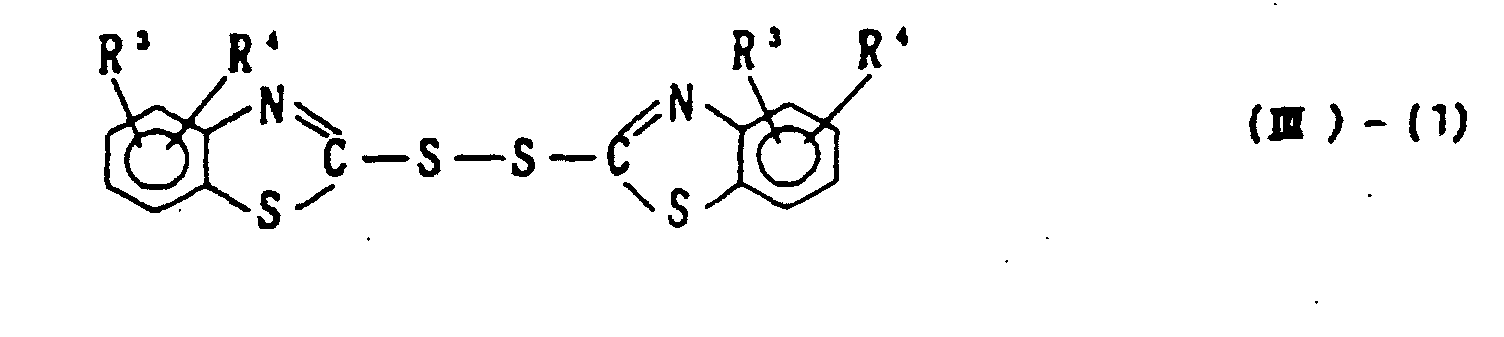


 wobei R3 und R4 unabhängig ein Wasserstoffatom, eine Alkylgruppe mit 1 bis 8 Kohlenstoffatomen oder eine Arylgruppe mit 6 bis 10 Kohlenstoffatomen sind, mit der Maßgabe, daß R3 und R4 nicht gleichzeitig ein Wasserstoffatom sind, R5 eine Alkylgruppe mit 1 bis 8 Kohlenstoffatomen, eine Alkenylgruppe mit 2 bis 8 Kohlenstoffatomen oder eine Cycloalkylgruppe mit 3 bis 8 Kohlenstoffatomen ist; R6 ein Wasserstoffatom oder eine Aminogruppe, dargestellt durch -N(R7)R8, ist, wobei R7 und R8 unabhängig ein Wasserstoffatom, eine Alkylgruppe mit 2 bis 4 Kohlenstoffatomen oder eine Cyclohexylgruppe sind, mit der Maßgabe, daß R7 und R8 nicht gleichzeitig ein Wasserstoffatom sind; R9 und R10 unabhängig eine Alkylgruppe mit 1 bis 8 Kohlenstoffatomen, eine Alkenylgruppe mit 2 bis 8 Kohlenstoffatomen oder eine Cycloalkylgruppe mit 3 bis 8 Kohlenstoffatomen sind; X ein Zn-Atom, Cu-Atom oder eine Aminogruppe, dargestellt durch >N-R13, ist, wobei R13 eine Alkylgruppe mit 2 bis 4 Kohlenstoffatomen oder eine Cyclohexylgruppe ist; und R11 und R12 jeweils die gleichen wie R9 sind.
- Luftreifen mit einer Lauffläche, welche die Kautschukzusammensetzung nach den Ansprüchen 1 bis 9 umfaßt.
Applications Claiming Priority (4)
| Application Number | Priority Date | Filing Date | Title |
|---|---|---|---|
| JP7558398 | 1998-03-24 | ||
| JP07558398 | 1998-03-24 | ||
| JP18099598 | 1998-06-26 | ||
| JP18099598 | 1998-06-26 |
Publications (2)
| Publication Number | Publication Date |
|---|---|
| EP0945482A1 EP0945482A1 (de) | 1999-09-29 |
| EP0945482B1 true EP0945482B1 (de) | 2004-01-28 |
Family
ID=26416726
Family Applications (1)
| Application Number | Title | Priority Date | Filing Date |
|---|---|---|---|
| EP99302296A Expired - Lifetime EP0945482B1 (de) | 1998-03-24 | 1999-03-24 | Kautschukmischung für Laufflächen und ihre Verwendung in Luftreifen |
Country Status (4)
| Country | Link |
|---|---|
| US (1) | US6242522B1 (de) |
| EP (1) | EP0945482B1 (de) |
| DE (1) | DE69914396T2 (de) |
| ES (1) | ES2213330T3 (de) |
Cited By (3)
| Publication number | Priority date | Publication date | Assignee | Title |
|---|---|---|---|---|
| DE102004026317A1 (de) * | 2004-05-26 | 2005-12-15 | Rhein-Chemie Rheinau Gmbh | Verfahren zur Herstellung von Kautschukmischungen |
| DE102008037593A1 (de) * | 2008-11-26 | 2010-05-27 | Continental Reifen Deutschland Gmbh | Kautschukmischung und hieraus hergestellte Reifen |
| CN1831021B (zh) * | 2004-10-25 | 2011-10-05 | 波利玛利欧洲股份公司 | 低支链含量聚丁二烯的制备方法 |
Families Citing this family (24)
| Publication number | Priority date | Publication date | Assignee | Title |
|---|---|---|---|---|
| US6489389B1 (en) * | 1994-08-19 | 2002-12-03 | Bridgestone Corporation | Rubber composition for tire treads |
| CA2325187A1 (en) * | 1999-11-11 | 2001-05-11 | Sumitomo Chemical Company, Limited | Resin composite and method for producing the same |
| EP1112961B1 (de) * | 1999-12-27 | 2004-09-15 | Sumitomo Chemical Company, Limited | Aluminiumhydroxid, Zusammensetzung einer Reifenlauffläche und Luftreifen enthaltend Aluminiumhydroxid |
| EP1120442B1 (de) * | 2000-01-28 | 2004-09-15 | Rhein Chemie Rheinau GmbH | Vulkanisierbare Kautschukmischungen |
| CA2352927C (en) * | 2000-07-14 | 2008-03-18 | Sumitomo Rubber Industries, Ltd. | Rubber composition for tyre tread |
| DE60221184T2 (de) * | 2001-05-15 | 2008-04-10 | Sumitomo Rubber Industries Ltd., Kobe | Kautschukzusammensetzung für Reifenlauffläche und Reifen mit derselben |
| KR100410857B1 (ko) * | 2001-08-21 | 2003-12-18 | 현대자동차주식회사 | 장기 내노화성 엔진 마운팅용 고무 조성물 |
| JP5006527B2 (ja) | 2005-06-06 | 2012-08-22 | 住友ゴム工業株式会社 | トレッド用ゴム組成物 |
| JP4499658B2 (ja) | 2005-12-26 | 2010-07-07 | 住友ゴム工業株式会社 | ゴム組成物およびそれを用いた空気入りタイヤ |
| US10273352B2 (en) * | 2006-08-03 | 2019-04-30 | The Yokohama Rubber Co., Ltd. | Pneumatic tire |
| US8841376B2 (en) * | 2006-12-31 | 2014-09-23 | Bridgestone Corporation | Methods for identifying and utilizing rubber compositions with good wet traction performance |
| KR101132144B1 (ko) | 2007-01-31 | 2012-06-14 | 알.티.반더빌트 컴퍼니, 인코포레이티드 | 디티오포스페이트 조성물 및 이의 고무에서의 용도 |
| JP5701062B2 (ja) | 2007-12-28 | 2015-04-15 | 株式会社ブリヂストン | ヒドロキシアリール官能化重合体 |
| US7960463B2 (en) * | 2007-12-31 | 2011-06-14 | Bridgestone Corporation | Tire treads including aluminum hydroxycarbonate |
| ES2458120T3 (es) | 2009-06-30 | 2014-04-30 | Bridgestone Corporation | Polímeros funcionalizados con hidroxiarilo |
| JP5889787B2 (ja) * | 2009-07-01 | 2016-03-22 | 株式会社ブリヂストン | フリーラジカル開始重合によるヒドロキシアリール官能化共重合体の製造方法 |
| US8637600B2 (en) | 2010-08-11 | 2014-01-28 | Bridgestone Corporation | Processing of rubber compositions including siliceous fillers |
| EP2771397A4 (de) | 2011-10-24 | 2015-06-10 | Bridgestone Americas Tire | Kieselsäuregefüllte kautschukzusammensetzung und herstellungsverfahren dafür |
| EP2771398B1 (de) * | 2011-10-24 | 2021-10-20 | Bridgestone Americas Tire Operations, LLC | Kieselsäuregefüllte kautschukzusammensetzung und herstellungsverfahren dafür |
| EP2783880B2 (de) * | 2013-03-27 | 2018-06-13 | Sumitomo Rubber Industries, Ltd. | Spikeloser Winterreifen |
| JP6173078B2 (ja) * | 2013-07-08 | 2017-08-02 | 住友ゴム工業株式会社 | タイヤ用ゴム組成物及び空気入りタイヤ |
| WO2016031476A1 (ja) | 2014-08-28 | 2016-03-03 | 住友ゴム工業株式会社 | トレッド用ゴム組成物及び空気入りタイヤ |
| CN104448431B (zh) * | 2014-12-18 | 2017-05-17 | 山东玲珑轮胎股份有限公司 | 耐刺扎、抗崩花掉块的轮胎胎面胶料及其制法和应用 |
| DE102017223545A1 (de) * | 2017-12-21 | 2019-06-27 | Contitech Luftfedersysteme Gmbh | Artikel, insbesondere ein Luftfederbalg, ein Metall-Gummi-Element oder ein Schwingungsdämpfer |
Family Cites Families (5)
| Publication number | Priority date | Publication date | Assignee | Title |
|---|---|---|---|---|
| FR2110151A5 (de) | 1970-10-31 | 1972-05-26 | Rhein Chemie Rheinau Gmbh | |
| JP3366452B2 (ja) * | 1994-08-19 | 2003-01-14 | 株式会社ブリヂストン | タイヤトレッド用ゴム組成物 |
| EP0697432B1 (de) | 1994-08-19 | 2003-10-15 | Bridgestone Corporation | Kautschukmischungen für Reifenlaufflächen |
| JPH09136999A (ja) * | 1995-11-15 | 1997-05-27 | Bridgestone Corp | ゴム組成物 |
| EP0864604A3 (de) | 1997-03-11 | 1999-01-13 | Bridgestone Corporation | Kautschukzusammensetzung |
-
1999
- 1999-03-22 US US09/274,012 patent/US6242522B1/en not_active Expired - Lifetime
- 1999-03-24 ES ES99302296T patent/ES2213330T3/es not_active Expired - Lifetime
- 1999-03-24 DE DE69914396T patent/DE69914396T2/de not_active Expired - Lifetime
- 1999-03-24 EP EP99302296A patent/EP0945482B1/de not_active Expired - Lifetime
Cited By (4)
| Publication number | Priority date | Publication date | Assignee | Title |
|---|---|---|---|---|
| DE102004026317A1 (de) * | 2004-05-26 | 2005-12-15 | Rhein-Chemie Rheinau Gmbh | Verfahren zur Herstellung von Kautschukmischungen |
| CN1831021B (zh) * | 2004-10-25 | 2011-10-05 | 波利玛利欧洲股份公司 | 低支链含量聚丁二烯的制备方法 |
| DE102008037593A1 (de) * | 2008-11-26 | 2010-05-27 | Continental Reifen Deutschland Gmbh | Kautschukmischung und hieraus hergestellte Reifen |
| DE102008037593B4 (de) * | 2008-11-26 | 2021-04-22 | Continental Reifen Deutschland Gmbh | Kautschukmischung und deren Verwendung für Laufstreifen und Reifen |
Also Published As
| Publication number | Publication date |
|---|---|
| DE69914396T2 (de) | 2004-11-04 |
| EP0945482A1 (de) | 1999-09-29 |
| US6242522B1 (en) | 2001-06-05 |
| ES2213330T3 (es) | 2004-08-16 |
| DE69914396D1 (de) | 2004-03-04 |
Similar Documents
| Publication | Publication Date | Title |
|---|---|---|
| US6242522B1 (en) | Rubber composition for tire tread and pneumatic tire using same | |
| EP0933391B1 (de) | Kautschukzusammensetzung und Reifen mit Lauffläche die Calciumcarbonat enthalten | |
| US6753374B1 (en) | Rubber compositions and method for increasing the Mooney Scorch value | |
| US6620875B2 (en) | Rubber compositions and method for increasing the mooney scorch value | |
| EP1277795B1 (de) | Luftreifen | |
| EP2231759B1 (de) | Reifen und vernetzbare elastomerzusammensetzung mit kieselgur | |
| JP3350291B2 (ja) | タイヤトレッド用ゴム組成物 | |
| US20040014840A1 (en) | Rubber compositions and methods for improving scorch safety and hysteretic properties of the compositions | |
| EP2019123B1 (de) | Kautschukzusammensetzung für wulstfüller und reifen daraus | |
| EP2325242B1 (de) | Gummizusammensetzung für Reifenlauffäche und spikelosen Reifen | |
| US6334476B1 (en) | Pneumatic tire | |
| EP0948029A2 (de) | Hochdruckentladungslampe | |
| JP5587407B2 (ja) | アセチルアセトネート化合物を含むタイヤゴム組成物 | |
| JP4295385B2 (ja) | 空気入りタイヤ | |
| JP3384774B2 (ja) | タイヤトレッド用ゴム組成物 | |
| EP3452543B1 (de) | Reifen mit komponente mit vulkanisierter kautschukzusammensetzung mit hoher dielektrischer konstante und zugehörige verfahren | |
| JPH11334310A (ja) | 空気入りタイヤ | |
| JP2002348412A (ja) | タイヤトレッド用ゴム組成物およびそれを用いた空気入りタイヤ | |
| EP1323774B1 (de) | Gummizusammensetzung und ihre Verwendung für Reifen | |
| WO2003020812A1 (en) | Rubber compositions and method for decreasing the tangent delta value | |
| US20040006163A1 (en) | Rubber compositions having improved scorch safety | |
| AU2002326753A1 (en) | Rubber compositions and method for increasing the mooney scorch value |
Legal Events
| Date | Code | Title | Description |
|---|---|---|---|
| PUAI | Public reference made under article 153(3) epc to a published international application that has entered the european phase |
Free format text: ORIGINAL CODE: 0009012 |
|
| AK | Designated contracting states |
Kind code of ref document: A1 Designated state(s): DE ES FR GB IT |
|
| AX | Request for extension of the european patent |
Free format text: AL;LT;LV;MK;RO;SI |
|
| RIN1 | Information on inventor provided before grant (corrected) |
Inventor name: SASAKA, NAOHIRO C/O BRIDGESTONE CORPORATION Inventor name: YAGAWA, KAZUO Inventor name: EZAWA, NAOFUMI |
|
| K1C3 | Correction of patent application (complete document) published |
Effective date: 19990929 |
|
| 17P | Request for examination filed |
Effective date: 20000302 |
|
| AKX | Designation fees paid |
Free format text: DE ES FR GB IT |
|
| 17Q | First examination report despatched |
Effective date: 20020215 |
|
| GRAP | Despatch of communication of intention to grant a patent |
Free format text: ORIGINAL CODE: EPIDOSNIGR1 |
|
| GRAS | Grant fee paid |
Free format text: ORIGINAL CODE: EPIDOSNIGR3 |
|
| GRAA | (expected) grant |
Free format text: ORIGINAL CODE: 0009210 |
|
| AK | Designated contracting states |
Kind code of ref document: B1 Designated state(s): DE ES FR GB IT |
|
| REG | Reference to a national code |
Ref country code: GB Ref legal event code: FG4D |
|
| REF | Corresponds to: |
Ref document number: 69914396 Country of ref document: DE Date of ref document: 20040304 Kind code of ref document: P |
|
| REG | Reference to a national code |
Ref country code: ES Ref legal event code: FG2A Ref document number: 2213330 Country of ref document: ES Kind code of ref document: T3 |
|
| ET | Fr: translation filed | ||
| PLBE | No opposition filed within time limit |
Free format text: ORIGINAL CODE: 0009261 |
|
| STAA | Information on the status of an ep patent application or granted ep patent |
Free format text: STATUS: NO OPPOSITION FILED WITHIN TIME LIMIT |
|
| 26N | No opposition filed |
Effective date: 20041029 |
|
| REG | Reference to a national code |
Ref country code: FR Ref legal event code: CA Effective date: 20140812 |
|
| REG | Reference to a national code |
Ref country code: DE Ref legal event code: R081 Ref document number: 69914396 Country of ref document: DE Owner name: BRIDGESTONE CORPORATION, JP Free format text: FORMER OWNER: BRIDGESTONE CORP., TOKIO/TOKYO, JP Effective date: 20140828 |
|
| PGFP | Annual fee paid to national office [announced via postgrant information from national office to epo] |
Ref country code: ES Payment date: 20150326 Year of fee payment: 17 |
|
| PGFP | Annual fee paid to national office [announced via postgrant information from national office to epo] |
Ref country code: GB Payment date: 20150319 Year of fee payment: 17 |
|
| PGFP | Annual fee paid to national office [announced via postgrant information from national office to epo] |
Ref country code: IT Payment date: 20150330 Year of fee payment: 17 |
|
| REG | Reference to a national code |
Ref country code: FR Ref legal event code: PLFP Year of fee payment: 18 |
|
| GBPC | Gb: european patent ceased through non-payment of renewal fee |
Effective date: 20160324 |
|
| PG25 | Lapsed in a contracting state [announced via postgrant information from national office to epo] |
Ref country code: GB Free format text: LAPSE BECAUSE OF NON-PAYMENT OF DUE FEES Effective date: 20160324 |
|
| PG25 | Lapsed in a contracting state [announced via postgrant information from national office to epo] |
Ref country code: IT Free format text: LAPSE BECAUSE OF NON-PAYMENT OF DUE FEES Effective date: 20160324 |
|
| REG | Reference to a national code |
Ref country code: FR Ref legal event code: PLFP Year of fee payment: 19 |
|
| REG | Reference to a national code |
Ref country code: ES Ref legal event code: FD2A Effective date: 20170426 |
|
| PGFP | Annual fee paid to national office [announced via postgrant information from national office to epo] |
Ref country code: DE Payment date: 20170322 Year of fee payment: 19 Ref country code: FR Payment date: 20170322 Year of fee payment: 19 |
|
| PG25 | Lapsed in a contracting state [announced via postgrant information from national office to epo] |
Ref country code: ES Free format text: LAPSE BECAUSE OF NON-PAYMENT OF DUE FEES Effective date: 20160325 |
|
| REG | Reference to a national code |
Ref country code: DE Ref legal event code: R119 Ref document number: 69914396 Country of ref document: DE |
|
| PG25 | Lapsed in a contracting state [announced via postgrant information from national office to epo] |
Ref country code: DE Free format text: LAPSE BECAUSE OF NON-PAYMENT OF DUE FEES Effective date: 20181002 |
|
| PG25 | Lapsed in a contracting state [announced via postgrant information from national office to epo] |
Ref country code: FR Free format text: LAPSE BECAUSE OF NON-PAYMENT OF DUE FEES Effective date: 20180331 |