EP0945713B1 - Durchflussreguliergerät für Flüssigkeiten - Google Patents
Durchflussreguliergerät für Flüssigkeiten Download PDFInfo
- Publication number
- EP0945713B1 EP0945713B1 EP99105014A EP99105014A EP0945713B1 EP 0945713 B1 EP0945713 B1 EP 0945713B1 EP 99105014 A EP99105014 A EP 99105014A EP 99105014 A EP99105014 A EP 99105014A EP 0945713 B1 EP0945713 B1 EP 0945713B1
- Authority
- EP
- European Patent Office
- Prior art keywords
- yoke
- valves
- flow
- bypass conduit
- plungers
- Prior art date
- Legal status (The legal status is an assumption and is not a legal conclusion. Google has not performed a legal analysis and makes no representation as to the accuracy of the status listed.)
- Expired - Lifetime
Links
- 239000007788 liquid Substances 0.000 title claims description 5
- 238000007789 sealing Methods 0.000 claims description 2
- 230000001105 regulatory effect Effects 0.000 description 5
- 239000011521 glass Substances 0.000 description 4
- 238000005259 measurement Methods 0.000 description 2
- XLYOFNOQVPJJNP-UHFFFAOYSA-N water Substances O XLYOFNOQVPJJNP-UHFFFAOYSA-N 0.000 description 2
- 230000006835 compression Effects 0.000 description 1
- 238000007906 compression Methods 0.000 description 1
- 230000002950 deficient Effects 0.000 description 1
- 238000010438 heat treatment Methods 0.000 description 1
Images
Classifications
-
- G—PHYSICS
- G01—MEASURING; TESTING
- G01F—MEASURING VOLUME, VOLUME FLOW, MASS FLOW OR LIQUID LEVEL; METERING BY VOLUME
- G01F1/00—Measuring the volume flow or mass flow of fluid or fluent solid material wherein the fluid passes through a meter in a continuous flow
- G01F1/05—Measuring the volume flow or mass flow of fluid or fluent solid material wherein the fluid passes through a meter in a continuous flow by using mechanical effects
- G01F1/20—Measuring the volume flow or mass flow of fluid or fluent solid material wherein the fluid passes through a meter in a continuous flow by using mechanical effects by detection of dynamic effects of the flow
- G01F1/28—Measuring the volume flow or mass flow of fluid or fluent solid material wherein the fluid passes through a meter in a continuous flow by using mechanical effects by detection of dynamic effects of the flow by drag-force, e.g. vane type or impact flowmeter
-
- G—PHYSICS
- G05—CONTROLLING; REGULATING
- G05D—SYSTEMS FOR CONTROLLING OR REGULATING NON-ELECTRIC VARIABLES
- G05D7/00—Control of flow
- G05D7/03—Control of flow with auxiliary non-electric power
Definitions
- the invention relates to a flow regulating device for liquids, in its passageway a flow control valve is located, and with a Bypass line with respect to the passageway, which Bypass line by means of two valves either from the passageway lockable or connectable with this, where in the bypass line is a flow meter located.
- Such a flow regulating device is through the German Utility Model 82 20 193 known.
- the case existing flow meter is known from DE 31 15 572 A 1 known.
- the flow regulating device is characterized in that each of the two Valves against a spring force réellestossenden valve-closing body and that the two rams of the two valves with a single hand-operated yoke are motion connected.
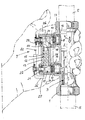
- the flow regulator has a main pipe 1 with a passage 2, in which a flow control valve 3 is located.
- the liquid flows through it Main pipe 1 in the direction of an arrow 4.
- the main pipe 1 lies in a wiring harness 5.
- bypass line 7 In addition to the main pipe 1 is a bypass line 7, at the point 8 from the passage 2 branches off and at the point 9 again in the passageway 2 opens.
- the bypass line 7 is by means of two valves 10 and 11 either from the passageway. 2 lockable or connectable with this.
- a flow meter 12 In the bypass line 7 is a flow meter 12, as he in detail in the two documents mentioned above is explained.
- the flow meter 12 has an im Sight glass 13 movably held pistons, whose front Front page 14 with a scale, not shown on the Sight glass 13 indicates the respective flow rate. Behind the piston is a helical compression spring 15th
- Each of the two valves 10 and 11 has one 16 and 17 réellestossenden against the force of a spring Valve-closing body 18 and 19.
- the valve 10 has a Plunger 20, and the valve 11 has a plunger 21. Die both rams 20 and 21 are in a hand-operated Joch 22 stored, which is in the drawing in the upper Half is in the actuated state, whereas it is in the drawing in the lower half in non-actuated State is.
- the two valves 10, 11 are so through the yoke 22 against the force of its spring 16, 17 to to open; when not operated yoke 22, the two Valves 10, 11 closed by the two springs 16, 17.
- the Yoke 22 substantially parallel to the passageway. 2 and thus also parallel to the main pipe 1.
- the two Plunger 20 and 21 push on one end on the valve-closing body 18, 19 and others are commuting in the Yoke 22 stored. This will ensure that the two plungers 20, 21 can not tilt, too if the yoke 22 is not moved exactly parallel.
- Each valve closing body 18, 19 carries a sealing disc 23, 24, which faces the respective plunger 20, 21.
- the yoke 22 is U-shaped, wherein the beam 25th the U-shape carries the two plungers 20, 21 and the legs 26 of the U-shape on both sides of a housing 27 of the Bypass line lie.
- This housing 27 has a guide rail 28, along which a pointer 29 slidably is to display the target flow rate at the flow meter.
- the hand is an operator shown in phantom.
- the palm lies at the yoke 22 and the opposite four fingers include the main tube 1.
- the palm of your hand is the Yoke in the position shown in the upper half pressed, the two valves are opened and the flow meter in the bypass line in function occurs. Is the hand no more power on the Flow regulator exercised, the two Valves 10 and 11 by the springs 16, 17 automatically closed and the bypass line is no longer flowed through.
- the flow regulator is so with Advantage mounted on the wiring harness 5 so that the Joch 22 of the operator faces, so by the palm of the hand both valves 10, 11 simultaneously be actuated as well as the flow meter 12 at Sight glass 13 can be easily read.
- the simultaneous Actuation of the two valves 10, 11 is also characterized guaranteed, because the palm of your hand also a kind Yoke with respect to the opposite four fingers, so that is the yoke of the handball when pressed of the device is pressed against the yoke 22 of the device.
- the flow control valve 3 has as a rotatable valve plug a spherical valve closing body with a through-channel, as detailed in the two at the beginning mentioned documents is explained. It is thus one stepless regulation of the flow rate possible.
- the Flow control valve can be manually operated (Control); but the valve 3 can also be in a control loop (Control) and by an actuator be operated.
- valves 10, 11 at an increase of the pressure in the Bypass line (by increasing the temperature) automatically to open. Should be e.g. the flow meter 12 itself leaks (e.g., defective sight glass 13) does not occur larger amount of liquid and thus no significant Water damage, as the two valves 10, 11 in the rest position the wiring harness 5 to the outside automatically Shut off.
- the flow regulating device is possible if the Main pipe 1 is not hot. Will such a device but used in heating systems where the wiring harness 5 and thus the main pipe 1 of hot water is flowed through, the latter does not include in the illustrated way, but one presses with the hand directly onto the yoke in the direction of the main pipe 1.
Landscapes
- Physics & Mathematics (AREA)
- General Physics & Mathematics (AREA)
- Engineering & Computer Science (AREA)
- Fluid Mechanics (AREA)
- Power Engineering (AREA)
- Automation & Control Theory (AREA)
- Flow Control (AREA)
- Measuring Volume Flow (AREA)
- Control Of Non-Electrical Variables (AREA)
Description
Claims (6)
- Durchflussreguliergerät für Flüssigkeiten, in dessen Durchgangskanal (2) ein Durchfluss-Regulierventil (3) liegt, und mit einer Bypass-Leitung (7) bezüglich des Durchgangskanals (2), welche Bypass-Leitung (7) mittels zweier Ventile (10, 11) entweder vom Durchgangskanal (2) abschliessbar oder mit diesem verbindbar ist, wobei sich in der Bypass-Leitung (7) ein Durchflussmesser (12) befindet, dadurch gekennzeichnet, dass jedes der beiden Ventile (10, 11) einen gegen Federkraft (16, 17) aufzustossenden Ventil-Schliesskörper (18, 19) aufweist, und dass die beiden Stössel (20, 21) der beiden Ventile (10, 11) mit einem einzigen handbetätigbaren Joch (22) bewegungsverbunden sind.
- Gerät nach Anspruch 1, dadurch gekennzeichnet, dass das Joch (22) im wesentlichen parallel zum Durchgangskanal (2) liegt, so dass der den Durchgangskanal (2) umgebende Gehäuseteil (1) und das Joch (22) dazu bestimmt sind, zusammen in der Hand einer Bedienungsperson zu liegen, zum Betätigen des Jochs (2).
- Gerät nach Anspruch 1 oder 2, dadurch gekennzeichnet, dass die beiden Stössel (20, 21) pendelnd im Joch (22) gelagert sind.
- Gerät nach einem der Ansprüche 1 bis 3, dadurch gekennzeichnet, dass die Ventilschliesskörper (18, 19) plattenförmig sind und je eine Abdichtscheibe (23, 24) tragen, die den Stösseln (20, 21) zugewandt sind.
- Gerät nach einem der Ansprüche 1 bis 4, dadurch gekennzeichnet, dass das Joch (22) U-förmig ist, wobei der Balken (25) der U-Form die beiden Stössel (20, 21) trägt und wobei die beiden Schenkel (26) der U-Form zu beiden Seiten eines Gehäuses (27) der Bypass-Leitung (7) liegen.
- Gerät nach Anspruch 5, dadurch gekennzeichnet, dass das Gehäuse (27) der Bypass-Leitung (7) eine Führungsschiene (28) mit einem längs dieser verschiebbaren Zeiger (29) aufweist, zum Anzeigen der Soll-Durchflussmenge am Durchflussmesser (12).
Applications Claiming Priority (2)
| Application Number | Priority Date | Filing Date | Title |
|---|---|---|---|
| DE29805136U | 1998-03-23 | ||
| DE29805136U DE29805136U1 (de) | 1998-03-23 | 1998-03-23 | Durchflußreguliergerät für Flüssigkeiten |
Publications (2)
| Publication Number | Publication Date |
|---|---|
| EP0945713A1 EP0945713A1 (de) | 1999-09-29 |
| EP0945713B1 true EP0945713B1 (de) | 2005-04-06 |
Family
ID=8054544
Family Applications (1)
| Application Number | Title | Priority Date | Filing Date |
|---|---|---|---|
| EP99105014A Expired - Lifetime EP0945713B1 (de) | 1998-03-23 | 1999-03-19 | Durchflussreguliergerät für Flüssigkeiten |
Country Status (4)
| Country | Link |
|---|---|
| EP (1) | EP0945713B1 (de) |
| AT (1) | ATE292788T1 (de) |
| DE (2) | DE29805136U1 (de) |
| ES (1) | ES2238787T3 (de) |
Families Citing this family (1)
| Publication number | Priority date | Publication date | Assignee | Title |
|---|---|---|---|---|
| ITMI20070703A1 (it) | 2007-04-05 | 2008-10-06 | Caleffi Spa | Dispositivo valvolare di regolazione e di indicazione della portata di un fluido |
Family Cites Families (4)
| Publication number | Priority date | Publication date | Assignee | Title |
|---|---|---|---|---|
| FR2480936A1 (fr) * | 1980-04-16 | 1981-10-23 | Taco Armaturen Ag | Appareil de reglage de debit, notamment pour des canalisations de liquides |
| DE8220193U1 (de) * | 1982-07-15 | 1982-10-21 | Taco Armaturen AG, 8048 Zürich | Durchflußreguliergerät |
| EP0465274A1 (de) * | 1990-07-02 | 1992-01-08 | Lamarque S.A. | Mechanische Dosiervorrichtung |
| GB2276656A (en) * | 1993-04-02 | 1994-10-05 | Sage Passant Peter | Water supply isolation system |
-
1998
- 1998-03-23 DE DE29805136U patent/DE29805136U1/de not_active Expired - Lifetime
-
1999
- 1999-03-19 AT AT99105014T patent/ATE292788T1/de active
- 1999-03-19 EP EP99105014A patent/EP0945713B1/de not_active Expired - Lifetime
- 1999-03-19 ES ES99105014T patent/ES2238787T3/es not_active Expired - Lifetime
- 1999-03-19 DE DE59911863T patent/DE59911863D1/de not_active Expired - Lifetime
Also Published As
| Publication number | Publication date |
|---|---|
| DE59911863D1 (de) | 2005-05-12 |
| DE29805136U1 (de) | 1998-05-07 |
| ES2238787T3 (es) | 2005-09-01 |
| ATE292788T1 (de) | 2005-04-15 |
| EP0945713A1 (de) | 1999-09-29 |
Similar Documents
| Publication | Publication Date | Title |
|---|---|---|
| EP0945713B1 (de) | Durchflussreguliergerät für Flüssigkeiten | |
| DE3810341A1 (de) | Fluessigkeitsfoerdereinrichtung, insbesondere hochdruckreinigungseinrichtung | |
| DE412842C (de) | Vorsteuerung fuer Druckluftfluessigkeitscheber | |
| DE3124944A1 (de) | "hochdruckreiniger" | |
| DE838098C (de) | Absperrorgan mit Rohrschiebern | |
| DE2400758B2 (de) | Vorrichtung zum Einbringen von Flüssigkeit, insbesondere Schmieröl, in Druckluft | |
| DE19701401A1 (de) | Gas-Druckregelgerät | |
| DE19802240A1 (de) | Stufenloses automatisch-mechanisches Schaum-Dosiersystem für Hoch- und Normaldruck Feuerlöschkreiselpumpen | |
| DE2235876A1 (de) | Regelventil | |
| DE3127738A1 (de) | Mengenregulierventil | |
| DE1897227U (de) | Mischventil mit zwei wahlweise einschaltbaren auslaeufen. | |
| DE4326352C2 (de) | Fluid-Kanalvorrichtung für Haushaltgeräte | |
| CH698702B1 (de) | Ventil. | |
| DE3539757C2 (de) | ||
| DE258512C (de) | ||
| DE480502C (de) | Druckumformer zur UEbertragung einer Impulskraft auf Regeleinrichtungen | |
| DE2930348C2 (de) | Ventileinrichtung | |
| AT28219B (de) | Dampfheizung für Eisenbahnwagen. | |
| DE647353C (de) | Zwangslaeufige oder kraftschluessige Ventilsteuerung mit Kniehebelgestaenge fuer Vorrichtungen zum Abmessen von Fluessigkeiten, insbesondere von Wasser, fuer Betonmischmaschinen | |
| DE1529151A1 (de) | Langsam-Zuendeinrichtung fuer Gasgeraete,insbesondere fuer Heiz- und Warmwasserbereiter | |
| DE2309692C3 (de) | Induktionsgerät für Vierrohrklimaanlagen | |
| DE8118510U1 (de) | "hochdruckreiniger" | |
| DE1227187B (de) | Handstueck fuer zahnaerztliche Spritzvorrichtungen | |
| DE2451675A1 (de) | Ueberstroemventil insbesondere fuer heizungsanlagen mit thermostatischen heizkoerperventilen | |
| DE923873C (de) | Gas-Wasserheizer mit Haupt- und Nebenzapfstelle |
Legal Events
| Date | Code | Title | Description |
|---|---|---|---|
| PUAI | Public reference made under article 153(3) epc to a published international application that has entered the european phase |
Free format text: ORIGINAL CODE: 0009012 |
|
| AK | Designated contracting states |
Kind code of ref document: A1 Designated state(s): AT BE CH DE DK ES FI FR GB GR IE IT LI NL PT SE |
|
| AX | Request for extension of the european patent |
Free format text: AL;LT;LV;MK;RO;SI |
|
| 17P | Request for examination filed |
Effective date: 19991203 |
|
| AKX | Designation fees paid |
Free format text: AT BE CH DE DK ES FI FR GB GR IE IT LI NL PT SE |
|
| GRAP | Despatch of communication of intention to grant a patent |
Free format text: ORIGINAL CODE: EPIDOSNIGR1 |
|
| GRAS | Grant fee paid |
Free format text: ORIGINAL CODE: EPIDOSNIGR3 |
|
| GRAA | (expected) grant |
Free format text: ORIGINAL CODE: 0009210 |
|
| AK | Designated contracting states |
Kind code of ref document: B1 Designated state(s): AT BE CH DE DK ES FI FR GB GR IE IT LI NL PT SE |
|
| PG25 | Lapsed in a contracting state [announced via postgrant information from national office to epo] |
Ref country code: NL Free format text: LAPSE BECAUSE OF FAILURE TO SUBMIT A TRANSLATION OF THE DESCRIPTION OR TO PAY THE FEE WITHIN THE PRESCRIBED TIME-LIMIT Effective date: 20050406 Ref country code: IE Free format text: LAPSE BECAUSE OF FAILURE TO SUBMIT A TRANSLATION OF THE DESCRIPTION OR TO PAY THE FEE WITHIN THE PRESCRIBED TIME-LIMIT Effective date: 20050406 Ref country code: FI Free format text: LAPSE BECAUSE OF FAILURE TO SUBMIT A TRANSLATION OF THE DESCRIPTION OR TO PAY THE FEE WITHIN THE PRESCRIBED TIME-LIMIT Effective date: 20050406 |
|
| REG | Reference to a national code |
Ref country code: GB Ref legal event code: FG4D Free format text: NOT ENGLISH |
|
| REG | Reference to a national code |
Ref country code: CH Ref legal event code: NV Representative=s name: E. BLUM & CO. PATENTANWAELTE Ref country code: CH Ref legal event code: EP |
|
| REG | Reference to a national code |
Ref country code: IE Ref legal event code: FG4D Free format text: LANGUAGE OF EP DOCUMENT: GERMAN |
|
| REF | Corresponds to: |
Ref document number: 59911863 Country of ref document: DE Date of ref document: 20050512 Kind code of ref document: P |
|
| PG25 | Lapsed in a contracting state [announced via postgrant information from national office to epo] |
Ref country code: SE Free format text: LAPSE BECAUSE OF FAILURE TO SUBMIT A TRANSLATION OF THE DESCRIPTION OR TO PAY THE FEE WITHIN THE PRESCRIBED TIME-LIMIT Effective date: 20050706 Ref country code: GR Free format text: LAPSE BECAUSE OF FAILURE TO SUBMIT A TRANSLATION OF THE DESCRIPTION OR TO PAY THE FEE WITHIN THE PRESCRIBED TIME-LIMIT Effective date: 20050706 Ref country code: DK Free format text: LAPSE BECAUSE OF FAILURE TO SUBMIT A TRANSLATION OF THE DESCRIPTION OR TO PAY THE FEE WITHIN THE PRESCRIBED TIME-LIMIT Effective date: 20050706 |
|
| GBT | Gb: translation of ep patent filed (gb section 77(6)(a)/1977) |
Effective date: 20050725 |
|
| REG | Reference to a national code |
Ref country code: ES Ref legal event code: FG2A Ref document number: 2238787 Country of ref document: ES Kind code of ref document: T3 |
|
| PG25 | Lapsed in a contracting state [announced via postgrant information from national office to epo] |
Ref country code: PT Free format text: LAPSE BECAUSE OF FAILURE TO SUBMIT A TRANSLATION OF THE DESCRIPTION OR TO PAY THE FEE WITHIN THE PRESCRIBED TIME-LIMIT Effective date: 20050908 |
|
| NLV1 | Nl: lapsed or annulled due to failure to fulfill the requirements of art. 29p and 29m of the patents act | ||
| REG | Reference to a national code |
Ref country code: IE Ref legal event code: FD4D |
|
| ET | Fr: translation filed | ||
| PLBE | No opposition filed within time limit |
Free format text: ORIGINAL CODE: 0009261 |
|
| STAA | Information on the status of an ep patent application or granted ep patent |
Free format text: STATUS: NO OPPOSITION FILED WITHIN TIME LIMIT |
|
| 26N | No opposition filed |
Effective date: 20060110 |
|
| PG25 | Lapsed in a contracting state [announced via postgrant information from national office to epo] |
Ref country code: BE Free format text: LAPSE BECAUSE OF NON-PAYMENT OF DUE FEES Effective date: 20060331 |
|
| REG | Reference to a national code |
Ref country code: CH Ref legal event code: PFA Owner name: OSTACO AG Free format text: OSTACO AG#STEINACKERSTRASSE 6#8902 URDORF (CH) -TRANSFER TO- OSTACO AG#STEINACKERSTRASSE 6#8902 URDORF (CH) |
|
| BERE | Be: lapsed |
Owner name: OSTACO A.G. Effective date: 20060331 |
|
| REG | Reference to a national code |
Ref country code: FR Ref legal event code: PLFP Year of fee payment: 18 |
|
| PGFP | Annual fee paid to national office [announced via postgrant information from national office to epo] |
Ref country code: ES Payment date: 20160309 Year of fee payment: 18 |
|
| PGFP | Annual fee paid to national office [announced via postgrant information from national office to epo] |
Ref country code: FR Payment date: 20160321 Year of fee payment: 18 Ref country code: GB Payment date: 20160321 Year of fee payment: 18 |
|
| PGFP | Annual fee paid to national office [announced via postgrant information from national office to epo] |
Ref country code: IT Payment date: 20160324 Year of fee payment: 18 |
|
| REG | Reference to a national code |
Ref country code: CH Ref legal event code: PFA Owner name: TACONOVA GROUP AG, CH Free format text: FORMER OWNER: OSTACO AG, CH |
|
| REG | Reference to a national code |
Ref country code: DE Ref legal event code: R082 Ref document number: 59911863 Country of ref document: DE Representative=s name: MAMMEL UND MASER, PATENTANWAELTE, DE Ref country code: DE Ref legal event code: R081 Ref document number: 59911863 Country of ref document: DE Owner name: TACONOVA GROUP AG, CH Free format text: FORMER OWNER: OSTACO AG, URDORF, CH |
|
| REG | Reference to a national code |
Ref country code: GB Ref legal event code: 732E Free format text: REGISTERED BETWEEN 20170331 AND 20170405 |
|
| REG | Reference to a national code |
Ref country code: FR Ref legal event code: CD Owner name: OSTACO AG Effective date: 20170522 Ref country code: FR Ref legal event code: CA Effective date: 20170522 |
|
| REG | Reference to a national code |
Ref country code: AT Ref legal event code: HC Ref document number: 292788 Country of ref document: AT Kind code of ref document: T Owner name: TACONOVA GROUP AG, CH Effective date: 20170814 |
|
| GBPC | Gb: european patent ceased through non-payment of renewal fee |
Effective date: 20170319 |
|
| REG | Reference to a national code |
Ref country code: FR Ref legal event code: ST Effective date: 20171130 |
|
| PG25 | Lapsed in a contracting state [announced via postgrant information from national office to epo] |
Ref country code: FR Free format text: LAPSE BECAUSE OF NON-PAYMENT OF DUE FEES Effective date: 20170331 |
|
| PG25 | Lapsed in a contracting state [announced via postgrant information from national office to epo] |
Ref country code: GB Free format text: LAPSE BECAUSE OF NON-PAYMENT OF DUE FEES Effective date: 20170319 Ref country code: IT Free format text: LAPSE BECAUSE OF NON-PAYMENT OF DUE FEES Effective date: 20170319 |
|
| PGFP | Annual fee paid to national office [announced via postgrant information from national office to epo] |
Ref country code: CH Payment date: 20180202 Year of fee payment: 20 Ref country code: DE Payment date: 20180322 Year of fee payment: 20 |
|
| REG | Reference to a national code |
Ref country code: ES Ref legal event code: FD2A Effective date: 20180507 |
|
| PGFP | Annual fee paid to national office [announced via postgrant information from national office to epo] |
Ref country code: AT Payment date: 20180322 Year of fee payment: 20 |
|
| PG25 | Lapsed in a contracting state [announced via postgrant information from national office to epo] |
Ref country code: ES Free format text: LAPSE BECAUSE OF NON-PAYMENT OF DUE FEES Effective date: 20170320 |
|
| REG | Reference to a national code |
Ref country code: DE Ref legal event code: R071 Ref document number: 59911863 Country of ref document: DE |
|
| REG | Reference to a national code |
Ref country code: CH Ref legal event code: PL |
|
| REG | Reference to a national code |
Ref country code: AT Ref legal event code: MK07 Ref document number: 292788 Country of ref document: AT Kind code of ref document: T Effective date: 20190319 |