EP0945918A2 - Connecteur électrique - Google Patents
Connecteur électrique Download PDFInfo
- Publication number
- EP0945918A2 EP0945918A2 EP99105792A EP99105792A EP0945918A2 EP 0945918 A2 EP0945918 A2 EP 0945918A2 EP 99105792 A EP99105792 A EP 99105792A EP 99105792 A EP99105792 A EP 99105792A EP 0945918 A2 EP0945918 A2 EP 0945918A2
- Authority
- EP
- European Patent Office
- Prior art keywords
- insulating covering
- connector
- connecting element
- shielding cover
- cables
- Prior art date
- Legal status (The legal status is an assumption and is not a legal conclusion. Google has not performed a legal analysis and makes no representation as to the accuracy of the status listed.)
- Withdrawn
Links
Images



Classifications
-
- H—ELECTRICITY
- H01—ELECTRIC ELEMENTS
- H01R—ELECTRICALLY-CONDUCTIVE CONNECTIONS; STRUCTURAL ASSOCIATIONS OF A PLURALITY OF MUTUALLY-INSULATED ELECTRICAL CONNECTING ELEMENTS; COUPLING DEVICES; CURRENT COLLECTORS
- H01R4/00—Electrically-conductive connections between two or more conductive members in direct contact, i.e. touching one another; Means for effecting or maintaining such contact; Electrically-conductive connections having two or more spaced connecting locations for conductors and using contact members penetrating insulation
- H01R4/24—Connections using contact members penetrating or cutting insulation or cable strands
- H01R4/2495—Insulation penetration combined with permanent deformation of the contact member, e.g. crimping
-
- H—ELECTRICITY
- H01—ELECTRIC ELEMENTS
- H01R—ELECTRICALLY-CONDUCTIVE CONNECTIONS; STRUCTURAL ASSOCIATIONS OF A PLURALITY OF MUTUALLY-INSULATED ELECTRICAL CONNECTING ELEMENTS; COUPLING DEVICES; CURRENT COLLECTORS
- H01R13/00—Details of coupling devices of the kinds covered by groups H01R12/70 or H01R24/00 - H01R33/00
- H01R13/648—Protective earth or shield arrangements on coupling devices, e.g. anti-static shielding
- H01R13/658—High frequency shielding arrangements, e.g. against EMI [Electro-Magnetic Interference] or EMP [Electro-Magnetic Pulse]
- H01R13/6598—Shield material
- H01R13/6599—Dielectric material made conductive, e.g. plastic material coated with metal
-
- H—ELECTRICITY
- H01—ELECTRIC ELEMENTS
- H01R—ELECTRICALLY-CONDUCTIVE CONNECTIONS; STRUCTURAL ASSOCIATIONS OF A PLURALITY OF MUTUALLY-INSULATED ELECTRICAL CONNECTING ELEMENTS; COUPLING DEVICES; CURRENT COLLECTORS
- H01R4/00—Electrically-conductive connections between two or more conductive members in direct contact, i.e. touching one another; Means for effecting or maintaining such contact; Electrically-conductive connections having two or more spaced connecting locations for conductors and using contact members penetrating insulation
- H01R4/70—Insulation of connections
Definitions
- the present invention relates to an electric connector.
- the present invention relates to an electric connector comprising a substantially channel-shaped connecting element made of conducting sheet metal and which is designed to receive end portions of insulated electric cables, is crimped onto the cables, and in turn comprises insulation-piercing contact elements for piercing the insulating sheath of the cables when the connecting element is crimped, to establish electric connection between the element and the wires of the cables.
- the connector also comprises an insulating covering generally formed by applying a layer of polymeric material to an outer surface of the contact element.
- the connectors of different lines are located close together and normally contacting one another.
- the insulating covering of the connectors provides for electrically insulating the connectors of different lines and, in conventional telephone applications, is normally sufficient to prevent any noticeable crosstalk between the lines.
- the present invention also relates to a method of fabricating the connector, as claimed in Claim 9.
- Number 1 in Figures 1 to 5 indicates as a whole an electric connector for connecting two electric cables 2, 3 ( Figure 4).
- Connector 1 substantially comprises a connecting element 4 made of conducting sheet metal; and an insulating covering 5 applied to the outside of connecting element 4.
- connecting element 4 is elongated and substantially channel-shaped with a substantially U-shaped section, and comprises a flat bottom wall 6, and two lateral walls 7, 8 extending integrally and in diverging directions from respective lateral edges of bottom wall 6, and defining with the bottom wall a cavity 10.
- a number of deformable retaining elements 14 extend from the free edges of lateral walls 7,8, comprise respective end portions 15 bent inwards of cavity 10, and, in use, are deformed inwards of cavity 10 to retain insulating covering 5 as described later on.
- Connecting element 4 also comprises two pairs of insulation-displacement contact (IDC) elements, each comprising a blade 17 cut from bottom wall 6 and bent 90° inwards of cavity 10 in a plane perpendicular to the longitudinal dimension of the connector.
- IDC insulation-displacement contact
- Each blade 17 ( Figure 3) comprises along the top edge a known substantially funnel-shaped slot 18 in turn having a lead-in portion 19, and a bottom portion 20 defined by a pair of edges 23 separated by a distance slightly less than the diameter of the conducting core of cables 2, 3.
- Insulating covering 5 conveniently comprises a dielectric layer 24 of dielectric polymeric material, e.g. polyester, which covers the entire outer surface of connecting element 4 and has a pair of lateral portions 25 extending beyond retaining elements 14 of connecting element 4 so as to be “gripped” between the retaining elements and held in place when the connector is fitted to the cables.
- dielectric layer 24 of dielectric polymeric material e.g. polyester
- Lateral portions 25 of insulating covering 5 comprise recesses 34 at contact elements 17 for the purpose explained later on.
- Covering 5 is longer than connecting element 4 so that axial edges 35 of the covering project from the connecting element ( Figure 1).
- Covering 5 is applied to connecting element 4 by means of adhesive conveniently comprising a second layer 26 of low-temperature-softening thermoplastic material, e.g. polyethylene, which forms part of covering 5 and by which dielectric layer 24 is heat-sealed to connecting element 4.
- adhesive conveniently comprising a second layer 26 of low-temperature-softening thermoplastic material, e.g. polyethylene, which forms part of covering 5 and by which dielectric layer 24 is heat-sealed to connecting element 4.
- Covering 5 is conveniently formed from a known continuous rolled strip 27 ( Figure 6) comprising layers 24, 26.
- connector 1 also comprises a shielding cover 30, which is applied to the outer surface of covering 5 and in turn conveniently comprises a conductive metal shielding layer 31 defined by a thin plate, e.g. of aluminium or copper alloy of a thickness measurable in hundredths of a millimeter.
- Shielding layer 31 covers the outside of the whole of insulating covering 5 except for respective free edges 25a of lateral portions 25, to prevent any electrical contact with connecting element 4 when connector 1 is fitted ( Figure 3).
- Layer 31 is also heat sealed to insulating covering 5, for which purpose, layer 30 conveniently comprises a thin film 32 of thermoplastic material, e.g. polyethylene, having a lower softening temperature than dielectric layer 24.
- Shielding cover 30 is conveniently formed from a continuous strip 33 ( Figure 6) comprising shielding layer 31 and polymeric film 32.
- Connector 1 is fitted in known manner using special tools not shown (hand pliers or semiautomatic tools); and the ends of cables 2, 3 are first placed inside respective end portions of cavity 10 of connecting element 4 so that each cable end is superimposed on a respective pair of blades 17.
- Connector 1 is then deformed using said tool, so that lateral walls 7, 8 are positioned perpendicular to bottom wall 6, retaining elements 14 are bent inwards of cavity 10, cables 2, 3 are forced inside slots 18 of blades 17, and the insulation of cables 2, 3 is cut by the lateral edges of slot 18 to establish an electrical connection between the conducting cores of the cables and connecting element 4 ( Figure 5).
- the tool When fitting connector 1, the tool, by means of a rolling operation, guides lateral portions 25 of insulating covering 5 between retaining elements 14 and into slots 18 of blades 17 to assist in retaining cables 2, 3; and recesses 34 are so sized as to prevent any unwanted interference between the material of covering 5 and the cables inside slots 18.
- FIG 4 shows connector 1 as fitted to cables 2, 3.
- Connecting element 4 is substantially entirely enclosed by shielding cover 30, and is insulated electrically from the shielding cover by covering 5.
- edges 25a of covering 5 projecting from shield 30 provide for electrically insulating the shield and connecting element 4.
- connector 1 In the event connector 1 is located, in use, contacting another similar connector, electric insulation is therefore ensured to eliminate any problems arising from inductive crosstalk.
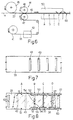
- Figure 6 shows schematically a method of producing a rolled strip 40 by superimposing and heat sealing strips 27 and 33 at a hot-rolling station 44.
- Strip 33 unwound off a reel 41, is first fed through a preblanking station 42 where transverse strips shorter than the width of strip 33 are removed to define equally spaced slots 43 ( Figure 7) at the regions eventually defining, in use, edges 25a of insulating covering 5.
- the spacing of slots 43 equals the width of the blank of covering 5 of connector 1.
- Strip 27 is unwound off a reel 45 and fed to rolling station 44 along a plane ⁇ .
- Station 44 comprises a pair of rotary cylinders 46, 47 symmetrical with and tangent to plane ⁇ so as to compress strips 27, 33.
- Cylinder 46 is cold and cooperates with the face of strip 27 defined by dielectric layer 24; and cylinder 47 also provides for guiding strip 33, which, on leaving preblanking station 42, is fed around cylinder 47 and onto strip 27 along plane ⁇ . Cylinder 47 is heated and cooperates with the face of strip 33 defined by shielding layer 31 to heat strip 33 to a temperature higher than the softening temperature of polyethylene film 32.
- the rolled strip 40 so formed is fed to a step-operated stamping station 50 where cutting and forming operations are performed successively with reference to slots 43 formed in strip 33.
- a first operation A ( Figure 8) comprises forming, with reference to slots 43, sprocket holes 51 along the longitudinal edges 52 of rolled strip 40; and a second operation B comprises simultaneously forming longitudinal slots 53 at opposite ends of slots 43, and a number of spaced openings 54 along slots 43.
- a third operation C comprises forming a transverse cut 55 along the center line of each slot 43 to define, at each step, a portion 56 of rolled strip 40 defined lengthwise of the strip by two successive cuts 55, and widthwise of the strip by cuts 53, and which defines the blank of enclosure 36 of a respective connector 1.
- a fourth and last operation D comprises preforming enclosure 36, whereby lateral portions 57 of portions 56 are bent upwards to form the lateral walls of the enclosure.
- a continuous semifinished part 60 is therefore obtained at the output of stamping station 50, and is defined by a succession of preformed insulating enclosures 36 connected to one another by a pair of lateral traction bands defined by longitudinal edges 52 of the original rolled strip 40.
- metal connecting elements 4 are supplied and hot fitted to respective insulating enclosures 36 to form the finished connectors 1.
- Figure 9 shows the end result of the method, which comprises a continuous strip of successive connectors 1 joined to one another by lateral bands 52.
- shielding cover 30 provides for eliminating any inductive crosstalk between adjacent high-frequency transmission lines.
- the shielding cover is formed using a particularly straightforward, low-cost method simply requiring, as compared with conventional methods of producing known nonshielded connectors, an additional preblanking operation of strip 33 and an additional rolling operation at station 44.
Landscapes
- Details Of Connecting Devices For Male And Female Coupling (AREA)
- Coupling Device And Connection With Printed Circuit (AREA)
- Connector Housings Or Holding Contact Members (AREA)
- Multi-Conductor Connections (AREA)
Applications Claiming Priority (2)
| Application Number | Priority Date | Filing Date | Title |
|---|---|---|---|
| ITTO980256 ITTO980256A1 (it) | 1998-03-24 | 1998-03-24 | Connettore elettrico. |
| ITTO980256 | 1998-03-24 |
Publications (2)
| Publication Number | Publication Date |
|---|---|
| EP0945918A2 true EP0945918A2 (fr) | 1999-09-29 |
| EP0945918A3 EP0945918A3 (fr) | 2000-02-02 |
Family
ID=11416630
Family Applications (1)
| Application Number | Title | Priority Date | Filing Date |
|---|---|---|---|
| EP99105792A Withdrawn EP0945918A3 (fr) | 1998-03-24 | 1999-03-22 | Connecteur électrique |
Country Status (2)
| Country | Link |
|---|---|
| EP (1) | EP0945918A3 (fr) |
| IT (1) | ITTO980256A1 (fr) |
Cited By (1)
| Publication number | Priority date | Publication date | Assignee | Title |
|---|---|---|---|---|
| WO2003100921A1 (fr) * | 2002-05-21 | 2003-12-04 | Tyco Electronics Corporation | Jonction de fil isolee |
Family Cites Families (5)
| Publication number | Priority date | Publication date | Assignee | Title |
|---|---|---|---|---|
| US3287790A (en) * | 1964-03-11 | 1966-11-29 | Amp Inc | Apparatus for making electrical splices |
| US3320354A (en) * | 1965-02-15 | 1967-05-16 | Amp Inc | Insulation piercing electrical connection |
| US5110387A (en) * | 1988-07-29 | 1992-05-05 | Amp Incorporated | Method for laminating polymer films |
| DE9116564U1 (de) * | 1991-07-27 | 1993-01-28 | Dehn + Söhne GmbH + Co KG, 8500 Nürnberg | Kabelschutzanordnung für oder an eine im Erdboden zu verlegende und an Gebäude, Ziehkästen o.dgl. anschließbare Leitungsanordnung (Fall B) |
| US5360350A (en) * | 1991-08-23 | 1994-11-01 | The Whitaker Corporation | Sealant compositions and sealed electrical connectors |
-
1998
- 1998-03-24 IT ITTO980256 patent/ITTO980256A1/it unknown
-
1999
- 1999-03-22 EP EP99105792A patent/EP0945918A3/fr not_active Withdrawn
Cited By (1)
| Publication number | Priority date | Publication date | Assignee | Title |
|---|---|---|---|---|
| WO2003100921A1 (fr) * | 2002-05-21 | 2003-12-04 | Tyco Electronics Corporation | Jonction de fil isolee |
Also Published As
| Publication number | Publication date |
|---|---|
| EP0945918A3 (fr) | 2000-02-02 |
| ITTO980256A1 (it) | 1999-09-24 |
Similar Documents
| Publication | Publication Date | Title |
|---|---|---|
| US4214361A (en) | Method of making insulated electrical terminations | |
| EP0245292B1 (fr) | Borne electrique | |
| EP1863129B1 (fr) | Terminal de terre pour câbles blindés et son procédé d'assemblage | |
| US6444910B1 (en) | Structure and method for connecting a flat cable to bus bars | |
| JP6709818B2 (ja) | 端子付き電線 | |
| US4118596A (en) | Connector with perforable insulative liner and methods of fabricating same | |
| JP2002367714A (ja) | ワイヤーハーネスおよびワイヤーハーネスの製造方法 | |
| US3546365A (en) | Grounding connector for connection onto a shield of a conductor means | |
| US3826861A (en) | Terminal connectors for insulated conductors | |
| US4981451A (en) | Method of producing contact elements from band material and contact elements produced by the method | |
| US6453552B1 (en) | Method of manufacturing electrical terminals and terminal modules | |
| EP0718913B1 (fr) | Câble électrique pour utiliser avec borne autodénudante et moyen de connexion électrique | |
| US20020058447A1 (en) | Crimp-type terminal and method of producing crimp-type terminal | |
| EP0520493B1 (fr) | Procédé de fabrication de borne de connexion à pression | |
| EP0945918A2 (fr) | Connecteur électrique | |
| JP3011041B2 (ja) | 平型多心電線 | |
| US3861033A (en) | Method of manufacturing a connector for insulated conductors | |
| GB2208976A (en) | Electrical crimp connector | |
| US5107588A (en) | Methods of producing intermediates for connectors with insulated ferrules | |
| US4565001A (en) | Method of making crimp connect terminals | |
| US7001203B2 (en) | Piercing terminal for coaxial cable | |
| CA3175188A1 (fr) | Serre-fils magnetique linearise | |
| JP3542712B2 (ja) | 圧接端子 | |
| US6948974B2 (en) | End-processing structure of flat cable and method of end-processing of flat cable | |
| JPH09147930A (ja) | 電気分配用コネクタ及び接続方法 |
Legal Events
| Date | Code | Title | Description |
|---|---|---|---|
| PUAI | Public reference made under article 153(3) epc to a published international application that has entered the european phase |
Free format text: ORIGINAL CODE: 0009012 |
|
| AK | Designated contracting states |
Kind code of ref document: A2 Designated state(s): AT BE DE ES FR GB SE |
|
| AX | Request for extension of the european patent |
Free format text: AL;LT;LV;MK;RO;SI |
|
| PUAL | Search report despatched |
Free format text: ORIGINAL CODE: 0009013 |
|
| AK | Designated contracting states |
Kind code of ref document: A3 Designated state(s): AT BE CH CY DE DK ES FI FR GB GR IE IT LI LU MC NL PT SE |
|
| AX | Request for extension of the european patent |
Free format text: AL;LT;LV;MK;RO;SI |
|
| RIC1 | Information provided on ipc code assigned before grant |
Free format text: 7H 01R 4/24 A, 7H 01R 4/70 B, 7H 01R 43/18 B, 7H 01R 13/658 B |
|
| 17P | Request for examination filed |
Effective date: 20000619 |
|
| AKX | Designation fees paid |
Free format text: AT BE DE ES FR GB SE |
|
| 17Q | First examination report despatched |
Effective date: 20001114 |
|
| GRAH | Despatch of communication of intention to grant a patent |
Free format text: ORIGINAL CODE: EPIDOS IGRA |
|
| RAP1 | Party data changed (applicant data changed or rights of an application transferred) |
Owner name: FCI |
|
| STAA | Information on the status of an ep patent application or granted ep patent |
Free format text: STATUS: THE APPLICATION IS DEEMED TO BE WITHDRAWN |
|
| 18D | Application deemed to be withdrawn |
Effective date: 20031009 |