EP0946018B1 - Procédé de réalisation rapide d'un d'un déchiffrage ou d'une authentification - Google Patents
Procédé de réalisation rapide d'un d'un déchiffrage ou d'une authentification Download PDFInfo
- Publication number
- EP0946018B1 EP0946018B1 EP99105099A EP99105099A EP0946018B1 EP 0946018 B1 EP0946018 B1 EP 0946018B1 EP 99105099 A EP99105099 A EP 99105099A EP 99105099 A EP99105099 A EP 99105099A EP 0946018 B1 EP0946018 B1 EP 0946018B1
- Authority
- EP
- European Patent Office
- Prior art keywords
- mod
- authenticator
- private key
- modulo
- public key
- Prior art date
- Legal status (The legal status is an assumption and is not a legal conclusion. Google has not performed a legal analysis and makes no representation as to the accuracy of the status listed.)
- Expired - Lifetime
Links
Images


Classifications
-
- H—ELECTRICITY
- H04—ELECTRIC COMMUNICATION TECHNIQUE
- H04L—TRANSMISSION OF DIGITAL INFORMATION, e.g. TELEGRAPHIC COMMUNICATION
- H04L9/00—Cryptographic mechanisms or cryptographic arrangements for secret or secure communications; Network security protocols
- H04L9/30—Public key, i.e. encryption algorithm being computationally infeasible to invert or user's encryption keys not requiring secrecy
- H04L9/3006—Public key, i.e. encryption algorithm being computationally infeasible to invert or user's encryption keys not requiring secrecy underlying computational problems or public-key parameters
- H04L9/302—Public key, i.e. encryption algorithm being computationally infeasible to invert or user's encryption keys not requiring secrecy underlying computational problems or public-key parameters involving the integer factorization problem, e.g. RSA or quadratic sieve [QS] schemes
-
- H—ELECTRICITY
- H04—ELECTRIC COMMUNICATION TECHNIQUE
- H04L—TRANSMISSION OF DIGITAL INFORMATION, e.g. TELEGRAPHIC COMMUNICATION
- H04L9/00—Cryptographic mechanisms or cryptographic arrangements for secret or secure communications; Network security protocols
- H04L9/32—Cryptographic mechanisms or cryptographic arrangements for secret or secure communications; Network security protocols including means for verifying the identity or authority of a user of the system or for message authentication, e.g. authorization, entity authentication, data integrity or data verification, non-repudiation, key authentication or verification of credentials
- H04L9/3236—Cryptographic mechanisms or cryptographic arrangements for secret or secure communications; Network security protocols including means for verifying the identity or authority of a user of the system or for message authentication, e.g. authorization, entity authentication, data integrity or data verification, non-repudiation, key authentication or verification of credentials using cryptographic hash functions
Definitions
- the present invention relates to a scheme for fast realization of encryption, decryption and authentication which is suitable for data concealment and communicating individual authentication in communications for a digital TV, a pay-per-view system of the satellite broadcast, a key distribution in the information distribution, electronic mails, electronic transactions, etc.
- the public key cryptosystem such as RSA cryptosystem has its security based on the computational difficulty for obtaining the private key from the public key which is a publicly disclosed information, so that the security level can be increased as much when a size of the public key is increased.
- the RSA cryptosystem has been associated with a drawback that it requires a considerable amount of time for encryption/decryption because it carries out higher degree modular exponent calculations and therefore the required amount of calculations is large.
- the encryption/decryption can be made faster by reducing the degree of the modular exponent calculations, for example, but that will require the reduction of the size of the public key and that in turn causes the lowering of the cryptosystem security.
- an arbitrary integer e is set as the second public key, and the second private key d given by: ed ⁇ 1 ( mod L ) is obtained using the Euclidean division algorithm.
- a plaintext M and its ciphertext C can be expressed as follow: C ⁇ M e ( mod n ) , M ⁇ C d mod n .
- the value of the second public key e can be rather small like 13, for instance, so that the encryption processing can be made very fast, but the value of the second private key d has a size nearly equal to n so that the decryption processing will be quite slow.
- the processing amount of the modular exponent calculations is proportional to the cube of the size of a number, so that by utilizing this property, the Chinese remainder theorem can be used in order to make the decryption processing faster.
- the decryption processing using the Chinese remainder theorem proceeds as follows. d o ⁇ d ( mod p - 1 ) , d q ⁇ p ( mod q - 1 ) , uq ⁇ 1 ( mod p ) , M p ⁇ C d p ( mod p ) , M q ⁇ C d q ( mod q ) , M ⁇ M p - M q ⁇ u ( mod p ) ⁇ q + M q , where u is an inverse of q modulo p.
- each of p, q, d p and d q is a half of the size of n so that the modular exponent calculations module p or q can be processed eight times faster, and as a result, the decryption processing as a whole can be made four times faster.
- the RSA cryptosystem can be easily cryptoanalyzed if the prime factoring of n can be made.
- the potentially threatening prime factoring algorithms include the number field sieve method and the elliptic curve method.
- the required amount of calculations is of a quasi-exponential order of the size of n in the number field sieve method and of a quasi-exponential order of the size of a prime number in the elliptic curve method.
- the elliptic curve method is practically not a problem because of its high order calculations and large coefficients.
- the number field sieve method has a record for the prime factoring of the largest number realized so far, which is about 140 figures in decimal. Consequently, attacks using these methods are not threatening in practice if n is 1024 bits or so.
- WO 90/02456 discloses a method whereby individual members of a group of members or entities may be provided, under the control of a trusted member, referred to as the parent, with respective individual secret keys for use i n public key cryptography, such that the matching public key can be readily derived, and group membership authenticated.
- N P.Q is the product of two primes.
- R the parent selects two further primes R, S and communicates two values dependent thereon to the requesting member, which selects two more primes T and U for use in conjunction with the received values to establish the member's secret key.
- objects of the present invention are:
- a decryption method according to the appended claim 1, an authentication method according to the appended claim 5, a decryption apparatus according to the appended claim 9, a cipher communication system according to the appended claim 10, an authentication message sender apparatus according to the appended claim 11, an authentication system according to the appended claim 12, and computer usable media according to the appended claims 13 and 14.
- Preferred embodiments of the invention are defined in the dependent claims.
- an encryption method comprising the steps of: setting N ( ⁇ 2) prime numbers p 1 , p 2 , ⁇ , p N as a first private key, and a product p 1 k1 p 2 k2 ⁇ p N kN as a first public key n, where k1, k2, ⁇ , kN are arbitrary positive integers; determining a second public key e and a second private key d which satisfy: ed ⁇ 1 ( mod L ) where L is a least common multiple of p 1 -1, p 2 -1, ⁇ , p N -1, using the first secret key; and obtaining a ciphertext C from a plaintext M according to: C ⁇ M e ( mod n ) using the first public key n and the second public key e.
- a decryption method for decrypting a ciphertext C obtained from a plaintext M according to: C ⁇ M e ( mod n ) using a first private key given by N ( ⁇ 2) prime numbers p 1 , p 2 , ⁇ , p N , a first public key n given by a product p 1 k1 p2 k2 ⁇ p N kN where k1, k2, ⁇ , kN are arbitrary positive integers, a second public key e and a second private key d which satisfy: ed ⁇ 1 ( mod L ) where L is a least common multiple of p 1 -1, p 2 -1, ⁇ , p N -1, the method comprising the steps of: obtaining residues M p1k1 , M p2k2 , ⁇ , M pNkN modulo p1 k1 , p2 k2 , ⁇ , p N kN
- an authentication method for authenticating an authentication message sent from a sender to a receiver comprising the steps of: (a) setting at the sender side a first private key given by N ( ⁇ 2) prime numbers p 1 , p 2 , ⁇ , p N , a first public key n given by a product p 1 k1 p 2 k2 ⁇ p N KN where k1, k2, ⁇ .
- kN are arbitrary positive integers, a second public key e and a second private key d which satisfy: ed ⁇ 1 ( mod L ) where L is a least common multiple of p 1 -1, p 2 -1, ⁇ , p N -1; (b) obtaining at the sender side an authenticator h(M) by hashing the authentication message M using a hash function h; (c) obtaining at the sender side an encrypted authenticator h(C) of the authenticator h(M) according to: h M ⁇ h ⁇ C e mod n by obtaining residues h(C) p1k1 , h(C) p2k2 , ⁇ , h(C) pNkN modulo p 1 k1 , p 2 k2 , ⁇ , p N kN , respectively, of the encrypted authenticator h(C) using a prescribed loop calculation with respect to the first secret key p 1 , p
- an encryption apparatus comprising: an encryption/decryption key generation processing unit for setting N ( ⁇ 2) prime numbers p 1 , p 2 , ⁇ , p N as a first private key, and a product p 1 k1 p 2 k2 ⁇ p N KN as a first public key n, where k1, k2, ⁇ , kN are arbitrary positive integers, and determining a second public key e and a second private key d which satisfy: ed ⁇ 1 ( mod L ) where L is a least common multiple of p 1 -1, p 2 -1, ⁇ , p N -1, using the first private key; and an encryption processing unit for obtaining a ciphertext C from a plaintext M according to: C ⁇ M e ( mod n ) using the first public key n and the second public key e.
- a decryption apparatus for decrypting a ciphertext C obtained from a plaintext M according to: C ⁇ M e ( mod n ) using a first private key given by N ( ⁇ 2) prime numbers p 1 , p 2 , ⁇ , p N , a first public key n given by a product p 1 k1 p 2 k2 ⁇ p N kN where k1, k2, ⁇ , kN are arbitrary positive integers, a second public key e and a second private key d which satisfy: ed ⁇ 1 ( mod L ) where L is a least common multiple of p 1 -1, p 2 -1, ⁇ , p N -1, the apparatus comprising: a calculation processing unit for obtaining residues M p1k1 , M p2k2 , ⁇ , M pNkN modulo p 1 k1 , p 2 k2 , ⁇ ,
- a cipher communication system comprising: a sender apparatus having: an encryption/decryption key generation processing unit for setting N ( ⁇ 2) prime numbers p 1 , p 2 , ⁇ , p N as a first private key, and a product p 1 k1 p 2 k2 ⁇ p N kN as a first public key n, where k1, k2, ⁇ , kN are arbitrary positive integers, and determining a second public key e and a second private key d which satisfy: ed ⁇ 1 ( mod L ) where L is a least common multiple of p 1 -1, p 2 -1, ⁇ , p N -1, using the first private key; and an encryption processing unit for obtaining a ciphertext C from a plaintext M according to: C ⁇ M e ( mod n ) using the first public key n and the second public key e; and a receiver apparatus having: a calculation processing unit for obtaining
- an authentication message sender apparatus for use in authenticating an authentication message sent from a sender to a receiver, the apparatus comprising: an encryption/decryption key generation processing unit for setting at the sender side a first private key given by N ( ⁇ 2) prime numbers p 1 , p 2 , ⁇ , p N , a first public key n given by a product P 1 k1 p2 k2 ⁇ p N kN where k1, k2, ⁇ , kN are arbitrary positive integers, a second public key e and a second private key d which satisfy: ed ⁇ 1 mod L where L is a least common multiple of p 1 -1, p 2 -1, ⁇ , p N -1; an authentication message hashing processing unit for obtaining at the sender side an authenticator h(M) by hashing the authentication message M using a hash function h; and an authenticator encryption processing unit for obtaining at the sender side an encrypted authenticator
- an authentication message receiver apparatus for use in authenticating an authentication message sent from a sender to a receiver, using a first private key given by N ( ⁇ 2) prime numbers p 1 , p 2 , ⁇ , p N , a first public key n given by a product p 1 k1 p 2 k2 - p N kn where k1, k2, ⁇ , kN are arbitrary positive integers, a second public key e and a second private key d which satisfy: ed ⁇ 1 ( mod L ) where L is a least common multiple of p 1 -1 , p 2 -1, ⁇ , p N -1, the apparatus comprising: an authenticator decryption processing unit for obtaining a first authenticator h(M) 1 by calculating h(C) e (mod n) from an encrypted authenticator h(C) received from the sender using the second public key e; an authentication message hashing processing unit for obtaining a first authenticator h(M
- an authentication system for authenticating an authentication message sent from a sender to a receiver, the system comprising: a sender apparatus having: an encryption/decryption key generation processing unit for setting at the sender side a first private key given by N ( ⁇ 2) prime numbers p 1 , p 2 , ⁇ , p N , a first public key n given by a product p 1 k1 p 2 k2 ⁇ P N kN where k1, k2, ⁇ , kN are arbitrary positive integers, a second public key e and a second private key d which satisfy: ed ⁇ 1 mod L where L is a least common multiple of p 1 -1, p 2 -1, ⁇ , p N -1; an authentication message hashing processing unit for obtaining at the sender side an authenticator h(M) by hashing the authentication message M using a hash function h; and an authenticator encryption processing unit for obtaining at the sender side an encrypted authentic
- a computer usable medium having computer readable program code means embodied therein for causing a computer to function as an encryption apparatus
- the computer readable program code means includes: first computer readable program code means for causing said computer to set N ( ⁇ 2) prime numbers p 1 , p 2 , ..., p N as a first private key, and a product p 1 k1 p 2 k2 ⁇ p N kN as a first public key n, where k1, k2, ⁇ , kN are arbitrary positive integers, and determining a second public key e and a second private key d which satisfy: ed ⁇ 1 ⁇ ( mod L ) where L is a least common multiple of p 1 -1, p 2 -1, ⁇ , P N -1, using the first private key; and second computer readable program code means for causing said computer to obtain a ciphertext C from a plaintext M according to: C ⁇ M e ( mod n
- a computer usable medium having computer readable program code means embodied therein for causing a computer to function as a decryption apparatus for decrypting a ciphertext C obtained from a plaintext M according to : C ⁇ M e ( mod n ) using a first private key given by N ( ⁇ 2) prime numbers p 1 , p 2 , ⁇ , p N , a first public key n given by a product p 1 k1 p 2 k2 ⁇ p N kN where k1, k2, ⁇ , kN are arbitrary positive integers, a second public key e and a second private key d which satisfy: ed ⁇ 1 ( mod L ) where L is a least common multiple of p 1 -1, p 2 -1, ⁇ , p N-1 , the computer readable program code means includes: first computer readable program code means for causing said computer to obtain residues M p1k1 ,
- a computer usable medium having computer readable program code means embodied therein for causing a computer to function as an authentication message sender apparatus for use in authenticating an authentication message sent from a sender to a receiver
- the computer readable program code means includes: first computer readable program code means for causing said computer to set at the sender side a first private key given by N ( ⁇ 2) prime numbers p 1 , p 2 , ⁇ , p N , a first public key n given by a product p 1 K1 p 2 k2 ⁇ p N kN where k1, k2, ⁇ , kN are arbitrary positive integers, a second public key e and a second private key d which satisfy: ed ⁇ 1 ( mod L ) where L is a least common multiple of p 1 -1, p 2 -1, ⁇ , p N -1; second computer readable program code means for causing said computer to obtain at the sender side an authenticator h(M
- a computer usable medium having computer readable program code means embodied therein for causing a computer to function as an authentication message receiver apparatus for use in authenticating an authentication message sent from a sender to a receiver, using a first private key given by N ( ⁇ 2) prime numbers p 1 , p 2 , ⁇ , p N , a first public key n given by a product p 1 k1 p 2 k2 ⁇ p N kN where k1, k2, ⁇ , kN are arbitrary positive integers, a second public key e and a second private key d which satisfy: ed ⁇ 1 mod L where L is a least common multiple of p 1 -1, p 2 -1, ⁇ , p N -1, the computer readable program code means includes: first computer readable program code means for causing said computer to obtain a first authenticator h(M) 1 by calculating h(C) e (mod n) from an encrypted authenticator h
- Fig. 1 to Fig. 4 one embodiment of the scheme for encryption, decryption and authentication according to the present invention will be described in detail.
- Fig. 1 shows an overall configuration of a cipher communication system according to one embodiment of the present invention.
- the cipher communication system of Fig. 1 generally comprises an encryption apparatus 10 and a decryption apparatus 19 which are connected through a communication path 14.
- the encryption apparatus 10 has an encryption processing unit 13 for obtaining a ciphertext C from a plaintext M given as its input, and transmitting the obtained ciphertext C to the decryption apparatus 19 through the communication path 14.
- the decryption apparatus 19 has a decryption processing unit 15 for recovering the plaintext M from the ciphertext C transmitted by the encryption processing unit 13, and outputting the obtained plaintext M as its output.
- This decryption processing unit 15 includes a loop calculation processing unit 17.
- the encryption apparatus 10 also has an encryption/decryption key generation processing unit 11 connected with both the encryption processing unit 13 and the decryption processing unit 15, for supplying the first public key n and the second public key e to the encryption processing unit 13 while supplying the firstprivatekey p. q, the second private key d, an arbitrary positive integer k, the first public key n and the second public key e to the decryption processing unit 15.
- the encryption/decryption keys are generated at the encryption/decryption key generation processing unit 11 as follows (step S101).
- the first private key is to be given by two rational prime numbers p and q
- L 1 ⁇ cm ( p - 1 , q - 1 ) is obtained from the first private key p and q.
- the ciphertext C is obtained at the encryption processing unit 13 as follows (step S102).
- the encryption processing unit 13 encrypts the plaintext M by using the first public key n and the second public key e, according to the formula: C ⁇ M e ( mod n ) and transmits the obtained ciphertext C to the receiving side.
- Step S201 The values d p and d q of the second secret key d modulo p-1 and q-1 respectively are obtained as follows.
- d p : d ( mod p - 1 )
- d q : d mod q - 1 .
- Step S203 The residue M pk of the plaintext M modulo p k is obtained by carrying out the following loop calculation according to the fast decryption algorithm disclosed in T. Takagi, "Fast RSA-type cryptosystem using n-adic expansion", Advances in Cryptology - CRYPTO'97, LNCS 1294, pp. 372-384 and in U.S. Patent Application Serial No. 08/907,852 of the present inventors, at the loop calculation processing unit 17.
- Step S204 The residue of the plaintext M with respect to a composite number n is obtained by applying the Chinese remainder theorem to the residues M pk and M q , so as to complete the decryption.
- the Chinese remainder theorem can be applied by the following calculation.
- q 1 : q - 1 ( mod p k )
- v 1 : ( M p k - M q ⁇ q 1 ) mod p k
- M : M q + q ⁇ v 1 .
- the Chinese remainder theorem can also be applied by the following calculation.
- p 1 : p k - 1 mod q ;
- v 1 : ( M q - M p k ⁇ p 1 ) mod q ;
- M : M p k + p k ⁇ v 1 .
- the Chinese remainder theorem can also be applied by the following calculation.
- p 1 : p k - 1 mod q ;
- q 1 : q - 1 ( mod p k ) ;
- M : ( q 1 q ⁇ M p k + p 1 p k ⁇ M q ) mod p k ⁇ q .
- n p k q of these two prime numbers p and q is obtained as the first public key.
- k is an arbitrary integer to be selected by accounting for the security level and the processing speed.
- the sizes of p and q can be made smaller when k is larger for a constant size (the number of digits, for example) of n, and the prime factoring becomes as much easier (that is, it becomes easier to learn the values of p and q) so that the security level of this cryptosystem becomes lower.
- the least common multiple L is calculated from these two prime numbers p and q, and the second pubic key e and the second private key d are generated according to ed 1 (mod L).
- This calculation of the least common multiple L can be done by first obtaining the greatest common divisor using the extended Euclidean division algorithm and then multiplying the remaining factors to obtain the least common multiple.
- the pair of e and d at this point is uniquely determined from ed ⁇ 1 (mod L). Although it can be any pair that satisfies this condition in principle, usually the second public key e is set to be a smaller value in order to make the encryption faster. For this reason, the second private key d becomes a considerably large number so that the decryption processing becomes slow when the conventional scheme is adopted. Note that the second public key e and the second private key d are in relationship of inverse numbers modulo L, so that the second private key d can be obtained if the second public key e and the least common multiple L are known.
- the encryption is carried out according to the formula: C ⁇ M e ( mod n ) using the second public key e of the receiving side, and the ciphertext C is transmitted to the receiving side.
- M pk M (mod p k ) and M q ⁇ C dq (mod q) are obtained using the aforementioned fast decryption algorithm, and the Chinese remainder theorem is applied to these two numbers.
- the Chinese remainder theorem when the residues of an unknown number for plural moduli are known, the unknown number (solution) modulo a product of these plural moduli can be obtained uniquely so that M can be recovered.
- each one of the first private key p and q is about n 1/(k +1)
- the least common multiple L is about n 2/(k+2) which is smaller than the RSA cryptosystem so that it can contribute to the realization of the faster encryption/decryption.
- the calculation time for C d mod n is 0((log n) 2 (log d)) while the calculation time for C d mod p and C d mod q is 0(1/3 log n) 2 (2/3 log n).
- the overall processing time is 0.148 times that of the RSA cryptosystem, and it is a little over three times faster than the Quisquater-Couvreur scheme that utilizes the Chinese remainder theorem (which has the calculation time of 0(1/2 log n) 2 (1 log n)).
- a ciphertext C can be obtained from a plaintext M according to: C ⁇ M e ( mod n ) using the first public key n and the second public key e defined above.
- the decryption can be realized by first obtaining residues M p1k1 , M p2k2 , ⁇ , M pNkN modulo p 1 k1 , p 2 k2 , ⁇ , p N kN , respectively, of the plaintext M using the loop calculation of the aforementioned fast decryption algorithm with respect to the first private key p 1 , p 2 , ⁇ , p N , and then applying the Chinese remainder theorem to the residues M p1k1, M p2k2 , ⁇ , M pNkN .
- Fig. 4 shows an overall configuration of an authentication system according to one embodiment of the present invention.
- the authentication system of Fig. 4 generally comprises a sender apparatus 20 and a receiver apparatus 33 which are connected through a communication path 26.
- the sender apparatus 20 has an authentication message hashing processing unit 23 for outputting an authenticator h(M) by applying a hashing processing on an input authentication message (plaintext) M, and an authenticator encryption processing unit 25 for encrypting the authenticator h(M) outputted from the authentication message hashing processing unit 23 and transmitting the obtained encrypted authenticator h(C) through a communication path 26.
- the receiver apparatus 33 has an authenticator decryption processing unit 27 for obtaining a first authenticator h(M) 1 from the encrypted authenticator h(C) and an authentication message hashing processing unit 29 for obtaining a second authenticator h(M) 2 from the authentication message M, both of which are connected to the authentication encryption processing unit 25 through the communication path 26, and an authenticity verification processing unit 31 for verifying an authenticity of the authentication message M, which is connected with the authenticator decryption processing unit 27 and the authentication message hashing processing unit 29.
- the sender apparatus 20 also has an authentication encryption/decryption key generation processing unit 21 for outputting authentication encryption/decryption keys to the authenticator encryption processing unit 25 and the authenticator decryption processing unit 27 respectively.
- This authentication system of Fig. 4 realizes the authentication scheme in which a person who wishes to have the own authentication message authenticated will send to the receiving side an authenticator generated by encrypting the authentication message by using the own private key.
- k is an arbitrary integer to be selected by accounting for the security level and the processing speed.
- n p k q for the first public key n
- the sizes of p and q can be made smaller when k is larger for a constant size (the number of digits, for example) of n, and the prime factoring becomes as much easier (that is, it becomes easier to learn the values of p and q) so that the security level of this cryptosystem becomes lower.
- the least common multiple L is calculated from these two prime numbers p and q, and the second pubic key e and the second private key d are generated according to ed ⁇ 1 (mod L).
- the plaintext authentication message M is hashed by using the hash function h to obtain the authenticator h(M), where it is assumed that 0 ⁇ h(M) ⁇ n.
- the hash function is used in order to shorten the message length.
- the hashing processing extracts several characters from the top of the message.
- a certain level of the scrambling function is to be provided. Note that the same hash function is to be used at the sending side and the receiving side.
- the encrypted authenticator h(C) is calculated by the technique of the aforementioned fast decryption algorithm, using the first public key n and the second private key d of the sending side. Note that, in the authentication, the decryption processing and the encryption processing become completely reversed from the case of the encryption/decryption scheme described above, so that the calculation of the encrypted authenticator h(C) can be processed quickly by using the Chinese remainder theorem.
- the set of the encrypted authenticator h(C) and the authentication message M is transmitted to the receiving side through the communication path.
- the receiving side decrypts the encrypted authenticator h(C) by calculating: h M 1 ⁇ h ⁇ C e mod n using the second public key e of the sending side, so as to obtain the first authenticator h(M) 1 .
- step S305 at the authentication message hashing processing unit 29, the receiving side hashes the authentication message M by using the hash function h so as to obtain the second authenticator h(M) 2 .
- step S306 at the authenticity verification processing unit 31, the authenticity of the authentication message is judged according to whether the first authenticator h(M) 1 and the second authenticator h(M) 2 coincide with each other or not, and an output indicating either coincide (Yes) or not coincide (No) is outputted.
- the authentication scheme according to the present invention can be realized as follows.
- the sender side sets a first private key given by N ( ⁇ 2) prime numbers p 1 , p 2 , ⁇ , p N , a first public key n given by a product p 1 k1 p 2 k2 ⁇ p N kN where k1, k2, ⁇ , kN are arbitrary positive integers, a second public key e and a second private key d which satisfy: ed ⁇ 1 mod L where L is a least common multiple of p 1 -1, p 2 -1, ⁇ , p N -1.
- the sender side obtains an authenticator h(M) by hashing the authentication message M using a hash function h, while obtaining an encrypted authenticator h(C) of the authenticator h(M) according to: h M ⁇ h ⁇ C e ( mod n ) by obtaining residues h(C) p1k1 , h(C) p2k2 , ⁇ , h(C) pNkN modulo p 1 k1 , p 2 k2 , ⁇ , p N kN , respectively, of the encrypted authenticator h(C) using the loop calculation of the aforementioned fast decryption algorithm with respect to the first private key p 1 , p 2 , ⁇ , p N , and applying the Chinese remainder theorem to the residues h(C) p1k1 , h(C) p2k2 , ⁇ , h(C) pNkN .
- the encrypted authenticator h(C) and the authentication message M are sent from the sender to the receiver.
- the receiver side obtains a first authenticator h(M) 1 by calculating h(C) e (mod n) from the encrypted authenticator h(C) received from the sender using the second public key e, while obtaining a second authenticator h(M) 2 by hashing the authentication message M received from the sender using the hash function h.
- an authenticity of the authentication message M is judged at the receiver side by checking whether the first authenticator h(M) 1 and the second authenticator h(M) 2 coincide or not.
- the loop calculation can be carried out as follows.
- h ⁇ A ⁇ : h ⁇ K ⁇ ;
- h ⁇ E i : ( h M - h ⁇ F i ) mod p i + 1 ;
- h ⁇ B i : h ⁇ E i / p i in Z ;
- h ( K ⁇ ) i : ( eh ⁇ F i - 1 ⁇ h ⁇ A i - 1 h ⁇ B i ) mod p ;
- h ⁇ A i : h ⁇ A i - 1 + p i h ⁇ K i in Z ;
- end h ⁇ C p k : h ⁇ A k - 1
- the Chinese remainder theorem can be applied by the following calculation.
- q 1 : q - 1 mod p k ;
- v 1 : ( h ⁇ C p k - h ⁇ C q ⁇ q 1 ) mod p k ;
- h C : h ( C ⁇ ) q + q ⁇ v 1 .
- the Chinese remainder theorem can also be applied by the following calculation.
- each of the prime numbers has a size of about n 1/(k+1) which is sufficient to prevent the number field sieve method and the elliptic curve method that are the fastest prime factoring algorithms currently known.
- the second public key e can be set small so that the second private key d has about the same size as the least common multiple L.
- the least common multiple L has a size of n 2/(k+1) which is smaller than that of the RSA cryptosystem so that it can contribute to the realization of the faster encryption/decryption.
- the decryption processing modulo p 3 requires about the same amount of calculations as the processing modulo p, so that the processing modulo p 3 and the processing modulo q can be made 64 times faster.
- the overall processing can be made 32 times faster, which is considerably faster even in comparison with the conventional Quisquater-Couvreur scheme that can realize four times faster decryption processing than the original RSA cryptosystem.
- the cryptosystem uses N ( ⁇ 2) prime numbers p 1 , p 2 , ⁇ , p N as the first private key and their product p 1 k1 p 2 k2 ⁇ p N kN as the first public key n, so that it has the same security level as the conventionally known RSA cryptosystem on rational integer ring, while it is capable of realizing the faster encryption and decryption processing.
- it can be utilized for the authentication as well, and it is also capable of realizing the faster authenticator generation and authenticity verification.
- the cryptosystem according to the present invention uses the second public key e as an encryption key and the second private key d as a decryption key which satisfy: ed ⁇ 1 ( mod L ) where L is a least common multiple of p 1 -1, p 2 -1, ⁇ , p N -1, so that the size of the decryption key d can be made about the same as the size of L.
- each of the encryption apparatus and the decryption apparatus of Fig. 1 and the sender apparatus and the receiver apparatus of Fig. 4 as described above can be conveniently implemented in a form of a software package.
- Such a software package can be provided in a form of a computer program product which employs a storage medium including stored computer code which is used to program a computer to perform the disclosed function and process of the present invention.
- the storage medium may include, but is not limited to, any type of conventional floppy disks, optical disks, CD-ROMs, magneto-optical disks, ROMs, RAMs, EPROMs, EEPROMs, magnetic or optical cards, or any other suitable media for storing electronic instructions.
Landscapes
- Engineering & Computer Science (AREA)
- Computer Security & Cryptography (AREA)
- Computing Systems (AREA)
- Theoretical Computer Science (AREA)
- Computer Networks & Wireless Communication (AREA)
- Signal Processing (AREA)
- Storage Device Security (AREA)
- Mobile Radio Communication Systems (AREA)
Claims (14)
- Procédé de déchiffrage pour déchiffrer un texte chiffré C obtenu à partir d'un texte en clair M en conformité avec :

en utilisant une première clé privée donnée par N ≥ 2 de nombres premiers p1, p2, ..., pN, une première clé publique n donnée par un produit p1 k1, p2 k2, ..., pN kN où k1, k2, ..., kN sont des nombres entiers positifs arbitraires, une seconde clé publique e et une seconde clé privée d qui satisfont :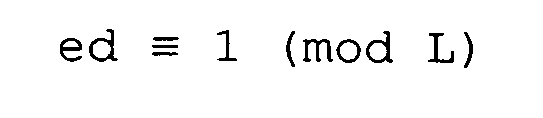
où L est le plus petit commun multiple de p1-1, p2-1, ..., pN-1, le procédé comprenant les étapes consistant à :obtenir des résidus Mp1k1, Mp2k2, ..., MpNkN modulo p1 k1, p2 k2, ..., pN kN, respectivement, du texte en clair M en utilisant un calcul en boucle par rapport à la première clé privée p1, p2, ..., pN ; etreconstituer le texte en clair M en appliquant le théorème du reste chinois aux résidus Mp1k1, Mp2k2, ..., MpNkN ;CARACTERISE EN CE QUEle texte chiffré C est obtenu en utilisant la première clé privée procurée par les deux nombres premiers p1 = p et p2 = q et la première clé publique n procurée par le produit pkq où k = k1 ;l'étape d'obtention obtient un résidu K0 modulo p et un résidu Mq modulo q du texte en clair M par le calcul d'exposant modulaire entier de :

où :

et obtient un résidu Mpk modulo pk du texte en clair M en appliquant le calcul en boucle à K0 ; etles étapes de reconstitution appliquent le théorème de reste chinois aux résidus Mpk et Mq ; etle calcul en boucle est effectué par :(a) établir A0 := K0 ;(b) pour i = 1 à (k-1), calculer de manière répétée :


 (c) établir Mpk := Ak-1.
 - Procédé selon la revendication 1, dans lequel l'étape de reconstitution reconstitue le texte en clair M en calculant :


- Procédé selon la revendication 1, dans lequel l'étape de reconstitution reconstitue le texte en clair M en calculant :



- Procédé selon la revendication 1, dans lequel l'étape de reconstitution reconstitue le texte en clair M en calculant :


- Procédé d'authentification pour authentifier un message d'authentification envoyé d'un émetteur à un récepteur, comprenant les étapes consistant à :(a) établir au niveau du côté émetteur une première clé privée procurée par N ≥ 2 nombres premiers p1, p2, ... , pN, une première clé publique procurée par le produit p1 k1 p2 k2 ... pN kN où k1, k2, ... kN sont des nombres entiers positifs arbitraires, une seconde clé publique e et une seconde clé privée d qui satisfont :
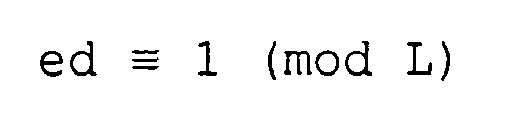
où L est le plus petit commun multiple de p1-1, p2-1, ..., PN-1 ;(b) obtenir au niveau du côté émetteur un authentificateur h(M) en hachant le message d'authentification M en utilisant une fonction de hachage h ;(c) obtenir au niveau du côté émetteur un authentificateur chiffré h(C) de l'authentificateur h(M) en conformité avec : (d) émettre l'authentificateur chiffré h(C) et le message d'authentification M de l'émetteur au récepteur ;(e) obtenir au niveau du côté récepteur, un premier authentificateur h(M)1 en calculant h(C)e (mod n) depuis l'authentificateur chiffré h(C) reçu de l'émetteur en utilisant la seconde clé publique e ;(f) obtenir au niveau du côté récepteur un second authentificateur h(M)2 en hachant le message d'authentification M reçu de l'émetteur en utilisant la fonction de hachage h ; et(g) juger de l'authenticité du message d'authentification M au niveau du côté récepteur en vérifiant si le premier authentificateur h(M)1 et le second authentificateur h(M)2 coïncident ou non ;CARACTERISE EN CE QUEl'authentificateur chiffré h(C) est obtenu en utilisant la première clé privée procurée par les deux nombres premiers p1 = p et p2 = q et la première clé publique n procurée par le produit pkq où k = k1 ;l'étape (c) obtient un résidu h(K)0 modulo p et un résidu h(C)q modulo q de l'authentificateur chiffré h(C) par des calculs d'exposant modulaire d'entier de :

où :

et obtient un résidu h(C)pk modulo pk de l'authentificateur chiffré h(C) en appliquant le calcul en boucle à h(K)0, et applique le théorème de reste chinois aux résidus h(c)pk et h(C)q ; etle calcul en boucle est effectué par :(a) établir h(A)0 := h (K) 0 ;(b) pour i = 1 à (k-1), calculer de manière répétée :


 (c) établir h(C)pk : = h(A)k-1.
 - Procédé selon la revendication 5, dans lequel l'étape (c) applique le théorème de reste chinois en calculant :


- Procédé selon la revendication 5, dans lequel l'étape (c) applique le théorème de reste chinois en calculant :


- Procédé selon la revendication 5, dans lequel l'étape (c) applique le théorème de reste chinois en calculant :



- Appareil de déchiffrage pour déchiffrer un texte chiffré C obtenu à partir d'un texte ordinaire M en conformité avec :

en utilisant une première clé privée procurée par N≥2 nombres premiers p1, p2, ..., pN, une première clé publique n procurée par un produit p1 k1 p2 k2 ... pN kN où k1, k2, ..., kN sont des nombres entiers positifs arbitraires, une seconde clé publique e et une seconde clé privée d qui satisfont :
où L est le plus petit commun multiple de p1-1, p2-1, ..., pN-1, l'appareil comprenant :une unité de traitement de calcul pour obtenir des résidus Mp1k1, Mp2k2, ... MpNkN modulo p1 k1, p2 k2, ..., pN kN respectivement du texte en clair M en utilisant un calcul en boucle par rapport à la première clé privée p1, p2, ..., pN ; etune unité de traitement de déchiffrage pour reconstituer le texte en clair M en appliquant le théorème de reste chinois aux résidus Mp1k1, Mp2k2, ... MpNkN ;CARACTERISE EN CE QUEle texte chiffré C est obtenu en utilisant la première clé privée procurée par les deux nombres premiers p1 = p et p2 = q et la première clé publique n procurée par le produit pkq où k = k1 ;l'unité de traitement de calcul est adaptée pour obtenir un résidu K0 modulo p et un résidu Mq modulo q du texte en clair M, par des calculs d'exposant modulaire d'entier de :

où

et est adaptée pour obtenir un résidu Mpk modulo pk du texte en clair M en appliquant le calcul en boucle à K0 ; etl'unité de traitement de déchiffrage de reconstitution est adaptée pour appliquer le théorème de reste chinois aux résidus Mpk et Mq ; etle calcul en boucle est effectué par :(a) établir A0 := K0 ;(b) pour i = 1 à (k-1), calculer de manière répétée :


 (c) établir Mpk : = Ak-1.
 - Système de communication chiffré, comprenant :un appareil émetteur ayant :une unité de traitement de génération de clés de chiffrage/déchiffrage pour établir N ≥ 2 nombres premiers p1, p2, ..., pN comme première clé privée, et un produit p1 k1 p2 k2 ...., pN kN comme première clé publique n, où k1, , k2, ..., kN sont des nombres entiers positifs arbitraires, et déterminer une seconde clé publique e et une seconde clé privée d qui satisfont :

où L est le plus petit commun multiple de p1-1, p2-1, ..., pN-1, en utilisant la première clé privée ; etune unité de traitement de chiffrage pour obtenir un texte chiffré C à partir d'un texte en clair M en conformité avec :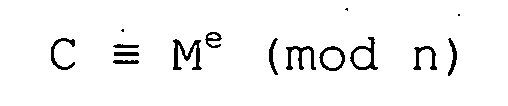 un appareil récepteur ayant :CARACTERISE EN CE QUEune unité de traitement de calcul pour obtenir des résidus Mp1k1, Mp2k2, ... MpNkN module p1 k1, pk2, ..., pN KN respectivement, du texte en clair M en utilisant un calcul en boucle par rapport à la première clé privée p1, p2, ..., pN ; etune unité de traitement de déchiffrage pour reconstituer le texte en clair M en appliquant le théorème de reste chinois aux résidus Mp1k1, Mp2k2, ... MpNkN ;le texte chiffré C est obtenu en utilisant la première clé privée procurée par les deux nombres premiers p1 = p et p2 = q et la première clé publique n procurée par le produit pkq où k = k1 ;l'unité de traitement de calcul est adaptée pour obtenir un résidu K0 modulo p et un résidu Mq modulo q du texte ordinaire M, par des calculs d'exposant modulaire entier de :

où

et est adaptée pour obtenir un résidu Mpk modulo pk du texte en clair M en appliquant le calcul en boucle à K0 ; etl'unité de traitement de déchiffrage est adaptée pour appliquer le théorème de reste chinois aux résidus Mpk et Mq ; etle calcul en boucle est effectué par :(a) établir A0 : K0 ;(b) pour i = 1 à (k-1), calculer de manière répétée :



 (c) établir Mpk := Ak-1.
 - Appareil émetteur de message d'authentification pour utilisation dans l'authentification d'un message d'authentification émis depuis un émetteur vers un récepteur, l'appareil comprenant :une unité de traitement de génération de clés de chiffrage/déchiffrage pour établir au niveau du côté émetteur une première clé privée procurée par N ≥ 2 nombres premiers p1, p2, ..., pN, une première clé publique n procurée par un produit p1 k1 p2 k2 ... pN kN où k1, k2, ..., kN sont des nombres entiers positifs arbitraires, une seconde clé publique e et une seconde clé privée d qui satisfont :

où L est le plus petit commun multiple de p1-1, p2-1, ..., PN-1 ;une unité de traitement de hachage de message d'authentification pour obtenir au niveau du côté émetteur un authentificateur h(M) en hachant le message d'authentification M en utilisant une fonction de hachage h ; etune unité de traitement de chiffrage d'authentificateur pour obtenir au niveau du côté émetteur un authentificateur chiffré h(C) de l'authentificateur h(M) en conformité avec :CARACTERISE EN CE QUE l'authentificateur chiffré h(C) est obtenu en utilisant la première clé privée procurée par les deux nombres premiers p1 = p et p2 = q et la première clé publique n procurée par le produit pkq où k = k1 ;l'unité de traitement de chiffrage d'authentification est adaptée pour obtenir un résidu h(K)0 modulo p et un résidu h(C)q modulo q de l'authentificateur chiffré h(C), par des calculs d'exposant modulaire d'entier de :

où
 le calcul en boucle est effectué par :(a) établir h(A)0 := h (K)0 ;(b) pour i = 1 à (k-1), calculé de manière répétée :


 (c) établir h (C) pk := h(A)k-1.
 - Système d'authentification pour authentifier un message d'authentification émis depuis un émetteur vers un récepteur, le système comprenant :un appareil émetteur ayant :une unité de traitement de génération de clé de chiffrage/déchiffrage pour établir au niveau du côté émetteur une première clé privée procurée par N ≥ 2 nombres premiers p1, p2, ... , pN ; une première clé publique n procurée par un produit p1 k1, p2 k2, ..., pN kN où k1, k2, ..., kN sont des nombres entiers positifs arbitraires, une seconde clé publique e et une seconde clé privée d qui satisfont :

où L est le multiplicateur le moins commun de p1-1, p2-1, ..., pN-1 ;une unité de traitement de hachage de message d'authentification pour obtenir au niveau du côté émetteur un authentificateur (M) en hachant le message d'authentification M en utilisant une fonction de hachage h ; etune unité de traitement de chiffrage d'authentificateur pour obtenir au niveau du côté émetteur un authentificateur chiffré h(C) de l'authentificateur h(M) en conformité avec : un appareil récepteur ayant :CARACTERISE EN CE QUEune unité de traitement de déchiffrage d'authentificateur pour obtenir un premier authentificateur h(M)1 par le calcul de h(C)e (mod n) depuis l'authentificateur chiffré h(C) reçu de l'émetteur en utilisant la seconde clé publique e ;une unité de traitement de hachage de message d'authentification pour obtenir un second authentificateur h(M)2 en hachant le message d'authentification M reçu de l'émetteur en utilisant la fonction de hachage h ; etune unité de traitement de vérification d'authenticité pour juger de l'authenticité du message d'authentification M en vérifiant si le premier authentificateur h(M)1 et le second authentificateur h(M)2 coïncident ou non ;l'authentificateur chiffré h(C) est obtenu en utilisant la première clé privée procurée par les deux nombres premiers p1 = p et p2 = q et la première clé publique n procurée par le produit pkq où k = k1 ;l'unité de traitement de chiffrage d'authentification est adaptée pour obtenir un résidu h(K)0 modulo p et un résidu h(k)0 modulo q de l'authentificateur chiffré h(C) par les calculs d'exposant modulaire d'entier de :

où

et est adapté pour obtenir un résidu h(C)pk modulo pk de l'authentificateur chiffré h(C) en appliquant le calcul en boucle à h(K)0, et est adapté pour appliquer le théorème de reste chinois aux résidus h(C)pk et h(C)q ; etle calcul en boucle est effectué par :(a) établir h (C)0:= h(K)0 ;(b) pour i = 1 à (k-1), calculé de manière répétée :


 (c) établir h (C)pk := h(A)k-1.
 - Support utilisable pour ordinateur ayant un moyen de code programme lisible par ordinateur incorporé dans celui-ci pour amener un ordinateur à fonctionner comme appareil de déchiffrage pour déchiffrer un texte chiffré C obtenu à partir d'un texte en clair M en conformité avec :

en utilisant une première clé privée procurée par N ≥ 2 nombres premiers p1, p2, ..., pN, une première clé publique n procurée par un produit p1 k1, p2 k2, ..., pN kN où k1, k2, ..., kN sont des nombres entiers positifs arbitraires, une seconde clé publique e et une seconde clé privée d qui satisfont :
où L est le plus petit commun multiple de p1-1, p2-1, ..., pN-1, le moyen de code programme lisible par ordinateur inclut :un premier moyen de code programme lisible par ordinateur pour amener ledit ordinateur à obtenir les résidus Mp1k1, Mp2k2, ..., MpNkN modulo p1 k1, p2 k2, ..., pN kN, respectivement, du texte en clair M en utilisant un calcul en boucle par rapport à la première clé privée p1, p2, ... , pN ; etun second moyen de code programme lisible par ordinateur pour amener ledit ordinateur à reconstituer le texte en clair M en appliquant le programme de reste chinois aux résidus Mp1k1, Mp2k2, ..., MpNkN ;CARACTERISE EN CE QUEle texte chiffré C est obtenu en utilisant la première clé privée procurée par deux nombres premiers p1 = p et p2 = q et la première clé publique n procurée par le produit pkq où k = k1 ;le premier moyen de code programme lisible par ordinateur obtient un résidu K0 modulo p et un résidu Mq modulo q du texte en clair M, par les calculs d'exposant modulaire d'entier de :


et obtient un résidu Mpk modulo pk du texte ordinaire M en appliquant le calcul en boucle k0 ; etle second moyen de code programme lisible par ordinateur applique le théorème de reste chinois aux résidus Mpk et Mq ; etle calcul en boucle est effectué par :(a) établir A0 : k0 ;(b) pour i = 1 à (k-1), calculé de manière répétée :



 (c) établir Mpk := Ak-1.
 - Support utilisable par ordinateur ayant un moyen de code programme lisible par ordinateur incorporé dans celui-ci pour amener un ordinateur à fonctionner comme appareil émetteur de message d'authentification pour utilisation dans l'authentification d'un message d'authentification émis depuis un émetteur vers un récepteur, le moyen de code programme lisible par ordinateur inclut :un premier moyen de code programme lisible par ordinateur pour amener ledit ordinateur à établir au niveau du côté émetteur une première clé privée procurée par N ≥ 2 nombres premiers p1, p2, ..., pN, une première clé publique n procurée par un produit p1 k1, p2 k2, ..., pN kN, où k1, k2, ..., kN sont des nombres entiers positifs arbitraires, une seconde clé publique e et une seconde clé privée e qui satisfont :
 un second moyen de code programme lisible par ordinateur pour amener ledit ordinateur à obtenir au niveau du côté émetteur un authentificateur h(M) en hachant le message d'authentification M en utilisant une fonction de hachage h, etun troisième moyen de code programme lisible par ordinateur pour amener ledit ordinateur à obtenir au niveau du côté émetteur un authentificateur chiffré h(C) de l'authentificateur h(M) en conformité avec :CARACTERISE EN CE QUE
en obtenant les résidus h(C)p1k1, h(C)p2k2, ..., h(C)pNkN modulo p1 k1, p2 k2, ..., pN kN, respectivement, de l'authentificateur chiffré h(C) en utilisant un calcul en boucle par rapport à la première clé privée p1, p2, ..., pN, et en appliquant le théorème de reste chinois aux résidus h (C)p1k1, h(C)p2k2, ...., h(C)pNkN, et en émettant ensuite l'authentificateur chiffré h(C) et le message d'authentification M vers le récepteur :l'authentificateur chiffré h(C) est obtenu en utilisant la première clé privée procurée par les deux nombres premiers p1 = p et p2 = q et la première clé publique n procurée par le produit pkq où k = k1 ;le troisième moyen de code programme lisible par ordinateur obtient un résidu h(k)0 modulo p et un résidu h(C)q modulo q de l'authentificateur chiffré h(C) par des calculs d'exposant modulaire de nombre d'entier de :


et obtient un résidu h(C)pk modulo pk de l'authentificateur chiffré h(C) en appliquant le calcul en boucle à h(k)0, et applique le théorème de reste chinois aux résidus h(C)pk et h(C)q ; etle calcul en boucle est effectué par :(a) établir h (A)0 = h (K)0 ;(b) pour i=1 à (k-1) est calculé de manière répétée



 (c) établir h(C)pk := h(A)k-1.
Applications Claiming Priority (5)
| Application Number | Priority Date | Filing Date | Title |
|---|---|---|---|
| JP7983698 | 1998-03-26 | ||
| JP7983698 | 1998-03-26 | ||
| JP23608498 | 1998-08-21 | ||
| JP23608798 | 1998-08-21 | ||
| JP23608498 | 1998-08-21 |
Publications (3)
| Publication Number | Publication Date |
|---|---|
| EP0946018A2 EP0946018A2 (fr) | 1999-09-29 |
| EP0946018A3 EP0946018A3 (fr) | 2002-08-14 |
| EP0946018B1 true EP0946018B1 (fr) | 2007-03-14 |
Family
ID=26420835
Family Applications (1)
| Application Number | Title | Priority Date | Filing Date |
|---|---|---|---|
| EP99105099A Expired - Lifetime EP0946018B1 (fr) | 1998-03-26 | 1999-03-25 | Procédé de réalisation rapide d'un d'un déchiffrage ou d'une authentification |
Country Status (4)
| Country | Link |
|---|---|
| US (1) | US6396926B1 (fr) |
| EP (1) | EP0946018B1 (fr) |
| CA (1) | CA2267721C (fr) |
| DE (1) | DE69935469T2 (fr) |
Cited By (4)
| Publication number | Priority date | Publication date | Assignee | Title |
|---|---|---|---|---|
| US7757278B2 (en) | 2001-01-04 | 2010-07-13 | Safenet, Inc. | Method and apparatus for transparent encryption |
| US7958091B2 (en) | 2006-02-16 | 2011-06-07 | Ingrian Networks, Inc. | Method for fast bulk loading data into a database while bypassing exit routines |
| US8379865B2 (en) | 2006-10-27 | 2013-02-19 | Safenet, Inc. | Multikey support for multiple office system |
| US8386768B2 (en) | 2006-02-08 | 2013-02-26 | Safenet, Inc. | High performance data encryption server and method for transparently encrypting/decrypting data |
Families Citing this family (33)
| Publication number | Priority date | Publication date | Assignee | Title |
|---|---|---|---|---|
| FR2799851B1 (fr) * | 1999-10-14 | 2002-01-25 | Gemplus Card Int | Procede de contre-mesure dans un composant electronique mettant en oeuvre un algorithme de cryptographie a cle publique de type rsa |
| DE19962915A1 (de) | 1999-12-23 | 2001-09-06 | Intelligent Implants Gmbh | Vorrichtung für den geschützten Betrieb von Neuroprothesen und Verfahren hierzu |
| US20020039420A1 (en) * | 2000-06-12 | 2002-04-04 | Hovav Shacham | Method and apparatus for batched network security protection server performance |
| US20020087884A1 (en) * | 2000-06-12 | 2002-07-04 | Hovav Shacham | Method and apparatus for enhancing network security protection server performance |
| FI111208B (fi) * | 2000-06-30 | 2003-06-13 | Nokia Corp | Datan salauksen järjestäminen langattomassa tietoliikennejärjestelmässä |
| US20040015725A1 (en) * | 2000-08-07 | 2004-01-22 | Dan Boneh | Client-side inspection and processing of secure content |
| US7137143B2 (en) | 2000-08-07 | 2006-11-14 | Ingrian Systems Inc. | Method and system for caching secure web content |
| US6721771B1 (en) * | 2000-08-28 | 2004-04-13 | Sun Microsystems, Inc. | Method for efficient modular polynomial division in finite fields f(2{circumflex over ( )}m) |
| US6772184B2 (en) * | 2000-08-28 | 2004-08-03 | Sun Microsystems, Inc. | Method for efficient modular division over prime integer fields |
| US20020041683A1 (en) * | 2000-09-29 | 2002-04-11 | Hopkins Dale W. | Method for selecting optimal number of prime factors of a modulus for use in a cryptographic system |
| KR100340102B1 (ko) * | 2000-11-30 | 2002-06-10 | 조휘갑 | 알에스에이 공개키 암호 고속화 장치 및 방법 |
| DE10061697A1 (de) * | 2000-12-12 | 2002-06-27 | Infineon Technologies Ag | Verfahren und Vorrichtung zum Ermitteln eines Schlüsselpaars und zum Erzeugen von RSA-Schlüsseln |
| US20020116429A1 (en) * | 2000-12-19 | 2002-08-22 | International Business Machines Corporation | System and method for modular multiplication |
| US6963977B2 (en) * | 2000-12-19 | 2005-11-08 | International Business Machines Corporation | Circuits and methods for modular exponentiation |
| JP4199937B2 (ja) | 2001-03-06 | 2008-12-24 | 株式会社日立製作所 | 耐タンパー暗号処理方法 |
| US7221757B2 (en) * | 2002-08-15 | 2007-05-22 | Opentv, Inc. | Method and system for accelerated data encryption |
| US20070107067A1 (en) * | 2002-08-24 | 2007-05-10 | Ingrian Networks, Inc. | Secure feature activation |
| US20060149962A1 (en) * | 2003-07-11 | 2006-07-06 | Ingrian Networks, Inc. | Network attached encryption |
| US8442219B2 (en) * | 2004-03-31 | 2013-05-14 | Jesse Lipson | Public key cryptographic methods and systems |
| US7519835B2 (en) | 2004-05-20 | 2009-04-14 | Safenet, Inc. | Encrypted table indexes and searching encrypted tables |
| US20060251248A1 (en) * | 2005-05-03 | 2006-11-09 | Jesse Lipson | Public key cryptographic methods and systems with preprocessing |
| US20070079386A1 (en) * | 2005-09-26 | 2007-04-05 | Brian Metzger | Transparent encryption using secure encryption device |
| US20070079140A1 (en) * | 2005-09-26 | 2007-04-05 | Brian Metzger | Data migration |
| US7853018B2 (en) | 2005-11-10 | 2010-12-14 | Atallah Mikhail J | Method and apparatus for hiding a private key |
| US7848516B2 (en) * | 2006-01-20 | 2010-12-07 | Chiou-Haun Lee | Diffused symmetric encryption/decryption method with asymmetric keys |
| FR2897964B1 (fr) * | 2006-02-28 | 2017-01-13 | Atmel Corp | Procede de calcul numerique incluant la division euclidienne |
| US8229109B2 (en) * | 2006-06-27 | 2012-07-24 | Intel Corporation | Modular reduction using folding |
| US7925011B2 (en) * | 2006-12-14 | 2011-04-12 | Intel Corporation | Method for simultaneous modular exponentiations |
| US8689078B2 (en) | 2007-07-13 | 2014-04-01 | Intel Corporation | Determining a message residue |
| US20090132804A1 (en) * | 2007-11-21 | 2009-05-21 | Prabir Paul | Secured live software migration |
| US8042025B2 (en) * | 2007-12-18 | 2011-10-18 | Intel Corporation | Determining a message residue |
| US7886214B2 (en) * | 2007-12-18 | 2011-02-08 | Intel Corporation | Determining a message residue |
| KR102273770B1 (ko) | 2016-07-19 | 2021-07-06 | 삼성에스디아이 주식회사 | 배터리 시스템 |
Family Cites Families (8)
| Publication number | Priority date | Publication date | Assignee | Title |
|---|---|---|---|---|
| US4405829A (en) * | 1977-12-14 | 1983-09-20 | Massachusetts Institute Of Technology | Cryptographic communications system and method |
| JPS58190151A (ja) | 1982-04-30 | 1983-11-07 | Nec Corp | 符号変換器 |
| WO1990002456A1 (fr) * | 1988-08-19 | 1990-03-08 | Ncr Corporation | Procede de diversification de cles publiques |
| EP0381523A3 (fr) * | 1989-02-02 | 1993-03-03 | Kabushiki Kaisha Toshiba | Procédé de calcul assisté par serveur et unité distribuée de traitement d'information |
| FR2737369A1 (fr) * | 1995-07-26 | 1997-01-31 | Trt Telecom Radio Electr | Systeme de communication de messages cryptes selon un procede de type r.s.a. |
| JPH1165439A (ja) * | 1996-08-09 | 1999-03-05 | Nippon Telegr & Teleph Corp <Ntt> | N進表現暗号による通信および認証方法、ならびにそれらの装置、およびn進表現暗号による通信および認証プログラムを格納した記憶媒体 |
| US5848159A (en) * | 1996-12-09 | 1998-12-08 | Tandem Computers, Incorporated | Public key cryptographic apparatus and method |
| JP3402441B2 (ja) | 1997-12-17 | 2003-05-06 | 日本電信電話株式会社 | 公開鍵暗号化装置、公開鍵暗号復号装置及び復号プログラム記録媒体 |
-
1999
- 1999-03-24 CA CA002267721A patent/CA2267721C/fr not_active Expired - Fee Related
- 1999-03-25 EP EP99105099A patent/EP0946018B1/fr not_active Expired - Lifetime
- 1999-03-25 DE DE69935469T patent/DE69935469T2/de not_active Expired - Fee Related
- 1999-03-26 US US09/280,150 patent/US6396926B1/en not_active Expired - Fee Related
Cited By (4)
| Publication number | Priority date | Publication date | Assignee | Title |
|---|---|---|---|---|
| US7757278B2 (en) | 2001-01-04 | 2010-07-13 | Safenet, Inc. | Method and apparatus for transparent encryption |
| US8386768B2 (en) | 2006-02-08 | 2013-02-26 | Safenet, Inc. | High performance data encryption server and method for transparently encrypting/decrypting data |
| US7958091B2 (en) | 2006-02-16 | 2011-06-07 | Ingrian Networks, Inc. | Method for fast bulk loading data into a database while bypassing exit routines |
| US8379865B2 (en) | 2006-10-27 | 2013-02-19 | Safenet, Inc. | Multikey support for multiple office system |
Also Published As
| Publication number | Publication date |
|---|---|
| CA2267721C (fr) | 2002-07-30 |
| US6396926B1 (en) | 2002-05-28 |
| CA2267721A1 (fr) | 1999-09-26 |
| EP0946018A2 (fr) | 1999-09-29 |
| DE69935469D1 (de) | 2007-04-26 |
| DE69935469T2 (de) | 2007-11-29 |
| EP0946018A3 (fr) | 2002-08-14 |
Similar Documents
| Publication | Publication Date | Title |
|---|---|---|
| EP0946018B1 (fr) | Procédé de réalisation rapide d'un d'un déchiffrage ou d'une authentification | |
| US6259790B1 (en) | Secret communication and authentication scheme based on public key cryptosystem using N-adic expansion | |
| ElGamal | A public key cryptosystem and a signature scheme based on discrete logarithms | |
| EP0997016B1 (fr) | Procede et appareil permettant le cryptage elliptique rapide par integration directe | |
| US5231668A (en) | Digital signature algorithm | |
| Nyberg et al. | Message recovery for signature schemes based on the discrete logarithm problem | |
| US6154541A (en) | Method and apparatus for a robust high-speed cryptosystem | |
| EP0963635B1 (fr) | Construction polynomiale cyclotomique de systemes cryptographiques a logarithme discret sur des corps finis | |
| US6697488B1 (en) | Practical non-malleable public-key cryptosystem | |
| Zheng et al. | Practical approaches to attaining security against adaptively chosen ciphertext attacks | |
| US20020041684A1 (en) | Public-key encryption and key-sharing methods | |
| EP2686978B1 (fr) | Signatures pv à clé | |
| US7248692B2 (en) | Method of and apparatus for determining a key pair and for generating RSA keys | |
| US6337909B1 (en) | Generation of session keys for El Gamal-like protocols from low hamming weight integers | |
| KR100431047B1 (ko) | Crt에 기초한 rsa 공개키 암호화 방식을 이용한디지털 서명방법 및 그 장치 | |
| US20040208317A1 (en) | Encrypting device, decrypting device, cryptosystem including the same devices, encrypting method, and decrypting method | |
| US6931126B1 (en) | Non malleable encryption method and apparatus using key-encryption keys and digital signature | |
| US7519178B1 (en) | Method, system and apparatus for ensuring a uniform distribution in key generation | |
| JP3041293B2 (ja) | 暗号化方法、復号化方法、認証方法、暗号化装置、復号化装置、認証装置、認証文送信者装置、認証文受信者装置、暗号通信システム及び認証システム | |
| Wang et al. | Signature schemes based on two hard problems simultaneously | |
| Pon et al. | Dynamic reblocking RSA-based multisignatures scheme for computer and communication networks | |
| Encinas et al. | Maple implementation of the Chor-Rivest cryptosystem | |
| US20060251248A1 (en) | Public key cryptographic methods and systems with preprocessing | |
| EP1148675A1 (fr) | Chiffreur a cle non protegee et procede de partage de cle | |
| EP0854603B1 (fr) | Génération de paramètres de session pour protocoles du type el-gamal |
Legal Events
| Date | Code | Title | Description |
|---|---|---|---|
| PUAI | Public reference made under article 153(3) epc to a published international application that has entered the european phase |
Free format text: ORIGINAL CODE: 0009012 |
|
| 17P | Request for examination filed |
Effective date: 19990325 |
|
| AK | Designated contracting states |
Kind code of ref document: A2 Designated state(s): AT BE CH CY DE DK ES FI FR GB GR IE IT LI LU MC NL PT SE |
|
| AX | Request for extension of the european patent |
Free format text: AL;LT;LV;MK;RO;SI |
|
| K1C1 | Correction of patent application (title page) published |
Effective date: 19990929 |
|
| RIN1 | Information on inventor provided before grant (corrected) |
Inventor name: NAITO, SHOZO, C/O NIPPON T. & T. CORPORATION Inventor name: TAKAGI, TSUYOSHI, C/O NIPPON T.& T. CORPORATION |
|
| PUAL | Search report despatched |
Free format text: ORIGINAL CODE: 0009013 |
|
| AK | Designated contracting states |
Kind code of ref document: A3 Designated state(s): AT BE CH CY DE DK ES FI FR GB GR IE IT LI LU MC NL PT SE |
|
| AX | Request for extension of the european patent |
Free format text: AL;LT;LV;MK;RO;SI |
|
| AKX | Designation fees paid |
Designated state(s): DE FR |
|
| 17Q | First examination report despatched |
Effective date: 20030414 |
|
| GRAP | Despatch of communication of intention to grant a patent |
Free format text: ORIGINAL CODE: EPIDOSNIGR1 |
|
| RTI1 | Title (correction) |
Free format text: SCHEME FOR FAST REALIZATION OF A DECRYPTION OR AN AUTHENTICATION |
|
| GRAS | Grant fee paid |
Free format text: ORIGINAL CODE: EPIDOSNIGR3 |
|
| GRAA | (expected) grant |
Free format text: ORIGINAL CODE: 0009210 |
|
| AK | Designated contracting states |
Kind code of ref document: B1 Designated state(s): DE FR |
|
| REF | Corresponds to: |
Ref document number: 69935469 Country of ref document: DE Date of ref document: 20070426 Kind code of ref document: P |
|
| ET | Fr: translation filed | ||
| PLBE | No opposition filed within time limit |
Free format text: ORIGINAL CODE: 0009261 |
|
| STAA | Information on the status of an ep patent application or granted ep patent |
Free format text: STATUS: NO OPPOSITION FILED WITHIN TIME LIMIT |
|
| 26N | No opposition filed |
Effective date: 20071217 |
|
| PGFP | Annual fee paid to national office [announced via postgrant information from national office to epo] |
Ref country code: FR Payment date: 20090327 Year of fee payment: 11 Ref country code: DE Payment date: 20090326 Year of fee payment: 11 |
|
| REG | Reference to a national code |
Ref country code: FR Ref legal event code: ST Effective date: 20101130 |
|
| PG25 | Lapsed in a contracting state [announced via postgrant information from national office to epo] |
Ref country code: FR Free format text: LAPSE BECAUSE OF NON-PAYMENT OF DUE FEES Effective date: 20100331 |
|
| PG25 | Lapsed in a contracting state [announced via postgrant information from national office to epo] |
Ref country code: DE Free format text: LAPSE BECAUSE OF NON-PAYMENT OF DUE FEES Effective date: 20101001 |