EP0947923A2 - Kompilierverfahren, Kompiliervorrichtung, Aufzeichnungsmedium mit darauf aufgezeichnetem Kompilierprogramm, und Aufzeichnungsmedium mit darauf aufgezeichneter, bei der Kompilierung verwendeter Umwandlungstübereinstimmenden Zielprogrammes - Google Patents
Kompilierverfahren, Kompiliervorrichtung, Aufzeichnungsmedium mit darauf aufgezeichnetem Kompilierprogramm, und Aufzeichnungsmedium mit darauf aufgezeichneter, bei der Kompilierung verwendeter Umwandlungstübereinstimmenden Zielprogrammes Download PDFInfo
- Publication number
- EP0947923A2 EP0947923A2 EP99106704A EP99106704A EP0947923A2 EP 0947923 A2 EP0947923 A2 EP 0947923A2 EP 99106704 A EP99106704 A EP 99106704A EP 99106704 A EP99106704 A EP 99106704A EP 0947923 A2 EP0947923 A2 EP 0947923A2
- Authority
- EP
- European Patent Office
- Prior art keywords
- code
- low
- level
- level code
- conversion table
- Prior art date
- Legal status (The legal status is an assumption and is not a legal conclusion. Google has not performed a legal analysis and makes no representation as to the accuracy of the status listed.)
- Withdrawn
Links
Images






Classifications
-
- G—PHYSICS
- G06—COMPUTING OR CALCULATING; COUNTING
- G06F—ELECTRIC DIGITAL DATA PROCESSING
- G06F8/00—Arrangements for software engineering
- G06F8/40—Transformation of program code
- G06F8/41—Compilation
- G06F8/44—Encoding
- G06F8/447—Target code generation
-
- G—PHYSICS
- G06—COMPUTING OR CALCULATING; COUNTING
- G06F—ELECTRIC DIGITAL DATA PROCESSING
- G06F8/00—Arrangements for software engineering
- G06F8/40—Transformation of program code
- G06F8/41—Compilation
- G06F8/47—Retargetable compilers
Definitions
- the present invention relates to a method of compiling a source program to generate a mechanical level program (hereinafter referred to as the target program), particularly to a method in which the target program can be generated in accordance with a type of processor (hereinafter referred to as the target processor) for operating the target program from one source program.
- the present invention also relates to a device for realizing the method, a recording medium in which a program for allowing a computer to execute a processing based on the method is stored, and a recording medium in which a conversion table for use in the processing based on the method is recorded.
- FIG. 13 is a flowchart showing the first conventional example.
- code generation means when an intermediate language code command is generated from a source program, and a code of target program is generated from the intermediate language code command, code generation means is used.
- a generation code table comprising at least one generation code pattern (generation code with a header attached thereto), and a content of change of the generation code pattern (cependent on program) are transmitted to the code generator means. Additionally, the header attached to the generation code indicates what change is made on the generation code.
- a compiler code generation device successively fetches the generation code pattern from the generation code table. Subsequently, the change content dependent on program is developed in a code in accordance with the type of the header attached to the generation code, which is formed into a code to be generated.
- the compiler code generation device can be prepared only by changing the content of the generation code table.
- generation code tables need to be individually prepared for the types of target processors. Specifically, every time the target processor is changed, all the generation code patterns have to be changed. When a large number of types of target processors are to be handled, the amount of the generation code table is enormously increased, and an amount of operations necessary for generating the generation code table is disadvantageously increased.
- the type of the target processor when the type of the target processor is changed, not only the generation code pattern but also the way of developing the change content dependent on program into the generation code are influenced.
- the influence is caused by a difference in architecture of the target processor.
- difference of architecture in determinations of a loop upper or lower bound repeated integer times, a comparison command including an equal sign is used in some target processor, while a comparison command excluding the equal sign is used in the other target processor.
- an immediate value forming the loop upper or lower bound value may vary in the generation code in accordance with the type of the target processor.
- the way of developing the change content dependent on program into the generation code is limited to the way designated as a header type. Therefore, the first conventional system can only be used for a target processor gap at a limited type in which the way of development is the same as a source program format. For example, in the system, a program (target program) for a microprocessor manufactured by a specified maker can be generated, but a program for a microprocessor manufactured by another maker cannot be generated. Therefore, the first conventional system has a problem that the types of target processors are limited.
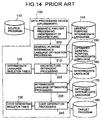
- FIG. 14 is a functional block diagram showing the second conventional example.
- a compiler 100 for realizing the compiling system comprises a semantic analysis processing section 200 independent of architecture, general-purpose intermediate language optimization processing section 210, architecture-dependent processing section 220, intermediate language optimization processing section 230, code generation processing section 240, intermediate language skeleton table 120, and code generating skeleton table 130.
- compiling is performed as follows:
- a semantic analysis processing of inputted source program 110 is performed, and a general-purpose intermediate language 140 independent of architecture is outputted.
- a general-purpose intermediate language optimization processing section 210 if necessary, a conversion for optimization of general-purpose intermediate language is performed, and results are outputted as an optimized general-purpose intermediate language 150.
- a processing dependent on architecture related with a conventional semantic analysis is performed in the architecture-dependent processing section 220.
- an intermediate language 160 dependent on computer architecture is generated from the optimized general-purpose intermediate language 150 using the intermediate language skeleton table 120.
- the intermediate language optimization processing section 230 the intermediate language 160 is optimized to output an optimized intermediate language 170.
- a target program 180 comprising a machine language command sequence and the like is generated from the optimized intermediate language 170 using the code generating skeleton table 130.
- a high-performance object is generated by separating the processing dependent on computer architecture from the semantic analysis processing.
- the architecture-dependent section is separated from the semantic analysis processing. Therefore, every time the architecture is changed, the intermediate language skeleton table needs to be changed.
- the code generating skeleton table needs to be separately prepared for each type of target processor. Specifically, every time the target processor is changed, all code generating skeleton tables need to be changed. As a result, when a large number of types of target processors are to be handled, the amount of the code generating skeleton table disadvantageously becomes enormous. Furthermore, when the amount of code generating skeleton table is enormous, the amount of operations necessary for preparing the code generating skeleton table is disadvantageously increased.
- the present invention has been developed to solve the above-mentioned problem, and an object thereof is to provide a compiling method in which a change amount of conversion table accompanied with a change of target processor type can be reduced.
- output codes indicating the same or similar function are usually included in output codes for a target program operated in a plurality of different target processors. They have found that when the output codes indicating the same or similar function is associated with one code of intermediate language, at least a part of the conversion table can be made common, so that the change amount of the conversion table accompanied with the change of target program can be reduced.
- a compiling method comprising a front end processing step of generaing a high-level code independent of a target program type from a source program, and a code generating step of generating an output code for a desired target program from the high-level code, the code generating step comprising:
- a compiling device comprising a front end processing section for generating a high-level code independent of a target program type from a source program, and a code generating section for generating an output code for a desired target program from the high-level code, the code generating section comprising:
- a recording medium which stores a program for allowing a computer to execute a front end processing of generating a high-level code independent of a target program type from a source program, and a code generation processing of generating an output code for a desired target program from the high-level code, the code generation processing comprising:
- a recording medium which stores a conversion table for use in a processing of generating a high-level code independent of a target program type from a source program and generating an output code for a desired target program from the high-level code, the conversion table comprising:
- the second conversion table is prepared for each of different types of target programs.
- the output codes indicating the same or similar function are associated with the common low-level code.
- the conversion table can be made common, in the present invention, all the first and second conversion tables do not need to be changed when the type of the target processor is changed.
- a part of each of the first and second conversion tables for a certain type of target processor can be used as a part of each of the first and second conversion tables (also referred to together as the conversion table) for another type of target processor. Therefore, according to the present invention, the change amount of conversion table accompanied with the change of target processor type can be reduced.
- the change amount of conversion table can be reduced, the amount of operations for changing the conversion table can be reduced.
- the first and second conversion tables are preferably stored in storage devices, respectively.
- the storage device may store the first and second conversion tables for one target processor, or may store the first and second conversion tables for a plurality of target processors.
- the compiling processing device of the present invention is preferably provided with a first storage device storing the first conversion table. Moreover, a second storage device storing the second conversion table may preferably be provided.
- these first and second conversion tables may be provided inside or outside the code generating section.
- the first and second storage devices may be constituted of two different storage areas or one storage device.
- At least one of the first and second conversion tables is preferably stored in an external storage device.
- the external storage device may store both the first and second conversion tables, only the first conversion table, or only the second conversion table.
- the target processor type when the target processor type is changed, not only the generation code pattern but also the way of developing the change content dependent on program into the generation code may need to be changed.
- the immediate value to be developed in the generation code needs to be changed and determined based on information dependent on target processor such as a target command (operator) and operand attribute.
- the second conversion table preferably includes a low-level operator as the low-level code, and includes an output operator and an output operand of the output operator as the output code.
- the second conversion table preferably includes a low-level operand of the low-level operator.
- FIG. 1 is a block diagram showing an entire configuration of the first embodiment.
- FIG. 2 is also a block diagram showing a configuration of a code generating section.
- a compiling device 10 of the first embodiment is a device for generating a code 14 for a target program operated in a target processor (hereinafter referred to as the output code 14) from a source program 12, comprising a front end processing section 16, and a code generating section 18.
- the front end processing section 16 performs a semantic analysis of the inputted source program 12 to generate a high-level intermediate language code 20 independent of a target program type from a code of source program 12 (hereinafter referred to as the high-level code 20). Additionally, for a method of semantic analysis in the front end processing section 16, the same method as that in the prior art can be used.
- the code generating section 18 generates the output code 14 from the high-level code 20.
- the code generating section 18 is provided with a first converting section 22, first storage device 24, second converting section 26, and second storage device 28.
- the first converting section 22 refers to a first conversion table stored in the first storage device 24 to generate a low-level intermediate language code 30 (hereinafter referred to as the low-level code 30) from the high-level code 20.
- FIG. 3 shows an example of first conversion table.
- the high-level codes 20 are stored on the left side of the table, and the corresponding low-level codes 30 are stored on the right side.
- CMPFEQU and BFF as the low-level codes 30 corresponding to "relop_EQ_float”
- GMPLT and EBEQU as the low-level codes 30 corresponding to "cmp_and_br_LE”
- CMPLT and BEQU as the low-level codes 30 corresponding to "cmp_and_br_GE”
- CMPLT and EBNEQ as the low-level codes 30 corresponding to "cmp_and_br_GT” are stored, respectively.
- a plurality of low-level codes 30 may correspond to one high-level code 20.
- the plurality of low-level codes associated with one high-level code 20 are hereinafter referred to together as the low-level code pattern.
- the second converting section 26 refers to the second conversion table stored in the second storage device 28 to generate the output code 14 from the low-level code 30.
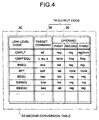
- FIG. 4 shows an example of second conversion table.
- the low-level codes 30 are stored on the left side of the table, while the corresponding output codes 14 are stored on the right side.
- the output code 14 is represented by a combination of target command (operator) 36 and operand 38.
- first to third operands can be designated as the operand 38, which can be provided with different operand attributes.
- CMPLT, CMPFEQU, BNEQ, BFF, BEQU, EBNEQ and EBEQU are stored as the low-level codes 30.
- the low-level code 30 and the output code 14 have one-to-one correspondence.
- the low-level code CMPLT is associated with target command "slt" of output code 14.
- the target command "slt” indicates a function of a command having three registers as the operands 38, for first comparing first and second register values, setting a non-zero value in a third register when the first register value is smaller than the second register value, otherwise setting a zero value to the third register.
- the function is hereinafter referred to as the less-than comparison and value setting.
- first and second operands have attributes "reg", while third operand has an attribute "reg/imm”. Additionally, “reg” indicates a register, and reg/imm” indicates a register or an immediate value. Moreover, the operand attribute of the immediate value indicates that the operand corresponds to the change content of program.
- low-level code CMPFEQU is associated with target command "c.eq.s" of the output code 14.
- the target command "c.eq.s” indicates a function of a command having two registers for floating point as operands, for setting a flag for floating point when values or two floating point registers are equal to each other, otherwise setting no flag for floating point.
- first operand has an attribute of "none”
- second and third operands have an attribute of "freg”. Additionally, "none” indicates that there is no operand, and "freg” indicates a floating point register.
- low-level code BNEQ is associated with target command "bne" of the output code 14.
- the target command "bne” indicates a function of a command having two registers and one label as operands, for shifting control to an address indicated by the label when two register values are equal to each other.
- first operand has an attribute of "lab”
- second and third operands have an attribute of "reg”.
- "lab” indicates a label.
- low-level code BFF is associated with target command "bclf" of the output code 14.
- the target command "bclf” indicates a function of a command having one label as the operand, for shifting control to an address indicated by the label when no floating point flag is set.
- first operand has an attribute of "lab”
- second and third operands have an attribute of "none”.
- first and second conversion tables 32, 34 are recorded and provided, for example, in FD (floppy disc), hard disc or another magnetic recording medium, magneto-optical recording medium, CD-ROM or another optical recording medium, and another arbitrary, preferable recording medium.
- one first conversion table 32 is sufficient irrespective of the target program type.
- the second conversion table 34 needs to be prepared in accordance with the target program type.
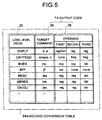
- the second conversion table 34 is prepared for the first target program, but in order to generate output codes for a second target program, a separate second conversion table 34a shown in FIG. 5 needs to be prepared.
- the low-level codes CMPLT, CMPFEQU, BNEQ, BFF, BEQU, EBNEQ and EBEQU in the second conversion table 34 for the first target program are used as the low-level codes 30 also in the second conversion table 34a for the second target program.
- the low-level codes 30 are associated with output codes 14 for the second target program, indicating functions the same as or similar to the output codes 14 in the second conversion tables 34 of FIG. 4.
- low-level code CMPLT is associated with target command "lt.w” of output code in the second conversion table 34a.
- the “lt.w” indicates the function of less-than comparison and setting, and is substantially the same as “slt” in the second conversion table 34.
- first operand has an attribute of "reg/imm”
- second and third operands have an attribute of "reg”.
- low-level code CMPFEQU is associated with target command "cmpeq.s" of output code in the second conversion table 34a.
- the "cmpeq.s” indicates substantially the same function as “c.eq.s” in the second conversion table 34.
- first operand has an attribute of "none”
- second and third operands have an attribute of "freg”.
- low-level code BNEQ is associated with target command "jne" of output code in the second conversion table 34a.
- the “jne” indicates substantially the same function as “bne” in the second conversion table 34.
- first and second operands have an attribute of "reg”
- third operand has an attribute of "lab”.
- low-level code BEF is associated with target command "jff" of output code in the second conversion table 34a.
- the "jff” indicates substantially the same function as “bclf” in the second conversion table 34.
- first operand has an attribute of "lab”
- second and third operands have an attribute of "none”.
- the correspondence (independent of the target program) of high-level and low-level codes is stored in common in the first conversion table, and only the correspondence of low-level code and output code (variable in accordance with the target program) is stored in the second conversion table for each target program. Therefore, the change amount of conversion table accompanied with the change of target processor can be reduced by the amount made common in the first conversion table.
- the compiling processing is realized when a program (compiler) for performing the compiling processing is read by a computer, and the computer executes the processing according to program instructions.
- a program compact disc
- the computer executes the processing according to program instructions.
- FD floppy disc
- hard disc or another magnetic recording medium magneto-optical recording medium
- CD-ROM or another optical recording medium magneto-optical recording medium
- another arbitrary, preferable recording medium can be used as the recording medium storing the program.
- CD-ROM when the program stored in the recording medium is read by the computer, for example, CD-ROM may be mounted on the computer for reading, or the program may be transferred to the computer from outside via a communication channel.
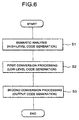
- FIG. 6 is a flowchart showing an entire processing flow of the first embodiment.
- the front end processing section 16 performs the semantic analysis of the source program 12. The same method of semantic analysis as in the prior art may be used. Subsequently, the front end processing section 16 generates the high-level code 20 from the source program 12. The high-level code 20 is not dependent on the target program type (S1).
- the high-level code 20 generated in the front end processing section 16 is transferred to the code generating section 18.
- the first converting section 22 performs a first conversion processing.
- the low-level code 30 is generated from the high-level code 20 (S2).
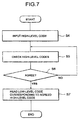
- the first converting section 22 checks the high-level code 20 with the first conversion table 32 stored in the first storage section 24 (S5) .
- “cmp_and_br_LT” is transmitted as the high-level code 20 to the first converting section 22.
- the high-level codes of the first conversion table 32 are read one by one, and it is determined whether or not the code agrees with the inputted high-level code (S6).
- the first converting section 22 generates the low-level code 30 from the high-level code 20 in this manner.
- the low-level code 30 generated by the first converting section 22 is transferred to the second converting section 26.
- the second converting section 26 performs a second conversion processing.
- the output code 14 is generated from the low-level code 30 (S3).
- the second conversion processing will be described hereinafter with reference to FIG. 8.
- an example of generating the output code 14 for the first target program will be described with reference to the second conversion table 34 shown in FIG. 4.
- the second converting section 26 checks the low-level code 30 with the second conversion table 34 stored in the second storage section 28 (S8).
- CMPLT is transmitted as the low-level code 30 to the second converting section 26.
- the low-level codes of the second conversion table 34 are read one by one, and it is determined whether or not the code agrees with the inputted low-level code (S9).
- the next low-level code is successively read until the low-level codes agree.
- the output code 14 corresponding to the agreed low-level code in the second conversion table 34 is read from the second storage section 28.
- target command "slt" and its operands "reg”, “reg”, “reg/imm” are read as the output codes 14 corresponding to the low-level code CMPLT (S10).
- the second converting section 26 generates the output code 14 from the low-level code 30 in this manner.
- the compiling device 10 outputs the output code 14.
- FIG. 9 is a block diagram showing a configuration of code generating section 18a in the second embodiment.
- first and second conversion tables 32, 34 are stored in external storage devices. Specifically, the first conversion table 32 is stored in a first storage device 40. Moreover, the second conversion table 34 is stored in a second storage device 42.
- the conversion table in the external storage device includes, for example, a case where the conversion table comprises a program or a file separate from the program for operating the code generating section.
- the first converting section 22 may be connected to the first external storage device 40, for example, via a communication channel.
- the second converting section 26 may also be connected to the second external storage device 42, for example, via the communication channel.
- High-level code command "ADD_M_M” in the high-level code indicates a function of loading a register with two pieces of data on a memory to perform addition.
- the high-level code command is provided with operands "mem1", “mem2", and "reg$".
- the "mem1,” indicates the data on a first memory, while “mem2” indicates the data on a second memory.
- "reg$" indicates the register for storing results.
- the output codes corresponding to one high-level code usually vary with each target program. Therefore, for example, in the first conventional example, the conversion table for target program A and the conversion table for target program B need to be separately prepared.
- the correspondence of the high-level and low-level codes (independent of the target program) is stored in common to the first conversion table, and only the correspondence of the low-level code and output code (variable in accordance with the target program) is stored in the second conversion table for each target program.
- An example of the correspondence will be described hereinafter with reference to examples of the first and second conversion tables.
- the high-level code is associated with the low-level code.
- the high-level code comprises a high-level code command (high-level operator) and its operand.
- First to third operands can be designated as the operand, and can be provided with different operand attributes.
- the high-level code command is provided with operands "mem1", “mem2” and "reg$".
- the low-level code comprises a low-level code command (low-level operator) and its operand.
- First to third operands can be designated as the operand, and can be provided with different operand attributes.
- the first conversion table can be shared for the target programs A and B, as described later.
- the low-level code includes a low-level code command (low-level operator) and its operand.
- the operand includes first, second and third operands, which are provided with different operand attributes.
- the output code includes an output code command (output operator), and its operand.
- the operand further includes first, second, third operands, which are provided with different operand attributes.
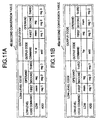
- second conversion table 46a for target program B An example of second conversion table 46a for target program B will next be described with reference to FIG. 11B.
- "LDW mem, reg” is indicated as the low-level code
- "lw reg, mem” is indicated as the output code for target program B corresponding to the low-level code.
- "ADD reg1, reg2, reg3” is indicated as the low-level code
- "add reg3, reg1, reg2” is indicated as the output code for target program B corresponding to the low-level code.
- the low-level codes are common in the second conversion tables 46 and 46a. Therefore, the first conversion table 44 shown in FIG. 10 can be used in both the target programs A and B. For example, when the target program A is changed to the target program B, the first conversion table does not need to be changed.
- FIG. 12A shows an example of second conversion table 48 for target program A
- FIG. 12B shows an example of second conversion table 48a for target program B.
- each of the second conversion tables 48 and 48a is provided with "andi" as an output code command of output code.
- the compiling processing is correctly performed by designating "posimm" as the operand.
- the second conversion table is prepared for two target processors, but the target processors of the present invention are not limited to two types.
- the output codes indicating the same or similar functions in different target programs is associated with one low-level code.
- the conversion table can be made common in this manner, in the present invention, all of the first and second conversion tables do not need to be changed when the type of target processor is changed. Therefore, according to the present invention, the change amount of the conversion table accompanied with the change of target processor type can be reduced.
- the change amount of the conversion table can be reduced, the amount of operations for changing the conversion table can be reduced.
- the target processor type is changed, the way of developing the change content dependent on program into the code can be changed by converting the low-level operand to the output operand designated in the second conversion table.
- the compiling processing can be performed irrespective of the target processor type. Consequently, the restriction of the target processor type can be relaxed.
Landscapes
- Engineering & Computer Science (AREA)
- General Engineering & Computer Science (AREA)
- Theoretical Computer Science (AREA)
- Software Systems (AREA)
- Physics & Mathematics (AREA)
- General Physics & Mathematics (AREA)
- Devices For Executing Special Programs (AREA)
Applications Claiming Priority (2)
| Application Number | Priority Date | Filing Date | Title |
|---|---|---|---|
| JP08908798A JP3246438B2 (ja) | 1998-04-01 | 1998-04-01 | 可変ターゲットコンパイル処理方法、その処理装置、そのプログラムの記憶媒体および変換テーブルの記憶媒体 |
| JP8908798 | 1998-04-01 |
Publications (2)
| Publication Number | Publication Date |
|---|---|
| EP0947923A2 true EP0947923A2 (de) | 1999-10-06 |
| EP0947923A3 EP0947923A3 (de) | 2003-05-07 |
Family
ID=13961099
Family Applications (1)
| Application Number | Title | Priority Date | Filing Date |
|---|---|---|---|
| EP99106704A Withdrawn EP0947923A3 (de) | 1998-04-01 | 1999-04-01 | Kompilierverfahren, Kompiliervorrichtung, Aufzeichnungsmedium mit darauf aufgezeichnetem Kompilierprogramm, und Aufzeichnungsmedium mit darauf aufgezeichneter, bei der Kompilierung verwendeter Umwandlungstübereinstimmenden Zielprogrammes |
Country Status (3)
| Country | Link |
|---|---|
| US (1) | US6305013B1 (de) |
| EP (1) | EP0947923A3 (de) |
| JP (1) | JP3246438B2 (de) |
Cited By (2)
| Publication number | Priority date | Publication date | Assignee | Title |
|---|---|---|---|---|
| WO2002041145A3 (en) * | 2000-11-20 | 2004-02-26 | Zucotto Wireless Inc | System and methods providing runtime byte code simplification for platform independent languages |
| EP1398695A3 (de) * | 2002-08-02 | 2005-06-22 | Matsushita Electric Industrial Co., Ltd. | Kompiler |
Families Citing this family (15)
| Publication number | Priority date | Publication date | Assignee | Title |
|---|---|---|---|---|
| FR2812479B1 (fr) * | 2000-07-28 | 2003-01-31 | Airsys Atm S A | Generateur universel de code informatique |
| US7278137B1 (en) | 2001-12-26 | 2007-10-02 | Arc International | Methods and apparatus for compiling instructions for a data processor |
| US7657881B2 (en) * | 2004-12-21 | 2010-02-02 | Intel Corporation | Using optimized libraries to improve performance of deployed application code at runtime |
| JP2010205068A (ja) * | 2009-03-04 | 2010-09-16 | Hitachi Information Systems Ltd | ソフトウェア資源移行システム及び同移行方法 |
| WO2012103209A2 (en) | 2011-01-27 | 2012-08-02 | Soft Machines, Inc. | Guest instruction to native instruction range based mapping using a conversion look aside buffer of a processor |
| WO2012103367A2 (en) | 2011-01-27 | 2012-08-02 | Soft Machines, Inc. | Guest to native block address mappings and management of native code storage |
| WO2012103373A2 (en) | 2011-01-27 | 2012-08-02 | Soft Machines, Inc. | Variable caching structure for managing physical storage |
| WO2012103253A2 (en) * | 2011-01-27 | 2012-08-02 | Soft Machines, Inc. | Multilevel conversion table cache for translating guest instructions to native instructions |
| WO2012103245A2 (en) | 2011-01-27 | 2012-08-02 | Soft Machines Inc. | Guest instruction block with near branching and far branching sequence construction to native instruction block |
| WO2012103359A2 (en) | 2011-01-27 | 2012-08-02 | Soft Machines, Inc. | Hardware acceleration components for translating guest instructions to native instructions |
| CN102647336B (zh) * | 2011-02-22 | 2016-09-07 | 瑞昱半导体股份有限公司 | 用于封包内容转换的方法以及网络装置 |
| WO2014151652A1 (en) | 2013-03-15 | 2014-09-25 | Soft Machines Inc | Method and apparatus to allow early dependency resolution and data forwarding in a microprocessor |
| EP2972798B1 (de) | 2013-03-15 | 2020-06-17 | Intel Corporation | Verfahren und vorrichtung für eine gastadressenstapelemulation mit unterstützung einer spekulation |
| KR101632864B1 (ko) * | 2014-06-02 | 2016-06-22 | 미쓰비시덴키 가부시키가이샤 | 프로그래머블 컨트롤러 시스템, 프로그래머블 컨트롤러, 프로그램 표시장치, 프로그램의 표시 방법 |
| JP2018120285A (ja) * | 2017-01-23 | 2018-08-02 | 茂 長澤 | プログラムの開発を支援するためのシステム、そのシステムにおいて実行される方法およびプログラム |
Family Cites Families (15)
| Publication number | Priority date | Publication date | Assignee | Title |
|---|---|---|---|---|
| JPS4847737A (de) * | 1971-10-12 | 1973-07-06 | ||
| CA1248238A (en) * | 1985-10-17 | 1989-01-03 | Francis D. Lawlor | Compiler including retargetable data generation |
| JPH0250730A (ja) | 1988-08-12 | 1990-02-20 | Nec Corp | 共通機械語による言語変換方式 |
| JPH032933A (ja) * | 1989-05-30 | 1991-01-09 | Mitsubishi Electric Corp | オブジェクトコード生成装置 |
| JPH03252820A (ja) | 1990-03-02 | 1991-11-12 | Nec Corp | 最適オブジェクト生成処理方式 |
| JPH0414144A (ja) | 1990-05-08 | 1992-01-20 | Fujitsu Ltd | コンパイル処理方法 |
| JP3602857B2 (ja) | 1991-04-23 | 2004-12-15 | 株式会社日立製作所 | 多機種対応型情報処理システム、および、方法 |
| EP0553731B1 (de) * | 1992-01-23 | 1999-04-14 | Mitsubishi Denki Kabushiki Kaisha | Speicherprogrammierbare Steuerung |
| JPH06332719A (ja) | 1993-05-24 | 1994-12-02 | Sharp Corp | コンパイラコード発生装置 |
| JP3318051B2 (ja) * | 1993-06-17 | 2002-08-26 | 富士通株式会社 | 翻訳処理方法 |
| US5375242A (en) * | 1993-09-29 | 1994-12-20 | Hewlett-Packard Company | Compiler architecture for cross-module optimization |
| JP3190773B2 (ja) * | 1993-09-30 | 2001-07-23 | 日本電気株式会社 | 言語処理プログラムのコンパイル処理方法 |
| US5488569A (en) * | 1993-12-20 | 1996-01-30 | At&T Corp. | Application-oriented telecommunication system interface |
| US5768593A (en) * | 1996-03-22 | 1998-06-16 | Connectix Corporation | Dynamic cross-compilation system and method |
| JPH10287743A (ja) | 1997-04-11 | 1998-10-27 | Toray Ind Inc | 中空成形品の製造方法 |
-
1998
- 1998-04-01 JP JP08908798A patent/JP3246438B2/ja not_active Expired - Fee Related
-
1999
- 1999-04-01 EP EP99106704A patent/EP0947923A3/de not_active Withdrawn
- 1999-04-01 US US09/285,039 patent/US6305013B1/en not_active Expired - Lifetime
Cited By (4)
| Publication number | Priority date | Publication date | Assignee | Title |
|---|---|---|---|---|
| WO2002041145A3 (en) * | 2000-11-20 | 2004-02-26 | Zucotto Wireless Inc | System and methods providing runtime byte code simplification for platform independent languages |
| EP1398695A3 (de) * | 2002-08-02 | 2005-06-22 | Matsushita Electric Industrial Co., Ltd. | Kompiler |
| US7284241B2 (en) | 2002-08-02 | 2007-10-16 | Matsushita Electric Industrial Co., Ltd. | Compiler, compiler apparatus and compilation method |
| US8151254B2 (en) | 2002-08-02 | 2012-04-03 | Panasonic Corporation | Compiler, compiler apparatus and compilation method |
Also Published As
| Publication number | Publication date |
|---|---|
| EP0947923A3 (de) | 2003-05-07 |
| JPH11288375A (ja) | 1999-10-19 |
| US6305013B1 (en) | 2001-10-16 |
| JP3246438B2 (ja) | 2002-01-15 |
Similar Documents
| Publication | Publication Date | Title |
|---|---|---|
| US6305013B1 (en) | Compiling method for generating target program in accordance with target processor type, compiling device, recording medium with compiling program recorded therein and recording medium with conversion table used in compiling recorded therein | |
| Fauth et al. | Describing instruction set processors using nML | |
| US5896521A (en) | Processor synthesis system and processor synthesis method | |
| Nayak et al. | Precision and error analysis of MATLAB applications during automated hardware synthesis for FPGAs | |
| US10762265B1 (en) | Heterogeneous instantiation of high-level language callable library for hardware core | |
| EP1253515A2 (de) | Verfahren zur Prüfung der Reihenfolge von Basisbefehlen in einem VLIW-Befehl für einen VLIW-Prozessor mit variabler Wortlänge | |
| Özkan et al. | FPGA-based accelerator design from a domain-specific language | |
| KR19990064011A (ko) | 디지털 신호 프로세서를 제조하는 방법 | |
| US20040194071A1 (en) | Compiling device, computer-readable recording medium on which a compiling program is recorded and a compiling method | |
| US5581769A (en) | Multipurpose program object linkage protocol for upward compatibility among different compilers | |
| Berz et al. | COSY INFINITY version 8.1 programming manual | |
| Dewitt | A Machine Independent Approach To The Production Of Optimized Horizontal Microcode. | |
| US6952817B1 (en) | Generating hardware interfaces for designs specified in a high level language | |
| US7111274B1 (en) | Scheduling hardware generated by high level language compilation to preserve functionality of source code design implementations | |
| JP3049814B2 (ja) | マイクロコンピュータの言語処理装置 | |
| Hopwood | Decompilation. | |
| US10755013B1 (en) | Automatic creation of high-level language callable library for a hardware core | |
| US20070271080A1 (en) | Model generation method for software/hardware collaboration design | |
| JP2004118518A (ja) | シミュレータ、そのシミュレータをコンピュータ読み取り可能に記録した記録媒体 | |
| Hanes | Logic design verification using static analysis | |
| Bailey | CSDL: reusable computing system descriptions for retargetable systems software | |
| Ortega Cisneros et al. | Introduction to OpenLane | |
| Love | ANSI C for programmers on UNIX systems | |
| Mulder et al. | An architecture framework for application-specific and scalable architectures | |
| Pillai et al. | RISC-V Processor Design: A Comparative Analysis of HDL Versus HLS Techniques |
Legal Events
| Date | Code | Title | Description |
|---|---|---|---|
| PUAI | Public reference made under article 153(3) epc to a published international application that has entered the european phase |
Free format text: ORIGINAL CODE: 0009012 |
|
| AK | Designated contracting states |
Kind code of ref document: A2 Designated state(s): AT BE CH CY DE DK ES FI FR GB GR IE IT LI LU MC NL PT SE |
|
| AX | Request for extension of the european patent |
Free format text: AL;LT;LV;MK;RO;SI |
|
| PUAL | Search report despatched |
Free format text: ORIGINAL CODE: 0009013 |
|
| AK | Designated contracting states |
Designated state(s): AT BE CH CY DE DK ES FI FR GB GR IE IT LI LU MC NL PT SE |
|
| AX | Request for extension of the european patent |
Extension state: AL LT LV MK RO SI |
|
| RAP1 | Party data changed (applicant data changed or rights of an application transferred) |
Owner name: NEC ELECTRONICS CORPORATION |
|
| 17P | Request for examination filed |
Effective date: 20030805 |
|
| AKX | Designation fees paid |
Designated state(s): DE FR GB |
|
| 17Q | First examination report despatched |
Effective date: 20040616 |
|
| STAA | Information on the status of an ep patent application or granted ep patent |
Free format text: STATUS: THE APPLICATION IS DEEMED TO BE WITHDRAWN |
|
| 18D | Application deemed to be withdrawn |
Effective date: 20041228 |