EP0948193B1 - Verfahren zum Einbringen manipulationssicherer digitaler Fingerabdrücke in elektronische Dokumente - Google Patents
Verfahren zum Einbringen manipulationssicherer digitaler Fingerabdrücke in elektronische Dokumente Download PDFInfo
- Publication number
- EP0948193B1 EP0948193B1 EP99104339A EP99104339A EP0948193B1 EP 0948193 B1 EP0948193 B1 EP 0948193B1 EP 99104339 A EP99104339 A EP 99104339A EP 99104339 A EP99104339 A EP 99104339A EP 0948193 B1 EP0948193 B1 EP 0948193B1
- Authority
- EP
- European Patent Office
- Prior art keywords
- copy
- fingerprints
- document
- manipulation
- purchaser
- Prior art date
- Legal status (The legal status is an assumption and is not a legal conclusion. Google has not performed a legal analysis and makes no representation as to the accuracy of the status listed.)
- Expired - Lifetime
Links
- 238000000034 method Methods 0.000 title claims abstract description 8
- 238000003780 insertion Methods 0.000 title 1
- 230000037431 insertion Effects 0.000 title 1
- 230000009977 dual effect Effects 0.000 claims description 9
- 241001136792 Alle Species 0.000 description 1
- 241001530812 Goupia glabra Species 0.000 description 1
- 230000007812 deficiency Effects 0.000 description 1
- 230000000694 effects Effects 0.000 description 1
- 238000011156 evaluation Methods 0.000 description 1
- 239000012634 fragment Substances 0.000 description 1
Images

Classifications
-
- H—ELECTRICITY
- H04—ELECTRIC COMMUNICATION TECHNIQUE
- H04N—PICTORIAL COMMUNICATION, e.g. TELEVISION
- H04N1/00—Scanning, transmission or reproduction of documents or the like, e.g. facsimile transmission; Details thereof
- H04N1/32—Circuits or arrangements for control or supervision between transmitter and receiver or between image input and image output device, e.g. between a still-image camera and its memory or between a still-image camera and a printer device
- H04N1/32101—Display, printing, storage or transmission of additional information, e.g. ID code, date and time or title
- H04N1/32144—Display, printing, storage or transmission of additional information, e.g. ID code, date and time or title embedded in the image data, i.e. enclosed or integrated in the image, e.g. watermark, super-imposed logo or stamp
-
- H—ELECTRICITY
- H04—ELECTRIC COMMUNICATION TECHNIQUE
- H04N—PICTORIAL COMMUNICATION, e.g. TELEVISION
- H04N2201/00—Indexing scheme relating to scanning, transmission or reproduction of documents or the like, and to details thereof
- H04N2201/32—Circuits or arrangements for control or supervision between transmitter and receiver or between image input and image output device, e.g. between a still-image camera and its memory or between a still-image camera and a printer device
- H04N2201/3201—Display, printing, storage or transmission of additional information, e.g. ID code, date and time or title
- H04N2201/3225—Display, printing, storage or transmission of additional information, e.g. ID code, date and time or title of data relating to an image, a page or a document
- H04N2201/3226—Display, printing, storage or transmission of additional information, e.g. ID code, date and time or title of data relating to an image, a page or a document of identification information or the like, e.g. ID code, index, title, part of an image, reduced-size image
- H04N2201/323—Display, printing, storage or transmission of additional information, e.g. ID code, date and time or title of data relating to an image, a page or a document of identification information or the like, e.g. ID code, index, title, part of an image, reduced-size image for tracing or tracking, e.g. forensic tracing of unauthorized copies
-
- H—ELECTRICITY
- H04—ELECTRIC COMMUNICATION TECHNIQUE
- H04N—PICTORIAL COMMUNICATION, e.g. TELEVISION
- H04N2201/00—Indexing scheme relating to scanning, transmission or reproduction of documents or the like, and to details thereof
- H04N2201/32—Circuits or arrangements for control or supervision between transmitter and receiver or between image input and image output device, e.g. between a still-image camera and its memory or between a still-image camera and a printer device
- H04N2201/3201—Display, printing, storage or transmission of additional information, e.g. ID code, date and time or title
- H04N2201/3225—Display, printing, storage or transmission of additional information, e.g. ID code, date and time or title of data relating to an image, a page or a document
- H04N2201/3233—Display, printing, storage or transmission of additional information, e.g. ID code, date and time or title of data relating to an image, a page or a document of authentication information, e.g. digital signature, watermark
-
- H—ELECTRICITY
- H04—ELECTRIC COMMUNICATION TECHNIQUE
- H04N—PICTORIAL COMMUNICATION, e.g. TELEVISION
- H04N2201/00—Indexing scheme relating to scanning, transmission or reproduction of documents or the like, and to details thereof
- H04N2201/32—Circuits or arrangements for control or supervision between transmitter and receiver or between image input and image output device, e.g. between a still-image camera and its memory or between a still-image camera and a printer device
- H04N2201/3201—Display, printing, storage or transmission of additional information, e.g. ID code, date and time or title
- H04N2201/3225—Display, printing, storage or transmission of additional information, e.g. ID code, date and time or title of data relating to an image, a page or a document
- H04N2201/3233—Display, printing, storage or transmission of additional information, e.g. ID code, date and time or title of data relating to an image, a page or a document of authentication information, e.g. digital signature, watermark
- H04N2201/3239—Display, printing, storage or transmission of additional information, e.g. ID code, date and time or title of data relating to an image, a page or a document of authentication information, e.g. digital signature, watermark using a plurality of different authentication information
Definitions
- Digital fingerprints go one step further.
- the principle of Securing a document via digital fingerprints is next to the digital one Copyright holder's watermark at the same time also the name of the customer, the one electronic copy of the document acquires invisibly inserted into the document.
- This customer now distributes his copy contrary to the interests of the copyright holder further, this may be based on its electronic content contained in all illegal copies Fingerprint clearly identified and held accountable.
- the invention has the object to eliminate this deficiency. It should still be Each document can only be assigned to one customer. The customers may not individually still as a group to be able to get the customer-related fingerprints in their Entity to delete. Furthermore, it should be possible to get out of the still remained fragments of digital fingerprints of an unlawfully distributed Document undoubtedly to reconstruct which customers involved in the manipulation are or which documents were included in the manipulation.
- a digit or area for the customer's digital fingerprint is defined for each copy from a predetermined number of copies to the document. All digital fingerprint locations and areas defined in the document are, in their entirety, subject to a self-contained finite ordering system in which, at well-defined locations or areas, overlaps of digital fingerprints are defined. In a digital fingerprint location assignment made according to this principle, any locations or areas S where digital fingerprints overlap may not be recognized by customers whose digital fingerprints overlap at the location or area S. If the number of attackers does not exceed the number of attackers allowed in the system, the attackers involved in the manipulation can be clearly determined by comparing the document with the manipulated copy based on the evaluation of the interfaces not found by the attackers ,
- the fingerprints are placed on the basis of finite geometric structures, each point of a fingerprint being assigned a unique location within the framework of the selected finite geometric structure.
- finite geometric structure clearly defined regions, such as intersections, are derived from the geometric structure, in which digital fingerprints overlap according to the assignment of the individual digital fingerprints within the geometric structure.
- interface S are not recognizable for the customers whose digital fingerprints intersect at this point or in this area S.
- the attackers In the case of a manipulation, it can therefore be assumed that the attackers generally do not manage to delete all interfaces or interface areas.
- the customers participating in manipulations as attackers can be identified on the basis of the interfaces or interface areas they do not recognize.
- Fig. 1 shows the operating principle of the method according to the invention on the example of three fingerprints.
- the three fingerprints 1, 2 and 3 are arranged within a projective plane according to geometrical aspects on the document to be protected so that they overlap in the area S.
- Each of the fingerprints 1, 2 and 3 is placed in a copy of the document.
- attackers buyers may be able to spot the places where the fingerprints differ, but not the places where they are the same. For example, if buyers of copy 1 and copy 2 join together, they can only recognize and remove different parts of fingerprint 1 and fingerprint 2.
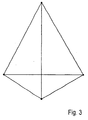
- FIG. 3 the inventive method is explained in more detail in three-dimensional space using a tetrahedron.
- a fingerprint consists of the points that lie on one side of the tetrahedron.
- four customers received a copy of the document.
- two digital fingerprints always intersect exactly in a straight line and always three fingerprints in exactly one point at a time. This means that from the intersection of two or three fingerprints you can close exactly on the two or the three customers who have tried as an attacker to remove the fingerprints.
- the maximum number of detectable attackers is therefore limited to three attackers.
- the rational norm curve R is dimensioned as a set of q + 1 hyperplanes (ie projective subspaces of dimension d-1), of which d intersect at exactly one point and this intersection uniquely determines the d hyperplanes.
- R is a set of q + 1 points in the finite projective space PG (d, q) of which at most d lie in a common hyperplane.
Landscapes
- Engineering & Computer Science (AREA)
- Multimedia (AREA)
- Signal Processing (AREA)
- Editing Of Facsimile Originals (AREA)
- Storage Device Security (AREA)
- Reverberation, Karaoke And Other Acoustics (AREA)
- Lubrication Of Internal Combustion Engines (AREA)
- Collating Specific Patterns (AREA)
Description
Digitale Wasserzeichen erlauben es dem Copyright-Inhaber, sein geistiges Eigentum an einem illegal verteilten Dokument nachzuweisen.
Digitale Wasserzeichen erlauben es jedoch nicht, den Verursacher der illegalen Verteilung zu ermitteln und ihm die illegale Verteilung nachzuweisen.
Ausgangspunkt der Erfindung ist der Sachverhalt, daß beim Vergleich von Dokumenten verschiedener Kunden ein Angreifer zwar die Stellen entdecken kann, an denen sich die Fingerabdrücke unterscheiden, er kann jedoch die Stellen nicht erkennen, an denen Fingerabdrücke auf beiden Dokumenten gleich sind.
Erfindungsgemäß wird ausgehend von einer vorher festgelegten Anzahl von Kopien zum Dokument für jede Kopie eine Stelle oder ein Bereich für den digitalen Fingerabdruck des Kunden definiert. Alle im Rahmen des Dokuments definierten Stellen und Bereiche für die digitalen Fingerabdrücke unterliegen in ihrer Gesamtheit einem in sich geschlossenen endlichen Ordnungssystem, in dem an genau definierten Stellen oder Bereichen Überschneidungen der digitalen Fingerabdrücke definiert sind. Bei einer nach diesem Prinzip vorgenommenen Platzzuweisung für digitale Fingerabdrücke können alle Stellen oder Bereiche S, in denen sich digitale Fingerabdrücke überschneiden, von den Kunden nicht erkannt werden, deren digitale Fingerabdrücke sich an der Stelle oder im Bereich S überschneiden. Übersteigt die Anzahl der Angreifer die im Rahmen des Systems zulässige Anzahl von Angreifern nicht, so können anhand eines Vergleichs des Dokuments mit der manipulierten Kopie, der auf der Auswertung der durch die Angreifer nicht gefundenen Schnittstellen basiert, die an der Manipulation beteiligten Angreifer eindeutig ermittelt werden.
Ausgehend von den in endlichen geometrischen Strukturen bestehenden geometrischen Gesetzmäßigkeiten können die an Manipulationen als Angreifer beteiligten Kunden anhand der von ihnen nicht erkannten Schnittstellen bzw. Schnittstellenbereiche identifiziert werden.
- duale rationale Normkurven in endlichen projektiven Ebenen bzw.
- duale rationale Normkurven in endlichen projektiven Räumen Anwendung finden.
Das erfindungsgemäße Verfahren wird anhand von zwei Ausführungsbeispielen näher erläutert.
Fig. 1 zeigt das Wirkprinzip des erfindungsgemäßen Verfahrens am Beispiel von drei Fingerabdrücken. Die drei Fingerabdrücke 1, 2 und 3 sind innerhalb einer projektiven Ebene nach geometrischen Gesichtspunkten auf dem zu schützenden Dokument so angeordnet, daß sie sich im Bereich S überschneiden. Jeder der Fingerabdrücke 1, 2 und 3 wird jeweils in einer Kopie des Dokuments angeordnet.
Als Angreifer auftretende Käufer können zwar die Stellen erkennen, an denen sich die Fingerabdrücke unterscheiden, nicht aber die Stellen, an denen sie gleich sind. Schließen sich beispielsweise die Käufer der Kopie 1 und der Kopie 2 zusammen, so können sie nur unterschiedliche Teile von Fingerabdruck 1 und Fingerabdruck 2 erkennen und entfernen. Da die Schnittmenge aus dem sich überschneidenden Bereich S sowohl auf der Kopie von Käufer 1, als auch auf der Kopie von Käufer 2 gleich ist, kann dieser Bereich nicht erkannt werden und bleibt demzufolge auch auf der manipulierten Kopie enthalten. Anhand des bitweisen Vergleichs des Ursprungsdokuments mit der manipulierte Kopie können die Stellen, an denen auf der Kopie Manipulationen vorgenommen wurden, wieder rekonstruiert werden. Die Identifizierung der Angreifer erfolgt anhand des Vergleichs der rekonstruierten Fingerabdrücke mit den Fingerabdrücken des Ursprungsdokuments.
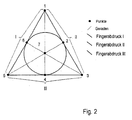
Alle Punkte und Geraden in der projektiven Ebene PG(2,2) sind eingezeichnet. Jedem Punkt in der projektiven Ebene wird mittels einer geheimen Funktion (Einwegfunktion) eine Stelle im Dokument zugewiesen. Jeder Kunde enthält dann eine Kopie des Dokuments, in dem ausschließlich die für seinen digitalen Fingerabdruck zutreffenden Stellen markiert sind. Das kann beispielsweise durch Invertieren der Bits an den betreffende Stellen, die zu seinem Fingerabdruck gehören, erfolgen. Für den Kunden I wären dies z. B. die Stellen, die den Punkten 1, 5 und 6 zugeordnet sind.
Vergleichen nun zwei Kunden anhand ihrer Dokumente ihre Fingerabdrücke bitweise, so finden sie alle markierten Stellen bis auf die Stelle, die im Schnittpunkt der beiden Fingerabdrücke liegt. Würden beispielsweise Kunde I und Kunde II die Fingerabdrücke auf ihren Dokumenten vergleichen, so könnten sie die Stellen finden, die den Punkten 2, 3, 5 und 6 entsprechen. Die Stelle entsprechend Punkt 1 können sie dagegen nicht finden, da die Bitwerte der Stelle entsprechend Punkt 1 in beiden Kopien gleich sind.
In der im ersten Ausführungsbeispiel gewählten Ausführungsform ist eine Identifizierung aber auch dann noch möglich, wenn sich maximal je zwei Kunden als Angreifer verbünden, denn jeder Schnittpunkt kann nur von genau einem Paar von Angreifern übersehen werden. Im Ausführungsbeispiel nach Figur 1 kann der Punkt 1 nur genau von den Angreifern I und II übersehen werden. Verbünden sich Kunde II und Kunde III zu Angreifern, würden sie genau den Punkt 3 nicht feststellen können. In diesem System mit 3 Kunden müßten sich schon alle 3 Kunden zu Angreifern verbünden, um alle Punkte zu finden.
In Fig. 3 ist die Anordnung von vier verschiedenen digitalen Fingerabdrücken als Abbildung im endlichen projektiven Raum PG(d,q) dargestellt.
Ein solches System kann bei einem Verteilerschlüssel mit einer höheren Anzahl von Kunden Anwendung finden. Der Parameter d gibt dabei die maximale Zahl von Angreifern an, bei deren Zusammenschluß eine Manipulation noch nachgewiesen werden kann. Parameter q+1 ist die Anzahl der Kunden, die in den Verteilerschlüssel des Dokuments einbezogen sind.
Ein solches System kann demzufolge q+1 Kunden mit Kopien des Dokumentes so versorgen, daß die beiden folgenden Anforderungen erfüllt werden:
Ein Fingerabdruck besteht dabei aus den Punkten, die auf einer Seite des Tetraeders liegen. Es haben demzufolge vier Kunden eine Kopie des Dokuments erhalten. Aufgrund der gewählten Geometrie schneiden sich immer jeweils zwei digitale Fingerabdrücke genau in einer Geraden und immer jeweils drei Fingerabdrücke in genau einem Punkt. Das bedeutet, daß man aus der Schnittmenge von je zwei bzw. je drei Fingerabdrücken genau auf die beiden bzw. die drei Kunden zurückschließen kann, die als Angreifer versucht haben, die Fingerabdrücke zu entfernen. In diesem System ist die maximale Anzahl der erkennbaren Angreifer also auf drei Angreifer beschränkt.
Man erhält R, indem man zunächst eine rationale Normkurve R' betrachtet. R' ist dabei eine Menge von q+1 Punkten im endlichen projektiven Raum PG(d,q) von denen maximal d in einer gemeinsamen Hyperebene liegen. R' kann in homogenen Koordinaten als
Claims (2)
- Verfahren zum Einbringen manipulationssicherer digitaler Fingerabdrücke in elektronische Dokumente, bei dem jedem Käufer eine Kopie eines Dokuments zugeordnet wird, in welcher als Markierung ein dem jeweiligen Käufer der Kopie zugeordneter individueller, vom Käufer nicht erkennbarer Fingerabdruck eingebracht ist, dadurch gekennzeichnet, daß die Zuweisung der Markierungsstellen des für jede Kopie unterschiedlichen individuellen digitalen Fingerabdrucks unter Zuhilfenahme endlicher geometrischen Strukturen erfolgt, wobei die Kopie jedes Käufers an den Stellen markiert wird, die durch die dem jeweiligen Kunden zugeordnete geometrische Unterstruktur und eine geheime Funktion festgelegt werden, daß die so für jeden Käufer als digitaler Fingerabdruck ermittelten Punkte innerhalb der geometrischen Struktur so festgelegt sind, daß sie sich mit den Punkten der Fingerabdrücke anderer Käufer überschneiden, und daß anhand eines bitweisen Vergleichs des ursprünglichen Dokuments mit einer Kopie, aus der durch Manipulation von höchstens d Käufern Teile von Fingerabdrücken entfernt wurden, aus den noch vorhandenen Schnittmengen der Fingerabdrücke die an der Manipulation beteiligten Kopien und damit die als Angreifer tätig gewordenen Käufer ermittelt werden können.
- Verfahren nach Anspruch 1, dadurch gekennzeichnet, daß als endliche geometrische Struktur zur Platzzuweisung des digitalen Fingerabdrucks des Kunden auf der ihm zugeordneten Kopie eine duale rationale Normkurve R im endlichen projektiven Raum mit Dimension d und Ordnung q gewählt wird, wobei die duale rationale Normkurve R im endlichen projektiven Raum und eine geheime Abbildung bzw. Einwegfunktion f der Punkte des endlichen projektiven Raumes auf die Markierungsstellen des Dokuments bestimmt werden, dass jedem Kunden eindeutig eine Hyperebene H aus der dualen rationalen Normkurve R zugeordnet wird, und daß in der Kopie des jeweiligen Kunden die den Punkten der Hyperebene H mittels der geheimen Abbildung f zugeordneten Markierungsstellen markiert werden, so dass im Falle einer Manipulation die Möglichkeit besteht, die aus der Manipulation resultierende Kopie bitweise mit dem Original des Dokuments zu vergleichen, wobei aus den in Kopie und Dokument verschiedenen Markierungsstellen mittels der Umkehrfunktion der geheimen Abbildung bzw. der Einwegfunktion f der entsprechende Unterraum im projektiven Raum rekonstruiert wird, und daß aus dem so konstruierten Unterraum eindeutig auf die zur Bildung dieses Unterraumes verwendeten Hyperebenen H der dualen rationalen Normkurve R und damit auf die Identität der an der Manipulation beteiligten Angreifer geschlossen werden kann.
Applications Claiming Priority (2)
| Application Number | Priority Date | Filing Date | Title |
|---|---|---|---|
| DE19816356A DE19816356C2 (de) | 1998-04-03 | 1998-04-03 | Verfahren zum Einbringen manipulationssicherer digitaler Fingerabdrücke in elektronische Dokumente |
| DE19816356 | 1998-04-03 |
Publications (3)
| Publication Number | Publication Date |
|---|---|
| EP0948193A2 EP0948193A2 (de) | 1999-10-06 |
| EP0948193A3 EP0948193A3 (de) | 2002-05-22 |
| EP0948193B1 true EP0948193B1 (de) | 2004-02-25 |
Family
ID=7864393
Family Applications (1)
| Application Number | Title | Priority Date | Filing Date |
|---|---|---|---|
| EP99104339A Expired - Lifetime EP0948193B1 (de) | 1998-04-03 | 1999-03-04 | Verfahren zum Einbringen manipulationssicherer digitaler Fingerabdrücke in elektronische Dokumente |
Country Status (4)
| Country | Link |
|---|---|
| US (1) | US6590995B1 (de) |
| EP (1) | EP0948193B1 (de) |
| AT (1) | ATE260523T1 (de) |
| DE (2) | DE19816356C2 (de) |
Families Citing this family (8)
| Publication number | Priority date | Publication date | Assignee | Title |
|---|---|---|---|---|
| ATE364963T1 (de) | 1998-10-09 | 2007-07-15 | Deutsche Telekom Ag | Verfahren zum einbringen und zur analyse von manipulationssicheren digitalen fingerabdrücken in elektronischen dokumenten |
| US7430670B1 (en) | 1999-07-29 | 2008-09-30 | Intertrust Technologies Corp. | Software self-defense systems and methods |
| US7770016B2 (en) | 1999-07-29 | 2010-08-03 | Intertrust Technologies Corporation | Systems and methods for watermarking software and other media |
| US7190470B2 (en) * | 2001-04-05 | 2007-03-13 | Hewlett-Packard Development Company, L.P. | System and method for automatic document verification |
| US7555650B1 (en) * | 2002-03-20 | 2009-06-30 | Thomson Licensing | Techniques for reducing the computational cost of embedding information in digital representations |
| US20060257001A1 (en) * | 2003-09-12 | 2006-11-16 | Minne Van Der Veen | Methods and apparatus for tamper detection in watermarking systems |
| US7817820B2 (en) * | 2003-11-25 | 2010-10-19 | Florida State University | Method and system for generating and using digital fingerprints for electronic documents |
| WO2016118216A2 (en) | 2014-11-06 | 2016-07-28 | Intertrust Technologies Corporation | Secure application distribution systems and methods |
Family Cites Families (10)
| Publication number | Priority date | Publication date | Assignee | Title |
|---|---|---|---|---|
| IE56668B1 (en) * | 1984-06-15 | 1991-10-23 | Pelling Nicholas John M | An encoder/decoder |
| US5467447A (en) * | 1990-07-24 | 1995-11-14 | Vogel; Peter S. | Document marking system employing context-sensitive embedded marking codes |
| US5748783A (en) * | 1995-05-08 | 1998-05-05 | Digimarc Corporation | Method and apparatus for robust information coding |
| US6086706A (en) * | 1993-12-20 | 2000-07-11 | Lucent Technologies Inc. | Document copying deterrent method |
| US5600738A (en) | 1994-12-30 | 1997-02-04 | Lucent Technologies Inc. | Polarization dispersion compensation for optical devices |
| US5699427A (en) * | 1995-06-23 | 1997-12-16 | International Business Machines Corporation | Method to deter document and intellectual property piracy through individualization |
| US5949885A (en) * | 1996-03-12 | 1999-09-07 | Leighton; F. Thomson | Method for protecting content using watermarking |
| US5664018A (en) * | 1996-03-12 | 1997-09-02 | Leighton; Frank Thomson | Watermarking process resilient to collusion attacks |
| US5790703A (en) * | 1997-01-21 | 1998-08-04 | Xerox Corporation | Digital watermarking using conjugate halftone screens |
| US6233684B1 (en) * | 1997-02-28 | 2001-05-15 | Contenaguard Holdings, Inc. | System for controlling the distribution and use of rendered digital works through watermaking |
-
1998
- 1998-04-03 DE DE19816356A patent/DE19816356C2/de not_active Expired - Fee Related
-
1999
- 1999-03-04 EP EP99104339A patent/EP0948193B1/de not_active Expired - Lifetime
- 1999-03-04 AT AT99104339T patent/ATE260523T1/de active
- 1999-03-04 DE DE59908611T patent/DE59908611D1/de not_active Expired - Lifetime
- 1999-04-02 US US09/285,828 patent/US6590995B1/en not_active Expired - Lifetime
Also Published As
| Publication number | Publication date |
|---|---|
| US6590995B1 (en) | 2003-07-08 |
| DE59908611D1 (de) | 2004-04-01 |
| ATE260523T1 (de) | 2004-03-15 |
| DE19816356C2 (de) | 2001-01-25 |
| EP0948193A3 (de) | 2002-05-22 |
| EP0948193A2 (de) | 1999-10-06 |
| DE19816356A1 (de) | 1999-10-07 |
Similar Documents
| Publication | Publication Date | Title |
|---|---|---|
| EP1040662B1 (de) | Verfahren zum sichern eines durch eine schlüsselhierarchie geschützten systems | |
| EP0879535B1 (de) | Verfahren zur markierung binär codierter datensätze | |
| DE69127965T2 (de) | Verteiltes benutzerauthentisierungsprotokoll | |
| WO2004114173A2 (de) | Produktschutz-portal und verfahren zur echtheitsprüfung von produkten | |
| EP0948193B1 (de) | Verfahren zum Einbringen manipulationssicherer digitaler Fingerabdrücke in elektronische Dokumente | |
| DE60029020T2 (de) | Verschlüsselungs- und entschlüsselungsverfahren von elektronischen informationen unter verwendung von zufälligen permutationen | |
| DE112005001654T5 (de) | Verfahren zum Übermitteln von Direct-Proof-Privatschlüsseln an Geräte mittels einer Verteilungs-CD | |
| DE19961151A1 (de) | Verfahren zum Erstellen und Lesen eines neuen Zertifikatstyps zur Zertifizierung von Schlüsseln | |
| DE19750779C1 (de) | Verfahren zum Identifizieren von Verrätern proprietärer Daten | |
| DE19911176A1 (de) | Anonymisierungsverfahren | |
| EP0993176B1 (de) | Verfahren zum Einbringen und zur Analyse von manipulationssicheren digitalen Fingerabdrücken in elektronischen Dokumenten | |
| WO2000022810A1 (de) | Verfahren zum generieren von digitalen wasserzeichen für elektronische dokumente | |
| DE102008042406A1 (de) | Verfahren zum sicheren Austausch von Daten | |
| EP2187282B1 (de) | Verfahren zum Betreiben einer Anlage unter Verwendung von gegen unberechtigte Verwendung gesicherten Daten | |
| DE19847942A1 (de) | Verfahren zum Einbringen manipulationssicherer digitaler Fingerabdrücke in elektronische Dokumente | |
| DE60307981T2 (de) | Verfahren zur erzeugung und verifizierung digitaler unterschriften | |
| WO2005010814A1 (de) | Fälschungssicheres dokument und verfahren zu seiner herstellung | |
| WO2002063824A1 (de) | Telekommunikationsprotokoll, -system und -vorrichtungen zur anonymen und authentischen abwicklung einer elektronischen wahl | |
| DE10323755B3 (de) | Verfahren zum Bereitstellen und Abrufen von Dokumenten über ein Computer-Netzwerk | |
| DE10136326A1 (de) | Steuerverfahren zur Beaufschlagung eines IC-Betriebsmodus mit einer Unschärfe | |
| DE10061102B4 (de) | System zur Statusabfrage von digitalen Zertifikaten | |
| DE4416253B4 (de) | Verfahren zur datenschutzgerechten Verteilung von Schlüsselinformationen | |
| DE112020005556T5 (de) | Schlüsselverwaltungsvorrichtung und Schlüsselverwaltungsverfahren | |
| DE10328792A1 (de) | Fälschungssicheres Dokument und Verfahren zu seiner Herstellung | |
| EP0948052A2 (de) | Microcontrollerschaltung |
Legal Events
| Date | Code | Title | Description |
|---|---|---|---|
| PUAI | Public reference made under article 153(3) epc to a published international application that has entered the european phase |
Free format text: ORIGINAL CODE: 0009012 |
|
| AK | Designated contracting states |
Kind code of ref document: A2 Designated state(s): AT BE CH CY DE DK ES FI FR GB GR IE IT LI LU MC NL PT SE |
|
| AX | Request for extension of the european patent |
Free format text: AL;LT;LV;MK;RO;SI |
|
| RIN1 | Information on inventor provided before grant (corrected) |
Inventor name: UEBERBERG, JOHANNES, DR. Inventor name: SCHWENK, JOERG |
|
| PUAL | Search report despatched |
Free format text: ORIGINAL CODE: 0009013 |
|
| RIC1 | Information provided on ipc code assigned before grant |
Free format text: 7H 04N 1/44 A, 7H 04N 1/32 B, 7G 09C 5/00 B, 7G 06T 1/00 B |
|
| AX | Request for extension of the european patent |
Free format text: AL;LT;LV;MK;RO;SI |
|
| 17P | Request for examination filed |
Effective date: 20021122 |
|
| AKX | Designation fees paid |
Designated state(s): AT BE CH CY DE DK ES FI FR GB GR IE IT LI LU MC NL PT SE |
|
| 17Q | First examination report despatched |
Effective date: 20030121 |
|
| GRAP | Despatch of communication of intention to grant a patent |
Free format text: ORIGINAL CODE: EPIDOSNIGR1 |
|
| GRAS | Grant fee paid |
Free format text: ORIGINAL CODE: EPIDOSNIGR3 |
|
| GRAA | (expected) grant |
Free format text: ORIGINAL CODE: 0009210 |
|
| AK | Designated contracting states |
Kind code of ref document: B1 Designated state(s): AT BE CH CY DE DK ES FI FR GB GR IE IT LI LU MC NL PT SE |
|
| PG25 | Lapsed in a contracting state [announced via postgrant information from national office to epo] |
Ref country code: IT Free format text: LAPSE BECAUSE OF FAILURE TO SUBMIT A TRANSLATION OF THE DESCRIPTION OR TO PAY THE FEE WITHIN THE PRE;WARNING: LAPSES OF ITALIAN PATENTS WITH EFFECTIVE DATE BEFORE 2007 MAY HAVE OCCURRED AT ANY TIME BEFORE 2007. THE CORRECT EFFECTIVE DATE MAY BE DIFFERENT FROM THE ONE RECORDED.SCRIBED TIME-LIMIT Effective date: 20040225 Ref country code: IE Free format text: LAPSE BECAUSE OF FAILURE TO SUBMIT A TRANSLATION OF THE DESCRIPTION OR TO PAY THE FEE WITHIN THE PRESCRIBED TIME-LIMIT Effective date: 20040225 Ref country code: FI Free format text: LAPSE BECAUSE OF FAILURE TO SUBMIT A TRANSLATION OF THE DESCRIPTION OR TO PAY THE FEE WITHIN THE PRESCRIBED TIME-LIMIT Effective date: 20040225 Ref country code: CY Free format text: LAPSE BECAUSE OF FAILURE TO SUBMIT A TRANSLATION OF THE DESCRIPTION OR TO PAY THE FEE WITHIN THE PRESCRIBED TIME-LIMIT Effective date: 20040225 |
|
| REG | Reference to a national code |
Ref country code: GB Ref legal event code: FG4D Free format text: NOT ENGLISH |
|
| REG | Reference to a national code |
Ref country code: CH Ref legal event code: EP |
|
| PG25 | Lapsed in a contracting state [announced via postgrant information from national office to epo] |
Ref country code: LU Free format text: LAPSE BECAUSE OF NON-PAYMENT OF DUE FEES Effective date: 20040304 |
|
| REG | Reference to a national code |
Ref country code: IE Ref legal event code: FG4D Free format text: GERMAN |
|
| PG25 | Lapsed in a contracting state [announced via postgrant information from national office to epo] |
Ref country code: MC Free format text: LAPSE BECAUSE OF NON-PAYMENT OF DUE FEES Effective date: 20040331 Ref country code: BE Free format text: LAPSE BECAUSE OF NON-PAYMENT OF DUE FEES Effective date: 20040331 |
|
| REF | Corresponds to: |
Ref document number: 59908611 Country of ref document: DE Date of ref document: 20040401 Kind code of ref document: P |
|
| PG25 | Lapsed in a contracting state [announced via postgrant information from national office to epo] |
Ref country code: SE Free format text: LAPSE BECAUSE OF FAILURE TO SUBMIT A TRANSLATION OF THE DESCRIPTION OR TO PAY THE FEE WITHIN THE PRESCRIBED TIME-LIMIT Effective date: 20040525 Ref country code: GR Free format text: LAPSE BECAUSE OF FAILURE TO SUBMIT A TRANSLATION OF THE DESCRIPTION OR TO PAY THE FEE WITHIN THE PRESCRIBED TIME-LIMIT Effective date: 20040525 Ref country code: DK Free format text: LAPSE BECAUSE OF FAILURE TO SUBMIT A TRANSLATION OF THE DESCRIPTION OR TO PAY THE FEE WITHIN THE PRESCRIBED TIME-LIMIT Effective date: 20040525 |
|
| PG25 | Lapsed in a contracting state [announced via postgrant information from national office to epo] |
Ref country code: ES Free format text: LAPSE BECAUSE OF FAILURE TO SUBMIT A TRANSLATION OF THE DESCRIPTION OR TO PAY THE FEE WITHIN THE PRESCRIBED TIME-LIMIT Effective date: 20040605 |
|
| GBT | Gb: translation of ep patent filed (gb section 77(6)(a)/1977) |
Effective date: 20040611 |
|
| REG | Reference to a national code |
Ref country code: CH Ref legal event code: PFA Owner name: DEUTSCHE TELEKOM AG Free format text: DEUTSCHE TELEKOM AG#FRIEDRICH-EBERT-ALLEE 140#53113 BONN (DE) $ DAIMLERCHRYSLER SERVICES (DEBIS)AG#EICHHORNSTRASSE 3#10875 BERLIN (DE) -TRANSFER TO- DEUTSCHE TELEKOM AG#FRIEDRICH-EBERT-ALLEE 140#53113 BONN (DE) $ DAIMLERCHRYSLER SERVICES AG#EICHHORNSTRASSE 3#10875 BERLIN (DE) Ref country code: CH Ref legal event code: NV Representative=s name: ISLER & PEDRAZZINI AG |
|
| REG | Reference to a national code |
Ref country code: IE Ref legal event code: FD4D |
|
| BERE | Be: lapsed |
Owner name: DAIMLERCHRYSLER SERVICES (DEBIS)AG Effective date: 20040331 Owner name: DEUTSCHE TELEKOM A.G. Effective date: 20040331 |
|
| ET | Fr: translation filed | ||
| PLBE | No opposition filed within time limit |
Free format text: ORIGINAL CODE: 0009261 |
|
| STAA | Information on the status of an ep patent application or granted ep patent |
Free format text: STATUS: NO OPPOSITION FILED WITHIN TIME LIMIT |
|
| 26N | No opposition filed |
Effective date: 20041126 |
|
| REG | Reference to a national code |
Ref country code: CH Ref legal event code: PCAR Free format text: ISLER & PEDRAZZINI AG;POSTFACH 1772;8027 ZUERICH (CH) |
|
| PG25 | Lapsed in a contracting state [announced via postgrant information from national office to epo] |
Ref country code: PT Free format text: LAPSE BECAUSE OF NON-PAYMENT OF DUE FEES Effective date: 20040725 |
|
| REG | Reference to a national code |
Ref country code: FR Ref legal event code: PLFP Year of fee payment: 18 |
|
| PGFP | Annual fee paid to national office [announced via postgrant information from national office to epo] |
Ref country code: CH Payment date: 20160322 Year of fee payment: 18 |
|
| PGFP | Annual fee paid to national office [announced via postgrant information from national office to epo] |
Ref country code: AT Payment date: 20160318 Year of fee payment: 18 |
|
| REG | Reference to a national code |
Ref country code: FR Ref legal event code: PLFP Year of fee payment: 19 |
|
| REG | Reference to a national code |
Ref country code: CH Ref legal event code: PL |
|
| REG | Reference to a national code |
Ref country code: AT Ref legal event code: MM01 Ref document number: 260523 Country of ref document: AT Kind code of ref document: T Effective date: 20170304 |
|
| PG25 | Lapsed in a contracting state [announced via postgrant information from national office to epo] |
Ref country code: AT Free format text: LAPSE BECAUSE OF NON-PAYMENT OF DUE FEES Effective date: 20170304 |
|
| PG25 | Lapsed in a contracting state [announced via postgrant information from national office to epo] |
Ref country code: LI Free format text: LAPSE BECAUSE OF NON-PAYMENT OF DUE FEES Effective date: 20170331 Ref country code: CH Free format text: LAPSE BECAUSE OF NON-PAYMENT OF DUE FEES Effective date: 20170331 |
|
| REG | Reference to a national code |
Ref country code: FR Ref legal event code: PLFP Year of fee payment: 20 |
|
| PGFP | Annual fee paid to national office [announced via postgrant information from national office to epo] |
Ref country code: GB Payment date: 20180326 Year of fee payment: 20 Ref country code: DE Payment date: 20180322 Year of fee payment: 20 Ref country code: NL Payment date: 20180322 Year of fee payment: 20 |
|
| PGFP | Annual fee paid to national office [announced via postgrant information from national office to epo] |
Ref country code: FR Payment date: 20180326 Year of fee payment: 20 |
|
| REG | Reference to a national code |
Ref country code: DE Ref legal event code: R071 Ref document number: 59908611 Country of ref document: DE |
|
| REG | Reference to a national code |
Ref country code: NL Ref legal event code: MK Effective date: 20190303 |
|
| REG | Reference to a national code |
Ref country code: GB Ref legal event code: PE20 Expiry date: 20190303 |
|
| PG25 | Lapsed in a contracting state [announced via postgrant information from national office to epo] |
Ref country code: GB Free format text: LAPSE BECAUSE OF EXPIRATION OF PROTECTION Effective date: 20190303 |