EP0948204A2 - Méthode pour empêcher la copie non autorisée des images - Google Patents
Méthode pour empêcher la copie non autorisée des images Download PDFInfo
- Publication number
- EP0948204A2 EP0948204A2 EP99302492A EP99302492A EP0948204A2 EP 0948204 A2 EP0948204 A2 EP 0948204A2 EP 99302492 A EP99302492 A EP 99302492A EP 99302492 A EP99302492 A EP 99302492A EP 0948204 A2 EP0948204 A2 EP 0948204A2
- Authority
- EP
- European Patent Office
- Prior art keywords
- artifact
- artifacts
- image
- rgb
- domain
- Prior art date
- Legal status (The legal status is an assumption and is not a legal conclusion. Google has not performed a legal analysis and makes no representation as to the accuracy of the status listed.)
- Withdrawn
Links
Images

Classifications
-
- H—ELECTRICITY
- H04—ELECTRIC COMMUNICATION TECHNIQUE
- H04N—PICTORIAL COMMUNICATION, e.g. TELEVISION
- H04N5/00—Details of television systems
- H04N5/76—Television signal recording
- H04N5/91—Television signal processing therefor
- H04N5/913—Television signal processing therefor for scrambling ; for copy protection
-
- G—PHYSICS
- G09—EDUCATION; CRYPTOGRAPHY; DISPLAY; ADVERTISING; SEALS
- G09G—ARRANGEMENTS OR CIRCUITS FOR CONTROL OF INDICATING DEVICES USING STATIC MEANS TO PRESENT VARIABLE INFORMATION
- G09G5/00—Control arrangements or circuits for visual indicators common to cathode-ray tube indicators and other visual indicators
-
- H—ELECTRICITY
- H04—ELECTRIC COMMUNICATION TECHNIQUE
- H04N—PICTORIAL COMMUNICATION, e.g. TELEVISION
- H04N21/00—Selective content distribution, e.g. interactive television or video on demand [VOD]
- H04N21/40—Client devices specifically adapted for the reception of or interaction with content, e.g. set-top-box [STB]; Operations thereof
- H04N21/41—Structure of client; Structure of client peripherals
- H04N21/4104—Peripherals receiving signals from specially adapted client devices
- H04N21/4135—Peripherals receiving signals from specially adapted client devices external recorder
-
- H—ELECTRICITY
- H04—ELECTRIC COMMUNICATION TECHNIQUE
- H04N—PICTORIAL COMMUNICATION, e.g. TELEVISION
- H04N21/00—Selective content distribution, e.g. interactive television or video on demand [VOD]
- H04N21/40—Client devices specifically adapted for the reception of or interaction with content, e.g. set-top-box [STB]; Operations thereof
- H04N21/43—Processing of content or additional data, e.g. demultiplexing additional data from a digital video stream; Elementary client operations, e.g. monitoring of home network or synchronising decoder's clock; Client middleware
- H04N21/431—Generation of visual interfaces for content selection or interaction; Content or additional data rendering
- H04N21/4318—Generation of visual interfaces for content selection or interaction; Content or additional data rendering by altering the content in the rendering process, e.g. blanking, blurring or masking an image region
-
- H—ELECTRICITY
- H04—ELECTRIC COMMUNICATION TECHNIQUE
- H04N—PICTORIAL COMMUNICATION, e.g. TELEVISION
- H04N21/00—Selective content distribution, e.g. interactive television or video on demand [VOD]
- H04N21/40—Client devices specifically adapted for the reception of or interaction with content, e.g. set-top-box [STB]; Operations thereof
- H04N21/43—Processing of content or additional data, e.g. demultiplexing additional data from a digital video stream; Elementary client operations, e.g. monitoring of home network or synchronising decoder's clock; Client middleware
- H04N21/432—Content retrieval operation from a local storage medium, e.g. hard-disk
- H04N21/4325—Content retrieval operation from a local storage medium, e.g. hard-disk by playing back content from the storage medium
-
- H—ELECTRICITY
- H04—ELECTRIC COMMUNICATION TECHNIQUE
- H04N—PICTORIAL COMMUNICATION, e.g. TELEVISION
- H04N21/00—Selective content distribution, e.g. interactive television or video on demand [VOD]
- H04N21/40—Client devices specifically adapted for the reception of or interaction with content, e.g. set-top-box [STB]; Operations thereof
- H04N21/45—Management operations performed by the client for facilitating the reception of or the interaction with the content or administrating data related to the end-user or to the client device itself, e.g. learning user preferences for recommending movies, resolving scheduling conflicts
- H04N21/462—Content or additional data management e.g. creating a master electronic programme guide from data received from the Internet and a Head-end or controlling the complexity of a video stream by scaling the resolution or bit-rate based on the client capabilities
- H04N21/4627—Rights management associated to the content
-
- G—PHYSICS
- G09—EDUCATION; CRYPTOGRAPHY; DISPLAY; ADVERTISING; SEALS
- G09G—ARRANGEMENTS OR CIRCUITS FOR CONTROL OF INDICATING DEVICES USING STATIC MEANS TO PRESENT VARIABLE INFORMATION
- G09G2340/00—Aspects of display data processing
- G09G2340/02—Handling of images in compressed format, e.g. JPEG, MPEG
-
- H—ELECTRICITY
- H04—ELECTRIC COMMUNICATION TECHNIQUE
- H04N—PICTORIAL COMMUNICATION, e.g. TELEVISION
- H04N5/00—Details of television systems
- H04N5/76—Television signal recording
- H04N5/91—Television signal processing therefor
- H04N5/913—Television signal processing therefor for scrambling ; for copy protection
- H04N2005/91307—Television signal processing therefor for scrambling ; for copy protection by adding a copy protection signal to the video signal
-
- H—ELECTRICITY
- H04—ELECTRIC COMMUNICATION TECHNIQUE
- H04N—PICTORIAL COMMUNICATION, e.g. TELEVISION
- H04N21/00—Selective content distribution, e.g. interactive television or video on demand [VOD]
- H04N21/40—Client devices specifically adapted for the reception of or interaction with content, e.g. set-top-box [STB]; Operations thereof
- H04N21/41—Structure of client; Structure of client peripherals
- H04N21/426—Internal components of the client ; Characteristics thereof
-
- H—ELECTRICITY
- H04—ELECTRIC COMMUNICATION TECHNIQUE
- H04N—PICTORIAL COMMUNICATION, e.g. TELEVISION
- H04N9/00—Details of colour television systems
- H04N9/64—Circuits for processing colour signals
- H04N9/641—Multi-purpose receivers, e.g. for auxiliary information
Definitions
- the invention relates to image and video display and to methods and apparatus for discouraging the unauthorized copying of digital colour images and video sequences.
- it relates to apparatus and method for degrading the quality of unauthorized copies of colour images and video sequences.
- Digital Versatile Disc (DVD) players are providing consumers with access to wide screen movies having high quality images and high fidelity sound.
- the high quality format of the DVD players brings theatre-like entertainment to the home.
- the DVD players presently utilize a copy protection scheme that is transparent to the images being displayed by the DVD player.
- Trigger bits are set on a DVD disc. While the DVD disc is being played, the trigger bits activate a certain digital-analog converter chip inside the DVD player. The chip then applies copy protection to an NTSC output of the DVD player.
- This copy protection scheme is based on differences in the way VCRs and televisions operate.
- the automatic gain control (AGC) circuits within a television are designed to respond slowly to change, whereas the AGC circuits within a VCR are designed to respond quickly to change.
- the scheme attempts to take advantage of these differences by modifying the video signal so that quality of the original video signal will be unaffected when displayed on a television, yet quality of an unauthorized copy of the video signal will be degraded.
- the NTSC output of the DVD player is recorded on a VCR, the resulting VHS copies will typically have reduced viewability or quality.
- the copy protection scheme can be defeated on DVD-ROM drives for computers.
- a DVD-ROM drive allows the same high quality format videos to be played on a computer monitor.
- the DVD-ROM drive does not output an NTSC signal. Instead it outputs an analog RGB signal, which is unprotected between the computer and the monitor.
- An RGB-NTSC converter between the computer and the monitor can convert the unprotected RGB signal to the NTSC domain for storage on a videocassette or other recorder.
- a simple RGB-to-NTSC converter would allow a person to bypass the copy protection scheme on the DVD-ROM drive and record the video on a videocassette recorder.
- the invention can be regarded as a method of processing a signal representing an image.
- the signal is analyzed to select an area having minimal detail in the image.
- a plurality of artifacts are added to domain components of a selected area by making a first artifact change in a first domain component of the selected area and making at least one other artifact change in at least one other domain component of the selected area such that the artifacts are perceptively balanced.
- the artifacts are not perceptible while the processed signal is being displayed.
- the processed signal is modified such that the balance between the artifacts is destroyed, at least one of the image-distorting artifacts will become perceptible while the modified signal is being displayed.
- This method can be utilized by a DVD-ROM drive and associated electronics. If an RGB-to-NTSC converter is connected between a computer monitor and an RGB output of the apparatus, and an RGB signal on the RGB output is converted to an NTSC signal and recorded on a recorder, the balance between the artifacts in the recorded signal will be destroyed. Therefore, when played back, the recorded signal will display perceptible artifacts that reduce viewability. Thus, the method discourages unauthorized copying of DVD discs.
- the present invention is described in connection with a DVD-ROM drive and associated electronics for a computer.
- the DVD-ROM electronics generates an RGB signal including artifacts that discourage unauthorized copying. Even if the RGB signal from the DVD-ROM electronics is converted to an NTSC signal and recorded on a videocassette recorder, the resulting VHS copies will still contain images of degraded quality and, therefore, reduced viewability. Thus, a person could not make high quality VHS copies by using an RGB-to-NTSC converter between the monitor and an RGB output of the DVD-ROM electronics.
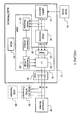
- FIG. 1 shows a DVD-ROM drive 10 and associated electronics 12 for a computer.
- the drive 10 plays DVD discs. Data stored on the DVD discs is compressed according to a well-known MPEG standard.
- an output of the ROM drive 10 provides a stream of MPEG-compressed data to the DVD-ROM electronics 12.
- An MPEG decoder 14 decodes the data stream into a video signal separated into luminance and chrominance components.
- the video signal will be described in connection with Y (luminance), U (chrominance) and V (chrominance) components of a YUV domain.
- the YUV domain is used merely to facilitate an understanding the invention. It is understood that the components of the video signal could be from a different domain, such as a Y, R-Y, B-Y domain.
- An RGB converter 16 converts the video signal leaving the MPEG decoder 14 to an RGB domain having Red, Green and Blue components. A video signal leaving the RGB converter 16 is unprotected from unauthorized copying.
- image-distorting artifacts are added to the video signal leaving the RGB converter 16.
- the YUV components of the video signal are supplied to a digital signal processor (DSP) 18.
- the DSP 18 delays (e.g., stores) the video signal leaving the RGB converter 16 (block 20) and performs detail analysis on the image represented by the YUV components of the video signal (block 22).
- the DSP 18 looks for image areas having minimal detail. Minimal detail areas include areas that have relatively flat colors and areas of gradually-changing brightness and color. In contrast, high detail areas include edges and other areas of sharp changes in intensity and color.
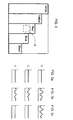
- Figure 2 provides an example of a multicolor bar chart having minimal and high detail areas. Although the bar chart is shown in black and white, each bar represents a different color. Between the side edges of each bar is minimal detail - constant color. High detail occurs at the side edges, where colors change abruptly. The selected area S has minimal detail.
- the DSP 18 retrieves a pattern from Read-Only Memory (ROM) 24 and generates image-distorting artifacts (block 26).
- Luminance of an image-distorting artifact has a changing pattern of intensity.
- the changing pattern could be a random pattern or a well defined pattern such as a sinusoidal wave. If only the luminance component of the sinusoidal wave was displayed on a computer monitor, dark and light white bands would be perceived by a viewer.
- the chrominance component of another image-distorting artifact has a changing pattern of saturation.
- the changes in saturation are selected to balance the perceived changes in intensity of the luminance. Consequently, the image-distorting artifacts are not perceptible when the balanced luminance and chrominance components are viewed together on a computer monitor.
- the DSP 18 translates the artifacts from the YUV domain to the RGB domain (block 28).
- the translated artifacts are then added to the delayed RGB signal (block 30).
- selected areas of the RGB signal leaving the DSP 18 include the image-distorting artifacts.
- the artifacts are introduced in the RGB domain because all three components of the RGB domain have the same high bandwidth.
- a digital-to-analog converter 32 converts the digital RGB signals leaving the DSP 18 to analog RGB signals.
- the analog RGB signals are sent to an RGB output of the DVD-ROM electronics 12 and supplied to a monitor 34 for display. Because the artifacts are perceptively balanced in the RGB domain, the artifacts displayed on the monitor 34 are not perceptible to a viewer.
- the RGB-to-NTSC converter 36 and the VCR 38 do not form a part of the invention; they are described merely to facilitate and understanding of the invention.
- the RGB-to-NTSC converter 36 filters the U and V components much more heavily than the luminance component. Heavy filtering causes the changes in saturation of the U and V components to be modified substantially (e.g., filtered out substantially or blocked entirely).
- the changes in intensity of the luminance component are modified less substantially (e.g., passed entirely or filtered out only slightly).
- a signal containing unbalanced artifacts is recorded by the VCR 38. Consequently, the unbalanced artifact in the luminance component becomes perceptible when the unauthorized copy is played back on a television.
- the copied images are degraded such that viewability is reduced. Consequently, the copied images are unsuitable for redistribution. Thus, unauthorized copying of the DVD disc is discouraged.
- Figures 3a, 3b and 3c illustrate how the image-distorting artifacts appear in an unauthorized copy of an image.
- Figure 3a shows constant intensity and saturation of the luminance and chrominance components.
- Figure 3b shows the luminance and chrominance signals after the artifacts have been added.
- the luminance and chrominance components are no longer constant, instead having patterns of changing intensity and saturation.
- the changes in intensity of the luminance component are balanced by the changes in saturation of the chrominance components.
- an increase in intensity is balanced by a decrease in saturation. Therefore, when the components of Figure 3b are converted to the RGB domain and displayed on the monitor, the viewer does not perceive the changes in intensity and saturation.
- the components of Figure 3c are shown in the YUV domain, the artifacts are likely to be introduced in the RGB domain.
- RGB-to-NTSC conversion causes the changes in saturation of the chrominance components to be modified substantially, while the changes in the intensity of the luminance component are modified less substantially.
- the unbalanced artifact in the luminance component is perceived when the unauthorized copy of the image is displayed.
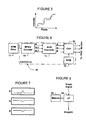
- Figure 4 shows a method of performing detail analysis and generating image-distorting artifacts.
- the DSP 18 stores an image in memory (step 100) and picks a candidate area for analysis (step 102). For example, the image could be broken up into 8x8 blocks, and the blocks could be analyzed sequentially.
- intensity and saturation of the luminance and chrominance components for the candidate area are determined (step 104). Since the artifacts will increase and decrease the intensity and saturation of the luminance and chrominance components, the DSP 18 determines whether the intensity and saturation of the candidate area can be modified. For instance, a candidate area having an intensity of 15 bits would not be able to accommodate a sine wave artifact having an amplitude of 40 bits. It follows that areas having black or white backgrounds, for example, would not be selected.
- the DSP 18 analyzes luminance of the candidate area for detail (step 106). Edges are to be avoided. If the luminance component has edges and other high detail characteristics, it will be difficult to create a smooth pattern that allows the changes in intensity to be balanced. Resulting will be edges that can perceived by a viewer. Therefore, if too much detail is found in the luminance component (step 108), the candidate area is not selected and the DSP 18 analyzes the next area (step 102).
- the DSP 18 analyzes the U chrominance component for detail (step 110). If too much detail is found in the U chrominance component (step 112), the candidate area is not selected and the DSP 18 analyzes the next area (step 102). If, however, the U chrominance component of the candidate area is relatively free of detail, the DSP 18 analyzes the V chrominance component for detail (step 114). If too much detail is found in the V chrominance component (step 116), the candidate area is not selected and DSP 18 analyzes the next area (step 102). If, however, the V chrominance component of the candidate area is relatively free of detail, the DSP 18 selects the candidate area.
- the DSP 18 retrieves an artifact pattern from the ROM 24 (step 118).
- the artifact pattern has a predetermined shape and intensity that will create a smooth, controlled transition in the luminance and chrominance components.
- the changes in intensity and saturation are relatively smooth. If the changes in intensity and saturation are sharp, it will be difficult to perceptively balance them out. However, if too smooth, the changes in saturation will not be filtered out by the RGB-to-NTSC converter 36 and will be recorded by the VCR 38.
- a hue for the artifact is selected to match the hue of the selected area.
- the DSP 18 sizes the retrieved pattern to fit in the selected area.
- the amplitude of the artifact pattern is adjusted to fit within the intensity/saturation range. Intensity of the artifact is typically a function of the intensity of luminance.
- the DSP 18 adds image-distorting artifacts to at least two of the domain components of the image signal by making a first artifact change in the luminance component of the selected area (step 124) and making a second artifact change in one or both of the U and V chrominance components (step 126) such that the first artifact change is balanced and, therefore, perceptively canceled by the second artifact change while the image is being displayed.
- a first sine wave is imposed on the luminance component, giving the luminance component a smooth, changing pattern.
- the first sine wave has an amplitude that is proportional to intensity of the luminance.
- An inverse sine wave is then imposed in the chrominance.
- the inverse sine wave has an amplitude which is proportional to saturation of the hue.
- the sum of the amplitudes in the chrominance perceptively balances the amplitude of the luminance.
- the DSP 18 converts and adds the artifacts to the stored RGB signal.
- RGB-to-NTSC conversion unbalanced filtering of the image signal destroys the balance between the artifacts and causes the image-distorting artifacts to be perceived in the selected area when a filtered image is displayed. Consequently, a pirated copy of the RGB signal would display at least one of the artifacts.
- the luminance component could appear as shown in Figure 5.
- the luminance component of the original area is shown in dashed, and the luminance signal containing the artifact is shown in solid.
- the lack of perceptibility of the artifacts in the processed RGB signal might vary from monitor to monitor. This issue could be addressed by customizing the artifacts for a particular monitor. For example, a typical customization procedure might involve calibration during installation of the DVD-ROM drive 10 and electronics 12 to optimize performance for the particular monitor being used. The calibration would involve viewing artifacts on a portion of the monitor and changing intensity or saturation until the artifacts are blended or the contrast is softened. Perceptibility of the artifacts is saturation-dependant. Actual intensity works better at higher intensity colors. Therefore, artifacts can be made more perceptible by exploiting the saturation effect.
- the MPEG decoder 14 could be implemented in an ASIC.
- An alternative to the ROM 24 could be a random pattern generator for generating the artifacts.
- FIG 6 shows an alternative embodiment of a DVD-ROM drive 10 and associated electronics 50.
- the electronics 50 includes the MPEG decoder 14 and the RGB converter 16.
- a DSP 52 performs detail analysis on the RGB components provided by the RGB converter 16 instead of the YUV components provided by the MPEG decoder 14.
- the DSP 52 generates the image-distorting artifacts from components of the RGB domain instead of the components of the YUV domain.
- Figure 7 shows artifacts that have been added to the Red, Green and Blue components.
- the RGB output of the RGB converter 16 is simultaneously stored and used for generating artifacts.
- This embodiment would allow the DSP 52 to interface with a single ASIC including the MPEG decoder 14 and the RGB converter 16.
- Figure 8 shows a microprocessor 60 that receives an image signal.
- the microprocessor 60 is programmed to store the image signal, perform detail analysis on the image signal, select the artifacts, translate the artifacts to the domain of the stored signal, and add the artifacts to the stored signal.
- Artifact pattems are stored in a memory 62.
- Instructions for the microprocessor 60 are also stored in memory 62.
- the microprocessor 60 can also perform preprocessing such as decoding and domain conversion on the image signal.
- the invention is particularly applicable to DVD-ROM electronics and DVD players. Even if the RGB signal from the DVD-ROM electronics is converted to an NTSC signal and recorded on a videocassette recorder, the unauthorized copy will still contain images having unbalanced artifacts in the luminance and chrominance components. Such degraded images would be unsuitable for viewing. Consequently, unauthorized copying of the DVD disc would be discouraged.
- the invention is not limited only to DVD-ROM electronics and DVD players. Nor is the invention limited to display devices including MPEG decoders. Compression is not even required.
- the invention can be applied to situations where bandwidths of domain components are changed during conversion of the video signal.
- YUV-to-RGB conversion is but one example.
- the image-distorting artifacts could produce countermarking images. For example, if an unauthorized copy of an image is made, an image-distorting artifact including a message could appear when the pirated image is displayed. For example, the message could state "WARNING: ILLEGAL COPY.” The message could appear as a visible watermark.
- the artifacts could be of any shape and any number. On the image of Figure 2, for example, there could be only one artifact for the entire image, or one or more artifacts for each bar.
- a change in intensity of luminance could be balanced by a change in the saturation of the U component alone, or it could be balanced by changes in the saturation of both the U component and the V component.
- the DSP 18 could find areas having minimal detail by looking at edges in an image.
Landscapes
- Engineering & Computer Science (AREA)
- Multimedia (AREA)
- Signal Processing (AREA)
- Databases & Information Systems (AREA)
- Computer Hardware Design (AREA)
- Physics & Mathematics (AREA)
- Computer Security & Cryptography (AREA)
- General Physics & Mathematics (AREA)
- Theoretical Computer Science (AREA)
- Television Signal Processing For Recording (AREA)
- Signal Processing For Digital Recording And Reproducing (AREA)
- Processing Of Color Television Signals (AREA)
- Optical Recording Or Reproduction (AREA)
Applications Claiming Priority (2)
| Application Number | Priority Date | Filing Date | Title |
|---|---|---|---|
| US53974 | 1998-04-02 | ||
| US09/053,974 US6137952A (en) | 1998-04-02 | 1998-04-02 | Apparatus and method for degrading the quality of unauthorized copies of color images and video sequences |
Publications (2)
| Publication Number | Publication Date |
|---|---|
| EP0948204A2 true EP0948204A2 (fr) | 1999-10-06 |
| EP0948204A3 EP0948204A3 (fr) | 2001-06-13 |
Family
ID=21987855
Family Applications (1)
| Application Number | Title | Priority Date | Filing Date |
|---|---|---|---|
| EP99302492A Withdrawn EP0948204A3 (fr) | 1998-04-02 | 1999-03-30 | Méthode pour empêcher la copie non autorisée des images |
Country Status (4)
| Country | Link |
|---|---|
| US (1) | US6137952A (fr) |
| EP (1) | EP0948204A3 (fr) |
| JP (1) | JPH11355716A (fr) |
| CN (1) | CN1197032C (fr) |
Cited By (1)
| Publication number | Priority date | Publication date | Assignee | Title |
|---|---|---|---|---|
| WO2004102951A3 (fr) * | 2003-05-16 | 2005-03-31 | Koninkl Philips Electronics Nv | Systeme et procede pour decourager les copies au moyen d'une perte recurrente de quantification |
Families Citing this family (14)
| Publication number | Priority date | Publication date | Assignee | Title |
|---|---|---|---|---|
| JPH11203049A (ja) * | 1998-01-14 | 1999-07-30 | Hitachi Ltd | ドライブ接続システムおよび光情報記録媒体のドライブ接続システム |
| US6272283B1 (en) * | 1998-04-22 | 2001-08-07 | Neomagic Corp. | Copy-protection for laptop PC by disabling TV-out while viewing protected video on PC display |
| JP3817364B2 (ja) * | 1998-05-07 | 2006-09-06 | パイオニア株式会社 | 画像記録信号生成装置、情報記録装置及び記録媒体 |
| US7334247B1 (en) * | 1999-03-29 | 2008-02-19 | The Directv Group, Inc. | Method and apparatus for watermarking received television content |
| US6963363B1 (en) * | 1999-09-10 | 2005-11-08 | Nikon Corporation | Digital camera capable of embedding an electronic watermark into image data |
| US6833833B1 (en) * | 2000-09-26 | 2004-12-21 | Intel Corporation | Feedback path for video benchmark testing |
| DE60135377D1 (de) * | 2000-12-14 | 2008-09-25 | Edc Systems Inc | Verfahren zur Authentifizierung eines optischen Aufzeichnungsmediums und ein optisches Aufzeichnungsmedium |
| US6765739B2 (en) | 2002-03-18 | 2004-07-20 | Hewlett-Packard Development Company, L.P. | Method and apparatus for discouraging duplication of digital data |
| JP2005063483A (ja) * | 2003-08-12 | 2005-03-10 | Pioneer Electronic Corp | 情報記録再生装置、情報記録再生方法及び情報記録再生プログラム |
| TWI223754B (en) * | 2003-10-22 | 2004-11-11 | Avermedia Tech Inc | Computer system with direct media access mode |
| US7170529B2 (en) * | 2003-10-24 | 2007-01-30 | Sigmatel, Inc. | Image processing |
| JP2006295344A (ja) * | 2005-04-06 | 2006-10-26 | Toshiba Corp | コンテンツ処理装置 |
| US8155212B2 (en) * | 2006-11-24 | 2012-04-10 | Mediatek Inc. | System and method for outputting video streams |
| US10157437B2 (en) | 2013-08-27 | 2018-12-18 | Morphotrust Usa, Llc | System and method for digital watermarking |
Family Cites Families (31)
| Publication number | Priority date | Publication date | Assignee | Title |
|---|---|---|---|---|
| US4644422A (en) * | 1982-07-22 | 1987-02-17 | Tvi Systems, Ltd. | Anti-copy system |
| US4733295A (en) * | 1984-04-27 | 1988-03-22 | Utah Scientific Advanced Development Center, Inc. | Luminance selection apparatus for video signal control system |
| US4953008A (en) * | 1986-09-08 | 1990-08-28 | Encore Video, Inc. | Method and apparatus for uniform saturation, hue and luminance correction |
| US5394274A (en) * | 1988-01-22 | 1995-02-28 | Kahn; Leonard R. | Anti-copy system utilizing audible and inaudible protection signals |
| JP2507578B2 (ja) * | 1989-02-09 | 1996-06-12 | 富士通株式会社 | カラ―描画ワ―クステ―ション |
| NL9000951A (nl) * | 1990-04-20 | 1991-11-18 | Copyguard Enterprises | Werkwijze en toestel voor het verhinderen van het onrechtmatig op band overnemen van beeldsignalen. |
| US5315098A (en) * | 1990-12-27 | 1994-05-24 | Xerox Corporation | Methods and means for embedding machine readable digital data in halftone images |
| JPH04245063A (ja) * | 1991-01-31 | 1992-09-01 | Sony Corp | 複製防止用の信号合成回路並びに検出回路 |
| JP3084796B2 (ja) * | 1991-06-14 | 2000-09-04 | ソニー株式会社 | 映像信号処理装置 |
| JP3128328B2 (ja) * | 1992-05-26 | 2001-01-29 | キヤノン株式会社 | 記録装置 |
| JPH0644755A (ja) * | 1992-07-24 | 1994-02-18 | Sony Corp | ビデオ信号の伝送方法及び記録装置 |
| JP3217137B2 (ja) * | 1992-07-28 | 2001-10-09 | 株式会社日立製作所 | 映像信号記録装置、再生装置及び伝送装置 |
| US5636292C1 (en) * | 1995-05-08 | 2002-06-18 | Digimarc Corp | Steganography methods employing embedded calibration data |
| US5659613A (en) * | 1994-06-29 | 1997-08-19 | Macrovision Corporation | Method and apparatus for copy protection for various recording media using a video finger print |
| US5574787A (en) * | 1994-07-25 | 1996-11-12 | Ryan; John O. | Apparatus and method for comprehensive copy protection for video platforms and unprotected source material |
| KR0136458B1 (ko) * | 1994-12-08 | 1998-05-15 | 구자홍 | 디지탈 자기 기록재생 시스템의 복사 방지장치 |
| US5991499A (en) * | 1995-09-01 | 1999-11-23 | Sony Corporation | Data recording apparatus and method for preventing illegal copying |
| CA2184949C (fr) * | 1995-09-28 | 2000-05-30 | Ingemar J. Cox | Filigrane de securite a etalement du spectre pour donnees multimedia |
| CA2234971C (fr) * | 1995-10-17 | 2001-08-07 | Macrovision Corporation | Procede pour enlever ou rendre inoperantes des impulsions de protection contre la copie d'un signal video, et dispositif associe |
| EP0769780B1 (fr) * | 1995-10-18 | 2003-01-29 | Matsushita Electric Industrial Co., Ltd. | Dispositif d'enregistrement d'information et dispositif émetteur d'information |
| DE69606608T2 (de) * | 1995-12-07 | 2000-12-07 | Matsushita Electric Industrial Co., Ltd. | Verfahren zur Erzeugung von Information für ein Kopierschutzsignal und Anlage in der davon Gebrauch gemacht wird |
| CN1123221C (zh) * | 1995-12-11 | 2003-10-01 | 皇家菲利浦电子有限公司 | 标记视频和/或音频信号 |
| US5699434A (en) * | 1995-12-12 | 1997-12-16 | Hewlett-Packard Company | Method of inhibiting copying of digital data |
| JP3694981B2 (ja) * | 1996-04-18 | 2005-09-14 | ソニー株式会社 | ビデオ信号処理装置およびビデオ信号処理方法 |
| JP3866376B2 (ja) * | 1996-05-02 | 2007-01-10 | テキサス インスツルメンツ インコーポレイテツド | 著作権付き資料のみをディジタルメディアシステム内で再生及び使用可能とする方法 |
| US5889868A (en) * | 1996-07-02 | 1999-03-30 | The Dice Company | Optimization methods for the insertion, protection, and detection of digital watermarks in digitized data |
| US5960398A (en) * | 1996-07-31 | 1999-09-28 | Wictor Company Of Japan, Ltd. | Copyright information embedding apparatus |
| US5915018A (en) * | 1996-11-05 | 1999-06-22 | Intel Corporation | Key management system for DVD copyright management |
| JP3154325B2 (ja) * | 1996-11-28 | 2001-04-09 | 日本アイ・ビー・エム株式会社 | 認証情報を画像に隠し込むシステム及び画像認証システム |
| US5923754A (en) * | 1997-05-02 | 1999-07-13 | Compaq Computer Corporation | Copy protection for recorded media |
| US5959717A (en) * | 1997-12-12 | 1999-09-28 | Chaum; Jerry | Motion picture copy prevention, monitoring, and interactivity system |
-
1998
- 1998-04-02 US US09/053,974 patent/US6137952A/en not_active Expired - Lifetime
- 1998-11-25 CN CNB981225977A patent/CN1197032C/zh not_active Expired - Fee Related
-
1999
- 1999-03-30 EP EP99302492A patent/EP0948204A3/fr not_active Withdrawn
- 1999-03-31 JP JP11090939A patent/JPH11355716A/ja active Pending
Cited By (1)
| Publication number | Priority date | Publication date | Assignee | Title |
|---|---|---|---|---|
| WO2004102951A3 (fr) * | 2003-05-16 | 2005-03-31 | Koninkl Philips Electronics Nv | Systeme et procede pour decourager les copies au moyen d'une perte recurrente de quantification |
Also Published As
| Publication number | Publication date |
|---|---|
| CN1197032C (zh) | 2005-04-13 |
| EP0948204A3 (fr) | 2001-06-13 |
| JPH11355716A (ja) | 1999-12-24 |
| US6137952A (en) | 2000-10-24 |
| CN1230733A (zh) | 1999-10-06 |
Similar Documents
| Publication | Publication Date | Title |
|---|---|---|
| US6137952A (en) | Apparatus and method for degrading the quality of unauthorized copies of color images and video sequences | |
| CA2503835C (fr) | Techniques permettant d'alterer imperceptiblement le spectre d'une image affichee de maniere a dissuader la copie | |
| US7324646B1 (en) | Method and apparatus for film anti-piracy | |
| EP0808541B1 (fr) | Marquage d'un signal video et/ou audio | |
| US7248784B1 (en) | Signal conversion apparatus and method | |
| US6516132B1 (en) | Method and apparatus for improving the effects of color burst modifications to a video signal | |
| US20100178032A1 (en) | Method and apparatus for providing a copy protected analog video signal via a DAC | |
| JP2007510321A (ja) | アナログビデオインタフェースを介し権限を伝達するための方法及び装置 | |
| EP0995310B1 (fr) | Protection d'un signal video composant | |
| US8280049B2 (en) | Method and apparatus for synthesizing copy protection for reducing/defeating the effectiveness or capability of a circumvention device | |
| US7092616B2 (en) | Method and apparatus for copy protecting video content and producing a reduced quality reproduction of video content for personal use | |
| US6345099B1 (en) | System and method for copy protecting computer graphics | |
| WO2001056279A2 (fr) | Mesures de lutte contre la piraterie audiovisuelle | |
| US6678465B1 (en) | Method and apparatus for restricting a video output of a computing system based on copy protection information | |
| US20110069938A1 (en) | Method and apparatus for providing a content control signal in a media player via color burst phase modifications | |
| JP2003302960A (ja) | 画像表示装置、および画像表示方法、並びにコンピュータ・プログラム | |
| US6181828B1 (en) | Apparatus and method for reducing compressibility of unauthorized copies of color images and video sequences | |
| US5995164A (en) | Reduction of color transition distortions in NTSC/PAL encoder | |
| CN1109440C (zh) | 用于改善视频信号的色同步信号修改的效果的方法和设备 | |
| US7634089B1 (en) | Cinema anti-piracy measures | |
| US8248532B2 (en) | Method and apparatus for providing a content control signal via color burst phase modifications | |
| Bravo | P‐58: DCI Quality Specifications for Emissive LED Screens | |
| EP1627385A2 (fr) | Systeme et procede pour decourager les copies au moyen d'une perte recurrente de quantification | |
| EP0896470A1 (fr) | Appareil pour transmettre un signal vidéo protégé contre l'enregistrement | |
| JPWO1998016928A1 (ja) | データのアクセス管理方法及びシステム |
Legal Events
| Date | Code | Title | Description |
|---|---|---|---|
| PUAI | Public reference made under article 153(3) epc to a published international application that has entered the european phase |
Free format text: ORIGINAL CODE: 0009012 |
|
| AK | Designated contracting states |
Kind code of ref document: A2 Designated state(s): DE FR GB |
|
| AX | Request for extension of the european patent |
Free format text: AL;LT;LV;MK;RO;SI |
|
| PUAL | Search report despatched |
Free format text: ORIGINAL CODE: 0009013 |
|
| RAP1 | Party data changed (applicant data changed or rights of an application transferred) |
Owner name: HEWLETT-PACKARD COMPANY, A DELAWARE CORPORATION |
|
| AK | Designated contracting states |
Kind code of ref document: A3 Designated state(s): AT BE CH CY DE DK ES FI FR GB GR IE IT LI LU MC NL PT SE |
|
| AX | Request for extension of the european patent |
Free format text: AL;LT;LV;MK;RO;SI |
|
| RIC1 | Information provided on ipc code assigned before grant |
Free format text: 7H 04N 7/00 A, 7H 04N 5/913 B |
|
| 17P | Request for examination filed |
Effective date: 20010827 |
|
| AKX | Designation fees paid |
Free format text: DE FR GB |
|
| GRAP | Despatch of communication of intention to grant a patent |
Free format text: ORIGINAL CODE: EPIDOSNIGR1 |
|
| STAA | Information on the status of an ep patent application or granted ep patent |
Free format text: STATUS: THE APPLICATION IS DEEMED TO BE WITHDRAWN |
|
| 18D | Application deemed to be withdrawn |
Effective date: 20071005 |