EP0948223A1 - Installation mixte de téléphone - Google Patents
Installation mixte de téléphone Download PDFInfo
- Publication number
- EP0948223A1 EP0948223A1 EP99400544A EP99400544A EP0948223A1 EP 0948223 A1 EP0948223 A1 EP 0948223A1 EP 99400544 A EP99400544 A EP 99400544A EP 99400544 A EP99400544 A EP 99400544A EP 0948223 A1 EP0948223 A1 EP 0948223A1
- Authority
- EP
- European Patent Office
- Prior art keywords
- private
- base station
- mobile telephone
- base
- station
- Prior art date
- Legal status (The legal status is an assumption and is not a legal conclusion. Google has not performed a legal analysis and makes no representation as to the accuracy of the status listed.)
- Granted
Links
Images
Classifications
-
- H—ELECTRICITY
- H04—ELECTRIC COMMUNICATION TECHNIQUE
- H04W—WIRELESS COMMUNICATION NETWORKS
- H04W60/00—Affiliation to network, e.g. registration; Terminating affiliation with the network, e.g. de-registration
-
- H—ELECTRICITY
- H04—ELECTRIC COMMUNICATION TECHNIQUE
- H04W—WIRELESS COMMUNICATION NETWORKS
- H04W52/00—Power management, e.g. Transmission Power Control [TPC] or power classes
- H04W52/02—Power saving arrangements
- H04W52/0209—Power saving arrangements in terminal devices
- H04W52/0251—Power saving arrangements in terminal devices using monitoring of local events, e.g. events related to user activity
- H04W52/0254—Power saving arrangements in terminal devices using monitoring of local events, e.g. events related to user activity detecting a user operation or a tactile contact or a motion of the device
-
- H—ELECTRICITY
- H04—ELECTRIC COMMUNICATION TECHNIQUE
- H04W—WIRELESS COMMUNICATION NETWORKS
- H04W84/00—Network topologies
- H04W84/02—Hierarchically pre-organised networks, e.g. paging networks, cellular networks, WLAN [Wireless Local Area Network] or WLL [Wireless Local Loop]
- H04W84/10—Small scale networks; Flat hierarchical networks
- H04W84/105—PBS [Private Base Station] network
-
- H—ELECTRICITY
- H04—ELECTRIC COMMUNICATION TECHNIQUE
- H04W—WIRELESS COMMUNICATION NETWORKS
- H04W88/00—Devices specially adapted for wireless communication networks, e.g. terminals, base stations or access point devices
- H04W88/02—Terminal devices
- H04W88/06—Terminal devices adapted for operation in multiple networks or having at least two operational modes, e.g. multi-mode terminals
-
- Y—GENERAL TAGGING OF NEW TECHNOLOGICAL DEVELOPMENTS; GENERAL TAGGING OF CROSS-SECTIONAL TECHNOLOGIES SPANNING OVER SEVERAL SECTIONS OF THE IPC; TECHNICAL SUBJECTS COVERED BY FORMER USPC CROSS-REFERENCE ART COLLECTIONS [XRACs] AND DIGESTS
- Y02—TECHNOLOGIES OR APPLICATIONS FOR MITIGATION OR ADAPTATION AGAINST CLIMATE CHANGE
- Y02D—CLIMATE CHANGE MITIGATION TECHNOLOGIES IN INFORMATION AND COMMUNICATION TECHNOLOGIES [ICT], I.E. INFORMATION AND COMMUNICATION TECHNOLOGIES AIMING AT THE REDUCTION OF THEIR OWN ENERGY USE
- Y02D30/00—Reducing energy consumption in communication networks
- Y02D30/70—Reducing energy consumption in communication networks in wireless communication networks
Definitions
- the subject of the present invention is a mixed telephone installation, that is to say a telephone installation usable as much in relation to a public network than with a private network.
- phones used will be mobile phones.
- the purpose of the invention will increase the reliability of the various components of the installation.
- the principle of entering into relationship includes, at the time of implementation mobile phone service, sending a message from recognition and identification of the mobile telephone, then the transmission cyclic of a location message sent by the mobile phone at base stations.
- the trace is formed by the cyclic or continuous emission of this location signal.
- the different base stations receive the signal from location and, depending on the signal level received by each of them, one of these stations is designated as being that which should be in a privileged relationship with the mobile telephone set. As the movement of the user, the designation of this base station can change from place to square.
- Recognition, identification, location signals as well as speech signals are transmitted from mobiles to base stations and reciprocally by radio transmissions of modulated carriers, in phase and or frequency. In the context of public use, the ranges of frequency of the modulated carriers are normalized: for example, they are 900 MHz for GSM, 1800 MHz for DCS. Other frequency ranges are available for other standardizations and protocols.
- the equipment used in these installations has a duration of life. The shorter the equipment, the more used frequently. In the case of a mixed installation, obviously the use is permanent, wear is faster.
- the object of the invention is to increase this lifespan as well as to limit electrical consumption and radio emissions as much as possible which occupy the frequency space permanently.
- these objectives are achieved by providing that in for private use, location messages, sent cyclically or continuously by mobile telephones at private base stations, will not be issued when the mobile phone is physically and electrically connected to the private base station, especially when it is there hooked to cause electric recharging of its battery.
- the invention therefore relates to a mixed telephone installation comprising a private base station, base stations of a public network and a mobile telephone, the mobile telephone being provided with a switch for changing from a mode of use of the private base station to a mode of use a public base station and vice versa, and comprising a circuit for transmit a location signal to a base station, the base station private base with physical support and connection electric mobile phone, characterized in that it includes a detector to detect that the private phone is kept on the private base station and a control circuit for issuing an order to stop transmitting said location signal, the mobile telephone comprising a slave circuit for modify its mode of use according to this order.
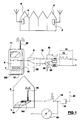
- FIG. 1 shows a mixed telephone installation according to the invention.
- This installation includes a private base station 1.
- the base station private 1 is for example arranged inside the home 2 of an individual.
- the installation also includes base stations 3 and 4 of a public network. Through example, base stations 3 and 4 are arranged on the front of houses 5 and 6 before which the holder of a mobile phone can move freely on the public domain.
- the installation also includes, at least one telephone mobile 7. Conventionally, this mobile telephone has a circuit 8 to be put into service. In practice, this circuit has functions electrical and recognition functions. Recognition functions allow to authorize the commissioning of the mobile phone only by a authorized user.
- this commissioning function includes a protocol for composition of a secret user code.
- the commissioning function electric is comparable to an electric switch which switches the supply electric from a mobile telephone set battery to the functional circuit of this mobile telephone set. In fact, this commissioning is more complex.
- mobile phone 7 After recognizing that the user of the mobile telephone 7 is an authorized user, mobile phone 7 sends a message identification with base stations of its environment. One of these stations, for example the one receiving the strongest signal is chosen. She assigns different constraints on mobile telephone 7: emission level, frequency range, synchronization rate and so on. In addition this base station broadcasts the identification of this mobile telephone set 7 to central organs of the network so that telephone communications can be routed to this mobile phone set 7.
- the mobile telephone set 7 can also include a switch 9 to switch from a mode of use to a private base station 1 to a mode of use of a public base station: a mode of use of the public network. Obviously the identification phase occurs according to the mode chosen with the corresponding base station (s).
- the switch 9 is shown schematically. It can include a physical switch. In general it will involve a link to a microprocessor contained in mobile telephone set 7 and whose function of private / public switching is generated by the actions of an operator on buttons 10 visible on the front of the mobile telephone set 7.
- the mobile telephone set includes in general a screen 11 on which are displayed, generally in clear, various information, in particular that relating to the operation of the substation mobile phone 7.
- each mobile telephone set sends a location message 13.
- the reception of this message 13 in base stations 3 and 4 makes it possible to follow the movement of the user with his mobile phone 7.
- Other functions 15 are put into service in the public mode: in particular, the transmission function and receiving lyrics to use the mobile phone extension conversation.
- These other functions are figuratively represented by a link to a circuit. In reality, this will be a function proposed by the station microprocessor 7.
- functions similar are accessible.
- a location function F2 will be the counterpart of the F1 function. It must be seen that this duality is particularly simple to achieve. You just have to modify the parameters of the functions while keeping them.
- the transmission function will be the same from one mode to another: only the frequency parameter (900 MHz or 27MHz) will be changed.
- public / private switching will be automatic. So, when a private base station receives a location signal from a mobile telephone station assigned to it (i.e. for which the private base already knows recognition signals that have been imposed on the origin), it assigns different constraints to this mobile telephone set. Basically, it imposes parameters for connecting this position mobile phone with this private base station. Conversely, when a user moves away from his home, his mobile telephone does not receive plus responses from his private base station. But he gets better and better responses from a public base station. He then enters into relation with this last at the first location for which the signal reception level is higher than a previous level. In both cases, the public / private is automatic.
- the private base station comprises a base 16 allowing the physical maintenance of the mobile telephone set 7.
- This base 16 which can be of various shapes, essentially has a cavity to embed the foot 17 of the mobile telephone set 7, or a hook intended to engage in a cavity of the mobile telephone set (or vice versa).
- This cavity or this hook are generally associated with a set of electrical contacts 181.
- the electrical contacts 181 make it possible in known manner to enter into relationship with contacts 182 of station 7, in particular to recharge the battery of station mobile telephone, when the latter is engaged in the base 16.
- the base station private 1 includes a detector to detect that the mobile phone 7 is there maintained.
- a detector to detect that the mobile phone 7 is there maintained.
- a switch mechanical 19 comprising in particular a lever which will make it possible to deliver a signal representative of the installation of the mobile telephone 7 in the base 16.
- the foot 17 of the station 7 includes other signaling connectors, which relate to the pins corresponding to base 16. We then use the signals available on these signaling connectors to inform private base station 1 that the mobile telephone set 7 is hung up (placed on the base 16). From the detection signal, the private base station 1 produced in a command 21, an order 22 intended to modify the mode of use of the telephone mobile. This change in mode depends on the detection.
- the telephone mobile then has a slave circuit 23 for receiving the order 22 and for modify its mode of use according to the nature of this order.
- circuit 23 will functionally include a switch to stop the cyclic (or continuous) transmission of the location 13.
- Circuits 21 and 23 will of course only be special features of the microprocessors that manage the base station 1 and mobile phone 7 respectively.
- the station mobile phone is located on base 16, in this case there is no longer any need to locate it: we know where it is. Therefore, the transmission of location signals is no longer required. It is no longer undertaken. There are no more unnecessary shows in the frequency space. There is no more unnecessary power consumption.
- the mobile telephone set 7 is less used; its lifespan is extended.
- this switch 9 can be actuated in two ways. Of a first way, in the old fashion, automatically or manually, the user dialing the keystroke on the 10 buttons to cause this switching. According to the refinement of the invention, it will suffice to place its mobile telephone set on base 16 for switching 9 to occur immediately, at the same time of course that the switch 23 will be open to stop emissions from unnecessary locations.
- the opposite order 22 will preferably be issued in a form radioelectric by an antenna 24 of the private base station in relation radioelectric with the antenna 25 of the mobile telephone set 7.
- the opposite order 22 will thus be the first order issued by the private base station 1 at the time of dropping out. It will complement the identification message and or of location exchanged between the private base station and the station mobile phone 7.
- the cyclic transmission by the station mobile phone 7 of the location message will mainly be used for private base station 1 to modulate the power of its transmissions according to the distance from the mobile telephone set 7. In fact, the more distant it is, the less its location signals will be received in the private base station 1 with force.
- the detectors 19 and 20 and the control circuit 21 can be located in the mobile telephone set 7 insofar as the latter can itself have means to detect that it is placed on the base 16. From this fact, it should be understood that it is the installation which has means of detect that the mobile telephone set 7 is hung up, even if, in a preferred embodiment, only the private base station will be provided with it.
Landscapes
- Engineering & Computer Science (AREA)
- Computer Networks & Wireless Communication (AREA)
- Signal Processing (AREA)
- Mobile Radio Communication Systems (AREA)
- Telephone Function (AREA)
- Radio Relay Systems (AREA)
Abstract
Description
Claims (5)
- Installation mixte de téléphone comportant une station de base privée (1), des stations de base (3, 4) d'un réseau public et un téléphone mobile (7), le téléphone mobile étant muni d'un commutateur pour passer d'un mode d'utilisation de la station de base privée à un mode d'utilisation d'une station de base publique et réciproquement, et comportant un circuit (F1, F2) pour émettre un signal de localisation à destination d'une station de base, la station de base privée comportant un moyen de maintien physique (16) et de connexion électrique (181-182) du téléphone mobile, caractérisée en ce qu'elle comporte un détecteur (19, 20) pour détecter que le téléphone privé est maintenu sur la station de base privée et un circuit (21) de commande pour émettre un ordre de cessation d'émission dudit signal de localisation, le téléphone mobile comportant un circuit esclave (23) pour modifier son mode d'utilisation en fonction de cet ordre.
- Installation selon la revendication 1, caractérisée en ce que le signal de localisation est cyclique ou continu.
- Installation selon l'une des revendications 1 à 2, caractérisée en ce que le détecteur est un détecteur électronique et comporte un circuit de mesure (20) d'un courant de charge de la batterie du téléphone mobile par la station de base privée.
- Installation selon l'une des revendications 1 à 3, caractérisée en ce que la station de base privée comporte le détecteur de maintien sur la station de base privée et le circuit de commande.
- Installation selon l'une des revendications 1 à 4, caractérisée en ce que le poste téléphonique mobile comporte le détecteur de maintien sur la station de base privée, le circuit de commande, et le circuit esclave.
Applications Claiming Priority (2)
| Application Number | Priority Date | Filing Date | Title |
|---|---|---|---|
| FR9803894 | 1998-03-30 | ||
| FR9803894A FR2776884B1 (fr) | 1998-03-30 | 1998-03-30 | Installation mixte de telephone |
Publications (2)
| Publication Number | Publication Date |
|---|---|
| EP0948223A1 true EP0948223A1 (fr) | 1999-10-06 |
| EP0948223B1 EP0948223B1 (fr) | 2005-03-09 |
Family
ID=9524635
Family Applications (1)
| Application Number | Title | Priority Date | Filing Date |
|---|---|---|---|
| EP99400544A Expired - Lifetime EP0948223B1 (fr) | 1998-03-30 | 1999-03-08 | Installation mixte de téléphone |
Country Status (9)
| Country | Link |
|---|---|
| US (1) | US6453171B1 (fr) |
| EP (1) | EP0948223B1 (fr) |
| JP (1) | JPH11331924A (fr) |
| CN (1) | CN1124060C (fr) |
| AU (1) | AU2245999A (fr) |
| CA (1) | CA2260404A1 (fr) |
| DE (1) | DE69924046T2 (fr) |
| ES (1) | ES2238817T3 (fr) |
| FR (1) | FR2776884B1 (fr) |
Cited By (1)
| Publication number | Priority date | Publication date | Assignee | Title |
|---|---|---|---|---|
| WO2001045434A3 (fr) * | 1999-12-17 | 2002-05-10 | Siemens Ag | Terminaux de telecommunication et procede de commande du transfert d'appel entre des terminaux de telecommunication |
Families Citing this family (7)
| Publication number | Priority date | Publication date | Assignee | Title |
|---|---|---|---|---|
| SE517980C2 (sv) * | 2000-03-29 | 2002-08-13 | Tryggit Ab | Förfarande och system för radiokommunikation med mobila enheter |
| EP1180902B1 (fr) * | 2000-08-09 | 2005-10-19 | Telefonaktiebolaget LM Ericsson (publ) | Méthode d'attribution dans une station mobile de paramètres opérationels en fonction de la position de la station, station mobile correspondante et émetteur pour l'émission des informations de position |
| US20020090977A1 (en) * | 2001-01-08 | 2002-07-11 | Syagration Ltd. | Automatic signal transfer apparatus for mobile phone |
| US7706336B2 (en) * | 2001-02-28 | 2010-04-27 | Motorola, Inc. | Mobile station architectures for circuit and packet modes and methods therefor |
| US7133386B2 (en) * | 2002-11-18 | 2006-11-07 | Cisco Technology, Inc. | Method and system for service portability across disjoint wireless networks |
| US7079521B2 (en) * | 2002-11-18 | 2006-07-18 | Cisco Technology, Inc. | Method and system for voice calls in a wireless local area network (WLAN) |
| ITRE20120045A1 (it) * | 2012-06-26 | 2013-12-27 | Davide Campana | Apparato telefonico comprendente un telefono cellulare multiuso con commutazione di trasmissione a bassa potenza per uso domestico e relativa base radio |
Citations (4)
| Publication number | Priority date | Publication date | Assignee | Title |
|---|---|---|---|---|
| WO1995001070A1 (fr) * | 1993-06-22 | 1995-01-05 | Telefonaktiebolaget Lm Ericsson | Terminal multireseaux |
| GB2282735A (en) * | 1993-06-04 | 1995-04-12 | Mercury Personal Communication | Autorouting system for mobile telephones |
| GB2295069A (en) * | 1994-11-14 | 1996-05-15 | Nec Corp | Mobile telephone having communication mode switching device |
| EP0740482A1 (fr) * | 1995-04-28 | 1996-10-30 | Hewlett-Packard Company | Système de gestion téléphonique pour repondre à un appel ou transférer l'appel dans un système contenant un téléphone cellulaire |
Family Cites Families (2)
| Publication number | Priority date | Publication date | Assignee | Title |
|---|---|---|---|---|
| GB2284727A (en) * | 1993-12-09 | 1995-06-14 | Stephen Robin Temple | Portable radio telephone capable of receiving calls over fixed telephone network |
| FI104140B (fi) * | 1996-12-05 | 1999-11-15 | Nokia Telecommunications Oy | Matkaviestimen käyttö langattomana puhelimena |
-
1998
- 1998-03-30 FR FR9803894A patent/FR2776884B1/fr not_active Expired - Fee Related
-
1999
- 1999-02-15 CA CA002260404A patent/CA2260404A1/fr not_active Abandoned
- 1999-03-08 EP EP99400544A patent/EP0948223B1/fr not_active Expired - Lifetime
- 1999-03-08 ES ES99400544T patent/ES2238817T3/es not_active Expired - Lifetime
- 1999-03-08 DE DE69924046T patent/DE69924046T2/de not_active Expired - Fee Related
- 1999-03-15 JP JP11068893A patent/JPH11331924A/ja active Pending
- 1999-03-24 US US09/275,438 patent/US6453171B1/en not_active Expired - Fee Related
- 1999-03-29 AU AU22459/99A patent/AU2245999A/en not_active Abandoned
- 1999-03-29 CN CN99104452A patent/CN1124060C/zh not_active Expired - Fee Related
Patent Citations (4)
| Publication number | Priority date | Publication date | Assignee | Title |
|---|---|---|---|---|
| GB2282735A (en) * | 1993-06-04 | 1995-04-12 | Mercury Personal Communication | Autorouting system for mobile telephones |
| WO1995001070A1 (fr) * | 1993-06-22 | 1995-01-05 | Telefonaktiebolaget Lm Ericsson | Terminal multireseaux |
| GB2295069A (en) * | 1994-11-14 | 1996-05-15 | Nec Corp | Mobile telephone having communication mode switching device |
| EP0740482A1 (fr) * | 1995-04-28 | 1996-10-30 | Hewlett-Packard Company | Système de gestion téléphonique pour repondre à un appel ou transférer l'appel dans un système contenant un téléphone cellulaire |
Cited By (1)
| Publication number | Priority date | Publication date | Assignee | Title |
|---|---|---|---|---|
| WO2001045434A3 (fr) * | 1999-12-17 | 2002-05-10 | Siemens Ag | Terminaux de telecommunication et procede de commande du transfert d'appel entre des terminaux de telecommunication |
Also Published As
| Publication number | Publication date |
|---|---|
| EP0948223B1 (fr) | 2005-03-09 |
| JPH11331924A (ja) | 1999-11-30 |
| ES2238817T3 (es) | 2005-09-01 |
| CA2260404A1 (fr) | 1999-09-30 |
| AU2245999A (en) | 1999-10-14 |
| CN1235471A (zh) | 1999-11-17 |
| DE69924046D1 (de) | 2005-04-14 |
| DE69924046T2 (de) | 2006-04-13 |
| CN1124060C (zh) | 2003-10-08 |
| FR2776884A1 (fr) | 1999-10-01 |
| US6453171B1 (en) | 2002-09-17 |
| FR2776884B1 (fr) | 2000-11-10 |
Similar Documents
| Publication | Publication Date | Title |
|---|---|---|
| US10389446B2 (en) | Reproduction method for reproducing contents | |
| EP2940893A1 (fr) | Procédé de communication d'informations | |
| EP0948223B1 (fr) | Installation mixte de téléphone | |
| FR2795590A1 (fr) | Systeme de communication | |
| AU2014371943A1 (en) | Information processing program, receiving program and information processing device | |
| US20060232428A1 (en) | Baby monitor system | |
| EP1124392B1 (fr) | Terminal de télécommunication mobile mixte pour l'exploitation avec un premier réseau collectif et un second réseau local préferentiel | |
| EP3236598B1 (fr) | Procédé de transmission, dispositif de transmission et programme | |
| CA2805973C (fr) | Module de gestion de candelabres et de services et systeme de telegestion comportant au moins un tel module | |
| FR2738982A1 (fr) | Systeme de telecommunications comportant une pluralite d' unites portables et au moins une unite de base formant un systeme de communication sans fil | |
| WO2012011073A1 (fr) | Chaîne de télécommande comprenant un téléphone mobile avec une fonction de télécommande et un émulateur de télécommande | |
| FR2768227A1 (fr) | Dispositif de surveillance d'un appareil electrique, notamment d'une unite informatique d'un parc bureautique, et systeme de mise en oeuvre | |
| EP1120948B1 (fr) | Téléphone portable utilisé conjointement avec un téléphone sans fil pour une station d'accueil de type DECT | |
| FR2751153A1 (fr) | Equipement de radiocommunication a mode de communication securisee, et unite d'extension faisant partie d'un tel equipement | |
| FR2999006A1 (fr) | Procede d’appairage de deux appareillages communicants d’une installation domotique et installation associee | |
| JP2002335547A (ja) | 電話機端末の着信切り替え方式 | |
| EP4106270A1 (fr) | Procédés pour apparier un appareil électrique, systèmes associés | |
| FR2691865A1 (fr) | Perfectionnements aux installations téléphoniques comprenant deux combinés dont un sans fil. | |
| FR2639168A3 (fr) | Dispositif de detection et d'information d'un usager du telephone de l'envoi d'un message telematique lui etant destine | |
| FR3100904A1 (fr) | Ensemble et procédé pour l’identification par un usager d’un véhicule | |
| EP2649821A1 (fr) | Appairage perfectionne d'equipements relies a un reseau local | |
| BE429105A (fr) | ||
| WO1983002375A1 (fr) | Dispositif de telecommande par le reseau telephonique | |
| EP1977589A2 (fr) | Procede permettant le transfert d' un appel | |
| FR2784840A1 (fr) | Dispositif de securisation d'une ligne telephonique |
Legal Events
| Date | Code | Title | Description |
|---|---|---|---|
| PUAI | Public reference made under article 153(3) epc to a published international application that has entered the european phase |
Free format text: ORIGINAL CODE: 0009012 |
|
| AK | Designated contracting states |
Kind code of ref document: A1 Designated state(s): DE ES FI FR GB IT SE |
|
| AX | Request for extension of the european patent |
Free format text: AL;LT;LV;MK;RO;SI |
|
| 17P | Request for examination filed |
Effective date: 20000406 |
|
| AKX | Designation fees paid |
Free format text: DE ES FI FR GB IT SE |
|
| 17Q | First examination report despatched |
Effective date: 20031203 |
|
| GRAP | Despatch of communication of intention to grant a patent |
Free format text: ORIGINAL CODE: EPIDOSNIGR1 |
|
| GRAS | Grant fee paid |
Free format text: ORIGINAL CODE: EPIDOSNIGR3 |
|
| GRAA | (expected) grant |
Free format text: ORIGINAL CODE: 0009210 |
|
| AK | Designated contracting states |
Kind code of ref document: B1 Designated state(s): DE ES FI FR GB IT SE |
|
| PG25 | Lapsed in a contracting state [announced via postgrant information from national office to epo] |
Ref country code: IT Free format text: LAPSE BECAUSE OF NON-PAYMENT OF DUE FEES Effective date: 20050309 Ref country code: FI Free format text: LAPSE BECAUSE OF FAILURE TO SUBMIT A TRANSLATION OF THE DESCRIPTION OR TO PAY THE FEE WITHIN THE PRESCRIBED TIME-LIMIT Effective date: 20050309 |
|
| REG | Reference to a national code |
Ref country code: GB Ref legal event code: FG4D Free format text: NOT ENGLISH |
|
| REF | Corresponds to: |
Ref document number: 69924046 Country of ref document: DE Date of ref document: 20050414 Kind code of ref document: P |
|
| GBT | Gb: translation of ep patent filed (gb section 77(6)(a)/1977) |
Effective date: 20050516 |
|
| REG | Reference to a national code |
Ref country code: ES Ref legal event code: FG2A Ref document number: 2238817 Country of ref document: ES Kind code of ref document: T3 |
|
| PLBE | No opposition filed within time limit |
Free format text: ORIGINAL CODE: 0009261 |
|
| STAA | Information on the status of an ep patent application or granted ep patent |
Free format text: STATUS: NO OPPOSITION FILED WITHIN TIME LIMIT |
|
| 26N | No opposition filed |
Effective date: 20051212 |
|
| REG | Reference to a national code |
Ref country code: FR Ref legal event code: CD |
|
| PG25 | Lapsed in a contracting state [announced via postgrant information from national office to epo] |
Ref country code: SE Free format text: LAPSE BECAUSE OF FAILURE TO SUBMIT A TRANSLATION OF THE DESCRIPTION OR TO PAY THE FEE WITHIN THE PRESCRIBED TIME-LIMIT Effective date: 20050609 |
|
| PGFP | Annual fee paid to national office [announced via postgrant information from national office to epo] |
Ref country code: ES Payment date: 20080328 Year of fee payment: 10 |
|
| PGFP | Annual fee paid to national office [announced via postgrant information from national office to epo] |
Ref country code: GB Payment date: 20080320 Year of fee payment: 10 |
|
| PGFP | Annual fee paid to national office [announced via postgrant information from national office to epo] |
Ref country code: FR Payment date: 20080314 Year of fee payment: 10 Ref country code: DE Payment date: 20080321 Year of fee payment: 10 |
|
| GBPC | Gb: european patent ceased through non-payment of renewal fee |
Effective date: 20090308 |
|
| REG | Reference to a national code |
Ref country code: FR Ref legal event code: ST Effective date: 20091130 |
|
| PG25 | Lapsed in a contracting state [announced via postgrant information from national office to epo] |
Ref country code: DE Free format text: LAPSE BECAUSE OF NON-PAYMENT OF DUE FEES Effective date: 20091001 |
|
| PG25 | Lapsed in a contracting state [announced via postgrant information from national office to epo] |
Ref country code: GB Free format text: LAPSE BECAUSE OF NON-PAYMENT OF DUE FEES Effective date: 20090308 Ref country code: FR Free format text: LAPSE BECAUSE OF NON-PAYMENT OF DUE FEES Effective date: 20091123 |
|
| REG | Reference to a national code |
Ref country code: ES Ref legal event code: FD2A Effective date: 20090309 |
|
| PG25 | Lapsed in a contracting state [announced via postgrant information from national office to epo] |
Ref country code: ES Free format text: LAPSE BECAUSE OF NON-PAYMENT OF DUE FEES Effective date: 20090309 |
|
| PG25 | Lapsed in a contracting state [announced via postgrant information from national office to epo] |
Ref country code: IT Free format text: LAPSE BECAUSE OF NON-PAYMENT OF DUE FEES Effective date: 20070308 |