EP0948954A2 - Moyen de transport pour personnes et dispositif d'entraínement pour ce moyen de transport - Google Patents
Moyen de transport pour personnes et dispositif d'entraínement pour ce moyen de transport Download PDFInfo
- Publication number
- EP0948954A2 EP0948954A2 EP99103933A EP99103933A EP0948954A2 EP 0948954 A2 EP0948954 A2 EP 0948954A2 EP 99103933 A EP99103933 A EP 99103933A EP 99103933 A EP99103933 A EP 99103933A EP 0948954 A2 EP0948954 A2 EP 0948954A2
- Authority
- EP
- European Patent Office
- Prior art keywords
- drive
- lever
- frame part
- passenger
- transport
- Prior art date
- Legal status (The legal status is an assumption and is not a legal conclusion. Google has not performed a legal analysis and makes no representation as to the accuracy of the status listed.)
- Withdrawn
Links
- 230000008878 coupling Effects 0.000 claims description 21
- 238000010168 coupling process Methods 0.000 claims description 21
- 238000005859 coupling reaction Methods 0.000 claims description 21
- 230000007246 mechanism Effects 0.000 abstract description 2
- 210000002414 leg Anatomy 0.000 description 49
- 230000005540 biological transmission Effects 0.000 description 6
- 230000029058 respiratory gaseous exchange Effects 0.000 description 3
- 210000001217 buttock Anatomy 0.000 description 2
- 230000002349 favourable effect Effects 0.000 description 2
- 238000003780 insertion Methods 0.000 description 2
- 230000037431 insertion Effects 0.000 description 2
- 210000003205 muscle Anatomy 0.000 description 2
- 230000001020 rhythmical effect Effects 0.000 description 2
- 230000008901 benefit Effects 0.000 description 1
- 230000008859 change Effects 0.000 description 1
- 238000010586 diagram Methods 0.000 description 1
- 230000000694 effects Effects 0.000 description 1
- 230000002093 peripheral effect Effects 0.000 description 1
- 239000007787 solid Substances 0.000 description 1
- 230000007103 stamina Effects 0.000 description 1
- 238000002560 therapeutic procedure Methods 0.000 description 1
Images


Classifications
-
- A—HUMAN NECESSITIES
- A61—MEDICAL OR VETERINARY SCIENCE; HYGIENE
- A61G—TRANSPORT, PERSONAL CONVEYANCES, OR ACCOMMODATION SPECIALLY ADAPTED FOR PATIENTS OR DISABLED PERSONS; OPERATING TABLES OR CHAIRS; CHAIRS FOR DENTISTRY; FUNERAL DEVICES
- A61G5/00—Chairs or personal conveyances specially adapted for patients or disabled persons, e.g. wheelchairs
- A61G5/02—Chairs or personal conveyances specially adapted for patients or disabled persons, e.g. wheelchairs propelled by the patient or disabled person
- A61G5/021—Chairs or personal conveyances specially adapted for patients or disabled persons, e.g. wheelchairs propelled by the patient or disabled person having particular propulsion mechanisms
- A61G5/023—Chairs or personal conveyances specially adapted for patients or disabled persons, e.g. wheelchairs propelled by the patient or disabled person having particular propulsion mechanisms acting directly on hubs or axis
-
- A—HUMAN NECESSITIES
- A61—MEDICAL OR VETERINARY SCIENCE; HYGIENE
- A61G—TRANSPORT, PERSONAL CONVEYANCES, OR ACCOMMODATION SPECIALLY ADAPTED FOR PATIENTS OR DISABLED PERSONS; OPERATING TABLES OR CHAIRS; CHAIRS FOR DENTISTRY; FUNERAL DEVICES
- A61G5/00—Chairs or personal conveyances specially adapted for patients or disabled persons, e.g. wheelchairs
- A61G5/02—Chairs or personal conveyances specially adapted for patients or disabled persons, e.g. wheelchairs propelled by the patient or disabled person
- A61G5/024—Chairs or personal conveyances specially adapted for patients or disabled persons, e.g. wheelchairs propelled by the patient or disabled person having particular operating means
- A61G5/025—Levers
-
- A—HUMAN NECESSITIES
- A61—MEDICAL OR VETERINARY SCIENCE; HYGIENE
- A61G—TRANSPORT, PERSONAL CONVEYANCES, OR ACCOMMODATION SPECIALLY ADAPTED FOR PATIENTS OR DISABLED PERSONS; OPERATING TABLES OR CHAIRS; CHAIRS FOR DENTISTRY; FUNERAL DEVICES
- A61G5/00—Chairs or personal conveyances specially adapted for patients or disabled persons, e.g. wheelchairs
- A61G5/02—Chairs or personal conveyances specially adapted for patients or disabled persons, e.g. wheelchairs propelled by the patient or disabled person
- A61G5/027—Chairs or personal conveyances specially adapted for patients or disabled persons, e.g. wheelchairs propelled by the patient or disabled person by using auxiliary detachable mechanisms
-
- A—HUMAN NECESSITIES
- A61—MEDICAL OR VETERINARY SCIENCE; HYGIENE
- A61G—TRANSPORT, PERSONAL CONVEYANCES, OR ACCOMMODATION SPECIALLY ADAPTED FOR PATIENTS OR DISABLED PERSONS; OPERATING TABLES OR CHAIRS; CHAIRS FOR DENTISTRY; FUNERAL DEVICES
- A61G5/00—Chairs or personal conveyances specially adapted for patients or disabled persons, e.g. wheelchairs
- A61G5/10—Parts, details or accessories
- A61G5/1051—Arrangements for steering
-
- B—PERFORMING OPERATIONS; TRANSPORTING
- B62—LAND VEHICLES FOR TRAVELLING OTHERWISE THAN ON RAILS
- B62M—RIDER PROPULSION OF WHEELED VEHICLES OR SLEDGES; POWERED PROPULSION OF SLEDGES OR SINGLE-TRACK CYCLES; TRANSMISSIONS SPECIALLY ADAPTED FOR SUCH VEHICLES
- B62M1/00—Rider propulsion of wheeled vehicles
- B62M1/14—Rider propulsion of wheeled vehicles operated exclusively by hand power
-
- B—PERFORMING OPERATIONS; TRANSPORTING
- B62—LAND VEHICLES FOR TRAVELLING OTHERWISE THAN ON RAILS
- B62M—RIDER PROPULSION OF WHEELED VEHICLES OR SLEDGES; POWERED PROPULSION OF SLEDGES OR SINGLE-TRACK CYCLES; TRANSMISSIONS SPECIALLY ADAPTED FOR SUCH VEHICLES
- B62M1/00—Rider propulsion of wheeled vehicles
- B62M1/14—Rider propulsion of wheeled vehicles operated exclusively by hand power
- B62M1/16—Rider propulsion of wheeled vehicles operated exclusively by hand power by means of a to-and-fro movable handlebar
Definitions
- the invention relates to a drive device for a means of transportation, in particular a wheelchair, according to the preamble of claim 1 and a Passenger vehicles according to the preamble of the Claim 10 and Claim 16.
- a known means of transportation comprises at least three wheels, a seat with a backrest and a drive device.
- the means Muscle-actuated drive device comprises a crank handle for each hand of the operator, each of a manual actuator and a drive lever are formed.
- the drive levers are non-rotatably coupled to a drive shaft, which in turn have a powertrain connected to a wheel of the means of transportation is. That about an axis, for example the central axis the drive shaft, rotatable drive cranks are mirror images of a perpendicular to the central axis the central plane of the drive shaft arranged.
- the drive cranks Rotated in the same direction in the direction of travel. In doing so, the one applied to the manual control elements Force permanent, i.e. during full Rotation of the drive cranks on the drive shaft transfer.
- the means of passenger transport is around a vertical axis directed.
- the well-known means of transportation is with hands driven, steered and braked. In addition must still operate the circuit and signal are given. With these functions at least one hand from the drive device respectively the manual controls that Are part of the steering. In this Driving situation is a drive and steering the Passenger means of transportation not possible.
- a drive device is used to achieve the object proposed the characteristics of the claim 1 has.
- This is characterized in that the manual control element with at least one an axis swiveling drive lever interacts that the drive lever via a Freewheel is coupled to the drive shaft, such that that with a first pivoting movement of the drive lever - seen from the seat - to the front Drive lever and the drive shaft coupled and when swiveling back the drive lever and the drive shaft are decoupled.
- This allows a comfortable, in an upright sitting posture and during the actuation of the drive device too to be kept. In an upright sitting position becomes the drive lever for applying a torque on the drive shaft only after pressed at the front in the direction of travel.
- the Body pressed against the back of the seat and can be supported in an advantageous manner.
- a means of transportation is also used to solve the problem proposed that the in claim 10 Features mentioned.
- This includes at least a seat with a backrest and a drive device that has at least one Manual control element includes. With the help of the manual control element can a torque on a Drive shaft are applied.
- the on the manual override applied force is about one Powertrain, for example sprockets and has at least one chain, at least transferred a wheel of the means of transportation.
- the manual control element with at least one around an axis back and forth swiveling drive lever cooperates, that the drive lever has a freewheel is coupled to the drive shaft such that with a first pivoting movement of the drive lever - From the seat seen - the drive lever to the front and the drive shaft coupled and when swiveling back the drive lever and the drive shaft are decoupled.
- the operator can freely choose in which area one passed by the manual control element Pitch circle he chooses the swivel angle so that he a comfortable sitting position for him during the back and forth Maintain swinging of the drive lever permanently can.
- this comprises two vehicle parts, a first vehicle part trained as a wheelchair and with one second vehicle part can be coupled.
- the wheelchair with the second part of the vehicle on which preferably attached the drive device is, releasably connected is a handicapped Maximum flexibility and comfort possible because this, with an appropriate design of the two Vehicle parts, the wheelchair while connecting do not leave the two vehicle parts together have to.
- a means of transportation is also used to solve the problem suggested which the characteristics of claim 16.
- This means of transportation has at least one backrest comprehensive seat and a drive device, which comprises at least one manual control element, with the help of a torque on a drive shaft can be applied, which on the manual control element applied force via a drive train transferred to at least one wheel becomes.
- the means of transportation also points two parallel and at a distance from each other Frame parts. Furthermore, it is a drive frame part provided on which the drive train, the drive device and a wheel arranged are.
- the drive frame part is preferably -in Direction seen - in front of the parallel to each other lying frame parts. According to the invention, that the drive frame part with a side articulation leg extending from it on one the frame parts are articulated.
- pivot leg on the drive frame part firmly attached and detachable to one frame part can be coupled.
- the articulation leg both firmly with the drive frame part as well as firmly connected to the one frame part is. So it becomes a one-piece frame of the means of transport provided by himself a particularly good strength respectively Stiffness distinguishes.
- Cross strut can be arranged.
- the means of passenger transportation although only one articulated leg between the drive frame part and the one Frame part is provided - good rigidity on that increases road safety.
- cross strut with the two frame parts is releasably connectable, that is, can be coupled and uncoupled.
- Cross strut can be removed so that after use of the passenger transport means this can be collapsed or is collapsible, when folding the two parallel ones Frame parts are placed on top of each other.
- cross strut firmly connected to the pivot leg, however detachable or attachable to the frame part can be arranged.
- a particularly preferred embodiment is characterized in that between the drive frame part and the other frame part Stiffening leg can be used.
- the stiffening leg also extends laterally from the drive frame part, the stiffening leg on the opposite of the pivot leg Provided on the drive frame part is.
- stiffening leg with its one End on the drive frame part or on the other of the two frame parts is pivotally arranged and a coupling device at its other end having.
- the stiffening leg a coupling device at both ends has, with which he both on Drive frame part as well as on one frame part can be coupled. This allows the user to board the stiffening leg completely removed and then again with the drive frame part and the frame part are connected.
- the means of transport described below can be used by adults as well as by Children are served. It includes at least three Wheels that are arranged so that the passenger transportation stands independently and not knock over. At least one of the wheels that is common a rim and a solid tire or one Tires and an associated tube, is powered by muscle power Drive device can be driven.
- the means of transportation is universally applicable, for example as a therapy device for the rehabilitation of People after an accident or illness or as a permanent means of transportation respectively - help for the disabled.
- the means of transportation can for example instead of one Bicycle also as a recreational device of physically intact People are used.
- the drive device of the means of transportation is in following explained with reference to Figures 1 and 2.
- Figure 1 shows part of an embodiment of a passenger vehicle 1, the only one cut-out frame 3, one on it attached drive device 5 and a fork 7 includes.
- a hub shaft 11 of the Wheel 9 On the fork 7 is a hub shaft 11 of the Wheel 9 rotatably attached.
- the hub shaft 11 With the hub shaft 11 is at least one, preferably also several sprockets referred to as sprockets rotatably connected, of which only one sprocket in Figure 1 13 is shown.
- the drive device 5 here comprises an in Direction of a double arrow 14 adjustable in length Drive lever 15, at one end a fastening device 17 for a manual control element 19 is provided.
- the fastening device 17 is in the embodiment shown in Figure 1 integrally connected to the drive lever. Alternatively, it is possible for the fastening device 17 and the drive lever 15 integrally or connected frictionally are.
- On the drive lever 15 is a circular Cross-section manual control element 19 attached, for example by a straight or a curved rod or tube is formed.
- the manual control element 19 is in a through opening 21 of the fastening device 17 arranged in the one of an outer surface 23 of the fastening device 17 outgoing Slot 25 is introduced.
- the diameter of the Through opening 21 is smaller than the outer diameter of the manual operating element 19, whereby the slot 25 is spread.
- To the manual control 19 certainly frictionally in the To keep through opening 21 are in the area of Slot 25 two fasteners 27, here Screws, provided. These prevent another Widen the slot 25 and thus keep that Manual actuator 19 frictionally in the Through opening 21.
- the drive lever 15 is on its the manual control element 19 end facing away from itself known, not shown freewheel 29th coupled to a drive shaft 31.
- a drive shaft 31 which is rotatable in a U-shaped Receiving part 33 is held ( Figure 2), is a sprocket 35 rotatably mounted on the a chain 37 shown with a broken line to be led.
- the one connected at its ends, one Loop forming chain 37 is also over a the sprockets operatively connected to the hub shaft 11 13 led.
- the drive lever 15 is around a perpendicular to the image plane of Figure 1 Axis 39 which is transverse or substantially transverse to Direction of travel (arrow 40) of the means of passenger transport 1 is arranged clockwise and counterclockwise swivels back and forth as with arrows 41 and 43 are shown.
- the axis 39 falls in this Embodiment with the longitudinal axis of the drive shaft 31 together.
- the sprocket 35 assigned to the drive shaft 31, the closed chain 37 and that of the hub shaft 11 assigned sprockets 13, 13 ', 13' '( Figure 2) are parts of a powertrain that are based on the Manual operating element 19 applied force transmits the wheel 9.
- the drive lever 15 acts via the freewheel 29 so together with the drive shaft 31 that at a first pivoting movement of the drive lever 15 in the direction of arrow 41, i.e. not from one shown in the seat of the means of transport 1 seated operator seen from the front, the drive lever 15 and the drive shaft 31 coupled are so that the on the manual operating element 19th applied force on the drive train on the Wheel 9 is transmitted.
- the freewheel 29 is effective, the drive lever 15 and the drive shaft 31 decoupled, so that no force is introduced into the drive shaft 31 becomes. So there is no torque on the Drive shaft 31 applied.
- the drive lever 15 is around the angle ⁇ Axis 39 swiveling, individually by the operator is variable. It has been shown that in one comfortable, especially upright sitting posture a pleasant power transmission is possible if the angle ⁇ in a range from 40 ° to 130 °, preferably 50 ° to 120 °, in particular from 60 ° to 110 °. Of course, shorter ones are also Strokes ( ⁇ ⁇ 40 °) or longer strokes ( ⁇ > 130 °) with the Drive lever possible.
- the seat of the passenger transportation means at least while driving against axis 39 a fixed position.
- the operator can also determine the position of the peripheral area of the imagined - in Figure 1 with dashed Line shown - circle 44 along which the manual control element 19 is moved, set.
- the operator can therefore easily for him cheapest angular range and the location of the Circumferential area of the circle 44 over which it drives the drive lever 15 pivoted, determine yourself, see above that, for example, he felt comfortable for him Power transmission can realize.
- Figure 1 embodiment indicated that the manual operating element 19 of a point A on the circumference of the circle 44 over a Circumferential area of approximately 90 ° to one on the circle 44 lying point B and again relocatable is.
- the length of the drive lever 15 can be chosen arbitrarily become. Because of the leverage laws, this can at a constant, on the manual actuator applied force, with different long drive levers a more or less large drive torque applied to the drive shaft become.
- a lever length adjustment device with whose help advantageously the length of the Drive lever 15 by an operator during the Operating or driving can be adjusted can.
- An embodiment of the lever length adjustment device is in the following with reference to figure 3 explained in more detail.
- Figure 2 shows schematically part of the means of passenger transport 1 according to Figure 1 in front view.
- the same parts have the same reference numerals provided so that in this respect to the description is referred to Figure 1.
- the drive lever 15 and the manual actuator 19 a T-shape when assembled have and a handlebar for the passenger transportation form.
- U-shaped receiving part 33 is with the help a fastener 45, which in this embodiment is formed by a screw attached to a connecting part 47 of the fork 7.
- the screw is in a spreadable Clamping sleeve 46 screwed in, creating a frictional Connection is created.
- the fork 7 holding the wheel 9 is also pivoted.
- Parts of the means of transportation attached be, for example a brake pawl respectively two brake pawls for actuating the the figures not shown brake, a circuit, the chain 37 from the sprocket 13 to one the other sprockets 13 ', 13' 'transferred or vice versa, an illuminant, if necessary Turn signals and the like.
- the advantage here is that to operate these parts the hands of the Handlebar or from the manual control element 19 must be taken so that safe operation is possible.
- the means of transportation can, for example, also during operation the gearshift (not shown) driven and be steered without your hands from Manual control element must be taken. Thereby can be a high level of operational security and a high ease of use can be ensured.
- FIG. 3 shows part of a further embodiment of the means of transportation 1 in Front view. Parts with those based on the figures 1 and 2 match, are provided with the same reference numerals so that reference is made to the description.
- the drive lever 15 is by means of a lever length adjustment device 51 adjustable in length and includes a lever shaft 15a, which in a lever tube 15b is held displaceably.
- the lever tube 15b is on his facing away from the manual operating element 19 End in a suitable manner rotatably with the drive shaft 31 coupled.
- On the free one, out of the lever tube 15b protruding end of the lever shaft 15a is the manual operating element 19 by means of the Attachment device 17 shown in more detail attached.
- a driving pin is located on the lever shaft 15a 53 attached, the radial ⁇ at least in substantially radially to the longitudinal axis 49 of the drive lever 15 runs.
- the driving pin 53 is in a longitudinal slot made in the lever tube 15b 55 led.
- In the 3 is the lever shaft 15a completely retracted into the lever tube 15b.
- the means, the driving pin 53 is -in seen in the vertical direction - in its lower end position within the longitudinal slot 55.
- At the Driving pin 53 is the core 57 of a Bowden cable 59 attached.
- the Bowden cable 59 is on his the driving pin 53 facing away from one end the handle 19 attached rotary handle 61 attached. From Figure 3 it can still be seen that the soul 57 of the Bowden cable 59 by a Through opening of a counter bearing, not shown 63 is guided, on which the Bowden cable 59 supports. Furthermore, the Bowden cable 59 can be selected can also be guided over a deflection roller 65, which can be rotated beneath the driving pin 53 is held on the lever tube 15b.
- the lever length adjustment device 51 By means of the lever length adjustment device 51 an operator while the passenger vehicle is traveling 1 the length of the drive lever 15, that is to what extent the lever shaft 15a from the lever tube 15b protrudes, adjust in a simple manner.
- the rotary handle 61 is turned, whereby Dependence of the direction of rotation of the rotary handle 61-der Lever shaft 15a quasi from the lever tube 15b pulled out or into the lever tube 15b is sunk.
- the length adjustment of the drive lever 15 by means of the lever length adjustment device 51 can be made continuously can by turning the handle 61 more or less is rotated.
- a drive lever length adjustment is necessary for example on slopes or large when starting up the passenger vehicle Applying driving torque with relatively little force.
- the twist grip mechanism described with reference to FIG. 3 is particularly well suited for this, because it can be operated by the operator is without letting go of the drive lever 15 got to. This results in a particularly high one Operational safety.
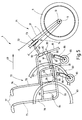
- FIGS. 5 and 6 One in FIGS. 5 and 6 is particularly preferred illustrated embodiment of the means of passenger transportation, the two arranged in a row Vehicle parts comprises, a first vehicle part is designed as a wheelchair 70 and with a second vehicle part 71 can be coupled. Preferably is the drive device on the second vehicle part 5 arranged.
- the structure of the second vehicle part can that in Figures 1 and 2 shown part 71 of the means of passenger transport 1 correspond.
- the inventive Coupling the drive lever 15 via the freewheel 29 with the drive shaft 31 to Applying a drive torque to the drive shaft Required force - seen from the seat - always forward in the direction of travel of the means of transport is directed. Press to drive the operator pulls the drive lever forward from the body away and swings it practically without effort back (idle stroke). This is in one an upright sitting posture is optimal for the operator due to the adjustable swivel angle and the freely selectable circumferential area of the circle 44, along which the manual operating element 19 a favorable power transmission possible. Furthermore, one is compared to the known means of passenger transportation improved ergonomics possible.
- FIG. 5 shows a means of passenger transportation according to the invention 1, which is the first Has vehicle part 70, which in particular as Wheelchair is trained.
- the means of passenger transportation 1 the second vehicle part 71 on, which includes the fork 7, the one End carries the wheel 9 and converges at its other end and merges into a one-pipe frame part 72, in a so-called steering head bearing 73 is rotatably held.
- the single-tube frame part 72 carries the drive device 5, which in connection with Figures 1 to 3 is explained above.
- the monotube frame part 72 and the fork 7 form a drive frame part 74, the swivel or on the steering head bearing 73 rotatable with the rear part of the vehicle 70 is connected.
- the first, also referred to as the rear vehicle part Vehicle part 70 has two in parallel and in one Frame parts 75 and 76 spaced apart from one another on the framework of what is also referred to as a wheelchair form first vehicle part 70.
- the frame parts 75 and 76 are essentially identical. They point at their top ends a handle 77, each at one end an essentially vertical subframe 78 is arranged. Between the two subframes 78 of the frame parts 75 and 76 is the backrest (not shown) of the wheelchair, so of the first vehicle part 70.
- the subframes 78 branch spaced from the handles 77 in two others essentially perpendicular to them Subframes 79 and 80, which in their further Course again in a vertical subframe 81 pass, at the end of which is not shown here Footrests are arranged. Between two subframes 79 and 80 are two connecting struts each 82 provided, which is substantially parallel to Subframe 78 run.
- each roller 85 is rotatably held in a bearing receptacle 86.
- the Bearing receptacle 86 is in each case on its frame part 75 or 76 rotatably arranged in the direction of arrow 87.
- the rollers 75 have no ground contact, when the first vehicle part 70 and the second vehicle part 71 are connected to one another.
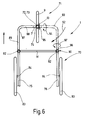
- FIGS show that Passenger means of transport 1 of FIG. 5 schematically in a top view from above.
- the frame parts 75 and 76 are shown in a very simplified form. It it can be seen that the drive frame part 74 over an L-shaped pivot leg 87 with the frame part 75, preferably on the front connecting strut 82 is connected.
- the pivot leg 87 is in the area of the steering head bearing 73 with the drive frame part 74 connected.
- FIG Coupling device 90 shown schematically be provided, which is provided at the end of the leg 89 is.
- the coupling device 90 preferably has two half-shell-like parts, the -in the coupling position Grasp the connecting strut 82. Both half shells are secured in the coupling position so that a Relative rotation with respect to the connecting strut 82 is prevented.
- a stiffening leg is dash-dotted 93 shown between the drive frame part 74 and the frame part 76 is provided.
- the stiffening leg 93 goes laterally from the drive frame part 74 in the area of the steering head bearing 73, but is with the drive frame part 74 either pivotable (arrow 94) or on the drive frame part 74 by means of a coupling device 90 can be coupled, the coupling device at one end 95 of the stiffening leg 93 is provided.
- the Stiffening leg 93 a coupling device 90 with which he attached to the front connecting strut 82 of the frame part 76 can be uncoupled and coupled.
- stiffening leg 93 can be pivoted (arrow 97) on the front connecting strut 82 of the frame part 76 is articulated, then a coupling device 90 is provided at its end 95 to the stiffening leg 93 with the drive frame part 74 to connect.
- two articulation legs 87 are provided, which - as shown in FIG. so - according to Figure 5- one above the other are arranged.
- the second pivot leg identical to that Link leg according to Figure 5 or Figure 6 trained. That means he can also do one Have coupling device 90.
- a recording is provided, in which the Link leg 87 can be inserted.
- the recording is So designed so that the pivot leg 87 in this receptacle insertable and there for example can be locked with a quick-release lock can.
- a quick release device for example spring-loaded bolts are used which protrude from the jacket of the pivot leg 87 and in a corresponding opening respectively Snap the opening into the holder.
- spring-loaded bolts are used which protrude from the jacket of the pivot leg 87 and in a corresponding opening respectively Snap the opening into the holder.
- the articulation leg 87 in the receptacle in which it is inserted, with a bolt secured by breakthroughs respectively Holes in the receptacle and the articulation leg reaches through.
- you can several bolts may also be provided.
- the receptacle and / or the articulation leg have several breakthroughs, so that length adjustment is possible. That is, the Link leg 87 can be in different insertion positions or insertion depths in the recording be secured. As a profile for the Link leg or for the link leg 87, the stiffening leg 93 and / or the Polygonal tubes, especially square tubes, or round tube profiles can be used.
- At least the drive frame part 74 a removable, fold-out and / or pivotable Support device (not shown) is provided be who is supported on the ground and in particular from a person sitting in the first vehicle part 70 User can be operated.
- This support device can be operated, for example, when a decoupling of the second vehicle part 71 to be carried out by the first vehicle part 70.
- the user can in the first vehicle part 70 stay seated and disconnect the second vehicle part 71, without this when unfolded or pivoted support would fall over.
- this can be placed on the support device second vehicle part 71 also by the user, who sits in the first vehicle part 70, easily be coupled again.
Landscapes
- Public Health (AREA)
- Engineering & Computer Science (AREA)
- Health & Medical Sciences (AREA)
- Life Sciences & Earth Sciences (AREA)
- Animal Behavior & Ethology (AREA)
- General Health & Medical Sciences (AREA)
- Veterinary Medicine (AREA)
- Combustion & Propulsion (AREA)
- Transportation (AREA)
- Mechanical Engineering (AREA)
- Chemical & Material Sciences (AREA)
- Handcart (AREA)
- Seats For Vehicles (AREA)
Applications Claiming Priority (4)
| Application Number | Priority Date | Filing Date | Title |
|---|---|---|---|
| DE19815687 | 1998-04-08 | ||
| DE19815687A DE19815687C2 (de) | 1998-04-08 | 1998-04-08 | Personenbeförderungsmittel und eine Antriebsvorrichtung für ein Personenbeförderungsmittel |
| DE19850362A DE19850362A1 (de) | 1998-04-08 | 1998-11-02 | Personenbeförderungsmittel und eine Antriebsvorrichtung für ein Personenbeförderungsmittel |
| DE19850362 | 1998-11-02 |
Publications (2)
| Publication Number | Publication Date |
|---|---|
| EP0948954A2 true EP0948954A2 (fr) | 1999-10-13 |
| EP0948954A3 EP0948954A3 (fr) | 2000-09-20 |
Family
ID=26045348
Family Applications (1)
| Application Number | Title | Priority Date | Filing Date |
|---|---|---|---|
| EP99103933A Withdrawn EP0948954A3 (fr) | 1998-04-08 | 1999-03-08 | Moyen de transport pour personnes et dispositif d'entraínement pour ce moyen de transport |
Country Status (1)
| Country | Link |
|---|---|
| EP (1) | EP0948954A3 (fr) |
Family Cites Families (6)
| Publication number | Priority date | Publication date | Assignee | Title |
|---|---|---|---|---|
| DE8210860U1 (de) * | 1982-08-05 | Hauenstein, Friedrich, 8000 München | Vorrichtung zur Halterung von Nachrüstteilen an Rollstühlen | |
| DE3413312A1 (de) * | 1984-04-09 | 1986-01-30 | Ebbinghaus, geb. Becker, Birgit, 5802 Wetter | Rollstuhlantrieb durch zwei hebel, deren drehpunkt im mittelpunkt der antriebsraeder liegt |
| DE3415524A1 (de) * | 1984-04-26 | 1985-10-31 | Heinz Ing.(Grad.) 6457 Maintal Hapke | Vielzweckmobil fuer freizeit, sport und behinderte |
| SU1738282A1 (ru) * | 1987-08-20 | 1992-06-07 | С.Н.Лукь нов | Инвалидна кол ска Лукь нова С.Н. |
| DE9410469U1 (de) * | 1994-07-01 | 1995-01-12 | Scholl, Rainer, Dipl.-Ing., 75223 Niefern-Öschelbronn | Zuggerät für Dreiradfahrzeug |
| DE9420328U1 (de) * | 1994-12-22 | 1995-02-16 | Schäberle, Erwin, 71126 Gäufelden | Fahrzeug für Gehbehinderte |
-
1999
- 1999-03-08 EP EP99103933A patent/EP0948954A3/fr not_active Withdrawn
Also Published As
| Publication number | Publication date |
|---|---|
| EP0948954A3 (fr) | 2000-09-20 |
Similar Documents
| Publication | Publication Date | Title |
|---|---|---|
| DE3941768C1 (fr) | ||
| EP2075183B1 (fr) | Tricycle pliable pour handicapé | |
| DE602004013005T2 (de) | Mobilitätsassistenzfahrzeug | |
| DE2116597A1 (de) | Personenfahrzeug | |
| DE69918667T2 (de) | Rollstuhlvorrichtung | |
| DE3121166A1 (de) | Gehgestell fuer gehbehinderte | |
| DE3333309A1 (de) | Behindertenfahrzeug | |
| EP0531260B1 (fr) | Engine aquatique à propulsion musculaire | |
| DE69020363T2 (de) | Transporteinrichtung für invalide. | |
| DE2822338A1 (de) | Fahrrad | |
| DE2610644A1 (de) | Fahrrad mit trethebelantrieb | |
| DE19612632C2 (de) | Trainingsgerät | |
| DE10312878B4 (de) | Roller | |
| DE29802643U1 (de) | Fortbewegungs- und/oder Trainingsgerät | |
| DE3126075A1 (de) | Vorderradantrieb fuer fahrraeder oder aehnliche fahrzeuge | |
| DE102019121133B4 (de) | Bewegungsvorrichtung für Personen | |
| DE60002493T2 (de) | Vorrichtung zum fahren eines karts mit den händen für personen mit beinbehinderungen und damit ausgerüstetes kart | |
| DE19815687C2 (de) | Personenbeförderungsmittel und eine Antriebsvorrichtung für ein Personenbeförderungsmittel | |
| DE19850362A1 (de) | Personenbeförderungsmittel und eine Antriebsvorrichtung für ein Personenbeförderungsmittel | |
| AT396743B (de) | Krankenfahrstuhl | |
| DE102008004357B4 (de) | Muskelkraftgetriebenes Leichtfahrzeug umfassend einen linearen Handantrieb mit Lenkfunktion | |
| DE102020117354A1 (de) | Vierrädriger Pedal-Gokart und dessen Verwendung | |
| DE4413712C2 (de) | Muskelkraftgetriebenes Fahrzeug zur spielerischen und sportlichen Fortbewegung im Stehen | |
| EP4267069B1 (fr) | Véhicule propulsé par la force musculaire | |
| DE29620645U1 (de) | Rollstuhl für körperbehinderte Benutzer |
Legal Events
| Date | Code | Title | Description |
|---|---|---|---|
| PUAI | Public reference made under article 153(3) epc to a published international application that has entered the european phase |
Free format text: ORIGINAL CODE: 0009012 |
|
| AK | Designated contracting states |
Kind code of ref document: A2 Designated state(s): AT BE CH CY DE DK ES FI FR GB GR IE IT LI LU MC NL PT SE |
|
| AX | Request for extension of the european patent |
Free format text: AL;LT;LV;MK;RO;SI |
|
| PUAL | Search report despatched |
Free format text: ORIGINAL CODE: 0009013 |
|
| AK | Designated contracting states |
Kind code of ref document: A3 Designated state(s): AT BE CH CY DE DK ES FI FR GB GR IE IT LI LU MC NL PT SE |
|
| AX | Request for extension of the european patent |
Free format text: AL;LT;LV;MK;RO;SI |
|
| RIC1 | Information provided on ipc code assigned before grant |
Free format text: 7A 61G 5/02 A, 7B 62M 1/16 B |
|
| 17P | Request for examination filed |
Effective date: 20010320 |
|
| AKX | Designation fees paid |
Free format text: AT BE CH CY DE DK ES FI FR GB GR IE IT LI LU MC NL PT SE |
|
| AXX | Extension fees paid |
Free format text: AL PAYMENT 20010320;LT PAYMENT 20010320;LV PAYMENT 20010320;MK PAYMENT 20010320;RO PAYMENT 20010320;SI PAYMENT 20010320 |
|
| DAX | Request for extension of the european patent (deleted) | ||
| RBV | Designated contracting states (corrected) |
Designated state(s): AT BE CH DK FI FR GB IE IT LI LU NL SE |
|
| REG | Reference to a national code |
Ref country code: DE Ref legal event code: 8566 |
|
| 17Q | First examination report despatched |
Effective date: 20031114 |
|
| STAA | Information on the status of an ep patent application or granted ep patent |
Free format text: STATUS: THE APPLICATION IS DEEMED TO BE WITHDRAWN |
|
| 18D | Application deemed to be withdrawn |
Effective date: 20040525 |
|
| REG | Reference to a national code |
Ref country code: HK Ref legal event code: WD Ref document number: 1023716 Country of ref document: HK |