EP0948977A2 - Videospielvorrichtung und computerlesbares Aufzeichungsmedium für Videospielprogramm - Google Patents
Videospielvorrichtung und computerlesbares Aufzeichungsmedium für Videospielprogramm Download PDFInfo
- Publication number
- EP0948977A2 EP0948977A2 EP99104073A EP99104073A EP0948977A2 EP 0948977 A2 EP0948977 A2 EP 0948977A2 EP 99104073 A EP99104073 A EP 99104073A EP 99104073 A EP99104073 A EP 99104073A EP 0948977 A2 EP0948977 A2 EP 0948977A2
- Authority
- EP
- European Patent Office
- Prior art keywords
- game
- character
- leading
- content
- met
- Prior art date
- Legal status (The legal status is an assumption and is not a legal conclusion. Google has not performed a legal analysis and makes no representation as to the accuracy of the status listed.)
- Ceased
Links
Images



Classifications
-
- A63F13/10—
-
- A—HUMAN NECESSITIES
- A63—SPORTS; GAMES; AMUSEMENTS
- A63F—CARD, BOARD, OR ROULETTE GAMES; INDOOR GAMES USING SMALL MOVING PLAYING BODIES; VIDEO GAMES; GAMES NOT OTHERWISE PROVIDED FOR
- A63F9/00—Games not otherwise provided for
- A63F9/24—Games using electronic circuits not otherwise provided for
-
- A—HUMAN NECESSITIES
- A63—SPORTS; GAMES; AMUSEMENTS
- A63F—CARD, BOARD, OR ROULETTE GAMES; INDOOR GAMES USING SMALL MOVING PLAYING BODIES; VIDEO GAMES; GAMES NOT OTHERWISE PROVIDED FOR
- A63F13/00—Video games, i.e. games using an electronically generated display having two or more dimensions
- A63F13/45—Controlling the progress of the video game
- A63F13/49—Saving the game status; Pausing or ending the game
- A63F13/493—Resuming a game, e.g. after pausing, malfunction or power failure
-
- A—HUMAN NECESSITIES
- A63—SPORTS; GAMES; AMUSEMENTS
- A63F—CARD, BOARD, OR ROULETTE GAMES; INDOOR GAMES USING SMALL MOVING PLAYING BODIES; VIDEO GAMES; GAMES NOT OTHERWISE PROVIDED FOR
- A63F13/00—Video games, i.e. games using an electronically generated display having two or more dimensions
- A63F13/45—Controlling the progress of the video game
-
- A—HUMAN NECESSITIES
- A63—SPORTS; GAMES; AMUSEMENTS
- A63F—CARD, BOARD, OR ROULETTE GAMES; INDOOR GAMES USING SMALL MOVING PLAYING BODIES; VIDEO GAMES; GAMES NOT OTHERWISE PROVIDED FOR
- A63F13/00—Video games, i.e. games using an electronically generated display having two or more dimensions
- A63F13/55—Controlling game characters or game objects based on the game progress
- A63F13/58—Controlling game characters or game objects based on the game progress by computing conditions of game characters, e.g. stamina, strength, motivation or energy level
-
- A—HUMAN NECESSITIES
- A63—SPORTS; GAMES; AMUSEMENTS
- A63F—CARD, BOARD, OR ROULETTE GAMES; INDOOR GAMES USING SMALL MOVING PLAYING BODIES; VIDEO GAMES; GAMES NOT OTHERWISE PROVIDED FOR
- A63F13/00—Video games, i.e. games using an electronically generated display having two or more dimensions
- A63F13/80—Special adaptations for executing a specific game genre or game mode
- A63F13/833—Hand-to-hand fighting, e.g. martial arts competition
-
- A—HUMAN NECESSITIES
- A63—SPORTS; GAMES; AMUSEMENTS
- A63F—CARD, BOARD, OR ROULETTE GAMES; INDOOR GAMES USING SMALL MOVING PLAYING BODIES; VIDEO GAMES; GAMES NOT OTHERWISE PROVIDED FOR
- A63F13/00—Video games, i.e. games using an electronically generated display having two or more dimensions
- A63F13/90—Constructional details or arrangements of video game devices not provided for in groups A63F13/20 or A63F13/25, e.g. housing, wiring, connections or cabinets
- A63F13/95—Storage media specially adapted for storing game information, e.g. video game cartridges
-
- A—HUMAN NECESSITIES
- A63—SPORTS; GAMES; AMUSEMENTS
- A63F—CARD, BOARD, OR ROULETTE GAMES; INDOOR GAMES USING SMALL MOVING PLAYING BODIES; VIDEO GAMES; GAMES NOT OTHERWISE PROVIDED FOR
- A63F2300/00—Features of games using an electronically generated display having two or more dimensions, e.g. on a television screen, showing representations related to the game
- A63F2300/60—Methods for processing data by generating or executing the game program
- A63F2300/65—Methods for processing data by generating or executing the game program for computing the condition of a game character
-
- A—HUMAN NECESSITIES
- A63—SPORTS; GAMES; AMUSEMENTS
- A63F—CARD, BOARD, OR ROULETTE GAMES; INDOOR GAMES USING SMALL MOVING PLAYING BODIES; VIDEO GAMES; GAMES NOT OTHERWISE PROVIDED FOR
- A63F2300/00—Features of games using an electronically generated display having two or more dimensions, e.g. on a television screen, showing representations related to the game
- A63F2300/80—Features of games using an electronically generated display having two or more dimensions, e.g. on a television screen, showing representations related to the game specially adapted for executing a specific type of game
- A63F2300/8029—Fighting without shooting
Definitions
- the present invention relates to video game machines using a recording medium containing program data, such as an optical disk, a magnetic disk, or a semiconductor memory, and to recording media containing video game programs.
- a recording medium containing program data such as an optical disk, a magnetic disk, or a semiconductor memory
- Many game systems have been proposed, such as a system comprised of a home-use game console and a television monitor, a commercial-use game machine, and a system comprised of a personal computer or work station, a display, and an audio output device.
- These game systems each include a player-operated controller, a recording medium containing game-program data, a central processing unit (CPU) for performing control for the generation of sound and images based on the game-program data, a processor for generating images, a processor for generating sound, a monitor for displaying images, and a speaker for outputting the generated sound.
- the types of recording medium include a compact-disk read-only memory (CD-ROM), a semiconductor memory, and a cassette having a built-in semiconductor memory.
- Conventional video games for these video game machines are known in which a game player selects a leading game character from among a plurality of predetermined leading game characters.
- the conventional video games are nothing but simple games in which a leading game character can be selected from a plurality of leading game characters. Their game contents are single; that is, a selected leading game character is used to play the same game.
- independent game contents are provided for a plurality of leading game characters.
- the game contents are not related to one another, and a plurality of types of games can be simply played.
- mutually related game contents are provided for a plurality of leading game characters, and when the game corresponding to a selected leading game character is played, a game subsequently played is influenced by action of the leading game character in the first game.
- the other leading game character does not interest the player since the other leading game character does not appear.
- a video game machine characterized by comprising a display unit for displaying images of a game performed in a predetermined game world; at least one operation unit for outputting an operation signal in accordance with an external operation; a first-game-content storage unit for storing a first game content using a first game character as a leading game character, and a second game character; a second-game-content storage unit for storing a second game content using the second character as a leading game character, and the first character; a leading-character selection unit for selecting either the first character or the second character as a leading game character; a game-screen output unit for outputting, to the display unit, game screens in accordance with the game content corresponding to the selected leading character; a game-progress control unit for advancing the set game content by using the operation signal to control the action of the leading character displayed on the display unit; a first condition determination unit for determining whether a predetermined first game condition for the first game content is
- the first game content may be a fighting game in which the first character fights so as to cause a predetermined amount of damage to at least one first enemy game character.
- the second game content may be a fighting game in which the second character fights so as to cause a predetermined amount of damage to at least one second enemy game character.
- the first game condition may be met when the first character causes the predetermined amount of damage to the first enemy character on condition that the second game condition is met, or may be met when the first character causes a predetermined amount of damage to a first boss-enemy game character appearing after causing the predetermined amount of damage to the first enemy character in the case where the second game condition is not met.
- the second game condition may be met when the second character causes the predetermined amount of damage to the second enemy character on condition that the first game condition is met, or may be met when the second character causes a predetermined amount of damage to the first boss-enemy character appearing after causing the predetermined amount of damage to the second enemy character in the case where the first game condition is not met.
- the third game content may be a fighting game in which the selected leading character fights so as to cause a predetermined amount of damage to a second boss-enemy game character.
- the foregoing object is achieved through provision of a computer-readable recording medium containing a video game program for performing a game in a predetermined game world, the computer-readable recording medium characterized in that the video game program has: a first game content using a first game character as a leading game character, and a second game character; a second game content using the second character as a leading game character, and the first game character; and a third game content provided so that either the first character or the second character is selected as a leading game character; and in that the video game program comprises: a leading-character selection step for selecting either the first character or the second character as a leading game character; a game-screen output step for outputting, to a display unit, game screens in accordance with the game content corresponding to the selected game character; a game-progress control step for advancing the set game content by using an operation signal in accordance with an operation by an operation unit to control the action of the leading character displayed on the display unit; a first condition determination step for
- a video game machine characterized by comprising: a display unit for displaying images of a game performed in a predetermined game world; at least one operation unit for outputting an operation signal in accordance with an external operation; a game-content storage unit for storing a plurality of game contents using a plurality of game characters and one of the plurality of game characters as a leading game character; a leading-character selection unit for selecting one game character as a leading game character from among the plurality of game characters; a game-screen output unit for outputting, to the display unit, game screens in accordance with the game content corresponding to the selected leading character; a game-progress control unit for advancing the set game content by using the operation signal to control the action of the leading character displayed on the display unit; a condition determination unit for determining whether each of predetermined game conditions provided for the plurality of game contents is met; a permission unit for permitting the leading-character selection unit to select another game character from among the plurality
- the foregoing object is achieved through provision of a computer-readable recording medium containing a video game program for performing a game in a predetermined game world, the computer-readable recording medium characterized in that the video game program has: a plurality of game contents using a plurality of game characters and one of the plurality of game characters as a leading game character; and a third game content provided so that one game character is selected as a leading game character from among the plurality of game characters; and in that the video game program comprises: a leading-character selection step for selecting one game character as a leading game character from among the plurality of game characters; a game-screen output step for outputting, to a display unit, game screens in accordance with the game content corresponding to the selected leading character; a game-progress control step for advancing the set game content by using an operation signal in accordance with an operation by an operation unit to control the action of the leading character displayed on the display unit; a condition determination step for determining whether each of predetermined game conditions provided for
- a method for controlling a video game in a predetermined game world wherein said video game has:
- the foregoing object is achieved through provision of a video game machine characterized in that the video game machine comprises: a display unit for displaying images of a game performed in a predetermined game world; at least one operation unit for outputting an operation signal in accordance with an external operation; a first-game-content storage unit for storing a first game content as a fighting game using a first game character as a leading game character, and a second leading game character, the first character fighting so as to cause a predetermined amount of damage to at least one first enemy game character; a second-game-content storage unit for storing a second game content, which differs from the first game content, as a fighting game using the second character as a leading game character, and the first character, the second character fighting so as to cause a predetermined amount of damage to at least one second enemy game character; a leading-character selection unit for selecting either the first character or the second character as a leading game character; a game-screen output unit for outputting, to the display unit, game
- the foregoing object is achieved through provision of a computer-readable recording medium containing a video game program for performing a game in a predetermined game world, the computer-readable recording medium characterized in that the video game program has: a first game content as a fighting game using a first game character as a leading game character, and a second game character, the first character fighting so as to cause a predetermined amount of damage to at least one first enemy character; and a second game content as a fighting game which differs from the first game content, the second game content using the second character as a leading game character, and the first character, the second character fighting so as to cause a predetermined amount of damage to at least one second enemy character; and the video game program comprises: a leading-character selection step for selecting either the first character or the second character as a leading game character; a game-screen output step for outputting, to a display unit, game screens in accordance with the game content corresponding to the selected game character; a game-progress control step for a leading-character selection step for selecting either the
- a method for controlling a video game in a predetermined game world wherein said video game has:
- both a first game character and a second game character are used in each game content. This enhances amusement by each game content.
- a first game content and a second game content can be sequentially performed. This enhances amusement by each game content.
- game screens in accordance with a third game content are output, whereby the amusement is further enhanced.
- the third game content its leading game character can be selected, which diversifies the game.
- a first enemy character against a first game character differs from a second enemy character against a second game character. Therefore, even if both the first and second games are performed, a game player enjoys fighting games that differ for the respective game contents.
- game contents are provided so that one game character as a leading game character, and the leading game character of another game content, are used. This enhances amusement by each game content.
- any one game condition is met, it is allowed to select a game character in another game condition. Thereby, the game contents are sequentially performed, which enhances amusement by the game contents.
- the game player leaves a first game and a second game
- game screens in accordance with a third game content as the final stage are output, whereby amusement by each game is enhanced.
- the third game content has a leading game character that can be selected, which enhances game diversity.
- a first game character and a second game character are used, which enhances amusement by each game content.
- a game content differs in accordance with the selection of a leading game character from among a first game character and a second game character. Therefore, even if both characters are sequentially selected, the same game content is not repeatedly performed. This enables amusement by each game content.
- a first enemy character against a first game character in a first game content differs from a second enemy character against a second game character in a second game content. Therefore, even if both game contents are performed, fighting games that differ for the respective game contents are enjoyed.
- a first game content and a second game content are provided so that in a scene where a first game character and a second game character appear, the first and second characters fight with different enemy characters, respectively. Therefore, the original features of each game content are emphasized, and amusement by each game content is enhanced.
- Fig. 1 shows a game system according to an embodiment of the present invention.
- This game system consists of a main unit and a recording medium 30 containing program data.
- the main unit includes a CPU 1, a bus 2 comprised of an address bus, a data bus, and a control bus 2, and components connected to the bus 2.
- a graphics-data generating processor 3 an interface circuit 4, a main memory 5, a read only memory (ROM) 6, a decompression circuit 7, a parallel port 8, a serial port 9, a rendering processor 10 and a buffer 11 therefor, an audio processor 13 and a buffer 14 therefor, a decoder 17 and a buffer 18 therefor, and an interface circuit 20 and a memory 21 therefor, are connected to the bus 2.
- a television monitor (hereinafter referred to simply as a "monitor") 12 is connected to the rendering processor 10.
- a speaker 16 is connected to the audio processor 13 via an amplifier circuit 15.
- a recording medium driver 19 is connected to the decoder 17.
- the memory 21 and a controller 22 are connected to the interface circuit 20.
- the form of the game system 1 differs depending on its purpose.
- the monitor 12, and the speaker 16 are separately provided.
- the correspondence between the game system 1 and the components of the computer or workstation is as follows:
- the graphics-data generating processor 3 functions as a so-called co-processor.
- the graphics-data generating processor 3 performs parallel processing for coordinate transformation and illumination computation, for example, computation of a fixed point matrix and vectors.
- Main processes performed by the graphics-data generating processor 3 include a process for finding, based on coordinate data on each vertex (in a two-dimensional or three-dimensional plane) of image data supplied from the CPU 1, the address (in a display area) of an image to be processed, and sending back the address data to the CPU 1; and a process for computing the brightness of an image in accordance with a distance from a virtual light source.
- the interface circuit 4 connects the main unit and peripheral devices, for example, pointing devices such as mice and track balls.
- the ROM 6 contains program data as an operating system for the game system.
- the program data correspond to a basic input output system (BIOS) in a personal computer.
- BIOS basic input output system
- the decompression circuit 7 decompresses an image compressed by intra-coding based on the Moving Picture Engineering Group (MPEG) standard for moving pictures, or the Joint Picture Engineering Standard (JPEG) standard for still pictures. Decompression consists of decoding (the decoding of data encoded using a variable length code), inverse quantization, inverse discrete cosine transform (IDCT), intra-image restoration, etc.
- MPEG Moving Picture Engineering Group
- JPEG Joint Picture Engineering Standard
- Decompression consists of decoding (the decoding of data encoded using a variable length code), inverse quantization, inverse discrete cosine transform (IDCT), intra-image restoration, etc.
- the rendering processor 10 performs rendering in the buffer 11, based on a rendering command issued by the CPU 1.
- the buffer 11 consists of a display area and a non-display area. In the display area, data to be displayed on the screen of the monitor 12 are loaded.
- data for defining skeletons data for defining polygons, animation data for causing models to move, pattern data representing the contents of animations, texture data, color-palette data, etc., are stored.
- the texture data are two-dimensional image data.
- the color-palette data are used to select a color for a texture data or the like. These data are prerecorded from the recording medium 30 into the non-display area of the buffer 11 by the CPU 1 once or a number of times in accordance with the progress of the game.
- Each rendering command includes a rendering command for using polygons to render a three-dimensional image, and a rendering command for rendering an ordinary two-dimensional image.
- the polygons are two-dimensional virtual polygonal figures. In this embodiment, triangles or quadrangles.
- the rendering command for using polygons to render a three-dimensional image consists of a polygon-vertex-address data in the display area of the buffer 11, a texture-address data representing a position at which a texture data to be pasted is stored in the buffer 11, a color-palette-address data representing a position at which a color-palette data representing the color of the texture data is stored in the buffer 11, and a brightness data representing a texture brightness.
- the polygon-vertex-address data in the display area of the buffer 11 is obtained such that a polygon-vertex-coordinate data (in a three-dimensional space) from the CPU 1 is replaced with a two-dimensional polygon-vertex-coordinate data by performing, based on movement data and rotation data on the screen (viewpoint), the coordinate transformation of the polygon-vertex-coordinate data.
- the brightness data is determined based on the distance from a position represented by the obtained two-dimensional polygon-vertex-coordinate data to the virtual light source.
- the polygon-vertex-coordinate data represents an address in the display area of the buffer 11.
- a range of the display area (of the buffer 11) which is represented by three or four polygon-vertex-address data corresponding texture data are written by the rendering processor 10.
- One object consists of a plurality of polygons.
- the CPU 1 stores three-dimensional-space coordinate data on each polygon in the buffer 11 so that the coordinate data are correlated with corresponding skeleton vector data.
- the following processes are performed by using the controller 22.
- the CPU 1 supplies the graphics-data generating processor 3 with three-dimensional coordinate data on polygon vertices, which are stored in the non-display area of the buffer 11, and movement data and rotation data on polygons, which are found based on skeleton coordinates and its rotation data.
- the graphics-data generating processor 3 Based on the three-dimensional coordinate data on polygon vertices, and on the movement data and rotation data on polygons, the graphics-data generating processor 3 sequentially finds three-dimensional coordinate data on moved and rotated polygons.
- horizontal and vertical coordinate data are supplied as address data, that is, polygon-vertex-address data, to the rendering processor 10.
- the rendering processor 10 writes, in a triangular or tetragonal display area of the buffer 11 which is represented by three or four polygon-vertex-address data, a texture data represented by a pre-assigned texture address data. This displays, on the screen of the monitor 12, an object in which texture data are pasted on a plurality of polygons.
- Each rendering command for rendering an ordinary two-dimensional image includes a vertex-address data, a texture-address data, a color-palette-address data representing a position at which a color-palette data representing a texture data is stored in the buffer 11, and a brightness data representing the brightness of a texture.
- the vertex-address data is a coordinate data obtained such that the graphics-data generating processor 3 performs, based on movement data and rotation data from the CPU 1, the coordinate transformation of a two-dimensional vertex-coordinate data from the CPU 1.
- the audio processor 13 stores, in the buffer 14, adaptive-differential-pulse-code-modulated (ADPCM) data read from the recording medium 30, and uses the ADPCM data as a audio source.
- the audio processor 13 reads the ADPCM data, using a clock signal having a frequency of 44.1 MHz.
- the audio processor 13 performs processes for the ADPCM data read from the buffer 14, such as pitch transformation, noise addition, envelope setting, level setting, and reverbing.
- audio data read from the recording medium 30 are pulse-code-modulated (PCM) data such as compact disk digital audio (CD-DA) data
- PCM pulse-code-modulated
- CD-DA compact disk digital audio
- the audio data are converted into ADPCM data by the audio processor 13.
- the PCM data are directly processed in the main memory 5 by using the program data.
- the PCM data processed in the main memory 5 are supplied and converted into ADPCM data in the audio processor 13, and the above-described processes for the ADPCM data are performed before being output as sound from the speaker 16.
- the recording medium driver 19 is, for example, a CD-ROM drive, a hard disk drive, an optical disk drive, a flexible disk drive, a silicon disk drive, a cassette medium reader, or the like.
- the recording medium 30 is, for example, a CD-ROM, a hard disk, a flexible disk, a semiconductor memory, or the like.
- the recording medium driver 19 reads images, sound, and program data from the recording medium 30, and supplies them to the decoder 17.
- the decoder 17 uses error-correcting codes to perform the error correction of the reproduced data, and supplies the error-corrected data to the main memory 5 or the audio processor 13.
- the memory 21 chiefly consists of, for example, a card memory, and is used to store various game parameters such as termination conditions
- the controller 22 includes, as externally operable means, a first left button 22L1, a second left button 22L2, a first right button 22R1, a second right button 22R2, an up-key 22U, a down-key 22D, a left key 22L, a right key 22R, a start button 22a, a selector button 22b, a first button 22c, a second button 22d, a third button 22e, and a fourth button 22f.
- the controller 22 is operated by the game player, and outputs operation signals in accordance with operations.
- the up-key 22U, the down-key 22D, the left key 22L, and the right key 22R are used by the game player to supply the CPU 1 with commands for vertically or horizontally moving a game character on the screen, or with a command for transferring the selection of icons on a menu screen.
- the start button 22a is used for the game player to instruct the CPU 1 to initiate the game program loaded from the recording medium 30.
- the selector button 22b is used for the game player to instruct the CPU 1 to perform various selections related to the game program data loaded from the recording medium 30 into the main memory 5.
- the functions of the first button 22c, the second button 22d, the third button 22e, the fourth button 22f, the first left button 22L1, the second left button 22L2, the first right button 22R1, and the second right button 22R2, differ depending on the game program data loaded from the recording medium 30.
- the CPU 1 instructs the recording medium driver 19 to read the program data from the recording medium 19, based on an operating system stored in the ROM 6.
- the recording medium driver 19 reads images, sound, and program data from the recording medium 30.
- the read images, sound, and program data are supplied and processed for error correction in the decoder 17.
- the error-corrected image data are supplied and decompressed in the decompression circuit 7 via the bus 2.
- the decompressed data are supplied to the rendering processor 10, and are written into the non-display area of the buffer 11 by the rendering processor 10.
- the error-corrected audio data obtained in the decoder 17 are supplied to the main memory 5 or the signal processor 13, and are written in the main memory 5 or the buffer 14.
- the error-corrected program data obtained in the decoder 17 are supplied and written in the main memory 5. Subsequently, the CPU 1 proceeds with the game, based on the game program data stored in the main memory 5, and on the content of an instruction from the controller 22 by the game player. In other words, based on the content of an instruction from the controller 22 by the game player, the CPU 1 controls image processing, audio processing, and internal processing.
- control of image processing includes skeleton-coordinate computation and polygon-vertex computation based on pattern data corresponding to an animation selected by a game character, the supply of the obtained three-dimensional coordinate data and viewpoint position data to the graphics-data generating processor 3, and the issue of a rendering command including address and brightness data (in the display area of the buffer 11) found by the graphics-data generating processor 3.
- Control of audio processing includes the issue of an audio output command to the audio processor 13, level setting, and reverbing.
- Control of internal processing is, for example, computation in accordance with an operation from the controller 22, or the like.
- Fig. 2 shows the functional blocks of the CPU 1. Components connecting the monitor 12 and the bus 2, and components connecting the recording medium 30 and the bus 2, are not shown for brevity.
- a leading game character to be manipulated by the game player can be selected from among a first game character and a second game character.
- the recording medium 30 contains a first game content having the first game character as a leading game character, a second game content having the second game character as a leading game character, and a third game content that can be performed only when the game player has left both the first and second game contents.
- the first and second game contents are independent of each other, and are set so that the first character and the second character act independently in the same game world.
- the first and second game contents have relevance in that the first game content uses the second character, and the second game content uses the first character.
- the first character as a leading character is manipulated to fight with a first enemy game character by using the controller 22, and when the first character beats the first enemy character by inflicting a predetermined amount of damage, the next stage begins.
- the second character as a leading character is manipulated to fight with a second enemy game character which differs from the first enemy character by using the controller 22, and when the second character beats the first enemy character by inflicting a predetermined amount of damage, the next stage begins.
- the first or second game content is set up such that when the other game content is still pending, the leading game character of one game fights with a first boss-enemy game character after beating all enemy game characters, and when the leading game character of the game beats the first boss-enemy character by inflicting a predetermined amount of damage, the game player is allowed to leave the game. If the game player has left the other game content, the game player is allowed to leave the game when all enemy characters are beaten.
- the third game content can be performed only when the game player has left both the first and second game contents.
- its leading game character fights with a second boss-enemy game character, and when its leading character beats the second boss-enemy character by inflicting a predetermined amount of damage, the video game is terminated.
- the first boss-enemy character has the function of a false boss-enemy character
- the second boss-enemy character has the function of a real boss-enemy character.
- the game is terminated when the leading game character is damaged by a predetermined amount by the enemy character.
- the CPU 1 includes a controller detection means 41, a leading-character selection means 42, a game-screen output means 43, a game-progress control means 44, a hemorrhage detection means 45, an attack determination means 46, a damage determination means 47, a first condition determination means 48, a second condition determination means 49, a condition control means 50, a permission means 51, and a setting change means 52.
- the controller detection means 41 detects the switching of operation, based on an operation signal from each operation means of the controller 22.
- the leading-character selection means 42 controls the selection of a leading game character by the game player.
- the leading-character selection means 42 displays, on the monitor 12, a selection screen on which the first character and the second character are arranged, and selects either character in accordance with the operation of the right and left keys 22R and 22L.
- the fourth button 22f to determine the selected character, the leading character is selected.
- the game-screen output means 43 outputs the game content corresponding to the selected leading character on the monitor 12.
- the game-screen output means 43 outputs the first game content when the first character is selected as a leading character, and outputs the second game content when the second character is selected.
- the game-progress control means 44 controls the action of the leading character displayed on the monitor 12 in accordance with an operation signal from the controller 22 which is detected by the controller detection means 41.
- the game-progress control means 44 controls the leading character to fight with the enemy character by using weapons (e.g., a sword and a throwing-knife in this embodiment) in accordance with the operation of the controller 22.
- weapons e.g., a sword and a throwing-knife in this embodiment
- the hemorrhage detection means 45 determines, in a fight between the leading character and the enemy character, whether a hemorrhage determination condition is satisfied in which each character has been cut by a sword, or each character has been stabbed by a throwing-knife.
- the attack determination means 46 functions to determine whether each character is attacked. By way of example, the attack determination means 46 determines whether a part of the body such as the head or the arm is cut off with a sword in a fight between the leading character and the enemy character.
- the damage determination means 47 determines an amount of damage generated during a fight between the leading character and the enemy character, the leading character being attacked by the enemy character or the leading character attacking the enemy character. The damage determination means 47 also determines that one game character has been beaten when damage reaches a predetermined amount.
- That damage to the enemy character by the leading character has reached a predetermined amount is hereinafter referred to simply as "beating the enemy character”.
- the first condition determination means 48 determines that a first game condition is met when the first boss-enemy character is beaten in the case where the second game content is pending or when all first enemy characters are beaten in the case where the game player has left the second game content.
- the second condition determination means 49 determines that a second game condition is met when the first boss-enemy character is beaten in the case where the game player has left the first game content or when all second enemy characters are beaten in the case where the game player has left the first game content.
- condition control means 50 creates and stores condition data in the memory 21.
- the permission means 51 When either the first or second game condition is met, the permission means 51 repeatedly performs the same game content, or permits the leading-character selection means 42 to again select a leading game character in order that another game content may be performed.
- the setting change means 52 changes the setting of wasted expression displayed as game screens in the middle of a fight between the leading character and the enemy character. A process for changing the settings is described below.
- the setting change means 52 has the following functions (1) and (2):
- the wasted image is an image that should be suppressed for ethical considerations.
- the wasted image is set so that by default, the color of blood from the leading character or enemy character is set to be transparent, and the cut arm or the head is not sent flying.
- the game-screen output means 43 outputs, to the monitor 12, game screens in accordance with setting by the setting change means 52.
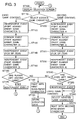
- Fig. 3 shows a flowchart of the video game process
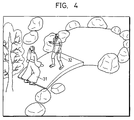
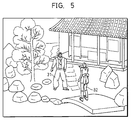
- Figs. 4 and 5 show game screens, respectively.
- step ST100 when the game is started, the monitor 12 displays a selection screen on which the first character and the second character are arranged so that either game character is selected as a leading game character.
- step ST110 the player uses the controller 22 to select the leading character.
- step ST120 a fight against enemy game character 1 is performed as an independent event.
- step ST130 a common event is provided.
- This common event is a scene where the second character appears in addition to the first character as the leading character.
- the first character 31 as a leading character has a conversation with the second character (ninja in this embodiment) 32.
- step ST140 a scene where the leading character picks up an item such as a medicinal herb in accordance with an operation by the controller 22 is provided as an independent event.
- step ST150 a fight with enemy game character 3 is performed as an independent event.
- step ST160 the process determines whether the game player has left the second game. If the game player has left the second game ("YES" in step ST160), an independent event is performed in step ST170, and the process proceeds to step ST260 and the subsequent steps provided for the third game.
- step ST160 If the second game is still pending ("NO" in step ST160), a fight against the first boss-enemy character is performed in step ST180. If the leading character beats the first boss-enemy character, condition data are created and stored in the memory 21 in step ST190, and the process returns to step ST100.
- step ST110 in the case where the second character is selected as a leading character, the process proceeds in accordance with the second game content.
- step ST200 a fight against enemy game character 4 is performed as an independent event.
- step ST210 a common event is provided.
- This common event is a scene where the first character appears in addition to the second character as the leading character.
- the second character (ninja in this embodiment) 32 as the leading character has a conversation with the first character (masterless samurai in this embodiment) 31.
- This scene is displayed as an image viewed from a viewpoint different from a viewpoint in a similar scene shown in Fig. 4.
- step ST220 a scene where the leading character picks up an item such as a medicinal herb in accordance with an operation by the controller 22 is provided as an independent event similar to that in the first game content.
- step ST230 a fight against enemy character 6 is performed as an independent event.
- step ST240 the process determines whether the game player has left the first game. If the game player has left the first game ("YES" in step ST240), an independent event is performed in step ST250, and the process proceeds to step ST260 and the subsequent steps for the third game.
- step ST240 If the first game is still pending ("NO" in step ST240), the process proceeds to step ST180, and steps similar to those in the first game content are performed.
- step ST260 in the third game content, the selection screen on which the first and second characters are arranged for selecting a leading game character is displayed on the monitor 12, again.
- the leading character is selected in accordance with an operation by the controller 22.
- step ST260 the selected leading character fights with the second boss-enemy character. When the selected leading character beats the second boss-enemy character, the video game is terminated.
- step ST110 the process proceeds from step ST110 to step ST120, and performs steps ST120 to ST160. At this time, the second game has not been performed. Accordingly, the process proceeds from step ST160 to ST180, and in step ST190, disabling data on the first game are created and stored.
- step ST110 the process proceeds from step ST110 to step ST200, and performs steps ST200 to ST240. At this time, the game player has left the first game. Accordingly, the process proceeds from step ST240 to step ST250. Steps ST250 to ST270 are performed, and the process terminates.
- the enemy character against the first character in the first game content completely differs from the enemy character against the second character.
- the first game content and the second game content are independent of each other.
- the second character is not allowed to pick up the same item in step ST220 in the second game content.
- the first game content and the second game content influences each other because they have relevance in that a result of executing a first game content changes a game screen displayed by executing the subsequent game content. Therefore, amusement by each game content can be enhanced.
- the first or second game content is set up that when the leading character fights with the boss-enemy character, and the game player is once allowed to leave the game, the game player is allowed to leave the other game without a fight between the leading character and the boss-enemy character, and the process proceeds to the third game content as the final stage.
- the first boss-enemy character has the function of a false boss-enemy game character
- the second boss-enemy character has the function of a real boss-enemy game character. This can enhance amusement by the game.
- Fig. 6 shows the process for changing image settings.
- Fig. 7 shows a status screen.
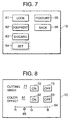
- Fig. 8 shows a setting screen.
- step ST300 the process determines whether the selector button 22b of the controller 22 has been pressed. If the selector button 22b has been pressed ("YES" in step ST300), the status screen is displayed in step ST310, and the process determines whether a "SET" icon 64 has been selected in step ST320.
- the status screen displays various icons 61 to 66 including the "SET" icon 64.
- the "SET" icon 64 is selected.
- the selection is determined.
- Fig. 7 shows that the "SET" icon 64 is selected.
- step ST320 when the "SET" icon 64 is not selected ("NO” in step ST320), the process determines whether the "BACK” icon 66 is selected in step ST330. When the "BACK” icon 66 is selected ("YES” in step ST330), the process stops this routine, and returns to the game screen. When the "BACK” icon 66 is not selected ("NO” in step ST330), the process returns to step ST310, and the status screen is continuously displayed.
- step ST300 determines whether the select button 22b has been pressed ("NO" in step ST300). If the select button 22b has not been pressed ("NO" in step ST300), the process determines whether the start button 22a has been pressed in step ST340. If the start button 22a has not been pressed ("NO" in step ST340), the process stops this routine, and returns to the game screen.
- step ST340 If the start button 22a has been pressed ("YES" in step ST340), the setting screen is displayed in step ST350.
- the setting screen displays a cutting image setter 71 and a color effect setter 81.
- the cutting image setter 71 has an "ON” icon 72 and an "OFF” icon 73.
- the color effect setter 81 has an "ON” icon 82, an "OFF” icon 83, and a color selector 84.
- the "ON" icon 72 is selected using the left key 22L and the right key 22R. The selection is determined by pressing the fourth button 22f. Fig. 8 shows that the "ON" icon 72 is selected.
- the "ON" icon 82 is selected using the left key 22L and the right key 22R.
- the selection of the "ON” icon 82 is determined by pressing the fourth button 22f.
- Fig. 8 shows that the "ON" icon 82 is selected.
- the color of blood can be set to be an arbitrary chromatic color of red (R) to green (G) to blue (B).
- Fig. 8 shows that the color of blood is set to be an intermediate color between red (R) and green (G).
- the color of blood from a game character in a fight can be set to be transparent.
- step ST360 the process determines whether the third button 22e has been switched on. If the third button 22e has not been switched on ("NO” in step ST360), the process determines whether the setting of wasted image, namely, the setting of the cutting image and color effect has been changed in step ST370. If the setting has not been changed (“NO” in step ST370), the process returns to step ST350. If the setting has been changed (“YES” in step ST370), the image setting is changed as described above in step ST380, and the process returns to step ST350.
- step ST360 the process stops this routine.
- the color of blood can be set to be an arbitrary chromatic color, and an image in which the cut arm or head is not sent flying can be changed to an image in which the cut arm or head is sent flying, a game having violent images in accordance with player preference is realized, which can enhance amusement necessary for a fighting game.
Landscapes
- Engineering & Computer Science (AREA)
- Multimedia (AREA)
- Theoretical Computer Science (AREA)
- Human Computer Interaction (AREA)
- Processing Or Creating Images (AREA)
- Display Devices Of Pinball Game Machines (AREA)
Applications Claiming Priority (2)
| Application Number | Priority Date | Filing Date | Title |
|---|---|---|---|
| JP7092598 | 1998-03-19 | ||
| JP10070925A JP2930237B1 (ja) | 1998-03-19 | 1998-03-19 | ビデオゲーム装置及びビデオゲームプログラムが記録された可読記録媒体 |
Publications (2)
| Publication Number | Publication Date |
|---|---|
| EP0948977A2 true EP0948977A2 (de) | 1999-10-13 |
| EP0948977A3 EP0948977A3 (de) | 2001-05-02 |
Family
ID=13445586
Family Applications (1)
| Application Number | Title | Priority Date | Filing Date |
|---|---|---|---|
| EP99104073A Ceased EP0948977A3 (de) | 1998-03-19 | 1999-03-18 | Videospielvorrichtung und computerlesbares Aufzeichungsmedium für Videospielprogramm |
Country Status (6)
| Country | Link |
|---|---|
| US (1) | US6296567B1 (de) |
| EP (1) | EP0948977A3 (de) |
| JP (1) | JP2930237B1 (de) |
| KR (1) | KR100338240B1 (de) |
| CN (1) | CN1231455A (de) |
| TW (1) | TW377303B (de) |
Cited By (1)
| Publication number | Priority date | Publication date | Assignee | Title |
|---|---|---|---|---|
| EP1151775A3 (de) * | 2000-04-27 | 2003-09-10 | Sony Computer Entertainment Inc. | Speichermedium, Programm, Unterhaltungssystem, und Unterhaltungsvorrichtung |
Families Citing this family (3)
| Publication number | Priority date | Publication date | Assignee | Title |
|---|---|---|---|---|
| US6820265B1 (en) * | 1999-06-29 | 2004-11-16 | Rare Limited | System method and data storage medium for sharing data between video games |
| JP4048150B2 (ja) | 2003-05-12 | 2008-02-13 | 任天堂株式会社 | ゲーム装置およびゲームプログラム並びにゲームシステム |
| JP5587800B2 (ja) * | 2011-01-12 | 2014-09-10 | 株式会社スクウェア・エニックス | ネットワークゲームシステム、ゲーム装置、サーバ装置、及びプログラム |
Family Cites Families (4)
| Publication number | Priority date | Publication date | Assignee | Title |
|---|---|---|---|---|
| US4738451A (en) * | 1986-05-20 | 1988-04-19 | Atari Games Corporation | Multi-player, multi-character cooperative play video game with independent player entry and departure |
| JP3187301B2 (ja) * | 1994-12-02 | 2001-07-11 | 株式会社ナムコ | ゲーム装置及び画像合成方法 |
| JP3442181B2 (ja) | 1995-02-17 | 2003-09-02 | 株式会社ナムコ | 3次元ゲーム装置及び画像合成方法 |
| JPH08224377A (ja) | 1995-02-22 | 1996-09-03 | Sega Enterp Ltd | 対象選択機能付きゲーム装置 |
-
1998
- 1998-03-19 JP JP10070925A patent/JP2930237B1/ja not_active Expired - Lifetime
-
1999
- 1999-03-12 US US09/267,235 patent/US6296567B1/en not_active Expired - Lifetime
- 1999-03-13 KR KR1019990008444A patent/KR100338240B1/ko not_active Expired - Fee Related
- 1999-03-17 TW TW088104159A patent/TW377303B/zh not_active IP Right Cessation
- 1999-03-18 EP EP99104073A patent/EP0948977A3/de not_active Ceased
- 1999-03-19 CN CN99103068A patent/CN1231455A/zh active Pending
Cited By (1)
| Publication number | Priority date | Publication date | Assignee | Title |
|---|---|---|---|---|
| EP1151775A3 (de) * | 2000-04-27 | 2003-09-10 | Sony Computer Entertainment Inc. | Speichermedium, Programm, Unterhaltungssystem, und Unterhaltungsvorrichtung |
Also Published As
| Publication number | Publication date |
|---|---|
| CN1231455A (zh) | 1999-10-13 |
| JPH11267359A (ja) | 1999-10-05 |
| TW377303B (en) | 1999-12-21 |
| KR100338240B1 (ko) | 2002-05-27 |
| US6296567B1 (en) | 2001-10-02 |
| KR19990077854A (ko) | 1999-10-25 |
| JP2930237B1 (ja) | 1999-08-03 |
| EP0948977A3 (de) | 2001-05-02 |
Similar Documents
| Publication | Publication Date | Title |
|---|---|---|
| US6413163B1 (en) | Video game machine, method for switching viewpoint on game screen of video game, and computer-readable recording medium containing game-screen-viewpoint switching program | |
| US6878065B2 (en) | Video game system, character action control method, and readable storage medium storing character action control program | |
| JP3863293B2 (ja) | ビデオゲーム装置、及びビデオゲーム進行制御プログラムを記録したコンピュータ読み取り可能な記録媒体 | |
| JP3145064B2 (ja) | ビデオゲーム機及びビデオゲームプログラムを記録した媒体 | |
| EP0987051B1 (de) | Video-Angelspielvorrichtung | |
| JP2001314645A (ja) | キャラクタ制御方法、ビデオゲーム装置、及び記録媒体 | |
| JP2000279637A (ja) | ゲーム装置、ゲーム表示制御方法、およびコンピュータ読取り可能な記録媒体 | |
| JP4791852B2 (ja) | ゲーム装置、ゲームプログラムおよびゲーム制御方法 | |
| EP0988877B1 (de) | Video-Angelspielvorrichtung | |
| EP1279423A2 (de) | Aufzeichnungsmedium für Volumenkontrollprogramm, Volumenkontrollverfahren, Videospielvorrichtung and Volumenkontrollprogramm | |
| JP3686920B2 (ja) | 3次元画像処理プログラム、3次元画像処理方法及びビデオゲーム装置 | |
| US20030109295A1 (en) | Recording medium storing game progress control program, game progress control program, game progress control method, and video game device | |
| US20030171146A1 (en) | Quick passing feature for sports video games | |
| US7014561B2 (en) | Recording medium for storing gauge display program, gauge display method video game device, and gauge display program | |
| US20040163133A1 (en) | Storing medium storing game program, game apparatus, action-range controlling method of game character | |
| US6296567B1 (en) | Video game machine and computer-readable recording medium containing video game program | |
| JP2872667B1 (ja) | ビデオゲーム装置、ゲーム画面出力方法及びゲーム画面出力プログラムが記録された可読記録媒体 | |
| JP3621663B2 (ja) | 音声出力プログラム、音声出力方法及びビデオゲーム装置 | |
| HK1020896A (en) | Video game machine and computer-readable recording medium containing video game program | |
| JP4545544B2 (ja) | ゲームプログラムおよびゲーム装置 | |
| US20020075275A1 (en) | Storage medium storing display control program, entertainment apparatus, and display control program | |
| JP3629453B2 (ja) | ゲーム進行制御プログラム、ゲーム進行制御方法及びビデオゲーム装置 | |
| HK1024649A (en) | Fishing video game apparatus | |
| HK1024648A (en) | Fishing video game apparatus |
Legal Events
| Date | Code | Title | Description |
|---|---|---|---|
| PUAI | Public reference made under article 153(3) epc to a published international application that has entered the european phase |
Free format text: ORIGINAL CODE: 0009012 |
|
| AK | Designated contracting states |
Kind code of ref document: A2 Designated state(s): DE FR GB |
|
| AX | Request for extension of the european patent |
Free format text: AL;LT;LV;MK;RO;SI |
|
| PUAL | Search report despatched |
Free format text: ORIGINAL CODE: 0009013 |
|
| AK | Designated contracting states |
Kind code of ref document: A3 Designated state(s): AT BE CH CY DE DK ES FI FR GB GR IE IT LI LU MC NL PT SE |
|
| AX | Request for extension of the european patent |
Free format text: AL;LT;LV;MK;RO;SI |
|
| 17P | Request for examination filed |
Effective date: 20010628 |
|
| AKX | Designation fees paid |
Free format text: DE FR GB |
|
| 17Q | First examination report despatched |
Effective date: 20040115 |
|
| STAA | Information on the status of an ep patent application or granted ep patent |
Free format text: STATUS: THE APPLICATION HAS BEEN REFUSED |
|
| 18R | Application refused |
Effective date: 20051110 |
|
| REG | Reference to a national code |
Ref country code: HK Ref legal event code: WD Ref document number: 1020896 Country of ref document: HK |