EP0949196A1 - Beverage chiller - Google Patents
Beverage chiller Download PDFInfo
- Publication number
- EP0949196A1 EP0949196A1 EP99302212A EP99302212A EP0949196A1 EP 0949196 A1 EP0949196 A1 EP 0949196A1 EP 99302212 A EP99302212 A EP 99302212A EP 99302212 A EP99302212 A EP 99302212A EP 0949196 A1 EP0949196 A1 EP 0949196A1
- Authority
- EP
- European Patent Office
- Prior art keywords
- liquid
- cryogen
- spirit
- tube
- vessel
- Prior art date
- Legal status (The legal status is an assumption and is not a legal conclusion. Google has not performed a legal analysis and makes no representation as to the accuracy of the status listed.)
- Withdrawn
Links
- 235000013361 beverage Nutrition 0.000 title description 2
- 239000007788 liquid Substances 0.000 claims abstract description 49
- 239000004020 conductor Substances 0.000 claims description 3
- CURLTUGMZLYLDI-UHFFFAOYSA-N Carbon dioxide Chemical compound O=C=O CURLTUGMZLYLDI-UHFFFAOYSA-N 0.000 abstract description 11
- CSCPPACGZOOCGX-UHFFFAOYSA-N Acetone Chemical compound CC(C)=O CSCPPACGZOOCGX-UHFFFAOYSA-N 0.000 abstract description 6
- 239000007787 solid Substances 0.000 abstract description 5
- 238000009835 boiling Methods 0.000 abstract description 4
- 239000001569 carbon dioxide Substances 0.000 abstract description 3
- 229910002092 carbon dioxide Inorganic materials 0.000 abstract description 3
- 239000000203 mixture Substances 0.000 abstract description 3
- 235000015096 spirit Nutrition 0.000 description 17
- IJGRMHOSHXDMSA-UHFFFAOYSA-N Atomic nitrogen Chemical compound N#N IJGRMHOSHXDMSA-UHFFFAOYSA-N 0.000 description 6
- 238000001816 cooling Methods 0.000 description 4
- 239000007789 gas Substances 0.000 description 3
- 229910052757 nitrogen Inorganic materials 0.000 description 3
- LFQSCWFLJHTTHZ-UHFFFAOYSA-N Ethanol Chemical compound CCO LFQSCWFLJHTTHZ-UHFFFAOYSA-N 0.000 description 2
- 239000003570 air Substances 0.000 description 2
- 235000013334 alcoholic beverage Nutrition 0.000 description 2
- 239000012080 ambient air Substances 0.000 description 2
- 235000011089 carbon dioxide Nutrition 0.000 description 2
- 238000004140 cleaning Methods 0.000 description 2
- 230000000295 complement effect Effects 0.000 description 2
- 239000011521 glass Substances 0.000 description 2
- 239000000126 substance Substances 0.000 description 2
- 230000000007 visual effect Effects 0.000 description 2
- 206010003497 Asphyxia Diseases 0.000 description 1
- RYGMFSIKBFXOCR-UHFFFAOYSA-N Copper Chemical compound [Cu] RYGMFSIKBFXOCR-UHFFFAOYSA-N 0.000 description 1
- 238000003491 array Methods 0.000 description 1
- QVGXLLKOCUKJST-UHFFFAOYSA-N atomic oxygen Chemical compound [O] QVGXLLKOCUKJST-UHFFFAOYSA-N 0.000 description 1
- 230000015572 biosynthetic process Effects 0.000 description 1
- UBAZGMLMVVQSCD-UHFFFAOYSA-N carbon dioxide;molecular oxygen Chemical compound O=O.O=C=O UBAZGMLMVVQSCD-UHFFFAOYSA-N 0.000 description 1
- 229910052802 copper Inorganic materials 0.000 description 1
- 239000010949 copper Substances 0.000 description 1
- 230000035622 drinking Effects 0.000 description 1
- 230000000694 effects Effects 0.000 description 1
- 230000002708 enhancing effect Effects 0.000 description 1
- 239000002360 explosive Substances 0.000 description 1
- PCHJSUWPFVWCPO-UHFFFAOYSA-N gold Chemical compound [Au] PCHJSUWPFVWCPO-UHFFFAOYSA-N 0.000 description 1
- 229910052737 gold Inorganic materials 0.000 description 1
- 239000010931 gold Substances 0.000 description 1
- 230000005484 gravity Effects 0.000 description 1
- 239000000383 hazardous chemical Substances 0.000 description 1
- 238000012423 maintenance Methods 0.000 description 1
- 238000004519 manufacturing process Methods 0.000 description 1
- 239000000463 material Substances 0.000 description 1
- 238000000034 method Methods 0.000 description 1
- 238000002156 mixing Methods 0.000 description 1
- 238000012986 modification Methods 0.000 description 1
- 230000004048 modification Effects 0.000 description 1
- 239000001301 oxygen Substances 0.000 description 1
- 229910052760 oxygen Inorganic materials 0.000 description 1
- 239000004810 polytetrafluoroethylene Substances 0.000 description 1
- 229920001343 polytetrafluoroethylene Polymers 0.000 description 1
- 230000000717 retained effect Effects 0.000 description 1
- 238000000926 separation method Methods 0.000 description 1
- 229910052709 silver Inorganic materials 0.000 description 1
- 239000004332 silver Substances 0.000 description 1
- 239000007921 spray Substances 0.000 description 1
- 239000012780 transparent material Substances 0.000 description 1
- 238000009834 vaporization Methods 0.000 description 1
Images


Classifications
-
- B—PERFORMING OPERATIONS; TRANSPORTING
- B67—OPENING, CLOSING OR CLEANING BOTTLES, JARS OR SIMILAR CONTAINERS; LIQUID HANDLING
- B67D—DISPENSING, DELIVERING OR TRANSFERRING LIQUIDS, NOT OTHERWISE PROVIDED FOR
- B67D1/00—Apparatus or devices for dispensing beverages on draught
- B67D1/08—Details
- B67D1/0857—Cooling arrangements
-
- B—PERFORMING OPERATIONS; TRANSPORTING
- B67—OPENING, CLOSING OR CLEANING BOTTLES, JARS OR SIMILAR CONTAINERS; LIQUID HANDLING
- B67D—DISPENSING, DELIVERING OR TRANSFERRING LIQUIDS, NOT OTHERWISE PROVIDED FOR
- B67D3/00—Apparatus or devices for controlling flow of liquids under gravity from storage containers for dispensing purposes
- B67D3/0009—Apparatus or devices for controlling flow of liquids under gravity from storage containers for dispensing purposes provided with cooling arrangements
-
- F—MECHANICAL ENGINEERING; LIGHTING; HEATING; WEAPONS; BLASTING
- F25—REFRIGERATION OR COOLING; COMBINED HEATING AND REFRIGERATION SYSTEMS; HEAT PUMP SYSTEMS; MANUFACTURE OR STORAGE OF ICE; LIQUEFACTION SOLIDIFICATION OF GASES
- F25D—REFRIGERATORS; COLD ROOMS; ICE-BOXES; COOLING OR FREEZING APPARATUS NOT OTHERWISE PROVIDED FOR
- F25D3/00—Devices using other cold materials; Devices using cold-storage bodies
- F25D3/10—Devices using other cold materials; Devices using cold-storage bodies using liquefied gases, e.g. liquid air
- F25D3/107—Devices using other cold materials; Devices using cold-storage bodies using liquefied gases, e.g. liquid air portable, i.e. adapted to be carried personally
-
- F—MECHANICAL ENGINEERING; LIGHTING; HEATING; WEAPONS; BLASTING
- F25—REFRIGERATION OR COOLING; COMBINED HEATING AND REFRIGERATION SYSTEMS; HEAT PUMP SYSTEMS; MANUFACTURE OR STORAGE OF ICE; LIQUEFACTION SOLIDIFICATION OF GASES
- F25D—REFRIGERATORS; COLD ROOMS; ICE-BOXES; COOLING OR FREEZING APPARATUS NOT OTHERWISE PROVIDED FOR
- F25D3/00—Devices using other cold materials; Devices using cold-storage bodies
- F25D3/12—Devices using other cold materials; Devices using cold-storage bodies using solidified gases, e.g. carbon-dioxide snow
- F25D3/14—Devices using other cold materials; Devices using cold-storage bodies using solidified gases, e.g. carbon-dioxide snow portable, i.e. adapted to be carried personally
-
- F—MECHANICAL ENGINEERING; LIGHTING; HEATING; WEAPONS; BLASTING
- F25—REFRIGERATION OR COOLING; COMBINED HEATING AND REFRIGERATION SYSTEMS; HEAT PUMP SYSTEMS; MANUFACTURE OR STORAGE OF ICE; LIQUEFACTION SOLIDIFICATION OF GASES
- F25D—REFRIGERATORS; COLD ROOMS; ICE-BOXES; COOLING OR FREEZING APPARATUS NOT OTHERWISE PROVIDED FOR
- F25D2331/00—Details or arrangements of other cooling or freezing apparatus not provided for in other groups of this subclass
- F25D2331/80—Type of cooled receptacles
- F25D2331/811—Pour-throughs
Definitions
- This invention relates to the supply of a liquid, particularly but not exclusively a potable liquid such as a spirit drink, which has been chilled below ambient temperature and preferably below 0°C.
- the present invention is predicated on the use of a cryogen to chill a liquid.
- the present invention also provides an apparatus for supplying a liquid comprising conduit means for bringing the liquid at or about ambient temperature into indirect thermal contact with a cryogen so as to chill the liquid below ambient temperature.
- cryogen is used herein to denote those gases and gas mixtures which at ambient temperature and pressure are normally in gaseous form - air, nitrogen, oxygen, carbon dioxide and the like - but which are used in the liquid or solid state, as well as azeotropic mixtures such as solid carbon dioxide and acetone.
- gases and gas mixtures which at ambient temperature and pressure are normally in gaseous form - air, nitrogen, oxygen, carbon dioxide and the like - but which are used in the liquid or solid state, as well as azeotropic mixtures such as solid carbon dioxide and acetone.
- Such substances are, in use, all at a temperature substantially below 0°C (boiling point, at ambient pressure, of carbon dioxide being -78°C and nitrogen -194.3°C) and thus have considerable capacity to chill an equivalent volume of a liquid to sub-ambient temperature very quickly. In fact, the cooling rate achievable using such cold substances is so great that care has to be taken not to over-chill, or even freeze, the liquid.
- a degree of thermal separation between the cryogen and the liquid to be cooled is important, so as to prevent over-chilling.
- these are preferably chilled to about -5°C before drinking; because of their alcohol content, spirits usually remain liquid at these temperatures and when drunk will give the drinker the frisson of frozen pleasure sought without being so cold as to damage the tissues of the mouth.
- each conduit in thermal contact with the cryogen is provided each conduit being adapted to allow a throughflow of the liquid, or beverage, to be supplied, the liquid being in direct thermal contact with the conduit(s). This enables the high cooling rate of the cryogen to be used but enables over-chilling to be avoided.
- Means may be provided to restrict the throughflow of liquid, so as to prolong the indirect thermal contact between liquid and cryogen, so as accurately to control the chilling of the liquid, according to its specific heat capacity, for example.
- This may be combined with means to supply a metered dose, or shot, of liquid for chilling, as is the norm for the commercial dispensing of spirits, for example.
- the conduit(s) may be formed of a thermally-conductive material, and in relatively poor thermal contact with the cryogen. This allows rapid heat transfer between conduit(s) and liquid so as rapidly to chill the liquid by the desired amount without over-chilling, followed by the somewhat slower cooling of the conduit(s) through heat transfer with the cryogen.
- a cycle comprising the successive chilling of an amount of liquid, the removal of said liquid from the conduit(s) and the cooling of the conduit(s) to cryogenic temperature is envisaged, a cycle suited to the dispensing of shots of spirits.
- the conduit(s) is/are preferably in indirect thermal contact with the cryogen.
- Those skilled in the art will begin to comprehend how such an arrangement will complement the usual "optics" used for dispensing some alcoholic beverages; as a shot of spirits is supplied to a channel, its throughflow is restricted for long enough for the cold channel to chill the spirit to about -5°C (the specific heats of the channel.and spirit resulting in this net temperature - which of course can be varied if seen as appropriate) whilst the heat transfer rate with the surrounding cryogen is insufficient to materially affect this.
- the shot of spirits then flows out of the channel (typically under gravity) at the desired temperature and the channel then gradually cools to cryogenic temperature so that a further measure of spirits can be chilled.
- a typical shot of spirits to be cooled from ambient temperature to -5°C requires about 1kCal (4.186kJ), so a channel of a thermally-conductive material such as plated copper, with silver or gold having a mass of about 0.12kg would be required.
- the spirits should flow through the channel in about 5 seconds and the time for the channel to recool would be about 30-40 seconds.
- This rate of recooling can be controlled by providing a preferential path for heat transfer of known thermal conductivity between the channel and the cryogen; a typical arrangement may comprise the thermally-conductive channel in direct thermal contact with a surrounding layer of known (relatively poor) thermal conductivity of particular area, which layer is in turn in direct thermal contact with either the cryogen itself or the surrounding walls of the vessel or bath containing the cryogen.
- cryogens will realise that there are several features which lend themselves to embodiments which will be particularly advantageous in the milieu of commercial spirit dispensing (in bars).
- a channel is recooled there will be a corresponding burst of rapid cryogen vaporisation. This will usually result in a puff of fog which, using suitable lighting, could enhance the aesthetic appeal of the spirit chiller.
- the boiling of the cryogen could present an aesthetic attraction in itself, if the cryogen container were transparent and suitably lit, and/or the cryogen itself tinted or coloured.
- a single cryogen-containing vessel could have a plurality of channels passing through it, each channel being for the throughflow of a different spirit, so preventing mixing of different spirits prior to discharge from the chiller, and enhancing hygiene.
- a number of channels may be dedicated to a particular spirit, thus maximising the area of thermal contact between channel and spirit for maximised chilling rate and corresponding boiling of cryogen for eye appeal.
- each channel is suitably disposed within the vessel. and/or the vessel is advantageously configured such that, on tilting the vessel away from its usual in use position, the channel(s) is/are disposed above the surface of the liquid cryogen within the vessel. It will also be understood that means are preferably provided for preventing any convective flow of ambient air into the channel(s), since this would lend to the formation of frost and, ultimately, blockage thereof.
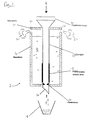
- Tube 4 passes through an insulated vessel or bath 6 containing a cryogenic liquid 8, the tube 4 being concentric within an uninsulated tube 10 which is in direct thermal contact with the cryogen 8 and is also integral with vessel 6.
- Tube 4 is formed of relatively high thermal conductivity material but which is in relatively poor thermal contact with the liquid cryogen 8, there being a PTFE-coated contact area 12 between inner tube 4 and outer tube 10.
- a measured shot of spirits is introduced into tube 4 and flow restrictor 14 permits only a limited flow of spirits out of tube 4 via outlet 16. Whilst the shot of spirits is retained within tube 4 there is rapid heat transfer between spirits and tube 4, such that both reach a net temperature of about -5°C before the chilled dose of spirits is dispensed into container, or glass, 18.
- Tube 4 is subsequently cooled back to the temperature of liquid cryogen 8 relatively slowly by heat transfer with contact area 12.
- the arrangement is such that the spirits flow through tube 4 and emerge chilled to -5°C in about 5 seconds, and the time for the tube 4 to be cooled back down to the temperature of the liquid cryogen 8 is about 30 to 40 seconds.
- a shot of spirits is dispensed via chiller 2 a certain amount of the cryogen 8 vaporises or is boiled off, producing a cloud of fog 20 which emerges from gap 22 between the lid 24 of the container and the main part of the vessel 6 in a spectacular display.
- valve means may be provided for the egress of these clouds 20 of fog.
- the flow restrictor 14 may also be configured so as to prevent a flow of ambient air into tube 4 via inlet 16, as this would rapidly cause the apparatus to be choked with frost. Similar means could be provided for preventing the ingress of air into the end of tube 4 distant from outlet 16, and apparatus 2 could quite easily be combined with the known optic device for dispensing spirits to provide an integral spirit chiller/dispenser.
- the restriction on the spirit flow through the tube 44 is at the top of the tube 44 rather than the bottom, so as to ensure that the spirit is introduced in such a way that it wets the inside surface of the tube 44.
- the lid 50 is sealingly fitted to the insulated housing 52 so that evaporated cryogen passes through fill/vent holes 54 in a spray baffle plate 56 and then, in the direction shown by the arrows, through the hollow plug 48, down the tube 44 to exit from its lower end 58.
- the advantage of this arrangement is that the evaporated cryogen remains in heat exchange relationship with the spirits in the tube 44, thus adding to the chilling effect.
- FIG. 4 like numerals denote similar elements to those shown in Figure 3. Instead, however, of a plurality of small holes 54 for filling the housing 52 with cryogen and allowing evaporated cryogen to vent there is a single large hole 54'.
- a complementary gas vent 60 is also provided in the housing 52. to allow a proportion of evaporated cryogen to vent near the top of the housing 52, to enhance the visual effect as a shot of spirits is dispensed.
Landscapes
- Engineering & Computer Science (AREA)
- Chemical & Material Sciences (AREA)
- Mechanical Engineering (AREA)
- Combustion & Propulsion (AREA)
- Physics & Mathematics (AREA)
- Thermal Sciences (AREA)
- General Engineering & Computer Science (AREA)
- Chemical Kinetics & Catalysis (AREA)
- Table Equipment (AREA)
Applications Claiming Priority (2)
| Application Number | Priority Date | Filing Date | Title |
|---|---|---|---|
| GB9807594 | 1998-04-08 | ||
| GBGB9807594.8A GB9807594D0 (en) | 1998-04-08 | 1998-04-08 | Spirit chiller |
Publications (1)
| Publication Number | Publication Date |
|---|---|
| EP0949196A1 true EP0949196A1 (en) | 1999-10-13 |
Family
ID=10830093
Family Applications (1)
| Application Number | Title | Priority Date | Filing Date |
|---|---|---|---|
| EP99302212A Withdrawn EP0949196A1 (en) | 1998-04-08 | 1999-03-23 | Beverage chiller |
Country Status (12)
| Country | Link |
|---|---|
| US (1) | US6199386B1 (id) |
| EP (1) | EP0949196A1 (id) |
| CN (1) | CN1237396A (id) |
| AU (1) | AU3429699A (id) |
| CA (1) | CA2267827A1 (id) |
| GB (1) | GB9807594D0 (id) |
| ID (1) | ID23617A (id) |
| NZ (1) | NZ334988A (id) |
| PE (1) | PE20000306A1 (id) |
| UY (1) | UY25466A1 (id) |
| WO (1) | WO1999052813A1 (id) |
| ZA (1) | ZA992572B (id) |
Cited By (2)
| Publication number | Priority date | Publication date | Assignee | Title |
|---|---|---|---|---|
| GB2376737A (en) * | 2001-06-22 | 2002-12-24 | Peter Michael Julian Henry | A beverage cooling device |
| US20250060152A1 (en) * | 2023-08-15 | 2025-02-20 | Rhonda Kennedy DBA Booze-Block | Party accessory |
Families Citing this family (13)
| Publication number | Priority date | Publication date | Assignee | Title |
|---|---|---|---|---|
| US6817951B2 (en) * | 2001-11-13 | 2004-11-16 | Steven Levine | Novelty item |
| US20080289357A1 (en) * | 2007-05-22 | 2008-11-27 | Skobel Robert M | Liquid nitrogen cooled beverage dispenser |
| EP2070423A1 (de) * | 2007-12-10 | 2009-06-17 | Kaiserschote Feinkost Catering GmbH | Verfahren zur Ausgabe von gekühlter, insbesondere gefrorener Speise |
| US9771252B2 (en) * | 2013-10-15 | 2017-09-26 | Streamline Beverage Pty Ltd | Beverage dispenser |
| US20150323239A1 (en) * | 2014-05-06 | 2015-11-12 | Yung-Shang LIN | Method of freezing and preserving drink |
| DE202014005817U1 (de) * | 2014-07-18 | 2014-09-04 | Michael Lacomba | Mehrteilige Kühlvorrichtung für Strohhalm |
| US9745187B2 (en) | 2015-05-05 | 2017-08-29 | Fizzics Group Llc | Carbonated fluid dispenser with ultrasonic foaming mechanism |
| US9895667B2 (en) | 2015-05-05 | 2018-02-20 | Fizzics Group Llc | Carbonated fluid dispenser with ultrasonic foaming mechanism |
| US10317134B2 (en) | 2016-04-12 | 2019-06-11 | Cornelius, Inc. | Rapid cooling systems for beverages |
| EP3713849B1 (en) | 2017-11-24 | 2022-06-29 | Société des Produits Nestlé S.A. | Attachment for a beverage container |
| EP3689196A1 (de) * | 2019-02-04 | 2020-08-05 | Stephan Machinery GMBH | Vorrichtung zur kühlung von hocherhitzten lebensmittelprodukten sowie entsprechendes verfahren und hocherhitzungslinie damit |
| CN111023344A (zh) * | 2019-12-18 | 2020-04-17 | 彭香莲 | 一种空工厂用恒湿型净化设备 |
| US20240118022A1 (en) * | 2021-02-11 | 2024-04-11 | Bert Douglas Montgomery | Non-Electric Alcohol Fluid Chiller with the Use of Liquid Carbon Dioxide |
Citations (6)
| Publication number | Priority date | Publication date | Assignee | Title |
|---|---|---|---|---|
| US2104467A (en) * | 1935-04-22 | 1938-01-04 | Farwell Ozmun Kirk & Co | Liquid refrigerating dispenser |
| US4494600A (en) * | 1981-03-09 | 1985-01-22 | Delau Bruce E | Portable quick chilling and heating appliance |
| GB2250576A (en) * | 1990-11-30 | 1992-06-10 | Joel Martin Langford | Apparatus for cooling a liquid |
| US5131239A (en) * | 1987-11-06 | 1992-07-21 | Wilson John J | Automatic self-cooling device for beverage containers |
| EP0717246A1 (en) * | 1994-12-12 | 1996-06-19 | Colpo Company Limited | Method and apparatus for transporting/storing chilled goods |
| RU2076061C1 (ru) * | 1992-11-16 | 1997-03-27 | Товарищество с ограниченной ответственностью "Интеллект" | Устройство для охлаждения напитка |
Family Cites Families (8)
| Publication number | Priority date | Publication date | Assignee | Title |
|---|---|---|---|---|
| US1591623A (en) * | 1925-05-19 | 1926-07-06 | Louis W Hassensall | Beverage-dispensing apparatus |
| US2313954A (en) * | 1940-04-02 | 1943-03-16 | George V Mariani | Beverage dispensing device |
| US4407356A (en) * | 1981-03-09 | 1983-10-04 | Delau Bruce E | Portable quick chilling and heating appliance |
| US4599872A (en) * | 1984-12-07 | 1986-07-15 | Rist Wesley G | Pour through beverage chiller |
| US5009083A (en) * | 1989-12-06 | 1991-04-23 | Spinos Frank T | Beverage cooler |
| US5142874A (en) * | 1990-04-10 | 1992-09-01 | Union Carbide Canada Limited | Cryogenic apparatus |
| SE502564C2 (sv) * | 1994-03-07 | 1995-11-13 | Aga Ab | Sätt och anordning för kylning av en produkt med utnyttjande av kondenserad gas |
| US5427276A (en) * | 1994-06-15 | 1995-06-27 | Sidney Frank Importing Co., Inc. | Machine for dispensing chilled alcoholic beverage with self-contained cooling tank and bottle mounting system |
-
1998
- 1998-04-08 GB GBGB9807594.8A patent/GB9807594D0/en not_active Ceased
-
1999
- 1999-03-23 EP EP99302212A patent/EP0949196A1/en not_active Withdrawn
- 1999-03-31 CA CA002267827A patent/CA2267827A1/en not_active Abandoned
- 1999-04-01 US US09/283,892 patent/US6199386B1/en not_active Expired - Fee Related
- 1999-04-01 NZ NZ334988A patent/NZ334988A/xx unknown
- 1999-04-07 AU AU34296/99A patent/AU3429699A/en not_active Abandoned
- 1999-04-07 ZA ZA9902572A patent/ZA992572B/xx unknown
- 1999-04-07 WO PCT/GB1999/001057 patent/WO1999052813A1/en not_active Ceased
- 1999-04-08 UY UY25466A patent/UY25466A1/es unknown
- 1999-04-08 ID IDP990314A patent/ID23617A/id unknown
- 1999-04-08 CN CN99107391A patent/CN1237396A/zh active Pending
- 1999-04-08 PE PE1999000286A patent/PE20000306A1/es not_active Application Discontinuation
Patent Citations (6)
| Publication number | Priority date | Publication date | Assignee | Title |
|---|---|---|---|---|
| US2104467A (en) * | 1935-04-22 | 1938-01-04 | Farwell Ozmun Kirk & Co | Liquid refrigerating dispenser |
| US4494600A (en) * | 1981-03-09 | 1985-01-22 | Delau Bruce E | Portable quick chilling and heating appliance |
| US5131239A (en) * | 1987-11-06 | 1992-07-21 | Wilson John J | Automatic self-cooling device for beverage containers |
| GB2250576A (en) * | 1990-11-30 | 1992-06-10 | Joel Martin Langford | Apparatus for cooling a liquid |
| RU2076061C1 (ru) * | 1992-11-16 | 1997-03-27 | Товарищество с ограниченной ответственностью "Интеллект" | Устройство для охлаждения напитка |
| EP0717246A1 (en) * | 1994-12-12 | 1996-06-19 | Colpo Company Limited | Method and apparatus for transporting/storing chilled goods |
Cited By (2)
| Publication number | Priority date | Publication date | Assignee | Title |
|---|---|---|---|---|
| GB2376737A (en) * | 2001-06-22 | 2002-12-24 | Peter Michael Julian Henry | A beverage cooling device |
| US20250060152A1 (en) * | 2023-08-15 | 2025-02-20 | Rhonda Kennedy DBA Booze-Block | Party accessory |
Also Published As
| Publication number | Publication date |
|---|---|
| WO1999052813A1 (en) | 1999-10-21 |
| CN1237396A (zh) | 1999-12-08 |
| GB9807594D0 (en) | 1998-06-10 |
| ID23617A (id) | 2000-05-04 |
| CA2267827A1 (en) | 1999-10-08 |
| AU3429699A (en) | 1999-11-01 |
| ZA992572B (en) | 1999-10-07 |
| US6199386B1 (en) | 2001-03-13 |
| UY25466A1 (es) | 1999-11-17 |
| PE20000306A1 (es) | 2000-05-02 |
| NZ334988A (en) | 2000-08-25 |
Similar Documents
| Publication | Publication Date | Title |
|---|---|---|
| US6199386B1 (en) | Spirit Chiller | |
| US7785641B2 (en) | Method of cooling a beverage | |
| TW418169B (en) | Method and device for manufacturing positive pressure packaging body | |
| US7478583B2 (en) | Beverage | |
| US20030161925A1 (en) | Method of cooling a beverage | |
| US6112537A (en) | Beverage container with ice compartment | |
| AU762393B2 (en) | A beverage | |
| US7241464B2 (en) | Draught alcoholic beverage | |
| AU778170B2 (en) | A beverage | |
| JP2002515238A5 (id) | ||
| US5080261A (en) | Soda generator and cooler for soft drink dispenser | |
| US6763675B1 (en) | Apparatus and method for preparing, chilling and dispensing a beverage | |
| MXPA06005367A (es) | Metodo y aparato para la formacion controlada de cristales de hielo en una bebida. | |
| US20030211219A1 (en) | Apparatus for supplying a beverage | |
| US20060147601A1 (en) | Apparatus for supplying a beverage | |
| JP5006908B2 (ja) | 飲料分取装置 | |
| GB2476834A (en) | Cooling device for cooling a predetermined part of a container | |
| GB2250576A (en) | Apparatus for cooling a liquid | |
| GB2353349A (en) | Serving Draught Beverage | |
| JP2005003346A (ja) | 製氷法および製氷装置 | |
| GB2397118A (en) | A beverage | |
| GB2368114A (en) | A Beverage | |
| US5341648A (en) | Process for producing ices | |
| ES2805792T3 (es) | Refrigerador de bebida | |
| GB2367611A (en) | Method of serving draught beverage |
Legal Events
| Date | Code | Title | Description |
|---|---|---|---|
| PUAI | Public reference made under article 153(3) epc to a published international application that has entered the european phase |
Free format text: ORIGINAL CODE: 0009012 |
|
| AK | Designated contracting states |
Kind code of ref document: A1 Designated state(s): AT BE CH CY DE DK ES FI FR GB GR IE IT LI LU MC NL PT SE |
|
| AX | Request for extension of the european patent |
Free format text: AL PAYMENT 19990406;LT;LV;MK;RO PAYMENT 19990406;SI PAYMENT 19990406 |
|
| 17P | Request for examination filed |
Effective date: 20000321 |
|
| AKX | Designation fees paid |
Free format text: AT BE CH CY DE DK ES FI FR GB GR IE IT LI LU MC NL PT SE |
|
| AXX | Extension fees paid |
Free format text: AL PAYMENT 19990406;RO PAYMENT 19990406;SI PAYMENT 19990406 |
|
| 17Q | First examination report despatched |
Effective date: 20020723 |
|
| STAA | Information on the status of an ep patent application or granted ep patent |
Free format text: STATUS: THE APPLICATION IS DEEMED TO BE WITHDRAWN |
|
| 18D | Application deemed to be withdrawn |
Effective date: 20040129 |