EP0949199B1 - Zusammensetzung enthaltend Nanoröhren und eine organische Verbindung - Google Patents
Zusammensetzung enthaltend Nanoröhren und eine organische Verbindung Download PDFInfo
- Publication number
- EP0949199B1 EP0949199B1 EP99650033A EP99650033A EP0949199B1 EP 0949199 B1 EP0949199 B1 EP 0949199B1 EP 99650033 A EP99650033 A EP 99650033A EP 99650033 A EP99650033 A EP 99650033A EP 0949199 B1 EP0949199 B1 EP 0949199B1
- Authority
- EP
- European Patent Office
- Prior art keywords
- nanotube
- polymer
- nanotubes
- solution
- organic
- Prior art date
- Legal status (The legal status is an assumption and is not a legal conclusion. Google has not performed a legal analysis and makes no representation as to the accuracy of the status listed.)
- Expired - Lifetime
Links
- 239000002071 nanotube Substances 0.000 title claims abstract description 101
- 239000000203 mixture Substances 0.000 title claims description 16
- 150000002894 organic compounds Chemical class 0.000 title 1
- 229920000642 polymer Polymers 0.000 claims abstract description 63
- 238000000034 method Methods 0.000 claims abstract description 41
- 239000000463 material Substances 0.000 claims abstract description 39
- 239000002131 composite material Substances 0.000 claims abstract description 35
- 230000008569 process Effects 0.000 claims abstract description 16
- 239000004071 soot Substances 0.000 claims abstract description 16
- 239000002904 solvent Substances 0.000 claims abstract description 15
- 239000000725 suspension Substances 0.000 claims abstract description 12
- 239000011343 solid material Substances 0.000 claims abstract description 7
- -1 arene aromatic hydrocarbon Chemical class 0.000 claims description 11
- 239000011368 organic material Substances 0.000 claims description 8
- 238000002156 mixing Methods 0.000 claims description 5
- 239000000178 monomer Substances 0.000 claims description 4
- 239000003960 organic solvent Substances 0.000 claims description 4
- 238000000527 sonication Methods 0.000 claims description 2
- 238000000746 purification Methods 0.000 abstract description 7
- 229910003481 amorphous carbon Inorganic materials 0.000 abstract description 5
- 230000001066 destructive effect Effects 0.000 abstract description 4
- 239000007787 solid Substances 0.000 abstract description 3
- OKTJSMMVPCPJKN-UHFFFAOYSA-N Carbon Chemical compound [C] OKTJSMMVPCPJKN-UHFFFAOYSA-N 0.000 description 25
- 239000004033 plastic Substances 0.000 description 20
- 229920003023 plastic Polymers 0.000 description 20
- 230000003068 static effect Effects 0.000 description 19
- 239000002041 carbon nanotube Substances 0.000 description 17
- 229910021393 carbon nanotube Inorganic materials 0.000 description 17
- 239000003973 paint Substances 0.000 description 10
- 239000000243 solution Substances 0.000 description 10
- YXFVVABEGXRONW-UHFFFAOYSA-N Toluene Chemical compound CC1=CC=CC=C1 YXFVVABEGXRONW-UHFFFAOYSA-N 0.000 description 9
- 238000004519 manufacturing process Methods 0.000 description 9
- 239000011347 resin Substances 0.000 description 8
- 229920005989 resin Polymers 0.000 description 8
- 239000002216 antistatic agent Substances 0.000 description 7
- OKKJLVBELUTLKV-UHFFFAOYSA-N Methanol Chemical compound OC OKKJLVBELUTLKV-UHFFFAOYSA-N 0.000 description 6
- 239000010439 graphite Substances 0.000 description 6
- 229910002804 graphite Inorganic materials 0.000 description 6
- 229910052500 inorganic mineral Inorganic materials 0.000 description 6
- 239000011707 mineral Substances 0.000 description 6
- LFQSCWFLJHTTHZ-UHFFFAOYSA-N Ethanol Chemical compound CCO LFQSCWFLJHTTHZ-UHFFFAOYSA-N 0.000 description 5
- 230000015556 catabolic process Effects 0.000 description 5
- 239000000919 ceramic Substances 0.000 description 5
- 238000006731 degradation reaction Methods 0.000 description 5
- 229920001971 elastomer Polymers 0.000 description 5
- 230000005611 electricity Effects 0.000 description 5
- 239000011521 glass Substances 0.000 description 5
- 239000000049 pigment Substances 0.000 description 5
- 239000005060 rubber Substances 0.000 description 5
- VYPSYNLAJGMNEJ-UHFFFAOYSA-N Silicium dioxide Chemical compound O=[Si]=O VYPSYNLAJGMNEJ-UHFFFAOYSA-N 0.000 description 4
- 238000003917 TEM image Methods 0.000 description 4
- 239000004020 conductor Substances 0.000 description 4
- GNTDGMZSJNCJKK-UHFFFAOYSA-N divanadium pentaoxide Chemical compound O=[V](=O)O[V](=O)=O GNTDGMZSJNCJKK-UHFFFAOYSA-N 0.000 description 4
- 230000000694 effects Effects 0.000 description 4
- 239000000446 fuel Substances 0.000 description 4
- 239000007788 liquid Substances 0.000 description 4
- 239000004065 semiconductor Substances 0.000 description 4
- 239000000126 substance Substances 0.000 description 4
- ZMXDDKWLCZADIW-UHFFFAOYSA-N N,N-Dimethylformamide Chemical compound CN(C)C=O ZMXDDKWLCZADIW-UHFFFAOYSA-N 0.000 description 3
- ABLZXFCXXLZCGV-UHFFFAOYSA-N Phosphorous acid Chemical class OP(O)=O ABLZXFCXXLZCGV-UHFFFAOYSA-N 0.000 description 3
- 238000001237 Raman spectrum Methods 0.000 description 3
- 239000004411 aluminium Substances 0.000 description 3
- XAGFODPZIPBFFR-UHFFFAOYSA-N aluminium Chemical compound [Al] XAGFODPZIPBFFR-UHFFFAOYSA-N 0.000 description 3
- 229910052782 aluminium Inorganic materials 0.000 description 3
- 238000000576 coating method Methods 0.000 description 3
- 238000000605 extraction Methods 0.000 description 3
- 239000000835 fiber Substances 0.000 description 3
- 125000002485 formyl group Chemical class [H]C(*)=O 0.000 description 3
- 239000012212 insulator Substances 0.000 description 3
- 150000002500 ions Chemical class 0.000 description 3
- 239000011159 matrix material Substances 0.000 description 3
- 239000002086 nanomaterial Substances 0.000 description 3
- 229920003052 natural elastomer Polymers 0.000 description 3
- 229920001194 natural rubber Polymers 0.000 description 3
- 229920000620 organic polymer Polymers 0.000 description 3
- 238000005215 recombination Methods 0.000 description 3
- 230000006798 recombination Effects 0.000 description 3
- 230000002787 reinforcement Effects 0.000 description 3
- 238000000926 separation method Methods 0.000 description 3
- 238000001228 spectrum Methods 0.000 description 3
- 238000000859 sublimation Methods 0.000 description 3
- 230000008022 sublimation Effects 0.000 description 3
- 229920003051 synthetic elastomer Polymers 0.000 description 3
- 239000005061 synthetic rubber Substances 0.000 description 3
- XLYOFNOQVPJJNP-UHFFFAOYSA-N water Substances O XLYOFNOQVPJJNP-UHFFFAOYSA-N 0.000 description 3
- IJGRMHOSHXDMSA-UHFFFAOYSA-N Atomic nitrogen Chemical compound N#N IJGRMHOSHXDMSA-UHFFFAOYSA-N 0.000 description 2
- ZHNUHDYFZUAESO-UHFFFAOYSA-N Formamide Chemical group NC=O ZHNUHDYFZUAESO-UHFFFAOYSA-N 0.000 description 2
- 239000000654 additive Substances 0.000 description 2
- AZDRQVAHHNSJOQ-UHFFFAOYSA-N alumane Chemical group [AlH3] AZDRQVAHHNSJOQ-UHFFFAOYSA-N 0.000 description 2
- 239000012300 argon atmosphere Substances 0.000 description 2
- 239000012298 atmosphere Substances 0.000 description 2
- 125000004429 atom Chemical group 0.000 description 2
- 229910052799 carbon Inorganic materials 0.000 description 2
- 238000005266 casting Methods 0.000 description 2
- 239000002800 charge carrier Substances 0.000 description 2
- 239000002826 coolant Substances 0.000 description 2
- AIPRAPZUGUTQKX-UHFFFAOYSA-N diethoxyphosphorylmethylbenzene Chemical compound CCOP(=O)(OCC)CC1=CC=CC=C1 AIPRAPZUGUTQKX-UHFFFAOYSA-N 0.000 description 2
- 239000000428 dust Substances 0.000 description 2
- 230000005686 electrostatic field Effects 0.000 description 2
- 238000005516 engineering process Methods 0.000 description 2
- 239000010433 feldspar Substances 0.000 description 2
- 239000010436 fluorite Substances 0.000 description 2
- 230000006698 induction Effects 0.000 description 2
- 230000003993 interaction Effects 0.000 description 2
- 229910052751 metal Inorganic materials 0.000 description 2
- 239000002184 metal Substances 0.000 description 2
- 239000007800 oxidant agent Substances 0.000 description 2
- 238000004806 packaging method and process Methods 0.000 description 2
- 239000002245 particle Substances 0.000 description 2
- BASFCYQUMIYNBI-UHFFFAOYSA-N platinum Chemical compound [Pt] BASFCYQUMIYNBI-UHFFFAOYSA-N 0.000 description 2
- XAEFZNCEHLXOMS-UHFFFAOYSA-M potassium benzoate Chemical compound [K+].[O-]C(=O)C1=CC=CC=C1 XAEFZNCEHLXOMS-UHFFFAOYSA-M 0.000 description 2
- LPNYRYFBWFDTMA-UHFFFAOYSA-N potassium tert-butoxide Chemical compound [K+].CC(C)(C)[O-] LPNYRYFBWFDTMA-UHFFFAOYSA-N 0.000 description 2
- 238000002360 preparation method Methods 0.000 description 2
- 230000002265 prevention Effects 0.000 description 2
- 238000012545 processing Methods 0.000 description 2
- BDERNNFJNOPAEC-UHFFFAOYSA-N propan-1-ol Chemical compound CCCO BDERNNFJNOPAEC-UHFFFAOYSA-N 0.000 description 2
- 239000011208 reinforced composite material Substances 0.000 description 2
- 239000002990 reinforced plastic Substances 0.000 description 2
- 239000000523 sample Substances 0.000 description 2
- 239000000377 silicon dioxide Substances 0.000 description 2
- NTHWMYGWWRZVTN-UHFFFAOYSA-N sodium silicate Chemical compound [Na+].[Na+].[O-][Si]([O-])=O NTHWMYGWWRZVTN-UHFFFAOYSA-N 0.000 description 2
- 239000004094 surface-active agent Substances 0.000 description 2
- 238000004627 transmission electron microscopy Methods 0.000 description 2
- 238000001644 13C nuclear magnetic resonance spectroscopy Methods 0.000 description 1
- 238000005160 1H NMR spectroscopy Methods 0.000 description 1
- RNFJDJUURJAICM-UHFFFAOYSA-N 2,2,4,4,6,6-hexaphenoxy-1,3,5-triaza-2$l^{5},4$l^{5},6$l^{5}-triphosphacyclohexa-1,3,5-triene Chemical compound N=1P(OC=2C=CC=CC=2)(OC=2C=CC=CC=2)=NP(OC=2C=CC=CC=2)(OC=2C=CC=CC=2)=NP=1(OC=1C=CC=CC=1)OC1=CC=CC=C1 RNFJDJUURJAICM-UHFFFAOYSA-N 0.000 description 1
- WVDDGKGOMKODPV-UHFFFAOYSA-N Benzyl alcohol Chemical compound OCC1=CC=CC=C1 WVDDGKGOMKODPV-UHFFFAOYSA-N 0.000 description 1
- 229910001369 Brass Inorganic materials 0.000 description 1
- ZAMOUSCENKQFHK-UHFFFAOYSA-N Chlorine atom Chemical compound [Cl] ZAMOUSCENKQFHK-UHFFFAOYSA-N 0.000 description 1
- 235000015842 Hesperis Nutrition 0.000 description 1
- 238000004566 IR spectroscopy Methods 0.000 description 1
- 235000012633 Iberis amara Nutrition 0.000 description 1
- XUIMIQQOPSSXEZ-UHFFFAOYSA-N Silicon Chemical compound [Si] XUIMIQQOPSSXEZ-UHFFFAOYSA-N 0.000 description 1
- 239000004115 Sodium Silicate Substances 0.000 description 1
- 229910000831 Steel Inorganic materials 0.000 description 1
- ATJFFYVFTNAWJD-UHFFFAOYSA-N Tin Chemical compound [Sn] ATJFFYVFTNAWJD-UHFFFAOYSA-N 0.000 description 1
- HCHKCACWOHOZIP-UHFFFAOYSA-N Zinc Chemical compound [Zn] HCHKCACWOHOZIP-UHFFFAOYSA-N 0.000 description 1
- 230000000996 additive effect Effects 0.000 description 1
- 239000013466 adhesive and sealant Substances 0.000 description 1
- 230000002776 aggregation Effects 0.000 description 1
- 238000004220 aggregation Methods 0.000 description 1
- HSFWRNGVRCDJHI-UHFFFAOYSA-N alpha-acetylene Natural products C#C HSFWRNGVRCDJHI-UHFFFAOYSA-N 0.000 description 1
- 238000004458 analytical method Methods 0.000 description 1
- QVGXLLKOCUKJST-UHFFFAOYSA-N atomic oxygen Chemical compound [O] QVGXLLKOCUKJST-UHFFFAOYSA-N 0.000 description 1
- 235000019445 benzyl alcohol Nutrition 0.000 description 1
- 229960004217 benzyl alcohol Drugs 0.000 description 1
- 230000005540 biological transmission Effects 0.000 description 1
- 239000010951 brass Substances 0.000 description 1
- 125000004432 carbon atom Chemical group C* 0.000 description 1
- 238000003421 catalytic decomposition reaction Methods 0.000 description 1
- 230000003197 catalytic effect Effects 0.000 description 1
- 238000005119 centrifugation Methods 0.000 description 1
- 230000008859 change Effects 0.000 description 1
- 239000002801 charged material Substances 0.000 description 1
- 238000006243 chemical reaction Methods 0.000 description 1
- 239000000460 chlorine Substances 0.000 description 1
- 229910052801 chlorine Inorganic materials 0.000 description 1
- 150000001875 compounds Chemical class 0.000 description 1
- 238000000748 compression moulding Methods 0.000 description 1
- 239000000470 constituent Substances 0.000 description 1
- 238000010276 construction Methods 0.000 description 1
- 238000013497 data interchange Methods 0.000 description 1
- 230000007812 deficiency Effects 0.000 description 1
- 230000001419 dependent effect Effects 0.000 description 1
- 238000009826 distribution Methods 0.000 description 1
- 238000001035 drying Methods 0.000 description 1
- 238000010891 electric arc Methods 0.000 description 1
- 238000009429 electrical wiring Methods 0.000 description 1
- 230000008030 elimination Effects 0.000 description 1
- 238000003379 elimination reaction Methods 0.000 description 1
- 239000002360 explosive Substances 0.000 description 1
- 238000001914 filtration Methods 0.000 description 1
- 238000010304 firing Methods 0.000 description 1
- 239000003063 flame retardant Substances 0.000 description 1
- 230000004907 flux Effects 0.000 description 1
- 239000011888 foil Substances 0.000 description 1
- 239000003574 free electron Substances 0.000 description 1
- 239000000156 glass melt Substances 0.000 description 1
- 231100001261 hazardous Toxicity 0.000 description 1
- 238000010438 heat treatment Methods 0.000 description 1
- 239000001307 helium Substances 0.000 description 1
- 229910052734 helium Inorganic materials 0.000 description 1
- SWQJXJOGLNCZEY-UHFFFAOYSA-N helium atom Chemical compound [He] SWQJXJOGLNCZEY-UHFFFAOYSA-N 0.000 description 1
- 238000002173 high-resolution transmission electron microscopy Methods 0.000 description 1
- 229930195733 hydrocarbon Natural products 0.000 description 1
- 150000002430 hydrocarbons Chemical group 0.000 description 1
- 238000011065 in-situ storage Methods 0.000 description 1
- 238000010348 incorporation Methods 0.000 description 1
- AMGQUBHHOARCQH-UHFFFAOYSA-N indium;oxotin Chemical compound [In].[Sn]=O AMGQUBHHOARCQH-UHFFFAOYSA-N 0.000 description 1
- 238000001746 injection moulding Methods 0.000 description 1
- JEIPFZHSYJVQDO-UHFFFAOYSA-N iron(III) oxide Inorganic materials O=[Fe]O[Fe]=O JEIPFZHSYJVQDO-UHFFFAOYSA-N 0.000 description 1
- 238000000608 laser ablation Methods 0.000 description 1
- 231100000518 lethal Toxicity 0.000 description 1
- 230000001665 lethal effect Effects 0.000 description 1
- 238000011068 loading method Methods 0.000 description 1
- 230000007257 malfunction Effects 0.000 description 1
- 238000005259 measurement Methods 0.000 description 1
- 150000002739 metals Chemical class 0.000 description 1
- 238000004377 microelectronic Methods 0.000 description 1
- 238000006386 neutralization reaction Methods 0.000 description 1
- 230000003472 neutralizing effect Effects 0.000 description 1
- 229910052757 nitrogen Inorganic materials 0.000 description 1
- 239000012811 non-conductive material Substances 0.000 description 1
- 229910052755 nonmetal Inorganic materials 0.000 description 1
- 230000003287 optical effect Effects 0.000 description 1
- 230000005693 optoelectronics Effects 0.000 description 1
- 230000003647 oxidation Effects 0.000 description 1
- 238000007254 oxidation reaction Methods 0.000 description 1
- 239000001301 oxygen Substances 0.000 description 1
- 229910052760 oxygen Inorganic materials 0.000 description 1
- 239000000123 paper Substances 0.000 description 1
- 229910052697 platinum Inorganic materials 0.000 description 1
- 229920001197 polyacetylene Polymers 0.000 description 1
- 229920001296 polysiloxane Polymers 0.000 description 1
- 235000019353 potassium silicate Nutrition 0.000 description 1
- 230000002028 premature Effects 0.000 description 1
- 150000003138 primary alcohols Chemical class 0.000 description 1
- 238000007639 printing Methods 0.000 description 1
- 239000011253 protective coating Substances 0.000 description 1
- 238000004064 recycling Methods 0.000 description 1
- 230000003014 reinforcing effect Effects 0.000 description 1
- 230000008439 repair process Effects 0.000 description 1
- 238000009745 resin transfer moulding Methods 0.000 description 1
- 230000035807 sensation Effects 0.000 description 1
- 229910052710 silicon Inorganic materials 0.000 description 1
- 239000010703 silicon Substances 0.000 description 1
- 229910052911 sodium silicate Inorganic materials 0.000 description 1
- 229910000679 solder Inorganic materials 0.000 description 1
- 238000010561 standard procedure Methods 0.000 description 1
- 239000007858 starting material Substances 0.000 description 1
- 239000010959 steel Substances 0.000 description 1
- 238000005092 sublimation method Methods 0.000 description 1
- 239000000758 substrate Substances 0.000 description 1
- 238000012360 testing method Methods 0.000 description 1
- 229910052718 tin Inorganic materials 0.000 description 1
- 238000012546 transfer Methods 0.000 description 1
- 229910052720 vanadium Inorganic materials 0.000 description 1
- GPPXJZIENCGNKB-UHFFFAOYSA-N vanadium Chemical compound [V]#[V] GPPXJZIENCGNKB-UHFFFAOYSA-N 0.000 description 1
- 238000004804 winding Methods 0.000 description 1
- 229910052725 zinc Inorganic materials 0.000 description 1
- 239000011701 zinc Substances 0.000 description 1
Images




Classifications
-
- C—CHEMISTRY; METALLURGY
- C08—ORGANIC MACROMOLECULAR COMPOUNDS; THEIR PREPARATION OR CHEMICAL WORKING-UP; COMPOSITIONS BASED THEREON
- C08K—Use of inorganic or non-macromolecular organic substances as compounding ingredients
- C08K9/00—Use of pretreated ingredients
- C08K9/04—Ingredients treated with organic substances
-
- B—PERFORMING OPERATIONS; TRANSPORTING
- B82—NANOTECHNOLOGY
- B82Y—SPECIFIC USES OR APPLICATIONS OF NANOSTRUCTURES; MEASUREMENT OR ANALYSIS OF NANOSTRUCTURES; MANUFACTURE OR TREATMENT OF NANOSTRUCTURES
- B82Y30/00—Nanotechnology for materials or surface science, e.g. nanocomposites
-
- B—PERFORMING OPERATIONS; TRANSPORTING
- B82—NANOTECHNOLOGY
- B82Y—SPECIFIC USES OR APPLICATIONS OF NANOSTRUCTURES; MEASUREMENT OR ANALYSIS OF NANOSTRUCTURES; MANUFACTURE OR TREATMENT OF NANOSTRUCTURES
- B82Y40/00—Manufacture or treatment of nanostructures
-
- C—CHEMISTRY; METALLURGY
- C01—INORGANIC CHEMISTRY
- C01B—NON-METALLIC ELEMENTS; COMPOUNDS THEREOF; METALLOIDS OR COMPOUNDS THEREOF NOT COVERED BY SUBCLASS C01C
- C01B32/00—Carbon; Compounds thereof
- C01B32/15—Nano-sized carbon materials
- C01B32/158—Carbon nanotubes
- C01B32/168—After-treatment
- C01B32/17—Purification
-
- Y—GENERAL TAGGING OF NEW TECHNOLOGICAL DEVELOPMENTS; GENERAL TAGGING OF CROSS-SECTIONAL TECHNOLOGIES SPANNING OVER SEVERAL SECTIONS OF THE IPC; TECHNICAL SUBJECTS COVERED BY FORMER USPC CROSS-REFERENCE ART COLLECTIONS [XRACs] AND DIGESTS
- Y10—TECHNICAL SUBJECTS COVERED BY FORMER USPC
- Y10S—TECHNICAL SUBJECTS COVERED BY FORMER USPC CROSS-REFERENCE ART COLLECTIONS [XRACs] AND DIGESTS
- Y10S977/00—Nanotechnology
- Y10S977/70—Nanostructure
- Y10S977/734—Fullerenes, i.e. graphene-based structures, such as nanohorns, nanococoons, nanoscrolls or fullerene-like structures, e.g. WS2 or MoS2 chalcogenide nanotubes, planar C3N4, etc.
- Y10S977/742—Carbon nanotubes, CNTs
-
- Y—GENERAL TAGGING OF NEW TECHNOLOGICAL DEVELOPMENTS; GENERAL TAGGING OF CROSS-SECTIONAL TECHNOLOGIES SPANNING OVER SEVERAL SECTIONS OF THE IPC; TECHNICAL SUBJECTS COVERED BY FORMER USPC CROSS-REFERENCE ART COLLECTIONS [XRACs] AND DIGESTS
- Y10—TECHNICAL SUBJECTS COVERED BY FORMER USPC
- Y10S—TECHNICAL SUBJECTS COVERED BY FORMER USPC CROSS-REFERENCE ART COLLECTIONS [XRACs] AND DIGESTS
- Y10S977/00—Nanotechnology
- Y10S977/84—Manufacture, treatment, or detection of nanostructure
-
- Y—GENERAL TAGGING OF NEW TECHNOLOGICAL DEVELOPMENTS; GENERAL TAGGING OF CROSS-SECTIONAL TECHNOLOGIES SPANNING OVER SEVERAL SECTIONS OF THE IPC; TECHNICAL SUBJECTS COVERED BY FORMER USPC CROSS-REFERENCE ART COLLECTIONS [XRACs] AND DIGESTS
- Y10—TECHNICAL SUBJECTS COVERED BY FORMER USPC
- Y10S—TECHNICAL SUBJECTS COVERED BY FORMER USPC CROSS-REFERENCE ART COLLECTIONS [XRACs] AND DIGESTS
- Y10S977/00—Nanotechnology
- Y10S977/84—Manufacture, treatment, or detection of nanostructure
- Y10S977/842—Manufacture, treatment, or detection of nanostructure for carbon nanotubes or fullerenes
- Y10S977/845—Purification or separation of fullerenes or nanotubes
-
- Y—GENERAL TAGGING OF NEW TECHNOLOGICAL DEVELOPMENTS; GENERAL TAGGING OF CROSS-SECTIONAL TECHNOLOGIES SPANNING OVER SEVERAL SECTIONS OF THE IPC; TECHNICAL SUBJECTS COVERED BY FORMER USPC CROSS-REFERENCE ART COLLECTIONS [XRACs] AND DIGESTS
- Y10—TECHNICAL SUBJECTS COVERED BY FORMER USPC
- Y10T—TECHNICAL SUBJECTS COVERED BY FORMER US CLASSIFICATION
- Y10T428/00—Stock material or miscellaneous articles
- Y10T428/29—Coated or structually defined flake, particle, cell, strand, strand portion, rod, filament, macroscopic fiber or mass thereof
- Y10T428/2913—Rod, strand, filament or fiber
- Y10T428/2918—Rod, strand, filament or fiber including free carbon or carbide or therewith [not as steel]
-
- Y—GENERAL TAGGING OF NEW TECHNOLOGICAL DEVELOPMENTS; GENERAL TAGGING OF CROSS-SECTIONAL TECHNOLOGIES SPANNING OVER SEVERAL SECTIONS OF THE IPC; TECHNICAL SUBJECTS COVERED BY FORMER USPC CROSS-REFERENCE ART COLLECTIONS [XRACs] AND DIGESTS
- Y10—TECHNICAL SUBJECTS COVERED BY FORMER USPC
- Y10T—TECHNICAL SUBJECTS COVERED BY FORMER US CLASSIFICATION
- Y10T428/00—Stock material or miscellaneous articles
- Y10T428/29—Coated or structually defined flake, particle, cell, strand, strand portion, rod, filament, macroscopic fiber or mass thereof
- Y10T428/2913—Rod, strand, filament or fiber
- Y10T428/2933—Coated or with bond, impregnation or core
- Y10T428/2935—Discontinuous or tubular or cellular core
-
- Y—GENERAL TAGGING OF NEW TECHNOLOGICAL DEVELOPMENTS; GENERAL TAGGING OF CROSS-SECTIONAL TECHNOLOGIES SPANNING OVER SEVERAL SECTIONS OF THE IPC; TECHNICAL SUBJECTS COVERED BY FORMER USPC CROSS-REFERENCE ART COLLECTIONS [XRACs] AND DIGESTS
- Y10—TECHNICAL SUBJECTS COVERED BY FORMER USPC
- Y10T—TECHNICAL SUBJECTS COVERED BY FORMER US CLASSIFICATION
- Y10T428/00—Stock material or miscellaneous articles
- Y10T428/29—Coated or structually defined flake, particle, cell, strand, strand portion, rod, filament, macroscopic fiber or mass thereof
- Y10T428/2913—Rod, strand, filament or fiber
- Y10T428/2933—Coated or with bond, impregnation or core
- Y10T428/2936—Wound or wrapped core or coating [i.e., spiral or helical]
-
- Y—GENERAL TAGGING OF NEW TECHNOLOGICAL DEVELOPMENTS; GENERAL TAGGING OF CROSS-SECTIONAL TECHNOLOGIES SPANNING OVER SEVERAL SECTIONS OF THE IPC; TECHNICAL SUBJECTS COVERED BY FORMER USPC CROSS-REFERENCE ART COLLECTIONS [XRACs] AND DIGESTS
- Y10—TECHNICAL SUBJECTS COVERED BY FORMER USPC
- Y10T—TECHNICAL SUBJECTS COVERED BY FORMER US CLASSIFICATION
- Y10T428/00—Stock material or miscellaneous articles
- Y10T428/29—Coated or structually defined flake, particle, cell, strand, strand portion, rod, filament, macroscopic fiber or mass thereof
- Y10T428/2913—Rod, strand, filament or fiber
- Y10T428/2933—Coated or with bond, impregnation or core
- Y10T428/2938—Coating on discrete and individual rods, strands or filaments
-
- Y—GENERAL TAGGING OF NEW TECHNOLOGICAL DEVELOPMENTS; GENERAL TAGGING OF CROSS-SECTIONAL TECHNOLOGIES SPANNING OVER SEVERAL SECTIONS OF THE IPC; TECHNICAL SUBJECTS COVERED BY FORMER USPC CROSS-REFERENCE ART COLLECTIONS [XRACs] AND DIGESTS
- Y10—TECHNICAL SUBJECTS COVERED BY FORMER USPC
- Y10T—TECHNICAL SUBJECTS COVERED BY FORMER US CLASSIFICATION
- Y10T428/00—Stock material or miscellaneous articles
- Y10T428/31504—Composite [nonstructural laminate]
- Y10T428/31678—Of metal
- Y10T428/31692—Next to addition polymer from unsaturated monomers
-
- Y—GENERAL TAGGING OF NEW TECHNOLOGICAL DEVELOPMENTS; GENERAL TAGGING OF CROSS-SECTIONAL TECHNOLOGIES SPANNING OVER SEVERAL SECTIONS OF THE IPC; TECHNICAL SUBJECTS COVERED BY FORMER USPC CROSS-REFERENCE ART COLLECTIONS [XRACs] AND DIGESTS
- Y10—TECHNICAL SUBJECTS COVERED BY FORMER USPC
- Y10T—TECHNICAL SUBJECTS COVERED BY FORMER US CLASSIFICATION
- Y10T428/00—Stock material or miscellaneous articles
- Y10T428/31504—Composite [nonstructural laminate]
- Y10T428/31678—Of metal
- Y10T428/31692—Next to addition polymer from unsaturated monomers
- Y10T428/31696—Including polyene monomers [e.g., butadiene, etc.]
Definitions
- Carbon nanotubes are a relatively new class of materials which, in their pure form are of great technological interest as mechanical reinforcing, electrically and thermally conducting additives for static protection.
- the present invention relates to a method of purification of the carbon nanotubes by a non-destructive and efficient method using a new type of polymer to extract them from the accompanying material without damage to their structure.
- Static charges of up to 30,000 Volts (V) are not uncommon and can be generated by the simple act of walking across a floor; yet a discharge of only 10 V can destroy a class 1 electrostatic discharge (ESD) sensitive device.
- Static electricity is in essence invisible although we often see its effects and can feel and measure its presence or electrostatic field. Since it is created from an imbalance of electrons it is not in a natural or stable state. Material with an imbalance of electrons will, when possible, return to a balanced state. When this is done rapidly a zap or spark associated with rapid ESD occurs. We may feel the zap if the discharge that occurs is over 3000 V. Electrostatic discharges below that level are below the threshold of human sensation but are still lethal to electronic and associated semi-conductor devices.
- antistatic material can be conductive, dissipative or even insulative. Only conductive or dissipative antistatic material should be used in ESD safe areas. Insulative materials are more commonly understood to generate and hold a static charge. Since they are insulators they do not allow the charge to move or distribute throughout the object. Grounding is not an effective method of neutralising insulators. Static fields on insulators are not necessarily permanent either; they will eventually be neutralised by gradual recombination with free ions. Free ions are charged particles that occur naturally in air. They may be in the form of atoms, molecules, or groups of molecules such as water droplets.
- a charged object is surrounded by an electrostatic field. This field can also affect nearby objects by charge induction. Charge induction lets an electrostatically charged object charge other nearby objects without actually touching them; typically as far away as several feet.
- ESD damage may lead to premature or intermittent failure.
- Estimates of the cost of ESD damage to electronic based equipment run as high as five billion dollars annually.
- the cost of ESD damage is not simply the cost of the components, but includes the cost of labour and may include all of the expenses associated with field repair. Another cost is that of lost business due to customer dissatisfaction.
- Charge prevention is accomplished by reducing the exposure to charge generating materials. Charge generation can be prevented through the elimination of unnecessary activities that create static charges, the removal of unnecessary materials that are known charge generators and the use of antistatic materials.
- Antistatic materials are those materials that are shown to create minimal static charges generally less than 200 V, when exposed to friction and separation. Antistatic materials may be naturally low in charge generation properties or have been made or treated with an antistatic agent.
- Carbon nanotubes are graphite sheets that are rolled up and closed at either end producing a closed tube of carbon atoms. Carbon nanotubes have an electronic character that ranges from semi-conducting to metallic. It is these unique electronic characteristics that confers on the carbon nanotubes their potential for use as antistatic agents.
- Carbon nanotube production can be carried out using the Krätschmer generator where sublimation and recombination occur to form carbon nanotube soot from graphite rods in a plasma.
- Methods that have previously been disclosed for purifying carbon nanotubes include purification by treatment with strong chemical oxidants, purification by burning of unpurified samples and purification using surfactants.
- One such method is described in patent specification No. US5560898. All of the previously disclosed methods have disadvantages.
- Chemical oxidants do remove the nanotubes from the impure soot but tend to break chemical bonds in the nanotubes, especially at the tips.
- a composition comprising which includes nanotubes and an organic material.
- the organic material has a coiling structure.
- coiling structure means a structure which facilitates the organic material wrapping about the nanotubes, that is capable of forming structures which wrap, coil, curve or bend around the nanotubes.
- the material may form strands and/or ropes for this purpose.
- nanotube as used in this patent specification is taken to mean any nanostructure and related materials.
- the organic material may comprise one or more polymer (conjugated and non-conjugated), oligomer (conjugated and non-conjugated) and monomer (conjugated and non-conjugated) or combinations thereof.
- the nanotubes which are mixed with these can be in the form of carbon nanotubes, nanotubes of other materials such as vanadium pentoxide for example, nanostructures (regular and undefined), as well as derivatives of these which can be based on or contain, as an example, Silicon, Boron, Tin, nitrogen, compounds of vanadium and oxygen such as vanadium pentoxide, etc.
- the nanostructures can have dimensions from nanometers in length to millimetres in length, as well as nanometers in width to micrometers in width.
- the organic material is a polymer.
- the polymer is poly(m-phenylene-co-2,5-dioctoxy-p-phenylenevinylene).
- coiling polymers such as poly(dioctyl fluorene) or poly(sulphonic acid).
- Other polymers such as polyacetylene which can form strands and/or ropes could also be used.
- DNA and all related coiling biological systems could be used.
- the nanotube extracting material keeps the nanotubes in suspension while allowing the undesirable solid materials such as amorphous carbon to settle out.
- the nanotube extracting material is one or more polymer, oligomer or monomer or combinations thereof.
- the nanotube extracting material is poly(m-phenylene-co-2,5-dioctoxy-p-phenylenevinylene).
- the nanotube soot, nanotube extracting material and solvent are mixed in an optimized ratio dependent on the starting materials used.
- the solvent could be a liquid or gel. Any suitable solvent which can solubilise the nanotube extracting material can be used.
- the solvent used is an organic solvent.
- the organic solvent is an arene aromatic hydrocarbon.
- the solution is mixed by sonication.
- any other suitable mixing method may be used.
- the solution is mixed in a low power ultrasonic bath for at least 20 minutes.
- a process for making a nanotube and organic polymer suspension comprising the steps of mixing a solvent with an organic polymer to form a solution having a desired viscosity, said viscosity being sufficient to suspend nanotube containing material to the solution, and mixing the nanotube containing material through the solution to form a nanotube and organic polymer suspension.
- the invention provides a nanotube extracting polymer poly(m-phenylene-co-2,5-dioctoxy-p-phenylenevinylene, of the formula:
- the side groups can be changed if desired to change the helical structure. In some cases only one side group may be provided.
- the invention provides a method for preparing poly(m-phenylene-co-2,5-dioctoxy-p-phenylenevinylene)polymer comprising:
- the phosphonate salt, aldehyde and ionizing solvent are mixed in an optimised concentration ratio.
- the phosphonate salt used is 1,4-bis(2,5-dioctoxy)benzyldiethyl-phosphonate.
- the aldehyde used is terphthalaldehyde.
- the ionising solvent is a formamide.
- the polymer is prepared in an inert atmosphere.
- the inert atmosphere is an argon atmosphere.
- the mixture is heated to between 70 and 90°C.
- the mixture is heated to about 80°C.
- the potassium salt is potassium tert-butoxide.
- the mixture is allowed to react for at least 3 hours.
- the solvent used is water.
- the polymer is separated from the liquid by centrifugation.
- the polymer is dried under vacuum.
- the polymer is purified by continuous extraction using an alcohol.
- the polymer is purified by continuous extraction using a primary alcohol.
- the alcohol is selected from the group including methanol, ethanol, propan-1-ol and phenylmethanol.
- Carbon nanotubes are prepared according to the Krätschmer technique in a steel generator, where sublimation and recombination occur to form nanotubes from graphite rods in a plasma.
- An 8 mm graphite rod is used as the positive electrode and a plug of graphite is used as the negative electrode.
- the generator is flushed with Helium three times before evacuating to 450 Torr.
- a DC potential of 27 V is applied between the two graphite rods of 99.99% purity.
- a grey/black cylinder is found on the negative electrode.
- This cylinder consists of a grey metallic outer layer and a black inner core. Analysis of the outer region has shown that it is rich in polyhedra with small amounts of nanotubes and amorphous carbon.
- the inner black region is very rich in nanotubes of all sizes and thickness with some deposits of amorphous carbon and polyhedra. The above conditions can alter from generator to generator, while yields of nanotubes have also varied considerably.
- a number of other methods are available to produce carbon nanotubes such as for example: electric arc discharge; laser ablation; solar energy; catalytic decomposition of hydrocarbons; production of aligned nanotube bundles; carbon nanotubes grown in situ by a catalytic method and fabrication of nanotubes by plasma torch disassociation.
- the methods of production generally fall into two categories, those that rely on sublimation of carbon vapour, or those that use purely chemical methods. The sublimation methods are more common due to the greater quantities produced.
- nanotube soot prepared in a Krätschmer generator was added to 5 cm 3 of a 20 g dm -3 toluene solution of the nanotube extracting polymer.
- the suspension was sonicated for 30 minutes in a 60 W low power ulstrasonic bath then allowed to settle. Solid material such as polyhedra and amorphous carbon settle to the bottom of the container.
- the suspension was decanted from the settled solid and the material obtained analysed by transmission electron microscopy. Repeated trials have found that the mass yield is typically 20% from this procedure.
- Up to about 100 mg of nanotube soot can be added to 5 cm 3 of 20 g dm -3 toluene solution of the polymer.
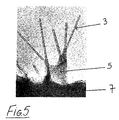
- Fig. 5 is a photograph of the extracted nanotube polymer composite 7 with carbon nanotubes 3 and polymer 5 also indicated.
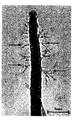
- Figs. 1 to 5 show the interaction of the polymer with the nanotubes.
- a nanotube 3 is shown having a generally cylindrical wall 6 with an internal cavity 7.
- the polymer 5 initially wraps or coils about the nanotube 3 (see Figs. 1 and 2).
- branches 8 of polymer extend outwardly from the nanotube 3 (see Figs. 3 and 4).
- Branches 8 of polymer on adjacent nanotubes 3 then interengage to form a web which strongly binds the nanotubes together. This web can be seen indicated at 5 on Fig. 5.
- nanotubes are therefore a useful additive for forming anti-static sheets and films as well as for producing organic semiconductor devices with enhanced charge carrier mobility.
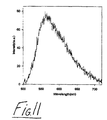
- a light emitting diode 10 in which the active layer comprises a 0.1 mass fraction of nanotube composite 20.
- the diode 10 consists of a 1 ⁇ m thick layer of nanotube polymer composite 20 on top of an indium tin oxide contact 30 on a glass substrate 40.
- the top contact 15 is an evaporated aluminium layer forming an aluminium electrode.
- the diode 10 exhibits a current of 0.1 A for a switch on bias of 14 V.
- the spectrum of light emitted is shown in Fig. 11.
- the diode represents a prototype semiconductor device where the charge carrier mobility and electrical conductivity are enhanced by the presence of nanotubes.
- the same device performance using the pure polymer requires a film thickness of less than 0.1 ⁇ m which leads to severe fabrication problems and much poorer device efficiency.
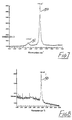
- Figs. 7 and 8 show Raman spectrum of unpurified nanotube soot (Fig. 7) and the purified nanotube polymer composite (Fig. 8).
- Fig. 7 there is a nanotube peak 50 and an amorphous material peak 51.
- Fig. 8 the amorphous material peak has disappeared in the spectrum of the purified composite.
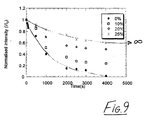
- Fig. 9 is a graph showing reduced degradation of plastic with the incorporation of the nanotube polymer composite. Several graph lines are shown illustrating 0%, 10%, 20% and 25% mass fraction of nanotube content in the polymer.
- nanotubes in conjunction with the polymer has many benefits. We have observed that the polymer and nanotube bind well together. This gives mechanical reinforcement to the polymer.
- the introduction of thermally conductive nanotubes should dramatically reduce the polymers susceptibility to thermal degradation. Thermal degradation is one of the major reasons for the limited lifetime of luminescent polymers. Other notable benefits are a huge increase in conductivity of the order of 10 6 due to the introduction of nanotubes.
- the introduction of nanotubes also reduces aggregation affects and helps to suppress inter-chain non-radiative decay.
- the present invention provides a nanotube polymer composite with technological applications comprising antistatic coatings and packaging as well as semi-conductor devices including light emitting diodes.
- the nanotube polymer composite has electrical conductivity of up to 10 -3 Sm -1 and has application for use in static protection.
- the nanotube polymer composite also has application for use in superconductivity; mechanical reinforcement: domestic, automotive and aerospace; optoelectronic technologies, telecommunications, signal processing (large non-linear optical effects).
- the carbon nanotubes can be purified in a non-destructive method. Good yields of material (in the order of 20%) are provided compared to other methods.
- the method of the present invention is highly reproducible from batch to batch.
- the present invention avoids the use of hazardous explosive or corrosive materials.
- the method provides a useful polymer nanotube composite material with relatively high electrical conduction which can be blended with other plastics or used as is.
- Nanotubes can be used for static protection in a matrix with polymers and oligomers, conjugated and non-conjugated which can also be used in: -
- the nanotubes can induce an increase in conductivity to provide this protection.
- elastic-plastic fibre-reinforced composite materials fibre-reinforced composite materials for strength which can prevent failure seen in other matrix composites since the onset of plastic yielding starts very early in the loading process as compared to the composite's ultimate strength.
- Elastic-plastic behaviour of nanotube-plastic composites consisting of aligned and non-aligned, continuous elastic filaments can be described in terms of the constituent properties, their volume fractions, and mutual constraints between phases indicated by the geometry of the microstructure.
- the nanotube composite prevents degradation of plastics in light, heat and air, and reinforces the plastic for strength and durability.
- the nanotube composite can be used in part for space suit manufacture and fabrication, EMF shielding for the suit. It may also be used to form a radiowave "shield” for applications such as stealth plane, military vehicles and vessels, rockets and space vehicles of all types.
- the composite can be used to provide a protective coating in part or full for vehicles including space vehicles, aeroplanes, ships, tanks, etc.
- the nanotube extracting polymer has a natural fluorescence which is greatly enhanced by combination with nanotubes. This has widespread applications in display technology.
Landscapes
- Chemical & Material Sciences (AREA)
- Engineering & Computer Science (AREA)
- Nanotechnology (AREA)
- Organic Chemistry (AREA)
- Materials Engineering (AREA)
- Condensed Matter Physics & Semiconductors (AREA)
- Physics & Mathematics (AREA)
- General Physics & Mathematics (AREA)
- Crystallography & Structural Chemistry (AREA)
- Polymers & Plastics (AREA)
- Health & Medical Sciences (AREA)
- Manufacturing & Machinery (AREA)
- Medicinal Chemistry (AREA)
- Chemical Kinetics & Catalysis (AREA)
- Inorganic Chemistry (AREA)
- Composite Materials (AREA)
- Compositions Of Macromolecular Compounds (AREA)
- Carbon And Carbon Compounds (AREA)
Claims (13)
- Verfahren zur Reinigung von Nanoröhrchenruß, das folgende Schritte umfasst:Hinzufügen des Nanoröhrchenrußes zu einem Lösungsmittel, das ein organisches Nanoröhrchen-Extraktionsmaterial mit einer Wicklungsstruktur umfasst, um eine Lösung zu bilden;Mischen der Lösung, um eine Nanoröhrchen-Verbundstoffsuspension und getrennten Feststoff zu bilden;Ermöglichen des Abscheidens des getrennten Feststoffs; undEntfernen der Nanoröhrchen-Verbundstoffsuspension.
- Verfahren nach Anspruch 1, wobei das Nanoröhrchen-Extraktionsmaterial ein oder mehrere Polymere, Oligomere oder Monomere oder Kombinationen daraus ist.
- Verfaren nach einem der vorhergehenden Ansprüche, wobei das Nanoröhrchen-Extraktionsmaterial Poly(m-phenylen-co-2,5-dioctoxy-p-phenylenvinylen) ist.
- Verfahren nach einem der vorhergehenden Ansprüche, wobei das verwendete Lösungsmittel ein organisches Lösungsmittel ist.
- Verfahren nach Anspruch 4, wobei das organische Lösungsmittel ein aromatischer Arenkohlenwasserstoff ist.
- Verfahren nach einem der vorhergehenden Ansprüche, wobei die Lösung durch Beschallung gemischt wird.
- Verfahren nach einem der vorhergehenden Ansprüche, wobei die Lösung in einem Ultraschallbad mit niedriger Leistung gemischt wird.
- Verfahren nach Anspruch 7, wobei die Lösung in dem Bad mindestens 20 Minuten lang gemischt wird.
- Nanoröhrchen-Verbundstoffsuspension, die ein organisches Nanoröhrchen-Extraktionsmaterial mit einer Wicklungsstruktur umfasst, wenn sie mit dem Verfahren nach einem der vorhergehenden Ansprüche hergestellt wird.
- Zusammensetzung, die Nanoröhrchen und ein organisches Material mit einer Wicklungsstruktur umfasst.
- Zusammensetzung nach Anspruch 10, wobei das organische Material ein oder mehrere Polymere, Oligomere oder Monomere oder Kombinationen daraus umfasst.
- Zusammensetzung nach Anspruch 11, wobei das organische Material ein Polymer ist.
- Zusammensetzung nach Anspruch 12, wobei das Polymer Poly(m-phenylen-co-2,5-dioctoxy-p-phenylenvinylen) ist.
Applications Claiming Priority (2)
| Application Number | Priority Date | Filing Date | Title |
|---|---|---|---|
| IE980272 | 1998-04-09 | ||
| IE980272 | 1998-04-09 |
Publications (2)
| Publication Number | Publication Date |
|---|---|
| EP0949199A1 EP0949199A1 (de) | 1999-10-13 |
| EP0949199B1 true EP0949199B1 (de) | 2003-05-21 |
Family
ID=11041762
Family Applications (1)
| Application Number | Title | Priority Date | Filing Date |
|---|---|---|---|
| EP99650033A Expired - Lifetime EP0949199B1 (de) | 1998-04-09 | 1999-04-09 | Zusammensetzung enthaltend Nanoröhren und eine organische Verbindung |
Country Status (6)
| Country | Link |
|---|---|
| US (1) | US6576341B1 (de) |
| EP (1) | EP0949199B1 (de) |
| JP (1) | JP4696229B2 (de) |
| AT (1) | ATE240906T1 (de) |
| DE (1) | DE69908016T2 (de) |
| ES (1) | ES2205746T3 (de) |
Cited By (6)
| Publication number | Priority date | Publication date | Assignee | Title |
|---|---|---|---|---|
| US7411019B1 (en) | 2003-08-25 | 2008-08-12 | Eltron Research, Inc. | Polymer composites containing nanotubes |
| US7750071B2 (en) | 2001-03-22 | 2010-07-06 | Clemson University | Halogen containing-polymer nanocomposite compositions, methods, and products employing such compositions |
| CN101485962B (zh) * | 2008-11-06 | 2011-05-04 | 青岛大学 | 一种分散碳纳米管的简易方法 |
| US8558105B2 (en) | 2006-05-01 | 2013-10-15 | Wake Forest University | Organic optoelectronic devices and applications thereof |
| US8772629B2 (en) | 2006-05-01 | 2014-07-08 | Wake Forest University | Fiber photovoltaic devices and applications thereof |
| US9105848B2 (en) | 2006-08-07 | 2015-08-11 | Wake Forest University | Composite organic materials and applications thereof |
Families Citing this family (72)
| Publication number | Priority date | Publication date | Assignee | Title |
|---|---|---|---|---|
| KR100404187B1 (ko) * | 2000-07-08 | 2003-11-01 | 엘지전자 주식회사 | 카본 나노 튜브 또는 카본 나노 화이바를 이용한 인덕터 |
| JP2004506530A (ja) * | 2000-08-24 | 2004-03-04 | ウィリアム・マーシュ・ライス・ユニバーシティ | ポリマー巻き付け単層カーボンナノチューブ |
| JP2002105314A (ja) * | 2000-09-29 | 2002-04-10 | Shimadzu Corp | 潤滑性組成物 |
| US20020145791A1 (en) * | 2001-01-23 | 2002-10-10 | Lee Cheng | Optical component having a reduced thermal sensitivity |
| JP3578098B2 (ja) | 2001-03-16 | 2004-10-20 | 富士ゼロックス株式会社 | 電気接続体の製造方法、電気接続体および電気配線方法 |
| KR20040030553A (ko) | 2001-03-26 | 2004-04-09 | 에이코스 인코포레이티드 | 탄소 나노튜브를 함유하는 코팅막 |
| JP2004529840A (ja) | 2001-03-26 | 2004-09-30 | エイコス・インコーポレーテッド | 構造体と修復用組成物におけるカーボンナノチューブ |
| US6723299B1 (en) | 2001-05-17 | 2004-04-20 | Zyvex Corporation | System and method for manipulating nanotubes |
| US6762237B2 (en) | 2001-06-08 | 2004-07-13 | Eikos, Inc. | Nanocomposite dielectrics |
| US6896864B2 (en) | 2001-07-10 | 2005-05-24 | Battelle Memorial Institute | Spatial localization of dispersed single walled carbon nanotubes into useful structures |
| US6878361B2 (en) | 2001-07-10 | 2005-04-12 | Battelle Memorial Institute | Production of stable aqueous dispersions of carbon nanotubes |
| EP1436196A4 (de) * | 2001-09-18 | 2008-08-27 | Eikos Inc | Esd-beschichtungen zur verwendung mit raumfahrzeugen |
| JP5061414B2 (ja) * | 2001-09-27 | 2012-10-31 | 東レ株式会社 | 薄膜トランジスタ素子 |
| RU2198136C1 (ru) * | 2001-10-16 | 2003-02-10 | Бурангулов Наиль Идрисович | Способ получения растворов фуллеренов |
| ATE522909T1 (de) * | 2001-10-29 | 2011-09-15 | Hyperion Catalysis Int | Polymer mit funktionalisierten kohlenstoff- nanoröhren |
| WO2003050332A1 (en) * | 2001-12-12 | 2003-06-19 | Ashland Inc. | Preparation of stable carbon nanotube dispersions in liquids |
| AU2003237782A1 (en) * | 2002-03-04 | 2003-10-20 | William Marsh Rice University | Method for separating single-wall carbon nanotubes and compositions thereof |
| WO2003078315A2 (en) * | 2002-03-20 | 2003-09-25 | Facultes Universitaires Notre-Dame De La Paix | Nanocomposites: products, process for obtaining them and uses thereof |
| EP1398300A1 (de) * | 2002-09-04 | 2004-03-17 | A.S.B.L. Facultes Universitaires Notre-Dame De La Paix | Nanoverbundwerkstoffen: Verfahren zu ihrer Herstellung, Produkten und ihre Verwendung |
| US20060155043A1 (en) * | 2002-03-20 | 2006-07-13 | The Trustees Of The University Of Pennsylvania | Nanostructure composites |
| US6905667B1 (en) | 2002-05-02 | 2005-06-14 | Zyvex Corporation | Polymer and method for using the polymer for noncovalently functionalizing nanotubes |
| US20040034177A1 (en) * | 2002-05-02 | 2004-02-19 | Jian Chen | Polymer and method for using the polymer for solubilizing nanotubes |
| US7029645B2 (en) * | 2002-06-18 | 2006-04-18 | Motorola, Inc. | Method for non-reactive separation of nanomorphic carbon species |
| JP4547852B2 (ja) * | 2002-09-04 | 2010-09-22 | 富士ゼロックス株式会社 | 電気部品の製造方法 |
| AU2003251307A1 (en) * | 2002-09-10 | 2004-04-30 | The Trustees Of The University Pennsylvania | Carbon nanotubes: high solids dispersions and nematic gels thereof |
| US7108773B2 (en) * | 2002-09-11 | 2006-09-19 | The Board Of Trustees Of The University Of Illinois | Solids supporting mass transfer for fuel cells and other applications and solutions and methods for forming |
| US7844347B2 (en) * | 2002-12-06 | 2010-11-30 | Medtronic, Inc. | Medical devices incorporating carbon nanotube material and methods of fabricating same |
| US20040265212A1 (en) * | 2002-12-06 | 2004-12-30 | Vijay Varadan | Synthesis of coiled carbon nanotubes by microwave chemical vapor deposition |
| US7244499B2 (en) * | 2003-01-10 | 2007-07-17 | Sanyo Electric Co., Ltd. | Bonded structure including a carbon nanotube |
| US6762073B1 (en) * | 2003-02-24 | 2004-07-13 | Donald P. Cullen | Method of fabricating electronic interconnect devices using direct imaging of dielectric composite material |
| US7285591B2 (en) * | 2003-03-20 | 2007-10-23 | The Trustees Of The University Of Pennsylvania | Polymer-nanotube composites, fibers, and processes |
| US20040211942A1 (en) * | 2003-04-28 | 2004-10-28 | Clark Darren Cameron | Electrically conductive compositions and method of manufacture thereof |
| WO2004106420A2 (en) | 2003-05-22 | 2004-12-09 | Zyvex Corporation | Nanocomposites and method for production |
| US20040232389A1 (en) * | 2003-05-22 | 2004-11-25 | Elkovitch Mark D. | Electrically conductive compositions and method of manufacture thereof |
| US7956108B2 (en) | 2003-05-30 | 2011-06-07 | The Provost, Fellows And Scholars Of The College Of The Holy And Undivided Trinity Of Queen Elizabeth, Near Dublin | Product |
| US20040262581A1 (en) * | 2003-06-27 | 2004-12-30 | Rodrigues David E. | Electrically conductive compositions and method of manufacture thereof |
| KR20060060682A (ko) * | 2003-08-08 | 2006-06-05 | 제너럴 일렉트릭 캄파니 | 탄소 나노튜브를 포함하는 전기 전도성 조성물 및 그의제조방법 |
| US7354988B2 (en) * | 2003-08-12 | 2008-04-08 | General Electric Company | Electrically conductive compositions and method of manufacture thereof |
| US7026432B2 (en) * | 2003-08-12 | 2006-04-11 | General Electric Company | Electrically conductive compositions and method of manufacture thereof |
| FR2859988A1 (fr) * | 2003-09-18 | 2005-03-25 | Nanoledge | Dispersion de nanotubes dans des solvants organiques |
| US7309727B2 (en) * | 2003-09-29 | 2007-12-18 | General Electric Company | Conductive thermoplastic compositions, methods of manufacture and articles derived from such compositions |
| US20050070658A1 (en) * | 2003-09-30 | 2005-03-31 | Soumyadeb Ghosh | Electrically conductive compositions, methods of manufacture thereof and articles derived from such compositions |
| US7959783B2 (en) | 2003-09-30 | 2011-06-14 | The Boeing Company | Electrochemical deposition process for composite structures |
| JP4868490B2 (ja) * | 2004-01-06 | 2012-02-01 | 国立大学法人京都大学 | カーボンナノチューブの精製方法 |
| US20050238565A1 (en) * | 2004-04-27 | 2005-10-27 | Steven Sullivan | Systems and methods of manufacturing nanotube structures |
| US7358291B2 (en) * | 2004-06-24 | 2008-04-15 | Arrowhead Center, Inc. | Nanocomposite for enhanced rectification |
| US20060293434A1 (en) * | 2004-07-07 | 2006-12-28 | The Trustees Of The University Of Pennsylvania | Single wall nanotube composites |
| US7296576B2 (en) | 2004-08-18 | 2007-11-20 | Zyvex Performance Materials, Llc | Polymers for enhanced solubility of nanomaterials, compositions and methods therefor |
| US7462656B2 (en) * | 2005-02-15 | 2008-12-09 | Sabic Innovative Plastics Ip B.V. | Electrically conductive compositions and method of manufacture thereof |
| CA2575479C (en) * | 2005-03-25 | 2012-05-22 | Institut National De La Recherche Scientifique | Methods and apparatuses for purifying carbon filamentary structures |
| JP4742650B2 (ja) * | 2005-04-08 | 2011-08-10 | 東レ株式会社 | カーボンナノチューブ組成物、バイオセンサーおよびそれらの製造方法 |
| JP2007118112A (ja) * | 2005-10-26 | 2007-05-17 | National Institute For Materials Science | ナノ樹木/ナノ微粒子複合構造物の作製方法とナノ樹木/ナノ微粒子複合構造物 |
| FR2895393B1 (fr) * | 2005-12-23 | 2008-03-07 | Arkema Sa | Procede de synthese de nanotubes de carbone |
| JP4670100B2 (ja) * | 2006-03-01 | 2011-04-13 | 独立行政法人物質・材料研究機構 | 窒化ホウ素ナノチューブの精製方法 |
| US20080149178A1 (en) * | 2006-06-27 | 2008-06-26 | Marisol Reyes-Reyes | Composite organic materials and applications thereof |
| US20100247419A1 (en) * | 2006-11-01 | 2010-09-30 | Nguyen Khe C | Solid phase synthesized carbon nano fiber and tube |
| EP2151415A4 (de) | 2007-05-09 | 2014-01-22 | Univ Kyushu Nat Univ Corp | Kohlenstoffnanoröhrchen-lösungsvermittler |
| JP2011503849A (ja) * | 2007-11-01 | 2011-01-27 | ウェイク フォレスト ユニバーシティ | ラテラル型有機光電デバイス及びその用途 |
| FR2924133B1 (fr) * | 2007-11-26 | 2012-12-14 | Porcher Ind | Element de renfort longitudinal a base de fibres minerales ou organiques et son procede d'obtention |
| WO2009128449A1 (ja) * | 2008-04-15 | 2009-10-22 | 国立大学法人九州大学 | アロイルビフェニル系ハイパーブランチポリマーからなるカーボンナノチューブ可溶化剤 |
| JP2009274900A (ja) * | 2008-05-14 | 2009-11-26 | Tatsuhiro Takahashi | 低分子量ポリアニリンがグラフトしたカーボンナノチューブ及びその分散液 |
| JP2009179808A (ja) * | 2009-05-18 | 2009-08-13 | Bridgestone Corp | サイド補強式ランフラットタイヤ |
| JP5716670B2 (ja) | 2009-11-25 | 2015-05-13 | 日産化学工業株式会社 | カーボンナノチューブ分散剤 |
| WO2012133314A1 (ja) | 2011-03-28 | 2012-10-04 | 富士フイルム株式会社 | 導電性組成物、当該組成物を用いた導電性膜及びその製造方法 |
| JP6052170B2 (ja) | 2011-05-25 | 2016-12-27 | 日産化学工業株式会社 | 高分岐ポリマーおよびカーボンナノチューブ分散剤 |
| WO2012161306A1 (ja) | 2011-05-25 | 2012-11-29 | 日産化学工業株式会社 | 導電性組成物および導電性複合体 |
| US9156698B2 (en) | 2012-02-29 | 2015-10-13 | Yazaki Corporation | Method of purifying carbon nanotubes and applications thereof |
| EP3029111A4 (de) | 2013-07-31 | 2017-02-22 | Nissan Chemical Industries, Ltd. | Kohlenstoffmaterialzusammensetzung zur herstellung eines dispergierten films |
| JP5773097B1 (ja) | 2013-08-27 | 2015-09-02 | 日産化学工業株式会社 | 導電性結着層用組成物 |
| US10578094B2 (en) | 2016-05-04 | 2020-03-03 | Curium Us Llc | Pump for operation in radioactive environment |
| CN110902670B (zh) | 2018-09-14 | 2021-07-20 | 中国科学院苏州纳米技术与纳米仿生研究所 | 一种碳纳米管取向薄膜、其制备方法及应用 |
| KR102954716B1 (ko) | 2020-02-27 | 2026-04-22 | 닛산 가가쿠 가부시키가이샤 | 카본 나노 튜브 분산액 |
Family Cites Families (5)
| Publication number | Priority date | Publication date | Assignee | Title |
|---|---|---|---|---|
| US5281653A (en) * | 1991-11-25 | 1994-01-25 | Exxon Research And Engineering Company | Fullerene-polymer compositions |
| JPH0822733B2 (ja) | 1993-08-04 | 1996-03-06 | 工業技術院長 | カーボンナノチューブの分離精製方法 |
| JP2654918B2 (ja) * | 1994-01-09 | 1997-09-17 | 科学技術振興事業団 | フラーレンの精製方法 |
| CA2185443C (en) * | 1994-03-16 | 2007-10-23 | Jerry L. Atwood | Method for the separation and purification of fullerenes |
| US5866434A (en) * | 1994-12-08 | 1999-02-02 | Meso Scale Technology | Graphitic nanotubes in luminescence assays |
-
1999
- 1999-04-09 EP EP99650033A patent/EP0949199B1/de not_active Expired - Lifetime
- 1999-04-09 US US09/288,671 patent/US6576341B1/en not_active Expired - Lifetime
- 1999-04-09 AT AT99650033T patent/ATE240906T1/de active
- 1999-04-09 ES ES99650033T patent/ES2205746T3/es not_active Expired - Lifetime
- 1999-04-09 DE DE69908016T patent/DE69908016T2/de not_active Expired - Lifetime
- 1999-04-09 JP JP10335499A patent/JP4696229B2/ja not_active Expired - Fee Related
Cited By (6)
| Publication number | Priority date | Publication date | Assignee | Title |
|---|---|---|---|---|
| US7750071B2 (en) | 2001-03-22 | 2010-07-06 | Clemson University | Halogen containing-polymer nanocomposite compositions, methods, and products employing such compositions |
| US7411019B1 (en) | 2003-08-25 | 2008-08-12 | Eltron Research, Inc. | Polymer composites containing nanotubes |
| US8558105B2 (en) | 2006-05-01 | 2013-10-15 | Wake Forest University | Organic optoelectronic devices and applications thereof |
| US8772629B2 (en) | 2006-05-01 | 2014-07-08 | Wake Forest University | Fiber photovoltaic devices and applications thereof |
| US9105848B2 (en) | 2006-08-07 | 2015-08-11 | Wake Forest University | Composite organic materials and applications thereof |
| CN101485962B (zh) * | 2008-11-06 | 2011-05-04 | 青岛大学 | 一种分散碳纳米管的简易方法 |
Also Published As
| Publication number | Publication date |
|---|---|
| JP2000044216A (ja) | 2000-02-15 |
| JP4696229B2 (ja) | 2011-06-08 |
| EP0949199A1 (de) | 1999-10-13 |
| ATE240906T1 (de) | 2003-06-15 |
| ES2205746T3 (es) | 2004-05-01 |
| US6576341B1 (en) | 2003-06-10 |
| DE69908016D1 (de) | 2003-06-26 |
| DE69908016T2 (de) | 2004-08-19 |
Similar Documents
| Publication | Publication Date | Title |
|---|---|---|
| US6576341B1 (en) | Composition | |
| Alemour et al. | Review of Electrical Properties of Graphene Conductive Composites. | |
| US6908572B1 (en) | Mixing and dispersion of nanotubes by gas or vapor expansion | |
| US20100078194A1 (en) | Polymeric compositions containing nanotubes | |
| US8894963B2 (en) | Dispersion and retrieval of de-bundled nanotubes | |
| KR101307303B1 (ko) | 투명 도전성 박막과 그 제조 방법 | |
| US20110036829A1 (en) | Planar heating element obtained using dispersion of fine carbon fibers in water and process for producing the planar heating element | |
| US20080118736A1 (en) | Conductive composite compositions with fillers | |
| WO2007136559A2 (en) | Conductive coatings produced by monolayer deposition on surfaces | |
| US20090311436A1 (en) | Conductive composite materials with graphite coated particles | |
| WO2017065340A1 (ko) | 2차원 하이브리드 복합체 제조 방법 | |
| Tanaka et al. | Generic PD resistance characteristics of polymer nanocomposites | |
| US7956108B2 (en) | Product | |
| CN103732797A (zh) | 有机无机复合物及其制造方法 | |
| JP2002519830A (ja) | 色の明るい導電性被覆粒子およびそれから製造される組成物 | |
| Omastova et al. | Surface characterizations of conductive poly (methyl methacrylate)/polypyrrole composites | |
| IE990298A1 (en) | A composition | |
| Gul | Conducting Polymer Materials | |
| Danilaev et al. | Single‐stage plasma‐chemical synthesis and characterization of carbon nanoparticle‐polymer suspensions | |
| JP2002234999A (ja) | 成形材料、成形品およびその製造方法 | |
| Nisha et al. | Effect of 4-aminobutyltriethoxysilane modified Al2O3 nanoparticles on the dielectric properties of epoxy nanocomposites for high voltage applications | |
| JP2014207116A (ja) | 透明導電膜およびその製造方法 | |
| KR20100046320A (ko) | 탄소나노튜브 절단 분산 방법 및 장치 | |
| Parten | Development and testing of spray-coated lightning strike protection systems for fiber-reinforced thermoplastic composites | |
| Cauchy | Approaching Typical Metallic Conductivities in Polymer Nanocomposites for Lightning Strike Protection |
Legal Events
| Date | Code | Title | Description |
|---|---|---|---|
| PUAI | Public reference made under article 153(3) epc to a published international application that has entered the european phase |
Free format text: ORIGINAL CODE: 0009012 |
|
| AK | Designated contracting states |
Kind code of ref document: A1 Designated state(s): AT BE CH CY DE DK ES FI FR GB GR IE IT LI LU MC NL PT SE |
|
| AX | Request for extension of the european patent |
Free format text: AL;LT;LV;MK;RO;SI |
|
| 17P | Request for examination filed |
Effective date: 20000316 |
|
| AKX | Designation fees paid |
Free format text: AT BE CH CY DE DK ES FI FR GB GR IE IT LI LU MC NL PT SE |
|
| 17Q | First examination report despatched |
Effective date: 20010713 |
|
| GRAH | Despatch of communication of intention to grant a patent |
Free format text: ORIGINAL CODE: EPIDOS IGRA |
|
| GRAH | Despatch of communication of intention to grant a patent |
Free format text: ORIGINAL CODE: EPIDOS IGRA |
|
| GRAA | (expected) grant |
Free format text: ORIGINAL CODE: 0009210 |
|
| AK | Designated contracting states |
Designated state(s): AT BE CH CY DE DK ES FI FR GB GR IE IT LI LU MC NL PT SE |
|
| PG25 | Lapsed in a contracting state [announced via postgrant information from national office to epo] |
Ref country code: FI Free format text: LAPSE BECAUSE OF FAILURE TO SUBMIT A TRANSLATION OF THE DESCRIPTION OR TO PAY THE FEE WITHIN THE PRESCRIBED TIME-LIMIT Effective date: 20030521 |
|
| REG | Reference to a national code |
Ref country code: GB Ref legal event code: FG4D |
|
| REG | Reference to a national code |
Ref country code: CH Ref legal event code: EP |
|
| REG | Reference to a national code |
Ref country code: IE Ref legal event code: FG4D |
|
| REF | Corresponds to: |
Ref document number: 69908016 Country of ref document: DE Date of ref document: 20030626 Kind code of ref document: P |
|
| PG25 | Lapsed in a contracting state [announced via postgrant information from national office to epo] |
Ref country code: SE Free format text: LAPSE BECAUSE OF FAILURE TO SUBMIT A TRANSLATION OF THE DESCRIPTION OR TO PAY THE FEE WITHIN THE PRESCRIBED TIME-LIMIT Effective date: 20030821 Ref country code: PT Free format text: LAPSE BECAUSE OF FAILURE TO SUBMIT A TRANSLATION OF THE DESCRIPTION OR TO PAY THE FEE WITHIN THE PRESCRIBED TIME-LIMIT Effective date: 20030821 Ref country code: GR Free format text: LAPSE BECAUSE OF FAILURE TO SUBMIT A TRANSLATION OF THE DESCRIPTION OR TO PAY THE FEE WITHIN THE PRESCRIBED TIME-LIMIT Effective date: 20030821 Ref country code: DK Free format text: LAPSE BECAUSE OF FAILURE TO SUBMIT A TRANSLATION OF THE DESCRIPTION OR TO PAY THE FEE WITHIN THE PRESCRIBED TIME-LIMIT Effective date: 20030821 |
|
| PLBE | No opposition filed within time limit |
Free format text: ORIGINAL CODE: 0009261 |
|
| STAA | Information on the status of an ep patent application or granted ep patent |
Free format text: STATUS: NO OPPOSITION FILED WITHIN TIME LIMIT |
|
| ET | Fr: translation filed | ||
| PG25 | Lapsed in a contracting state [announced via postgrant information from national office to epo] |
Ref country code: LU Free format text: LAPSE BECAUSE OF NON-PAYMENT OF DUE FEES Effective date: 20040409 |
|
| PG25 | Lapsed in a contracting state [announced via postgrant information from national office to epo] |
Ref country code: MC Free format text: LAPSE BECAUSE OF NON-PAYMENT OF DUE FEES Effective date: 20040430 |
|
| REG | Reference to a national code |
Ref country code: ES Ref legal event code: FG2A Ref document number: 2205746 Country of ref document: ES Kind code of ref document: T3 |
|
| 26N | No opposition filed |
Effective date: 20040224 |
|
| PGFP | Annual fee paid to national office [announced via postgrant information from national office to epo] |
Ref country code: CY Payment date: 20070419 Year of fee payment: 9 |
|
| PG25 | Lapsed in a contracting state [announced via postgrant information from national office to epo] |
Ref country code: CY Free format text: LAPSE BECAUSE OF NON-PAYMENT OF DUE FEES Effective date: 20080409 |
|
| PGFP | Annual fee paid to national office [announced via postgrant information from national office to epo] |
Ref country code: DE Payment date: 20120628 Year of fee payment: 14 Ref country code: IE Payment date: 20120427 Year of fee payment: 14 Ref country code: NL Payment date: 20120508 Year of fee payment: 14 Ref country code: CH Payment date: 20120427 Year of fee payment: 14 |
|
| PGFP | Annual fee paid to national office [announced via postgrant information from national office to epo] |
Ref country code: FR Payment date: 20120531 Year of fee payment: 14 Ref country code: GB Payment date: 20120427 Year of fee payment: 14 |
|
| PGFP | Annual fee paid to national office [announced via postgrant information from national office to epo] |
Ref country code: IT Payment date: 20120430 Year of fee payment: 14 |
|
| PGFP | Annual fee paid to national office [announced via postgrant information from national office to epo] |
Ref country code: BE Payment date: 20120618 Year of fee payment: 14 |
|
| PGFP | Annual fee paid to national office [announced via postgrant information from national office to epo] |
Ref country code: ES Payment date: 20120516 Year of fee payment: 14 |
|
| PGFP | Annual fee paid to national office [announced via postgrant information from national office to epo] |
Ref country code: AT Payment date: 20120502 Year of fee payment: 14 |
|
| BERE | Be: lapsed |
Owner name: *HORCOM LTD Effective date: 20130430 Owner name: *ENTERPRISE IRELAND (TRADING AS MATERIALS IRELAND) Effective date: 20130430 Owner name: THE *PROVOST FELLOWS AND SCHOLARS OF THE COLLEGE O Effective date: 20130430 |
|
| REG | Reference to a national code |
Ref country code: NL Ref legal event code: V1 Effective date: 20131101 |
|
| REG | Reference to a national code |
Ref country code: CH Ref legal event code: PL |
|
| REG | Reference to a national code |
Ref country code: AT Ref legal event code: MM01 Ref document number: 240906 Country of ref document: AT Kind code of ref document: T Effective date: 20130430 |
|
| GBPC | Gb: european patent ceased through non-payment of renewal fee |
Effective date: 20130409 |
|
| REG | Reference to a national code |
Ref country code: IE Ref legal event code: MM4A |
|
| PG25 | Lapsed in a contracting state [announced via postgrant information from national office to epo] |
Ref country code: CH Free format text: LAPSE BECAUSE OF NON-PAYMENT OF DUE FEES Effective date: 20130430 Ref country code: LI Free format text: LAPSE BECAUSE OF NON-PAYMENT OF DUE FEES Effective date: 20130430 Ref country code: GB Free format text: LAPSE BECAUSE OF NON-PAYMENT OF DUE FEES Effective date: 20130409 Ref country code: AT Free format text: LAPSE BECAUSE OF NON-PAYMENT OF DUE FEES Effective date: 20130430 Ref country code: BE Free format text: LAPSE BECAUSE OF NON-PAYMENT OF DUE FEES Effective date: 20130430 Ref country code: DE Free format text: LAPSE BECAUSE OF NON-PAYMENT OF DUE FEES Effective date: 20131101 |
|
| REG | Reference to a national code |
Ref country code: FR Ref legal event code: ST Effective date: 20131231 |
|
| REG | Reference to a national code |
Ref country code: DE Ref legal event code: R119 Ref document number: 69908016 Country of ref document: DE Effective date: 20131101 |
|
| PG25 | Lapsed in a contracting state [announced via postgrant information from national office to epo] |
Ref country code: FR Free format text: LAPSE BECAUSE OF NON-PAYMENT OF DUE FEES Effective date: 20130430 Ref country code: NL Free format text: LAPSE BECAUSE OF NON-PAYMENT OF DUE FEES Effective date: 20131101 Ref country code: IT Free format text: LAPSE BECAUSE OF NON-PAYMENT OF DUE FEES Effective date: 20130409 |
|
| PG25 | Lapsed in a contracting state [announced via postgrant information from national office to epo] |
Ref country code: IE Free format text: LAPSE BECAUSE OF NON-PAYMENT OF DUE FEES Effective date: 20130409 |
|
| REG | Reference to a national code |
Ref country code: ES Ref legal event code: FD2A Effective date: 20140606 |
|
| PG25 | Lapsed in a contracting state [announced via postgrant information from national office to epo] |
Ref country code: ES Free format text: LAPSE BECAUSE OF NON-PAYMENT OF DUE FEES Effective date: 20130410 |