EP0949251B1 - Diresorcinyltriazine als Lichtschutzmittel - Google Patents
Diresorcinyltriazine als Lichtschutzmittel Download PDFInfo
- Publication number
- EP0949251B1 EP0949251B1 EP99810280A EP99810280A EP0949251B1 EP 0949251 B1 EP0949251 B1 EP 0949251B1 EP 99810280 A EP99810280 A EP 99810280A EP 99810280 A EP99810280 A EP 99810280A EP 0949251 B1 EP0949251 B1 EP 0949251B1
- Authority
- EP
- European Patent Office
- Prior art keywords
- formula
- compound
- preparation
- alkyl
- reaction
- Prior art date
- Legal status (The legal status is an assumption and is not a legal conclusion. Google has not performed a legal analysis and makes no representation as to the accuracy of the status listed.)
- Expired - Lifetime
Links
- 239000000516 sunscreening agent Substances 0.000 title description 9
- 150000001875 compounds Chemical class 0.000 claims abstract description 91
- 238000002360 preparation method Methods 0.000 claims abstract description 45
- 150000003918 triazines Chemical class 0.000 claims abstract description 3
- -1 2-decylhexadecyl Chemical group 0.000 claims description 44
- 239000000203 mixture Substances 0.000 claims description 32
- 238000006243 chemical reaction Methods 0.000 claims description 22
- GHMLBKRAJCXXBS-UHFFFAOYSA-N resorcinol Chemical compound OC1=CC=CC(O)=C1 GHMLBKRAJCXXBS-UHFFFAOYSA-N 0.000 claims description 18
- 239000002537 cosmetic Substances 0.000 claims description 16
- 229910052739 hydrogen Inorganic materials 0.000 claims description 15
- 239000003381 stabilizer Substances 0.000 claims description 12
- 238000000034 method Methods 0.000 claims description 6
- 239000011368 organic material Substances 0.000 claims description 6
- 239000000126 substance Substances 0.000 claims description 6
- 239000001301 oxygen Substances 0.000 claims description 5
- 229910052760 oxygen Inorganic materials 0.000 claims description 5
- QVGXLLKOCUKJST-UHFFFAOYSA-N atomic oxygen Chemical compound [O] QVGXLLKOCUKJST-UHFFFAOYSA-N 0.000 claims description 4
- MGNCLNQXLYJVJD-UHFFFAOYSA-N cyanuric chloride Chemical compound ClC1=NC(Cl)=NC(Cl)=N1 MGNCLNQXLYJVJD-UHFFFAOYSA-N 0.000 claims description 4
- 239000001257 hydrogen Substances 0.000 claims description 4
- 238000005727 Friedel-Crafts reaction Methods 0.000 claims description 3
- 125000002887 hydroxy group Chemical group [H]O* 0.000 claims description 2
- 125000004435 hydrogen atom Chemical class [H]* 0.000 claims 2
- 230000001681 protective effect Effects 0.000 claims 2
- 150000001408 amides Chemical class 0.000 claims 1
- 239000000969 carrier Substances 0.000 claims 1
- 150000003852 triazoles Chemical class 0.000 claims 1
- 125000000391 vinyl group Chemical group [H]C([*])=C([H])[H] 0.000 claims 1
- 125000000217 alkyl group Chemical group 0.000 abstract description 7
- 125000003342 alkenyl group Chemical group 0.000 abstract description 3
- 239000000543 intermediate Substances 0.000 abstract 4
- IPHDQSNAYMVQCP-UHFFFAOYSA-N 2,6-dichloro-1h-triazine Chemical compound ClN1NC(Cl)=CC=N1 IPHDQSNAYMVQCP-UHFFFAOYSA-N 0.000 abstract 1
- IHDBZCJYSHDCKF-UHFFFAOYSA-N 4,6-dichlorotriazine Chemical compound ClC1=CC(Cl)=NN=N1 IHDBZCJYSHDCKF-UHFFFAOYSA-N 0.000 abstract 1
- YXFVVABEGXRONW-UHFFFAOYSA-N Toluene Chemical compound CC1=CC=CC=C1 YXFVVABEGXRONW-UHFFFAOYSA-N 0.000 description 84
- CSCPPACGZOOCGX-UHFFFAOYSA-N Acetone Chemical compound CC(C)=O CSCPPACGZOOCGX-UHFFFAOYSA-N 0.000 description 57
- LFQSCWFLJHTTHZ-UHFFFAOYSA-N Ethanol Chemical compound CCO LFQSCWFLJHTTHZ-UHFFFAOYSA-N 0.000 description 40
- VYPSYNLAJGMNEJ-UHFFFAOYSA-N Silicium dioxide Chemical compound O=[Si]=O VYPSYNLAJGMNEJ-UHFFFAOYSA-N 0.000 description 21
- LQNUZADURLCDLV-UHFFFAOYSA-N nitrobenzene Chemical compound [O-][N+](=O)C1=CC=CC=C1 LQNUZADURLCDLV-UHFFFAOYSA-N 0.000 description 18
- 239000000741 silica gel Substances 0.000 description 18
- 229910002027 silica gel Inorganic materials 0.000 description 18
- VSCWAEJMTAWNJL-UHFFFAOYSA-K aluminium trichloride Chemical compound Cl[Al](Cl)Cl VSCWAEJMTAWNJL-UHFFFAOYSA-K 0.000 description 16
- 238000003756 stirring Methods 0.000 description 16
- OKKJLVBELUTLKV-UHFFFAOYSA-N Methanol Chemical compound OC OKKJLVBELUTLKV-UHFFFAOYSA-N 0.000 description 15
- 239000006096 absorbing agent Substances 0.000 description 15
- VLKZOEOYAKHREP-UHFFFAOYSA-N n-Hexane Chemical compound CCCCCC VLKZOEOYAKHREP-UHFFFAOYSA-N 0.000 description 15
- PEDCQBHIVMGVHV-UHFFFAOYSA-N Glycerine Chemical compound OCC(O)CO PEDCQBHIVMGVHV-UHFFFAOYSA-N 0.000 description 13
- 239000013078 crystal Substances 0.000 description 13
- DNIAPMSPPWPWGF-UHFFFAOYSA-N Propylene glycol Chemical compound CC(O)CO DNIAPMSPPWPWGF-UHFFFAOYSA-N 0.000 description 12
- FAPWRFPIFSIZLT-UHFFFAOYSA-M Sodium chloride Chemical compound [Na+].[Cl-] FAPWRFPIFSIZLT-UHFFFAOYSA-M 0.000 description 12
- HEMHJVSKTPXQMS-UHFFFAOYSA-M Sodium hydroxide Chemical compound [OH-].[Na+] HEMHJVSKTPXQMS-UHFFFAOYSA-M 0.000 description 12
- 239000000243 solution Substances 0.000 description 12
- XLYOFNOQVPJJNP-UHFFFAOYSA-N water Substances O XLYOFNOQVPJJNP-UHFFFAOYSA-N 0.000 description 12
- 229910052799 carbon Inorganic materials 0.000 description 11
- 238000000921 elemental analysis Methods 0.000 description 11
- 229910052757 nitrogen Inorganic materials 0.000 description 11
- 239000003921 oil Substances 0.000 description 11
- 239000012071 phase Substances 0.000 description 11
- 239000002904 solvent Substances 0.000 description 10
- RYHBNJHYFVUHQT-UHFFFAOYSA-N 1,4-Dioxane Chemical compound C1COCCO1 RYHBNJHYFVUHQT-UHFFFAOYSA-N 0.000 description 9
- VEXZGXHMUGYJMC-UHFFFAOYSA-N Hydrochloric acid Chemical compound Cl VEXZGXHMUGYJMC-UHFFFAOYSA-N 0.000 description 9
- 238000004809 thin layer chromatography Methods 0.000 description 9
- 238000004440 column chromatography Methods 0.000 description 8
- 229920000642 polymer Polymers 0.000 description 8
- IAZDPXIOMUYVGZ-UHFFFAOYSA-N DMSO Substances CS(C)=O IAZDPXIOMUYVGZ-UHFFFAOYSA-N 0.000 description 7
- 230000005540 biological transmission Effects 0.000 description 7
- 239000012074 organic phase Substances 0.000 description 7
- 239000011541 reaction mixture Substances 0.000 description 7
- 239000007787 solid Substances 0.000 description 7
- 230000000475 sunscreen effect Effects 0.000 description 7
- 239000012043 crude product Substances 0.000 description 6
- 238000000338 in vitro Methods 0.000 description 6
- 239000000463 material Substances 0.000 description 6
- 239000011780 sodium chloride Substances 0.000 description 6
- CXBDYQVECUFKRK-UHFFFAOYSA-N 1-methoxybutane Chemical compound CCCCOC CXBDYQVECUFKRK-UHFFFAOYSA-N 0.000 description 5
- 239000003054 catalyst Substances 0.000 description 5
- 239000008367 deionised water Substances 0.000 description 5
- 229910021641 deionized water Inorganic materials 0.000 description 5
- 238000009472 formulation Methods 0.000 description 5
- 235000011187 glycerol Nutrition 0.000 description 5
- XUGNVMKQXJXZCD-UHFFFAOYSA-N isopropyl palmitate Chemical compound CCCCCCCCCCCCCCCC(=O)OC(C)C XUGNVMKQXJXZCD-UHFFFAOYSA-N 0.000 description 5
- 238000001256 steam distillation Methods 0.000 description 5
- 239000000725 suspension Substances 0.000 description 5
- CSNNHWWHGAXBCP-UHFFFAOYSA-L Magnesium sulfate Chemical compound [Mg+2].[O-][S+2]([O-])([O-])[O-] CSNNHWWHGAXBCP-UHFFFAOYSA-L 0.000 description 4
- SECXISVLQFMRJM-UHFFFAOYSA-N N-Methylpyrrolidone Chemical compound CN1CCCC1=O SECXISVLQFMRJM-UHFFFAOYSA-N 0.000 description 4
- CTQNGGLPUBDAKN-UHFFFAOYSA-N O-Xylene Chemical compound CC1=CC=CC=C1C CTQNGGLPUBDAKN-UHFFFAOYSA-N 0.000 description 4
- GWEVSGVZZGPLCZ-UHFFFAOYSA-N Titan oxide Chemical compound O=[Ti]=O GWEVSGVZZGPLCZ-UHFFFAOYSA-N 0.000 description 4
- 229920001577 copolymer Polymers 0.000 description 4
- 239000000839 emulsion Substances 0.000 description 4
- 238000000227 grinding Methods 0.000 description 4
- 239000005457 ice water Substances 0.000 description 4
- 239000002245 particle Substances 0.000 description 4
- 239000008096 xylene Substances 0.000 description 4
- 150000003738 xylenes Chemical class 0.000 description 4
- ZWEHNKRNPOVVGH-UHFFFAOYSA-N 2-Butanone Chemical compound CCC(C)=O ZWEHNKRNPOVVGH-UHFFFAOYSA-N 0.000 description 3
- 239000004808 2-ethylhexylester Substances 0.000 description 3
- QCDWFXQBSFUVSP-UHFFFAOYSA-N 2-phenoxyethanol Chemical compound OCCOC1=CC=CC=C1 QCDWFXQBSFUVSP-UHFFFAOYSA-N 0.000 description 3
- WEVYAHXRMPXWCK-UHFFFAOYSA-N Acetonitrile Chemical compound CC#N WEVYAHXRMPXWCK-UHFFFAOYSA-N 0.000 description 3
- UHOVQNZJYSORNB-UHFFFAOYSA-N Benzene Chemical compound C1=CC=CC=C1 UHOVQNZJYSORNB-UHFFFAOYSA-N 0.000 description 3
- RTZKZFJDLAIYFH-UHFFFAOYSA-N Diethyl ether Chemical compound CCOCC RTZKZFJDLAIYFH-UHFFFAOYSA-N 0.000 description 3
- XEKOWRVHYACXOJ-UHFFFAOYSA-N Ethyl acetate Chemical compound CCOC(C)=O XEKOWRVHYACXOJ-UHFFFAOYSA-N 0.000 description 3
- UFHFLCQGNIYNRP-UHFFFAOYSA-N Hydrogen Chemical compound [H][H] UFHFLCQGNIYNRP-UHFFFAOYSA-N 0.000 description 3
- YBGZDTIWKVFICR-JLHYYAGUSA-N Octyl 4-methoxycinnamic acid Chemical compound CCCCC(CC)COC(=O)\C=C\C1=CC=C(OC)C=C1 YBGZDTIWKVFICR-JLHYYAGUSA-N 0.000 description 3
- 235000014113 dietary fatty acids Nutrition 0.000 description 3
- 239000003995 emulsifying agent Substances 0.000 description 3
- 150000002148 esters Chemical class 0.000 description 3
- 239000000194 fatty acid Substances 0.000 description 3
- 229930195729 fatty acid Natural products 0.000 description 3
- 125000005456 glyceride group Chemical group 0.000 description 3
- 229930195733 hydrocarbon Natural products 0.000 description 3
- 238000003801 milling Methods 0.000 description 3
- WWZKQHOCKIZLMA-UHFFFAOYSA-N octanoic acid Chemical compound CCCCCCCC(O)=O WWZKQHOCKIZLMA-UHFFFAOYSA-N 0.000 description 3
- 239000000546 pharmaceutical excipient Substances 0.000 description 3
- 229960005323 phenoxyethanol Drugs 0.000 description 3
- 238000001953 recrystallisation Methods 0.000 description 3
- 150000003839 salts Chemical class 0.000 description 3
- 150000003626 triacylglycerols Chemical class 0.000 description 3
- GVJHHUAWPYXKBD-UHFFFAOYSA-N (±)-α-Tocopherol Chemical compound OC1=C(C)C(C)=C2OC(CCCC(C)CCCC(C)CCCC(C)C)(C)CCC2=C1C GVJHHUAWPYXKBD-UHFFFAOYSA-N 0.000 description 2
- WNWHHMBRJJOGFJ-UHFFFAOYSA-N 16-methylheptadecan-1-ol Chemical class CC(C)CCCCCCCCCCCCCCCO WNWHHMBRJJOGFJ-UHFFFAOYSA-N 0.000 description 2
- XMVBHZBLHNOQON-UHFFFAOYSA-N 2-butyl-1-octanol Chemical compound CCCCCCC(CO)CCCC XMVBHZBLHNOQON-UHFFFAOYSA-N 0.000 description 2
- YIWUKEYIRIRTPP-UHFFFAOYSA-N 2-ethylhexan-1-ol Chemical compound CCCCC(CC)CO YIWUKEYIRIRTPP-UHFFFAOYSA-N 0.000 description 2
- SVTBMSDMJJWYQN-UHFFFAOYSA-N 2-methylpentane-2,4-diol Chemical compound CC(O)CC(C)(C)O SVTBMSDMJJWYQN-UHFFFAOYSA-N 0.000 description 2
- WMJBVALTYVXGHW-UHFFFAOYSA-N 3,3-diphenylprop-2-enoic acid Chemical compound C=1C=CC=CC=1C(=CC(=O)O)C1=CC=CC=C1 WMJBVALTYVXGHW-UHFFFAOYSA-N 0.000 description 2
- KCYXUPSQDTWHIJ-UHFFFAOYSA-N 3-(1-benzofuran-2-yl)-2-cyanoprop-2-enoic acid Chemical compound C1=CC=C2OC(C=C(C(=O)O)C#N)=CC2=C1 KCYXUPSQDTWHIJ-UHFFFAOYSA-N 0.000 description 2
- NIXOWILDQLNWCW-UHFFFAOYSA-N Acrylic acid Chemical compound OC(=O)C=C NIXOWILDQLNWCW-UHFFFAOYSA-N 0.000 description 2
- 239000004215 Carbon black (E152) Substances 0.000 description 2
- KFZMGEQAYNKOFK-UHFFFAOYSA-N Isopropanol Chemical compound CC(C)O KFZMGEQAYNKOFK-UHFFFAOYSA-N 0.000 description 2
- FXHOOIRPVKKKFG-UHFFFAOYSA-N N,N-Dimethylacetamide Chemical compound CN(C)C(C)=O FXHOOIRPVKKKFG-UHFFFAOYSA-N 0.000 description 2
- 229920002125 Sokalan® Polymers 0.000 description 2
- RAHZWNYVWXNFOC-UHFFFAOYSA-N Sulphur dioxide Chemical compound O=S=O RAHZWNYVWXNFOC-UHFFFAOYSA-N 0.000 description 2
- HEDRZPFGACZZDS-MICDWDOJSA-N Trichloro(2H)methane Chemical compound [2H]C(Cl)(Cl)Cl HEDRZPFGACZZDS-MICDWDOJSA-N 0.000 description 2
- 239000000654 additive Substances 0.000 description 2
- RDOXTESZEPMUJZ-UHFFFAOYSA-N anisole Chemical compound COC1=CC=CC=C1 RDOXTESZEPMUJZ-UHFFFAOYSA-N 0.000 description 2
- 239000003963 antioxidant agent Substances 0.000 description 2
- 235000006708 antioxidants Nutrition 0.000 description 2
- WTEOIRVLGSZEPR-UHFFFAOYSA-N boron trifluoride Chemical compound FB(F)F WTEOIRVLGSZEPR-UHFFFAOYSA-N 0.000 description 2
- 229960001631 carbomer Drugs 0.000 description 2
- 239000004359 castor oil Substances 0.000 description 2
- 235000019438 castor oil Nutrition 0.000 description 2
- MVPPADPHJFYWMZ-UHFFFAOYSA-N chlorobenzene Chemical compound ClC1=CC=CC=C1 MVPPADPHJFYWMZ-UHFFFAOYSA-N 0.000 description 2
- 150000001851 cinnamic acid derivatives Chemical class 0.000 description 2
- 239000006071 cream Substances 0.000 description 2
- 230000000254 damaging effect Effects 0.000 description 2
- 230000020335 dealkylation Effects 0.000 description 2
- 238000006900 dealkylation reaction Methods 0.000 description 2
- SASYSVUEVMOWPL-NXVVXOECSA-N decyl oleate Chemical compound CCCCCCCCCCOC(=O)CCCCCCC\C=C/CCCCCCCC SASYSVUEVMOWPL-NXVVXOECSA-N 0.000 description 2
- 229940008099 dimethicone Drugs 0.000 description 2
- 239000004205 dimethyl polysiloxane Substances 0.000 description 2
- 235000013870 dimethyl polysiloxane Nutrition 0.000 description 2
- VAYGXNSJCAHWJZ-UHFFFAOYSA-N dimethyl sulfate Chemical compound COS(=O)(=O)OC VAYGXNSJCAHWJZ-UHFFFAOYSA-N 0.000 description 2
- 229920001971 elastomer Polymers 0.000 description 2
- UVCJGUGAGLDPAA-UHFFFAOYSA-N ensulizole Chemical compound N1C2=CC(S(=O)(=O)O)=CC=C2N=C1C1=CC=CC=C1 UVCJGUGAGLDPAA-UHFFFAOYSA-N 0.000 description 2
- 238000001704 evaporation Methods 0.000 description 2
- 230000008020 evaporation Effects 0.000 description 2
- 239000003925 fat Substances 0.000 description 2
- 150000004665 fatty acids Chemical class 0.000 description 2
- 150000002191 fatty alcohols Chemical class 0.000 description 2
- 239000012065 filter cake Substances 0.000 description 2
- ZEMPKEQAKRGZGQ-XOQCFJPHSA-N glycerol triricinoleate Natural products CCCCCC[C@@H](O)CC=CCCCCCCCC(=O)OC[C@@H](COC(=O)CCCCCCCC=CC[C@@H](O)CCCCCC)OC(=O)CCCCCCCC=CC[C@H](O)CCCCCC ZEMPKEQAKRGZGQ-XOQCFJPHSA-N 0.000 description 2
- 150000002430 hydrocarbons Chemical class 0.000 description 2
- 238000010348 incorporation Methods 0.000 description 2
- 239000004611 light stabiliser Substances 0.000 description 2
- HQKMJHAJHXVSDF-UHFFFAOYSA-L magnesium stearate Chemical compound [Mg+2].CCCCCCCCCCCCCCCCCC([O-])=O.CCCCCCCCCCCCCCCCCC([O-])=O HQKMJHAJHXVSDF-UHFFFAOYSA-L 0.000 description 2
- 229910052943 magnesium sulfate Inorganic materials 0.000 description 2
- 235000019341 magnesium sulphate Nutrition 0.000 description 2
- 125000000956 methoxy group Chemical group [H]C([H])([H])O* 0.000 description 2
- 239000010445 mica Substances 0.000 description 2
- 229910052618 mica group Inorganic materials 0.000 description 2
- 239000002480 mineral oil Substances 0.000 description 2
- 235000010446 mineral oil Nutrition 0.000 description 2
- 238000002156 mixing Methods 0.000 description 2
- 239000007764 o/w emulsion Substances 0.000 description 2
- GLDOVTGHNKAZLK-UHFFFAOYSA-N octadecan-1-ol Chemical compound CCCCCCCCCCCCCCCCCCO GLDOVTGHNKAZLK-UHFFFAOYSA-N 0.000 description 2
- 229960001679 octinoxate Drugs 0.000 description 2
- IIGMITQLXAGZTL-UHFFFAOYSA-N octyl octadecanoate Chemical compound CCCCCCCCCCCCCCCCCC(=O)OCCCCCCCC IIGMITQLXAGZTL-UHFFFAOYSA-N 0.000 description 2
- 229920000620 organic polymer Polymers 0.000 description 2
- DXGLGDHPHMLXJC-UHFFFAOYSA-N oxybenzone Chemical compound OC1=CC(OC)=CC=C1C(=O)C1=CC=CC=C1 DXGLGDHPHMLXJC-UHFFFAOYSA-N 0.000 description 2
- 239000003973 paint Substances 0.000 description 2
- 229920000435 poly(dimethylsiloxane) Polymers 0.000 description 2
- 229920005862 polyol Polymers 0.000 description 2
- 150000003077 polyols Chemical class 0.000 description 2
- 239000000843 powder Substances 0.000 description 2
- 239000000047 product Substances 0.000 description 2
- 230000035484 reaction time Effects 0.000 description 2
- 239000004576 sand Substances 0.000 description 2
- 229920002545 silicone oil Polymers 0.000 description 2
- 230000000087 stabilizing effect Effects 0.000 description 2
- HXJUTPCZVOIRIF-UHFFFAOYSA-N sulfolane Chemical compound O=S1(=O)CCCC1 HXJUTPCZVOIRIF-UHFFFAOYSA-N 0.000 description 2
- 239000007762 w/o emulsion Substances 0.000 description 2
- 239000001993 wax Substances 0.000 description 2
- HEOCBCNFKCOKBX-RELGSGGGSA-N (1s,2e,4r)-4,7,7-trimethyl-2-[(4-methylphenyl)methylidene]bicyclo[2.2.1]heptan-3-one Chemical compound C1=CC(C)=CC=C1\C=C/1C(=O)[C@]2(C)CC[C@H]\1C2(C)C HEOCBCNFKCOKBX-RELGSGGGSA-N 0.000 description 1
- PDHSAQOQVUXZGQ-JKSUJKDBSA-N (2r,3s)-2-(3,4-dihydroxyphenyl)-3-methoxy-3,4-dihydro-2h-chromene-5,7-diol Chemical compound C1([C@H]2OC3=CC(O)=CC(O)=C3C[C@@H]2OC)=CC=C(O)C(O)=C1 PDHSAQOQVUXZGQ-JKSUJKDBSA-N 0.000 description 1
- 125000000923 (C1-C30) alkyl group Chemical group 0.000 description 1
- DSSYKIVIOFKYAU-XCBNKYQSSA-N (R)-camphor Chemical class C1C[C@@]2(C)C(=O)C[C@@H]1C2(C)C DSSYKIVIOFKYAU-XCBNKYQSSA-N 0.000 description 1
- OCJBOOLMMGQPQU-UHFFFAOYSA-N 1,4-dichlorobenzene Chemical compound ClC1=CC=C(Cl)C=C1 OCJBOOLMMGQPQU-UHFFFAOYSA-N 0.000 description 1
- AZUYLZMQTIKGSC-UHFFFAOYSA-N 1-[6-[4-(5-chloro-6-methyl-1H-indazol-4-yl)-5-methyl-3-(1-methylindazol-5-yl)pyrazol-1-yl]-2-azaspiro[3.3]heptan-2-yl]prop-2-en-1-one Chemical compound ClC=1C(=C2C=NNC2=CC=1C)C=1C(=NN(C=1C)C1CC2(CN(C2)C(C=C)=O)C1)C=1C=C2C=NN(C2=CC=1)C AZUYLZMQTIKGSC-UHFFFAOYSA-N 0.000 description 1
- YHCGGLXPGFJNCO-UHFFFAOYSA-N 2-(2H-benzotriazol-4-yl)phenol Chemical class OC1=CC=CC=C1C1=CC=CC2=C1N=NN2 YHCGGLXPGFJNCO-UHFFFAOYSA-N 0.000 description 1
- XNWFRZJHXBZDAG-UHFFFAOYSA-N 2-METHOXYETHANOL Chemical compound COCCO XNWFRZJHXBZDAG-UHFFFAOYSA-N 0.000 description 1
- 125000004974 2-butenyl group Chemical group C(C=CC)* 0.000 description 1
- CAYHVMBQBLYQMT-UHFFFAOYSA-N 2-decyltetradecan-1-ol Chemical compound CCCCCCCCCCCCC(CO)CCCCCCCCCC CAYHVMBQBLYQMT-UHFFFAOYSA-N 0.000 description 1
- 125000006176 2-ethylbutyl group Chemical group [H]C([H])([H])C([H])([H])C([H])(C([H])([H])*)C([H])([H])C([H])([H])[H] 0.000 description 1
- XULHFMYCBKQGEE-UHFFFAOYSA-N 2-hexyl-1-Decanol Chemical compound CCCCCCCCC(CO)CCCCCC XULHFMYCBKQGEE-UHFFFAOYSA-N 0.000 description 1
- GDHWAMVEOAWHIM-UHFFFAOYSA-N 2-hydroxyoctacosyl 12-hydroxyoctadecanoate Chemical compound CCCCCCCCCCCCCCCCCCCCCCCCCCC(O)COC(=O)CCCCCCCCCCC(O)CCCCCC GDHWAMVEOAWHIM-UHFFFAOYSA-N 0.000 description 1
- 125000003229 2-methylhexyl group Chemical group [H]C([H])([H])C([H])([H])C([H])([H])C([H])([H])C([H])(C([H])([H])[H])C([H])([H])* 0.000 description 1
- GGHBKCSNURXPNB-UHFFFAOYSA-N 2-n,4-n,6-n-triphenyl-1,3,5-triazine-2,4,6-triamine Chemical class N=1C(NC=2C=CC=CC=2)=NC(NC=2C=CC=CC=2)=NC=1NC1=CC=CC=C1 GGHBKCSNURXPNB-UHFFFAOYSA-N 0.000 description 1
- LEACJMVNYZDSKR-UHFFFAOYSA-N 2-octyldodecan-1-ol Chemical compound CCCCCCCCCCC(CO)CCCCCCCC LEACJMVNYZDSKR-UHFFFAOYSA-N 0.000 description 1
- 125000003903 2-propenyl group Chemical group [H]C([*])([H])C([H])=C([H])[H] 0.000 description 1
- 125000004975 3-butenyl group Chemical group C(CC=C)* 0.000 description 1
- HEOCBCNFKCOKBX-UHFFFAOYSA-N 4,7,7-trimethyl-2-[(4-methylphenyl)methylidene]bicyclo[2.2.1]heptan-3-one Chemical compound C1=CC(C)=CC=C1C=C1C(=O)C2(C)CCC1C2(C)C HEOCBCNFKCOKBX-UHFFFAOYSA-N 0.000 description 1
- HJLGQPREWJFXII-UHFFFAOYSA-N 4-(1-benzofuran-2-yl)aniline Chemical class C1=CC(N)=CC=C1C1=CC2=CC=CC=C2O1 HJLGQPREWJFXII-UHFFFAOYSA-N 0.000 description 1
- ALYNCZNDIQEVRV-UHFFFAOYSA-N 4-aminobenzoic acid Chemical class NC1=CC=C(C(O)=O)C=C1 ALYNCZNDIQEVRV-UHFFFAOYSA-N 0.000 description 1
- HIQIXEFWDLTDED-UHFFFAOYSA-N 4-hydroxy-1-piperidin-4-ylpyrrolidin-2-one Chemical compound O=C1CC(O)CN1C1CCNCC1 HIQIXEFWDLTDED-UHFFFAOYSA-N 0.000 description 1
- GJCOSYZMQJWQCA-UHFFFAOYSA-N 9H-xanthene Chemical compound C1=CC=C2CC3=CC=CC=C3OC2=C1 GJCOSYZMQJWQCA-UHFFFAOYSA-N 0.000 description 1
- 229910015900 BF3 Inorganic materials 0.000 description 1
- XGWHVVYKLOLYMN-UHFFFAOYSA-N CCOc1nc(-c(ccc(O)c2)c2O)nc(-c(c(O)c2)ccc2O)n1 Chemical compound CCOc1nc(-c(ccc(O)c2)c2O)nc(-c(c(O)c2)ccc2O)n1 XGWHVVYKLOLYMN-UHFFFAOYSA-N 0.000 description 1
- ZAMOUSCENKQFHK-UHFFFAOYSA-N Chlorine atom Chemical compound [Cl] ZAMOUSCENKQFHK-UHFFFAOYSA-N 0.000 description 1
- XZMCDFZZKTWFGF-UHFFFAOYSA-N Cyanamide Chemical compound NC#N XZMCDFZZKTWFGF-UHFFFAOYSA-N 0.000 description 1
- FBPFZTCFMRRESA-FSIIMWSLSA-N D-Glucitol Natural products OC[C@H](O)[C@H](O)[C@@H](O)[C@H](O)CO FBPFZTCFMRRESA-FSIIMWSLSA-N 0.000 description 1
- ZAKOWWREFLAJOT-CEFNRUSXSA-N D-alpha-tocopherylacetate Chemical compound CC(=O)OC1=C(C)C(C)=C2O[C@@](CCC[C@H](C)CCC[C@H](C)CCCC(C)C)(C)CCC2=C1C ZAKOWWREFLAJOT-CEFNRUSXSA-N 0.000 description 1
- FBPFZTCFMRRESA-JGWLITMVSA-N D-glucitol Chemical compound OC[C@H](O)[C@@H](O)[C@H](O)[C@H](O)CO FBPFZTCFMRRESA-JGWLITMVSA-N 0.000 description 1
- MYMOFIZGZYHOMD-UHFFFAOYSA-N Dioxygen Chemical compound O=O MYMOFIZGZYHOMD-UHFFFAOYSA-N 0.000 description 1
- SNRUBQQJIBEYMU-UHFFFAOYSA-N Dodecane Natural products CCCCCCCCCCCC SNRUBQQJIBEYMU-UHFFFAOYSA-N 0.000 description 1
- 241001295925 Gegenes Species 0.000 description 1
- NHTMVDHEPJAVLT-UHFFFAOYSA-N Isooctane Chemical compound CC(C)CC(C)(C)C NHTMVDHEPJAVLT-UHFFFAOYSA-N 0.000 description 1
- 239000002841 Lewis acid Substances 0.000 description 1
- 241001465754 Metazoa Species 0.000 description 1
- BZLVMXJERCGZMT-UHFFFAOYSA-N Methyl tert-butyl ether Chemical compound COC(C)(C)C BZLVMXJERCGZMT-UHFFFAOYSA-N 0.000 description 1
- 239000004909 Moisturizer Substances 0.000 description 1
- WHNWPMSKXPGLAX-UHFFFAOYSA-N N-Vinyl-2-pyrrolidone Chemical class C=CN1CCCC1=O WHNWPMSKXPGLAX-UHFFFAOYSA-N 0.000 description 1
- WYWZRNAHINYAEF-UHFFFAOYSA-N Padimate O Chemical compound CCCCC(CC)COC(=O)C1=CC=C(N(C)C)C=C1 WYWZRNAHINYAEF-UHFFFAOYSA-N 0.000 description 1
- 229910010413 TiO 2 Inorganic materials 0.000 description 1
- 239000004904 UV filter Substances 0.000 description 1
- 230000006750 UV protection Effects 0.000 description 1
- 229930003427 Vitamin E Natural products 0.000 description 1
- QCWXUUIWCKQGHC-UHFFFAOYSA-N Zirconium Chemical compound [Zr] QCWXUUIWCKQGHC-UHFFFAOYSA-N 0.000 description 1
- NWGKJDSIEKMTRX-BFWOXRRGSA-N [(2r)-2-[(3r,4s)-3,4-dihydroxyoxolan-2-yl]-2-hydroxyethyl] (z)-octadec-9-enoate Chemical compound CCCCCCCC\C=C/CCCCCCCC(=O)OC[C@@H](O)C1OC[C@H](O)[C@H]1O NWGKJDSIEKMTRX-BFWOXRRGSA-N 0.000 description 1
- 238000010521 absorption reaction Methods 0.000 description 1
- 239000000853 adhesive Substances 0.000 description 1
- 230000001070 adhesive effect Effects 0.000 description 1
- 239000002671 adjuvant Substances 0.000 description 1
- 239000000443 aerosol Substances 0.000 description 1
- UBNYRXMKIIGMKK-RMKNXTFCSA-N amiloxate Chemical compound COC1=CC=C(\C=C\C(=O)OCCC(C)C)C=C1 UBNYRXMKIIGMKK-RMKNXTFCSA-N 0.000 description 1
- 150000001412 amines Chemical class 0.000 description 1
- 125000004104 aryloxy group Chemical group 0.000 description 1
- XNEFYCZVKIDDMS-UHFFFAOYSA-N avobenzone Chemical compound C1=CC(OC)=CC=C1C(=O)CC(=O)C1=CC=C(C(C)(C)C)C=C1 XNEFYCZVKIDDMS-UHFFFAOYSA-N 0.000 description 1
- 150000008366 benzophenones Chemical class 0.000 description 1
- 125000001797 benzyl group Chemical group [H]C1=C([H])C([H])=C(C([H])=C1[H])C([H])([H])* 0.000 description 1
- 239000003139 biocide Substances 0.000 description 1
- 230000015572 biosynthetic process Effects 0.000 description 1
- 230000002051 biphasic effect Effects 0.000 description 1
- 239000004305 biphenyl Substances 0.000 description 1
- FQUNFJULCYSSOP-UHFFFAOYSA-N bisoctrizole Chemical compound N1=C2C=CC=CC2=NN1C1=CC(C(C)(C)CC(C)(C)C)=CC(CC=2C(=C(C=C(C=2)C(C)(C)CC(C)(C)C)N2N=C3C=CC=CC3=N2)O)=C1O FQUNFJULCYSSOP-UHFFFAOYSA-N 0.000 description 1
- MIOPJNTWMNEORI-UHFFFAOYSA-N camphorsulfonic acid Chemical compound C1CC2(CS(O)(=O)=O)C(=O)CC1C2(C)C MIOPJNTWMNEORI-UHFFFAOYSA-N 0.000 description 1
- 125000004432 carbon atom Chemical group C* 0.000 description 1
- QGJOPFRUJISHPQ-NJFSPNSNSA-N carbon disulfide-14c Chemical compound S=[14C]=S QGJOPFRUJISHPQ-NJFSPNSNSA-N 0.000 description 1
- 235000021466 carotenoid Nutrition 0.000 description 1
- 150000001747 carotenoids Chemical class 0.000 description 1
- 239000003153 chemical reaction reagent Substances 0.000 description 1
- 239000003795 chemical substances by application Substances 0.000 description 1
- 150000008280 chlorinated hydrocarbons Chemical class 0.000 description 1
- 239000000460 chlorine Substances 0.000 description 1
- 229910052801 chlorine Inorganic materials 0.000 description 1
- 238000013375 chromatographic separation Methods 0.000 description 1
- 239000012230 colorless oil Substances 0.000 description 1
- 238000007796 conventional method Methods 0.000 description 1
- 238000001816 cooling Methods 0.000 description 1
- 150000001907 coumarones Chemical class 0.000 description 1
- 238000004132 cross linking Methods 0.000 description 1
- ZAKOWWREFLAJOT-UHFFFAOYSA-N d-alpha-Tocopheryl acetate Natural products CC(=O)OC1=C(C)C(C)=C2OC(CCCC(C)CCCC(C)CCCC(C)C)(C)CCC2=C1C ZAKOWWREFLAJOT-UHFFFAOYSA-N 0.000 description 1
- 125000002704 decyl group Chemical group [H]C([H])([H])C([H])([H])C([H])([H])C([H])([H])C([H])([H])C([H])([H])C([H])([H])C([H])([H])C([H])([H])C([H])([H])* 0.000 description 1
- NZZIMKJIVMHWJC-UHFFFAOYSA-N dibenzoylmethane Chemical class C=1C=CC=CC=1C(=O)CC(=O)C1=CC=CC=C1 NZZIMKJIVMHWJC-UHFFFAOYSA-N 0.000 description 1
- 229940117389 dichlorobenzene Drugs 0.000 description 1
- JVSWJIKNEAIKJW-UHFFFAOYSA-N dimethyl-hexane Natural products CCCCCC(C)C JVSWJIKNEAIKJW-UHFFFAOYSA-N 0.000 description 1
- 239000006185 dispersion Substances 0.000 description 1
- 238000004821 distillation Methods 0.000 description 1
- 125000003438 dodecyl group Chemical group [H]C([H])([H])C([H])([H])C([H])([H])C([H])([H])C([H])([H])C([H])([H])C([H])([H])C([H])([H])C([H])([H])C([H])([H])C([H])([H])C([H])([H])* 0.000 description 1
- 239000000975 dye Substances 0.000 description 1
- 239000000806 elastomer Substances 0.000 description 1
- 239000003974 emollient agent Substances 0.000 description 1
- 229960004697 enzacamene Drugs 0.000 description 1
- 125000001495 ethyl group Chemical group [H]C([H])([H])C([H])([H])* 0.000 description 1
- 239000000835 fiber Substances 0.000 description 1
- 239000000706 filtrate Substances 0.000 description 1
- 239000003205 fragrance Substances 0.000 description 1
- WIGCFUFOHFEKBI-UHFFFAOYSA-N gamma-tocopherol Natural products CC(C)CCCC(C)CCCC(C)CCCC1CCC2C(C)C(O)C(C)C(C)C2O1 WIGCFUFOHFEKBI-UHFFFAOYSA-N 0.000 description 1
- FOYKKGHVWRFIBD-UHFFFAOYSA-N gamma-tocopherol acetate Natural products CC(=O)OC1=C(C)C(C)=C2OC(CCCC(C)CCCC(C)CCCC(C)C)(C)CCC2=C1 FOYKKGHVWRFIBD-UHFFFAOYSA-N 0.000 description 1
- 239000000499 gel Substances 0.000 description 1
- 229940051250 hexylene glycol Drugs 0.000 description 1
- 238000009775 high-speed stirring Methods 0.000 description 1
- 238000007731 hot pressing Methods 0.000 description 1
- 150000002431 hydrogen Chemical class 0.000 description 1
- 238000001727 in vivo Methods 0.000 description 1
- 238000001746 injection moulding Methods 0.000 description 1
- 125000000959 isobutyl group Chemical group [H]C([H])([H])C([H])(C([H])([H])[H])C([H])([H])* 0.000 description 1
- 125000001972 isopentyl group Chemical group [H]C([H])([H])C([H])(C([H])([H])[H])C([H])([H])C([H])([H])* 0.000 description 1
- 125000000555 isopropenyl group Chemical group [H]\C([H])=C(\*)C([H])([H])[H] 0.000 description 1
- 125000001449 isopropyl group Chemical group [H]C([H])([H])C([H])(*)C([H])([H])[H] 0.000 description 1
- 239000004922 lacquer Substances 0.000 description 1
- 229920000126 latex Polymers 0.000 description 1
- 150000007517 lewis acids Chemical class 0.000 description 1
- 150000002632 lipids Chemical class 0.000 description 1
- 239000007788 liquid Substances 0.000 description 1
- 239000006210 lotion Substances 0.000 description 1
- 235000019359 magnesium stearate Nutrition 0.000 description 1
- 230000014759 maintenance of location Effects 0.000 description 1
- 125000002960 margaryl group Chemical group [H]C([*])([H])C([H])([H])C([H])([H])C([H])([H])C([H])([H])C([H])([H])C([H])([H])C([H])([H])C([H])([H])C([H])([H])C([H])([H])C([H])([H])C([H])([H])C([H])([H])C([H])([H])C([H])([H])C([H])([H])[H] 0.000 description 1
- 239000000155 melt Substances 0.000 description 1
- SOXAGEOHPCXXIO-UHFFFAOYSA-N meradimate Chemical compound CC(C)C1CCC(C)CC1OC(=O)C1=CC=CC=C1N SOXAGEOHPCXXIO-UHFFFAOYSA-N 0.000 description 1
- 239000006078 metal deactivator Substances 0.000 description 1
- UZKWTJUDCOPSNM-UHFFFAOYSA-N methoxybenzene Substances CCCCOC=C UZKWTJUDCOPSNM-UHFFFAOYSA-N 0.000 description 1
- 125000002496 methyl group Chemical group [H]C([H])([H])* 0.000 description 1
- JZMJDSHXVKJFKW-UHFFFAOYSA-N methyl sulfate Chemical compound COS(O)(=O)=O JZMJDSHXVKJFKW-UHFFFAOYSA-N 0.000 description 1
- JZMJDSHXVKJFKW-UHFFFAOYSA-M methyl sulfate(1-) Chemical compound COS([O-])(=O)=O JZMJDSHXVKJFKW-UHFFFAOYSA-M 0.000 description 1
- 239000004200 microcrystalline wax Substances 0.000 description 1
- 235000019808 microcrystalline wax Nutrition 0.000 description 1
- 230000001333 moisturizer Effects 0.000 description 1
- 239000000178 monomer Substances 0.000 description 1
- 125000001421 myristyl group Chemical group [H]C([*])([H])C([H])([H])C([H])([H])C([H])([H])C([H])([H])C([H])([H])C([H])([H])C([H])([H])C([H])([H])C([H])([H])C([H])([H])C([H])([H])C([H])([H])C([H])([H])[H] 0.000 description 1
- 125000004108 n-butyl group Chemical group [H]C([H])([H])C([H])([H])C([H])([H])C([H])([H])* 0.000 description 1
- 125000003136 n-heptyl group Chemical group [H]C([H])([H])C([H])([H])C([H])([H])C([H])([H])C([H])([H])C([H])([H])C([H])([H])* 0.000 description 1
- 125000001280 n-hexyl group Chemical group C(CCCCC)* 0.000 description 1
- 125000000740 n-pentyl group Chemical group [H]C([H])([H])C([H])([H])C([H])([H])C([H])([H])C([H])([H])* 0.000 description 1
- 125000004971 nitroalkyl group Chemical group 0.000 description 1
- LQNUZADURLCDLV-IDEBNGHGSA-N nitrobenzene Chemical group [O-][N+](=O)[13C]1=[13CH][13CH]=[13CH][13CH]=[13CH]1 LQNUZADURLCDLV-IDEBNGHGSA-N 0.000 description 1
- VLZLOWPYUQHHCG-UHFFFAOYSA-N nitromethylbenzene Chemical compound [O-][N+](=O)CC1=CC=CC=C1 VLZLOWPYUQHHCG-UHFFFAOYSA-N 0.000 description 1
- 125000001400 nonyl group Chemical group [H]C([*])([H])C([H])([H])C([H])([H])C([H])([H])C([H])([H])C([H])([H])C([H])([H])C([H])([H])C([H])([H])[H] 0.000 description 1
- FMJSMJQBSVNSBF-UHFFFAOYSA-N octocrylene Chemical compound C=1C=CC=CC=1C(=C(C#N)C(=O)OCC(CC)CCCC)C1=CC=CC=C1 FMJSMJQBSVNSBF-UHFFFAOYSA-N 0.000 description 1
- 125000000913 palmityl group Chemical group [H]C([*])([H])C([H])([H])C([H])([H])C([H])([H])C([H])([H])C([H])([H])C([H])([H])C([H])([H])C([H])([H])C([H])([H])C([H])([H])C([H])([H])C([H])([H])C([H])([H])C([H])([H])C([H])([H])[H] 0.000 description 1
- 229940031709 peg-30-dipolyhydroxystearate Drugs 0.000 description 1
- 125000002958 pentadecyl group Chemical group [H]C([*])([H])C([H])([H])C([H])([H])C([H])([H])C([H])([H])C([H])([H])C([H])([H])C([H])([H])C([H])([H])C([H])([H])C([H])([H])C([H])([H])C([H])([H])C([H])([H])C([H])([H])[H] 0.000 description 1
- 238000005191 phase separation Methods 0.000 description 1
- AQSJGOWTSHOLKH-UHFFFAOYSA-N phosphite(3-) Chemical class [O-]P([O-])[O-] AQSJGOWTSHOLKH-UHFFFAOYSA-N 0.000 description 1
- 150000003904 phospholipids Chemical class 0.000 description 1
- XRBCRPZXSCBRTK-UHFFFAOYSA-N phosphonous acid Chemical class OPO XRBCRPZXSCBRTK-UHFFFAOYSA-N 0.000 description 1
- PJGSXYOJTGTZAV-UHFFFAOYSA-N pinacolone Chemical compound CC(=O)C(C)(C)C PJGSXYOJTGTZAV-UHFFFAOYSA-N 0.000 description 1
- 239000004033 plastic Substances 0.000 description 1
- 229920003023 plastic Polymers 0.000 description 1
- 229920002401 polyacrylamide Polymers 0.000 description 1
- 238000006116 polymerization reaction Methods 0.000 description 1
- 229920001296 polysiloxane Polymers 0.000 description 1
- 239000002244 precipitate Substances 0.000 description 1
- 239000003755 preservative agent Substances 0.000 description 1
- 125000001436 propyl group Chemical group [H]C([*])([H])C([H])([H])C([H])([H])[H] 0.000 description 1
- 230000004224 protection Effects 0.000 description 1
- 230000005855 radiation Effects 0.000 description 1
- 239000005060 rubber Substances 0.000 description 1
- 229940058287 salicylic acid derivative anticestodals Drugs 0.000 description 1
- 150000003872 salicylic acid derivatives Chemical class 0.000 description 1
- 125000002914 sec-butyl group Chemical group [H]C([H])([H])C([H])([H])C([H])(*)C([H])([H])[H] 0.000 description 1
- 238000007493 shaping process Methods 0.000 description 1
- 239000000344 soap Substances 0.000 description 1
- 239000004334 sorbic acid Substances 0.000 description 1
- 239000000600 sorbitol Substances 0.000 description 1
- 238000009987 spinning Methods 0.000 description 1
- 125000004079 stearyl group Chemical group [H]C([*])([H])C([H])([H])C([H])([H])C([H])([H])C([H])([H])C([H])([H])C([H])([H])C([H])([H])C([H])([H])C([H])([H])C([H])([H])C([H])([H])C([H])([H])C([H])([H])C([H])([H])C([H])([H])C([H])([H])C([H])([H])[H] 0.000 description 1
- 239000000758 substrate Substances 0.000 description 1
- 238000003786 synthesis reaction Methods 0.000 description 1
- PUGUQINMNYINPK-UHFFFAOYSA-N tert-butyl 4-(2-chloroacetyl)piperazine-1-carboxylate Chemical compound CC(C)(C)OC(=O)N1CCN(C(=O)CCl)CC1 PUGUQINMNYINPK-UHFFFAOYSA-N 0.000 description 1
- 125000000999 tert-butyl group Chemical group [H]C([H])([H])C(*)(C([H])([H])[H])C([H])([H])[H] 0.000 description 1
- 229920001169 thermoplastic Polymers 0.000 description 1
- 239000002562 thickening agent Substances 0.000 description 1
- HPGGPRDJHPYFRM-UHFFFAOYSA-J tin(iv) chloride Chemical compound Cl[Sn](Cl)(Cl)Cl HPGGPRDJHPYFRM-UHFFFAOYSA-J 0.000 description 1
- 239000004408 titanium dioxide Substances 0.000 description 1
- XJDNKRIXUMDJCW-UHFFFAOYSA-J titanium tetrachloride Chemical compound Cl[Ti](Cl)(Cl)Cl XJDNKRIXUMDJCW-UHFFFAOYSA-J 0.000 description 1
- 125000002889 tridecyl group Chemical group [H]C([*])([H])C([H])([H])C([H])([H])C([H])([H])C([H])([H])C([H])([H])C([H])([H])C([H])([H])C([H])([H])C([H])([H])C([H])([H])C([H])([H])C([H])([H])[H] 0.000 description 1
- 125000002948 undecyl group Chemical group [H]C([*])([H])C([H])([H])C([H])([H])C([H])([H])C([H])([H])C([H])([H])C([H])([H])C([H])([H])C([H])([H])C([H])([H])C([H])([H])[H] 0.000 description 1
- LOIYMIARKYCTBW-UHFFFAOYSA-N urocanic acid Chemical compound OC(=O)C=CC1=CNC=N1 LOIYMIARKYCTBW-UHFFFAOYSA-N 0.000 description 1
- 235000019165 vitamin E Nutrition 0.000 description 1
- 229940046009 vitamin E Drugs 0.000 description 1
- 239000011709 vitamin E Substances 0.000 description 1
- 238000010626 work up procedure Methods 0.000 description 1
- 229920001285 xanthan gum Polymers 0.000 description 1
- 229910052726 zirconium Inorganic materials 0.000 description 1
Classifications
-
- C—CHEMISTRY; METALLURGY
- C07—ORGANIC CHEMISTRY
- C07D—HETEROCYCLIC COMPOUNDS
- C07D251/00—Heterocyclic compounds containing 1,3,5-triazine rings
- C07D251/02—Heterocyclic compounds containing 1,3,5-triazine rings not condensed with other rings
-
- C—CHEMISTRY; METALLURGY
- C07—ORGANIC CHEMISTRY
- C07D—HETEROCYCLIC COMPOUNDS
- C07D405/00—Heterocyclic compounds containing both one or more hetero rings having oxygen atoms as the only ring hetero atoms, and one or more rings having nitrogen as the only ring hetero atom
- C07D405/02—Heterocyclic compounds containing both one or more hetero rings having oxygen atoms as the only ring hetero atoms, and one or more rings having nitrogen as the only ring hetero atom containing two hetero rings
- C07D405/12—Heterocyclic compounds containing both one or more hetero rings having oxygen atoms as the only ring hetero atoms, and one or more rings having nitrogen as the only ring hetero atom containing two hetero rings linked by a chain containing hetero atoms as chain links
-
- A—HUMAN NECESSITIES
- A61—MEDICAL OR VETERINARY SCIENCE; HYGIENE
- A61K—PREPARATIONS FOR MEDICAL, DENTAL OR TOILETRY PURPOSES
- A61K8/00—Cosmetics or similar toiletry preparations
- A61K8/18—Cosmetics or similar toiletry preparations characterised by the composition
- A61K8/30—Cosmetics or similar toiletry preparations characterised by the composition containing organic compounds
- A61K8/49—Cosmetics or similar toiletry preparations characterised by the composition containing organic compounds containing heterocyclic compounds
- A61K8/494—Cosmetics or similar toiletry preparations characterised by the composition containing organic compounds containing heterocyclic compounds with more than one nitrogen as the only hetero atom
- A61K8/4966—Triazines or their condensed derivatives
-
- A—HUMAN NECESSITIES
- A61—MEDICAL OR VETERINARY SCIENCE; HYGIENE
- A61P—SPECIFIC THERAPEUTIC ACTIVITY OF CHEMICAL COMPOUNDS OR MEDICINAL PREPARATIONS
- A61P17/00—Drugs for dermatological disorders
- A61P17/16—Emollients or protectives, e.g. against radiation
-
- A—HUMAN NECESSITIES
- A61—MEDICAL OR VETERINARY SCIENCE; HYGIENE
- A61Q—SPECIFIC USE OF COSMETICS OR SIMILAR TOILETRY PREPARATIONS
- A61Q17/00—Barrier preparations; Preparations brought into direct contact with the skin for affording protection against external influences, e.g. sunlight, X-rays or other harmful rays, corrosive materials, bacteria or insect stings
- A61Q17/04—Topical preparations for affording protection against sunlight or other radiation; Topical sun tanning preparations
-
- C—CHEMISTRY; METALLURGY
- C07—ORGANIC CHEMISTRY
- C07D—HETEROCYCLIC COMPOUNDS
- C07D251/00—Heterocyclic compounds containing 1,3,5-triazine rings
- C07D251/02—Heterocyclic compounds containing 1,3,5-triazine rings not condensed with other rings
- C07D251/12—Heterocyclic compounds containing 1,3,5-triazine rings not condensed with other rings having three double bonds between ring members or between ring members and non-ring members
- C07D251/14—Heterocyclic compounds containing 1,3,5-triazine rings not condensed with other rings having three double bonds between ring members or between ring members and non-ring members with hydrogen or carbon atoms directly attached to at least one ring carbon atom
- C07D251/22—Heterocyclic compounds containing 1,3,5-triazine rings not condensed with other rings having three double bonds between ring members or between ring members and non-ring members with hydrogen or carbon atoms directly attached to at least one ring carbon atom to two ring carbon atoms
Definitions
- the present invention relates to novel direscorcinyl-alkoxy- and -aryloxy-triazines, to processes for the preparation of these compounds and to their use in cosmetic preparations.
- Alkyl is a branched or unbranched hydrocarbon radical, such as e.g. Methyl, ethyl, propyl, isopropyl, n-butyl, sec-butyl, isobutyl, t-butyl, 2-ethylbutyl, n-pentyl, isopentyl, 1-methylpentyl, 1,3-dimethylbutyl, n-hexyl, 1-methylhexyl, n-heptyl, isoheptyl, 1,1,3,3-tetramethylbutyl, 1-methylheptyl, 3-methylheptyl, n-octyl, isooctyl; 2-ethylhexyl, 1,1,3-trimethylhexyl, 1,1,3,3-tetramethylpentyl, nonyl, decyl, undecyl, 1-methylundecyl, dodecyl, 1,1,3,3,5,5
- Alkenyl includes, for example, allyl, isopropenyl, 2-butenyl, 3-butenyl, isobutenyl, n-penta-2,4-dienyl, 3-methylbut-2-enyl, n-oct-2-enyl, n-dodec-2-enyl, iso-dodecenyl, n-dodec-2-enyl, n-octadec-4-enyl or 3,7,11,11-tetramethyl-2,6,10-undecatrienyl.
- Table 1 Compound of the formula R 1 (3) (4) -O-iso-C 18 H 38 (5) (6) -OnC 18 H 37 (7) -O-2-ethyl-hexyl (8th)* (9) * (10) * (11) * (12) * (13) * (14) * (15) * (16) * (17) * (18) * (19) * *
- the examples are not the subject of the invention
- the preparation of the inventive Diresorcinyl-alkoxy and -aryloxy-triazines is carried out, for example, by reaction of cyanuric chloride with the alcohol R 1 -OH to the aryloxy or alkoxy-dichloro-s-triazines of the formula (2).
- R 1 -OH the aryloxy or alkoxy-dichloro-s-triazines of the formula (2).
- the new compounds of the formula (1) are obtained in the second reaction stage.
- the reaction can be represented schematically as follows:
- the first reaction step is usually carried out in the presence of a solvent, e.g. Acetone, methyl ethyl ketone, dimethylacetamide, toluene, or xylene performed.
- a solvent e.g. Acetone, methyl ethyl ketone, dimethylacetamide, toluene, or xylene performed.
- the temperatures range from 0 to 130, in particular 20 to 70 ° C; the reaction times from 1 to 48, preferably from 2 to 10 hours.
- toluene, nitrotoluene, nitrobenzene, anisole, xylene, benzene, sulfolane, chlorobenzene, dichlorobenzene, hydrocarbons (e.g., isooctane), chlorinated hydrocarbons, nitroalkanes, carbon disulfide, sulfur dioxide, and mixtures of the solvents mentioned are commonly used as solvents.
- the temperatures are from -10 to 200, in particular 0 to 100 ° C.
- reaction times range from 1 to 100, preferably from 2 to 50 hours.
- the second reaction step is usually carried out in the presence of a catalyst.
- catalysts are e.g. Considered: aluminum chloride, aluminum bromide, tin chloride, titanium tetrachloride, boron trifluoride and other Lewis acids.
- the catalyst is in an amount of 0.1 to 3 moles per mole of reactive chlorine. used.
- R 1 and R 5 have the meaning given for formula (1).
- the inventive dirorescinyl-acyloxy and aryloxy-triazines of the formula (1) have an absorption maximum of about 350 nm, ie these compounds are UVA absorbers.
- the compounds are therefore particularly suitable as UV filters, ie for protecting ultraviolet sensitive organic materials, in particular the skin and hair of humans and animals from the damaging effect of UV radiation.
- These compounds are therefore suitable as sunscreen agents in cosmetic, pharmaceutical and veterinary preparations. They can be used both dissolved and in the micronized state.
- the UV absorbers according to the invention are present in micronized form, they usually have an average particle size of from 0.02 to 2, preferably from 0.05 to 1.5, and very particularly from 0.1 to 1.0 ⁇ m.
- the methods for micronization are eg in the GB A-2303549 described.
- grinding apparatuses for producing the micronized organic UV absorbers according to the invention it is possible, for example, to use a jet, ball, vibration or hammer mill, preferably a high-speed stirring mill.
- the milling is preferably carried out with a grinding aid, such as an alkylated vinylpyrrolidone polymer, a vinylpyrrolidone-vinyl acetate copolymer, an acylglutamate or in particular a phospholipid.
- the compounds (1) can be incorporated well into oil and fat-containing cosmetic formulations, especially when R 1 is a branched alkyl radical having more than 8 C atoms.
- a further subject of the invention is a cosmetic preparation containing at least one compound of the formula (1), as well as cosmetically acceptable excipients or auxiliaries.
- the light stabilizers according to the invention usually have an average particle size in the range from 0.02 to 2, preferably from 0.05 to 1.5, and very particularly from 0.1 to 1.0 ⁇ .
- the insoluble UV absorbers according to the invention can, as mentioned above, be brought to the desired particle size by customary milling methods.
- the milling is carried out in the presence of 0.1 to 30, preferably 0.5 to 15 wt .-%, based on the UV absorber, a grinding aid.
- UV absorbers described in Cosmetics & Toiletries (107), 50ff (1992) can be used as additional UV protectants in the formulation of this invention.
- the cosmetic preparation according to the invention may also be used together with known antioxidants, e.g. Vitamin E, carotenoids or HALS (Hindered Amine Light Stabilizers) compounds.
- antioxidants e.g. Vitamin E, carotenoids or HALS (Hindered Amine Light Stabilizers) compounds.
- the inventive cosmetic preparation contains 0.1 to 15, preferably 0.5 to 10 wt .-%, based on the total weight of the composition, of a UV absorber or a mixture of UV absorbers and a cosmetically acceptable excipient.
- the preparation of the cosmetic preparation may be accomplished by physically mixing the UV absorber (s) with the adjuvant by ordinary methods such as e.g. done by simply stirring the individual components together.
- the cosmetic preparation according to the invention can be in the form of a water-in-oil or oil-in-water emulsion, as an oil-in-alcohol lotion, as a vesicular dispersion of an ionic or nonionic amphiphilic lipid, as a gel, solid stick or as an aerosol formulation be formulated.
- the cosmetically acceptable excipient preferably contains from 5 to 50% of an oil phase, from 5 to 20% of an emulsifier and from 30 to 90% of water.
- the oil phase may contain any suitable oil for cosmetic formulations, such as one or more hydrocarbon oils, a wax, a natural oil, a silicone oil, a fatty acid ester or a fatty alcohol.
- Preferred mono- or polyols are ethanol, isopropanol, propylene glycol, hexylene glycol, glycerol and sorbitol.
- any conventional emulsifier may be used for the cosmetic preparation according to the invention, such as e.g. one or more ethoxylated esters of natural derivatives, e.g. polyethoxylated esters of hydrogenated castor oil; or a silicone oil emulsifier such as e.g. silicone polyol; an optionally ethoxylated fatty acid soap; an ethoxylated fatty alcohol; an optionally ethoxylated sorbitan ester; an ethoxylated fatty acid; or an ethoxylated glyceride.
- ethoxylated esters of natural derivatives e.g. polyethoxylated esters of hydrogenated castor oil
- silicone oil emulsifier such as e.g. silicone polyol; an optionally ethoxylated fatty acid soap; an ethoxylated fatty alcohol; an optionally ethoxylated sorbitan ester; an ethoxylated fatty
- the cosmetic preparation may also contain other components, e.g. Emollients, emulsion stabilizers, skin moisturizers, skin tanning accelerators, thickeners, e.g. Xanthan, moisture retention agents such as e.g. Glycerin, preservatives, fragrances and dyes included.
- Emollients e.g. Emollients, emulsion stabilizers, skin moisturizers, skin tanning accelerators, thickeners, e.g. Xanthan, moisture retention agents such as e.g. Glycerin, preservatives, fragrances and dyes included.
- the inventive cosmetic preparation is characterized by excellent protection of the human skin against the damaging influence of sunlight.
- the inventive Diresorcinyl-alkoxy- and -aryloxy-s-triazines are characterized by a high thermal stability and therefore find use as stabilizers for organic polymers, in particular paints, against their damage by light, oxygen and heat.
- the stabilized with the novel compounds material is characterized by excellent resistance to weathering and light, as well as excellent photostability of the incorporated stabilizer.
- the materials to be stabilized may be e.g. Oils, fats, waxes or biocides. Of particular interest is the use in polymeric materials such as those found in plastics, rubbers, paints, lacquers, photographic material or adhesives.
- the invention also relates to a process for stabilizing organic material against damage by light, oxygen and / or heat, which comprises adding thereto a stabilizer compound of the formula (1), and the use of the compound of the formula (1 ) for stabilizing organic material.
- the amount of stabilizer to be used depends on the organic material to be stabilized and the intended use of the stabilized material.
- the composition according to the invention contains from 0.01 to 15, in particular from 0.05 to 10, and especially from 0.1 to 5, parts by weight of the stabilizer (component (B)) per 100 parts by weight of component (A) ,
- the stabilizer (component (B)) may also be a mixture of several compounds of formula (1).
- the compositions according to the invention may contain, in addition to the compounds according to the invention, other stabilizers or other additives, e.g. Antioxidants, other sunscreens, metal deactivators, phosphites or phosphonites.
- the type and amount of the added stabilizers is determined by the nature of the substrate to be stabilized and its intended use; Often 0.1 to 5 wt .-%, based on the polymer to be stabilized, is used.
- the incorporation into the organic polymers can be carried out by adding the triazine compounds according to the invention and optionally further additives according to the methods customary in the art.
- the incorporation may conveniently be carried out before or during shaping, for example by mixing the powdered components or by adding the stabilizer to the melt or solution of the polymer, or by applying the dissolved or dispersed compounds to the polymer, optionally with subsequent evaporation of the solvent. In the case of elastomers, these can also be stabilized as latices.
- Another possibility for incorporating the novel mixtures into polymers is to add them before or during the polymerization of the corresponding monomers or before crosslinking.
- the stabilized polymer compositions thus obtained can be converted into shaped articles by conventional methods such as hot pressing, spinning, extruding or injection molding, such as fibers, films, tapes, plates, web plates, vessels, pipes and other profiles.
- the stabilized polymers are characterized by high weather resistance, especially by high resistance to UV light. For a long time, they retain their mechanical properties as well as their color and shine in outdoor use.
- Cyanuric chloride (9.22 g, 0.05 mol) is initially charged in toluene (80 ml). Within 40 minutes, a mixture of 2-decyl-1-tetradecanol (20.1 g, 0.057 mol), dimethylacetamide (6.53 g, 0.075 mol) and toluene (20 ml) is added dropwise at 30-55 ° C, 4h at Stirred at 50 ° C and filtered through kieselguhr.
- the filtrate is mixed with tert-butyl methyl ketone (50 ml) and ice-cold 10% NaCl solution (150 ml) and shaken out.
- the organic phase is washed again with 10% NaCl solution, separated and dried over Na 2 SO 4 .
- the resulting oil is worked up by column chromatography (silica gel, toluene / hexane 7: 3).
- Resorcinol (4.9 g, 0.045 mol) is placed in nitrobenzene (40 ml). Powdered aluminum chloride (5.9 g, 0.044 mol) is added in portions at 10-15 ° C. Stirring is continued for 30 minutes, the compound of formula (101 a) (10.05 g, 0.020 mol) dissolved in nitrobenzene (10 ml), added dropwise within 30 min at 10-15 ° C and stirred for 5 hours. At room temperature, stirring is continued for a further 3 hours. The reaction can be monitored by thin-layer chromatography (silica gel, toluene / acetone 9: 1).
- the reaction mixture is poured with stirring into a mixture of ice-water (100 ml) and 2N-HCl (25 ml). Here, a precipitate separates. Nitrobenzene residues are removed by steam distillation. The solid residue is dissolved in acetone, dried with Na 2 SO 4 , concentrated by evaporation and separated by column chromatography (silica gel, toluene / ethyl acetate 8: 2). This gives 5.7 g of a yellow powder, which is obtained after recrystallization from hexane / dioxane 6: 4 reagent grade.
- the compound of the formula (102a) is prepared analogously to the compound (101a) from Example 1.
- the alcohol component used is 2-ethylhexanol.
- the liquid crude product is purified by distillation in a high vacuum (bp 118-119 ° C / 0.2 torr).
- the crude product can also be purified by column chromatography on silica gel (toluene / hexane 9: 1).
- the compound of formula (102a) (11.1 g, 0.040 mol), resorcinol (9.7 g, 0.088 mol), xylene (80 ml) and sulfolane (30 ml) are presented.
- Powdered aluminum chloride (11.7 g, 0.088 mol) is added at 35-40 ° C within 20 min and stirred for 5 hours.
- the biphasic reaction mixture is separated.
- the lower orange-red phase is allowed to run into a mixture of ice-water (250 ml) and 32% hydrochloric acid (20 ml).
- the precipitated solid is filtered off, washed with acetone and dried. From dioxane is recrystallized several times.
- the compound of the formula (103a) is prepared analogously to the compound (101a) from Example 1.
- Isooctadecanol isomer mixture (CA Reg. No. 27458-93-1) is used as the alcohol component.
- Resorcinol (6.6 g, 0.060 mol), nitrobenzene (40 mL) and xylene isomer mixture (20 mL) are charged.
- powdered aluminum chloride (7.0 g, 0.052 mol) is added and stirred for 30 min. Thereafter, at 0-5 ° C within 1.5 hours, a mixture of the compound of formula (103a) (10.5 g, 0.025 mol) and xylene (10 ml) was added dropwise and stirred at 2-3 ° C for 5 hours ,
- reaction mixture is allowed to run into a mixture of ice-water (100 ml) and 2N HCl (25 ml). Nitrobenzene is removed by steam distillation. With butyl methyl ether (200 ml), the crude product is extracted from the residue. The organic phase is washed with 5% NaCl solution, dried and freed from the solvent. Column chromatography (silica gel, toluene / acetone 9: 1), the mixture is then separated.
- the compound of the formula (104a) is prepared analogously to the compound of the formula (101a) from Example 1.
- the alcohol component used is 2-hexyl-decanol.
- the compound of formula (105a) is prepared analogously to the compound of formula (101a).
- the alcohol component used is 1-octadecanol.
- Nitrobenzene (40 ml), resorcinol (6.6 g, 0.06 mol) and xylene isomer mixture (20 ml) are initially charged at room temperature.
- powdered aluminum chloride (7.0 g, 0.05 mol) is added and 30 min. stirred at 45-50 ° C.
- reaction suspension is stirred into a mixture of ice-water (200 ml) and 4 N hydrochloric acid (25 ml) and heated to 50 ° C. Then with tert. Butyl methyl ether (200 ml) was extracted and the organic phase was concentrated on a rotary evaporator. The residue is mixed with water and residues of the nitrobenzene / xylene isomer mixture are removed by means of steam distillation. The crude product is recrystallized from dioxane / acetone 6: 4.
- the compound of formula (106a) is prepared analogously to the compound of formula (101a).
- the alcohol component used is 2-butyl-1-octanol.
- the compound of formula (106a) (16.7 g, 0.05 mol), toluene (150 ml) and resorcinol (13.2 g, 0.12 mol) are initially charged at room temperature. At 0-5 ° C, within 1h 15min. powdered aluminum chloride (14.7 g, 0.11 mol) was added in small portions and stirred at 0-5 ° C for 6.5 hours. Then 2N-HCl (60 ml) is added dropwise with cooling in the reaction mixture. The yellow emulsion is extracted with butyl methyl ether. The organic phase is washed with 10% NaCl solution, dried over Na 2 SO 4 and freed from the solvent.
- the solid residue is purified by column chromatography (silica gel, toluene / butyl methyl ether 75:25). The reaction can be monitored by thin-layer chromatography (silica gel, toluene / acetone 9: 1).
- the compound of the formula (107a) is prepared analogously to the compound of the formula (101a).
- the alcohol component used is methanol.
- the compound of formula (107) is prepared analogously to the compound of formula (105).
- the crude product is stirred in warm methanol (150 ml), filtered with suction, washed with methanol, dried and recrystallized from acetonitrile / N-methyl-2-pyrrolidone.
- the crystal powder thus obtained is boiled with methanol to remove trapped N-methyl-2-pyrrolidone, filtered off and dried.
- the reaction can be monitored by thin-layer chromatography (silica gel, toluene / acetone 8: 2). You get pale yellow crystals.
- the compound of formula (108a) is prepared analogously to the compound of formula (101a).
- the alcohol component used is ethanol.
- the compound of formula (108) is prepared analogously to the compound of formula (105).
- the reaction can be monitored by thin-layer chromatography (silica gel, toluene / acetone 8: 2). You get light beige crystals.
- the compound of formula (109a) is prepared analogously to the compound of formula (101a).
- the alcohol component used is 2-octyl-1-dodecanol.
- Resorcinol (13.2 g, 0.12 mol) is placed in nitrobenzene (30 ml). At 50-60 ° C, a solution of the compound of formula (109a) (22.3 g, 0.05 mol) in toluene (70 ml) is added. At 0-5 ° C within 40 min powdered aluminum chloride (14.7 g, 0.11 mol) is added and stirred at 0-5 ° C for 6 hours. Subsequently, the reaction mixture is stirred into 2N HCl and the nitrobenzene removed by steam distillation. The solid residue is separated and extracted with butyl methyl ether. The organic phase is washed with 10% NaCl solution and 2% Na 2 CO 3 solution, dried over Na 2 SO 4 and evaporated. The crude product is purified by column chromatography (silica gel, toluene / acetone 85:15). Analytically pure product is obtained by subsequent recrystallization from acetone.
- the compound of formula (101) (9.8 g, 0.015 mol), acetone (85 ml), water (40 ml) and 2N NaOH (15.8 ml) are initially charged at room temperature. At 40 ° C dimethyl sulfate (4.16 g, 0.04 mol) is added dropwise and stirred at 40 ° C for 2.5 hours. It is adjusted to pH 6 with 1N HCl and the solid is filtered off. The filter cake is dissolved in toluene, shaken with H 2 O, dried and freed of solvent. It is then separated by column chromatography (silica gel, toluene) and recrystallized from diethyl ether.
- the compound of formula (104) (10.8 g, 0.02 mol) is presented in dioxane (100 ml). At 40 ° C 2N NaOH (21 ml) is added and stirred for 15 min. Subsequently, dimethyl sulfate (4.2 ml) is added at 40 ° C and stirred for 5 hours. The solvent is stripped off on a rotary evaporator and the residue is dissolved in toluene. The organic phase is extracted by shaking with 10% NaCl solution and dried. Pure product is obtained by column chromatographic separation (silica gel, toluene / acetone 98.5: 1.5) followed by recrystallization from hexane.
- the compound of formula (112) is prepared analogously to the compound of formula (110).
- the solvent used is dioxane.
- Example 15 Sunscreen Emulsion (O / W)
- Example 16 Sunscreen Emulsion (O / W)
- Example 17 Sunscreen Cream (W / O)
Landscapes
- Chemical & Material Sciences (AREA)
- Organic Chemistry (AREA)
- Health & Medical Sciences (AREA)
- Life Sciences & Earth Sciences (AREA)
- Animal Behavior & Ethology (AREA)
- General Health & Medical Sciences (AREA)
- Public Health (AREA)
- Veterinary Medicine (AREA)
- Dermatology (AREA)
- Birds (AREA)
- Epidemiology (AREA)
- Engineering & Computer Science (AREA)
- Pharmacology & Pharmacy (AREA)
- Bioinformatics & Cheminformatics (AREA)
- Chemical Kinetics & Catalysis (AREA)
- General Chemical & Material Sciences (AREA)
- Medicinal Chemistry (AREA)
- Nuclear Medicine, Radiotherapy & Molecular Imaging (AREA)
- Toxicology (AREA)
- Cosmetics (AREA)
- Pharmaceuticals Containing Other Organic And Inorganic Compounds (AREA)
- Plural Heterocyclic Compounds (AREA)
- Compositions Of Macromolecular Compounds (AREA)
- Heat Sensitive Colour Forming Recording (AREA)
- Anti-Oxidant Or Stabilizer Compositions (AREA)
Description
- Die vorliegende Erfindung betrifft neue Diresorcinyl-Alkoxy- und -aryloxy-Triazine, Verfahren zur Herstellung dieser Verbindungen sowie deren Verwendung in kosmetischen Mitteln.
- Die neuen Diresorcinyl-Alkoxy- und Aryloxy-Triazine entsprechen der Formel
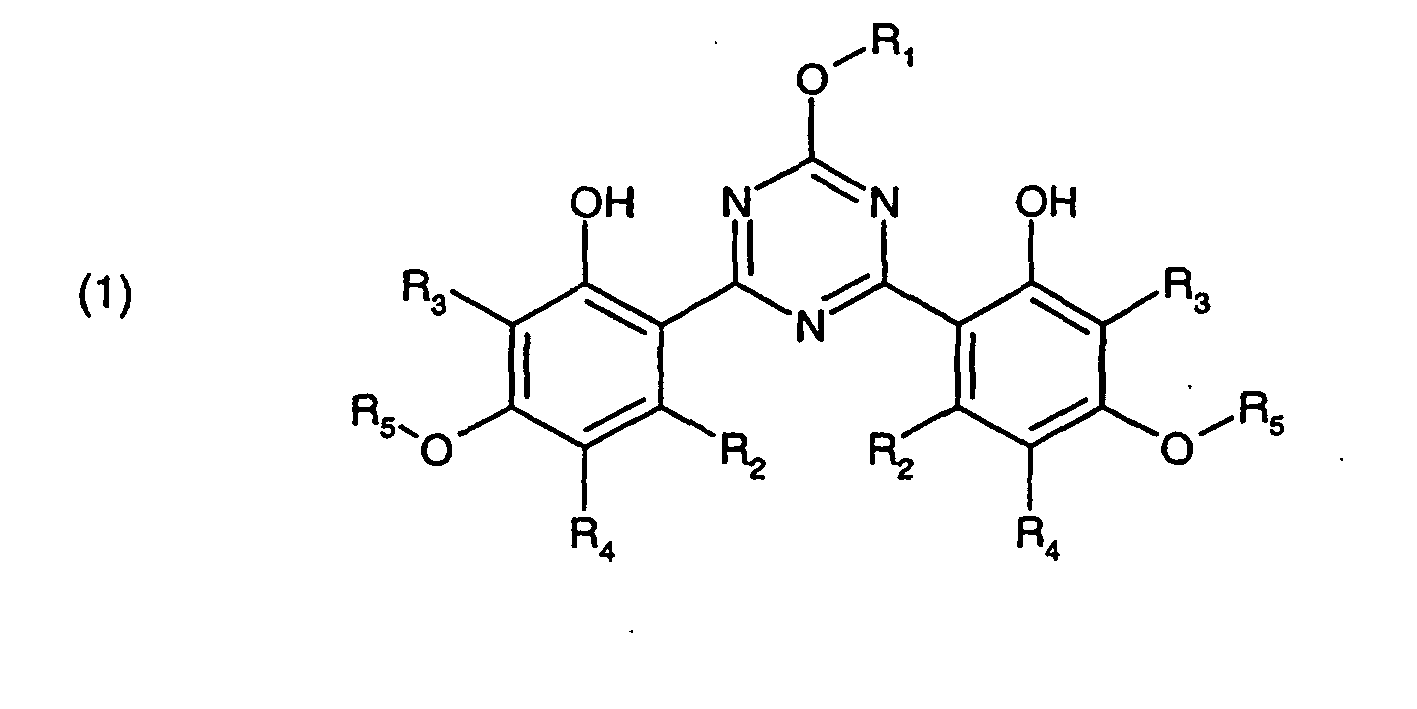
- R1
- 2-Decyl-hexadecyl; isooctadecyl; n-octadecyl; 2-hexyldecyl; 2-ethylhexyl;
- R2, R3 und R4,
- unabhängig voneinander Wasserstoff, Hydroxy-, C1-C30-Alkyl, C1-C30-Alkenyl,
und - R5
- Wasserstoff;
- Alkyl bedeutet einen verzweigten oder unverzweigten Kohlenwasserstoffrest wie z.B. Methyl, Ethyl, Propyl, Isopropyl, n-Butyl, sec-Butyl, Isobutyl, t-Butyl, 2-Ethylbutyl, n-Pentyl, Isopentyl, 1-Methylpentyl, 1,3-Dimethylbutyl, n-Hexyl, 1-Methylhexyl, n-Heptyl, Isoheptyl,1,1,3,3-Tetramethylbutyl, 1-Methylheptyl, 3-Methylheptyl, n-Octyl, iso-Octyl; 2-Ethylhexyl, 1,1,3-Trimethylhexyl, 1,1,3,3-Tetramethylpentyl, Nonyl, Decyl, Undecyl, 1-Methylundecyl, Dodecyl, 1,1,3,3,5,5-Hexamethylhexyl, Tridecyl, Tetradecyl, Pentadecyl, Hexadecyl, Heptadecyl oder Octadecyl.
- Alkenyl umfasst im Rahmen der angegebenen Bedeutungen u.a. Allyl, Isopropenyl, 2-Butenyl, 3-Butenyl, Isobutenyl, n-Penta-2,4-dienyl, 3-Methyl-but-2-enyl, n-Oct-2-enyl, n-Dodec-2-enyl, iso-Dodecenyl, n-Dodec-2-enyl, n-Octadec-4-enyl oder 3,7,11,11-Tetramethyl-2,6,10-undecatrienyl.
- Als Hintergrund literatur werden die Dokumente
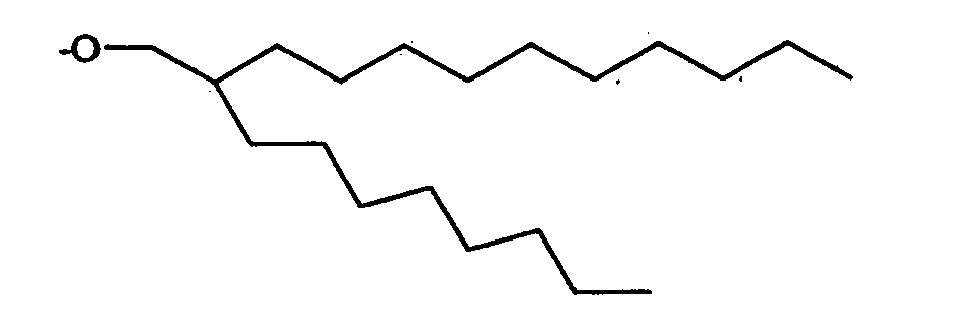
US 3293247 ,BE 661 225 JP 05025029 EP 0165 608 ,EP 0557247 zitiert. - Weiter Beispielhafte Vertreter der erfindungsgemässen Diresorcinyl-Alkoxy-Triazine sind in der folgenden Tabelle zusammengestellt:
Tabelle 1: 
Verbindung der Formel R 1 (3) 
(4) -O-iso-C18H38 (5) 
(6) -O-n-C18H37 (7) -O-2-Ethyl-hexyl (8)* 
(9)* 
(10)* 
(11)* 
(12)* 
(13)* 
(14)* 
(15)* 
(16)* 
(17)* 
(18)* 
(19)* 
* Die Beispiele sind nicht Gegenstand der Erfindung - Die Herstellung der erfindungsgemässen Diresorcinyl-Akoxy- und -aryloxy-Triazine erfolgt z.B. durch Umsetzung von Cyanurchlorid mit dem Alkohol R1-OH zu den Aryloxy- bzw.-alkoxy-dichlor-s-triazinen der Formel (2). In einer Friedel-Crafts-Reaktion werden in der zweiten Reaktionsstufe die neuen Verbindungen der Formel (1) erhalten. Die Reaktion lässt sich schematisch folgendermassen darstellen:

- Die erste Reaktionsstufe wird gewöhnlich in Anwesenheit eines Lösungsmittel wie z.B. Aceton, Methylethylketon, Dimethylacetamid, Toluol, oder Xylol durchgeführt.
- Die Temperaturen reichen dabei von 0 bis 130, insbesondere 20 bis 70°C; die Reaktionszeiten von 1 bis 48, vorzugsweise von 2 bis 10 Stunden.
- In der zweiten Reaktionsstufe werden als Lösungsmittel gewöhnlich Toluol, Nitrotoluol, Nitrobenzol, Anisol, Xylol, Benzol, Sulfolan, Chlorbenzol, Dichlorbenzol, Kohlenwasserstoffe (z.B. lsooctan), chlorierte Kohlenwasserstoffe, Nitroalkane, Schwefelkohlenstoff, Schwefeldioxid und Gemische aus den genannten Lösungsmitteln verwendet.
- Die Temperaturen betragen dabei von -10 bis 200, insbesondere 0 bis 100°C.
- Die Reaktionszeiten reichen von 1 bis 100, vorzugsweise von 2 bis 50 Stunden.
- Die zweite Reaktionsstufe wird gewöhnlich in Anwesenheit eines Katalysators durchgeführt. Als Katalysatoren kommen z.B. in Betracht: Aluminiumchlorid, Aluminiumbromid, Zinnchlorid, Titantetrachlorid, Bortrifluorid sowie andere Lewis-Säuren.
- Der Katalysator wird dabei in einer Menge von 0.1 bis 3 Mol pro Mol reaktives Chlor. eingesetzt.
- In Friedel-Crafts-Reaktionen mit Dichlor-alkoxy-s-triazinen werden häufig Dealkylierungen im Alkoxyrest beobachtet. Unter erfindungsgemässen Bedingungen, d.h. Steuerung der Temperatur; Menge des Katalysators, Dosierung des Katalysators verläuft die Reaktion besonders glatt und ohne merkliche Dealkylierung.
- Eine weitere Synthesemöglichkeit für die erfindungsgemässen Diresorcinyl-Alkoxy- und Aryloxy-Triazine erfolgt durch Umsetzung von Cyanurchlorid mit Resorcin zum 2-Chlor-4,6-resorcinyl-triazin (Verbindung der Formel (20) in der ersten Reaktionsstufe und Umsetzung mit HO-R1 zur Verbindung der Formel (1) in einer zweiten Reaktionsstufe nach folgendem Schema:

- R1 und R5 haben dabei die für Formel (1) angegebene Bedeutung.
- Die erfindungsgemässen Diresorcinyl-Akoxy- und Aryloxy-Triazine der Formel (1) besitzen ein Absorptionsmaximum von ca. 350 nm, d.h. es handelt sich bei diesen Verbindungen um UV-A-Absorber. Die Verbindungen eignen sich daher insbesondere als UV-Filter, d.h. zum Schützen von ultraviolett empfindlichen organischen Materialien, insbesondere der Haut und Haare von Menschen und Tieren vor der schädigenden Einwirkung von UV-Strahlung. Diese Verbindungen eignen sich daher als Lichtschutzmittel in kosmetischen, pharmazeutischen und veterinärmedizinischen Präparaten. Sie können sowohl gelöst als auch im mikronisierten Zustand verwendet werden.
- Liegen die erfindungsgemässen UV-Absorber in mikronisierter Form vor, so haben sie gewöhnlich eine mittlere Partikelgrösse von 0,02 bis 2, vorzugsweise 0,05 bis 1,5, und ganz besonders von 0,1 bis 1,0 µm. Die Methoden zur Mikronisierung sind z.B. in der
GB A-2303549 - Als Mahlapparate zur Herstellung der erfindungsgemässen mikronisierten organischen UV-Absorber können z.B. eine Düsen-, Kugel-, Vibrations- oder Hammermühle, vorzugsweise eine Hochgeschwindigkeits-Rührmühle verwendet werden. Die Mahlung erfolgt vorzugsweise mit einer Mahlhilfe, wie z.B. einem alkylierten Vinylpyrrolidon-Polymer, einem Vinylpyrrolidon-Vinylacetat-Copolymer, einem Acylglutamat oder insbesondere einem Phospholipid.
- Auf Grund ihrer Lipophilität lassen sich die Verbindungen (1) besonders dann gut in Öl- und fetthaltige kosmetische Formulierungen einarbeiten, wenn R1 ein verzweigter Alkylrest mit mehr als 8 C-Atomen ist.
- Einen weiteren Erfindungsgegenstand bildet ein kosmetisches Präparat, enthaltend mindestens eine Verbindung der Formel (1), sowie kosmetisch verträgliche Träger- oder Hilfsstoffe.
- Für die kosmetische Verwendung haben die erfindungsgemässen Lichtschutzmittel gewöhnlich eine mittlere Partikelgrösse im Bereich von 0,02 bis 2, vorzugsweise 0,05 bis 1,5, und ganz besonders von 0,1 bis 1,0 µ. Die unlöslichen erfindungsgemässen UV-Absorber können, wie weiter oben erwähnt, durch übliche Mahlmethoden, auf die gewünschte Partikelgrösse gebracht werden. Vorzugsweise wird das Mahlen in Anwesenheit von 0,1 bis 30, vorzugsweise 0,5 bis 15 Gew.-%, bezogen auf den UV-Absorber, einer Mahlhilfe durchgeführt.
- Das kosmetische Präparat kann neben dem erfindungsgemässen UV-Absorber auch noch einen oder mehrere weitere UV-Schutzstoffe der folgenden Substanzklassen enthalten:
- 1. p-Aminobenzoesäurederivate, wie z.B. 4-Dimethylaminobenzoesäure-2-ethylhexylester;
- 2. Salicylsäurederivate, wie z.B. Salicylsäure-2-ethylhexylester;
- 3. Benzophenonderivate, wie z.B. 2-Hydroxy-4-methoxybenzophenon und sein 5-sulfonsäurederivat;
- 4. Dibenzoylmethanderivate, wie z.B. 1 -(4-tert.-Butylphenyl)-3-(4-methoxyphenyl)propan-1,3-dion;
- 5. Diphenylacrylate, wie z.B. 2-Ethylhexyl-2-cyano-3,3-diphenyl acrylat und 3-(Benzofuranyl)-2-cyanoacrylat;
- 6. 3-lmidazol-4-yl-acrylsäure und -ester;
- 7. Benzofuranderivate, insbesondere 2-(p-Aminophenyl)benzofuranderivate, beschrieben in der
EP-A-582,189 US-A-5,338,539 ,US-A-5,518,713 und derEP-A-613,893 - 8. polymere UV-Absorber wie z.B. die in der
EP-A-709,080 - 9. Zimtsäurederivate, wie z.B. die in der
US-A-5,601,811 undWO 97/00851 - 10. Campherderivate, wie z.B. 3-(4'-Methyl)benzyliden-bornan-2-on, 3-Benzyliden-bornan-2-on, N-[2(und 4)-2-Oxyborn-3-yliden-methyl)-benzyl]acrylamid-Polymer, 3-(4'-Trimethylammonium)-benzyliden-bornan-2-on methylsulfat, 3,3'-(1,4-Phenylendimethin)-bis(7,7-dimethyl-2-oxo-bicyclo-[2.2.1]heptan-1-methansulphonsäure) und Salze, 3-(4'-Sulfo)-benzyliden-bornan-2-on und Salze;
- 11. Trianilino-s-Triazinderivate, wie z.B. 2,4,6-Trianilin-(p-carbo-2'-ethyl-1'-oxi)-1,3,5-triazin sowie die in der
US-A-5,332,568 ,EP-A-517,104 EP-A-507,691 WO 93/17002 EP-A-570,838 - 12. 2-Hydroxyphenyl-Benzotriazol-Derivate;
- 13. 2-Phenylbenzimidazol-5-sulfonsäure und deren Salze;
- 14. Menthyl-o-aminobenzoat.
- 15. TiO2 (unterschiedlich umhüllt), ZnO und Mica.
- Auch die in "Sunscreens", Eds. N.J. Lowe, N.A.Shaath, Marcel Dekker, Inc., New York and Basel oder in Cosmetics & Toiletries (107), 50ff (1992) beschriebenen UV-Absorber können als zusätzliche UV-Schutzstoffe in der erfindungsgemässen Formulierung verwendet werden.
- Weiterhin kann das erfindungsgemässe kosmetische Präparat auch zusammen mit bekannten Antioxidantien, wie z.B. Vitamin E, Carotinoiden oder HALS (="Hindered Amine Light Stabilizers")-Verbindungen eingesetzt werden.
- Das erfindungsgemässe kosmetische Präparat enthält 0,1 bis 15, vorzugsweise 0,5 bis 10 Gew.-%, bezogen auf das Gesamtgewicht der Zusammensetzung, eines UV-Absorbers oder eines Gemisches aus UV-Absorbern und einen kosmetisch verträglichen Hilfsstoff.
- Die Herstellung des kosmetischen Präparats kann durch physikalisches Mischen des oder der UV-Absorber mit dem Hilfsstoff durch gewöhnliche Methoden, wie z.B. durch einfaches Zusammenrühren der Einzelkomponenten erfolgen.
- Das erfindungsgemässe kosmetische Präparat kann als Wasser-in-Öl- oder Öl-in-Wasser-Emulsion, als Öl-in-Alkohol-Lotion, als vesikulare Dispersion eines ionischen oder nichtionischen amphiphilen Lipids, als Gel, fester Stift oder als Aerosol-Formulierung formuliert werden.
- Als Wasser-in-Öl- oder Öl-in-Wasser-Emulsion enthält der kosmetisch verträgliche Hilfsstoff vorzugsweise 5 bis 50% einer Ölphase, 5 bis 20% eines Emulgators und 30 bis 90% Wasser. Die Ölphase kann dabei irgendein für kosmetische Formulierungen geeignetes Öl enthalten, wie z.B. ein oder mehrere Kohlenwasserstofföle, ein Wachs, ein natürliches Öl, ein Silikon-Öl, einen Fettsäureester oder einen Fettalkohol. Bevorzugte Mono- oder Polyole sind Ethanol, Isopropanol, Propylenglykol, Hexylenglycol, Glycerin und Sorbitol.
- Für das erfindungsgemässe kosmetische Präparat kann jeder konventionell einsetzbare Emulgator verwendet werden, wie z.B. einer oder mehrere ethoxylierte Ester von natürlichen Derivaten, wie z.B. polyethoxylierte Ester von hydrogeniertem Castor-Öl; oder ein Silikonöl-Emulgator wie z.B. Silikonpolyol; eine gegebenenfalls ethoxylierte Fettsäureseife; ein ethoxylierter Fettalkohol; ein gegebenenfalls ethoxylierter Sorbitanester; eine ethoxylierte Fettsäure; oder ein ethoxyliertes Glycerid.
- Das kosmetische Präparat kann auch weitere Komponenten, wie z.B. Emollients, Emulsionsstabilisatoren, Haut-Feuchthaltemittel, Hautbräunungsbeschleuniger, Verdickungsmittel wie z.B. Xanthan, Feuchtigkeit-Retentionsmittel wie z.B. Glycerin, Konservierungsmittel, Duft-und Farbstoffe enthalten.
- Das erfindungsgemässe kosmetische Präparat zeichnet sich durch exzellenten Schutz der menschlichen Haut gegen den schädigenden Einfluss von Sonnenlicht aus.
- Die erfindungsgemässen Diresorcinyl-alkoxy- und -aryloxy-s-Triazine zeichnen sich durch eine grosse thermische Stabilität aus und finden daher Verwendung als Stabilisatoren für organische Polymere, insbesondere Lacke, gegen deren Schädigung durch Licht, Sauerstoff und Wärme.
- Das mit den erfindungsgemässen Verbindungen stabilisierte Material zeichnet sich durch hervorragende Beständigkeit gegen Einflüsse durch Witterung und Licht, sowie hervorragende Photostabilität des eingearbeiteten Stabilisators aus.
- Die zu stabilisierenden Materialien können z.B. Öle, Fette, Wachse oder Biocide sein. Von besonderem Interesse ist die Verwendung in polymeren Materialien, wie sie in Kunststoffen, Kautschuken, Anstrichstoffen, Lacken, fotografischem Material oder Klebstoffen vorliegen.
- Gegenstand der Erfindung ist daher auch eine Zusammensetzung enthaltend
- (A) ein gegen Schädigung durch Licht, Sauerstoff und/oder Hitze empfindliches organisches Material und
- (B) als Stabilisator eine Verbindung der Formel (1)
- Die Erfindung betrifft auch ein Verfahren zum Stabilisieren von organischem Material gegen Schädigung durch Licht, Sauerstoff und/oder Hitze, das dadurch gekennzeichnet ist, dass man diesem als Stabilisator eine Verbindung der Formel (1) zusetzt, sowie die Verwendung der Verbindung der Formel (1) zum Stabilisieren von organischem Material.
- Die Menge des zu verwendenden Stabilisators richtet sich nach dem zu stabilisierenden organischen Material und der beabsichtigten Verwendung des stabilisierten Materials. Im allgemeinen enthält die erfindungsgemässe Zusammensetzung auf 100 Gew.-Teile der Komponente (A) 0,01 bis 15, insbesondere 0,05 bis 10, und vor allem 0,1 bis 5 Gew.-Teile des Stabilisators (Komponente(B)).
- Der Stabilisator (Komponente (B)) kann auch ein Gemisch sein von mehreren Verbindungen der Formel (1). Die erfindungsgemässen Zusammensetzungen können ausser den erfindungsgemässen Verbindungen noch andere Stabilisatoren oder sonstige Zusätze enthalten, wie z.B. Antioxidantien, weitere Lichtschutzmittel, Metalldesaktivatoren, Phosphite oder Phosphonite.
- Die Art und Menge der zugesetzten weiteren Stabilisatoren wird von der Art des zu stabilisierenden Substrates und dessen Verwendungszweck bestimmt; häufig werden 0,1 bis 5 Gew.-%, bezogen auf das zu stabilisierende Polymer, verwendet.
- Die Einarbeitung in die organischen Polymere, beispielsweise in die synthetischen organischen, insbesondere thermoplastischen Polymere, kann durch Zusatz der erfindungsgemässen Triazinverbindungen und gegebenenfalls weiterer Additive nach den in der Technik üblichen Methoden erfolgen. Die Einarbeitung kann zweckmässig vor oder während der Formgebung, beispielsweise durch Mischen der pulverförmigen Komponenten oder durch Zusatz des Stabilisators zur Schmelze oder Lösung des Polymeren, oder durch Aufbringen der gelösten oder dispergierten Verbindungen auf das Polymere, gegebenenfalls unter nachträglichem Verdunsten des Lösungsmittels erfolgen. Im Fall von Elastomeren können diese auch als Latices stabilisiert werden. Eine weitere Möglichkeit der Einarbeitung der erfindungsgemässen Gemische in Polymere besteht in deren Zugabe vor oder während der Polymerisation der entsprechenden Monomeren bzw. vor der Vernetzung.
- Die so erhaltenen stabilisierten Polymerzusammensetzungen können nach den üblichen Methoden, wie z.B. durch Heisspressen, Spinnen, Extrudieren oder Spritzgiessen, in geformte Gegenstände überführt werden, wie z.B. in Fasern, Folien, Bändchen, Platten, Stegplatten, Gefässe, Rohre und sonstige Profile.
- Die so stabilisierten Polymere zeichnen sich aus durch hohe Witterungsbeständigkeit, vor allem durch hohe Beständigkeit gegen UV-Licht. Sie behalten dadurch auch im Aussengebrauch lange Zeit ihre mechanischen Eigenschaften sowie ihre Farbe und ihren Glanz.
- In den folgenden Beispielen beziehen sich die Prozentsätze auf das Gewicht. Die Mengen beziehen sich bei den eingesetzten Dis-Resorcinyl-Triazinverbindungen auf die Reinsubstanz.
- Herstellundsbeispiele
-

- Cyanurchlorid (9,22 g , 0,05 mol) wird in Toluol (80ml) vorgelegt. Innerhalb von 40 min wird ein Gemisch aus 2-Decyl-1-tetradecanol (20,1 g ,0.057 mol), Dimethylacetamid (6,53 g ,0.075 mol) und Toluol (20ml) bei 30-55 °C zugetropft, 4h bei 50°C nachgerührt und über Kieselgur abfiltriert.
- Das Filtrat wird mit tert.-Butyl-methyl-keton (50ml) und eiskalter 10%iger NaCl-Lösung (150ml) versetzt und ausgeschüttelt. Die organische Phase wird nochmals mit 10%iger NaCl-Lösung gewaschen, abgetrennt und über Na2SO4 getrocknet. Nach Abziehen des Lösungsmittels wird das erhaltene Öl säulenchromatographisch aufgearbeitet (Kieselgel, Toluol/Hexan 7:3).
- Man erhält ein farbloses Öl der Verbindung der Formel (101a).
Ausbeute: 18,4 g (73 %)
13C NMR (90 MHz, CDCl 3 , TMS): δ = 14,50; 23,09; 27,08; 29,74; 29,76; 29,97; 30,04; 30,26; 30,32; 31,31; 32,32; 37,75; 73,68; 171,63; 172,84.Elementaranalyse: %C %H %N Berechnet: 64,52 9,83 8,36 Gefunden: 65,0 9,9 8,2 -

- Resorcin (4,9 g, 0.045 mol) wird in Nitrobenzol (40ml) vorgelegt. Bei 10-15°C wird gepulvertes Aluminiumchlorid (5,9 g, 0.044 mol) portionsweise eingetragen. 30min wird nachgerührt, die Verbindung der Formel (101 a) (10.05 g, 0.020 mol) gelöst in Nitrobenzol (10ml), innerhalb von 30min bei 10-15°C zugetropft und 5 Stunden nachgerührt. Bei Raumtemperatur wird weitere 3 Stunden nachgerührt. Die Reaktion kann im Dünnschichtchromatogramm verfolgt werden (Kieselgel, Toluol/Aceton 9:1).
- Das Reaktionsgemisch wird unter Rühren in eine Mischung aus Eiswasser (100 ml) und 2N-HCl (25 ml) gegossen. Dabei scheidet sich ein Niederschlag ab. Nitrobenzol-Reste werden mittels Wasserdampfdestillation entfernt. Der feste Rückstand wird in Aceton gelöst, mit Na2SO4 getrocknet, eingeengt und säulenchromatographisch getrennt (Kieselgel, Toluol/Essigester 8:2). Man erhält 5,7g eines gelben Pulvers, welches nach Umkristallisieren aus Hexan/Dioxan 6:4 analysenrein anfällt.
- Man erhält hellgelbe Kristalle der Verbindung der Formel (101).
Ausbeute: 4,1 g (31 %)
Schmp.: 165-166 °C
UV/Vis (EtOH): λmax (ε) = 350 (34482) nm
13C NMR (90MHz, D 6 -DMSO, TMS): δ = 14,6 (CH3); 23,0 (CH2); 27,0 (CH2); 29,8 (CH2); 30,0 (CH2); 30,06 (CH2); 30,11 (CH2); 30,3 (CH2); 31,3 (CH2); 32,3 (CH2); 37,6 (CH); 71,2(CH2O); 103,8 (CH); 109,0 (CH); 109,4 (CH); 131,6 (CH); 164,6 (Cq); 165,1 (Cq); 167,8 (Cq); 171,5 (Cq).Elementaranalyse: %C %H %N Berechnet: 72,08 9,15 6,47 Gefunden: 72,04 9,16 6,48 -

- Die Verbindung der Formel (102a) wird analog der Verbindung (101a) aus Beispiel 1 hergestellt. Als Alkoholkomponente wird 2-Ethyl-hexanol verwendet.
Das flüssig anfallende Rohprodukt wird durch Destillation im Hochvakuum (Sdp. 118-119° C/0.2 torr) gereinigt. - Die Reinigung des Rohprodukts kann auch säulenchromatographisch an Kieselgel (Toluol/Hexan 9:1) erfolgen.
- Die Verbindung wurde bereits in
US-A-3,542,752 (American Cyanamid) beschrieben. -

- Die Verbindung der Formel (102a) (11,1 g, 0,040 mol), Resorcin (9,7 g, 0,088 mol), Xylol (80 ml) und Sulfolan (30 ml) werden vorgelegt. Bei 35-40°C wird innerhalb von 20 min pulverisiertes Aluminiumchlorid (11,7 g, 0,088 mol) eingetragen und 5 Stunden nachgerührt. Das zweiphasige Reaktionsgemisch wird getrennt. Die untere orangerote Phase lässt man in eine Mischung aus Eiswasser (250 ml) und 32%iger Salzsäure (20 ml) einlaufen. Der ausgeschiedene Feststoff wird abfiltriert, mit Aceton gewaschen und getrocknet. Aus Dioxan wird mehrfach umkristallisiert.
- Man erhält hellgelbe Kristalle der Verbindung der Formel (102).
Löslichkeit in Ethanol (25°C): 1,50% Smp. 235-236 °C Ausbeute: 5 g (29 %) UV/Vis (EtOH): λmax (ε) = 350 (39177) nm 13C NMR (90MHz, D 6 -DMSO, TMS): δ= 11,6 (CH3); 14,7 (CH3); 23,3 (CH2); 24,0 (CH2); 29,3 (CH2); 30,6 (CH2); 38,9 (CH); 71,0 (CH2O); 103,9 (CH); 109,5 (CH); 131,9 (CH); 164,4 (Cq); 165,1 (Cq); 167,9 (Cq); 171,5 (Cq). Elementaranalyse: %C %H %N Berechnet: 64.93 6.40 9.88 Gefunden: 64.6 6.4 9.9 -

- Die Verbindung der Formel (103a) wird analog der Verbindung (101a) aus Beispiel 1 hergestellt. Als Alkoholkomponente wird Isooctadecanol-Isomerengemisch (CA-Reg.No. 27458-93-1) verwendet.
-

- Resorcin (6,6 g, 0.060 mol), Nitrobenzol (40 ml) und Xylol-lsomerengemisch (20 ml) werden vorgelegt. Bei 45-50°C wird gepulvertes Aluminiumchlorid (7,0 g, 0,052 mol) eingetragen und 30 min gerührt. Danach wird bei 0-5°C innerhalb von 1,5 Stunden eine Mischung aus der Verbindung der Formel (103a) (10,5 g, 0,025 mol) und Xylol (10 ml) zugetropft und bei 2-3°C 5 Stunden nachgerührt.
- Zur Aufarbeitung lässt man das Reaktionsgemisch in eine Mischung aus Eiswasser (100 ml) und 2N HCl (25 ml) einlaufen. Nitrobenzol wird mittels Wasserdampfdestillation entfernt. Mit Butylmethylether (200 ml) wird das Rohprodukt aus dem Rückstand extrahiert. Die organische Phase wird mit 5%iger NaCl-Lösung gewaschen, getrocknet und vom Lösungsmittel befreit. Säulenchromatographisch (Kieselgel, Toluol/Aceton 9:1) wird das Gemisch anschliessend aufgetrennt.
- Man erhält beigefarbene Kristalle der Verbindung der Formel (103).
Ausbeute: 4,6 g (32 %)
Smp.: 166-167°C
UV/Vis (EtOH): λ max = 351 nm
13C NMR (90MHz, D 6 -DMSO, TMS): δ = 13,9 (CH3); 22,1 (CH2); 26,1 (CH2); 28,77 (CH2); 28,8 (CH2); 29,0 (CH2); 29,1 (CH2); 29,4 (CH2); 30,6 (CH2); 31,3 (CH2); 31,4 (CH2); 36,7 (CH); 70,5 (CH2O);103,1 (CH); 108,4 (CH); 108,7 (CH); 131,0 (CH); 163,4 (Cq); 164,4 (Cq); 167,2 (Cq); 170,8 (Cq).Elementaranalyse: %C %H %N Berechnet: 70.06 8.37 7.43 Gefunden: 70.2 8.5 7.3 -

- Die Verbindung der Formel (104a) wird analog der Verbindung der Formel (101a) aus Beispiel 1 hergestellt. Als Alkoholkomponente wird 2-Hexyl-decanol verwendet.
-

- In eine Lösung der Verbindung der Formel (104a) (9,76 g, 0,025 mol) in Toluol (80 ml) wird Resorcin (6,6 g, 0,060 mol) bei 0-5°C innerhalb von 30 min eingetragen. Pulverisiertes Aluminiumchlorid (7,0 g, 0,025 mol) wird anschliessend bei 2°C innerhalb von 30 min in kleinen Portionen in das Reaktionsgemisch eingebracht und 4 Stunden nachgerührt. Das Kältebad wird entfernt und über Nacht bei Raumtemperatur nachgerührt. Die Reaktion kann im Dünnschichtchromatogramm verfolgt werden (Kieselgel, Toluol/Aceton 9:1).
- Nach Eingiessen des Reaktionsgemisches in verdünnte Salzsäure (150 ml H2O + 25ml conc. HCl) erfolgt bei 50°C eine Phasentrennung. Aus der oberen organische Phase wird mittels Wasserdampfdestillation das Toluol entfernt. Der abgeschiedene Feststoff wird mit tert.-Butyl-methylether extrahiert. Das über Na2SO4 getrocknete Extrakt wird eingeengt und säulenchromatographisch getrennt (Kieselgel, Toluol/Aceton 8:2).
- Man erhält hellgelbe Kristalle der Verbindung der Formel (104) (aus Dioxan/Hexan).
Ausbeute: 10,1 g (74,8 %)
Smp.: 175-176°C
UV/Vis (EtOH.): λ max (ε) = 351 (36148) nm
13C NMR (90MHz, D 6 -DMSO, TMS): δ = 14,7 (CH3); 23,0 (CH2); 26,9 (CH2); 27,0 (CH2); 29,6 (CH2); 29,8 (CH2); 29,9 (CH2); 30,2 (CH2); 31,4 (CH2); 31,5 (CH2); 32,1 (CH2); 32,2 (CH2); 37,6 (CH); 71,3 (CH2O); 103,9 (CH); 109,2 (CH); 109,5 (CH); 131,9 (CH); 164,5 (Cq); 165,1 (Cq); 168,0 (Cq); 171,6 (Cq)Elementaranalyse: %C %H %N Berechnet: 69,25 8,06 7,81 Gefunden: 69,1 7,9 7,.8 -

- Die Verbindung der Formel (105a) wird analog der Verbindung der Formel (101a) hergestellt. Als Alkoholkomponente wird 1-Octadecanol verwendet.
-

- Nitrobenzol (40 ml), Resorcin (6,6 g, 0,06 mol) und Xylol Isomerengemisch (20 ml) werden bei Raumtemperatur vorgelegt. Bei 45-50°C wird pulverisiertes Aluminiumchlorid (7,0 g, 0,05 mol) eingetragen und 30 min. bei 45-50°C nachgerührt. Danach wird bei 0-5°C eine Lösung der Verbindung der Formel (105a) (10,5 g, 0,025 mol) in Xylol-lsomerengemisch (15 ml) innerhalb von 35 min. zugetropft. Es wird 3 Stunden bei 0-5°C und anschliessend 1,5 Stunden bei 5-10°C nachgerührt. Die Reaktionssuspension wird in eine Mischung aus Eiswasser (200 ml) und 4 N Salzsäure (25 ml) eingerührt und auf 50°C erwärmt. Dann wird mit tert. Butyl-methylether (200 ml) extrahiert und die organische Phase am Rotationsverdampfer eingeengt. Der Rückstand wird mit Wasser versetzt und Reste des Nitrobenzol/Xylol-lsomerengemisches mittels Wasserdampfdestillation entfernt. Das Rohprodukt wird aus Dioxan/Aceton 6:4 umkristallisiert.
- Die Reaktion kann im Dünnschichtchromatogramm verfolgt werden (Kieselgel, Toluol/Aceton 9:1).
Man erhält hellgelbe Kristalle
Ausbeute: 6,9 g (48,8 %)
Smp.: 213-214°C
UV/Vis (EtOH): λmax (ε) = 350 (31662) nmElementaranalyse: %C %H %N Berechnet: 70,06 8,37 7,43 Gefunden: 70,4 8,6 7,5 -

- Die Verbindung der Formel (106a) wird analog der Verbindung der Formel (101a) hergestellt. Als Alkoholkomponente wird 2-Butyl-1-octanol verwendet.
-

- Die Verbindung der Formel (106a) (16,7 g, 0,05 mol), Toluol (150 ml) und Resorcin (13,2 g, 0,12 mol) werden bei Raumtemperatur vorgelegt. Bei 0-5°C wird innerhalb von 1h 15min. pulverisiertes Aluminiumchlorid (14,7 g, 0,11 mol) in kleinen Portionen eingetragen und 6,5 Stunden bei 0-5°C nachgerührt. Dann wird 2N-HCI (60 ml) unter Kühlung in das Reaktionsgemisch eingetropft. Die gelbe Emulsion wird mit Butylmethylether extrahiert. Die organische Phase wird mit 10%iger NaCl-Lösung gewaschen, über Na2SO4 getrocknet und vom Lösungsmittel befreit. Der feste Rückstand wird säulenchromatographisch gereinigt (Kieselgel, Toluol/Butylmethylether 75:25).
Die Reaktion kann im Dünnschichtchromatogramm verfolgt werden (Kieselgel, Toluol/Aceton 9:1).
Man erhält beige Kristalle
Ausbeute: 7,0 g (29,1 %)
Smp.: 170-172°C
13C NMR (90MHz, D 6 2DMSO, TMS): δ = 14,7; 23,0; 23,3; 27,0; 29,3; 29,9; 31,2; 31,5; 32,1; 37,5; 67,2; 103,9; 109,2; 109,5; 131,6; 164,5 (Cq); 165,1 (Cq); 168,0 (Cq); 171,6 (Cq).Elementaranalyse: %C %H %N Berechnet: 67,34 7,33 8,73 Gefunden: 67,3 7,4 8,5 -

- Die Verbindung der Formel (107a) wird analog der Verbindung der Formel (101a) hergestellt. Als Alkoholkomponente wird Methanol verwendet.
-

- Die Verbindung der Formel (107) wird analog der Verbindung der Formel (105) hergestellt. Das Rohprodukt wird in warmem Methanol (150 ml) verrührt, abgenutscht, mit Methanol gewaschen, getrocknet und aus Acetonitril/N-Methyl-2-pyrrolidon umkristallisiert. Das so erhaltene Kristallpulver wird mit Methanol ausgekocht, um eingeschlossenes N-Methyl-2-pyrrolidon zu entfernen, abfiltriert und getrocknet.
Die Reaktion kann im Dünnschichtchromatogramm verfolgt werden (Kieselgel, Toluol/Aceton 8:2).
Man erhält hellgelbe Kristalle. - Die Verbindung ist in der
EP-A-0,165,608 beschrieben.
Löslichkeit in Ethanol (25°C): 0,08%
Smp.: >300°C
UV/Vis (EtOH): λ max (ε) = 350 (36949) nm
13C NMR (90MHz, D 6 -DMSO, TMS): δ = 53,9 (OCH3); 102,0(CH); 107,6(CH);; 130,0(CH);; 107,3 (Cq); 162,5 (Cq); 163,2 (Cq); 166,2 (Cq); 169,5 (Cq).Elementaranalyse: %C %H %N Berechnet: 58,72 4,00 12,84 Gefunden: 58,64 4,18 12,76 -

- Die Verbindung der Formel (108a) wird analog der Verbindung der Formel (101a) hergestellt. Als Alkoholkomponente wird Ethanol verwendet.
-

- Die Verbindung der Formel (108) wird analog der Verbindung der Formel (105) hergestellt. Die Reaktion kann im Dünnschichtchromatogramm verfolgt werden (Kieselgel, Toluol/Aceton 8:2).
Man erhält hellbeige Kristalle.
Löslichkeit in Ethanol (25°C): 0,17%
Ausbeute: 3,6 g (42,2 %)
Smp.: >300°C
UV/Vis (EtOH): λ max (ε) = 350 (36761) nm
13C NMR (90MHz, D 6 -DMSO, TMS): δ = 14,8 (CH3) ;64,9 (CH2);.103,8 (CH); 109,5 (CH); 131,8 (CH); 109,1 (Cq); 164,4 (Cq); 165,0 (Cq); 167,5(Cq); 171,4 (Cq). -

- Die Verbindung der Formel (109a) wird analog der Verbindung der Formel (101a) hergestellt. Als Alkoholkomponente wird 2-Octyl-1-Dodecanol verwendet.
-

- Resorcin (13,2 g, 0,12 mol) wird in Nitrobenzol (30 ml) vorgelegt. Bei 50-60°C wird eine Lösung der Verbindung der Formel (109a) (22,3 g, 0,05 mol) in Toluol (70 ml) zugegeben. Bei 0-5 °C wird innerhalb von 40 min pulverisiertes Aluminiumchlorid (14,7 g, 0,11 mol) eingetragen und 6 Stunden bei 0-5°C nachgerührt. Anschliessend wird das Reaktionsgemisch in 2N HCl eingerührt und das Nitrobenzol durch Wasserdampfdestillation abgezogen. Der feste Rückstand wird abgetrennt und mit Butylmethylether extrahiert. Die organische Phase wird mit 10%iger NaCl-Lösung und 2%iger Na2CO3-Lösung gewaschen, über Na2SO4 getrocknet und eingedampft. Die Reinigung des Rohprodukts erfolgt säulenchromatographisch (Kieselgel, Toluol/Aceton 85:15). Analysenreines Produkt wird durch nachfolgendes Umkristallisieren aus Aceton erhalten.
- Die Reaktion kann im Dünnschichtchromatogramm verfolgt werden (Kieselgel, Toluol/Aceton 9:1).
Man erhält hellgelbe Kristalle.
Ausbeute: 7,1 g (23,9 %)
Smp.: 166-167°C
13C NMR (90MHz, D 6 -DMSO, TMS): δ = 14,6; 23,0; 27,0; 29,6; 29,7; 29,9; 28,0; 30,2; 30,3; 31,4; 32,2; 37,6; 71,2; 103,9; 109,1; 109,5; 131,8; 164,5 (Cq); 165,1 (Cq); 168,0 (Cq); 171,6 (Cq).Elementaranalyse: %C %H %N Berechnet: 70,79 8,66 7,08 Gefunden: 70,8 8,5 6,9 -

- Die Verbindung der Formel (101) (9,8 g, 0,015 mol), Aceton (85 ml), Wasser (40 ml) und 2N NaOH (15,8 ml) werden bei Raumtemperatur vorgelegt. Bei 40°C wird Dimethylsulfat (4,16 g, 0,04 mol) zugetropft und 2,5 Stunden bei 40°C nachgerührt. Mit 1N HCl wird auf pH 6 gestellt und der Feststoff abfiltriert. Der Filterkuchen wird in Toluol gelöst, mit H2O ausgeschüttelt, getrocknet und vom Lösungsmittel befreit. Anschließend wird säulenchromatographisch (Kieselgel, Toluol) getrennt und aus Diethylether umkristallisiert.
Die Reaktion kann im Dünnschichtchromatogramm verfolgt werden (Kieselgel, Toluol/Aceton 95:5)
Man erhält hellbeige Kristalle.
Ausbeute: 3,1 g (30,5 %)
Smp.: 79-80°C
UV/Vis (Dioxan): λmax (ε) = 347 (36219) nm
13C NMR (90MHz, CDCl 3 . TMS): δ= 15,5; 24,1; 28,2; 30,8; 31,1; 31,4; 32,5; 33,3; 38,9; 56,9 (OCH3); 72,7; 102,7; 109,4; 111,2 (COCH3); 132,4; 165,9 (Cq); 167,1 (Cq); 168,8 (Cq); 172,8 (Cq).Elementaranalyse: %C %H %N Berechnet: 72,64 9,37 6,20 Gefunden: 72,77 9,39 6,20 -

- Die Verbindung der Formel (104) (10,8 g, 0,02 mol) wird in Dioxan (100 ml) vorgelegt. Bei 40°C wird 2N NaOH (21 ml) zugegeben und 15 min nachgerührt. Anschließend wird Dimethylsulfat (4,2 ml) bei 40°C zudosiert und 5 Stunden nachgerührt. Das Lösungsmittel wird am Rotationsverdampfer abgezogen und der Rückstand in Toluol gelöst. Die organische Phase wird mit 10%iger NaCl-Lösung ausgeschüttelt und getrocknet. Reines Produkt wird durch säulenchromatographische Trennung (Kieselgel, Toluol/Aceton 98,5:1,5) und anschliessendes Umkristallisierenaus Hexan erhalten.
Die Reaktion kann im Dünnschichtchromatogramm verfolgt werden (Kieselgel, Toluol/Aceton 9:1).
Man erhält hellbeige Kristalle.
Ausbeute: 7,5 g (66,3 %)
Smp.: 99-100°C
UV/Vis (EtOH): λmax (ε) = 348 (34123) nm
13C NMR (90MHz, CDCl 3 , TMS): δ= 14,5; 23,1; 27,20; 27,21; 29,8; 30,0; 30,1; 30,4; 31,5; 32,27; 32,31; 38,9; 55,8 (OCH3); 71,7; 101,6; 108,4; 110,2; 131,2; 164,9 (Cq); 166,0 (Cq); 167,8 (Cq); 172,0 (Cq).Elementaranalyse: %C %H %N Berechnet: 70,06 8,37 7,43 Gefunden: 70,0 8,4 7,1 -

- Die Verbindung der Formel (112) wird analog der Verbindung der Formel (110) hergestellt.
Als Lösungsmittel wird Dioxan verwendet. Das Nutschgut wird mit Dioxan/H2O und Methanol gewaschen und getrocknet. Anschliessend wird aus Methylcellosolve umkristallisiert.
Man erhält hellgelbe Kristalle.
Ausbeute: 5,7 g (64,2 %)
Smp.: 193-194°C
UV/Vis (Dioxan): λmax (ε) = 347 (37680) nm
Applikationsbeispiele: - 50g der Verbindung der Formel (108)* werden zusammen mit 7% Alkylpolyglykosid, 43% H2O und 80g Zirkoniumsand gemahlen, bis eine Partikelgröße von d50 = 150 nm erreicht ist.
Danach wird der Mahlsand von der Suspension, enthaltend die mikronisierte Verbindung der Formel (108) abgetrennt. -
Komponenten Gew.% Öl-Phase PEG-30 Dipolyhydroxystearate (Arlacel P 135®) 3,00 PEG-22/ Dodecyl Glycol Copolymer (Elfacos ST 37®) 1,00 Microcrystalline Wax 1,00 Hydrogeniertes Castor Öl 0,50 Magnesium Stearate 1,00 Octyl Stearate 15,00 Coco Glycerides 2,00 Mineral Öl 3,00 Phenoxyethanol&Parabens 1,00 Octyl Methoxycinnamate 5,00 Dimethicone 0,10 Wasser-Phase deionisiertes Wasser 52,40 Magnesium Sulphate (MgSO4 x 7 H2O) 1,00 Propylene Glycol 4,00 50%ige Suspension entsprechend Beispiel 13 10.00 - Die Öl- und die Wasserphase werden separat auf 80° C erhitzt, zusammengegeben und die Mischung intensiv homogenisiert. Danach lässt man unter leichtem Rühren auf 40°C abkühlen. Die 50%ige Suspension des mikronisierten UV-Absorbers der Formel (108)* wird portionsweise unter Rühren zugegeben und noch 15 Minuten nachgerührt.
SPF (in vivo) = 16 (COLIPA)
[ohne mikronisierte Verbindung der Formel (108): SPF = 6] -
Komponenten Gew.-% A Polyglyceryl-3 Methylglucose Distearate (Tego® Care 450) 2,0 Decyl Oleate 5,7 Isopropyl Palmitate 5,0 Caprylic/Capric Triglyceride 6,5 Verbindung der Formel (101)* 3,5 B Glycerol 3,0 Phenonip 0,5 deionisiertes Wasserer 72,4 C Carbomer 141 0,2 Isopropyl Palmitate 0,8 D NaOH (10%) 0,4 - Die Phasen A und B werden separat auf 80° C erwärmt und dann unter leichtem Rühren zusammengegeben. C wird zu der Mischung von A und B zugegeben und dannach intensiv homogenisiert. Das Homogenisat läßt man unter leichtem Rühren auf Raumtemperatur abkühlen. Wenn erforderlich wird der pH durch Hinzufügen von D eingestellt.
- SPF (in vitro) = 3,0
- (Optometrics SPF 290 Analyzer, 2 µl/cm2 on Transpore®-Tape) Australian / New Zealand Standard, 15 / NZS 2604 : 1993 (weniger als 10% Transmission zwischen 320 nm und 360 nm) wird erfüllt.
-
Komponenten Gew.-% A Polyglyceryl-3 Methylglucose Distearate (Tego® Care 450) 2,0 Decyl Oleate 5,7 Isopropyl Palmitate 5,0 Caprylic/Capric Triglyceride 6,5 Verbindung der Formel (101)* 3,0 Octyl Methoxycinnamate 5,0 B Glycerol 3,0 Phenonip 0.5 deionisiertes Wasser 67,9 C Carbomer 141 0,2 Isopropyl Palmitate 0,8 D NaOH (10%) 0,4 - Die Phasen A und B werden separat auf 80° C erwärmt und dann unter leichtem Rühren zusammengegeben. C wird zu der Mischung von A und B zugegeben und danach intensiv homogenisiert. Das Homogenisat lässt man unter leichtem Rühren auf Raumtemperatur abkühlen. Wenn erforderlich wird der pH durch Hinzufügen von D eingestellt.
- SPF (in vitro) = 11
- (Optometrics SPF 290 Analyzer, 2 µl/cm2 on Transpore®-Tape) Australian / New Zealand Standard, 15 / NZS 2604 : 1993 (weniger als 10% Transmission zwischen 320 nm und 360 nm) wird erfüllt.
-
Komponenten Gew.-% Ölphase Methoxy PEG-22/Dodecyl Glycol Copolymer (Elfacos E 200®) 3,00 PEG-22/ Dodecyl Glycol Copolymer (Elfacos ST 37®) 3,00 Hydroxyoctacosanyl Hydroxystearate (Elfacos C 26®) 3,00 Octyl Stearate 15,00 Coco Glycerides 2,00 Mineral Öl 3,00 Phenoxyethanol&Parabens 0,70 Verbindung der Formel (104) 3,50 4-Methyl-benzylidene Camphor 4,00 Tocopheryl Acetate 1,00 Dimethicone 0,20 Wasser-Phase deionisiertes Wasser 56,80 Magnesium Sulphate (MgSO4 x 7 H2O) 0,80 Propylene Glycol 4,00 - Die Phasen A und B werden separat auf 80° C erwärmt und dann unter leichtem Rühren zusammengegeben. C wird zu der Mischung von A und B zugegeben und danach intensiv homogenisiert. Das Homogenisat lässt man unter leichtem Rühren auf Raumtemperatur abkühlen. Wenn erforderlich wird der pH durch Hinzufügen von D eingestellt.
- SPF (in vitro) = 12
- (Optometrics SPF 290 Analyzer, 2 µl/cm2 on Transpore®-Tape) Australian / New Zealand Standard, 15 / NZS 2604 : 1993 (weniger als 10% Transmission zwischen 320 nm und 360 nm) wird erfüllt.
-
Komponenten Gew.-% 1 deionisiertes Wasser ad 100 2 Titanium Dioxide (and) Isopropyl Myristate 6,25 3 Phenoxyethanol&Parabens 0,50 4 Salcare SC91 2,50 5 Glycerin 2,00 6 Verbindung der Formel (104) 0,70 7 Isopropyl Palmitate 5,00 8 Caprylic/Capric Triglyceride 2,50 9 Propylene Glycol 1,00 10 Methylen Bis Benzotriazolyl Tetramethyl-butylphenol (50%ige Suspension) 6,00 - Die Substanzen (2) bis (5) werden in der angegebenen Reihenfolge unter kräftigem Rühren zu Wasser (1) zusammengegeben. Danach wird die Lösung von (6) im Gemisch von (7) und (8) unter mässigem Rühren zugegeben. Es folgen ebenfalls unter Rühren die Zugabe von (9) und danach von (10). Man rührt weiter, bis die Masse homogen ist.
- Australian/New Zealand Standard, 15/NZS 2604:1993 (weniger als 10% Transmission zwischen 320 nm und 360 nm) wird erfüllt.
Claims (6)
- Verbindungen der Formel
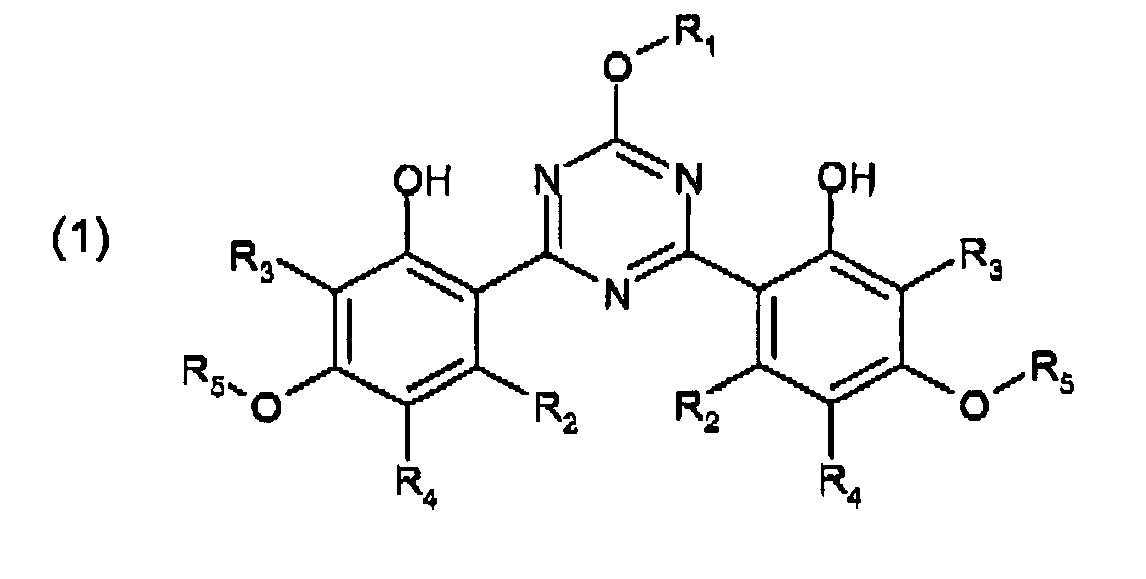 R1 2-Decyl-hexadecyl; isooctadecyl; n-octadecyl; 2-hexyldecyl; 2-ethylhexyl;R2, R3 und R4,unabhängig voneinander Wasserstoff, Hydroxy-, C1-C30-Alkyl, C1-C30-Alkenyl, undR5 Wasserstoff;bedeuten,
 - Verfahren zur Herstellung der Verbindungen der Formel (1) gemäss Anspruch 1, dadurch gekennzeichnet, dass man in der ersten Reaktionsstufe Cyanurchlorid mit der Verbindung R1-OH zu den Dichlor-aryloxytriazinen der Formel (2) umsetzt, und in einer zweiten Stufe in einer Friedel-Crafts-Reatkion diese Verbindungen mit Resorcin zur Verbindung der Formel (1) umsetzt nach folgendem Reaktionsschema:

- Kosmetisches Präparat, enthaltend mindestens eine oder mehrere Verbindungen der Formel (1) nach Anspruch 1 mit kosmetisch verträglichen Träger- oder Hilfsstoffen.
- Präparat nach Anspruch 3, dadurch gekennzeichnet, dass es weitere UV-Schutzstoffe enthält,
- Präparat nach Anspruch 3 oder 4, dadurch gekennzeichnet, dass es als weitere UV- Schutzstoffe Triazine. Oxanilide, Triazole, Vinylgruppen enthaltende Amide oder Zimtsäureamide enthält.
- Zusammensetzung enthaltend(A) ein gegen Schädigung durch Licht, Sauerstoff und/oder Hitze empfindliches organisches Material und(B) als Stabilisator eine Verbindung gemäss Anspruch 1.
Priority Applications (1)
| Application Number | Priority Date | Filing Date | Title |
|---|---|---|---|
| EP99810280A EP0949251B1 (de) | 1998-04-09 | 1999-04-01 | Diresorcinyltriazine als Lichtschutzmittel |
Applications Claiming Priority (3)
| Application Number | Priority Date | Filing Date | Title |
|---|---|---|---|
| EP98810314 | 1998-04-09 | ||
| EP98810314 | 1998-04-09 | ||
| EP99810280A EP0949251B1 (de) | 1998-04-09 | 1999-04-01 | Diresorcinyltriazine als Lichtschutzmittel |
Publications (2)
| Publication Number | Publication Date |
|---|---|
| EP0949251A1 EP0949251A1 (de) | 1999-10-13 |
| EP0949251B1 true EP0949251B1 (de) | 2009-04-01 |
Family
ID=8236034
Family Applications (1)
| Application Number | Title | Priority Date | Filing Date |
|---|---|---|---|
| EP99810280A Expired - Lifetime EP0949251B1 (de) | 1998-04-09 | 1999-04-01 | Diresorcinyltriazine als Lichtschutzmittel |
Country Status (13)
| Country | Link |
|---|---|
| US (1) | US6111103A (de) |
| EP (1) | EP0949251B1 (de) |
| JP (1) | JP2000063366A (de) |
| KR (1) | KR100589869B1 (de) |
| CN (1) | CN1168722C (de) |
| AT (1) | ATE427304T1 (de) |
| AU (1) | AU757142B2 (de) |
| BR (1) | BR9901088A (de) |
| DE (1) | DE59914993D1 (de) |
| IL (1) | IL129349A0 (de) |
| NZ (1) | NZ334934A (de) |
| SG (1) | SG75939A1 (de) |
| ZA (1) | ZA992565B (de) |
Cited By (1)
| Publication number | Priority date | Publication date | Assignee | Title |
|---|---|---|---|---|
| ES2367390A1 (es) * | 2009-01-14 | 2011-11-03 | Isdin, S. A. | Derivados de bis-resorcinil triazina como agentes protectores frente a la radiación uv. |
Families Citing this family (16)
| Publication number | Priority date | Publication date | Assignee | Title |
|---|---|---|---|---|
| JP2000026435A (ja) | 1998-05-07 | 2000-01-25 | Ciba Specialty Chem Holding Inc | トリスレゾリシニルトリアジン |
| DE19846771A1 (de) * | 1998-10-10 | 2000-04-13 | Beiersdorf Ag | Verwendung von Triglyceridwachsen zur Verstärkung des Lichtschutzfaktors und/oder der UV-A-Schutzleistung kosmetischer oder dermatologischer Lichtschutzmittel |
| FR2799965B1 (fr) * | 1999-10-22 | 2002-10-31 | Oreal | Emulsions sans emulsionnant contenant au moins un filtre uv organique insoluble |
| AU2002247649A1 (en) * | 2001-01-31 | 2002-08-12 | Roche Vitamins Ag | Process for the preparation of 2-(disubstituted-amino)-4,6-diaryl triazines |
| DE10130963A1 (de) * | 2001-06-27 | 2003-01-16 | Beiersdorf Ag | Verwendung von Bis-Resorcinyltriazinderivaten zur Verbesserung der Wirksamkeit von lipophilen Wirkstoffen in kosmetischen oder dermatologischen Zubereitungen |
| EP1342745A1 (de) * | 2002-03-05 | 2003-09-10 | Lofo High Tech Film GmbH | Verfahren zur Herstellung von Polyolefinfolien |
| KR101064902B1 (ko) * | 2003-01-20 | 2011-09-16 | 시바 홀딩 인코포레이티드 | Uv 흡수제로서 트리아진 유도체 |
| JP5448853B2 (ja) | 2007-03-15 | 2014-03-19 | データレース リミテッド | レゾルシニルトリアジン誘導体を主成分とする感熱性コーティング組成物 |
| FR2917609B1 (fr) * | 2007-06-22 | 2012-11-16 | Oreal | Composition de maquillage comprenant un compose hydroxyle. |
| CA2696032A1 (en) | 2007-08-22 | 2009-02-26 | Basf Se | Laser-sensitive coating composition |
| WO2009059888A1 (en) | 2007-11-07 | 2009-05-14 | Basf Se | New fiber products |
| JP5645832B2 (ja) | 2008-10-27 | 2014-12-24 | データレース リミテッドDatalase Ltd. | 基材にマーキングするためのレーザー感受性水性組成物 |
| ES2463674T3 (es) | 2009-01-19 | 2014-05-28 | Basf Se | Pigmentos negros orgánicos y su preparación |
| US10183916B2 (en) * | 2015-05-18 | 2019-01-22 | Dsm Ip Assets B.V. | Process for the preparation of triazines |
| KR102705589B1 (ko) * | 2018-03-30 | 2024-09-11 | 가부시키가이샤 아데카 | 입상 자외선 흡수제 및 수지 조성물 |
| WO2020071695A1 (ko) | 2018-10-05 | 2020-04-09 | 삼성디스플레이 주식회사 | 표시 장치 및 표시 장치에 포함된 광 흡수제 |
Family Cites Families (15)
| Publication number | Priority date | Publication date | Assignee | Title |
|---|---|---|---|---|
| BE558354A (de) * | 1956-06-15 | |||
| NL6400510A (de) * | 1964-01-23 | 1965-07-26 | ||
| CH473818A (de) * | 1964-03-18 | 1969-06-15 | Ciba Geigy | Verfahren zur Herstellung von neuen Hydroxyphenyl-1,3,5-triazinen und deren Verwendung |
| US3542752A (en) * | 1966-02-07 | 1970-11-24 | American Cyanamid Co | Chemical compositions |
| US4547113A (en) * | 1984-06-19 | 1985-10-15 | The Procter & Gamble Company | Continuous motion spiral stacker |
| EP0165608B1 (de) * | 1984-06-22 | 1991-01-02 | Ilford Ag | Hydroxyphenyltriazine, Verfahren zu ihrer Herstellung und ihre Verwendung als UV-Absorber |
| FR2674851B1 (fr) * | 1991-04-04 | 1995-02-10 | Oreal | Derives s-triaziniques portant des substituants benzylidene camphre, compositions cosmetiques filtrantes et leur utilisation pour proteger la peau et les cheveux du rayonnement ultraviolet. |
| FR2674850B1 (fr) * | 1991-04-04 | 1993-07-02 | Oreal | Derives s-triaziniques portant des substituants benzalmalonates, compositions cosmetiques filtrantes les contenant et leur utilisation pour proteger la peau et les cheveux du rayonnement ultraviolet. |
| EP0520938B1 (de) * | 1991-06-03 | 1997-09-24 | Ciba SC Holding AG | UV-Absorber enthaltendes photographisches Material |
| JPH0525029A (ja) * | 1991-07-22 | 1993-02-02 | Daikyo Rubber Seiko:Kk | 日焼け止め用化粧品 |
| US5298030A (en) * | 1992-02-21 | 1994-03-29 | Ciba-Geigy Corporation | Process for the photochemical and thermal stabilization of undyed and dyed or printed polyester fiber materials |
| JPH06308666A (ja) * | 1993-04-20 | 1994-11-04 | Fuji Photo Film Co Ltd | ハロゲン化銀写真感光材料及び画像形成方法 |
| JP3026244B2 (ja) * | 1993-10-19 | 2000-03-27 | 富士写真フイルム株式会社 | ハロゲン化銀カラー写真感光材料 |
| JPH07330743A (ja) * | 1994-06-10 | 1995-12-19 | Kao Corp | O−ベンザルマロネート置換基を有するs−トリアジン誘導体及びその製造法並びにこれを含有する紫外線吸収剤及び化粧料 |
| GB9611614D0 (en) * | 1996-06-04 | 1996-08-07 | Ciba Geigy Ag | Process for inhibiting the effect of flourescent whitening agents |
-
1999
- 1999-03-25 SG SG1999001415A patent/SG75939A1/en unknown
- 1999-03-30 NZ NZ334934A patent/NZ334934A/xx unknown
- 1999-04-01 AT AT99810280T patent/ATE427304T1/de not_active IP Right Cessation
- 1999-04-01 DE DE59914993T patent/DE59914993D1/de not_active Expired - Lifetime
- 1999-04-01 EP EP99810280A patent/EP0949251B1/de not_active Expired - Lifetime
- 1999-04-06 IL IL12934999A patent/IL129349A0/xx not_active IP Right Cessation
- 1999-04-06 US US09/287,029 patent/US6111103A/en not_active Expired - Fee Related
- 1999-04-07 KR KR1019990011973A patent/KR100589869B1/ko not_active Expired - Fee Related
- 1999-04-07 ZA ZA9902565A patent/ZA992565B/xx unknown
- 1999-04-08 AU AU23653/99A patent/AU757142B2/en not_active Ceased
- 1999-04-08 CN CNB991056558A patent/CN1168722C/zh not_active Expired - Fee Related
- 1999-04-09 JP JP11102490A patent/JP2000063366A/ja active Pending
- 1999-04-09 BR BR9901088-7A patent/BR9901088A/pt not_active Application Discontinuation
Cited By (1)
| Publication number | Priority date | Publication date | Assignee | Title |
|---|---|---|---|---|
| ES2367390A1 (es) * | 2009-01-14 | 2011-11-03 | Isdin, S. A. | Derivados de bis-resorcinil triazina como agentes protectores frente a la radiación uv. |
Also Published As
| Publication number | Publication date |
|---|---|
| MX9903313A (de) | 1999-12-01 |
| NZ334934A (en) | 2000-09-29 |
| AU2365399A (en) | 1999-10-21 |
| EP0949251A1 (de) | 1999-10-13 |
| IL129349A0 (en) | 2000-02-29 |
| AU757142B2 (en) | 2003-02-06 |
| US6111103A (en) | 2000-08-29 |
| CN1232027A (zh) | 1999-10-20 |
| KR100589869B1 (ko) | 2006-06-15 |
| BR9901088A (pt) | 2000-05-02 |
| JP2000063366A (ja) | 2000-02-29 |
| DE59914993D1 (de) | 2009-05-14 |
| MX209164B (de) | 2002-07-23 |
| ZA992565B (en) | 1999-10-11 |
| SG75939A1 (en) | 2000-10-24 |
| KR19990082993A (ko) | 1999-11-25 |
| CN1168722C (zh) | 2004-09-29 |
| ATE427304T1 (de) | 2009-04-15 |
Similar Documents
| Publication | Publication Date | Title |
|---|---|---|
| EP0949251B1 (de) | Diresorcinyltriazine als Lichtschutzmittel | |
| EP0878469B1 (de) | Resorcinyl-Triazine | |
| EP0818450B1 (de) | Triazinderivate als UV-Filter in Sonnenschutzmitteln | |
| EP1380583B1 (de) | Bis-Resorcinyl-Triazine und deren Verwendung als Sonnenschutzmittel | |
| DE69726529T2 (de) | Benzoxazolderivate und ihre Verwendung als UV-Filter | |
| US5962452A (en) | Resorcinyl-triazines | |
| US6217856B1 (en) | Symmetrical triazine derivatives | |
| DE69215434T2 (de) | 1,3,5-Triazinderivate, ihre Herstellung und ihre Verwendung als Lichtschutzmittel | |
| DE19648010A1 (de) | Verwendung von substituierten Benzazolen als UV-Absorber, neue Benzazole und Verfahren zu ihrer Herstellung | |
| EP1117641B1 (de) | Indolinderivate als lichtschutzmittel | |
| EP2210887A1 (de) | Bis-Resorcinyl-Triazin-Derivate als Schutzmittel gegen UV-Strahlung | |
| DE69718664T2 (de) | Verwendung von selektierten benzotriazol derivaten zum schutz von menschlicher und tierischer haut und haar vor der schädigenden einwirkung von uv-strahlung | |
| DE60019959T2 (de) | Verwendung von benzotriazolen als uv-absorber | |
| US6399047B1 (en) | Benzoxazole derivatives for use in cosmetic compositions and for stabilizing synthetic polymers | |
| KR20080027286A (ko) | 피롤일트리아진의 유도체, 이들의 수득방법 및 자외복사선에 대한 보호 제제로서의 이들의 용도 | |
| EP1117638B1 (de) | Durch camphor- oder hydantoin-derivate substituierte diphenylverbindungen als lichtschutzmittel | |
| EP0937716B1 (de) | Verfahren zur Herstellung von Phenyldichloro-1,3,5-triazinverbindungen | |
| DE19857252A1 (de) | Benzyliden-gamma-butyrolactone, Verfahren zu ihrer Herstellung und ihre Verwendung als UV-Absorber | |
| MXPA99003313A (en) | Diresorcinil-alcoxi-y-ariloxi-s-triazi | |
| HK1022690A (en) | Diresorcinyltriazines as sunscreen agents | |
| MXPA98003820A (en) | Resorcinil-triazi |
Legal Events
| Date | Code | Title | Description |
|---|---|---|---|
| PUAI | Public reference made under article 153(3) epc to a published international application that has entered the european phase |
Free format text: ORIGINAL CODE: 0009012 |
|
| AK | Designated contracting states |
Kind code of ref document: A1 Designated state(s): AT BE CH DE ES FR GB IT LI NL |
|
| AX | Request for extension of the european patent |
Free format text: AL;LT;LV;MK;RO;SI |
|
| 17P | Request for examination filed |
Effective date: 20000306 |
|
| AKX | Designation fees paid |
Free format text: AT BE CH DE ES FR GB IT LI NL |
|
| 17Q | First examination report despatched |
Effective date: 20020326 |
|
| REG | Reference to a national code |
Ref country code: HK Ref legal event code: WD Ref document number: 1022690 Country of ref document: HK |
|
| RAP1 | Party data changed (applicant data changed or rights of an application transferred) |
Owner name: CIBA HOLDING INC. |
|
| GRAP | Despatch of communication of intention to grant a patent |
Free format text: ORIGINAL CODE: EPIDOSNIGR1 |
|
| GRAP | Despatch of communication of intention to grant a patent |
Free format text: ORIGINAL CODE: EPIDOSNIGR1 |
|
| GRAS | Grant fee paid |
Free format text: ORIGINAL CODE: EPIDOSNIGR3 |
|
| GRAA | (expected) grant |
Free format text: ORIGINAL CODE: 0009210 |
|
| AK | Designated contracting states |
Kind code of ref document: B1 Designated state(s): AT BE CH DE ES FR GB IT LI NL |
|
| REG | Reference to a national code |
Ref country code: GB Ref legal event code: FG4D Free format text: NOT ENGLISH |
|
| REG | Reference to a national code |
Ref country code: CH Ref legal event code: EP |
|
| REF | Corresponds to: |
Ref document number: 59914993 Country of ref document: DE Date of ref document: 20090514 Kind code of ref document: P |
|
| NLV1 | Nl: lapsed or annulled due to failure to fulfill the requirements of art. 29p and 29m of the patents act | ||
| PG25 | Lapsed in a contracting state [announced via postgrant information from national office to epo] |
Ref country code: ES Free format text: LAPSE BECAUSE OF FAILURE TO SUBMIT A TRANSLATION OF THE DESCRIPTION OR TO PAY THE FEE WITHIN THE PRESCRIBED TIME-LIMIT Effective date: 20090712 |
|
| BERE | Be: lapsed |
Owner name: CIBA HOLDING INC. Effective date: 20090430 |
|
| PG25 | Lapsed in a contracting state [announced via postgrant information from national office to epo] |
Ref country code: NL Free format text: LAPSE BECAUSE OF FAILURE TO SUBMIT A TRANSLATION OF THE DESCRIPTION OR TO PAY THE FEE WITHIN THE PRESCRIBED TIME-LIMIT Effective date: 20090401 |
|
| REG | Reference to a national code |
Ref country code: CH Ref legal event code: PL |
|
| PG25 | Lapsed in a contracting state [announced via postgrant information from national office to epo] |
Ref country code: LI Free format text: LAPSE BECAUSE OF NON-PAYMENT OF DUE FEES Effective date: 20090430 Ref country code: CH Free format text: LAPSE BECAUSE OF NON-PAYMENT OF DUE FEES Effective date: 20090430 |
|
| PLBE | No opposition filed within time limit |
Free format text: ORIGINAL CODE: 0009261 |
|
| STAA | Information on the status of an ep patent application or granted ep patent |
Free format text: STATUS: NO OPPOSITION FILED WITHIN TIME LIMIT |
|
| 26N | No opposition filed |
Effective date: 20100105 |
|
| PG25 | Lapsed in a contracting state [announced via postgrant information from national office to epo] |
Ref country code: BE Free format text: LAPSE BECAUSE OF NON-PAYMENT OF DUE FEES Effective date: 20090430 |
|
| PGFP | Annual fee paid to national office [announced via postgrant information from national office to epo] |
Ref country code: GB Payment date: 20100330 Year of fee payment: 12 |
|
| PGFP | Annual fee paid to national office [announced via postgrant information from national office to epo] |
Ref country code: FR Payment date: 20100521 Year of fee payment: 12 |
|
| PG25 | Lapsed in a contracting state [announced via postgrant information from national office to epo] |
Ref country code: AT Free format text: LAPSE BECAUSE OF NON-PAYMENT OF DUE FEES Effective date: 20090401 |
|
| PG25 | Lapsed in a contracting state [announced via postgrant information from national office to epo] |
Ref country code: IT Free format text: LAPSE BECAUSE OF FAILURE TO SUBMIT A TRANSLATION OF THE DESCRIPTION OR TO PAY THE FEE WITHIN THE PRESCRIBED TIME-LIMIT Effective date: 20090401 |
|
| GBPC | Gb: european patent ceased through non-payment of renewal fee |
Effective date: 20110401 |
|
| REG | Reference to a national code |
Ref country code: FR Ref legal event code: ST Effective date: 20111230 |
|
| PG25 | Lapsed in a contracting state [announced via postgrant information from national office to epo] |
Ref country code: FR Free format text: LAPSE BECAUSE OF NON-PAYMENT OF DUE FEES Effective date: 20110502 |
|
| PG25 | Lapsed in a contracting state [announced via postgrant information from national office to epo] |
Ref country code: GB Free format text: LAPSE BECAUSE OF NON-PAYMENT OF DUE FEES Effective date: 20110401 |
|
| PGFP | Annual fee paid to national office [announced via postgrant information from national office to epo] |
Ref country code: DE Payment date: 20180629 Year of fee payment: 20 |
|
| REG | Reference to a national code |
Ref country code: DE Ref legal event code: R071 Ref document number: 59914993 Country of ref document: DE |